Having reviewed German business history during the nineteenth and twentieth centuries Werner Plumpe observed that a distinguishing feature is the comparative stability of corporate structures in the face of numerous crises and upheavals. He reflected that this suggested “an amazing capacity to adapt” and argued that historians have paid insufficient attention to the sources of corporate continuity.Footnote 1 This continuity in “a national history marked by violent, destructive political change” represents a “classic dilemma of German history.”Footnote 2 In this article, we seek to explore the adaptability of German entities when confronted by one of the foremost crises of the interwar years, the Weimar hyperinflation of 1923. We focus on the response of entities to the threat that this trauma posed to the operation of accounting information systems. These systems were especially vulnerable to the effects of rapidly changing prices.
By examining the Weimar hyperinflation the study responds to the long-standing call to explore the impact of crises on German businesses, particularly on individual firms during the aforementioned years of almost perpetual disturbance.Footnote 3 Indeed, the business environment of the first half of the twentieth century has been associated with Eric Hobsbawm's “Age of Catastrophe.”Footnote 4 During this period German firms experienced two world wars, the replacement of a constitutional monarchy by a democratic republic, hyperinflation, economic depression, a banking crisis, the rise of National Socialism, and the Hitlerian state. Businesses were consequently exposed to a succession of socioeconomic, military, and political disturbances that potentially impacted on corporate stability.Footnote 5 Plumpe contends that the challenge for company historians is to seek explanations for the ability of German corporations to manage such risks and emerge from crises intact.Footnote 6 Examining everyday business practices and unveiling their inner workings and routines offers one route to finding explanations.Footnote 7
In the current study we gain such insights through the operation of accounting, which Jeffrey Fear has identified as an especially useful conduit for “entering into the life of an organization.”Footnote 8 By focusing on accounting information systems the article chimes with the observation that while business historians have investigated corporate transformations in relation to transport, communication, production, and marketing, much less attention has been devoted to changes in accounting and capital markets. Fear and Christopher Kobrak contend that the combination of world war followed by hyperinflation had a ruinous impact on the development of the German equity market. Of particular significance to the current investigation, Fear and Kobrak suggest that “the hyperinflation destroyed attempts to initiate good accounting practices.”Footnote 9
The German hyperinflation represents a salient event in the history of accounting for price level changes.Footnote 10 In its day the crisis generated “a change in the mindsets of German accountants.”Footnote 11 Contemporaries suggested that the difficulties confronting practitioners in Germany were so acute that they are “worthy of study by accountants of all other countries.”Footnote 12 The episode unleashed enduring debates and inspired theoretical contributions that established Germany as a leading center of accounting thought.Footnote 13 While a number of studies have discussed the experience and impact of the hyperinflation on German business accounting, there has tended to be an emphasis on theoretical developments and on the end products of the accounting regimen: the financial statements, particularly of banks.Footnote 14 However, accounting information systems extend well beyond financial reporting.Footnote 15 Accordingly, the current investigation adopts a holistic notion of accounting systems, one that embraces elements that our sources suggest were particularly disturbed by the effects of hyperinflation, namely, business operations, transaction processing, control, and reporting.Footnote 16 In contrast to the majority of previous studies on the organizational impacts of the hyperinflation, which focus on a single corporation, we draw on the archives of numerous organizations. Our survey includes major corporations, public and private entities, and firms of various sizes operating in a range of sectors (see Appendix).
In the next section we elaborate on the significance of the German hyperinflation as a macroeconomic perturbation. Then we evaluate the manner in which German corporations responded to the threats posed by this shock to specific elements of accounting information systems.
The German Hyperinflation
Perturbations represent disturbances that place systems under exceptional degrees of stress. Such shocks may derive from inside or outside the system. In the context of an accounting information system, an endogenous perturbation might comprise a major fraud or a technological failure within the organization. An exogenous perturbation could arise from a natural catastrophe, such as an earthquake or a flood, or from a man-made socioeconomic or political disaster such as a financial crash or a war.Footnote 17 In the current article the focal perturbation, hyperinflation, is exogenous and macroeconomic. The hyperinflation that struck Germany in 1923 was the most spectacular hitherto to afflict an advanced industrial economy. Histories of the resultant “great disorder” bear dramatic titles such as The Downfall of Money and When Money Dies.Footnote 18 At its peak in November 1923 the annual rate of inflation stood at 5.3 million percent.Footnote 19 This had a potentially traumatic impact on the calculative, measuring, recording, valuation, disclosure, and analytical elements of accounting information systems.
Adaptive capacity, or adaptation, concerns the ability to prepare for, or respond to, a perturbation.Footnote 20 For a business entity it relates to the capacity to cope with the disruptive effects of trauma and to make adjustments to enable the continuing operation of systems.Footnote 21 Ability to adapt, particularly during a period of crisis, is a component of organizational capability.Footnote 22 In the current investigation we focus on the adaptations and adjustments to accounting information systems that corporations pursued in response to the harmful effects of hyperinflation. It was only near the end of the perturbation that the state seriously considered the accounting implications of hyperinflation, with the result that businesses were left to design their own coping strategies.Footnote 23
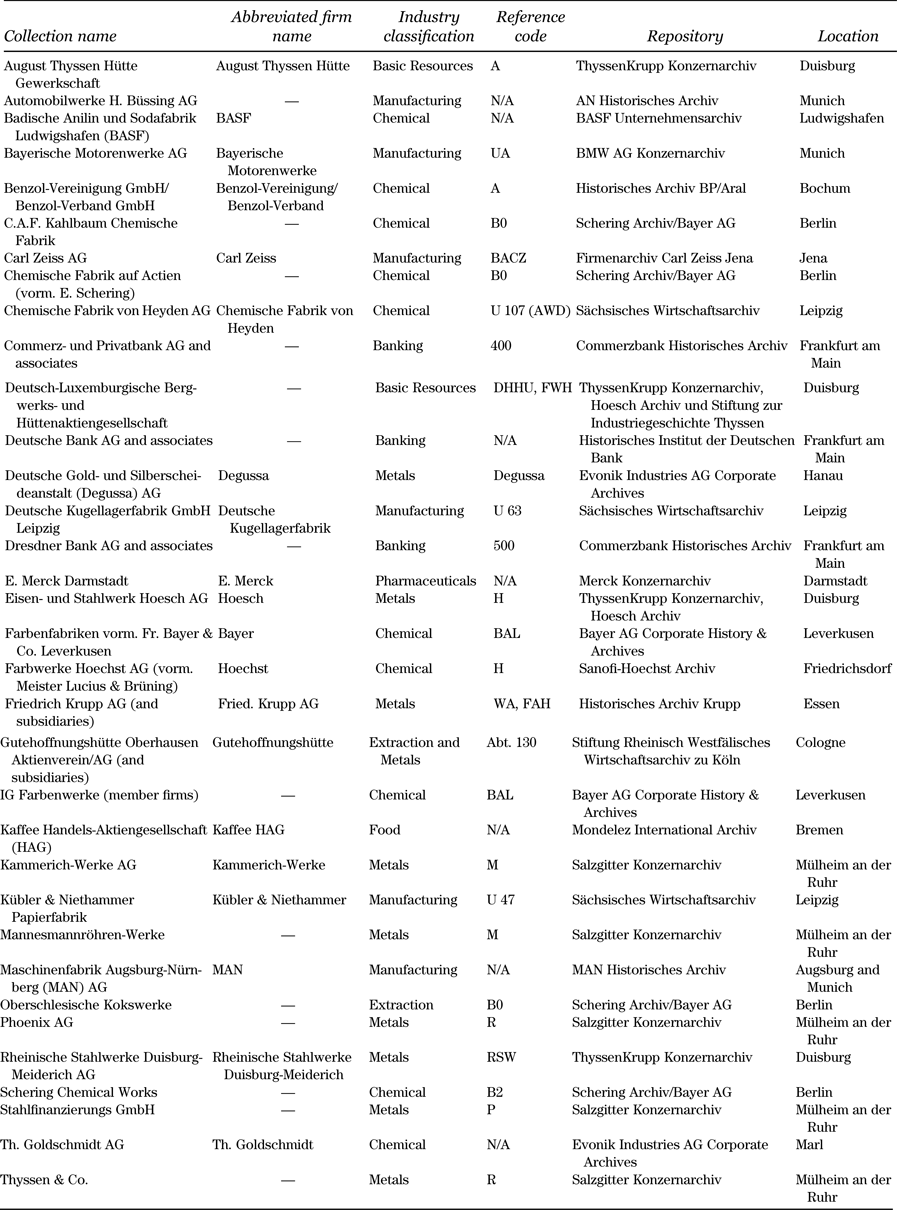
Consistent with the aforementioned call for investigations of everyday business practices, we investigate whether and how entities adapted accounting information systems to the hyperinflationary disturbance. To achieve this we consulted surviving documents relating to the period from 1919 to 1925 retained by German corporations and public repositories.Footnote 24 We accessed the archives of more than thirty public and private firms, most of which were corporations. It should be noted that our findings are unlikely to be representative of the experience of businesses organized as partnerships (Personengesellschaften) and sole proprietors (Einzelunternehmen). As the appendix shows, these firms operated in a range of sectors. References to archival material in the article are also explained in the appendix. The records consulted comprised annual reports, ledgers, journals, memorials, cost and profit calculations, audit and management reports, board minutes, personal and official correspondence, business and employment contracts, and the personal recollections of employees. Our analysis of the adaptive ability of corporations focuses on the elements of accounting information systems that our sources suggest were most sensitive to the effects of hyperinflation: business operations, transactions processing, control, financial reporting, and managerial reporting.Footnote 25
Business Operations
Fundamental business activities, such as selling and buying goods and services and remunerating labor, operate in tandem with systems for the processing of financial information.Footnote 26
Sales and purchases
The primary sources indicate that selling and purchasing activities were vulnerable to the impact of hyperinflation. Rising prices between the time when an order was placed and the receipt of the corresponding goods or services disrupted processing. Given the fundamental importance of this activity to the going-concern status of the corporation, swift adaptation was necessary. When inflation began to accelerate, some corporations, such as E. Merck, Carl Zeiss, Chemische Fabrik auf Actien (vorm. E. Schering), and Bayer, began invoicing in a variety of foreign currencies instead of the German mark.
Initially some of these responses were problematic. Responding to the devaluation and high volatility of the German mark in early 1920, E. Merck began invoicing South American customers in U.S. dollars. As the U.S. dollar appreciated in subsequent months, it became increasingly difficult for these customers to source this foreign currency. Following the substantial impairment of the related receivables, E. Merck returned to invoicing in German marks at the end of 1920.Footnote 27 From late 1922 the firm calculated prices for overseas customers in Swiss francs and thereby achieved stabilization in their overseas sales accounts. Domestic prices were calculated in paper-marks until August 1923, when intense inflationary pressure encouraged the firm to switch pricing to gold-marks.Footnote 28 In other entities issues arose as to whether to channel export sales through overseas subsidiaries (as at Kaffee HAG). Firms that could not boast such group structures often used close business partners in other countries as vehicles for making and receiving payments in a foreign currency (Deutsche Kugellagerfabrik) or opened accounts with smaller banks overseas (Kübler & Niethammer). Significantly, the Rentenmark, which became additional legal tender in Germany from November 1923, does not feature prominently in the surviving records. The firms we examined continued to use either paper- or gold-marks or a foreign currency in the operation of their accounting information systems.
Another adaptation was to introduce sophisticated payment arrangements in contracts and terms of trade. The manufacturing firm MAN used a price adjustment clause to ensure that customers bore price increases between ordering and delivery, based on a U.S. dollar multiplier. By the end of July 1923 this multiplier had increased to 17,700 and was adjusted weekly. From August 1923 onward, MAN invoiced in gold-marks and gave customers no more than eight days to pay their bills.Footnote 29 Having explored almost all proposed theoretical anchors to adjust for inflation, the extraction and metals producing firm Gutehoffnungshütte experimented with a number of price adjustment clauses based on increases in materials and labor costs as measured by a firm-specific prime cost index, foreign currencies, and the price of gold. None of these proved manageable or effective.Footnote 30
Inflation adjustments were also made in relation to purchasing. At Th. Goldschmidt, from 1922 the amounts stated in raw material accounts were no longer only recorded in marks but also converted to the foreign currency of the country from which the materials were sourced. The firm argued that this enabled the better monitoring of “real” (that is, noninflated) changes in the price of materials.Footnote 31 Inflation adjustment clauses were especially important in contracts for the acquisition of assets that took time to complete. An example is Deutsche Kugellagerfabrik. Its acquisition of a property for 1.15 million marks in January 1923 required an immediate payment of 600,000 marks but the remainder, due when all relevant approvals were granted, would be paid in a foreign currency.Footnote 32
The management of debtors and creditors was also vulnerable to the effects of hyperinflation. Indeed, the relationship between debtor and creditor was “turned upside down” and the foremost rule of business became to minimize credit offered to customers and exploit credit opportunities available to oneself.Footnote 33 In an internal memo to the board, the chief accountant at Gutehoffnungshütte complained about the additional administrative burden surrounding this activity. Not only did the volume of enquiries about the balance on accounts increase, but these were not easily resolvable by reference to the increasingly complex records. Debtors had to be constantly reminded of payments due and, if necessary, interest penalties had to be calculated and enforced. Reciprocally, complex negotiations took place with creditors who sought compensation for the devaluation of their claims against the firm. To make his point, the chief accountant quantified the additional work performed during the period of hyperinflation. In a review of financial year 1923–1924 he reported that the accounting department had processed 78 percent more accounts and related documents than in 1913–1914.Footnote 34 This case suggests that the firm had adapted to the additional burden of managing debtors and creditors, and ensured the ongoing operation of the department, by devoting more labor to the activity. Although this was also a period of acquisition and corporate restructuring for Gutehoffnungshütte, the number of clerks employed in its central accounting department increased from thirty-six in 1913–1914 to fifty-eight in July 1923.
Remuneration
The archives indicate that corporations were highly vulnerable to the impact of hyperinflation on the payment of wages and salaries. Such sensitivity emanated from the potential for labor unrest given the effect of rapidly rising prices on real earnings and the consequences of labor discontent for the continuity of business operations. During the hyperinflation, “the value of the pay packet sank in the time it took to cover the distance between the wages office and the shops.”Footnote 35 Frequent changes to employment contracts were necessary to adjust salaries and pensions. By way of illustration, the monthly gross salary of Mr. Albrecht, a white-collar worker with paper manufacturer Kübler & Niethammer, increased from 2,400 paper-marks in January 1922 to 9,534,684,695,000,000 in November 1923.Footnote 36 The recollections of a payroll clerk at Chemische Fabrik auf Actien (vorm. E. Schering) are insightful.Footnote 37 Reporting on the filling of huge pay packets—brown bags stuffed with U.S. dollars, vouchers (Notgeld) issued by other firms, and tons of paper-marks of small denomination—she exemplifies regular complaints by payroll personnel about the physical challenges of preparing and distributing cash wages.
Firms also adapted to the perturbation by remunerating employees more frequently. From August 1923 Kübler & Niethammer recalculated and paid salaries five times a week. They also responded to shortages of paper-marks by making payments with alternative currencies. When a shortage of cash arose at Hoesch in August 1923 the workers were issued with vouchers (Notgeld). If alternative currency could not be utilized, firms might ration what was available. When E. Merck was short of liquidity, it prioritized the payment of wages and salaries according to employees’ marital status.
Others adapted by meeting their obligations to labor in alternative ways. BASF created its own unit of currency for remuneration purposes. From August 1923 wage payments were made in the form of “fixed mark” (Festmark) vouchers that employees could exchange for paper-marks at the company cash office. Each day the firm published a spot exchange rate (based on the U.S. dollar) for fixed to paper-marks. In this way employees were shielded from the devastating effects of inflation. Internal correspondence between the firm's administrative department and the board suggests that accounting for payroll was more manageable under this regime and that labor productivity increased because employees worried less about converting worthless paper-marks into goods.Footnote 38
Corporations also adapted to the substantial burdens of remunerating employees by changing their internal organization. At Chemische Fabrik auf Actien (vorm. E. Schering), for example, a new human resources department was created on January 1, 1923. This commenced with six staff but was doubled in size as the crisis worsened. Sources also indicate that existing payroll staff worked longer hours during the hyperinflation.Footnote 39
Transactions Processing
Archival material suggests that the transactions-processing element of accounting information systems was highly vulnerable to the impacts of hyperinflation. Sensitivity centered on two constituent activities: calculation and recording.
Calculation
The volatility of exchange rates in Germany during the hyperinflation meant that calculations relating to foreign-currency transactions were increasingly complex and more frequent. Calculative activity consumed substantial accounting and clerical labor. In February 1923, for example, BASF concluded that foreign-currency translation “occupies a huge number of staff for eight days per month and requires more and more time as the numerals grow further.”Footnote 40 Many of the surviving accounting records relating to foreign-currency calculations are “messy”: they contain miscalculations, erasures, and entries in different colored inks.
Banking was especially impacted by the expansion of calculative activity during the crisis. Bank clerks complained about performing calculations involving unmanageable numbers.Footnote 41 At the Bank für Handel und Industrie daily calculations of interest on client accounts became a huge undertaking, not only because of the increased frequency and magnitude of the task but also because, from November 1923, amounts were translated into U.S. dollars. The latter generated some unwieldy accountings. Investigating client complaints of miscalculation also consumed much clerical labor.Footnote 42 As indicated earlier, the calculation of wages and salaries was also vulnerable to the focal perturbation. Inscriptions relating to the calculation of hourly and monthly wage rates at E. Merck reveal the mounting disorder as the inflation worsened in 1923.Footnote 43 The documents of almost all firms studied indicate that payroll calculations were rendered more complex by adjustments to wages for inflation. These adjustments were often the result of agreements with labor unions anxious to preserve the purchasing power of their members, or were negotiated between management and labor within an entity, or stipulated by the board.Footnote 44 The board minutes of the steel producer Hoesch describe how inflation adjustments to the salaries of white-collar workers from April 1923 were linked to the price of the raw coal needed to heat the furnaces. In December of that year the add-on to wages for inflation was 73.5 trillion percent.Footnote 45 Carl Zeiss calculated a firm-specific inflation index using the base year 1914. This index was based on the price of food and other essentials. It formed the foundation of wages and salaries multipliers, which, at the height of the crisis, were altered every other day.Footnote 46
Entities adapted to the impact of hyperinflation on calculative activity by performing calculations more frequently, rationalizing calculation, and devoting more labor to the task. In relation to the first of these, as the crisis mounted, wages and salary payments became increasingly linked to a stable unit such as the U.S. dollar or gold-mark and adjustments were made more often. Documents at the Darmstädter und Nationalbank (Danat) reveal that as inflation increased, the salaries of directors were corrected retroactively every month from February 1923. These calculations became fortnightly in August 1923 and then, from October 1923, every other day.Footnote 47 Indicative of the challenge of making such frequent calculations, the underlying documents became increasingly disorderly. In relation to the second response, some firms made efforts to simplify aspects of calculative practice. In an attempt to ease the burden of calculating wages and salaries, in September 1923 Gutehoffnungshütte decided to round to the nearest million marks. From November 1923 the price of coal supplied to its workers was no longer quoted in marks at all but in working hours, and was “paid” accordingly.Footnote 48 As a result of the ever-increasing complexity of wages and salaries calculations relating to different classes, types, and experience levels of employees, Bayer began to simplify its payroll calculations as early as 1920 by discontinuing complex wage supplements.Footnote 49
The third adaptation was the most common. The supply of labor performing calculative functions was increased by employing more clerical staff and/or, as at Bayer, transferring existing employees between departments. Previous commentators have noted a shifting ratio of clerical to manual labor as firms attempted to cope with complex and voluminous calculations.Footnote 50 The archival evidence confirms this observation. At banks, such as Commerz- und Privatbank, Dresdner Bank, Deutsche Bank, Disconto-Gesellschaft, and Norddeutsche Bank, the increased work associated with performing routine calculations demanded a significant increase in personnel and office space. At Deutsche Bank there was an “enormous increase of employees at the height of the inflation.”Footnote 51 Indeed, the number of staff employed in the banking sector in Germany increased fourfold between 1913 and 1923.Footnote 52 At Commerz- und Privatbank many investment decisions were motivated by the need to obtain the clerical labor and accommodation necessary to perform additional work during the inflation.Footnote 53
Although primary evidence suggests that the responses of firms to the problem of calculation often proved effective, a number of examples indicate that they were insufficient to address the disruptive impact of the crisis at its height. On occasion the response was to discontinue a calculative activity deemed unessential to business survival. On October 2, 1923, the treasury accounting department at Gutehoffnungshütte reported to the board that it had “given up” because it was “impossible for us to recalculate how the cash inflows (on our current accounts) of approximately M 190,897,700,000, are composed.”Footnote 54 Some entities also considered whether it was more economic to discontinue calculations than to incur the cost of employing additional clerical staff to perform them. For example, in December 1922 Casella questioned the necessity of continuous translation of foreign currency for purposes of running the Interessengemeinschaft (Erweiterte I.G.), given that this would require the firm to engage ten additional clerks, and potentially more in other member firms.Footnote 55 In many cases, sheets containing calculations of wage costs reveal increasing signs of systemic stress in 1923. Cancellations, erasures, overwriting, and check marks became common.
Recording
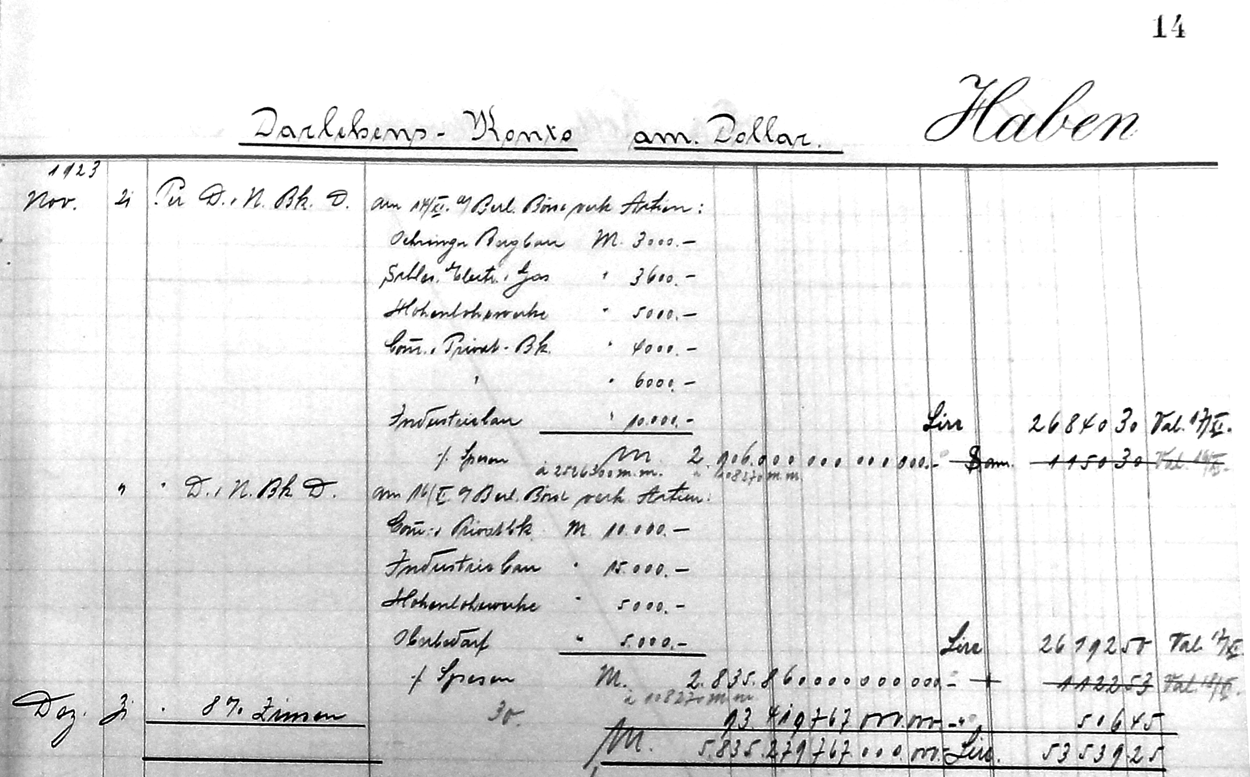
The problem of continuing calculative activity during the hyperinflation was mirrored in the recording of transactions. The inscriptions made in surviving account books evidence the frustrations associated with this activity. Huge numbers were entered in books of original entry and in general ledgers, extending well beyond preprinted column widths (Figure 1). At Fried. Krupp AG, columns intended for decimals were used to add multiple zeros to the numbers. In September 1923 columns were headed “millions” of marks; one month later, “millions” was crossed out and replaced with “billions.” At E. Merck the transition from recording in paper-marks to gold-marks involved the considerable burden of making book entries on each basis, as did bookkeeping where customers were invoiced in a foreign currency.Footnote 56
Extract from E. Merck's general ledger. (Source: Hauptbuch, E. Merck, November 1923, sig. S1/54, Merck-Archiv, Darmstadt.)

The demanding nature of transactions recording was exemplified in a reflective memo prepared in 1943 by the head of accounting at Krupp-Gusonwerke. The memorialist reflected that accountants made entries in books and ledgers that weighed “almost half a hundredweight.”Footnote 57 Inscribing inflated paper-mark values meant a significant additional workload because the forms, columns, and rows in the books were not configured to accommodate such large numerals. A contemporary commentator suggested that firms could do little in response to the problem of transactions recording other than assume a more systematic and structured approach to keeping their books under inflationary conditions.Footnote 58 Much advice focused on maintaining clarity by distinguishing entries in different currencies by the use of colored inks. At Farbwerke Hoechst, for example, revenues were recorded in gold-marks (green ink) and paper-marks (black ink) from 1923.Footnote 59 Replacing leather-bound books with loose-leaf files was suggested as a palliative, because preprinted sheets could be inserted as necessary and there was no restriction on the number of transactions that could be recorded in a single book.
The bookkeepers at Krupp-Gusonwerke initially adapted by adding extra pencil-drawn columns to the books. Later, the firm's printing shop was ordered to produce customized pro forma sheets. Kaffee HAG resorted to mechanical methods. Following a successful trial in its Swiss subsidiary, Ruf bookkeeping machines were introduced in late 1922 to accommodate the additional workload in processing and recording transactions.Footnote 60 As with the additional burden of calculation, the need to enter massive numbers in additional columns using different writing instruments was addressed by increasing the productivity of existing staff, having staff work overtime, and engaging more personnel.
As was the case with calculative activity, such attempts to maintain transaction recording did not always demonstrate an ability to cope. Errors were inevitably made when large numbers were aggregated in memorial books and posted to ledgers. Surviving account books are replete with crossings-out, overwriting, and cluttered inscriptions.Footnote 61 When the inflationary trauma compounded a crisis in the entity itself, the disruption to recording could become severe. In 1923 the book entries of Benzol-Vereinigung, which had gone into liquidation in 1922, became chaotic.Footnote 62 Debits and credits were occasionally confused and a number of accounts were in total disarray.
In some cases it appears that despite attempts to adapt, the books were no longer kept at all. Routine transactions processing appeared to be in a state of suspension. For example, at MAN no transactions were entered in the cashbook relating to a deposit account from the end of 1923 to 1925. At Kaffee HAG a journal was closed from June 1923 to December 1923.Footnote 63 From November 1923 until the new financial reporting regulations were implemented in 1924, no double-entry bookkeeping was performed by Actien-Gesellschaft für Anilinfabrikation Berlin (Agfa), it being deemed “unnecessary and unproductive extra work.”Footnote 64 At other entities, like Krupp-Gusonwerke, the additional burdens placed on accountants led to delays of three to four weeks in recording transactions.Footnote 65
The recording of payroll again highlighted the limits to adaptability. The surviving accounting records often indicate that measures such as the use of different colored inks failed to restore order to recording. For example, by mid-1923 the wages and salaries account books of the steel producer Rheinische Stahlwerke Duisburg-Meiderich had become extremely confusing.Footnote 66 There was insufficient room in the preprinted columns to accommodate the increasing number of zeros. From August 1923 different ink colors were used to indicate quantities. The preprinted columns were seldom used for their original purpose. Previously important, but now seemingly inconsequential, information (such as employee status) was no longer entered. The books showed signs of falling into disrepair.
Similarly, at BASF the numbers in the books relating to wages and salaries were annotated with numerous question marks, subcalculations, and comments indicative of uncertainty.Footnote 67 Bayer did not record any salaries in its ledger from October 1923 to January 1924.Footnote 68 As an auditable record of payroll costs, the account books of this period are unfathomable. Nor did the recruitment of additional labor always prove sufficient to address the negative impacts of the hyperinflation on recording transactions, especially of wages and salaries. The archives contain frequent references to the overworked and distressed state of the employees engaged in bookkeeping.Footnote 69
Control
The hyperinflation also impacted on the effectiveness of controls over the processing of accounting information. Vulnerability arose from the prioritization of essential operations during the crisis and the consequences for other elements of accounting systems. For example, at Krupp-Gusonwerke the monitoring of customer accounts was performed less effectively given delays in filing relevant documents and updating the books.Footnote 70 The processing of cash was an activity where the effectiveness of controls was most at risk. An employee at Chemische Fabrik auf Actien (vorm. E. Schering) reported that internal controls surrounding the counting and distribution of cash for wages had broken down as the system came under increasing stress.Footnote 71 The movement and physical counting of mountains of paper-marks placed particular pressure on the control functions of banks. Reviewing the 1923 accounts in September 1924, the Bank für Handel und Industrie's internal auditors discovered many incorrect calculations and bookkeeping errors.Footnote 72 The fraudulent activities of an employee at the Hamburg branch of the Danat bank in 1923 were attributed to the excessive burden of work arising from hyperinflation. His misdemeanor was rendered feasible by the impossibility of keeping accounts updated, the failure to balance foreign-currency accounts, and the limited capacity to review daily account sheets.Footnote 73
Control over cash was also an issue beyond financial institutions. An internal audit of the Hamburg operation of the manufacturer Carl Zeiss revealed that the cashbooks were in a state of disrepair and that some practices contradicted the company's internal guidelines. It was also observed that a new bookkeeping system had been introduced in 1923 that was not authorized by the firm's headquarters and did not provide for the checking of entries made by different staff.Footnote 74 Hence, there was scope for fraud. There are indications that entities attempted to adapt to such risks by strengthening their internal controls, especially over cash. At Barmer Bank-Verein the board demanded in November 1923 that the directors of branches should monitor movements of cash more carefully and asserted that only trustworthy senior staff be engaged to handle it.Footnote 75 Given the increasing importance of foreign currency during the crisis, Krupp-Gusonwerke introduced an additional layer of control: a dedicated accountant was appointed to monitor and record in- and outflows of foreign currency.Footnote 76
The evidence suggests, however, that some firms only adapted to the threats posed to their internal controls once the crisis had abated. At Hoechst a new liquidity monitoring system was introduced in 1924 in response to the severe problems of managing cash during the previous year.Footnote 77 As a result of the experience of hyperinflation, in 1924 the board of Rheinische Stahlwerke Duisburg-Meiderich demanded more control over the accounting and finance functions of the firm. Consequently, it instituted a separate accounting department that reported directly to the board.Footnote 78
Financial Reporting
Given that in 1920s Germany considerable emphasis was placed on the balance sheet, it is not surprising that contemporaries focused on the vulnerability of external reporting to the impacts of hyperinflation.Footnote 79 Indeed, this was the subject of belated intervention by the state. In December 1923, the Verordnung über Goldbilanzen (Regulation on gold-mark accounts) was passed.Footnote 80 The regulation stipulated that all firms required to keep books under the Handelsgesetzbuch (German commercial code) were to prepare new opening balance sheets for financial years beginning on or after January 1, 1924. These accounts were to be stated in gold-marks (an “artificial” currency defined as 10/42 of the U.S. dollar) and their preparation would result in a full revaluation of all assets and liabilities.Footnote 81 Prior to the introduction of gold-mark accounts, some observers contended that the paper-mark-based data in financial statements “meant absolutely nothing and must be completely ignored.”Footnote 82 Preparing the annual accounts was deemed “a waste of money,” especially as those accounts offered limited insight to corporate performance and position.Footnote 83 The combination of a disruptive environment, shifting commercial morality, belated statutory intervention, and the move from paper- to gold-mark-based financial reporting in 1924 also offered the potential for manipulating the financial statements.Footnote 84 Our emphasis is on firms’ adaptations to two financial reporting activities that were particularly sensitive to the effects of hyperinflation: measurement and disclosure.
Measurement
The documentary evidence suggests that before the advent of gold-mark financial statements in 1924 it was widely recognized that generating meaningful numbers for reporting purposes was highly problematic. A number of firms attempted to adapt by shifting to alternative measurement bases. Hoechst translated paper-mark profits for 1922 into U.S. dollars but did not make any attempt to do so in relation to its “useless” profit figure in 1923. The 1922–1923 annual report of Hoesch contains a chart of the exchange rate of the Swedish Crown against the mark to enable the reader to make sense of the paper-mark values contained therein. Converting paper-mark figures into foreign currencies for the purpose of preparing the financial statements was a widespread practice.Footnote 85
Unable to produce meaningful paper-mark values for their assets, banks generated random “reminder amounts,” the derivation of which was seldom explained. In 1922 and 1923 the Dresdner Bank and Mitteldeutsche Kreditbank reported reminder amounts of one million paper-marks for own shares, investments, and property. The only “actual” values entered in its balance sheets were related to monetary assets. Disconto-Gesellschaft reported reminder amounts ranging from 10 million to 100 million paper-marks for own shares, investments, and equipment. Deutsche Bank disclosed “reminder values” of 10,000 million paper-marks for property only, as did Norddeutsche Bank, which reported one million paper-marks per property. Other banks offered no values for such items. In the annual report of Commerz- und Privatbank for 1923, no balance sheet amounts were given for own shares, investments, and property, plant, and equipment. The bank also explained that the balances disclosed for share capital and reserves merely had a “formal meaning.” The 1923 balance sheet of the Barmer Bank-Verein contains no values for tangible assets and investments. Some nonfinancial entities opted to carry all (or at least some) fixed nonmonetary assets at one, five, or ten (million) paper-mark(s).Footnote 86 When publishing its 1923 financial statements in July 1924, Chemische Fabrik von Heyden argued that this accounting practice was more meaningful as it would permit a focus on the measurement of total debt.Footnote 87 Such disruption to accounting conventions provided ample opportunities for uncontested earnings management.Footnote 88
More constructive responses followed the state's requirement for gold-mark-based financial reporting from 1924. Anticipating the regulatory change, some firms saw an opportunity for the early cessation of paper-mark-based financial reporting. Kübler & Niethammer, for example, was due to prepare annual accounts at the end of 1923. However, it provided no year-end values. Instead, it reported gold-mark values determined at the start of 1924. The steel producer Deutsch-Luxemburgische Bergwerks- und Hütten-Aktiengesellschaft, conscious that regulatory change was likely, produced a gold-mark balance sheet as early as October 1923. Although Fried. Krupp AG encountered numerous measurement issues, especially in valuing its fixed assets, the corporation had laid the foundations of gold-mark-based accounting early in 1923 by recording transactions in both paper-marks and gold-marks. The firm developed comprehensive guidance on converting paper-marks to gold-marks as well as procedures for the treatment of conversion losses. The result was the production of a comparatively impressive annual report that offered fulsome explanations on how the numbers had been generated.
Degussa represents another example of the benefits of a preemptive and systematic approach to the production of financial statements in gold-marks. The company publicly raised concerns about the impact of inflation on its business as early as August 1922. These concerns featured in its subsequent financial statements. Likewise, beginning in January 1924 steel producer Rheinische Stahlwerke Duisburg-Meiderich followed a highly systematic approach to converting its paper-mark accounts into gold-mark accounts, detailing the determination of values for every line item. The result was a comprehensible and auditable set of financial statements as of June 30, 1924. The steel corporation August Thyssen Hütte represents another instance of the seeming maintenance of order in financial reporting through the crisis. In early 1924 this entity produced a full set of (unpublished) financial statements for 1923 in paper-marks and gold-marks.Footnote 89 The surviving documents indicate that considerable effort was expended in their creation.
These responses to the problem of measurement in financial reporting suggest that while some firms continued to produce meaningful annual accounts by reverting to alternative bases of measurement (such as gold-marks or U.S. dollars), others were unable to do so. The annual reports that entities produced during the years of crisis are testament to this. For example, the commentary attending the 1922 and 1923 annual reports of Hoechst conceded that the firm's financial position could not be ascertained from its paper-mark balance sheets. Bayerische Motorenwerke concluded that because the accounts were stated in paper-marks, the financial statements for 1923 were completely useless. Likewise, in its annual report for 1923, Agfa stated that “the calculation of net assets and profit based on a paper-mark balance sheet has lost its economic meaning.” The firm reported that it issued financial statements for 1923 purely in “fulfillment of [its] legal duty.”Footnote 90 Similarly, BASF, Bayer, Deutsche Bank, Disconto-Gesellschaft, Norddeutsche Bank, and Westfälische Eisen- und Drahtwerke (a subsidiary of Fried. Krupp AG) stated that their financial statements for 1923 were published only to ensure formal compliance with the law.
Disclosure
In relation to the second dimension of financial reporting, disclosure, the archival evidence indicates that a number of corporations found the challenges of publishing financial information in a hyperinflationary environment too great. A common response was to cease the production of financial statements altogether. In some cases the periodicity assumption in accounting was breached fundamentally.Footnote 91 For example, the Deutsche Orientbank produced a single annual report for the years from 1914 to 1923 and the Deutsch-Asiatische Bank did the same for 1915 to 1927, both on the grounds of successive disruptions caused by war and hyperinflation. Rheinische Stahlwerke Duisburg-Meiderich released accounts for the financial years 1922–1923 (in paper-marks) and 1923–1924 (in gold-marks) in a single annual report published in March 1925.Footnote 92 At Mannesmannröhren-Werke there is no evidence that an annual report was produced for 1923 or that an auditor was engaged in that year.Footnote 93 The sources suggest that the accountants at Mannesmannröhren-Werke focused on transitioning to a gold-mark balance sheet in July 1924 instead of preparing financial statements for 1923.
The transition to gold-mark balance sheets in 1924 could be used as a reason to reduce the volume of financial disclosures for 1923. For example, Mannesmannröhren-Werke's and Hoechst's 1923 paper-mark financial statements and Th. Goldschmidt's and MAN's annual reports for 1922–1923 provided no comparative information for the prior year. Farbwerke Mühlheim presented an annual report for 1923 that contained only the gold-mark opening balance sheet as at January 1, 1924, on the grounds that paper-mark financial statements would have provided a thoroughly “unreliable view of our firm's condition.”Footnote 94
Although users of the financial statements may have sought insights to the disruptive effects of hyperinflation on the determination of account balances, the narrative disclosures contained in the annual reports for 1923 were often shorter than usual. Their content suggests that users were aware that these were extraordinary times and that macroeconomic and political adversities were impacting on all businesses. Thus, no further explanation was necessary.Footnote 95 The primary sources also suggest that the volume of voluntary disclosures decreased at the height of the crisis. For example, Norddeutsche Bank suspended its detailed revenue report in 1923 because the numbers “do not constitute any basis for a comparison with prior years.”Footnote 96
Managerial Reporting
It has been suggested that German firms, given their comparatively limited exposure to equity capital markets, emphasized the development of internal as opposed to external reporting after World War I.Footnote 97 The archival evidence suggests that this managerial reporting was highly vulnerable to the impacts of the hyperinflation. In particular, rapidly changing prices significantly diminished the utility of financial data for longitudinal analyses of performance.
Corporations adapted to the problem of managerial reporting under hyperinflation in two principal ways. First, years of inflation (and war) were assumed to be abnormal and were omitted from trend analysis.Footnote 98 At E. Merck the years of World War I and subsequent inflation were rendered anonymous in multiyear analyses. The years 1922 and 1923 are simply referred to as “inflation,” a period of void. Reference years were set as 1913–1914 and 1924—that is, before the outbreak of war and after inflation had abated.Footnote 99 The “peace mark” (Friedensmark) or “peace values” (Friedenswerte) that had prevailed before the war were used as the basis for comparison. At Degussa, time periods in charts were labeled as either “time before the war” (Vorkriegszeit), “world war” (Weltkrieg), or “inflation” (Inflation).Footnote 100 At Carl Zeiss, management reports were based on 1913 and 1924—the years of war and inflation between were considered irrelevant.Footnote 101 Th. Goldschmidt also selected 1913 as the base year when analyzing production efficiency from 1921 to 1923.Footnote 102 At MAN the longitudinal analysis of revenue data was absent for the decade between 1914 and 1924, because conditions were deemed “abnormal.” A graph of revenue over several decades contains two periods with no data, identified as “war” and “inflation.”Footnote 103 At Fried. Krupp AG the internal reporting of production information centers on 1913 and 1925; again, the years between do not feature.Footnote 104
The second response of firms to the disutility of financial data during the hyperinflation was to focus their analysis of performance on physical quantities rather than monetary measures.Footnote 105 These adaptations produced data that inevitably impacted on corporate decision making and, in some cases, induced changes to internal reporting systems. At Mannesmannröhren-Werke the weight rather than the cost of steel produced each month became the focus of attention. At Degussa, from 1921, internal sales reporting shifted from revenues earned to the weight of different metals sold. Likewise, regular comparative information on different production methods was no longer reported in monetary amounts. Rather, the key indicator became energy consumption per 100 kilograms of the final product. In 1923, decisions on alternative production technologies for the same product, and the introduction of new products, were made on the basis of productivity and efficiency calculations or by comparing monetary values with base costs in 1899 and 1913.Footnote 106 At the paper manufacturer Kübler & Niethammer, monthly statements focused on the consumption of wood in meters, while pulp produced and coal consumed in the manufacturing process were measured in kilograms. References to the cost of these raw materials were rare during the hyperinflation.Footnote 107 At steel producer Rheinische Stahlwerke Duisburg-Meiderich, monthly production reports did focus on costs (in paper-marks and gold-marks) until the autumn of 1923, when the reporting pro forma was temporarily dispensed with and only data about quantities were recorded.Footnote 108
Other forms of management information, such as variance analysis, also became more complex, and the gathering of the necessary information often took much longer than specified in internal reporting guidelines.Footnote 109 Determining labor costs was particularly problematic, which also had implications for pricing decisions.Footnote 110 Reflecting the general disruption to accounting information systems at Gutehoffnungshütte, even the reporting of physical quantities became less comprehensive in 1922–1923. The narrative analysis of the firm's monthly management reports was summarized initially but disappeared completely toward the end of the reporting period.Footnote 111
The sources suggest that some capital-investment decisions were also based on quantity rather than financial measures. At Chemische Fabrik von Heyden, for example, the papers of the supervisory board indicate that decisions about machinery purchases were based on efficiency data and expected savings of time.Footnote 112 In other cases, decisions were focused on productivity measures, foreign currency, or prewar values. At Degussa, for instance, the assessment of research and development activities shifted to measures of productivity. Calculations relating to a new production method in one of the firm's factories in France had to be performed twice, because management requested that data originally presented in paper-marks be re-presented in French francs.Footnote 113
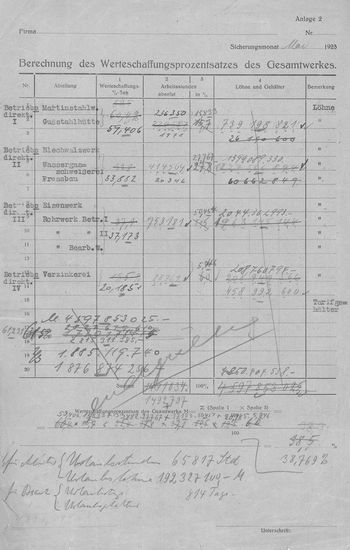
Some entities attempted to continue internal reporting based on monetary variables. The evidence suggests that this could generate reports exhibiting a similar state of disrepair as found in financial reporting. An example is provided by the “value creation calculation” performed by Thyssen & Co., which was used to assess the firm's productivity and estimate overhead surcharges (Figure 2). From April 1923 the reports are replete with erasures, crossings-out, the use of different colored inks, pencil entries, and various handwritten comments and calculations, rendering them largely incomprehensible. While the reports had conventionally been prepared in typescript, by August 1923 they were entirely handwritten.
Extract from Thyssen & Co.'s internal value creation calculation, May 1923.
(Source: Berechnung des Wertschaffungsprozentsatzes des Gesamtwerks, Thyssen & Co., May 1923, sig. R 2.35.13.3., Collection Thyssen & Co., Salzgitter Konzernarchiv, Mülheim an der Ruhr.)

Although some firms discussed problems of cost allocation, no evidence in the primary sources suggests that cost-accounting systems were fundamentally adapted during the perturbation.Footnote 114 The archives refer to the high uncertainty of future estimates, the increasingly large numbers requiring manual processing, and delays in producing the usual reports or their incompleteness.Footnote 115 There is little suggestion of responses to these issues. Costing for new phenomena during the hyperinflation, such as issuing Notgeld, was rather simplistic, without attempts to split costs into fixed and variable.Footnote 116 Likely, firms concluded that the distortion of monetary values during hyperinflation was an insurmountable problem and that nonmonetary information on quantities and productivities was more useful to management.
Conclusion
During the “Age of Catastrophe” businesses in Germany were exposed to a succession of economic, military, social, and political disturbances. We have examined how firms responded to one such perturbation, the Weimar hyperinflation. Given its potential for offering compelling insights into everyday organizational practices, we have focused on the adaptability of firms as revealed through the impact of disturbance on their accounting information systems.
In relation to the business operations element of accounting information systems we discovered that processes of selling and purchasing, managing debtors and creditors, and paying employees were highly vulnerable to the effects of hyperinflation. Across the board, initial adaptations were centered on sales and procurement activities, as evidenced by frequent amendments to terms and conditions, and the use of a variety of currencies in calculating values in these contracts. At the height of the crisis, the focus shifted to remunerating labor. Frequent and flexible adjustments to payment contracts, cycles, and methods ensured the retention of the workforce.
In relation to the transactions-processing element of accounting information systems we found evidence of disorder and errors in calculative activity and delays in or cessation of certain recording tasks. The testimony of accounting and clerical employees refers to the unbearable burdens placed upon them by hyperinflation. Here, we discovered limitations to adaptability, especially at the height of the crisis. Firms tended to respond by reallocating corporate resources. They devoted significantly more labor to the performance of those activities that were essential to the continuation of the business. In particular, the economic and social consequences of failing to remunerate employees expeditiously were such that firms devoted considerable effort to maintaining payroll activity. It would appear that paying workers was deemed more important than accurate and timely accounting for wages and other expenses. We also observed some industry variation. In banks, where firms responded by substantially increasing the supply of labor performing calculation and recording, adaptability in transaction processing was more evident than in some nonfinancial entities.
In relation to the control element of accounting information systems we found that corporations were especially vulnerable to the effects of hyperinflation on the handling and processing of physical cash. Such sensitivity was further heightened by the need to maintain essential business operations. The evidence suggests that entities, including some banks, had a limited capacity to adapt their control environment at the height of the crisis, because of physical constraints on handling masses of cash, an insurmountable volume of transactions to process, and the need to perform complex calculations manually. The deficiencies this situation revealed were often addressed only after the storm had passed.
Measurement and disclosure practices in financial (external) reporting were highly sensitive to the effects of rapidly changing price levels. Firms initially adapted by providing supplementary information in their financial statements. However, the production of “meaningless” numbers in balance sheets, the failure to publish annual accounts, delays in the same, and reduced levels of disclosure suggest a limited ability to adapt to the hyperinflationary environment. The lack of regulatory guidance did not help the situation. Nonetheless, certain entities maintained the continuity of financial reporting by devoting additional resources to it early in the crisis and by preparing financial statements on the basis of alternative currencies. In relation to managerial (internal) reporting, entities responded to the perturbation by focusing on data relating to physical quantities and productivity rather than monetary measures and by suspending analysis in inflation-impacted “abnormal” years. Although such adaptations represented departures from certain accounting conventions, they did offer meaningful bases for managerial decision making.
The study has indicated the diverse experiences of hyperinflation in various sectors and firms. While firm size does not appear to have been a major factor in determining response to the disturbance, banks appear to have managed the crisis by significantly increasing the supply of accounting labor. We have seen cases of individual entities that expeditiously and determinately attempted to address the threat that rapidly rising prices posed to specific accounting activities. It is also clear that adapting to the effects of the disturbance became more difficult over time. As the crisis reached its zenith in the second half of 1923, all elements of the accounting information systems came under considerable pressure and were severely tested in all firms examined.
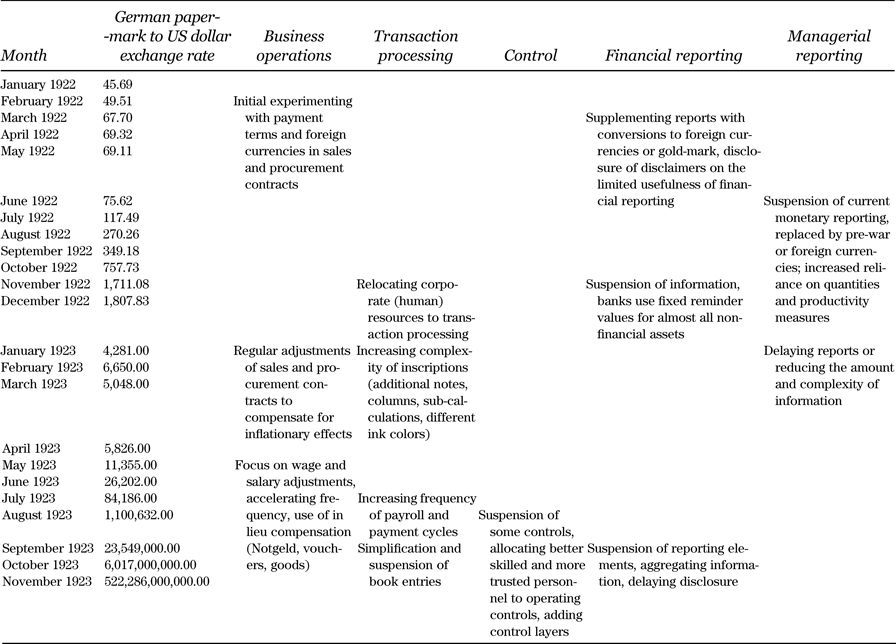
Our investigation of accounting information systems during a period of crisis suggests that German corporations exhibited a strong capacity to adapt to the effects of hyperinflation. They adapted in a pragmatic fashion as the crisis accelerated (see Table 1). Experimenting with a number of possible responses to the disturbance, the key adaptation was to devote greater human resources to everyday operations that were essential to business survival, such as trading, servicing debtors and creditors, and remunerating labor. Such responses invariably pointed to the ability of their systems to recover, survive, and return to a pre-crisis state. But it is also apparent that the hyperinflation could result in system adaptations that represented positive change. Some corporations responded to the crisis by improving specific elements of accounting information systems, such as their internal controls or financial-reporting practices, by reducing complexity and focusing on essential activities and information needs. While hyperinflation was severely disruptive to accounting information systems, in individual entities it could also inspire innovation and advancement once the trauma had passed.
Timeline of Inflation and Adaptations to Accounting Information Systems, 1922–1923

Source: Table by authors using data from Statistisches Reichsamt, Die deutsche Inflation: Zahlen zur Geldentwertung in Deutschland 1914 bis 1923. Wirtschaft und Statistik. Sonderheft (Berlin, 1925), 6–10.
Archival Sources