

In 1915, A. E. Cowley published fragments of documentary and literary texts in Hebrew script from two papyri found in excavations at Oxyrhynchus, Egypt, and preserved at the Bodleian Library.Footnote 1 One of those fragments, MS. Heb. d. 83 (P), was later identified by Markham Geller as an Aramaic incantation.Footnote 2 Another, MS. Heb. c. 57 (P), contains a letter from the “heads of the synagogue” (rashe ha-keneset) to another rosh keneset named Aninah. The other fragments are literary; as Cowley noted, one of the fragments seems to be some sort of liturgical composition and another contains language parallel to Mishnah Yoma, describing elements of the Yom Kippur sacrifice. These brief, elusive literary texts published by Cowley shed light on how the Temple and its rituals were remembered and transformed into ritual centuries after their obliteration. They are also bound up with the complex history of the Mishnah tractate Yoma and its diverse functions in late antiquity.Footnote 3
Mishnah Yoma is an essential text for understanding Jewish attitudes to the Temple after its destruction. It also played an important role in the history of the Yom Kippur ritual itself. From early rabbinic times, the tractate was recited liturgically in some form during the Yom Kippur synagogue service. This custom eventually evolved in late antiquity into the Avodah service, with its distinctive genre of piyyut. The unusual literary character of the tractate made this possible. This study will look at internal and external textual evidence for the metamorphosis of Mishnah Yoma into a full-scale component of the Yom Kippur ritual in the ancient synagogue. The Oxyrhynchus texts will serve as evidence of the proliferation of this process.
Yoma as a Narrative Tractate
It has long been recognized that Yoma belongs to a category of Mishnah tractates and portions of tractates distinguished by their unusual style. Rather than give legal principles and rulings, Yoma is structured as a narrative, describing the Yom Kippur ritual from the week of preparation preceding the day to the evening at the close of the holiday when the high priest rejoins his family. Martin Jaffee describes this category of mishnaic texts as “spare descriptive accounts of the most important institutions in ancient Palestinian Jewish society.”Footnote 4 These tractates include descriptions of Temple rituals and institutions, such as Tamid, which describes the daily sacrifice; Parah, which describes the purification ritual of the red heifer; and Sotah, which describes the ordeal of the woman accused of adultery, which takes place in the Temple. Such narratives also include sectors of civil law, such as in Sanhedrin, and calendrical procedures, in Rosh Ha-shanah.
Although previous generations of scholars thought these distinctive characteristics were evidence for the antiquity and historical reliability of those tractates, more recent studies have cast doubt on this thesis,Footnote 5 instead focusing on the role that mishnaic narrative plays in constructing rabbinic ideology.Footnote 6 In particular, Naftali Cohn's The Memory of The Temple and the Making of the Rabbis examines rabbinic rhetorical strategies of authority by surveying narrative tractates of the Mishnah that describe Temple rituals.Footnote 7
Mishnah Yoma does indeed contribute to this process of redirecting discourse about the Temple to the communal authority of sages and their allies. The tractate adds many details to biblical and earlier depictions of the Yom Kippur sacrifice; these have been enumerated by Jacob Neusner, Daniel Stökl Ben Ezra, Cohn, and others.Footnote 8 Many of these details pertain to elements of the sacrificial ritual itself, but the most striking innovations in the tractate concern the interplay of the ritual and the social. The tractate's narrative introduces whole classes of personnel, individuals and whole institutions, such as the court and the elders, and sectarian factions that do not appear in the biblical text.Footnote 9 This study will focus on another element of the trajectory of Mishnah Yoma in late antiquity, the ritualization of verbal utterance as a way of performing the memory of the Temple.
Tractate Yoma of the Mishnah attained its full ritual expression in the Avodah liturgy, which most likely developed sometime in the third century CE or later as a component of the Yom Kippur Musaf service.Footnote 10 The earliest text of an Avodah liturgy is Shiv‘at yamim, which frames the text of the Mishnah as a continuous narrative of the high priest's preparation for the sacrifice, the sacrifice itself, and the conclusion of the day's rituals.Footnote 11 Shiv‘at yamim does not include the legal details and disputes found in the Mishnah, and, as we will see, includes verbal utterances not found in the Mishnah text. In time the Avodah evolved into a full-fledged genre of piyyut, which constitutes the most important extant compositions of the fourth-century poet Yose ben YoseFootnote 12 and was the subject of anonymous piyyut, including the massive composition “ʾAz be-ʾen kol.”Footnote 13 The Avodah liturgy can be seen as an expression of a synagogue piety that also valorized the priesthood and its concerns, whereas early rabbinic discourse is more likely to be critical of the priesthood as a historical class.Footnote 14 It can also be seen as an attempt not simply to memorialize the Yom Kippur sacrifice, but to transform it into a verbal ritual that could allow a post-Temple community to partake of some of its original function and glory.Footnote 15
At the same time, the sources and analyses presented below attest to the persistence of sacrifice as a concern very much on the minds of the composers of the Mishnah and tannaitic literature. In fact, the roots of the Avodah's verbalization of the Yom Kippur sacrifice can be found in the text of the Mishnah itself. Mishnah Yoma's narrative employs verbal utterances that do not appear in Leviticus, both in quotations and in descriptions. The most prominent of these are the confessions recited by the high priest in the course of the sacrifices. Only one verse in Leviticus refers explicitly to a verbal recitation during the ritual, Leviticus 16:20, in which the priest is to place his hands on the sacrificial goat and “confess over it all the iniquities and transgressions of the Israelites.” The Mishnah expands this to three confessions.Footnote 16 Other utterances, such as the short prayer that the high priest recites in the holy of holies, the announcement that the scapegoat has arrived in the wilderness, and the reading of Scriptures at the end of the ceremony, are worked into the ritual structure. These elements enhance the liturgical, or protoliturgical, character of the tractate, which came to be recited in the ancient synagogue.
Text and Liturgy
There was probably no one definitive text of Mishnah Yoma. That is, between the fluidity of scribal practices and the tradition of oral recitation of the Mishnah, variations appeared that represent divergent but early exemplars of the tractate. The complexities of transmission have been brought into relief in Yehoshua Rosenberg's 1995 dissertation and critical edition of the tractate, which also casts light on how it evolved as a liturgical unit.Footnote 17 Not only did the Mishnah tractate inspire the Avodah liturgy, but that liturgy influenced the scribal transmission of the tractate.Footnote 18
The most notable example of the intricate relationships between the manuscript tradition of Mishnah Yoma and the liturgy can be found in the text of the confessions recited by the high priest. Leviticus 16:20–21 only describes one confession explicitly, which the priest recites over the scapegoat. The biblical text mentions the bull of the sin offering for the high priest and his household in 16:6, but does not prescribe an individual action to be performed on it until 16:11. However, according to the Mishnah, the high priest recites three confessions in the course of the ceremony. In Sifra, the other two confessions are inferred from the confession over the goat: the midrash argues that “just as expiation by the goat is [accompanied by] a verbal confession, so the expiation by the bull is [accompanied by] a verbal confession.”Footnote 19
So too in the Mishnah, the high priest approaches the bull and recites the first confession over the bull for his own ḥata't on behalf of himself and his household. After selecting the two goats, he returns to the bull and confesses on behalf of the Aaronide priesthood before he slaughters it. The Mishnah thus adds two confessions, and includes their texts. The texts of the confessions and accompanying ritual actions and utterances vary among the three instances and between manuscripts.
One significant variation concerns how God's name is invoked in the opening formulae of the confession. In the two most important Palestinian manuscripts of the Mishnah, the formula of the two invocations cites ha-shem, literally, “the name,” in all three confessions. However, in the Cambridge manuscript and in one Geniza fragment, the second invocation is introduced with ba-shem, “in the name.” In the Tosefta and the Yerushalmi, ba-shem is used for the second invocation.Footnote 20 Sifra quotes the confession four times, corresponding to the three confessions, including two versions provided in the dispute between the sages and Rabbi Meir found in T. Yoma 2:1. In all cases the invocation is ʾanaʾ ha-shem. In those early Palestinian Avodah piyyutim that contain the full text of the confessions, the second invocation in all the confessions is usually ba-shem.Footnote 21
Saul Lieberman argued that the toseftan variant that invokes God the second time in each confession with ba-shem reflects an ancient tradition that was altered by the sages.Footnote 22 According to Lieberman, “The words of R. Haggai [in Y. Yoma 3:7] are based on an ancient tradition, and at first the practice was to say ba-shem kapper [‘In the name, forgive’], and since he said the Tetragrammaton, it seemed as if he was swearing in the name of God.”Footnote 23 That is, in the first invocation, the high priest is simply calling on God in the vocative. The second invocation, according to this conception, is more like an adjuration in His name—that is, it presupposes that the name itself has the power to atone.Footnote 24 He thus argues that the sages suppressed this version because it resembled an adjuration, but that it nonetheless reappeared in later traditions.Footnote 25
The textual history of the confessions raises the possibility that compilers and scribes were sensitive to the nuances of oral formulation that the two invocations represent. The term ba-shem is perhaps the most prominent formulaic marker of oaths and adjurations, even finding its way into Greek magical formulae.Footnote 26 By choosing this variant, some scribes and tradents, not to mention the poets of the Avodah, reinforced one of the ritual effects of the confession of the high priest. By adjuring in God's name in his plea for confession, both the priest, in the past, and the reciter, in the present, wish to affect atonement in the most direct way possible.
A second way in which the text of the confessions of the high priest is bound up with that of the Avodah liturgy concerns the people's response to the pronunciation of the divine name in the confession. In M. Yoma 3:8, 4:2, and 6:3, those in attendance respond with a doxology: “And they respond after him, ‘Blessed is the name of His majesty's glory forever and ever.’”Footnote 27 This formula is also recited silently in the statutory liturgy after the pronouncement of the Shema.Footnote 28 But some manuscript traditions as well as the 1492 Naples edition of the Mishnah append a formulaic description of the priests and people prostrating themselves in response to M. Yoma 3:8 or 6:2. This passage is a prominent feature of Shiv‘at yamim and subsequent Avodah liturgies.Footnote 29 J. N. Epstein and Yehoshua Rosenberg argue that this passage was inserted into those manuscripts from the liturgy.Footnote 30
The history of transmission of the text of Mishnah Yoma is thus virtually inseparable from its eventual liturgical function. Besides its narrative characteristics, the text includes several verbal utterances. At least one of these, the high priest's confession, is explicitly liturgical. Others, such as the enumeration of the acts of sprinkling of blood, serve as repetitive litanies. It is therefore likely that before a version of the tractate became part of the Yom Kippur liturgy, these literary traits predisposed the text to a type of performance that transcended the rabbinic practice of memorization through recitation.
External Evidence: The Bavli
Two sources in the Babylonian Talmud describe prayer leaders who recite their versions of the Mishnah before the fourth-century Babylonian Amora Rabba on Yom Kippur. In B. Yoma 36b, a discussion of a baraita found in T. Kippurim 2:1 regarding the order of the high priest's confession leads to one such story. The Talmud debates whether the confession should be read as ‘aviti, pasha‘ti, ve-ḥataʾti, as Rabbi Meir holds, or ḥata'ti, ‘aviti, pasha‘ti, according to the sages: “A certain person went down [to lead prayers] in the presence of Rabbah and performed [the confession] according to Rabbi Meir. He said to him, ‘You have abandoned the sages and performed it according to Rabbi Meir.’ He said to him, ‘I act according to Rabbi Meir. It makes sense to me because it is written in the book of the Torah of Moses.’” The story uses the phrase ha-huʾ de-naḥet kame R. X, “a certain person went down before [a certain rabbi].” This expression indicates that the person served as prayer leader when that rabbi was in attendance. It is used several times in the Bavli to introduce a disagreement between a prayer leader and a rabbinic authority.Footnote 31 In this case, the dispute concerns the priest's confession to God, which could have been recited as a discrete liturgical unit.Footnote 32 The second story concerns a detail in the prayer leader's recitation of the narrative:
A certain person went down in the presence of Rabbah. He said: “He [the high priest] went out and placed it on the second stand in the hekhal and took the blood of the bull and put down blood of the goat.” He said to him, “One like the rabbis and one like R. Judah? Rather, say: ‘He put down the blood of the goat and took the blood of the bull, and sprinkled it on the curtain facing the ark from outside; and he did not intend to sprinkle upwards or downwards, but rather in a whipping motion.’”Footnote 33
In this case, the detail under dispute concerns a specific ritual action, one without direct and verbal liturgical consequences. This story thus provides better evidence for the recitation of the Mishnah's narration in some form in Amoraic Babylonia.Footnote 34
Shiv‘at Yamim
From the talmudic tradition we move to documentary evidence for the earliest history of the liturgical use of Yoma. Shiv‘at yamim (Seven days) is the earliest extant Avodah liturgy. It does not take the form of poetry but is rather a liturgical reworking of Mishnah Yoma. Shiv‘at yamim allows us to see how early Avodah services, such as that depicted in the talmudic stories above, must have looked.Footnote 35
Although Shivʿat yamim follows the Mishnah closely, it omits much and introduces some changes. Most significantly, it omits minority opinions of individual sages and many legal details. It also adds details found in the Tosefta and the Palestinian Talmud, as well as a section adapted from Mishnah Tamid. The text also features a full text of the confessions of the high priest and the people's prostration and doxology discussed above. It is distinctive in how it incorporates earlier traditions into its discourse, sometimes framing them as verbal utterances. For example, in M. Yoma 1:5, the high priest is adjured by the court not to change the order of the ritual from their instructions. Although this passage carries hints of sectarian conflict, the sects are not mentioned in the Mishnah—nor, for that matter, the specific details of the dispute that occasioned the adjuration.Footnote 36 Those details are supplied in the Tosefta and talmuds.Footnote 37 Shiv‘at yamim includes those details, mentioning the Sadducees by name (the text added to the Mishnah's language is in bold): “We adjure you by Him who caused His name to dwell in this house that you change nothing of all that we have told you, so that you do not sacrifice the first [animal] last and the last first, and that you do not burn the incense outside and bring it inside and not do as the Sadducees, but do the first first and the last last, as we have adjured you to do and demonstrated it before you.”Footnote 38 However, instead of narrating those details in the form of anecdotes or legal comments as the Tosefta and talmuds do, they are incorporated into the speech given by the sages. Another addition occurs at the pivotal moment in M. Yoma 5:1, when the high priest recites a short prayer in the sanctuary. The Mishnah does not specify the content of the prayer. However, the talmuds supply their own theories of what that prayer was.Footnote 39 Shiv‘at yamim quotes a prayer directly: “And thus he would pray: May it be Your will that this year be a year of abundance and let not the prayers of travelers enter before You.”Footnote 40 Shivʿat yamim thus frames the Mishnah's basic narrative in a way that optimizes it for performance: for example, by eliminating legal disputes and glosses and explaining some obscure details concisely. But it also enhances the element of verbal utterance and ritual actions built into the text by adding details, such as the act of prostration, the full confessions, and the high priest's prayer in the sanctuary.
Oxyrhynchus
We have thus seen that versions of Mishnah Yoma were recited in synagogues in Babylonia and Palestine. We now return to the evidence from Oxyrhynchus. The papyrus under discussion was first published by Cowley in 1915Footnote 41 and in facsimile by Collette Sirat.Footnote 42 Cowley dated the fragment to the late fourth century or early fifth century CE.
The town of Oxyrhynchus, on the western bank of the Nile, is notable for its extensive deposits of papyri, which were buried in a rubbish heap on the outskirts of town.Footnote 43 Those finds have yielded manuscripts of lost gospel traditions, classical literature, and a great deal of data for the social and economic history of Egypt in late antiquity.Footnote 44 These data include letters and business documents from Greco-Egyptian priests, Christian bishops, and other functionaries, liturgical calendars, and legal forms and records. They have made it possible to reconstruct a great deal of the regional history of Christianity and Greco-Egyptian religions from the Ptolemaic to Byzantine eras.
A very small percentage of these documents are relevant to the history of the Jewish community in Oxyrhynchus, but they do shed light on that community in unique ways. Oxyrhynchus had a Jewish community since at least the first century CE.Footnote 45 The Jews of Oxyrhynchus suffered in the revolt against Trajan in 115–117 CE; in fact, eight decades later, at the end of the second century, the Roman citizens of the city observed an annual holiday commemorating their victory against the Jews. However, a modest but noticeable Jewish community survived. By 291 CE the community had enough means to sponsor the manumission of a Jewish slave and her children.Footnote 46
In contrast to earlier documents from Oxyrhynchus, the only Hebrew and Aramaic texts on papyri and parchment that have surfaced date from the second or third centuries and later; the strongest evidence is that most of them date from the third or fourth to sixth centuries.Footnote 47 Most relevant to this study are a letter to the leadership of the synagogue published by Cowley, and a few liturgical and incantation texts. The letter published by Cowley was apparently written from “the heads of the community” in one place to a certain Aninah,Footnote 48 another “head of the community,” presumably that of Oxyrhynchus. The following is Cowley's translation of the letter with Hebrew terms interpolated:
From the heads of the synagogue (מן ראשי הכנסת) [and from your brethren]
the members of the synagogue (בני הכנסת) which is in Egypt [to our master (לרבנו)]
Aninah the head of the synagogue (ראש הכנ[סת])
to the elders of the synagogue and to [all our brethren]Footnote 49
the holy congregation (קהל הקדוש) which [is in …].
Our prayers shall [be] for your life
and for the welfare of your sons and [your] households …
And the service (שירות) of the commandments …
We see that the letter refers to classes of officials shared by both communities, such as the rosh ha-keneset, the “head of the community” or “head of the synagogue,” zikne ha-keneset, “elders of the community,” bene keneset, the “members of the community,” and prostatin, superintendent or patron (Greek prostatēs).Footnote 50 The opening greeting that constitutes the surviving text also refers to sherut ha-miẓvot, the “service of the commandments.”
The literary fragments from Oxyrhynchus also include a prose prayer on parchment published by Felix Klein-Franke in 1983. This prayer is not directly parallel to a unit in the traditional statutory liturgy. However, it does open with the phrase modim ʾanaḥnu lakh, the opening phrase of the eighteenth blessing in the statutory Amidah.Footnote 51 Called a “lamentation” by Klein-Franke and a “congregational prayer” by Mark Harding, it may commemorate an event that affected the Jewish community, perhaps the revolt of 115–117 CE.Footnote 52 The Aramaic incantation text was published by Cowley, who did not recognize it as such, and republished by Markham Geller, who recognized it as a magical text and demonstrated its affinities to other Jewish incantation texts, including the Babylonian Jewish magic bowls.Footnote 53 All of these sources thus attest to a Jewish community in Oxyrhynchus from the third through sixth centuries, which had established some form of synagogue organization and was engaged in Hebrew and Aramaic literary and liturgical activity. In addition to the fragments from Oxyrhynchus, a few fragments of piyyut from Egypt have been found. In the British Museum, a papyrus fragment first published in the 1920s was later identified by Jefim Schirmann as a piyyut for Shavuot.Footnote 54 More remarkably, a set of papyri from the Fayyum in Berlin includes an Aramaic poem, “ʾEzel Moshe,” a dramatic narration of Moses's encounter with the Red Sea, which is attested in medieval European targum manuscripts and in the Cairo Geniza.Footnote 55
We now return to the Hebrew fragments from Oxyrhynchus. Two of the fragmentary passages published by Cowley are apparently liturgical. The first of those fragments (b) is missing the beginnings of the lines, but it is apparently a poem or composition in poetic prose. The fragment is translated here following a tentative transcription:Footnote 56

The first word of the phrase [ḥel]ve ʾelim is uncertain. The phrase ḥelev ʾelim, the fat of rams, appears in 1 Samuel 15:22: “Surely, obedience is better than sacrifice, compliance than the fat of rams.”Footnote 57 However, it is not uncommon for piyyut to use a biblical phrase out of context, and therefore it is possible that the phrase ḥelev ʾelim was appropriated by the composer to refer positively to sacrificial offerings. The phrase “male goats,” se‘ire ‘izim, recalls Leviticus 16:5. The “ash heap” (shifkhe deshen) is mentioned in Leviticus 1:16 and 4:12. These fragmentary lines thus seem to be descriptions either of one particular sacrifice or sacrifices in general. It is also not clear whether the composition is describing the Yom Kippur ritual. Despite these references, the passage is clearly not a quote from Scripture or Mishnah.
Stylistically, the extant lines show indications of rhythm and assonance: the phrases ḥelve ʾelim and se‘ire ‘izim rhyme by virtue of their plural forms. They also form construct pairs (ẓerufe milim), which are one of the most distinctive features of preclassical piyyut.Footnote 58 This fragment may therefore have been part of a poetic composition in which actions of a sacrifice are listed in sequence.Footnote 59 Such a passage is a prominent feature of the early Avodah piyyut “ʾAtah konanta ‘olam me-rosh.”
The second liturgical fragment (c) is missing the beginnings and ends of lines:
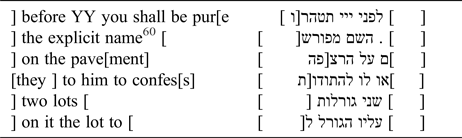
The fragment thus apparently quotes or paraphrases Mishnah Yoma, in particular M. Yoma 3:8, 3:9, and 4:1. Those mishnayot depict the high priest's handling of the goats and his second confession. The first two lines are clear references to the text of the confession. Moreover, the word meforash in the second line is apparently an allusion to the pronunciation of the divine name, as described in the liturgical passages of Mishnah Yoma and its paraphrases. The word riẓpah, “pavement,” appears in the Ma‘agarim transcription of the text. If this reading is valid, it is a somewhat puzzling detail. The word riẓpah appears once in M. Yoma 1:7, when the young priests (pirḥe ha-kehunah) keep the high priest awake by charging him to walk on the pavement. Otherwise, the word appears in M. Tamid 1:4 in the description of the process of clearing out the ashes from the altar. However, both actions would take place before the first confession, and presuming that the passage is narrating the Avodah in sequence, they would be out of place here. It is possible that the passage is referring to M. Yoma 5:4, in which the priest puts down the bowl containing the blood of the goat and picks up the bowl with the blood of the bull. As we recall, this detail was the subject of debate in the talmudic story about the liturgical recitation of the Mishnah.
It is apparent that this text is not a direct quotation from our extant Mishnah. Nor is it clear from the fragment that the text is formal poetry or piyyut. However, it is evidence that some version of Mishnah Yoma was recited in the fourth or fifth century in an Egyptian synagogue, either in a form similar to Shiv‘at yamim or in more poeticized form. Furthermore, a composition in poetry or poetic prose also dealt with Temple sacrifice, perhaps also for Yom Kippur.
The earliest Avodah piyyut is “ʾAtah baraʾta,” a brief composition that serves as a prolegomenon to the description of the sacrifice. The poem sets a paradigm for a major component of subsequent Avodah piyyutim. It begins with God's creation of the world and humankind, and then proceeds briskly though human prehistory and the patriarchs, emphasizing Abraham's willingness to sacrifice Isaac. From there it traces Jacob's line straight through Levi to Aaron. The remaining five stanzas are dedicated to Aaron's role as Israel's representative before God at the shrine on Yom Kippur, adding that the role is passed on to his descendants:
As a substitute for atonement
You informed his sons
That they might serve before You
Following his example.
The poem ends there. It was clearly meant to be followed by a description of the Yom Kippur sacrifice itself; in all other Avodah piyyutim a poetic preamble like this is followed by an extensive poetic description of the priestly garments, the sacrifice itself, and its conclusion at the end of the day. And in fact, in two Geniza manuscripts, “ʾAtah baraʾta” serves as the introduction to Shiv‘at yamim—that is, the poetic preamble leads to a prose retelling of Mishnah Yoma. Our papyri may be too fragmentary to draw a conclusion about the relationship of the poetic and prose texts, but if the two compositions found at Oxyrhynchus were recited at the same liturgical occasion, they may have fit together in a similar fashion.
The evidence presented here suggests that versions of Mishnah Yoma much like Shiv‘at yamim were in circulation in Amoraic Babylonia and Roman Egypt. This evidence does not indicate whether poetic versions were common in Babylonia and Egypt, but it does at least show that liturgical recitation of the Avodah according to the mishnaic pattern was a custom that spread across a wide geographical range in the talmudic period.
Ritual Function
The foregoing analysis is an effort to explore the particular way that the memory of the Temple and the sacrificial system intersected with rituals of repetition and liturgical systems. It is also an exploration of the geographic range of these acts of memory. Mishnah Yoma's narrative introduces speech acts that reinforce the rabbis’ vision of a socially and politically charged sacrifice. At the same time, those verbal utterances can allow the reciter of that narrative to reenact key moments in the ritual. A narrative presupposes an audience, but a liturgy presupposes a community of participants. Mishnah Yoma thus became associated early on in its transmission with the Avodah service, in which the community was more than a passive recipient of the narrative tradition.
What may be surprising to us is the geographic distribution of the custom of reciting that narrative in the synagogue, ranging from Palestine eastward to Babylonia and westward to Upper Egypt. Beyond the remarkable affinities to the Avodah, the extant papyri from late Roman and early Christian Egypt provide evidence that the Egyptian and Palestinian Jewish communities of this period were in contact. The manumission of the Jewish slave and her sons mentioned above was apparently carried out by a local official, Aurelius Dioscorus, in cooperation with a Palestinian Jew, Aurelius Justus, “Bouleutes of Ono in Syria-Palestina and Pater-Synagogos.”Footnote 61 So too the affinities in style and substance between the fragments of piyyut found in this period and Palestinian preclassical piyyut are specific enough to indicate direct influence—not to mention the appearance of a Palestinian Aramaic piyyut known from other sources.
We have also seen that from the modest Jewish community in Oxyrhynchus, at least two liturgical treatments of sacrifice out of the small number of Hebrew papyri have survived. The status of the Jews in Oxyrhynchus after the second century was at times precarious, and the community recovered to some extent. It may be possible to see our fragments as assertions of ritual parity with the community's neighbors. To account for this phenomenon fully will require a deeper exploration into the religious environment of Christian Egypt in the fourth century.Footnote 62
At the same time, these documents are a testimony to the persistence of interest in sacrifice in ancient synagogues. They add to the evidence that in late antiquity, recitation and verbal reenactment were considered authentic acts of sacrifice and not just substitutes for it; we should take rabbinic statements that study of sacrifice is equivalent to sacrifice and that prayer is the sacrifice of the heart as more than metaphors.Footnote 63 During this formative period of the Avodah liturgy, sacrifices continued throughout the Roman Empire, Christians were debating the sacrificial status of their own rituals, and images of Temple implements constituted nearly universal symbols of Judaism. These sources attest to an ongoing process whereby the scholastic and ideological program of the Mishnah was transformed into performance.


