INTRODUCTION
The marine biota of the boreal North Pacific has a unique evolutionary history due to ocean cooling and the closure of the Bering Strait in the mid-Cretaceous ~100 million years ago (MYA), which led to a subsequent faunal isolation of this area (Nesis, Reference Nesis2003). Even belemnites, an extinct order of cephalopods, disappeared in this region about 35 MYA before the Cretaceous − Paleogene boundary when these dominant cephalopods became globally extinct along with the dinosaurs (Iba et al., Reference Iba, Mutterlose, Tanabe, Sano, Misaki and Terabe2011). Long periods of geographical isolation gave rise to a high level of endemism, including species in the deep-sea fish family Macrouridae and the squid family Gonatidae (Nesis, Reference Nesis2003).
However, recent discoveries of North Pacific bathy- and benthopelagic species in the south-west Atlantic have raised the possibility of a direct oceanographic link between the North Pacific and South Atlantic Oceans. It has been proposed that unidirectional dispersal from the North Pacific into the south-west Atlantic follows the Pacific Arctic Intermediate Water, the Pacific Deep Water and eventually the Upper Circumpolar Deep Water (UCDW) through the Drake Passage (Arkhipkin et al., 2010). Evidence for this dispersal pathway includes the recent discoveries of the orange roughy (Hoplostethus atlanticus) and scaled squid (Lepidoteuthis grimaldii) off the Falkland Islands and southern Argentina (Wöhler & Scarlato, Reference Wöhler and Scarlato2006; Laptikhovsky, Reference Laptikhovsky2008; Laptikhovsky et al., Reference Laptikhovsky, Arkhipkin, Brickle, Hearne and Neely2011). Also among the new records was the giant grenadier, Albatrossia pectoralis, one of the two dominant macrourids of the North Pacific. This paper describes the recent capture of another dominant Pacific grenadier, Coryphaenoides acrolepis (Bean, 1884) and provides some evidence of oceanographic changes in deep seas of the south-west Atlantic.
MATERIALS AND METHODS
A specimen tentatively identified as Coryphaenoides acrolepis (Bean, 1884) was collected on 27 August 2012 by the longliner CFL ‘Gambler’, which targeted Patagonian toothfish; it was captured at Station 2791, 54°00′S 56°52′W–53°57′S 56°44′W, depth range 1540–1860 m (Figure 1). The fish was immediately frozen upon capture and later the specimen thawed, weighed and measured; a piece of abdominal muscle tissue was preserved in 95% EtOH for genetic analyses.
Map of the area including the location where Coryphaenoides acrolepis was caught (grey circle) and the deep-sea station where oceanographic data were collected (star).

Molecular analysis
DNA was isolated using the modified HotSHOT method (Truett et al., Reference Truett, Mynatt, Truett, Walker and Warman2000; Meeker et al., Reference Meeker, Hutchinson, Ho and Trede2007). We amplified approximately 660 base pairs (bp) of the mitochondrial cytochrome c oxidase subunit I (COI) gene using the primers FishF2 and FishR2 of Ward et al. (Reference Ward, Zemlak, Inness, Last and Hebert2005). Polymerase chain reactions (PCRs) were carried out in a 15 Kl volume containing 5–10 ng of template DNA, 0.4 KM of each primer, 1 X PCR buffer (20 mM Tris–HCl, 50 mM KCl), 1.5 mM MgCl2, 0.4 uM each primer, 200 uM each dNTP, 1.25 u of Taq and deionized water to volume. After an initial 4 min denaturation at 95°C, each of 35 cycles consisted of denaturation for 30 s at 94°C, annealing at 54°C for 30 s, and extension at 72°C for 45 s with a final 5 min extension at 72°C. PCR products were then visualized on a 1% agarose gel and purified using ExoSAP-IT (USB, Cleveland, Ohio) as per the manufacturer's instructions. Cycle-sequencing was carried out using the FishF2 primer. Cycle sequence reactions were then purified using a standard ethanol precipitation protocol and run on an ABI 3130xl Genetic Analyzer (Applied Biosystems, Foster City, CA, USA) at the Center for Comparative Genomics, California Academy of Sciences. The sequence was edited using the DNA sequence assembly and analysis software Geneious Pro 5.0 (Biomatters, Ltd, Auckland, NZ). Specimen identification was confirmed using the Identify Specimen option on the Barcode of Life Data Systems 2.5 website (www.barcodinglife.org). The specimen is deposited in the California Academy of Sciences, catalogue number 235676, and the GenBank Accession number is KF420483.
Oceanographic data
Oceanographic data from the deep-water station east of the Falkland Islands (51°45′0S 55°37′0W, bottom depth 1,120–1,177 m) were collected monthly between 1999 and 2012 from a total of 124 oceanographic CTDO deployments. To obtain temperature (°C), salinity (psu), and density (kg m−3) profiles, a logging CTDO (SBE-25, Sea-Bird Electronics Inc., Bellevue, USA) was deployed from the surface to a depth of 1000 m. The speed of deployment was ~1 m/s and was monitored by use of a wire counter. Mean annual temperature and salinity between 900 and 950 m were calculated as indicators of interannual variability. Waters in this depth are assumed to represent the frontal zone between Atlantic Antarctic Intermediate Water (AAIW), which extends there to 800–1000 m, and underlying the UCDW (Reid, Reference Reid1989; Severov, Reference Severov1991; Wallace, Reference Wallace2000) that was suspected of being a part of a cross-ocean dispersal pathway between the North Pacific and South Atlantic (Arkhipkin et al., Reference Arkhipkin, Laptikhovsky and Brickle2010).
RESULTS
Morphological and molecular identification
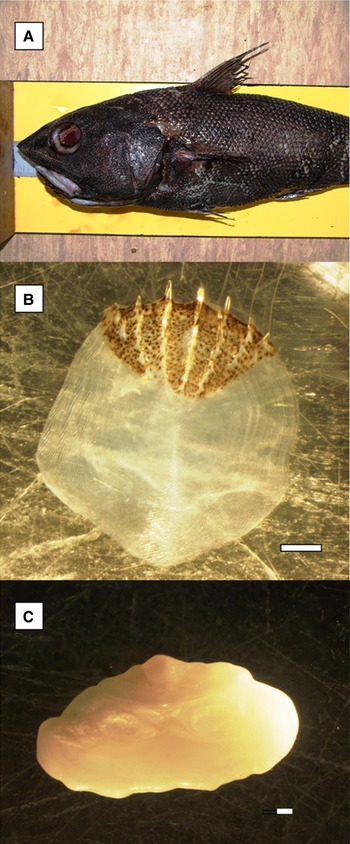
After preliminary morphological investigation, the fish was identified as Coryphaenoides acrolepis (Figure 2). The total length of the fish 61 cm, preanal length 21.5 cm. Head width 32 mm, head length 138 mm. Orbit diameter 34 mm. Pectoral fin rays 18, pelvic fin –8. The first dorsal fin 11, 2nd dorsal –88, anal fin –90. Branchiostegal rays 6. Barbel present. Scales above lateral line below origin of second dorsal fin 7. Number of inner gillrakers on first arch 10 (total). We resolved 625 bp of the cytochrome c oxidase subunit I gene from this single Coryphaenoides sp. specimen. When compared to sequences from Barcode of Life Data Systems 2.5 website (www.barcodinglife.org) we found a 100% match for 5 sequences from Coryphaenoides acrolepis collected from the Pacific Ocean.
Captured Coryphaenoides acrolepis: (A) head; (B) body scale; (C) otolith. Scale bar: B, C, 1 mm.

Recent oceanographic variability in deep seas
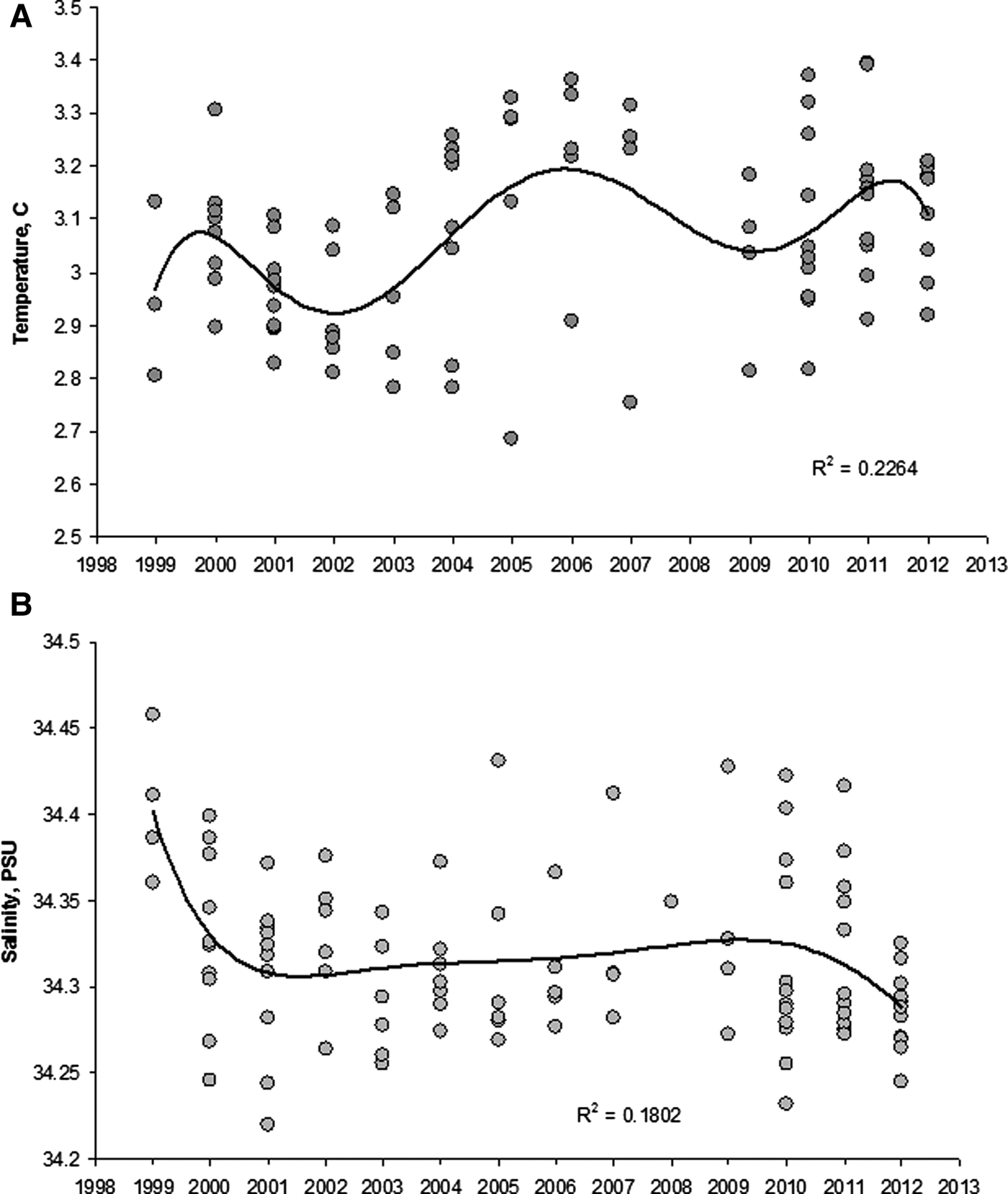
Analysis of T-S data collected at the oceanographic stations from surface to maximum depth (Figure 3) indicated the existence of a frontal zone between AAIW and UCDW in the water layer with salinity 34.1–34.2 psu and temperatures 2.5–4°C that corresponds to depth of 900–950 m (Figure 3). The mean interannual temperature in the studied layer of 900–950 m was 3.07 ± 0.04°C, which perfectly fits into the position of this front. The oceanographic situation in deep seas around the Falkland Islands was neither stable nor erratically variable during 1999–2012 but rather exhibited an unambiguous unidirectional trend (Figure 4). Changes in this habitat were characterized by an increase of water temperatures and decline in salinity with some multiannual, possibly periodic fluctuations superimposed.
Temperature–salinty (T–S) curve of the oceanographic station (51°45′S 55°37′W), 1999–2012, depth range 0–1050 m. A frontal zone is seen as the inflection point of two T–S straight lines (Mamaev, Reference Mamaev1975).

Interannual variability of average temperature and salinity in the layer of 900–950 m depth (51°45′S 55°37′W).

DISCUSSION
Coryphaenoides acrolepis is the most important commercial grenadier of the North Pacific. Its range extends from Baja California north to the Bering Sea, across to the Kuril Islands in the western North Pacific and as far south as southern Japan. This species is benthopelagic, inhabiting depths between 300 and 3700 m and fished mostly at ~1000 m (Benson & McFarlaine, Reference Benson, McFarlaine, Orlov and Iwamoto2008; Froese & Pauly, Reference Froese and Pauly2013). The giant grenadier, Albatrossia pectoralis, which was also recently recorded at the Falklands, is the second most important grenadier in the North Pacific. Nothing is known about their possible migratory activity if such exists; the only known case of grenadier migrations was described for Macrourus carinatus (Laptikhovsky, Reference Laptikhovsky2011). However, such immigration is theoretically possible because in contrast to shallow waters, the environment in deep seas is sufficiently homogeneous resulting from absence of barriers and a confluence of oceanic floor (Gage & Tyler, Reference Gage and Tyler1996). Particularly temperature and salinity of the Falkland deep seas where the grenadier was captured (– ~3.0°C and 34°5 psu—Figure 3) were very similar to those of its native species range—temperature 2.0–3.9°C, salinity 33.70–34.60‰ (Tuponogov et al., Reference Tuponogov, Orlov, Kodolov, Orlov and Iwamoto2008). In the equatorial East Pacific close to South American shores—the area that the species had to cross before coming to the Falkland Islands—the respective values of temperature (2–4°C) and salinity (34.58–34.66 psu) were found at depths ~1,200–2,500 m (Tsuchiya & Talley, Reference Tsuchiya and Talley1998), which is within the normal depth range of this species (Benson & McFarlaine, Reference Benson, McFarlaine, Orlov and Iwamoto2008; Tuponogov et al., Reference Tuponogov, Orlov, Kodolov, Orlov and Iwamoto2008).
Why new records of deep-water species have increased in recent decades is not entirely clear. It cannot be attributed to a development of either fisheries or research activities in deep seas of the south-west Atlantic because nothing like that took place after the year 2000. A longline fishery around the Falkland Islands began in 1993 and since then was diminishing in respect to numbers of fishing days, so did a possibility to catch a rare species. Deep waters of the south-west Atlantic also were reasonably well studied during ~100 research cruises carried out by different nations in 1888–1992 (figure 2 in Angelescu & Sánchez, Reference Angelescu and Sánchez1995).
We suppose that this phenomenon is related to changes in deep-sea circulation patterns and a possible intensification in the deep-water conveyor from the North Pacific to the South Atlantic, driven by warming of deep seas around Antarctica. Actually, enhancing of the southward boundary current flow at mid-depths off Chile in 1995 in respect to a period 28 years earlier was already noted (Shaffer et al., Reference Shaffer, Leth, Ulloa, Bendtsen, Daneri, Dellarossa, Hormazabal and Sehlstedt2000).
Shelf waters around the Antarctic Peninsula are warming at 0.01°C per year since the 1990s (Smith et al., Reference Smith, Grange, Honig, Naudts, Huber, Giudi and Domack2012) and have been accompanied by a decrease in salinity, including the AAIW (Wang et al., Reference Wang, Bindoff and Church1999; Jacobs et al., Reference Jacobs, Giulivi and Mele2002). Because of this it is not surprising that similar processes occurred in adjacent deep seas off the Falkland Islands.
These environmental changes, particularly the warming of oceanic waters, have been implicated in the recent expansion of lithodid crabs into the West Antarctic Peninsula shelf (Smith et al., Reference Smith, Grange, Honig, Naudts, Huber, Giudi and Domack2012) as well as the appearance of subtropical grenadiers and orange roughy in the waters around the Falkland Islands (Laptikhovsky, Reference Laptikhovsky2008; Laptikhovsky & Monllor, Reference Laptikhovsky and Monllor2012). Recently (July 2008 and July 2011), two additional orange roughy specimens were caught within miles of the first report (V.L., unpublished data), which may indicate that a small resident population has become established nearby.
The range expansion of several North Pacific fish and squid species into the south-west Atlantic is still unknown. It is possible that recent changes in local deep-sea circulation patterns have increased dispersal between these distant ocean basins. These changes seem to be occurring on a global scale and may also account for recent records of sub-Antarctic and notalian deep-sea fish in Greenland (Møller et al., Reference Møller, Nielsen and Fossen2003; Kloppmann & Thiel, Reference Kloppmann and Thiel2012).
ACKNOWLEDGEMENTS
The authors thank Drs T. Iwamoto, A. Orlov and L. Rocha for their valuable help in identification of our specimen and their comments.