INTRODUCTION
This new radiocarbon laboratory in Canada is housed in the Advanced Research Complex (ARC), University of Ottawa. Dedicated to the late Dean of the Faculty of Science and Professor in the Department of Earth and Environmental Sciences, the André E. Lalonde Accelerator Mass Spectrometry (AMS) Laboratory is currently the only AMS lab in Canada. The AMS system and sample preparation laboratories have been set up to provide routine analytical services (3H, 10Be, 26Al, 129I, actinides, etc., and, of course, 14C) in an open-access environment to foster the sharing of ideas and to train researchers and students on how to process their samples from start to finish under the supervision of highly qualified personnel.
The 14C sample preparation laboratory moved into the ARC in the spring of 2014 and was operational almost immediately due largely to the fact that preparations for the lab, including design and construction of the graphitization equipment (St-Jean et al. Reference St-Jean, Kieser, Crann and Murseli2016, in this issue), began at least 3 yr earlier. In light of the results from the first few batches of standards and blanks for organics, collagen, and carbonates, the first unknown samples were accepted in the fall of 2014.
The pretreatment protocols are modeled after published protocols and personal communications from other well-established labs (Longin Reference Longin1971; Bronk Ramsey et al. Reference Bronk Ramsey, Higham, Bowles and Hedges2004; Beaumont et al. Reference Beaumont, Beverly, Southon and Taylor2010; Brock et al. Reference Brock, Higham, Ditchfield and Bronk Ramsey2010; Staff et al. Reference Staff, Reynard, Brock and Bronk Ramsey2014; ORAU; Keck-CCAMS; 14Chrono). After more than a year of analyzing unknowns, the routine pretreatment protocols are well established and therefore documented here along with results from standards run with each batch.
PRETREATMENT METHODS
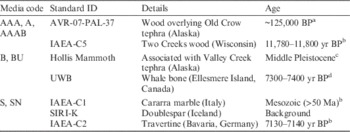
Each pretreatment protocol is assigned a media code (described in detail below and listed in Table 1), which is usually decided by the researcher, but consultation is often required to ensure that the most appropriate media codes are selected. The submission form requests geographical information, which is essential for calibration and also can be useful for answering questions about preservation and possible contaminants from the natural environment or storage issues. An approximate age range is requested in order to select the secondary standards and, to a certain extent, determine the sequence in which the samples will be run on the accelerator. Each group of samples of the same type is paired up with a process blank and a secondary standard, as shown in Table 1.
Current routinely measured known-age standards used for quality assurance.

a Reyes et al. (2010).
b Rozanski et al. (Reference Rozanski, Stichler, Gonfiantini, Scott, Beukens, Kromer and van der Plicht1990); Rozanski (Reference Rozanski1991).
c Constrained by ~700-ka glass-fission track age on tephra from Westgate et al. (Reference Westgate, Preece and Jackson2011) and Valley Creek tephra from Jensen et al. (Reference Jensen, Reyes, Froese and Stone2013).
d Based on average of 19 measurements.
The physical pretreatment takes place in a low-dust environment and all tools are sonicated in methanol and dried prior to use. All glassware is baked at 500°C for at least 3 hr. The chemical pretreatment is performed in 13-mL Pyrex® test tubes and heating is performed in a 14L Lab Armor® waterless bead bath.
Physical Pretreatment
Samples are inspected for signs of possible contaminants (dust, soil, discolouration, shellac, preservatives), sonicated in Milli-Q® water if necessary (15 min at room temperature), and cleaned with a stainless steel surgical kit, in combination with various drill and Dremel® bits. In the case of bone (media codes B, BU), a stainless steel percussion mortar is used to crush the sample to coarse (1–2 mm) powder. Carbonate samples (media code S) are manually abraded with a drill and stainless steel Dremel bit to remove porous or recrystallized areas, and pre-etched with 0.2N HCl to remove the outer 20–30%. For small samples (e.g. forams) or powders (e.g. SrCO3), no pre-etch is performed (media code SN).
Organics, Charcoal, Sediments, Wood (AAA, A, AAAB)
The standard acid-alkali-acid (AAA) pretreatment at the Lalonde AMS Laboratory follows the protocol outlined in Brock et al. (Reference Brock, Higham, Ditchfield and Bronk Ramsey2010). Sedimentary or other carbonates are removed during the first acid wash (HCl, 1N, 80°C, 30 min), and then to remove humics, the sample undergoes rinses in an alkali solution (NaOH, 0.2N, 80°C, 30 min) until the supernatant is the color of weak tea. Any CO2 absorbed during the alkali step is removed with a second acid wash (HCl, 1N, 80°C, 30 min). Each step is followed by three rinses in Milli-Q water. Clean samples are freeze-dried overnight.
If humic acid is not believed to be an issue, the sample is too fragile for AAA, or the submitter does not wish for humics to be removed, the sample will be assigned the media code A and will only undergo the first acid treatment of the AAA protocol before being freeze-dried overnight.
For wood, as recommended by Staff et al. (Reference Staff, Reynard, Brock and Bronk Ramsey2014), the AAA-pretreated material is bleached to cellulose using a 5% NaClO2 solution at 80°C. The samples are monitored and removed once the colour has turned white (30–60 min). After three rinses in Milli-Q water, the samples are freeze-dried overnight.
Bone, Teeth, Antler, and Ivory (B, BU)
The standard collagen extraction follows the Longin (Reference Longin1971) method and the protocol outlined in Brock et al. (Reference Brock, Higham, Ditchfield and Bronk Ramsey2010), with modifications from Beaumont et al. (Reference Beaumont, Beverly, Southon and Taylor2010). The sample is first decalcified with 0.5N hydrochloric acid until translucent (3 or 4 rinses over ~18 hr, room temperature), treated with 0.1N sodium hydroxide to remove humic acid (30 min, room temperature), and 0.5N HCl again (30 min, room temperature) to remove any CO2 that may have been adsorbed during the base wash. Each step is followed by three rinses with Milli-Q water. The samples are gelatinized at 60°C overnight in a pH 3 solution (5 mL total volume max) and filtered using a cleaned glass Whatman® autovial syringeless filter.
If required, ultrafiltration (media code BU) takes place at this stage. Ultrafilters (Vivaspin® 30kDa MWCO) are first cleaned by centrifuging with Milli-Q twice, 15 min of ultrasonic cleaning in Milli-Q, then centrifuged again three times with Milli-Q (Bronk Ramsey et al. Reference Bronk Ramsey, Higham, Bowles and Hedges2004). The sample, following the filtration step of the collagen extraction, is centrifuged in the ultrafilter and the >30 kDa fraction is removed and freeze-dried.
Carbon and nitrogen content are measured by an elemental analyzer (ThermoTM Flash 1112), and if the C:N is outside the range of 2.9–3.6, the sample is deemed unsuitable for dating as it has likely undergone postdepositional alteration (DeNiro et al. Reference DeNiro, Schoeninger and Hastorf1985). If δ13C and δ15N are required, an aliquot of the extracted collagen is submitted to the G.G. Hatch Stable Isotope Laboratory (our partner laboratory located on the same floor in the ARC) for analysis by isotope ratio mass spectrometry (IRMS) on a Thermo DeltaPlus Advantage coupled to an elemental analyser (Vario EL Cube, Elementar) via a Conflo III interface (Thermo). Their internal standards are (δ15N, δ13C in ‰): C-51 nicotinamide (0.07, –22.95), C-52 mix of ammonium sulfate + sucrose (16.58, –11.94), C-54 caffeine (–16.61, –34.46), and blind std C-55: glutamic acid (–3.98, –28.53). All δ15N is reported as ‰ vs. AIR and normalized to internal standards calibrated to international standards IAEA-N1 (+0.4‰), IAEA-N2 (+20.3‰), USGS-40 (–4.52‰), and USGS-41 (47.57‰). All δ13C is reported as ‰ vs. V-PDB and normalized to internal standards calibrated to international standards IAEA-CH-6 (–10.4‰), NBS-22 (–29.91‰), USGS-40 (–26.24‰), and USGS-41 (37.76‰). Please note that the PDB and VPDB scales are identical and interchangeable. The analytical precision is based on an internal standard (C-55), which is not used for calibration and is usually better than 0.2‰.
Acid Hydrolysis of Carbonates (S, SN)
The cleaned samples are powdered manually with a glass mortar and pestle and added to prebaked glass reaction vessels with a side-arm containing 3 mL anhydrous H3PO4 (see next paragraph for preparation procedure) added to the side-arm. The vessel is evacuated to vacuum baseline, the valve closed, the vessel tipped to add the acid to the carbonate powder, and the sample is left to react overnight at room temperature. The CO2 is extracted and cryogenically purified on a glass vacuum extraction line before being sealed in a 6-mm prebaked Pyrex breakseal. We have chosen not to display a schematic of this extraction line here as this traditional method will soon be replaced with an autosampler interfaced with the new 10-port semi-automated gas cleanup line described in St-Jean et al. (Reference St-Jean, Kieser, Crann and Murseli2016). The gas cleanup line is currently being tested (yield, background, memory) and results will be presented in a future publication.
Anhydrous H3PO4 is used as it will pump down quickly, thus allowing the technician to leak check the vessels after a much shorter evacuation time. The stock of 100% H3PO4 is prepared by slowly dissolving 500g of P2O5 in 600 mL of 85% H3PO4 with 10 mg of CrO3 and heating to 180°C overnight, followed by adding 1 mL of H2O2 and heating to 220°C for 4.5 hr (Coplen et al. Reference Coplen, Kendall and Hopple1983). The solution is allowed to cool to 150°C and is then transferred to glass bottles with caps containing conical plastic inserts for airtight sealing.
Combustion
Pretreated, freeze-dried samples are combusted using a Thermo Flash 1112 elemental analyzer (EA) in CN mode interfaced with an extraction line to trap the pure CO2 in a prebaked 6-mm Pyrex breakseal. Solid organic samples are weighed into a tin capsule (Elemental Microanalysis cat#D1008) and combusted using the EA. Blank tin capsules are combusted between each sample to monitor the blank and ensure no memory effect. Samples that are too small for pretreatment or do not require pretreatment are submitted for direct combustion with the media code D. While the EA will continue to be used for samples requiring C:N measurement, new semi-automated tube sealing and gas cleanup lines are now complete for sealed quartz tube combustions (St-Jean et al. Reference St-Jean, Kieser, Crann and Murseli2016).
Graphitization
Samples of pure CO2 in 6-mm breakseals are converted to elemental carbon in the presence of iron and hydrogen using semi-automated graphitization lines that were designed and built in-house (St-Jean et al. Reference St-Jean, Kieser, Crann and Murseli2016). In brief, 10 breakseals are scored, loaded into Rotulex® cracker tubes, and left to pump overnight along with the reactor, which is composed of a horizontal quartz tube containing 5 mg of preconditioned (oxidized and reduced) –200 mesh (currently testing –325 mesh and various amount) iron powder (Alpha Aesar®, 99+%, CAS7439-89-6, P/N: 00737), and an empty Pyrex vertical tube pointing down for cryogenic water trapping. The CO2 is released into the reactor by gently creating a bend at the Rotulex cracker joint to snap the breakseal, followed by transfer to the reaction volume by freezing into the water trap using liquid nitrogen. Residual noncondensable gases are pumped away, the CO2 is heated back to room temperature to measure the pressure, and then refrozen to add hydrogen at 2.5× pCO2 into the reaction volume. Ovens are connected and the quartz tubes are heated to a reactor inside temperature of ~550°C. The cooling bar is raised to insert the Pyrex tubes into individual cups filled with ethanol, and a closed-loop cooling system maintains the cups at –40°C for effective cryogenic water removal. The samples are left to graphitize for 3 hr, but the process is usually complete in about 2 hr. The pressure, oven temperature, and cooling cup temperatures for each sample are monitored, graphed, and recorded throughout the reaction. A memory test on the graphitization line (St-Jean et al. Reference St-Jean, Kieser, Crann and Murseli2016) showed a cross-over of about 0.025% of the previous sample, which is within our standard precision of 2–3‰ and will only affect very old or very small samples. The UC Irvine reactors were tested in the same way by Southon (Reference Southon2007), who found a memory effect of 0.035% of the previous sample.
Graphitized samples are then pressed into targets using a pneumatic press, designed and constructed in-house. We currently use aluminum targets and copper back-pressing pins, which were found to have minimal carbon content.
AMS MEASUREMENT
14C analyses are performed on a 3MV tandem accelerator mass spectrometer built by High Voltage Engineering (HVE). 12,13,14C+3 ions are measured at 2.5MV terminal voltage with Ar stripping. The fraction modern carbon, F14C, is calculated according to Reimer et al. (Reference Reimer, Brown and Reimer2004) as the ratio of the sample 14C/12C ratio to the standard 14C/12C ratio (in our case Ox-II) measured in the same data block (see paragraph below). Both 14C/12C ratios are background-corrected and the result is corrected for spectrometer and preparation fractionation using the AMS-measured 13C/12C ratio and is normalized to δ13C (PDB). 14C ages are calculated as –8033ln(F14C) and reported in 14C yr BP (BP=AD 1950) as described by Stuiver and Polach (Reference Stuiver and Polach1977). The errors on 14C ages (1σ) are based on counting statistics and 14C/12C and 13C/12C variation between data blocks.
A description of the A.E. Lalonde AMS system and the analysis procedure and setup is found in Kieser et al. (Reference Kieser, Zhao, Clark, Cornett, Litherland, Klein, Mous and Alary2015). The HVE SO-110B ion source has a 200-position sample wheel. Because this AMS system is frequently switched to measure several different isotopes, it becomes necessary for 14C samples to be measured in large batches of 100 to 200 samples each, with 6–10 pairs of Ox-II and Fe-only blanks, as well as several secondary references and process blank samples evenly distributed on the wheel. The 12,13,14C+3 ions are measured with fast sequential injection at 92 Hz, with 90% time spent counting 14C+3. The total 14C+3 counts and the average 12C+3 and 13C+3 currents are recorded in 30-s blocks. When a target is inserted, 10 blocks are measured regardless of counting statistics from the target; after all targets are so measured (one pass), the measurement repeats. To reach 3‰ precision on standards, usually ~10 passes, or about 100 blocks per sample, are measured in total. The AMS system is sufficiently stable to support these long-lasting cycles; the measurements of all targets included in a batch are well distributed and are averaged for normalization. The 12C+3 current is presently limited to ≤40 µA to optimize the reproducibility of the results. Although this increases analysis time, it does not affect the accuracy or precision of the results. We are currently studying this operational limitation, which we believe to be related to the design of the instrument, as, compared with the carbon dedicated instruments with better flat-topped transmissions, the Lalonde system has the flexibility to also measure heavy elements (U, Pb, Am, etc.).
Blanks
The measurement of natural, high-purity graphite from Alfar Aesar® (-200 mesh, 99.9999%, cat#14734) typically results in F14C ~0.0002 (no blank correction). This commercial graphite is included as reference only; we do not consider it as a suitable system blank because it does not include contributions from the Fe catalyst, which has an additional gettering effect from residual hydrocarbons in the source vacuum during sputtering. Instead, we always include several targets of Fe that have been conditioned on the graphitization line (oxidized and reduced) as blanks that represent any unremoved (bound) carbon impurities in the Fe catalyst as well as the small amount of contamination that occurs during graphitization, sample storage, and AMS measurement. Although using pure fossil CO2 is commonly used as a graphitization blank, this does not allow to correct for all three isotopes of carbon present in the iron and ion source vacuum; thus, at present we use Fe-only blanks in order to correct for 12,13,14C+3.
Typically, the Fe-only blank produces two 14C+3 counts per minute under ion source conditions that produce an average of 30 µA 12C+3 from Ox-II target containing 1 mg C. Contaminations in these phases could come from several carbon sources with unknown quantity and mix. However, these are corrected in the offline AMS data reduction in which the average result of all the Fe-only n th blocks is subtracted from the corresponding n th block of the other targets, including process blanks. Such subtraction is applied to all three isotopes of carbon, although it has little impact on 13C and 12C for regular samples with masses >200 µg C. The final results are then the weighted average over all blocks of the Fe-blank corrected data for each target. For making further corrections from process blanks, to account for contamination during pretreatment and CO2 production, we are continuing to evaluate the most appropriate procedures for doing so, including a mass-balance approach.
RESULTS AND DISCUSSION
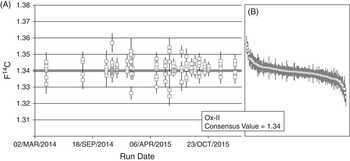
Figure 1A shows results for oxalic acid II (Ox-II), measured with each wheel for normalization, starting from the very first wheel. Figure 1B demonstrates that the majority of the Ox-II measurements are within ±1σ with tails that do not exceed ±0.02 F14C. Figure 1B also illustrates the reproducibility of the precision. Data for Figure 1 are based on samples in the range of 0.5–3 mgC (typically 1–2 mg C). Ox-II samples have been measured down to 50 µg C and, although an exhaustive minimum sample size test has not yet been performed, the measurements are fairly reliable down to about 200 µg C (F14C = 1.33±0.007), below which point the F14C continues to decrease with decreasing sample size and the precision is lower.
(A) Time series of results for the Ox-II standard (±1σ) measured from early 2014 (acceptance testing) through to late 2015. (B) Ox-II results from (A) sorted to show the distribution of data overlapping the consensus value within ±1σ, and spread of data found among the tails (±0.02 F14C).

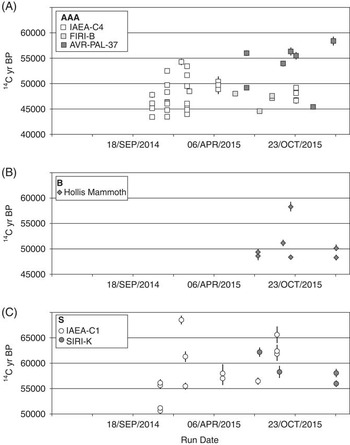
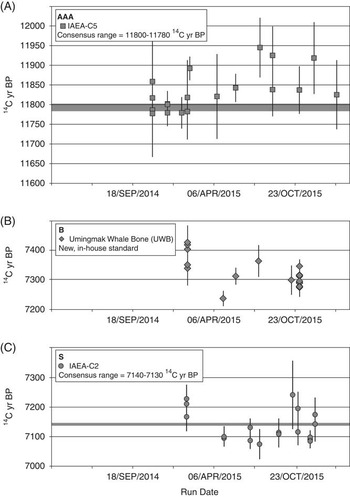
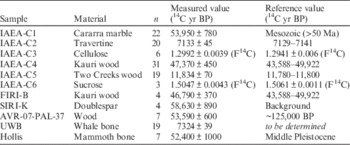
Each batch is paired up with an appropriate process blank (>50 ka) and a secondary standard, usually Holocene in age (Table 1). Figures 2 and 3 illustrate the results from the first year of standards routinely measured with sample batches. Table 2 is a summary of results for the first year of routinely measured standards along with other reference materials.
Results for process blanks: (A) AAA group materials, the current blank is AVR-07-PAL wood (IAEA-C4 and FIRI-B are both Kauri wood); (B) Hollis mammoth bone for samples undergoing collagen extraction (SIRI-C was used for a while as a background check, but it was not a true process blank); (C) shells and carbonates, both IAEA-C1 (Cararra marble) and SIRI-K (Icelandic doublespar), are currently used.

Results for secondary standards (A) IAEA-C5 Two Creeks wood, used for AAA materials; (B) Umingmak whale bone is an in-house standard for collagen containing materials; (C) IAEA-C2 travertine is used for shells and carbonates.

Results for reference materials tested during the first year of operation. For samples with more than one measurement, the measured value and error are an average.

For organics and wood samples, two different kauri wood samples (IAEA-C4 and FIRI-B) were used during the first year, but we now use the AVR-07-PAL-37 wood (Reyes et al. Reference Reyes, Froese and Jensen2010) as it routinely provides background ages of greater than 50,000 14C yr BP and so far it has not dated to younger than 45,000 14C yr BP (Figure 2A). IAEA-C5 (Two Creeks wood, 11,780–11,800 14C yr BP) is measured as a secondary standard for AAA batches. For the most part, IAEA-C5 is well behaved (Figure 3A), although it is affected by the process blank, causing some scatter.
For collagen extraction, SIRI-B (38,300±300 14C yr BP, n = 4) and SIRI-C (44,100±300 14C yr BP, n = 7)Footnote 1 were measured along with the first few bone batches, but since the ages were not true background, the Hollis Mine mammoth bone [constrained by ~700-ka glass-fission track age on tephra from Westgate et al. (Reference Westgate, Preece and Jackson2011), and Valley Creek tephra from Jensen et al. (Reference Jensen, Reyes, Froese and Stone2013)] was tested and is now used as the process blank sample as it routinely dates to greater than 45,000 14C yr BP (Table 2, Figure 2B). An in-house secondary standard has been developed from a large whale bone from Ellesmere Island (Nunavut, Canada; GSC-3055; BS-79-134; Blake Reference Blake1987). The name Umingmak, for the Umingmake whale bone (UWB), comes from the Inuit name for Ellesmere Island. The current estimate of 7324±39 14C yr BP for the UWB is based on 19 measurements (Figure 3B). As part of the future work for the lab, we will provide a more robust age estimate for the UWB based on a greater number of measurements and lab intercomparisons.
Carbonates and shells are analyzed along with the IAEA-C1 Cararra marble (process blank) and IAEA-C2 travertine (secondary standard). Freshly crushed IAEA-C1 routinely yields ages >50,000 14C yr BP (Figure 2C). Precrushed, stored powders have shown not to keep well, typically producing ages <48,000 14C yr BP (not shown), likely due to the adsorption of atmospheric CO2. For this reason, only freshly crushed powders are used for the process blank. We have recently started testing the SIRI-K1 geologic doublespar, which shows consistent results >55,000 14C yr BP (Figure 2C). IAEA-C2 generally falls within the consensus range at 2σ (Figure 3C), again with scatter likely attributed to some variability observed with the IAEA-C1 process blank.
SUMMARY
The work presented here is based on the standards and reference materials from the first 1000 samples processed within a year or so of installation of the accelerator and getting the new sample prep lab up and running (summer 2014). The goal with presenting this early work is to demonstrate our ability to measure routine samples of varying age and material type, and to document the sample preparation protocols as they evolve with advances in knowledge. Moreover, the first status report gives a lab the opportunity to establish a baseline upon which to improve.
CURRENT AND FUTURE WORK
Below is a glimpse at the rapidly growing list of projects underway at the A.E. Lalonde AMS Laboratory:
-
1. Develop a protocol for 14CH4 analysis from gas mixtures and waters;
-
2. Continued QA/QC testing of standards for extraction of DIC by acidification and DOC by wet oxidation, and investigation of UV oxidation methods for DOC extraction from water;
-
3. Integration of a CTC robotic autosampler with the semi-automated gas cleanup line (St-Jean et al. Reference St-Jean, Kieser, Crann and Murseli2016) for the rapid analysis of carbonates, gas mixtures, and waters (DIC/DOC);
-
4. Test the use of Eeze-filters to replace decanting during pretreatment;
-
5. Establish a consensus value for the Umingmak whale bone (UWB) with improved statistics and lab intercomparisons;
-
6. Test protocols used by other labs for old charcoals: e.g. ABOx-SC (acid-base-wet oxidation-stepped combustion; Bird et al. Reference Bird, Ayliffe, Fifield, Turney, Cresswell, Barrows and David1999; Brock et al. Reference Brock, Higham, Ditchfield and Bronk Ramsey2010);
-
7. Thorough investigation into minimum sample size for a variety of ages;
-
8. Method development for small sample (<200 µg C) and compound-specific analysis, including gas source technologies; and
-
9. Further developing a routine for mass-balanced process blank correction.
ACKNOWLEDGMENTS
This work was funded by the Canadian Foundation for Innovation and the Ontario Research Fund. We thank the Geological Survey of Canada for providing a suite of samples from previous 14C intercomparisons, Grant Zazula (Yukon Government) for providing the Hollis Mine mammoth bone, Alberto Reyes and Duane Froese (University of Alberta) for providing the AVR-07-PAL-37 wood, and 14Chrono and Aarhus for providing graphite samples during acceptance testing. Thanks are also due to the staff of the G.G. Hatch Stable Isotope Laboratory for their support and assistance during the setup of our new lab.