Within the context of multilevel selection theory as it is presently hypothesized, variance among life history strategies has increased among Britannic populations and decreased among Gallic populations as the two populations have vied with one another over the past 200 years. To test this hypothesis, the rates of differentiation over time in Britannic and Gallic populations are compared using the predictions of limiting similarity theory. Our predictions suggest that Britannic populations are expanding in their niche breadth, evidencing strategic differentiation, whereas Gallic populations are contracting in their niche breadth, evidencing the opposite effect.
In this article, life history strategies are discussed at length, followed by an explanation of why life history variance might have changed in these populations over this time according to the dictates of limiting similarly theory—although, broadly stated at present, we are using the differentiation of life history traits as an index of niche breadth in the absence of a method capable of directly measuring niche breadth in human populations. Precedent for using life history differentiation as a proxy for social ecological niche breadth can be found in A Sequential Canonical Cascade Model of Social Biogeography: Plants, Parasites, and People,Reference Figueredo1 in which it was shown, through various mediators, such as macroeconomic diversification, that the economic complexity of a society is influenced to a substantial degree by life history differentiation.
To risk repetition for the sake of clarity, in this study, (1) intergroup competition is understood within the context of multilevel selection theory; (2) the samples are the Britannic and Gallic populations; (3) the hypothesized prediction is an inversion of the variance in niche breadth over time between the two study populations; and (4) the outcome variable, serving as a proxy for niche breadth, is the degree of life history strategy differentiation. The remainder of this article provides prerequisite definitions and descriptions of multilevel selection, life history, and limiting similarity theory, ahead of presenting methodological approaches and formal results.
Intergroup competition and multilevel selection
The plausibility of the claim that conditions permitting competition between groups to drive evolution are unlikely has, for decades, been rethought.Reference Sober2, Reference Wilson3, Reference Wilson and Sober4, Reference Wilson and Wilson5 Moreover, there has been a reexamination of the evidence that these conditions are sometimes met, especially in humans. According to the theoretical approach resultant from these examinations, the direction of evolutionary change in a population is the product (i.e., the final vector) of multiple co-occurrent selection forces. In other words, it is the product of multilevel selection. If vectors are in different directions, the resultant depends on the relative strength of the selection forces. Group-level selection never occurs in isolation but rather with selection vectors in diverse directions at lower levels of aggregation than the group, which may occur in similar or different directions. Therefore, the proposal of multilevel selection does not return to the “naive” group selection view.Reference Wynne-Edwards6 Lower levels would not be subservient to higher levels—in fact, competition within groups frequently trumps group-level selection pressures.
Individual-level competition within groups does not simply disappear if group selection is a strong enough force to impact gene frequencies. Frequency-dependent selection and evolutionarily stable strategies may (with local equilibria) occur within groups. As long as different groups exhibit different equilibria, between-group variation may be a target of selection, with evolution favoring increasing representativeness of the most competitively advantageous equilibria. Moreover, it can be argued that within-group character displacement can exist, and the evolution of specialization and complementarity may occur.
Frequently, there is selective migration between groups,Reference Richerson7 or assortative formation of groups in the case of the trait-group model.Reference Wilson3 Thus, if the decision to disperse is based on (or informed by) the composition of groups, dispersal can increase phenotypic and genetic variation among groups rather than decrease it, as is commonly assumed. It is logical that genes for in-group altruism would be selected out if coupled with individually selected selfish ones—thus, it must be adaptive for selectivity in migration and group formation to occur. This would set the stage for between-group phenotypic and genetic variation and differential group performance as an emergent property of this migration selectivity process.
Although self-sacrificial phenotypes may contribute to the competitive success of the group, other forms of phenotypes can be group selected. A point that is not commonly spelled out is that, as in the case of the evolution of spiteful behaviors in inclusive fitness models (i.e., jeopardizing the reproductive success of individuals with whom one has little relatednessReference Hamilton8), it can be argued that behaviors that damage the likelihood of success of other groups can become group selected. This is because we can see fitness as a relative property: replicative success depends on not only increasing absolute frequency but also increasing it relative to alternatives, even if that means directly reducing the chances of success for other groups. Therefore, phenomena such as warfare may not only permit group expansion and access to resources but also reduce or limit the success of competitors. Nonsacrificial, group-benefiting phenotypes may simultaneously be group selected—warfare confers multiple resources and sexual opportunities for warriors.Reference Fernandes, Zerbe, Peñaherrera-Aguire and Figueredo9, Reference McDonald, Navarrete and Vugt10
Furthermore, it should be noted that targets of group selection may be phenotypes that arose initially through individual-level selection. This is possible if the phenotype in question initially permitted individual success but gave rise to an emergent property at the group level. This may be the case of warrior phenotypes, which permit even those not directly participating in warfare to benefit by being able to maintain, or even expand, their amount of resources over time. Of course, once such a phenotype is the target of group selection, it is clear that it may become partly self-sacrificial: exposing oneself to the dangers of battles is costly to the individual but not directly to others in the group, who also benefit from it. Phenotypes that become the target of group selection may thus arise through individual selection, as long as in the eyes of the source of selection pressures, the phenotype acquires a novel effect upon the group. Note that one form of selection need not replace the other, but rather, they may operate as summative selection vectors.Reference Sober2
Traditionally, the field of behavioral ecology has described two forms of competition, contest and scramble, with the degree of resource monopolization distinguishing each form of rivalry.Reference Preuschoft and Schaik11 Contest competition occurs when the coveted resource can be guarded by one or more individuals who will rely on either the threat to use or employ force against a rival faction.Reference Preuschoft and Schaik11 Alternatively, the nature of the resource may force individuals or groups to opt for other forms of competition. Instead of directly engaging rivals, coalitions may compete against an opposing faction by increasing the extraction or consumption rate (i.e., scramble competitionReference Preuschoft and Schaik11).
Among humans, both forms of competition pervade intergroup interactions. Instances of scramble competition could include societies outcompeting each other by developing technologies used in the immediate and efficient extraction of resources. Moreover, contrary to some perspectives in which cooperation and competition are often regarded as opposite behavioral dimensions, individuals may often establish coalitions and alliances against a common antagonist. Hence, a group can benefit from establishing a mercantile exchange with a group that provides different goods and services.Reference Ruffin12 This interdependency enables societies to invest in some economic sectors more than others. An increase in the level of economic specialism further bolsters the initial interdependency, which, in turn, decreases the likelihood of direct intergroup conflict.
Although several nonhuman species exhibit agonistic behaviors such as boundary patrols and territoriality, fewer species rely on lethal intercoalition aggression.Reference Peñaherrera-Aguire, Fernandes and Figueredo13 Territoriality can be an onerous endeavor, from allocating time and resources patrolling the boundaries, to injury and death during confrontations with rival factions.Reference Wrangham14 Human societies are characterized by their ability to transform former contexts associated with scramble competition into scenarios promoting contest competition; warfare is a clear example of such transformation. Because of the individual costs incurred by warriors, it has been argued that individual fitness gains can compensate for the warrior’s sacrifice.Reference Patton15
Although mechanisms such as kin selection, reciprocal altruism, and indirect reciprocity have often been considered sources of the persistence of prosocial behaviors within groups, other perspectives suggest these mechanisms may not be enough to counter the likelihood of defection in larger societies.Reference Boyd and Richerson16 Rather than diminishing the role of kin selection, reciprocal exchanges, and status-driven motivations, multilevel selection provides a framework in which their degree of influence varies depending on the social unit in which each force operates. Hence, in large-scale societies such as nation-states, the presence of institutions as well as agents enforcing the adherence to prosocial norms can circumvent the threat of defection associated with living sizeable groups.Reference Boyd and Richerson16 The degree of intragroup cooperation provides some coalitions with a higher likelihood of eliminating, supplanting or assimilating rival groups with lower levels of intragroup cooperation.Reference Soltis, Boyd and Richerson17
Another important clarification is needed with respect to our use and justification of the concept of biocultural groups. Important work on group selection has already noted the probable biocultural aspects of intergroup competition. For example, one of the leading exponents of the cultural group selection approach, Peter Richerson, stated that the cultural factors that distinguish human groups are unlikely to be independent from associated genetic factors in relation to selection:
Some … theories invoke genetic group selection (on groups larger than those composed of close kin) as at least a partial explanation for human sociality… . Several authors have imagined hybrid models in which culturally transmitted institutions reduce within-group phenotypic variation to such low levels that modest amounts of between-group genetic variation can come under selection… . We propose that [cultural group selection] can exert selection on genes via culturally transmitted cost and benefit schedules (coevolutionary social selection). Culture-led gene-culture coevolution could produce much the same result as group selection more directly on genes.Reference Richerson18
We would further argue that given the existence of relevant intergroup behavior-genetic variation, the cultural differences that emerge between genetically distinct human groups are very likely a function of genetic variation, at least in part. For instance, it has recently been demonstrated that objectively small genetic differences between biogeographic ancestry groups give rise to substantial and highly heritable behavioral differences.Reference Kirkegaard19 If small genetic differences between groups are amplified into pronounced behavioral differences, it is reasonable to expect that these behavioral differences will further engender cultural variation. This can happen if there are intergroup heritable differences in the behavioral systems that determine what sorts of cultural norms individuals adopt, for instance, which would serve as a selective filter through which culture is formed (such intergroup behavioral differences do existReference Figueredo1). Cultural differences would thus rest on a partially genetic foundation, and so it would be reasonable to assert that groups with these differences are bioculturally distinct.
As we characterize the life history strategies of entire biocultural groups, we need to specify exactly what we mean by those characterizations. OkashaReference Okasha20 distinguished between two types of collective fitness, and hence multilevel selection, which he numbered Type I and Type II. The first type of collective fitness is simply the aggregate, or average, of the fitness of the individuals within it, indicated by measures such as how many new individuals are produced within that group. The second type of collective fitness is not an aggregate but an emergent property of the group, indicated by measures such as how many new daughter groups are produced by the mother group by some process of group proliferation.
Using this conceptual framework, we can specify that our application of life history strategy to the fitness of groups is of the first type only: an aggregate of individual life history strategies and not the life history strategy of the group per se. For example, our measures of fertility refer to the aggregate fertility of individuals within each group, not the differential proliferation of daughter groups; our measures of mortality refer to the aggregate mortality of individuals within each group, not the differential extinction of entire groups. Our theoretical predictions regarding the aggregate life history strategies of biocultural groups are thus limited in application to Type I multilevel selection only; we thus characterize the aggregate, or average, life histories of the individuals within each population.Reference Damuth and Heisler21, Reference Heisler and Damuth22
Life history theory
As the term “life history” has variant uses within different scientific specialties, it is important to specify exactly how we are using it in the context of this article and what our biodemographic indicators of life history are intended to represent. Simply put, we limit our use of the concept of life history strategy to that pioneered by MacArthur and Wilson,Reference MacArthur and Wilson23 formerly known as the r-K continuum. This continuum denotes a systematic pattern of resource allocation among alternative components of fitness, such as survival and reproduction. Within this continuum, slow life history strategies are biased toward more bioenergetic and material resources being devoted to growth, maintenance, and organismic survival as opposed to reproductive effort; fast life history strategies are biased toward more bioenergetic and material resources being devoted to faster development, increased sexuality, and higher fecundity as opposed to individual health and longevity.
Life history (LH) theory is a mid-level theory of evolution and development in which the life cycle of a species or an individual, inclusive of its major functions such as growth, maturation, reproduction, senescence, and death, compresses or expands along a continuum relative to the predictability and controllability of disease and death.Reference Ellis24 Just as fickle and fluctuating markets undermine returns to large and long-term investments, to the end of encouraging investment strategies marked by small, diversified, and rapidly cycling investments, unpredictable and uncontrollable morbidity and mortality undermine returns to deferred gratification and delayed growth, to the end of selecting for reproductive strategies marked by large, diverse, rapidly maturing broods. Both the investor and the organism, under these circumstances, logically “invest” in many smaller and temporary instantiations of capital, whether monetary or genetic. Neither the investor nor the organism has the luxury of predictability or controllability, which might otherwise bring gains to long-term, specialized investments. Organisms evolving under these selective regimes, again marked by unpredictable and uncontrollable morbidity and mortality, tend to evolve and develop faster LH strategies, whereas those organisms evolving under opposite selective regimes tend to evolve and develop slower LH strategies.
One may illustrate this principle with the oft-invoked rabbit, whose rapid development, large litters, restricted parental care, early aging, and short life show the evolved effects of mortality that comes early and often. Its counterpart is the elephant, showing the opposite set of traits as a consequence of its slow LH, which evolved in connection with augmenting bulk that ultimately put mature elephants outside the reasonable risk of predation. Such developmental features have been subsumed within the framework of LH theory, beginning with its advent in the 1960s and throughout the 1970s. LH theory was thereafter expanded to encompass and explain variations within species, inclusive of the human species. Following from the original biodemographic LH markers, humans have been found to vary with respect to maturation rate, births, and senescence, but additionally along sociological markers, such as group mean intelligence, national conscientiousness, sociopolitical complexity, and economic diversity.
Slower LH human populations tend to differentiate strategically to spread out across the available niche breadth, resulting in greater within-group variances in LH traits, leading to greater specialization among individuals to adapt to different regions of the available niche and thus reducing the within-group competition. The extent of available niche breadth will be partially determined by the geographic range across which a population is distributed, as well as the abundance and diversity of resources within the niche space available. Thus, the relative size of human empires might serve as an indicator of the available niche breadth that is realized by each biocultural group, as opposed to the fundamental niche breadth of the species, which is defined by its theoretical limits rather than actual conditions for expansion.
Expansion of the realized niche of a given population should therefore result in greater strategic differentiation among LH traits within that biocultural group, reflecting increased internal niche diversification. In contrast, contraction of the realized niche of a given population should instead result in greater strategic integration among LH traits within that biocultural group, reflecting increased niche compression. Therefore, niche breadth will partially determine how strongly LH traits are correlated with each other, whether strongly and convergent, as a result of generalism, or weakly and divergent, as a result of specialism. Between-group competition among two or more expanding human empires should therefore result in the niche expansion of the winners and the niche compression of the losers in that competition. Limiting similarity among socioecologically overlapping biocultural groups might lead us to predict differences among the groups in those characteristics that occur at the group level and are not reducible to those of the individual members of those groups, which are referred to as Type II group selection characteristics.Reference Okasha20, Reference Okasha25
Prior synchronic studies have found that slowing LH speed positively predicted within-group and between-group peace.Reference Figueredo1 The hypothesized causal sequence underlying these associations posits that relatively cold and wet biomes, such as temperate broadleaf deciduous forests, limit human parasite burdens, which historically have been major sources of extrinsic (uncontrollable) morbidity and mortality. Environments low in extrinsic morbidity and mortality have tended to positively select for slower LH strategies, which came to dominate the human populations in such ecologies. These human slow LH strategists established social and sexual selective pressures that unleashed a cascade of consequences, with each step in the causal hierarchy influencing the next, favoring social equality, within-group and between-group peace, sexual equality, strategic differentiation, macroeconomic diversification, higher levels of human capital, larger brain volumes, and enhanced cognitive abilities.Reference Figueredo1 The causal model applied to those synchronic data is consistent with previously conducted diachronic analyses,Reference Woodley26 which found that a chronometric common factor consisting of specialized cognitive abilities, brain volume, height, and other sequelae of slower LH increased over time as the ecologies of Britannic populations became less harsh.
Findings from both individual-level and aggregate population-level dataReference Figueredo27, Reference Woodley and Fernandes28 revealed strategic differentiation among the components of the general LH factor at higher levels of the slow LH factor (commonly denoted K), fostering greater macroeconomic diversification and within-group division of labor. In synchronic cross-sectional and cross-national comparisons, this phenomenon appears to trigger the action of Ricardo’sReference Ricardo29law of comparative advantage and promote higher group-level economic productivity and the development of elevated levels of aggregate human capital, consistent with reviewed synchronic analyses of the effects of slowing LH.
Limiting similarity theory
One way in which the peaceful coexistence of Britain and France may have manifested at the level of the biocultural group is via the process of limiting similarity. The theory of limiting similarity (TLS) was first proposed by HutchinsonReference Hutchinson30 and describes the maximum allowable overlap between two ecologically similar species. Hutchinson noticed that among highly similar species that coexist within the same habitat, the size of individuals of one species would often be 1.3 times that of individuals of the other species. This relation was subsequently termed Hutchinson’s ratio, although that precise ratio has not been subsequently reported to be as universal as Hutchinson initially believed. However, the observation that members of coexistent and morphologically similar species vary in size relative to one another has withstood the test of time.Reference Abrams31
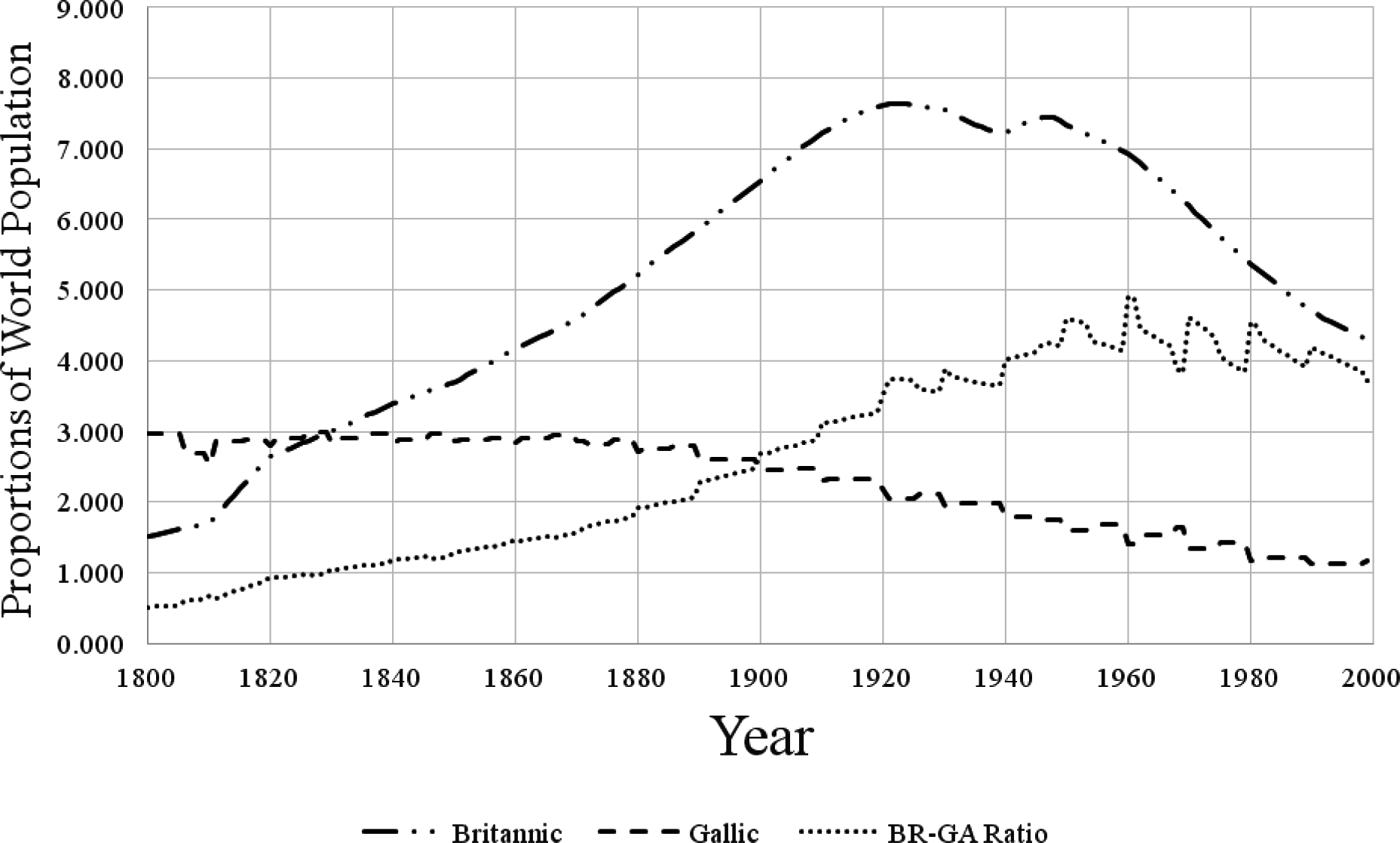
Hutchinson’s ratio may have an analog at the biocultural group level. One candidate Type II group selection characteristic that should illustrate this principle is group population size, and at this level, there may be character displacement between groups. As the Gallic biocultural group has become historically less successful than the Britannic biocultural group in between-group competition over the past 200 years, we suspect that the previously more successful Gallic biocultural group should have contracted to a smaller proportion of the world population relative to the Britannic biocultural group. A temporal trend should therefore reveal a positive association over time if the Britannic proportion of the world population is compared with the Gallic proportion of the world population. An increase in this population ratio over time would indicate the action of the TLS-type process in producing an accommodation that ensured the coexistence of the two populations and prevented full competitive exclusion. The results of this analysis are displayed graphically in Figure 1. We interpret these relations as supporting our proposal that these results conform to pertinent TLS predictions.
Britannic and Gallic proportions of world population across AD 1800–1999.

However, these processes might be confounded in the present diachronic within-group comparisons by the ecological context of strong between-group competition, as historically existed between the Gallic and the Britannic populations in the Age of Empire. Thus, one possibility is that competition for the same socioecological niche might be leading to selection for convergent LH specializations within each of the two populations. The locus of differentiation may thus have shifted to the between-group level so as to avoid the competitive exclusion that would inevitably result from two biocultural groups trying to occupy the same socioecological niche. Consistent with multilevel selection theory, we therefore predict that selection might have acted in different directions and at different strengths across hierarchically nested levels of biological organization. Thus, the opposing processes generated by between-group competition and cooperation over the last 200 years would have instead exerted causal influences upon the historical patterns of within-group strategic diversification of LH adaptations over time in both the Britannic and Gallic populations.
The present study
We subjected the last 200 years of Britannic-Gallic relations to multivariate statistical analyses. The results provide evidence of increasingly complex slow LH societies moving in the direction of peaceful and cooperative relations, such as international trade; correspondingly, these developments have had the effect of limiting between-group competition. These convergent diachronic and synchronic findings broadly align with historical accounts of the evolution of Britannic-Gallic relations over the past two centuries.
We operationalize strategic diversification as the variance among the standardized (z) scores of the component LH traits at any particular point in time. This permitted us to quantify the degree to which either niche expansion or niche compression, as a result of either victory or defeat in between-group competition, exerted effects on the degree of either strategic differentiation or integration among the LH traits of Britannic and Gallic populations.
Methods
Populations sampled
Consistent with Figueredo et al.,Reference Figueredo32 spanning the nineteenth and twentieth centuries (AD 1800–1999), data were collected for Britain, inclusive of the United Kingdom, and its successor states, the United States, Canada, New Zealand, and Australia. With respect to France, French Algeria and French Guiana were added to the traditional confines of the French Republic, as all such territory is included in the national census.
Biodemographic measures
A database maintained by the Groningen Growth and Development Center, known as the Maddison Project database,Reference Bolt33 supplied data on population size and gross domestic product per capita data for the two samples. The Correlates of War databaseReference Sarkees and Wayman34 supplied the warfare mortality estimates, from which only interstate conflicts involving Britain, France, or both nations were included. To provide an intelligible gauge of relative casualties that avoids the confounding effects of demographic differences across time and between nations, standardized rates (per 100,000) were computed after accounting for population size. Roser’s demographic databaseReference Roser and Ortiz-Ospina35 supplied estimates of the proportion of the world population. Lastly, the Gapminder database repository supplied total fertility values,Reference Ajus, Lindgren and Rosling36 infant mortality rates,Reference Johannson, Lindgren and Rosling37 and life expectancy estimates.Reference Lindgren38
Lexicographic measures
Subsuming more than 5.9 million texts and 500 billion written words from AD 1500 to 2008, Google Ngram ViewerReference Michel39 served as the database within which lexicographic searches were conducted. Specifically, within Google Ngram, relative frequencies of key terms were counted between 1800 and 1999, separately in French and English. These lexicographic items were first formulated in English and then translated into French to allow for comparison. As translation can be fraught with difficulties, literal equivalents were not reflexively employed. Instead, a range of conceivable synonymous French terms were generated for each target English term. From that list of synonymous French terms, those selected and included in the analysis showed the highest part-whole correlation by correlating most highly with all other terms in the synonym list.
Statistical analyses
As in Figueredo et al.,Reference Figueredo1 all univariate and multivariate analyses were performed using SAS 9.3 and UniMult 2. A hierarchical analytical strategy was employed. Some missing data at the item level were imputed by the EM algorithm using SAS PROC MI; unit-weighted common factor scalesReference Gorsuch40 were then estimated using SAS PROC STANDARD and DATA, as the means of the standardized scores for the items on each scale and for the scales on each factor.Reference Figueredo41 Also computed were the covariance matrices of the subscales using SAS PROC CORR, as well as the part-whole correlations of the items with the scales and of the scales with the unit-weighted factors.
Unit-weighted factors were then entered as manifest variables into SAS PROC MIXED for multilevel longitudinal analysis.Reference Hertler42 Multilevel models (MLMs) were constructed using SAS PROC MIXED, with heterogeneous autoregressive (ARH-1) residual covariance structures, random intercepts, fixed logarithmic slopes, and maximum likelihood estimation.
Results
The measurement models
Lexicographic scales
Darwin altruism words.
This scale consisted of a collated list of words used throughout Darwin’sReference Darwin43The Descent of Man to refer directly to within-group altruism and indirectly to between-group competition in human populations. Words included were self-sacrifice, kindness, aid, sympathy, duty, fidelity, courage, heroism, obedience, and patriotism. This list was employed to construct a psychometric scale at the population level in recent published work on the diachronic social biogeography of cognitive abilities in the modern history of Britannic populations.Reference Woodley26 It was validated relative to diachronically convergent indicators of competition among groups, and the translation and adaptation process to French was recently validated as well.Reference Figueredo32 The equivalent words in the French version were abnégation, bienveillance, charité, compassion, devoir, dévouement, hardiesse, héroïsme, obéissance, and patriotisme.
Unit-weighted factor loadings in the Britannic version ranged from .286 to .915 (all significant at p < .05), with the overall factor explaining 55.21% of the variance in the total word usage frequencies in publications from 1800 to 2000. In the Gallic version, factor loadings ranged from .400 to .943 (all significant), and 62.28% of the variance was explained by the common factor among words.
Slow LH words and fast LH words. Two lists were compiled, obtained from the collections of words reported by Sherman, Figueredo, and FunderReference Sherman, Figueredo and Funder44 that have been demonstrated to exhibit different average frequencies in the verbal outputs of slower and faster LH strategists, who were empirically identified by nonlexicographic methods. For each language, the optimal subsets of words were psychometrically selected from these lists if they exhibited adequate part-whole correlations to the corresponding aggregate scale score using data on word usage from AD 1800 to 1999, a procedure that maximized the internal consistency of each lexicographic scale. An equal number of semantically equivalent, or maximally comparable, words were selected for the two languages, to protect against the possibility of capitalizing on chance associations in the psychometric selection of words. This procedure ensured that each word was semantically cross-validated across both languages. In spite of these steps, internal consistency with respect to the factor scale was not guaranteed to be consistently high for every single item, as illustrated by the negative (albeit statistically nonsignificant) part-whole correlations of the items victoire and songes in the French version of the scale.Reference Figueredo32
Unit-weighted factor loadings for the slow LH factor in the Britannic version ranged from .822 to .974 (all significant), and the overall factor explained 86.11% of the variance in the total word usage frequencies. In the Gallic version, factor loadings ranged from –.107 to .937 (all positive and significant except for victoire), and 64.66% of the variance was explained by the common factor among word usage estimates. For the fast LH factor, in the Britannic version loadings ranged from .295 to .956 (all significant), with 61.77% of the variance explained by the common factor, and in the Gallic version loadings ranged from –.286 to .917 (all positive and significant, except for the negative and significant loading upon songes), with the common factor explaining 54.33% of the variance among usage frequencies for the words. These two item irregularities were not corrected to maintain the integrity of the selection procedures, given that the overall convergent validities of the two scales were quite acceptable and capitalization on chance might also occur in item elimination and not just selection.
Common factor models
Between-group (BG) competition factor.
This latent common factor was constructed for each of the two populations examined in the study to estimate between-group competition based on three different types of data spanning AD 1800 to 1999: usage frequency of altruism-related words (see Darwin altruism words earlier), proportion of the world’s population made up of each of the two, and per capita war mortality. This approach is the same as that used in the diachronic social biogeography study of cognitive abilities in Britannic populationsReference Woodley26; here it was applied to both Britannic and Gallic populations.
The convergent indicators of the between-group competition factor were explicitly sampled from the two types of group selection characteristics hypothesized by OkashaReference Okasha20: (1) The proportions of war fatalities and the relative frequencies of Darwin’s altruism words sampled Okasha’s Type I group selection characteristics, which are individual difference traits under frequency-dependent selection that affect the relative fitness of social groups depending on the relative proportions of altruistic and selfish phenotypes within each group. (2) The relative proportions of the world population encompassed by either the former Gallic or Britannic empires and successor states sampled Okasha’s Type II group selection characteristics, which are emergent properties that exist only at the level of the group and are not manifest at the level of the individual.
Unit-weighted factor loadings in the Britannic version ranged from .415 to .662 (all significant), with the overall factor explaining 27.49% of the indicators variance. In the Gallic version, factor loadings ranged from .518 to .923 (all significant), and 59.54% of the variance was explained by the common factor among words.
Slow life history (LH factor). This was a latent common factor constructed to measure slower LH strategies using five convergent LH indicator traits: (1) life expectancy; (2) total fertility rate, reversed; (3) infant mortality rate, reversed; (4) the lexicographic slow LH words scale; and (5) the lexicographic fast LH words scale, reversed. The total fertility rate, infant mortality rate, and fast LH words scales were reverse-scored prior to aggregation for both Britannic and Gallic populations to orient the direction of the scale toward reflecting slower LH strategies.
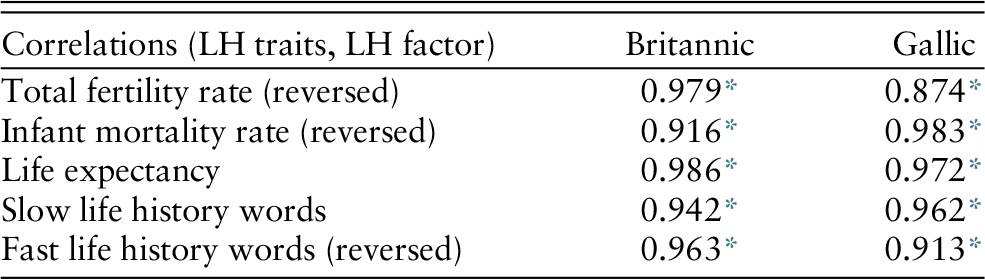
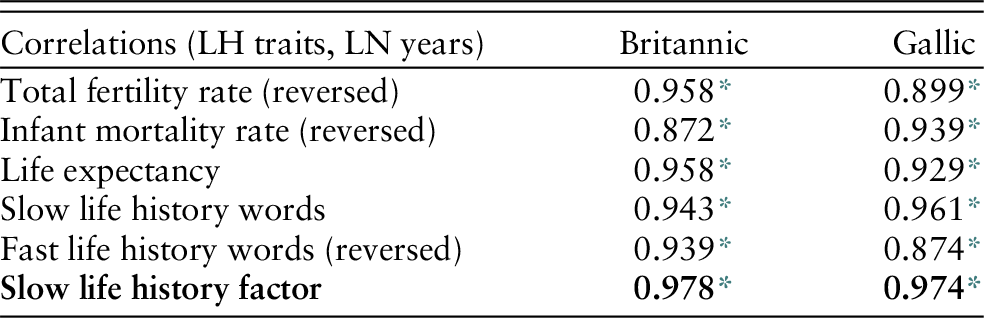
Table 1 displays the part-whole correlations of each convergent LH indicator with the latent LH common factor, in parallel for Britannic and Gallic populations. The unit-weighted factor loadings were marginally higher overall for the Britannic than the Gallic data.
Part-whole correlations of slow life history traits converging on a single slow life history factor in Britannic and Gallic populations.

* p < .05.
Descriptive statistics
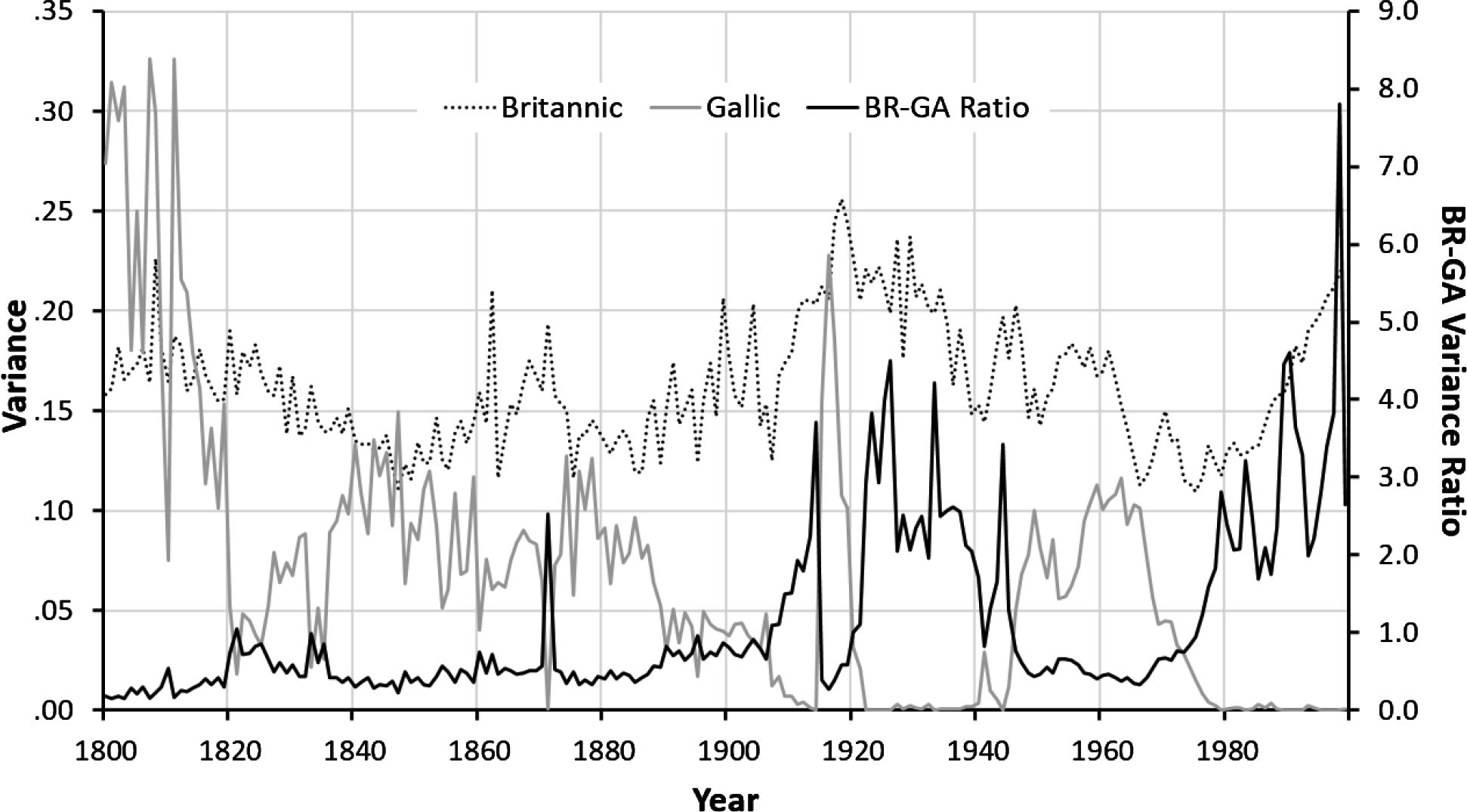
For a complete tabulation of these data, as opposed to the statistical summary that follows, see Appendix A. A summary of this information is displayed graphically in Figure 2.
Britannic and Gallic cross-sectional cross-trait variances (mean squares) among life history indicators across AD 1800–1999 (using logarithmic scales).

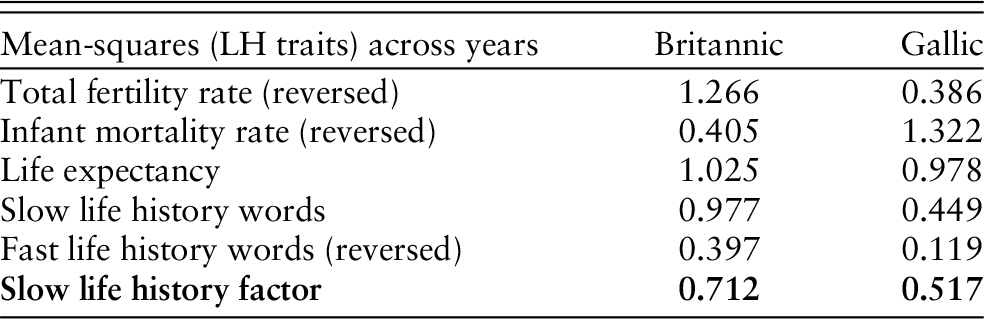
The sample variances of the standardized (z) scores of each of the five LH indicator traits are displayed in Table 2, aggregated across AD 1800–1999, which shows that these variances are somewhat greater in magnitude for the Britannic than the Gallic LH traits in all but infant mortality rate (reversed), for which the Gallic mean was higher.
Mean-squares (variances) of life history traits across years (AD 1800–1999) for Britannic and Gallic populations.

To assess strategic differentiation within each of the two biocultural groups, cross-trait sample variances (mean-squares) were computed in parallel across the five convergent LH indicators for each cross-sectional time point, again spanning AD 1800–1999. Table 3 shows the bivariate correlations of the levels of these five LH indicator traits with the natural logarithmic function of time in years, showing nearly identical logarithmic slopes for each of the five LH indicator traits across the Britannic and Gallic biocultural groups. The greatest discrepancy among groups was found in fast LH words (reversed), and that difference was only equal to .065; for the overall slow LH factor as a whole, the discrepancy was only equal to .04, favoring the Britannic group.
Correlations of slow life history traits and slow life history factor with the natural logarithm of years (AD 1800–1999) showing time trends in Britannic and Gallic populations.

* p < .05.
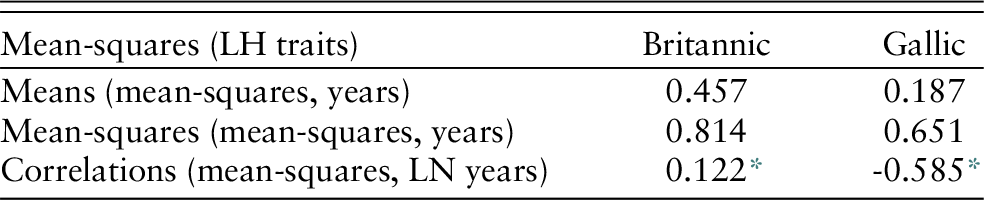
These mean-squares across LH traits were aggregated separately for the Britannic and Gallic populations, and the arithmetic means and sample variances were computed across years for the cross-trait sample mean-squares, representing the relative degrees of strategic differentiation among LH traits. These comparisons are shown in Table 4. In addition, Table 4 displays the bivariate correlations of these same mean-squares with the natural logarithmic function of time in years, showing a marked discrepancy between both the magnitudes and directions of the logarithmic time slopes of the Britannic and the Gallic biocultural groups, with the Britannic slope being statistically significant and positive and the Gallic slope being statistically significant and negative as well as quite large by comparison in absolute magnitude. This inequality relation was tested for statistical significance and supported by the MLM nested model comparisons reported here.
Means across years, mean-squares across years, and correlations with natural logarithm of years (AD 1800–1999) for mean-squares (variances) of life history traits in Britannic and Gallic populations.

* p < .05
The structural models
Multilevel models.
We constructed two nested MLMs to determine whether the statistically equivalent growth curve parameters could account for the diachronic variances among our five slow LH traits, using the same methods that were successfully applied with the “co-occurrence nexus” of cognitive abilitiesReference Woodley26 and the corresponding nexus of LH traits for data spanning the same period.
The cross-sectional variances across the five hypothesized slow LH indicator traits were modeled as a natural logarithmic function of time in years (AD 1800–1999), as in the previous work cited. These MLMs allowed us to ascertain whether the serially autoregressive effects were negligibly small (estimated as covariances of zero) for the array of cross-sectional cross-trait variances, as they previously were found to be for the unit-weighted common factor score of the slow LH factor, operationalized as the arithmetic mean of the five standardized LH indicator traits.Reference Figueredo32 This turned out to be the case, meaning that the descriptive statistics reported did not need to be corrected for any residual covariances among successive observations.
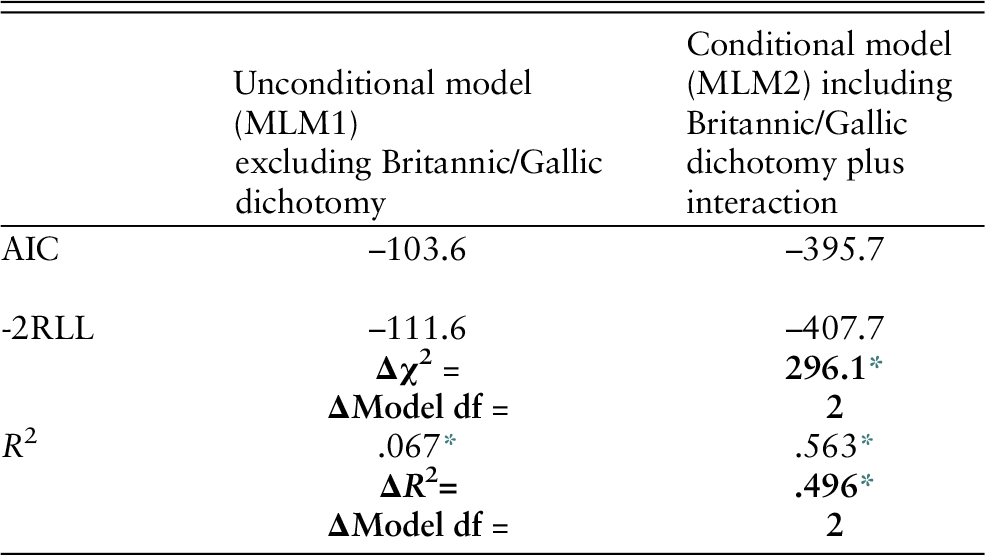
These MLMs also allowed us to compare two alternative model specifications, as in the previous work cited, including (MLM2) and excluding (MLM1), a categorical variable distinguishing the Britannic from the Gallic biocultural groups and its interaction with the main effect of logarithmic time. A statistically significant (p < .05) interaction term of this categorical variable with the natural logarithmic function of time indicated that the temporal slopes were indeed different in both direction and magnitude between those biocultural groups, which justified reporting them as separate parameter estimates in the descriptive statistics reported. These results are consistent with the formal nested model comparison shown in Table 5 using AIC, –2RLL, and R 2 as relative indices of model fit. Statistically significant (p < .05) differences were found between the nested models MLM2 and MLM1 in both –2RLL and R 2.
Nested MLM comparisons for the latent chronometric slow life history factor as a natural logarithmic function of time, comparing and contrasting Britannic and Gallic populations across AD 1800–1999.

* p < .05.
The general linear model.
Finally, a general linear model (GLM) was constructed to estimate and test the main effects and interactions of the MLM residuals of the between-group competition (rBGC) factor, statistically controlled for the logarithmic effect of time, as well as any single-lagged heterogeneous autoregressive serial dependencies among successive data, on the cross-sectional variances of the five hypothesized slow LH indicator traits. This is a critical test of our theory in that any unmeasured occurrences that might have happened over the 200-year period in question could conceivably have generated the differential effects of time observed on the Gallic and Britannic populations.
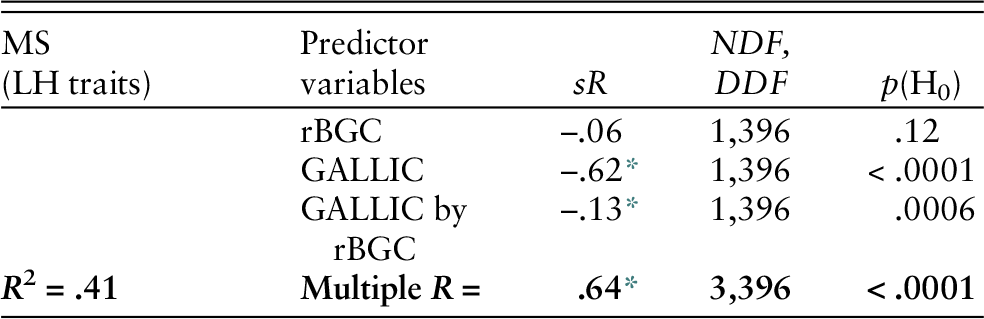
However, if the time-residualized values of between-group competition (rBGC) were to predict those cross-sectional cross-trait variances among LH indicators, then it would support our theoretical interpretation that rBGC is a likely candidate for the prime causal factor in producing those phenomena. The results displayed in Table 6 demonstrate that this is indeed the case, with sR representing the semipartial correlation in the context of a hierarchical regression model.
GLM comparisons for the cross-sectional, cross-trait variances among convergent indicators of slow life history as a function of between-group competition, residualized by MLM for any logarithmic effects of time, comparing and contrasting Britannic and Gallic populations across AD 1800–1999.

* p < .05.
This GLM shows no significant main effect of rBGC, indicating that the competition had no impact on the cross-sectional, cross-trait variances among LH indicators in Britannic populations. However, both the main effect and the interaction terms of the Gallic (versus Britannic) dichotomous variable were both negative and unequivocally statistically significant. What this can be interpreted to mean is that intense competition between groups per se has no such effects unless one loses it, independently of any secular temporal trend. In the case of the Gallic biocultural group, losing the competition with the Britannic group substantially reduced its strategic diversification in LH parameters over the historical period specified. The victorious Britannic biocultural group, in contrast, displayed no such ill effects from the contest.
Discussion
Summary of results
We tracked the relative integration and differentiation among LH traits over the period spanning AD 1800–1999 in the Britannic and Gallic biocultural groups and found that during this historical period, the Britannic populations tended toward greater strategic differentiation and the Gallic populations tended toward greater strategic integration. This was revealed by having estimated logarithmic time slopes in their cross-sectional, cross-trait variances that were significantly different in both magnitudes and directions over the specified period of time. However, the existence of different time trends does not support causal attribution. The basic hypothesis underlying this study was that the dynamics of between-group competition between these two erstwhile rival biocultural groups over the two centuries of interest were the factors driving these processes. By constructing a latent factor that specifically sought to measure between-group competition and residualizing it for the logarithmic effects of time, we were able to make a time-independent test of whether and how the levels of between-group competition at any point in time might affect the observed strategic integration and differentiation on each independent occasion. We found a significantly asymmetrical impact of between-group competition, where that factor appeared to be driving the diachronic integration in Gallic populations but having no significantly corresponding influence on the parallel process of diachronic differentiation in Britannic populations. This suggests that the latter process was attributable to some alternative and unmeasured causes, such as the resource abundance consequent to territorial expansion rather than contraction.
We now turn to the broader theoretical interpretations of how these findings relate to what is either known or theorized about the dynamics of competition and cooperation among human (and selected nonhuman) biocultural groups.
Competition, conflict, coexistence, and cooperation among human biocultural groups
Although between-group competition is a pervasive phenomenon across human and nonhuman species, instances of lethal between-group conflict have been reported for only a few species, including spotted hyenas, lions, cheetahs, grey wolves, red colobus monkeys, mountain gorillas, chimpanzees, and human societies.Reference Wrangham14, Reference Gat45, Reference Keeley46, Reference Rosenbaum, Vecellio and Stoinski47, Reference Wilson48 The paleoanthropological and ethnographic evidence concerning human between-group conflict supports the occurrence of lethal conflicts in medium and small-scale societies.Reference Estabrook49, Reference Guilaine and Zammit50, Reference Lahr51, Reference LeBlanc52 Furthermore, when contrasted with the current mortality rates due to interstate warfare, hunter-gatherer and horticulturalist societies experienced a higher percentage of deaths due to between-group violence.Reference Wrangham, Wilson and Muller53 Nonetheless, between-group killings are frequently associated with warfare among national polities. Standardized comparisons between pre-state and state societies indicate that after accounting for population size, states experience lower percentages of individuals killed in battles, raids, and ambushes, compared with small- and medium-scale societies.Reference Keeley46
Furthermore, this pattern is not exclusive to contemporary polities, as conflicts experienced by premodern states, such as the so-called Aztec (i.e., Mexica or Nahua) Triple Alliance, were lower than that of bands of hunter-gatherers and horticulturalists.Reference Keeley46 Although further tests are required, the pattern in the data suggests that, rather than fitting a positive linear trend between warfare and the degree of sociopolitical complexity, the prehistoric and historic pattern of between-group killings is best represented as a curvilinear function where bands and states experienced fewer deaths due to between-group aggressions relative to tribes of horticulturalists. Moreover, with respect to modern and contemporary states, the current data provide further evidence of a general decline of war deaths in the last 400 years, with some estimates being lower than 2 percent of deaths even after combining all North American and European conflicts during the twentieth century.Reference Keeley46
Between-group conflict, killings, and warfare are widespread phenomena in humans, but coexistence and cooperation between overlapping, adjacent, or even distant groups are not uncommon. Evidence suggests that early humans (e.g., Aurignacian and Gravettian cultures) engaged in internal and long-distance trade of raw materials such as stone, ivory, and fossil and marine shells, and their innovations were widely dispersed, suggesting that they shared knowledge as well.Reference Horan, Bulte and Shogren54 Likewise, the ancient Silk Road is an exemplar of a trade system that connected multiple adjacent and distant populations through commerce that mutually influenced their cultures over two millennia, although debates exist as to how coherent the trade system was in the Silk Road and other smaller networks.Reference Ball55 Importantly, commercial exchanges, whether formally organized or not, overwhelmingly reflect relations of amity between populations,Reference Pollins56 serving as indicators of cooperative disposition. Alliances between distinct (and at times even severely contrasting, as in the case of Athens and Sparta) populations have materialized throughout history, from ancient Mesopotamia to the World Wars and in ongoing relations. The amicable nature of such relations is usually not limited to the development of stronger military power but generalizes to other forms of cooperative relations. Therefore, to this day, there is considerable overlap between trade blocs and mutual defense arrangements.
Nevertheless, an important conceptual distinction must be made between coexistence and active cooperation. Coexistence does not necessarily imply cooperation. Furthermore, empirical relations between within-group and between-group cooperation are unclear. Early experimental studies identified that groups demonstrating internal cooperation exhibited more cooperation at the between-group level subsequently, during negotiations, while groups experiencing internal conflict were also, to a certain degree, more competitive at the between-group level.Reference Keenan and Carnevale57 More recently, however, contrary evidence suggests that within-group cooperation pays off when there is competition, rather than cooperation, among groups,Reference Puurtinen and Mappes58 although the experimental design relying on the formation of artificial groups by random assignment does not necessarily replicate the relations established at the complex level of between-nation interactions. Recent analyses of true relations among within-group and between-group conflict using data on 66 national polities indicate support for earlier studies, with a strong effect of within-group upon between-group conflict.Reference Figueredo1 On the other hand, KeeleyReference Keeley46 pointed out that violent conflict breaks out between societies that are trading partners more often than between those that are not.
Theoretically, ecological processes undergird the dynamics of competition, cooperation, and coexistence. These processes specifically pertain to niche theory, as articulated by George Evelyn Hutchinson,Reference Hutchinson59 who conceptualized a species’ niche as being composed of the sum of environmental gradients with respect to which a species is distributed in some unimodal fashion. Different species can compete over the same set of gradients. Species can also accommodate one another with respect to their distributions in niche space via character displacement—whereby different species come to occupy different regions of niche space—exploiting different ranges of the same resource. This distinction is reflected in the difference between the species’ fundamental niche, which corresponds to all environmental dimensions and distributions that a species could potentially encompass, and the realized niche, which corresponds to the actual observed distribution of that species through its niche—dimensions of which may be shared with other overlapping species’ niches imposing constraints on that species’ distribution. Excessive overlapping of realized niche space causes competitive exclusion, whereby small differences in fitness between species will inevitably lead to one species outcompeting the other and driving it into extinction. Alternatively, character displacement among species can lead to coexistence among morphologically and phylogenetically very similar species within a single habitat via the members of one species simply shrinking in size relative to the other, thus permitting them to exploit an alternative bioenergetic regime limiting competition.Reference Hutchinson59 This body of ecological theory should also be applicable to human biocultural groups within the framework of a multilevel selection model.
Periods of coexistence among human biocultural groups appear to be facilitated spontaneously when there is increased availability of resources, such as in warm historical periods that permit crop abundance rather than famine and thus mitigate conflict for land.Reference Zhang60 Although selection pressure for competitive territory establishment is relaxed in such periods, this does not preclude a certain degree of continued economic competition between trading partners, with different societies developing competitive advantages in different economic domains. The construction and maintenance of specialized micro-niches (a corollary of slow LH strategy populationsReference Woodley and Fernandes28) necessarily involve some competitive pressures along with the establishment of networks of exchange.Reference Fernandes61 Strategic specialization in LH strategies and diversity in labor, production, and commerce co-occur, increasing the aggregate productivity of populations involved in this network of specialists, relative to fast LH populations of generalists with little or no cooperative relations.
More broadly, regimes of micro-niche partitioning and exclusion should drive patterns of competition and coexistence among human biocultural groups. Evidence for these micro-niche dynamics can be seen in operationalizations of strategic differentiation and integration among biocultural groups, specifically nation-states, as a function of their aggregate LH speeds. Slow LH nation-states exhibit much weaker intercorrelations among constituent LH indicators than do fast LH groups, evidencing group-level character displacement (and niche splitting) among slow LH groups, permitting multiple distinct biocultural groups to coexist with high intrinsic population densities and relatively little land (such as in the case of Europe). Being a cooperative strategy, high group-level character displacement via strategic differentiation is related to between-group peace, whereas high strategic integration and concomitant micro-niche overlap are associated with between-group conflict.Reference Figueredo1
Limitations of the study
As Figueredo and colleaguesReference Figueredo32 share overlapping data sets, the following limitations noted in that study may also apply to this study. The lexicographic measures used herein are relatively novel, although they are not unprecedented. Accordingly, this method requires validation against alternative methods. The present study provides the beginnings of such validation, implicit in the fact that findings from this lexicographic method correspond to findings garnered from biodemographic indicators of life history and competition between groups. As this first limitation pertains presently, so do the two following limitations noted in Figueredo and colleagues.Reference Figueredo32 The first of these two relates to assumptions concerning the internal homogeneities of the British and French as biocultural groups. Especially as each nation established and maintained far-flung empires, one can argue, to the contrary, that these groups were in fact heterogeneous. Notwithstanding some degree of heterogeneity, these biocultural groups were organized into cohesive and contrasting polities approximating structured demes within metapopulations.Reference Bowles, Choi and Hopfensitz62, Reference Hauert and Imhof63, Reference Nuismer, Thompson and Gomulkiewicz64, Reference Thompson65, Reference Wilson66
Lastly, our variables of interest operate within a larger ecological matrix, as in any “natural experiment”; and so it is with the French and British, who were often fighting one another as the major protagonists in larger European conflicts. This is a particular limitation to the present study in that analyzed mortality rates for Britain were not exclusively imposed by France, and vice versa. Additional investigations delineating mortality rates, may find applicable life history and economic trends specific to Gallic and Britannic populations, providing specificity to the aggregate information presently obtained.
Supplementary materials
To view supplementary material for this article, please visit http://dx.doi.org/10.1017/pls.2019.12.