Background
Work can play an important role in both developing and maintaining psychological health (Blustein, Reference Blustein2008). It provides a connection to the broader social and economic world which presents opportunities to use skills, as well as offering goals, variety, money, physical security, interpersonal contact and a valued social position (Warr, Reference Warr1987). Among mental health service users, paid employment is associated with greater satisfaction and higher functioning than participation in other activities of daily living (Eklund et al. Reference Eklund, Hansson and Ahlqvist2004). A recent survey of 1353 mental health service users in London found that only 5.5% were in paid work, with a further 12.7% in unpaid vocational activity including involuntary work, study or training (Lloyd-Evans et al. Reference Lloyd-Evans, Marwaha, Burns, Secker, Latimer, Blizard, Killaspy, Totman, Tanskanen and Johnson2012). A recent systematic review highlighted the role of stigma and discrimination as a barrier to finding and keeping work for individuals with a mental health problem (Brohan et al. Reference Brohan, Henderson, Wheat, Malcolm, Clement, Barley, Slade and Thornicroft2012). Disclosure or self-disclosure can be defined as the process of communicating information about oneself verbally to another person (Cozby, Reference Cozby1973). Evidence suggests that employers would like prospective employees to disclose a mental health problem at the application stage (80% in 2006, n = 550, 77% in 2009, n = 500) (Little et al. Reference Little, Henderson, Brohan and Thornicroft2010). However, in eight of the ten papers included in the systematic review, applicants with a mental health problem were rated as less employable than either a candidate with a physical disability (e.g. diabetes, back injury) or a candidate with no disability (Glozier, Reference Glozier1998; Koser et al. Reference Koser, Matsuyama and Kopelman1999; Bricout & Bentley, Reference Bricout and Bentley2000; Hazer & Bedell, Reference Hazer and Bedell2000; Gouvier et al. Reference Gouvier, Sytsma-Jordan and Mayville2003; Pearson et al. Reference Pearson, Ip, Ho, Hui, Yip and Lo2003; Reilly et al. Reference Reilly, Bocketti, Maser and Wennet2006; Zissi et al. Reference Zissi, Rontos, Papageorgiou, Pierrakou and Chtouris2007). This places applicants with a mental health problem in a difficult situation when it comes to deciding how much, if anything, to disclose to a potential employer about a mental health problem.
Stigma and discrimination are not limited to employers. In a survey of the American general population (n = 1444), 58% were unwilling to work closely with someone who has a diagnosis of depression, schizophrenia or drug or alcohol dependency (Martin et al. Reference Martin, Pescosolido and Tuch2000). However, the general public also view individuals with a mental health problem who are in employment in a less stigmatizing way than those who are not in employment (Perkins et al. Reference Perkins, Raines, Tschopp and Warner2009). This highlights another predicament for individuals with a mental health problem, i.e. the general public do not want to work alongside individuals with a mental health problem but evaluate individuals who are in employment more positively.
The legislative context is important in framing disclosure experiences and beliefs. In England, the Equality Act has applied since 2010. This Act includes restrictions on pre-employment questionnaires suggesting that although employers may prefer to have this information, it is generally no longer permitted to request this (Lockwood et al. Reference Lockwood, Henderson and Thornicroft2012). Furthermore, this legislation prohibits unjustifiable less favourable treatment of those with a mental disability and requires an employer to make reasonable adjustments for them (in other jurisdictions often referred to as ‘accommodations’). Not everyone with a mental health problem will be considered as having a disability under the Act: it is limited to those who have an impairment that has a substantial and long-term adverse effect on their normal day-to-day activities. However, if there is a disability under the Act, the person can only be brought within its ambit if the employer has, or could reasonably be expected to have, knowledge of the disability. Therefore, disclosure is a crucially important consideration for an employee or jobseeker in this situation.
There is a need for further in-depth qualitative work to understand the disclosure beliefs and behaviours of English mental health service users (Brohan et al. Reference Brohan, Henderson, Wheat, Malcolm, Clement, Barley, Slade and Thornicroft2012). This study aims to gain an understanding of the beliefs and experiences of mental health service users in disclosing a mental health problem in the employment setting. Interpretative phenomenological approach was used (interpretative phenomenological analysis (IPA)). This method is concerned with detailed examination of individuals' lived experiences and understanding how they make sense of their experiences within the social world (Eatough & Smith, Reference Eatough, Smith, Wilig and Stainton-Rogers2008). This approach has previously been used in addressing related topics including: return to work following mental illness (Millward et al. Reference Millward, Lutte and Purvis2005); and the stigma associated with both mental illness (Knight et al. Reference Knight, Wykes and Hayward2003) and chronic fatigue syndrome (Dickson et al. Reference Dickson, Knussen and Flowers2007). It was selected as it principally examines the way in which people conceptualize the issues they face, and how they arrive at and represent the decisions they make (Smith, Reference Smith, Smith, Harre and Van Langenhove1995; Chapman & Smith, Reference Chapman and Smith2002). This study aims to produce a rich account of experiences and beliefs in this area, drawing together key themes and descriptions to produce a thematic framework (Phase one). Supporting evidence will then be considered in further validating the thematic framework of disclosure beliefs and experiences (Phase two).
Method
Participants
Participants in Phase one were a convenience sample of people currently using secondary mental health care services and aged at least 18 years. Ethical approval (Joint South London and Maudsley and Institute of Psychiatry research ethics committee, ref: 07/Q0706/21) was obtained. Phase two involved a secondary analysis of data collected as part of the Discrimination and Stigma (DISC) study (Brohan et al. Reference Brohan, Clement, Rose, Sartorius, Slade and Thornicroft2013). Ten verbatim transcripts of DISC study interviews were selected from participants in each of three employment categories: (1) employed or in education; (2) voluntary employment and (3) unemployed or job seeking. An equal number of transcripts were selected from male and female participants.
Procedure
Phase one interviews were conducted at the participant's home or their mental health service. Themes identified in the meta-ethnographic component of a systematic review were used to inform the interview schedule (Brohan et al. Reference Brohan, Henderson, Wheat, Malcolm, Clement, Barley, Slade and Thornicroft2012).
The interview schedule focused on six main areas: (1) experiences of a mental health problem; (2) experiences with paid employment, education or voluntary employment; (3) personal experience of disclosure; (4) beliefs about disclosure; (5) experiences and expectations of mental illness stigma; (6) knowledge of the legal aspects of disclosure in the context of employment. The purpose of this interview schedule was to allow participants to speak freely about their beliefs and experiences regarding disclosure of a mental health problem in the workplace. Emphasis was placed on constructing open-ended, non-directive questions and a funnelling approach was used with questions moving from the general to the more focused (Dickson-Swift et al. Reference Dickson-Swift, James, Kippen and Liamputtong2007). Interviews were digitally recorded and transcribed verbatim.
In Phase two, the themes identified in Phase one were further validated through secondary analysis of verbatim transcripts of DISC interviews. Aspects of the transcript related to employment and concealment of a mental health problem were included.
Analysis
In Phase one, IPA was used in the analysis of verbatim transcripts. The guidelines outlined by Smith and colleagues were used as the basis for the analysis (Smith et al. Reference Smith, Jarman, Osborn, Murray and Chamberlain1999). A collaborative approach was taken in the early stages of data analysis with a second researcher conducting the below steps 1–5 at the same time as the primary researcher:
1. The first transcript was read thoroughly and coded using NVivo software.
2. The themes identified from the transcript were listed and examined for connections between them, with certain themes seen to cluster together.
3. As each new cluster was identified, the transcript was rechecked to ensure that these connections were an accurate representation of the interview data.
4. A table of coherently ordered themes was then produced for each transcript. This identified each super-ordinate theme and associated sub-themes.
5. The theme lists for each transcript, provided by each researcher, were then read together and combined. When new themes were identified in subsequent interviews, they were tested against earlier transcripts. New themes were adjusted, or became either a super-ordinate or a sub-theme of an earlier derived theme. This continued until a consistent and inclusive set of themes was developed.
The primary researcher then reread each transcript with the complete theme list as a reference point. The second researcher checked the codes applied to the first seven interviews. Both researchers discussed many areas of discrepancy and agreed on the final thematic framework at this point. Any final adjustments to the theme list were made at this stage and the primary researcher recoded any necessary areas of the transcripts. The analysis then continued into the write-up stage using the themes and verbatim examples to produce a narrative of the participants' experiences of the topic. Demographic data were analysed using SPSS version 15 (SPSS, 2006).
In Phase two, verbatim transcripts of the selected sections were analysed using the theme list identified in Phase one as coding categories. Instances of each coding category were counted. This follows the approach of directed content analysis by basing the coding categories on a framework developed from existing theoretical work (Hsieh & Shannon, Reference Hsieh and Shannon2005). Analysis was conducted using NVivo version 8 (QSR International Pty Ltd., 2008). The following procedure was used: (1) each transcript was read and coded independently using the super-ordinate themes and subthemes developed in Phase one; (2) any additional themes not covered by this thematic framework were assigned a new code; (3) when all transcripts had been coded, the additional themes were reviewed. Any additional theme which was present in two or more of the 30 transcripts was assigned a new code; and (4) all transcripts were recoded using the revised thematic framework.
The credibility of the IPA analysis was examined. Two markers of validity were considered: (1) sensitivity to context; and (2) impact and importance (Yardley, Reference Yardley2000). Sensitivity to context was demonstrated by basing the interview schedule on a systematic review of the literature (Brohan et al. Reference Brohan, Henderson, Wheat, Malcolm, Clement, Barley, Slade and Thornicroft2012). Sensitivity to the socio-cultural setting, participant's perspective and ethical issues were addressed in discussion with clinical staff and the wider research team. The interview schedule was also reviewed by a service user researcher, who had personal experience of a mental health problem as well as qualitative research experience within the selected service setting. The impact and importance of the analysis will be considered in the discussion.
Two markers of reliability were considered: (1) commitment and rigour and (2) transparency and coherence (Yardley, Reference Yardley2000). The following steps were taken to enhance commitment and rigour: (1) the interview schedule was pilot tested (2) the same researcher carried out all interviews; (3) transcripts were checked by the researcher who carried out the interviews. Transparency and coherence were considered using ‘grounding in examples’, with sufficient verbatim quotations provided to allow the reader to determine the level of interpretation applied to the data (Elliott et al. Reference Elliott, Fischer and Rennie1999). Transparency was also enhanced by including a discussion section on reflexivity in key decision.
Results
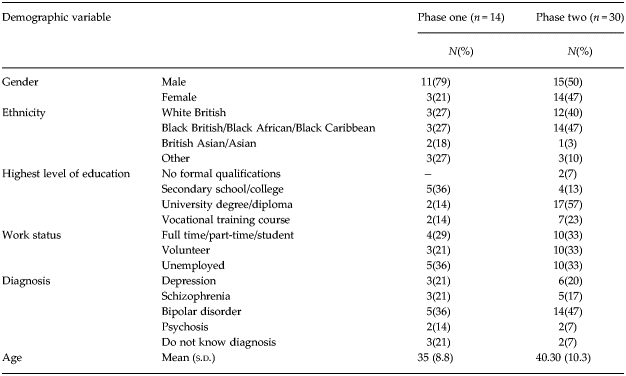
The characteristics of participants in Phase one (n = 14) and Phase two (n = 30) are presented in Table 1.
Demographic characteristics of interview participants

The IPA analysis of Phase one data identified four super-ordinate themes: (1) public understanding of mental health problems; (2) the employment context; (3) personal impact of labelling and (4) disclosure needs. The themes are presented starting with a discussion of the wider societal factors which influence disclosure beliefs and behaviours in the theme ‘Public understanding of mental health problems’, followed by a consideration of workplace = specific factors in ‘the employment context’ and funnelling down to more personal beliefs and experiences related to disclosure in the final super-ordinate themes of ‘personal impact of labelling’ and ‘disclosure needs’.
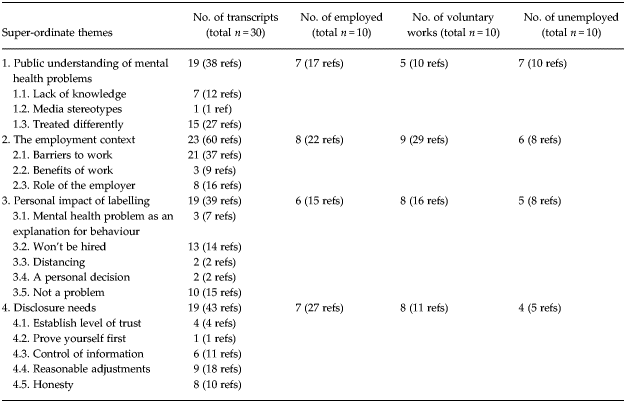
In Phase two, no additional codes were identified which were present in two or more transcripts. Therefore, the original thematic framework as applied in Phase one was used. Table 2 presents the frequency of each super-ordinate theme in the 30 transcripts. The super-ordinate themes are represented across each of the three employment categories.
Thematic structure by employment status in Phase two (n = 30)
Each super-ordinate theme and its constituent sub-themes will now be discussed with examples from Phase one. Examples have been taken from Phase one, as these interviews were conducted to specifically focus on this topic. The number of occurrences of each super-ordinate theme and its constituent sub-theme in Phase two is presented in Table 2.
Public understanding of mental health problems
This super-ordinate theme represented participants' belief about how employers understand and respond to people who have been labelled as having a mental health problem. It comprises of three sub-themes: (1) lack of knowledge; (2) media stereotypes; and (3) treated differently.
Lack of knowledge
This sub-theme represents the belief that employers are not particularly informed about mental health problems. Participants also reflected on a ‘lack of knowledge’ experienced in other relationships, such as with friends and family. A desire for employers and others to increase their understanding of mental health problems was expressed.
“I hope they would be all right about it but you know it's hard to say, some people are just not educated about things like that and they might treat you differently, but then I have met some people that understand, not so many” Participant 5
One participant suggested that fear was the reason for a lack of knowledge and that it is easier for people to think about mental health problems with a narrow range of knowledge rather than acknowledge the complexity and diversity involved. This was presented as similar to the fear experienced in other medical conditions such as cancer:
“I just think it's inherent in certain situations because there still is such, well it has to do with ignorance really. I think it's, well I don't know, I think it's across the board in a lot of medical conditions, it's like the fear of cancer, it's really the same thing, it's all fear motivated because people would like to be able to contain things within the idea that they have” Participant 14
Media stereotypes
The second sub-theme concerns the influence of stereotypes on public attitudes to people with a mental health problem. The media was mentioned as an influential factor in perpetuating stereotypical images of people with mental health problems, particularly the idea that people with a mental health problem are violent or should be avoided. Personal reactions to this phenomenon including fear and feeling ‘cut quite deep’ were presented.
“A few years ago that man that went, with the samurai sword, and chopped up all the people in that church down at [local location], people are like he's got a mental illness, they think that everyone is going to be like that that has got a mental illness and they are not” Participant 5
The gulf between these stereotypes and day-to-day ordinariness ‘just like anybody else on the street’ of a mental health problem was expressed.
“There are so many people out there that are just like anybody else on the street and you wouldn't even know that they have got a mental illness but they don't look at it like that, they just think that everyone is off their trolley and stay away, stay away you know what I mean but not everyone is like that. You can suffer from a mental illness get over it, lead a normal life, once you take your tablets (laughs), you can live a reasonable life just like anybody else, I have” Participant 5
Treated differently
The final sub-theme describes experiences or expectations of being treated differently by people who know about their mental health problem, both in the workplace and other settings. Rejection, being looked down on, being treated like a child or as if one is fragile or of low intelligence were described.
“And I got an interview. I said to her that I suffered with mental illness but it's clearing up now and I am feeling a lot better than what I was, I can work. And when I told her that you could see, literally saw on the woman's face, her face just dropped, it was like she was happy to employ me up until that point, it was like I already had the job, you know sometimes you know straight away that you've got the job but when I said that I knew I didn't” Participant 12
Situations in which the other person was uncomfortable or unsure of how to behave and situations in which their behaviour was overly intrusive, although possibly well intentioned, were also described.
The employment context
This super-ordinate theme presents beliefs and experiences about employment. This was a broader theme which reflected disclosure as one element in the larger decision of deciding whether and how to obtain employment. There are three constituent sub-themes: (1) barriers to work; (2) benefits of work; and (3) role of the employer.
Barriers to work
Although participants were not specifically asked about barriers to work, this topic emerged. Concern about the impact of employment on disability benefits was particularly reported as a barrier to seeking work. There was a view that the benefits system is difficult to navigate and there was a suspicion that individuals may be forced into taking on more work than they can manage.
“I think the difficulty is that the pay and the benefits side. It sometimes put me off going into work. That sort of information is not very straightforward” Participant 7
Other barriers to work included a lack of confidence due to previous rejections when applying for work or a feeling that illness combined with other factors such as lack of qualifications or age may make it difficult to get a job.
Benefits of work
Work was presented as a step forward, a challenge and an important part in the recovery process. The reported benefits of work included: financial gain, boosting confidence, giving something back to the community, keeping oneself busy and providing structure and purpose in life.
“I suppose it's generally willpower, you know saying to yourself that you have a purpose in life, there is a, you know you should make a sort of reason for yourself to get up out of bed and go out there and do something, have an ambition because I suppose you know you just waste your life away if you've got no ambitions in life” Participant 10
Role of the employer
The importance of finding an employer who is accepting of mental health problems was emphasized with participants describing variety in employers' attitudes.
“I think it depends on your employer, I have had really, really good bosses that I know, if that was the case they would but there are also others that would make your job very difficult so it's an individual thing I think. Some people are more open whereas other people just don't want to get involved” Participant 4
Personal impact of labels
The third super-ordinate theme focused on the personal impact of being labelled as having a mental health problem. This is of key importance in disclosure decisions as disclosure is the point at which someone transitions to become one who is labelled.
This theme has five constituent sub-themes: (1) mental health problem as an explanation for behaviour; (2) won't be hired; (3) distancing; (4) a personal decision and (5) not a problem.
Mental health problem as an explanation for behaviour
This included the attribution of everyday behaviour to a mental health problem. Participants described this as a method of undermining them and reported feeling fearful that if they disagree with someone else, lose their temper or do not get along with a colleague then this will be attributed to their mental health problem rather than a difference of opinion between colleagues.
“You have difficulties with that colleague and I've had them use the knowledge of me to say this is why this has happened, because she's not well. In circumstances where I was actually quite well and I was just standing up for myself in a situation, I've had that experience and I find it really frightening so I am very careful who I discuss it with” Participant 14
Won't be hired
The second sub-theme represented anticipated discrimination in hiring. Several participants reported the expectation that their application would be disregarded if they mentioned having a mental health problem.
“I was aware that as soon as I ticked the psychiatric illness box I felt really that the door was closing… I think it was just that it was out of the question really, getting work, and saying to someone that I had a care programme and medication” Participant 7
It was also anticipated that at least some colleagues would be discriminating.
Distancing
This sub-theme included occasions where participants reported separating themselves from both labels related to mental health problems or to disability. This distancing was described as necessary to preserve a healthy self-image and reduce the stress and discomfort involved in interacting with individuals who have stigmatizing views.
“I mean like what they put in the newspapers about mental health problems, it would make me feel as if I really have a mental health problem, it would make me unable to continue and be active with work and study, now if I ignore the fact that I have mental health problems, not to think about that so it wouldn't be a barrier” Participant 11
A personal decision
The personal nature of disclosure was highlighted. Participants emphasized the influence of personal characteristics such as confidence and levels of comfort at discussing mental health problems in deciding whether to disclose.
“It's kind of an individual thing, it's kind of how you would react to somebody else laughing at you about it, people talking about you behind your back, it's how you would handle that and I think it's very much an individual thing” Participant 4
Not a problem
This sub-theme reflects a different viewpoint on the personal effect of labelling. For several participants, this was not something which had a particular effect on employment or which was perceived as problematic in other areas of life.
“I was very successful because at the end of the day as you've probably guessed, I am not afraid to speak to people about illness, at the end of the day by doing that I find I get any of the jobs” Participant 12
Disclosure needs
The final super-ordinate theme is disclosure needs. This theme focuses on aspects of the personal and interpersonal nature of disclosure. There are five sub-themes: (1) establish level of trust; (2) prove yourself first; (3) control of information; (4) reasonable adjustments; and (5) honesty.
Establish level of trust
The need to establish trust prior to disclosure and to be careful when disclosing were discussed.
“Just the development of relationships with people and being able to trust them hopefully to the extent and it's also that kind of you know you can't always be sure that this is the right choice and it's that thing of hoping that with in any given relationship that you can trust somebody enough to talk to them about the intimate parts of your life” Participant 14
A step-by-step approach was mentioned by participants in establishing whether the target could be trusted. This involved introducing information slowly and gauging the person's reaction before presenting further information.
“I would explain the fact that the mood disorder is a fluctuation in mood, and the schizophrenic aspect is delusion, the word to use is delusion and grandiosity etc. which is pretty hard to explain but yeah it's, you basically take it easy, give them a little bit of information then build up gradually” Participant 3
The benefits of disclosing within a ‘safe’ environment were also described.
“It is completely beneficial to disclose. I mean when I worked at (organisation that promotes service user expertise) and I was out, I never had to watch what I said about anything, I never had to be careful you know and it's a very powerful thing to be able to do that but it was only within this very isolated community that I felt safe to do that” Participant 14
Prove yourself first
Participants reported not introducing information about their mental health problem until a point where the employer had become familiar with other aspects of their self, such as their work performance or personality. This avoided prejudice and emphasis on the mental health problem as a core aspect of their perceived identity.
“I don't want people to form their opinions of me without seeing for themselves the facts first of what I am actually like, I mean it's the old saying that you can't judge a book by its cover, do you know what I mean, you've got to get to know the person first and see for yourself, not just to form an opinion on nothing. It's not fair to me or to anybody else, check your facts first then make your mind up and be more open minded, that's what I say” Participant 5
Control of information
One participant suggested that although the person can choose when to disclose; this choice may be removed if they become ill or want to use their insider knowledge as a mental health service user in their job.
“It's just another one of those situations where you can't control what happens with it, you have to make a decision whether you either disclose or you don't disclose. I mean on a certain level there is this illusion of control and it is just that, around disclosure, because ultimately sooner or later if you are still actively using the services, and if also you use your experience in order to change things where you are ultimately you are not going to be able to control it” Participant 14
Control was also an underlying theme with participants emphasizing that if they were not asked then they would not volunteer information and wishing that they were not asked about illness so they would be able to keep this information private:
“I don't feel a weight in disclosing the information but sometimes I say it's best not to. If the information, if it's not asking you about it, then I wouldn't put it” Participant 2
A previous lack of control due to involuntary treatment was mentioned by several participants. This was not explicitly discussed in relation to disclosure in the employment context; however, these previous experiences of lack of control provided a relevant context for understanding the importance of control of information:
“Just the fact that you are locked in for instance, and the food is horrible, all little things, you are not allowed to, you can't stay up overnight sort of thing so if you are watching a film and it overlaps past midnight you've got to really make an effort you know to let them let you watch it. So it's niggley little things you know” Participant 8
Reasonable adjustments
This sub-theme represents discussion of the need for mental-illness related adjustments in the workplace. Several participants reported not disclosing their illness because they didn't want to be treated differently or because they did not need any adjustments.
“It doesn't affect my work so no I've never really had any reason to say it” Participant 2
For some, disclosure was necessary from the outset due to the need for adjustments:
“I would probably be all right for a week or a month, there might be a whole period where I never take a day off and there may come a day when I am bad or there might come a week when I am bad, I don't want a phone call saying if you don't come in you will lose your job and I get that phone call and I know that I can't go in and it's finished” Participant 12
Others reported disclosing only when necessary.
Honesty
Disclosure was presented as a matter of ‘honesty’ with participants discussing the idea that it is ‘dishonest’ not to disclose.
“I wouldn't be able to feel comfortable walking away saying no, those declarations, and you have to sign them, so I think no. I mean at the end of the day if I don't have a clear conscience, I would rather have that than if you have work and find out I have some disturbance” Participant 7
When participants spoke of non-disclosure it was also discussed in terms of honesty with a disclaimer that although they would prefer to be honest this is not possible due to the perceived ramifications.
“If a question like that comes up on an application form, now you know I am an open and honest person, I can put that down but what I show with ticking yes they want to know more about it. When I leave it there they will ask you, it's not about whether you can talk, whether you've got a problem talking about it, it's not a case of that” Participant 2
The need for honesty was also presented as a matter of pride in one's identity and a way of avoiding the stress of concealment.
“I've never hidden my illness from anyone, I'm not ashamed of it, I'm not ashamed of it, you know some people they do treat you differently” Participant 5.
“See I don't need, I'm sure there is enough stress in the work itself; I don't need any extra stress of hiding things from people etc” Participant 3
Discussion
We identify a new four-dimensional framework for understanding the disclosure beliefs and experiences of individuals with a mental health problem. Disclosure was presented as embedded in wider societal, employment and interpersonal contexts. The relationship between themes moves from macro level or societal themes as represented in super-ordinate theme 1 ‘public understanding of mental illness’ to meso level themes which are related to aspects of the employment context as represented in super-ordinate theme 2 ‘the employment context’ through to micro level or personal themes as represented in super-ordinate theme 3 ‘the personal impact of labelling’ and super-ordinate theme 4 ‘disclosure needs’.
The first identified super-ordinate theme is ‘public understanding of mental illness’. This highlights the importance of considering disclosure beliefs and behaviours within the context of a society in which mental health problems are stigmatized. Public knowledge deficits, the predominance of media influenced stereotypical attitudes towards mental health problems and the experience and expectation of unwelcome behaviour from others ranging from rejection and abuse to intrusion and behaving in a patronizing way, are detailed. The theme of being treated differently or experiencing rejection by employers and colleagues is reported elsewhere (Goldberg et al. Reference Goldberg, Killeen and O'Day2005; Michalak et al. Reference Michalak, Yatham, Maxwell, Hale and Lam2007; Owen, Reference Owen2004). However, the role of public knowledge and attitudes has received little previous attention.
The second super-ordinate theme ‘the employment context’ focuses on organizational influences on disclosure beliefs and behaviours. Disclosure decisions were presented as part of a range of decisions related to finding and keeping work. This highlights the need to consider disclosure in conjunction with other factors related to work such as disability benefits, educational qualifications, desire to work and beliefs about benefits and barriers to work. The importance of the fit between the employer and the employee was heavily emphasized, with participants discussing the individual differences between employers and the need to find an employer who is understanding of mental health problems. This links with previous work on factors associated with workplace disclosure including feeling respected and secure in their workplace (Ellison et al. Reference Ellison, Russinova, Donald-Wilson and Lyass2003; Michalak et al. Reference Michalak, Yatham, Maxwell, Hale and Lam2007); and feeling that disclosure would be acceptable within workplace culture (Owen, Reference Owen2004; Goldberg et al. Reference Goldberg, Killeen and O'Day2005; Munir et al. Reference Munir, Leka and Griffiths2005, Reference Munir, Pryce, Haslam, Leka and Griffiths2006).
The third super-ordinate theme ‘personal impact of labelling’ and the fourth super-ordinate theme ‘disclosure needs’ reflect personal factors which influence disclosure beliefs and behaviours. ‘Personal impact of labelling’ contains five sub-themes: (1) mental health problem as an explanation for behaviour; (2) won't be hired; (3) distancing; (4) a personal decision and (5) not a problem. Participants reported experiences of having their mental health problem used to devalue and dismiss their point of view in the workplace, particularly when it differs from that of others. This is related to the theme of gossip which is identified in the literature (Owen, Reference Owen2004). The sub-theme of ‘won't be hired’ is also reflected in qualitative literature (Owen, Reference Owen2004; Auerbach & Richardson, Reference Auerbach and Richardson2005; Goldberg et al. Reference Goldberg, Killeen and O'Day2005; Marwaha & Johnson, Reference Marwaha and Johnson2005). This study builds on previous research by refining the nature of the personal impact of disclosure. ‘Disclosure needs’ is the most personally focused super-ordinate theme. This theme can be understood within the framework of the previous three super-ordinate themes. Disclosure is seen to occur within relationships of trust. Establishing trust with others by proving oneself first and determining whether others can be trusted were emphasized. A conflict was articulated between the desire for honesty and the need to be careful about releasing information. This was reconciled by discussing the timing of disclosure in relation to the need for reasonable adjustments, with participants reflecting that this was the most important consideration in timing of disclosure. This focus on disclosing to gain reasonable adjustments or provide the employer with necessary information is consistent with other studies (Gioia & Brekke, Reference Gioia and Brekke2003; Goldberg et al. Reference Goldberg, Killeen and O'Day2005). This was also discussed in terms of control of information with participants reflecting on previous experiences of feeling a lack of control in their life. One participant described disclosure decisions as having an ‘illusion of control’ as the nature of managing a chronic illness means that sooner or later the invisibility of the illness may be compromised. This is particularly central in understanding how other disclosure needs are formulated.
Reflexivity
A key element of IPA as an analytical position is the acknowledgment that the researcher plays a role in generating both the data itself as well as the analysis. In this section, the influence of the researcher on data and analysis is presented by discussing two key areas in which dilemmas were encountered: (1) acknowledging the ‘disclosure imperative’; and (2) emphasis on the employment context. The researcher is familiar with the concept of the ‘disclosure imperative’ as popularized in the literature on ‘coming out’ and disclosing a lesbian, gay, bisexual or transgender sexual orientation (McLean, Reference McLean2007). This narrative position places disclosure as a fundamental stage in developing a positive and ‘healthy’ sexual identity. A similar position is observed in narratives which present disclosure of a mental health problem as an action which empowers both the self and mental health service users collectively. In this context, those who choose not to disclose may experience feelings of shame that they have acted in a way which does not support actions to reduce stigma or increase the empowerment of mental health service users. Corrigan (Reference Corrigan2003) suggests that mental health services users need further support before they can enact a ‘political’ disclosure such as this, as without this support, the personal implications of disclosure can be detrimental (Corrigan, Reference Corrigan2003). This was considered in choosing the term ‘disclosure’. Many iterations of the term such as ‘coming out’, ‘concealing or revealing’ and ‘being open about’ were considered. However, these were considered ‘value laden’ and reflective of ‘the disclosure imperative’. The term ‘disclosure’ was used; however, the researcher was aware that this can be an unfamiliar word and also a formal word which evokes ideas of the legal aspects of disclosure. To enhance understanding, the researcher informed participants that, for the purposes of this interview, the word disclosure was being used to mean ‘telling at least one person something about one's mental health problem’.
A further area of reflection is that in focusing on the employment context, the researcher may have been corroborating the notion that getting back to work is a desirable activity and a commendable stage of recovery which may have inhibited participants from presenting alternative perspectives on the desirability of employment. However, this does not appear to be the case as participants presented alternative views on the desirability and possibility of employment, with the employment context forming a super-ordinate theme in the analysis.
Strengths and limitations
This study contributes to evidence by focusing on the beliefs and experiences of mental health service users in England. It also uses IPA which has not previously been used in focusing on the topic of disclosure. Previous studies have instead used the grounded theory (Goldberg et al. Reference Goldberg, Killeen and O'Day2005), or thematic analysis (Allen & Carlson, Reference Allen and Carlson2003). IPA is particularly useful in understanding experience and has produced a rich account of the beliefs and behaviours of 14 mental health service users who were interviewed. The study is also unique as the interview schedule was developed following a systematic review of the disclosure literature in this area (Brohan et al. Reference Brohan, Henderson, Wheat, Malcolm, Clement, Barley, Slade and Thornicroft2012) and a narrative review of stigma measures and outcomes (Brohan et al. Reference Brohan, Slade, Clement and Thornicroft2010). In this way, the validity marker of ‘sensitivity to context’ is thoroughly applied. The second proposed validity marker is ‘impact and importance’. This study demonstrates impact and importance by providing an analysis which will directly inform the development of a decision aid tool to assist mental health service users in reaching disclosure decisions in the employment context. The first reliability marker of ‘commitment and rigour’ is demonstrated through detailed description of the process of IPA, as detailed in the Methods Section. The second reliability marker of ‘transparency and coherence’ has been discussed in the previous section on reflexivity, and is further demonstrated through thorough comprehensive grounding in examples.
Phase one cannot be considered reflective of the experiences of mental health service users who are currently in employment as only 4 of the 15 participants were currently employed competitively or in education. The majority of participants were male (11/15) which suggests that men's views and experiences may be over-emphasised in this research. This limitation was mitigated by including the retrospective analysis of DISC interviews in Phase two. This provides further information on the appropriateness of this thematic framework to a wider sample selected according to gender and employment status. This confirmed that the framework was appropriate to describe the beliefs and experiences of men and women in a range of employment contexts. Although all super-ordinate themes were represented across all three groups, two of the subthemes ‘media stereotypes’ and ‘prove yourself’ were only coded once each across the 30 transcripts. This suggests that these two subthemes may be less representative of the beliefs and experiences of this group of participants.
The retrospective analysis also brings some limitations as the questions were not specifically designed to assess aspects of disclosure beliefs and experiences. A large range of aspects related to this are covered with questions asking about: unfair treatment in finding and keeping work; positive treatment in the workplace; avoiding telling people about one's diagnosis; and stopping oneself from applying for work due to stigma and discrimination. However, the wording of questions may have been more specific to disclosure, had they been designed for this purpose.
Furthermore, both phase one and phase two of the study were conducted with individuals recruited from secondary mental health services in South London. Interviews were also conducted during a period of recession in the UK economy. These factors need to be considered in understanding the appropriateness of this disclosure framework for use in other mental health service contexts or in a more prosperous economic time.
Implications
The findings of this study are novel as the data identify the importance of the role of the specific line manager, and not just the culture of the workplace. This suggests that individuals with a mental health problem are more likely to disclose to employers who indicate their readiness to employ such individuals. Otherwise, disclosure may be seen as involving too much risk for the individual. This points to potential interventions of: (1) ensuring job descriptions explicitly allow or even encourage applications from people with experience of mental illness and (2) for some jobs, ensuring that the introductory remarks by an employer at an interview specifically include reference to valuing people with such experiences and these remarks are reflective of organizational policies and practices. Some aspects of disclosure were seen to vary in salience among the three included groups in Phase two (employed or in education; volunteering, unemployed or job-seeking). For example, disclosure needs were more frequently reported by those in the employed and volunteer categories, than those in the unemployed category. This suggests that it may be useful to tailor disclosure considerations depending on the employment status of the target audience.
Financial Support
This research was supported by funding from the Trustees of South London and Maudsley NHS Foundation Trust. Support was also provided by the National Institute for Health Research (NIHR) under its Programme Grants for Applied Research scheme (RP-PG-0606-1053). The views expressed in this publication are those of the author(s) and not necessarily those of the Trustees of SLAM, the NHS, the NIHR or the Department of Health. GT is also funded through a NIHR Specialist Mental Health Biomedical Research Centre at the Institute of Psychiatry, King's College London and the South London and Maudsley NHS Foundation Trust.
Conflict of Interest
The authors declare that they have no competing interests.
Ethical Standards
The authors assert that all procedures contributing to this work comply with the ethical standards of the relevant national and institutional committees on human experimentation and with the Helsinki Declaration of 1975, as revised in 2008.