Introduction
The sterile insect technique (SIT) is increasingly being applied as a component of area-wide integrated pest management (AW-IPM) programmes (Hendrichs et al., Reference Hendrichs, Kenmore, Robinson, Vreysen, Vreysen, Robinson and Hendrichs2007). It has proven to be an effective environmentally friendly tool for the suppression, containment, prevention or eradication of some major insect pests that affect agricultural crops, animal livestock and human lives (Enkerlin, Reference Enkerlin, Dyck, Hendrichs and Robinson2005; Hendrichs et al., Reference Hendrichs, Vreysen, Enkerlin, Cayol, Dyck, Hendrichs and Robinson2005; Klassen, Reference Klassen, Dyck, Hendrichs and Robinson2005). The SIT involves mass-producing the pest insect using an artificial diet, careful timing of irradiation to inhibit reproduction without affecting the performance of the sterile insects, and then releasing them into the target area where they compete reproductively with their wild counterparts (Dyck et al., Reference Dyck, Hendrichs and Robinson2005).
The application of the SIT requires that insects be irradiated at a specific age to maximize the induction of sterility and to minimize the negative effects on the quality and mating competitiveness of the released sterile adults (Bakri et al., Reference Bakri, Mehta, Lance, Dyck, Hendrichs and Robinson2005). In facilities mass-rearing the Mediterranean fruit fly Ceratitis capitata (Wiedemann) at standard holding temperatures, pupae are usually irradiated at about 48 h before adult emergence; this ensures the sterility even of females that are advanced in their development (Ohinata et al., Reference Ohinata, Chambers, Fujimoto, Kashiwai and Miyabara1971; Williamson et al., Reference Williamson, Mitchell and Seo1985; Fisher, Reference Fisher1997; Barnes et al., Reference Barnes, Rosenberg, Arnolds and Johnson2007). This pupal irradiation protocol is also commonly applied to the South American fruit fly Anastrepha fraterculus (Wiedemann) (Allinghi et al., Reference Allinghi, Calcagno, Petit-Marty, Gómez Cendra, Segura, Vera, Cladera, Gramajo, Willink and Vilardi2007), the Mexican fruit fly Anastrepha ludens (Loew), the West Indian fruit fly Anastrepha obliqua (Macquart) (Hernández et al., Reference Hernández, Orozco, Flores Breceda and Domínguez2007), the melon fly Bactrocera cucurbitae (Coquillett) (Teruya and Zukeyama, Reference Teruya and Zukeyama1979; Teruya and Isobe, Reference Teruya and Isobe1982), the oriental fruit fly Bactrocera dorsalis (Hendel) (Sutantawong et al., Reference Sutantawong, Orankanok, Enkerlin, Wornoayporn, Caceres and Barnes2004) and the Philippines fruit fly Bactrocera philippinensis Drew & Hancock (Resilva et al., Reference Resilva, Obra, Zamora and Gaitan2007). However, for genetic sexing strains such as the temperature-sensitive lethal (tsl) strains of C. capitata (Franz, Reference Franz, Dyck, Hendrichs and Robinson2005) that allow the elimination of most of the females at the egg stage, the age at irradiation can be delayed to 24 h before emergence; this increases the sexual performance of the sterile males (Bakri et al., Reference Bakri, Mehta, Lance, Dyck, Hendrichs and Robinson2005; Cáceres et al., Reference Cáceres, Ramírez, Wornoayporn, Islam and Ahmad2007).
Occasionally during SIT operations, there are situations that require fly emergence to be delayed or accelerated, e.g. inclement weather, mechanical failure of irradiation equipment, large differences in cohort size, breakdown in the release operations, and when there is a need to have fewer but larger releases of flies (Enkerlin, Reference Enkerlin2007). These situations require a non-routine management of the temperature conditions of the pupal rooms to accelerate or delay pupal development and careful monitoring of pupal age for the correct timing of pupal irradiation. For C. capitata, pupal eye colour has been used routinely as the most practical and reliable indicator of pupal development and to determine the correct age for irradiation (Ruhm and Calkins, Reference Ruhm and Calkins1981). However, in the various tephritid fruit fly species, pupal development rates differ significantly in different temperature regimens.
Based on the approach developed by Ruhm and Calkins (Reference Ruhm and Calkins1981) for C. capitata, in this study, we observed systematically the eye colour changes during metamorphosis (from pupation to adult emergence) of 12 tephritid fruit fly species held at a wide range of temperatures. The results obtained can be used as a guide or baseline information to determine pupal age and to properly time irradiation.
Materials and methods
Insects
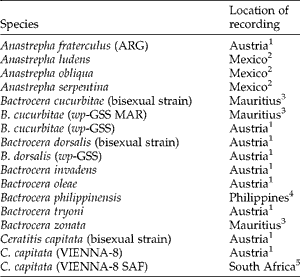
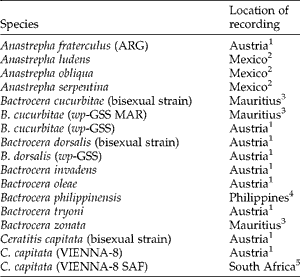
The 12 tephritid fruit fly species studied were A. fraterculus, A. ludens, A. obliqua, A. serpentina (Wiedemann), B. cucurbitae, B. dorsalis, B. invadens (Drew, Tsuruta & White), B. oleae (Rossi), B. philippinensis, B. tryoni (Froggatt), B. zonata (Saunders) and C. capitata. In addition, sexing strains of B. cucurbitae and B. dorsalis, developed in Hawaii (McCombs and Saul, Reference McCombs and Saul1995; McInnis et al., Reference McInnis, Tam, Lim, Komatsu, Kurashima and Albrecht2004), were included and sexing strains of C. capitata developed at the FAO/IAEA Agriculture and Biotechnology Laboratories in Seibersdorf, Austria, were also included (Franz, Reference Franz, Dyck, Hendrichs and Robinson2005). The flies had been reared for several generations. The pupal eye colour recordings were made at research laboratories or at various mass-rearing facilities used in SIT programmes (Table 1). The studies were conducted over several years at various research laboratories and mass-rearing facilities, where experimental conditions were not identical.
Fruit fly species and strains and locations at which pupal eye colour changes were recorded at various holding temperatures
1 FAO/IAEA Insect Pest Control Laboratory, Seibersdorf.
2 Moscamed/Moscafrut Mass-Rearing Facility, Tapachula.
3 Ministry of Agro-Industry and Fisheries, Entomology Division, Reduit.
4 PNRI Fruit Fly Mass-Rearing Facility, Quezon City.
5 SIT Africa Medfly Mass-Rearing Facility, Stellenbosch.
Rearing conditions
Adult fruit flies were held in rectangular aluminium and nylon screen cages kept in rooms maintained at 23 °C and 55–60% relative humidity. Adult flies were provided with water and a mixture of sugar and yeast hydrolysate (3:1 ratio). Females laid their eggs in egging bottles impregnated with guava juice or directly through the screen (eggs fell into metal trays partly filled with water). Eggs were seeded onto the surface of larval diet lined with tissue paper. The larval diet used for each fruit fly species was the one used in the various laboratories and mass-rearing facilities. The larval trays were held in controlled temperature rooms until the larvae left the diet. At all the locations, mature larvae were collected within 1 h of their leaving the larval diet to permit synchronization of the pupal development of the various cohorts studied.
Cohorts of 200–500 ml of larvae of each fruit fly species were mixed with vermiculite or sawdust, subdivided according to temperature regimens, and placed into covered plastic pupation trays. Trays with the larvae were held for pupation in controlled temperature rooms or chilling incubators at temperatures of 15–28 °C, according to the various treatment regimens. Most of the species and strains were also held under trees to simulate pupal development under natural conditions, where the temperatures fluctuated between 20 and 35 °C.
Dissection of pupae, taking of photos and determination of eye colour
From the day of pupation to the day of emergence, about 50–100 pupae of each species at each of the holding temperatures were sampled daily and dissected to observe changes in eye colour. During dissection, the shell of the anterior part of the puparium was carefully removed to expose the eyes of the developing imago (Ruhm and Calkins, Reference Ruhm and Calkins1981). The eyes of the dissected pupae were photographed at 60 × magnification using an Intel QX5 computer microscope (2007 Digital Blue, Inc., Microsoft Corporation, Atlanta, GA, USA). Whole pupal eyes were positioned under the microscope, focused with proper illumination and photographed close-up. The daily eye colour data of each species at each temperature were recorded and then matched and tabulated with the colour scale of the Munsell Soil Color Charts (Anonymous, 2000) (note that the colour chart used by Ruhm and Calkins (Reference Ruhm and Calkins1981) was DuMont's Farben-Atlas).
The calibration point at standard holding temperatures for each species was the pupal eye colour on the day of irradiation. Then, for each species and strain, the same pupal eye colour was used as the indicator of the irradiation time for the other holding temperatures. For A. fraterculus, no facility that routinely irradiates this species was visited, and therefore no calibration point was available so as to recommend irradiation ages for the different holding temperatures.
Determination of adult emergence and flight ability
Before (1–3 days) adult emergence, samples of 100 pupae in five replications were placed in black Plexiglas tubes to determine adult emergence and flight ability (adult flies that are capable of flight). This was done for all species and strains at all pupal holding temperatures following the standard quality control procedures (FAO/IAEA/USDA, 2003).
Results
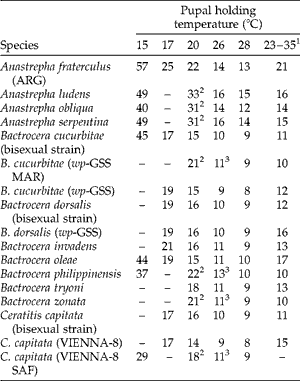
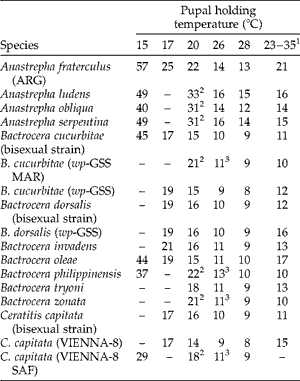
Pupal development times until adult emergence for various species and strains at various holding temperatures are given in Table 2. The shortest pupal development times (8–10 days) occurred in Bactrocera spp. and C. capitata at 28 °C and the longest in Anastrepha spp. at 15 °C. At the fluctuating temperature regimen (23–35 °C), pupal development times for all species and strains were between 10 and 21 days.
Pupal development times (days) until adult emergence of various tephritid fruit fly species and strains held at various temperatures
1 Natural environment (temperature fluctuated between 20 and 35 °C).
2 19 °C.
3 25 °C.
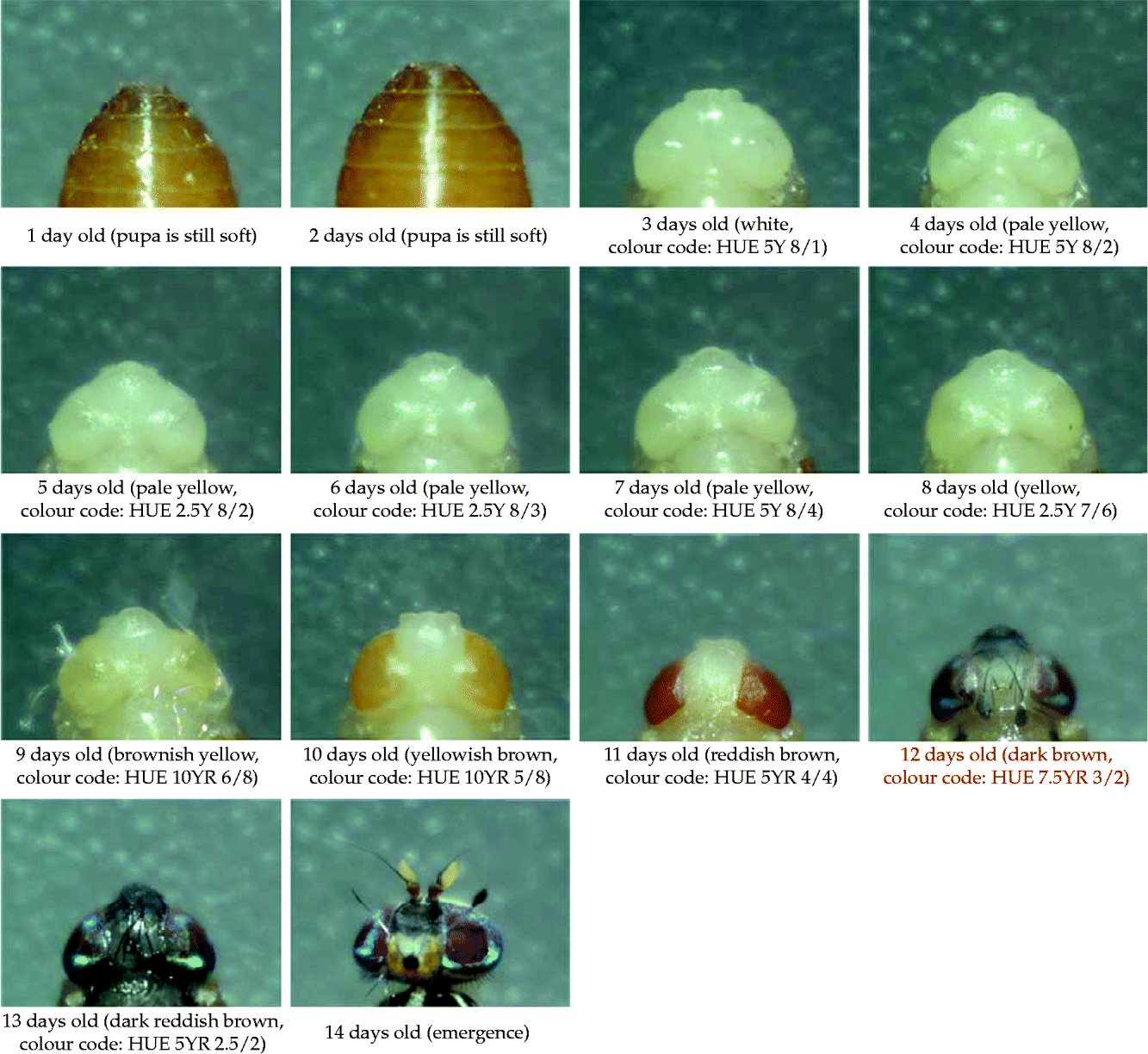
Figure 1 shows an example of the daily matching of colour codes of the Munsell Soil Color Charts with the eye colours that were observed in the dissected pupae. The example shows pupal eye colour change over time in the C. capitata VIENNA-8 genetic sexing strain (Franz, Reference Franz, Dyck, Hendrichs and Robinson2005) maintained at 20 °C. At this temperature, fly emergence occurs after 14 days in the pupal stage, while 48 h before adult emergence (on day 12 of pupation), the dark brown eye colour is indicative of the age when pupae should be irradiated.
(colour online) Eye colour change inside the puparium between pupation and adult emergence of Ceratitis capitata flies (VIENNA-8 genetic sexing strain) at 20 °C (for the denomination of colour and code refer to the Munsell Soil Color Charts (Anonymous, 2000))

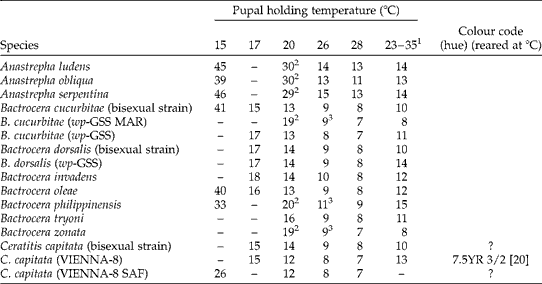
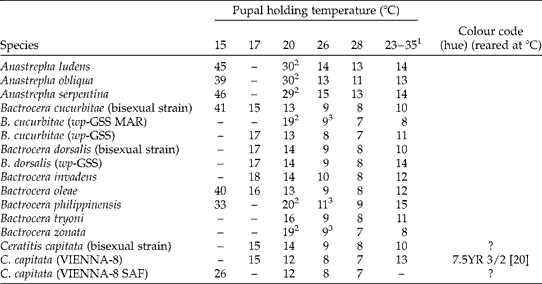
Similar observations on eye colour changes were made for the other fruit fly species and strains that were studied at various temperatures. However, because of the large volume of data obtained in these observations, only one case is presented herein. Based on these daily observations and eye colour matches corresponding to pupal development phases, recommendations can be made for the specific eye colour and corresponding age when irradiation of each fruit fly species held at a given holding temperature should be done. Therefore, we compiled a list of the recommended times (pupal ages) to irradiate each species at a particular holding temperature (Table 3). The eye colours at these times were also observed. For the lower holding temperatures, where the correct pupal eye colour lasts for several days, the latest day is the recommended irradiation day.
Recommended age after pupation (days) and pupal eye colour to irradiate various tephritid fruit fly species held at various temperatures
1 Natural environment (temperature fluctuated between 20 and 35 °C).
2 19 °C.
3 25 °C.
With reference to the quality control data, adult emergence ranged from 83.2 to 98.6% and flight ability from 81.0 to 98.0% for all species and strains at temperatures of 17 °C and above. All these results were above the standard minimum specifications (FAO/IAEA/USDA, 2003).
Discussion
The study carried out by Ruhm and Calkins (Reference Ruhm and Calkins1981) on eye colour changes of the imago inside the puparium during pupal development was the first attempt to use eye colour as an indicator of the stage of pupal development and then to link it to the optimal age for irradiation and the level of sterility achieved as confirmed by bioassays. This linkage has been the basis for managing the timing of pupal irradiation in C. capitata mass-rearing facilities. Their study also provided information to operational programmes on how to manage pupal holding temperatures under adverse conditions. However, their study was conducted using a colour standard based on DuMont's Farben-Atlas.
Our study, using the international standard Munsell Soil Color Charts (Anonymous, 2000), extended this initial work to other species of fruit flies that are the target of SIT programmes. We also observed pupal development at various temperatures in the laboratory and under fluctuating natural conditions. We found that Anastrepha species have longer pupal development times and correspondingly slower pupal eye colour changes than the other species.
The pupal eye colour changes differed among the species. The pupal eye colour at 48 h before adult emergence of B. dorsalis, B. oleae and C. capitata is dark brown; this indicates the correct timing of irradiation at all holding temperatures. For B. cucurbitae and B. invadens pupae, the symptomatic eye colours are dusky red and dark reddish brown, respectively. Anastrepha ludens and A. obliqua pupae should be irradiated when the eye colour is dark brown, very dark brown and greyish grey, while for A. serpentina the indicative colour is dark reddish brown. As no routine irradiation of A. fraterculus is conducted, no recommended eye colour for radiation sterilization of this species is available.
The progression of pupal eye colour changes determined for each species can be used as baseline information at mass-rearing facilities for timing the sterilization of pupae at the desired holding temperatures and also for managing pupal development according to programme needs for sterile flies. The results of this study indicate that pupae of all tephritid fruit fly species used in SIT programmes can be maintained at holding temperatures between 17 and 28 °C without affecting adult emergence and flight ability.
Acknowledgements
The authors are grateful to the heads of fruit fly mass-rearing facilities from Mexico, Mauritius, South Africa and Philippines, as well as the IAEA Insect Pest Control Laboratory in Seibersdorf, Austria. S.S.R. travel to those facilities to photograph the biological material was supported by the IAEA.