Introduction
Understanding the role of values in informing behavioural outcomes has been a focus in the forest conservation literature in recent years (Ramcilovic-Suominen et al. Reference Ramcilovic-Suominen, Matero and Shannon2012, Sharaunga et al. Reference Sharaunga, Mudhara and Wale2013, Reference Sharaunga, Mudhara and Wale2015, Eriksson et al. Reference Eriksson, Nordlund, Schenk and Westin2015, Drescher et al. Reference Drescher, Warriner, Farmer and Larson2017). However, values alone do not lead directly to behaviours (Vaske & Donnelly Reference Vaske and Donnelly1999, Ramcilovic-Suominen et al. Reference Ramcilovic-Suominen, Matero and Shannon2012, Sharaunga et al. Reference Sharaunga, Mudhara and Wale2015). Understanding what fills this value–action gap (Blake Reference Blake1999) remains a challenge.
One of the earliest behavioural models is the Theory of Reasoned Action (Fishbein & Ajzen Reference Fishbein and Ajzen1975), which uses attitudes as a primary factor driving behavioural intentions, alongside subjective norms and the relative importance (or value) of both. In time, this model was adapted to take greater account of the other factors that influence behavioural intentions, one of the most well-known of which is Ajzen’s (Reference Ajzen1991) Theory of Planned Behaviour, which includes the concept of ‘perceived behavioural control’, which influences norms, behavioural intent and behaviour.
Social-psychological behavioural theory stipulates that specific attitudes and norms influence associated behaviours (Fishbein & Ajzen Reference Fishbein and Ajzen1975). Attitudes are derived from values and are specific to individual behaviours and situations (Fulton et al. Reference Fulton, Manfredo and Lipscomb1996, Li et al. Reference Li, Wang, Liu and Weng2010). In this field, attitudes and norms are themselves derived from – and are predicted by – values (Fulton et al. Reference Fulton, Manfredo and Lipscomb1996, Schwartz Reference Schwartz2001, Li et al. Reference Li, Wang, Liu and Weng2010). Rokeach (Reference Rokeach1973) and Schwartz (Reference Schwartz1992, Reference Schwartz2001) suggest that values are “single, stable beliefs that individuals use as standards for evaluating attitudes and behaviour” and “beliefs, cognitive structures that are closely linked to affect,” respectively. The broad and stable nature of these values can provide insight into a wide range of behaviours (Rokeach Reference Rokeach1973, Hofstede Reference Hofstede1980, Schwartz Reference Schwartz2001). As deforestation and forest degradation (DD) is often a result of a range of different behaviours, actions or decisions, values could provide an effective starting point for a holistic exploration of drivers of DD. However, although values can provide explanations for a range of actions, Kollmuss and Agyeman (Reference Kollmuss and Agyeman2002) and Darnton (Reference Darnton2008) provide extensive reviews of a variety of models that account for the non-linear link between values and actions/behaviours, termed the ‘value–action gap’ (Blake Reference Blake1999).
The Capability Approach is a concept initially developed by Sen (Sen & McMurrin Reference Sen and McMurrin1979, Sen Reference Sen2001) and further built on by Nussbaum (Reference Nussbaum2003), initially in response to monetary indicators of well-being commonly found in development planning and assessment. The ‘well-being’ considered in the Capability Approach is that of ‘functionings’ that people have a reason to value, such as being educated or having self-respect. However, in line with the value–action gap concept in behavioural theory, the act of achieving specific functionings is mediated by the ‘freedom to achieve’ these functionings. In the Capability Approach, these freedoms are individually referred to as capabilities, and collectively as a person’s capability set (Sen Reference Sen2001).
Robeyns (Reference Robeyns2005) set out to clarify the steps between the means of achievement, the creation of the capability and the final achieved functioning. In order to identify which factors constitute capabilities and how they can be enhanced, it is important to know the means available to an individual, and subsequently the process of conversion that occurs to transform these into capabilities (Sen Reference Sen2001). Robeyns (Reference Robeyns2005) categorized these conversion factors into three groups: personal, social and environmental. Personal conversion factors are specific to the individual (i.e., physical strength, sex, intelligence), social conversion factors are social practices and norms and environmental factors include geographic location, infrastructure and public goods. These factors interact to either create or destroy capabilities available to the individual.
Many of the factors mediating the value–action gap identified by behavioural theorists (e.g., social norms, feelings/emotions or information) can be accounted for within these conversion factors. The conversion factors also relate practically to drivers of DD, providing an explicit categorization system that is broad enough to account for both social-psychological and external factors.
The concept of a set of shared universal human values has been well developed, but large-scale empirical studies also show that preferences for – or orientations towards – these values may differ across cultures (Rokeach Reference Rokeach1973, Hofstede Reference Hofstede1980, Schwartz Reference Schwartz1994, Schwartz et al. Reference Schwartz, Cieciuch, Vecchione, Davidov, Fischer, Beierlein, Ramos, Verkasalo, Lönnqvist, Demirutku, Dirilen-Gumus and Konty2012). Studies specifically on forest values have similarly found that although people may have similar forest values, value orientations (e.g., ecological versus production) often vary between different cultures and social groups (Vaske & Donnelly Reference Vaske and Donnelly1999, Eriksson et al. Reference Eriksson, Nordlund, Schenk and Westin2015). The differences in these orientations or preferences are often a result of how different cultures and social groups view themselves in relation to other objects and people, so an understanding of these perspectives is important for identifying social and cultural norms that populate the value–action gap and help predict behaviours (Kluckhohn & Strodtbeck Reference Kluckhohn and Strodtbeck1961, Hills Reference Hills2002). Therefore, to capture the full range of values and mediating factors that may contribute to land-use decisions, behaviours and, ultimately, change, an approach derived from a shared values perspective that includes a range of values associated with whole landscapes and ecosystems is required.
The relationship between forest values and behaviour has been explored (Vaske & Donnelly Reference Vaske and Donnelly1999, Ní Dhubháin et al. Reference Ní Dhubháin, Cobanova, Karppinen, Mizaraite, Ritter, Slee and Wall2007, Ramcilovic-Suominen et al. Reference Ramcilovic-Suominen, Matero and Shannon2012, Sharaunga et al. Reference Sharaunga, Mudhara and Wale2015), often with a focus on a specific type of value (e.g., forest values or individual values) or mediating factor (e.g., attitudes, norms). However, shared values have been increasingly noted as important to ecosystem services and landscape-level approaches to decision-making (Brunetta & Voghera Reference Brunetta and Voghera2008, Fish et al. Reference Fish, Burgess, Church and Turner2011, Kenter et al. Reference Kenter, O’Brien, Hockley, Ravenscroft, Fazey, Irvine, Reed, Christie, Brady, Bryce, Church, Cooper, Davies, Evely, Everard, Fish, Fisher, Jobstvogt, Molloy, Orchard-Webb, Ranger, Ryan, Watson and Williams2015).
We propose a conceptual model based on social-psychological behavioural theory combined with the Capability Approach to identify and structure drivers of DD. The model is then applied, using a mixed-methods approach, to explore the link between land users’ shared values and forest cover change behaviour in the Sarstún Motagua region of Guatemala.
Methodology
The Sarstún Motagua Region
The Sarstún Motagua region lies in the northeast of Guatemala, spanning from the city of Guatemala to the Caribbean coast. Two non-governmental organizations (NGOs), Fundaeco and Fundación Defensores de la Naturaleza (FDN), manage various categories of protected land in this region, together with the National Council for Protected Areas (CONAP). The FDN manages the Sierra de Las Minas Biosphere Reserve (RBSM). Fundaeco manages areas in the department of Izabal, including multiple-use zones, municipal parks, hydrological reserves, biotopes and special protected areas. The area to the north of the RBSM is outside of NGO management.
Land access, ownership and management arrangements vary across the region, as do the livelihood activities of the residents. There is also a mix of Ladino (non-indigenous) and Mayan ethnicities throughout the region. The diversity of the land users and the presence of different nature reserves provides an excellent case study to explore the different factors that can mediate between shared values and behaviour.
Methods
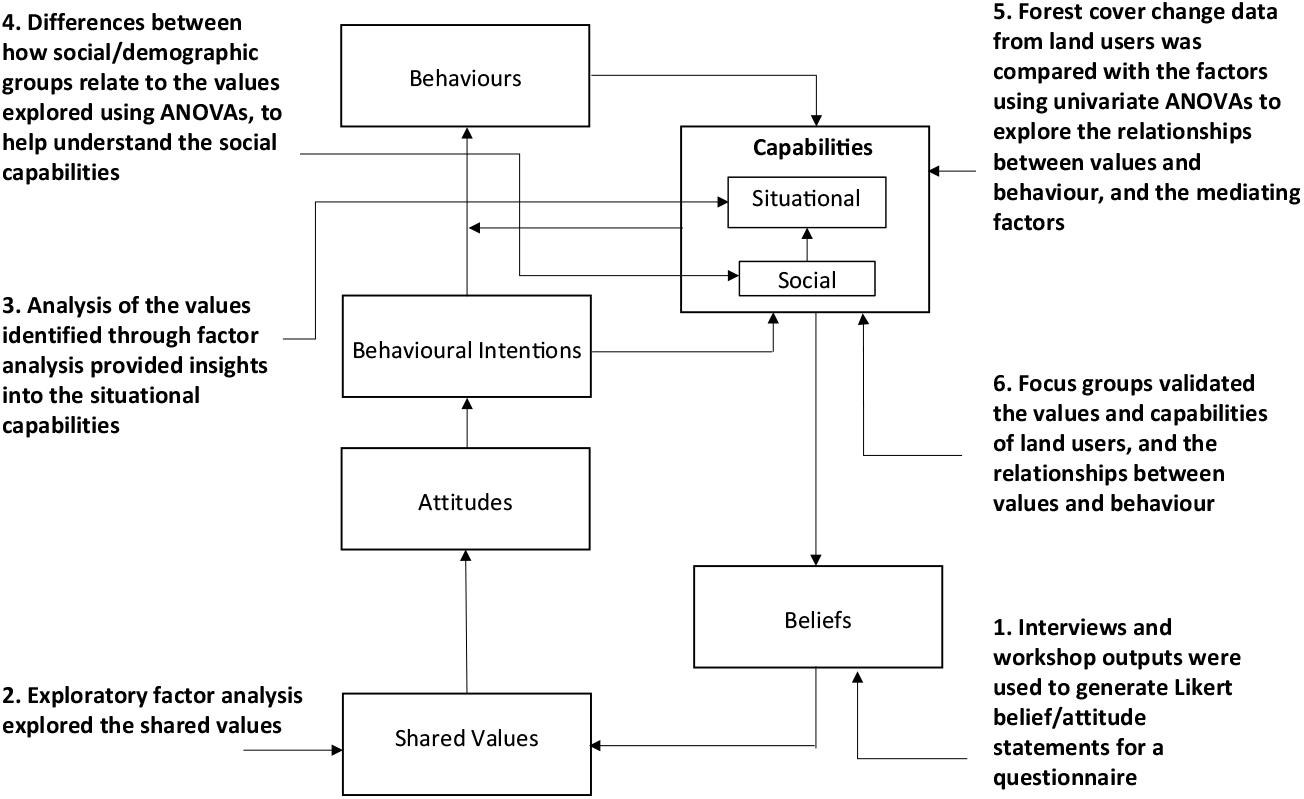
The Behaviour–Capability–Drivers model (Fig. 1) provided the conceptual framework for this study. The model explains how beliefs derived from external sources (social and situational capabilities) form values, which in turn inform attitudes and behavioural intentions. The final behaviours are influenced by both the intentions and the social and situational factors that constitute (or are absent from) a person’s capability set (which fills the value–action gap). The behaviours, if maintained, eventually integrate into people’s beliefs, which may lead to new (or revised) value formation in the long-term, in a cyclical feedback model similar to that of Knott et al. (Reference Knott, Muers and Aldridge2008).
The Behaviour–Capabilities–Drivers model with numbered annotations explaining the methods used to elicit each aspect of the model. ANOVA = analysis of variance.

In late 2014, researchers at Universidad del Valle de Guatemala (UVG) held workshops with key stakeholders involved in land-use decision-making in the Sarstún Motagua region, including individuals from government, academia, community associations, cooperatives, the private sector and NGOs. These actors’ perceptions of drivers of deforestation were used as a source of stakeholder belief statements about land use. The statements were written with relevance to those who make direct decisions regarding land use.
A five-point Likert scale of ‘strongly agree’ to ‘strongly disagree’ was chosen for the belief statements (Foddy Reference Foddy1994), which were tested for their relevance and comprehension with 42 land-use decision-makers from community associations, cooperatives and NGOs across the Sarstún Motagua region.
A questionnaire survey (Appendix S1, available online) was conducted of 501 land users (including land owners, renters and those with land-use rights; Table S1) from the Sarstún Motagua region of Guatemala. For practical reasons, sampling was limited to those communities that were accessible by vehicle. Responses were gathered through face-to-face interviews of land users in mid-2015 by staff from FDN, Fundaeco and UVG. Respondents were self-selected according to their willingness to participate, which was probably influenced by their knowledge of or experience with the organizations applying the questionnaire. This may represent some self-selection bias.
To collect forest cover change data, respondents were asked how much land they owned, how much of the land was forested when they acquired it and how much forested land they had currently. These were converted to percentages of land owned to ensure that large differences in land owned did not skew the results. A total of 402 participants responded to all of the forest change questions and were used for further statistical analyses.
Statistical Analysis
We first carried out EFA using the responses to belief statements in SPSS v.22 in order to identify the common factors (or shared values) associated with land use. The belief statements within each factor provide insights into the situational capabilities associated with each value. Factor scores for different land user characteristics (age, gender, sector, location, ethnicity and number of children) were compared by analyses of variance (ANOVAs).
Factor scores were regressed against forest cover change to identify which of the shared values had a significant effect on forest cover change. The land user characteristics were then used as proxies to identify some of the social and situational capabilities available (or not) to land users that may determine their behaviour. These different land user characteristic groups were compared using multiple Tukey post hoc tests in order to identify which characteristics (and thus capabilities) are likely to influence forest cover change.
In order to identify potential significant interactions between the values and the capabilities that may influence forest cover change behaviour, ANOVAs of the factors and the land user characteristics that were found to significantly correlate with forest cover change were conducted in an iterative process of elimination to find the significant main effects and interactions. In order to explain the interactions, we categorized open-answer responses to the question ‘Why have you maintained this amount of forest?’ and compared them with the factor scores and land user characteristics in an ANOVA.
Focus Group Discussions
The statistical results indicated a clear difference in the actions between ethnic groups in their responses to one of the factors from the EFA. Therefore, we also decided to run two further analyses on datasets consisting of Maya and Ladino respondents separately. We carried out a factor analysis and used these with the other statistical results in focus groups with Q’eqchi Maya (n = 25) and Ladino (n = 31) participants separately in order to further explain and validate the results. Participants were invited from the communities in the buffer zone around the RBSM.
Focus groups were used to validate the EFA results for the Sarstún Motagua land user shared values and to elaborate on associated social capabilities. Deliberative processes such as focus groups can allow the exchange of information and perspectives on values, beliefs and norms, which is essential for bringing out these shared values (Kenter et al. Reference Kenter, Hyde, Christie and Fazey2011, Reed et al. Reference Reed, Hubacek and Bonn2013).
The Ladino focus group was carried out in Spanish. The Maya focus group was carried out entirely in the Q’eqchi language, with translation to Spanish carried out by FDN facilitators, who also recorded the outputs in written Spanish.
The structure of the focus groups was designed to validate or interpret the factor grouping from the statistical analyses through the following process.
1. Understanding different perspectives on the shared values: (a) participants were asked to separate into five small groups; (b) each group was given the list of belief statements for one of the factors from the full, combined EFA analysis (or the list was read out); (c) the groups were asked to discuss the key ideas expressed in the statements and suggest a name for the factor (they were not told that these were meant to represent shared values); and (d) the different suggestions and perspectives across both of the focus groups were integrated to help the researchers come up with one final name for each factor.
2. Validation of the shared values: (a) each group was given three versions of the same factor – one from the combined analysis, one from the Mayan sub-analysis and one from the Ladino sub-analysis; and (b) the groups were asked to choose which factor version they preferred and why.
3. Validation of the interaction effect: (a) participants were asked to indicate how strongly they related to the shared value with the significant interaction effect from the statistical analysis; and (b) participants were asked to volunteer why they related to the factor in this way.
In the case of the Ladino group, this resulted in further votes on how many people had de/reforested and why and how many had taken part in incentive schemes and why. For the Mayan group, a follow-up one-on-one interview with a community leader provided deeper insights into some of the reasons why he reforested.
Results
Shared Values across Land Users in Sarstún Motagua
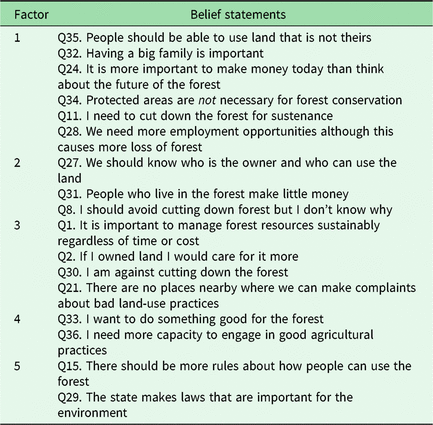
The EFA of the full, combined dataset (Table S2) identified five factors (Table 1). The factors were named based on the results of the ANOVAs and focus group discussions.
Exploratory factor analysis rotated factor matrix for the full, combined dataset showing the grouping of belief statements into five factors (shared values).

Factor 1. The Q’eqchi Maya interpreted this factor as ‘respect our land and love our forest’. They explained that with no forest there is no life. The Ladino group interpreted this factor as ‘management and sustainable use of natural and economic resources with well-being and social responsibility’. They disagreed with questions 24, 32 and 35. They also mentioned how they needed to balance necessity with the need to care for the environment, and that improving well-being and encouraging social responsibility could be approaches to incentivizing people to care for the environment.
We named this factor ‘valuing sustainable futures’. For Ladinos, this future is linked to the use of natural and economic resources for the future of the community. Q’eqchi Mayans felt that it was more about a symbiotic relationship with people and the forest, where the life of each one sustains the other.
Factor 2. The Q’eqchi interpreted this factor as ‘to be conscious of the care of natural resources through the good use of soil’ and explained that they believe organic practices are the best. The Ladino group interpreted this as ‘the importance of natural resources’. They believed they should know who landowners are in order to regulate activities and to engage in sustainable management practices so as to avoid deforestation and obtain better incomes. They also discussed how they needed more resources to help conserve the forests and that people do not understand the importance of the law.
We named this factor ‘valuing good governance’. The Maya focused on aspects of ‘stewardship’: they considered themselves to be the ones who provide the care, while the Ladinos considered the law (or municipality) to be responsible for governance. The two perspectives indicate the importance of the governance of good practices, but from different cultural perspectives.
Factor 3. The Q’eqchi identified this factor as ‘to know, love and care for the forest is to know love for life’. They considered that if people do not care for the forest, they do not care for themselves or the future of their children. The Ladinos interpreted this factor as ‘regulation of and strengthening of institutions and environmental education for conservation of natural resources’. They believed that when people have no environmental conscience they use the land badly, and environmental education could help cultivate an environmental conscience. They also mentioned that they would like offices in each department where they can report bad land uses, as currently it is a complex process to do so.
We named this factor ‘valuing environmental conscience’. Q’eqchi Mayans considered this factor to reflect an intrinsic, symbiotic relationship with the environment and people, highlighting that if people do not care for the forest, they do not care for themselves. The Ladinos considered environmental conscience to come from education, not necessarily as an intrinsic value.
Factor 4. The Q’eqchi interpreted this factor as ‘I engage in caring for the forest but also I need more capacity to have a sustainable livelihood’. They said that people needed more environmental education to be able to develop and reforest and that knowledge about the environment equals care for the environment. The Ladinos interpreted this as ‘formation and training through community extension work in good forest (and agricultural) management practices and alternative production’. They discussed how people need to know more about the environment, but they often do not have enough information to engage in good practices. We named this factor ‘valuing environmental conservation’.
Factor 5. The Q’eqchi interpreted this factor as ‘we respect our laws as we love our forests’, and they explained that for development to occur in communities, these communities need laws. The Ladino group interpreted this factor as ‘regulation of sustainable farming’. As both groups mentioned some sort of respect for the law (whether formal or informal), we named this factor ‘valuing the rule of law’.
In the focus group discussion, the Q’eqchi Maya and Ladinos unanimously agreed with the combined factor 1, although Ladinos also discussed how they disagreed (sometimes strongly) with several statements in factor 1. Therefore, it appears that although the Ladinos disagreed with the belief statements in the factor, their interpretation of the factor (‘management and sustainable use of natural resources with well-being and social responsibility’, a clearly ‘positive’ idea) reflects the value they wished to achieve. This would suggest that the belief statements outline capabilities that enable or inhibit achievement of their values. Furthermore, the agreement with these statements (or capabilities) reflects the extent to which these issues are relevant to participants’ lives: the Ladino focus group did not consider most of the statements in the combined factor 1 to be relevant to their lives, while the Mayans did.
Shared Values When Analysed by Ethnic Group
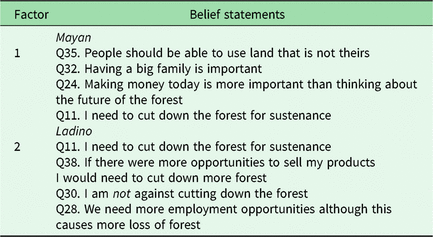
The separate Ladino and Mayan exploratory factor analyses produced differing factor structures (Tables S3 and S4). The Mayan factor 1 and Ladino factor 2 (Table 2) together contained all of the statements in the combined analysis factor 1. These three factors were chosen for comparison in the focus groups.
Maya factor 1 and Ladino factor 2 belief statements from exploratory factor analyses by ethnic group.
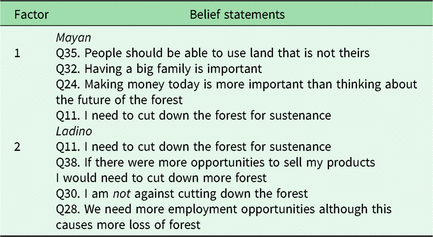
When the focus groups were asked to choose which of these factors they associated with most, the majority of the Q’eqchi Maya chose the Maya factor 1. They mentioned how having a big family (question 32) negatively impacts the forest. Taking into account the fact that the average number of children per family is eight, their response suggests that they chose this factor due to its relevance to their lives: they have seen first-hand how large families negatively affect the environment.
The majority of Ladinos chose the combined factor 1, with their reason being their perceived importance of protected areas for the environment. According to one of the FDN facilitators, to this group ‘protected areas’ meant forest plantations, not necessarily reserves such as the RBSM. Approximately half of the Ladinos in the focus group owned land that they had reforested, although not as part of an incentive scheme, again suggesting that they are identifying with the idea of ‘protected areas’ due to its relevance to their lives. The other Ladinos chose the Ladino factor 1. Similarly, they discussed how the statements in the factor made them think about all of the ways in which they need to avoid deforestation in their communities (e.g. question 28).
None of the Ladinos identified with the Mayan factor 1, and only a few Mayans identified with the Ladino factor 1, suggesting that there is a significant difference in the separate values across the two groups. However, several Mayan and Ladino focus groups chose the combined factor 1, supporting the idea that the combined analysis is likely to represent some form of shared value structure.
Shared Values, Land User Characteristics and Forest Cover Change
All land user characteristics, except number of children, varied significantly with at least one of the combined factors (shared values). Factors 1 (p < 0.001; R2 = 0.034) and 5 (p = 0.005; R2 = 0.02) and ethnicity (p = 0.036), location (p < 0.001) and number of children (p = 0.021; R2 = 0.015) all significantly correlated with forest cover change. Factors 1 and 5 and ethnicity and location were taken forward for exploring interactions, as they all varied significantly with each other and with forest change.
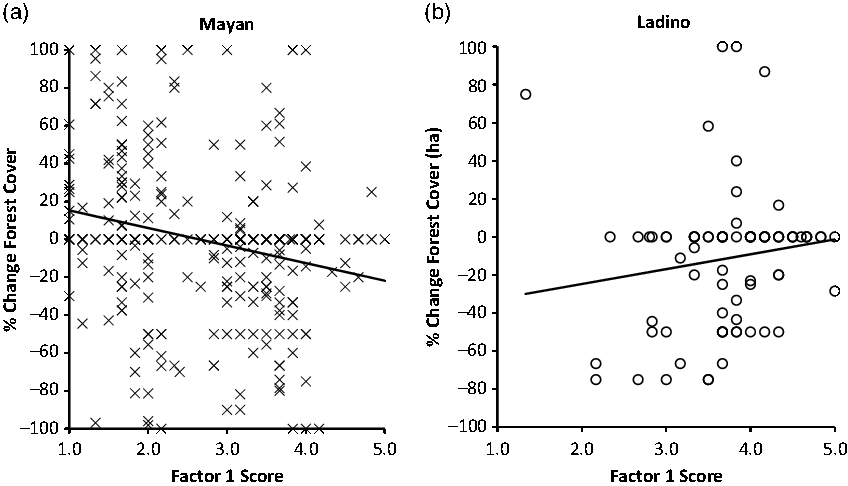
Ethnicity alone had a significant effect on forest cover change (Ladino = –17.46% versus Mayan = –2.71%, p = 0.01); Ladinos tended to report more negative forest cover change than Mayans. Ethnicity significantly interacted with the combined factor 1 score in its influence on forest cover change (p < 0.001), with Mayan forest cover change negatively associated with disagreement with factor 1 score (Fig. 2a) and Ladino forest change positively associated with disagreement with factor 1 score (Fig. 2b).
Plot of percentage change in forest cover (y-axis) against level of agreement with factor 1 score (x-axis) for (a) Mayan and (b) Ladino respondents (factor score of 1 = strongly agree; factor score of 5 = strongly disagree). Linear regressions are plotted for each ethnic group (Mayan, y = 24.52 + (−9.27x), R2 = 0.053; Ladino, y = −40.4 + 7.81x, R2 = 0.022).

We found that the reasons provided for keeping forest for Ladinos tended to be either related to conservation of/for the environment (n = 24) or necessity (n = 31), while for Mayans they were conservation of/for the environment (n = 169) or access to incentive schemes (n = 20).
Among the Mayans, there was no significant difference between those who stated their motivation as conservation or incentive schemes. However, when the Mayans who also spoke Spanish alongside their indigenous Maya language were removed (n = 62 total, of whom 20 responded to the ‘maintaining forest cover’ open question), there was a significant interaction with factor 1 (p = 0.004). Mayans who agreed with the combined factor 1 tended towards increased forest cover, the opposite of the Ladinos (Fig. 2). The Mayans who tended to agree with the combined factor 1 had accessed forestry incentive schemes, suggesting that when they experience necessity they use forest plantations to generate income instead of deforesting.
We found a significant difference between Ladinos who cited necessity versus conservation as their motivation. Ladinos who agreed more with the combined factor 1 tended towards forest cover loss (p = 0.001), suggesting that Ladinos who experience necessity engage in DD activities. Conversely, Ladinos who do not experience necessity may not rely on the forest for survival and engage in activities that increase forest cover.
In a one-on-one interview, a community leader from the Q’eqchi Maya group told us how that, in order to afford to feed his children and find a way to support them growing up, he had used a government forestry incentive scheme that was available to private landowners. His children were now in various professions (e.g., teachers, police officers). However, he preferred for them not to leave the community to find work, but he acknowledged the difficulty in surviving solely based on the farm. His story lends support to our interpretation that access to incentive schemes provided Mayans with an opportunity to make money to survive while maintaining their preferred lifestyle that is closely associated with the land and forest.
When the Ladinos were asked how many had ever engaged in reforestation activities on their own land, 16 out of the 31 said that they had. When asked how many had ever had to deforest due to necessity, only five responded with ‘yes’. Only four Ladinos said they had ever accessed any type of financial incentive scheme for reforestation activities. When asked why some of them had chosen to reforest even though they were not receiving financial payments, they responded that they had done so purely for the environmental benefits related to conservation of water sources, animals and plants. They also said that they did not trust the government enough to engage in incentive schemes, partly because they considered the government to lack the capacity to run the incentive programmes and partly because they were afraid to lose their land once the incentive scheme was over (they would be required to continue to pay rent on the forested land that they may not be able to afford without incentive payments).
The discussion supports our interpretation that Ladinos who had not experienced necessity tended to engage in reforestation activities, in a converse relationship to Mayan decision-making.
Discussion
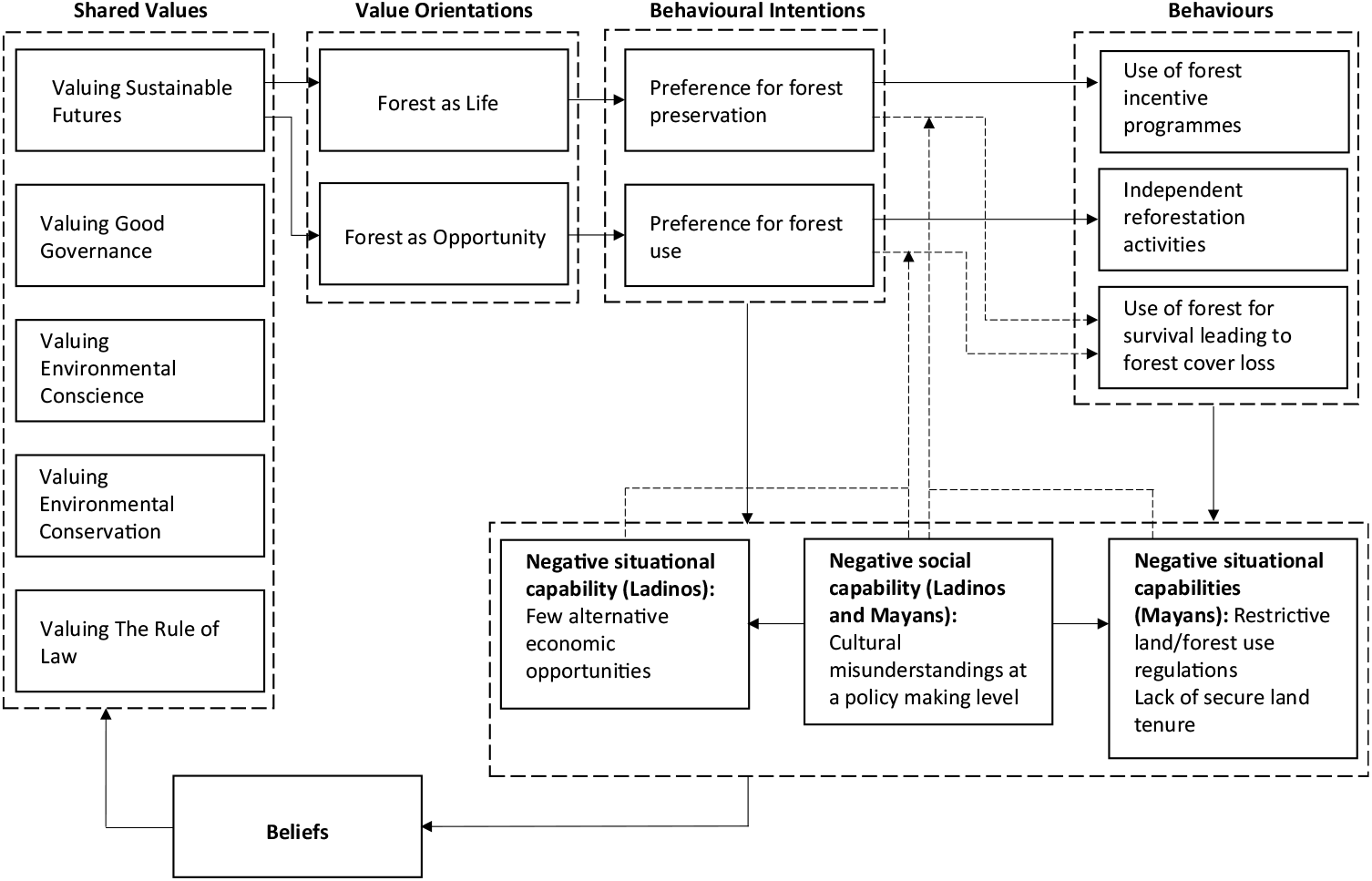
Our study provides evidence that shared values were present across land users in the Sarstún Motagua region of Guatemala. These shared values could be attributable to their shared identity as campesinos (smallholder farmers; Orlove Reference Orlove2002), although campesino identities were not discussed with land users, nor was it a concept that they used in discussing their attitudes. Other studies have similarly found that diverse stakeholders may have similar values, but were separated by their orientations within that value (e.g., Vaske & Donnelly Reference Vaske and Donnelly1999, Eriksson et al. Reference Eriksson, Nordlund, Schenk and Westin2015). The different perspectives associated with the shared values suggest the presence of common themes, but different orientations within these themes that are separated by culture. Therefore, the Q’eqchi Mayan value orientation on combined factor 1 (valuing sustainable futures) represents an intrinsic relationship for them (‘forest as life’), while Ladinos considered the ‘forest as opportunity’.
The study has several limitations that often come with research conducted into behaviour or social issues. These include the potential bias associated with self-reported data, the influence of interviewers on participant responses to interviews or focus groups and the question of whether ‘measuring’ values or behaviour is possible. EFA results are dependent on the quality of the study design and are only able to identify common factors that are described by the inputted variables, and therefore factors rarely cumulatively account for 100% of the variance in the sample. Reliability tests were conducted on the data including split data and Cronbach’s alpha. The data presented appear robust and have been validated through follow-up focus groups.
Language differences are another consideration. Most of the questionnaires (58%) were delivered by an interviewer in a Mayan language, and each of these was translated by a member of the community who could speak both Spanish and the local Mayan language. The Mayan focus groups were carried out fully in the Mayan language, and we were provided with a translation into Spanish. This still meant that there is likely to have been some loss of richness and information in this translation process, but the participants were able to speak and discuss freely in their own language. Although this also meant that we had limited ‘control’ over the avenues of discussion that the focus group developed, it did evolve more naturally from the participants, potentially providing a truer overall picture.
Overall, the results still provide a useful insight into the shared values of land users in Guatemala and how this approach could be used to further understand forest change behaviours. Several studies have found that biocentric (but not anthropocentric) value orientations predicted positive attitudes and behavioural intentions towards wildland preservation (e.g., Fulton et al. Reference Fulton, Manfredo and Lipscomb1996, Milfont & Duckitt Reference Milfont and Duckitt2004, Milfont & Gouveia Reference Milfont and Gouveia2006). In our study, people with both the forest as life (biocentric) and forest as opportunity (anthropocentric) value orientations engaged in practices that increased forest cover. In the case of the Q’eqchi, when they experienced necessity, their preference was to find ways to meet their basic needs while maintaining forest cover (e.g., accessing incentive schemes). If they could not access incentive schemes (due to negative capabilities outlined in the belief statements associated with the shared value), then it is likely that they would be forced to deforest.
Conversely, when Ladinos could not meet their more anthropocentric view of a sustainable future value (e.g., with no access to off-farm income opportunities, a negative capability), they used the forest to generate income first; only once they had met their basic needs would they consider conservation practices.
Knowing the different capabilities available to different social and cultural groups is important for effectively targeting intervention design. Additionally, if DD interventions are designed without taking into account cultural perspectives, this could exacerbate current land-use problems and cultural divides by playing off of existing cultural misunderstandings (already particularly prevalent in Guatemalan societal history; Hale Reference Hale2002), having further negative effects on the environment (creating a negative social capability; Fig. 3).
The results of the study applied to the Behaviour–Capabilities–Drivers model, showing land user shared values, value orientations, (negative) capabilities and links to behaviours.

In social-psychological theories, value orientations are considered to more tangibly link to attitudes and behavioural intentions, are an expression of basic values (our shared values) and can provide consistency and organization among the broad spectrum of beliefs, values, attitudes, etc. (Fulton et al. Reference Fulton, Manfredo and Lipscomb1996, Vaske & Donnelly Reference Vaske and Donnelly1999, Manfredo et al. Reference Manfredo, Teel, Bright, Bosworth, Shroufe, Kruckenberg, Loker, Romberg, Casper, Gray, Sikorowski, Smeltzer, Beucler, Harmoning and Gigliotti2003, Li et al. Reference Li, Wang, Liu and Weng2010). Therefore, our results align with broader theory in which value orientations would sit between shared values and behavioural intentions.
There has been some other work exploring the value differences between ethnic and cultural groups, including between the Maya and Ladinos of Guatemala. In the Petén region of Guatemala, land-use practices between Q’eqchi Maya and Ladinos may be similar, as Lopez-Carr (Reference Lopez-Carr2004) found that location, not ethnicity, was the driving factor. His identification of locational aspects (e.g., lack of market access and rural underdevelopment) fits well with our identification of negative situational capabilities, but he claims that the same intervention approaches (e.g., limiting access to forestland and promoting alternative livelihoods) can be used across both cultures to effectively reduce forest cover change.
Our results clearly indicated that the Maya and Ladino groups had different capabilities available to them. The contrast of the Lopez-Carr (Reference Lopez-Carr2004) results with ours may be due to the immigrant nature of the Q’eqchi in the Petén region, while Alta Verapaz (in the Sarstún Motagua region) is their homeland. The bond between humans and the environment appears to be severed when Q’eqchi move to another region. Lopez-Carr (Reference Lopez-Carr2004) may account for the significant relationships observed between the combined factor 1, forest cover change and location in our study, indicating that ‘place’ can be important, but in our case study ethnicity was of greater importance.
Conclusion
Land users in the Sarstún Motagua area have a set of shared values and a number of different capabilities associated with the achievement (or not) of actions related to forest cover change. However, we found a significant difference in the way in which the two predominantly different cultures (Ladino and Maya) relate to these shared values and how these relationships influence their behaviour. Our results support the theory behind the Behaviour–Capabilities–Drivers model in which social and situational capabilities mediate between shared values and behaviour. Additionally, we found that value orientations appear to determine behavioural intentions and that an understanding of both value orientations and capabilities is necessary to fill the value–action gap.
Other studies on pro-environmental values and behaviours have tended to focus on particular actions, values or mediating factors, which may be expensive and time-consuming to carry out or review individually for the range of possible actions and factors that may contribute to land-use change. The approach could be useful for decision-makers working at a landscape/whole-ecosystem level to identify factors that may enable or inhibit pro-environmental behaviours. For environmental policy-making, either hyper-localized approaches or a ‘one-size-fits-all’ approach to policies is often the only option. The shared value approach used here identified a wide range of values and subsequent capabilities that were not limited to a specific type of action/behaviour, but could be explored in depth to elicit capabilities relevant to specific cultural groups.
Supplementary Material
For supplementary material accompanying this paper, visit https://www.journals.cambridge.org/ENC.
Acknowledgements
We thank Dan Bray for his advice and feedback on the statistical analyses; Alma Quilo and Danai Fernandez from Universidad del Valle de Guatemala and Javier Marquez, Cesar Tot and Carlos Cifuentes from Fundación Defensores de la Naturaleza for their project support in country; and Gaby Fuentes, Gaby Alfaro, Jacky Brinker and Erick Lopez for their support during the fieldwork.
Financial Support
This project received funding from the University of Greenwich Vice Chancellor Scholarship, with in-country assistance from the Climate, Nature and Communities Guatemala project in collaboration with the Rainforest Alliance, Fundación Defensores de la Naturaleza (FDN), Universidad del Valle de Guatemala (UVG) and Fundaeco, funded by the USAID.
Conflict of Interest
None.
Ethical Standards
This project received ethical approval from the University of Greenwich in June 2015 prior to initial fieldwork.