This article analyzes the targets of papal policies on Christians' relations with non-(Roman)Christians contained in canon law's On Jews, Saracens, and Their Servants in a historical period that has attracted comparatively little attention: the mid-thirteenth to the late fifteenth century.Footnote 1 It argues the inherent ambiguity of the normative discourse on “proper” relations with “infidels.” On the one hand, popes and canonists faithfully preserved a taxonomy of otherness inherited from the church's ancient past. On the other hand, they often reduced all difference to the pastoral distinction between flock and “infidels.” The conflation of non-Christians occurred in multiple ways: through the explicit extension of a specific policy's targets, overt canonistic discussion, the tacit application of the law to analogous situations, or its simplification for use in the confessional. As a result, a number of policies aimed originally at a specific target were applied to all non-Christians. In the course of the later Middle Ages, a whole group of policies meant to define Christians' proper relations with others became potentially applicable against all non-Christians. In the words of a widely, if regionally disseminated, penitential work, all that was said of the Jews applies to the Muslims and all that was said of heretics, applies to schismatics.Footnote 2
There is, admittedly, no shortage of legal and social studies on interfaith relations in medieval Europe. Walter Pakter, notably, has analyzed in detail the formation and the history of a key facet of the canon law on the subject—that concerning Jews—whereas Guido Kisch and Vittore Colorni, among others, have addressed more broadly the formation and development of Jewry law.Footnote 3 The pagan Roman Empire was tolerant of Judaism, if not necessarily of Jewish proselytizing efforts throughout the Mediterranean. The situation changed with Christianity's assumption of a privileged position in the course of the fourth century. Early medieval ecclesiastical legislation, whether Western or Byzantine, clearly placed Jews in an inferior position to Christians. In the context of church centralization and canon law homogenization during the high Middle Ages, ecclesiastical jurisdiction over Jews was extended whereas the canonists became increasingly less tolerant of Jewish books and Judaism. The Jews, in sum, were to be “protected whilst living a life of desperation, subjugation and inferiority that reflected their reprobate status in God's sight.”Footnote 4 This theologically derived condition achieved uniformity in the canon law during the first half of the thirteenth century, spearheading a similar if multicausal and far from uniform process that made Jews increasingly more distinct from and inferior to Christians in the iura propria of kings and cities as well.Footnote 5
A well-defined Corpus Iuris Canonici may have placed Christendom's Jews in a veritable legal ghetto, but it also awarded them a recognized, if inferior and, in practice, uncertain place within Christian society. By contrast, as discursive, undifferentiated “Saracens,” Muslims occupied a comparatively unremarkable place in the law.Footnote 6 Actual, internally far from homogenous Muslim communities existed for different periods of time throughout much of Iberia, in Sicily, southern Italy, Hungary, the Crusader states, and in some Genoese-ruled settlements in the Black Sea.Footnote 7
The scholarly focus on Jews and/or Muslims as distinct communities does justice to those who self-identified as such. Distinctions between non-Christians, moreover, played an important role in the process of Christians' own self-definition, resulting in a tripartite infidelitas: that of Jews, pagans (and hence Saracens and Turks), and heretics (and hence schismatics).Footnote 8 The canonists never tired of explaining who was a “Jew” and who was a “Saracen.” Much of the canons contained in the law of the church, finally, address explicitly one or another group of “infidels.” However, in a pioneering study of the views that popes and canonists held of Christian relations with others, James Muldoon aptly remarks that “The canonists tended to lump together the various kinds of people who were not members of the Church, so that legal principles and practices developed for dealing with one class of people defined as extra ecclesiam were applied to another class.”Footnote 9 Averil Cameron, in turn, shows that the conflation of others was far from a purely Western and/or later medieval phenomenon; it was prominent in early Christian and Byzantine works.Footnote 10
Whereas Cameron has focused on the East and Muldoon's own interests have gravitated around Christians' relations with others outside Christendom (and the rights of “infidels”),Footnote 11 David Freidenreich has exposed one way in which the process of interest worked in the case of the Western canon law. As in many other cases, the law contained conflicting canons in that of Christians' sharing of meals with others. Writing at a time when Christians were a privileged minority, John Chrysostom and Augustine approved of commensality with others, perceiving it as an opportunity to spread the faith, but before long, a church council forbade Christians from sharing meals with Jews. In the context of a mostly Christianized Europe, however, high medieval canonists turned the words of the church fathers around and worried that Christians' commensality with Jews might lead to the former's apostasy rather than to the latter's conversion. Others were concerned less with a potential outflow of souls than with the symbolic implications of eating the food of those who refuse Christian meals. What no longer raised doubts by the early thirteenth century, in any case, was the main point: Christians ought not to share meals with Jews. But what about other non-Christians? Some banned the sharing of meals with anyone who distinguished between foods and allowed meals with anyone who did not. Others found all contemporary pagans to be Judaizing, and hence banned commensality with any non-Catholics. Some of the most influential commentators, finally, proclaimed that no Christian was allowed to share meals with non-Christians, except missionaries armed with a papal license. Thus, in the course of just over a century, explicit canonistic debate expanded the law from a less than unambiguous measure aimed at Jews alone to one that emphatically banned unauthorized commensality with any non-Christians.Footnote 12
A focus on the distinctions between non-Christians, in other words, can obfuscate the ambivalence of the perspective of those who coined the canon law on the subject. It can also lead us to forget the fact that actual, living non-Christians (and hence historical contexts) were of incidental importance in a system of thought based on model, stylized identities.Footnote 13 However, important questions remain unaddressed. Was the expansion of the law on commensality an anomaly? Did legal change on the subject cease with the great decretalists of the thirteenth century? More generally, the introduction of newly produced council decisions and papal letters aside, was an explicit debate among legal commentators the only way in which the meaning of the law changed over time?Footnote 14
The goal of this article, accordingly, is to bring to light the diversity and convergence of legal attitudes toward non-Catholics in the later Middle Ages.Footnote 15 In terms of interpretation, I show that a structural contradiction of the laws governing Christians' relations with others made contemporary interpretations fundamentally unstable. Popes and canonists never disposed of the taxonomy of otherness built around Jews, pagans, and heretics, which they inherited from the ancient church. However, perhaps under the weight of the simpler, pastoral distinction between faithful and infidels, popes and canonists made each canon, irrespective of its original target or historical context (with which, unlike modern historians, they had little concern) potentially applicable against each other group of “infidels.” In terms of method, this article shows why papal decrees and council decisions cannot be analyzed in isolation from the body of legal commentaries that was an integral part of their circulation; they gain meaning only in relation to the broader legal discourse of which they were a part.Footnote 16
I. The Ambiguity of a Legal Discourse: Canonists, Jews, and Saracens
Church councils and popes in late antiquity and the early Middle Ages addressed occasionally the relationships between sheep within the papal flock and those outside it. The resulting canons circulated in canonical collections but were of scarce relevance beyond the specific historical contexts in which they had been promulgated.Footnote 17 A legal discourse that would extract individual canons from their original temporal and spatial contexts and deploy them across Christendom as ahistorical and universally valid precepts for proper Christian behavior did not begin to emerge until the church reform movement turned the once loose agglomeration of virtually independent bishoprics into a somewhat centralized and hierarchical church.Footnote 18 A twelfth century compilation of canon law entitled “Concord of Discordant Canons,” known simply as the Decretum, both stemmed from the reform effort and, in turn, played a critical part in the process of transforming the popes from “Vicars of Peter” into “Vicars of Christ,” armed with universal powers within the church.Footnote 19 The composition of the Decretum, however, marked not the end, but rather the beginning, of a period of unparalleled legal creativity in the area of canon law, which was to last until 1234 when the Dominican Raymond of Peñafort (d. 1275) completed the Liber extra, officially known as Decretals of Gregory IX.Footnote 20 Ordered and promulgated by Pope Gregory IX, the Liber extra integrated and superseded the compilations made after the Decretum and became the heart of the law in the matters of interest here: Christians' relations with non-Christians. Copied much more often than even the Decretum (800 preserved copies vs. approximately 510),Footnote 21 the Liber extra would serve, alongside Gratian's always popular and abundantly cited work, as the law for the Roman Church. It would have a direct and long-lasting relevance on the ways in which the papacy and the missionary orders alike would approach everything from Christians' relations with Jews in late medieval Europe to the “infidels” in Africa, the Indian Ocean, and the Americas in the early modern period.
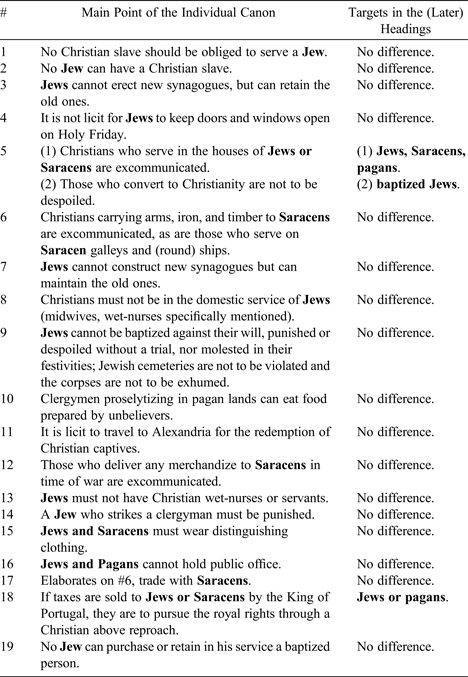
We will briefly describe the content of Liber extra's Book V, Title 6 (see Table 1), which will serve as the starting point of this article's discussion. Entitled On Jews, Saracens, and their Servants, but dealing in fact with Jews, Muslims, pagans, and their slaves and servants, this section arranges chronologically all canons on Christians' relations with non-Christians that Raymond of Peñafort deemed relevant, excluding those that had already achieved wide currency through the Decretum.Footnote 22 Of the nineteen canons, only three predate the reform period.Footnote 23
Brief Summary of X. 5.6, On Jews, Saracens, and their Slaves/Servants

Six of the nineteen canons place restrictions on Jews (Table 1) (#2, 4, 8, 13, 19);Footnote 24 three provide Jews with basic rights (#3, 7, 9);Footnote 25 and one deals with the rather hypothetical possibility that Jews might raise a hand against clergymen (#14). Four canons mention Jews alongside other non-Christians. Christians who cohabit with Jews and Saracens are excommunicated by the force of the deed itself; Muslims and Jews must wear distinguishing signs (#5 and 15).Footnote 26 One canon bans Jews and pagans from public office, another, although addressing the same subject, speaks first of Jews and pagans and then of Jews and Saracens (#16 and 18).Footnote 27 Four canons aim specifically at trade with Saracens (#6, 11, 12, 17).Footnote 28 The single canon to deal exclusively with pagans allowed qualified clergymen to consume food prepared by infidels while proselytizing in pagan lands (#10).Footnote 29 Subsequent collections, which were much shorter and which functioned as appendices to the Liber extra, feature only a single relevant decision, a canon by the Council of Vienne (1311–12), which bans the call of the muezzin in Christian lands—called the invocation of Muhammad—and on pilgrimage to, evidently Mecca, defined by a renowned canonist as “the place where a certain Saracen was buried whom they venerate as a saint.”Footnote 30 Another well-known jurist rephrased the law, the facto expanding it: Catholic princes must not allow Saracens to say any words in honor of Muhammad in a loud voice, “nor to venerate any Saracen as a saint.”Footnote 31
Upon promulgation of the Liber extra, and the corresponding bull proclaiming it as the law of the church, legal heavyweights took it upon themselves to provide an understanding of the law suitable for classrooms, courts, and the confessional. Bernard of Parma composed what became known as the standard gloss to the Decretales.Footnote 32 The canonists produced two different types of works of interest to us, lecturae and summae. The lecturae are extended, detailed comments on each individual canon, whereas the summae merge several or even all the canons on a given subject into a single, general treatment, thus turning the sum of ad hoc decisions that the Liber extra represented into an abstract law of the church. In turn, the summae can be subdivided into legal treatises and penitential manuals.Footnote 33
Juxtaposing the influential penitential summa of Raymond (ca. 1222–25/34) with the equally famous summa on the law of Hostiensis (ca. 1253) will allow us to point out the subtle differences in the ways in which influential authors approached the subject.Footnote 34 Generally, Raymond and Hostiensis simply arranged in a coherent narrative the individual laws that make Liber extra's section On Jews and Saracens. Sometimes, however, their accounts are at dissonance both with the letter of the law and with one another. Unlike the law and Raymond's interpretation of it, for example, Hostiensis separates Jews and Saracens, dealing with the former first and not necessarily repeating a canon when discussing the latter. Therefore, if we read Hostiensis' summa in a proscriptive key, we may be tempted to infer that pagans or Muslims could hold public office, because he omits pagans from the canon that requires Christians to be removed from contact with “Jews and pagans” wherever the latter transgress the stipulations against holding public office.Footnote 35 Both Raymond and Hostiensis differ from the law itself in appearing unconcerned with the double target of Lateran IV's requirement that Jews and Saracens wear distinctive clothing, speaking instead of Jews alone.Footnote 36 Both authors, at the same time, spend some time on the question of whether Christians, who are clearly prohibited from sharing a meal with a Jew, could do so with a Muslim, something the law itself does not discuss.Footnote 37
The more works we add to our discussion, the more blurred the answer to the question “How ought Christians relate to others?” becomes. The leading late medieval authorities, Johannes Andreae (d. 1348) and Nicolò de Tudeschi (Panormitanus, d. 1445) open their commentaries on Lateran IV's requirement that Jews and Muslims wear distinguishing signs by speaking of, indeed, Jews and Saracens.Footnote 38 On the other hand, neither Johannes von Erfurt, nor Astesanus da Asti, authors of influential penitential works (completed in 1302 and 1317, respectively) explicitly link this requirement to a specific group of people. Johannes inserts it after a sentence in which he speaks of Jews, pagans, and Saracens.Footnote 39 Astesanus' line on the subject, by contrast, is situated within sentences that clearly speak of Jews alone.Footnote 40 Similarly, unlike Hostiensis, Johannes Andreae and Johannes von Erfurt clearly state that neither Jews nor pagans can hold public office in Christian lands.Footnote 41 In Panormitanus, this ruling appears no less prominently, although, tellingly, it is said to be aimed at Jews and pagans in the actual discussion, and at Jews and “infidels” in its summary.Footnote 42
This mildly discordant chorus of the great authorities turns into a veritable cacophony once we give an ear to those whose voices those such as Hostiensis usually silence. The mid-thirteenth century Franciscan Henry of Merseburg who seems to have taught at Magdeburg and Erfurt wrote a short summa for classroom use.Footnote 43 The section On Jews and Saracens is well summarized. Christians, for example, cannot eat, drink, cohabit, or bathe with Jews or receive medicines from them; Jews must wear distinguishing clothes or signs, and must not be allowed to hold office among Christians.Footnote 44 At the same time, Henry does not discuss “Saracens.” Aiming at a concise and clear exposition, Henry may have simply left out a non-Christian group of little concern in his own area (his work circulated in northern Germany).Footnote 45
However, it is hard to always link a commentator's choice to the area of his activities. It is precisely a contemporary work of regional relevance, the so-called Summula Conradi (1226/29), which remained popular in central Europe throughout the Middle Ages, that swings the pendulum of interpretation to the opposite extreme. At a glance, the Summula Conradi, or at least the eight manuscripts on which the critical edition of the work rests, focuses on Jews alone: Christians cannot share a table with Jews, nor eat their food, Jews cannot be the doctors of Christians, nor are Christians to bathe with Jews.Footnote 46 Jews must be dressed differently from Christians, and they are not allowed to hold public office. However, the whole section concludes with the words “That which is said of the Jews, you should also understand of the Saracens, except that, perhaps, Christians are allowed to sit at the table of Saracens [C.11.q.3.c.24] and this, perhaps, for the reason that, unlike the Jews, they do not have law by which they can deceive the faithful.”Footnote 47
Summula Conradi's line was turned into this article's title for a reason: it provides what, at least to modern eyes, appears to be a whole new dimension of the law. Christians are not to call upon Muslim doctors, bathe with Muslims, or appoint them to public office, points not made by the law itself (and, of course, Saracens are to wear distinctive clothing). Given the well-known ambiguity in the distinction between a “Saracen” and a “pagan,” so well illustrated by Summula Conradi's own manuscript tradition—six of the manuscripts that make the text's critical edition use “Saracens” whereas two use “pagans”—the work may well have been understood as banning a broad range of contact between Christians on the one hand, and Jews, Muslims, and pagans, on the other. Thus, lesser known works provide a glimpse underneath the glamor of the time's most renowned authors, exposing the full range of possibilities in the understanding of the law of the church, from restrictions aimed at Jews alone to such aimed at Jews, Muslims, and pagans.
Some penitential works, finally, appear confusing for an altogether different reason. Bartolomeo da Pisa arranged his Summa (ca. 1338) alphabetically, thus separating Jews from Saracens by approximately 100 folios. Cohabitation, food, medicines, public office, and fashion are all subjects with which Bartolomeo deals in his entry on Iudeus/i,Footnote 48 stuck in between Istrio and Iudicare potest/Iudex. Illicit trade dominates the much shorter one on “Saracens,” to be found in between Saints' bodies and Satisfaction.Footnote 49 Thus Bartolomeo excised, for reasons that seem to have more to do with style than with policy, the reference to Muslims from canons that explicitly featured them.
It is hardly news that the canonists disagreed on the meaning of individual canons. What is noteworthy is that the commentarial literature does not offer an unequivocal perspective on the very targets of the various ecclesiastical policies aimed at non-Christians. These discrepancies cannot be explained away by arguing that individual commentaries were to be consulted alongside the law itself. Works aimed at the classroom may have been consulted alongside the law, but even so, they complicate it as much as they clarify it. The premise of penitential works, moreover, was certainly different: to make the content of the law accessible for practical use. The link between the commentators' choices and the religious landscape of the territories they inhabited cannot explain all discrepancies. Historical context could and did serve as an “irritant,” in Freidenreich's words on commensality, but it was quickly pushed to the background by the text-based approach of the canonists into what Pakter, speaking of the canons on Christian slaves and servants, calls a “closet debate.”Footnote 50
The rest of this article is hence dedicated to proposing that what is misleading may well be the impression of confusion itself. Perhaps we do not face commonplace, explicit canonistic disagreement, as in the case of the sharing of meals with non-Christians. No matter how individual popes and canonists may have thought of their own actions, legal commentaries, penitential manuals, and papal letters treat the labels Jew, pagan, heretic, Saracen, and schismatic in a twofold fashion. On the one hand, they are treated as presumably distinct groups of people. On the other, the labels are often interchangeable placeholders for the broader category “infidelity.” The inherent ambiguity of the legal discourse on Christians' relations with others was one way in which each policy became potentially applicable against each group of “infidels.” But did “apply to Muslims what was said of the Jews” become the norm over time?
II. Toward a Clearly Articulated Conflation of Others?
The different threads of papal discriminatory legislation fuse in the works of two extremely influential fifteenth century authors. One is Antoninus, the Dominican Archbishop of Florence (1389–1459), a saint, as well as the twenty-fourth most printed author between 1455 and 1500.Footnote 51 The other is Roberto Caracciolo, who is in forty-fifth place among the most printed authors in the fifteenth century, an observant Franciscan who “was chosen in 1450 to deliver the official eulogy during the ceremonies for the canonization of Bernardino da Siena.”Footnote 52 Before we turn to their advice on how a Christian ought to relate to others, however, we need to revisit Hostiensis' work.
In his mid-thirteenth century summa, Hostiensis makes a short statement, which is striking on account of its brevity, generality, unremarkable place in the text, where it is placed simply as point number three, and its content: Christians ought to refrain from continual contact with Jews “so that the simpleminded are not corrupted by them.”Footnote 53 Technically, this statement is a typical representation of the canonists' method of forging new legal interpretations by uprooting whatever phrases would suit their purposes from their original contexts. This propensity to generalize on questionable basis was normatively neutral, but it yielded in this case a morally charged result. Hostiensis' ban against Christians' contacts with Jews was based on the canon dealing with new converts from Judaism to Christianity. According to the Decretum, it was that specific group of people, and not Christians in general, who were expected to refrain from communication with Jews qua their former fellow co-religionists.Footnote 54
Two centuries later, Caracciolo took his audience on an exhaustive tour of the Liber extra. His last target is the Jews, to whom he dedicates a lengthy discussion. Once he reaches the bans against eating, drinking, and cohabiting with Jews, Caracciolo tackles the subject of communication. He first repeats the old adage that Christians may talk with Jews and “infidels,” but not eat with them, because one is more easily deceived during meals. Caracciolo immediately clarifies, however, that it is the strong in the faith who can converse with (note the choice of words) “infidels.” Even the strong in the faith, furthermore, should do so with caution, so that others are not scandalized.Footnote 55 Antoninus' take on the matter was no different, but he also adds explicitly that the weak are to have contact with others only in case of necessity.Footnote 56 This approach is typical: on the one hand, Caracciolo and Antoninus came close to banning any communication, on the other, their writings de facto popularized maxims found already in Thomas Aquinas and clung to long-circulating legal commentary that their training would not allow them to discard.Footnote 57 In the case of Caracciolo, his somewhat traditional discussion appears to match the one he offers on Muslims, the whole section on whom is a well-informed and lengthy exposition on papal trade restrictions. However, whereas this would make it seem that issues other than trade are not of equal concern, Caracciolo prefaces the whole section with a clear-cut and rather original recommendation of broader nature: “Christians must avoid their dangerous association and also must be careful not to carry arms or other goods to them.”Footnote 58
This desire to both report the law of the church and summarize it along lines that obliterate any distinction between policies, thus erecting a general ban on association, is sharper in the works of Antoninus of Florence. Antoninus's summa features a lengthy exposition on Liber extra's section On Jews and Saracens. It differs from the law of the church and from all earlier authorities considered in this work in one crucial way, however: it both attempts to summarize the section on Jews and Saracens and explicitly links it to the one that follows it in the law, On Heretics. “[One is not allowed to speak with heretics on account of their excommunication] but to talk with other infidels such as Jews and Saracens is not prohibited; what is banned is excessive familiarity and association.”Footnote 59 Depending upon the version consulted, Antoninus' penitential work, a much shortened and enormously popular derivative of his summa, which was meant to serve both confessors and the laity, displays some interesting variations. An Italian edition, for example, states: “The infidelity of pagans, Jews, and heretics is a gravest sin that damns those who follow such errors. There is no need to mention that only the heretics are excommunicated [and hence one is not allowed to be in contact with them], but one—and especially the stupid and the ignorant—must not have intimate familiarity with Jews too.”Footnote 60 Whoever would consult only this edition, therefore, may well understand the ban on “intimate familiarity” as applicable to Jews alone. Several other Italian and Spanish editions, furthermore, do not even feature the paragraph of interest, and hence never mention the subject of communication with non-Christians. This, in turn, raises difficult questions about the intentionality of editorial intervention.
However, unlike the vernacular editions, the Latin ones I have been able to consult—published in Venice, Rome, Strasbourg, Cologne, Speier, and Memmingen—are very consistent with one another. They feature the sentence of interest here differently from the Florentine vernacular edition cited previously, suggesting that the warning of excessive familiarity did not apply only to Jews: “Only the heretics are excommunicated but there should not be intimate contact with others, too, and especially with Jews, and especially by idiote.”Footnote 61Idiote here most likely refers to laymen in general; Antoninus lived and worked in a period of a concerted papal and mendicant effort to re-establish ecclesiastical authority on a variety of fronts, from lay religiosity to contact with the “infidel.”Footnote 62 A Spanish version corroborates a reading of Antoninus's work as a rather general and comprehensive restriction of contacts between Jews and Christian laymen: “…one must not have intimate contact, especially with Jews and that much less should laymen [los idiotas] and those who are not literate hold such communication.”Footnote 63
It would be misleading, however, to see the work of Antoninus as an example of a linear development toward a well-articulated anxiety with the size of the papal flock resulting in a complete ban on all forms of relations between Christians and non-Christians. Antoninus is not quite as categorical, limiting himself to “intimate contact.” His own hand gets lost among those of his editors. Rather than seeing the change toward generalization as resulting from a careful and intentional redefinition of the meaning of the canon law, we may attribute it to the search for brevity entailed in the reworking of the clumsy Summa into a practical guide to daily life. The printing press, moreover, gave a new lease on life to high medieval works, now more widely available for consultation than ever before, thus hypothetically preserving the relevance of earlier views. Finally, not all editions of Antoninus's work feature the passage on “infidelity.”
However, Antoninus' confessional was printed more than 100 times in different versions and formats in Latin, Italian, and Spanish between 1468 and 1500, and many of these editions feature one or another version of his words on infidels. The editions of his Confessionale far surpass the sum total of those of influential earlier work.Footnote 64 Therefore, the abovementioned qualifications notwithstanding, Antoninus's writings—and the manner of their circulation—put into focus this article's argument. Although “Concord of discordant canons” was the declared purpose of canonical jurisprudence, and although the canonists continously reused the same material, there was little harmony in the ways in which they wrote about the church's precepts on how Christians ought to relate to non-Christians, let alone in the ways in which such opinions circulated at the dawn of printing. The canonists upheld a taxonomy of otherness too central to Christian cosmology to be discarded; however, canonistic interpretation of the law consistently came close to reducing all difference to one between own and alien sheep, spreading by implication suspicion of any form of contact between faithful and others.
III. Generalizing from a Specific Canon: Can a Christian Bequeath to Non-Christians?
The inherent ambiguity in the church's stance on the subject of Christians' relations with others may have prevented the friars from clearly articulating a general ban on any form of unlicensed communication with non-Catholics. There were no obstacles, however, in expanding the validity of individual policies. Commenting on the law of bequests, the famous lawyer Panormitanus states that a specific legislative act is necessary for a rule that speaks of bishops to apply to all clergy members.Footnote 65 This logical conclusion was drawn through the juxtaposition of the two earliest canons on the subject. However, it is precisely the canonists' treatment of the law on this subject that suggests otherwise. The canonists themselves could turn a specific law into a general one by rephrasing it in general terms.
In 418–19, African bishops met at Carthage and approved the decisions taken at earlier African councils. Two of these canons found their way into Liber extra's section “On Heretics.” Canon si quis proclaims the anathema of bishops, even if post mortem, who would bequeath to people not related to them by blood, to heretics, even if their relatives, or to pagans. Canon in eos proclaims, in turn, that neither bishops, nor any clerics can bequeath to non-Catholics.Footnote 66 Accordingly, the standard gloss merged the two canons, adding “and the same about all those who are not Catholics.”Footnote 67 Therefore, whereas these canons were placed in the section dealing with “heretics,” they also concern Christians' relations with anyone else outside the papal flock. No clergyman can bequeath anything to non-Christians.
But is a layperson allowed to do so? Hostiensis appears to allow the laity to bequeath to individual Jews, if not to Jewish communities.Footnote 68 He fails, however, to mention non-Catholics other than Jews or to reiterate the matter in his subsequent section on “Saracens.” Given that the Liber extra explicitly forbids any clergy members to bequeath anything to any non-Catholics, a literal reading of Hostiensis' summa, which would implicitly allow even clergymen to bequeath to “Saracens” or “pagans,” could not be viable, but Hostiensis did not preclude the possibility that ordinary Catholics could legally bequeath to non-Catholics. If Hostiensis' summa can be somewhat confusing, lesser known works can feature outright misunderstandings of the law. Whereas canon si quis disallowed a bishop to bequeath to a non-relative or to a “heretic,” even if a relative, a little-known penitential work states that “A clergy member cannot bequeath anything to a Jew, a Saracen, or a relative.”Footnote 69 Working at a higher level of abstraction, some jurists provided categorical statements. The resulting clarity was achieved at the expense of all non-Catholics. Gottofredo da Trani, writing of the ways in which Christians are to relate to Jews and Saracens, implicitly conflates clergy and the Ecclesia as a whole by broadly anathematizing Christians who would bequeath anything to pagans.Footnote 70 Whereas we may have expected Gottofredo to simply merge si quis and in eos and thus substitute non-Catholics for “heretics” and pagans, as the standard gloss would do, he apparently simply erases “heretics” from the original sentence in si quis, now out of place in a section entitled “On Jews and Saracens.” Given the sentence's context, there can be little doubt that his statement should be understood as also applicable to Jews and “Saracens.” Others were more explicit. Raymond of Peñafort 's penitential summa proclaims simply that no one can bequeath to a Jew or to a pagan.Footnote 71
Late medieval authors appear to have followed Raymond's hard line. Writing in the 1330s, Bartolomeo Pisano allowed no one to bequeath anything to the community of the Jews or to any Jew or pagan.Footnote 72 Antoninus of Florence's Summa uses almost identical language.Footnote 73 Roberto Caracciolo follows suit: “no Christian may bequeath anything to any Jew or to a congregation of Jews or of other infidels” under the threat of anathema.Footnote 74 There was, therefore, a noticeable change over time toward broader readings of the law. An ancient law concerning bishops' relations with non-Christians was quickly applied to clergymen at large, and, in the later Middle Ages, to all Christians. Therefore, although they may have been too cautious to erect a sharp and undifferentiated boundary between faithful and others, the jurists could and did provide judges, confessors, and administrators with clear-cut readings of a specific law that were as practical as if they were their own invention. Was canonistic opinion divorced from papal practice?
IV. Papal Practice and Its Implications
There are three types of “infidelity,” Antoninus of Florence wrote in the fifteenth century echoing a long established practice: “paganism,” “Judaism,” and “heresy.”Footnote 75 This article concludes by briefly shifting our attention from Jews and Muslims to “heretics” and “schismatics” and from legal and penitential works to papal letters that never made their way into decretal collections, in order to make two points. First, that the voices of popes and canonists rang in one tone throughout the later Middle Ages. Second, that by applying the mind of the law to analogous situations, ad-hoc papal letters expanded over time the validity of a specific policy, even if the canonists themselves ignored the development.
“Papal letters” is a generic term for a variety of documents produced by the church's central administration that can be classified in more ways than one.Footnote 76 The thirteenth century letters mentioned in the previous section were decretales, papal answers to the queries of clergymen or laics.Footnote 77 What is of interest here, however, is the enormous body of letters as a whole, whether these legislated, advanced papal diplomacy, exhorted the faithful to crusade, provided consultation, made decisions on specific cases, bestowed privileges, or granted dispensations. The one problem we need to clarify at the outset is that of the voices they contain. This is best done through an example.
A letter addressed in 1354 to the Archbishop of Crete, the largest Venetian overseas territory, dispensed the nobleman Nicoleto Bono and the noblewoman Agneta, daughter of Francesco Mudazzo from the provisions of the ban on marriage within the fourth degrees.Footnote 78 As typical, the exposition contains much of the language of the original petition. Crete was surrounded by “Barbarian Saracens and Schismatic Greeks.” The island itself was filled with Greeks with whom the Latins were hence compelled to talk and to live. The prospective spouses abhorred the thought of marrying such people, but so few were the nobles of suitable rank unrelated to them, in part because of the Black Death, that these were hard to identify.Footnote 79 It may be tempting to use letters of this sort as evidence that at least the nobility had internalized the canon law distinctions between Christians and schismatics (and Venetian laws' clearly demarcated line between Venetians and Greeks). However, it was difficult in practice to tell a “Latin” from a “Greek.”Footnote 80 The supplicants may have been able to, but did not have to have any input in the actual phrasing of their petition. This may well have been the work of a clergyman on Crete or even of professionals at the papal court, “scriveners,” “who would draw up papal petitions on request and couch them in a proper form.”Footnote 81 The letter, therefore, tells us nothing certain about how Nicoleto and Agneta themselves viewed the Greek-speaking Orthodox Christians among whom they lived. Whoever stood behind the argument through which the dispensation was to be obtained, however, clearly employed language that was deemed likely “to work” at the curia. Therefore, whatever its source, the language of a papal letter reflected the curia's own characterizations of the outside world.
Nicoleto and Agneta's petition was far from harsh in labeling Orthodox, Greek-speaking people as “schismatics.” They could well have called them “heretics.” Schism separates one from the church, proclaims the Decretum, setting the tone for centuries, whereas heretics keep perverse dogma, which they obdurately defend.Footnote 82 Papal letters, accordingly, often consider Eastern Europeans, such as Greeks, Ruthenians, and Bulgarians as neither “infidels,” nor “heretics,' but rather “schismatics” who follow the “Greek rite.” An important caveat applies, however. Persisting in a schism over a prolonged period of time is impossible without lapsing into heresy.Footnote 83 Accordingly, the author of Summula Raymundi, having first applied all laws regarding Jews to “Saracens,” unsurprisingly concludes his section on “heretics” with “What was said of the heretics, you should also understand of the schismatics.”Footnote 84
Context often explains the word choice adopted in papal letters. Although the First Crusade (1096–99) had once been launched, in part, under the premise that Eastern Christians need help against Muslims (called Saracens, Persians, Turks, or pagans), the Fourth Crusade (1201–04) led to the establishment of Latin polities on Byzantine soil. The Roman see developed a hard line against Eastern Christian polities seeking to dislodge the Latins.Footnote 85 In this context, papal letters often efface any difference between “infidels,” “heretics,” and “schismatics.” When answering a letter from Guido della Rocca, Lord of Athens, who had accused Greek monks of revealing secrets to Greek “infidels” and hence asked that said monks be replaced with Latin ones, the papal chancery was content to uphold Guido's obviously self-interested construction of the Greeks' identity.Footnote 86 The choice of words might have come “from below,” but it is unreasonable to suppose that Innocent, one of the most highly regarded canonists as well as the pontiff who took to heart to define the extent of papal power over non-Christians, was not aware of the implications of the vocabulary that his chancery was using. What really mattered, it seems, was a given group's failure to belong to the papal flock.
Another pope well-versed in the law of the church, John XXII, writing to the Genoese, Venetian, and Pisan officials, as well as to all other Catholics in Caffa, a Genoese colony in the Crimea and the Black Sea's premier emporium in the late Middle Ages, took issue with the Latins' practice of contracting marriages “with schismatic and heretical women.”Footnote 87 These women, John claims, promise at first to “rejoin” the Roman Church, but after a period of observance of the orthodox faith, are seduced by the cunning of Satan away from the truth of the faith and into heresy, dragging their husbands with them into perdition.Footnote 88 John's letter thus laments the Devil's employment of “schismatic and heretical” women to corrupt what his rhetoric, informed by the monastic image of Eve as the tool through which the Devil wreaks havoc in an otherwise orderly world, diacritically constructed as innocent Catholic men. Overall, however, the issue was not gendered. Catholic women were, in turn, painted as the victims of their male relatives. In 1309 a papal legate held two synods, one in Buda for clergymen from Hungary and another in Bratislava for their Polish brethren. The latter banned all Catholics from marrying their daughters or other female relatives to any heretics, Patarens, Gazars, schismatics or others who oppose the Christian faith, chiefly Ruthenians, Bulgarians, Serbs, and Lithuanians “who remain in error;” provisions that applied to Hungary, too.Footnote 89 The decision had a specific trigger, the apparent attempt of Ladislaus Kán, voyvode of Transylvania, to marry his Catholic daughter to “Stephan, King of Serbia,” perhaps Stephan Milutin (d. 1321) who fought his brother Stephan Dragutin over the Serbian throne.Footnote 90 The specific context of its origins notwithstanding, the decision assumed a broad validity in the eastern areas of Latin Christendom. Suggesting that the supposedly theologically sound “schismatics” “oppose the faith,” and by lumping them with the partly pagan, partly Christianized Lithuanians, renders meaningless any distinction between the categories “schismatic,” “heretic,” and “pagan” even as it nominally upholds them.
By the fifteenth century, the Ottomans had conquered a good portion of the Balkans, obliterated Bulgaria, and turned the once proud Byzantine emperors to purple-clothed beggars for Western help.Footnote 91 The Roman Church adopted a much more compassionate stance to Orthodox Christians; the novel attitude was most obvious in the church's categorical opposition to the enslavement of eastern Christians.Footnote 92 In this context Pope Martin V (1417–31) addressed in two bulls a particularly heinous crime in the eyes of the church, the long-standing trade in Eastern Christian slaves conducted between the Crimea and Egypt, whose sultan used the slaves as military recruits.Footnote 93 The bulls resulted from the supplication of an Augustinian monk who, returning from overseas, complained of Christians who aided Turks against the city of Constantinople, of the sale of Christians of the “Greek rite” to infidels, and of Jews not wearing distinguishing signs, hence committing many crimes, including the sale of Christians to infidels. Martin dealt with Jews in one bull and with Christians in the other. Both bulls focus on the issue of the alleged Jewish and Christian trade in Christian slaves, seen as resulting in the latter's apostasy and their subjection to sodomy. In this context, Martin's chancery referred to the Eastern Christians neither as “heretics,” nor as “infidels,” or even “schismatics,” but simply as “Christians baptized in the Greek rite” or as peoples “baptized in the name of Christ.”Footnote 94
“Schismatics” appeared in more favorable terms not only in the context of the later crusades, but also in that of mission.Footnote 95 One of the important papal documents on the subject is the bull Cum hora undecima (Because it is the eleventh hour, that is, the second coming is imminent). First issued by Gregory IX in 1235, it was reissued throughout the later Middle Ages in accordance with a model established by Innocent IV in 1245.Footnote 96 An example from John XXII (1316–34) allows the Dominican and then the Franciscan preachers setting out for lands of the “Saracens, pagans, Greeks, Bulgarians, Cumans, Iberians, Alans, Khazars, Goths, Ruthenians, Jacobites, Nubians, Nestorians, Georgians, Armenians, Indians, Mocolitarum and of any other unbelievers,” to let schismatics who have rejoined the church to cohabit and be in contact with their apparently still schismatic relatives.Footnote 97 This bull followed the logic of the canon that allowed missionaries to enter in contact with those outside the flock (Table 1, #10) echoing Chrystostom's and Augustine's proselytizing mandate now firmly denied to the laity. Although it conflated “schismatics,” “heretics,” “pagans,” and Muslims into the category of unbelievers, the bull did, nonetheless, allow for a hierarchy of otherness in which Eastern Christians stood higher than others.
Therefore, the language of papal letters is a good example of the ecclesiastical practice of reading texts and the world on two main planes: that of specific historical circumstances and that of unchangeable truths. Papal letters, as canon law commentaries, oscillated between a monolithic infidelitas, tied to the ahistorical distinction between the flock of the faithful and everyone else, and a taxonomy of otherness, derived from the history of the early church and tied to ever-changing current contexts. Only a statistical analysis of hard-to-manage scope can tell us if a clearly defined linear development shifted the place of “schismatics” on the liminal space between those firmly within the flock and those certainly outside it.
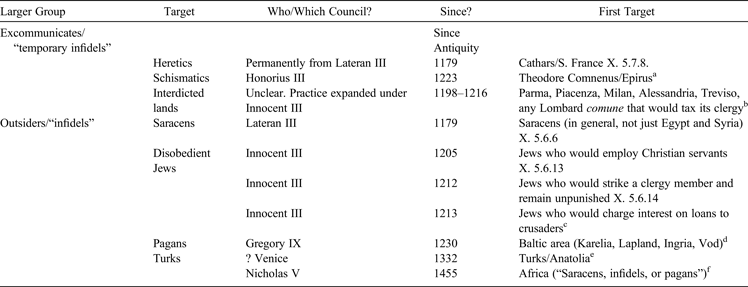
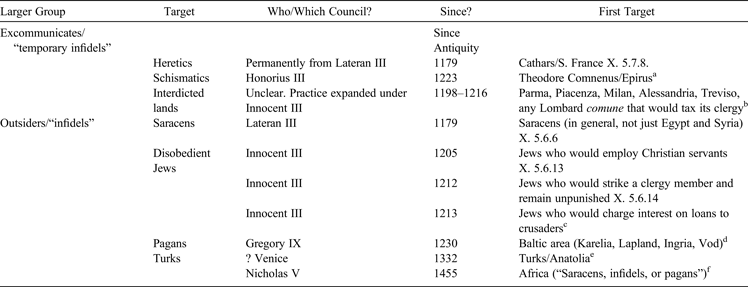
I mentioned previously that the canonists could turn a specific law into a general one by rephrasing it in general terms. The exact same outcome could be achieved, moreover, in an entirely different way, as the sum total of ad hoc applications of a given policy in the absence of a general rule. Between 1179 and 1230, councils and popes banned some or all trade and business between the faithful and two groups of targets, each with rather fuzzy internal subdivisions. One was made of excommunicates, disobedient Christian communities, “heretics,” and “schismatics,” all subject to the sentence of excommunication, and, therefore, to the penalties accompanying it. The other group of targets was comprised of Muslims, pagans, and incompliant Jews, all of whom lay outside the flock by definition. Nonetheless, when Raymond of Peñafort composed the Liber extra, he included no decretals that deal with disobedient Christian communities, pagans, or “schismatics.” When the canonists commented on the Liber extra, in turn, they too omitted any discussion of these three targets of embargoes. However, papal practice spoke clearly even as the lawyers remained mute: anyone out of bounds was to be cut from some or all business contact with Christians. This development was squarely grounded in a web of historical contexts,Footnote 98 but for the purposes of this article, it is best presented schematically (see Table 2).
Expansion of the Targets of Papal Trade Restrictions.
aAloysius Tautu, ed., Acta Honorii III (1216–1227) et Gregorii IX (1227–1241) (Vatican City, Typis Polyglottis Vaticanis, 1950), #112.
bPeter D. Clarke, The Interdict in the Thirteenth Century: A Question of Collective Guilt (Oxford: Oxford University Press, 2007), 83.
cFor the specific passage see Solomon Grayzel, The Church and the Jews in the XIIIth Century, Vol. I (New York: Hermon Press, 1966), 137.
dJohan Gustaf Liljegren, Svenkst Diplomatarium (Stockholm: Tryckt hos Norstedt, 1829), I, #254, 256. For the Baltic Crusades see Eric Christiansen, The Northern Crusades (London: Penguin, 1997 [1980]) and Iben Fonnesberg-Schmidt, The Popes and the Baltic Crusades 1147–1254 (Leiden: Brill, 2007).
eGeorges I. Bratianu, Les Venitiens dans la mez Noire au XIVe siecle. La politique du senat en 1332–33 et la notion de latinite (Buscarest: Academie roumaine, 1939), #14, 46–47.
fFrances G. Davenport, European Treaties Bearing on the History of the United States and its Dependencies to 1648, 1 (Washington DC: Carnegie Institution of Washington, 1917), 13–26.
By the mid-fifteenth century, the chief maritime cities procured for their citizens long-term licenses (i.e., dispensations from the provisions of church-made law) that allowed them to sail (with items other than war materiel) to “[lands] held by the Sultan of Babylon [Mamluk Egypt] and to other cities, lands, ports, and places beyond-the-sea of whatever other infidels and Saracens….”Footnote 99 The provenience of the language employed in these licenses and the individual views of popes and lawyers thus become a moot point. By the fifteenth century, to avoid ambiguity meant to understand the sum of ad hoc policies as a general rule that demarcated space in simple terms: Christians and infidels.
Conclusion
In conclusion to her work on ecclesiastical writings from the Eastern Empire in the early Middle Ages, Averil Cameron writes “It is a mistake to think that we are in the presence of three distinct strands, let alone genres, of Christian writing, concerned respectively with pagans, Jews, and heretics. Rather, I have been describing a mode of thinking, a kind of mindset and a way of describing, that informed Christian self-identity.”Footnote 100 This article describes, in turn, how a similar process occurred in later medieval Western canon law. The variety of categories into which the jurists sorted the non-Catholics remained conceptually distinct: Jews, pagans, heretics. Over time, however, they appear to have become increasingly more conflated in terms of the policies of segregation that applied to them. This happened in a variety of ways. The canonists banned all faithful from bequeathing to any non-Catholics by implicitly equating Christian clergy with all Christians. Popes applied trade restrictions against everyone perceived as disobedient or threatening to the papacy without ever formulating a general principle. Elsewhere, the language used by the canonists is too confusing, too atypical of their approach to the law to allow us to treat it as a matter of interpretation. Rather than a confusion regarding the targets of papal policies, it appears that what we face is the inherent interchangeability of such targets: Jews; pagans, and by extension Muslims; heretics, and by extension schismatics. “Jew,” “pagan,” and “heretic” were at one and the same time highly stylized markers of presumably clear-cut religious difference and nothing more than the interchangeable constituent parts of the broader category “infidelity.”
Individual laws, papal letters, and single legal commentaries yield meaning only in relation to the broader legal discourse of which they were a part. Whatever the views and intentions of individual popes and lawyers, the law of the church, legal commentaries, penitential manuals, and sermons constructed a legal discourse that transcended individual laws and commentaries, making each law against each target defined as outside the body of the faithful available for application against any other target: what was said of the Jews was applicable to Muslims, what was said of heretics was applicable to Schismatics. This article shows that this discourse insisted on clearly defined identities based on religious law while toying with the formulation of a general rule not contained in the law of the church: that ordinary Catholics must avoid any contact with non-Christians.