I. INTRODUCTION
Aluminum and aluminum alloys have been widely used as electrical conductors in power lines and hybrid induction motor applications because of their high specific strength, good corrosion resistance and excellent electric conductivity. Reference Karabay1,Reference Karabay2 It is well known that addition of rare earth elements in aluminum alloys has a lot of benefits, such as deoxidizing, Reference Li, Wang and Zhao3 dehydrogenizing Reference Pan, Zhou, Shi and Ding4 and refining grain sizes. Reference Zuo, Shi, Li and Zhang5–Reference Wan, Han, Li and Wang9 This results in an improvement of castability Reference Zhang, Ma, Guan, Chen, Li and Zhao10–Reference Lü, Wang, Zeng, Ding, Zhai and Zhu12 and mechanical properties. Reference Buttinelli, Felli, Lupi and Marani13–Reference Zhao, Yao and Yang15
Numerous studies have been conducted on the effect of rare earth (RE) on electric conductivity of aluminum alloys. However, there are contradictory results reported in the literature. Xu et al. Reference Xu, Wang, Tian, Du, Zhou and Ni16 reported that electric resistance of Al–0.97% Mg–0.54% Si alloy decreased with addition of Ce. Zhao et al. Reference Zhao, Yao and Yang15 observed that addition of La in Al–0.5% Si–0.43% Mg alloy refined the microstructure and also improved electric conductivity. Chen et al. Reference Chen, Zhu and Zhang17 investigated the effect of addition of Ce and Y in Al–Zr–Mg alloys and reported that addition of mischmetal improved the conductivity. But, Gao et al. Reference Gao, He and Chen18 reported no improvement of the conductivity with addition of Ce in commercially pure aluminum alloy (CP-Al). Wang et al. Reference Wang, Kang, Erjun and Zhang19 also pointed out that mischmetal addition has no effect on conductivity of CP-Al. The controversial results indicate that there is a need to further study the effect of rare earth addition on conductivity in aluminum alloys.
As RE elements have large radius and tend to lose two outmost level s-electrons and a 5d or 4f electron easily becoming trivalent ion, RE metals are very active. Reference Nie, Jin, Fu, Xu, Yang, Zhou and Zuo20 As a result, RE is prone to form intermetallic compounds with Fe and Si solutes in the Al alloys. Reference Hosseinifar and Malakhov21,Reference Ravi, Pillai, Pai, Damodaran and Dwarakadasa22 For overhead wire conductors or conductive components in hybrid electric vehicle, to meet its strength requirement, Mg and Si as strengthening elements are usually designed in the alloy with a little excess Si, and in industrial practices, even for conductive aluminum alloys, Fe as impurity is strictly limited but inevitably presents in alloy. Fe and Si solutes in Al solution increase the electronic resistance. Reference Hatch23 Impurity elements above in solid solution have a much more significant harm to conductivity than out of solid solution. Reference Karabay2,Reference Hatch23 Thus, it is generally believed that RE addition leads to a reduction of solute contents of Fe and Si in Al solution and hence improves the conductivity. However, no detailed and direct evidences have been revealed.
Although many research works have shown the benefits of RE addition in Al alloys on the conductivity, there exists a need to understand the fundamentals and mechanism of conductivity improvement. In this paper, the effect of Ce on conductivity is studied based on a crystal structure theory and comprehensive analyses of scanning electron microscope (SEM)-EDS microstructure observations. The lattice constants and density of states (DOS) of Al solutions with or without addition of Ce are calculated using the first principle and Bragg equations from X-ray diffraction (XRD) diagrams.
II. EXPERIMENTAL PROCEDURE
A. Alloying and casting
The chemical compositions of the studied alloys with or without Ce addition are listed in Table I, which were measured using ARL-3460 (flame direct reading spectrometry). The ingots of commercially pure aluminum (99.8%) (CP-Al) and magnesium (99.8%), Al–12.5% Si and Al–10% Ce mater alloys were melted in a graphite crucible of 3 kg capacity, using an electrical resistance furnace. The melt was held at 760 °C for at least 30 min. After being cooled to 720 °C, the melt was first degassed using C2Cl6 (0.6 wt%) and then added with Al–10 wt% Ce master alloys. Prior to pouring, the melt was held in vacuum (−0.1 MPa) at 720 °C for one hour. After being processed, the molten aluminum was poured into various preheated metal molds (at 250 °C) including fluidity and hot tearing sensitivity test molds, and a plate-like mold with a cavity of 170 × 100 × 20 mm3 for preparing samples for tensile and conductivity tests.
Composition of the studied alloys by ARL-3460, wt%.

*: addition level only for Ce; ⊗: high purity aluminum.
B. Electric conductivity test
Samples for electric conductivity test were cut from the plate-like casting with a size of 5 × 5 × 70 mm3. The resistance of the sample, R, was measured using QJ-36 double bridge system (Shanghai Electric Meter Factory, Shanghai, China). Reference Liao, Liu, Lü and Wang24,Reference Lü, Liao, Liu and Wang25 The conductivity is characterized by
 $$\% \;{\rm{IACS}} = {{{\rho _{{\rm{annealed\ copper}}}}} \over {{\rho _{{\rm{sample}}}}}} = {{1.7241} \over {R{s \over l}}}\quad ,$$
where International Annealed Copper Standard (IACS) is a unit of electrical conductivity for metals and alloys relative to a standard annealed copper conductor and an IACS value of 100% refers to a resistivity of 1.7241 μΩ·cm at 20 °C, and, l and s are the length and section area of the sample, respectively. The data of conductivity is an average of 3 test values.
C. Microstructure characterization
Samples for microstructure observation were cut from the plate-like castings and prepared using standard metallographic processing. Sirion Field-emission scanning electron microscope (FEI Company, Hillsboro, Oregon) and Tecnai G2-20 transmission electron microscope (TEM; FEI Company), both with GENESIS 60S X-Ray EDS (EDAX Inc., Mahwah, New Jersey), were used to characterize the microstructure.
Two scanning modes were selected for D8-Discover XRD (Bruker Corporation, Karlsruhe, Germany) characterization. For Al–0.35% Si–0.2% Mg alloy with or without Ce addition, a large range of 2θ (25°–55°) were scanned at 2°/min and 0.15°/step to characterize the possible phases. For some selected alloys, a much slower scanning at 0.05°/step was focused on Al (111) peak (37°–40° of 2θ) to study the effect of solutes such as Fe, Si, La, and Ce on lattice constant of the Al solution. MDI Jade 5.0 software was used to analyze the obtained data.
D. First principle calculation
The Castup module in Material Studio software, one of the first principle calculations, was adopted to calculate the properties of Al solutions with different solute elements, such as lattice constant and DOS. Material Studio provides a platform from which a crystal model can be virtually constructed to describe the disorder in a solution. In this study, 2 × 2 × 2 unit cell models of Al solutions with different solute elements were constructed. The maximum solubility of Ce, La, Si, and Fe is assumed to be 0.0096 at.%, 0.01 at.%, 1.47 at.%, and 0.024 at.% based on their binary diagrams, respectively. Broyden Fleteher Goldfarb Shannon method was used to optimize the lattice structure. For the optimized models, energies in quantum mechanics were calculated based on density functional theory. In model optimization, generalized gradient approximation method was used to correlate the exchange effect among the electrons of atoms. The DOS of solutions were obtained by Analysis Function of Castup. All the calculations were done using the supercell approach with periodic boundary conditions.
III. RESULTS AND DISCUSSION
A. Effect of Ce on electric conductivity
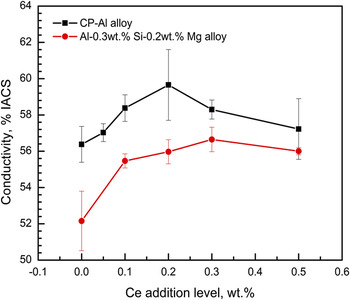
Figure 1 shows the effect of Ce addition on the electric conductivity of CP-Al and Al–0.3% Si–0.2% Mg alloys. Reference Liao, Liu, Lü and Wang24,Reference Lü, Liao, Liu and Wang25 Addition of Ce remarkably improves the conductivity. For the studied alloys, the conductivity first increases and then decreases with increase in Ce addition. When the amount of Ce addition is at 0.2 wt%, the CP-Al alloy has the maximum conductivity of 59.7% IACS, 3.3% IACS increment compared with the alloy without Ce addition. For Al–0.3% Si–0.2% Mg alloy without Ce addition, its conductivity (52.1% IACS) is expectedly lower than that of the CP-Al alloy without Ce (56.4% IACS), because it contains a large amount of solutes that has a negative impact to conductivity. With addition of Ce, however, its conductivity is remarkably increased, a max. 4.2% IACS rise at 0.3% Ce addition compared with that without Ce addition. In our study, effect of La addition, in form of Al–10 wt% La master alloy, on conductivity of CP-Al and Al–0.3% Si–0.2% Mg alloys was also investigated. For CP-Al alloy, 0–0.7 wt% addition of La has no obvious influence on the conductivity, 56.4% IACS (0 wt% La) to max. 56.64% IACS (0.5 wt% La). And for Al–0.3% Si–0.2% Mg alloy, the max.% IACS value, 54.84, is obtained at 0.1 wt% La addition, only 2.57% IACS increment compared with the alloy without La addition. But for Ce addition in CP-Al alloy, 3.3% IACS increment is obtained at 0.3 wt% Ce, and in Al–0.3% Si–0.2% Mg alloy, 4.2% IACS increment at 0.3 wt% Ce. Both La and Ce belong to light rare earth family, but the effect of Ce on conductivity is much more significant than La. The reason for it needs more attention.
Effect of Ce addition on electric conductivity of commercial purity aluminum (CP-Al), data adapted from Ref. Reference Lü, Liao, Liu and Wang25, and Al–0.3% Si–0.2% Mg alloy, data adapted from Ref. Reference Liao, Liu, Lü and Wang24.

B. Microstructure evolution
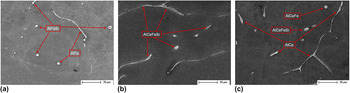
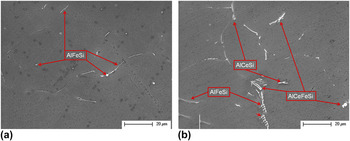
Figure 2 shows that Ce addition in the CP-Al alloy has a significant influence on the second phases, leading to a considerable increase in both the amount and size. In the absence of Ce, all second phases, whether discontinuous reticular or particulate, are AlFeSi compounds [Fig. 2(a)]. With an addition of 0.2 wt% Ce, however, most of the second phases are changed to AlCeFeSi compound [Fig. 2(b)]. When the addition of Ce is 0.5 wt%, most of the second phases are Al–Ce compound and thus the Fe and Si solutes have to re-dissolve into Al solution. Similar to the results observed in the CP-Al alloy, addition of Ce in Al–0.3% Si–0.2% Mg alloy reduces the amount of Fe and Si solutes in Al solution during solidification (seen in Fig. 3). When excess Ce is added in the alloy, similar results are obtained as in the CP-Al alloy. Similarly, La addition in CP-Al and Al–0.3% Si–0.2% Mg alloys also results in the increase in the amount of the second phases rich in Fe and Si, meaning the reduction of Fe and Si solutes in Al solution.
SEM metallographs showing the second phases in the commercially pure aluminum, (a) 0 wt% Ce; (b) 0.2 wt% Ce; and (c) 0.5 wt% Ce.

SEM metallographs showing the second phases in Al–0.3% Si–0.2% Mg alloy, (a) 0 wt% Ce and (b) 0.3 wt% Ce.

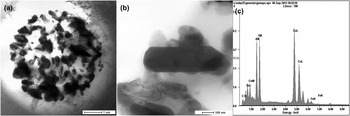
Figure 4(a) shows a crystal structure of a second phase particle, observed by TEM in Al–0.4% Si–0.3% Mg–0.3% Ce alloy. As a whole, it looks like a ball, however in fact, it is very loose and composed of many blocky particles [Fig. 4(b)]. EDS result of one nanoparticle is shown in Fig. 4(c). It contains very high levels of Ce and Si and very small amount of Fe but no Mg. This suggests that addition of Ce in Al–Si–Mg alloy, CeSi or AlCeSi compounds are formed.
AlSiCeFe compound in Al–0.4% Si–0.3% Mg–0.3% Ce alloy, (a–b) TEM photos showing the morphology of second phase; (c) EDS composition of the blocky particle in (b).

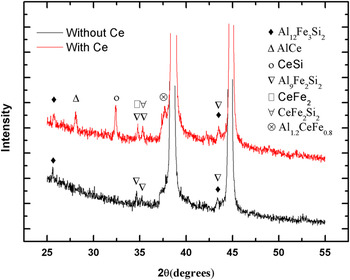
XRD diagrams of Al–0.3% Si–0.2% Mg alloys with 0.3 wt% and without addition of Ce are shown in Fig. 5. Since three intensity peaks of possible phases in this alloy are at small 2θ angle, the scanning range was specified as 25°–55°. For the alloy without Ce addition, except for high intensity Al peaks, there are only four very weak peaks, representing Al12Fe3Si2 (α-Fe) and Al9Fe2Si2 (β-Fe), as shown in Fig. 5. This is consistent with the characterization results by SEM-EDS [Fig. 3(a)]. With addition of Ce, three new peaks are obviously observed, corresponding to AlCe, CeSi, and Al12CeFe0.8 phases. It is worth noting that the intensities of these three peaks are much higher than that of Al12Fe3Si2 (α-Fe) and Al9Fe2Si2 (β-Fe) peaks, suggesting the amount of them formed in the alloy containing Ce are also much higher than the latter. This is also consistent with the results shown in Figs. 3 and 4. By comparison, two weak peaks around 35° of 2θ angle are intensified due to Ce addition, which may be related with the formation of CeFe2 or CeFe2Si2 phases.
XRD diagrams of Al–0.3% Si–0.2% Mg alloys with 0.3 wt% and without addition of Ce.

Based on the microstructure analysis, it can be concluded that addition of Ce in the CP-Al and the Al–Si–Mg alloys enhances the formation of binary, ternary or quaternary compounds of Ce, Si, Fe, and Al that are rich in Ce, Si, and Fe. As a result, it reduces the contents of Si and Fe in Al solution and improves the conductivity. Reference Wang, Kang, Erjun and Zhang19,Reference Hosseinifar and Malakhov21,Reference Liao, Liu, Lü and Wang24–Reference Hosseinifar and Malakhov27 This explains why proper addition of Ce remarkably improves the conductivity of the CP-Al and Al–0.3% Si–0.2% Mg alloys.
Therefore, the amount of solute elements of Fe and Si in α-Al solution is believed to be reduced with Ce addition. Li et al. Reference Li, Wu, Wang, Wang and Li6 also reported that the Si solute content in Al solution was reduced with Ce addition. The removing of Fe and Si solutes from aluminum solution can reduce the lattice distortion and hence decrease the electron scattering. Thus, it is believed that the reduction of Fe and Si solutes in α-Al solution by Ce addition is one of the main reasons for the improvement of electric conductivity. When the addition of Ce is beyond 0.2% in CP-Al or 0.3% in Al–0.3% Si–0.2% Mg alloys, most of the second phases formed are Al–Ce compound (shown in Figs. 2 and 3), and thus the Fe and Si solutes have to enter into Al solution during solidification, thus the conductivity is decreased.
C. Mechanisms
For a pure metal, conductivity law from quantum mechanics can be expressed as Reference Wang28
 $$\sigma = {1 \over \rho } = {{{e^2}} \over {2m}}{n_{{\rm{eff}}}}{{\bar L} \over {\bar v}}\quad ,$$
where σ is the conductivity, ρ the electrical resistivity, e the electron charge, m the electron mass,
 $\bar v$
the average electrical thermal motion velocity, and
 $\bar L$
the average electrical free path. According to Fermi–Dirac distribution law, the electrons that participate conduction is not all valence electrons, only part that are adjacent to E
F (Fermi energy), as n
eff. The effective electron number (n
eff) is dependent on energy band structure.
 ${1 \over \tau }$
(τ, the relaxation time) is proportional to the DOS adjacent to Fermi level.
Reference Huang29
DOS is defined as the population of energy levels in E + dE range.
 $\bar v$
almost does not change with temperature, and that changes with temperature is only
 $\bar L$
. The scattering of electron wave motion in a metal is from two aspects: one is the temperature-induced ion vibration (lattice dynamic distortion); the other is lattice static distortion from all kinds of defects and impurities. For a commercial Al alloy, this becomes more complex. Impurity atoms enter the Al lattice, leading to not only the lattice static distortion, but also interaction between the valence electrons of the lattice atom and ones of the impurity atom that may change the electron energy band structure and also the DOS.
Generally, when solutes, whether large atomic radius or small one, enter the Al lattice, it will increase the lattice static distortion and thus the resistance of electric conductivity. The contribution of Fe in solid solution to the reduction of conductivity is 44 times higher than that out of solid solution, and the one of Si is 11 times higher. Reference Hatch23 Therefore, removing Fe and Si solutes from Al solution can inevitably improve the conductivity. Experimentally, it is observed that addition of Ce or La in Al alloys promotes the formation of compounds rich in Fe and Si. Reference Hosseinifar and Malakhov21,Reference Ravi, Pillai, Pai, Damodaran and Dwarakadasa22,Reference Liao, Liu, Lü and Wang24,Reference Lü, Liao, Liu and Wang25
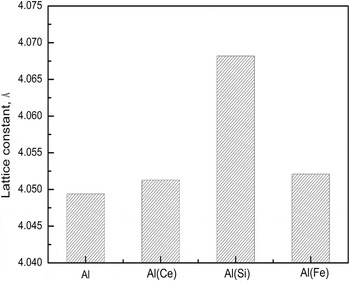
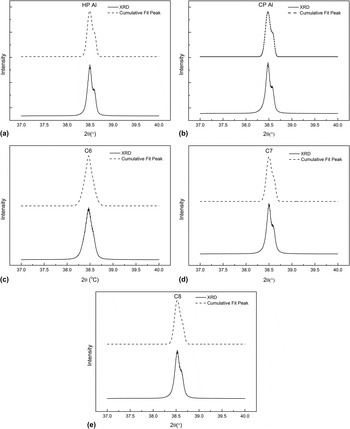
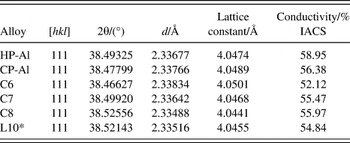
Figure 6 shows the influence of Ce, Si, and Fe solute elements on the lattice constant of Al solutions with their maximum solubility, based on Castup calculation. When solute atoms of Ce, Si, or Fe get into Al lattice, the lattice constant increases. So does the lattice static distortion. The impact of Si on lattice constant seems much higher than the others. In fact, it is due to the higher maximum solubility of Si in Al solution. Figure 7 shows XRD diagrams on Al(111) peak of the studied alloys with a slow rate of scanning at 0.05°/step. Based on Bragg model, the lattice constants of Al solutions in these alloys are calculated and tabulated in Table II. As listed in Table I, CP-Al has more impurity solutes (mainly Fe) than high purity aluminum (HP-Al). As an inference from Fig. 6, its lattice constant would be larger than HP-Al. C6 alloy (nominally Al–0.3% Si–0.2% Mg) contains much more solutes of Si, Mg, and Fe, thus its lattice constant would be much larger by inferring. The calculated lattice constants based on XRD diagrams actually demonstrate it, seen in Table II. Of more interest, with Ce addition in C6, the Al lattice constants of C7 and C8 alloys are decreased, indicating that some solutes have removed from the solution. 0.1 wt% La addition into C6 alloy (namely, L10 alloy in Table II) also leads to a reduction of the Al lattice constant. Table II also clearly links the lattice static distortion to conductivity. Adding Ce or La reduces the distortion and hence improves the conductivity. The reduction of lattice static distortion means the decrease of the phonon scattering effect. In other words,
 $\bar L$
is expanded and hence σ is increased.
Calculated lattice constants of aluminum solutions with the maximum solubility of Ce, Si, and Fe (based on Castup calculations).

XRD diagrams on Al(111) peak of the studied alloys with a slow rate scanning at 0.05°/step, (a) HP-Al (high purity); (b) CP-Al (commercial purity); (c) C6 alloy (Al–0.3% Si–0.2% Mg); (d) C7 alloy (Al–0.3% Si–0.2% Mg–0.1% Ce); (e) C8 alloy (Al–0.3% Si–0.2% Mg–0.2% Ce).

Lattice constant of Al solution in the casting samples of the studied alloys from XRD diagrams with a scanning step of 0.05° and its conductivity.

* Nominal composition is Al–0.3% Si–0.2% Mg–0.1% La.
But, as described above, the conductivity improvement of Ce addition in CP-Al and Al–0.3% Si–0.2% Mg alloys is much more than La. Obviously, the above possible difference in lattice static distortion of Al solution induced by Ce or La additions cannot interpret it conclusively. Whether does other mechanism play a key role in conduction? It is noted that the outer electron structure of La, 5d 16s 2, is different from that of Ce, 4f 15d 16s 2. Impurity atoms of La and Ce may alter the energy band structure of Al lattice. Based on the Castup module, the DOS of a large number of Al solutions is calculated, involving in all La serial and Ac serial elements, and Fe, Si, Ti, Zr, Mn, Mg, etc. as impurity atom.
Figure 8 shows DOS curves of pure aluminum and Al(Ce), Al(Fe), Al(Si), and Al(La) solutions, as examples. The dot lines in the plots represent the Fermi level, namely, E = E F. For pure aluminum, the DOS is quite high near the Fermi level. When Fe or Si solutes get into Al lattice, however, DOS adjacent to Fermi level changes remarkably. There are two downward sharp peaks formed at both sides of Fermi level suggesting pseudogap. It indicates that covalency is enhanced and, in other words, metallicity is weakened, and thus conductivity is considerably reduced. Reference He30 Similar pseudogaps were also found in our calculations for other impurity solutes such as Zr, V, Ti, Mn, etc. Figure 1 in Ref. Reference Karabay1 clearly reveals the negative impacts of these solutes on conductivity to a significant extent. However, it is noted that La solute in Al solution has the same behavior as Fe, Si, and above other elements. But, Ce solute in Al solution seems to be an exception among all calculated DOS curves. There is no formation of pseudogap, fairly similar with that of pure Al [seen in Figs. 8(a) and 8(b)]. It is well known that Ce is quite peculiar element due to instability of the 4f shell, which causes the hybridization between the localized 4f electron and conduction electrons band. It leads to spreading out of the 4f states over a certain energy range. The hybridization of free electrons from the conduction electronic states with localized local magnetic moments of 4f electrons can lead to a number of diverse physical properties associated with the instability of the 4f shell and be reflected in the electron transport properties, i.e., electrical resistivity (electrical conductivity). The hybridization between 4f and conduction electron states may give rise to an enhanced DOS near the Fermi level in heavy fermion metals. This means that more conduction electronic states might have been excitated with the addition of Ce, in other words, the effective electron number (n eff) is increased by Ce entering the Al lattice. So, the remarkable improvement of conductivity by Ce addition in Al alloys may be due to the alteration of electron energy band structure, other than other impurity atoms.
DOS curves of the doped systems of aluminum solutions with different alloying elements obtained from the first principle calculations, (a) high purity aluminum; (b) Al–0.0096 at.% Ce solution; (c) Al–0.024 at.% Fe solution; (d) Al–1.47 at.% Si solution; (e) Al–0.01 at.% La solution.

IV. CONCLUSIONS
-
(1) Microstructure characterizations indicate that addition of Ce enhances the formation of binary, ternary, or quaternary compounds of Ce, Si, Fe, and Al that are rich in Ce, Si, and Fe.
-
(2) Based on the lattice constant calculation and experimental observation, Ce addition in Al alloy leads to a reduction of solute contents of Fe and Si in Al solution.
-
(3) Based on DOS of Al solutions from the first principle calculation, it is interesting to note that Ce solute in Al solution is an exception that DOS adjacent to Fermi level is obviously different from other impurity atoms involving La, Fe, Si etc. and fairly similar with that of pure Al.
-
(4) There are two possible reasons for the remarkable improvement of conductivity with addition of Ce in Al alloys. First, Ce addition leads to a reduction of solute contents of Fe and Si in Al solution, alleviating the lattice static distortion in Al solution and hence expanding the average electrical free path. Second, Ce-induced alteration of electron energy band structure of Al lattice, other than other impurity atoms, may intensify the effective electron number that participates conduction.
ACKNOWLEDGMENTS
The authors would like to thank Professors Y. Pan and G.X. Sun at Southeast University for their valuable discussions. This work is supported by GM Research Foundation under contract No. GB1279-NV, Jiangsu Key Laboratory of Advanced Metallic Materials (BM2007204) and the Fundamental Research Funds for the Central Universities (2242016K40011).