




No CrossRef data available.
Article contents
Metamemory for faces following frontal lobe damage
Published online by Cambridge University Press: 21 October 2005
Abstract
Previous research has provided evidence of metamemory impairments in patients with frontal lobe damage on verbal episodic memory tasks. In the present study, we employed metamemory paradigms to investigate whether patients with frontal lesions show monitoring deficits on semantic memory tasks involving facial stimuli. Patients with frontal lobe damage and healthy control subjects made memory decisions to famous faces in a retrospective confidence judgment task and in a prospective feeling-of-knowing (FOK) task. Results indicated that frontal patients performed worse than controls on the retrospective confidence task, but there were no differences between the groups on the FOK task. These findings suggest that metamemory deficits in frontal patients are not confined to specific stimulus domains (words vs. faces) or memory systems (episodic vs. semantic). In addition, the dissociation between retrospective confidence judgments and FOK accuracy documented in this study and also in a recent report by Schnyer et al. suggesting that metamemory should not be considered a unitary function with a single neuroanatomic substrate. (JINS, 2005, 11, 668–676.)
Information
- Type
- Research Article
- Information
- Journal of the International Neuropsychological Society , Volume 11 , Issue 6 , October 2005 , pp. 668 - 676
- Copyright
- © 2005 The International Neuropsychological Society
INTRODUCTION
Metamemory can be defined as knowledge about one's memory capabilities and about strategies that can aid memory (Shimamura, 1994). Converging evidence from studies of patients with a variety of neurological disorders (e.g., amnesia, Alzheimer's disease, multiple sclerosis; Beatty & Monson, 1991; Shimamura & Squire, 1986; Souchay et al., 2002), as well as observations in normal elderly individuals (Souchay et al., 2000), suggest an association between frontal lobe dysfunction and metamemory impairment. Despite the proposed link between prefrontal cortex and memory awareness, there have been relatively few studies investigating metamemory in patients with circumscribed frontal lobe lesions. In the landmark study by Janowsky et al. (1989), frontal lobe damaged patients and healthy controls participated in episodic and semantic memory feeling-of-knowing (FOK) tasks. In the episodic memory task, subjects attempted to learn novel sentences. After a delay of 5 min or 1–3 days, participants were given the study sentences with the last word missing. Subjects were asked to recall the missing word, and then to make FOK judgments if they could not retrieve the correct item from memory. Accuracy was measured by the correlation between the FOK judgments and performance in a subsequent recognition memory test for the target words. Results showed that patients with frontal lobe damage were comparable to healthy control subjects in their FOK accuracy when tested after a 5-min delay. However, frontal patients demonstrated impaired FOK accuracy compared to controls when memory was tested after a 1–3-day delay. In the semantic memory test, FOK accuracy was assessed with general knowledge questions. There were no significant differences between the frontal and control groups on this task. Taken together, the findings of this study suggested that metamemory deficits in frontal patients are mostly apparent on episodic memory tasks, especially under experimental conditions when the memory trace is degraded (e.g., by imposing a longer delay between study and test).
Additional studies have attempted to identify the specific regions of the frontal lobes that are involved in metamemory. In two studies utilizing a judgment-of-learning (JOL) paradigm, right frontal damaged patients were found to be inaccurate in predicting their own recall performance on word-list and spatial-learning tasks, whereas patients with left frontal lobe damage were primarily impaired on the verbal metamemory task (Vilkki et al., 1998, 1999). A more recent study by Schnyer et al. (2004) utilized neuroimaging-based lesion analysis to investigate areas of frontal lobe damage that contribute to poor metamemory. Frontal damaged subjects and healthy controls learned novel sentences and made FOK and retrospective confidence judgments following their attempts to recall the last word of each sentence. Results indicated that frontal damaged patients performed worse than normal controls in FOK accuracy, but there were no group differences in retrospective confidence judgments. Lesion analysis revealed an overlapping region of damage in right medial prefrontal cortex in the patients who were most impaired on the FOK task. Based on these results, Schnyer et al. (2004) proposed that FOK and retrospective confidence judgments were mediated by different prefrontal regions.
In the study reported here, we examined metamemory for faces in patients with focal frontal lobe lesions. Our decision to use facial stimuli was motivated by several considerations. First, previous investigations of metamemory have typically used verbal materials, thus raising questions about whether or not the findings of these studies would generalize to other stimulus domains. Second, faces represent a biologically important visual category and accurate judgments of facial familiarity and identity play a critical role in normal social interaction. Although face memory is generally quite accurate, recognizing people in everyday life frequently gives rise to a “feeling-of-knowing” state, such as when a familiar face fails to elicit additional identity-specific semantic and name information about the person (Young et al., 1985). Such lapses of memory retrieval occurring under natural circumstances would seem to make faces an ideal stimulus category for studying metamemory. Finally, previous neuropsychological studies have documented face memory disorders in patients with frontal lobe damage, including both defective identification of familiar faces (Mangels et al., 1996; Rapcsak et al., 2001) and false recognition or misidentification of unfamiliar faces (Rapcsak et al., 1996, 1999, 2001). It has been suggested that face memory impairments following frontal lobe damage reflect the breakdown of strategic memory retrieval, monitoring, and decision functions critical for attributing facial familiarity to a specific context or source (Rapcsak et al., 1999, 2001). Because executive monitoring and control operations implemented by prefrontal cortex are also required for normal memory awareness (Shimamura, 1986, 1994), we anticipated that patients with frontal lobe lesions would demonstrate poor metamemory for faces compared to normal controls.
METHODS
Research Participants
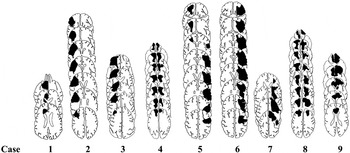
Nine patients with focal frontal lobe lesions (8 males, 1 female) between the ages of 51 and 82 participated in the study. Lesion etiology included stroke, anterior communicating artery aneurysm (ACoA) rupture, tumor resection, and head trauma (see Table 1 for details). Lesion location was independently determined by two of the authors (blind to other study results) based on clinical CT or MRI scans. Laterality and regions of frontal lobe involvement were documented by mapping the lesions onto standard neuroanatomic templates following the procedure of Damasio and Damasio (1989; see Figure 1). Evidence of additional damage to parietal cortex was noted in 2 cases (Cases 6 and 7). All patients were ambulatory and did not have significant impairments in hearing or vision. Patients' scores on the Recognition Memory Test (Warrington, 1984), Wisconsin Card Sort Test (128 cards; Heaton, 1981), letter fluency (FAS total score; Benton & Hamsher, 1989) and Trails B (US War Department, 1944) are displayed in Table 1. In addition, each study participant was tested using the digit span subtest of the Wechsler Adult Intelligence Scale–Revised (WAIS–R; Wechsler, 1981) to rule out any gross deficits in attention. There was no significant difference between frontal patients and controls with respect to raw digit span scores [F(1,16) = .28, p > .6].
Lesion etiology and neuropsychological performance data


Reconstructions of frontal lobe lesions from CT or MRI scans. Patients 6 and 7 have additional evidence of parietal damage that is not fully displayed on these overlaps.
Nine healthy controls between the ages of 58 and 77 participated in the study. Control subjects were recruited through newspaper ads and flyers distributed to various independent living communities around the Tucson area. Participants were screened with a comprehensive health and demographic questionnaire and had no history of neurological or psychiatric illness, and no history of substance abuse. Five of the control subjects were male, and four were female.
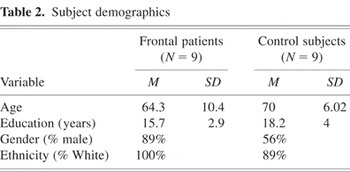
Table 2 summarizes the demographic data for patients and controls. A one-way ANOVA did not indicate significant group differences for age [F(1,16) = 1.9, p > .1], or education [F(1,16) = 2.2, p > .1].
Subject demographics

The Human Subjects Committee of the University of Arizona approved all procedures, and informed consent was obtained from each participant. Subjects were compensated $20 for their participation in the study.
Stimuli and Procedure
Two metamemory tasks were designed using famous and novel faces as stimuli. Test items were selected in part from an existing database of faces from our laboratory. Additional faces were also downloaded from celebrity and model websites from the internet. Celebrity faces spanned several decades from the 1920's to present day. Familiarity ratings for the famous faces included in the study were gathered in a pilot sample of nine healthy older adults (ages 55–75) using a 9-point scale (9 = highly familiar, 1 = unfamiliar). The mean familiarity rating of all faces on the first metamemory task (Retrospective Confidence Judgment) was 5.6 and the mean familiarity rating of the faces used in the second metamemory task (Feeling-of-Knowing) was 5.3. The distribution of familiarity ratings for the famous faces in the two tasks was not significantly different [t(94) = −.081, p > .42]. Testing took place on a Dell personal computer with stimulus presentation and response collection controlled by DMASTR software developed at Monash University and at the University of Arizona by K. I. Forster and J. C. Forster (see http://www.u.arizona.edu/∼jforster/dmdx.htm for more information).
Retrospective Confidence Judgment Task
This task was designed to test post-retrieval, or retrospective monitoring of face memory accuracy. In this experiment, 60 famous faces were presented one at a time on the computer screen along with the question “Who is this person?” and eight answer choices of possible names. The distractor names were of other famous people from the same occupational category. After participants selected their response, they were asked to make a confidence rating using a 6-point scale; the options were 0% confident, 20% confident … 100% confident that they chose the correct name. There were no time limits imposed. Participants used the keyboard to select the name and to make the confidence judgment. If the participant was reluctant to use the keyboard, the investigator pushed the keys to ensure correct recording of the response. This was the case for 4 frontal damaged subjects and 2 controls.
Feeling-of-Knowing Task
The feeling-of-knowing (FOK) task was designed to investigate prospective monitoring of face memory retrieval. Subjects were shown a face on the computer screen and were asked to recall the person's name. If a subject could not recall the name, or produced an incorrect name, he/she was prompted to rate the likelihood of being able to select the correct name at a later time if given eight choices. There were a total of 72 test items presented in random order: 36 famous faces and 36 novel faces. The famous faces used in the FOK task were different from the ones used in the retrospective confidence judgment task. Our decision to also include novel faces in this experiment was motivated by the observation that some frontal patients show increased susceptibility to false recognition of unfamiliar faces (Rapcsak et al., 1996, 1999, 2001). Therefore, we were interested in determining whether frontal patients experienced an abnormal “feeling-of-knowing” state in response to pictures of unfamiliar people.
Analogous to the retrospective confidence judgment task, participants made FOK judgments using a 6-point scale, ranging from 0% to 100%. Although subjects made FOK ratings for novel faces to which they could not recall names, only famous faces were included in the subsequent recognition test. The recognition test was administered 15 min after the FOK task. Subjects were presented with the famous faces from the FOK task along with eight name choices. Participants were asked to select the correct name for each face. Distractor names were of other famous people from the same occupational category. There were no time limits imposed.
Following administration of the face metamemory tests, subjects participated in a post-event questionnaire that probed subjective experience of task difficulty and their knowledge of popular culture. Examples of the questions were “How many hours of TV do you watch per week?” and “How difficult did you find the feeling-of-knowing task?”
RESULTS
There were no differences between the groups on the post-event questionnaire with respect to the amount of television and movies watched per week, suggesting similar exposure to the media and popular culture. There were also no obvious group differences in the subjective experience of task difficulty.
Retrospective Confidence Judgment Task
Memory performance
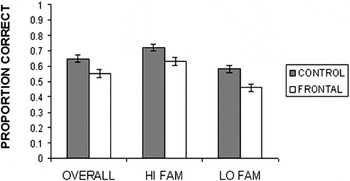
The proportion of famous faces correctly identified by frontal patients (M = .55) and controls (M = .65) is shown in Figure 2. Although frontal patients obtained numerically lower recognition scores, a one-way ANOVA indicated that the two groups did not significantly differ in terms of face memory accuracy [F(1,16) = 2.51, p = .13]. Additional analyses were conducted to examine the influence of facial familiarity on recognition memory performance. To accomplish this, we calculated the median of the facial familiarity ratings obtained in our pilot study and used this value to divide target faces into high (M = 6.7) versus low (M = 4.6) familiarity categories. Recognition performance for high and low familiarity faces is shown in Figure 2. A 2 (Group) × 2 (Familiarity) ANOVA indicated a significant main effect of familiarity [F(1,16) = 49.05, p < .0001], but no effect of group [F(1,16) = 2.53, p = .13] or Group × Familiarity interaction [F(1,16) = .21, p = .66]. Follow-up tests confirmed that high familiarity faces were better recognized than low familiarity faces by both normal controls [t(8) = 4.36, p < .01] and by patients with frontal lobe damage [t(8) = 5.65, p < .001].

Proportion of famous faces correctly recognized by control and frontal damaged subjects on the retrospective confidence judgment task. HI FAM = high familiarity faces. LO FAM = low familiarity faces. Error bars are standard error of the mean.
Memory monitoring
Two types of statistics were computed to measure monitoring accuracy: Goodman-Kruskal gamma correlations (Nelson, 1984) and Somers's d correlations (Somers, 1962). Although the former measure is frequently used in the metamemory literature, one shortcoming of the gamma correlation is that it ignores pairs tied on the predictor variable. Thus, the results may inflate monitoring accuracy estimation. To address this potential problem, the Somers's d coefficient was also calculated. The Somers's d statistic is similar to the gamma correlation with one exception: it includes tied pairs in the denominator of the gamma equation to control for non-monotonicity of the data.
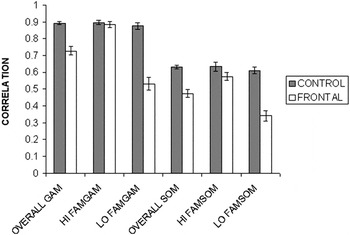
Gamma correlations and Somers's d values for frontal patient and controls are shown in Figure 3. A one-way ANOVA revealed that the frontal damaged patients' monitoring effectiveness scores were significantly lower when compared to controls with respect to both the gamma correlation [F(1,16) = 9.83, p < .01] and the Somers's d statistic [F(1,16) = 8.83, p < .01]. Additional analyses were conducted to examine monitoring accuracy for high versus low familiarity faces (Figure 3). A 2 (Group) × 2 (Familiarity) ANOVA for the gamma correlations indicated significant main effects of group [F(1,16) = 18.47, p < .001], familiarity [F(1,16) = 13.49, p < .01], and a Group × Familiarity interaction [F(1,16) = 10.57, p < .01]. Similarly, an ANOVA for the Somers's d coefficient revealed significant main effects of group [F(1,16) = 8.9, p < .01], familiarity [F(1,16) = 7.19, p < .05], and a Group × Familiarity interaction [F(1,16) = 4.78, p < .05]. Follow-up tests indicated that memory monitoring in frontal patients was less accurate for low familiarity faces than for high familiarity faces [t(8) = 3.94, p < .01 for gamma correlations and t(8) = 3.20, p < .05 for the Somers's d], whereas facial familiarity had no significant effect on monitoring accuracy in normal controls.

Gamma and Somers's d correlations on the retrospective confidence judgment task. OVERALL GAM = gamma correlation across all levels of facial familiarity. HI FAMGAM = gamma correlations for high familiarity faces. LO FAMGAM = gamma correlation for low familiarity faces. OVERALL SOM = Somers's d correlation across all levels of facial familiarity. HI FAMSOM = Somers's d correlation for high familiarity faces. LO FAMSOM = Somers's d correlation for low familiarity faces. Error bars are standard error of the mean.
Although the control and frontal groups did not significantly differ in their face memory scores, we computed an analysis of covariance to investigate whether differences in monitoring accuracy would still be observed after adjusting for differences in recognition performance. The results of the ANCOVA indicate that frontal damaged patients' monitoring scores continued to be significantly lower than the control group scores after using recognition memory performance as a covariate [gamma: F(1,15) = 6.96, p < .05; Somers's d: F(1,15) = 6.49, p < .05]. These results provide additional evidence that the monitoring deficit in our frontal patients was not directly related to memory impairment. In general, these findings support the view that metamemory and memory functions are potentially dissociable (Janowsky et al., 1989; Schnyer et al., 2004; Shimamura, 1994).
To explore further the relationship between confidence judgments and memory accuracy, we compared calibration graphs for frontal patients and normal controls. Recognition accuracy at each confidence level for high versus low familiarity faces is plotted in Figure 4. The graphs show that the memory judgments of frontal damaged subjects were less well calibrated than the judgments of normal controls, especially for low familiarity faces. For these items, the most noticeable anomaly seems to reflect overconfidence on the patients' part, indicated by relatively low memory accuracy scores at higher levels of confidence.

Calibration graphs for the retrospective confidence judgment task. Ideal = perfect calibration between confidence level and percentage correctly recognized. HIFAM Frontal = frontal patients' calibration curve for high familiarity faces. HIFAM Control = control subjects' calibration curve for high familiarity faces. LOFAM Frontal = frontal patients' calibration curve for low familiarity faces. LOFAM Control = control subjects' calibration curve for low familiarity faces.
In summary, frontal lobe damaged patients did not demonstrate significant memory impairment compared to normal controls on a famous face recognition test. However, the retrospective confidence ratings of frontal patients were less well correlated with actual memory performance than the ratings of control subjects, indicating defective post-retrieval monitoring of face memory accuracy. Additional analyses revealed that the monitoring deficit of frontal patients was particularly pronounced when judging the correctness of memory decisions made to low familiarity faces, whereas facial familiarity did not have a significant effect on monitoring efficacy in normal controls. This finding can be explained by assuming that, due to their less robust representation in memory, confidence judgments about low familiarity faces place greater demands on frontal metamemory operations than judgments about high familiarity faces. Consistent with this hypothesis, a functional imaging study in normal subjects (Henson et al., 2000) demonstrated increased frontal lobe activation during low-confidence judgments compared to high-confidence judgments in a recognition memory task. The enhanced frontal lobe activation during low-confidence judgments was attributed to the greater monitoring requirements associated with recognition decisions made under conditions of reduced memory strength. The healthy control subjects in our study were able to monitor the product of face memory retrieval accurately across a range of familiarity levels. In other words, monitoring in normal controls was not particularly sensitive to variations in memory strength. By contrast, patients with frontal lobe damage showed disproportionate metamemory impairment under conditions of low familiarity/reduced memory strength. In general, these findings are consistent with the proposal that strategic frontal monitoring operations play a crucial role in assessing memory accuracy under conditions of uncertainty, when the face cue does not automatically elicit relevant identity-specific semantic and name information about the person (Rapcsak et al., 1999). This situation is most likely to arise when making recognition decisions about less frequently encountered or “low familiarity” faces which have relatively impoverished representations in memory. Our results are also in agreement with other studies documenting that reductions in memory strength tend to exacerbate the metamemory deficit of patients with frontal lobe damage (Janowsky et al., 1989).
Feeling-of-Knowing Task
Memory performance
The proportion of famous faces correctly named by frontal patients (M = .20) and controls (M = .30) is shown in Figure 5. Although frontal patients obtained numerically lower name recall scores, the difference between the groups was not significant [F(1,16) = 2.34, p = .15). Similar to the retrospective confidence judgment task, we used the median of the familiarity ratings from our pilot study to divide target faces into high (M = 7.4) versus low (M = 3.0) familiarity categories. Recall accuracy for high versus low familiarity faces is shown in Figure 5. A 2 (Group) × 2 (Familiarity) ANOVA indicated an effect of familiarity [F(1,16) = 87.64, p < .0001], but no effect of group [F(1,16) = 2.3, p = .15] or significant Group × Familiarity interaction [F(1,16) = 3.4, p = .08]. Follow-up tests confirmed that both normal controls [t(8) = 8.52, p < .0001] and patients with frontal lobe damage [t(8) = 4.99, p < .01] were more successful in naming high familiarity faces than low familiarity faces.

Name recall and recognition scores for famous faces in the FOK task. HI FAM = high familiarity faces. LO FAM = low familiarity faces. Error bars are standard error of the mean.
On the subsequent recognition memory test for the famous faces that participants were unable to name, frontal patients performed worse (M = .37) than normal controls [M = .48; F(1,16) = 6.34, p < .05; see Figure 5). In addition, a 2 (Group) × 2 (Familiarity) ANOVA revealed significant effects of group [F(1,16) = 8.93, p < .01] and familiarity [F(1,16) = 47.89, p < .0001], but no interaction [F(1,16) = .22, p = .65]. Follow-up tests indicated that both controls [t(8) = 4.61, p < .01] and patients with frontal lobe damage [t(8) = 5.18, p < .001] recognized more high familiarity faces than low familiarity faces. Frontal patients also recognized fewer low familiarity faces than controls [t(16) = 2.23, p < .05].
Memory Monitoring
Gamma correlations and Somers's d values for frontal patients and normal controls are shown in Figure 6. There were no significant differences in overall FOK accuracy between the groups on either measure [gamma: F(1,16) = .55, p = .47; Somers's d: F(1,16) = .13, p = .72]. FOK accuracy for high versus low familiarity faces is also shown in Figure 6. Additional analyses of these data did not indicate significant main effects of group [gamma: F(1,16) = .09, p = .76; Somers's d: F(1,16) = .81, p = .38] or familiarity [gamma: F(1,16) = .02, p = .89; Somers's d: F(1,16) = 1.46, p = .24], nor was there evidence of a Group × Familiarity interaction [gamma: F(1,16) = .01, p = .92; Somers's d: F(1,16) = .10, p = .76]. Frontal patients also did not differ from normal subjects in their FOK judgments in response to the unfamiliar faces [F(1,16) = .02, p = .90]. It is interesting to note that in the FOK task frontal patients demonstrated preserved monitoring ability but impaired recognition memory performance compared to controls, whereas in the retrospective confidence judgment task we found evidence of defective monitoring without significant memory impairment. Again, these findings are consistent with the notion that memory performance and monitoring are dissociable.

Gamma and Somers's d correlations on the FOK task. OVERALL GAM = gamma correlation across all levels of facial familiarity. HI FAMGAM = gamma correlation for high familiarity faces. LO FAMGAM = gamma correlation for low familiarity faces. OVERALL SOM = Somers's d correlation across all levels of familiarity faces. HI FAMSOM = Somers's d correlation for high familiarity faces. LO FAMSOM = Somers's d correlation for low familiarity faces. Error bars are standard error of the mean.
In summary, we were unable to find differences between frontal patients and control subjects in a FOK task that presumably measures prospective memory monitoring. This is in contrast to the results of the retrospective confidence judgment task, where significant group differences emerged with respect to post-retrieval monitoring of face memory accuracy. Dissociations between different metamemory tasks have been documented previously both in normal subjects (Leonesio & Nelson, 1990; Miner & Reder, 1994; Nelson & Narens, 1994) and in patients with frontal lobe damage (Schnyer et al., 2004). Interestingly, the frontal patients in the Schnyer et al. (2004) study demonstrated a dissociation that is the exact opposite of what was observed in our study: impaired FOK accuracy but preserved retrospective confidence judgments. These authors hypothesized that different types of metamemory judgments may depend on distinct prefrontal cortical regions. Specifically, right ventromedial frontal cortex may play a critical role in prospective FOK judgments, whereas retrospective confidence judgments may depend on regions in dorsolateral prefrontal cortex (Schnyer et al., 2004; see also Henson et al., 2000). Unfortunately, we are unable to address this neuroanatomical hypothesis conclusively due to the small sample size and the considerable heterogeneity of lesion size and location in our frontal patients, many of whom showed evidence of both ventromedial and dorsolateral involvement (Figure 1). Nevertheless, we did examine the lesion profiles of individual patients who performed particularly poorly on the retrospective confidence judgment task and/or the FOK task (gamma scores > 2 SD from the control mean). We note that all 4 patients with poor performance on the retrospective confidence judgment task (Cases 3, 7, 8, 9) had evidence of damage to dorsolateral prefrontal cortex (right-sided in 2 subjects, left-sided in 1, and bilateral in another; Figure 1). By contrast, the two patients who obtained the lowest monitoring accuracy scores in the FOK task (Cases 1, 9) both had evidence of ventromedial frontal lobe damage (left-sided in 1 and bilateral in the other). Consistent with the dissociations documented in frontal patients, measures of monitoring accuracy in the FOK and retrospective confidence judgment tasks were not significantly correlated in our normal control subjects (FOK and retrospective gamma scores, r = .082, p = .84; FOK and retrospective Somers's d scores, r = −.051, p = .90), providing additional evidence that these two tasks may not be measuring the same metacognitive ability.
DISCUSSION
The results of this study complement and extend the findings of previous investigators documenting metamemory impairments in patients with focal frontal lobe lesions. Specifically, we demonstrated that the monitoring deficit of frontal patients is not limited to verbal episodic memory tasks (Janowsky et al., 1989; Schnyer et al., 2004) and seems to extend to the recognition of famous faces that is generally considered a test of semantic memory. Taken together, these observations suggest that the metamemory impairment of frontal patients is not confined to specific stimulus domains (words vs. faces) or memory systems (episodic vs. semantic). At the same time, our findings in conjunction with the results of Schnyer et al. (2004) indicate that frontal patients do not necessarily have a global monitoring deficit that manifests itself equally across a variety of tasks. In both studies, frontal patients were impaired on some metamemory tasks whereas they performed within normal range on others. In addition, the apparent double dissociation between FOK and retrospective confidence judgments provides direct empirical evidence that metamemory should not be considered a unitary function. Instead, it is likely to comprise several computationally distinct but functionally integrated cognitive operations, each of which makes a unique contribution to the executive control of memory accuracy. As discussed previously, our study and the findings of Schnyer et al. (2004) raise the possibility that these different metamemory operations may be localizable to specific prefrontal regions. However, the available empirical evidence regarding putative neural substrates must be considered preliminary and will require additional confirmation in larger groups of patients with more circumscribed damage to distinct prefrontal cortical areas. It is also important to keep in mind that there were a number of procedural and methodological differences between our study and the study by Schnyer et al. (2004), raising some concern that the apparent double dissociation between FOK and retrospective confidence judgments might ultimately be reducible to critical differences in task format, processing demands, or task difficulty. For instance, in the Schnyer et al. study (2004) participants made FOK and retrospective confidence judgments within the same experiment, whereas in our study the two types of metamemory judgments were assessed in different experiments using different test stimuli. In addition, the patients in the Schnyer et al. (2004) study were told to guess when they were unable to retrieve the information from memory and they were also provided with feedback about the accuracy of their answers. Finally, it is unclear whether the episodic verbal memory tests used by Schnyer et al. and the semantic face memory test used in our study are strictly comparable in terms of monitoring demands.
As noted earlier, it has been proposed that defective memory monitoring operations play an important role in the pathogenesis of false facial recognition (Rapcsak et al., 1999, 2001). Consistent with this hypothesis, one of the patients in our study (Case 9) who demonstrated striking false recognition on a variety of face memory tasks (Rapcsak et al., 1999) also performed extremely poorly in both the FOK and the retrospective confidence judgment tasks. However, of the other 4 frontal damaged patients who exhibited significantly impaired monitoring accuracy on at least one of the two metamemory tasks used in this study (see results above), 2 showed evidence of excessive false recognition on the kinds of face memory tests that were given to Case 9, whereas the other 2 patients did not. These observations suggest that although impaired monitoring is likely to contribute to false recognition, it is not sufficient in isolation to produce these types of memory distortions. These findings are consistent with the notion that false recognition results from a combination of frontal executive deficits that include not only impaired monitoring but also the breakdown of strategic memory search, criterion setting, and decision making operations (Rapcsak et al., 1999, 2001). In addition, it is likely that the most striking cases of false recognition require a combination of memory impairment and executive dysfunction. Note also that we did not find evidence that our frontal patients experienced abnormal FOK states in response to unfamiliar faces. However, in interpreting these results it is important to keep in mind that in making FOK judgments subjects are required to rate the likelihood of being able to select the correct name for the face. We have shown previously that instructing frontal patients to use name retrieval as the basis for making recognition decisions about unfamiliar faces can eliminate false recognition (Rapcsak et al., 1999). Taken together, these findings underscore the importance of task instructions in investigating the complex functional relationship between memory, metamemory, and executive dysfunction in patients with false recognition or confabulation following frontal lobe damage.
ACKNOWLEDGMENTS
This work was supported by a National Science Foundation Graduate Fellowship awarded to J.K. Pannu and a Social & Behavioral Sciences Award from the University of Arizona. The efforts of A.W. Kaszniak and S.Z. Rapcsak were also partially supported by Grant P30 AG19610 from the National Institute on Aging. We would like to thank the anonymous reviewers for their contributions in improving this paper. We would also like to acknowledge Patrick McKnight, Ph.D., for his assistance and David Schnyer, Ph.D., for helpful comments on an earlier version of this manuscript.
References
REFERENCES
Beatty, W. &
Monson, N.
(1991).
Metamemory in multiple sclerosis.
Journal of Clinical and Experimental Neuropsychology,
13,
309–327.Google Scholar
Benton, A.L. &
Hamsher, K.
(1989).
Multilingual Aphasia Examination.
Iowa City, IA:
AJA Associates.
Damasio, H. &
Damasio, A.R.
(1989).
Lesion analysis in neuropsychology.
New York:
Oxford University Press.
Heaton, R.K.
(1981).
Wisconsin Card Sorting Test.
Odessa, FL:
Psychological Assessment Resources.
Henson, R.N.A.,
Rugg, M.D., &
Shallice, T.
(2000).
Confidence in recognition memory for words: Dissociating right
prefrontal roles in episodic retrieval.
Journal of Cognitive Neuroscience,
12,
913–923.Google Scholar
Janowsky, J.S.,
Shimamura, A.P., &
Squire, L.R.
(1989).
Memory and metamemory: Comparisons between patients with frontal
lobe lesions and amnesic patients.
Psychobiology,
17,
3–11.Google Scholar
Leonesio, R.J. &
Nelson, T.
(1990).
Do different metamemory judgments tap the same underlying aspects of
memory?
Journal of Experimental Psychology: Learning, Memory, and
Cognition,
16,
464–470.Google Scholar
Mangels, J.A.,
Gershberg, F.B., &
Shimamura, A.P.
(1996).
Impaired retrieval from remote memory in patients with frontal lobe
damage.
Neuropsychology,
10,
32–41.Google Scholar
Miner, A.C. &
Reder, L.M.
(1994).
A new look at feeling of knowing: Its metacognitive role in
regulating question answering. In
J. Metcalfe &
A.P. Shimamura (Eds.),
Metacognition: Knowing about knowing (pp.
47–70).
Cambridge, MA:
The MIT Press.
Nelson, T.O.
(1984).
A comparison of current measures of the accuracy of
feeling-of-knowing.
Psychological Bulletin,
95,
109–133.Google Scholar
Nelson, T.O. &
Narens, L.
(1994).
Why investigate metacognition? In
J. Metcalfe &
A.P. Shimamura (Eds.),
Metacognition: Knowing about knowing (pp.
1–25).
Cambridge, MA:
The MIT Press.
Rapcsak, S.Z.,
Nielsen, L., &
Littrell, L.D.
(2001).
Face memory impairments in patients with frontal lobe damage.
Neurology,
57,
1168–1175.Google Scholar
Rapcsak, S.Z.,
Polster, M.R., &
Glisky, M.L.
(1996).
False recognition of unfamiliar faces following right hemisphere
damage: Neuropsychological and anatomical observations.
Cortex,
32,
593–611.Google Scholar
Rapcsak, S.Z.,
Reminger, S.L.,
Glisky, E.L.,
Kaszniak, A.W., &
Comer, J.F.
(1999).
Neuropsychological mechanisms of false facial recognition following
frontal lobe damage.
Cognitive Neuropsychology,
16,
267–292.Google Scholar
Schnyer, D.M.,
Verfaellie, M.,
Alexander, M.,
LaFleche, G.,
Nicholls, L., &
Kaszniak, A.W.
(2004).
A role for right medial prefrontal cortex in accurate
feeling-of-knowing judgments: Evidence from patients with lesions to
frontal cortex.
Neuropsychologia,
42,
957–966.Google Scholar
Shimamura, A.P.
(1994).
The neuropsychology of metacognition. In
J. Metcalfe &
A.P. Shimamura (Eds.),
Metacognition: Knowing about knowing (pp.
253–276).
Cambridge, MA:
The MIT Press.
Shimamura, A.P. &
Squire, L.
(1986).
Memory and metamemory: A study of the feeling-of-knowing phenomenon
in amnesic patients.
Journal of Experimental Psychology: Learning, Memory, and
Cognition,
12,
452–460.Google Scholar
Somers, R.H.
(1962).
A new asymmetric measure of association for ordinal
variables.
American Sociological Review,
27,
799–811.Google Scholar
Souchay, C.,
Isingrini, M., &
Espagnet, L.
(2000).
Aging, episodic memory feeling-of-knowing, and frontal
functioning.
Neuropsychology,
14,
299–309.Google Scholar
Souchay, C.,
Isingrini, M., &
Gil, R.
(2002).
Alzheimer's disease and feeling-of-knowing in episodic
memory.
Neuropsychologia,
40,
2386–2396.Google Scholar
Spreen, O. &
Strauss, E.
(1991).
A compendium of neuropsychological tests.
New York:
Oxford University Press.
US War Department
(1944).
Army Individual Test Battery.
Washington, DC:
War Department, Adjutant General's Office.
Vilkki, J.,
Servo, A., &
Surma-aho, O.
(1998).
Word list learning and prediction of recall after frontal lobe
lesions.
Neuropsychology,
12,
268–277.Google Scholar
Vilkki, J.,
Surma-aho, O., &
Servo, A.
(1999).
Inaccurate prediction of retrieval in a face matrix learning task
after right frontal lobe lesions.
Neuropsychology,
13,
298–305.Google Scholar
Warrington, E.K.
(1984).
Recognition Memory Test.
Windsor, UK:
NFER-Nelson.
Wechsler, D.
(1981).
Wechsler Adult Intelligence Scale–Revised manual.
New York:
The Psychological Corporation.
Young, A.W.,
Hay, D.C., &
Ellis, A.W.
(1985).
The faces that launched a thousand slips: Everyday difficulties in
recognizing people.
British Journal of Psychology,
76,
495–523.Google Scholar

Lesion etiology and neuropsychological performance data
Reconstructions of frontal lobe lesions from CT or MRI scans. Patients 6 and 7 have additional evidence of parietal damage that is not fully displayed on these overlaps.
Subject demographics
Proportion of famous faces correctly recognized by control and frontal damaged subjects on the retrospective confidence judgment task. HI FAM = high familiarity faces. LO FAM = low familiarity faces. Error bars are standard error of the mean.
Gamma and Somers's d correlations on the retrospective confidence judgment task. OVERALL GAM = gamma correlation across all levels of facial familiarity. HI FAMGAM = gamma correlations for high familiarity faces. LO FAMGAM = gamma correlation for low familiarity faces. OVERALL SOM = Somers's d correlation across all levels of facial familiarity. HI FAMSOM = Somers's d correlation for high familiarity faces. LO FAMSOM = Somers's d correlation for low familiarity faces. Error bars are standard error of the mean.
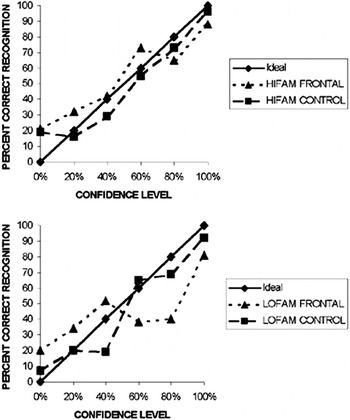
Calibration graphs for the retrospective confidence judgment task. Ideal = perfect calibration between confidence level and percentage correctly recognized. HIFAM Frontal = frontal patients' calibration curve for high familiarity faces. HIFAM Control = control subjects' calibration curve for high familiarity faces. LOFAM Frontal = frontal patients' calibration curve for low familiarity faces. LOFAM Control = control subjects' calibration curve for low familiarity faces.
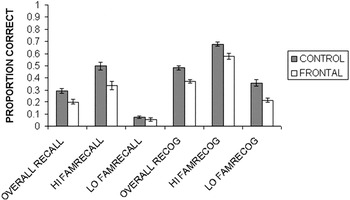
Name recall and recognition scores for famous faces in the FOK task. HI FAM = high familiarity faces. LO FAM = low familiarity faces. Error bars are standard error of the mean.
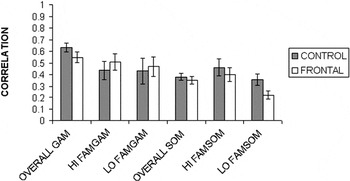
Gamma and Somers's d correlations on the FOK task. OVERALL GAM = gamma correlation across all levels of facial familiarity. HI FAMGAM = gamma correlation for high familiarity faces. LO FAMGAM = gamma correlation for low familiarity faces. OVERALL SOM = Somers's d correlation across all levels of familiarity faces. HI FAMSOM = Somers's d correlation for high familiarity faces. LO FAMSOM = Somers's d correlation for low familiarity faces. Error bars are standard error of the mean.
 You have
Access
- 35
- Cited by