Introduction
When, in America, statues of and monuments to Confederate heroes were being toppled or removed from public display, and when, in England, the statue of city patron and slave trader Edward Colston was tipped into Bristol harbor, the late-nineteenth-century statue of John Bunyan in Bedford, England was left and remains undisturbed.Footnote 1 Bunyan neither owned nor participated in the trade of enslaved humans. It was slavery to sin that preoccupied this mechanick preacher. Even so, his vastly influential treatment of the Christian life of conversion, justification, and sanctification in the “dark figures” of The Pilgrim’s Progress introduces a figure, almost casually, into the imagination of generations of readers and their communities that has a troubling testimony in matters of race. This is particularly acute to observe for the book’s most fervent religious readership within contemporary white evangelical Christianity. Since the charge that conservative Protestants are and have always been racist is most strongly heard, for now, in America, my focus will be on Bunyan’s legacy in the United States.Footnote 2 Nevertheless, the anglophone evangelical world remains strongly transatlantic, and reaches globally, as does the world of The Pilgrim’s Progress, so that implications for evangelicals in America carry, with historical recontextualization, further afield.
Bunyan is still standing. And The Pilgrim’s Progress still has standing. It is still read as a key devotional text and an aid to evangelical piety, befitting its status as a spiritual classic. Just so, elements of its theological construction and its explicit racial bias play into the character of American evangelicalism as a movement plagued by white supremacy. In what follows I argue that the reception of The Pilgrim’s Progress demonstrates the failing of white supremacy as well as a recent implicit reckoning that offers an, albeit fragile, iconoclastic hope.
This article is distinctive as a contribution to the wider recognition and exposure of the whiteness of evangelicalism in tracking one highly authorized text through time into the reality of today. Reception of The Pilgrim’s Progress functions as a measure of the everyday bias and prejudice that shapes a community in a vicious denial of the gospel. Vincent Bacote defines racism as “as a species of resistance to or hostility towards the great commandments to love God above all and to love neighbors as oneself.”Footnote 3 A life and posture that ignores the consistent racism of its authorizing texts is the product of, and perpetuates, white supremacy. Regarding fellow humans as “other,” against whom one must be on guard, toward whom one must reach down and offer civilizing uplift, on the basis of the artificial construction of race, is wholly contrary to the gospel. Bacote notes variations in causation of racist attitudes, which can arise from “neglect or intent.”Footnote 4 The culpability of the latter compared to the former may differ, but the end result in practical effect does not. Lack of awareness that racialization is a factor in a lauded spiritual classic instead belies the privilege to overlook, ignore, or propound ideological color-blindness, even while reading that spiritual classic. White supremacy does not need to be stated viciously to be vicious. Furthermore, racism does not have to be exhibited in hateful interpersonal interaction to be present. We have no record of Bunyan’s encounter with others who would be raced differently to himself. But we do not need evidence of personal animus to determine that his imagination is tainted by racist constructs. Certainly, Bunyan is shaped already by a racialized vision as he writes The Pilgrim’s Progress. The prejudice that plays a small visible role in his most famous text will play a greater one in the hands of others in the “New World” of America.Footnote 5 This is not to be read as pressing a claim that white supremacy is only found among conservative Protestants or that there are not evangelicals who recognize and work against acknowledged personal and systemic bias within a movement characterized by fluidity and competing self-definitions. Throughout, I will be in conversation with Bacote’s recent Reckoning with Race and Performing the Good News: In Search of a Better Evangelical Theology.Footnote 6 Bacote, as a black theologian working in American evangelical space, is an important guiding voice for both reckoning and hope for evangelical theology and practice in matters of race. He shares, on a broader scale, a hope of rehabilitating evangelical theological space through a reckoning that is consistent with the hopes of my treatment with a much narrower focus on The Pilgrim’s Progress in the predominantly white conservative Protestant world.Footnote 7
The argument follows in five stages. I first broach the problematic racialized vision in The Pilgrim’s Progress by way of the character of the Flatterer. Secondly, I unpack ways in which a discussion of monuments, with which I opened, fits both the goal of tackling racialized reception as well the internal logic of Bunyan’s biblical imagination of monuments within The Pilgrim’s Progress. An exposition of reception history follows, thirdly, focused on illustration and adaptation, principally identifying the racism of a children’s edition called either Little Christian’s Progress or Little Pilgrim’s Progress. Fourthly, I turn to a few more recent editions, adaptations, and their illustrations to show how dominant white supremacy can be challenged in its monumentality. I conclude, in a fifth section, by offering a theological assessment of the prospects of The Pilgrim’s Progress’s future in America in conversation with Bacote’s conviction that evangelicalism needs a reckoning but need not necessarily be abandoned.
Meeting the Flatterer
The Flatterer is the “man black of flesh”Footnote 8 whose brief appearance in the text stands as an enduring test of the white supremacist gaze into which The Pilgrim’s Progress is enfolded in its life in America.Footnote 9 I argue that reception of the Flatterer in particular and of The Pilgrim’s Progress in general monumentalizes Bunyan’s racism, even as recent awareness seeks to alter and relocate that monumentality. Some images of The Pilgrim’s Progress function idolatrously. They lock in a racialized vision that privileges the reader’s white gaze. If the work is to continue as a spiritual classic, as many would have it do, its iconography in illustration must open up white readers’ vision beyond their own self-representation to see the image of God in those racialized as other. This acknowledgement of others redounds to a true knowledge of God. I indicate recent iconographic trends that display a hopeful iconoclasm in pointing beyond the white imaginary that has plagued reception, without looking for eschatological perfection in the present.Footnote 10
Bunyan’s original text of Christian’s and Hopeful’s encounter with the Flatterer in The Pilgrim’s Progress is brief, making its inclusion in full here worthwhile:
And as they were thinking about the way, behold, a man black of flesh, but covered with a very light Robe, came to them, and asked them, why they stood there? They answered, They were going to the Coelestial City, but knew not which of these ways to take. Follow me, said the man, it is thither that I am going. So they followed him in the way that but now came into the road, which by degrees turned, and turned them so far from the City that they desired to go to, that in a little time their faces were turned away from it; yet they followed him. But by and by, before they were aware, he led them both within the compass of a Net, in which they were both so entangled, that they knew not what to do; and with that, the white robe fell off the black man’s back: then they saw where they were. Wherefore there they lay crying sometime, for they could not get themselves out.
Chr: Then said Christian to his fellow, Now do I see myself in an errour. Did not the Shepherds bid us beware of the flatterers? As is the saying of the Wise man, so we have found it this day: A man that flattereth his neighbour, spreadeth a net for his feet. [Bunyan’s marginal note is to Prov. 29:6, although 29:5 is most apposite.] … They told him [the rescuing Shining One] That they were poor Pilgrims, going to Sion, but were led out of their way by a black man, cloathed in white, who bid us, said they, follow him; for he was going thither too. Then said he with the Whip, it is Flatterer, a false Apostle, that hath transformed himself into an angel of light. [Marginal notes to Dan 11:32; 2 Cor 11:13,14.]Footnote 11
The episode of the Flatterer, of whom the traveling Christian and his companion Hopeful have been warned, comes near the close of their journey. Here it might be supposed, and indeed the pilgrims themselves suppose, that they are well equipped by experience and trial to withstand temptation. Christian and Hopeful are exposed as falling into the same presumption with which Bunyan finally defines Ignorance.Footnote 12 Jason Crawford rightly observes that the principal literary purpose of the Flatterer incident is to allow Bunyan to flesh out his chosen text of Proverbs 29:5.Footnote 13 The episode is an emblematic exegetical sermon in miniature. Telling that story, however, does not require that Bunyan’s character be imagined any differently from other preceding malefactors whose skin color is not commented on, and who are supposedly white. In one of the few articles to address the Flatterer incident, Margaret Sönser Breen asks: “How should readers of Bunyan understand this episode?”; “How and for whom is the Flatterer’s blackness significant?”Footnote 14 Her questions invite reflection on the significance of the Flatterer for the devotional evangelical readers, whom most authorities take to be the largest portion of The Pilgrim’s Progress’s contemporary readership.Footnote 15
The Pilgrim’s Progress as a Monumental Spiritual Classic
The Pilgrim’s Progress stands as a monument in the conservative Protestant Christian imagination. Among preachers, theologians, and missiologists it remains totemic.Footnote 16 Its prominence is certainly obscured by later additions to the imaginative landscape. It has lost a pre-eminence of former years, but it still commands acknowledgment and serves as a marker of sound soteriology and experiential discipleship with adherence across confessional distinctives that otherwise mark divisions.Footnote 17
Monuments celebrate as well as silence. They display as well as hide. They also tell a story about the weight of collective memory within dominant society. Problematically, the removal of monuments that give offense can reprove ancestors while salving the guilt of contemporary beneficiaries of prejudice, and at the same time, further erase and silence those whose story has been subjugated to the shadows because of the monument. Simply ignoring The Pilgrim’s Progress and its racism is no solution. Ryan Newson, in his theological treatment of American Civil War confederate monuments, argues that these both cement and distort collective memory. That is, monuments take sides, elevating one privileged narrative over the voices of others, often those who speak from the margins. And, in any case, minority voices are always susceptible to accommodation to the imaginative landscape where dominant forms of collective memory shape the present possibilities for all. Footnote 18
RefToons cartoonist Paul Cox has a print that captures well the classic status of The Pilgrim’s Progress for a theologically inclined conservative Christian audience. The print illustrates a quotation from Charles Spurgeon commending his hearers to “visit many good books, but live in the Bible.” Cox has an open Bible as the massive book that provides two walls of a house, fitted with hearth and chimney place, inside which dwelling Charles Spurgeon sits in an armchair with a pile of books on the floor and a book open in his hand. That open book is identified by its cover title as The Pilgrim’s Progress.Footnote 19 This recognizes The Pilgrim’s Progress as monumental in the conservative Protestant imagination and connects it to a discussion of the place of monuments in American life in the context of race.Footnote 20
There is also plausible justification in the text of The Pilgrim’s Progress and Scripture on which it draws to explore the metaphor of monuments. Having just avoided the allure of Demas’ silver mines and the enticements to more latitudinarian perspectives on religious preferment and prosperity from Mr Money-love, Christian and Hopeful come across a pillar. It turns out to be a statue of Lot’s wife. The pillar connects the story back to Bunyan’s famous opening of flight from the city bound for fiery destruction, drawn from Genesis 18 and 19. The pillar stands as a warning to pilgrims not to long for the riches of the world. In like spirit, Christian and Hopeful themselves construct a pillar as a monument and warning to pilgrims after they escape from Giant Despair’s Doubting Castle. They inscribe the pillar with this text: “Over this Stile is the way to Doubting-Castle, which is kept by Giant Despair, who despiseth the King of the Coelestial Countrey, and seeks to destroy his holy Pilgrims,” so that “many, therefore, that followed after, read what was written, and escaped the danger.”Footnote 21 In other words, it is consistent with Bunyan’s imagination and Christian biblical iconography to recognize monuments as warnings. The Pilgrim’s Progress’s racialized iconographic reception can then stand as a warning when recognized, acknowledged, and grappled with. Thus read, the celebration of white identity can be dethroned. Nevertheless, with Bunyan’s The Pilgrim’s Progress Part II, it is also possible to conclude that a monument must be torn down and its owner’s head lofted on a pike for a macabre dance of victory. This is what, in Bunyan’s 1684 sequel, befalls Giant Despair and his Doubting Castle.Footnote 22 Christian and Hopeful’s pillar had not succeeded. It remains to be seen if relocation and alteration of the spiritual classic can succeed as recognition and warning or if more brutal excision from the tradition is needed.
Bunyan himself, then, anticipates the concern for monuments advocated in this article. Nevertheless, the visual reception of Bunyan’s Flatterer and the text at large suffer from the same problem that inflicts white America in Newsom’s view. That is, “the problem in white America is that the wounds of whiteness are rarely acknowledged or integrated into the collective identity of the country, and so they continue to return in altered form. Confederate monuments stand as reminders of a wound largely ignored, as such they perpetuate a form of not-seeing that is woven into group dynamics and individual imaginations.”Footnote 23 The Flatterer in the white reception tradition for The Pilgrim’s Progress perpetuates the same problem. His unacknowledged presence despite gains in racial consciousness through the twentieth century demonstrates an indifferent racialization unaware of its tragedy. This problem is not insurmountable. Newson explores the possibilities of removal and destruction of idolatrous monuments, as well as their repurposing by alteration or relocation. For Newson, monuments can remain effectively invisible as spatial markers of entrenched privilege for whose beneficiaries they mean little until an incident raises threats, not so much to the monument itself, but to the privilege it represents as the dominant way of living. Likewise, The Pilgrim’s Progress is a monument of conservative white evangelicalism in America, unremarked upon in the background of the imagination.
Bunyan writes his images in words, but within his lifetime The Pilgrim’s Progress was already being illustrated. This adaptation played a part in its runaway success and its continual appeal, especially as the book moved from study shelves to nursery bookcases.Footnote 24 The legacy of the Flatterer for a racialized and ultimately white supremacist reception of The Pilgrim’s Progress is mapped in what follows, principally, although not exclusively, and both tragically and hopefully, through children’s adaptations.
Racialization and Reception of Little Pilgrim’s Progress
Contemporary reception of The Pilgrim’s Progress in America displays both a lamentable and a hopeful iconoclasm.Footnote 25 That is, with Natalie Carnes, the images used in adaptation of Bunyan’s work imprison and cement inhumane false worship of racist imagination, but can also open up vistas for recognition of goods beyond that distorted vision in the direction of the gospel call to neighbor-love. In particular reference to the Flatterer, reception history offers evidence of a white supremacy that is oblivious to its racism. The iconic classic is lauded on its own problematic terms as a celebration of white identity such that Bunyan’s iconoclastic dissenting fiction becomes an idol. The children’s adaptation, Little Pilgrim’s Progress exhibits this. Yet even this adaptation has its own reception-afterlife that in turn takes a hammer to the white supremacist, idolatrous reading of Bunyan. To be other than a white supremacist text, authors, adapters, and illustrators revise the visual imaginary of The Pilgrim’s Progress to challenge a racialized reception.
Helen Taylor’s Little Pilgrim’s Progress has pride of place among children’s adaptations for white evangelicals due to its consistent championing and reissuing by Moody Publishers of Chicago since first publication in 1947. It was originally published in the 1880s in England as Little Christian’s Pilgrimage and therefore not written in up-to-date narrative style even for the 1940s, let alone for today. Yet, it endures as a popular adaptation appreciated by families and churches, and used in Christian homeschooling. It serves as an adaptation in its own right, but also as the source of another adaptation examined here, Christian’s Quest. Its latest iteration will show the power and limitations of reimagining the problematic episode of the Flatterer, in the conclusion below.
Little Pilgrim’s Progress was published as an adaptation of The Pilgrim’s Progress, transforming the seventeenth-century vocabulary and style and the dogmatic heaviness into the accessibility of a tale spun around the adventures of children. The story begins with this authorial wisdom: “Although the ‘Pilgrim’s Progress’ is read with delight by hundreds of children, few of them, probably, are able to grasp more than a faint idea of its meaning.”Footnote 26 As with many adaptations, which effectively abridge at the same time, extensive dialogue was cut but narrative episodes in adventure-mode remained. So, the Flatterer-incident was kept and the traveling children indeed get caught up in the Flatterer’s net. Replacing “black of flesh,” Taylors tells readers that the Flatterer’s “face was dark and ugly, but he wore a white robe. … Then his white robe slipped from his shoulders, and they saw that he was a servant of the Wicked Prince.”Footnote 27 Taylor removed Bunyan’s reference to black flesh but, as a translation, now offers the morally problematic “dark and ugly” tied to wickedness. The visual aspect of the Flatterer’s ugly darkness would still be left to the reader’s imagination were it not for the fact that, as a book for children, the text was accompanied by illustrations. And it is the history of the illustrations of Little Pilgrim’s Progress that will chiefly serve as indicting evidence of a problematic racialized American evangelical reception of Bunyan.
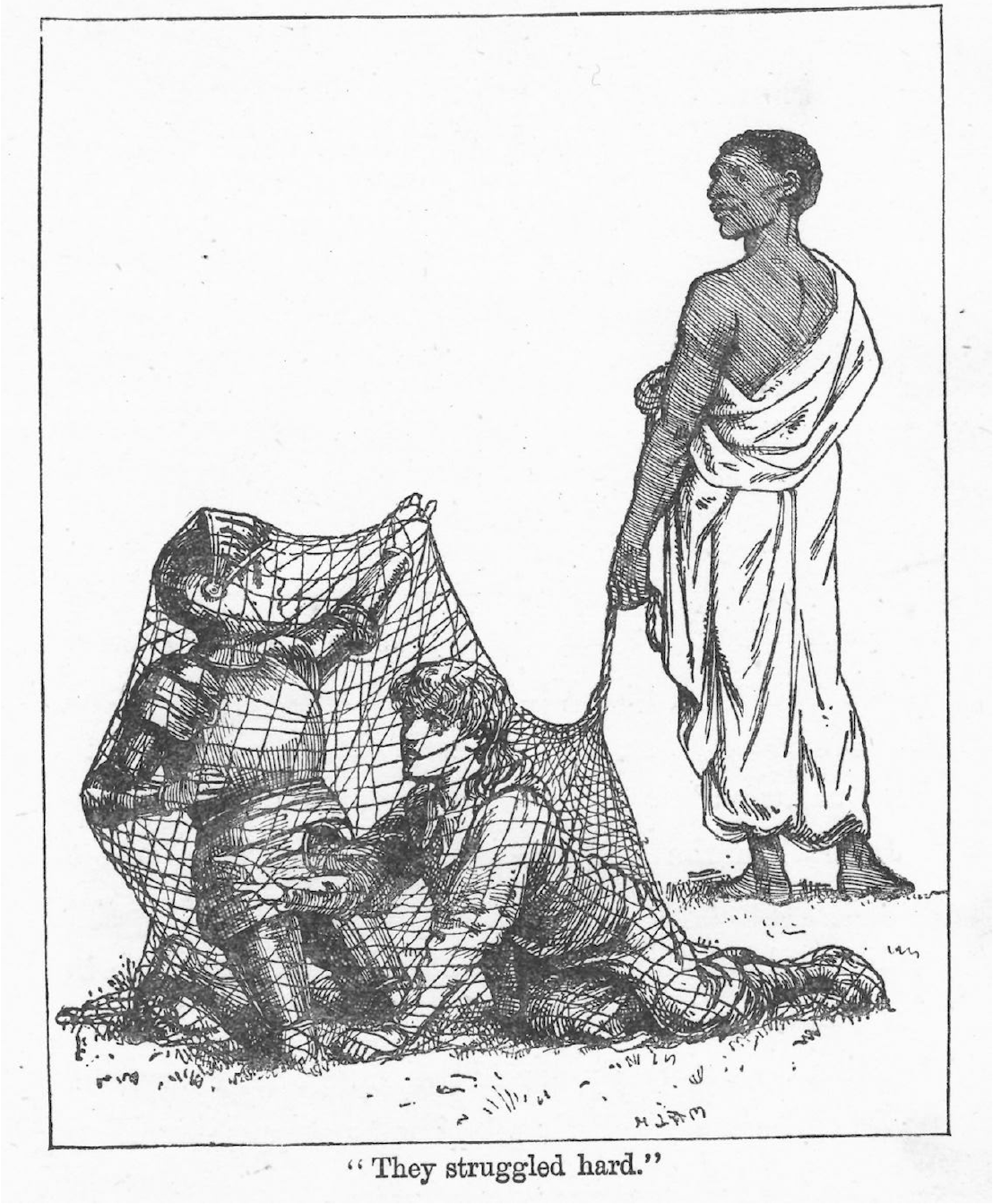
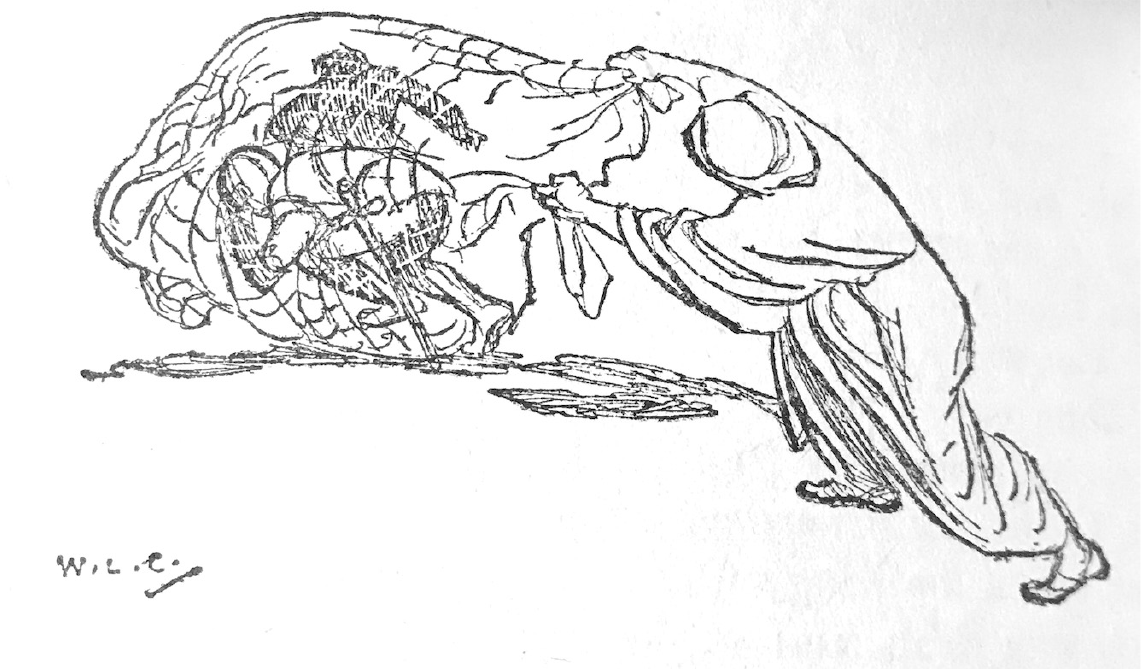
In the 1889 British edition, illustrator Helen Miles undid any possible gain in refraining from using Bunyan’s term “black of flesh” in her illustration of the Flatterer as a bare shouldered, stereotypically black African man. Expressing the condescension of the high Victorian imperial age, the Flatterer wore a complacent, even docile expression belying his wickedness (Fig. 1). The visual warning to the British readers against falling for the wiles of “colonial natives” was written plainly in this image. By the time of a new British edition nearly 70 years later, after multiple reprints, Miles’s illustrations had been judged anachronistic. When London publisher Wells Gardner Darton and Co. Ltd. re-released the book, as “First Published in this Series 1947,” Miles’s illustrations were replaced by those of a young Scot, W. Lindsay Cable.Footnote 28 With a great many more, and simpler, line illustrations dotting the text, chapter 40’s “The Flatterer and his Net” had two images, one of the Flatterer casting his net, the other of the two pilgrim boys netted. Notably, the Flatterer was depicted from behind in a way that showed him completely shrouded in his cloak, giving no fuel to Taylor’s comments on his visage, and not darkening his exposed arms as Cable clearly could have given his shading of Hopeful (Fig. 2).
“They Struggled Hard,” in Helen L.Taylor, The Little Christian’s Pilgrimage (London: Wells Gardner, Darton, 1891) 185, illustration by H. J. A. Miles. (Public Domain)

“The Flatterer and his Net,” in H. L. Taylor, Little Christian’s Pilgrimage (Chicago: Moody, 1947) 128, illustration by W. Lindsay Cable. (Public Domain)

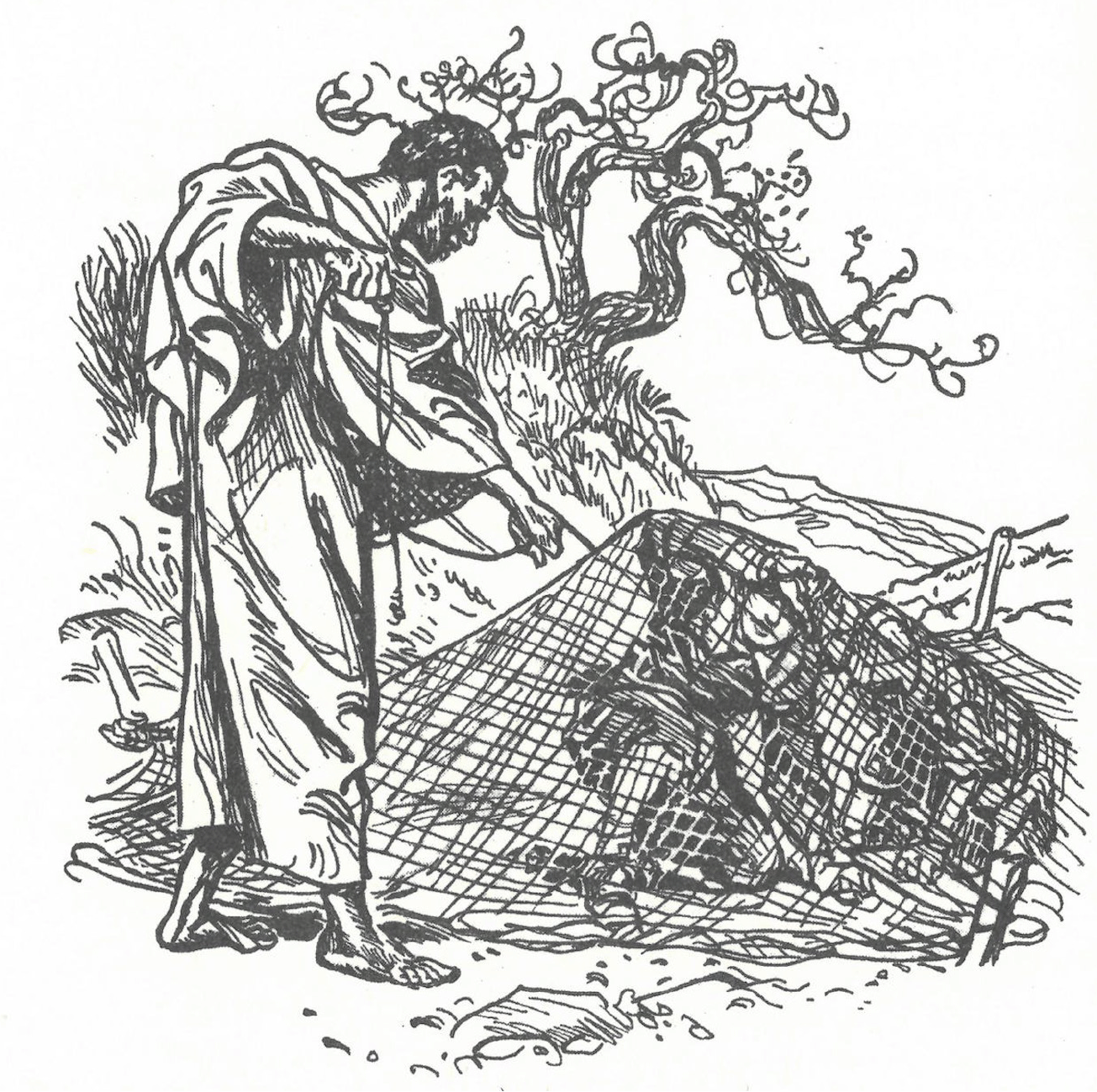
Moody Press of Chicago secured the rights to the US distribution of Taylor’s book for the first time also in 1947. One clear change that followed was in the title, from Little Christian’s Pilgrimage to Little Pilgrim’s Progress. Little Pilgrim’s Progress used Cable’s images but, in another change, did not include all of them. Significantly, none of Cable’s illustrations were included in this American version of chapter 40 that contained the encounter with the Flatterer. Instead, there were two Cable illustrations of the Shining One breaking the net and chastising the young pilgrims in chapter 41. This could indicate the wisdom of an editorial judgment to avoid a potentially problematic portrayal of the Flatterer. The moral judgment on darkness remained in the unchanged text but the illustrations no longer directed the reader with a racialized depiction. The use of Cable’s illustrations continued through multiple editions and a variety of cover art in cheap, undated copies at least through 1986. Sometime in the 1990s, undated, and now claiming at the bottom of the front cover, “over half a million sold,” the publishers again re-packaged Little Pilgrim’s Progress, removing Cable’s artwork and inserting illustrations by Kelly Shields. In an aesthetic departure from Cable’s line drawings, the reader was returned to the more realistic representational art that accompanied the nineteenth-century Taylor-Miles edition. And in a remarkable echo of that high imperialist cultural moment, Shields provided the following image of the Flatterer (Fig. 3).
“The Flatterer and his Net,” in Helen Taylor, Little Pilgrim’s Progress (Chicago: Moody, 2006) 158, illustration by Kelly Shields. © Moody Publishers. (Used with permission. Reuse not permitted.)

Again, the black Flatterer is not robed as one wearing a cloak as a weather covering for day clothes, which would most easily fit Bunyan’s meaning given that it falls from his back. Rather the robe is all that he wears. But this was now over a century after Miles’s original colonial era art racialized the adapted text in the same manner. It is not just the compositional rendition of a black African in this way that is problematic.Footnote 29 The visual highlighting endorsed a racialized context of reading whereby the only black character of the entire spiritual journey is portrayed for predominantly white readers’ eyes in arresting realist detail as the embodiment of evil.
The 60th anniversary of Little Pilgrim’s Progress was celebrated in 2006, with the back cover extolling the edition for containing “the best of the many illustrations used to depict the highs and lows of the Christian journey.”Footnote 30 Some but not all of Shields’s illustrations were rejoined by a selection of Cable’s, and also some by Joanne Brubaker, who had provided them originally for another publication from the same press, Pictorial Pilgrim’s Progress.Footnote 31 The inclusion of Brubaker’s art further complicates the presentation of the Flatterer in Little Pilgrim’s Progress as it indicates that the publisher had access to an iconographic and textual rendering of the Flatterer very different to Shields’s and Cable’s. Brubaker’s Flatterer is white, and Ellen Drummond’s text refers only to “a man in a white robe.”Footnote 32 Therefore, if the Flatterer episode needed illustration in an already illustration-replete 60th anniversary edition, either Cable or Brubaker could have supplied images of the Flatterer. Or the publisher could have reverted to the tactic of illustrating the pilgrims’ release and not their capture as the whole initial forty years of Little Pilgrim’s Progress editions had done. But Shields’s image persisted (Fig. 3), and no illustration was then provided in the short chapter of the pilgrims’ release, where Cable’s had once stood. This demonstrates an intentional editorial decision to stick with Shield’s image of the Flatterer even though other of her illustrations did not make it into the combination anniversary edition. For example, Shields’s image in chapter two of a burdened Christian holding onto his walking staff is replaced by Brubaker’s image of Evangelist, wearing a monk’s cowl, pointing Christian to the light shining over the brow of a hill. And Brubaker’s Evangelist’s costume is noticeably similar to her later Flatterer’s, emphasizing the textual mimicry of ministers of light by the false apostle.Footnote 33
I will return to the Little Pilgrim’s Progress once more at the close. Immediately here though, it is significant testimony to the curious course of a text’s afterlife to point out that it proved the inspiration for an utterly different approach to racializing The Pilgrim’s Progress. This adaptation of an adaptation emerged from an afterschool Christian educational ministry, Circle Urban Ministries, in inner city Chicago in the 2000s. This work too would be published by Moody Press, in partnership with Lift Every Voice Publishing (2012). Jacqueline Busch designed a three-year curriculum for the mostly African American elementary school kids, choosing Bunyan’s story as the basis from which to teach the basics of Christian life and theology. She used Helen Taylor’s Little Pilgrim’s Progress as the read-aloud story to draw her young students into the outline journey of following Christ. The story approach only worked to a limited extent, because, as her students told her, “Miss Jackie, this is so white.” They and she found Taylor’s nineteenth-century language and cultural setting old-fashioned and displaced. Drawing on her friendship with Melvin Patterson, whom Busch had already brought into the ministry to teach art, a plan was formulated to contextualize Little Pilgrim’s Progress in a mural.
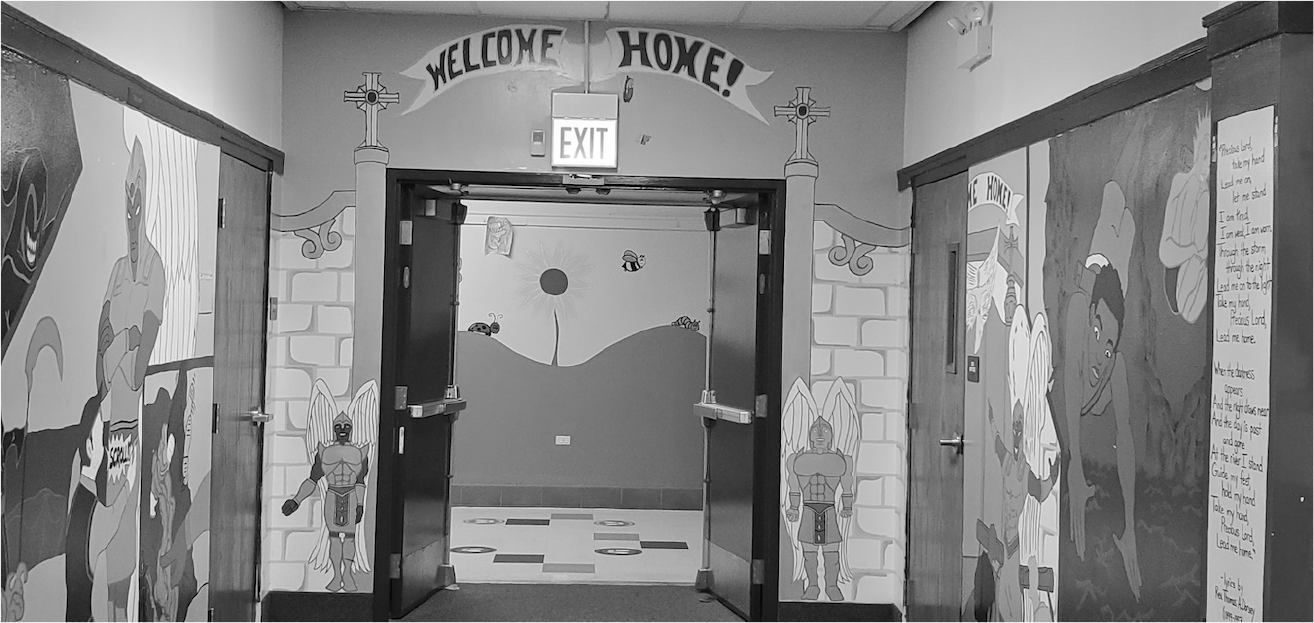
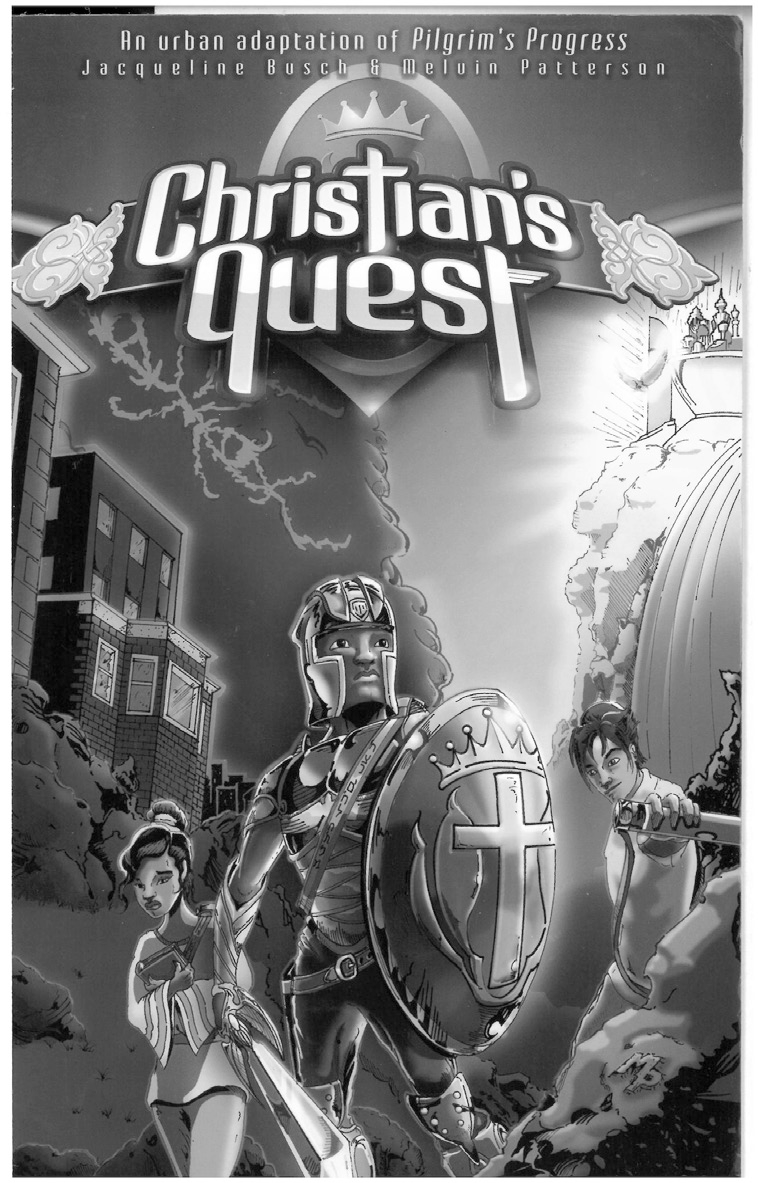
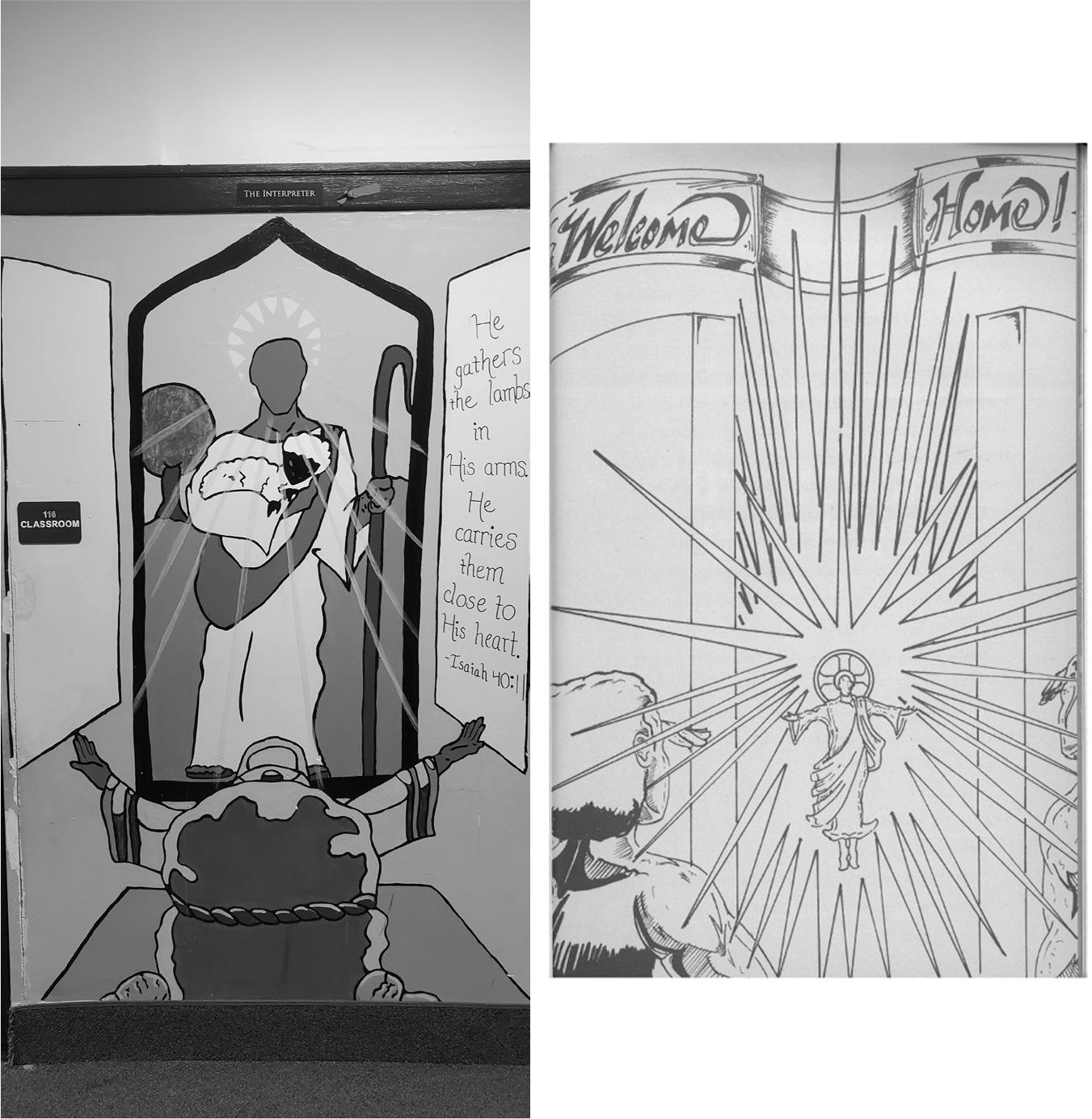
At first offered the wall of the lunch room, the pair were much more excited about the possibility of using the whole 180 foot hallway (Fig. 4). It had a natural break with a double doorway part of the way down the corridor that ended up serving as the location of the wicket gate, and the exit would mark arrival at the Celestial City (Fig. 5). Drawn by Patterson and projected onto the walls of the corridor, the mural developed with young student painters (and minimal adult touch ups) over a three-year period. Patterson’s own journey away from and back to Christianity in his native eastside Chicago echoed in story panels of the contextualized mural. Starting in Sin City, a young, burdened teen makes his way through testing obstacles, including bowing to the idol of high school football, to the wicket gate and beyond. From the mural came the co-written book that Patterson illustrated, Christian’s Quest, described on the front cover as “an urban adaptation of Pilgrim’s Progress.”Footnote 34 The clue that the adaptation leans on Little Pilgrim’s Progress is in the mimicry of Taylor’s idiosyncratic naming of Apollyon as Self.Footnote 35 So, when the battle with Apollyon happens in Christian Quest, the chapter is called “Battle with Self,” although the name plays no part in the written narrative of the chapter. Yet, compared to the “so white” Little Pilgrim’s Progress, Christian’s Quest is populated, predominantly but not exclusively, by African American characters (Fig. 6). Importantly, while muted in the book’s black and white, Patterson’s mural confirms the representation of Jesus as an iconoclastic person of color (Fig. 7—side-by-side from mural and book). The significance of this representation is not a small matter. In fact, the mural deliberately incorporated a diversity of ethnicities, while still respecting the predominantly African American context.Footnote 36
Corridor with Wicket Gate double door entry midway down. © Melvin Patterson, Little Pilgrim’s Progress Mural, Circle Urban Ministries. Photo credit, Melvin Patterson, cropped by author. (Used with permission. Reuse not permitted.)

The corridor ends at the Celestial Gates, with Christian sinking in the River of Death, to right. © Melvin Patterson, Little Pilgrim’s Progress Mural, Circle Urban Ministries. Photo credit, Melvin Patterson, cropped by author. (Used with permission. Reuse not permitted.)

Cover Art for Christian’s Quest. © Melvin Patterson (Chicago: Moody, 2012) (Used by permission. Reuse not permitted.)

Shepherd Jesus. As the Interpreter in Little Pilgrim’s Progress Mural © Melvin Patterson (Left, photo credit, Melvin Patterson, 2021) and in Christian’s Quest (Chicago: Moody, 2012) 271 (detail) © Melvin Patterson. (Both used by permission. Reuse not permitted)

Busch and Patterson’s adaptation is significant precisely because The Pilgrim’s Progress and its reception is largely a white affair among evangelicals, as showcased by the careless images of the Flatterer in Little Pilgrim’s Progress. Yet the reception story is not so simple. Black reformed pastor and author Anthony J. Carter would disagree that the book is confined to such an audience, even if the title of his book speaks to coming to The Pilgrim’s Progress as the property of a new tradition: The Glory Road: The Journeys of 10 African-Americans into Reformed Christianity.Footnote 37 His commendation of The Pilgrim’s Progress as influential in his journey in doctrine shows that theological and racial markers intersect in ways that cannot be oversimplified. Furthermore, it is clear that an evangelical publisher, in one form of its corporate existence, was at one time aware of and committed to market outreach to a demographic beyond white suburban evangelicals, and thus supported a theologically significant revision of a classic text.Footnote 38
Can a re-orientation of a monumental text in adaptation ever escape the shadow of the originating imagination and that of the prevailing reception demographic? This is similar to the question that arises in regard to the re-purposing of public space in the context of monuments to racial hatred. Contemporary examples give a mixed response to the hopes engendered in a positive answer to the question.
Hopeful Iconoclasm of a Racialized Pilgrim’s Progress
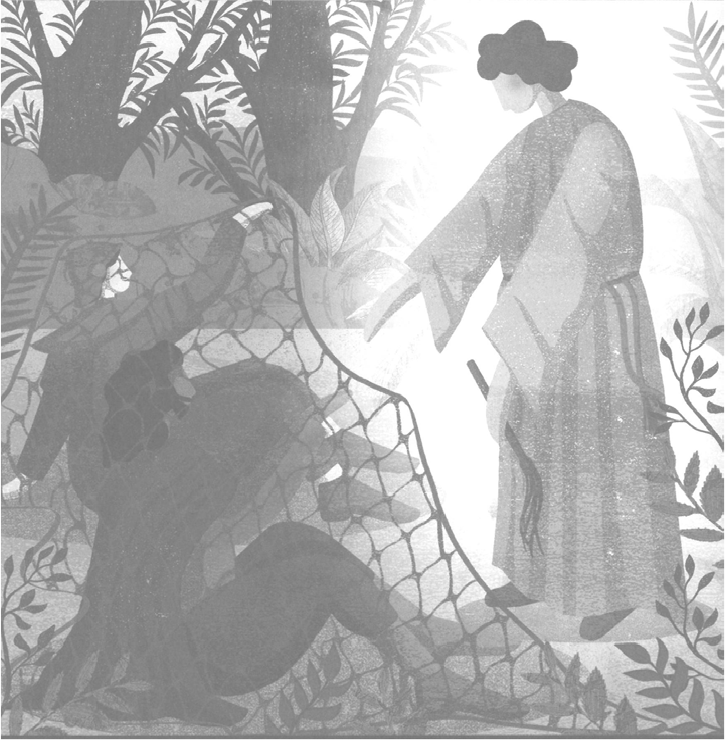
Three very recent evangelical publications offer hope that future readers of The Pilgrim’s Progress may be allowed to see the world differently when spiritually authorized by the text. First, faltering steps are made in relation to the illustration of Bunyan’s full text. Thomas Nelson’s “An Illustrated Christian Classic” does not depict the Flatterer visually at all.Footnote 39 In keeping with the early versions of Little Pilgrim’s Progress, its illustrations portray the pilgrims’ release (Fig. 8). Enduring whiteness persists editorially. Despite numerous editorial comments in side-bar windows dotted throughout the book, it is the Shining One’s whipping the pilgrims on their release from the net that elicits editorial reassurance to readers that God’s discipline is not literally violent. But the violence of Bunyan’s description of the Flatterer as “black of flesh” is overlooked without comment. What is worthy of note, however, is the consistent rendering of Christian as a person of color throughout the book. The significant gain in illustration of the volume goes unheralded, however, as the graphic design illustrator is not credited in the volume, thereby corporatizing and anonymizing this still significant contribution.
Taken from John Bunyan, The Pilgrim’s Progress: An Illustrated Christian Classic (Nashville, TN: Thomas Nelson, 2019) 221, © 2019. (Used by permission of Thomas Nelson. www.thomasnelson.com. Reuse not permitted.)

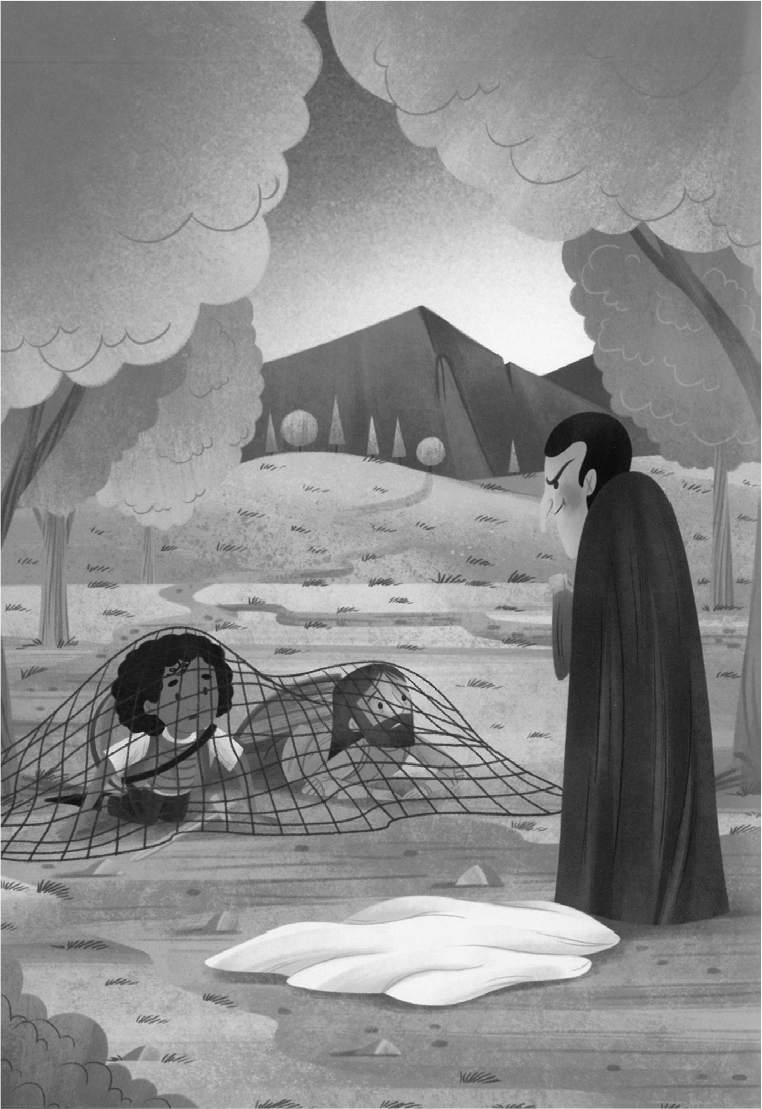
Katya Longhi’s illustrations accompanying Rousseaux Brasseur’s “Poetic Retelling” of The Pilgrim’s Progress make both Faithful and Hopeful characters of color.Footnote 40 Brasseur’s rhyming couplets depict the Flatterer as “a man with a robe as white as snow” who, only after entrapping the pilgrims, “pulled off his robe and disguise.”Footnote 41 There is no mention here of black skin or darkness at all. Longhi illustrates this reveal scene by setting the Flatterer’s white cloak on a heap on the ground to show that he was in fact dressed in a dark brown cloak. But he is a white man with furrowed brow, a gloating smirk and an elongated nose—physical extremes communicating his evil instead of skin color—a mix between a Dracula and a Chitty-Chitty-Bang-Bang child catcher (Fig. 9).Footnote 42
Taken from The Pilgrim’s Progress, Text ©. Rousseaux Brasseur, artwork © Katya Longhi. Published by Harvest House Publishers, Eugene, OR 97408. www.harvesthousepublishers.com, pg. 168. (Reproduced with permission. Reuse not permitted.)

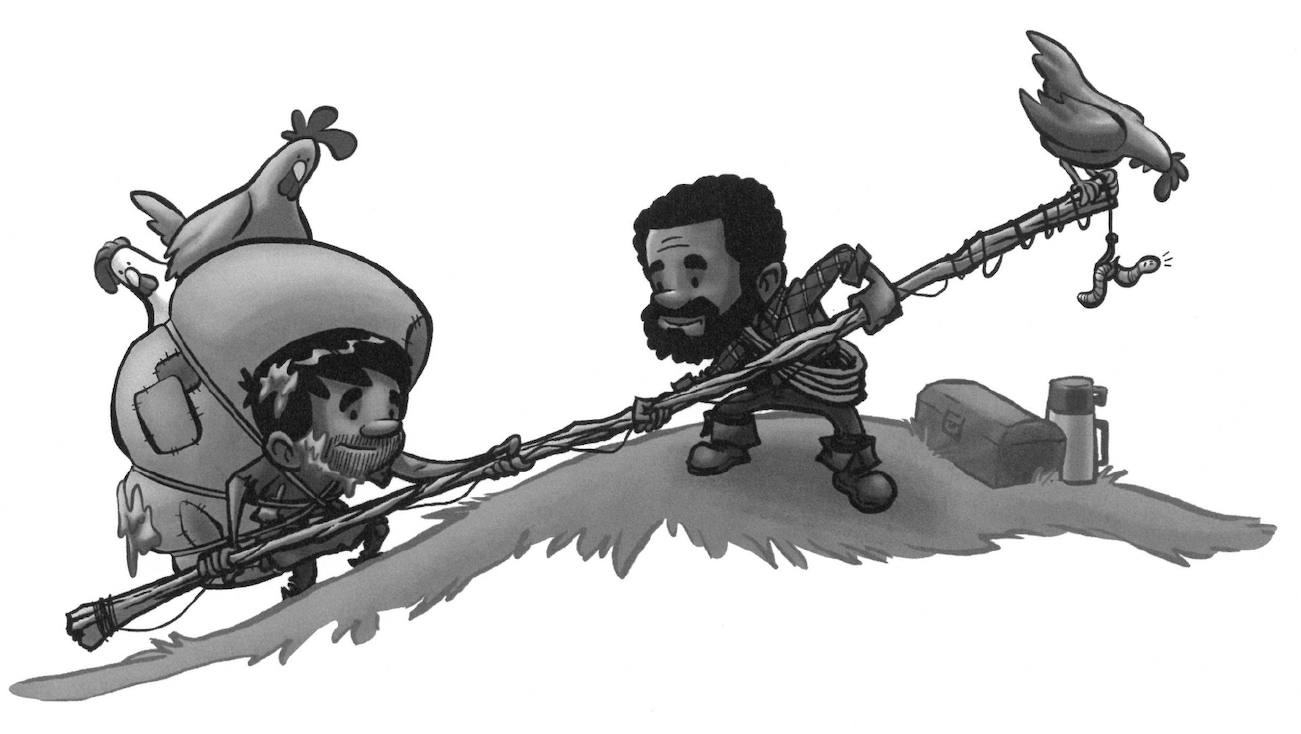
The most significant adaptation for a racialized evangelical readership is the lowliest. The Pilgrim’s Progress: A Poetic Journey is a slim volume of 36 pages.Footnote 43 Given the power that children’s adaptations have not only in forming the vision of children themselves but also their adult readers, the Coxes’ work stands out. Christian and his family, Helpful (Fig. 10), and Faithful are all persons of color in this representation, alongside a white Evangelist and Hopeful. The Flatterer incident is not included, but the undoing of this character’s miserably handled racialized iconographic legacy is deftly executed. Readers are placed with these characters in a world where racial difference is normalized and co-inhabited.
Concluding Theological Assessment
Should Bunyan still be standing? Should The Pilgrim’s Progress and its adaptations still have standing as works of spiritual authority? The Pilgrim’s Progress and its adaptations offer many riches to readers in terms of theological orthodoxy of a Protestant kind. Submission to Scripture’s authority is held aloft alongside the practical good of experiential religion inhabiting sanctification and perseverance. Its monumentality as a spiritual classic is not unilaterally toxic. Bacote suggests that a racialized vision is often concomitant with evangelical personal piety. So “complicity with White supremacy in evangelicalism” means that minority participants in the community are invited to sacrifice their “horizontal” concerns for equity and justice for solely “vertical” dimensions of pious fellowship.Footnote 44 This in turn is based on the “erroneous idea that theology is clearly distinct from social, cultural and political practices, or more precisely that theology and ethics are easily separable.”Footnote 45 Another way of saying this is that while Bunyan is lionized for his spiritual classic as an exemplar of Protestant orthodoxy it is supposed that his or readers’ prejudices on race are beside the point in the transmission and reception of the book spiritually.Footnote 46 The whiteness of the spiritual classic has coalesced with insensitive or simply prejudicial and racist depictions of the Flatterer and the racialization of characters of the plot in relation to his blackness.
Some Christians will believe, metaphorically at least, that the statue should come down. The Pilgrim’s Progress must be set aside as a tainted contributor to evangelicalism’s toxic racism and culpable neglect of race as a theological problem of idolatry. In some measure its fall from the popularity of its heyday might suggest this is a natural trend. But this demographic fate would not address and reckon with its racialized reception, plausibly allowing the racialized present to remain complacent. Still, some will want to bury The Pilgrim’s Progress and turn to other classics from other traditions.
Another tactic is that employed by Steven Case in his adaptation of The Pilgrim’s Progress. This Road Tonight introduces a female Faith and a black Hope as pilgrim companions for the still implicitly white Christian on his journey to the City of Light and beyond the structures of conservative religion on a broader way.Footnote 47 Case transforms the hypocritical character of Talkative, who is all head knowledge but lacking heart religion into a conservative Sunday School teacher, armed with Bible verses, rebuking and contending with Faith. These revisions and corrections of The Pilgrim’s Progress arise satirically but with theological intent. Yet the sway of a satirical adaptation from The Apocryphile Press cannot compete with the influence of editions and adaptations published by Zondervan, Crossway, B & H, and Thomas Nelson.Footnote 48 Christians who appreciate Case’s revolution will not compare in number to the many who still flock to The Pilgrim’s Progress as a marker of their conservative theological bona fides.
Within the bounds of conservative Christianity, adaptations are changing even though explicit public theological criticism of Bunyan’s racist portrait of the Flatterer has not surfaced. This points to theological work borne out in the practice of authors, editors, and illustrators. It shows that there is work that can be done now other than public hand-wringing over a racist past. Where textual and iconographic change is noticed, this helps evangelical readers, inured to whiteness, reckon with their racialization. Even without knowledge of change in reception, these moves help readers, who learn and are encouraged by The Pilgrim’s Progress, to see racialized others as fellow pilgrims. For those who continue to seek fruitful gospel discipleship within the American evangelical world, transforming The Pilgrim’s Progress’s reception by altering its monumental presence visually is as a more hopeful trajectory of reckoning and repentance in a community’s imaginative formation.Footnote 49
The work is not yet all done. The journey still to be taken is evident in Moody Press’s latest edition of Little Pilgrim’s Progress. Footnote 50 Re-framing the narrative from the adventures of children to woodland animals requires minor editing of Taylor’s Victorian prose alongside the newly envisioned illustrations by Joe Sutphin. The pilgrims are rabbits, Evangelist is an owl, Apollyon is a wild dog and, environmentally displaced, the King is, of course, a lion. Turning to chapter 40, “The Flatterer and His Net,” the reader finds that, of all the animals available to Sutphin, the Flatterer is rendered as a raccoon. Will children to whom the story is read know of the character’s association with blackness or, for that matter, the racist epithet derived from the animal’s name? The framing of the question invites an answer skewed to the whiteness of the text and its assumed audience, for whom collective memory of the term “coon” is not of having been on the receiving end of the slur. Another opportunity to redeem an iconographic tradition that has been mired in racism is, even in redrawing, carelessly entangled yet again in racist tropes.Footnote 51
Attention has been deliberately drawn to adaptations that reckon with and reorient the problematic racialization of The Pilgrim’s Progress. With Vincent Bacote, it must be recognized that no one expression of Christianity is pristine. And evangelicalism’s failings over race are consistent and deplorable.Footnote 52 Commitment to Scripture to support affirmations of the good news of salvation in Jesus Christ is a strength of conservative Christianity, and is displayed in a number of significantly apposite and memorable ways in Bunyan’s classic. Reckoning with racism in the tradition means a commitment to publicly recognize failings, repent and step out into greater awareness of what love of God and neighbor requires in the transmission of a spiritual classic. Practical steps must include at least the clear highlighting of the racialization of the Flatterer in editorial notes accompanying the text. Adaptations can be more creative in recasting the vision of the text inclusively. This gets past the kinds of well-meant but evasive spiritualization around the Flatterer expressed in observations that, for example, “the man’s flesh was as black as night, but this had nothing whatsoever to do with his race or ethnicity. The color of his skin was figurative only, signifying an evil character within.”Footnote 53 The spiritualizing move is exactly the division of theology from ethics that fails evangelicalism on race. The Pilgrim’s Progress is still standing along with John Bunyan’s statue. It is a monument to a glorious gospel and at the same time a flawed gospel vision. As a monument it can be made a focal point for reckoning and repentance, it can be altered and re-positioned, and even by those minorities within evangelicalism whose non-white voice its reception has most abetted in marginalizing.Footnote 54 From Melvin Patterson’s mural to Paul and Stephanie Cox’s children’s book, iconographic reception can challenge enduring racist tropes and effect an iconoclastic hope for a spiritual classic.Footnote 55
© Paul Cox 2019, in Paul and Stephanie Cox, The Pilgrim’s Progress: A Poetic Journey (Peterborough, Canada: H&E Kids, 2019). (Used with permission. Reuse not permitted.)