Introduction
As a result of population aging, dementia has emerged as a crucial public health problem. As limited effective treatment alternatives for dementia are currently available, the identification of risk or protective factors, especially modifiable factors, could provide potential means for preventing the disorder. Among the potential protective factors, lifestyle leisure activities are receiving increased attention. Various studies have examined the association between different types of leisure activities (physical, social, and cognitive) and cognitive function or cognitive decline. The beneficial effect of cognitive activity on cognitive function is the consistent findings of these studies (Verghese et al., Reference Verghese2006; Leung et al, Reference Leung2010; Iwasa et al., Reference Iwasa, Yoshida, Kai, Suzuki, Kim and Yoshida2012; Vemuri et al., Reference Vemuri2014). Social activity has also found to be favorable for the preservation of cognitive function (Saczynski et al., Reference Saczynski2006; James et al., Reference James, Wilson, Barnes and Bennett2011).
Physical exercise may positively influence cardiovascular risk factors such as diabetes (Hu et al., Reference Hu1999), hypertension (Hagberg et al., Reference Hagberg, Park and Brown2000), and dyslipidemia (Stefanick et al., Reference Stefanick, Mackey, Sheehan, Ellsworth, Haskell and Wood1998), conditions demonstrated to be associated with the development of dementia (Kivipelto et al., Reference Kivipelto2001; Sofi et al., Reference Sofi2007). Physical activity has been found to have a neuroprotective effect, which stimulates the release of neurotrophins, increases synaptic and dendritic receptors and promotes neuronal growth and survival (Gomez-Pinilla et al., Reference Gomez-Pinilla, So and Kesslak1998). In addition, physical activity during leisure time can provide enjoyment, fulfillment and social interactions (Teychenne et al., Reference Teychenne, Ball and Salmon2008). It is reasonable to speculate that physical activity may have protective effect on cognitive function. The cognitive reserve (CR) model (Stern, Reference Stern2002) was proposed to explain the possible mechanisms of the protective effect of physical activity. The model suggests that participation in physical activity may help individuals to cope with dementia pathology better than those who do not participate. However, research findings on relations between physical activity and cognitive performance in old age are not entirely consistent.
Some studies demonstrated that physical activity had beneficial effect on cognitive function (Lindsay et al., Reference Lindsay2002; Podewils et al., Reference Podewils2005; Ku et al., Reference Ku, Stevinson and Chen2012). Some other studies did not find strong association between physical activity and cognitive function in older adults (Sturman et al., Reference Sturman2005; Leung et al., Reference Leung2010; Iwasa et al., Reference Iwasa, Yoshida, Kai, Suzuki, Kim and Yoshida2012). Snowden (Reference Snowden2011) conducted a systematic review of physical interventions studies, and did not find strong evidence for beneficial effects of physical activity on cognition in old age.
Furthermore, most of the studies on physical activity were limited to single measures of cognitive function and without accounting for participation in cognitively stimulating activities. Although it is difficult to separate different components of many activities (physical, cognitive, and social), the distinct effect of physical activity on cognitive function should be explored. In the present study, we examined the association between physical activity and cognitive function of the elderly Chinese from two cities with different social systems. We also conducted the study with a view to address the question of whether that if physical activity has a predominantly protective effect on the cognitive function independent of participation in other types of leisure activities.
In the present study, we examined the association between physical activity and cognitive function of the elderly Chinese from two cities with different social systems. We also conducted the study with a view to address the question of whether physical activity has a predominantly protective effect on cognitive function independent of participation in other types of leisure activities.
Methods
Participants
The study was conducted in HK and GZ. The participants were recruited from the neighborhood social centers of HK and GZ. A conveniently selected sample (260 in HK and 297 in GZ) was recruited in both sites. Briefly, the study enrolled community-dwelling participants aged over 60 years. Exclusion criteria included living in old age homes; dementia; greatly impaired communication and language abilities; bed bound; unstable physical conditions; history of primary neurodegenerative disorder; known history of psychotic disorder and substance misuse. Clinical dementia was defined according to the criteria of the Diagnostic and Statistical Manual of Mental Disorders, 4th edition (DSMI-V) (American Psychiatric Association, 1994). Older persons who agreed to participate were invited for a face-to-face interview in the social centers. Having been given detailed explanation about the study, older persons who agreed to participate in the study were asked to sign the Consent Form. Socio-demographic characteristics were obtained during the interview. Information was collected by the same psychiatrist through face-to-face interviews using standardized questionnaires and a battery of cognitive assessment tools. The whole assessment took approximately an hour to complete. The study was approved by the ethics committees of the Chinese University of Hong Kong.
Assessment
Cognitive assessment
The participants were assessed with a cognitive battery that included the following tests: the Cantonese version of Mini Mental State Examination (CMMSE) (Chiu et al., Reference Chiu1994) served as an index of global cognitive function. Word list learning test and delayed recall test from the Chinese version of the Alzheimer's Disease Assessment Scale-cognitive subscale (ADAS-Cog) (Chu et al., Reference Chu, Chiu, Hui, Yu, Tsui and Lee2000) provided a measure of episodic memory. The CVFT was used to assess participants’ semantic and executive functions (Lam et al., Reference Lam, Ho, Lui and Tam2006). The trail making test measured executive function (Reiran and Wolfson, Reference Reiran and Wolfson1995). The digit vigilance test (Kelland and Lewis, Reference Kelland and Lewis1996) was used to test participants’ sustained attention. The Stroop test (Lee et al., Reference Lee and Chan2000) was used as a measure of selective attention.
Physical activity assessment
Participation in physical activity was assessed using a checklist developed by Leung et al. (Reference Leung2010), which has been used in a pilot study in GZ before the field trial. Leisure activities local elderly people commonly engaged in had been classified into physical, intellectual, social, and recreational categories. They were asked if they had been engaged in any types of physical activities (tai chi, qigong, yoga, other Chinese-style mind-body exercise, Chinese martial arts, jogging or running, stair climbing or swimming, hiking or excursions, cycling or using exercise machines, playing ballgames or racquet sports, calisthenics or dancing, slow walking, pebble trail walking, general stretching, and toning exercise) in the past year. They were also asked to specify the types, frequency, and duration of their participation in physical activity to identify the extent of engagement. Activities performed at frequencies of less than a month were excluded, similar to a previous study (Leung et al., Reference Leung2010). The level of participation was measured in terms of total hours per week and total number of individual items.
As previous studies (Chan et al., Reference Chan, Ho, Cheung, Albert, Chiu and Lam2005; Lam et al., Reference Lam2009) found that only aerobic and mind-body exercises (tai chi, qigong, yoga, other Chinese-style mind-body exercise, Chinese martial arts, jogging or running, stair climbing or swimming, hiking or excursions, cycling or using exercise machines, playing ballgames or racquet sports, and calisthenics or dancing) were associated with cognitive function in Chinese older persons, whereas light exercises such as slow walking and stretching and toning exercises were not intense enough to have a significant effect. To better understand the association between physical activity and cognitive function, slow walking and stretching and toning exercises were excluded from the analyses in our study.
Assessment of other variables
Information on participation in the other three categories of activity was collected using the checklist mentioned above (Leung et al., Reference Leung2010), including intellectual activity (reading, writing, painting, calligraphy, using computer, plays mahjong or card games, gambling, participation in forums, handicraft, and playing a musical instrument), social activity (attending an interest class, joining a social center, participating in volunteer work, going to museums, exhibitions, theatres or concerts, meeting relatives or friends, drama or Chinese opera performance, singing, and attending religious activities), and recreational activity (watching television and listening to the radio, listening to music, shopping, cooking for pleasure, fishing, keeping plants or pets, and facials or massage). The activities were measured in two ways: total hours per week and total number of individual items. Depressive symptoms were assessed using the Hamilton Depression Rating Scales (HAMD). Chronic disease burden was assessed using the Cumulative Illness Risk Scale (CIRS) (Conwell et al., Reference Conwell, Forbes, Cox and Caine1993).
Statistical analysis
Univariate analyses were used to explore the correlation between potential confounding factors, leisure activity, and cognitive function. The correlation between cognitive performance and potential confounding factors was examined using Pearson's correlation coefficient for parametric variables (age, education, CIRS score, and HAMD score) and the χ 2 test for non-parametric variables (gender, occupation, marital status, living arrangement, drinking status, and smoking status). Those factors found to be significantly correlated with cognitive function were entered as covariates. The correlation between cognitive performance and leisure activity was examined using Pearson's correlation coefficient. Leisure activities that were significantly associated with cognitive performance were entered in the linear regression models.
Multivariate linear regression analyses were conducted to explore the association between physical activity and cognitive function. The dependent variables were the scores of cognitive tests (delayed recall test and CVFT). The independent variable was total number of physical activity, which showed significant association with delayed recall test and CVFT. The linear regression models examined the independent association between total number of physical activity and cognitive function (delayed recall test and CVFT) with adjusting for participation in the other three activity categories showing significant associations with the corresponding scores. The models were also adjusted for potential confounders significantly correlated with cognitive function. Age and education were entered in the two models simultaneously. Other covariates were entered when found to be significantly associated with the corresponding scores.
The Statistical Package for the Social Sciences (SPSS) software, version 17.0, was used to conduct the analyses. The level of statistical significance was set at p < 0.05.
Results
Characteristics of the whole sample
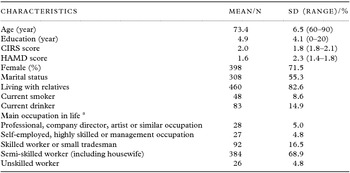
The characteristics of the whole sample are shown in Table 1. The sample had a mean age of 73.4 years (SD 6.5, Range 60–90) and 71.5% were female and 55.3% were married. 460 participants (82.6%) were living with their relatives. The mean number of years of education was 4.9 (SD 4.1, Range 0–20). 48 participants (8.6%) were current smokers (having smoked part or all of a cigarette during the past 30 days) (Substance Abuse and Mental Health Services Administration, 2009) and 83 (14.9%) were current drinkers (at least one drink of any kind of alcoholic beverage in the past year) (Clark and Hilton, Reference Clark and Hilton1991). The most common main occupation in life was semi-skilled worker (68.9%).
Characteristics of the participants

aThe classification was adopted and modified from Schmand et al., (Reference Schmand, Smit, Geerlings and Lindeboom1997) and Leung et al., (Reference Leung2010).
CIRS = Cumulative Illness Risk Scales; HAMD = Hamilton Depression Rating Scales.
Physical activity profiles of the whole sample
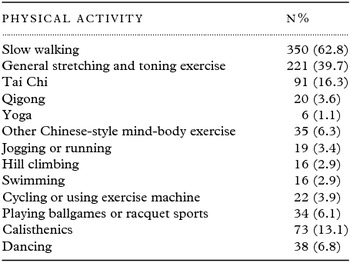
The two most frequent types of common activities in which participants engaged were slow walking (62.8%) and general stretching and toning exercise (39.7%). The two most common mind-body and aerobic exercises were tai chi (16.3%) and calisthenics (13.1%). Other activities reported less frequently included dancing (6.8%), other Chinese mind-body exercises (6.3%), ball games (6.1%), cycling (3.9%), qigong (3.6%), jogging or running (3.4%), hill climbing (2.9%), swimming (2.9%) and yoga (1.1%) (Table 2).
Physical activity profiles of the participants

Leisure activity and cognitive function
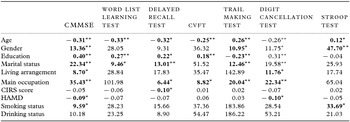
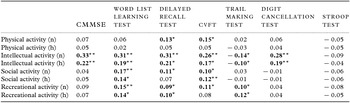
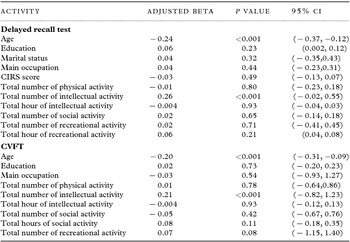
Correlation analyses of the scores of cognitive tests and potential confounders showed that age and education had a consistent significant correlation with the scores. Other important confounding factors included gender, marital status and main occupation, and CIRS score (Table 3). Potential confounding factors that were significantly associated with the scores were included in the multivariate linear regression models. Correlation analyses of the scores of cognitive tests and leisure activity showed that total number of physical activity had a significant correlation with the scores of the delayed recall test and CVFT (Table 4). However, with adjustment for potential confounders having significant correlations with the delayed recall test (age, education, marital status, main occupation, CIRS score, total number of intellectual activity, total hours of intellectual activity, total number of social activity, total number of recreational activity, and total hours of recreational activity) and CVFT (age, education, main occupation, total number of intellectual activity, total hours of intellectual activity, total number of social activity, total hours of social activity, and total number of recreational activity) correspondingly, the association between physical activity and cognitive function was no longer statistically significant (p > 0.05) (Table 5).
Correlation between socio-demographic factors and cognitive performancea

*p < 0.01 and **p < 0.001.
aCorrelation coefficient was calculated using Pearson correlation test for parametric variables and χ 2 test for non-parametric variables. Note: statistically significant coefficients are set in bold type.
CIRS = Cumulative Illness Risk Scales; CMMSE = Cantonese version of Mini Mental State Examination; CVFT = category verbal fluency test; HAMD = Hamilton Depression Rating Scales.
Correlation between leisure activity and cognitive performancea

aCorrelation coefficient was calculated using Pearson correlation test.
*p < 0.01 and **p < 0.001; n = total number of individual items; h = total hours per week; CMMSE = Cantonese version of Mini Mental State Examination; CVFT = category verbal fluency test. Note: Statistically significant coefficients are set in bold type.
Multivariate linear regression of physical activity participation on the cognitive performance (delayed recall test and CVFT)*

The two models included the covariates found to be significantly associated with the corresponding score of the delayed recall test and the CVFT. The independent association of physical activity was studied while controlling for participation in the other three categories of activity, which showed significant association with the delayed recall test and the CVFT correspondingly.
CIRS = Cumulative Illness Risk Scales; CVFT = category verbal fluency test.
Discussion
In this fairly large, community-based Chinese elderly study, some types of physical activity showed a small association with a better performance on specific cognitive test (delayed recall test and CVFT). Other cognitive functions seemed to be insensitive to physical activity. The result was consistent with a previous Chinese studies that mind-body exercise group performed better in CVFT (Lam et al., Reference Lam2009). Randomized controlled studies demonstrated that fitness training had a beneficial effect on improving certain cognitive process (Colcombe and Kramer, Reference Colcombe and Kramer2003). It is likely that aerobic and Chinese mind-body exercise can improve blood and oxygen supply to the cerebral areas, which is important for specific cognitive function. It is also possible that other cognitive processes are more susceptible to aging, and that physical exercise cannot compensate the influence of aging on cognitive function. Unfortunately, the relatively small number of published clinical studies prevents closer examination of the nature of the cerebral responses to physical activities. Well-designed randomized controlled clinical trials are much needed to address this issue.
The association was not statistically significant when participation in other cognitive challenging activities was adjusted for. Hence, the results suggest that physical activity may not have a substantial positive association with cognitive function on its own. Our findings were consistent with the results of some previous studies. Wilson et al. (Reference Wilson2002) conducted a 4.5-year longitudinal study among older Catholic clergy in the US and did not find a significant association. A cross-sectional study by Leung et al. (Reference Leung2010) failed to find a significant association between physical activity and cognitive function. Sturman et al. (Reference Sturman2005) conducted an investigation of 4,055 adults aged over 65 years living in a biracial community on the south side of Chicago. They found that when participation in cognitive activities and potential confounders were adjusted for, physical activity alone did not show a significant protective effect against cognitive decline.
There are some possible explanations for the weak association between physical activity and cognitive function. The first reason might be participation in intellectual activity, which might have a confounding effect on the association between physical activity and cognitive function. People who frequently participate in intellectual activities may adopt a more active lifestyle and might participate in more leisure activities, including physical activity. Some types of physical activity may imply simultaneous cognitive activity, even if the physical activity does not involve explicit mental skills. For example, mind-body exercise, represented by tai chi, involves a combination of complex movements in a specific order. The participant has to memorize when specific motor actions should be carried out, which may provide additional cognitive stimulation. The confounding effects of other activities were demonstrated by Sturman et al. (Reference Sturman2005), who found that the association between physical activity and cognitive function became insignificant after controlling for participation in cognitive challenging activities. Although it is difficult to separate the contribution of physical activity to cognitive function, our study investigated predominantly physical activities and then adjusted for intellectual and other types of activities with a principally cognitive component, yet the results did not show a significant association between physical activity and cognitive function. Thus, it is probable that cognitive stimulation is the common factor underlying the protective effect of different types of leisure activities.
When analyzing the association between physical activity and cognitive function, it is important to note the modality of exercise performed. A study by Colcombe et al. (Reference Colcombe2006) compared aerobic exercise to simple toning and stretching exercise and found an increase in the volume of both gray and white matter after six months of aerobic training. Two studies conducted among Chinese older adults also showed that only aerobic and mind-body exercise was associated with better cognitive function (Chan et al., Reference Chan, Ho, Cheung, Albert, Chiu and Lam2005; Lam et al., Reference Lam2009). In the preliminary analysis of our study, all types of physical activity were included. However, we failed to find a significant association between physical activity and cognitive function. It is probable that slow walking and stretching and toning exercises were not intense enough to have a significant influence on cognitive function. When only aerobic and mind-body exercise were included in the analysis, we found that physical activity was associated with better performance on the delayed recall and CVFT. We can speculate that there is a threshold for the favorable influence of physical activity. A previous study suggested that regular, moderate physical activity may be beneficial for the preservation of cognitive function (Yoshitake et al., Reference Yoshitake1995). Although we measured participation level by the number and duration of activities, we could not determine how strenuous the activities were. Apart from the confounding effect of intellectual activities, the included activities may not have been intense enough to have a profound effect on cognitive function.
The weak association between physical activity and cognitive function may also be explained by the relatively low levels of physical activity (aerobic and mind-body exercise) participation observed in our study. For example, a large majority of the participants took slow walking (62.8%) and general stretching and toning exercise (39.7%) as their common physical exercise. Only 16.3% and 13.1% of our participants took tai chi and calisthenics, the two most common aerobic and mind-body exercise, as their common physical activity. It is probable that the relative small sample of older persons practicing mind-body and aerobic exercise limited the power to detect a significant association with cognitive function.
It is also likely that lifetime participation in physical activity, rather than current participation, has the most important influence on cognitive function in later life. Measurement of participants’ current physical activity levels may not have adequately captured the important relationship between physical activity and later-life cognitive function. The major limitation of the study is the cross-sectional design, which does not allow drawing causal conclusions. Furthermore, the retrospective assessment of activity pattern may be influenced by social desirability.
In summary, the results of this study do not provide strong evidence that physical activity is related to better cognitive performance. Nevertheless, as physical activity has been demonstrated to have many beneficial effects on health, it should still be recommended for older persons living in the community. In particular, mind-body exercise and aerobic exercise are low-stress and user-friendly forms of exercise, and are readily accepted by Chinese older persons. In the absence of randomized trials on the long-term effects of physical activity on cognitive function, future observational studies are needed to explore the optimal way to estimate the potential for mind-body exercise and aerobic exercise as a means of intervention for cognitive decline.
Conflict of interest
None.
Description of author's roles
Elena X. F. Su designed the study, undertook the interviews and statistical analyses, and wrote the paper. Y. Q. Lin helped with the recruitment of the participants. S. L. Zhang helped with the recruitment of the participants. Grace T. Y. Leung helped with the design of the study. Linda C. W. Lam helped with the design of the study, statistical analyses and writing the paper. Helen F. K. Chiu helped with the recruitment of the participants and revising the paper.