Introduction
The ancient city of Hama was excavated between 1931 and 1938 by a team of Danish archaeologists under the direction of Harald Ingholt (Reference Ingholt1934, Reference Ingholt1940; Fugmann Reference Fugmann1958; Riis & Buhl Reference Riis and Buhl1990). Finds from the excavations were carefully catalogued and a substantial proportion was legally exported for display and curation at the National Museum of Denmark in Copenhagen. The Hama Collection has since become an invaluable resource for archaeological research, particularly as the current political climate still prevents fieldwork in Syria, and we believe that the present study underlines the importance of revisiting museum collections for continued study.
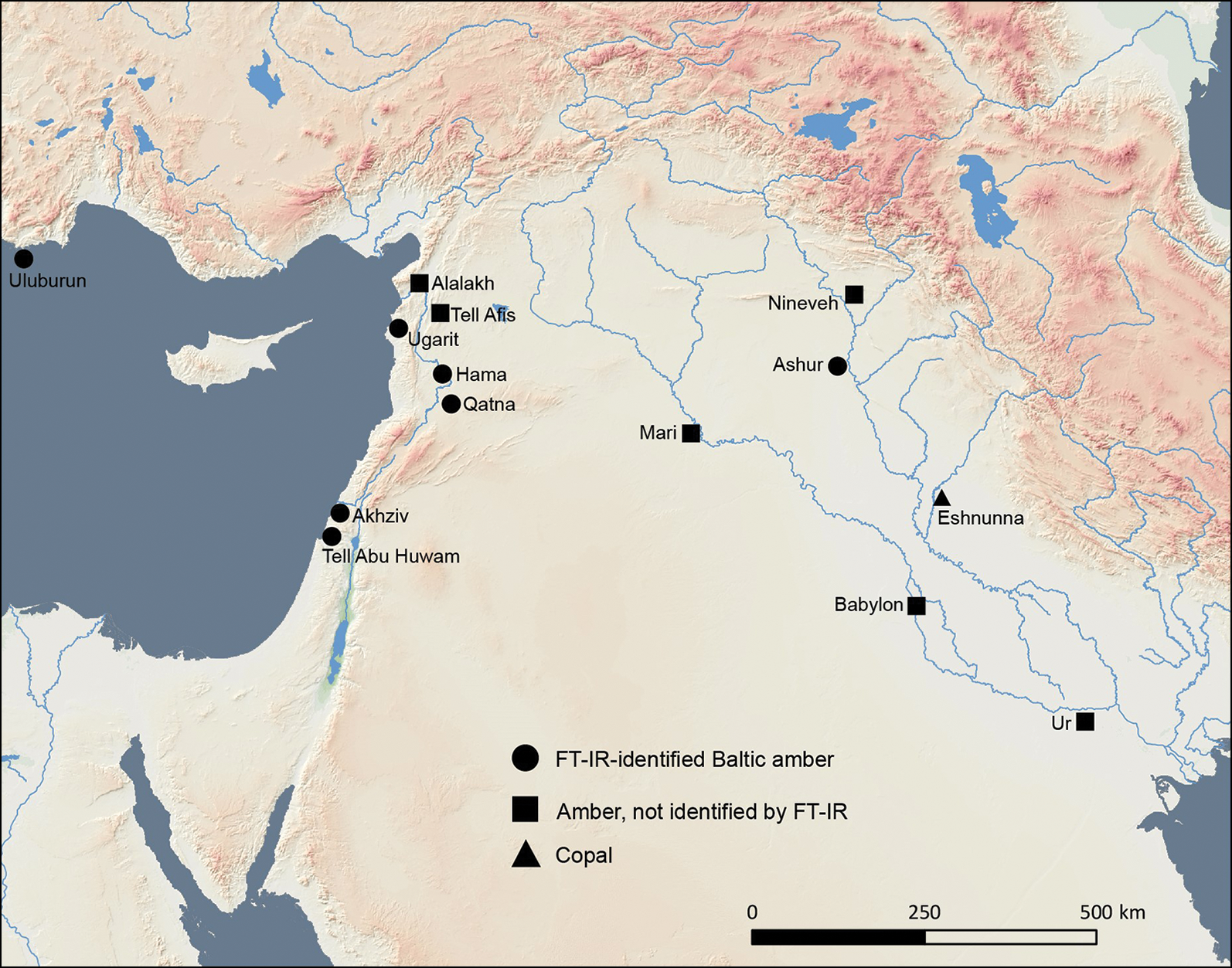
The mound that marks the ancient city sits in the middle of the modern city of Hama in a dry-farming zone along the Orontes River in western Syria, on the boundary between the arid steppe to the east and the temperate mountains to the west (Figure 1). The city is strategically placed on north-south and east-west communication routes, which may account for its longevity; the settlement on the mound has the longest continuous sequence of occupation in western Syria, spanning nearly 8000 years, from the Late Neolithic through to the Ottoman period (c. 6500 BC–AD 1400s).
Location of Near Eastern sites mentioned in the text (figure by authors).

The mound measures about 430 × 300m with a height of approximately 46m. In the middle of the mound, excavation revealed a settlement extending from the Neolithic to Iron Age II (c. 6500–1000 BC) and produced the largest exposure of an Early Bronze IV period (c. 2500–2000 BC) domestic neighbourhood in western Syria. In the southern part of the mound, an Iron Age ‘Royal Quarter’ was excavated, comprising several monumental buildings arranged around a large plaza and with basalt lion guardian sculptures flanking their entryways. Buildings II and V are interpreted as royal palaces (Fugmann Reference Fugmann1958). About 300m to the south/south-west of the mound, 1682 Iron Age cremation graves were uncovered and excavated between 1935 and 1938 (Riis Reference Riis1948). The cemetery was established c. 1100 BC and remained in use until the destruction of the city by the Assyrian king, Sargon II, in 720 BC (Fugmann Reference Fugmann1958), when the ‘Royal Quarter’ went up in flames (Lumsden Reference Lumsden and Karlsson2019; Gallet et al. Reference Gallet, Mouamar, Lumsden and Hald2023).
Here, we present an assemblage of beads found in one of the cremation graves; the material of these beads is identified as Baltic amber through Fourier-transform infrared spectroscopy (FT-IR), and we discuss the meaning of this find within the context of the broad trading networks in which Hama, as a long-lived hub (Lawrence & Wilkinson Reference Lawrence and Wilkinson2015), played a crucial role. These trading systems—and Hama's role in them—had reached a remarkable size and complexity already by the Early Bronze Age (Vacca et al. Reference Vacca, Mouamar, D'andrea and Lumsden2018).
The beads were found in Grave XII, Burial 15 (hereafter Grave XII15), inside a funerary urn containing the cremated remains of an adult female and a child (Riis Reference Riis1948: 250). Grave XII is situated in one of the oldest sections of the cemetery: late Period F, grave phase II, dated to c. 1075–925 BC (Riis Reference Riis1948: 202), corresponding with the Iron Age I–II transition/IA–IIA (Harrison Reference Harrison2021). The urns found in the cremation graves are generally uniform in character though not particularly standardised. Most were probably made locally but a few imports can be identified.
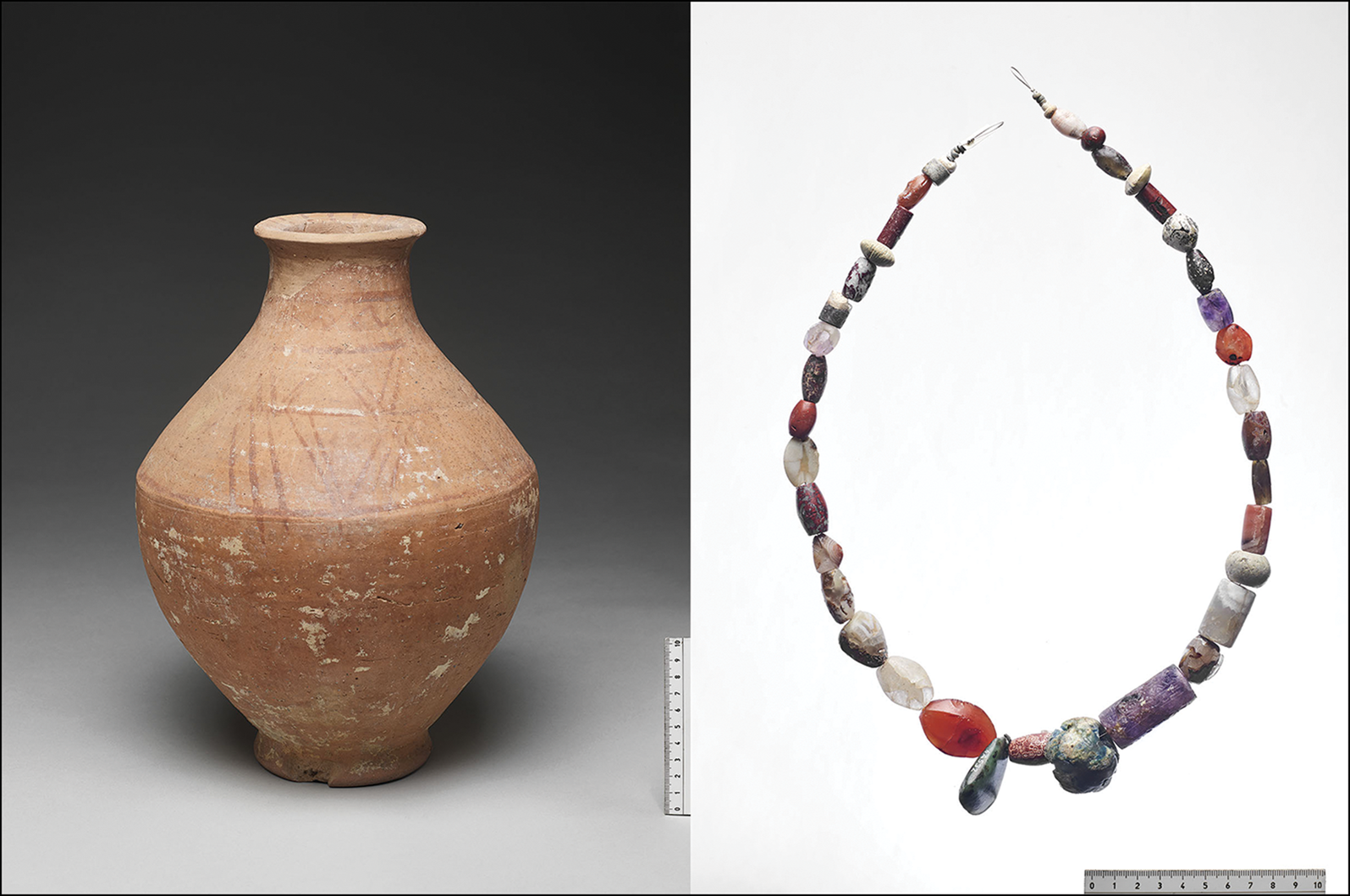
Urn 6A947 from Grave XII15 (Figure 2) is carinated (i.e. sharply curved) with a short cylindrical neck, the lower part of the vessel is semi-globular with a ring base. The surface of the jar is smooth and slightly burnished (polished), reddish-orange in colour. The clay is not particularly coarse but does contain a large quantity of inclusions. The urn is decorated in its upper part with a monochrome red pattern composed of horizontal and wavy stripes grouped at the neck, as well as horizontal stripes and zigzag patterns distributed fairly evenly over the entire decorated surface.
The funerary urn 6A947 and the reconstructed necklace from Grave XII15, without the amber beads (photographs by R. Fortuna & L.C.E. Hansen, National Museum of Denmark).

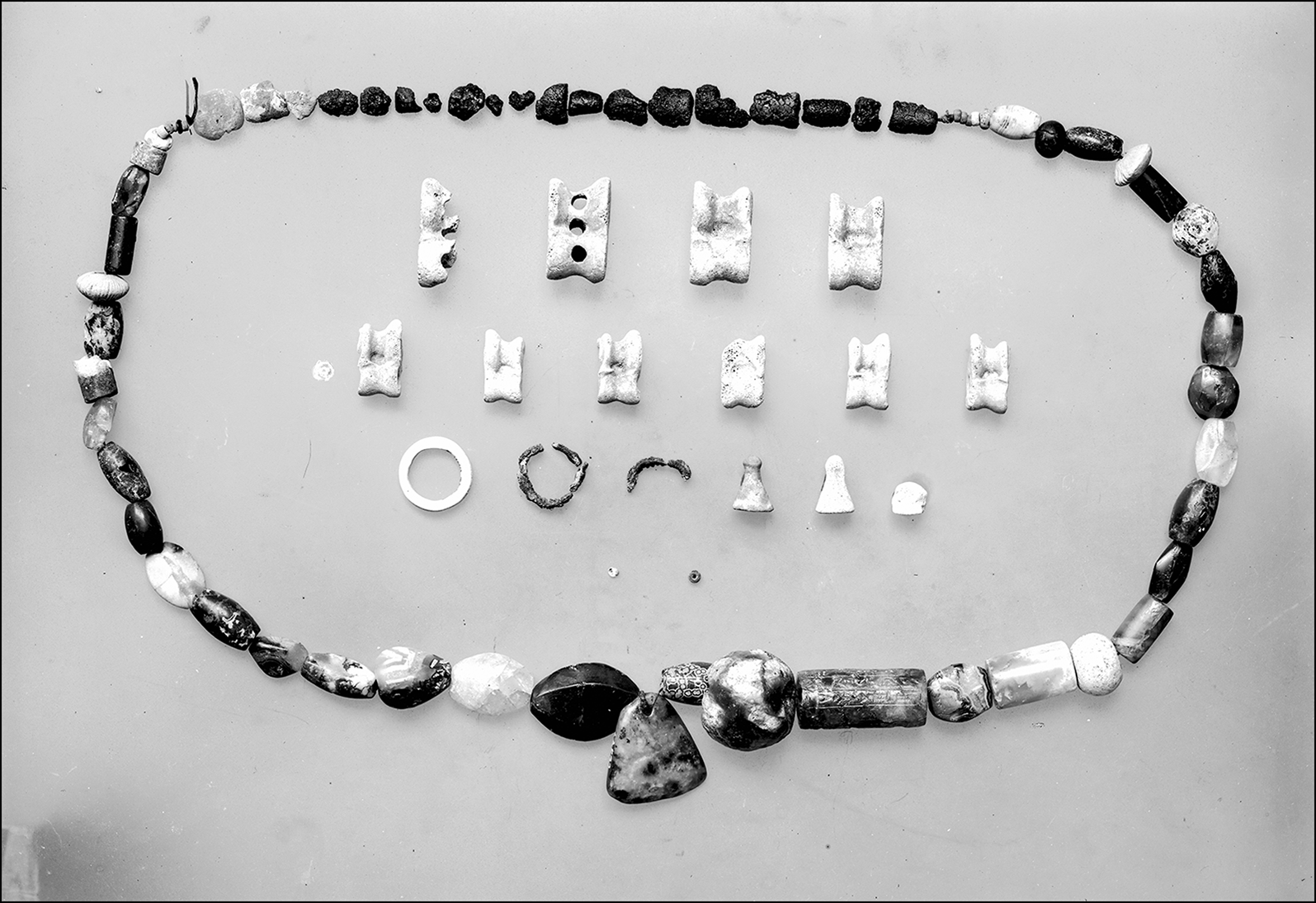
Inside the funerary urn were three finger rings (two of bronze and one of frit, a silica mixture), three gaming pieces, 10 astragali (a compact bone of the lower hindleg, four of which were available for analysis; three were identified as sheep, one only as sheep/goat), 51 beads, and an amethyst cylinder seal. The astragali may have been used as gaming pieces but could equally have had a ritual function (Gilmour Reference Gilmour1997). The cylinder seal was described by the excavators as being of “imitated ‘Kassite-style’” (Riis Reference Riis1948: 154)—the Kassites ruled central Iraq in the second half of the second millennium BC (Glatz et al. Reference Glatz2024: 369–70)—and more recent inspection confirms that it mimics Kassite cuneiform signs with “pseudo-hieroglyphic shapes” (Arbøll Reference Arbøll2023: 170–71). One bead, made of agate, bears a short cuneiform inscription, probably of Kassite origin (Arbøll Reference Arbøll2023), indicating that it was at least 100 years old when it was included in the cremation urn. This opens the possibility that other objects in the urn may also represent heirlooms. The remaining beads are a mixture of semi-precious stones and faience with a few smaller clay beads included (Figures 2 & 3); they were reconstructed, together with the inscribed bead and cylinder seal, as a necklace in the 1930s, but whether they represent a single necklace, several necklaces, bracelets, or individual items cannot be ascertained.
Original photograph of the contents of funerary urn 6A947 from Grave XII15. Note the fragments of amber beads laid out in the upper part of the reconstructed necklace (Riis Reference Riis1948: 35, fig. 22).

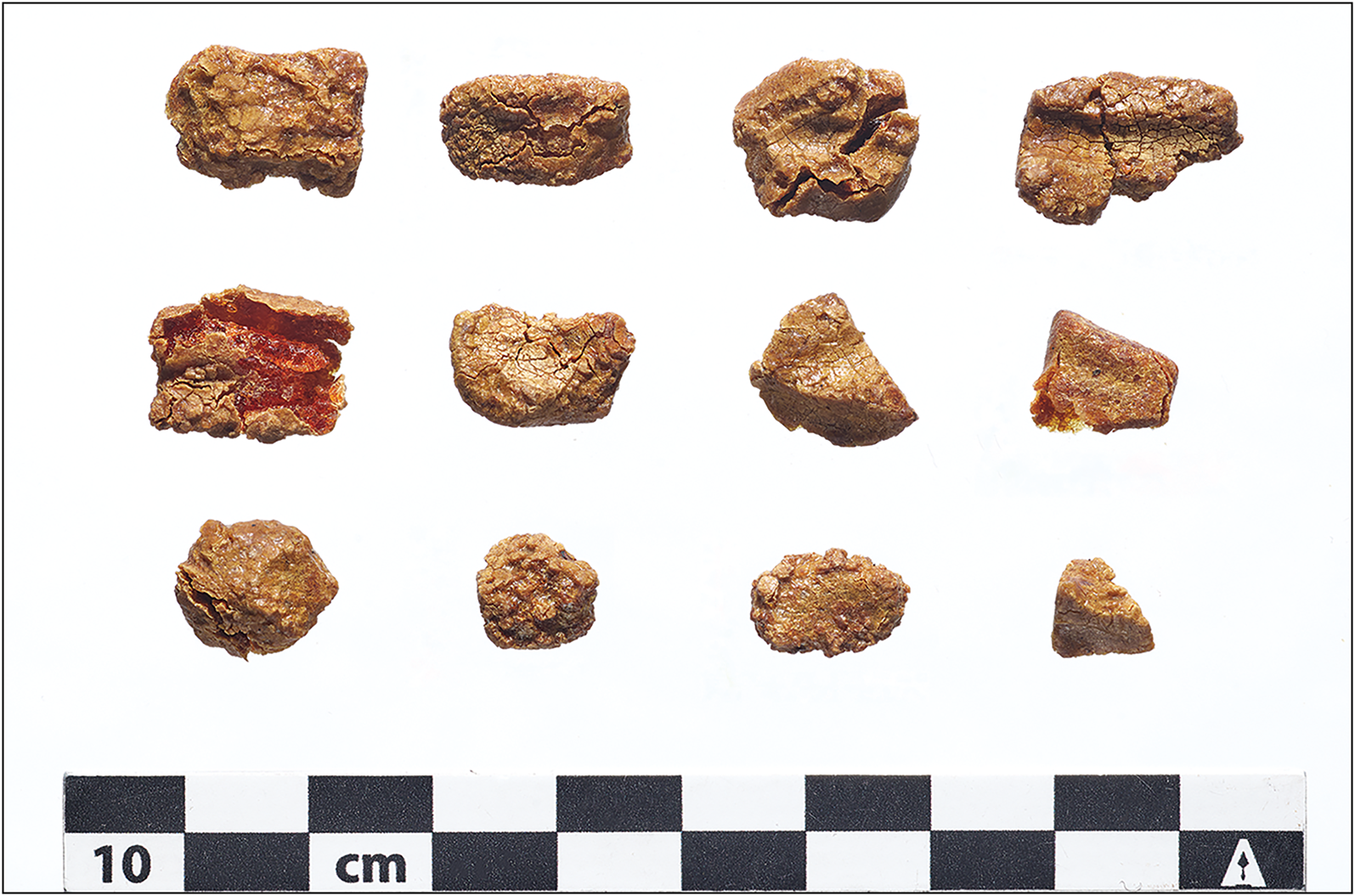
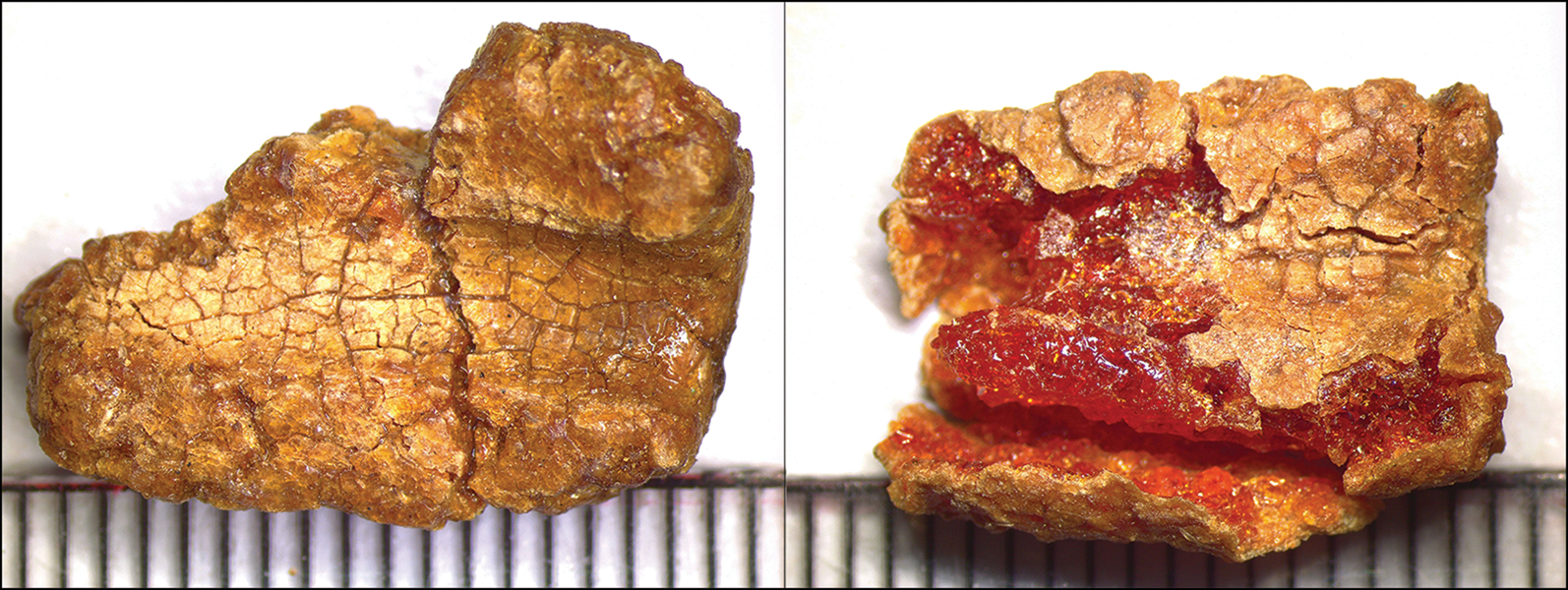
Among the beads were 17 fragments that had a distinctly different appearance, resembling amber, and that were too degraded to be re-strung during the reconstruction of the necklace in the 1930s (Figure 4). In the original presentation of the find (Figure 3), these were laid out in continuation of the outline of the reconstructed necklace. Inspection of the fragments under a stereoscopic microscope confirms that some are broken in half along their length and a visible depression indicates that a hole was drilled in the beads (Figures 4 & 5). The 17 fragments, therefore, may represent 10–15 beads.
Fragments of amber beads from Grave GXII15 (photograph by R. Fortuna & L.C.E. Hansen, National Museum of Denmark).

Two of the 17 amber bead fragments from Grave GXII15 showing the hole drilled through the amber as well as the crusty surface and translucent interior. Scale in mm (photographs by Mette Marie Hald, National Museum of Denmark).

Methods
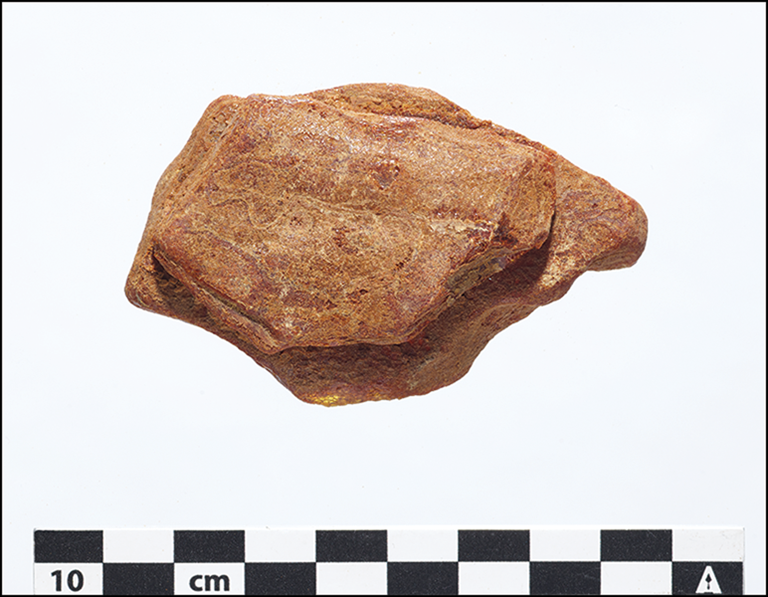
Two of the fragments (designated ‘bead 1’ and ‘bead 2’) from GXII15, as well as a larger nodule of similar looking material (measuring 75 × 45 × 20mm; Figure 6) recovered from Iron Age levels in square N13—in the plaza that formed part of the ‘Royal Quarter’—were analysed using FT-IR and gas chromatography-mass spectrometry (GC-MS) and compared with Baltic amber reference measurements from a known source. The beads were very fragile with a crusty surface and a core that appeared compact with a reddish-golden translucence (Figure 5). The larger nodule had a dull and cloudy surface and a translucent core. The exact find spot of this nodule remains unknown, though it was most likely found among the many other objects scattered across the plaza in the aftermath of the Assyrian attack in 720 BC, and it was included in the analysis to determine whether it was also amber. Material was taken for analysis from the surfaces and cores of both beads and the nodule. Initial results indicated that the surface of the beads had previously been treated for conservation and that the nodule has what appears to be an outer layer of degradation. Discussion of identification and provenance in this article therefore only considers the analysis of material from the bead and nodule cores.
Resin- or amber-like nodule from the ‘Royal Quarter’, presumably from the Iron Age destruction level. The nodule had broken in half lengthwise and a sample was taken from its interior. Its original translucent character can be glimpsed along the lower edge of the nodule (photograph by R. Fortuna & L.C.E. Hansen, National Museum of Denmark).

FT-IR spectroscopy was conducted in transmission mode on a pellet made from 1–5mg sample mixed with potassium bromide (KBr). The instrument was a PerkinElmer FT-IR Frontier spectrometer operated between 4000cm-1 and 650cm-1. In total, 25 scans were collected and averaged, and database searches were conducted using the Infrared and Raman Users Group (IRUG) database (Price & Pretzel Reference Price and Pretzel2000).
Samples were also derivatised for GC-MS analysis using direct silylation (the introduction of one or more trimethyl-silyl groups ((CH3)3Si) to enhance gas chromatography performance). Approximately 1–5mg of the archaeological sample was combined with 10μl of internal standard solution (0.62mg/ml deuteropalmitate CAS 39756-30-4 d31 in methyltertbutylether), 70μl anhydrous pyridine and 70μl N,O-Bis(trimethylsilyl)trifluor-acetamide with trimethylchlorosilane in a 2ml GC vial. After mixing, the vial was left on a heating block at 70°C for 60 minutes under a tight lid. After cooling, the solution was evaporated to dryness under a stream of nitrogen gas. The condensate was re-dissolved in 0.5ml n-hexane using an ultrasonic bath and a whirly-mixer. Not everything dissolved but centrifugation at 5000rpm for five minutes allowed clear solution to be isolated in another GC vial that was then analysed by GC-MS. The instrument was a Bruker SCION 456GC-TQMS equipped with a Restek Rtx-5 capillary column (30m, 0.25mm ID, 0.25μm) programmed for a 1ml min-1 helium flow. A 1μl sample was injected through the programmed temperature vaporization injector, which was held at 64°C for 30 seconds, ramped to 315°C at 200°C min-1 and held at that temperature for 40 minutes. The GC oven temperature was held at 64°C for 30 seconds, ramped to 190°C at 10°C min-1 and then to 315°C at 4°C min-1 and held at that temperature for 15 minutes. The electron ionisation source temperature in the mass spectrometer was 250°C and the ionisation potential was -70eV. The mass spectrometer was operated in full scan mode from m/z 45 to m/z 600.
Results
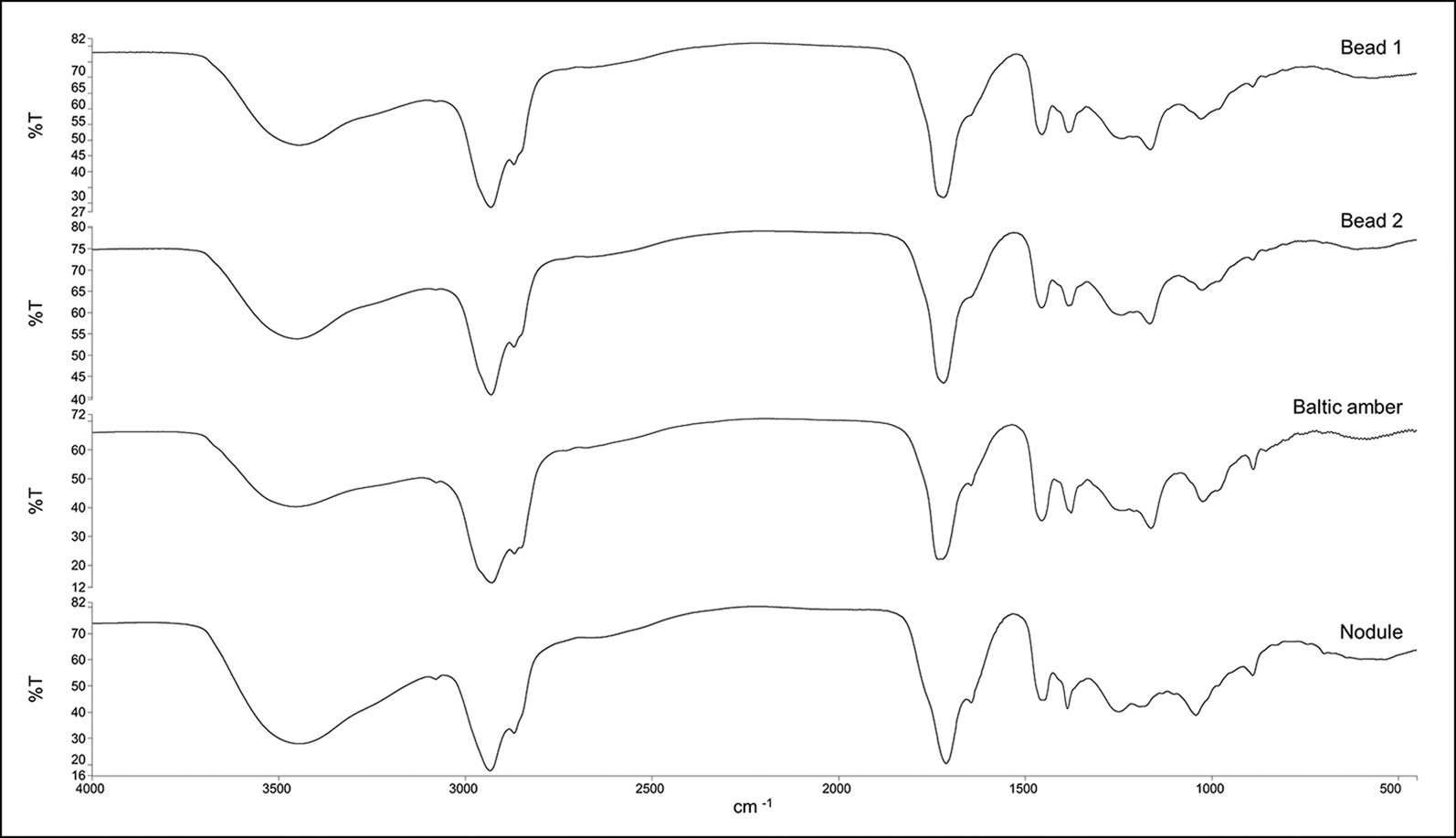
FT-IR spectra were recorded on KBr pellets made from core material from the three samples and scrapings from a reference of Baltic amber. The resulting four FT-IR spectra are very similar (Figure 7), suggesting that the archaeological samples and the reference are all similar materials. Only the nodule has minor differences compared to the others.
FT-IR spectra recorded on KBr pellets of four samples. Spectres of (top to bottom) core sample from bead 1; core sample from bead 2; natural reference of Baltic amber; and core sample from the nodule (Figure 6). Both bead samples match the Baltic amber reference, while the nodule does not fully match the others. %T= transmission (figure by authors).

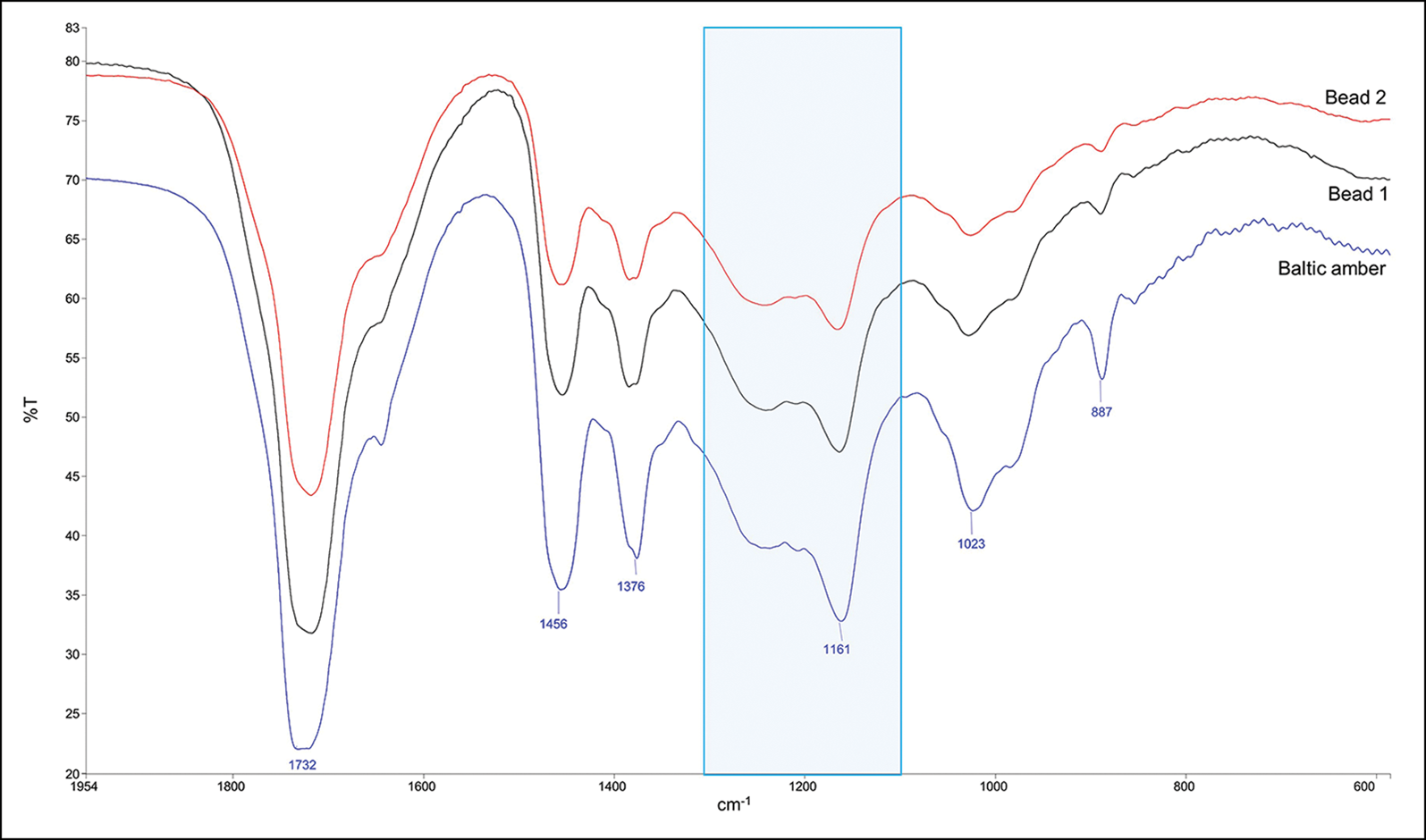
Direct comparison of spectra from beads 1 and 2 and the Baltic amber reference shows that they are almost identical (Figure 8). Crucially, the so-called ‘Baltic shoulder’—an easy-to-recognise spectral feature that is only found in the region between 1300 and 1100cm-1 in Baltic amber (Beck et al. Reference Beck, Eilbur and Meret1964)—is present on the spectra from beads 1 and 2 and is comparable with the reference sample. It can therefore be concluded that beads 1 and 2 are made of amber from the Baltic region.
FT-IR spectra recorded on KBr pellets of core samples from bead 1, bead 2, and the natural reference of Baltic amber. All spectra match. Blue box shows location of Baltic shoulder (figure by authors).

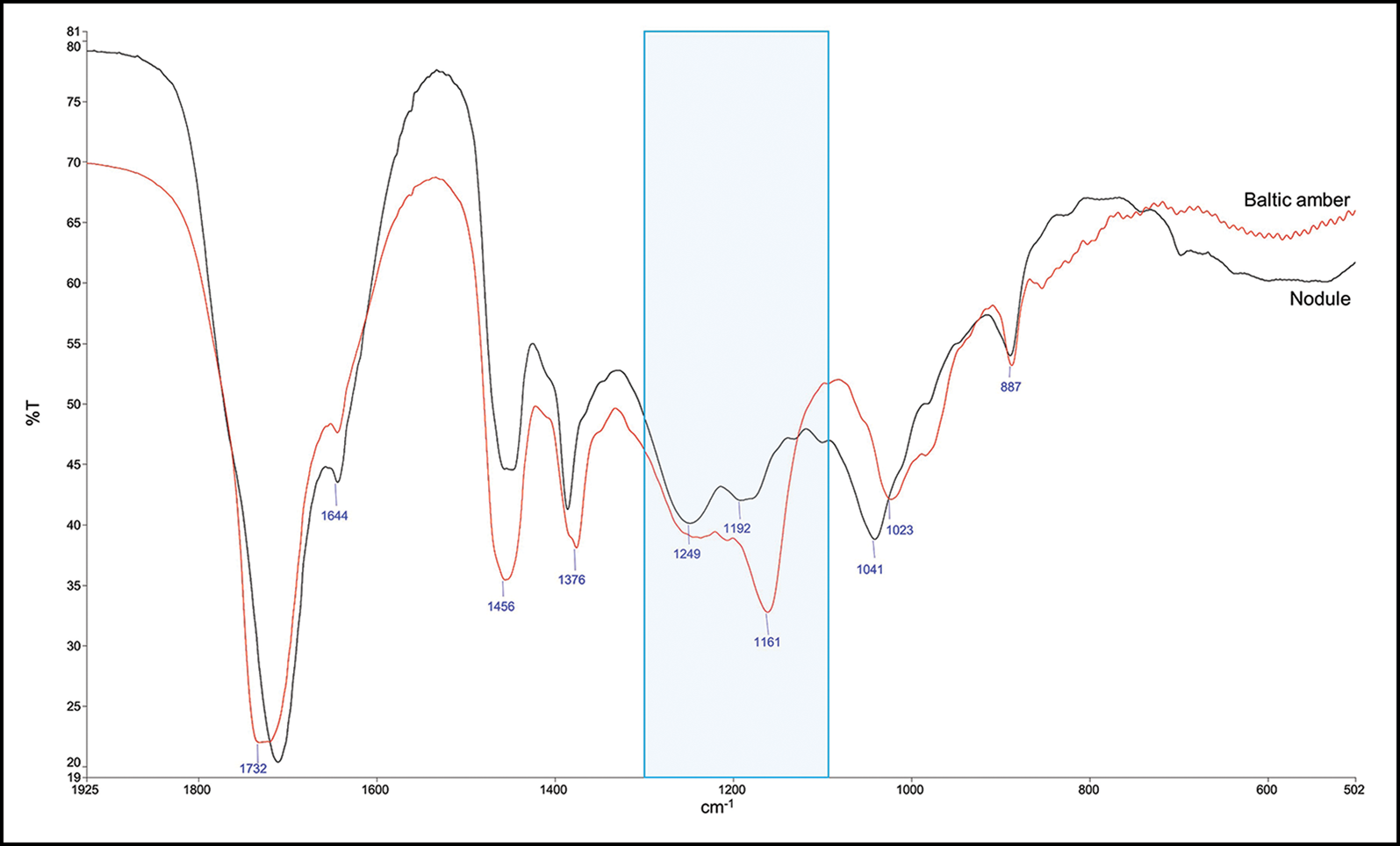
Although the FT-IR spectra for the Baltic amber reference and the large nodule are similar overall, closer inspection of the peaks between 1200 and 900cm-1 reveal some difference in the Baltic shoulder region (Figure 9). The nodule and Baltic amber reference differ from each other both regarding intensity and wave number, at 1192cm-1 and 1161cm-1, respectively. Furthermore, a peak is seen at 1023cm-1 in the Baltic amber reference but seems to be displaced to 1041cm-1 in the nodule. Thus, although similarities are observed in the FT-IR spectra of the nodule and the Baltic amber reference, there is not a perfect match.
FT-IR spectra recorded on KBr pellets of natural Baltic amber reference and core sample from the nodule. Although similar, the two spectra are not identical, which is indicated by comparing the peak at 1192cm-1 on the nodule spectrum to the peak at 1161cm-1 on the Baltic amber spectrum, and the peak at 1041cm-1 on the nodule spectrum to the one at 1023cm-1 on the Baltic amber spectrum. Blue box shows location of Baltic shoulder (figure by authors).

A database search was carried out in IRUG 2000 (Price & Pretzel Reference Price and Pretzel2000) for the FT-IR spectrum of the nodule. This yielded a handful of hits with a high search score (>0.92), including Tanganyikan copal, cashew gum, Zanzibar copal, non-Baltic amber, and aged dammar varnish. This suggests that the nodule is not Baltic amber but likely part of a larger family consisting of amber, resin and copal (another resin-like substance).
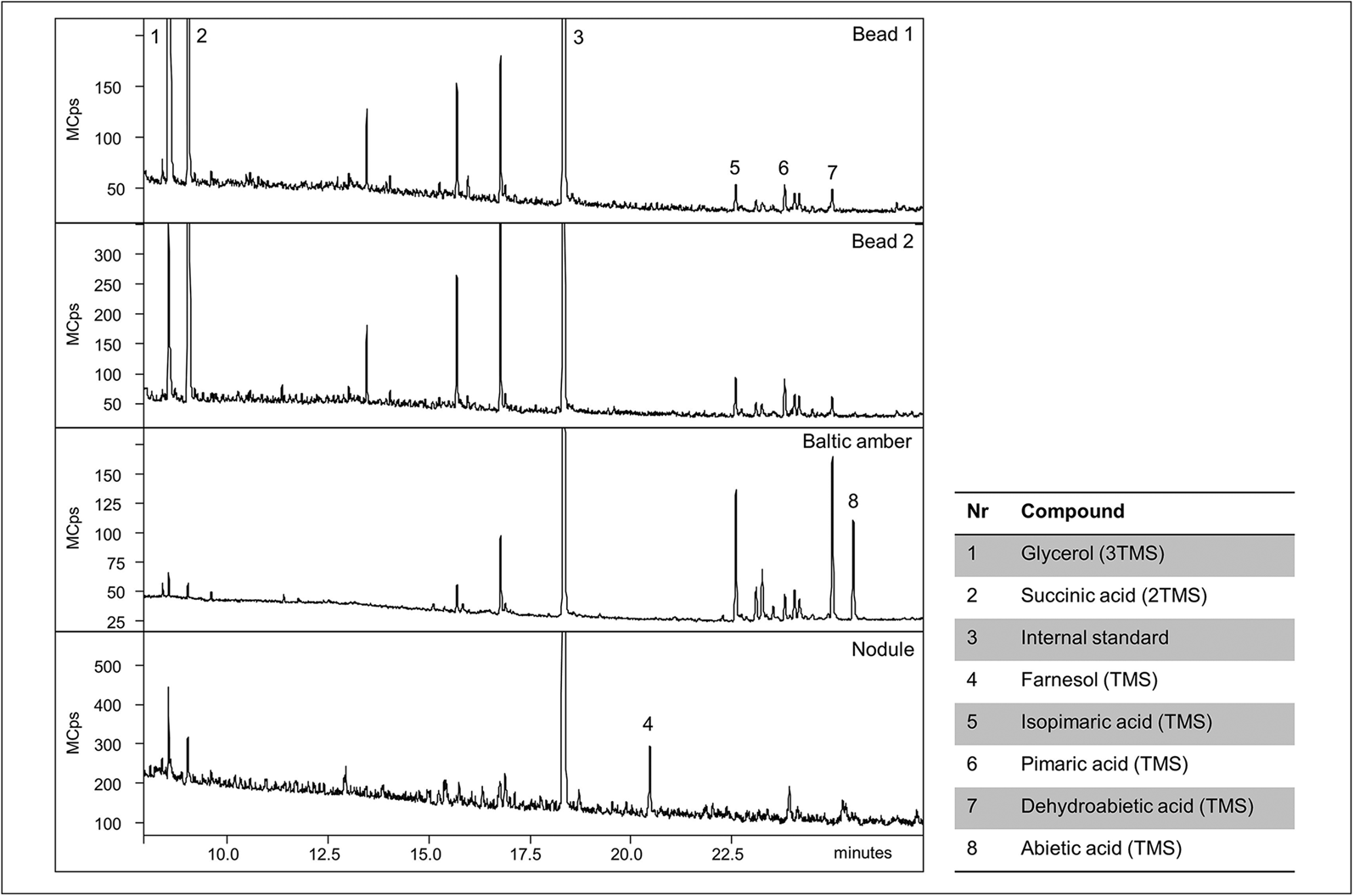
To investigate further, GC-MS analysis was carried out on the four samples prepared by direct silylation without prior hydrolysis or extraction. The samples were not fully soluble in the solvents used and so the result reflects only the compounds that were soluble. Figure 10 shows partial chromatograms for the three samples plus the Baltic amber reference. Beads 1 and 2 both have a composition high in glycerol (Figure 10, no. 1) and succinic acid (no. 2), with some abietanes (nos. 5–7). The Baltic amber reference had a small content of glycerol and succinic acid and a larger content of abietanes; here abietic acid itself (no. 8) was also present. The presence of succinic acid and abietanes in GC-MS is diagnostic for Baltic amber (Yamamoto et al. Reference Yamamoto, Otto, Krumbiegel and Simoneit2006) and thus the GC-MS analysis supports the FT-IR result for beads 1 and 2 and the Baltic amber reference.
Partial GC-MS chromatograms of directly silylated samples; TMS = trimethylsilyl; MCp = Mega counts per second (figure by authors).

The intensities of the peaks in the chromatogram for the nodule were quite low overall, yet succinic acid and glycerol can be detected. The presence of succinic acid points to Baltic amber but the absence of abietanes suggests that the nodule is not identical to the Baltic amber reference. This is an ambiguous result that does not fully agree with the FT-IR result, which suggests alternatives to Baltic amber. Farnesol (Figure 10, no. 4) was detected in the nodule; this substance occurs in perfume and some flowers (Ishizaka et al. Reference Ishizaka, Yamada and Sasaki2002; Azanchia et al. Reference Azanchia, Shafaroodi and Asgarpanah2014; Krupčík et al. Reference Krupčík, Gorovenko, Špánik, Sandra and Armstrong2015; Jung et al. Reference Jung, Hwang, Sethi, Fan, Arfuso and Ahn2018), though whether this reflects recent contamination or might be indicative of acacia resin or incense, is not known. The relatively low intensity of the GC-MS results from the nodule may be an issue regarding the interpretation of this sample. We conclude that the nodule does not fully match Baltic amber but similarities in the FT-IR and GC-MS recordings suggest that ambers, resins or copals may still be possible interpretations. In the case of Tanganyikan and Zanzibar copals, this would imply an East African origin, but further analysis is needed before a more definitive conclusion can be drawn.
Discussion
The Amber Road networks
Amber-rich soil layers along exposed coastlines in west Jutland, Denmark, as well as the Pommeranian coast of Poland, Kaliningrad and the Baltic states, have produced very large quantities of amber in the past, especially after storms when the light amber nodules wash ashore. Today the bay of Gdańsk produces some four tonnes of amber per year, with the Jutland coast producing around one tonne annually (Kristiansen Reference Kristiansen1998: 234; Murillo-Barroso & Martinón-Torres Reference Murillo-Barroso and Martinón-Torres2012). Baltic amber beads were traded in enormous quantities in the past and have been found across Central Europe, in Italy, Greece and the Iberian Peninsula, and further on in Anatolia, the Levant and Mesopotamia (e.g. Kristiansen & Larsson Reference Kristiansen and Larsson2005; Erneé Reference Ernée2012; Murillo-Barroso & Martinón-Torres Reference Murillo-Barroso and Martinón-Torres2012; Gestoso Singer Reference Gestoso Singer2016; Alaura & Bonechi Reference Alaura, Bonechi and Naso2024).
The ‘Amber Road’ networks through Europe, from the Baltic region to the Mediterranean, involved the southward transportation of Baltic amber (and other goods) from at least the Early Bronze Age (early second millennium BC) onwards. Finds of Baltic amber in classic Aunjetitz Culture (2050–1750 BC) contexts in Bohemia show the existence of a trade route that collapsed by the mid-eighteenth century BC (Erneé Reference Ernée2012), but was followed by trade routes along the Oder River connecting the Baltic region and Hungary, as evidenced by distributions of metalwork and pottery at this time (Kristiansen Reference Kristiansen1998: 90). Such trade was probably directional, given the maintenance of the trade routes over hundreds of kilometres and several generations (Kristiansen Reference Kristiansen1998: 95–6), and it may have been organised through chiefly alliances across the continent (Kristiansen & Larsson Reference Kristiansen and Larsson2005). A colossal number of Baltic amber beads is found in sixteenth-century BC Mycenean funerary contexts (Moorey Reference Moorey1994: 79–81; Kristiansen & Larsson Reference Kristiansen and Larsson2005; Czebreszuk Reference Czebreszuk, Bergerbrant and Sabatini2013). There are also connections from the eighth century BC between the island of Funen in Denmark and the Villanovan culture in Italy, running from the Pommeranian coast along the Wisła and Dnipro rivers, through the Hallstatt region, to the Balkans and Italy (Kristiansen Reference Kristiansen1998; Murillo-Barroso & Martinón-Torres Reference Murillo-Barroso and Martinón-Torres2012; Gestoso Singer Reference Gestoso Singer2016).
The amber trade left its traces in western Syria from at least the Final Middle–Late Bronze Age (c. 1600–1200 BC) onwards, although it is uncertain whether this trade represents down-the-line exchange of goods from the Southern European and Mycenean trade networks, gift-giving between elite travellers in a ‘prestige circuit’ or a combination of both (Gestoso Singer Reference Gestoso Singer2016; Bunnefeld et al. Reference Bunnefeld, Becker, Martin, Pausewein, Simon and Meller2021). A number of beads and other objects identified as amber through FT-IR and dating from the early second millennium BC onwards have been found in the Near East, including two beads from a foundation deposit beneath the ziggurat at Ashur in northern Mesopotamia (Bunnefeld et al. Reference Bunnefeld, Becker, Martin, Pausewein, Simon and Meller2021), 14 beads from the royal palace of Ugarit/Ras Shamra on the Levantine coast (Gestoso Singer Reference Gestoso Singer2016: 263), at least 14 beads from the Uluburun shipwreck off the Anatolian coast (Pulak Reference Pulak1988), and—arguably the most spectacular find—a lion head-shaped container as well as around 90 beads from a royal tomb dated to c. 1340 BC at Late Bronze Age Mishrife-Qatna, some 40km south of Hama (Mukherjee et al. Reference Mukherjee2008). A fragment of a hand fashioned in amber from a statue was also found at Mishrife-Qatna (Pfälzner Reference Pfälzner and Pfälzner2011). In the southern Levant, two beads and another lion-shaped object that may have formed part of a lid were found at the Late Bronze–Early Iron Age site of Akhziv, and a fragment of a bead was found at Middle/Late Bronze Age Tell Abu Huwam; all have been identified as Baltic amber (Todd Reference Todd1985: 293, 296). Other finds of amber, though to our knowledge not yet confirmed by FT-IR to be of the Baltic variety, are included in the surveys of amber finds in the Near East by Moorey (Reference Moorey1994) and Alaura and Bonechi (Reference Alaura, Bonechi and Naso2024). Find sites include Middle Bronze Age Ur, Late Bronze Age Mari, Iron Age Nineveh and Babylon in Mesopotamia, as well as Late Bronze Age Alalakh and Tell Afis in western Syria and the Levant.
Function and perception of amber
Some of the amber beads found in Near Eastern contexts, like most of those found in the Qatna tomb, are lenticular in shape and resemble beads found in the Aegean and further north in Europe. This shared morphology supports the possibility that they were indeed manufactured in northern Europe and traded as finished beads across the continent (Mukherjee et al. Reference Mukherjee2008). We know, however, that larger pieces of raw Baltic amber also made it into Syria, as evidenced by the Qatna lion, which was made of Baltic amber but cut in a distinctively Syrian style of manufacture (Mukherjee et al. Reference Mukherjee2008).
The Hama amber beads were originally tubular in shape. This is a common shape for beads in the region, indicating that they could have been locally produced, like the Qatna lion. However, tubular shapes are also common in Scandinavian bead assemblages (Faber et al. Reference Faber, Frandsen and Ploug2000: 36), so it is equally likely that the amber beads arrived at Hama in their finished form, as suggested for the Qatna beads (Mukherjee et al. Reference Mukherjee2008). No larger pieces of unworked amber have been observed at Hama, but the nodule discussed above, which shows compositional similarities with amber or copal, may well have been intended as raw material for goods manufacturing. A pendant made from copal found in the Northern Palace of Early Dynastic (2900–2350 BC) Tell Asmar/Eshnunna in the Diyala region confirms that copal was used in this way, though the inherent fragrance means that the pendant could have been for adornment or burning (Meyer et al. Reference Meyer, Todd and Beck1991). The Tell Asmar copal was determined to have originated in East Africa (Meyer et al. Reference Meyer, Todd and Beck1991) and the possible presence of this variety of copal at Hama potentially adds to the scale of its trade connections.
In general, the Iron Age assemblage from Hama consists of large amounts of raw materials and by-products from the production of goods, including hundreds of fragments of cut-out stone, bone and ivory from what may have been the manufacture of inlays for statuary and furniture (Fugmann Reference Fugmann1958). Hama appears to have supported numerous workshops providing its inhabitants, and likely people from further afield, with a wide range of goods. Although the original location of manufacture of the amber beads is unknown, the citizens of Hama undoubtedly had access to the infrastructure and skills necessary to transform diverse raw materials into a multitude of goods.
By the time the funerary urn with the Baltic amber beads was buried, Hama—one of the longest-lived cities in Syria at that time—had already been developing extensive trading networks within and beyond the region for more than 5000 years. Obsidian from both central and eastern Anatolian sources is present from the Neolithic Phase M (mid-sixth millennium BC) onwards (Thuesen Reference Thuesen1988). The bevelled-rim bowl, characteristic for Late Chalcolithic (fourth millennium BC) Mesopotamia but otherwise only found further east in Syria in the Euphrates/Jazira region, appears at Hama in the Late Chalcolithic Phase K (Thuesen Reference Thuesen1988). The regional interconnectedness of the city is especially apparent in the Early Bronze IV Phase J (2500–2000 BC) when abundant ceramic imports are documented from inland Syria to the north, the Syro-Lebanese coast to the west, the Syrian steppe as far as the Euphrates to the east, and possibly the Beqa’ to the south (Vacca et al. Reference Vacca, Mouamar, D'andrea and Lumsden2018: 37). Regional and interregional connections continued through the second millennium BC.
During the Iron Age, Hama was the southernmost of the Syro-Hittite kingdoms, controlling a significant part of western and central Syria. Amber, as a commodity that covered one of the longest distances to reach the city, would have been a highly valued material. Goods typically increase in economic, social, or ritual value the greater the distance from their place of origin (Helms Reference Helms1988) and textual evidence indicates that the inhabitants of Mesopotamia knew that amber had travelled far. In the ancient Sumerian text ‘An elegy on the death of Nannaya’, the place of origin of amber is described as kur sud-da, meaning “in a distant foreign land” (Alaura & Bonechi Reference Alaura, Bonechi and Naso2024: 145).
Consideration of terms thought to denote amber or an amber hue in Hittite, Akkadian and Sumerian texts (ḫušt-, elmēšu(m) and *sudr-aĝ, respectively) from the third through the first millennia BC suggests that amber, copal and similar resinous substances were regarded as exotic materials that were valued for their therapeutic benefits, decorative qualities and symbolism (Alaura & Bonechi Reference Alaura, Bonechi and Naso2024). These substances circulated throughout the Levant, Mesopotamia and Anatolia in quantities that were anything but modest, though supply depended on fluctuations in long-distance trade. Taxonomically, in learned as well as practical cuneiform texts, ḫušt-, elmēšu(m) and *sudr-aĝ occupy a liminal position—between stones and plants, or between metals and softer substances. Yet these terms are always used with a positive connotation, reflecting the prized nature of resinous substances as useful ingredients in therapeutic preparations, as elements of prophylactic procedures and as decorations for statuettes, furniture, other objects and even architecture (Alaura & Bonechi Reference Alaura, Bonechi and Naso2024). They are also referenced in conceptualisations related to deities, particularly goddesses. Thus, in general, a sense of wealth, renewal, good luck, and warding from illness accompanies amber-like substances. As such, the amber beads found in the cremation grave at Hama most likely served as amulets worn by one or both of the deceased.
Amber is found in other private funerary contexts, including 12 Late Bronze Age tombs at Mari (Margueron Reference Margueron2014: 130; Bunnefeld et al. Reference Bunnefeld, Becker, Martin, Pausewein, Simon and Meller2021: 234) and a Late Bronze Age grave at Alalakh (ATG/47/8; Woolley Reference Woolley1955: 208; Pieniążek Reference Pieniążek, Yener and Ingman2020: 123). As at Hama, the amber is in the form of beads included as grave goods that may have been purely decorative but could also have functioned as amulets. The ritual function of amber is further underlined by the inclusion of two amber beads in an assemblage amounting to several thousands of beads in a foundation deposit beneath the ziggurat at Ashur, the most important religious centre in the oldest capital of Assyria (Bunnefeld et al. Reference Bunnefeld, Becker, Martin, Pausewein, Simon and Meller2021).
Conclusions
Identification of Baltic amber beads among the objects within an Iron Age cremation burial at the ancient city of Hama in western Syria provides evidence for long-distance trade between the Near East and the Baltic coast of northern Europe. This bolsters and expands what is already known of the Amber Road networks across Europe and the Mediterranean, as well as emphasising Hama's role as an important hub in regional and interregional trade networks from at least the Early Bronze Age onwards. The amber finds at Hama add another location to the map of Baltic amber occurrences in the Near East and underline the social and economic value of this liminal and highly sought-after material from ‘a distant foreign land’.
Acknowledgements
The authors would like to thank the two anonymous reviewers for their insightful and very helpful comments.
Funding statement
This research was generously supported by the Independent Research Fund Denmark for the project ‘Ordinary lives in extraordinary times: a new view of the earliest urban societies in Bronze Age Syria’ (grant number 1024-00107B; PI: Mette Marie Hald).