For more than a century, scholars and commentators alike have argued that compulsory electoral participation can help socialize individuals into the democratic system, leading them to acquire political knowledge and interest, political trust, and positive orientations toward democracy (see Broomall Reference Broomall1893; Nerincx Reference Nerincx1901; Barthélemy Reference Barthélemy1912; Lijphart Reference Lijphart1997, 10; Engelen Reference Engelen2007, 32; Lacroix Reference Lacroix2007, 194; See Reference See2007, 597). Additionally, numerous studies find that individuals who are uninformed about and uninterested in political matters, who are untrusting of democracy’s primary actors and institutions, and who are negatively oriented toward the democratic system turn out to the polls at significantly higher rates when subject to compulsory voting (e.g., Irwin Reference Irwin1974; Carlin and Love Reference Carlin and Love2015; Singh Reference Singh2015), which suggests that compelled participation does indeed foster democratic engagement.
Yet, according to country-level, cross-national research, invalid balloting rates are higher where voting is mandatory (e.g., Reynolds and Steenbergen Reference Reynolds and Steenbergen2006; Power and Garand Reference Power and Garand2007; Uggla Reference Uggla2008). This is puzzling, given compulsory voting’s purportedly positive effects on political engagement. Confronting this puzzle requires an individual-level explanation together with an examination of behavior under both compulsory and voluntary rules, which is missing from extant research. Recognizing that individuals need not be especially engaged or democratically oriented to show up at the polls where voting is mandatory, I theorize that compulsory voting causes the politically unknowledgeable and uninterested, the politically distrusting, and those disaffected with democracy to cast blank or spoiled ballots at relatively high rates. I further argue that, as a result of changing citizenship norms in the democratic world, political distrust and disaffection with democracy will have a particularly strong relationship with invalid balloting where voting is compulsory.
Using AmericasBarometer data, I find an array of support for my expectations with multilevel regression analyses and regression discontinuity (RD) analyses, which exploit the fact that five of the countries in my sample with compulsory voting make turnout voluntary for senior citizens. In the Online Appendix, I demonstrate the robustness of my findings to alternate conceptualizations of the dependent and independent variables, a different estimation technique, different model specifications, and a separate source of cross-national survey data from the Latinobarometer.
This study represents a novel theoretical and empirical treatment of the microfoundations of the link between compulsory voting and invalid balloting across countries. My findings suggest that compulsory voting is more likely to boost nonconformity via increased invalid balloting than to meaningfully socialize individuals into political engagement and pro-democracy orientations. In the conclusion, I consider the potential importance of my findings for debates over the utility and justifiability of compulsory voting and for countries that are considering a change in voting rules.
PREVIOUS RESEARCH ON BLANK AND SPOILED BALLOTING UNDER COMPULSORY VOTING
Invalid balloting under compulsory rules has been described as the “functional equivalent of abstention” under optional voting (Lavareda Reference Lavareda1991, 40; see also Hirczy Reference Hirczy1994). This is apparent with regard to the behavior of the politically uninformed and uninterested. In voluntary systems, such individuals turn out to vote at a relatively low rate (e.g., Blais and St-Vincent Reference Blais and St-Vincent2011; Bowler and Donovan Reference Bowler and Donovan2013; Carreras and Castañeda-Angarita Reference Carreras and Castañeda-Angarita2014), and in compulsory systems, where abstention entails a penalty, they are more likely to cast blank and spoiled ballots. For example, McAllister and Makkai (Reference McAllister and Makkai1993) find that recent immigrants, who tend to have relatively little political knowledge, are more likely to spoil their ballots under Australia’s compulsory voting rule, and Power and Roberts (Reference Power and Roberts1995) find that illiteracy is positively related to invalid balloting in Brazil’s compulsory voting system. Carlin (Reference Carlin2006) finds that, under Chile’s former compulsory rule, those with less political interest and younger voters were relatively likely to cast invalid ballots.
Political distrust and disaffection also affect turnout and invalid voting. As Prothro and Grigg note, “those with the most undemocratic principles are also those who are least likely to act” (Reference Prothro and Grigg1960, 294). Such “inaction” via electoral abstention is often used to express dissatisfaction or to advocate for reform (e.g., Grönlund and Setälä Reference Grönlund and Setälä2007). When individuals are compelled to the polls, abstention from voting becomes costly, and such sentiment may instead be conveyed with blank and spoiled ballots. Hirczy (Reference Hirczy1994), comparing voting behavior across Austrian provinces, finds that political disaffection manifested in an increased percentage of invalid ballots in the provinces with compulsory voting, while such an effect was not apparent where voting was voluntary.Footnote 1 In Belgium, which mandates voter participation, Hooghe, Marien and Pauwels (Reference Hooghe, Marien and Pauwels2011) find that individuals who are politically distrusting are more likely to cast blank or spoiled ballots. In Australia, Goot (Reference Goot1985, 203) mentions that blank and spoiled ballots have been used to protest both specific candidates and the institution of compulsory voting itself.
Such relationships are also found outside of the highly developed world. For example, Power and Roberts (Reference Power and Roberts1995) find that blank and spoiled balloting were most pronounced in Brazil’s former military regime, which made voting obligatory, when its manipulation of the democratic process was particularly egregious. Carlin (Reference Carlin2006) finds that, under Chile’s former compulsory voting rule, those who were discontented with regime performance, democratic institutions, and political authorities were more likely to cast invalid ballots. In Bolivia’s judicial elections, in which participation is compulsory, Driscoll and Nelson (Reference Driscoll and Nelson2014) find that support for the ruling party and the president relates negatively to the probability of casting a blank or spoiled ballot, while invalid balloting is more common in opposition strongholds. In Argentina’s compulsory system, blank and spoiled ballots are so closely associated with voter disillusionment and distrust that they are colloquially referred to as voto bronca, or “angry votes” (Uggla Reference Uggla2008, 1141).
In sum, existing research establishes a robust link between invalid balloting rates and compulsory voting, and it suggests that this link is driven by the behavior of politically unengaged and democratically disaffected groups. However, it neither grounds this expectation in theory nor tests it in an appropriate empirical framework. Studies of invalid voting under compulsory rules conducted at the individual-level focus on a single country operating under a static electoral rule (e.g., McAllister and Makkai Reference McAllister and Makkai1993; Carlin Reference Carlin2006; Hooghe, Marien and Pauwels Reference Hooghe, Marien and Pauwels2011; Driscoll and Nelson Reference Driscoll and Nelson2014). At the same time, studies of invalid voting that do leverage spatial or temporal variation in compulsory voting only examine aggregate-level returns (e.g., Reynolds and Steenbergen Reference Reynolds and Steenbergen2006; Power and Garand Reference Power and Garand2007; Uggla Reference Uggla2008; Kouba and Lysek Reference Kouba and Lysek2016),Footnote 2 which can at best provide an indirect test of individual-level mechanisms.
THEORY AND HYPOTHESES
In what follows, I advance and test a novel, individual-level theory, which considers how compulsory voting should induce invalid balloting among critical segments of the population—the politically unknowledgeable and uninterested, those who are untrusting of the democratic political system, and the democratically disaffected. My expectations contrast with the argument noted at the outset, which states that compulsory voting can socialize individuals into political engagement and pro-democracy orientations.
Lending support to this socialization thesis, some studies find a link between compulsory voting and higher levels of political knowledge and engagement in the public (e.g., Gordon and Segura Reference Gordon and Segura1997; Berggren Reference Berggren2001). However, a preponderance of published work finds no such link or finds it to be weak (e.g., Loewen, Milner and Hicks Reference Loewen, Milner and Hicks2008; Birch Reference Birch2009, Chapter 4; Selb and Lachat Reference Selb and Lachat2009, 575, note 1; de Leon and Rizzi Reference deCharms2014; Sheppard Reference Sheppard2015; Carreras Reference Carreras2016). This lack of support may come about because voters need not inform themselves about the issues of the day in order to avoid a sanction where voting is mandatory. Rather than creating an electorate that seeks out political information in order to meaningfully complete ballots out of sense of democratic duty, I argue that compulsory voting instead boosts the propensity of the least engaged and least democratically oriented people to lodge a blank or spoiled ballot. There are two mechanisms that undergird this behavior.
First, in order to avoid a sanction where voting is compulsory, politically ignorant, disinterested individuals will show up to the polls. However, there is no method for ensuring that they cast valid ballots, and they will not instinctively put deep thought into their votes. Instead, they will routinely cast blank and spoiled ballots because they lack the information necessary to make a meaningful choice or because they are not interested in the competing parties and candidates to the extent that they wish to choose one over the others. Where voting is voluntary, alternatively, such individuals will generally stay home, as doing so will not lead to a potential penalty.
Second, individuals who are distrusting of or discontented with the democratic system, who prefer to abstain, may become irritated where their participation is forced, and thereby become less willing to lodge a meaningful ballot. Individuals prefer to feel that their actions are intrinsically motivated (deCharms Reference Deci1968), and when they are forced into a behavior, their motivation to engage in that behavior drops (Deci Reference de Leon and Rizzi1975). Coercion and punishment are also associated with decreased cognitive engagement with one’s environment, decreased belief in the legitimacy of the coercer and its authorities, and lower levels of interest in one’s assigned tasks, and being forced into a behavior can damage one’s sense of the social bond and enhance any existing belief that the governmental or legal system and its authorities are illegitimate (Scheff and Retzinger Reference Scheff and Retzinger1991; Sherman Reference Sherman1993; Tyler Reference Tyler2006). Henn and Oldfield (Reference Henn and Oldfield2016) and Singh (Reference SinghForthcoming) show that electoral coercion, in particular, can harm attitudes toward the democratic system and deepen existing resentments. Thus, while individuals who distrust democratic processes and actors or are disillusioned with the democratic system may participate on election day to avoid a sanction where voting is compulsory, they will be inclined to signal their distrust or disillusionment by leaving their ballots blank or spoiling them in reaction to democratic coercion.
In contrast with the suggestion that compulsory voting creates a more informed and civically oriented electorate, my reasoning proposes that political ignorance, disinterest, distrust, and disaffection trigger invalid balloting where voting is mandatory. This dynamic will be most apparent in compulsory systems in which abstainers are likely to be punished and harshly penalized, as individuals are less likely to alter their behavior in response to unenforced compulsory rules. Indeed, extant research finds compulsory rules have the biggest effect on turnout where they are routinely enforced and stiffly sanctioned (e.g., Panagopoulos Reference Panagopoulos2008; Singh Reference Singh2011). This leads to the following observable implications, expressed below in hypothesis form:
Hypothesis 1: Where voting is mandatory, blank and spoiled ballots are more likely. This will be especially apparent where compulsory rules are enforced and penalties for abstention are substantial.
Hypothesis2: Where voting is mandatory, blank and spoiled ballots are more likely, particularly among individuals who are uninterested in or ignorant of politics. This will be especially apparent where compulsory rules are enforced and penalties for abstention are substantial.
Hypothesis3: Where voting is mandatory, blank and spoiled ballots are more likely, particularly among individuals who are untrusting of key democratic institutions and actors. This will be especially apparent where compulsory rules are enforced and penalties for abstention are substantial.
Hypothesis4: Where voting is mandatory, blank and spoiled ballots are more likely, particularly among individuals who are negatively oriented toward democracy and its processes. This will be especially apparent where compulsory rules are enforced and penalties for abstention are substantial.
My unique individual-level treatment also allows me to consider whether ignorance and disinterest, political distrust, and negative orientations toward democracy have differing effects on the relationship between compulsory voting and invalid balloting. Recent work by Dalton and Welzel (Reference Dalton and Welzel2014a), who differentiate between “allegiant” and “assertive” citizens, provides some insight into this possibility. Allegiant citizens are politically trusting, deferential to authority, and supportive of democratic principles and practice. Conversely, assertive citizens are politically distrusting, are skeptical of authority, and, while they may support the principles of the democratic system, do not support democracy in practice. As initially observed by Almond and Verba (Reference Almond and Verba1980), political culture throughout the democratic world has become less allegiant and more assertive in recent decades (allegiant citizens are especially uncommon in modern democracies in Latin America and post-communist Europe (Dalton and Welzel Reference Dalton and Welzel2014b, 295–7)).
Assertive citizens are drawn to activities that challenge elites (Jakobsen and Listhaug Reference Jakobsen and Listhaug2014). Invalid balloting is one such activity, and because assertive citizens are negatively predisposed toward authority, they should be especially prone to casting blank or spoiled ballots where their electoral participation is coerced. Further, while citizenship values are strongly linked to political trust and orientations toward democracy, they are largely orthogonal to political interest (e.g., Dalton and Shin Reference Dalton and Welzel2014; Dalton and Welzel Reference Dalton and Shin2014c; Welzel and Alvarez Reference Welzel and Alvarez2014). This suggests that political ignorance and disinterest should do less to shape the link between compulsory voting and invalid balloting than political distrust and negative orientations toward democracy. In hypothesis form:
Hypothesis 5: Political distrust and negative orientations toward democracy more strongly condition the relationship between compulsory voting and blank and spoiled balloting than political ignorance and disinterest.
DATA AND VARIABLE MEASUREMENT
I gather data from the AmericasBarometer,Footnote 3 which biennially surveys individuals across the Caribbean and North, Central, and South America. My sample includes surveys from the 21 countries in which the necessary questions, discussed below, were asked. The included countries are mostly, but not exclusively, Latin American.Footnote 4 These are listed in Table A1 of the Online Appendix.
My hypotheses suggest that compulsory voting’s behavioral effects will be more forcefully realized where individuals can be confident that any decision to abstain will be met with a punishment. Therefore, following Fornos, Power and Garand (Reference Fornos, Power and Garand2004) and subsequent authors (e.g., Kostadinova and Power Reference Kostadinova and Power2007; Power and Garand Reference Power and Garand2007; Uggla Reference Uggla2008; Dettrey and Schwindt-Bayer Reference Dettrey and Schwindt-Bayer2009; Kouba and Lysek Reference Kouba and Lysek2016), I create a four-category variable to classify countries according to both the existence of a compulsory rule and the degree to which sanctions are enforced—which itself is strongly associated with the severity of the punishment for nonvoting (Singh Reference Singh2011, 105).
The four categories are as follows:
VV: Countries with purely voluntary voting.
CVlow: Countries that mandate voting but do not employ sanctions for abstention.
CVmed:Countries that have legal sanctions for abstention but do not generally enforce them in practice.
CVhigh: Countries that mandate turnout and enforce sanctions in practice.Footnote 5
Information on compulsory voting laws is from Payne, Zovatto and Díaz (Reference Payne, Zovatto and Díaz2006) and the Institute for Democracy and Electoral Assistance.Footnote 6 Turnout is compulsory in 15 of the countries in my sample, and Table A1 in the Online Appendix indicates which countries employ compulsory voting and the degree to which sanctions for abstention are enforced.
I argue that the increased propensity to cast a blank or spoiled ballot in a compulsory system is most pronounced among individuals who are ignorant of or uninterested in political matters, those who are untrusting of democratic institutions and actors, and those who are negatively oriented toward the democratic system. The AmericasBarometer asks several questions that allow me to capture such attitudes and characteristics. To gauge Lack of Political Information and Interest, I use misunderstanding of political issues, lack of political information, and lack of political interest. To capture Political Distrust, I use distrust of government, distrust of congress, and distrust of elections. Finally, to gauge Negative Orientations toward Democracy, I use belief that democracy does not matter, belief that leaders do not care, and dissatisfaction with democracy. I provide detailed information on my measurement of these variables and full question wording in section 13 of the Online Appendix.
I use factor analysis to create scales of Lack of Political Information and Interest, Political Distrust, and Negative Orientations toward Democracy. Because the constituent variables are measured ordinally and dichotomously, I employed polychoric correlations in the creation of the matrices input into the factor analyses. In each factor analysis, the first factor accounted for over 85 percent of the common variance, and I use scores on these factors to create my scales. In section 2 of the Online Appendix, I consider each constituent variable separately, and this approach does not alter my substantive conclusions.
The dependent variable is a dichotomous indicator for whether one intends to cast a blank or spoiled ballot. The question wording is: “If the next election were to be held this week, what would you do?
∙ I would not vote
∙ I would vote for the candidate or party of current government
∙ I would vote for a candidate or party other than the current government
∙ I would vote but leave the ballot blank or spoiled.”
I assigned individuals a 1 if they selected the last option and a 0 otherwise.Footnote 7 The proportion of individuals intending to cast a blank or spoiled ballot across countries is provided in Table A1 of the Online Appendix.
Answers to survey questions are imperfect proxies for true behavior. In section 6 of the Online Appendix, I review the potential consequences of the use of survey questions to gauge voting behavior, and I compare intended invalid balloting rates in my sample to official reports of invalid balloting. I also estimate models that use recalled votes in place of intended votes in the creation of my dependent variable. This does not alter substantive conclusions.
Control Variables
There are, of course, individual-level factors that may modify the impact of compulsory voting on invalid balloting beyond those I identify in my hypotheses. If such variables are also correlated with political awareness and attitudes toward democracy, their omission could bias my findings. As such, I control for age and education, both of which are known to affect political knowledge and interest, political trust, and democratic orientations (e.g., Galston Reference Galston2001; Karp, Banducci and Bowler Reference Karp, Banducci and Bowler2003; Catterberg and Moreno Reference Catterberg and Moreno2006) and may also relate to blank and spoiled balloting (cf. McAllister and Makkai Reference McAllister and Makkai1993; Power and Roberts Reference Power and Roberts1995; Carlin Reference Carlin2006; Uggla Reference Uggla2008). Age is measured in tens of years, and, to facilitate cross-country comparison of diverse education systems, individuals with a university education are assigned a 1, and others are assigned a 0.Footnote 8 The resulting variables are called age and college. In section 7 of the Online Appendix, I introduce additional controls for political ideology and whether a respondent lives in an urban or rural area. Results are robust to these specifications.
At the macro-level, I control for economic development, democratic development, and corruption, each of which is potentially related to the propensity to cast a blank or spoiled ballot (e.g., Power and Garand Reference Power and Garand2007; Uggla Reference Uggla2008) and to political knowledge and interest, political trust, and orientations toward democracy (e.g., Knack and Keefer Reference Knack and Keefer1997; Catterberg and Moreno Reference Catterberg and Moreno2006). Economic development is measured as gross domestic product per capita at the time of the survey, adjusted for purchasing power and reported in constant thousands of US dollars. Data are from the World Bank.Footnote 9 To measure democratic development, I use the Polity IV Index.Footnote 10 This ranges from −10 to 10, with higher values indicating consolidated democracy. Finally, to measure corruption, I use Transparency International’s Corruption Perceptions Index,Footnote 11 which ranges from 0 to 10. I reverse the original coding so that higher values indicate more corruption.
All variables are summarized in Table A2 in the Online Appendix. The AmericasBarometer did not ask each of the questions that I use to measure the independent variables consistently across waves. As such, the number of individuals in the sample varies between 41,942 and 76,232 across the models, and the number of country-year surveys included in each model varies between 32 and 49.Footnote 12
RESULTS FROM MULTILEVEL MODELS
Individuals (level 1) in the data set are clustered within survey country-years (level 2). I estimate multilevel logit models, which account for this tiered data structure and the dichotomously measured dependent variable. I fit a unique intercept to each country-year, and the coefficients on each key individual-level variable—those that capture disinterest and low information, distrust, and disaffection—vary randomly across country-years. I estimate separate equations for each of these variables.Footnote 13 This gives
 $$\eqalignno{ {\rm Logit}\left\{ {{\rm Pr}\left( {y_{{ij}} } \right)} \right\} \,& {\rm {\equals}}\,\alpha _{j} {\rm {\plus}}{\bf{X}} _{{ij}} {\bf{\beta }} {\rm {\plus}}\delta _{j} z_{{ij}} {\rm ,where} \cr \alpha _{j} \,{\equals}\,{\bf W}_{j} {\bf \gamma }{\plus}\zeta _{j} . $$
In this equation, i indexes each individual and j each country-year. y
ij
is coded 1 if an individual casts a blank or spoiled ballot and 0 otherwise. The random variation around the country-year-specific mean is captured by ζ
j
.Footnote
14
,
Footnote
15
In each estimation, the key individual-level variable is captured with z
ij
, and the effect of each is denoted δ
j
, with the j subscript indicating that this effect varies randomly over country-years. X
ij
contains the remaining individual-level variables, and W
j
contains the country-year-level covariates. To account for possible correlation between the random effects and each key individual-level variable, the W
j
matrix includes their country-year-specific means,
 $\bar{z}_{j} $
. β is the coefficient vector associated with X
ij
and γ the coefficient vector associated with W
j
.
I also estimated three-level models that considered individuals to be clustered within survey country-years, which were further considered to be clustered in countries. With few surveys per country, and with just 21 countries in the sample, this approach may be imprudent (e.g., Stegmueller Reference Stegmueller2013). Further, because substantive results are the same with a three-level approach, and because the three-level models indicate that a preponderance of the unmodeled contextual variation exists at the country-year level, I proceed with a two-level setup. Results of the three-level models are provided in section 3 of the Online Appendix.
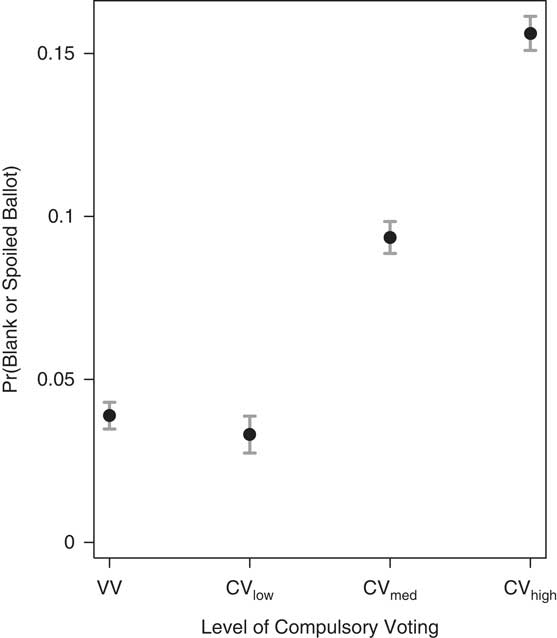
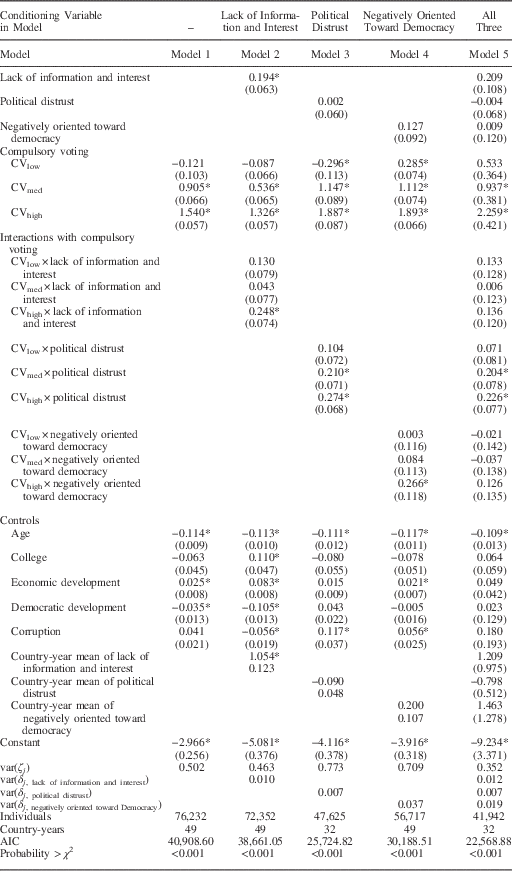
In Model 1 of Table 1 I test my first hypothesis, which, following previous research, predicts that the probability of casting a blank or spoiled ballot will be greater in countries with compulsory rules, especially where abstainers can be confident in receiving a sanction for their non-participation. To test the hypothesis, in addition to the control variables, I include dummy variables for the three categories of compulsory voting, excluding fully voluntary systems as the baseline category. The results largely support Hypothesis 1: blank and spoiled balloting is least common in countries with voluntary voting and unenforced compulsory voting (category CVlow). Where voting is compulsory and abstention is potentially sanctioned, blank and spoiled ballots are more common, especially if enforcement is strict (category CVhigh). Using the results of Model 1, I plot the predicted probabilityFootnote 16 of casting a blank or spoiled ballot across each voting system in Figure 1. As illustrated in the figure, all else being equal, where voting is voluntary, this probability is about 0.04, and, in countries with the strongest compulsory rules, it is over 10 percentage points higher, at about 0.16.
Blank and spoiled balloting in voluntary and compulsory voting systems Note: Vertical brackets represent 95 percent confidence intervals. Results are from Model 1 of Table 1.

Compulsory Voting, Blank and Spoiled Balloting, and Individual-Level Characteristics

Note: Dependent variable is intended blank or spoiled balloting. Results are from multilevel logistic regressions. Standard errors in parentheses.
AIC=Akaike information criterion.
*Significant at p<.05 (two-sided).
Hypotheses 2–4 predict that the effect of compulsory rules on an individual’s propensity to cast a blank or spoiled ballot is moderated by his or her level of political awareness and interest, the degree to which he or she is politically trusting, and his or her orientations toward democracy, especially where compulsory voting laws are strictly enforced. To test for the existence of these conditional relationships, in Models 2–4 of Table 1, I interact each of the scales used to capture these three attributes with the dummy variables for the three categories of compulsory voting, again excluding fully voluntary systems as the baseline category.
The data support Hypotheses 2–4: in Models 2–4, the effect of compulsory voting on the probability of casting a blank or spoiled ballot tends to be stronger among the politically unaware and uninterested, the politically distrusting, and those with negative orientations toward democracy. Further, in line with the hypotheses’ predictions, these amplificatory effects tend to be strongest where compulsory rules have “teeth.”
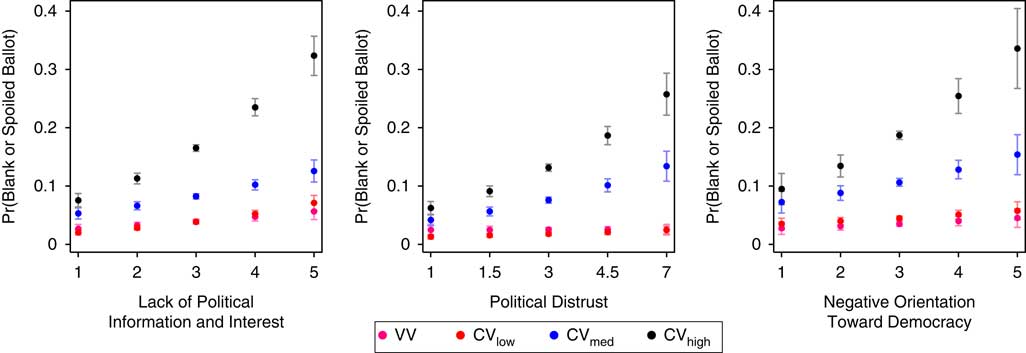
The results of Models 2–4 are illustrated in Figure 2. Each circle in the figure represents the probability of casting a blank or spoiled ballot in each category of compulsory voting and in voluntary systems. It is clear that the effect of compulsory rules on one’s probability of casting a blank or spoiled ballot is strongly conditioned by individual-level characteristics. On the one hand, for those who are politically aware and interested, those who are politically trusting, and those who are positively oriented toward democracy, living in a country with compulsory voting does relatively little to boost the probability of blanking or spoiling one’s ballot. On the other hand, for individuals who are politically unaware and uninterested, those who are politically untrusting, and those who are negatively oriented toward democracy, living in a country with a compulsory voting law can sharply increase the probability of casting a blank or spoiled ballot, especially if the compulsory rule is enforced and penalties for abstention are substantial. This militates against the idea that compulsory voting can spur political knowledge and interest, political trust, and positive orientations toward democracy.
Hypothesis 5 puts forth that political distrust and negative attitudes toward democracy should more strongly condition the relationship between compulsory voting and blank and spoiled balloting than political ignorance and disinterest. However, working against the hypothesis, Figure 2 shows that all three scales play a similar role in conditioning this relationship.Footnote 17 To conduct a fuller test of Hypothesis 5, I estimate the effects of all three scales simultaneously in Model 5 of Table 1. Interpreting the results requires a bit of caution, as the scales are highly collinear,Footnote 18 and the adverse effects of collinearity are extensive in multilevel models (Kreft and Leeuw Reference Kreft and Leeuw1998, 105; Shieh and Fouladi Reference Shieh and Fouladi2003).
Conditional effects of voting rules on blank and spoiled balloting Note: Vertical brackets represent 95 percent confidence intervals. Results are from Models 2–4 of Table 1.
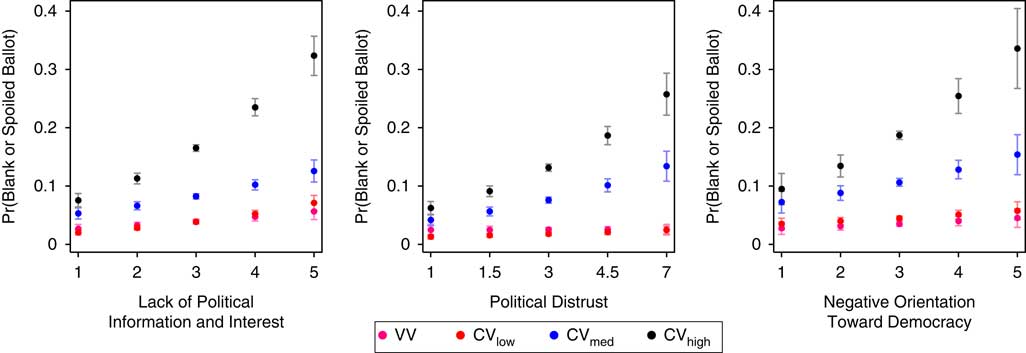
When all three scales are entered into the model, results show that political distrust heightens the link between blank and spoiled balloting and both moderate and strong compulsory rules, while none of the coefficients on the interactions involving lack of political information and interest or negative orientations toward democracy reaches statistical significance. Still, I find no evidence that the moderating impact of political distrust is substantively greater than that of political ignorance and disinterest.Footnote 19 Further, while political distrust proves important to the link between blank and spoiled balloting and compulsory rules, the effects of negative orientations toward democracy unexpectedly wash out. Thus, Model 5 provides very limited support for Hypothesis 5.Footnote 20
ANALYSES LEVERAGING AGE THRESHOLDS IN COMPULSORY SYSTEMS
It is difficult to identify causality with cross-national analyses of survey responses. To gain additional empirical leverage, I make use of compulsory voting age thresholds, which are employed in five of the countries in my sample. Specifically, Argentina, Bolivia, Brazil, and Peru make voting voluntary for individuals aged 70 and over, while, in Ecuador, voting is voluntary for those 65 and above. These arbitrary cutoffs, which quasi-randomly assign individuals to compulsory and voluntary voting conditions, provide a nice setting for RD analyses.Footnote 21
RD models estimate a function on either side of a value and subsequently estimate the difference between the two functions at this value (see e.g., Imbens and Lemieux Reference Imbens and Lemieux2008; Lee Reference Lee2008). I use a sharp RD design, which allows me estimate the effect of a binary treatment (compulsory voting) strictly determined by the value of a predictor (age). I estimate local polynomial regressions among observations nearby each side of the compulsory voting age cutoff.
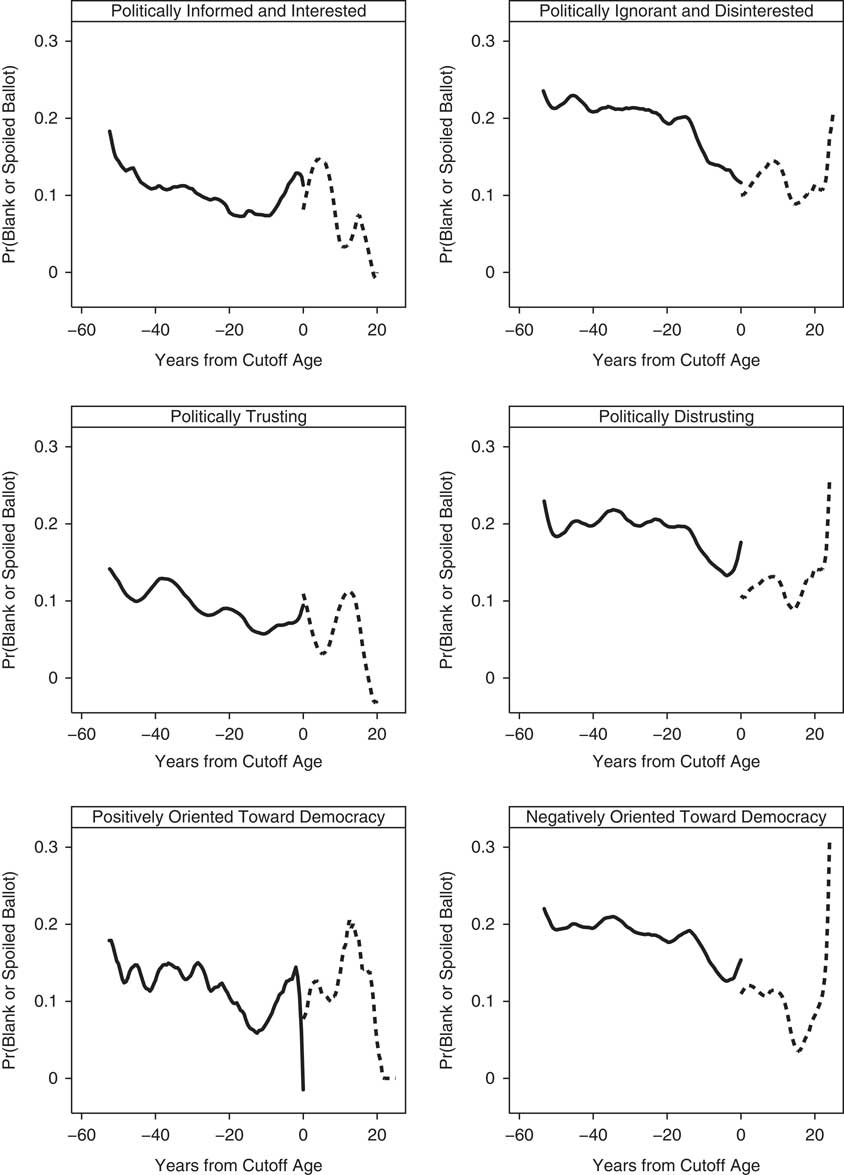
I illustrate the results of the analyses in Figure 3, in which I take the “Politically Informed and Interested,” the “Politically Trusting,” and the “Positively Oriented Toward Democracy” to be those below the 25th percentile of each scale, and I take the “Politically Ignorant and Disinterested,” the “Politically Distrusting,” and the “Negatively Oriented Toward Democracy” to be those above the 75th percentile of each scale. The bottom two rows of the figure demonstrate that, among those who are politically distrusting and those who are negatively oriented toward democracy, blank and spoiled balloting is more likely among individuals who are forced to vote; as individuals in these groups cross the cutoff age and are therefore no longer required to vote, their propensity to cast a blank or spoiled ballot declines. The effects are −6.91 percentage points for the politically distrusting and −4.39 percentage points for those who are negatively oriented toward democracy, as illustrated in the middle-right and bottom-right panels, respectively.Footnote 22 For the politically trusting and those who are positively oriented toward democracy, these negative effects are not present, as illustrated in the middle-left and bottom-left panels, respectively. This aligns with the expectations of Hypotheses 3 and 4.
Blank and spoiled balloting above and below compulsory voting age thresholds Note: Plots contain smoothed polynomials estimated on both side of the age cutoffs. The cutoff age is 70 in Argentina, Bolivia, Brazil, and Peru and 65 in Ecuador.

The RD results do not indicate that the relationship between mandated turnout and blank and spoiled balloting is conditioned by political information and interest, as illustrated in the top row of the figure. While this contradicts Hypothesis 2, it is supportive of Hypothesis 5, which puts forth that political distrust and negative orientations toward democracy do more to condition the relationship between compulsory rules and invalid balloting than political ignorance and disinterest. In section 11 of the Online Appendix, I present details of the RD analyses. Further, a series of null results associated with placebo age cutoffs suggest that the discontinuities observed in Figure 3 are a genuine result of a shift from a compulsory voting rule to a voluntary rule, rather than an artifact of the aging process.
CONCLUSION
About ten years ago, Blais noted that “we know nothing about the microfoundations of compulsory voting” (Reference Blais2006, 113). Today, still relatively little is known about how individual-level factors interact with compulsory rules to shape outcomes. In an effort to begin filling this knowledge gap, this study examines the influence of compulsory voting on blank and spoiled balloting across both individuals and countries.
I first find that, relative to voluntary voting, compulsory voting increases the incidence of blank and spoiled ballots, especially where sanctions for abstention are routinely enforced. I then demonstrate who is responsible for such an increase—compulsory voting’s positive relationship with the propensity to cast a blank or spoiled ballot is largely due to the behavior of individuals who are politically unaware and uninterested, individuals who are negatively oriented toward the democratic process, and, especially, individuals who are untrusting of democratic actors and institutions.
Those in favor of compulsory voting may hail these results as evidence that politically unsophisticated, untrusting, or disaffected individuals make use of their “out” where their presence at the ballot box is forced, and they thus need not contribute to the social choice when they lack the desire or skills to do so. For their part, opponents of mandatory voting may instead argue that the relatively high rate of blank and spoiled balloting among politically unaware, uninterested, untrusting, and disillusioned individuals where participation is obligatory is evidence that compulsory voting does not socialize such individuals into embracing civic values and seeking out political knowledge, a dynamic the institution’s proponents have championed as one of its beneficial effects for over a century (see Broomall Reference Broomall1893; Nerincx Reference Nerincx1901; Barthélemy Reference Barthélemy1912; Lijphart Reference Lijphart1997, 10; Engelen Reference Engelen2007, 32; Lacroix Reference Lacroix2007, 194; See Reference See2007, 597). Seen from another angle, these results suggest that, even where compulsory voting boosts participation, leaders may feel free to behave unscrupulously when they perceive that the electorate is unlikely to observe such behavior and punish it at the next election. In the words of Carlin and Love (Reference Carlin and Love2015, 57), where “those weakly invested in politics” do not cast meaningful ballots under compulsory voting, “the potential for moral hazard among elites” will increase.
In addition to an increase in turnout, the results of this paper suggest that constitutional designers in democracies considering the adoption of compulsory voting should expect a rise in blank and spoiled ballots. This will largely result from the balloting behavior of the politically unknowledgeable, uninterested, untrusting, and disaffected. Policymakers interested in boosting turnout might willingly accept this pattern, as it is not, in and of itself, detrimental to democracy. Of course, a system that incentivized both attendance at the polls and well-reasoned ballots would do more to improve the democratic process. Future research may consider what such a system might look like.