




No CrossRef data available.
The transition to coparenthood: Parents' prebirth expectations and early coparental adjustment at 3 months postpartum
Published online by Cambridge University Press: 01 September 2004
Abstract
In the decade since the first observationally based empirical studies of coparenting process in nuclear families made their mark, most investigations of early coparenting dynamics have examined whether and how such dynamics drive child development trajectories, rather than identifying factors that may contribute to the differential development of such dynamics in the first place. In this prospective study, we examined both individual-representational and dyadic-interpersonal predictors of early coparental process. Fifty married couples expecting their first child portrayed their expectations and concerns about family life after the baby's arrival, and took part in a set of problem-solving tasks used to help evaluate marital quality. Both mothers' and fathers' prebaby expectations about the future family, and prenatal marital quality, predicted observed coparenting cohesion at 3 months postpartum. Maternal– and marriage–coparenting trajectories differed as a function of infant characteristics, with pathways most pronounced when infants were rated high in negative reactivity. Results reveal how the prenatal environment can come to shape early coparenting process, and indicate that family models must take into account the role that child characteristics can play in altering prebirth–postpartum pathways.This study was supported by National Institute of Child Health and Development Grant RO1 HD42179. We thank the families who contributed their time and effort to the investigation and our colleagues Regina Kuersten–Hogan, Wendy DeCourcey, Julia Berkman, Valerie Haskell, Meaghan DiLallo, Nina Olsen, Amy Alberts, Oliver Hartman, Stefanie Giampa, Eleanor Chaffe, and Kate Fish for their assistance with various aspects of this project.
Information
- Type
- Research Article
- Information
- Copyright
- © 2004 Cambridge University Press
Approximately 10 years ago, our field welcomed an important shift in how family-oriented developmental researchers conceived of family socialization forces. Several investigative teams began looking beyond traditional dyadic distress markers in families (such as insecure parent–child attachments and marital conflict) to search for meaning in the broader, multiperson family group dynamic. Exemplifying this shift were new, observationally based studies of early coparenting processes in nuclear families with infant- and toddler-aged children (Belsky, Crnic, & Gable, 1995; McHale, 1995). In the decade since these initial reports on coparenting appeared, numerous reports have linked individual differences in children's social and emotional adjustment to the coparental dynamics organizing their family processes. Particularly robust ties appear to exist between coparental cooperation, competition, and affective engagement, and children's behavioral, interpersonal, and emotion regulation competencies (e.g., Belsky, Putnam, & Crnic, 1996; Brody & Flor, 1996; Fivaz–Depeursinge, Frascarolo, & Corboz–Warnery, 1996; Frosch, Mangelsdorf, & McHale, 2000; McConnell & Kerig, 2002; McHale, Kuersten, & Lauretti, 1996; McHale, Johnson, & Sinclair, 1999; McHale & Rasmussen, 1998; Schoppe, Mangelsdorf, & Frosch, 2001; Stright & Neitzel, 2003).
Despite this surge of interest in coparenting solidarity as a core organizational principle in families, most empirical studies have examined whether and how coparental processes drive child development trajectories, without identifying factors responsible for the differential development of such processes in the first place. This is an unfortunate oversight, particularly from a risk and prevention standpoint, because once established, multiperson relationship processes show marked coherence from early infancy forward (Fivaz–Depeursinge & Corboz–Warnery, 1999; Gable, Belsky, & Crnic, 1995; McHale & Rasmussen, 1998). Concerned with this knowledge gap, we undertook a prospective study of the family's early coparenting environment, from the time it is imagined during first-time pregnancies to its early instantiation and enactment at 3 months postpartum. Addressing a second limitation in the coparenting literature, which is its penchant for asking how coparenting dynamics affect children without considering whether child characteristics alter coparenting paths, we also asked whether the type of baby who joins the new family system has any impact on emerging pathways between pre- and postpartum functioning. Before reporting on this work, however, we provide our rationale for pursuing this line of inquiry in a volume dedicated to family system approaches in studies of development and psychopathology.
Family Dynamics at the Parenthood Transition: Conceptual Issues
The infusion of systems thinking into studies of child and family development owes largely to a landmark paper by Minuchin (1985), who outlined fundamental family systems principles relevant but largely unattended to in the extant child development literature. Minuchin's article catalyzed a sweeping paradigmatic shift in how developmentalists thought about families. Soon, evidence began appearing documenting lawful interrelatedness among family subsystems (Emde, 1991; Erel & Burman, 1995; Hinde, 1989; Katz & Gottman, 1996; Katz & Woodin, 2002; McHale, 1995; Sroufe, Jacobvitz, Mangelsdorf, DeAngelo, & Ward, 1985), and recurrent, stable and systematic family patterns in which children functioned (such as family coalitions, alliances, and triangles; e.g., Cobb, 1996; Gilbert, Christensen, & Margolin, 1984; Kerig, 1995). Children's behavior was shown to simultaneously serve a function in, and be given meaning by, the family relational networks in which it functioned (Eisler, Dare, Hodes, Russell, Dodge, & La Grange, 2000; Simpson, 1991; Yahav & Sharlin, 2002), and developmentalists pursued with enthusiasm notions such as circular causality, systemic homeostasis, and disequilibrium and family reorganization at times of system perturbation and transition (Parke, Ornstein, Rieser, & Zahn–Waxler, 1994).
These essential notions were all central in the genesis of coparenting theory and research, as well. At the same time, unattended have been other important foundational principles requiring further integration into the emerging systemic frameworks guiding research on coparenting development (McHale & Fivaz–Depeursinge, 1999). Three are most germane to this report.
Gender and dyadic power theory: At what price coparenting equality?
Traditionally, one of the few domains in which women have possessed legitimate family power and authority has been in the realm of parenting (Rollins & Bahr, 1976). But as Lamb, Pleck, and Levine (1985) cautioned nearly 20 years ago, movements toward greater paternal involvement in family work, although having the benefit of reducing mothers' workload, also cost women in terms of marital power and affective importance to children. This development was at times obscured in studies of marital satisfaction following the transition to parenthood, which understandably placed major emphasis on women's unhappiness with men's lack of involvement in household labor (e.g., Crouter, Perry–Jenkins, Huston, & McHale, 1987; Deutsch, Lussier, & Servis, 1993; Nicholson, 1990). Overlooked quite frequently were studies revealing negative ramifications in certain marriages when women's prebirth expectations about shared caregiving were violated by partners who took on more of the responsibility for child care than the women had anticipated (Hackel & Ruble, 1992), perhaps precisely because such men were intruding upon the mother's “special role with the baby” (Cowan & Cowan, 1992, p. 103).
Parenting collaboratively requires accommodations and openness to inputs by both parents (Deinhart & Daly, 1997; Lamb, 1995; McHale & Fivaz–Depeursinge, 1999). As Lamb, Pleck, and Levine (1987) caution, researchers should not blindly assume that egalitarianism in parenting is a desired state of affairs in all families. Individual couples weigh the costs and benefits of increased paternal involvement in light of their own values, attitudes, and aspirations (MacDermid, Huston, & McHale, 1990). Indeed, observational studies documenting distinct patterns of competition, cooperation, and engagement during early coparenting and triadic interactions may generate meaningful findings precisely because they capture the degree of comfort and mutual respect characterizing the underlying coparental partnership, whatever the family's actual working arrangement concerning child-care responsibilities may be.
A related point on this topic is also relevant. Historically, maternal primary caregivers have been the ones held responsible for children's struggles or failures (Luepnitz, 1988). Family researchers studying the early evolution of coparental alliances need to avoid making a similar error. As a case in point, a concept gaining interest in coparenting studies is that of maternal “gatekeeping” (Allen & Hawkins, 1999; DeLuccie, 1995; Hoffman & Moon, 1999; Van Egeren, 2001, 2003), wherein mothers are seen as determining, if not controlling levels of paternal involvement with children (Coiro & Emery, 1998). We see both promise and danger in this line of study. From a systemic perspective, coparental patterns in families, be they cooperative, contentious, or disconnected, are cocreated by both partners; they are not and never have been attributable to the inputs of just one (see, e.g., von Klitzing, Simoni, & Bürgin, 1999).
Core family processes: Change does not preclude stability
A second, recurring principle in family process research is the relationship between homeostasis and morphogenesis. Minuchin (1985) cautioned against emphasizing homeostatic principles, family equilibrium, and stability of family dynamics at the expense of allowing for the evolution and change inherent in open systems. Family researchers recognize that existing family patterns are challenged at points of developmental transition, followed by reorganization so that the family process becomes more complex and differentiated (Kreppner, 2002). Given the inevitability and growth-promoting functions of change, what is the rationale for expecting meaningful core themes and patterns to already underlie the family's coparental relationship in the early months following the first infant's birth? Two lines of argument speak to this question.
First, family patterns of interaction tend toward predictability and coherence because they are embedded in powerful, albeit unseen structures (Nichols & Schwartz, 2001). When a newly emerging system such as the family triad starts out, interactions do indeed shape structure but ultimately structure comes to shape interaction. As Minuchin and Nichols (1993) put it, family interactions once free to vary quickly become regularized, with one result being that family members come to use very few of the myriad patterns of interaction actually available to them. With respect to coparenting interactions, Wille (1995) has made the case that in two-parent families, both coparenting partners unwittingly collude to maintain early emerging cocaregiving patterns, often even despite their own expressed discontent with these patterns.
Second, and related, family patterns are also carried forward and concretized through family narratives (Fiese et al., 1999; Talbot & McHale, 2003; White & Epston, 1990). Despite the heuristic value of distinctions between represented and enacted family process (Reiss, 1989), it is also the case that family members attribute meaning to one another's actions with such attributions leading to variations in affective experiences and interactive behaviors (Hinde, 1989; Umbarger, 1983). Hence, interactions and narratives are often systematically related in circular fashion. That is, family events are understood and organized in narrative form, with narratives or scripts coloring the expectations that influence future dyadic and collective interactions (Sroufe & Fleeson, 1986, 1988). This point harkens our third conceptual stance.
Significant gains by reintroducing individuals back into the family system
When systems theory took hold within the family therapy field, patterns of interaction took center stage and individual “monads” were downplayed or dismissed. In many ways, this dichotomy continues today, despite creative attempts at rapprochement (Jones & Lindblad–Goldberg, 2002). Yet individuals' personhood, psychodynamics, and belief systems do affect family members' actions within the family group, actions that themselves over time come to be regularized as recurring patterns of interaction. Indeed, only after constructivism infiltrated the family therapy field (Hoffman, 1988; Watzlawick, 1984) did family scholars begin entertaining the possibilities of integrating action-oriented approaches focusing on patterns of interaction with constructivist emphases on cognitive meaning and personal interpretation.
We see coparenting dynamics as born of both interpersonal interactions and social constructions. Accordingly, we targeted both the quality of the dyadic marital partnership before the baby's arrival, and the individual representational systems of both mothers- and fathers-to-be concerning the anticipated future family process, as likely predictors of the early emerging family process. We anticipated that these two sets of markers would (a) themselves be lawfully interrelated during the prepartum and (b) each contribute independently in predicting later coparental competitiveness, cooperation, and family warmth.
Although studies of coparenting across the parenthood transition are new to the family field, existing empirical evidence suggests good reason to anticipate the prospective relations we hypothesized in this study. We review this evidence next.
Factors Shaping Early Coparenting Process: Evidence to Date
Integrity of the marital partnership
Marital dissatisfaction before the child is born foreshadows maternal dissatisfaction with family workload during these early months (Cowan & Cowan, 1987). This much is known. But does the couple's prebirth marital relationship also set the stage for greater mutuality in the early triadic family process itself? A smattering of evidence does suggest that prebirth marital quality forecasts coparental processes that have emerged by the end of the child's first year. Lewis, Owen, and Cox (1988) reported that prebirth marital integrity facilitated couples' success at fully incorporating their infants into family triads (indexed by greater mutuality in patterns of affect and activity during triadic interaction at 12 months postpartum). Diamond, Heinicke, and Mintz (1996) also traced links between prebirth marital functioning and 12-month family process, while Lindahl, Clements, and Markman (1997) reported that they had uncovered linkages extending from prebirth marital functioning all the way to the triadic family process at child age 5 years. As yet unknown, however, is whether and how marital adjustment before the baby's birth has already come to color coparental and triadic family process in the earliest postpartum months.
Expectations concerning coparenting and family process
To date, two lines of research indicate that prebirth family expectations can help shape subsequent family dynamics, although neither has asked whether prebirth expectations about future coparenting dynamics trigger different coparental or family patterns following the baby's arrival. Of these lines of prior research, von Klitzing, Simoni, Amsler, and Bürgin' (1999) work is especially pertinent. In von Klitzing's data, quality of family “trilogue” at 4 months postpartum (degree of mutual activity, internal relating, and flexibility during triadic interaction that family members exhibited, in accordance with their stage of development) was predicted by the parents' prenatal “triadic capacities” (or propensities to talk about the impending parent–infant relationship in triadic (rather than dyadic) terms). That is, knowledge of how the partners portrayed the future family process prior to the baby's arrival enabled predictions of coordination within the triad several months later.
A second line of research examining prenatal expectations about division of labor reveals that both men and women overestimate men's participation in child-care labor, and that the more expectations are violated, the more dissatisfied women become in their marriage (Belsky, Lang, & Huston, 1986; Grote & Clark, 2001). One study bucks this trend of results: Hackel and Ruble's (1992) report that women holding traditional gender role beliefs are most dissatisfied when their husbands do more than the women had anticipated prenatally. This important finding accentuates the importance of understanding fully parents' prebaby models of the future family environment.
Contributions of the infant
Although developmentalists attest to bidirectional and transactional models of development, transition to parenthood research has given little attention to how child effects moderate linkages between pre- and postbirth family functioning. No study has yet asked how early temperament or regulatory abilities influence the emergent coparental process (McHale, Kavanaugh, & Berkman, 2003), despite growing evidence that such characteristics affect parenting by mothers. From a conceptual vantage, patterns of mutual involvement, coordination, and positive affect in the family group dynamic may very well be influenced by infant temperament. Somewhat counterintuitively, parents of more irritable or temperamentally difficult babies often exert especially positive efforts with their infants during the early postpartum months, although they later come to show negative involvement or withdrawal as the children age (Sanson & Rothbart, 1995). Heinicke and Lampl (1988) also found that early on, parents of less optimally responsive infants exhibited greater responsivity than other parents but that by 2 years, parents whose babies were initially more optimally responsive were the ones showing the most sensitive responsiveness with their toddlers.
Whether similar compensatory patterns characterize early coparenting dynamics is not known. Although parents (or, at least, mothers) may compensate by showing especially sensitive responsiveness to challenging infants during the baby's first few months, coparental and family group process may not be as yielding. It is also quite feasible that difficult infants have an impact mainly in already strained systems. Families not well prepared to receive a new infant (because of marital strain or parental skepticism about their ability to work together in parenthood) may have a very difficult time cocreating a positive coparental alliance when their baby is a difficult one. By contrast, families at risk for coparenting problems because of marital strain or pessimistic outlooks who are blessed with a well-regulated baby may find it easier to pull together in the postpartum. We tested this moderating hypothesis by asking whether families of babies high on the “core” temperamental dimension of negative reactivity (Sanson & Rothbart, 1995) are more likely to follow expected pathways leading from low marital quality and pessimistic expectations about the impending coparental partnership to a less harmonious coparental process at 3 months.
Summary and Prospectus
In summary, the inattention to early-emerging coparenting processes in the empirical literature is puzzling. In 1992, Cowan and Cowan questioned sociologists' characterizations of the early postpartum months as a “honeymoon” period, as many couples in their study felt unprepared for the changes in lifestyle and major adjustments they had to make during the first 3 months following the birth of their first child (pp. 76–77). Yet this sage cautionary note did not instigate any comprehensive looks at coparenting during early infancy; most studies relied primarily upon parental-reported division of child-care labor as a proxy for estimating the quality of the emerging coparental alliance. Yet inequity in parental caregiving involvement with young infants is actually the norm in virtually every culture studied, and countless men who do not contribute practically to child-care activities nonetheless define themselves as deeply committed family men and coparental partners. In addition, it may be the case that the family's core interpersonal dynamics (collaboration and support, oppositionality and antagonism, mutual affective involvement with the baby) bear no direct relationship to division of child-care labor (Carleton, Rotman, & McHale, 2000; Carleton, Rotman, Fish, & McHale, 2001; Ehrenberg, Gearing–Small, & Hunter, 2001).
Being able to predict problems in early coparental process is important from the perspective of development and psychopathology. The longitudinal investigations of Fivaz–Depeursinge and Corboz–Warnery (1999) have established that interpersonal dynamics of family triads, once established by the 3- to 4-month marks, are remarkably stable well beyond the child's first year. More to the point, both Fivaz–Depeursinge et al. (1996) and McHale and Rasmussen (1998) have documented that these same core dynamics assessed at the end of the child's first year show prospective relations with later child symptomatology and adaptation to preschool. In short, it is important to establish whether distinctive individual family patterns beginning to take shape by the third postpartum month are anticipated by individual and marital profiles before the baby arrives, and if so, whether such prebirth to postpartum trajectories are altered in any way by infant characteristics. These are the aims of the present report.
Method
Participants
Participants were 50 expectant couples, recruited from prenatal classes at area hospitals, and later, their first-born sons (N = 22) and daughters (N = 28). All but one couple were married, with length of marriage ranging from 1 to 11 years (mean length of marriage = 4.25). Women ranged in age from 22 to 47 years (M = 31 years), and men from 21 to 49 years (M = 33 years). Median family income was in the $70,000–$75,000 range in 2003 US dollars. The mean education for wives was 15.9 years and for husbands 15.8 years. Of the study participants, 93% were Caucasian, and 7% were African American, Asian American, or Latino.
Design
Parents completed assessments (a) during the third trimester of the pregnancy, and (b) as the child turned 3 months of age. During prebaby sessions, parents took part in a coparenting interview, participated in two revealed-difference problem-solving sessions, and completed a set of questionnaires. At 3 months postpartum, project staff visited the family's home at a time when the baby was ordinarily awake and alert to complete a family evaluation. This report details data gathered during the pregnancy and 3-month assessments.
Procedure
Time 1: Pregnancy assessment
At a university-based Family Study Center, couples rated aspects of their relationship for which they did and did not desire change (Sagrestano, Christensen, & Heavey, 1998). Their responses enabled selection of two topics for problem-solving discussions: one discussion targeting an issue identified by the husband, but not the wife, as an area of desired change, and the other an issue for which the wife, but not the husband, desired change. Videotaped records of these discussions were later evaluated along several relationship dimensions, described below. After the marital interactions, each partner was interviewed separately about their own and their partner's origin families, and their hopes, aspirations, and concerns about their future family. Interviews were audio taped and transcribed, and evaluated along dimensions also discussed below. Finally, the participants completed surveys reporting on their predictions about shared child care after the baby's arrival, perceptions of similarity and difference in their own and their partner's parenting ideologies, depressive symptomatology, and marital satisfaction.
Time 2: Postpartum assessment, infant age 3 months
At 3 months postpartum, families were visited at home and completed several assessments, including the Lausanne Trilogue Play (LTP; Fivaz–Depeursinge & Corboz–Warnery, 1999). The LTP is an extensively researched and well-validated assessment that permits the evaluation of multiperson relationship dynamics as early as infant age 3 months (Fivaz–Depeursinge & Corboz–Warnery, 1999; Fivaz–Depeursinge, Frascarolo, & Corboz–Warnery, 1996; McHale, Berkman, Kavanaugh, Carleton, & Alberts, in press). Researchers brought with them a specially constructed infant orthopedic seat, designed so the baby could sit in an upright, reclined position with head held comfortably and securely in place at midline, and to allow parents to swivel the child seat to each of three fixed positions. The seat was placed facing two chairs for the adults, so that family members sat in a triangular configuration. A mirror was placed behind the adults' seats and positioned so that all three participants' faces were visible to a small video camera placed behind the baby's seat.
The LTP assessment has four “parts”, and took about 8–10 min to complete (parents determined when to make transitions between parts, following a signal at each 2-min mark by the researcher). In Part 1, one parent interacted with the baby while the other assumed a role of “third party”, watching but not interfering with the interaction. In Part 2, the parents switched off, with the previously “third party” parent now interacting with the baby while the other watched. In Part 3, the whole family (mother, father, and baby) interacted. Finally, in Part 4, the parents took a turn interacting together, placing the baby in the “third party” role. Videotaped records of these sessions were later evaluated along coparenting and family dimensions described below. An assessment of the baby's temperament was also completed during these visits.
Measures
Prenatal marital quality
Two sources of data were used to generate an index of marital quality: clinical ratings of the problem-solving tasks and self-reports of marital satisfaction. Clinical ratings of the marital process were provided by advanced graduate students in clinical psychology who had completed practicum training in marital and family therapy, and who had received 20 hr of training in Cox, Tresch–Owen, and Lewis' (1989) adaptation of the Beavers–Timberlawn system for rating couples. This system has been validated by researchers from our laboratory in other published reports (e.g., McHale, 1995; McHale, Kuersten–Hogan, Lauretti, & Rasmussen, 2000), where detailed descriptions of the system's six main constructs—intimacy of communication, warmth, power, autonomy, problem solving, and overt conflict—can be found. Each construct was rated on a 5-point behaviorally anchored scale ranging from 1 (low) through 5 (high). Interjudge reliabilities (intraclass correlations, per Shrout & Fleiss, 1979), calculated on 30% of cases, were acceptable, ranging from .68 (power) to .89 (conflict; warmth). Table 1 summarizes descriptive data for these indicators and for others in the study.
Descriptive statistics for key study variables

Couples also completed the Marital Adjustment Test (MAT; Locke & Wallace, 1959), which measures overall marital satisfaction. The MAT has well-documented reliability and validity (e.g., Gottman, Markman, & Notarius, 1977). In this nonclinical sample, very low ratings of marital satisfaction were infrequent, as has been the case in prior work on the transition to parenthood (e.g., Belsky, Lang, & Rovine, 1985; Belsky, Spanier, & Rovine, 1983; Cowan & Cowan, 1992). This said, however, there was also a rather large spread among marital satisfaction scores, which ranged from 68 to 157 for women and from 97 to 156 for men (Table 1).
Factor analysis of the six Cox et al. (1989) dimensions indicated a single factor, accounting for 81% of the variance in scores, and so ratings for the six dimensions were composited to form a single “positive engagement” score. This score was significantly and positively correlated with both husbands' and wives' reports of marital satisfaction, and so the three sets of scores were standardized and combined to form a single estimate of marital quality (α = .86). Couples with high scores on this estimate were those in which both partners reported high marital satisfaction and engaged in a positive and productive fashion during the couple problem-solving tasks.
Prenatal representations of coparenting and family group process
Three sets of indicators examined the nature of expectant participants' representations concerning the soon to emerge three-person family dynamic: (a) an interview-based measure of negativity in parents' expectations about future family process, (b) an index of respondents' perception of difference in their own and their partners' ideas about parenting, and (c) an estimate of the discrepancy between how parents expected the division of child-care labor to be parsed after the baby's arrival and how they wished it might be. On each measure, higher scores indicated greater dissonance (more negativity, a bigger self-partner difference in parenting ideology, and a wider gap between expected and ideal circumstances involving the baby's care).
Extent of negativity, pessimism, and concern in outlook about future family process
Prebirth representations were assessed in a Coparenting Interview (McHale, Pouquette, Carleton, Khazan, & DeCourcey, 2002; Pouquette, Talbot, Berkman, Jacob, Fulton, & McHale, 2001) in which participants reflected on their own parents' coparenting relationship, and on their expectations for the coparenting relationship they would soon begin forming with their partner. The interview (see Appendix A), included questions such as “How did your parents work together as a team to raise you?” and “How often have you found yourself thinking about what it will be like for the three of you to be a family? What have those fantasies been like?”
Interviews were rated, as a whole, along dimensions including propensity to think about triadic systems, complexity of family representations, and extent of negativity, skepticism, and concern in the respondent's recollection and outlook about family process. The Negativity scale is the one of main pertinence to this report. It captures the degree of negative tone that colors the respondent's descriptions of coparenting and triadic family dynamics. Negativity is scored separately for origin and future families, yielding two scores for each narrative. Scores of 7 are assigned when respondents offer numerous characterizations of coparents as having been (in the origin family) or expected to be (in the future family) actively and intentionally nonsupportive, competitive, and undermining of one another, or alternatively, overly disinterested, disengaged, and/or quietly hostile. When discussing origin families, many respondents in this community sample vividly recalled parents arguing about them, and instances of one parent speaking disparagingly about the other. Such recollections of interparental animosity were actually very commonplace among parents' recollections of their origin family process; 23 of the 50 mothers and 21 of the 50 fathers received the most extreme negativity scores of 5, 6, or 7 on this index.
Extreme worries about hostility in the future family were not as common. Nonetheless, parents did worry about negative interactions and relationships with their coparental partners, and such concerns fueled higher future family negativity scores. For example, a mother worrying about her partner's response to parenthood said “He may be withdrawn physically and emotionally; babyhood scares him, and that's how he responds to anxiety.” Another shared fears about her partner undermining her parenting: “I'm worried that he won't support me, or back me up, or that he will encourage our child to deceive me.” Some parents expressed concerns about their impending coparental roles directly. A father-to-be told us: “I was ambivalent to the idea of children to begin with … I'm worried about the noise, we'll need a bigger house so that I can move to the other end of it and not hear things.” By contrast, parents rated low on these scales revealed no negative memories or fantasies about coparenting in their origin or future families.
Thirty interviews were coded by a second trained judge blind to the study's hypotheses. Interjudge agreement was acceptable, with intraclass correlations of .87 and .76 for origin and future family negativity (respectively) for mothers, and .83 and .85 for fathers. Surprisingly, negativity in depictions of origin and future families correlated only modestly for fathers (r = .29, p < .05), and not at all for mothers (r = .18, ns), arguing against the operation of a general pessimistic “cast” in family narratives. Along the same lines, negativity about the future family process was also unrelated to concurrent levels of parental depression. There were no associations between degree of depressive symptomatology as indicated by the Center for Epidemiological Studies Depression Scale (CESD; Radloff, 1977) and negative outlook about the future family for either the mothers (r = .12, ns) or fathers (r = .08, ns) in this sample.
Expectations of inequity in the future division of child-care labor
Partner's completed a prebirth version of Cowan and Cowan's (1988) 44-item “Who Does What” questionnaire. On this instrument, parents portray who does what on a scale ranging from 1 (she does it all) through 5 (we do this about equally) to 9 (he does it all). Given our focus on coparenting, only the survey's 20 items related to child care (diapering, responding to distress, middle of the night needs, scheduling medical appointments) were used. Both spouses indicated how they expected the task to be allocated, and how they wished the task would be divided ideally. A “How it will be”–”How I'd like it to be” discrepancy was calculated for each item, and these scores were summed to indicate magnitude of difference between anticipated and wished for realities, or future family labor concerns. Absolute difference scores were used, although it was never the case that parents expected fathers to do more than mothers on any child-care task.
Perceived discrepancies in parenting ideologies
Parents also completed Heming, Cowan, and Cowan's (1991) Ideas About Parenting (IAP) survey. Comprising items from Baumrind (1971), Block (1971), and Cohler, Grunebaum, Weiss, and Moran (1971), this scale asks parents to specify their own opinions (from 1, strongly agree, to 9, strongly disagree) about 46 different parenting beliefs—and then indicate what they perceive their partner's opinion to be. Absolute difference scores were calculated between the respondents' opinions, and what they perceived their partners' to be, for each of the 46 items. These difference scores were then summed to form an index indicating perceived degree of difference in childrearing philosophies.
Infant negative reactivity
We assessed infant negative reactivity using Rothbart's Infant Behavior Questionnaire (IBQ; 1981). Rothbart (1986) reported that two of the six IBQ scales (distress to limitations and fear) can be used to approximate an index of negative reactivity that is itself stable from 3 to 6 months (r = .51). The IBQ's validity at 3 months was substantiated by Seifer, Schiller, Sameroff, Resnick, and Riordan (1996); using an extensive set of naturalistic home observational measures, Seifer at al. documented significant linkages between observed infant negativity at home, and the IBQ distress to limitations scale. Following Rothbart (1986), we estimated negative reactivity using a composite comprising of the distress to limitations and fearfulness scales. Mean scores are reported in Table 1, per Rothbart's recommendations. As a double check, we conducted a factor analysis using current study data, and replicated Rothbart's (1986) finding that these two scales do indeed load on an independent factor (with loadings of .86 and .75 for distress and fear, respectively).
Postpartum coparenting and family group process
Parents of infants under a year of age vary a great deal in how affectively engaged and collaborative they are during triadic family interactions (McHale, 1995; McHale & Rasmussen, 1998). Drawing upon prior observational work, we adapted McHale's system for families of 8- to 12-month-olds to capture individual differences in triadic family interaction patterns among families of 3-month-olds as they engage together in the LTP (Lieberson, Rotman, Hartman, Giampa, Kuersten–Hogan, & McHale, 2004). Dimensions estimated by this system are conceptually akin to those emphasized by other family researchers studying triadic interactions during infancy and early childhood (Lewis et al., 1988; McHale & Cowan, 1996; McHale & Fivaz–Depeursinge, 1999), including family affect, turn-taking, and cooperation, and intrusiveness and competitiveness.
The coding process proceeded in two steps. First, to focus attention on microanalytic events relevant to the constructs of interest (e.g., the ostensibly third party parent flirting with the baby during the 2 + 1, partners miscoordinating by proffering competing activities in different modalities and channels, as when one began jostling baby's foot while the other was silently making faces), clinicians rated parent–parent and parent–dyad behaviors within 10-s time-sampling intervals. In a second stage, coders generated global, clinical ratings of the family gestalt, taking into account behavior noted during the time sampling, but also transcending these counts when indicated to provide an overall portrayal of the family's esprit de corps. This report examines three global variables central to coparental solidarity: cooperation, competition, and family warmth.
Cooperation
In cooperative families, partners accommodate and support one another's interactions with the baby. Cooperation can be either active, as when partners validate one another's interventions with the child (e.g., mother light-heartedly asking the baby “what's daddy doing?” when the child looked quizzically to her as father made mouth noises), father building on an interaction initiated by mother without coopting it (e.g., mirroring mother's animation, joining in singing or playing “itsy bitsy spider,” holding and swinging one of the baby's hands as mother did the same with the other), or quietly supportive (e.g., watching with active animation rather than sitting passively during the 2 + 1 but refraining from interfering, stepping back from an activity with the child to afford the partner some “space” when s/he sought to join in during the three together). Low-end ratings on this scale reflect the absence of any active support or cooperation between parents. High-end ratings reflect multiple instances of active collaboration, validation, and support throughout the triadic interaction.
Competition
Competitive families are those that cannot refrain from intruding upon one another's interactions with the child. Competitiveness during the LTP was signaled in many ways—talking or flirting with the baby or making unsolicited critical comments on behalf of the baby about the partner's initiations (“you don't like that, huh?”) when supposedly in the role of third party, overriding an activity introduced by the partner with a competing activity during the three together, making clearly comparative statements during transition points or after transitions had been made (e.g., “No, look at Mommy, don't look at Daddy”), or in other ways intruding upon or interfering with the partner's efforts with the baby. Low-end ratings signified families who refrained from showing any comparative, antagonistic, or competitive remarks or behaviors during all parts of the LTP; high-end ratings were given to families that exhibited numerous instances of competitive behavior, both verbally and through their actions, often to the point where the flow of interaction was impeded.
Family warmth
High-warmth families are those who not only express high levels of positive affect and animation when engaging with the baby (smiling, laughing, using touch) but also who demonstrate evidence of a positive connection with and clear enjoyment of one another. Interadult warmth during family observations is typically evinced through humorous comments, episodic mutual smiles, and eye contact at moments during which the infant does something charming or amusing, simultaneous spontaneous laughter, and the like. In the current system, low-end scores on the warmth variable were assigned to families who seemed unusually reserved and out of synch with the baby, and where the adults remained essentially disconnected as partners throughout the session, interacting only through the baby and without demonstrating any genuine humor or shared warmth. Midrange scores were assigned to families demonstrating warmth during their engagement with the baby but not the partner. High-end scores were given only to families in which there were clear and multiple moments of positive affective connection both between the parents and the baby, and between the two parents in their coparenting roles.
Intraclass correlations, calculated on 30% of cases, were .88, .86, and .70 for cooperation, competition, and warmth, respectively. Evidence for the validity of these scales is reported by McHale and Alberts (2003), McHale et al. (in press), and Carlton et al. (1999). Ratings of family warmth and cooperation during the LTP have been linked to the degree of cooperation, support, and coordination partners show when working collaboratively to soothe their infant after a stressful triadic still-face interaction drawing on the standard Cohn and Tronick (1983) procedure (McHale et al., in press). They have also been linked to degree of collaborativeness and of confirmation/disconfirmation parents provide for one another as they work together in Dickstein, Seifer, and Magee's (1999) assessment requiring coconstruction of the story of the day their baby was born (Carleton et al., 1999). Additional reliability and validity data for cooperation, competition, and warmth codes in the Coparenting and Family Rating System (CFRS), on which the 3-month codes were based, can be found in McHale, Kuersten–Hogan, and Lauretti (2000).
Results
Estimation of expectant parents' prenatal representations of family
We first examined the overall degree of coherence between interview-based indicators of negativity and concern about the future family process, and indicators of perceived or anticipated dissonance in the coparental alliance accessed via the survey measures. Table 2 summarizes the linkages between narrative and self-report indicators of parents' concerns and differences.
Associations among prenatal conceptions of postbirth coparental and family process

As shown in Table 2, a clear pattern characterized the representational sets of mothers-to-be. More pronounced concerns about solidarity in the future family in the coparenting interview were linked both to fears that they would be performing a greater proportion of the work of parenting than they wanted to, and to perceptions of a larger gap between their own and their husbands' ideas about parenting. For men, there was no such connection between worries about future coparental solidarity and either expectations concerning division of child-care labor or perceptions of difference in parenting ideologies. That is, unlike their partners, men acknowledging greater concerns about their ability to coparent collaboratively did not seem to be basing these concerns on fears about being saddled with too much responsibility for child care or on a perceived dissimilarity between their own and their wives' parenting beliefs.
Links between prenatal family representations and prenatal marital quality
By contrast, both women's and men's concerns about potential difficulties in their coparental relationship were associated with current marital quality, such that fewer concerns were voiced by those in relationships higher in marital quality (Table 3). Not surprisingly, given the consistent pattern of intercorrelations among the representational indicators of coparenting for women, women in such marriages were also less concerned about division of child-care labor, and perceived less of a divide between their own and their partners parenting ideologies. Among men, there was no association between prenatal marital quality and worries about future division of labor, although data did suggest that men in stronger marriages saw less of a difference between their own and their partners' ideas about parenting (Table 3).
Associations between prenatal family representations and prenatal marital quality

Prospective links between prenatal family representations and subsequent coparenting process at 3 months postpartum
Did prenatal marital quality or expectations about the future family have any bearing on the actual, enacted family process at 3 months postpartum? As seen in Table 4, prenatal marital quality, all three maternal predictors, and paternal negativity concerning the future coparental relationship each showed prospective predictive associations with either coparental cooperation or warmth in the 3-month LTP, or with both. By contrast, none of these indicators predicted competitiveness, as indexed in the LTP.
Prospective links between prenatal family representations and coparenting at 3 months postpartum

Regression analyses examined the relative contributions of the marital, maternal, and paternal predictors. For these and all subsequent analyses examining moderating effects of infant temperament, two data reduction steps were taken. First, given significant associations among all three maternal representational measures, a single “maternal pessimism” index was formed by summing standardized scores for maternal future family negativity, future family labor inequity, and future family parenting belief discrepancy (α = .74). Second, 3-month cooperation and family warmth variables were similarly combined to form a single “cohesion” index (α = .75).
Predictors included in the regression analyses were prenatal marital quality, maternal pessimism, and paternal negativity concerning the future family. Two analyses were conducted—the first entering the maternal and paternal representational measures as a predictor set on Step 1, followed by the index of marital quality on Step 2. The second reversed order of entry, with marital quality entered first and the representational measures entered second.
Results indicated that the full predictor set explained a statistically significant 31% of the variance in observed coparenting cohesion at 3 months, F (3, 46) = 6.88, p < .001. In both models, the Step 1 predictor set explained a statistically significant proportion of the variance, while the Step 2 predictors did not. Hence, when entered first, parental representations explained a statistically significant 26% of the variance (F change [ΔF] = 7.99, p < .001), with both maternal pessimism (β = −.34, t = −2.63, p < .05) and paternal negativity about the future family (β = −.31, t = −2.35, p < .05) making statistically significant contributions. Prenatal marital quality explained an additional 5% of the variance, though this fell just short of statistical significance (ΔF = 3.72, ns). Likewise, when entered first, marital quality explained a statistically significant 26% of the variance (ΔF = 16.48, p < .001, β = .51). Prenatal representational measures explained an additional 5% of the variance (β = −.21 for mothers and −.18 for fathers), but again this increment fell short of statistical significance (ΔF = 1.80, ns).
Negative reactivity among infants and 3-month family process
The data showed no direct associations between reports of infant negative reactivity and any of the observed family process measures at 3 months. Negative reactivity was correlated just r = .05 (ns) with the composite coparenting cohesion index. Zero order correlations between negative reactivity and the three global family ratings were −.05, .14, and .01 (all ns) for coparental cooperation, family warmth, and coparental competition, respectively.
Does infant negative reactivity alter trajectories from prenatal–postnatal functioning?
Despite the absence of infant main effects on observed coparenting cohesion at 3 months, the presence of negative infants in families already evincing lower prenatal marital quality and/or negative anticipatory sets concerning future coparenting struggles may have helped solidify the crosstime trajectories documented above. By contrast, already strained family systems blessed with less negative babies may not have gravitated toward coparenting difficulties in the same lock-step fashion. To test this hypothesis, we divided infants into groups either high or low on negative reactivity, and asked whether infant negative reactivity could be conceived of as a moderator of the relationship between prenatal functioning and postnatal coparenting cohesion. In each of three hierarchical regression analyses, we determined whether the interaction between infant reactivity and (a) prenatal pessimism about the future family by mothers, (b) prenatal negativity about the future family by fathers, or (c) prenatal marital quality explained unique variance in coparenting cohesion. Significant two-way interactions were explored and interpreted using procedures outlined by Jaccard, Turrisi, and Wan (1990).
As would be anticipated, in each regression the variance explained by the Step 1 predictor set was significant, driven by the contribution of the prenatal predictor under examination (see Table 5). Further, the Step 2 Maternal Pessimism × Infant Negative Reactivity contribution was also statistically significant (Table 5), indicating that the linkage between the negative anticipatory sets of mothers during the pregnancy and the degree of cohesion in the subsequent coparenting process at 3 months postpartum was not the same for families with infants high and low in negative reactivity. The nature of this relationship is illustrated in Figure 1.
Predicting coparenting cohesion from prenatal indicators, infant negative reactivity, and their interaction


Predicting 3-month coparenting cohesion from prenatal maternal pessimism, as a function of infant negative reactivity. The values on the x and y axes are standardized composite scores.
As shown in Figure 1, only in families where babies were high in negative reactivity did the predictive relationship linking high maternal pessimism in the prepartum to low cohesion in the postpartum coparental process unfold (r = −.63, p < .05). In families with low reactive babies, higher maternal pessimism about the future family process during the prepartum did not predict lower coparental cohesion at 3 months postpartum (r = −.17, ns).1
For conceptual and illustrative reasons, we divided the sample into high and low reactivity groups for this analysis. The finding we describe remains the same when temperament is treated as a continuous variable.
A similar pattern was seen in the data concerning marital quality, although in this instance the variance explained in Step 2 of the regression analyses fell short of statistical significance (Table 5). Supporting our observation of this data trend was a significant difference, ascertained by Fischer's r to z transformation (z = 2.26, p < .05), between correlations linking prebirth marital quality to 3-month coparenting cohesion in the high and low infant negative reactivity families. In families with babies high in negative reactivity, the predictive relationship linking high marital quality in the prepartum to high levels of cohesion in the postpartum coparental process was pronounced (r = .71, p < .05), whereas in families with low reactive babies, marital quality was not as potent a prognosticator of subsequent family process (r = .19, ns). We caution that this latter finding must be viewed only as a potential lead for further research, because the more stringent regression analysis was not statistically significant. It does, however, provide some suggestive evidence that marital quality may be important in helping to protect against coparenting strains in families that must contend with a negative reactive child.
Discussion
Evidence from this study indicates rather clearly that prenatal marital quality and parents' expectations concerning their future family process set the stage for coparental cohesion or esprit de corps observed in the three-person family interaction at 3 months postpartum. Moreover, pessimistic outlooks were most salient when infants joining the family reacted negatively to new inputs and to parental control efforts. In this sample, it was in those families where mothers saw their babies as challenging or difficult to soothe that prepartum concerns about their partners' coparenting skills or motivation came to be especially prescient.
We speculate that such mothers may have been especially sensitive to any indications of disengagement or lack of cooperation from their partners during postpartum family commerce—a sensitivity that may have prompted behavioral choices not conducive to coparenting cohesion (e.g., taking control during interactions in anticipation of fathers' withdrawal). For mothers who viewed their babies as “easier,” prepartum pessimism may have become less salient for some. Certain of these women may have developed confidence in their ability to care for their babies whether their partners were optimally supportive or not. As a result, some may have been more comfortable enabling and enjoying their partner's involvement in the family triad, which our clinical coding team picked up on as a more relaxed and positive attitude in the LTP setting. A negative outlook by fathers, on the other hand, tended to be a harbinger of poorer coparental cohesion down the road regardless of characteristics brought by the infant.
Should the gender-related difference in the nature of this moderated linkage turn out to be a replicable finding, it may hinge on the fact that mothers, but not fathers, see themselves as ultimately responsible for child care and as not having real options about their levels of family participation (McHale & Fivaz–Depeursinge, 1999). Hence, mothers' comfort with how the emergent family process is shaping up may depend principally on their perceptions of the child. Fathers, by contrast, have greater latitude in determining personal levels of participation. They can deal with an infant's difficult temperament by taking a break when they want to, and so infant temperament may have less impact on their sense of the coparental relationship and comfort levels when engaged in triadic interaction. Hence, men's prepartum expectations of coparenting negativity (reflecting experiences/perceptions of the partner), rather than specific attributes brought by the infant, matter the most as they coconstruct coparental partnerships with their wives. These interpretations are highly speculative, but consistent with what we presently know about gender differences in parenting perspectives across the transition to new parenthood (Cowan & Cowan, 1992; McHale & Fivaz–Depeursinge, 1999).
Although we had anticipated independent contributions for the marital and family representational measures, the two turned out to be so intricately connected that once the contributions of one set of indicators had been taken into account, the amount of variance explained by the second fell shy of statistical significance (the marital index, just barely so). Although this may owe to methodological constraints related to measurement strategies employed, the marked interdependence of marital and representational indices also suggests that the state of the marriage may drive expectations about future family process as much as do recollections of contentious or splintered coparental relations in the origin family. This finding also raises interesting questions about the most active linkages among monadic, dyadic, and triadic levels of the family system (c.f. Dickstein, Seifer, Hayden, Schiller, Sameroff, Keitner, Miller, Rasmussen, Matzgo, & McGee, 1998; Hayden, Schiller, Dickstein, Seifer, Sameroff, Miller, Keitner, & Rasmussen, 1998), and about whether prenatal interventions with struggling couples could productively focus on wishes and concerns about coparenting and family outcomes, rather than on their marital relationship per se (Feinberg, 2002; McHale, Kazan, et al., 2002).
Our data also suggest that models failing to take stock of infant effects may miss out on documenting different crosstime trajectories followed by families. We recognize that our use of the term infant “effects” in this article is something of a misnomer. Although we relied on a widely used temperament index possessing good predictive and concurrent validity (Carter, Little, Briggs–Gowan, & Kogan, 1999; Rothbart, 1986; Seifer et al., 1996), ultimately the index did rely on the perceptions of mothers. Hence, the fact that infant reactivity amplified the linkage between maternal pessimism and a lack of cohesion in the coparental process may have said more about mothers than infants. This interpretation would not explain, however, the similar effect noted in our tracing of marriage–coparenting linkages.
Other study limitations also temper our conclusions. First, as ours was a community and not a clinical sample, we did not sample proportionately area families at risk for extreme violence or neglect, or already displaying clinically significant levels of disengagement, at the 3-month mark. At the same time however, 17 of the 50 families we saw (34%) did contain at least one partner reporting clinically meaningful levels of marital distress or depressive symptomatology on the Locke Wallace or CES-D instruments during the pregnancy assessment. These proportions are commensurate with those in other community samples studied by our lab (McHale, 1995; McHale et al., 1999, 2000), indicating that among these motivated study participants was a group of families already experiencing distress prior to their baby's arrival.
Second, we acknowledge our puzzlement over the nonfindings with respect to coparental competition. Ample evidence from studies of older infants, preschoolers, and children, including work from our own lab, indicates that observed oppositionality between coparents during family interactions can be tied to marital difficulties, as well as to child adjustment problems. It is also certainly not the case that the LTP is an inadequate paradigm for capturing interadult oppositionality and intrusiveness. A prominent subset of the families studied by Fivaz–Depeursinge and Corboz–Warnery (1999)—a group they conceptualized as having developed “collusive alliances”—exhibited similar propensities toward active interference and coopting of the child in the 3-month LTP (a pattern that also remained quite stable over multiple reassessments during the child's first 18 months).
Our sense is that over time, families continuing to display similar competitive patterns would indeed come to experience and report related difficulties in their marital partnership (e.g., Katz & Gottman, 1996; Kitzmann, 2000; McHale, 1995). Perhaps at the time of our evaluations, less than 100 days after the baby's birth, partners were still feeling their way as coparents to the baby. Although structures were forming, there was still a good degree of uncertainty and malleability. Certain parents who we saw as competitive in the LTP evaluation (acting independently rather than coordinating well with the partner) may have been well intentioned and eager individuals more focused on strengthening their own connection with the infant rather than on supporting and enabling the partner's efforts. Some of these individuals may go on to become more inclusive, while others who continue to emphasize their own aims with the child without accommodating the joint coparental inputs would go on to run into difficulties later.
This position on organizational disequilibrium at 3 months is not very satisfying, as it ignores the compelling findings of Fivaz–Depeursinge and Corboz–Warnery (1999) concerning stability of family patterns from 3 months forward, and also contradicts our own core theoretical assumptions concerning coherence of family patterns from early infancy onward. An equally plausible explanation is that indicators we took to assess competitiveness (comparative remarks, drawing of the baby away from the other parent, failure to deintensify stimulation when partners sought to join in), all valid indicators of competitiveness during interactions with children at later ages, are not appropriately sensitive in capturing the operation of clinically meaningful antagonism brewing in the coparental alliance at 3 months. For now, we simply call attention to this unexpected finding in the midst of an otherwise compelling story for crosstime coherence in coparenting themes across the transition to parenthood.
We also emphasize that many infant children are not raised in family systems where the salient or only coparenting adults are the child's biological mother and father (McHale, Khazan, Erera, Rotman, DeCourcey, & McConnell, 2002). In such systems, the strategy of approach taken here is likely to be of little direct relevance. Equally, however, we encourage study of the coparenting and family-level representations of significant coparenting figures, whomever they may be, across a wide range of family circumstances. This would permit evaluation of the extent to which coparenting belief systems and practices are linked in diverse family systems.
In closing, we wish to comment on the significance of this work for studies of development and psychopathology. For the past half-century, family therapists have emphasized the power of distressed family group processes. Over the past decade, careful empirical investigations have lent support to the notion that triadic dynamics from infancy forward do indeed play a major organizational role in shaping different patterns of adjustment among young children. Findings from this report, in the context of already existing evidence establishing substantial variability in different families' triadic processes during even the earliest postpartum months (Fivaz–Depeursinge et al., 1996; Von Klitzing, Simoni, & Bürgin, 1999), striking crosstime coherence of coparental and triadic dynamics through extended periods of infancy and toddlerhood (Fivaz–Depeursinge & Corboz–Warnery, 1999; Gable et al., 1995), and predictable relationships tying early coparental process to subsequent child adjustment (Belsky et al., 1996; Fivaz–Depeursinge et al., 1996; McHale & Rasmussen, 1998; Schoppe et al., 2001), advance a strong case for coherence in family-level trajectories through time.
Although there is value in identifying families likely to experience early challenges in establishing mutual coparental collaboration, a core issue for preventively oriented helping professionals will be whether these future coparents possess or can be helped to gain sufficient insight into the growth-promoting effects of coparental cohesion and solidarity. An awareness of personal tendencies toward opposition, toward spectating and withdrawal, or toward affective disconnection in the wake of other concurrent internal or external stressors may help parents to remain connected as coparenting partners, even when such stressors are active (Talbot & McHale, 2004). The work reported here constitutes a first step toward identifying the specific gains that targeted interventions could be expected to make in strengthening family cohesion; more comprehensive assessments of individual, dyadic, and family-level processes over longer time periods and times of developmental transition will help to give further substance to this beginning skeletal outline.
Appendix A: Prenatal Coparenting Interview
The purpose of this interview (McHale, 1998) is to (a) elicit pertinent memories of the interadult coparental relationship within the respondent's family of origin, (b) assess the respondent's awareness of the coparental relationship within their partner's family of origin, and (c) assess the quality of the incipient coparental relationship between partners.
By the end of this interview, information should be available concerning the respondents perception of the animosity versus cohesion of the coparenting relationship they experienced as children; about the level of prebaby planning the respondent has engaged in privately, about the respondent's knowledge of their partner's private prebaby planning; about the extent and quality of discussions between the respondent and his or her partner about the future coparenting relationship; about the level of regard with which the respondent views his or her partner as a future parent and about the overall degree of “we-ness” that comes through in the interview.
1. I'd like to start out by asking you a little about your memories as a child within the family you grew up in. First let me ask you, did you grow up with two parents in the home? (If no, ask about cocaregivers.) For all parents ask: Who would you identify as your primary caregiver when you were young? And who would you identify as your secondary caregiver? How often do you recall these two people being together in the home at the same time, as you grew up?
2. The focus of this interview has to do with coparenting. Coparenting relates to the coordination between adults as they raise their children. It's not something people typically think about: they can easily describe what kind of parents their mother and father were, and what kind of marriage their parents had. But what we'd like to know is, how did your parents work together as a team?
3. The next question is a very general one. I'd like you to remember back to being a young child, back to elementary school, and earlier if you can. Remember a time when you were together with both your parents (or, the two adults). Please tell me the first specific memory that comes to mind: where you were with them, and what you were doing.
4. Do you think that memory is a good illustration of how your family was as a unit when you were young? (Probe, why or why not? Goal of question: are pleasant/unpleasant memories the respondents' dominant set of recollections?)
5. Now, tell me about the happiest time you can remember as a family together. Please be specific. (Probe for details; make sure both adults are described)
6. Now tell me about the most distressing memory you have of the family together as a unit.
7. As you think of these memories, on a scale of 1 to 10, how well do you think your parents worked together as a team? Why did you choose that number? What would they have needed to do differently for you to have given them a higher rating?
8. Now, I'm curious to know what you know about your partner's early family experiences. How would you describe her/his family unit?
9. Would you say that the family experiences of you and your partner were more similar than different? What were the major differences?
10. As you think about the experiences you had as a child growing up, tell me about the things you hope to be able to recreate in your new family, and about the things you hope not to replicate. First, the things you'd like to do the same.
11. Now, the things you'd like to do differently.
12. What things do you think your partner is hoping to bring to the new family?
13. What things do you think s/he is hoping will not happen?
14. These next two questions are about private thoughts—first yours, and then your partner's. I'm not asking about your conversations together; I'll get to those in a minute. So, in your private moments, how often would you say you've thought ahead to what life will be like with your partner and in your family after the baby comes along? I'm not asking about you as a mom (or dad), but about the three of you together; have you had fantasies about this? What have they been like?
15. How much do you think your partner is doing this reflecting? Why do you say that?
16. Now let's get to the discussions the two of you have had. First, how frequently have you talked about life after the baby?
a. Was this a planned pregnancy?
b. Do you know if the baby will be a boy or girl?
c. Do you have a preference? Does your partner?
d. Have you decided what to name the baby? What has that process been like?
e. Have you discussed division of responsibilities?
f. If you could write a script about how things will go after the baby comes along—now I'm talking both about the division of labor and how you and your spouse will relate to the baby—what are you hoping will happen?
17. Knowing yourself and your partner as you do, what are your concerns about life after the baby?
a. What do you think will be your strong points as a parent?
b. What do you think will be your partner's strong points?
c. What are you concerned about in imagining yourself as a parent?
d. What are you concerned about in imagining your partner as a parent?
In closing, I'd like you to sketch for me what you would see as the ideal family life, from your point of view, at the time your baby reaches the age of 1 year.
References
REFERENCES
Allen, S., &
Hawkins, A.
(1999).
Maternal gatekeeping: Mothers' beliefs and behaviors that
inhibit greater father involvement in family work.
Journal of Marriage and the Family
61,
199–212.CrossRefGoogle Scholar
Baumrind, D.
(1971).
Current patterns of parental authority.
Developmental Psychology Monographs
4,
1–103.CrossRefGoogle Scholar
Belsky, J.,
Crnic, K., &
Gable, S.
(1995).
The determinants of coparenting in families with toddler boys:
Spousal differences and daily hassles.
Child Development
66,
629–642.CrossRefGoogle Scholar
Belsky, J.,
Lang, M., &
Huston, T.
(1986).
Sex typing and division of labor as determinants of marital change
across the transition to parenthood.
Journal of Personality and Social Psychology
50,
517–522.CrossRefGoogle Scholar
Belsky, J,
Lang, M., &
Rovine, M.
(1985).
Stability and change in marriage across the transition to
parenthood: A second study.
Journal of Marriage and the Family
47,
855–865.CrossRefGoogle Scholar
Belsky, J.,
Putnam, S., &
Crnic, K
(1996).
Coparenting, parenting, and early family development. In
J. P. McHale &
P. A. Cowan (Eds.),
Understanding how family-level dynamics affect children's
development: Studies of two parent families. New directions for child
development
(Vol. 74, pp.
45–57).
San Francisco, CA:
Jossey–Bass.
Belsky, J.,
Spanier, G. B., &
Rovine, M.
(1983).
Stability and change in the transition to parenthood.
Journal of Marriage and the Family
45,
567–577.CrossRefGoogle Scholar
Block, J.
(1971).
Lives through time.
Berkeley, CA:
Bancroft Books.
Brody, G., &
Flor, D.
(1996).
Coparenting, family interactions, and competence among African
American youths. In
J. McHale &
P. Cowan (Eds.),
Understanding how family-level dynamics affect children's
development: Studies of two-parent families. New directions for child
development
(Vol. 74, pp.
77–91).
San Francisco, CA:
Jossey–Bass.
Carleton, M.,
Rotman, T.,
Fish, K., &
McHale, J.
(2001, April).
Linking observational and narrative indices of coparental
coordination and collaboration at 3 months postpartum.
Paper presented at the Society for Research in Child Development,
Minneapolis, MN.
Carleton, M.,
Rotman, T., &
McHale, J.
(1999, August).
Assessing early coparenting dynamics within families via
observational, narrative, and self-report methods.
Paper presented at the 106th annual meeting of the American
Psychological Association, Boston.
Carleton, M.,
Rotman, T., &
McHale, J.
(2000, July).
Assessing the family's coparenting dynamic at infant age 3
months.
Paper presented at the International Conference on Infant Studies,
Brighton, UK.
Carter, A.,
Little, L.,
Briggs–Gowan, M., &
Kogan, N.
(1999).
The infant–toddler social and emotional assessment (ITSEA):
Comparing parent ratings to laboratory observations of task mastery,
emotion regulation, coping behaviors and attachment status.
Infant Mental Health Journal
20,
375–392.3.0.CO;2-P>CrossRefGoogle Scholar
Cobb, C.
(1996).
Adolescent–parent attachments and family problem-solving
styles.
Family Process
35,
57–82.CrossRefGoogle Scholar
Cohler, B.,
Grunebaum, H.,
Weiss, J., &
Moran, D.
(1971).
The childcare attitudes of two generations of mothers.
Merrill–Palmer Quarterly
17,
3–17.Google Scholar
Cohn, J., &
Tronick, E.
(1983).
Three month old infants' reaction to simulated maternal
depression.
Child Development
54,
185–193.CrossRefGoogle Scholar
Coiro, M., &
Emery, R.
(1998).
Do marriage problems affect fathering more than mothering? A
quantitative and qualitative review.
Clinical Child and Family Psychology Review
1,
23–40.CrossRefGoogle Scholar
Cowan, C., &
Cowan, P.
(1987).
Men's involvement in parenthood: Identifying the antecedents
and understanding the barriers. In
P. Berman &
F. Pedersen (Eds.),
Men's transitions to parenthood: Longitudinal studies of early
family experience (pp.
145–174).
Hillsdale, NJ:
Erlbaum.
Cowan, C. P., &
Cowan, P. A.
(1988).
Who does what when partners become parents: Implications for men,
women, and marriage.
Marriage & Family Review
12,
105–131.CrossRefGoogle Scholar
Cowan, C. P., &
Cowan, P. A.
(1992).
When partners become parents: The big life change for couples.
New York:
Basic Books.
Cox, M.,
Tresch–Owen, M., &
Lewis, J.
(1989, April).
Prebirth marital relationships and child development at age
2½.
Paper presented at the Society for Research in Child Development,
Washington, DC.
Crouter, A. C.,
Perry–Jenkins, M.,
Huston, T. L., &
McHale, S. M.
(1987).
Processes underlying father involvement in dual-earner and
single-earner families.
Developmental Psychology
23,
431–440.CrossRefGoogle Scholar
Deinhart, A., &
Daly, K.
(1997).
Men and women cocreating father involvement in a nongenerative
culture. In
A. Hawkins &
D. Dollahite (Eds.),
Generative fathering: Beyond deficit perspectives (pp.
147–164).
Thousand Oaks, CA:
Sage.
DeLuccie, M.
(1995).
Mothers as gatekeepers: A model of maternal mediators of father
involvement.
Journal of Genetic Psychology
156,
115–131.CrossRefGoogle Scholar
Deutsch, F. M.,
Lussier, J. B., &
Servis, L. J.
(1993).
Husbands at home: Predictors of paternal participation in child
care and house work.
Journal of Personality and Social Psychology
65,
1154–1166.CrossRefGoogle Scholar
Diamond, D.,
Heinicke, C., &
Mintz, J.
(1996).
Separation–individuation as a family transactional process in
the transition to parenthood.
Infant Mental Health Journal
17,
24–42.3.0.CO;2-1>CrossRefGoogle Scholar
Dickstein, S.,
Seifer, R.,
Hayden, L.,
Schiller, M.,
Sameroff, A.,
Keitner, G.,
Miller, I.,
Rasmussen, S.,
Matzgo, M., &
McGee, K.
(1998).
Levels of family assessment, II: Impact of maternal psychopathology
on family functioning.
Journal of Family Psychology
12,
23–40.CrossRefGoogle Scholar
Dickstein, S.,
Seifer, R., &
Magee, K.
(1999, April).
Maternal depression, family functioning, and infant development: A
narrative assessment of birth stories.
Paper presented at the Society for Research in Child Development,
Albuquerque, NM.
Ehrenberg, M. F.,
Gearing–Small, M., &
Hunter, M.
(2001).
Childcare task division and shared parenting attitudes in
dual-earner families with young children.
Family Relations: Interdisciplinary Journal of Applied Family
Studies
50,
143–153.CrossRefGoogle Scholar
Eisler, I.,
Dare, C.,
Hodes, M.,
Russell, G.,
Dodge, E., &
La Grange, D.
(2000).
Family therapy for adolescent anorexia nervosa: The results of a
controlled comparison of two family interventions.
Journal of Child Psychology and Psychiatry and Allied Disciplines
41,
727–736.CrossRefGoogle Scholar
Emde, R.
(1991).
The wonder of our complex enterprise: Steps enabled by attachment
and the effects of relationships on relationships.
Infant Mental Health Journal
12,
164–173.3.0.CO;2-4>CrossRefGoogle Scholar
Erel, O., &
Burman, B.
(1995).
Inter-relatedness of marital relations and parent–child
relations.
Psychological Bulletin
118,
108–132.CrossRefGoogle Scholar
Feinberg, M. E.
(2002).
Coparenting and prevention at the transition to parenthood.
Clinical Child and Family Psychology Review
5,
173–195.CrossRefGoogle Scholar
Fiese, B.,
Sameroff, A.,
Grotevant, H.,
Wamboldt, F.,
Dickstein, S.,
Fravel, D.,
Marjinsky, K.,
Gorall, D.,
Piper, J.,
St. Andre, M.,
Seifer, R., &
Schiller, M.
(1999).
The stories that families tell: Narrative coherence, narrative
interaction, and relationship beliefs.
Monographs of the Society for Research in Child Development
64,
1–162.Google Scholar
Fivaz–Depeursinge, E., &
Corboz–Warnery, A.
(1999).
The Primary triangle. A developmental systems view of fathers,
mothers and infants.
New York:
Basic Books.
Fivaz–Depeursinge, E,
Frascarolo, F., &
Corboz–Warnery, A.
(1996).
Assessing the triadic alliance between father, mother, and infant
at play. In
J. P. McHale &
P. A. Cowan (Eds.),
Understanding how family-level dynamics affect children's
development: Studies of two parent families (pp.
27–44).
San Francisco, CA:
Jossey–Bass.
Frosch, C.,
Mangelsdorf, S., &
McHale, J.
(2000).
Marital behavior and the security of preschooler–parent
attachment relationships
Journal of Family Psychology
14,
144–161.Google Scholar
Gable, S.,
Belsky, J., &
Crnic, K.
(1995).
Coparenting during the child's second year: A descriptive
account.
Journal of Marriage and the Family
57,
609–616.CrossRefGoogle Scholar
Gilbert, R.,
Christensen, A., &
Margolin, G.
(1984).
Patterns of alliances in nondistressed and multiproblem families.
Family Process
23,
75–87.CrossRefGoogle Scholar
Gottman, J.,
Markman, H., &
Notarius, C.
(1977).
The topography of marital conflict: A sequential analysis of verbal
and nonverbal behavior.
Journal of Marriage and the Family
39,
461–477.CrossRefGoogle Scholar
Grote, N. K., &
Clark, M. S.
(2001).
Perceiving unfairness in the family: Cause or consequence of
marital distress?
Journal of Personality and Social Psychology
80,
281–293.Google Scholar
Hackel, L. S., &
Ruble, D. N.
(1992).
Changes in the marital relationship after the first baby is born:
Predicting the impact of expectancy disconfirmation.
Journal of Personality and Social Psychology
62,
944–957.CrossRefGoogle Scholar
Hayden, L.,
Schiller, M.,
Dickstein, S.,
Seifer, R.,
Sameroff, A.,
Miller, I.,
Keitner, G., &
Rasmussen, S.
(1998).
Levels of family assessment, I: Family, marital, and
parent–child interaction.
Journal of Family Psychology
12,
7–22.CrossRefGoogle Scholar
Heinicke, C., &
Lampl, E.
(1988).
Pre- and post-birth antecedents of 3- and 4-year-old attention, IQ,
verbal expressiveness, task orientation, and capacity for
relationships.
Infant Behavior & Development
11,
381–410.CrossRefGoogle Scholar
Heming, G.,
Cowan, P. A., &
Cowan, C. P.
(1991).
Ideas about parenting. In
M. Touliatos &
M. Perlmutter (Eds.),
Handbook of family measurement techniques.
Newbury Park, CA:
Sage.
Hinde, R.
(1989).
Reconciling the family systems and the relationships approaches to
child development. In
K. Kreppner &
R. Lerner (Eds.),
Family systems and life-span development (pp.
149–163).
Hillsdale, NJ:
Erlbaum.
Hoffman, L.
(1988).
A constructivist position for family therapy.
The Irish Journal of Psychology
9,
110–129.CrossRefGoogle Scholar
Hoffman, C., &
Moon, M.
(1999).
Women's characteristics and gender role attitudes: Support for
father involvement with children.
Journal of Genetic Psychology
160,
411–418.CrossRefGoogle Scholar
Jaccard, J.,
Turrisi, R., &
Wan, C.
(1990).
Interaction effects in multiple regression.
Newbury Park, CA:
Sage.
Jones, C. W. &,
Lindblad–Goldberg, M.
(2002).
Ecosystemic structural family therapy. In
R. Massey &
S. Massey (Eds.),
Comprehensive handbook of psychotherapy, Volume 3,
Interpersonal/humanistic/existential.
New York:
Wiley.
Katz, L., &
Woodin, E.
(2002).
Hostility, hostile detachment, and conflict engagement in
marriages: Effects on child and family functioning.
Child Development
73,
636–651.CrossRefGoogle Scholar
Katz, L. F., &
Gottman, J. M.
(1996).
Spillover effects of marital conflict:
In search of parenting and
coparenting mechanisms. In
J. P. McHale &
P. Cowan (Eds.),
Family-level dynamics and the developing child: New directions in
child development (pp.
92–128).
San Francisco, CA:
Jossey–Bass.
Kerig, P.
(1995).
Triangles in the family circle: Effects of family structure on
marriage, parenting, and child adjustment
Journal of Family Psychology
9,
28–43.Google Scholar
Kitzmann, K. M.
(2000).
Effects of marital conflict on subsequent triadic family
interactions and parenting.
Developmental Psychology
36,
3–13.CrossRefGoogle Scholar
Kreppner, K.
(2002).
Retrospect and prospect in the psychological study of families as
systems. In
J. McHale &
W. Grolnick (Eds.),
Retrospect and prospect in the psychological study of the family (pp.
225–257).
Hillsdale, NJ:
Erlbaum.
Lamb, M.
(1995).
The changing roles of fathers. In
J. Shapiro &
M. Diamond (Eds.),
Becoming a father: Contemporary, social, developmental, and
clinical perspectives (pp.
18–35).
New York:
Springer.
Lamb, M.,
Pleck, J., &
Levine, J.
(1985).
Effects of paternal involvement on fathers and mothers.
Marriage & Family Review
9,
67–83.Google Scholar
Lamb, M.,
Pleck, J., &
Levine, J.
(1987).
Effects of increased paternal involvement on fathers and mothers.
In
C. Lewis,
M. O'Brien (Eds.),
Reassessing fatherhood: New observations on fathers and the modern
family (pp.
109–125).
Thousand Oaks, CA:
Sage.
Lewis, J. M.,
Owen, M. T., &
Cox, M. J.
(1988).
The transition to parenthood: III. Incorporation of the child into
the family.
Family Process
27,
411–421.Google Scholar
Lieberson, R.,
Rotman, T.,
Hartman, O.,
Giampa, S.,
Kuersten–Hogan, R., &
McHale, J.
(2004, January).
A system for evaluating the coparenting dynamics of families with
three-month-old infants.
Paper presented at the World Association for Infant Mental Health,
Melbourne, Australia.
Lindahl, K. M.,
Clements, M., &
Markman, H.
(1997).
Predicting marital and parent functioning in dyads and triads: A
longitudinal investigation of marital process.
Journal of Family Psychology
11,
139–151.CrossRefGoogle Scholar
Locke, J., &
Wallace, K.
(1959).
Short marital-adjustment and prediction tests: Their reliability
and validity.
Marriage and Family Living
21,
251–255.CrossRefGoogle Scholar
Luepnitz, D.
(1988).
The family interpreted: Feminist theory in clinical practice.
New York:
Basic Books.
MacDermid, S. M.,
Huston, T. L., &
McHale, S. M.
(1990).
Changes in marriage associated with the transition to parenthood:
Individual differences as a function of sex-role attitudes and changes
in the division of household labor.
Journal of Marriage & the Family
52,
475–486.CrossRefGoogle Scholar
McConnell, M., &
Kerig, P.
(2002).
Assessing coparenting in families of school-age children:
Validation of the coparenting and family rating system.
Canadian Journal of Behavioural Science
34,
44–58.CrossRefGoogle Scholar
McHale, J. P.
(1995).
Coparenting and triadic interactions during infancy: The roles of
marital distress and child gender.
Developmental Psychology
31,
985–996.CrossRefGoogle Scholar
McHale, J., &
Alberts, A.
(2003).
Thinking three: Coparenting and family-level considerations for
infant mental health professionals.
The Signal
11,
1–11.Google Scholar
McHale, J.,
Berkman, J.,
Kavanaugh, K.,
Carleton, M., &
Alberts, A.
(in press).
Discovery and construction: Uncovering early family–infant
dynamics through the use of observational methodologies. In
C. Lightfoot,
M. Lyra, &
J. Valsiner (Eds.),
Challenges and strategies for studying human development in
cultural contexts.
Greenwich, CT:
Information Age Publishing.
McHale, J., &
Cowan, P. (Eds.).
(1996).
Understanding how family-level dynamics affect children's
development: Studies of two-parent families. New directions for child
development
(Vol. 74).
San Francisco, CA:
Jossey–Bass.
McHale, J., &
Fivaz–Depeursinge, E.
(1999).
Understanding triadic and family group process during infancy and
early childhood.
Clinical Child and Family Psychology Review
2,
107–127.CrossRefGoogle Scholar
McHale, J.,
Johnson, D., &
Sinclair, R.
(1999).
Family-level dynamics, preschoolers' family representations,
and playground adjustment.
Early Education and Development
10,
373–401.CrossRefGoogle Scholar
McHale, J.,
Kavanaugh, K., &
Berkman, J.
(2003).
Sensitivity to infants' signals: As much a mandate for family
researchers as for parents. In
A. Booth &
A. Crouter (Eds.),
Children's influence on family dynamics: The neglected side of
family relationships (pp.
91–108).
Hillsdale, NJ:
Erlbaum.
McHale, J.,
Khazan, I.,
Erera, P.,
Rotman, T.,
DeCourcey, W., &
McConnell, M.
(2002).
Coparenting in diverse family systems. In
M. Bornstein (Ed.),
Handbook of parenting
(2nd ed., pp.
75–107).
Hillsdale, NJ:
Erlbaum.
McHale, J.,
Kuersten, R., &
Lauretti, A.
(1996).
New directions in the study of family-level dynamics during
infancy and early childhood. In
J. McHale &
P. Cowan (Eds.),
Understanding how family-level dynamics affect children's
development: Studies of two-parent families. New directions for child
development
(Vol. 74, pp.
5–26).
San Francisco, CA:
Jossey–Bass.
McHale, J.,
Kuersten–Hogan, R., &
Lauretti, A.
(2000).
Evaluating coparenting and family-level dynamics during infancy
and early childhood: The coparenting and family rating system. In
P. Kerig &
K. Lindahl (Eds.),
Family observational coding systems: Resources for systemic
research (pp.
151–170).
Hillsdale, NJ:
Erlbaum.
McHale, J.,
Kuersten–Hogan, R.,
Lauretti, A., &
Rasmussen, J.
(2000).
Parental reports of coparenting and observed coparenting behavior
during the toddler period.
Journal of Family Psychology
14,
220–237.CrossRefGoogle Scholar
McHale, J.,
Lauretti, A.,
Talbot, J. A., &
Pouquette, C.
(2002).
Retrospect and prospect in the psychological study of coparenting
and family group process. In
J. McHale &
W. Grolnick (Eds.),
Retrospect and prospect in the psychological study of families (pp.
127–165).
Hillsdale, NJ:
Erlbaum.
McHale, J.,
Pouquette, C.,
Carleton, M.,
Khazan, I., &
DeCourcey, W.
(2002, July).
Do prebirth expectancies about coparenting foreshadow post-birth
coparenting dynamics?
Paper presented at the World Association for Infant Mental Health,
Amsterdam.
McHale, J., &
Rasmussen, J.
(1998).
Coparental and family group-level dynamics during infancy: Early
family precursors of child and family functioning during
preschool.
Development and Psychopathology
10,
39–58.CrossRefGoogle Scholar
Minuchin, P.
(1985).
Families and individual development: Provocations from the field of
family therapy.
Child Development
56,
289–302.CrossRefGoogle Scholar
Minuchin, S., &
Nichols, M.
(1993).
Family healing: Tales of hope and renewal from family therapy.
New York:
Free Press.
Nichols, M., &
Schwartz, R.
(2001).
Family therapy: Concepts and methods
(5th ed.).
New York:
Allyn & Bacon.
Nicholson, P.
(1990).
A brief report of women's expectations of men's behavior
in the transition to parenthood: Contradictions and conflicts for
counseling psychology practice.
Counseling Psychology Quarterly
3,
353–361.CrossRefGoogle Scholar
Parke, R.,
Ornstein, P.,
Rieser, J., &
Zahn–Waxler, C.
(1994).
The past as prologue: An overview of a century of developmental
psychology. In
R. Parke,
P. Ornstein,
J. Rieser, &
C. Zahn–Waxler (Eds.),
A century of developmental psychology.
Washington, DC:
American Psychological Association.
Pouquette, C.,
Talbot, J.,
Berkman, J.,
Jacob, K.,
Fulton, S., &
McHale, J.
(2001, April).
Preparedness for coparenting: Prenatal triadic statements and
discrepancies in parenting philosophies.
Paper presented at the Society for Research in Child Development,
Minneapolis, MN.
Radloff, L.
(1977).
The CES-D Scale: A self-report depression scale for research in the
general population.
Applied Psychological Measurement
1,
385–401.CrossRefGoogle Scholar
Reiss, D.
(1989).
The represented and practicing family: Contrasting visions of
family continuity. In
A. Sameroff &
R. Emde (Eds.),
Relationship disturbances in early childhood (pp.
191–217).
New York:
Basic Books.
Rollins, B., &
Bahr, C.
(1976).
A theory of power relationships in marriage.
Journal of Marriage and the Family
38,
619–627.CrossRefGoogle Scholar
Rothbart, M.
(1981).
Measurement of temperament in infancy.
Child Development
52,
569–578.CrossRefGoogle Scholar
Rothbart, M.
(1986).
Longitudinal observation of infant temperament.
Developmental Psychology
22,
356–365.CrossRefGoogle Scholar
Sagrestano, L.,
Christensen, A., &
Heavey, C.
(1998).
Social influence techniques during marital conflict.
Personal Relationships
5,
75–89.CrossRefGoogle Scholar
Sanson, A. &
Rothbart, M.
(1995).
Child temperament and parenting. In
M. Bornstein (Ed.),
Handbook of parenting: Vol. 4. Applied and practical parenting (pp.
299–321).
Hillsdale, NJ:
Erlbaum.
Schoppe, S.,
Mangelsdorf, S., &
Frosch, C.
(2001).
Coparenting, family process, and family structure: Implications for
preschoolers' externalizing behavior problems.
Journal of Family Psychology
15,
526–545.CrossRefGoogle Scholar
Seifer, R.,
Schiller, M.,
Sameroff, A.,
Resnick, S., &
Riordan, K.
(1996).
Attachment, maternal sensitivity, and infant temperament during the
first year of life.
Developmental Psychology
32,
12–25.CrossRefGoogle Scholar
Shrout, P. E., &
Fleiss, J. L.
(1979).
Intraclass correlation: Uses in assessing rater reliability.
Psychological Bulletin
86,
420–428.CrossRefGoogle Scholar
Simpson, L.
(1991).
The comparative efficacy of Milan family therapy for disturbed
children and their families.
Journal of Family Therapy
13,
267–284.CrossRefGoogle Scholar
Sroufe, L.A. &
Fleeson, J.
(1986).
Attachment and the construction of relationships. In
W. Hartup &
Z. Rubin (Eds.),
Relationships and development (pp.
51–71).
Hillsdale, NJ:
Erlbaum.
Sroufe, L. A., &
Fleeson, J.
(1988).
The coherence of family relationships. In
R. Hinde &
J. Stevenson–Hinde (Eds.),
Relationships within families: Mutual influences (pp.
27–47).
Oxford:
Clarendon Press.
Sroufe, L. A.,
Jacobvitz, D.,
Mangelsdorf, S.,
DeAngelo, E., &
Ward, M.
(1985).
Generational boundary dissolution between mothers and their
preschool children: A relationship systems approach.
Child Development
56,
317–325.CrossRefGoogle Scholar
Stright, A., &
Neitzel, C.
(2003).
Beyond parenting: Coparenting and children's classroom
adjustment.
International Journal of Behavioral Development
27,
31–39.CrossRefGoogle Scholar
Talbot, J. A., &
McHale, J. P.
(2003).
Family-level emotional climate and its impact on the flexibility
of relationship representations. In
P. Erdman &
T. Caffery (Eds.),
Attachment and family systems: Conceptual, empirical, and
therapeutic relatedness (pp.
31–64).
New York:
Brunner–Routledge.
Talbot, J. A., &
McHale, J. P.
(2004).
Individual parental adjustment as a moderator of the relationship
between marital and coparenting quality.
Journal of Adult Development
11,
221–234.Google Scholar
Umbarger, C.
(1983).
Structural family therapy.
New York:
Grune & Stratton.
Van Egeren, L. A.
(2001).
Le rôle du père au sein du partenariat parental
[The father's role in the coparenting
relationship].
Santé Mentale au Québec
26,
134–159.CrossRefGoogle Scholar
Van Egeren, L. A.
(2003).
Prebirth predictors of coparenting experience trajectories in early
infancy.
Infant Mental Health Journal
24,
278–295.CrossRefGoogle Scholar
von Klitzing, K.,
Simoni, H.,
Amsler, F., &
Bürgin, D.
(1999).
The role of the father in early family interactions.
Infant Mental Health Journal
20,
222–237.3.0.CO;2-B>CrossRefGoogle Scholar
von Klitzing, K.,
Simoni, H., &
Bürgin, D.
(1999).
Child development and early triadic relationships.
International Journal of Psychoanalysis
80,
71–89.CrossRefGoogle Scholar
Watzlawick, P.
(1984).
The invented reality.
New York:
Norton.
White, M., &
Epston, D.
(1990).
Narrative means to therapeutic ends.
New York:
Norton.
Wille, D. E.
(1995).
The 1990s: Gender differences in parenting roles.
Sex Roles
33,
803–817.CrossRefGoogle Scholar
Yahav, R., &
Sharlin, S.
(2002).
Blame and family conflict: Symptomatic children as scapegoats.
Child and Family Social Work,
7,
91–98.CrossRefGoogle Scholar
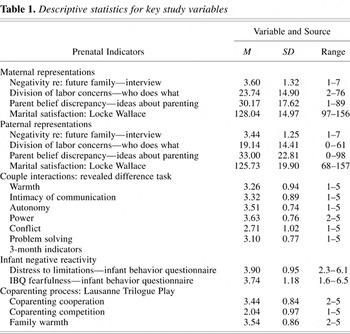
Descriptive statistics for key study variables
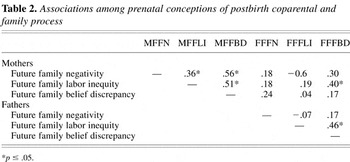
Associations among prenatal conceptions of postbirth coparental and family process
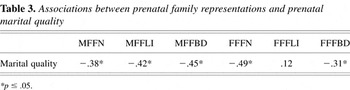
Associations between prenatal family representations and prenatal marital quality
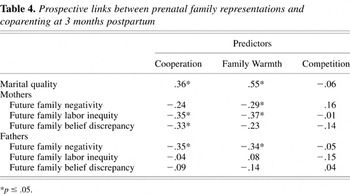
Prospective links between prenatal family representations and coparenting at 3 months postpartum
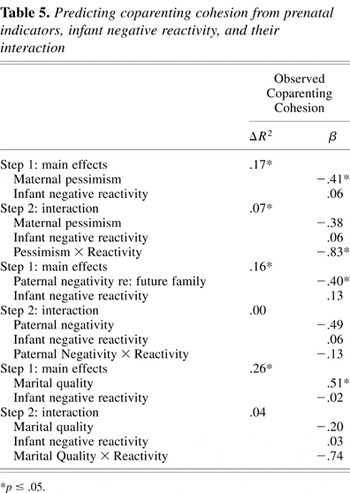
Predicting coparenting cohesion from prenatal indicators, infant negative reactivity, and their interaction
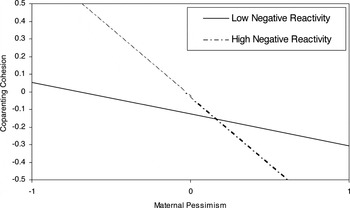
Predicting 3-month coparenting cohesion from prenatal maternal pessimism, as a function of infant negative reactivity. The values on the x and y axes are standardized composite scores.
 You have
Access
- 109
- Cited by