Introduction
Clinical experience and exposure are fundamental components of medical education. In all specialities, direct patient interactions make up a key aspect of clinical placements, allowing students to consolidate their knowledge within the context of real patient contact. Patient contact during paediatric placements can be challenging because the compliance of paediatric patients, as well as consent from parents, is variable.Reference Hilliard, Bannister, Amin and Baird1 Bedside teaching in paediatrics can often comprise numerous students crowded around a child, which can be distressing and invoke anxiety among patients.Reference Connelly and Gordon2
In paediatric otolaryngology, small in-patient numbers can mean that patients and parents can be seen by multiple medical students, bringing about fatigue for both the parents and the patients. Furthermore, the complexity of some patients in paediatric otolaryngology can lead to challenges in communication, impacting on the learning of medical students reviewing these patients.Reference Gardner3
Utilisation of augmented reality, which superimposes digital information onto the real world, presents a potential solution to the issues encountered by medical students during paediatric otolaryngology placements. Augmented reality enhances real-world environments by overlaying digital content such as images, sounds and other sensory enhancements. Unlike virtual reality, which creates a completely virtual environment, augmented reality maintains the real-world context while adding layers of information, allowing for an immersive yet grounded learning experience.Reference Brigham4 Augmented reality has been increasingly adopted in various medical fields for education and training. Particularly during and following the coronavirus disease 2019 pandemic, the use of augmented reality within medical education more widely as a useful learning tool increased dramatically.Reference Sadek, Baldwin, Gray, Khayyat and Fotis5, Reference Sivananthan, Gueroult, Zijlstra, Martin, Baheerathan and Pratt6
The aim of this project was to leverage augmented reality technology to facilitate medical student education in paediatric otolaryngology. This allowed students to gain hands-on experience and develop clinical skills in a controlled, child-friendly manner, with oversight from supervising clinicians.
Materials and methods
We conducted a pilot programme using the Microsoft HoloLens 2 between January 2023 and August 2024 at Alder Hey Children’s Hospital to evaluate the effectiveness of augmented reality in teaching bedside clinical paediatric ENT. University of Liverpool medical students undertake a 1-week placement at Alder Hey Children’s Hospital as a component of their 4th-year medical school rotations, and during this rotation the students had a 2-hour timetabled virtual ward round session.
All patients included were current in-patients admitted to our institution with a variety of paediatric ENT conditions. Appropriate cases for teaching were selected by facilitators, and prior to the session, consent was obtained from patients and parents to be involved with the virtual ward round.
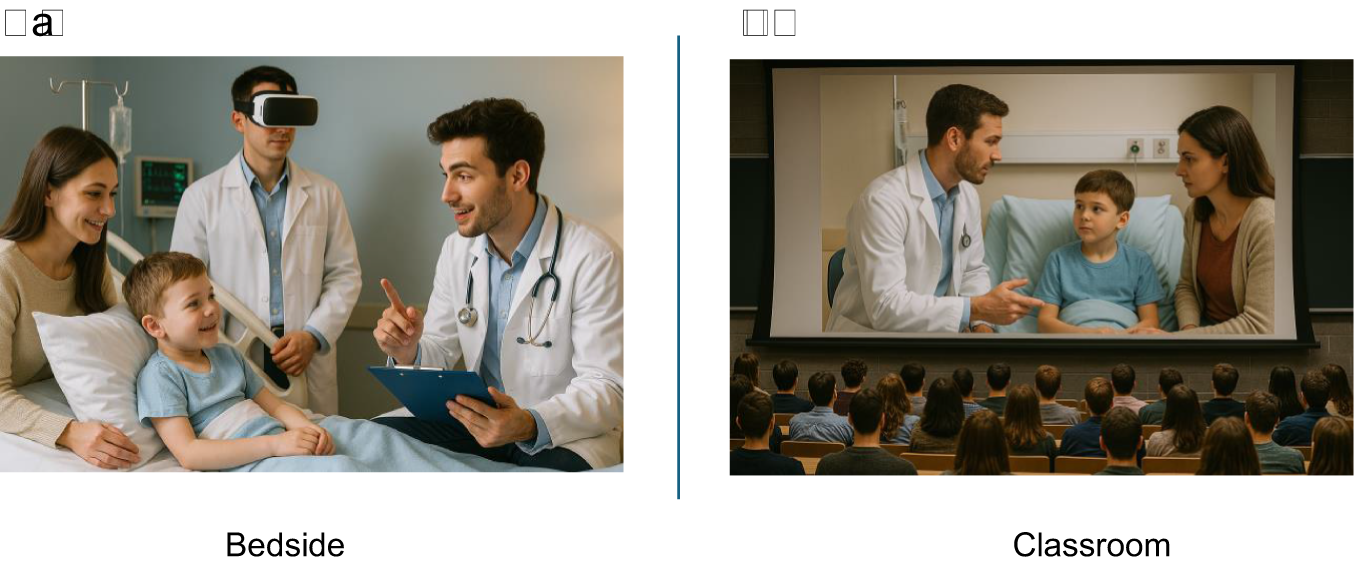
The principal of a virtual ward round was explained to the student group, and a volunteer or a pair of volunteers was sought to undertake clinical review of patients. A supervising ENT registrar guided the reviewing student to the patient’s bedside and supervised a clinical review, whilst wearing the Microsoft HoloLens 2. The remaining medical students in the group stayed in the classroom with a second supervisor. The image from the HoloLens 2 glasses, as seen by the supervisor, was shown on a screen in the classroom, allowing the medical students to watch their colleague undertake a clinical review of a patient in the hospital under the care of the paediatric otolaryngology team.
The students in the classroom were able to discuss with their supervisor if there were any questions or comments that arose. Furthermore, the students in the classroom could communicate with the bedside supervisor if there were any additional questions or points of discussion that they felt were indicated. Following completion of the review, all the students and supervisors returned to the classroom to give feedback and discuss the case, the pathology and any questions regarding ongoing investigation and management (Figure 1).
Images showing the bedside (a) and classroom (b) to demonstrate the setup of the augmented reality teaching sessions (images created using DALL-E AI software).

Feedback forms were completed by the students involved in the virtual ward round teaching sessions. Feedback was also obtained from parents and from patients, where appropriate, after the sessions.
Results and analysis
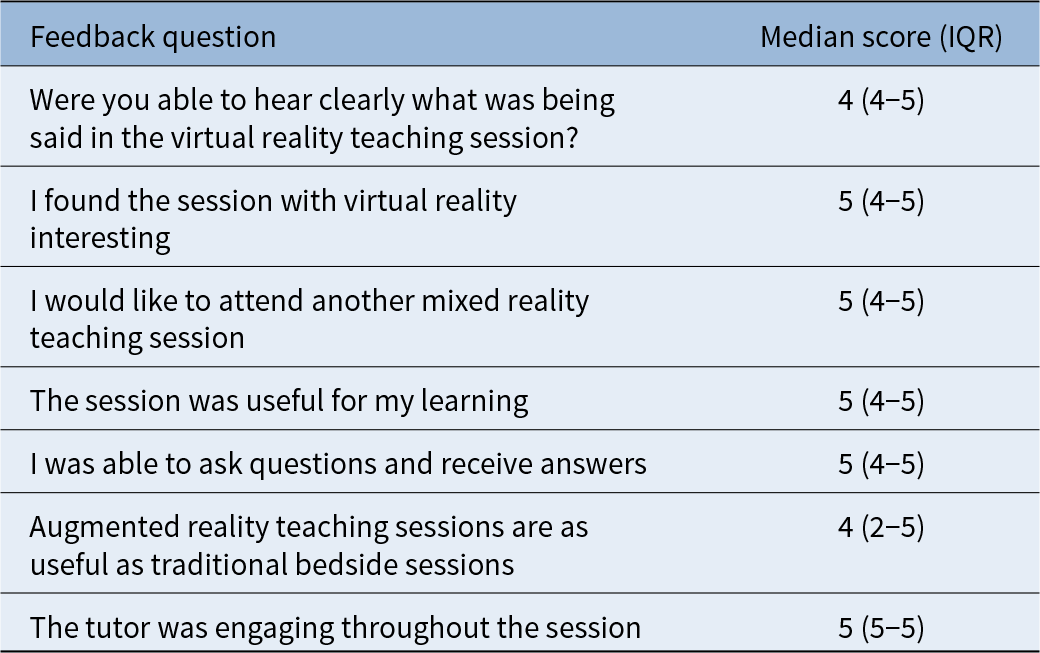
A total of 109 medical students participated in teaching between January 2023 and August 2024 over a course of 12 sessions, averaging 9 students per session. All the students were in their 4th (penultimate) year of medical school on rotation within the paediatric ENT department within our institution. Over 87 per cent of the students (95 of 109) had never attended any form of mixed-reality teaching session previously. A summary of student feedback can be found in Table 1.
Summary scores of student feedback following the augmented reality bedside teaching session

All answers are presented as Likert scale scores ranging from 1 = strongly disagree to 5 = strongly agree. IQR = interquartile range.
Generally, responses were positive from participants regarding the virtual reality teaching session.. Over 75 per cent of participants (82 of 109) rated their ability to hear clearly throughout the session as either good or very good, suggesting the technological delivery was of good quality. Students found sessions interesting and engaging, with over 94 per cent of them rating the session interesting or very interesting. The session was perceived as useful for learning, with 98 of 109 students (90 per cent) rating it as either useful or very useful, and participants felt they were able to ask questions and receive answers effectively, with 88 of 109 students (81 per cent) rating the ability to ask and answer questions as good or very good.
Interestingly, when asked directly to compare the session to a traditional beside teaching session, 69 per cent of students (75 of 109) found the session to be equivalent or better than a traditional bedside session.
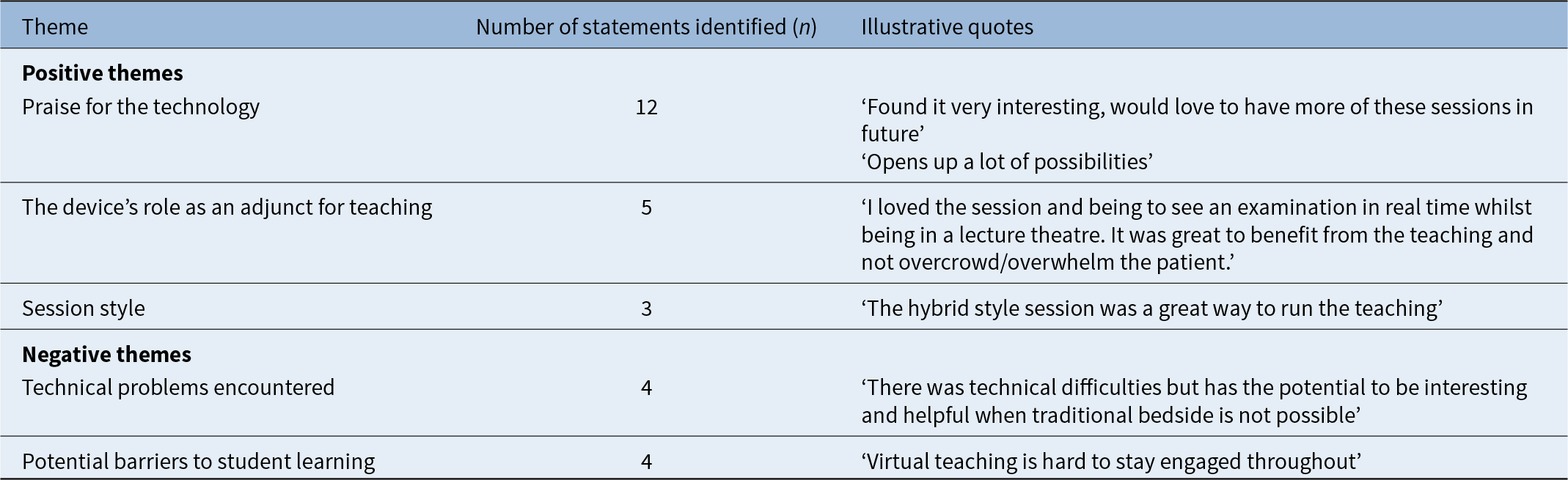
A total of 23 students chose to leave written free text feedback about the session. The authors completed thematic analysis to identify themes and subthemes within the responses.Reference Braun and Clarke7 Illustrative quotes were selected based on the representation of each theme and the clarity of their demonstration. This is summarised in Table 2.
Student feedback qualitative results

Positive themes
Participants praised the technology, with 12 statements highlighting its potential and expressing enthusiasm for future sessions:
‘Found it very interesting, would love to have more of these sessions in future’
‘Opens up a lot of possibilities.’
Additionally, five statements emphasised the role of the device as an adjunct to teaching.
‘I loved the session and being able to see an examination in real time whilst being in a lecture theatre. It was great to benefit from the teaching and not overcrowd/overwhelm the patient.’
Three statements also praised the session style, with comments such as
‘The hybrid style session was a great way to run the teaching.’
Negative themes
However, there were also four statements highlighting technical problems, with one participant commenting,
‘There were technical difficulties but has the potential to be interesting and helpful when traditional bedside is not possible.’
Additionally, four statements pointed to potential barriers to student learning, with some noting challenges in maintaining engagement during virtual teaching, such as,
‘Virtual teaching is hard to stay engaged throughout.’
Informal discussions were had following the sessions with parents and children. Out of the 12 patients and families, a total of 8 had experienced traditional bedside teaching sessions before. Discussions were generally positive, with parents commenting that the reduced number of students and facilitators at the bedside was much less daunting for children and allowed more authentic interactions. One family did comment about the facilitator wearing the headset itself being slightly intimidating for the child and suggested a quick introduction to the headset for the children prior to the session itself would aid with this. Conversely, some older children commented that the headset ignited their interest and attention as they had experienced virtual reality headsets at home.
Discussion
In this study, we have demonstrated that augmented reality is an effective tool for supplementing clinical medical education in a paediatric tertiary centre. We demonstrated that medical students found this to be an enjoyable and useful educational tool, and the majority would attend a similar session. Furthermore, family members of paediatric patients involved found the process to be a positive experience and enjoyed the opportunity to be involved with medical education. While this is encouraging, further research involving a more formal assessment of family member feedback is needed to validate this finding.Reference Khoo, Parameshwara and Kutzsche8
Augmented reality is a novel and rapidly growing tool in medical education. A recent meta-analysis found that 36 articles existed pertaining to the use of augmented reality in medical education, with the majority of these involving surgical simulation (n = 23).Reference Tang, Cheng, Mi and Greenberg9 Most of the articles pertained to the teaching of surgical techniques and only four papers included described the use of augmented reality in the context of teaching in the classroom.
At the time of writing, this is the first paper to describe the use of augmented reality to enhance the teaching of medical assessment of ward patients, both adults and paediatrics. The successful application of this technology in our cohort demonstrates the potential for further application of augmented reality, with a similar virtual ward round setup, could be applied in other specialities where high medical student numbers and limited in-patient numbers provide a logistical challenge. Further development of the virtual ward round may occur when virtual reality elements of medical education improve, which may allow for a virtual reality component of this training to be formulated, allowing for trainees to undertake assessment and management of patients in a fully simulated and virtual setting.Reference Pottle10
• Clinical exposure is a cornerstone of medical education, but in paediatrics, repeated bedside teaching can cause distress for children and fatigue for families
• Augmented reality has been increasingly explored in medical education, mainly in surgical simulation and classroom teaching
• Early studies, particularly during the coronavirus disease 2019 pandemic, demonstrated the feasibility of augmented reality for remote bedside teaching, but evidence in paediatrics is limited
• This is the first study to report the use of Microsoft HoloLens 2 to deliver virtual teaching in paediatric otolaryngology
• Augmented reality teaching was rated equivalent or superior to traditional bedside teaching by most medical students, and parents reported less stress with reduced student presence
• The study demonstrates augmented reality as a feasible, child-friendly and engaging teaching tool, although cost and logistical barriers to wider adoption remain
Challenges and limitations
Current limitations to the widespread application of the virtual ward round include its high cost, and technical and logistical limitations. The current setup of two trainers in the teaching session is personnel heavy, which may be a limitation in smaller departments or those without dedicated teaching sessions for trainees. Additional challenges included reliance on existing National Health Service hospital infrastructure such as WiFi connectivity, which led to occasional communication difficulties between the two groups.
Conclusion
Augmented reality offers a transformative approach to teaching clinical paediatrics, balancing the need for comprehensive education with the imperative to minimise patient distress. By incorporating augmented reality into training programmes, medical institutions can provide an effective, immersive and child-friendly learning experience, paving the way for future innovations in medical education.
Competing interests
None declared.