Introduction
Decades of psychosis research strongly suggest that stress is associated with the development of psychotic symptoms, such as paranoia. Experimental studies have shown that when stress is induced, both clinical and non-clinical participants react with an increase of paranoia (Kesting, Bredenpohl, Klenke, Westermann, & Lincoln, Reference Kesting, Bredenpohl, Klenke, Westermann and Lincoln2013; Lincoln, Peter, Schäfer, & Moritz, Reference Lincoln, Peter, Schäfer and Moritz2009; Veling, Pot-Kolder, Counotte, Van Os, & Van Der Gaag, Reference Veling, Pot-Kolder, Counotte, Van Os and Van Der Gaag2016). These findings are substantiated by experience sampling studies that consistently report an association between daily stress and paranoia (Ben-Zeev, Ellington, Swendsen, & Granholm, Reference Ben-Zeev, Ellington, Swendsen and Granholm2011; Kramer et al., Reference Kramer, Simons, Wigman, Collip, Jacobs, Derom and Wichers2014; Krkovic, Clamor, Schlier, & Lincoln, Reference Krkovic, Clamor, Schlier and Lincoln2020; Krkovic, Krink, & Lincoln, Reference Krkovic, Krink and Lincoln2018; Lataster, Valmaggia, Lardinois, van Os, & Myin-Germeys, Reference Lataster, Valmaggia, Lardinois, van Os and Myin-Germeys2013; Reininghaus et al., Reference Reininghaus, Kempton, Valmaggia, Craig, Garety, Onyejiaka and Morgan2016; Van Der Steen et al., Reference Van Der Steen, Gimpel-Drees, Lataster, Viechtbauer, Simons, Lardinois and Myin-Germeys2017). Moreover, a recent study by Grant and Hennig (Reference Grant and Hennig2020) showed the increase in psychotic experiences under stress to be a function of disorganized and negative schizotypy, which further emphasizes the importance of stress reactivity for the etiology of psychosis. However, it remains unclear which mechanism determines whether stress translates into paranoia.
Traditional vulnerability stress models (Nuechterlein & Dawson, Reference Nuechterlein and Dawson1984) and their cognitive extensions (Garety, Kuipers, Fowler, Freeman, & Bebbington, Reference Garety, Kuipers, Fowler, Freeman and Bebbington2001) emphasize aberrant information processing as a vulnerability factor for psychosis. In the event of stress, the aberrant information processing is assumed to render it difficult for individuals to integrate new evidence from the environment and to adapt their beliefs accordingly. So far, adapting of beliefs in psychosis has been investigated by two strands of research using different methods: One strand stems from the basic psychology and has utilized probabilistic reversal learning paradigms (RL; Cools, Clark, Owen, & Robbins, Reference Cools, Clark, Owen and Robbins2002) to investigate deficits in reinforcement learning in psychosis. The other strand has applied paradigms to investigate biases in decision-making, such as a bias against disconfirmatory evidence (BADE; e.g. Woodward, Moritz, Cuttler, & Whitman, Reference Woodward, Moritz, Cuttler and Whitman2006b) and a jumping to conclusions bias (JTC; Garety, Hemsley, & Wessely, Reference Garety, Hemsley and Wessely1991). The paradigms from both strands assess whether a person integrates new information and adjusts their decision accordingly. However, specific to the typical RL paradigms is the probabilistic nature of the feedback that can occasionally be misleading. Therefore, the challenge of such tasks is to accurately integrate information by taking into account the contingency of the feedback (Izquierdo, Brigman, Radke, Rudebeck, & Holmes, Reference Izquierdo, Brigman, Radke, Rudebeck and Holmes2017). Specific to the BADE paradigms is that they directly assess to which extent evidence contradicting the initial decision is being integrated into the decision-making process (Moritz & Woodward, Reference Moritz and Woodward2006; Woodward, Moritz, & Chen, Reference Woodward, Moritz and Chen2006a; Woodward et al., Reference Woodward, Moritz, Cuttler and Whitman2006b). Specific to the JTC paradigms is the assessment of hasty decisions, i.e. making a judgment on the basis of weak evidence (Fine, Gardner, Craigie, & Gold, Reference Fine, Gardner, Craigie and Gold2007; Garety et al., Reference Garety, Hemsley and Wessely1991). Hence, paradigms assessing RL and cognitive biases complement each other by focusing on somewhat different aspects of adapting of beliefs. Therefore, their concurrent assessment could offer more insight into the characteristics of adapting of beliefs in psychosis.
Empirical evidence suggests that individuals with psychosis generally show both RL deficits (Leeson et al., Reference Leeson, Robbins, Matheson, Hutton, Ron, Barnes and Joyce2009; Murray et al., Reference Murray, Cheng, Clark, Barnett, Blackwell, Fletcher and Jones2008; Reddy, Waltz, Green, Wynn, & Horan, Reference Reddy, Waltz, Green, Wynn and Horan2016; Schlagenhauf et al., Reference Schlagenhauf, Huys, Deserno, Rapp, Beck, Heinze and Heinz2014; Waltz & Gold, Reference Waltz and Gold2007) and cognitive biases (Eisenacher & Zink, Reference Eisenacher and Zink2017; So, Siu, Wong, Chan, & Garety, Reference So, Siu, Wong, Chan and Garety2016). At the same time, the extent to which these deficits are already evident at the earlier stage of the disorder development is still unclear: A study examining individuals at risk for psychosis, who are often referred to as individuals with ‘schizotypal traits’ could not find any deficits in RL (Humpston, Evans, Teufel, Ihssen, & Linden, Reference Humpston, Evans, Teufel, Ihssen and Linden2017). Similarly, Juarez-Ramos et al. (Reference Juarez-Ramos, Rubio, Delpero, Mioni, Sablum and Gomez-Milan2014) showed that psychosis patients have significantly higher BADE than low and high schizotypy participants, who did not significantly differ from each other in BADE. Furthermore, Le et al. (Reference Le, Fedechko, Cohen, Allred, Pham, Lewis and Barkus2019) investigated BADE and JTC under stress, and even report reversed effects, with only the group with low (but not with high) schizotypy showing stronger biases under stress. However, Buchy, Woodward, and Liotti (Reference Buchy, Woodward and Liotti2007) report high schizotypy participants to show stronger BADE compared to low schizotypy participants. Finally, a recent meta-analysis (Livet, Navarri, Potvin, & Conrod, Reference Livet, Navarri, Potvin and Conrod2020) reveals different types of adapting of beliefs difficulties to be present in ultra-high-risk samples. Hence, the results in subclinical schizotypy samples are inconsistent and up to this point it remains inconclusive at which stage of the disorder development the impaired adapting of beliefs emerges.
Nevertheless, deficits in adapting of beliefs seem to be directly associated with delusions across the continuum of psychosis. For instance, delusions have been associated with behavior relevant to RL, such as shift errors (Laws, Kondel, Clarke, & Nillo, Reference Laws, Kondel, Clarke and Nillo2011) and aberrant decision switching behavior (Feeney, Groman, Taylor, & Corlett, Reference Feeney, Groman, Taylor and Corlett2017). Additionally, the severity of paranoia across the continuum of psychosis has been found to be associated with BADE and JTC (Buchy et al., Reference Buchy, Woodward and Liotti2007; Dudley et al., Reference Dudley, Daley, Nicholson, Shaftoe, Spencer, Cavanagh and Freeston2013; Dudley, Taylor, Wickham, & Hutton, Reference Dudley, Taylor, Wickham and Hutton2016; Freeman, Pugh, & Garety, Reference Freeman, Pugh and Garety2008; Sanford, Veckenstedt, Moritz, Balzan, & Woodward, Reference Sanford, Veckenstedt, Moritz, Balzan and Woodward2014; Veckenstedt et al., Reference Veckenstedt, Randjbar, Vitzthum, Hottenrott, Woodward and Moritz2011; Woodward et al., Reference Woodward, Moritz and Chen2006a), whereby the meta-analysis by Livet et al. (Reference Livet, Navarri, Potvin and Conrod2020) found only weak associations between JTC and positive psychotic experiences in community samples. Hence, RL and cognitive biases research have independently accumulated empirical evidence on the direct link between deficits in adapting of beliefs and paranoia.
Although stress reactivity and adapting of beliefs appear to be highly relevant to the emergence of paranoia, the exact mechanism that links these psychological constructs remains unclear. In particular, studies on psychosis demonstrate cognitive biases to increase under stress (Ellett, Freeman, & Garety, Reference Ellett, Freeman and Garety2008; Keefe & Warman, Reference Keefe and Warman2011; Lincoln, Lange, Burau, Exner, & Moritz, Reference Lincoln, Lange, Burau, Exner and Moritz2010; Moritz et al., Reference Moritz, Burnette, Sperber, Köther, Hagemann-Goebel, Hartmann and Lincoln2011). Moreover, studies on processes related to RL in the general population suggest that stress has a negative impact on the performance in tasks requiring cognitive flexibility (Alexander, Hillier, Smith, Tivarus, & Beversdorf, Reference Alexander, Hillier, Smith, Tivarus and Beversdorf2007) and that stress promotes behavioral persistence and habit behavior (Schwabe & Wolf, Reference Schwabe and Wolf2009, Reference Schwabe and Wolf2011). Therefore, it can be postulated that deficits in adapting of beliefs under stress could represent a mediating mechanism through which stress translates into paranoia. Alternatively, deficits in adapting of beliefs could also represent a vulnerability factor that potentiates the path from stress to paranoia, indicating a moderation model. Therefore, in the present study, we tested a mediation model and also a moderation model examining the association between RL, BADE, and JTC, stress, and paranoia. We applied a within-subject (stress condition v. control condition) and between-subject (individuals diagnosed with a psychotic disorder, individuals with attenuated psychotic symptoms, clinical controls and healthy individuals) design. The inclusion of the group with attenuated psychotic symptoms and the healthy controls was based on the hypothesis of a psychosis continuum (e.g. Johns & van Os, Reference Johns and van Os2001; Van Os, Linscott, Myin-Germeys, Delespaul, & Krabbendam, Reference Van Os, Linscott, Myin-Germeys, Delespaul and Krabbendam2009) and enables us to draw conclusions about whether the hypothesized mechanisms for a specific symptom dimension (i.e. paranoia) differ at different stages of disorder expression. The inclusion of an OCD group enables to test if these effects are psychosis-specific.
We hypothesized (1) that paranoia would be significantly higher in the stress compared to the control condition; that (2) participants would have more difficulties in adapting of beliefs in the stress condition compared to the control condition; that (3) difficulties in adapting of beliefs would predict paranoia and (4) mediate the link between stress and paranoia. Finally, we hypothesized that (5) this mediating effect would be strongest in the group of individuals diagnosed with a psychotic disorder, compared to the other groups (moderated mediation). We tested a moderation model by examining the interaction effect between stress and adapting of beliefs on paranoia: Here, we hypothesized (6) the effect of stress on paranoia to be strongest in individuals with deficits in adapting of beliefs. Furthermore, we expected that (7) these associations would be strongest in the group of individuals diagnosed with a psychotic disorder, compared to the other groups (moderated moderation).
Method
Participants
Participants were recruited via flyers distributed at health care facilities as well as through job websites and forums. The recruitment took place between April 2018 and March 2020. Participants were compensated with 120€.
The sample consisted of 155 participants clustered into four groups according to their diagnostic status: 38 participants diagnosed with a psychotic disorder (PSY), 39 participants diagnosed with an obsessive-compulsive disorder (OCD), 40 participants with attenuated psychotic symptoms (AS), and 38 healthy controls (HC). General eligibility criteria included age between 18 and 55 years, sufficient knowledge of German language, and an IQ > 85 [assessed with the Multiple-Choice Vocabulary Intelligence Test (MWT-B; Lehrl, Reference Lehrl2005)]. Exclusion criteria for all groups were a diagnosis of dementia or any severe neurological disorder, bipolar disorder, social phobia or a substance use disorder during the previous 6 months. Furthermore, pregnant or acutely suicidal individuals were excluded. Participants were requested to refrain from sports, tobacco, caffeine, and food 2 h prior to testing. Specific eligibility criteria for the PSY group were a diagnosis of a psychotic disorder according to DSM-V and a score of 3 or higher on the P1 (i.e. one or more at least vague delusional ideas) or P6 (i.e. at least mild suspiciousness, careful behavior and attitude) items of the Positive and Negative Syndrome Scale (PANSS; Kay, Opler, & Lindenmayer, Reference Kay, Opler and Lindenmayer1989). These items both assess persecutory delusions, and we chose this cut-off score to ensure that the PSY group showed at least mild persecutory delusions, which was necessary in order to test our hypotheses on the formation of paranoia. The OCD group fulfilled the criteria for OCD according to DSM-V and had no comorbid psychotic disorder. To select participants for the AS and HC group, we pre-screened individuals from the general population with the Community Assessment of Psychic Experiences (CAPE; Stefanis et al., Reference Stefanis, Hanssen, Smirnis, Avramopoulos, Evdokimidis, Stefanis and van Os2002). Participants were assigned to the AS group if diagnostic criteria for a psychotic disorder were never met but the score on the positive symptoms subscale of the CAPE was above 8, which corresponds to the 50th percentile within a large community sample (Schlier, Jaya, Moritz, & Lincoln, Reference Schlier, Jaya, Moritz and Lincoln2015). If the score on the positive symptoms subscale of the CAPE was ≤8 and participants had no history of mental disorder, they were assigned to the HC group.
Design and procedure
All participants were exposed to a stress and a control condition in randomized order. Stress was induced with the Trier Social Stress Test (TSST; Kirschbaum, Pirke, & Hellhammer, Reference Kirschbaum, Pirke and Hellhammer1993) and in the control condition, we conducted a commonly used placebo TSST (Het, Rohleder, Schoofs, Kirschbaum, & Wolf, Reference Het, Rohleder, Schoofs, Kirschbaum and Wolf2009). In the TSST, participants are asked to prepare a speech (3 min), deliver it (5 min), and then perform a mental arithmetic task (5 min; sequentially subtracting 17 from 2043) in front of a committee with a camera facing them. In the placebo TSST, participants are asked to give a speech on any topic while standing in an empty room (5 min) and to do a simple arithmetic task (5 min; successively adding 15 starting from 0), while being reinsured that no one would be evaluating them.
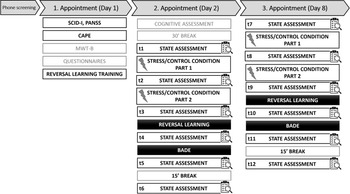
Potential participants were informed via telephone about the study and pre-screened for the eligibility. Three appointments were made, of which two took place on consecutive days and the third took place a week after the first (for the detailed procedure, see Fig. 1).
Study procedure. SCID-I = Structured Clinical Interview for DSM-IV Axis I disorders; PANSS = Positive and Negative Syndrome Scale; CAPE = Community Assessment of Psychic Experiences; MWT-B = Multiple-Choice Vocabulary Intelligence Test; BADE = Bias Against Disconfirmatory Evidence paradigm; t1, t3, t4, t5, t6, t7, t9, t10, t11, t12 = State assessments of salivary cortisol, heart rate, subjective stress, paranoia and obsessive-compulsive symptoms; t2 and t8 = State assessment of heart rate, subjective stress, paranoia and obsessive-compulsive symptoms; Stress/control condition part 1 = Preparation and speech in Trier Social Stress Test in the stress condition or in Placebo Trier Social Stress Test in the control condition; Stress/control condition part 2 = Mental arithmetic in the Trier Social Stress Test or in the Placebo Trier Social Stress Test.

During the first appointment, the German version of the Structured Clinical Interview for DSM-IV Axis I disorders adapted for DSM-V (SCID-I; Wittchen, Zaudig, & Fydrich, Reference Wittchen, Zaudig and Fydrich1997) was carried out to confirm the diagnosis status. This was followed by the MWT-B, a questionnaire battery and an RL task training. The PSY group was additionally assessed with the PANSS. The assessment lasted between 1 and 2.5 h.
At the second appointment, following a cognitive assessment and a 30 min break, participants were exposed to the stress or the control condition and completed the RL, BADE and JTC paradigms during which state assessments of subjective stress, heart rate, salivary cortisol, and paranoia and OCD symptomsFootnote †Footnote 1 took place (t1–t6 in Fig. 1). Thereafter, participants were asked to rest for 15 min. The appointment lasted between 2.5 and 3.5 h.
At the third appointment, individuals participated in the remaining condition, which involved parallelized versions of the RL and the BADE paradigms (see Fig. 1) and lasted approximately 1 h.
Measures
The PANSS is a semi-structured interview for rating positive (seven items) and negative symptoms (seven items), and overall psychopathology (16 items) in psychosis. Each item is scored on a seven-point scale, ranging from 1 ‘absent’ to 7 ‘extreme’. The PANSS has demonstrated good reliability, criterion, and construct validity (Kay et al., Reference Kay, Opler and Lindenmayer1989). We used PANSS to assess the eligibility of the potential participants for the PSY group.
The CAPE is a 42-item self-report instrument assessing lifetime psychotic experiences on three subscales – negative, positive, and depression symptoms. Previous studies demonstrated good convergent and discriminative validity (Hanssen et al., Reference Hanssen, Peeters, Krabbendam, Radstake, Verdoux and van Os2003) and a good test–retest reliability of the instrument (Konings, Bak, Hanssen, Van Os, & Krabbendam, Reference Konings, Bak, Hanssen, Van Os and Krabbendam2006). The German version of the CAPE has a good factorial and criterion validity (Schlier et al., Reference Schlier, Jaya, Moritz and Lincoln2015). We used scores of the positive symptoms subscale to check eligibility criteria for HC and AS group.
State assessment before, during, and after the stress and the control condition
State subjective stress was assessed with four items capturing anxiety, sadness, anger, and shame (items based on Stemmler, Heldmann, Pauls, & Scherer, Reference Stemmler, Heldmann, Pauls and Scherer2001) as well as two items capturing the controllability of the situation and perceived stress (items based on Gaab, Rohleder, Nater, & Ehlert, Reference Gaab, Rohleder, Nater and Ehlert2005). This scale has been applied in a longer form in Krkovic et al. (Reference Krkovic, Krink and Lincoln2018). Participants were asked to which extent each of the statements applies to them at the moment of the assessment on a 10-point Likert scale. The reliability of the scale in our sample was good to excellent with between-subject multilevel Cronbach's α = 0.964 and within-subject Cronbach's α = 0.840.
State paranoia was assessed using a five-item version of the Paranoia Checklist (original version: Freeman et al., Reference Freeman, Garety, Bebbington, Smith, Rollinson, Fowler and Dunn2005; five-item version: Schlier, Moritz, & Lincoln, Reference Schlier, Moritz and Lincoln2016) (e.g. ‘I need to be on my guard against others’; ‘My actions and thoughts might be controlled by others’). Participants were asked to which extent each of the statements applies to them at the moment of the assessment on a 10-point Likert scale. This short version has been validated and shown to be sensitive to change (Schlier et al., Reference Schlier, Moritz and Lincoln2016). The reliability of the scale in our sample was acceptable with between-subject multilevel Cronbach's α = 0.949 and within-subject Cronbach's α = 0.632.
Measures of adapting of beliefs
The RL paradigm was based on the concept of the existing probabilistic RL tasks (Cools et al., Reference Cools, Clark, Owen and Robbins2002; Reddy et al., Reference Reddy, Waltz, Green, Wynn and Horan2016). The paradigm consisted of six blocks. Throughout the 50 trials of a block, participants were presented with two visual stimuli. For each trial, participants were instructed to select which of the two stimuli they believed will lead to a reward, based on the feedback they received so far (reward = a green smiley face and a numerical score of +1; loss = a red sad face and a numerical score of −1). The stimuli were presented for 2000 ms within which the response had to be made (or else a ‘too slow’ message was presented). The choice of one stimulus resulted in a reward in 80% and a loss in 20% of the trials; the choice of the other stimulus resulted in a reward in 20% and a loss in 80% of the trials. The feedback was presented for 500 ms. After a pre-defined learning criterion (eight choices of the rewarding stimulus in a run of 10 consecutive trials) was achieved, the rewarded contingencies were reversed. An example of several consecutive trials of the task is depicted in the online Supplementary Material S1. The RL score was calculated as the total number of contingency reversals across six blocks, with higher scores reflecting more rewarding choices and faster learning of the reward contingencies.
The BADE paradigm consisted of 15 delusion-neutral, semantic tasks using stimuli from previous BADE studies (Buchy et al., Reference Buchy, Woodward and Liotti2007; Lüdtke, Kriston, Schröder, Lincoln, & Moritz, Reference Lüdtke, Kriston, Schröder, Lincoln and Moritz2017; Woodward, Buchy, Moritz, & Liotti, Reference Woodward, Buchy, Moritz and Liotti2007). In each task, one piece of information and three possible interpretations – one true and two lure interpretations – were presented. Participants were asked to rate for each interpretation how convinced they are that the interpretation is plausible (0%: not at all plausible; 100%: completely plausible). Subsequently, a second piece of information was presented and participants were asked to revise their plausibility ratings of the three interpretations. Finally, a third piece of information was introduced and a final revision of the plausibility of the three interpretations took place. Whereas the first piece of information is ambiguous and thus increases the plausibility of the lure interpretations, the subsequent pieces of information gradually disambiguate the task and disclose the true interpretation. An example is depicted in the online Supplementary Material S2.
We calculated a standard BADE score, where the change scores are computed subtracting the ratings of the lure interpretations following information 2 and 3 from the ratings of the lure interpretations following information 1 and averaging these across lure interpretations and tasks. The JTC score was calculated using the interpretation plausibility ratings after the first piece of information was provided and it represented the total number of interpretations where participants rated the plausibility between 75% and 100% (Lüdtke et al., Reference Lüdtke, Kriston, Schröder, Lincoln and Moritz2017). We used two parallelized versions that we matched for item difficulty in an unpublished pilot study. Each participant completed one of these versions in the stress and control condition, respectively. Within the present sample, the parallel-forms’ reliability was acceptable, as reflected in BADE scores Pearson correlation between two versions, r = 0.674, p < 0.001.
Statistical analyses
Technical errors resulted in one missing value on BADE/JTC and eight missing values on RL across the two conditions. MCAR-Test by Little showed that data were missing completely at random, χ2 (24) = 12.66, p = 0.971. There were no missings on paranoia.
Due to the hierarchical structure of the data, all hypotheses were tested using multilevel linear modeling (MLM) with repeated measurements nested within individuals. For all analyses, we applied the restricted maximum likelihood estimator. Predictors were entered as fixed effects and if continuous, they were centered around subjects’ mean. We added the intercepts for subjects as random effects. Random slopes were included if Bayesian information criterion (BIC) comparison of models with and without the random slope showed a substantial change, i.e. ΔBIC > 10 (this was only the case with condition as a predictor of paranoia; see online Table S3 in the Supplementary Material), otherwise slopes were fixed. The MLM was implemented through RStudio, version 3.6.2 (R Core Team, 2020; package nlme, function lme) and conducted according to guidelines (Hox, Reference Hox2002; Tabachnick & Fidell, Reference Tabachnick and Fidell2019).
As a manipulation check of the stress induction, we applied a MLM with state subjective stress (measured after the stress and control condition at t3/t9, see Fig. 1) as a dependent variable and condition (control v. stress) as an independent variable. Additionally, we added group as a predictor and the interaction term condition × group to test for moderating effects of the group.
To test the direct effect of stress on paranoia (hypothesis 1), we applied an MLM with paranoia (measured after the stress and control condition at t3/t9, see Fig. 1) as a dependent variable and condition (control v. stress) as an independent variable. Additionally, we added group as a predictor and the interaction term condition × group to test for moderating effects of the group.
Moderated mediation was tested in a series of steps: (1) Test for the main effect of condition on the mediators (RL, BADE, JTC, measured at t3/t9) (hypothesis 2); (2) test for main effects of the mediators on paranoia (hypothesis 3); (3) test whether the direct effect of condition on paranoia shrinks upon the addition of the mediators in the model (hypothesis 4); (4) test for moderating effect of group (PSY, AS, OCD, HC) by examining if the hypothesized mediating association between stress, RL, BADE, JTC and paranoia depends on the level of the moderator (hypothesis 5). Steps 2 and 3 were only performed given significance of steps 1 and 2, whereas step 4 was independent of the results of previous steps, since it is possible that the mediation mechanism is only present at the specific level of the moderating variable (for instance, only in PSY).
To examine the moderated moderation hypothesis, we first tested if there was an interaction effect of condition × moderator 1 (RL, BADE, JTC) (hypothesis 6). Then, we tested whether moderator 2 (group – PSY, AS, OCD, HC) influenced the effect of interaction condition × moderator 1 on paranoia (hypothesis 7).
Results
Descriptive statistics
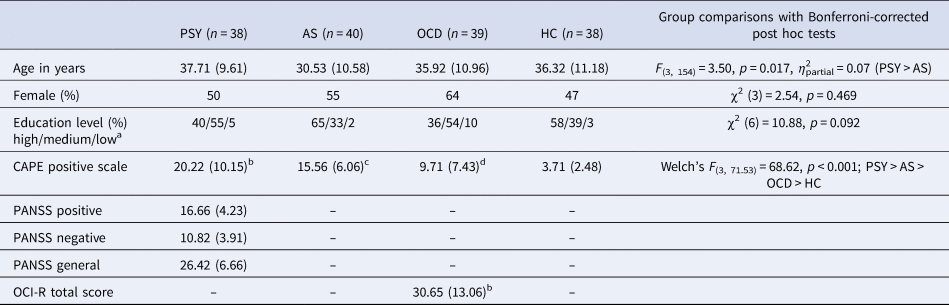
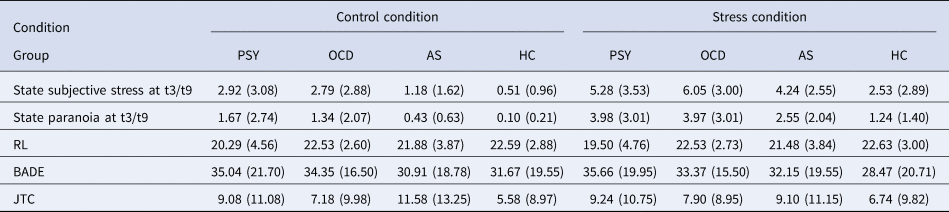
Socio-demographic and clinical characteristics of all groups are presented in Table 1. Means and standard deviations of state subjective stress paranoia, RL, BADE, and JTC scores in the stress and the control condition per group are presented in Table 2.
Sample characteristics and group comparison analyses

PSY, participants diagnosed with psychotic disorders; AS, participants with attenuated psychotic symptoms; OCD, participants diagnosed with obsessive-compulsive disorder; HC, healthy controls; CAPE, Community Assessment of Psychic Experiences; PANSS, Positive and Negative Syndrome Scale; OCI-R, Obsessive Compulsive Inventory-Revised.
Note: Values indicate group means (standard deviations) unless otherwise specified.
a High = university degree or A-level equivalent; medium = equivalent of advanced-level GCSEs or vocational qualification; low = equivalent of low-level GCSEs or no formal qualification.
b n = 37.
c n = 39.
d n = 38.
Means and standard deviations of state variables and adapting of beliefs in the control and stress condition per group

T3/t9, assessment time-point immediately after the stress/control condition; RL, reversal learning; BADE, bias against discriminatory evidence; JTC, jumping to conclusions; PSY, participants diagnosed with psychotic disorders; AS, participants with attenuated psychotic symptoms; OCD, participants diagnosed with obsessive-compulsive disorder; HC, healthy controls.
Manipulation check
Condition was a significant predictor of subjective stress, F (1, 150) = 17.110, p < 0.001. Subjective stress was higher in the stress than the control condition, b = 2.013, s.e. = 0.487, t(150) = 4.137, p < 0.001, 95% CI (1.064–2.962). Furthermore, across both conditions, group was a significant predictor of stress, F (3, 150) = 7.777, p < 0.001, with stress being significantly higher in both clinical groups compared to AS and HC [OCD: b = 2.316, s.e. = 0.612, t(150) = 3.783, p < 0.001, 95% CI (1.122–3.510); PSY: b = 2.408, s.e. = 0.612, t(150) = 3.933, p < 0.001, 95% CI (1.214–3.602)]. There was no significant interaction effect between condition and group, F (3, 150) = 1.654, p = 0.179.
Moderated mediation model: RL, BADE, and JTC as mediators of the association between stress and paranoia, group as a moderating factor
Step 1: Condition was a significant predictor of paranoia, F (1, 150) = 11.428, p < 0.001. Paranoia was higher in the stress than the control condition, b = 1.142, s.e. = 0.338, t(150) = 3.381, p < 0.001, 95% CI (0.483–1.801). Across both conditions, group was a significant predictor of paranoia, F (3, 150) = 7.102, p < 0.001, with paranoia being significantly higher in both clinical groups compared to AS and HC [OCD: b = 1.279, s.e. = 0.400, t(150) = 3.197, p < 0.001, 95% CI (0.499–2.059); PSY: b = 1.574, s.e. = 0.400, t(150) = 3.934, p < 0.001, 95% CI (0.794–2.354)]. There was a significant interaction effect between condition and group, F (3, 150) = 3.822, p = 0.011 (in stress condition PSY, OCD, AS > HC).
Step 2: Condition was not a significant predictor of any of the hypothesized mediators [RL, F (1, 146) = 1.137, p = 0.288; BADE, F (1, 153) = 0.236, p = 0.628; JTC, F (1, 153) = 0.075, p = 0.784]. Thus, the hypothesis of a mediation was rejected.
Step 3: Due to the non-significant associations between independent variable and mediators, step 3 of the mediation analysis was not performed.
Step 4: There was no significant interaction effect of group × condition on any of the hypothesized mediators (all p s > 0.05). Thus, the hypothesis of moderated mediation was rejected. However, there was a direct effect of group on RL, F (3, 151) = 5.541, p = 0.001 (PSY < HC, AS, OCD). There was no significant effect of group on BADE and JTC (p s > 0.05).
Moderated moderation model: RL, BADE, JTC, and group as moderators of the association between stress and paranoia
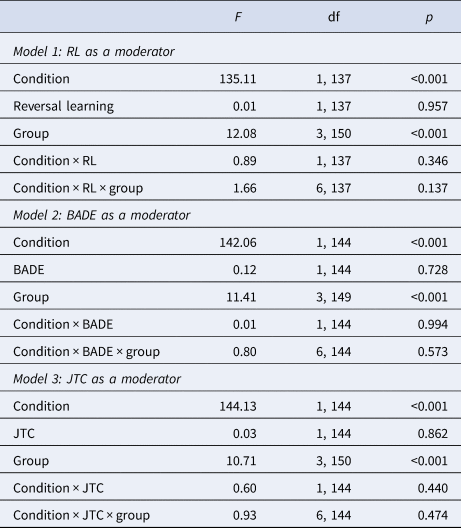
Table 3 shows the fixed effects of the moderated moderation analysis. None of the interaction effects (i.e. condition × RL, condition × BADE, condition × JTC) was significant and including group as a moderator did not affect these interaction effects. Hence, we rejected the hypothesis of moderated moderation.
Moderated moderation results

Df, df denominator, df numerator; RL, reversal learning; BADE, bias against disconfirmatory evidence; JTC, jumping to conclusions.
Additional analysis
The MLMs with condition order as a predictor (first the stress then the control condition v. first the control then the stress condition) showed that there was no order effect on any of the tested variables (i.e. subjective stress, paranoia, RL, BADE, JTC) (all p s > 0.05; see online Supplementary Material S4).
Discussion
Aiming to understand the processes involved in the development of paranoia, we focused on the ability to adapt beliefs, which we assumed to mediate or moderate the association between stress and paranoia. We found that paranoia was significantly higher in the stress than in the control condition, which is in line with a series of previous experimental studies (e.g. Kesting et al., Reference Kesting, Bredenpohl, Klenke, Westermann and Lincoln2013; Lincoln et al., Reference Lincoln, Peter, Schäfer and Moritz2009; Veling et al., Reference Veling, Pot-Kolder, Counotte, Van Os and Van Der Gaag2016). However, neither RL nor BADE or JTC were sensitive to stress. Thus, our results do not support the assumed mediating mechanism between stress and paranoia. Furthermore, RL, BADE, and JTC did not potentiate the association between stress and paranoia, so that we also rejected the hypothesis of a moderating mechanism.
Considering that a deteriorating effect of stress on decision-making and cognitive flexibility has often been found in healthy samples (for an overview, see Shields, Reference Shields2020; Shields, Sazma, & Yonelinas, Reference Shields, Sazma and Yonelinas2016), the absence of an overall effect of stress on adapting of beliefs was surprising. However, previous findings in this domain have been heterogeneous with the differences in results possibly being attributable to various aspects of study designs, such as the stressor used, the procedure, or different sample characteristics. In particular, while in our study we used a well-evaluated social stressor that reliably triggers stress, previous studies have used other stressors, such as the cold pressor task that could potentially differently impact the stress axis and cognitive performance. Moreover, using different scales to assess subjective stress across the studies further contributes to the limited comparability in this research field. Furthermore, Shields (Reference Shields2020) emphasizes the importance of limiting the design to few cognitive tasks to avoid cognitive fatigue which could confound with the effects of stress. Although the present study fulfills many of the recently published Shield's criteria for conducting stress research (e.g. the application of a validated stressor, ensuring that the stress manipulation was successful), definite conclusions regarding the extent to which the process of adapting of beliefs is sensitive to stress will require further evidence accumulation from studies that adhere to the guideline. Moreover, in future, special attention should be given to forming a consensus on paradigms measuring adapting of beliefs, given that up until now, RL, BADE, and JTC have been administered and scored in various ways, which further contributes to the heterogeneity of results and limits their comparability. This shortcoming applies to the present study as well – although our RL and BADE tasks were strongly based on previously published tasks, they diverge in some characteristics, such as number of tasks and used stimuli.
Given the absence of an overall effect of stress on adapting of beliefs, one could assume that the effect would nevertheless become apparent in the PSY group (moderated mediation). However, although several studies with participants with psychosis and those vulnerable to psychosis found cognitive biases to be sensitive to stress (e.g. Ellett et al., Reference Ellett, Freeman and Garety2008; Lincoln et al., Reference Lincoln, Lange, Burau, Exner and Moritz2010; Moritz et al., Reference Moritz, Burnette, Sperber, Köther, Hagemann-Goebel, Hartmann and Lincoln2011; Moritz, Köther, Hartmann, & Lincoln, Reference Moritz, Köther, Hartmann and Lincoln2015), the findings from our study align with a second group of studies that did not confirm this effect: For example, in an experience sampling study with patients with psychosis, Lüdtke et al. (Reference Lüdtke, Kriston, Schröder, Lincoln and Moritz2017) found JTC not to be affected by anxiety and therefore, not to act as a mediator for the effect of anxiety on paranoia. Similarly, in a sample of students with varying psychosis vulnerability, Lincoln et al. (Reference Lincoln, Peter, Schäfer and Moritz2009) found JTC not to be affected when noise stress was induced. Again, the heterogeneity of findings is challenging to interpret and is likely to result from differences in the study designs. For instance, previous studies have applied a variety of stressors, deployed varying samples ranging from undergraduate students to patients with remitted or acute psychosis, some studies used a control group and some did not, and in some studies, the putative effects have been examined in within-subject designs, whilst others applied between-subject designs. Therefore, we urge researchers to adhere to the Shields guideline when inducing stress in future studies. Moreover, the majority of aforementioned studies investigated the impact of stress on JTC only. The present study design is comparatively stronger as we used a wider range of belief adapting paradigms, including the established RL paradigm, several samples that reflect the range of psychotic severity and a validated, social-evaluative stressor (i.e. TSST), which – in our view – gives some weight to our finding that adapting of beliefs neither mediated nor moderated the effect of stress on paranoia.
Potentially, other cognitive facets related to information processing (i.e. encoding, storage, and retrieval and manipulation of information) that were not investigated in this study might be more relevant than adapting of beliefs. Specifically, Pot-Kolder, Veling, Counotte, and Van Der Gaag (Reference Pot-Kolder, Veling, Counotte and Van Der Gaag2018) recently found that attention biases were more relevant to the emergence of paranoia than decision-making biases. Possibly, acute stress activates attention biases that in turn activate a threat-monitoring system, as has been found for symptoms of anxiety and stress-related disorders (Shechner & Bar-Haim, Reference Shechner and Bar-Haim2016). Once such threat-monitoring system has been activated, maladaptive schemas (i.e. negative beliefs about the self and others) that have been found to be prevalent in individuals prone to psychosis, could provide the basis for paranoid interpretations (Jaya, Ascone, & Lincoln, Reference Jaya, Ascone and Lincoln2017; Sundag, Ascone, de Matos Marques, Moritz, & Lincoln, Reference Sundag, Ascone, de Matos Marques, Moritz and Lincoln2016). At the same time, difficulties in reversal learning that we found to be independent of stress could potentiate such paranoid interpretations by limiting learning from feedback in relevant situations. Hence, although our results suggest that difficulties in adapting of beliefs do not get triggered under stress, these seem to be present in patients with psychosis in general and could play a role in promoting paranoid interpretations.
Some additional findings warrant further discussion: The PSY group showed lower performance in RL than the comparison groups, which is in line with previous findings (Murray et al., Reference Murray, Cheng, Clark, Barnett, Blackwell, Fletcher and Jones2008; Reddy et al., Reference Reddy, Waltz, Green, Wynn and Horan2016; Schlagenhauf et al., Reference Schlagenhauf, Huys, Deserno, Rapp, Beck, Heinze and Heinz2014; Waltz & Gold, Reference Waltz and Gold2007). This result should also be interpreted in the light of the psychosis continuum. In line with Humpston et al. (Reference Humpston, Evans, Teufel, Ihssen and Linden2017), who examined RL deficits in individuals with high schizotypy, the group with attenuated symptoms in our sample did not show any deficits in RL. This could indicate that the deficits in RL exacerbate only later in the course of disorder development and cannot serve as a marker of vulnerability. Surprisingly, however, we found no group differences for BADE and JTC, contradicting the findings from the bulk of previous work (for a review on BADE, see Eisenacher & Zink, Reference Eisenacher and Zink2017; for a meta-analysis on JTC, see Dudley et al., Reference Dudley, Taylor, Wickham and Hutton2016). Nevertheless, several recent studies also failed to replicate deficits in JTC in psychosis (Pytlik et al., Reference Pytlik, Soll, Hesse, Moritz, Bechdolf, Herrlich and Mehl2020; Moritz et al., Reference Moritz, Scheunemann, Lüdtke, Westermann, Pfuhl, Balzan and Andreou2020). Similar to Pytlik et al. (Reference Pytlik, Soll, Hesse, Moritz, Bechdolf, Herrlich and Mehl2020), the present study had a 99% power to detect the effect found in Dudley et al. (Reference Dudley, Taylor, Wickham and Hutton2016) (Hedges g = 0.52), rendering a β-error unlikely. Although the reasons for these diverging results remain unclear, both Pytlik et al. (Reference Pytlik, Soll, Hesse, Moritz, Bechdolf, Herrlich and Mehl2020) and Moritz et al. (Reference Moritz, Scheunemann, Lüdtke, Westermann, Pfuhl, Balzan and Andreou2020) highlight that the specifics of the paradigms used may offer an explanation. Such paradigms specifics include, for instance, the analysis of the probabilities of a correct decision based on the specific information sequence as well as misunderstandings of the instructions of the cognitive bias tasks (see Balzan, Delfabbro, & Galletly, Reference Balzan, Delfabbro and Galletly2012). As discussed in the review by Eisenacher and Zink (Reference Eisenacher and Zink2017), similar methodological shortcomings could be a reason for heterogeneous results with regard to BADE, such as different number of items used across the studies, or varying manners of paradigm scoring. For this reason, we opted for a standard scoring of BADE and RL tasks and at the same time we recognize the need for sound psychometric research and recommendations for scoring of adapting of beliefs paradigms.
Several limitations of our study need to be discussed. One is that the stress induction took place before rather than during the RL and BADE tasks. Thus, the effect of stress may have already been wearing off when participants were completing the belief adaptation tasks. However, this is unlikely to sufficiently explain the non-significant result as previous studies have applied similarly short stressors or even stressors that are considered to be weaker (e.g. noise) and nevertheless found the effect of stress on the subsequent cognitive tasks (in psychosis samples: e.g. Keefe & Warman, Reference Keefe and Warman2011; Lincoln et al., Reference Lincoln, Lange, Burau, Exner and Moritz2010; Moritz et al., Reference Moritz, Köther, Hartmann and Lincoln2015; in general population: Shields et al., Reference Shields, Sazma and Yonelinas2016). Another issue regards the characteristics of our sample and its representability: the PSY individuals who successfully participated in this demanding study may have been healthier than typical psychosis samples, which could, in turn, explain why their performance in JTC and BADE was comparable to the HC group. However, the PANSS positive mean score, which is associated with BADE and JTC performance (Zhu, Sun, & So, Reference Zhu, Sun and So2017), approximately corresponded to the mean found in a large-scale, heterogeneous sample of psychosis in- and out-patients from 25 countries and 29 research centers (M = 14.81, s.d. = 6.22) (Fountoulakis et al., Reference Fountoulakis, Dragiot, Thofilidis, Wikilund, Atmatzidis, Nimatoudis and De Hert2019), so it is unlikely that these sample characteristics were a source of bias. Finally, the AS group recruited for this study does not represent a high-risk group but rather a group of individuals with elevated psychosis-like experiences.
Taken together, our study questions the relevance of adapting of beliefs for the path from stress to paranoia and suggest that improving adapting of beliefs under stress would not lead to a beneficial effect. Nevertheless, general deficits in reversal learning in psychosis patients found in our study can be interpreted as further evidence for the importance of targeting reasoning processes in psychosis patients.
Supplementary material
The supplementary material for this article can be found at https://doi.org/10.1017/S0033291721003524
Acknowledgements
We thank all participants and student assistants, who supported this study.
Financial support
Financial support for this study was provided by Landesforschungsförderung Hamburg (grant number LFF-FV38).
Conflict of interest
None.