


Introduction
Social anxiety disorder (SAD) is defined as a marked and persistent fear of social interaction/social performance situations. People suffering from SAD fear that they will act in a manner that will incur embarrassment or humiliation (APA, 2000).
More than 13% of the population meet the diagnostic criteria for SAD at some point in their lives (Kessler et al. 1994). Social anxiety is a relatively recent diagnosis (APA, 1980, 2000), and up to 40% of the general population describes itself as ‘shy’ (Zimbardo et al. Reference Zimbardo, Haney, Banks, Jaffe and Rubin1974). SAD had not been defined until recently, and it was previously described as the ‘neglected’ anxiety disorder (Liebowitz et al. Reference Liebowitz, Gorman, Fyer and Klein1985). However, in recent years, the prevalence and treatment of SAD has increased markedly [e.g. medication, cognitive behavioural therapy (CBT) both with and without medication]; CBT is considered an effective treatment (NICE, 2011).
The present study demonstrates the changes in ‘picturing of self’ (to which SAD individuals pay attention and project on themselves) through the course of CBT, mainly the Clark & Wells (Reference Clark, Wells, Heimberg, Liebowitz, Hope and Schneier1995) model for SAD. In this report, sessions involved a 50-min individual CBT psychotherapy and completion of a self-rating scale prior to the session; additionally, one patient completed a human figure drawing task after the session, and another used the brief video-taped feedback in one of the sessions. The two patients underwent 12 or 13 sessions on a once a week basis at an outpatient psychiatric clinic in Japan. In addition, the standard CBT homework between sessions was assigned collaboratively.
Human figure drawing is an instrument for measuring psychopathology, as the drawings provide a glimpse into the individual's state of mind. Drawings can be seen as a measure of an individual in relation to the world and others: ‘in general terms, the drawing of the person represents the expression of self, or the body, in the environment’ (Anderson & Anderson, 1951, p. 348). Human figure drawing in the clinical setting was initially conceptualized as the Draw-A-Man (DAM) test by Goodenough-Harris (Reference Goodenough-Harris1926). Machover (Reference Machover1949/1953) designed the Draw-A-Person (DAP) test.
The aim of the present study was to describe the ‘picturing of self’ procedure and assess the effect on SAD symptoms (e.g. ‘picturing of self’) within the context of CBT.
Methods
The present study demonstrates the changes in ‘picturing of self’ in two cases; for one case, a brief video feedback (VF) was used, and a projective drawing was used in the other. The CBT used for the treatment was based on the Clark & Wells (Reference Clark, Wells, Heimberg, Liebowitz, Hope and Schneier1995) model with modifications.
Measurements
Several self-rating questionnaires and structured diagnostic interviews [M.I.N.I (Sheehan et al. 1995) and SCID-I (First et al. Reference First, Spitzer, Gibbon and Williams1997)] were administered to aid in the assessment, diagnosis, conceptualization, and CBT in both patients (cases A and B). The participants completed the four self-rating scales prior to the individual sessions, and these were used to monitor outcomes, which are described below.
Liebowitz Social Anxiety Scale (LSAS). The LSAS (Liebowitz, Reference Liebowitz1987) is a 24-item self-report that examines the impact of social anxiety on various areas of life. The LSAS contains 24 situations, and respondents indicate on a 4-point scale the degree of anxiety experienced in each social situation. Each item is rated separately for fear (0 = none, 3 = severe) and avoidance behaviour (0 = never, 3 = usually). The research recommends a cut-off point of 30. Higher scores indicate a greater fear of social interaction (Heimberg et al. 1992).
Social Phobia Inventory (SPIN). Another SAD-related scale, SPIN (Connor et al. Reference Connor, Davidson, Churchill, Sherwood, Foa and Weisler2000) was implemented. This questionnaire is a 17-item self-report measure designed to examine the presence and severity of fear, avoidance, and physiological symptoms of anxiety associated with SAD. All items are rated on a 5-point scale (0 = not at all, 4 = extremely) where respondents indicate the frequency at which they experience physiological, cognitive, and behavioural aspects of social anxiety across a range of situations (Connor et al. Reference Connor, Davidson, Churchill, Sherwood, Foa and Weisler2000). Again, higher scores correspond to a greater level of anxiety of. A difference score is calculated by subtracting the agoraphobia subscale from the social phobia subscale, with a difference score of ≥60, indicating possible SAD (Turner et al. 1989).
Generalized Anxiety Disorder Questionnaire (GAD-7). The GAD-7 (Spitzer et al. Reference Spitzer, Kroenke, Williams and Lowe2006) is a 7-item self-report measure of the rate of anxiety. Items are rated on a 4-point scale ranging from 0 (not at all) to 3 (nearly every day).
Patient Health Questionnaire (PHQ-9). The PHQ-9 (Spitzer et al. Reference Spitzer, Kroenke and Williams1999) is a 9-item self-report measure of depression associated with DSM-IV-TR (APA, 2000) criteria. Items are rated on a 4-point scale ranging from 0 (not at all) to 3 (nearly every day).
Human figure drawing (e.g. DAM test/DAP test). An additional measure, human figure drawing (e.g. DAM test/DAP test), was used for projective drawing in case B. Human figure drawing is instructed simply by: ‘please draw a person on an 8.5 × 10.0 inch sheet of a blank paper with a pencil’.
The DAP test was initially developed by Machover (Reference Machover1949), to assess children's intelligence; however, in addition to measuring intelligence, the test is a source of rich clinical information, and can be used as a means of uncovering a client's attributes that cannot be verbally expressed. The original scoring was devised by Machover (Reference Machover1949), and Machover (Reference Machover1949) and Koppitz (Reference Koppitz1968) stipulated ways to analyse drawings from an emotional perspective. It is thought to be a useful diagnostic tool for identifying psychological problems (e.g. uneasiness), and it is now widely used in psychological testing. Further, the test is believed to effectively evoke anxieties, impulses, conflicts, and compensations characteristic of an individual (Gillespie, Reference Gillespie1994).
The guidelines for interpretation of projective drawing are as follows. The head is thought to represent the client's thoughts and emotions regarding their self-image, their projected perception of the outer world, and the aspects of their life, which collectively dictates their adaptation to the social world. The mouth, reflects the client's emotional experiences and their knowledge (e.g. knowing, the ability to learn) of actuality/reality.
Sahaku (Reference Sahaku1991) emphasized the drawing process as, ‘when people are drawing, people are creating a new means to it, or trying to examine the means of it’ (p. 46). Further, Sahaku (Reference Sahaku1991) noted that ‘to picture/draw it changes in the self, and changes of self would become a tool for wanting to draw a distinction drawing, and it is a process of changing’ (p. 46) and implied that the drawing process has the potential to change the person/patient.
Thus the drawing process might represent an intervention, as clients are able to express their feelings and perceptions regarding their inner and outer world. However, in this case it was only used for measurement purposes. It enabled the therapist to understand better the inner and outer world of Aya (case B) and how she had progressed/changed following CBT treatment.
The instruction given was simply ‘please draw a person’, and no limitations were imposed. The materials provided were an 8.5 × 10.0 inch sheet of blank white paper and a pencil.
Through the course of the CBT psychotherapy, we evaluated how the figure changed based on certain criteria (e.g. a doll-like figure vs. more human-like figure; the degree of shading, which can reflect anxiety levels; presence of facial features such as eyes and mouth, which represent the patient's relationship with the social environment).
Cases
Case A (Jun) was a 26-year-old unmarried male, and case B (Aya) was a 26-year-old unmarried female. The patients’ names have been changed to protect their identities.
Case A
Case summary and problems
Jun was a 26-year-old unmarried Japanese male who developed social anxiety 4 years ago, but was doing well until he reached the age of 26. He indicated that he was afraid of being negatively evaluated, and this prevented him from fully concentrating at work. His symptoms of SAD rendered him unable to continue his former job, causing him to resign and join his present company. After switching jobs, his symptoms improved until he was in charge of a new project. He was free of medication before and throughout the CBT sessions.
CBT consisted of 12 weekly 60-min individual sessions using the Clark & Wells (Reference Clark, Wells, Heimberg, Liebowitz, Hope and Schneier1995) model. The CBT included homework between individual sessions. To reduce Jun's fear of how he was picturing himself, one brief VF session was conducted within the session. The goal for Jun was to help him to work in front of others while he was on his PC without being anxious of how he might be perceived and to be able to express his opinions without fear or hesitation.
History
Jun's medical history prior to the study was uneventful.
Case assessment
Jun was diagnosed with SAD using SCID-I. He had not been treated for his anxiety with any medication and did not receive pharmacological treatment throughout this study. Jun had been working for an information technology company as an engineer for 3 years. His previous employment was with a similar company where he had also worked as an engineer. His highest academic qualification was attending a professional school for information technology after high school. He was born as a third son and lived with his parents. His main hobby was watching foreign drama programmes (e.g. Flash Forward) on TV. Jun did not present any serious social or economic problems at the beginning of the CBT therapy.
Case B
Case summary
Aya was a 26-year-old unmarried Japanese female. She had been experiencing social anxiety and panic disorder for 3 years. Before undergoing CBT, she was prescribed antidepressant (selective serotonin reuptake inhibitor; SSRI) medication to combat her anxiety of panic. She received CBT administered in 13 weekly 60-min individual therapy sessions. The goals for her treatment were to reduce anxiety in an attempt to reduce her safety behaviours (the amount of preparation she thought she needed to present a new proposal requested by her supervisor); and to participate in social gatherings without feeling overly anxious.
At the time of the CBT sessions, Aya was feeling extremely sensitive about her supervisor's evaluations. She worried about participating in social gatherings with her colleagues, which she usually avoided, and shunned conversations with others, often resorting to drinking, which resulted in her attending hospital for acute alcohol intoxication on one occasion. Her symptoms increased gradually and she developed a strong belief that ‘if she did not fulfil her supervisor's demands on time, she would be fired’. Aya pictured herself as a worthless person and avoided interacting with others.
The SAD symptoms became even more severe after one of her colleagues was fired from her company.
History
Aya's medical history was uneventful until the age of 23 years, at which point she came to the clinic because of intense feelings of panic and depression. She gradually began to experience difficulties in interacting with co-workers and her supervisor. Aya was prescribed antidepressant medication (sertraline hydrochloride, 50 mg/day), which she continued throughout the CBT sessions. Apart from the medication, Aya was also treated with interpersonal therapy for depression. She eventually gained control over her depression symptoms, but her anxiety in social situations remained.
Case assessment
After referral for CBT therapy, Aya was diagnosed with SAD and panic disorder via the M.I.N.I. She had been treated with 50 mg/day sertraline hydrochloride prior to and throughout the CBT sessions. Aya had been working for a natural cosmetic company as an office worker. Her highest academic qualification consisted of an undergraduate degree from art school. After graduating, she attended a professional computer school. She lived with her parents and her brother. Her hobbies were watching anime, contributing to fanzines, and socializing with close friends. Aya presented no serious social or economic problems at the beginning of the CBT sessions.
Ethics and dissemination
This study was conducted at an outpatient clinic in Japan. The study protocol was approved by the Institutional Review Board of Chiba University Hospital. The participants were informed of the objectives of the study and were asked if they would be willing to participate. Each patient was informed that participation was voluntary and that full anonymity would be provided. Each person was then required to provide written informed consent.
Therapist details
The therapist was a Japanese counsellor who was in her first year of a CBT training programme at Chiba University [Chiba Improving Access to Psychological Therapy (IAPT) training course] (Kobori et al. Reference Kobori, Nakazato, Yoshinaga, Shiraishi, Takaoka, Nakagawa, Iyo and Shimizu2014). Weekly supervision was provided, and the therapist had to provide case reports together with Manual of the Revised Cognitive Therapy Scale (CTS-R) evaluation from the supervisors. The therapist attended weekly group supervision (60 min) sessions and fortnightly individual supervision (30 min) sessions.
Intervention
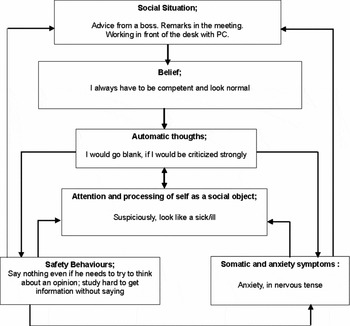
Both participants received psychoeducation and formulation for CBT, as well as cognitive restructuring. The behavioural modification using videotaped feedback was limited to case A (Fig. 1), and the cognitive modifications using metaphors and projective drawing were limited to case B.
Case formulation (case A, Jun).

Predictions of transition
Psychoeducation of CBT and formulation of SAD
Each patient was first provided psychoeducation as part of CBT that consisted of the following explanations: ‘Automatic thoughts that are self-focused lead to self-focused attention. These thoughts become distressing and repetitive due to the meaning people attach to them. In people with SAD, such thoughts can induce a negative self-image and feeling of anxiety. Such behaviours reinforce the way people think and feel.’ Both patients were asked to list the situations they were anxious about regarding self-focused attention.
Case A: Jun listed the following:
-
(1) Whether another person thought he was as a fool.
-
(2) Whether he looked foolish.
-
(3) Whether he might have said something wrong.
-
(4) Whether he looked strange (e.g. foolish, like a sick person) while having problems understanding a particularly difficult text on his PC.
-
(5) Whether he would be able to express an intelligent opinion.
The therapist and the patient collaboratively developed his case formulation (Fig. 1) based on his experiences. He had experienced social anxiety-related thoughts such as ‘What do I look like when I’m in front of the computer and not typing’, which led to ‘I look like a strange or ill person’. In a later section this will be tested. These interpretations led to discomfort and self-focused attention. These behaviours in turn reinforced his beliefs, depriving him of disconfirmation.
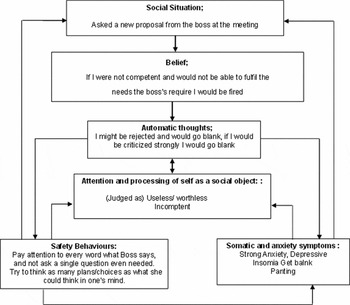
Case B: Aya's case formulation (Fig. 2) and trigger situations were as follows:
Case formulation (case B, Aya).

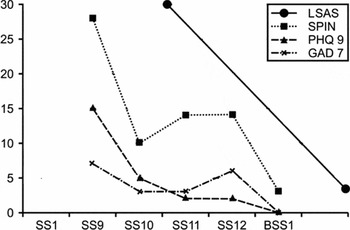
Scores of case A.

-
(1) Being asked to generate a new proposal by her supervisor at a meeting.
-
(2) Asking the supervisor a question or expressing her opinion to the CEO.
-
(3) Going to a social gathering (party).
In the above situations, Aya's automatic thoughts included the following: ‘If I am unable to fulfil my supervisor's demands (including what she thought the supervisor had implied), I will be in trouble or rejected or ‘I will lose my relationship’ with the belief that such rejection or relationship dissolution meant that she would be fired. These automatic thoughts evoked somatic symptoms such as heart palpitations and shaking hands. To avoid these symptoms, Aya resorted to safety behaviours such as the following:
-
(1) Generating as many ideas for a proposal as possible so as to be prepared for all eventualities.
-
(2) Paying attention to every word the supervisor says so that she will never have to ask a single question.
-
(3) Finding excuses to avoid social gatherings such as ‘I have an anime that I want to see on today's TV’, or if she did end up attending, drinking excessively to avoid communication/interaction with others.
-
(4) Not acknowledging her own feelings.
By engaging in her safety behaviours, Aya increased her self-focused attention (e.g. ‘I am useless, worthless, or incompetent’). Aya's safety behaviours in turn maintained her condition. She gradually became incapable of perceiving social cues from others.
Therapy sessions
The therapy sessions focused on the changes in ‘picturing of self’ in each case, with case A using brief VF, and case B using metaphors for A to B theory along with the human figure drawing.
Case A
Cognitive restructuring and the behavioural modification: videotaped feedback
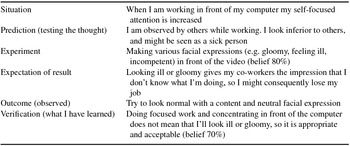
To challenge Jun's negative ‘picturing of self’ behaviour, a brief VF session was employed to help him visualize himself (see Table 1). Only the video image, not the audio, was provided as feedback to Jun.
Video feedback protocol (case A)

When an anxiety-provoking social situations emerged as he had predicted, he typically interpreted the situation in the following way:
-
(1) He felt uncertain about whether he was able to perform adequately and thought ‘I would appear as a fool or odd’.
-
(2) He thought that he was being ‘judged as a fool and that he would be humiliated in front of others’.
-
(3) He also thought that when he was having problems working on the computer, he would ‘appear as a strange or ill person’.
In order to change his beliefs, we examined the basis of his worries. Through discussion and behavioural modifications, he gained an understanding of his beliefs and challenged them in front of the video. Since he had a negative self-image, we first recorded a video of Jun in front of a computer to show him what he really looked like. He made some faces to demonstrate what he thought he looked like. This VF experiment (Table 1) helped him to alter his ‘picturing of self’ and established an understanding that ‘another person would not see him as a fool even if he took time reading a challenging text’ (e.g. complicated or novel engineering information). He also used the columns and A to B theory to resurrect his thoughts.
Case B
In Aya's case, the projective drawing test was performed in addition, as she had graduated from an art school and was familiar with the act of drawing.
Cognitive experiments: metaphors of A to B theory
Aya was given a metaphor to challenge her belief: ‘I have to be always perfect, or otherwise I would be useless’. The metaphor was a marathon runner who had retire in the full marathon race because he/she had a pulled muscle. With the metaphor, A to B theory was applied in the session to reduce her fear of having to perform a task perfectly within a certain time-frame, illustrating that it does not mean a person is useless.
Projective drawing
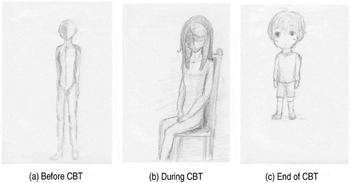
The projective drawing test was given to the patient with the instruction ‘please draw a person’, without any time limitations being imposed. The materials provided were 8.5 × 10.0 inch sheets of blank white paper and a pencil. The drawing was interpreted with emphasis on no facial features (e.g. eyes, mouth) of the figure, which represents the patient's relationship with the social world, i.e. avoidance and refusal to relate to the world; and the amount of shading, which correlates with anxiety levels.
Before the CBT psychotherapy, Aya continued to draw inorganic doll-like figures (Fig. 4 a). However, after receiving the 13 sessions, she drew a human figure (Fig. 4 b). Initially, she drew a shivering figure that was sitting on the ground, but she did not give us the permission to use the drawing, so instead the small child-like figure (Fig. 4 c) was used. The initial drawing represents her being in this world without her safety behaviours, and experiencing the real world.
Projective drawing (Draw-a-Person test) by case B (Aya). (a) Before CBT, (b) during CBT, (c) at the end of CBT.

Discussion about excessively high standards for social performance and fear
During her therapy sessions, we discovered her high standard for social performance (e.g. ‘I always have to be competent regardless of what the supervisor's request is’). She was afraid that if she was unable to fulfil the supervisor's demands, she would be fired. These beliefs of anxieties were so strong that we used ‘thought experiments’ to challenge her cognition. She was offered the following metaphors; ‘think about the Japanese football team that you expected [e.g. thought] to lose the match. Did it really lose the match as you had imagined?’ At that time, the football team was not expected to win, but it had won. She was also afraid of saying ‘I was not able to do it’. Another metaphor depicted a marathon runner retiring from a race. Runners are sometimes forced to retire from a race, but this does not mean that they have to stop being a runner. Taking a break/retiring from one race is not the end of being a runner, which refers to ceasing to be an office worker at the company. This metaphor was transferred to Aya's situation: ‘Even if you cannot do what the supervisor wanted on a specific day, it is only a small part of the job’, and this statement was used to change her negative thoughts/cognitions. When she felt a strong urge to fulfil every demand (safety behaviour) of her supervisor, due to anxiety she typically interpreted the experience as follows:
-
(1) She felt uncertain whether she could fulfil those demands, which she considered unbearable. She thought ‘I cannot bear the demands, but I have to accomplish them, otherwise I will be regarded as incompetent’.
-
(2) She thought ‘it would become a very bad situation [e.g. scolded, punished, fired, etc.] to renounce an assignment’.
-
(3) She tried to anticipate any upcoming demands (safety behaviour) by her supervisor in order to fully prepare, or ‘I will be in trouble’.
Treatment outcome
Effect of CBT for SAD
In case A, Jun's LSAS score decreased from 67 to 3 after 12 sessions, which corresponds to a normal score. Over 12 sessions, he had realized that he would not be perceived or evaluated in the way that he had imagined before CBT. Moreover, after the VF, Jun felt less anxious about how he might be perceived (e.g. ‘I do not need to worry, . . ., I look normal’).
For case B, Aya's LSAS score decreased from 85 to 40, and for 2 years since then she has not experienced a relapse. Her human figure drawings, gradually changed to reflect her changing perception of the environment, and the world figures she drew had changed from faceless objects into more human-like figures (Fig. 4). With regard to the relationship between shading and anxiety level, ‘the greater the shading the more intense is . . . anxiety’ and that on the face is thought to reflect ‘poor self-concept’ (Oster & Gould, Reference Oster and Gould1987, p. 24). Following CBT, the amount and the quality of shading changed. She had learned that ‘picturing of self’ is not what she had thought it was before CBT and understood that she was able to feel her emotions and do her work which she could not do before the CBT treatment.
Following the CBT sessions, the use of shading decreased. Moreover, she had learned that the way she had previously imagined herself prior to CBT psychotherapy was not accurate.
Discussion
The present study demonstrates that CBT effectively treated the self-focused attention and changed the aspect of ‘picturing of self’ over the course of the sessions. Reducing their engagement in safety behaviours allowed the patients to change their projected images of themselves. ‘Picturing of self’ was used in two different modalities, and in both cases it was an effective approach to observe the changes in cognition (Boschen & Curtis, Reference Boschen and Curtis2008).
Effect of CBT on ‘picturing of self’
Case A: VF
Case A's cognition changed as a result of viewing himself objectively using the (brief) VF (Clark, Reference Clark, Crozier and Alden2005). The brief VF session was the main reason for Jun's progress; although it was only conducted once during the entire CBT session, it allowed him the opportunity for self-reflection. The changes in SAD symptoms, such as decreased LSAS score, even in the booster sessions, indicate a continued improvement in SAD symptoms.
Jun's score on the SPIN, which is another measure of SAD, also showed a 50% reduction (from 28 to 14) points at the end of the CBT, and the booster session showed a further 3-point reduction, indicating treatment effectiveness. Further, scores on the PHQ-9 and GAD-7 decreased from 15 to 2, and 7 to 6 points, respectively. At the booster session, scores on both of the scales were 0 points. Thus, improvements following CBT were continuous and long lasting, persisting even a month after the CBT sessions ended.
With VF, the first phase is a cognitive preparation phase (Clark & Wells, Reference Clark, Wells, Heimberg, Liebowitz, Hope and Schneier1995); for Jun, this meant addressing the fact that he believed that if he were in front of the computer, but not typing, others would think critically of him (e.g. inferior, sick person). The second phase is an experimental procedural phase, which, for Jun, entailed him making various facial expressions (e.g. gloomy, feeling ill, incompetent) in front of the computer while being videotaped. In the third and final phase, the post-VF review/discussion phase, Jun looked at the video from an observer's perspective and verified whether the facial expressions were as had expected during the first phase or not. During the discussion, Jun stated, ‘concentrating in front of the computer or trying to understand a difficult issue does not mean [look] that I’ll look ill or gloomy; rather my facial expression seem appropriate and acceptable’. His ‘picturing of self ‘had changed through the brief VF. While the assessment strategy is the same, the VF used in the present study was brief compared to Clark's (Reference Clark, Crozier and Alden2005) original VF.
Jun's maladaptive belief was also tested and treated during the cognitive restructuring; however, for him the VF was more effective, because it allowed him to better understand the restructuring of automatic thoughts.
Through the course of CBT psychotherapy, he realized the irrationality of his predictions that he would not be able to perform adequately in social situations, that he would be humiliated in front of others, that he would appear strange and ill, and that his anxiety would be noticed by the others.
The brief VF experiment, which was only conducted once, gave Jun the confidence to perform in front of others without hesitation, and he became able to work in front of the computer without constant anxiety regarding what others might think of him. As SAD is directly linked to dependence on social standards and role expectations (Draguns & Tanaka-Matsumi, 2003), therapists sometimes need to challenge social norms in order to address patients’ maladaptive beliefs. The brief VF provided him with the means to perceive himself more objectively, and this was crucial because it made it easier for him to revise his automatic thoughts. The direct observation provided him with an immediate understanding and facilitated long-term behavioural changes; thus he became less hesitant when talking to others or expressing an opinion. As a result, his intrusive thoughts were no longer as distressing and repetitive.
There was no need for him to feel insecure when speaking to others. In addition, the cognitive restructuring challenged Jun's beliefs, which included intolerance of uncertainty and overestimation of threat. There was no need for him to feel insecure when speaking to others. His beliefs were modified through examination of probability and worst-case scenarios of anxiety-inducing situations. As a result, his intrusive thoughts were no longer as distressing and repetitive.
At the 9th session, cognitive restructuring using memory rescripting was given and from then his SPIN and PHQ-9 dropped effectively, although for Jun VF was pivotal in his progress, as he reflected after the treatment, stating, ‘I do not need to care about how others perceive me, and I look normal’.
CBT gave the patient greater insight that other people do not care as much about what he is saying or doing. Through VF, the patient learned that his concerns about visual appearance were unfounded. Thus, VF played a large part in improving his SAD cognitions and interpretations.
Case B: projective drawing
Following CBT, patient B's (Aya) projective drawing showed changes in the ‘picturing of self’ from a doll-like figure with no eyes, nose, or mouth to a human figure. Through the drawing, Aya's ‘picturing of self’ showed consistent avoidance of social content (Machover, Reference Machover1949). The human figure drawings showed the accompanying changes in her self-projection. Although Aya was still having a little anxiety in social situations after CBT, refraining from engaging in safety behaviours allowed her to confront the environment while acknowledging her feelings and emotions. The human figure drawings show the accompanying changes in her self-projection; patients are not told what the human figure drawing (e.g. projection/picturing of self) (Harris, Reference Harris1963).
Through restructuring modification, the therapist provided information to the patient so that she learned to interpret her intrusive thoughts with another perspective. Through increased self-recognition, she improved her sense of self-worth. Most of that information was new, perhaps because of the ‘lack of real world knowledge’ often observed in patients with SAD (Kingdon & Turkington, Reference Kingdon and Turkington1994).
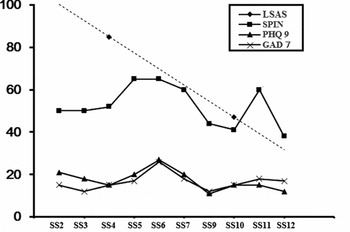
Through the measures, we found that CBT led to significant improvements in SAD symptoms. Her LSAS score decreased from 85 to 47 (Fig. 5); this assessment was only administered twice during the 12 sessions (sessions 4 and 10). The SPIN score decreased from 50 to 38. The PHQ-9 score decreased from 21 to 9 points, indicating a reduction in depressive symptoms, but the GAD-7 score, which measures anxiety, increased from 15 to 17. Thus, while her self-perception changed, this did not alleviate her anxiety.
Measures of SAD in case B. Time-course of different scores as a function of therapy sessions (2–12). Note that the LSAS score was obtained at only two time-points (sessions 4 and 10).

The main symptoms of SAD decreased following CBT and the patient was subsequently able to perform in social settings while experiencing only a little anxiety; this change was reflected in the human figure drawing (e.g. shivering and sitting outside), but the drawing also indicated that her recovery was not complete and more treatment was needed, as illustrated by the increased GAD-7 score. This increase may have been because the therapist was unable to successfully challenge her anxiety-provoking beliefs and was not able to use VF for Aya, as she refused to watch the video that was recorded.
The CBT sessions gradually changed her perception of the environment and also changed her rejection of the world, as indicated by the changes in her drawings. She became more open and able to relate to others. The figures she drew had changed from faceless objects into more human-like figures (Fig. 4). Excessive fear made it impossible for her to consider alternative ways of thinking and precluded her from learning through day-to-day living.
Moreover, while VF was suggested, Aya refused to watch herself on the video; however, VF might have allowed her to fully change her belief and reduce her anxiety.
Sahaku (Reference Sahaku1991) places emphasis on the process of drawing itself as ‘when people are drawing, people are creating a new means to it, or trying to examine the means to it’. In addition, Sahaku (Reference Sahaku1991) states that ‘to picture/draw, it changes in the self, and changes of self would become a tool to want to draw a distinction drawing, and it is a process of changing’ and this might enable an individual to change a maladaptive belief.
Similarities and differences
One similarity between the two methods (VF and the projective drawing of ‘picturing of self’) is that they both use projection and self-evaluation to enable patients to perceive the irrationality of their automatic thoughts.
One difference is that, in VF, an imagery/projection of self-perception is used to help the patient reach a conclusion that can be verbally conveyed. By contrast, the drawing method is not verbal, but allows patients to express themselves in ways that cannot be verbally conveyed (Sahaku, Reference Sahaku1991).
Another difference is that, with VF, the patient knows that it is him/herself in the video. VF (Boschen & Curtis, Reference Boschen and Curtis2008) enables patients to see and examine themselves objectively, while the drawing method helps patients view emotions that might be difficult to verbalize and does not require complicated operations, such as sentence formulation (Iwai, Reference Iwai1984).
A third difference is that the VF was conducted only once, while the projective drawing task/test was conducted after every session.
Finally, the present case study demonstrates that CBT had an effect on ‘picturing of self’, which can be regarded as self-projections of SAD. Helping the patients reduce their performance of safety behaviours allowed for changes in their projective images of themselves. ‘Picturing of self’ was used in two different modalities, and in both cases, it was an effective means of assessing their cognitions (Boschen & Curtis Reference Boschen and Curtis2008).
Memory phenomena associated with SAD have received increased attention following Clark & Wells (Reference Clark, Wells, Heimberg, Liebowitz, Hope and Schneier1995) publication. For example, it is suggested that typical SAD patients report less confidence with regard to how others perceive them and that they need more information to become comfortable with how they might be perceived by others (Hirsch et al. Reference Hirsch, Meynen and Clark2004). Decreased confidence with regard to their perceptions, judgement, and memory is also caused by SAD.
The present study has some limitations and suggests various future directions. First, since we were unable to obtain solid baseline data, it was not completely clear that the improvement was exclusively due to the CBT sessions. Second, it might have been advantageous to obtain additional information, such as through Kosslyn's Spontaneous Use of Imagery Questionnaire (Reisberg et al. Reference Reisberg, Pearson and Kosslyn2003) to see if the images of mental imagery would had been high for these patients. Third, since the study was limited to a stable outpatient population, an understanding of SAD and its treatment in a larger clinical population is still essential. Finally, we performed weekly, individualized therapy; and the human figure drawings were limited to one case therefore, the effectiveness with other patients needs to be examined.
Summary
This is a study of two cases, one using VF to make the change of ‘picturing of self’, and the other using human figure drawing to see the changes in ‘picturing of self’. The CBT used for the treatment was based on the Clark & Wells (Reference Clark, Wells, Heimberg, Liebowitz, Hope and Schneier1995) model with modifications.
Acknowledgements
The authors thank Dr Eiji Shimizu and Chiba IAPT for their great help in providing CBT to the two patients.
Declaration of Interest
None.
Ethical standards
The study was conducted in accordance with the ethical standards of the 1964 Declaration of Helsinki. Participants were informed of the objectives the study and asked if they were willing to participate. Each participant was informed that participation was voluntary and that full anonymity would be provided. Participants provided written informed consent for their participation in this study.
-
(1) VF is effective and will be more effective with individuals who are a sight-dominant.
-
(2) Providing SAD individual CBT cases of the two Japanese individuals fully involved in work.
-
(3) Show the changes of picturing of self/self-focused attention of SAD through the human figure.



Comments
No Comments have been published for this article.