Building vocabulary is a basic and essential part of language learning. Although vocabulary can be learned intentionally, researchers point out the importance of incidental, contextual vocabulary learning in reaching the high vocabulary targets necessary to function in a first (L1) or second (L2) language (e.g., Nagy, Herman & Anderson, Reference Nagy, Herman and Anderson1985; Nation, Reference Nation2013). Research examining incidental vocabulary learning during L2 reading has focused on the effect of exposure frequency (e.g., Horst, Cobb & Meara, Reference Horst, Cobb and Meara1998; Pellicer-Sánchez & Schmitt, Reference Schmitt2010; Rott, Reference Rott1999; Webb, Reference Webb2007; Zahar, Cobb & Spada, Reference Zahar, Cobb and Spada2001) and provided detailed analyses of different aspects of lexical knowledge (e.g., Elgort & Warren, Reference Elgort and Warren2014; Horst et al., Reference Horst, Cobb and Meara1998; Pellicer-Sánchez & Schmitt, Reference Schmitt2010; Webb, Reference Webb2007). However, these studies concerned themselves with learning outcomes, captured in vocabulary test scores, and not the cognitive processes that enable incidental learning. In addition, most of these studies used short texts, which may not be an accurate representation of incidental learning (i.e., through prolonged exposure) in naturalistic contexts. The purpose of the present study is thus twofold. First, we aim to track the effect of repeated exposure to unknown words in learners’ eye-movement patterns while the participants are reading five chapters of an English novel. Second, we combine offline (i.e., test scores) and online (i.e., eye-movement) measures to relate L2 learners’ acquisition of different components of vocabulary knowledge to their reading behavior.
Incidental L2 vocabulary acquisition from reading
Reading has long been considered an important source for vocabulary learning (e.g., Krashen, Reference Krashen1989; Nagy, Anderson & Herman, Reference Nagy, Anderson and Herman1987; Nagy et al., Reference Nagy, Herman and Anderson1985; Saragi, Nation & Meister, Reference Saragi, Nation and Meister1978). Although there has been some debate about how to define incidental learning, in this study we operationalize the construct methodologically, as learning that occurs in the context of a meaning-focused activity when participants are not forewarned about a vocabulary post-test (Hulstijn, Reference Hulstijn, Doughty and Long2003). In this view, incidental learning occurs “as a by-product of language usage” (Schmitt, Reference Schmitt2010, p. 29). Importantly, an incidental learning context need not entail that learning as a cognitive process is also incidental (Bruton, López & Mesa, Reference Bruton, López and Mesa2011; Gass, Reference Gass1999; Hulstijn, Reference Hulstijn, Doughty and Long2003; Paribakht & Wesche, 1999). This is because both incidental and intentional learning involve attention and noticing (Hulstijn, Reference Hulstijn, Doughty and Long2003); that is, some degree of intentionality. Bruton and colleagues (2011) problematized the construct of incidental learning on the grounds that “there is no saying what any one reader actually does at any one time, or over time” (p. 760). In this study, we argue that it is possible to obtain insight into what readers do when they encounter new words during reading provided the right methodological tools are used.
While it is widely accepted that vocabulary can be acquired incidentally from reading, studies have shown varying results in the amount of vocabulary gains. For instance, Zahar et al. (Reference Zahar, Cobb and Spada2001) reported that high school and college ESL participants learned about 8% of the target words after reading a short story, whereas Horst (Reference Horst2005) reported that adult ESL learners enrolled in an extensive reading program acquired 50% of unfamiliar words after reading graded texts. One factor that contributes to the divergent findings about vocabulary gains is that researchers have used different vocabulary measures that measured a single, different subcomponent of vocabulary knowledge (form vs. form-meaning). A more comprehensive approach to measuring vocabulary knowledge that tests various levels of knowledge is therefore necessary (Nation & Webb, Reference Nation and Webb2011). Nation (Reference Nation2013) theorized vocabulary knowledge as a multidimensional construct, involving form, meaning, and use. As learners acquire additional knowledge of a word, depth of knowledge is said to increase (Schmitt, Reference Schmitt2014). In addition, it is possible to take a single aspect, such as meaning, and probe learners’ knowledge of that aspect at varying levels or depths. This is what Laufer, Elder, Hill, and Congdon (Reference Laufer, Elder, Hill and Congdon2004) and Laufer and Goldstein (Reference Laufer and Goldstein2004) did in two test validation studies. Laufer and colleagues compared four degrees of knowing form-meaning connections by combining recall/recognition test formats with two directions of testing, L1-L2 testing for active knowledge and L2-L1 testing for passive knowledge. The authors found word recall was more difficult than word recognition, and active recall of word form (e.g., L1 English brother → L2 Spanish hermano) was more difficult than passive recall of word meaning (e.g., L2 Spanish hermano → L1 English brother). These results and similar findings from reading research suggest that learners are faster at building up recognition than recall-level vocabulary knowledge (Mohamed, Reference Mohamed2017; Pellicer-Sánchez, Reference Pellicer-Sánchez2015; Pellicer-Sánchez & Schmitt, Reference Pellicer-Sánchez and Schmitt2010; Waring & Takaki, Reference Waring and Takaki2003; Webb, Reference Webb2007). More generally, the results underscore that vocabulary development is incremental; learners may need to encounter a word many times in different contexts (Frishkoff, Perfetti & Collins-Thompson, Reference Frishkoff, Perfetti and Collins-Thompson2011; Joseph, Wonnacott, Forbes & Nation, Reference Joseph, Wonnacott, Forbes and Nation2014) to gain complete knowledge of a word.
Encounter frequency (also called exposure frequency, occurrence frequency, or repetition) has indeed emerged as a robust predictor of incidental vocabulary learning (e.g., Elgort & Warren, Reference Elgort and Warren2014; Horst et al., Reference Horst, Cobb and Meara1998; Pellicer-Sánchez & Schmitt, Reference Pellicer-Sánchez and Schmitt2010; Pigada & Schmitt, Reference Pigada and Schmitt2006; Rott, Reference Rott1999; Saragi et al., Reference Saragi, Nation and Meister1978; Waring & Takaki, Reference Waring and Takaki2003; Webb, Reference Webb2007). Ellis (Reference Ellis and Ellis1994) and Nation (Reference Nation2013) argued that exposure frequency is particularly beneficial for strengthening word-form knowledge (i.e., spelling and pronunciation). In contrast, learning form-meaning connections may require a greater conscious involvement because it entails mapping two distinct information sources, namely form and meaning.
The question then remains how frequently a word must occur for it to be acquired. This question has been investigated primarily, but not exclusively for meaning acquisition, with varying results. Rott (Reference Rott1999) found that learners’ word-meaning retention was significantly higher after six exposures than after only two exposures. Horst et al. (Reference Horst, Cobb and Meara1998) and Waring and Takaki (Reference Waring and Takaki2003), however, suggested that at least eight word exposures are necessary in a single long text to promote meaning recognition and recall. Pellicer-Sánchez (Reference Pellicer-Sánchez2015) also found that after eight encounters L2 readers were able to read new words as fluently as matched, known words. Other researchers have suggested even higher estimates of 10 (Pellicer-Sánchez & Schmitt, Reference Pellicer-Sánchez and Schmitt2010; Pigada & Schmitt, Reference Pigada and Schmitt2006; Webb, Reference Webb2007) or 12+ encounters (Elgort & Warren, Reference Elgort and Warren2014). While an exact estimate may be elusive due to the role of word-, text-, and learner-related variables, these studies converge in showing that many exposures are needed for incidental vocabulary learning to result in robust lexical growth.
Enhancing ecological validity with long reading materials
The reading materials in the abovementioned studies have ranged from single sentences (Webb, Reference Webb2005) to entire novels (Pellicer-Sánchez & Schmitt, Reference Schmitt2010; Saragi et al., Reference Saragi, Nation and Meister1978), with most studies using short or modified texts. Elgort and Warren (Reference Elgort and Warren2014) pointed out that the paucity of incidental vocabulary acquisition research with long texts is problematic for reasons of ecological validity. Nonetheless, one line of research has pursued ecological validity and experimental control, using a so-called Clockwork Orange methodology (Horst et al., Reference Horst, Cobb and Meara1998). The methodology was named after an English novel by Anthony Burgess, A Clockwork Orange, which contains 241 Russian slang words that served as targets for vocabulary learning in an L1 (Saragi et al., Reference Saragi, Nation and Meister1978) and L2 reading study (Pitts, White & Krashen, Reference Pitts, White and Krashen1989). More generally, researchers who adopt A Clockwork Orange methodology study the incidental acquisition of foreign words embedded in a target-language novel. In so doing, they can use real words instead of pseudowords while making sure participants have no prior knowledge of the targets.
Pellicer-Sánchez and Schmitt (Reference Pellicer-Sánchez and Schmitt2010) tested L2 readers’ acquisition of spelling, word class, meaning recognition, and meaning recall from reading an unmodified authentic English novel, called Things Fall Apart, with Igbo words embedded in the approximately 67,000-word text. The authors found modest vocabulary learning, ranging from 14–43% of the target words, and a positive correlation with word frequency. Elgort and Warren (Reference Elgort and Warren2014) investigated gains in explicit and tacit knowledge of novel (pseudo-)words from reading the first 40,000 words of the authentic text Freakonomics. Results showed that exposure frequency was the strongest predictor for meaning recall (Elgort and Warren's explicit knowledge measure) but was unrelated to form priming and semantic priming (the tacit knowledge measures).
Promoting psycholinguistic precision through eye-movement recordings
Unlike comparisons of pre-test/post-test data, eye-movement recordings allow researchers to examine what is occurring during real-time processing by providing a behavioral measure of overt attention: the eye gaze (Godfroid & Uggen, Reference Godfroid and Uggen2013). In reading research, eye movements can reflect aspects of moment-to-moment processing that other psycholinguistic techniques, like self-paced reading, are not sensitive enough to track (Dussias, Reference Dussias2010; Frenck-Mestre, Reference Frenck-Mestre2005; Roberts, Reference Roberts2012). In addition, eye-tracking is advantageous because it involves a more natural form of reading with no secondary tasks (Dussias, Reference Dussias2010; Godfroid & Spino, Reference Godfroid and Spino2015) yet with a possibility to reread earlier parts of the text (Godfroid, Loewen, Jung, Park, Gass & Ellis, Reference Godfroid, Loewen, Jung, Park, Gass and Ellis2015; Metzner, von der Malsburg, Vasishth & Rösler, Reference Metzner, von der Malsburg, Vasishth and Rösler2016). Furthermore, with up to 1000 samples or snapshots of the eye per second, eye-movement recordings are a dense sampling method that compares favorably to other discrete laboratory methods in terms of ecological validity (Anderson, Chui, Huette & Spivey, Reference Anderson, Chiu, Huette and Spivey2011; Spivey & Cardon, Reference Spivey, Cardon and Schwieter2015).
Eye-movement studies on vocabulary acquisition have focused on whether the time spent processing unfamiliar words predicts word learning and, more recently, on the role of word repetition. With regard to the first question, Williams and Morris (Reference Williams and Morris2004) found that L1 readers spent more initial processing time on unfamiliar than familiar words while reading. Processing time correlated with novel-word meaning recognition, albeit negatively for an early processing measure (gaze duration) and positively for a late measure (second pass time). Wochna (Reference Wochna2012), whose study built on Williams and Morris's original design, did not replicate the association between reading times and meaning recognition. Using paragraphs rather than sentences, Godfroid, Boers, and Housen (Reference Godfroid, Boers and Housen2013) were the first to link total fixation time to increased gains in vocabulary learning in a sample of L2 learners. The authors showed that at test, learners were more likely to recognize target words in context when they had fixated on them longer while reading. Mohamed (Reference Mohamed2017) extended Godfroid et al.’s finding to meaning recognition and meaning recall. Mohamed also found learning different aspects of each word increased incrementally with frequency of exposure: the knowledge of form developed first, followed by meaning recognition, and then meaning recall. Pellicer-Sánchez (Reference Pellicer-Sánchez2015) observed similar learning patterns in a study of L1 and L2 English readers, although the difference between form and meaning recognition was not significant. Native speakers in Pellicer-Sánchez's study read the six novel (pseudo-) words faster than the non-native speakers; however, both groups’ reading times decreased similarly across repeated exposures, and both groups acquired the same amount of vocabulary from reading a 2,300-word story. Similar decreases in reading times were also found by Joseph et al. (Reference Joseph, Wonnacott, Forbes and Nation2014) in a study with L1 English speakers.
Outside the realm of vocabulary, but leading the way in terms of ecologically valid eye-tracking research, Cop, Drieghe, and Duyck (Reference Cop, Drieghe and Duyck2015) recorded Dutch–English bilinguals’ and English monolinguals’ eye movements as they read an Agatha Christie novel (approximately 52,000 English words and 56,000 Dutch words in the translation). The monolinguals read the novel in English, whereas the bilinguals read half of the novel in Dutch and the other half in English. Cop et al.’s sentence-level analysis revealed that L2 reading patterns mimicked child-L1 reading patterns (e.g., 20% slower sentence reading times), although differences in reading behavior between adult L2 and adult L1 readers were smaller than those between child L1 and adult L1 readers. Cop et al.’s approach lends itself well to studying incidental vocabulary acquisition, given that longer texts are more representative of the contexts in which such learning normally occurs.
In the present eye-tracking study, participants read five chapters of an authentic English novel with naturally embedded foreign words as a proxy of a real-life reading activity. Reading this novel is different from the texts used in the previous studies in at least three regards: first, the novel is longer (approximately 9,000 words) and provides participants with the opportunity for multiple exposures over a greater length of time. Second, the novel is authentic, meaning that it is a well-known piece of literature that was not written for pedagogical or research purposes. Finally, the novel contains naturally-occurring Farsi-Dari words that are integral to the plot's setting in Afghanistan and make the use of pseudo words or potentially known low-frequency target words redundant. We investigate the following empirical questions:
1. Do native and non-native speakers’ reading times for new vocabulary items change over repeated exposures to the target words?
2. Do eye-fixation measures and repeated exposures predict learning gains on three vocabulary tests?
Method
Participants
Participants in this study were 20 native speakers (NSs) and 41 non-native speakers (NNSs) of English. Seven participants (one NS and six NNSs) were excluded, primarily due to the unsuccessful calibration of the eye tracker. Thus, the final sample consisted of 19 NSs (17 females) and 35 NNSs (23 females). These participants were all students at a large Midwestern university in the United States. The NS participants (age range 19 to 23) were mostly undergraduate students enrolled in language teaching courses. The NNS participants (age range 17 to 35) were either undergraduate or graduate students pursuing 21 different academic specializations. They came from a variety of language backgrounds, but excluding L1 Dari and Farsi speakers, and also excluding speakers of languages with many Farsi-Dari cognates, namely L1 Arabic, Hindi, and Urdu speakers. The participants’ median length of residence in the U.S. was 1.25 years (M=2.91; SD=4.21). The NNS knew between 9,100 and 12,200 English word families (M=9,927.24; SD=1,637.21), as measured by the 14k Vocabulary Size Test (Nation & Beglar, Reference Nation and Beglar2007; www.lextutor.ca/tests/). This vocabulary size is reflective of an advanced English proficiency. For comparison, NNS Ph.D. students are estimated to possess a 9,000-word vocabulary (Nation, Reference Nation2012).
Materials
Reading material
The text used in this study is A Thousand Splendid Suns, a novel by Khaled Hosseini (Reference Hosseini2007). This novel is set in Afghanistan, and several Dari words (an Afghani dialect of Farsi), are embedded in the text to convey the foreign setting in which the story takes place. The words occurred throughout the text with differing frequencies, as dictated by the storyline. The Dari words made the novel a suitable candidate for A Clockwork Orange methodology; we selected this particular novel (rather than other English novels with foreign words) because we felt it was engaging and of an appropriate difficulty level. Scores from two readability indexes (Flesch reading ease = 81.92; Coh-Metrix L2 readability = 20.25) indicated the text commonly fit the grades 4–5 band of the index norms of the Common Core State Standards Initiative (2015) and thus supported our assessment of the novel. Participants read the first five chapters of the book (approximately 9,000 words) over two sessions, as this represents a typical amount of text that readers might read for pleasure in any one or two sessions (Nation, Reference Nation2013). Moreover, the first five chapters can be considered a comprehensive unit, introducing the plot to the reader and reaching a climax between the main characters from Part 1 of the novel.
The vocabulary used in the first five chapters was appropriate for the participants’ proficiency level. Previous research has shown that learners need to know approximately 98% of the words in a text in order to comprehend it and be able to guess new words from the context (Hu & Nation, Reference Hu and Nation2000; Laufer & Ravenhorst-Kalovski, Reference Laufer and Ravenhorst-Kalovski2010). Excluding the Dari words and proper nounsFootnote 1, a frequency analysis revealed 98.16% of the words in the five chapters were within the 9,000 most frequent words in the database (Range program, Reference program2007) and our participants demonstrated at least a 9,000-word vocabulary, as described above. These were considered adequate percentages to ensure participants’ comprehension.
An additional passage (200 words) was selected from chapter 16 of the same novel to familiarize participants with reading on the screen in the eye-tracking lab and to practice moving from one screen to the next. The practice passage was carefully selected so that it did not contain any target word and did not spoil the story.
Target words
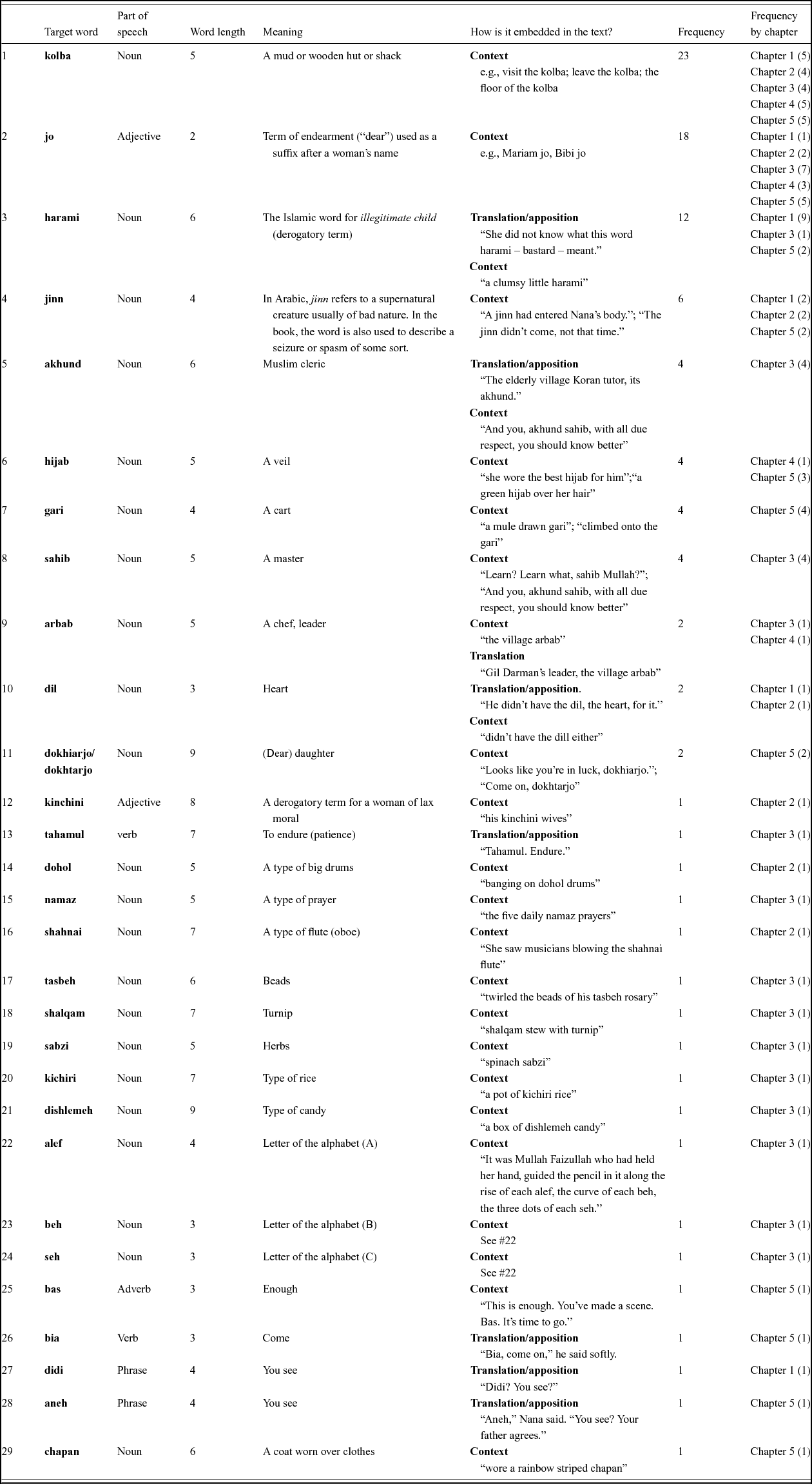
Target words were all the Dari words that occurred in the first five chapters, except for proper nouns. The number of exposures to these Dari words ranged from 1 to 23 with individual words occurring 1, 2, 4, 6, 12, 18, or 23 times. Most target words were nouns (k=22), but there were also two adjectives, one verb, one adverb, and three phrases. The mean length of target words was 5.2 letters (range: 2–9). A list of the 29 target words with a summary of their lexical and text characteristics is presented in Appendix A.
Comprehension posttest
A set of paper-based comprehension posttests (part 1 after Session 1 and part 2 after Session 2) were administered to measure participants’ reading comprehension and to encourage them to focus on meaning while reading. Participants were told beforehand they would answer comprehension questions after the reading. Each posttest contained 15 true/false statements, along with three answer options: “true”, “false”, and “I don't know.” The statements were carefully constructed to contain only plot-specific information. In addition, none of the target words were used in the statements. One point was assigned for correct answers, and zero points were given for incorrect or “I don't know” answers. The overall reliability coefficient (Cronbach's α) obtained for all participants was .81 for the 30 items. Reliability estimates by group were .74 for NSs and .84 for NNSs. This was considered to indicate good test reliability (Field, Reference Field2013).
Vocabulary tests
To measure participants’ vocabulary knowledge of the Dari words presented in the text, we administered three vocabulary tests: form recognition, meaning recall, and meaning recognition. Unlike the comprehension test, the vocabulary measures were surprise tests.
The form recognition test assessed learners’ ability to recognize the form of the Dari words encountered during reading. Participants were given a list of 60 Dari words after Session 2 and were asked to circle the words they remembered seeing in the text. The 29 target words were randomly mixed with 31 distractor Dari words taken from other chapters of the same novel. All target words in the list were treated as separate test items. We awarded one point to circled target words (hits) and zero points if the target words were not circled (misses). Because the data analysis was performed on a binary outcome variable (i.e., word recognized vs. word not recognized), we did not penalize for circling distractor words. Even so, we confirmed that the false positive rate was low, at 4.47% (2.68 distractors) for NSs and 4.90% (2.94 distractors) for NNSs. Overall test reliability was high, α = .83. The individual reliability estimates for NSs and NNSs were .77 and .85, respectively.
The meaning recall test assessed learners’ ability to retrieve the meaning of the target words they encountered. Participants were asked to provide an explanation or a translation of the 29 target words, presented in a list with no contextual support. The overall reliability coefficient was .76 for all 29 items and 54 participants, which was considered to be good. The individual reliability estimates for NS and NNS groups were .52 and .80, respectively.
The meaning recognition test assessed participants’ ability to recognize the correct meaning of the target words. Participants were asked to match each target word with one of four possible meanings, using a multiple choice format. They could also choose “I don't know”. Test items were carefully sequenced so that target words with similar meanings did not appear together. The distractor words sounded plausible in the context of the novel and were matched for part of speech with the target definitions. Some of the options were semantically related to the target word, others were only phonologically similar to the target word, and still others were completely unrelated. The overall reliability coefficient of the test for both groups was .73, which is considered acceptable. The individual reliability estimates for NS and NNS groups were .66 and .75, respectively.
For the meaning recall and meaning recognition tests, correct answers were given one point, and zero points were given for incorrect or “I don't know” answers.
Language background survey and post-experiment survey
Participants provided information about their language learning experiences in an online language background questionnaire. They also completed a post-experiment online survey. The survey items asked whether the participants had noticed the target words or tried to understand or memorize the words while reading.
Procedure
The NNS participants first took the 14k Vocabulary Size Test (Nation & Beglar, Reference Nation and Beglar2007) as a pre-screening measure, and only those with a 9,000+ vocabulary were invited to the study. We also ensured that no participant had read the novel before. Qualifying participants subsequently completed the online background questionnaire. Test takers who did not meet the eligibility criteria were given $5 for their time.
Participants in the main study met individually with one of the researchers in an eye-tracking laboratory for two 60- to 90-minute reading sessions on two consecutive days. Participants first signed a consent form. They then read the first five chapters of A Thousand Splendid Suns on a computer screen while their eye movements were recorded. On Day 1, the participants read chapters 1 to 3 and on Day 2, they read chapters 4 and 5. The participants were instructed to read at a normal pace and were informed there would be comprehension questions. After the reading session on Day 1, they completed the first part of the comprehension posttest. After the reading session on Day 2, they completed the three surprise vocabulary tests, the second part of the comprehension posttest, and an online post-experiment survey, in that order. To minimize response contamination from preceding vocabulary tests, the participants took the form recognition test first, followed by the meaning recall test, and finally the meaning recognition test.
The entire data collection, including the reading and testing sessions on both days, took approximately two hours for NSs and three hours for NNSs. Participants received $50 or extra course credit for completing both sessions.
Apparatus
Eye movements were recorded with an EyeLink 1000 desk-mounted eye-tracking camera sampling participants’ right eye at 1000 Hz (SR Research Ltd.; http://www.sr-research.com/). To enhance data recording quality, participants placed their head against a chin and forehead rest while they read the text on a computer monitor. The entire text was presented in regular Consolas font, size 18, double-spaced. At a 66 cm seating distance, one letter subtended 0.36 degrees of visual angle. The text was divided into 45 screens for Session 1 and 53 screens for Session 2, and each screen contained between five and twelve lines of text. The number of target words per screen ranged from zero to four, depending on how the Dari words were distributed in the original text. We controlled the words’ position on the screen to remove any associated measurement error from the data (e.g., Rayner, Reference Rayner1977): target words never occurred in the first or last line, as first or last word of a line, or as the first or last word in a sentence.
Participants moved from one screen to the next by pressing a controller button during reading. While they could reread text on the current screen, they could not go back to previous screens. A one-point calibration check (drift correction) was performed between text screens. The researcher recalibrated the eye tracker four times for Sessions 1 and 2 combined (approximately once every 18 screens) and more frequently if the calibration check indicated a need to recalibrate.
Statistical analysis
Research question 1
To answer the first research question, we provide both descriptive and statistical evidence of how NSs’ and NNSs’ reading times changed over time. We combine graphs (for all the target words) with inferential statistics (for a subset of target words) to examine whether the observed statistical effects generalize to the entire word set. In following this two-pronged approach, we provide a more robust answer to how repeated exposure affects reading times, while working within the constraints of a natural language, which, by nature, has a skewed distribution (Zipf, Reference Zipf1935). To elaborate, in a 9000-word unmodified text, only a limited number of target words occurs with sufficient frequency to be analyzed statistically; however, we can evaluate whether any statistically significant changes in reading times also occur in the complete set of target words through graphs and visual data inspection (Hudson, Reference Hudson and Plonsky2015; Larson-Hall, Reference Larson-Hall2017).
For the statistical analysis, we conducted separate eye-fixation analyses for the three most frequent target words – kolba, jo, and harami. The word kolba, meaning “hut”, occurred 23 times (Session 1: 13 times; Session 2: 10 times); jo, meaning “dear”, occurred 18 times (Session 1: 10 times; Session 2: 8 times); and harami, a derogatory term for “illegitimate child”, occurred 12 times (Session 1: 10 times; Session 2: 2 times). The occurrences of the target words in the text were considered as a time-course variable, with each occurrence representing one point in time. In so doing, we conducted a longitudinal analysis, or growth curve analysis (Cunnings, Reference Cunnings2012; Mirman, Reference Mirman2014), of the repeated observations for a target word. The goal was to reveal how eye-fixation durations on the target words changed over time. Because changes over time are often non-linear, growth curve analyses include higher-order polynomial terms, such as quartic, cubic, and quadratic effects (e.g., Exposure4, Exposure3, and Exposure2). As a result, these models can accommodate the view that vocabulary learning is non-linear (Bisson, van Heuven, Conklin & Tunney, Reference Bisson, van Heuven, Conklin and Tunney2014; Murre, Reference Murre2014).
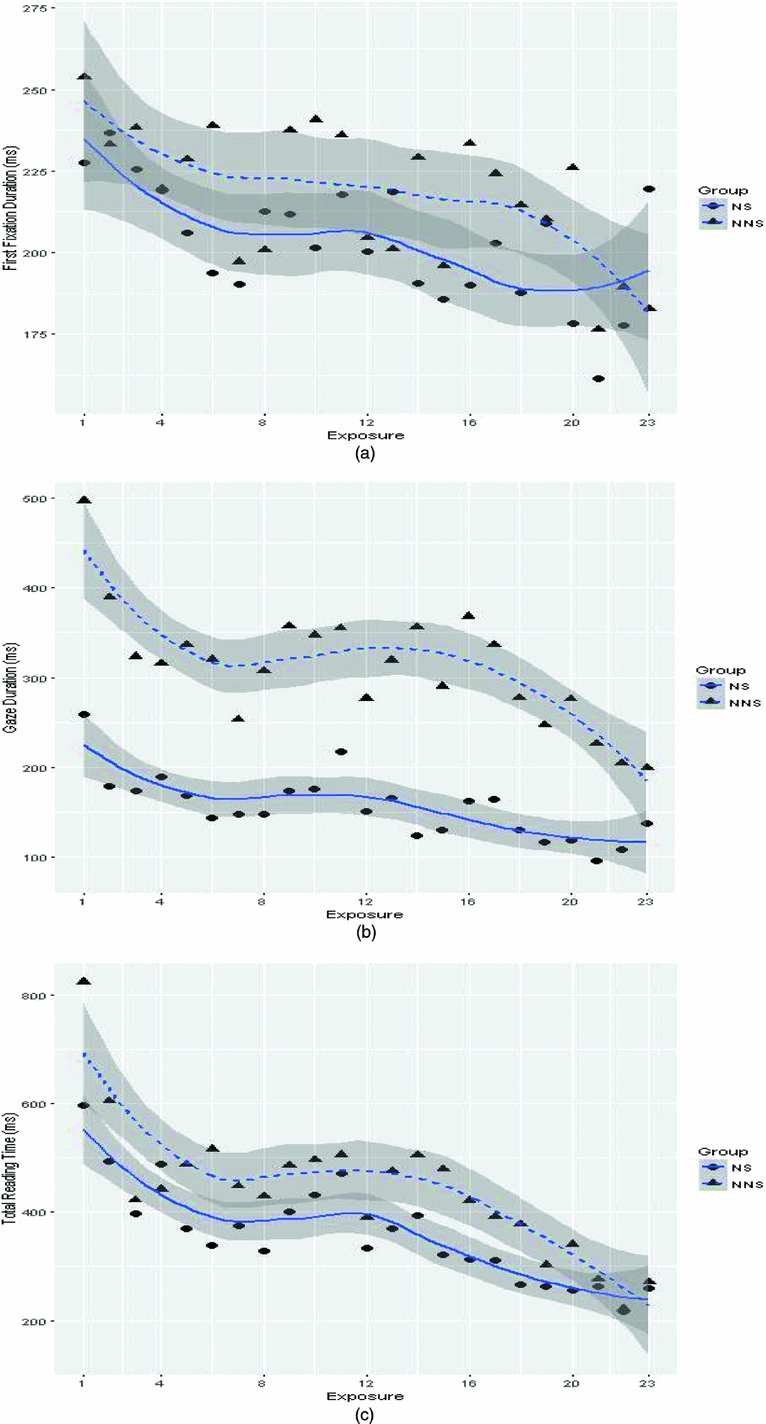
Our dependent variable was Total Reading Time, a late eye-movement measure (e.g., Winke, Godfroid & Gass, Reference Winke, Godfroid and Gass2013) which represents the sum of all fixations made in a given region of interest. Previous researchers have analyzed multiple eye-movement measures, including first fixation duration, gaze duration, and total time (Godfroid et al., Reference Godfroid, Boers and Housen2013; Joseph et al., Reference Joseph, Wonnacott, Forbes and Nation2014; Mohamed, Reference Mohamed2017; Pellicer-Sánchez, Reference Pellicer-Sánchez2015). Each of these measures is believed to measure a different cognitive process (see Winke et al., Reference Winke, Godfroid and Gass2013, for discussion). In this paper, we report the results for total time (i) because it is the variable that is of most pedagogical interest, (ii) because it has yielded the strongest associations with learning in previous studies, and (iii) because it encapsulates first fixation duration and gaze duration (see von der Malsburg & Angele, Reference von der Malsburg and Angele2017, for caveats on multiple testing in eye-movement research). Additionally, we present scatter plots with fitted loess lines (i.e., smoothers) for all three words for first fixation duration, gaze duration, and total time in Appendix B. The results for first fixation duration and gaze duration are also summarized in footnote 4.
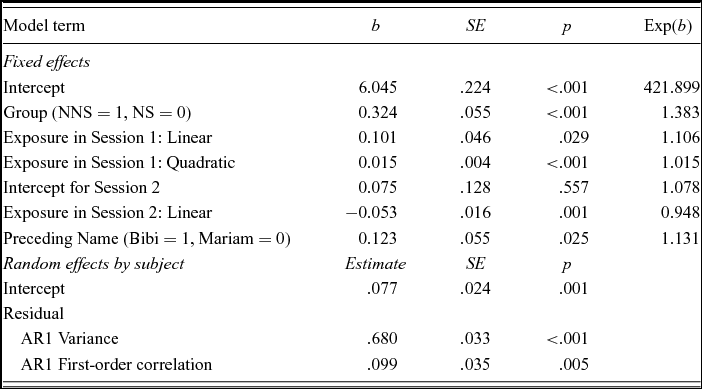
To reduce the amount of skipping of jo, a very short word, we defined the region of analysis as the preceding proper name plus jo; that is, either Mariam jo or Bibi jo (see Appendix A). Kolba and harami served as their own regions of analysis. Our main independent variables were Exposure (kolba: 23 times, jo: 18 times, harami: 12 times) and Group (i.e., NNS vs. NS). Control variables were added to the models whenever these improved model fit.Footnote 2
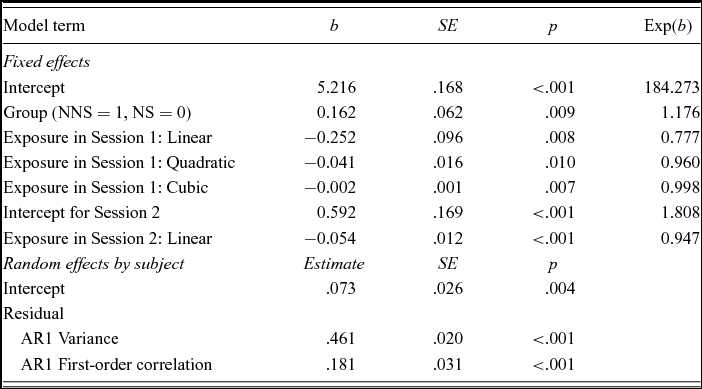
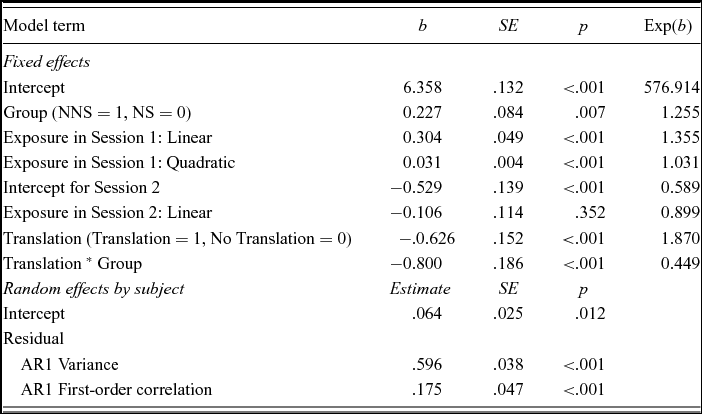
Because the experiment was conducted over two sessions that took place on two consecutive days, we allowed for the possibility that the break would mark a discontinuity in the reading time data. Therefore, we incorporated a piecewise regression into the growth curve model (Naumova, Must & Laird, Reference Naumova, Must and Laird2001). Essentially, we centered the time variable, which we called Exposure, around the first occurrence of the target word in Session 2, so we could estimate an additional intercept for the beginning of Session 2 and adjust the reading-time estimate for the new session. The piecewise regression also allowed us to test if the effect of Exposure differed between Session 1 and Session 2. Lastly, we used a log link function to account for the fact that reading times were positively skewed. The log link function is associated with a negative binomial distribution (Lawless, Reference Lawless1987) and can accommodate large numbers of zeros in the data that resulted from target-word skipping (i.e., 0 ms fixations). Because we ran a negative binomial regression, the β regression coefficients must be interpreted in relation to the log-transformed dependent variable (i.e., log Total Reading Time). To enable interpretation of the results on the original scale (i.e., Total Reading Time), we also report the effects of the independent variables as exponentiated coefficients exp(β) in Tables 1, 2, and 3. The β coefficients transform into exp(β) smaller than 1 for negative coefficients (associated with a decrease in reading time) and exp(β) larger than 1 for positive coefficients (signaling an increase in reading time).
Regression output for kolba.

Regression output for jo.

Regression output for harami.

In sum, we ran a mixed-model growth curve analysis with a log link function for each of the three most frequent target words. We used the piecewise method to account for the two data collection sessions. We plotted the predicted values from our best-fitting models for each target word and sought to identify common patterns in the repeated reading. Finally, we evaluated graphically how these patterns translated to the full set of all 29 words to understand how reading changes over time.
Research question 2
To answer the second research question, we investigated how eye-fixation measures and repeated exposures predicted learning gains on three vocabulary tests: form recognition, meaning recognition, and meaning recall. Unlike for research question one, all 29 target words were included in the statistical analysis. We adopted a generalized linear mixed model (logistic regression with random effects) to accommodate the binary outcomes of the vocabulary tests and repeated observations for each participant. The binary outcomes consisted of each participant's response (correct or incorrect) to each target word on each test. Because each participant contributed multiple responses, there were repeated observations for each participant and each test. We compared the three tests directly by means of a three-level hierarchical model. Specifically, target words (level 2) were nested within participants (level 1) and three scores (level 3) were associated with each target word – one score for each test.
Our independent variables of interest were Total Exposure (range: 1–23 times) and Summed Total Reading Time in seconds. To calculate Summed Total Reading Time, we added up the Total Reading Times over all exposures to a given target word. We centered and scaled the variables, which yielded z scores for standardized Total Exposure and standardized Summed Total Reading Time. Using z scores enabled us to compare the relative strengths of these two variables and determine whether one was more strongly related to word learning than the other.Footnote 3 The average Summed Total Reading Time was 1559 ms (SD = 2428 ms). The average Total Exposure over all target words was 3.41 (SD=5.22). These numbers revealed that readers spent an average 460 ms on each occurrence of a target word. We added Group (i.e., NNS vs. NS), and two control variables to the model, namely Word Length (i.e., number of letters), and Part of Speech (i.e., non-nouns vs. nouns; see Appendix A).
Similarly to the negative binomial regression for research question 1, the logistic regression for research question 2 is performed on the log-transformed dependent variable. Therefore, the interpretation of the β regression coefficients and exp(β) regression coefficients is similar to the first research question. In this case, the exp(β) regression coefficients are odds ratios (ORs): they indicate how strongly the likelihood of a correct test answer changes (with OR > 1 meaning an increase and OR < 1 meaning a decrease) under the influence of the independent variable (see Liberman, Reference Liberman2005, for further details). All analyses were run in the Statistical Package for the Social Sciences (SPSS, version 22) and the significance level α was set at .05.
Results
Participants demonstrated adequate comprehension of the text and answered 69.13% (SD=16.27%) of the comprehension questions correctly. The NSs and NNSs performed at similar levels, with NSs answering a mean 21.53 out of 30 items correctly (SD=4.07) and NNSs answering 20.31 items correctly (SD=5.27) (Mann-Whitney U test, U = 298.00, z = 0.627, p = .531, r=.085).
RQ1: Non-linear decrease in eye-fixation times over repeated exposures to the target words
The results for kolba, jo, and harami are presented in Tables 1, 2, and 3, respectively. To find the best-fitting model for each word, likelihood ratio tests for nested models were performed and AIC (Akaike information criterion) values were compared among models with higher- and lower-order polynomials. We started with a sixth-order polynomial (i.e., Exposure6) and continued simplifying the model until the goodness-of-fit indices signaled the simpler model was significantly different than the more complex model.
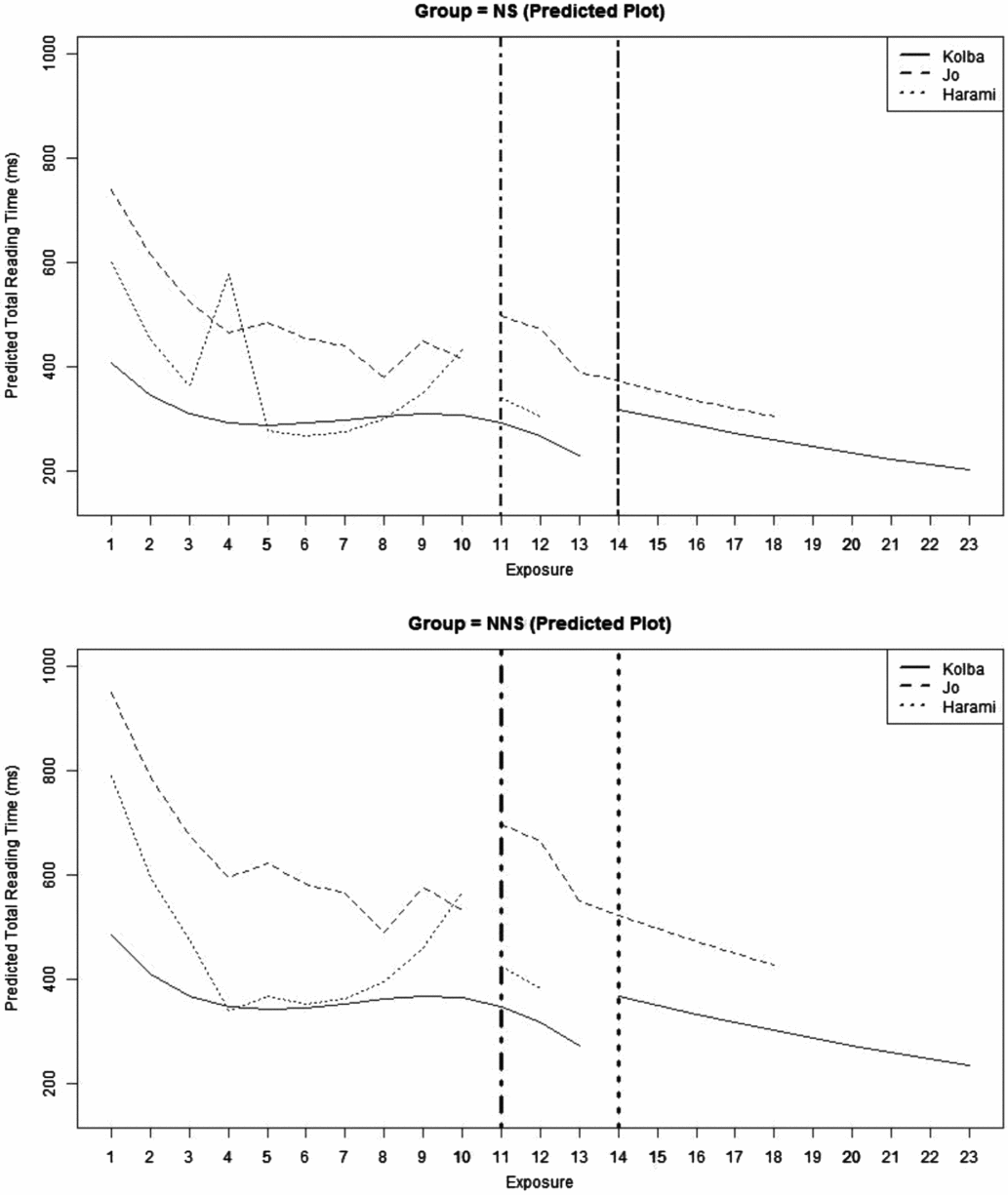
For Session 1, we found a curvilinear decrease in reading times for kolba and a U-shaped decrease for jo and harami (see Figure 1), as indicated by a significant cubic effect for kolba (Table 1) and significant quadratic effects for jo and harami (Tables 2 and 3) for Exposure in Session 1. In Session 2, all three words underwent a simple linear decrease in reading time with Exposure.Footnote 4 Crucially, our main variables – Exposure and Group – were significant predictors for all three target words (see Tables 1, 2, and 3). NNSs read target words significantly more slowly than NSs, but both groups showed a similar decrease in reading time with exposure, as suggested by the lack of significant Group * Exposure interactions. The control variables – Preceding Name for jo, Translation and Translation * Group for harami – were all significant. Finally, the random effect parameters for Exposure (variances and first-order correlations) were significant for all three words (all ps ≤ .005), indicating that reading time on any given exposure was strongly related to the reading time on the exposure exactly before and after. The random intercepts for subjects were also significant in all models (all ps ≤ .012). This pointed to significant individual differences in reading speed within the NS and NNS groups at the first encounter with a target word.
Changing reading-time patterns over repeated exposures for the three high-frequency words (kolba, jo, and harami). Note: Dotted vertical lines represent the beginning of Session 2, at exposure 11 for jo and harami, and exposure 14 for kolba.

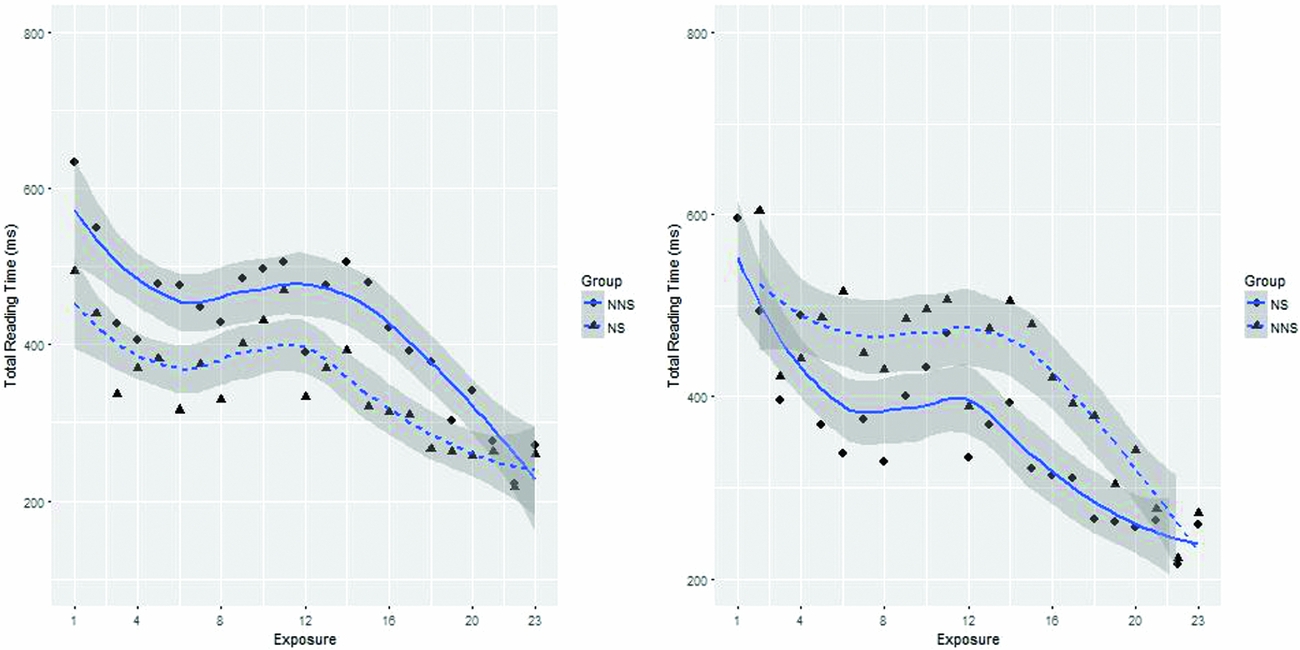
Figure 1 illustrates the changing reading-time patterns over repeated exposures to each word, as estimated by the three most parsimonious, best-fitting models. We note three common trends. First, from the first to the fourth exposure to the target words (i.e., initial stage), sharp negative slopes were found, indicating a rapid initial decrease in reading times for the target words. Second, from the seventh to tenth exposure (i.e., middle stage), a slight increasing trend in reading times was observed, especially around the ninth exposure. Third, from the eleventh exposure to the last exposure (i.e., final stage), the reading times for all three words gradually decreased towards values that may approximate fluent reading. When we compare these patterns to the overall changes in Total Reading Time across all 29 target words (Figure 2), we see essentially the same patterns unfolding – a steep initial decrease, followed by a plateau, and then a further, more gradual decrease.
A comparison of Total Reading Time over Exposure for all 29 target words (left) and the three high-frequency words only (right).

RQ 2: Total reading time and repeated exposure facilitate vocabulary learning
Table 4 presents the descriptive statistics for each vocabulary test for the NS and NNS groups. Overall, the two groups of participants performed similarly, with about 30% accuracy on the form and meaning recognition tests and a lower accuracy of about 13% on meaning recall. The NSs scored somewhat higher than the NNSs in terms of meaning recognition, but the group differences on the other two tests were small.
Performance on three vocabulary post-test measures (max. = 29).

To explore potential group differences in vocabulary test performance, we performed a 3 (Vocabulary Test) x 2 (Group) mixed-design ANOVA. Mauchly's test indicated that the assumption of sphericity was violated, χ 2(2) = 6.603, p=.037; therefore, the degrees of freedom were corrected using Greenhouse-Geisser estimates of sphericity (ε = .87) (Field, Reference Field2013). We found a significant interaction between Vocabulary Test and Group, F (2, 52) = 3.262, p = .050, ηp2=.071. However, post hoc t-tests for each vocabulary test separately did not reveal any statistically significant differences between the groups (form recognition: t(1, 52) = −0.103, p=.918, d=−0.029; meaning recognition: t(1, 52) = 1.67, p=.102, d=0.463; meaning recall: t(1, 52) = −.982, p=.331, d=−0.272). Test scores did differ strongly and significantly between Vocabulary Tests, F(1.75, 75.08) = 76.033, p < .001, ηp2=0.639. Multiple comparisons (post hoc Bonferroni tests) revealed that all the participants performed significantly better on form recognition and meaning recognition than on meaning recall (p < .001 in both cases), as suggested by Table 4. The levels of form recognition and meaning recognition were similar (p=1.000).
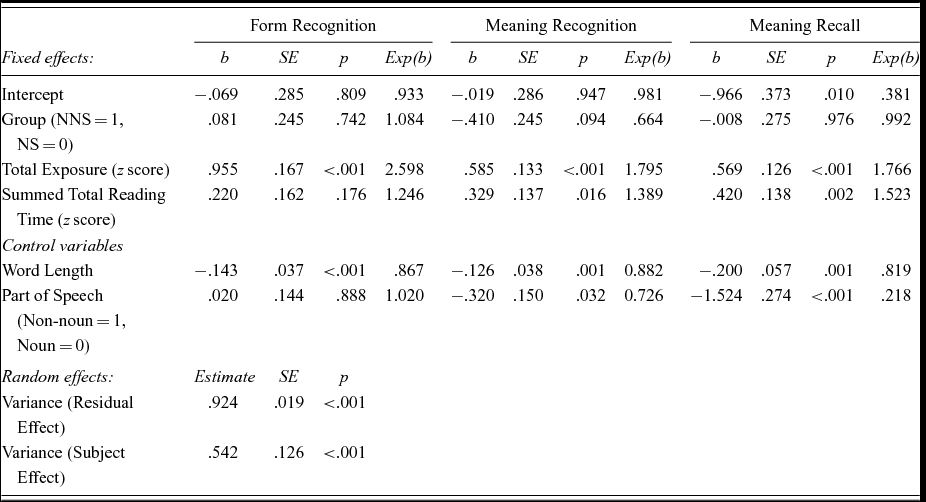
Next, we investigated the influence of Total Exposure and Summed Total Reading Time using a mixed-effects logistic regression. The results are presented in Table 5. The regression analysis confirmed the previous finding that NS-NNS group differences on each vocabulary test were small. Of primary interest were the results for standardized Total Exposure and standardized Summed Total Reading Time. The regression coefficients for the two predictor variables revealed that Total Exposure had a stronger effect on word learning than Total Reading Time. Total Exposure was positively associated with participants’ performance on all the vocabulary tests, which meant that additional exposures to a target word aided all aspects of vocabulary learning. Furthermore, the results by test revealed that Total Exposure had a slightly stronger influence on Form Recognition than Meaning Recall (between-test comparison: b=0.386, SE=0.206, p=.06, exp(b) = 1.471), yet played a comparable role in Meaning Recognition and Meaning Recall (between-test comparison: b=0.016, SE=0.180, p=.928, exp(b)=1.016). Summed Total Reading Time was positively related to performance on Meaning Recognition and Meaning Recall, with comparable strengths of association with the two tests (between-test comparison b=−0.092, SE=0.189, p=.628, exp(b)=.912). However, Summed Total Reading Time did not significantly enhance learning of word form. Thus, for a given number of exposures, longer processing statistically enhanced learning of word meaning, but not word form (i.e., we did not find a similar statistical association with word form).
Three-level hierarchical model for Total Exposure and Summed Total Reading Time.

The results for the control variables confirmed that word length negatively affected Form Recognition, Meaning Recognition, and Meaning Recall. Thus, shorter words were learned significantly better than longer words. Part of speech was not a significant predictor of Form Recognition; however, the meanings of nouns were recalled and recognized significantly better than those of other words. Finally, the estimated variances and covariances in the random effects component were all strongly significant. This suggested that the patterns in performance on the different tests were well accounted for.
Discussion
We expanded previous eye-movement research on incidental vocabulary acquisition by implementing eye-tracking technology in a more ecologically valid research context, namely reading the first 9000 words of a novel. Although the ultimate goal was to determine whether frequency of exposure and amount of processing make independent contributions to vocabulary acquisition, we also examined how processing (i.e., Total Reading Time) changed over repeated exposures to unknown foreign words. Overall, the data showed several general trends: (i) the reading times decreased in a non-linear fashion with three distinct phases across exposures (see Figures 1 and 2); (ii) although NSs read faster than NNSs, repetition had a similar effect on both groups’ reading patterns (Exposure did not interact with Group); and (iii) NS-NNS vocabulary gains were comparable, if not identical. Most importantly, (iv) the participants showed fuller learning of words with longer and more frequent exposure. This meant that the benefits of processing a word more attentively were in part different from those of seeing a word repeatedly, even though both were favorable to learning.
Eye movements as a window into vocabulary learning
This study confirmed earlier findings of a speed-up in reading through repetition (Hyönä & Niemi, Reference Hyönä and Niemi1990; Raney & Rayner, Reference Raney and Rayner1995) in the context of vocabulary acquisition (Joseph et al., Reference Joseph, Wonnacott, Forbes and Nation2014; Mohamed, Reference Mohamed2017; Pellicer-Sánchez, Reference Pellicer-Sánchez2015). The reduced reading times likely reflected a growing sense of familiarity with target words across repeated encounters, which allowed for faster decoding of word forms over time. An interesting observation is that despite the large reading-time gains, participants did not perform at ceiling on the vocabulary post-tests, not even for the three most frequently occurring words. Mean form recognition was 82.72% (SD=25.33%); meaning recognition was 74.69% (SD=28.00%); and meaning recall was 47.53% (SD=36.00%) for kolba, jo, and harami. We believe that the discrepancy between the substantial reading-time gains and the non-perfect test scores is due to these variables measuring different processes or different types of knowledge. The vocabulary post-tests are traditional measures of declarative or explicit vocabulary knowledge. On the other hand, faster reading times reflect “partial and incremental growth in knowledge” (Joseph et al., Reference Joseph, Wonnacott, Forbes and Nation2014, p. 245), which could be implicit or procedural in nature (Godfroid & Winke, Reference Godfroid, Winke and Rebuschat2015). Recent vocabulary research has used priming techniques, in addition to explicit knowledge measures, to tap into the implicit or tacit aspects of vocabulary knowledge (Elgort & Warren, Reference Elgort and Warren2014; Sonbul & Schmitt, Reference Sonbul and Schmitt2013). Similarly, the present findings suggest that changes in eye movements over time can reveal word learning processes that are not detected by traditional measures of explicit vocabulary knowledge (compare Joseph et al., Reference Joseph, Wonnacott, Forbes and Nation2014). Specifically, the speed-up over time could reflect implicit learning processes or the gradual build-up and specification of a new word representation that can be accessed increasingly fluently during reading.
Another noteworthy finding was the slight increase in fixation time between the seventh and tenth exposure (Figures 1 and 2) that gave rise to an S-shaped reading pattern. Based on this finding and other reports of non-linear learning in the literature (Bisson et al., Reference Bisson, van Heuven, Conklin and Tunney2014; Murre, Reference Murre2014), it appears that not all exposures affect the reading and learning of new vocabulary in the same way. The observed reading-time increase dovetails nicely with the finding that learners need between eight and ten exposures to acquire explicit knowledge of a new word (Horst et al., Reference Horst, Cobb and Meara1998; Pellicer-Sánchez, Reference Pellicer-Sánchez2015; Pigada & Schmitt, Reference Pigada and Schmitt2006; Waring & Takaki, Reference Waring and Takaki2003; Webb, Reference Webb2007). It appears that around the seventh to tenth exposure, the participants looked longer at the novel words, which could reflect increased cognitive effort and attempts on their part to integrate the words into the sentence contexts and make form-meaning connections (Frishkoff et al., Reference Frishkoff, Perfetti and Collins-Thompson2011; Joseph et al., Reference Joseph, Wonnacott, Forbes and Nation2014). Moreover, in spite of the overall decreasing trend in participants’ eye-fixation durations, the cumulative reading time, as measured by Summed Total Reading Time, was positively related to the acquisition of word meaning. It seems, then, that two different and seemingly contradictory phenomena are at play in the eye-movement data. On the one hand, we witnessed an overall decreasing trend (with a temporary plateau) in fixation durations. We took this to index learning and speculated it could be implicit and form based because of the disconnect with the post-tests. On the other hand, local increases in fixation duration or an overall more careful (i.e., slower) reading style benefited the development of explicit-declarative knowledge of word meaning, as shown by the positive associations between Summed Total Reading Time and Meaning Recognition and Meaning Recall. A goal for future research will be to isolate and identify these different subprocesses in readers’ eye-movement data more clearly so as to develop a better understanding of the eye-movement signatures of implicit and explicit processing (Godfroid & Winke, Reference Godfroid, Winke and Rebuschat2015).
The same reading patterns for kolba, jo, and harami were found in the graph showing the reading of all 29 target words over time (Figure 2). Combined these two sources of evidence allow us to conjecture an S-shaped pattern in Total Reading Time over repeated encounters (compare Murre, Reference Murre2014), which may also be found for gaze duration (Appendix B and footnote 4). This hypothesis could be tested in a more tightly controlled sentence-reading experiment, such as a modified version of Joseph et al.’s (Reference Joseph, Wonnacott, Forbes and Nation2014) study. In that study, participants came to the lab on five consecutive days to read 16 target words embedded in 15 sentence contexts each. Consistent with our findings, Joseph and colleagues found significant decreases in first fixation duration, gaze duration, and total time with increased exposures to the target words. Moreover, at test total time was the only measure to distinguish between words that were less and more fully acquired, which underscores the importance of the total time variable in learning experiments.
Attention, repetition, and the form-meaning distinction
This study contributes to the vocabulary acquisition literature by directly comparing the roles of attention (i.e., Summed Total Reading Time) and repetition in a single eye-tracking experiment. Consistent with previous research (e.g., Elgort & Warren, Reference Elgort and Warren2014; Folse, Reference Folse2006; Pellicer-Sánchez, Reference Pellicer-Sánchez2015; Waring & Takaki, Reference Waring and Takaki2003; Webb, Reference Webb2007), the results of the present study confirmed the benefits of seeing a word repeatedly. Repetition aided all three types of vocabulary knowledge; even so, the strength of the association (i.e., the regression coefficients b) varied somewhat between the tests. Specifically, exposure had a stronger influence on form recognition than meaning recall, while the effects on meaning recall and meaning recognition could not be distinguished statistically (Table 5). This finding potentially reveals differences in how form and meaning are learned, with form being perhaps a more shallow type of word knowledge that can be picked up more easily through simple repetition and implicit learning mechanisms (Ellis, Reference Ellis and Ellis1994; Nation, Reference Nation2013). This interpretation is tempered by the fact that Form Recognition was also the first of the three vocabulary post-tests and therefore, seeing the words again on this test may have diluted the effects of exposure on the tests of word meaning that came after (form > meaning). Although this is a possibility, we think it is not a very likely one in light of the findings for Summed Total Reading Time. Specifically, Summed Total Reading Time, like exposure, continued to rise with each additional post-test and yet for Summed Total Reading Time we find an increase in strength of association from the first test to the third (form < meaning); that is, the opposite of what we found for Total Exposure. What we can conclude from this is that exposure aided learning of both word form and word meaning, and may have been especially beneficial for the learning of word form.
The results for research question two also confirmed the importance of Summed Total Reading Time for the learning of word meaning; however, no association was found with the learning of word form after Total Exposure was accounted for. Again, this finding alludes to the distinction between form and meaning; specifically, to the notion that making a form-meaning connection entails a greater depth of processing than registering the form (Craik & Lockhart, Reference Craik and Lockhart1972; Leow, Reference Leow2015). A possible interpretation of our results, therefore, is that increased total reading times reflect greater effort at figuring out the meaning of a word, with some degree of success. This view aligns well with theoretical frameworks that emphasize the benefits of active engagement for learning (Schmitt, Reference Schmitt2008), including the noticing hypothesis (Schmidt, Reference Schmidt1990) and, for vocabulary, the involvement load hypothesis (Laufer & Hulstijn, Reference Laufer and Hulstijn2001). Furthermore, our findings lend empirical support to assertions that incidental learning need not be unintentional (Bruton et al., Reference Bruton, López and Mesa2011; Gass, Reference Gass1999; Hulstijn, Reference Hulstijn, Doughty and Long2003; Paribakht & Wesche, 1999) – that is, it can be intentional – because more processing correlated with more meaning-based learning. Incidental learning, therefore, is not so much a specific cognitive-psychological construct as it is learning that occurs with varying degrees of intentionality during a meaning-focused task (Bruton et al., Reference Bruton, López and Mesa2011; Hulstijn, Reference Hulstijn, Doughty and Long2003).
Different NS-NNS profiles
A somewhat surprising finding was that NSs and NNSs performed similarly on both the reading and the test components of this study. Although NNSs did read the target words more slowly overall, we found both groups’ reading times decreased at similar rates. It appears, then, that the use of Dari target words leveled the playing field for both groups, neither of which had prior frequency intuitions about Dari.
The picture becomes more complex when considering the vocabulary post-test results. At the surface, the NSs and NNSs again performed very similarly. The NSs outperformed the NNSs only on meaning recognition and only by a small margin (Tables 4 and 5). However, a post-hoc analysis of the post-experiment questionnaires revealed there were in fact two distinct NNS profiles, a larger group (n=26) who remained naïve about the purpose of the study (incidental learners; Hulstijn, Reference Hulstijn, Doughty and Long2003) and a subset of nine learners who suspected there would be a vocabulary test, even though task instructions only mentioned reading for comprehension (intentional learners; Hulstijn, Reference Hulstijn, Doughty and Long2003). In comparison, only one NS, who was also an experienced L2 learner, suspected a vocabulary test. Participants' perceptions of the task mattered for how they performed on the tests.Footnote 5 The intentional NNS group outperformed the incidental NNS group on meaning recognition (Mann-Whitney U = 59.00, z = 2.207, p = .027, r=.373) and meaning recall (Mann-Whitney U = 54.00, z = 2.396, p = .017, r=.405). Importantly, the NSs also outperformed the NNSs in meaning recognition when only the incidental learners were compared (Mann-Whitney U=141.50, z=2.220, p=.026, r=.335). Consistent with other findings in this study, test awareness did not boost learners’ form recognition scores significantly (Kruskal-Wallis test χ2(2) = 2.744, p = .254, r=.053). These findings suggest that L2 speakers may remain at a comparative disadvantage for learning new word meanings – but not word forms – incidentally from reading, even at advanced L2 proficiency levels. They may, however, benefit from increased awareness of the presence of new vocabulary in the input and should be encouraged to use this awareness to their advantage; that is, to enhance their language learning gains from meaning-focused tasks.
Balancing ecological validity and experimental control
Our attempts to maintain ecological validity in this study involved using an authentic novel with foreign words that were integral to the story context and replicating natural reading in which participants read 9,000 words over the course of two days, as one might do for leisure reading. Nonetheless, we acknowledge that the full benefits of reading for vocabulary learning may only become apparent in the context of an extensive reading program; that is, a context where learners read multiple longer texts over the span of weeks or months. Findings of the current study must therefore be interpreted alongside longitudinal, classroom-based research (e.g., Horst, Reference Horst2005; Pigada & Schmitt, Reference Pigada and Schmitt2006; Webb & Chang, Reference Webb and Chang2015a, Reference Webb and Chang2015b), where reported vocabulary learning gains are higher but the type and amount of exposure are less well controlled.
At the same time, our efforts to simulate natural reading conditions in the lab also had some methodological consequences. Because we used an unmodified authentic novel, we had no control over the target words’ distribution across the different chapters or the context in which the individual words occurred. Our analyses focused on general changes in reading patterns over time that are discernible in spite of encounter-to-encounter fluctuations in contextual predictability. Unlike previous eye-tracking studies with nonce words (Godfroid et al., Reference Godfroid, Boers and Housen2013; Mohamed, Reference Mohamed2017; Pellicer-Sánchez, Reference Pellicer-Sánchez2015) we also did not run a control condition with familiar English words, because we did not substitute any nonce words (or low-frequency words) for familiar real words in the text. Even under these more naturalistic conditions, we replicated previous findings and expanded on them by investigating the joint roles of frequency and attention in vocabulary learning. We showed that both contribute independently to the acquisition of word meaning and that the largest gains in reading times occur in the initial encounters with a word.
Conclusion
The current study adds to our understanding of how readers engage cognitively with unfamiliar words embedded in a long, authentic text. By tracking participants’ eye movements over the course of a two-day reading experiment, we found that participants grew more and more familiar with the new vocabulary repeated in the text. Not only frequency of exposure, but also how long participants engaged with the word at each exposure predicted the acquisition of meaning on a recall and a recognition post-test. Frequency alone, and not attention, predicted the acquisition of word form.
Our findings underscore the importance of repetition in word learning, as highlighted also by the literature on practice effects (e.g., Nakata, Reference Nakata2015). Reviewing words, either planned or incidentally, will consolidate them for long-term use. A deliberate focus on words in context will further augment the learning gains that accrue from seeing a word repeatedly and will be especially beneficial for developing rich knowledge of word meaning. Considering the number of word families learners need to know to function in an L2 environment, the vocabulary learning task is rather formidable. Language instructors must set high standards, provide rich and ample input and, above all, train their students to become life-long, autonomous learners.
Target word meaning and frequency.

Changes in eye fixation durations with repeated exposure for kolba, jo, and harami combined: (a) first fixation duration, (b) gaze duration, and (c) total reading time.