Introduction
Beyond its formal indications (epilepsy, bipolar disorder, and migraine), valproate sodium (VPA) is widely used in a number of other clinical conditions, such as neuropathic pain, trigeminal neuralgia, and cancer adjuvance.Reference Johannessen Landmark, Larsson, Rytter and Johannessen1 In European countries, VPA use has increased dramatically in psychiatric patients, and even in women of childbearing age diagnosed with either schizophrenia or bipolar disorder.Reference Hayes, Prah and Nazareth2, Reference Barbui, Conti and Purgato3 The same trend was observed in the U.S. Indeed, the prevalence of antiepileptic drug (AED) prescriptions among women without epilepsy tripled during the period 1996–2007.Reference Adedinsewo, Thurman and Luo4 Eighty-three percent of VPA prescriptions were issued to fertile women without epilepsy (74% of these women were affected by psychiatric disordersReference Adedinsewo, Thurman and Luo4).
However, scientific evidence reviewed in recent yearsReference Gentile5 has consistently shown that taking VPA during pregnancy increases the risk of congenital malformations (structural teratogenicityReference Gentile6). Most of the fetal anomalies associated with antenatal VPA use seem to be dose-dependent. However, lower VPA dose may offer benefits in reducing spina bifida and hypospadias; however, a lower dose has not been shown to prevent other types of fetal malformations.Reference Vajda, O'Brien, Graham, Lander and Eadie7 The differences in dose susceptibility for malformations could be due to relative sensitivity of different developing systems or to changes in the predominant metabolism shifting with dose and pregnancy.Reference Meador8 Increased risks for delivering babies that are small for gestational age and with transiently reduced Apgar scores (perinatal teratogenicityReference Gentile6) both have also been associated with prenatal VPA exposure.Reference Pennell, Klein and Browning9
Moreover, on May 6, 2013, the U.S. Food and Drug Administration (FDA) advised
… health care professionals and women that the anti-seizure medication VPA and related products, valproic acid and divalproex sodium, are contraindicated and should not be taken by pregnant women for the prevention of migraine headaches. Based on information from a recent study, there is evidence that these medications can cause decreased IQ scores in children whose mothers took them while pregnant. Stronger warnings about use during pregnancy will be added to the drug labels, and VPA pregnancy category for migraine use will be changed from “D” (the potential benefit of the drug in pregnant women may be acceptable despite its potential risks) to “X” (the risk of use in pregnant women clearly outweighs any possible benefit of the drug). With regard to VPA use in pregnant women with epilepsy or bipolar disorder, VPA products should only be prescribed if other medications are not effective in treating the condition or are otherwise unacceptable. VPA products will remain in pregnancy category “D” for treating epilepsy and manic episodes associated with bipolar disorder. With regard to women of childbearing age who are not pregnant, VPA should not be taken for any condition unless the drug is essential to the management of the woman's medical condition. All non-pregnant women of childbearing age taking VPA products should use effective birth control.10
Nevertheless, since the early 1990s, a growing body of evidence has suggested that antenatal exposure to AEDs, either in mono- or polytherapy, may adversely impact on several aspects of child neurodevelopmentReference Koch, Titze and Zimmermann11 (neurobehavioral teratogenicityReference Gentile6, 12), and not just on IQ scores.Reference Steinhausen, Losche, Koch and Helge13, Reference Losche, Steinhausen, Koch and Helge14
Given this background, this article aims to assess the neurobehavioral teratogenicity of VPA in order to evaluate alternative regulatory decisions. The term neurobehavioral teratogenicity identifies the whole spectrum of behavioral and developmental alterations that result from genetic and environmental perturbations of the nervous system during the pre- and perinatal periods.
Methods
A computerized Medline/PubMed search for the period between 1967 (year of VPA first marketing as an antiepileptic drug in France) and November 13, 2013, was conducted using the following filters/details:
• Article type: classic article, clinical trial, multicenter study, journal article, comparative study, randomized controlled trial
• Language: English
• Species: humans
• MeSH terms: (“valproic acid”[MeSH Terms] OR (“valproic”[All Fields] AND “acid”[All Fields]) OR “valproic acid”[All Fields] OR (“sodium”[All Fields] AND “valproate”[All Fields]) OR “sodium valproate”[All Fields]) AND (“pregnancy”[MeSH Terms] OR “pregnancy”[All Fields]) AND (“child development”[MeSH Terms] OR (“child”[All Fields] AND “development”[All Fields]) OR “child development”[All Fields])
The search provided 60 articles. The resulting articles were cross-referenced for other relevant articles not identified in the initial search. An extensive noncomputerized review of pertinent journals and textbooks was also performed. All peer-reviewed articles that reported primary data on developmental outcome of infants exposed in utero to VPA monotherapy and born without major or minor congenital anomalies were collected. Twenty-eight additional articles were identified.
Findings
Studies demonstrating VPA-related neurobehavioral teratogenicity
A small case-series studyReference Koch, Jäger-Roman and Lösche15 demonstrated that children exposed prenatally to VPA might show poor motor performance and impaired neurological outcome. VPA serum concentrations at birth correlated with the degree of neonatal hyperexcitability and neurological dysfunction when children were re-examined 6 years later. However, mothers were treated with the same AED for different typologies of epilepsy (eg, tonic clonic seizures during pregnancy occurred in 33% of VPA-exposed women, whereas the remaining 67% were diagnosed with other forms of epilepsy). Hence, potential effects of maternal seizure types and frequency on the children's development cannot be ruled out.
To examine the relative risks of additional educational needs in children exposed to antiepileptic drugs, a survey was conducted of women between the ages of 16 and 40 who were registered at the Mersey Regional Epilepsy Clinic in the United Kingdom.Reference Adab, Jacoby, Smith and Chadwick16 The main study findings were that VPA monotherapy during pregnancy might carry particular risks for the development of children exposed in utero. However, 22 of the 56 children who were prenatally exposed to VPA and with developmental problem had mothers with definite idiopathic generalized epilepsies. These genetic disorders could be linked to genetically determined learning disabilities.Reference Adab, Jacoby, Smith and Chadwick16
To investigate the frequency of neonatal and later childhood morbidity in children exposed to AEDs in utero, a retrospective population-based studyReference Dean, Hailey and Moore17 was performed on a population of epileptic mothers from the Grampian region of Scotland. The main study conclusions were that prenatal AED exposure in the setting of maternal epilepsy was associated with developmental delay and later childhood morbidity, in addition to congenital malformation. In particular, analysis of the different drug exposure groups showed that VPA monotherapy, as well as carbamazepine (CBZ) and phenytoin (PHT) monotherapy, were associated with significantly more developmental delay. Speech delay was common following exposure to VPA (29%) or CBZ (22%) monotherapy. Four cases of autism-spectrum disorders were also recorded in VPA-exposed children. Moreover, significantly reduced verbal IQ scores were found by Gaily etal in children exposed to VPA compared with the other study group children and control subjects.Reference Gaily, Kantola-Sorsa and Hiilesmaa18
A further research study,Reference Eriksson, Viinikainen and Monkkonen19 whose population was identified through a prospective community-based pregnancy registry covering the whole catchment area of the Kuopio University Hospital (population 250,000 inhabitants) in Finland, also led to worrying results. The increased prevalence of neurocognitive symptoms demonstrated in children exposed to VPA in utero raised further concern about long-term iatrogenic behavioral effects. In this study, the mothers had moderately or well controlled epilepsy during pregnancy. This clinical situation allowed the authors to exclude the potential confounding effect of the frequency of maternal seizures on children's development.
In a second, small, population-based studyReference Eriksson, Viinikainen and Monkkonen19 (performed by the same research team and, presumably, on the same population of patients), all children exposed to VPA were affected by minor, and some of them major, cognitive or neurological problems. The mothers using VPA had a lower IQ and lower level of education compared with other women. In contrast, no statistically significant differences were noted in the frequency of seizures during pregnancy and/or in the consumption of tobacco or alcohol.
A prospective studyReference Thomas, Ajaykumar and Sindhu21 was carried out in the Kerala Registry of Epilepsy and Pregnancy at a tertiary referral epilepsy center in Trivandrum, Kerala State, India. This registry examines the diverse problems related to pregnancy, delivery, and health status of infants, including late developmental outcome until 6 years of age. Developmental scores of VPA-exposed infants were lower than scores of those exposed to other AEDs. Maternal age, epilepsy type, seizure frequency during pregnancy, and use of folic acid did not influence these results.
Between 1999 and 2004, the Neurodevelopmental Effects of Antiepileptic Drugs (NEAD) Study, an ongoing prospective observational multicenter study in the United States and United Kingdom, enrolled pregnant women with epilepsy who were taking a single antiepileptic agent [CBZ, lamotrigine (LTG), PHT, or VPA]. The primary analysis was a comparison of neurodevelopmental outcomes at the age of 6 years after exposure to different antiepileptic drugs in utero. However, a planned interim analysis of cognitive outcomes in 309 children at 3 years of age was published.Reference Meador, Baker and Browning22 At 3 years of age, children who had been exposed to VPA in utero had significantly lower IQ scores than those who had been exposed to LTG. After adjustment for maternal IQ, maternal age, antiepileptic drug dose, gestational age at birth, and maternal preconception use of folate, the mean IQ was 101 for children exposed to LTG, 99 for those exposed to PHT, 98 for those exposed to CBZ, and 92 for those exposed to VPA. The association between VPA use and IQ was dose-dependent. A secondary armReference McVearry, Gaillard, VanMeter and Meador23 of this study also found that children who were prenatally exposed to VPA demonstrated impaired cognitive fluency and originality compared with children exposed to LTG and CBZ.
The NEAD Study produces results on an ongoing basis. Indeed, in a relatively recent article,Reference Cohen, Meador and Browning24 effects of fetal AED exposure on motor, adaptive, and emotional/behavioral functioning were examined in children at 3 years of age. A significant, dose-related performance decline in motor functioning was seen for VPA. A significant dose-related performance decline in parental ratings of adaptive functioning was also seen. Further, parents endorsed a significant decline in social skills for VPA that was dose-related. Finally, on the basis of parent ratings of attention span and hyperactivity, children of mothers who took VPA during their pregnancy appeared to be at a significantly greater risk for a future diagnosis of attention-deficit/hyperactivity disorder (ADHD). Epilepsy/seizure type was not found to be a significant outcome predictor. Adverse cognitive effects, dose-dependent, of fetal VPA exposure may persist to 4.5 and 6 years, and are related to performances at earlier ages.Reference Meador, Baker and Browning25, Reference Meador, Baker and Browning26 Recently, the increased likelihood of difficulty with adaptive functioning and ADHD was confirmed.Reference Cohen, Meador and Browning27
Further evidenceReference Meador, Baker and Browning28 has suggested that both verbal and nonverbal cognitive outcomes were impaired in children exposed in utero to VPA, that such effects were dose-dependent, and that their magnitude was greater for verbal than nonverbal abilities.
Two retrospective studiesReference Adab, Kini and Vinten29, Reference Vinten, Adab and Kini30 (which were conducted by the same group of researchers and, presumably, on the same population of patients) on children born to mothers with epilepsy settled in regional epilepsy clinics in Liverpool and Manchester, UK, identified VPA as a drug carrying potential risks for developmental delay and cognitive impairment. Results of both studies demonstrated that children exposed to VPA might show specific patterns of impairment for verbal abilities. This effect seemed to be dose-dependent.
The Liverpool and Manchester Neurodevelopment Group produced a further retrospective study,Reference Vinten, Bromley and Taylor31 wherein behavioral dysfunction and adaptive behavior functioning were evaluated in children exposed to AEDs in utero who were born to women with epilepsy. The study controlled for maternal IQ, employed standardized questionnaires, and used adequate-sized groups so that any differential drug effects could be identified. The results indicated that children exposed to VPA monotherapy were at higher risk of poorer adaptive behavior and, particularly, poorer daily living skills. A further area of concern was the poor socialization skills of VPA-exposed children, which led to high levels of parental stress.
Even in prospective investigations,Reference Bromley, Mawer and Love32 children exposed to VPA showed a statistically significant increased risk of delayed early development in comparison to the control children. Linear regression analysis showed a statistically significant effect of drug exposure on the child's overall developmental level that was not accounted for by confounding variables. A dose-dependent relationship was found for VPA exposure, with periconceptual daily doses >900 mg being associated with statistically poorer overall developmental scores. Apart from its prospective design, the strengths of this study include its sample sizes, reliable assessment methodology, and control for confounding variables. Even compared with leviracetam (LEV), VPA showed an increased risk of inducing early neurodevelopmental delay.Reference Shallcross, Bromley and Irwin33
Other findings reported by The Liverpool and Manchester Neurodevelopment Group (both in original research or in update of previous informationReference Bromley, Mawer, Clayton-Smith and Baker34, Reference Bromley, Mawer and Briggs35) were that children exposed to VPA monotherapy in utero may have a risk of developing autism-spectrum disorders (ASDs) or features of this disorder 10 times higher than that recorded in the general population.Reference Johnson and Myers36 At recruitment, each woman provided information on habits and lifestyle issues such as smoking and alcohol use during pregnancy. Seizure type, syndrome diagnosis (symptomatic/cryptogenic focal, idiopathic generalized epilepsy, or not classifiable), and current seizure frequency, as well as AED type and dose were also assessed.
A dose-dependent, negative impact of VPA on verbal intellectual abilities and working memory in school-aged children was also reported.Reference Nadebaum, Anderson and Vajda37 The same research group also demonstrated that fetal exposure to VPA might increase the risk of language impairment.Reference Nadebaum, Anderson and Vajda38
A study conducted in Northern IrelandReference Cummings, Stewart, Stevenson, Morrow and Nelson39 found that children with a history of in utero exposure to VPA monotherapy were at increased risk of impaired neurodevelopment when covariates were considered in data analysis. There was no impairment in the neurodevelopment of children exposed in utero to LTG. Fetal VPA exposure was also associated with weakness in working memory.Reference Kantola-Sorsa, Gaily, Isoaho and Korkman40
To confirm or exclude these safety concerns, a population-based studyReference Christensen, Grønborg and Sørensen41 of all children born alive in Denmark from 1996 to 2006 was performed. National registers were used to identify children exposed to VPA during pregnancy and diagnosed with ASDs, Asperger syndrome, atypical autism, and other or unspecified pervasive developmental disorders. Overall, maternal use of VPA during pregnancy was associated with a significantly increased risk (dose-independent) of ASDs in the offspring, even after adjusting for maternal epilepsy. However, no specific analysis was performed on the potential relationship between the studied outcome and maternal VPA use for clinical indications others than epilepsy. Moreover, the estimates were based on the trimester when the women redeemed a prescription and not on when the women actually ingested the tablets; therefore, misclassification of timing of the exposure may have occurred. Nevertheless, the authors found no difference in the risk of ASDs between offspring of women who redeemed prescriptions for VPA early vs later in pregnancy.
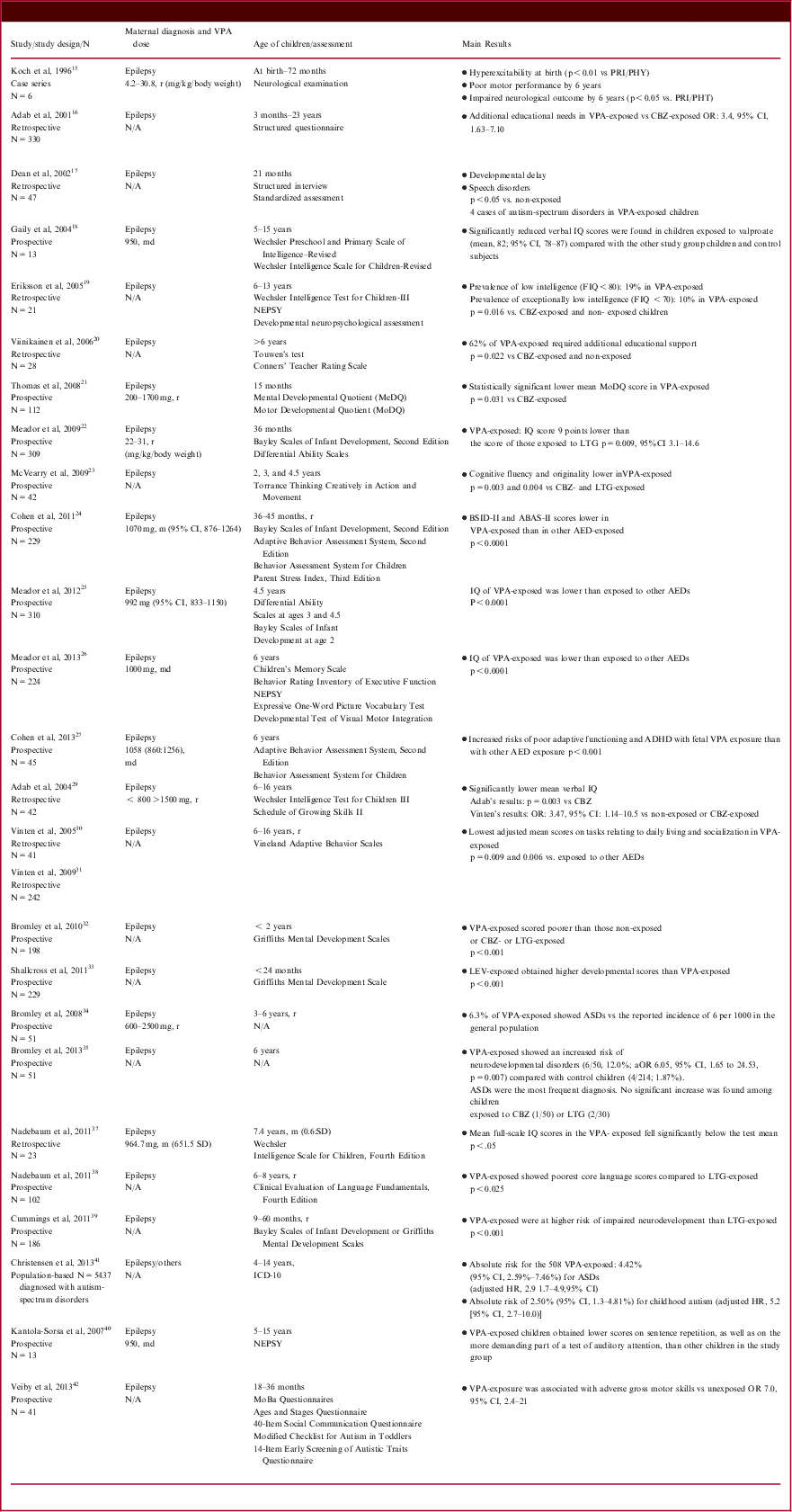
In an ongoing prospective study,Reference Veiby, Daltvei and Schjølberg42 exposures to monotherapy with several AEDs were associated with adverse outcome within different developmental domains. VPA exposure was associated with adverse gross motor skills at 18 months and language at 36 months. Moreover, the authors reported that children exposed to LTG in utero had a higher risk for adverse scores on autistic traits and language at 36 months. The statistical significance of this effect, however, remains unclear. Confidence intervals of difference parameters containing 0 (as in this case) actually imply that there is no statistically significant difference between the populations.Reference Rosner43 Please see Table 1 for a summary of all studies that demonstrated VPA-related neurobehavioral teratogenicity.
Antenatal VPA monotherapy exposure: neurobehavioral/neurocognitive teratogenicity

Abbreviations: r: range; m: mean; SD: standard deviation; VPA: valproate sodium; VPA: valproate; LTG: lamotrigine; PHT: phenytoin; CBZ: carbamazepine; PRI: primidone; AEDs: antiepileptic drugs; BSID-II: Bayley Scales of Infant Development, Second Edition; md: median; ABAS-II: Adaptive Behavior Assessment System, Second Edition; N/A: not available, ASDs: autism-spectrum disorders; aOR: adjusted odds ratio; HR: hazard ratio; CI: confidence interval; ICD-10: International Statistical Classification of Diseases, Tenth Revision; Developmental Neuro Psychological Assessment (NEPSY).
Studies not demonstrating VPA-related neurobehavioral teratogenicity
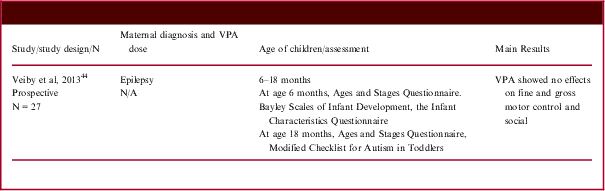
Just one study failed to demonstrate VPA-effects on neurodevelopmental outcomes (see Table 2).Reference Veiby, Engelsen and Gilhus44
Antenatal VPA monotherapy exposure: lack of neurobehavioral/neurocognitive teratogenicity
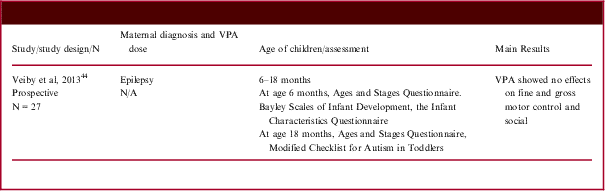
Abbreviation: VPA: valproate sodium.
Discussion
Limitations of reviewed data
The studies that have suggested the detrimental impact of intrauterine VPA exposure on child neurodevelopment are numerous and methodologically well conducted, since most of them are designed in a prospective fashion. However, all of the reviewed studies, although they are supported by standardized instruments widely used for screening cognitive, social, and emotional functions, suffer from some degrees of procedural inadequacy. Indeed, evidence from research and practice in early childhood assessment indicates that issues of technical satisfactoriness are more difficult to address with young children who have short attention spans and go through periods of variable and rapid development.Reference Thomas, Benham and Gean45, Reference Meisels and Provence46 The relevant limitations of standardized screening instruments that are routinely used for neurobehavioral evaluation in infants are summarized elsewhere.Reference Gentile47
Furthermore, the vast majority of the existing data comes from the neurology literature regarding epileptic women, and an exhaustive analysis of potential confounding factors was rarely available. Indeed, although genetic predisposition accounts for most of the variance in offspring ADHD, maternal smoking a remains a significant environmental influence even when other potential confounders are taken into account.Reference Thapar, Fowler and Rice48 Such a potential confounder has not constantly been assessed in the reviewed studies. Maternal smoking, together with other environmental factors (such as paternal age and maternal psychopathology), which, of note, may act independently,Reference Larsson, Eaton and Madsen49, Reference Hultman, Sparén and Cnattingius50 seem also to represent risks factors for ASDs.
Moreover, one studyReference Adab, Kini and Vinten29 identified VPA as a drug that carries potential risks for developmental delay and cognitive impairment, but also suggested that frequent tonic-clonic seizures might have similar effects. Also, no clear evidence exists about trimester-specific results: in particular, it remains unclear if VPA effects on the developing brain may occur just for exposure during the first trimester or later as well.
Last but not least, we have to remind readers of the tendency of authors, editors, and pharmaceutical companies to handle the reporting of experimental results that are positive differently from results that are negative or inconclusive, which can lead to a misleading bias in the overall published literature.Reference Easterbrook, Berlin, Gopalan and Matthews51
Regulatory implications
The reviewed information (despite its own intrinsic limitations) suggests concordantly a devastating impact of antenatal VPA exposure on global child neurodevelopment. Affected neurodevelopmental areas do not merely include those linked to IQ scores. Behavioral problems, such as poor social skills, needs of additional educational support, overall impaired neurodevelopment, and a potential increase in the risk for a future diagnosis of ADHD, all have been associated with antenatal VPA exposure. Such effects were dose-dependent. An increase in the risk of developing ASDs has also been reported. This effect seems to be dose-independent also. Moreover, VPA has been associated “historically” with an increased risk of congenital anomalies, as well as with poor pregnancy and neonatal outcomes.Reference Wright, Hoffman and Davies52, Reference Pennell, Klein and Browning53
In the light of such considerations, the FDA's choice to assign 2 different pregnancy categories to VPA, depending on the indications for which it is prescribed, seems to be unjustified. It could be hypothesized that the FDA's choice is based on the availability of alternative, effective, and reproductively safer medications for the prophylaxis of migraine. However, propanolol represents actually a relatively safe prophylactic option,Reference Fox, Diamond and Spiering54 and animal studies on flunarizine show no direct or indirect harmful effects with respect to pregnancy, embryonal/fetal development, parturition, or postnatal development.55 In contrast, available information suggests an increased risk of oral clefts and of growth retardation in infants exposed to topiramate.Reference Holmes and Hernandez-Diaz56
In addition, alternative options are also available for epilepsy. The National Institute for Health and Clinical Excellence (NICE) guidelines57 recommend VPA as a first-choice agent for new-onset absence, generalized tonic-clonic, and myoclonic seizures. However, LTG is also indicated in the first 2 clinical conditions, despite its risk of worsening myoclonic seizures. A suitable alternative to VPA for myoclonic seizures is LEV. Both LTG and LEV seem to be devoid of intrinsic neurobehavioral teratogenicity.Reference Shallcross, Bromley and Irwin33 It must be stressed that data on the reproductive safety on LEV are limited (in fact there are only 2 registered reports regarding malformations and just 1 regarding neurodevelopment); however, together with such neurodevelopmental data, recent (albeit preliminary) information suggests that either LTG and LEV should be used as drugs of choice over VPA, even at low dose, in women of childbearing age with epilepsy.Reference Campbell, Kennedy and Irwin58
Alternative medications, such as lithium, LTG, and atypical antipsychotics, whose reproductive safety remains a matter of concern,Reference Gentile59–Reference Gentile61 but until now have not been definitively associated with neurobehavioral teratogenicity,Reference Kjaer, Christensen and Becha62 are also available for bipolar mothers.
A second hypothesis that could explain the FDA's decision is that the regulatory agency considers migraine to be a disease less severe than both epilepsy and bipolar disorder. It is true that maternal bipolar disorder is associated with severe consequences in the offspring and can be considered, per se, a teratogen condition,Reference Boden, Lundgren and Brandt63 and epilepsy increases not just the risk of congenital birth defects, but also of placental abruption, preeclampsia, premature birth, low birth weight, and failure to progress during labor and delivery.64 However, migraine should not be considered a benign clinical problem, and especially during pregnancy. Migraine- and headache-related disability are prevalent conditions among pregnant women. Diagnosing and treating migraine and headaches during pregnancy are essential.Reference Frederick, Qiu and Enquobahrie65 Despite the fact that there is no evidence that migraine affects the risk of miscarriage, stillbirth, or congenital abnormalities over and above the expected outcome for pregnancy in women without migraine,Reference Wright and Patel66 this condition has actually been associated with an increase in the risk of both preeclampsia and stroke.Reference MacGregor67
Conclusions
Treatment of epilepsy, migraine, and bipolar disorder during pregnancy remains a formidable clinical challenge. Unfortunately, because none of the drugs with clear effectiveness in such clinical conditions are without risks, clinicians cannot hope to identify a “safe choice,” but merely a “less harmful” one.Reference Gentile6
However, it is difficult to understand why reproductive safety data on VPA should be more reassuring for patients with bipolar disorder or epilepsy than for those with migraine. Children born to epileptic or bipolar mothers treated with VPA during pregnancy may actually have the same risk of developing neurodevelopmental impairment, including lower intelligence, ADHD, and ASDs, than those born to mothers with migraine. Moreover, the FDA does not provide any suggestions about what “other medications”Reference Meador8 should be used in epileptic or bipolar patients.
Therefore, in all these clinical situations, VPA should be strictly avoided during pregnancy, due to the demonstrated risk of neurobehavioral and neurocognitive teratogenicity. Preliminary data (requiring however urgent confirmation) also seem to suggest that VPA may explicate its own neurobehavioral effects, even in the case of late pregnancy exposure.Reference Christensen, Grønborg and Sørensen41 Hence, the drug should be assigned definitively to the Category “X,” independent of any considerations about its clinical indications.
Disclosures
Salvatore Gentile does not have anything to disclose.