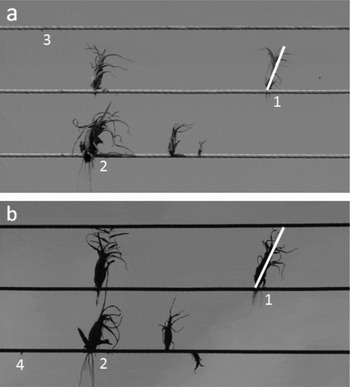
Almost 50% of the estimated 2500 species in the Bromeliaceae grow epiphytically in a remarkably wide range of habitats from inhospitable deserts to tropical rain forests (Benzing Reference BENZING2000). The degree of dependence on the host varies (Benzing Reference BENZING1990, Laube & Zotz Reference LAUBE and ZOTZ2006), and in some cases, epiphytic bromeliads may dispense completely with living hosts, and may thrive on artificial substrates such as electrical cables. This is not entirely surprising because this family provides examples of particularly remarkable adaptations to the epiphytic habitat like water-impounding leaf bases and water- and nutrient-absorbing scales (Benzing Reference BENZING2000). The so-called atmospheric forms in this family (e.g. Tillandsia recurvata) possess a dense covering of these scales, and use roots entirely as holdfasts, while leaves perform photosynthesis and take up water and nutrients. Although quite regularly mentioned in the literature (Benzing Reference BENZING1990, Reference BENZING2000; Brighigna et al. Reference BRIGHIGNA, RAVANELLI, MINELLI and ERCOLI1997, Lüttge Reference LÜTTGE1989), we are not aware of any study investigating the vigour of plants growing on cables compared with plants growing on trees. The only functional aspects that have already been studied are related to nutrients, i.e. presence of nitrogen-fixing endophytes in Tillandsia recurvata plants from natural hosts and from electrical cables in Mexico (Puente & Bashan Reference PUENTE and BASHAN1994) and differences in chemical composition of plant tissues and nutrient retention by leaves in Tillandsia capillaris growing on cables and trees in Argentina (Abril & Bucher Reference ABRIL and BUCHER2009). Intermittent water supply, but also low nutrient supply, play an important role in epiphyte ecology (Zotz & Hietz Reference ZOTZ and HIETZ2001), which leads to the following alternative hypotheses: (1) Plants on electrical cables are usually close to roads. Hence, if nutrient supply is of overwhelming importance for a given species, plants on cables may benefit from raised dust due to car traffic and grow faster; (2) Plants on cables are usually more wind- and sun-exposed than plants in trees. Hence, if water supply is of primary importance, plants on cables should not grow as fast as conspecifics in trees due to faster drying, and therefore shorter water availability, after rain events. Tillandsia flexuosa Sw. is the most xerophytic epiphytic bromeliad in many countries of Central America and the Caribbean, e.g. in Trinidad (Smith et al. Reference SMITH, GRIFFITHS and LÜTTGE1986) or Panama (Bader et al. Reference BADER, MENKE and ZOTZ2009, Zotz Reference ZOTZ2009), and was therefore a natural choice for such a study. In situ growth was monitored in naturally established populations growing on electrical cable (‘cable population’), of Tillandsia flexuosa in the eastern part of the Peninsula de Azuero (Republic of Panama, Herrera and Los Santos Provinces) in the villages of Pocrí (7°39.60ʹN, 80°07.01ʹW), Pedasí (7°31.76ʹN, 80°01.43ʹW), and Mariabé (7°35.00ʹN, 80°03.81ʹW). In a companion study (Zotz Reference ZOTZ2009), conspecifics were measured and marked on easily accessible trees in pastures (‘tree population’) growing within 60 km from our study sites. The annual rainfall in the region averages <1300 mm (Anonymous 1988). The only other common vascular epiphyte species in this driest part of Panama is Brassavola nodosa (L.) Lindl. (G. Zotz, pers. obs.). The fates of individual plants on 1250 m of electrical cables were followed by taking digital photographs with a Sony DSC-H5 camera in April 2007 and February 2008. The camera resolution (2048 × 1536 pixels, 72 dpi) was high enough to recognize even the smallest individuals on the cables (Figure 1). The conductor consists of aluminium wires woven around a steel cable for structural support, creating a rough and uneven surface, which could favour the establishment of seeds with a coma. The cable has a diameter of 8.25 mm (pers. comm. from the electricity company ETESA). The power lines in the area are usually in triplicate above each other (Figure 1). With the cable's diameter as scale we used the measuring tool of Adobe Photoshop CS3 Extended (Version 10.0.1, Adobe Systems, San Jose, USA) to estimate plant dimensions from the photographs. In the tree population, a total of 53 plants ranging in size from 1 to 38 cm for the longest leaf (LL) were measured and marked in March 2006. These plants were re-measured again after 1 and 2 y to determine relative growth rates (RGR) in this natural tree-inhabiting population (Zotz Reference ZOTZ2009). This study also reports a close correlation of the length of the longest leaf (LL) and plant dry weight (DW). Since leaves of T. flexuosa curl at the end, we could not directly use this relationship, but had to establish a correlation between the projected plant height (PPH), i.e. the height of an individual from the base to the uppermost part of the highest leaf (Figure 1), and LL. In February 2008 we determined PPH and LL for 36 individuals with an LL ranging from 1.2–74 cm growing on a set of trees that partially overlapped with the trees hosting the tree population of T. flexuosa. There was a tight correlation between these two parameters:

Applying both equations allowed us to calculate DW for all individuals and, in turn, to estimate in situ relative growth rates (RGR) in g g−1 d−1 following Hunt (Reference HUNT1982):

Occasionally, individual plants produced offshoots. In this case, LL and DW were determined as follows: LL was calculated for the mother plant and each additional offshoot separately. Then, the offshoot's LL was added to its mother plant's LL. The individual's total DW was derived from the mother plant's DW and DW of all offshoots which were calculated separately. For plants that died between observation dates, we noted the cause of death, as: (1) individuals that fell off the cable for unknown reasons (missing), (2) plants still in the same position but desiccated (drought). Case two was assumed when plants in the photographs clearly looked dry, i.e. plant size was reduced, leaves had shrivelled and had a brownish grey colour. From the demographic data, a stage transition matrix was constructed with four classes based on both qualitative and quantitative criteria. Since none of the recruits in 2008 was larger than 1 cm, a first stage class (SC1, <1 cm LL) was defined as recruits. A second stage comprised all non-reproductive individuals. Since no plant ≤13 cm had flowered in either 2007 or 2008, this size was used as upper limit of SC 2. Plants in SC3 (≤22 cm) reproduced occasionally, but never produced additional offshoots. Plants in the fourth stage class (>22 cm) showed a higher incidence of reproduction and sometimes produced additional offshoots. Fecundity was estimated by dividing the number of new seedlings in 2008 by the number of all potentially reproductive adults in SC3 and SC4 in 2007. The projection matrix (B = {bij}, where i, j = 1, 2, 3, 4) contains the transition probabilities and contributions (i.e. fecundity) of an average individual at different stages of the life cycle over 1 y. The matrix operates over a vector (nt) containing the distribution of individuals in the population between different size categories at a particular time t (Caswell Reference CASWELL2001). The size of the population after one time interval is equal to the product of matrix B by vector nt or Nt+1 = Bnt. The largest eigenvalue of the matrix B(k), is equivalent to the population's finite rate of increase, λ, the right (w) and left (v) eigenvectors associated with k are equivalent to the projected stable size distribution and the reproductive value distribution, respectively (Caswell Reference CASWELL2001). The analysis also yields the average residency time for each stage. These parameters were determined using RAMAS EcoLab (Applied Biomathematics, Setauket, NY, USA). To determine whether the obtained λ differed significantly from unity, 95% confidence intervals were determined using 1000 bootstrapped projection matrices (Caswell Reference CASWELL2001). These matrices were generated by randomly sampling individuals with replacement within stage classes. Seedling recruitment was not randomly sampled. The relative contribution of individual life cycle transitions to λ was analysed with elasticity analysis using RAMAS EcoLab as well. All other statistical analyses were done with R 2.8.0 (R Foundation for Statistical Computing, Vienna, Austria). Error terms are 1 SD.
Individuals of Tillandsia flexuosa growing on electrical cables in April 2007 (a) and the same individuals in February 2008 (b). The inserted white lines in plant 1 indicate the projected plant height (PPH), which was highly correlated with maximum leaf length (LL), a proxy for plant dry weight (DW). In the indicated plant 1, LL increased from 17.8 cm to 27.4 cm. Note that plant 2 produced an infructescence, plant 3 disappeared, and plant 4 is a first-year recruit.

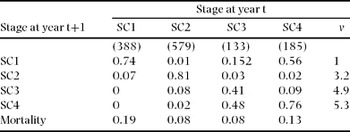
During this study, we noted a total of 1410 Tillandsia flexuosa individuals with 46 offshoots and a single individual of Brassavola nodosa (Orchidaceae) on 1250 m of photographed electrical cable. In 2007, the population consisted of 1287 individuals with 15 offshoots, decreasing to 1235 individuals with 46 offshoots, in 2008. This corresponds to densities of about 1 individual m−1 electrical cable. During the study period 62 individuals (4.8% of total) produced fruits, while 32 individuals (2.5%) produced at least one offshoot. There were 123 successful new recruits from seed during the study period, representing a per capita recruitment of 1.98 recruits per reproducing adult (SC3 and SC4). Mortality (175 deaths) exceeded recruitment by far. Most of the individuals were missing from their original position (129 individuals) or their death could be linked to drought (46 individuals). The mortality rate was highest among recent recruits with almost 20% y−1, which was about twice that of larger plants (Table 1). Based on the calculations of the projection matrix analysis the average time for a plant to reach SC3, i.e. to pass from germination to reproductive stage, was 9.1 y, which is comparable to other epiphyte species growing in trees (Hietz et al. Reference HIETZ, AUSSERER and SCHINDLER2002, Winkler et al. Reference WINKLER, HÜLBER and HIETZ2007, Zotz Reference ZOTZ1995). The relative growth rate of individuals in the cable population was 1.4 ± 2.4 mg g−1 d−1 (mean ± SD, n = 1025). We found no size-related variation in RGR (regression analysis with R2 < 0.01, P = 0.002). RGRs calculated separately for offshoots in the cable population were high with 17.9 ± 7.7 mg g−1 d−1 (n = 46). However, calculating RGR for the entire individual (mother plant plus offshoot) indicated stasis (RGRs: –0.6 ± 2.7 mg g−1 d−1, n = 46). The finite rate of population increase (λ) was 0.96, which is not significantly different from unity (95% confidence interval of 1000 bootstrap matrices: 0.93–1.01). Elasticity analysis revealed that survival was the most important demographic process (0.79), while growth (0.16) and particularly fecundity (0.04) influenced λ much less. Plants in the tree population of Tillandsia flexuosa had a much higher average RGR of c. 3.6 ± 2.0 mg g−1 d−1, with a significant decrease with plant size (Zotz Reference ZOTZ2009). This finding supports our second hypothesis that plants on cables are more affected by low water availability due to higher exposure to wind and sun, and cannot take advantage of possibly improved nutrient supply (Abril & Bucher Reference ABRIL and BUCHER2009). Far from optimal conditions for plants on cables are also indicated by the estimated λ of 0.96, although this value was not significantly different from unity. Mortality rates were similar or even somewhat lower than those found in other population studies with tree-inhabiting epiphytic bromeliads (Hietz Reference HIETZ1997, Winkler et al. Reference WINKLER, HÜLBER and HIETZ2007, Zotz Reference ZOTZ2005, Zotz et al. Reference ZOTZ, LAUBE and SCHMIDT2005), but establishment in the cable population, i.e. the number of recruits per reproducing individuals, was very low, though not exceptionally, when compared to other bromeliad species (range = 0.5–49.4; Winkler et al. Reference WINKLER, HÜLBER and HIETZ2007, Zotz Reference ZOTZ2005, Zotz et al. Reference ZOTZ, LAUBE and SCHMIDT2005). Although anchorage of seeds via the coma should be facilitated by the rough surface of both substrate types aluminium cables are arguably less advantageous in this regard. Alternatively, or in addition, mortality of recently germinated seedlings, which could not be captured by our census intervals, could be much higher on cables due to the low water-storage capacity of the substrate and extreme exposure to radiation (compare Bader et al. Reference BADER, MENKE and ZOTZ2009 for desiccation tolerance of seedlings). Thus, the most important differences between the cable population and the tree population seem to be slow growth and less successful colonization. Most population studies with tree-inhabiting epiphytes identified survival, particularly of large individuals, as the single most important demographic process (Tremblay Reference TREMBLAY1997, Winkler et al. Reference WINKLER, HÜLBER and HIETZ2007, Zotz Reference ZOTZ2005, Zotz & Schmidt Reference ZOTZ and SCHMIDT2006). Our elasticity analysis yields consistent results for the studied cable population. Consistent with the low RGR of individuals the population growth rate implies stasis. However, abiotic conditions will vary between years and λ may increase in years with higher water availability. We conclude that individuals in cable-inhabiting populations of Tillandsia flexuosa are slower growing than tree-inhabiting conspecifics which can be attributed to lower water availability. Population growth in the observed period was indistinguishable from stasis. Survival of individuals explained most of the population growth rate rather than growth and fecundity. Lower recruitment rates might be directly linked to poorer adhesive and water-holding properties of the aluminium cable compared with tree bark, while fast growing and reproducing, vegetative offspring seem to play an important role in the maintenance of cable-inhabiting populations.
Transition probability matrix for Tillandsia flexuosa growing on electrical cables. Stage classes (SC) are: SC1 – plants with longest leaf (LL) < 1cm; SC2 – plants with LL 1 ≤ 13 cm, SC3 – plants with LL 13 ≤ 22 cm, SC4 – plants with LL > 22 cm. The number of plants per stage class in the first census is given in parentheses. Also given is the reproductive value (v), as the relative contribution of an individual in a given size class to the next generation; and the probability of mortality.

ACKNOWLEDGEMENTS
We thank the Republic of Panama for making its natural resources available for study. Brigitte Rieger's (Oldenburg) help with the analysis of digital photographs is acknowledged.