In comparison to literature and the fine arts, there have been few attempts to theorize and conceptualize a notion such as global, world or transnational theatre history.Footnote 2 The terms mean, of course, different things: whereas ‘world’ and ‘global’ tend to be used interchangeably, transnational assumes clearly defined nation states as the point of reference for whatever traffic and movement is to be studied. Historically, transnational theatre has been, it could be argued, if not a norm, then at least an integral part of Western theatrical culture since the early modern period, as Italian and English troupes set off on extended peregrinations across the Continent.Footnote 3 Behind these peripatetic excursions lies the paradigmatic shift from a festival to a market economy, from theatre produced for specific occasions according to a festive calendar to one that needed to sell its product in a marketplace of competing entertainment forms. World or global theatre in the sense of world-encompassing and circumnavigating, if not the whole globe, then a good part of it, is a more recent development, not much older than 150 years. It is, I argue, part and parcel of what many historians of global history term ‘first-phase globalization’, which refers to the second half of the nineteenth and the early part of the twentieth centuries.
In this article I want to focus in particular on the question of transnational theatrical networks and how they functioned in the context of early globalization. I examine in particular the phenomenon of theatrical touring, perhaps the most under-researched of the various manifestations of transnational, even global, theatre in the period under scrutiny. I begin with some general remarks on the term ‘globalization’ and on how historians have applied it to this period. Shifting to the theatre itself, the focus becomes threefold: on the theatrical networks operating around the turn of the century that were transitioning from the almost moribund actor–manager model to complex, syndicated systems of theatrical entrepreneurship represented in our case by the theatrical circuit established by the largely forgotten actor and manager Maurice E. Bandmann, who, I argue, is representative of a significant new development. I attempt to tie together all of these heterogeneous factors by framing my material within the coordinates of actor-network-theory, a sociological theory developed mainly in science studies which is, however, now beginning to be adapted for historical research.
Transnational theatre and first-phase globalization
Many historians regard the period between 1850 and 1914 as a ‘first phase of globalization’ in as much as it evinces many parallels with current uses of the term, even though the word ‘globalization’ does not appear until the 1960s.Footnote 4 The watershed for this reading of world history is, according to Michael Geyer and Charles Bright, the mid- to late nineteenth-century worldwide ‘processes of unsettlement’ that saw an accelerating ‘mobilization of peoples, things, ideas, and images and their diffusion in space and time’ and the efforts of both local rulers and global regimes (empires) to ‘settle’ them.Footnote 5 The tensions ensuing from these dynamic processes form a central focus of global history. Concomitant with these tensions are technological advancements such as the laying of telegraph lines, the introduction of fast steamships and the growing networks of colonial and administrative centres, as well as the rapid spread of newspapers, which all combined to create the prerequisites for globalization in almost the present sense: a compression of time and space, movement towards standardization and a growing sensation of being part of an interconnected world.
Parallel with these demographic and technological changes, theatre too began to internationalize or ‘globalize’ on an unprecedented scale. In 1889 there existed at one very conservative estimate 302 permanent theatre buildings in Germany, England, France and Austria–Hungary. By the mid-1920s there were 2,499 permanent theatres in Europe alone. In the period post-dating 1890, over 1,500 theatres were built, most of them before 1914.Footnote 6 This pattern was repeated throughout many of the former and existing colonial empires, particularly in South East Asia and Latin America. In addition to the construction of permanent theatre spaces, the same period saw a massive expansion of theatrical touring, which began to be organized on an industrial scale and brought European-style theatre to all of those parts of the globe that could be reached by steamship or rail. Telegraph networks, countless local newspapers and syndicated news agencies provided the communications infrastructure enabling the touring companies to find their audiences. The same networks that brought European troupes to Asia and South America also enabled movement in other directions as Japanese troupes came to the United States and Europe, Chinese opera moved around the Pacific rim,Footnote 7 and Parsi theatre spread throughout the Indian subcontinent and into South East Asia, where it generated local variants (bangsawan in Malay regions, and komedi stambul and likay in the Dutch East Indies).Footnote 8
The rapid spread of theatre in this period was largely the work of theatrical managers, entrepreneurs and agents who established networks for the dissemination of this theatrical traffic. One prominent but today largely forgotten theatre entrepreneur who developed theatrical touring on a hitherto unimagined scale was Maurice Edward Bandmann (1872–1922). Bandmann managed numerous companies as well as a chain of up to fifty theatres that stretched from Gibraltar to Japan. Although he drew most of his productions from London, the centre of his operations was not the British capital, however, but India, where he had his headquarters in Calcutta, and later Cairo. His operations represent, I argue, a significant shift towards the globalization of theatre. The period immediately pre-dating the First World War saw a major change in theatrical touring, which reflected the economic structures of capitalism in the age of empire. Prior to this, it was, of course, quite normal practice to tour theatre. Its organizational form was based, however, on the actor–manager, an almost premodern business model in as much as at the close of the nineteenth century it did not differ greatly from the touring English or Italian troupes of the late sixteenth and early seventeenth centuries. It was characterized by strong familial ties, often a husband and wife as the lead performers and business managers, supported by about a dozen performers. Prominent examples of the actor–manager model were Maurice Bandmann's own parents: Daniel BandmannFootnote 9 and Millicent Bandmann-Palmer.Footnote 10 Both toured a predominantly Shakespearean repertoire, at first together, then separately, in the second half of the nineteenth century. Better-known actor–managers are Edwin Booth, Frank Benson, Herbert Beerbohm Tree and Henry Irving, to name only the most prominent.
Maurice Bandmann is a key figure in the transition from a premodern to a modern practice of theatrical touring. After completing his schooling at a classical Gymnasium in Wiesbaden, Bandmann entered the acting profession touring with both his father, in the United States, and mother, in the United Kingdom. Although he was an accomplished actor who soon formed his own troupe, his managerial career marks a new phase in the organization of theatrical touring. Within a few years, he managed four separate troupes in Britain, and in 1899 formed the Mediterranean and the East Entertainment Syndicate to tour Gibraltar, Tangiers, Malta and Egypt, the first stage in building a circuit that was to extend all the way to Japan.
After a first and somewhat unsuccessful foray into India in 1901, which coincided with the death of Queen Victoria and hence a temporary lack of interest in musical comedy, Bandmann took his light opera company to the West Indies. In 1902, he embarked on a tour to South America extending from Brazil to Peru, with a return route that included Halifax, Nova Scotia. In 1905, Bandmann resumed operations in India and made Calcutta his headquarters, where he rapidly established a ‘circuit’, which by his own account took in ‘Gibraltar, Malta, Egypt, India, Burmah, with the Malay States, the Straits Settlements, China, Japan, Java and Philippine Islands’.Footnote 11 He also included regular tours to the Caribbean. A calendar he issued to prospective theatres along the route in 1906 already figured him as a ‘global player’ positioned between ships, trains and different theatrical genres, his hand resting nonchalantly on a globe (Fig. 1).
A calendar issued by Bandmann to publicize the 1907 theatrical season and his own self-image as a ‘global player’. Photo: private collection.

Bandmann built, owned, managed or leased numerous theatres along his circuit, thus extending commercial control over all aspects of theatre production and reception.Footnote 12 A stranger to modesty and an expert in self-advertisement, for almost twenty years the name Bandmann stood for high-quality theatrical entertainment aimed at European and local audiences alike. As a Singapore paper noted in 1906, ‘The name of Bandmann is a sort of guinea stamp among itinerant theatrical circles’.Footnote 13 In 1914 he floated a public company, the Bandman Varieties Ltd, and some years later the Bandman Eastern Circuit Ltd (he dropped the second, Germanic-looking ‘n’ on his name because of the war), which controlled his many interests, including cinema distribution.Footnote 14 Upon his death in 1922 aged forty-nine, his personal fortune was assessed at around £33,000, the equivalent of £1 million in today's currency. Despite his early death, Bandman Varieties and the Bandman Eastern Circuit companies continued to operate in India well into the 1930s.
Connectivities: theatrical networks
The material presented so far is largely unknown, or least entirely absent from theatre histories, lexica and archives. Why is this? And perhaps more importantly, how can one examine this material in such a way that its dynamics and interconnections become visible? I propose that network theory, and in particular actor-network-theory, may offer one avenue. There are, of course, as many network theories as there are networks: social, technological, biological, political and economic, to name only some. What connects most of these quite disparate concepts and theories is a common emphasis on relational structures. By definition, relational structures are changing configurations of actors and nodes that constitute relay points around which communication and interaction take place. Some forms of network analysis attempt to visually graph these interconnections to demonstrate degrees of connectivity and tend to privilege aggregated data demonstrating multiple connections and correlations over monocausal factors such as class, sex, clan membership or individual agency.Footnote 15 This has been termed the ‘anticategorical imperative’, which ‘rejects all attempts to explain human behaviour or social processes solely in terms of the categorical attributes of actors, whether individual or collective’.Footnote 16
Actor-network-theory, often playfully abbreviated as ANT, is a particular variant of social network analysis that emerged in the 1970s in the field of the sociology of science, or what is now known as science studies, and is linked to a group of French sociologists, the best known of whom is Bruno Latour, but which also includes Michel Callon and the English sociologist John Law.Footnote 17 Broadly and abstractly speaking and at the risk of some simplification, ANT looks at interconnected networks of exchange known as actor networks. Actor networks consist in turn of interrelated nodes and actants, in which human beings are as much relational effects as initiating, all-controlling subjects.Footnote 18 The revolutionary move of ANT was to make the non-social – microbes and scallops to cite two famous examples – into ‘social’ actors. From objects being acted upon by conventional social actors, i.e. human beings, they were reconceptualized as part of a network in which, under certain circumstances, they are seen to have considerable agency. Although I do not want to enter too deeply into the controversies of this approach, its multiple perspectives and descriptive imperatives can help us rethink the complex relationships between theatrical trading, imperial formations and an understanding of what it meant to circulate and perform theatre on the eve of the First World War.
Methodologically, actor-network-theory can be considered a form of ethnography where techniques and practices of fieldwork and participant observation are applied to contemporary society and its many fields. Latour states that ANT is ‘simply another way of being faithful to the insights of ethnomethodology’.Footnote 19 Darryl Cressman refers to ANT's ‘ethnographic bent: micro-level studies of the labs and boardrooms tracing how actors exert influence over the trajectory of scientific and technical innovation’.Footnote 20 Since ethnography tends to focus on the present, how can theatre historians extend such insights gathered from present-day laboratories and boardrooms and make them useful for their concerns? And does not ANT have tautological implications for theatre, not the least of which is the term ‘actor’, but more so because theatre is intrinsically ‘social’ on account of its conditions of collaborative production and collective reception? If we simply revisit the usual objects of theatre research – plays, performances, performers, audiences and occasionally theatre buildings – then there is a real danger that we simply reformulate old insights with new metaphors.Footnote 21 A more productive application of actor-network-theory would require a recalibration of epistemological assumptions regarding why we do not know anything about Maurice Bandmann and his global activities. If the person did not register in the theatre-historical archive, then perhaps his circuit might. An ANT perspective would force us to concern ourselves more with the network than with the biographical person Maurice Edward Bandmann. It would lead to a concern with shipping and railway networks, newspapers, advance agents, the colonial judiciary, leaky ships, storms and tropical heat.Footnote 22 Actants would include texts, companies of performers, contracts and even courts, which all act upon each other in ‘webs of relations’.Footnote 23
Although one has not needed ANT to study Shakespeare, for example, the same cannot be said, I argue, for Maurice Bandmann's now forgotten ‘circuit’ and indeed this whole branch of theatrical activity, which is also largely overlooked and often not even recorded in our theatre archives.Footnote 24 While we could certainly map the activities of Bandmann and his many colleagues onto commonly understood historical processes such as commodification, imperial expansion and colonial power structures, I wish to view them from the perspective of connectivity.Footnote 25 In the chapter entitled ‘First Move: Localizing the Global’ in Reassembling the Social, Latour emphasizes the importance of examining connectivity itself:
we have to lay continuous connections leading from one local interaction to the other places, times, and agencies through which a local site is made to do something. This means that we have to follow the path indicated by the process of delegation or translation.Footnote 26
Following this perspective, we need to conceptualize itinerant theatre such as the Bandmann circuit as a set of interconnected nodes that together constitute the relay points for these associations. We can try and map these nodes and their forms of agency. This means that ‘connections, vehicles and attachments are brought into the foreground’.Footnote 27 We must try and conceptualize this network of associations across time and space spanning thousands of miles, interacting in a dozen locales, each regulated by a different legal system, cultural mores, audience tastes and compositions.
Finally, actor-network-theory is not just something that is ‘applied’ to a pre-existing object of research. Research itself forms an actor network in its own right. Prior to the accessibility of digital technology, it could be argued, the Bandmann circuit did not exist. The type of research to be described in this article has only been made possible with the digital revolution and the advent of digitalized newspapers, books and other resources, which enable peripatetic artists to be tracked. This technology ultimately circumscribes what is discoverable and knowable and is thus a key ‘actor’ in its own right.
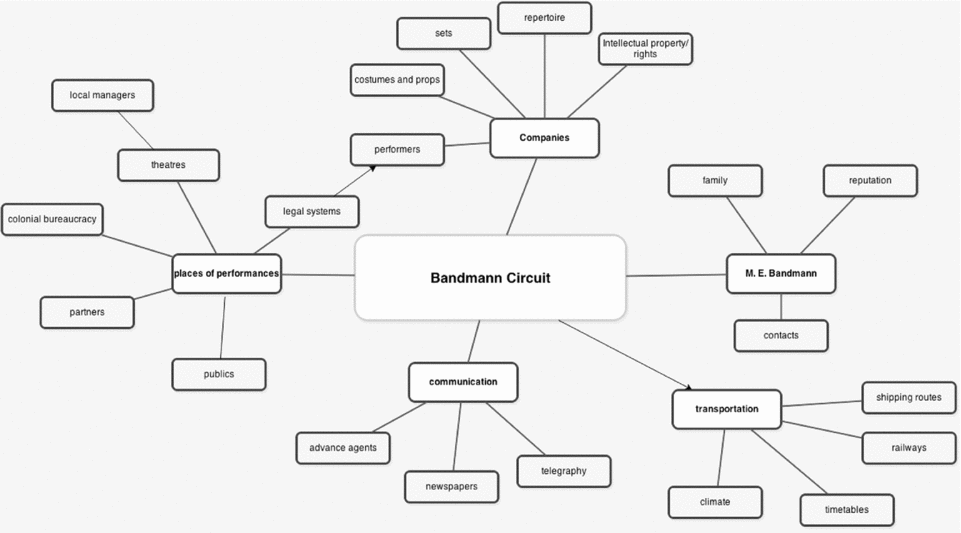
An ANT way to examine Bandmann's circuit (and the many others like it) would be to investigate the different nodes that were required for it to function at all. Leaving aside the managerial role of Bandmann himself, which was obviously crucial but ultimately not essential (his circuit continued to function long after his death), it is more productive to try and grasp, if not the totality, at least the multiaxial nature of the system and its various nodes. These can be represented as in Figure 2. In this conceptualization of a theatrical network it is not the person Maurice Bandmann who forms the central node but the circuit itself. The biographical person Bandmann is only one fulcrum exerting pressure on the rest of the network.
A conceptualization of the Bandmann circuit as an interconnected network of nodes.
Of central importance for any actor network are what Latour terms ‘mediators’. These are transporters of meaning that ‘transform, translate, distort and modify the meaning or the elements they are supposed to carry’.Footnote 28 In this sense they should be distinguished from ‘intermediaries’ where there is no such distortion and modification.Footnote 29 In both cases the function of a mediator can be human or non-human, a scientific panel of experts can be an intermediary, or a machine such as a computer can be a mediator. Concepts such as ‘mediators’ carry major epistemological implications. A conventional way of looking at touring theatre such as the Bandmann circuit would be to regard the passage of productions along the circuit and measure their degree of modification and ‘distortion’ from the originating source, the original Gaiety production in London, to its version in Bombay or Calcutta or Yokohama. Our object of interest would be, then, the local production of meaning, whether colonial or indigenous or some mixture of the two.
A less conventional and more ANT way of looking at touring practices would be to examine certain mediators in terms of the connectivity the Bandmann circuit exerted on the social fabric of the many communities it interacted with on a regular basis. First, this is clearly a difficult question to answer in the light of a complete dearth of research into his activities. Second, following ANT terminology, it would be necessary to understand a term such as ‘social fabric’ quite literally as a kind of texture of interwoven connections and associations. The diagram of the Bandmann circuit gives an indication of the different knots or nodes in this fabric. In the next section of this essay I propose, therefore, to discuss familiar topics of theatre history – repertoire, publics and partnerships – from the perspective of ‘mediation’ in the ANT sense of the term. In each case, I suggest, such mediators or mediation processes can be seen to ‘translate, distort and modify meaning’, not in a pejorative sense but as factors that cast light on the social dynamics of touring theatre in the first age of globalization.
Repertoire as mediation
The Bandmann repertoire was highly varied and specialized, with each troupe representing a different genre: opera, comedy, drama, variety, etc. These catered in turn to pre-existing patterns of taste, derived mainly from English theatre-going practices. At the height of his activities, Bandmann had several companies moving around the globe in a rotating chain of changing genres and repertoires. In an interview given in 1906 he described in detail his new rotation system. He planned to keep companies ‘going in regular rotation, working to and from London via the Mediterranean and Cairo to India and then up the Far East, and returning by the route that his present company is doing i.e. Burmah, Calcutta, Ceylon, and Bombay’. He also intended to have quick changes once the system became fully functional, so that
during the next two years Calcutta will never be without some theatrical entertainments: [my dramatic repertoire company] will play a week's season, and that will carry us well on into January. In February my new musical comedy company arrives, and I shall open with them at the Theatre Royal on 1 February 1907, with an entirely new repertoire. I shall play in Calcutta seven weeks, with two changes a week . . . At the end of the seven weeks there will be another company on the road, and in May and June, 1907, you will have my Gilbert and Sullivan repertoire company. In July the dramatic company will be on its way back from the Far East, and will play in Calcutta for about a month, and in its turn make room for the musical comedy company. I shall probably reorganise and play the cold weather season with one of my companies in Calcutta.Footnote 30
Although in reality the operation was not quite as seamless as he envisaged, the rotation system was in fact implemented. A repertoire could consist of up to a dozen different works performed in one locale over the course of a two-week run. A fourteen-week season in Calcutta, with its population of over a million, was the longest period that a Bandmann company remained in one place. A normal sojourn in most cities comprised a week to ten days at most. A travelling company could therefore most certainly be considered a form of ‘structured circulation’.Footnote 31
Repertoire can be examined as it connects with a culturally heterogeneous public – which will be discussed below – but it also needs to be seen in relation to intellectual property, as choice of repertoire was determined as much by access to and control of copyright as by questions of taste. Bandmann controlled and traded in a wide variety of intellectual property. One of the economic foundations of the Bandmann enterprise was a close cooperation with George Edwardes (1855–1915) and the Gaiety Company in London.Footnote 32 Edwardes, who practically invented the genre of musical comedy and produced numerous hit productions over a thirty-year period, entered into an agreement with Bandmann around 1903 with the result that the latter obtained sole rights for the British colonies and the ‘Far East’ of the Gaiety plays.Footnote 33 The control and management of intellectual property was a highly territorial affair, as performance rights were assigned to people, usually agents, who represented countries and/or regions. Whereas a country such the US or the UK could be quite closely monitored by the rights’ holders, this was not the case for the far-flung territories covered by the Bandmann circuit.
As well as managing his troupes and theatres, Bandmann also acted as an agent, perhaps the best example of mediation as translation in the ANT sense of the term. According to Latour, translation denotes ‘a relation that does not transport causality but induces two mediators into coexisting’. Although they do not exist in a casual relationship, translations between mediators ‘may generate traceable associations’.Footnote 34 The theatrical agent is the quintessential ‘actor’ in as much as he or she (and in this period there were many female theatrical agents) enabled other mediators to function. An illustrative example of this aspect of mediation can be seen in an exchange between Bandmann and the Incorporated Society of Authors, which represented, among other dramatists, George Bernard Shaw. In 1912, Shaw complained to G. Herbert Tring, the society's secretary, that unlicensed performances of Candida had taken place at the Royal Opera House, Bombay, Bandmann's newly opened theatre there. Bandmann explained that the culprit was actor–manager Allan Wilkie, who was touring India under a rival management. Bandmann also made a counterproposal:
If Mr. Shaw desires it I will write to my people in India and try to collect the fees. I am afraid this will be somewhat difficult in the case of this company, as I understand they are at present somewhere in the North West of India. I note what you say re Mr. Shaw's insistency, and of course quite agree with him, but to enforce compensation in a country like India is a far more difficult task I am afraid than what Mr. Shaw imagines, and also a very expensive proceeding. ‘Prevention is very much better than Cure’ in matters of this sort out East, and if your society could make up their mind to appoint me as their representative, I would then be in a position to instruct the agents which I have in every town of any importance in India and the Far East to act accordingly, and I think your society would find that illicit performances of their plays would be put a stop to.Footnote 35
Despite a brief exchange of letters and telegrams, the Society of Authors did not appoint Bandmann as their representative, but the proposal with its reference to ‘agents . . . in every town of any importance in India and the Far East’ represents the formation of an actor network in embryonic form, as well as shedding light on the ‘networked’ nature of theatrical business. Bandmann's ‘agents’ were probably the many managers of the fifty-odd theatres he owned or leased. While copyright and protection of authorial intellectual property existed in principle, its actualization was dependent on a functioning system of agents. The imagined or actual passage of theatrical intellectual property around the globe with Bandmann and his ‘representatives’ as translational mediators illustrates a web of connectivity linking Bandmann, Shaw, the Incorporated Society of Authors and the Bandmann theatres as conduits for the commercial transaction. The enabling technological ‘mediator’ is in fact the telegraph system, without which the whole system of monitoring would have been almost impossible.
Dispersed publics
As mentioned above, intellectual property also lay at the heart of Bandmann's special relationship with George Edwardes and the musical comedy of the Gaiety Theatre, a genre synonymous with Edwardian froth.Footnote 36 There remains, therefore, the nagging suspicion that Bandmann and his kind were just a theatrical extension of British commerce and colonialism, detached from indigenous peoples and experiences. There is, however, no doubt that non-European audiences frequented the productions – in some cases they constituted a majority of the spectators. Indeed, non-European audiences were economically essential for the whole enterprise. The theatre-going public on the Bandmann circuit was, in most cases, ‘distributed’ in a double sense: only a section of it corresponded to the ‘implied spectators’ for which the original productions had been conceived (very roughly a London metropolitan audience). It was also distributed in the sense of being dispersed over a large territory.Footnote 37 This state of dispersion represents the differentia specifica of touring theatre, but it was especially pronounced on the Bandmann circuit because of the astonishing geocultural and linguistic terrain covered by the troupes. The question of dispersed audiences can be explored from an ANT perspective by asking how repertoire provides an indicator of processes of negotiation and calibration between production and reception, between institutional frameworks and their social functions. The term ‘transformation’ in its ANT meaning is the useful here. If we take repertoire as a kind of potential ‘actor’ in the sense of a factor exerting pressure on the network then we can assume that it will change as it moves along the network. In Latour's terms, ‘This is not done by transporting a force that would remain the same throughout . . . but by generating transformations manifested by the many unexpected events triggered in the other mediators that follow them along the line.’Footnote 38 The various plays and productions and their effect on heterogeneous audiences, and vice versa, the transformations effected by the different audiences, were transformative in just this sense and thereby were a key factor regulating the theatrical network.
In July 1911, while on one of his periodic trips to London to sign up new performers and acts, Bandmann gave an interview to the English newspaper The Referee:
How do I find the Indian audiences? Excellent. They roll up in shoals for anything good. We have educated the natives into playgoing. They have become especially fond of Shakespeare. In Calcutta and in Bombay they will pay anything for seats, sometimes fifty rupees (about £3 6s. 8d.). And they always bring their ‘Shakespeare’ along, so as to follow the play. At first these natives were much surprised and annoyed at our necessary ‘cuts.’ When Shakespeare is given at the native theatre – as he often is now – he is always played entire. We are going to give the Indian and other natives a lot of Shakespeare presently.Footnote 39
The civilizing mission to tutor the ‘natives’ in the art of play-going reads like an early form of audience development, aimed less at acquainting them with the transcendental qualities of Shakespeare's plays than at entering them into the oldest Western theatrical contract: paying an entry fee in exchange for entertainment. Despite Bandmann's promise to give the ‘natives’ a lot of Shakespeare, the Bard was by no means the mainstay of his repertoire.Footnote 40 A typical season in Singapore in 1912 included Mousme, Peggy, The Count of Luxembourg, The Belle of New York, The Girl in the Train and Gilbert and Sullivan's The Gondoliers and Our Miss Gibbs, each work being performed on a different night.Footnote 41 For the slightly more discerning audience his Comedy Company offered a repertoire ranging from Charley's Aunt to Oscar Wilde's The Woman of No Importance, while the Bandmann Dramatic Company had more serious fare, such as Trilby, East Lynne and The Prisoner of Zenda. For those determined to avoid any type of serious reflection, the Bandmann Gaiety Company guaranteed a thought-free evening with a selection of the ‘Latest London Revues’, including nightly programmes such as ‘Frocks & Frills’, ‘All French’ and ‘Come Inside’.Footnote 42
This varied Edwardian repertoire was evidently necessary to cater to what was an exceptionally heterogeneous audience. In most of the cities comprising the Bandmann circuit, the performances were frequented by, ethnically speaking, a broad cross-section of the population. Theatre-going as Bandmann mentioned, was by no means the preserve of a colonial class. This was certainly the case in India but also held true in Shanghai, where many Chinese people attended, and even more so in Singapore, where it was calculated that on one night people from thirty different communities were present.Footnote 43 Although the Bandmann repertoire was targeted primarily at European spectators, such audiences were by no means large enough to sustain the longer seasons in the larger Indian cities. In 1907, Bandmann calculated that nowhere in India ‘will theatre-goers patronise more than three or four companies during a single year. If Bombay can get sixteen weeks of English attractions at reasonable intervals, that is as much as the town will stand’.Footnote 44 In the cities further east such as Shanghai and Manila and in Japan—the regular ports of call of Bandmann's companies—European audiences were even smaller. In Japan, Bandmann's companies performed to a largely Japanese public, the resident European population being quite small.
As a theatre manager, Bandmann needed to cater to cultural exigencies in order to provide for this heterogeneous public. In Calcutta in 1914, he renamed his Empire Theatre the ‘Palace of Varieties’ and advertised it in the anglophone Indian press somewhat oxymoronically as the ‘House of Refined Vaudeville’ where ‘Indian Gentry’ were ‘specially welcome’ and ‘special arrangements for Zenana ladies’ were available, meaning the segregation and curtaining off of boxes and sections of the stalls for Hindu and Muslim women.Footnote 45 Sometimes the programme was adapted for ‘Indian gentlemen’, on other occasions it was stressed that matinee and evening performances were identical.Footnote 46 Variety theatre, with its eponymous ‘variety’ of acts, lent itself particularly well to culturally tailored programming. Its combination of juggling acts, acrobatics, magic and films provided a ‘modularized’ structure that could be rearranged and adapted on a daily basis.
Musical comedy, Shakespeare, melodrama, comedy, variety, travelling magicians: in a metropolitan centre all of these different genres would be housed in their respective venues and cater to specialized audiences. In the Bandmann theatres they all passed through the same venue, or, put another way, the same venue became a relay station for a rich array of theatrical entertainment representing the whole gamut of English performance genres. The theatre then becomes the mediator of cultural exchange: socially, it becomes a place of contact for different races and religions; commercially, it is place of competition between European and Indian theatre owners; aesthetically, it provides a steady stream of plays, acts and persons, which act in some way on the emerging local theatre and film industry.
Building partnerships
To reach audiences, Bandmann required intermediaries and mediators of different kinds. These included advance agents in his employ, the local newspapers and theatre owners. Of these intermediaries, business partnerships were perhaps the most important mediators, connecting the peripatetic entrepreneur with the culture of the locale, which became a distinguishing characteristic of the Bandmann network. In comparison with normal touring, where an artist or company would pass through a city with little long-term impact, Bandmann attempted to forge lasting ties with the important centres on his circuit. This involved leasing theatres, not just for his companies but for other troupes and artists as well. Most significantly, he planned to, and indeed did, build new theatres. The fact that Bandmann built or attempted to build modern theatres in many of these cities suggests that his investment was long-term and predicated on a growing public for theatrical entertainment.
The construction of a theatre, a highly complex operation involving considerable capital investment, local knowledge, bureaucratic negotiations and political savvy, represents in itself the formation of a new actor network. To build such theatres, the itinerant entrepreneur needed the collaboration of local partners as mediators within the city in question. Of particular importance are the partnerships Bandmann entered into in Bombay and Calcutta, where his operations were physically based. In order to build the Royal Opera House in Bombay in 1911 at a cost of approximately £33,000, he formed a partnership with a Parsi coal merchant and entrepreneur, Jehangir Framji Karaka. In Calcutta, where he owned two large theatres, the Empire and the Theatre Royal, Bandmann, by his own account, first formed a partnership with an Armenian-born property investor, Arratoon Stephen. Later he alternately joined forces and competed with the Calcutta-based Parsi businessman Jamshedji Framji Madan (1857–1923), who was also expanding his operations with theatrical performances and was to establish the foundations of a local film industry. Certainly indirectly and perhaps directly, there is a connection between Bandmann and the beginnings of Bollywood.Footnote 47
At the end of the First World War, Bandmann temporarily relocated the centre of his operations to Cairo, where he had already entered into a partnership with the Italian ‘Chevalier’ Augusto Dalbagni (1874–1951), who had been an Egyptian resident since the 1890s and had established himself as an impresario. Together they owned and managed three theatres in Cairo – the Empire, the Kursaal and the Piccadilly – as well as the Alhambra in Alexandria. They also forged plans to control further theatres in Haifa, Beirut, Damascus, Aleppo, Jaffa and Jerusalem.Footnote 48 The partnership in Cairo functioned mainly on the level of repertoire. Before 1914, Augusto Dalbagni had established a reputation for building and managing the Kursaal theatre. Next to the Khedival Opera House, it became an important venue for touring troupes providing a varied programme ranging from opera to tragedy for Cairo's cosmopolitan citizens. With the outbreak of war, Cairo was flooded with foreign, mainly British and empire, troops whose taste was more inclined towards variety and revues. Here Bandmann provided the necessary theatrical fare, as he had just completed plans for establishing a circuit devoted entirely to variety theatre.Footnote 49 The partnership was provisional, as most are. By 1920, life in Cairo slowly returned to normal and Dalbagni terminated the collaboration and reinstated his pre-war repertoire, which included Italian, French, English, Spanish and Greek companies performing a broad collection ranging from opera, ballet and Greek tragedy to classical concerts.Footnote 50
In each case, Bandmann combined his technical theatrical know-how with local capital and knowledge: in Calcutta with the Armenian property tycoon, in Bombay with a wealthy coal merchant, in Cairo with an established impresario. From an ANT perspective these partnerships were actants in the sense of being strategic alliances that enabled other actor networks to come into play. One of these was the provision of technology and know-how from England, for example through the famous British theatre architect Frank Matcham, who designed the stages in Calcutta and Bombay. In India, this technological transfer joined forces with local capital to enable the construction of the finest and most up-to-date theatres in Asia.Footnote 51 Both theatres still stand, although the Empire (Fig. 3) is forgotten and now masquerades as the Roxy Cinema, oblivious of its colonial history. The Royal Opera House in Mumbai, also once a cinema and facing destruction, has been declared a Category One heritage building and is currently being renovated (Fig. 4).Footnote 52
The Empire Theatre in Calcutta, c.1914. Programme cover. Courtesy of Vanessa Lopez.
The Royal Opera House, Mumbai. Photo: private collection.
Partnerships, being just one node in a complex structure, demonstrate how theatrical networks enabled the relay of people, intellectual property, entertainment, technical know-how and affects around the world. The multiplicity of factors at play suggests that each individual actor can form the node of a network leading to further networks that the theatre historian needs to follow. There are many more connections one could trace in Bandmann's case: his interaction with the judicial system as he became embroiled in an endless series of legal disputes with partners and performers, contacts with colonial bureaucracy, or the importance of modern communication systems to facilitate the movement of people and intellectual property around the globe.
Conclusion
If we attach premium value to those activities and products that issue from or reflect bounded geopolitical entities – the village, town, community or nation – then mobile, circulating products or people are by definition difficult to map onto our scholarly and evaluative templates. This observation has a number of theatre-historiographical implications. First, from a long-term historical perspective, a theatre of mobility was as much a norm as the rooted, sedentary variety. In many periods of European theatre history, the provision of performance was entirely reliant on itinerant troupes. Once we move outside the major metropolitan centres, we can observe a practice of visiting companies rather than permanent ensembles, the latter being, even today, the exception rather than the rule.
Second, the itinerant theatre is by definition primarily commercial in orientation, and not motivated by the imperatives of art, community or nation. But when one considers that all professional theatre in the English-speaking world in the period under consideration was commercial, then the itinerant variety represents the geographical extension of a norm, not the exception. While mobility and commerce certainly condition one another, – no movement, no trade – their mutual entanglement results in almost total theatre-historiographical amnesia. Theatre on the move leaves few traces: some playbills, newspaper advertisements, the occasional article and review, and perhaps a scrapbook here or there. From ubiquity to disappearance is but one step in theatre history, it seems. Maurice Bandmann and his many companies were certainly ubiquitous, quite literally a household name, a ‘guinea stamp’ of quality and many things besides. Now they have been obliterated from our disciplinary memory because their activities do not appear to warrant attention; they do not meet current epistemological criteria of attention.
I have argued that while the performances – derivative productions performed for colonial audiences, the epitome of a spectateur manqué – may not warrant sustained hermeneutical enquiry, the network itself is another matter. Its range, complexity and multiaxial nodal structures require sustained investigation in order to understand how theatre globalized in the first decades of the twentieth century. I have adapted certain concepts from actor-network-theory to make visible the associations and connections that enabled the network to grow and function over a thirty-year period and astonishing distances. I have focused on three different components in the network – repertoire, publics and partnerships – and demonstrated how they functioned as ‘actors’ and ‘mediators’ in enabling a commercially organized theatrical network to finds its audience. In each case, I have argued that a particular ‘actor’ forms a multiaxial point at which other networks interconnect: repertoire in relation to intellectual property which is in turn ‘translated’ by agents; dispersed publics as a transformative force on a pre-existing system of genre-based companies; and finally partnerships as mediators between the itinerant manager and the actual locale. Together – and we could analyse many more such ‘actors’ – they function to make visible a complex, even abstract, theatrical network that managed to transport theatre in a multitude of genres to a plethora of different publics in what could be termed the first age of theatrical globalization.