Introduction
Ever since the discovery of glass-ceramics by Stookey in the 1950s, Reference Stookey1 there have been widespread applications for this unique class of materials. Reference Montazerian and Zanotto2–Reference Holand and Beall5 Glass-ceramics are generally defined as microcrystalline solids formed by controlled nucleation and crystallization of glass. Reference Holand and Beall5,Reference Beall6 The ability to use high-speed glass-forming processes (e.g., pressing, blowing, rolling, floating) to manufacture glass-ceramics provides a unique advantage over conventional ceramics.
Nowadays, the quest for more damage-resistant engineering materials is driving the development of high-performance materials with exceptional mechanical properties. Glass-ceramics with high strength and toughness are in demand for medical, structural, and consumer electronics markets. Reference Zanotto3 The properties of glass-ceramics strongly depend on both composition and microstructure. The bulk glass composition controls the ability for glass melting, forming, and the potential phase assemblage after ceramming (heat treatment), while the design of microstructure is crucial for key mechanical and optical properties. Reference Beall6,Reference Beall7 The microstructure is controlled through optimization of the heat-treatment cycle of the precursor glass.
This article presents an overview of current developments in the creation of glass-ceramics with the requisite structure and properties, with a focus on their body strength. First, we provide an overview of the composition, microstructure, and mechanical properties that have been reported in glass-ceramics. The section titled “Nature-inspired toughening” contains a detailed analysis of the approaches used to produce high strength and high toughness with inspirations from biological and geological materials. We conclude with recommendations for future directions in the development of glass-ceramics with unique structure and properties.
Composition–microstructure–mechanical properties
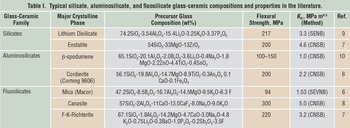
An extremely broad range of glass-ceramic compositions has been reported in the literature. The ability to form a glass and to control its crystallization through internal nucleation is generally required for a glass-ceramic composition. However, the phase assemblage and microstructure are restricted to those metastable crystals that can form from glass. The majority of reported glass-ceramic compositions are based on silica-containing glasses and can be divided into three groups: silicates, aluminosilicates, and fluosilicates. Table I provides a summary of the typical compositions and properties in these three glass-ceramic families. Reference Beall6–Reference Beall, Comte, Dale, Pinckney, Smith, Stewart and Tietje10
Typical silicate, aluminosilicate, and fluosilicate glass-ceramic compositions and properties in the literature.

Note: K IC, fracture toughness; SENB, single-edge notched beam; CNSB, chevron-notched short beam; SEVNB, single-edge v-notched beam.
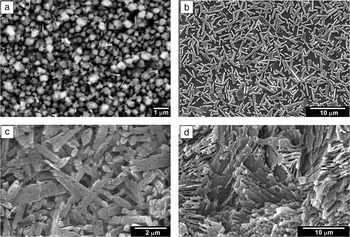
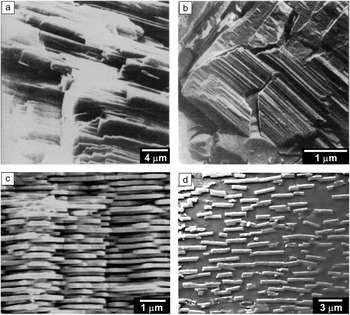
Figure 1 shows microstructures of silicates (lithium disilicate), Reference Höland, Schweiger, Frank and Rheinberger11 aluminosilicates (β-spodumene), Reference Beall, Comte, Dale, Pinckney, Smith, Stewart and Tietje10 and fluosilicates (mica and canasite) glass-ceramics. Reference Denry and Holloway12,Reference Pollington and van Noort13 Grain sizes spanning from the submicrometer regime (β-spodumene) to more than tens of micrometers (canasite) are achievable in glass-ceramics. As previously mentioned, the microstructure is dependent on the composition, phase assemblage, and heat-treatment schedule. A homogeneous microstructure through internal nucleation is required for good mechanical properties. Reference Holand and Beall5,Reference Beall6 Additionally, crystals with high anisotropy in one- or two-dimensional forms are necessary for mechanical performance.
Scanning electron microscope images showing microstructures of (a) β-spodumene, Reference Beall, Comte, Dale, Pinckney, Smith, Stewart and Tietje10 (b) mica, (c) lithium disilicate, and (d) canasite glass-ceramics. (b–d) Reprinted with permission from References Reference Höland, Schweiger, Frank and Rheinberger11–Reference Pollington and van Noort13. © 2000, 2004, and 2012, respectively, Wiley.

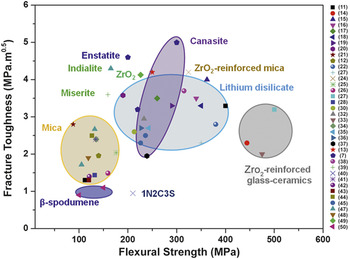
Both flexural strength and toughness, expressed as the critical stress intensity factor (K IC), are important mechanical parameters in the determination of the material properties of glass-ceramics and their suitability for use as a commercial product. Data compiled from more than 40 studies show the range of flexural strength and fracture toughness for glass-ceramics with different compositions and phase assemblages ( Figure 2 ). Reference Beall7,Reference Beall, Comte, Dale, Pinckney, Smith, Stewart and Tietje10–Reference Beall50 Each symbol corresponds to a specific glass-ceramic composition as listed in Table SI, available online. Several characteristics can be observed. First, flexural strengths span from 100 to more than 500 MPa, and fracture toughness ranges from 1.0–5.0 MPa.m0.5. Overall, fracture toughness is observed to increase with flexural strength. However, the highest toughness is not associated with the highest strength. It is worth noting that a variety of testing methods have been used to evaluate the strength and fracture toughness of glass-ceramics. For instance, three- or four-point bending, Reference Beall7,Reference Höland, Schweiger, Frank and Rheinberger11,Reference Elsaka and Elnaghy14–Reference Zhao, Qin, Zhang, Wang and Yang18,Reference Domingos Teixeira, Pereira, Boehs, Siligardi, Cantavella and de Oliveira20,Reference Taruta, Sakata, Yamaguchi and Kitajima21,Reference Uno, Kasuga and Nakajima23–Reference Hu, Li, Dali and Liang34,Reference Hamedani, Marghussian and Sarpoolaky38–Reference Peitl, Zanotto, Serbena and Hench40,Reference López-Esteban, Bartolome, Di, Esteban-Tejeda, Prado, Lopez-Piriz, Torrecillas and Moya43–Reference Bernardo, Doyle and Hampshire48 biaxial, Reference Mirsaneh, Reaney, Hatton and James35–Reference Kanchanarat, Bandyopadhyay-Ghosh, Reaney, Brook and Hatton37,Reference Fu, Wu, Grandfield, Unosson, Chang, Engqvist and Xia49 and indentation methods are used to obtain flexural strength; Reference Denry and Holloway12,Reference Xie, Bell and Kriven41,Reference Wu, Rawlings, Boccaccini, Dlouhy and Chlup42 while single-edge v-notched beam (SEVNB), Reference Höland, Schweiger, Frank and Rheinberger11,Reference Elsaka and Elnaghy14–Reference Huang, Zheng, Zhao, Zhong, Zhang and Wen16,Reference Zhao, Qin, Zhang, Wang and Yang18,Reference Domingos Teixeira, Pereira, Boehs, Siligardi, Cantavella and de Oliveira20,Reference Uno, Kasuga and Nakajima23,Reference Chaysuwan, Sirinukunwattana, Kanchanatawewat, Heness and Yamashita25–Reference Li, Wang, Meng and Chen29,Reference Kasuga and Nakajima31,Reference Liu and Chou32,Reference Hamedani, Marghussian and Sarpoolaky38 chevron-notched short-beam (CNSB), Reference Beall7,Reference Pinckney, Beall and Andrus39,Reference Beall47 double torsion, Reference Kokubo, Ito, Shigematsu, Sakka and Yamamuro30 and indentation methods have been used to measure fracture toughness. Reference Denry and Holloway12,Reference Serbena, Mathias, Foerster and Zanotto17,Reference Taruta, Sakata, Yamaguchi and Kitajima21,Reference Yang, Wu, Hu, Wang, Wang and He24,Reference Dittmer, Yamamoto, Bocker and Rüssel33–Reference Kanchanarat, Bandyopadhyay-Ghosh, Reaney, Brook and Hatton37,Reference Peitl, Zanotto, Serbena and Hench40–Reference Molla, Kesavulu, Chakradhar, Tarafder, Mohanty, Rao, Karmakar and Biswas46,Reference Bernardo, Doyle and Hampshire48,Reference Fu, Wu, Grandfield, Unosson, Chang, Engqvist and Xia49 A careful comparison among different methods and equations for measuring K IC values suggests that the SEVNB method produces more reliable evaluation than the other methods. Reference Quinn and Bradt51,Reference Beall, Chyung, Stewart, Donaldson, Lee, Baskaran and Hasselman52 However, the indentation fracture toughness method generates less reliable toughness values for brittle materials. Reference Serbena, Mathias, Foerster and Zanotto17,Reference Quinn and Bradt51
Mechanical properties of glass-ceramics in the literature. Reference Beall and Pinckney4,Reference Beall, Comte, Dale, Pinckney, Smith, Stewart and Tietje10–Reference Beall50 Compositions for corresponding glass-ceramics are listed in Table SI, as supplementary information available online, except miserite (wt%: 54.5 SiO2, 0.6 Al2O3, 19.6 CaO, 12.8 CaF2, 7.2 K2O, 1.9 B2O3, 1.3 Y2O3, 2.1 P2O5), 1N2C3S (wt%: 48.5 SiO2, 23.8 Na2O, 23.8 CaO), and indialite (wt%: 43.8 SiO2, 24.7 Al2O3, 18.7 MgO, 1.4 CaO, 11.4 TiO2).

Second, the data show that the microstructure, resulting from phase assemblage of glass-ceramics, has a strong effect on the strength and fracture toughness. Glass-ceramics with fine-grained structure generally have a lower strength and fracture toughness than those with large and interlocking (cross-linked) grains. Fine-grained β-spodumene glass-ceramics (Figure 1a) exhibit a combination of flexural strength of 100–150 MPa and K IC of 0.9–1.1 MPa m0.5, while a house-of-cards mica (Figure 1b) glass-ceramic has a flexural strength of 100–200 MPa and K IC of 1.2–3.0 MPa.m0.5. Furthermore, lithium disilicate (Figure 1c) and canasite (Figure 1d) with acicular interlocking rod-or blade-like crystals demonstrate even higher strength and toughness, a combination of 150–400 MPa and 2–4 MPa m0.5 for lithium disilicate, and 200–300 MPa and 2–5 MPa m0.5 for canasite glass-ceramic. The high fraction of the crystalline phase with well-cleaved crystals and interlocking crystal aggregates enable the crack-deflection and crack-bridging toughening mechanisms, which contribute to the good mechanical performance of lithium disilicate and canasite glass-ceramics. Reference Denry and Holloway12,Reference Serbena, Mathias, Foerster and Zanotto17 Canasite glass-ceramics with a fracture toughness of 5.0 MPa m0.5 remain the toughest glass-ceramics so far. Reference Beall7 Similar toughening mechanisms are also observed in other chain silicates, including enstatite (MgSiO3), Reference Beall7 miserite (KCa6Si8O22(OH, F)2), Reference Pinckney, Beall and Andrus39 and indialite (Mg2Al4Si5O18) glass-ceramics. Reference Beall47 Furthermore, the addition of reinforcement phases such as Al2O3 or ZrO2 to a glass-ceramic composition is also observed to have a marked improvement on mechanical performance. Reference Elsaka and Elnaghy14,Reference Huang, Zheng, Zhao, Zhong, Zhang and Wen16,Reference Yang, Wu, Hu, Wang, Wang and He24,Reference Uno, Kasuga, Nakayama and Ikushima27,Reference Dittmer, Yamamoto, Bocker and Rüssel33
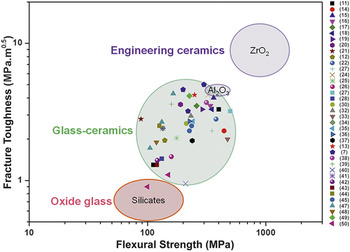
To date, it is encouraging to find that recent progress in glass-ceramics has resulted in new materials with strength and toughness much higher than that of glass, and even comparable to that of Al2O3 ceramics ( Figure 3 ). The body strength of glass-ceramics, however, is still far lower than that of ZrO2 ceramics. Reference Rahaman, Yao, Bal, Garino and Ries53 This suggests that novel routes to achieve multiple toughening mechanisms are needed to further improve the mechanical performance of glass-ceramics to the level of advanced oxide ceramics. Natural geological minerals such as jade and baddeleyite (ZrO2), and biological minerals such as bone and nacre (mother of pearl) with unique microstructures and exceptional mechanical performance, are stimulating new approaches in the design of strong and tough glass-ceramics.
Mechanical properties chart of glass, glass-ceramics, Reference Beall and Pinckney4,Reference Beall, Comte, Dale, Pinckney, Smith, Stewart and Tietje10–Reference Beall50 and ceramics in the literature. Reference Rahaman, Yao, Bal, Garino and Ries53 See Table SI, available online, for additional information.

Nature-inspired toughening
Both geological and biological minerals are renowned for their unique combination of properties that are often difficult to obtain with synthetic materials. Reference Fratzl and Weinkamer54,Reference Munch, Launey, Alsem, Saiz, Tomsia and Ritchie55 The hierarchical architectures of these naturally occurring materials with complex composite structures at defined length scales account for their mechanical performance. Reference Fratzl and Weinkamer54,Reference Wegst, Bai, Saiz, Tomsia and Ritchie56,Reference Mayer57 The knowledge from these natural minerals and their intriguing mechanisms have provided a fresh stimulus for the design of new synthetic materials with unprecedented properties and performance. Reference Munch, Launey, Alsem, Saiz, Tomsia and Ritchie55–Reference Mayer57 Attempts to duplicate the microstructures of natural materials such as those shown in Figure 4 for natural jadeite versus synthetic enstatite glass-ceramics, and natural seashell nacre versus synthetic mica glass-ceramics have been attempted.
Scanning electron microscope images showing the microstructure of natural and synthetic materials: (a) natural jadeite versus (b) synthetic enstatite (MgSiO3) glass-ceramics; Reference Beall7 (c) natural nacre (mother of pearl) versus (d) synthetic mica glass-ceramics. (a) Reprinted with permission from Reference Reference Bradt, Newnham and Biggers58. © 1973 Mineralogical Society of America. (c) Reprinted with permission from Reference Reference Song, Soh and Bai67. © 2003 Elsevier. (d) Reprinted with permission from Reference Reference Habelitz, Carl, Russel, Marchetti, Roeder, Elfler and Hergt73. © 1997 Elsevier.

Geological mineral jade (jadeite and nephrite) is widely accepted as the toughest natural mineral. Reference Bradt, Newnham and Biggers58 In jadeite, the tabular or lath-like crystals (Figure 4a) with pronounced cleavage planes force a crack to propagate in the transgranular cleavage mode, yielding a K IC value of more than 7.0 MPa m0.5. In nephrite, the acicular interlocking microstructure results in a high degree of crack deflection, yielding a K IC value close to 8.0 MPa m0.5. To mimic the unique structures of jadeite and nephrite, chain-silicate glass-ceramics based on canasite and enstatite were developed. Both canasite and enstatite demonstrate a unique combination of high strength and high fracture toughness (Figure 2). A comparison between the microstructures of natural jadeite and an enstatite glass-ceramic is shown in Figure 4. Reference Beall7
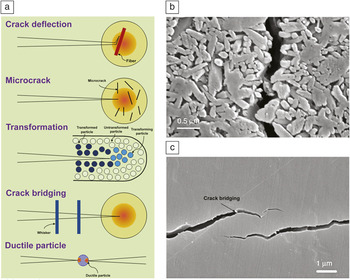
Baddeleyite (monoclinic ZrO2) is another important geological mineral that has been comprehensively investigated to understand its monoclinic-tetragonal-cubic phase transition and its relation to the stabilization of tetragonal ZrO2 ceramics. Reference Smith and Newkirk59 Structural ceramics based on stabilized ZrO2 have demonstrated excellent mechanical performance attributed to a combination of multiple toughening mechanisms as shown in Figure 5 . Reference Becher60–Reference Hannink, Kelly and Muddle62 In comparison, crack deflection (Figure 5b) and crack bridging (Figure 5c) are the two commonly observed toughening mechanisms in glass-ceramics. Reference Apel, Deubener, Bernard, Höland, Müller and Kappert63 Attempts have been made to introduce a ZrO2 phase in glass-ceramics. This can be realized either by internal crystallization of a ZrO2 phase in glass-ceramics, Reference Domingos Teixeira, Pereira, Boehs, Siligardi, Cantavella and de Oliveira20,Reference Uno, Kasuga, Nakayama and Ikushima27,Reference Dittmer, Yamamoto, Bocker and Rüssel33,Reference Fu, Wu, Grandfield, Unosson, Chang, Engqvist and Xia49,Reference Sarno and Tomozawa64 or by sintering and crystallization of pressed mixtures of glass and ZrO2 powder. Reference Huang, Zheng, Zhao, Zhong, Zhang and Wen16,Reference Yang, Wu, Hu, Wang, Wang and He24,Reference Montazerian, Alizadeh and Yekta28,Reference Kasuga and Nakajima31 However, no convincing evidence on the phase-transformation (tetragonal → monoclinic) toughening mechanism has been reported in these glass-ceramics. Reference Huang, Zheng, Zhao, Zhong, Zhang and Wen16,Reference Yang, Wu, Hu, Wang, Wang and He24,Reference Uno, Kasuga, Nakayama and Ikushima27,Reference Dittmer, Yamamoto, Bocker and Rüssel33
(a) Schematic illustration of the primary toughening mechanisms, including crack deflection, microcrack, phase transformation, crack bridging, and presence of a ductile phase, in ceramics and ceramic-matrix composites that enable their exceptional mechanical performance. Reprinted with permission from References Reference Becher60 and Reference Evans61. © 1991 and 1990, respectively, Wiley. (b) Crack deflection observed in lithium disilicate glass-ceramic. (c) Crack bridging observed in leucite glass-ceramic (stoichiometric composition: K2O·Al2O3 ·4SiO2). (b–c) Reprinted with permission from Reference Reference Apel, Deubener, Bernard, Höland, Müller and Kappert63. © 2008 Elsevier.

Biological minerals such as seashell nacre and bone are well known for their strength and toughness superior to those of many synthetic ceramics or composites. Reference Rahaman, Yao, Bal, Garino and Ries53,Reference Sarno and Tomozawa64,Reference Aksay, Trau, Manne and Honma65 Nacre exhibits a microarchitecture that is composed of a highly regular brick-and-mortar arrangement, as shown in Figure 4c. Crack deflection, “pull-out” of the inorganic phase (CaCO3), and organic-matrix bridging are regarded as the main toughening mechanisms. Reference Rahaman, Yao, Bal, Garino and Ries53,Reference Shao, Zhao, Feng and Gao66,Reference Song, Soh and Bai67 Inspired by the structure of nacre, oriented glass-ceramics with aligned crystal phases have been developed by surface crystallization, mechanical deformation of partially crystallized glass, and imposing an external magnetic field or pressure during ceramming. Reference Holand and Beall5,Reference Denry and Holloway12,Reference Cheng, Wan and Liang22,Reference Rüssel68–Reference Habelitz, Carl and Rüssel72 Figure 4d shows a typical extruded mica glass-ceramic composed of well-aligned mica crystals. Reference Habelitz, Carl, Russel, Marchetti, Roeder, Elfler and Hergt73 Both fracture toughness and flexural strength in oriented mica glass-ceramics (testing performed perpendicular to crystal orientation) prepared by extrusion increased by 100% compared to those with randomly oriented crystals. Reference Habelitz, Carl and Rüssel72 The creation of oriented crystals in other tough glass-ceramic families remains to be investigated.
Bone is another biological mineral with an exceptional combination of mechanical properties owing to its hierarchical structure spanning from the nano- to the macro-length scales (from several nanometers to more than a few millimeters). Reference Fratzl and Weinkamer54,Reference Wegst, Bai, Saiz, Tomsia and Ritchie56,Reference Launey, Buehler and Ritchie74,Reference Peterlik, Roschger, Klaushofer and Fratzl75 The origins of the high fracture toughness of bone are attributed to a combination of intrinsic and extrinsic toughening mechanisms. Reference Launey, Buehler and Ritchie74 Both crack deflection/twisting and crack bridging occur as the extrinsic toughening mechanisms at a length scale of 1–100 µm while the intrinsic toughness comes from the molecular uncoiling of collagen molecules, mineralized collagen fibril sliding, and microcracking at the submicrometer scale. Reference Launey, Buehler and Ritchie74,Reference Peterlik, Roschger, Klaushofer and Fratzl75 Although glass-ceramics containing apatite (Ca10(PO4)6(OH)2), which is the inorganic component of bone, have been successfully developed, Reference Li, Wang, Meng and Chen29,Reference Kokubo, Ito, Shigematsu, Sakka and Yamamuro30,Reference Liu and Chou32,Reference Höland, Ritzberger, Apel, Rheinberger, Nesper, Krumeich, Monster and Eckert76 their mechanical performance is far below that of bone. The design of glass-ceramics with hierarchical structure at multiple length scales to enable multiple toughening mechanisms remains challenging.
Engineering approaches to increase the body strength of glass-ceramics include thermal tempering, chemical strengthening by ion exchange, Reference Beall, Karstetter and Rittler77–Reference Dejneka, Dutta and Smith79 and tailoring the internal stress in glass-ceramics. Reference Davis80–Reference Mastelaro and Zanotto82 These have proven to be effective in increasing the strength of glass-ceramics, but their success in enhancing the fracture toughness of glass-ceramics has yet to be determined.
In summary, investigations of geological and biological minerals have provided new insights in the design of glass-ceramics. With inspiration from natural materials, glass-ceramics with unique structures and properties have been obtained. Further development of glass-ceramics with a hierarchical structure and a desired phase assemblage at defined scales to enable multiple toughening mechanisms is crucial to push the boundary of their mechanical performance.
Conclusion and future trends
The composition, microstructure, and mechanical properties of glass-ceramics were reviewed with emphasis on their mechanical performance. It is encouraging to find that glass-ceramics with strength and toughness comparable to structural ceramics such as Al2O3 have been successfully developed. Efforts are being devoted to achieving even tougher glass-ceramics. With inspiration from natural materials, glass-ceramics with unique interlocking or oriented microstructures have been developed. Multiple toughening mechanisms, including crack deflection, crack bowing, and crack bridging have been observed in glass-ceramics. Manipulation of these toughening mechanisms at different length scales plus the optimization of composition, microstructure, and phase assemblage is crucial to enable a step change in the mechanical performance of this materials family. Key areas for future investigation are summarized below:
-
1. Glass-ceramic compositional development is needed to enable the creation of unique microstructures. A hierarchical microstructure plays a key role in achieving exceptional mechanical performance in biological materials. The incorporation of multiple phases at length scales spanning from the nano- to macroscale requires innovations in the design of new glass-ceramic chemistry.
-
2. Explorations of new glass-ceramic families with inspiration from geological materials provide another approach to the development of materials with novel properties. For example, the mimicking of minerals such as jade has produced the toughest canasite glass-ceramics. Engineering routes to enable the design of glass-ceramic structures similar to natural minerals may lead to more breakthroughs in the field.
-
3. The activation of multiple toughening mechanisms in glass-ceramics is key to enable a step change in strength and toughness. A number of toughening mechanisms, including crack deflection, crack bridging, microcrack, phase transformation, and addition of ductile particles have been utilized to produce ceramics and composites with unique mechanical performances. Some of these toughening mechanisms such as crack deflection, crack bowing, and crack bridging have been observed in glass-ceramics and are believed to contribute to their high strength and toughness. Reference Serbena, Mathias, Foerster and Zanotto17,Reference Apel, Deubener, Bernard, Höland, Müller and Kappert63 Meanwhile, phase transformation in glass-ceramics such as the transformation from a protoenstatite phase to a clinoenstatite phase in enstatite leads to the formation of fine lamellar twinning that accounts for their high fracture toughness. Reference Beall6 Engineering of microstructure and phase assemblage in glass-ceramics using the knowledge from ceramic processing is important to activate multiple toughening mechanisms to function in one single glass-ceramic system.
-
4. New melting, sintering, and crystallization approaches have shown promise in the development of glass-ceramics with novel microstructure and compositions that are not available through traditional processing techniques. Continued research may provide new routes in the development of strong and tough glass-ceramics.
To view supplementary material for this article, please visit https://doi.org/10.1557/mrs.2017.31.

Qiang Fu is a senior glass research scientist at Corning Incorporated. He received his PhD degree from Missouri University of Science and Technology in 2009. He completed his postdoctoral research at Lawrence Berkeley National Laboratory before joining Corning Inc. in 2011. He received the Elsevier Materials Science and Engineering C Young Researcher Award in 2013 and the Woldemar A. Weyl International Glass Science Award from the International Commission on Glass in 2016. His research interests include bioactive glass and ceramics, chemically strengthened glass and glass-ceramics, and processing and mechanical properties of porous materials. Fu can be reached by phone at 607-248-0198 or by email at fuq2@corning.com.

George H. Beall is a retired research fellow at Corning Incorporated. He received his PhD degree in geology from the Massachusetts Institute of Technology in 1962. He is a Distinguished Life Member of The American Ceramic Society. He has authored/co-authored more than 90 papers and three books, and holds more than 120 US patents. He served as Courtesy Professor of Materials Science and Engineering at Cornell University for 15 years. He has received awards from both The American Ceramic Society and the American Chemical Society, and an Achievement Award from the Industrial Research Institute. His research focuses on controlled crystallization of glass. Beall can be reached by phone at 607-974-3430 or by email at beallgh@corning.com.

Charlene M. Smith is a research fellow in the Science and Technology Division of Corning Incorporated. In her 25 years at Corning, she has worked on such topics as the laser-induced response of high purity fused silica, low softening point glasses, photosensitive glasses, and ion-exchangeable glasses and associated processes. She is a recipient of the Stookey Award, a recognition at Corning conferred for exemplary exploratory research. Smith can be reached by phone at 607-974-3798 or by email at smithc@corning.com.