Introduction
Marriage is an important institution for the individual and society at large. For the individual it is a significant and memorable event in the life cycle, as well as the foundation of the family in societies where marriage is the only legal bond for the procreation of offspring. In addition, marriage marks the transition to adulthood (Ikamari, Reference Ikamari2005; Palamuleni, Reference Palamuleni2011). Child marriage, which is defined as marriage under the age of 18, is a reality for millions of women globally, especially in the developing world, and is a health and human rights issue of grave concern. It persists particularly among the poor and rural inhabitants of developing countries. It is projected that 142 million child marriages will take place in 2011–2020, and 151 million in 2021–2030 (UNFPA, 2012).
One in seven girls in the developing world is married-off before the age of 15 (ICRW, 2007). The highest rates are in sub-Saharan Africa, South Asia, parts of Latin America and the Caribbean (ICRW, 2006). Nearly half of the 331 million girls in developing countries are expected to marry by their 20th birthday. At this rate, every day more than 25,000 girls will be child brides in the next decade (Bruce & Clark, Reference Bruce and Clark2004). Countries with the lowest gross domestic product (GDP) tend to have the highest rate of child marriage (ICRW, 2006). Poverty leads to a higher prevalence of child marriage because poor families consider that they have fewer resources and incentives to invest as alternative options for girls (Mathur et al., Reference Mathur, Greene and Malhotra2003).
Child marriage remains pervasive in South Asia, where more than half of total ‘child marriage’ occurs (Raj et al., Reference Raj, Saggurti, Balaiah and Silverman2009). In spite of well-meaning laws, the high incidence of child marriage in the countries of southern Asia currently remains one of the greatest human rights challenges for the development of the regions. A dangerous combination of entrenched poverty and customs, deeply embedded in patriarchal societies, continue to fuel the harmful practice of early marriage, particularly of girls. Economic constraints, ‘customary law’, culture and tradition often trump national policies and legislation and prevent existing education programmes from effectively retaining girls in school. Consequently, the practice of child marriage continues to thrive in the region, although the minimum legal age at first marriage for girls is an official agendum (ICRW, 2012).
Marriage at a very young age has adverse health impacts on both young women and their offspring. This includes increased risk of sexually transmitted diseases (STDs), cervical cancer, malaria, maternal and child death during labour and obstetric fistulas (Nour, Reference Nour2006). The adverse health consequences of early marriage for young women also include unintended pregnancy, preterm delivery, delivery of low birth weight babies, fetal mortality and violence within marriage (Santhya, Reference Santhya2011). Girls of age 15–19 years are twice as likely to die of pregnancy-related complications (ICRW, 2012). Women who marry early will on average have a longer period of exposure to the risk of pregnancy, which often leads to a higher risk of induced abortion and higher fertility due to lack of contraceptive usage. Child marriage also directly impacts on girls' education, psychological well-being, human rights and economic survival (Walker, Reference Walker2012). Thus, child marriage has sufficient serious adverse social and health effects to draw attention to the acceleration of its demise (Jones, Reference Jones2001).
One important impetus for marrying girls at an early age in traditional societies is that it helps to prevent premarital sex. Many societies, like Bangladesh, prize virginity before marriage; and this can manifest itself in a number of practices designed to ‘protect’ a girl from unsanctioned sexual activities. Consequently, parents, guardians and society impose a large number of restrictions upon girls. They may, for example, be secluded from social interaction outside of family.
In extreme family and social poverty, a young girl may be regarded as an economic burden. Marriage of a teenage girl to an older, or even elderly, man is a common practice in some Middle Eastern and South Asian societies as a family survival strategy (UNICEF, 2001). Some specific points relating to child marriage in Bangladesh will now be discussed. Like other developing countries, Bangladesh has a long heritage of early marriage, particularly for girls. Bangladesh is not only the champion of child marriage within southern Asia but also in the world (Singh & Samara, Reference Singh and Samara1996). According to recent statistics on child marriage in southern Asia, the prevalence of child marriage in Bangladesh is highest at 71%, followed by Nepal (62%), India (59%) and Pakistan (50%) (Godha et al., Reference Godha, Hotchkiss and Gage2013). Poverty is not the only contributor to child marriage, and the traditions, culture and social settings of Bangladesh are also powerful drivers (ICRW, 2012). Caldwell et al. (Reference Caldwell, Reddy and Caldwell1983) reported that parents are unwilling to postpone marriage beyond the teenage years because of the increased cost of dowries for older brides. UNICEF's 2002 study in Bangladesh in 2002 found the same 20 years after the study of Caldwell et al. (UNICEF, 2002). Adherents of reproductive rights believe that laws specifying a minimum age at marriage are rarely enforced; rather, customary practice takes precedence over civil law (Boye et al., Reference Boye, Hill, Isaacs and Gordis1991).
In 1951, Bangladesh (as East Pakistan under the Pakistani regime) had only 11.3% of females aged 15–19 who were never married, whereas this proportion rose to nearly 43% in 1991 (Islam & Ahmed, Reference Islam and Ahmed1998), and further increased to 54.3% in 2011, indicating a change of great social as well as demographic significance. Earlier studies reported that older cohorts of women in Bangladesh had a lower mean age at first marriage than their younger counterparts, revealing an increasing trend of age at first marriage. The average age at first marriage was reported to have increased from 12.4 years in 1975 to 14.8 years in 1989 (Islam & Mahmud, Reference Islam and Mahmud1996). During the period 1989 to 2011, the proportion of women marrying before the legal age at first marriage decreased substantially (NIPORT et al., 2013). In the case of Bangladesh, some speculate that the rise in age at marriage based on survey data is not real, but is rather a reflection of the inflation of the reported age at marriage among adolescent females who are aware of the minimum legal age at first marriage (Amin, Reference Amin2000).
Eighteen is an internationally accepted age for women to marry. This age standard is justified considering the economics and culture of developed countries, but without identifying its contextual rationality almost all of the countries have been practising the same limit. Research in Bangladesh is yet to establish the causal linkage among early marriage, national economics and poor reproductive and health outcomes among women and their children. This interest in early marriage reflects the concern of human rights and reproductive health advocates who, in putting child marriage on the international agenda, have emphasized the potential harmful consequences for young women of marrying too early (Mensch et al., Reference Mensch, Singh and Casterline2005). Despite the pervasiveness of child marriage and its potential adverse consequences for reproductive health outcomes, there is relatively little empirical evidence available on this issue, which has hindered efforts to improve the targeting of adolescent health programmes (Godha et al., Reference Godha, Hotchkiss and Gage2013).
Age at marriage is one of the most important factors in population dynamics as well as a public health issue as it affects fertility, mortality, and women's and children's health. Age at marriage has a strong influence on a variety of social, economic, demographic and public health factors. Studies conducted so far on females' age at first marriage in Bangladesh have mainly focused on identifying the factors associated with age at first marriage (see e.g. Islam & Mahmud, Reference Islam and Mahmud1996; Islam & Ahmed, Reference Islam and Ahmed1998). Much less is known about the factors affecting child marriage. This study aims to examine the trends and determinants of child marriage among women in Bangladesh.
Methods
The data used in this study were extracted from the last six consecutive Bangladesh Demographic and Health Surveys (BDHSs). The surveys were conducted during 1993 to 2011. The BDHSs are large-scale, multi-round surveys conducted in a representative sample of households throughout the country. The surveys are the outcome of collaborative efforts of many organizations in Bangladesh. These include the National Institute for Population Research and Training (NIPORT), Mitra and Associates, Macro International, ICF international, US Agency for International Development (USAID) and Ministry of Health and Family Welfare. The surveys include information on several emerging issues such as marriage, fertility, fertility preference, family planning, maternal health care services utilization, child mortality, knowledge and attitude towards HIV/AIDS and other sexually transmitted infections (STIs) from ever-married women. The surveys followed a two-stage cluster sampling procedure to collect information from subjects covering rural and urban areas and all administrative regions of the country.
To meet the objectives of the study, a new file was created extracting data from all of the BDHSs. To examine the changing pattern of marriage, the extracted data files were merged into one. The surveys conducted in 1993–1994 and in 1996–1996 gathered information from ever-married women of age ranging from 10 to 49 years. The women aged below 16 years were totally excluded from the study. Moreover, married women aged 15–19 were excluded from the multivariate analyses as a large proportion of girls in this age group remained unmarried at the time of survey and their inclusion might have biased the findings of the study. Thus, the study sample was restricted to women aged 20–49. The weighted sample size stood at 59,792 ever-married women.
Outcome measure
The main outcome measure was child marriage. This was made a dichotomous variable based on the reported age at first marriage of women. It was categorized as: ‘child marriage’ (marriage that took place before age 18); and ‘adult marriage’ (marriage occurred at age 18 or later).
Exposure variables
The exposure variables included in the analyses were: survey years (1993–1994, 1996–1997, 1999–2000, 2004, 2007 and 2011), year-of-birth cohort (<1960, 1960–1969, 1970–1979 and ≥1980), year-of-marriage cohort (<1970, 1970–1979, 1980–1989, 1990–1999 and ≥2000), women's and their husbands' education (no education, primary, secondary and higher), women's current employment status (unemployed, unskilled labour, semi-skilled labour and professional), place of residence (urban and rural) and religion (Islam and other).
Statistical analyses
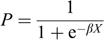
Simple cross-tabulation and multivariable statistical analyses were employed. The outcome measure was made a binary response. Women who were married-off before age 18 were coded as ‘1’, and ‘0’ otherwise. Binary logistic regression analysis was judged to be suitable for this study due to the binary nature of the outcome variable. Multicollinearity was tested prior to running the multivariate analysis and it was found between year-of-birth cohort and year-of-marriage cohort. To avoid multicollinearity and to examine the changing pattern of child marriage, a series of multivariate binary logistic regression models were constructed for survey years, year-of-birth cohort and year-of-marriage cohort. To examine the effect, the explanatory variables related to socioeconomic and culture included in the multivariable logistic regression analyses were: women's and husband's education, and women's employment status, place of residence and religion. In brief, the logistic regression model applied is as follows:
 $$P= {1\over 1+ {\rm e}^{-\beta X}}$$
, where P is the probability of the outcome measure, β is a vector of unknown coefficients and X is a vector of exposure variables that affect the outcome variable. Thus, the general multivariate logistic regression model can be written as:
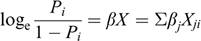 $${\rm log}_{\rm e} {P_i\over 1- P_i} = \beta X = \Sigma \beta _j X_{ji}$$
, which expresses the log odds of the outcome variable as a linear function of the exposure variables, where Pi=1 if the respondent was married-off before age 18 and 0 otherwise, and Xj are variables representing the background characteristics that influence women being married-off before the age of 18.
The model-fitting process involved three stages of estimation. The first model (Model I) was constructed to examine the unadjusted effects for survey years, year-of-birth cohort and year-of-marriage cohort. Model II was constructed to examine the net effects of different time points, such as survey years, year-of-birth cohort and year-of-marriage cohort controlling for other background characteristics. The final model (Model III) included interaction terms for education and either survey years or year-of-birth cohort or year-of-marriage cohort. The interaction terms would help understanding the effect of education over time on child marriage. The results of the logistic regression analyses are shown by odds ratios (ORs) with 95% confidence intervals (CIs). The level of significance was set at 5%. Statistical analysis was performed using IBM SPSS v21 (SPSS Inc., Chicago, IL, USA).
Results
Changes in socioeconomic status of women
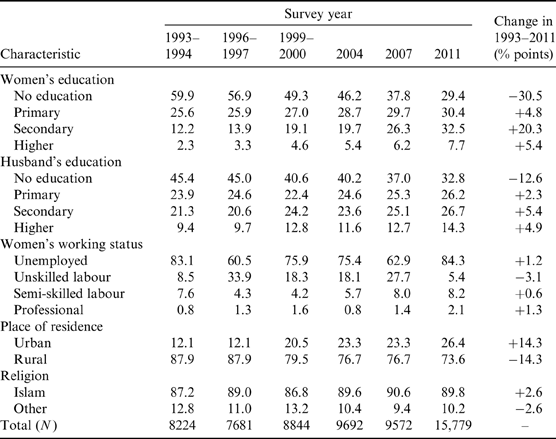
Table 1 shows the changes in the socioeconomic status of the respondents by survey year. It shows a drastic improvement in women's education during the period 1993–1994 to 2011. The proportion of women with ‘no education’ decreased by 31 percentage points: from a high of 60% in 1993–1994 to 29% in 2011. During the same period, the proportion of women with higher education increased by four-fold, from 2% in 1993–1994 to 8% in 2011. The educational attainment of husbands also had an increasing trend. Surprisingly, the rate of unemployment has increased in recent years. For instance, the proportion of women engaged in unskilled jobs increased to a peak of 34% in 1996–1997 from 9% in 1993–1994, then decreased to the lowest level of 5% in 2011. Also, the rate of participation of women in formal work sectors has increased slightly. The proportion of women living in urban areas increased by 14 percentage points: from 12% in 1993–1994 to 26% in 2011. The proportion of non-Muslim women decreased by 3 percentage points during 1993–2011.
Percentage distribution of women aged 20–49 by survey year and background characteristics, Bangladesh, BDHS 1993–2011

Single status among women
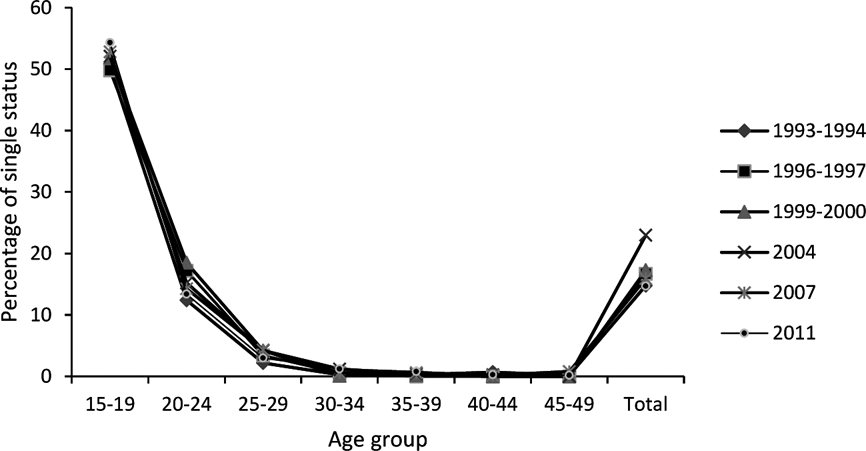
Figure 1 shows the rate of single staus among women by age and survey year. The proportion of never-married women aged 15–19 increased by 3 percentage points: from 51% in 1993–1994 to 54% in 2011. Meanwhile, single status among women aged 20–24 increased from 12% in 1993–1994 to 19% in 1999–2000 and then gradually decreased to 13% in 2011. Overall, the rate of single status among women aged 15–49 gradually increased to 23% in 2004 from 15% in 1993–1994 and then decreased again to 15% in 2011.
Proportion of single status among women by current age and survey year.
Rate of marriage by exact age
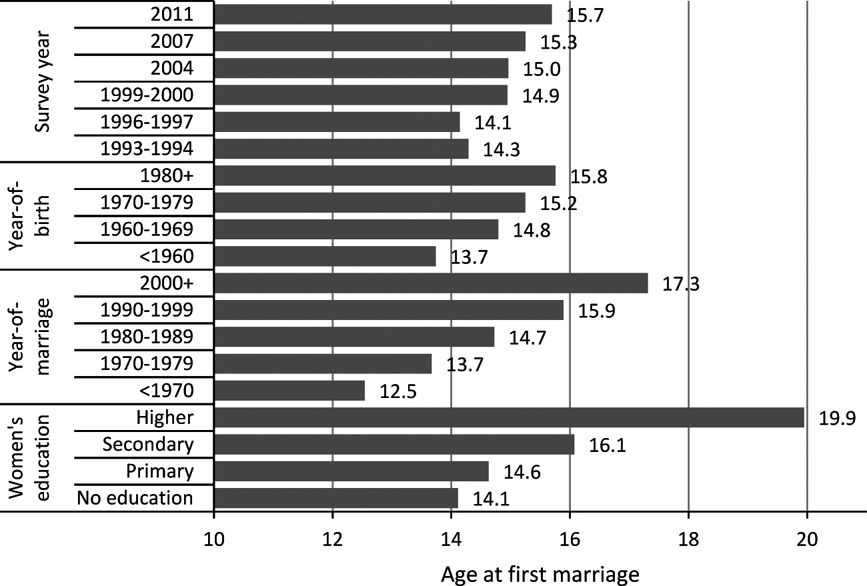
Figure 2 shows the mean age at first marriage (MAFM) of women by survey year, year-of-marriage cohort, year-of-birth cohort and women's level of education for the period 1993–1994 to 2011. The MAFM has increased by only 1.4 years over the past one and a half decades: from 14.3 years in 1993–1994 to 15.7 years in 2011. Both the year-of-birth cohort and year-of-marriage cohort reveal increasing trends in MAFM. The MAFM increased from 13.7 years among women who were born before 1960 to 15.8 years among those born in 1980 or later. Besides, MAFM was only 12.5 years among the women who got married before 1970 and increased to 17.3 years among those who were married-off in 2000 or later.
Mean age at first marriage by women's education, marriage cohort, birth cohort and survey year.
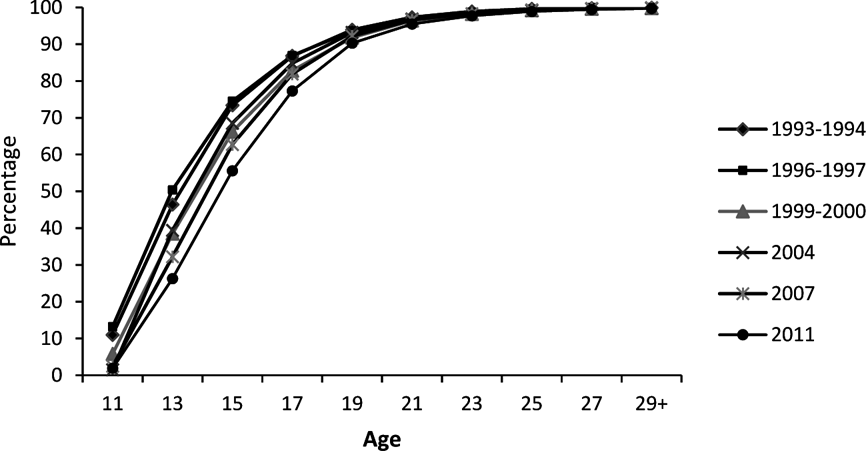
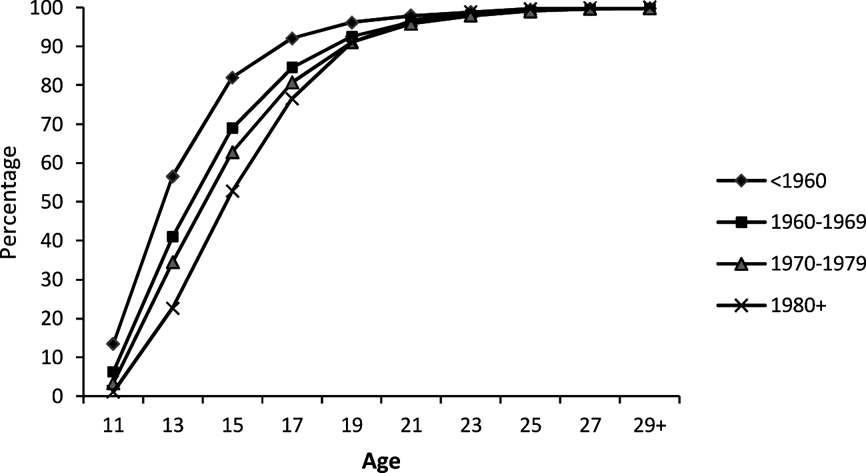
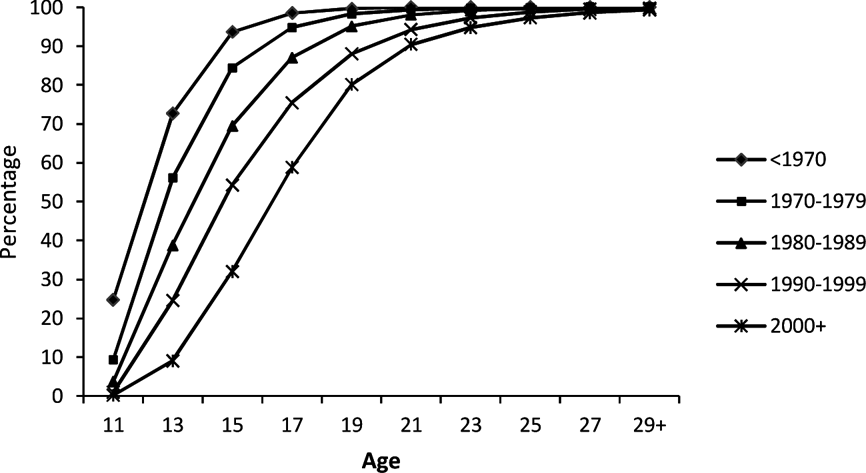
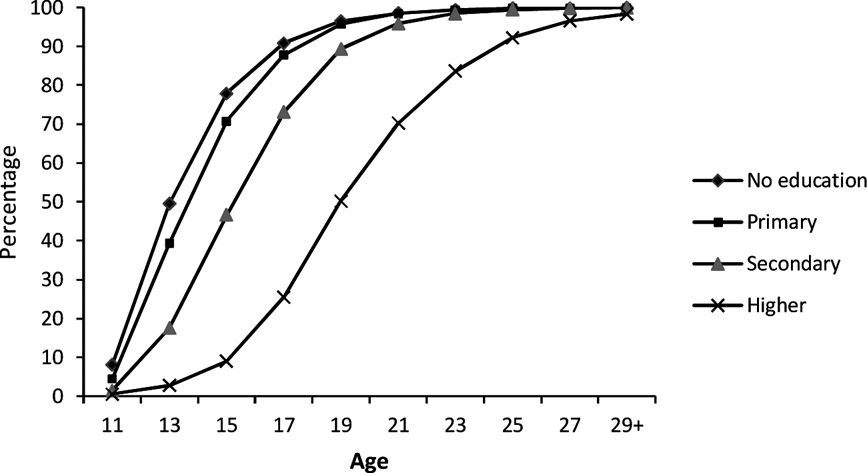
Figures 3, 4, 5 and 6 capture the percentage distribution of women aged from 20 to 49 by exact age at first marriage and by survey year, year-of-birth cohort, year-of-marriage cohort and women's educational attainment, respectively. The cohorts for year-of-birth and year-of-marriage both demonstrate an obvious trend of decreasing child marriage. The prevalence of child marriage was 87% in 1993–1994, and declined to 77% in 2011 (Fig. 3). More than 90% of the women who were born before 1960 were married-off as children. The prevalence was reduced to 77% among those born in 1980 or later (Fig. 4). The prevalence of child marriage was nearly universal (99%) among women who were married-off before 1970. The rate of child marriage decreased to 59% among women who got married in 2000 or later (Fig. 5). With regard to extreme early marriage (marriage before the age of 15), more than three-fifths of women were married-off in 1993–1994, which reduced to two-fifths in 2011 (Fig. 3). Both year-of-birth and year-of-marriage cohorts reveal a sharp decreasing trend of very early marriage. However, the survey years demonstrate fluctuations in very early and child marriage. Women's education level demonstrates a significant difference for very early marriage and child marriage. The higher the level of education, the lower the rate of very early marriage and child marriage (Fig. 6). The figures show that marriage before the age of 30 is almost universal for women in Bangladesh.
Proportion of women married by exact age and survey year.
Proportion of women married by exact age and birth cohort cohort.
Proportion of women married by exact age and marriage cohort.
Proportion of women married by exact age and their level of education.
Change in child marriage during 1993–2011
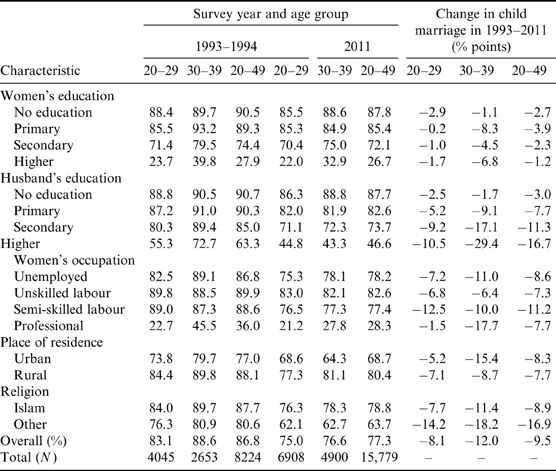
Table 2 shows the change in the incidence of child marriage among women by broad age group for the two time points 1993–1994 and 2011. Overall, the prevalence of child marriage decreased by 10 percentage points during 1993–2011 among women aged 20–49. When age was divided into broad age groups, it was observed that the incidence of child marriage among women aged 20–29 and 30–39 decreased by 8 and 12 percentage points, respectively, over the study period. The incidence of child marriage among women with higher education shows a modest decrease. For instance, 24% of the women aged 20–29 with higher education were married-off as children in 1993–1994, whereas this rate decreased to 22% in 2011. In addition, the rate of child marriage among women aged 20–29 with secondary level of education decreased by 1 percentage point: from 71% in 1993–1994 to 70% in 2011. In contrast, the rate of child marriage among women aged 30–39 with higher education was 40% in 1993–1994, which decreased to 33% in 2011. Further, the prevalence of child marriage among women aged 30–39 with secondary education decreased by 5 percentage points, from 80% in 1993–1994 to 75% in 2011. When women's employment status was grouped into unemployed, unskilled labour, semi-skilled labour and professional, the prevalence of child marriage was found to decrease in all categories. Overall, the prevalence of child marriage decreased by 8 percentage points among women engaged in professional jobs such as doctors, lawyers and teachers. On the other hand, the prevalence of child marriage among the women aged 20–29 who were engaged in professional jobs decreased by less than 2 percentage points during 1993–1994 to 2011. In rural areas the incidence of child marriage decreased in all age cohorts. The rate of decrease of child marriage was sharper among non-Muslim women compared with their Muslim counterparts.
Change in percentage of child marriage among women aged 20–29, 30–39 and 20–49 during the period 1993–1994 to 2011 by background characteristics, Bangladesh 1993–2011
Results of logistic regression analyses
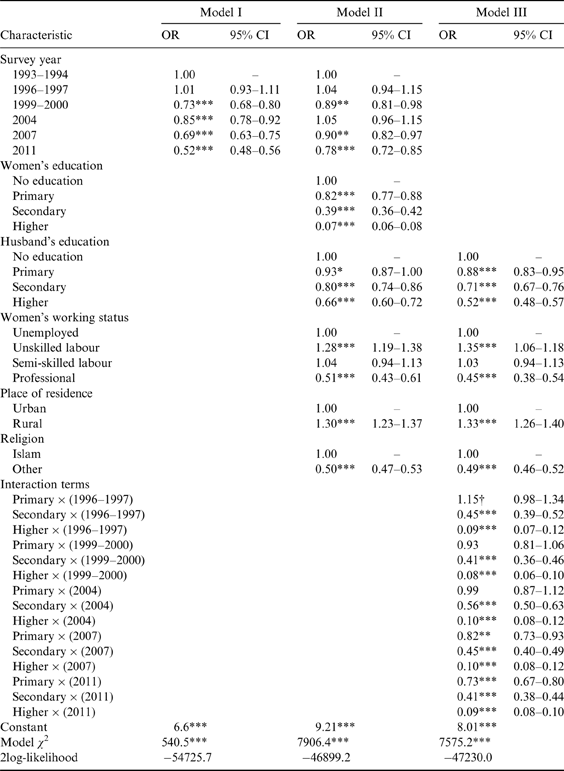
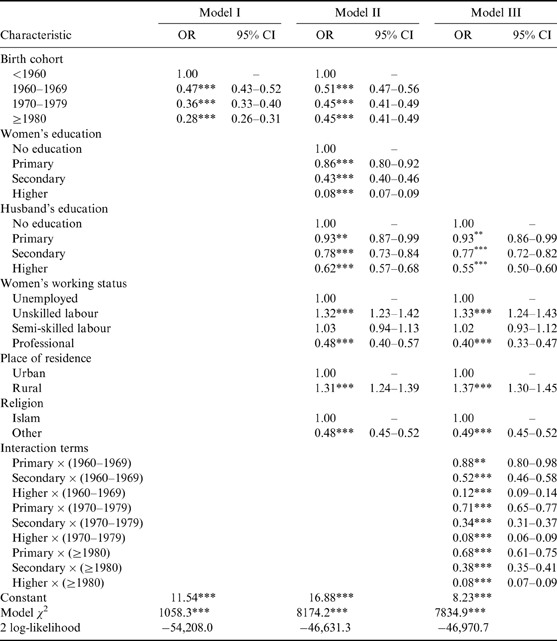
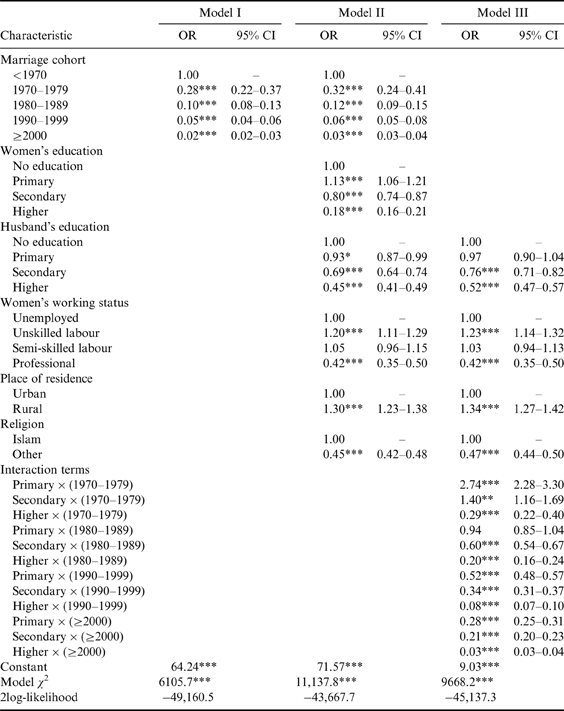
Table 3 captures the results of logistic regression modelling on child marriage by survey year and other background characteristics. Although the unadjusted OR shows a consistent trend of decreasing probability of child marriage by survey year (Model I), the effect was attenuated when other socioeconomic characteristics were controlled. Model II of Table 2 shows that the risk of child marriage decreased significantly in the survey years 1999–2000, 2007 and 2011 as compared with 1993–1994. Table 4 shows that the probability of child marriage declined consistently among women who were born in 1960 or compared with those who were born before 1960. The inclusion of other socioeconomic covariates attenuated the predictive power of year-of-birth cohort of women on child marriage. Similarly, Table 5 shows that the likelihood of child marriage decreased significantly among women who were married-off in 1970 or later compared with those who got marriage before 1970.
Logistic regression modelling on child marriage by survey year and other background characteristics
***p<0.001; **p<0.01; *p<0.05; †p<0.10.
Logistic regression modelling on child marriage by birth year and other background characteristics
***p<0.001; **p<0.01.
Logistic regression modelling on child marriage by marriage year and other background characteristics
***p<0.001; **p<0.01; *p<0.05.
Model II of Tables 3, 4 and 5 demonstrates that when other covariates were controlled, women with secondary and higher education were significantly less likely to be married-off as a child than those who had no formal education. The predictive influence of primary education on child marriage was vague. For instance, Model II of Tables 3 and 4 demonstrates that women with primary education as compared with those who had no formal education were less likely to be married-off as a child, whereas Model II of Table 5 shows that women with primary education were more likely to be married as a child. The results of the multivariate analyses reveal that the risk of child marriage decreased as husband's level of education increases (Model II of Table 3, 4 and 5).
The findings of this study show that non-Muslim women were significantly less likely to be married-off as a child. For instance, the risk of child marriage among non-Muslim women was almost 50 percentage points lower than that of their Muslim counterparts (Models II and III of Table 3, 4 and 5). The likelihood of child marriage was significantly higher among rural women than their urban counterparts. The logistic regression models of Tables 3, 4 and 5 showed that women who were engaged in unskilled labour were significantly more likely, and those who were engaged in professional jobs were less likely, to be married-off as a child as compared with their unemployed counterparts. The interaction terms included in Model III of Tables 3, 4 and 5 expose the higher predictive capability of women's education level to postpone child marriage. The interaction terms between education attainment and survey years, year-of-birth cohort and year-of-marriage cohort of Model III imply the improvement of the goodness of model fitting as compared with Model I in Table 3, 4 and 5. The estimated log-likelihood values of Model III of these tables suggest that educational differentials of child marriage have decreased and remained robust across successive survey years, and year-of-birth and year-of-marriage cohorts.
Discussion
The patterns of covariates of marital timing among the study women reflect a society in evolution. The analyses by year-of-birth cohort and year-of-marriage cohort reflect that women in Bangladesh are in transition with regard to the timing of marriage. For instance, women who were born in later cohorts and those married in recent years were more likely to postpone marriage compared with their older counterparts. This may be partly attributed to the higher education attainment of younger women as compared with their older counterparts. These findings are similar to those of earlier studies conducted using national survey data from Bangladesh (Islam & Mahmud, Reference Islam and Mahmud1996; Islam & Ahmed Reference Islam and Ahmed1998; Kamal Reference Kamal2011) and other developing countries like those of sub-Saharan Africa and Nepal (see e.g. Gupta & Mahy Reference Gupta and Mahy2003; Arayal Reference Aryal2007).
The association between education and age at first marriage has a long history in the field of demography. A number of studies have shown a significant negative relationship between education and fertility (von Elm & Hirschman, Reference von Elm and Hirschman1979; Lee Reference Lee1982; Wong, Reference Wong2005; Jones & Gubhaju, Reference Jones and Gubhaju2009; Kamal, Reference Kamal2011, Reference Kamal2012). Studies on women in Kenya and Nepal have shown that each additional level of education beyond primary school level lowers the probability of early marriage significantly (Choe et al., Reference Choe, Thapa and Mishra2005; Magadi & Agwanda Reference Magadi and Agwanda2009). Consistent with these earlier studies, this current study reveals that the higher the post-primary education among women, the lower the probability of child marriage. Moreover, the higher the level of education among husbands, the lower the likelihood of child marriage among their wives. The effect of husband's education on child marriage was somewhat weaker than that of women. It is likely that a woman with higher education will spend a longer period in schooling. Additionally, women with higher education attainment would usually have higher occupational aspiration and would want to have jobs suitable for them rather than getting married earlier (Kamal, Reference Kamal2012). The completion of education is an important step in the normative and economic conception of the transition to adulthood, and, in this way, becomes a socially significant precondition for entering into marriage. Higher educated women are expected to gain more control over household resources and personal behaviour so that they can achieve better bargaining power in deciding the timing of their marriage as well as the selection of grooms. Hence, due to prolonged schooling and desire for career development, higher educated women are more likely to marry later than their lower educated counterparts. Although higher education of both females and males seems to play a protective role in child marriage, it is not the higher education itself, but the environment and other external elements developed through education that reduce the chances of child marriage.
The timing of marriage pattern depends on several changes, both cross-sectional and longitudinal, in exogenous factors such as in the labour market, individual preferences for career development, duration of economic crises and so on, which directly affect marriage conditions (Goswami, Reference Goswami2012). Previous studies of women in Bangladesh (Islam & Ahmed, Reference Islam and Ahmed1998) and Nepal (Aryal, Reference Aryal2007) have shown that respondent's working status is an important determinant of age at first marriage. Consistent with the findings of earlier studies, this study confirms that women engaged in unskilled labour are more likely, and those engaged in prestigious professional jobs less likely, to be married-off as a child than unemployed women. There was no significant difference in the likelihood of child marriage and adult marriage between unemployed women and those who were engaged in semi-skilled professions. In Bangladesh, only a small proportion of women are engaged in professions. Women engaged in semi-skilled jobs are mostly employed in the low-paid informal sectors like making ready-made garments and non-government organizations, which do not significantly influence the postponement of marriage compared with unemployed women. According to existing theory, work experience, particularly in the formal sector, exposes women to new ideas and norms that discourage early marriage (Singh & Samara Reference Singh and Samara1996). Moreover, employment in formal sectors may provide the economic resources to allow the postponement of marriage and an economic incentive for parents to encourage their daughters to remain single during the economically productive period of young adulthood.
Place of residence partially explains the socialization process. It is likely that discernable culture and rural–urban socioeconomic variations might have an impact on the timing of marriage. Furthermore, religion is an indicator of faith and culture. These variables plausibly reflect the family values that a woman would have grown up with, and which would influence how she evaluates the costs and benefits of marrying or remaining single (Kamal, Reference Kamal2011). The higher likelihood of child marriage among Muslim and rural residents reflects their cultural norms, traditional beliefs and social values. The early socialization and values related to family formation and family life may be somewhat different in rural and urban areas making a substantial difference to the timing of family formation. Moreover, rural areas are disadvantaged in terms of education and socioeconomic status. The respondents who were born and living in rural areas are likely to reflect the more traditional behaviour of early marriage. These findings are also consistent with those of earlier studies conducted in Bangladesh, Hong Kong and a few other developing countries (Westoff, Reference Westoff2003; Wong, Reference Wong2005; Kamal, Reference Kamal2011, Reference Kamal2012).
Child marriage is common in impoverished and culturally traditional settings. Historically, Muslim women get married earlier than their non-Muslim counterparts around the world. In most developing contexts, marriage is more of a cultural phenomenon than an individual one in that personal happiness is generally given much lesser weight at the time of union formation (Goswami, Reference Goswami2012). However, it is not easy to capture cultural aspects quantitatively. Culture is reflected in other variables, for example religion, ethnicity and caste. It has been well recognized in the demographic literature that as part of culture, religion can influence a wide range of social behaviours. Religious perception could affect marriage, fertility, women's autonomy, access to economic resources, and so on. For example, in India several studies have found that the Muslim population has a strong, independent and positive effect on fertility (Islam & Ahmed, Reference Islam and Ahmed1998; Chattopadhyay et al., Reference Chattopadhyay, Bhagat, Roy, Guruswamy, Arokiaswamy and Roy2004; Kulkarni & Alagrajan, Reference Kulkarni and Alagrajan2005). However, the results of this study are substantially aligned with those of earlier studies (Palamuleni, Reference Palamuleni2011; Kamal, Reference Kamal2012) that have shown that Muslim women are more likely to be married as a child than women of other faiths.
The study has several strengths and limitations. The first limitation is that it used cross-sectional and retrospective data sets that might have under-reporting error. Surveys in developing countries, where vital registration systems are not properly followed, are prone to error in under-reporting of respondent's age, age at marriage, age at first birth and so on. Secondly, due to scarcity of data, it was not possible to include several important factors as exposure variables, such as parental education, their socioeconomic status and respondent's premarital employment status. Earlier studies have shown that these are important variables in explaining the timing of first marriage of women (Kamal, Reference Kamal2011). Thus, it is expected that the prevalence of child marriage among those who start work before getting married and those who enter the work force after marriage can theoretically be quite different. This is because factors such as education level and nature of the work in which women are engaged may also depend on the timing of entering into the work force. Thirdly, although one of the primary goals of the MEASURE DHS+ programme is to produce high-quality data and make them available for analysis in a coherent and consistent form, the findings of this study, particularly the 2011 BDHS data, raise the question of identifying working women. While in recent decades the participation of women in self-employment such as livestock husbandry and home-based manufacturing, and employment in the informal sectors such as making ready-made garments, have increased to a large extent, their proportions in the 2011 BDHS are insignificant, suggesting either the change of definition of working status of women or selection bias of subjects and the exclusion of self-employed women from the ‘working’ category. Although in all surveys women were asked the same question regarding employment status (What is your occupation, that is, what kind of work do you mainly do?) the options for the responses to this question were not consistent in all surveys. For instance, the 1993–1994 BDHS had sixteen options, whereas the 2011 BDHS included 21 options as a response to this particular question. It is likely that the survey interviewers had difficulty classifying respondents into perfect working status categories. Thus caution should be taken while interpreting the findings of the study. Despite these limitations, the strengths of the study are that it used a nationally representative, large sample and longitudinal data sets that are globally recognized and used in research related to demographic and public health issues.
Finally, the findings of the study show that although the mean age at first marriage has increased and the incidence of child marriage has decreased among women in Bangladesh over time, the pace has been distinctly sluggish. However, the increase in age at marriage has been accompanied by major social structural changes such as women's education attainment and the urbanization process. The strong association between women's education and child marriage suggests that increasing woman's access to higher education and level of education attainment are the most effective means of ensuring not only increasing women's individual benefit, but also overall development of the country. More privileges should be given to rural girls to encourage them to become more highly educated. Public policy should pay special attention to rural areas, where most of the child marriages of Bangladeshi women take place. More job opportunities for competent women should be created within the formal sectors. Rigidly enforcing legal action for infringement of the minimum age at first marriage could be the critical factor that the Bangladeshi government should emphasize to improve the child marriage situation. International schemes to tackle child marriage might have a short-term effect, but a long-term solution is only possible if the contextual reality is not ignored.