Introduction
During their lifetime, 16% of Americans will suffer from major depressive disorder (MDD), a costly, chronic and disabling disorder (Kessler et al. Reference Kessler, Berglund, Demler, Jin and Walters2005). To be diagnosed with DSM-IV MDD, persons must evidence both depressive symptoms and impairment in psychosocial functioning (APA, 2000). Although impairment in psychosocial functioning associated with MDD rivals that of chronic non-psychiatric diseases (e.g. Hays et al. Reference Hays, Wells, Sherbourne, Rogers and Spritzer1995; Cassano & Fava, Reference Cassano and Fava2002) and accounts for 62% of depression's economic burden (more than US$50 billion annually in the USA; Greenberg et al. Reference Greenberg, Kessler, Birnbaum, Leong, Lowe, Berglund and Corey-Lisle2003), few have investigated how psychosocial impairment changes during treatment. Instead, researchers investigating the treatment of MDD have focused primarily on changes in depressive symptoms.
Referencing a person's performance in and satisfaction with occupational, interpersonal and recreational roles (e.g. Dunn & Jarrett, Reference Dunn, Jarrett and Ingram2009; Ro & Clark, Reference Ro and Clark2009), impairment in psychosocial functioning is linked with the onset and persistence of depressive symptoms (e.g. Moos & Cronkite, Reference Moos and Cronkite1999), poor response to treatment (e.g. Hirschfeld et al. Reference Hirschfeld, Russell, Delgado, Fawcett, Friedman, Harrison, Koran, Miller, Thase, Howland, Connolly and Miceli1998), and more frequent relapse and recurrence (e.g. Vittengl et al. Reference Vittengl, Clark and Jarrett2009). Consequently, some researchers have suggested that psychosocial and pharmacological acute-phase treatments for MDD, lasting approximately 12 weeks (Rush et al. Reference Rush, Kraemer, Sackeim, Fava, Trivedi, Frank, Ninan, Thase, Gelenberg, Kupfer, Regier, Rosenbaum, Ray and Schatzberg2006), should not only reduce depressive symptom severity but also normalize functioning, or at least return individuals to pre-morbid functioning levels (e.g. Keller, Reference Keller2003; Thase, Reference Thase2003).
Research suggests that psychosocial and pharmacological acute-phase treatments improve psychosocial functioning in depressed patients (e.g. Hollon et al. Reference Hollon, DeRubeis, Evans, Wiemer, Garvey, Grove and Tuason1992; Gorenstein et al. Reference Gorenstein, Andrade, Moreno and Artes2002; Vittengl et al. Reference Vittengl, Clark and Jarrett2004). Compared to depressive symptom improvement, however, improvements in psychosocial functioning during acute-phase treatments are smaller, such that a significant number of depressed patients do not return to pre-morbid or normal levels of occupational (Mintz et al. Reference Mintz, Mintz, Arruda and Hwang1992), interpersonal (Bothwell & Weissman, Reference Bothwell and Weissman1977) or recreational functioning (De Lisio et al. Reference De Lisio, Maremmani, Perugi, Cassano, Deltito and Akiskal1986), even when they experience symptom remission (Miller et al. Reference Miller, Keitner, Schatzberg, Klein, Thase, Rush, Markowitz, Schlager, Kornstein, Davis, Harrison and Keller1998; Vittengl et al. Reference Vittengl, Clark and Jarrett2004).
Researchers investigating how psychosocial functioning improves during treatment for MDD have identified depressive symptom reduction as a potential mediator (Finkelstein et al. Reference Finkelstein, Berndt, Greenberg, Parsley, Russell and Keller1996; Lenderking et al. Reference Lenderking, Tennen, Nackley, Hale, Turner and Testa1999; Hirschfeld et al. Reference Hirschfeld, Dunner, Keitner, Klein, Koran, Kornstein, Markowitz, Miller, Nemeroff, Ninan, Rush, Schatzberg, Thase, Trivedi, Borian, Crits-Christoph and Keller2002; Vittengl et al. Reference Vittengl, Clark and Jarrett2004). In these studies, researchers compared pre- to post-treatment changes in psychosocial functioning and depressive symptom severity during acute-phase trials of psychotherapy (Vittengl et al. Reference Vittengl, Clark and Jarrett2004), antidepressant medication (Finkelstein et al. Reference Finkelstein, Berndt, Greenberg, Parsley, Russell and Keller1996; Lenderking et al. Reference Lenderking, Tennen, Nackley, Hale, Turner and Testa1999), and their combination (Hirschfeld et al. Reference Hirschfeld, Dunner, Keitner, Klein, Koran, Kornstein, Markowitz, Miller, Nemeroff, Ninan, Rush, Schatzberg, Thase, Trivedi, Borian, Crits-Christoph and Keller2002). Psychosocial functioning was measured with self-report instruments such as the Social Adjustment Scale – Self-Report (SAS-SR; Weissman & Bothwell, Reference Weissman and Bothwell1976) and the Dyadic Adjustment Scale (DYS; Spanier, Reference Spanier1976); depressive symptom severity was measured with instruments including the self-report Beck Depression Inventory (BDI; Beck et al. Reference Beck, Ward, Mendelson, Mock and Erbaugh1961) and the clinician-rated Hamilton Rating Scale for Depression (HAMD; Hamilton, Reference Hamilton1960), and both the self-report and clinician-rated Inventory for Depressive Symptomatology (IDS-SR, IDS-CR; Rush et al. Reference Rush, Gullion, Basco, Jarrett and Trivedi1996). Using linear regression, these studies found reductions in depressive symptom severity explained much, if not all, of concurrent improvements in psychosocial functioning. As a result, Vittengl et al. (Reference Vittengl, Clark and Jarrett2009) hypothesized that, during acute-phase treatment, ‘rapid decreases in depressive symptoms may facilitate slower improvements in psychosocial functioning as the social environment begins to notice and “trust” (i.e. perceive as lasting) improvements in the patient's functioning’ (p. 141).
However, additional research is needed to test Vittengl et al.'s (Reference Vittengl, Clark and Jarrett2009) hypothesis more directly. Before a mediating variable can be tested, researchers must first: (a) determine temporal precedence of change (i.e. establish that the mediating variable changes before the outcome variable) and (b) show that the mediating variable predicts or influences the outcome variable (Wilson et al. Reference Wilson, Fairburn, Agras, Walsh and Kraemer2002). Once these steps are accomplished, mediating variables can be tested and mechanisms of change established, allowing researchers to tailor interventions to optimize outcome and cost-effectiveness.
In this article, we attempt to improve understanding of how depression is treated acutely, by disentangling reciprocal relationships between changes in psychosocial functioning and depressive symptom severity. We analyzed a large sample (n=523) of out-patients who received acute-phase cognitive therapy (CT; Beck et al. Reference Beck, Rush, Shaw and Emery1979) for recurrent MDD. We estimated changes in levels (with ANOVA and regression analyses) and cross-lagged correlations [with structural equation modeling (SEM)] of psychosocial functioning and depressive symptom data obtained from both clinicians and patients at multiple assessment points. We tested hypotheses that: (a) depressive symptom severity improves earlier, and to a greater extent, than psychosocial functioning and (b) depressive symptom severity predicts subsequent improvement in psychosocial functioning measured at the beginning, middle and end of the acute phase, after controlling for previous levels of psychosocial impairment. Given the exploratory nature of this study, we also estimated psychosocial functioning's potential influence on subsequent depressive symptom severity, controlling for previous levels of depressive symptom severity.
Method
The current analyses used data from an ongoing, two-site clinical trial comparing acute-phase CT responders randomized to continuation-phase CT, fluoxetine or pill placebo (Jarrett & Thase, Reference Jarrett and Thase2010). Below we summarize relevant methods from the acute phase of this trial and refer readers to Jarrett & Thase (Reference Jarrett and Thase2010) for additional detail, including continuation and follow-up phases not described further here. Patients were withdrawn from psychotropic medications before entering the study and were not prescribed medications in the acute-phase CT protocol.
Participants
Participants consented to enter acute-phase CT as part of a randomized clinical trial approved by the Institutional Review Boards at The University of Texas Southwestern Medical Center at Dallas (UT Southwestern) and the Western Psychiatric Institute and Clinic at Pittsburgh (WPIC). Potential participants were self or practitioner referred and/or informed of the study through newspaper, bulletin board or internet announcements. Clinic staff screened potential participants over the telephone or in-person, and scheduled them for initial and follow-up diagnostic evaluations to determine study eligibility. Included participants met DSM-IV criteria for recurrent MDD (APA, 2000), by protocol scored ⩾14 on the 17-item HAMD at both diagnostic interviews (but two patients with HAMD=13 were enrolled erroneously), and provided informed consent. Excluded participants: (a) had severe or poorly controlled concurrent medical disorders that could cause depression, (b) had any psychotic or organic mental disorder, bipolar disorder, active alcohol or drug dependence, primary obsessive–compulsive disorder, or primary eating disorders (primary refers to the disorder associated with the most impairment or distress), (c) could not complete questionnaires in English, (d) represented an active suicide risk, (e) were outside 18–70 years of age, (f) failed to respond to a previous trial of ⩾8 weeks of CT or 6 weeks on 40 mg of fluoxetine, or (g) were pregnant or planned to become pregnant during the first 11 months after intake. Diagnoses and lifetime history of psychiatric disorders were made with the Structured Clinical Interview for DSM-IV (SCID; First et al. Reference First, Spitzer, Gibbon and Williams1996) applied to the patient's current and past symptoms, functioning, and previous treatment.
Participants consented to an initial diagnostic evaluation (UT Southwestern n=1053, WPIC n=306). Of these, 523 participants (UT Southwestern n=276, WPIC n=247) met study criteria at both the initial assessment and diagnostic follow-up visit and consented to enter acute-phase CT; 836 participants (UT Southwestern n=777, WPIC n=59) were excluded and referred to appropriate treatment. Participants were excluded most often because they did not meet criteria for recurrent MDD, scored below 14 on the HAMD, or had exclusionary disorders.
Consenting patients were mostly middle-aged [mean age=42.4 years (s.d.=12.1)], female (67.5%), single (58.1%), White (80.9%), and employed either full or part time (55.6%). Patients' mean age of MDD onset was 21.2 years (s.d.=10.8), with an average length of illness of 20.7 years (s.d.=11.8). Patients reported that their current major depressive episode averaged 25.0 months (s.d.= 45.1), and they endorsed a median of four major depressive episodes during their lifetime.
Procedure
Patients who entered acute-phase CT received 16 or 20 sessions spread over 12–14 weeks. By protocol, patients received two sessions a week for 4 weeks, after which they were categorized as early (⩾40% reduction in HAMD score compared to diagnostic follow-up) or late responders (<40% reduction). Early responders then received one weekly session for the final 8 weeks of the acute phase, whereas late responders continued receiving two sessions weekly until the last 4 weeks of the acute phase, when they also received one weekly session. Among 523 consenting patients, 410 completed the acute-phase protocol by attending ⩾14 (early responders) or ⩾18 (late responders) CT sessions.
Therapist competence
Fifteen therapists provided acute-phase CT and demonstrated competence by achieving and maintaining Cognitive Therapy Scale (CTS; Young & Beck, Reference Young and Beck1980) scores ⩾40. Therapists attended weekly group supervision. Group supervisors and other therapists observed and rated videotaped sessions on the CTS, providing therapists with feedback on strengths and weaknesses.
Measures
BDI
Using the 21-item BDI, patients rated their depressive symptom severity at the initial diagnostic evaluation, week 1 and week 7 of acute-phase CT, and the post-acute-phase CT evaluation, which occurred within 1 week after completion or premature termination of acute-phase CT. Total scores categorized depression as minimal (0–10), mild to moderate (10–18), moderate to severe (19–29), or severe (>29; Beck et al. Reference Beck, Ward, Mendelson, Mock and Erbaugh1961). In the current data, the median internal consistency reliability was 0.89 (range=0.83–0.92); median convergent validity r=0.72 (range=0.46–0.82) with the HAMD and r=0.85 (range=0.78–0.92) with the IDS-SR.
HAMD
Clinicians (during acute-phase CT) and evaluators (at intake and post-acute-phase CT assessments) rated depressive symptom severity with the HAMD at both diagnostic evaluations, weeks 1 and 7 of acute-phase CT, and the post-acute-phase CT evaluation. Total scores indicated very severe (>24), severe (19–23), moderate (14–18), mild (6–13) or no (<6) depression. In the current study, the HAMD demonstrated inter-rater reliability [intraclass correlation coefficient (ICC)=0.91], concurrent validity with the IDS-SR (median r=0.76, range=0.52–0.86) and median internal consistency reliability of α=0.68 (range=0.52–0.83).
IDS-SR
Patients also self-reported their depressive symptom severity with the IDS-SR at the initial diagnostic evaluation, weeks 1 and 7 of acute-phase CT, and the post-acute-phase CT evaluation. Total scores represented very severe (>49), severe (39–48), moderate (26–38), mild (14–25) or no (<13) depression. In this study, the IDS-SR showed median internal consistency reliability of α=0.86 (range=0.80–0.91).
Range of Impaired Functioning Tool (RIFT)
At the post-acute-phase CT evaluation, clinicians and evaluators rated psychosocial functioning retrospectively with the Longitudinal Interval Follow-up Evaluation – Psychosocial Interview (Keller et al. Reference Keller, Lavori, Friedman, Nielsen, Endicott, McDonald-Scott and Andreasen1987). From this interview, we scored the four-item RIFT (Leon et al. Reference Leon, Solomon, Mueller, Turvey, Endicott and Keller1999) for periods coinciding with the diagnostic phase and the first, second and third month of acute-phase CT. Higher scores indicate greater impairment. Leon et al. (Reference Leon, Solomon, Mueller, Turvey, Endicott and Keller1999) reported mean RIFT scores of 14 and 9 for depressed and non-depressed populations respectively. In the current analysis, the RIFT showed convergence with the SAS-SR (median r=0.46, range=0.34–0.68) and median internal consistency reliability of α=0.68 (range=0.59–0.76).
SAS-SR
Patients self-reported their psychosocial functioning on the 56-item SAS-SR at the first diagnostic evaluation, weeks 1 and 7 of acute-phase CT, and the post-acute-phase CT evaluation. Higher scores indicate greater impairment. Weissman et al. (Reference Weissman, Olfson, Gameroff, Feder and Fuentes2001) reported the total score averaged 2.5 and 1.7 for depressed and non-depressed samples respectively. In the current study, the SAS-SR total score showed median internal consistency reliability of α=0.76 (range=0.73–0.78).
Standardization of scores
To compare levels of change among measures, we converted each to T-score units (mean=50, s.d.=10) based on the measures' distributions at intake. In addition, we averaged the depressive symptom severity measures (BDI, HAMD, IDS-SR) to form a robust index because past research shows that these measures mark the same construct concurrently and longitudinally during acute-phase CT (Vittengl et al. Reference Vittengl, Clark and Jarrett2004). Internal consistency reliability for the three-measure symptom composite for this study's observations was high (median α=0.91, range=0.81–0.95). We also standardized and averaged the psychosocial functioning measures (SAS-SR, RIFT) to form a composite index with moderate reliability (median α=0.62, range=0.51–0.81). Previous research supports the convergence of the RIFT and SAS-SR concurrently and longitudinally for CT patients (Vittengl et al. Reference Vittengl, Clark and Jarrett2009).
Statistical analyses
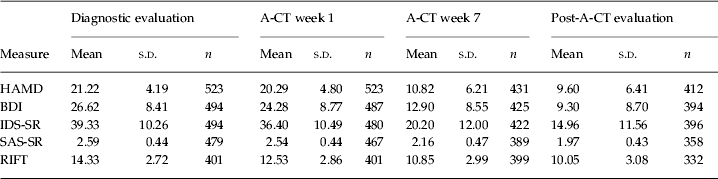
We implemented a multiple-imputation procedure to use all available data, maximize the statistical power of the hypothesis tests, and increase the generalizability of the results. Among the 523 patients, five measures and four assessment periods, 16.8% of observations were missing (see Table 1). We generated 10 data sets with missing values imputed through the Markov chain Monte Carlo method in PROC MI, computed standard analyses [e.g. ANOVA, regression, structural equation modelling (SEM)] on each dataset, and pooled the results using PROC MIANALYZE to test hypotheses (using SAS version 9.1; SAS Institute, Inc., USA). This procedure follows published guidelines for missing data (e.g. Schafer & Graham, Reference Schafer and Graham2002).
Descriptive statistics for depressive symptom and psychosocial functioning measures
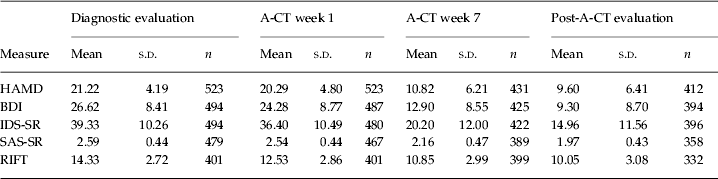
A-CT, Acute-phase cognitive therapy; HAMD, 17-item Hamilton Rating Scale for Depression; BDI, 21-item Beck Depression Inventory; IDS-SR, Inventory of Depressive Symptomatology; SAS-SR, Social Adjustment Scale – Self-Report; RIFT, Range of Impaired Functioning Tool.
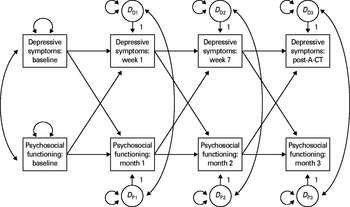
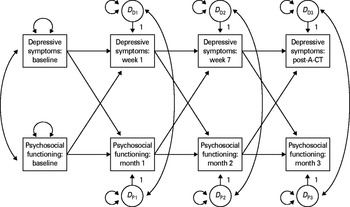
In our SEM, scores on the indices of psychosocial functioning and depressive symptom severity were cross-lagged over repeated measurements (see Fig. 1). In addition, paths were added to the SEM to control for: (a) covariation between measures of depressive symptoms and psychosocial functioning and (b) independent changes in depressive symptom severity and psychosocial functioning. As a result, the SEM provided information regarding the extent to which change in variance unique to measures of depressive symptom severity predicted change in variance unique to measures of psychosocial functioning, and vice versa. We evaluated model fit using several common metrics: the goodness-of-fit index (GFI), comparative fit index (CFI), non-normed fit index (NNFI), and root mean square error of approximation (RMSEA). Scores ⩾0.90 on the GFI, CFI and NNFI and ⩽0.08 on the RMSEA indicate acceptable model fit (Kline, Reference Kline2005).
Structural equation model showing potential mediating relationships between psychosocial functioning and depressive symptoms. Rectangles represent the indices of psychosocial functioning and depressive symptom severity. Circles with an uppercase D are called disturbances, which represent the effect of unexplained variation on the indices. One-sided arrows signify direct effects and double-sided arrows represent covariances, which control for covariation between variables.
Results
How much do psychosocial functioning and depressive symptom severity change during acute-phase CT?
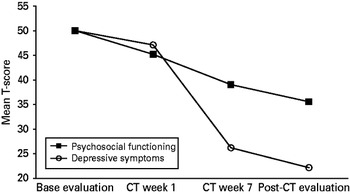
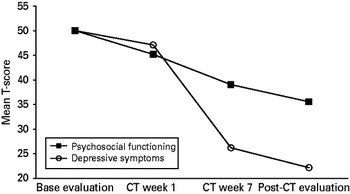
The depressive symptom and functioning composite measures' standardized means are shown in Fig. 2 (see Table 1 for raw scores). We analyzed changes in means with repeated-measures multi-level models including random subject effects, fixed effects of assessment time, and unstructured error patterns. Consistent with visual inspection of Fig. 2, the main effect of assessment time was significant in predicting the symptom composite (F 3,1014=603.35) and psychosocial functioning composite (F 3,338=202.63, p's <0.01). From pre- to post-acute-phase CT, decreases in depressive symptoms (d=1.83) and psychosocial functioning (d=1.24) were large. By week 7 of acute-phase CT, depressive symptoms (mean=26.28) were lower than psychosocial functioning (mean=39.10, t 223=25.90, p<0.01). Similarly, at the post-acute-phase CT follow-up, depressive symptom scores (mean=22.23) were lower than psychosocial functioning (mean=35.63), t 185=30.94, p<0.01. These results show that depressive symptoms changed sooner and more overall than did psychosocial functioning, replicating Vittengl et al. (Reference Vittengl, Clark and Jarrett2004).
Standardized depressive symptom and psychosocial functioning scores across acute-phase cognitive therapy (CT) for depression. Depressive symptoms are a composite of the Hamilton Rating Scale for Depression (HAMD), Beck Depression Inventory (BDI) and Inventory of Depressive Symptomatology – Self-Report (IDS-SR). Psychosocial functioning is a composite of the Social Adjustment Scale – Self-Report (SAS-SR) and Range of Impaired Functioning Tool (RIFT).
Pre- to post-acute-phase CT decreases in depressive symptoms (meandecrease=27.77, s.e.=0.71, p<0.01) correlated moderately highly [r=0.65, p<0.01; 95% confidence interval (CI) 0.58–0.71] with decreases in psychosocial functioning (meandecrease=14.37, s.e.=0.54, p<0.01). Based on intercept tests in regressions predicting pre- to post-acute phase CT depressive symptom change from psychosocial functioning change and vice versa, the amount of change in depressive symptoms controlling change in psychosocial functioning (meandecrease=15.60, s.e.=0.86, p<0.01) was roughly one-third smaller than the unadjusted change, but remained substantial and statistically significant. By contrast, change in psychosocial functioning (meandecrease=0.50, s.e.=0.92, p=0.59) was very small and no longer significant when controlling change in depressive symptoms. This pattern of results also replicates Vittengl et al. (Reference Vittengl, Clark and Jarrett2004) in suggesting that pre- to post-acute phase CT change in depressive symptoms accounts for change in psychosocial functioning. However, these analyses do not address the extent to which change in depressive symptoms drives subsequent changes in psychosocial functioning and vice versa at four monthly time-points during acute-phase CT.
Do changes in depressive symptom severity drive changes in psychosocial functioning or vice versa?
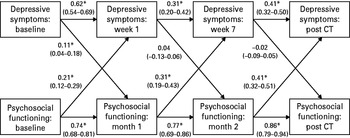
Cross-lagged correlations estimated using SEM are shown in Fig. 3. The model for depressive symptoms and psychosocial functioning fit acceptably by three indices (GFI=0.96, CFI=0.98, NNFI=0.95) but not RMSEA=0.11. Because the majority of fit indices were acceptable, and the model was specified a priori for hypothesis testing, we interpreted the model.
Correlations (95% confidence intervals) among depressive symptoms and psychosocial functioning during acute-phase cognitive therapy (CT) for depression. Depressive symptoms are a composite of the Hamilton Rating Scale for Depression (HAMD), Beck Depression Inventory (BDI) and Inventory of Depressive Symptomatology – Self-Report (IDS-SR). Psychosocial functioning is a composite of the Social Adjustment Scale – Self-Report (SAS-SR) and Range of Impaired Functioning Tool (RIFT). * p<0.05.
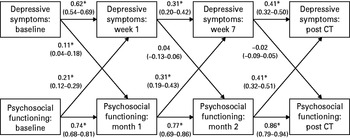
Not surprisingly, the depressive symptom and psychosocial functioning measures' retest correlations were moderate to high and stronger than cross-correlations between measures (see Fig. 3). Psychosocial functioning at baseline predicted depressive symptoms at week 1 of acute-phase CT, and depressive symptoms at baseline predicted psychosocial functioning at week 1. Thus, before acute-phase CT, analyses suggested reciprocal causality between improvements in symptoms and functioning. However, from weeks 1 to 7 of acute-phase CT, and from week 7 to post-acute-phase CT, depressive symptom reduction did not predict subsequent improvements in psychosocial functioning, whereas improvements in psychosocial functioning predicted subsequent symptom reduction. In sum, we found limited support for the hypothesis that changes in depressive symptoms drive improvements in psychosocial functioning. However, the evidence was somewhat stronger that changes in psychosocial functioning drive changes in depressive symptoms.
Discussion
In this study, we tested the hypotheses that change in depressive symptom severity would exceed, precede and predict change in psychosocial functioning during acute-phase CT. In replication of Vittengl et al. (Reference Vittengl, Clark and Jarrett2004), we analyzed mean changes and intercorrelations of pre- and post-acute-phase CT improvements in depressive symptoms and psychosocial functioning. We then extended analyses with SEM to control covariation between constructs and estimate interdependent changes across four assessment points. The results supported our hypothesis that depressive symptom severity showed greater improvement sooner than psychosocial functioning. Furthermore, pre–post changes in symptoms and functioning were moderately highly correlated, and improvement in psychosocial functioning was expected only when depressive symptoms decreased, replicating Vittengl et al.'s (Reference Vittengl, Clark and Jarrett2004) findings in a smaller dataset. Counter to our additional hypotheses, however, shorter-interval changes in depressive symptom severity did not consistently predict subsequent improvement in psychosocial functioning. Instead, improvement in psychosocial functioning more strongly predicted subsequent depressive symptom reduction across lagged assessments points.
The current findings may differ from expectations based on previous research for several reasons (Finkelstein et al. Reference Finkelstein, Berndt, Greenberg, Parsley, Russell and Keller1996; Lenderking et al. Reference Lenderking, Tennen, Nackley, Hale, Turner and Testa1999; Hirschfeld et al. Reference Hirschfeld, Dunner, Keitner, Klein, Koran, Kornstein, Markowitz, Miller, Nemeroff, Ninan, Rush, Schatzberg, Thase, Trivedi, Borian, Crits-Christoph and Keller2002; Vittengl et al. Reference Vittengl, Clark and Jarrett2004). First, when investigating the extent to which change in depressive symptom severity accounted for change in psychosocial functioning, or vice versa, the previous studies did not consider precedence of change (Finkelstein et al. Reference Finkelstein, Berndt, Greenberg, Parsley, Russell and Keller1996; Lenderking et al. Reference Lenderking, Tennen, Nackley, Hale, Turner and Testa1999; Hirschfeld et al. Reference Hirschfeld, Dunner, Keitner, Klein, Koran, Kornstein, Markowitz, Miller, Nemeroff, Ninan, Rush, Schatzberg, Thase, Trivedi, Borian, Crits-Christoph and Keller2002; Vittengl et al. Reference Vittengl, Clark and Jarrett2004). Instead, these studies compared global pre- to post-treatment changes in each construct. As a result, even if changes in depressive symptom severity accounted for changes in psychosocial functioning, the mediational relationship might also exist when constructs were reversed (Kraemer et al. Reference Kraemer, Stice, Kazdin, Offord and Kupfer2001). By dividing the acute phase into shorter time intervals and establishing temporal precedence, this study possibly was more sensitive to changes in reciprocal relationships between psychosocial functioning and depressive symptom severity.
Second, whereas previous studies relied on linear regression (Finkelstein et al. Reference Finkelstein, Berndt, Greenberg, Parsley, Russell and Keller1996; Lenderking et al. Reference Lenderking, Tennen, Nackley, Hale, Turner and Testa1999; Hirschfeld et al. Reference Hirschfeld, Dunner, Keitner, Klein, Koran, Kornstein, Markowitz, Miller, Nemeroff, Ninan, Rush, Schatzberg, Thase, Trivedi, Borian, Crits-Christoph and Keller2002; Vittengl et al. Reference Vittengl, Clark and Jarrett2004), this study used SEM to investigate mediational relationships between psychosocial functioning and depressive symptom severity. Kline (Reference Kline2005) suggests that the inability to enter variables as both predictor and criterion in the same analysis, and to control covariation between variables across data sets, limits linear regression analyses. As a result, this study may have revealed a different mediational relationship between psychosocial functioning and depressive symptom severity because SEM did not have these limitations.
Finally, a yet-to-be-identified change process may have been at work, such that early improvements in psychosocial functioning influenced depressive symptom severity later in the acute phase. For example, relationships between the two sets of variables may be different in the early and late phases of CT and/or early phase change may be necessary for late phase change. Thus, despite changing more slowly (see Fig. 2), early improvements in psychosocial functioning, or perhaps the initial mobilization of resources to improve psychosocial functioning (e.g. behavioral activation), might serve important roles in the alleviation of depressive symptoms. Moreover, cognitive therapists often focus on improving psychosocial functioning in addition to reducing depressive symptoms, particularly when functioning is impaired and selected as a target for treatment. A detailed analysis of individual patients' session content (e.g. from videotapes) could be used in future research to determine whether observed relationships between psychosocial functioning and depressive symptoms vary with individual patients' CT goals.
Implications for treatment of psychosocial impairment associated with depression
According to our results, changes in a depressed patient's psychosocial functioning played a role in reducing subsequent depressive symptom severity during acute-phase CT. As such, it could be said that these findings substantiated cognitive and behavioral theorists' idea that behavior change early in the acute phase makes the shift from negative to euthymic mood possible by increasing access to social reinforcement, reducing exposure to social punishment, and activating constructive schemas (e.g. Beck et al. Reference Beck, Rush, Shaw and Emery1979; Follette & Greenberg, Reference Follette, Greenberg, Castonguay and Beutler2005).
The development of behavioral activation as a free-standing treatment for depression separate from cognitive interventions (e.g. Dimidjian et al. Reference Dimidjian, Hollon, Dobson, Schmaling, Kohlenberg, Addis, Gallop, McGlinchey, Markley, Gollan, Atkins, Dunner and Jacobson2006) can be viewed as an extension of behavioral techniques in beginning sessions of CT. Behavioral activation emphasizes reduction of avoidance and re-engagement in psychosocial activities (e.g. in fulfilling social role obligations) with potential for long-term reinforcement and reduction of depressive symptoms.
The current findings are also consistent theoretically with interventions that focus on improving patients' interpersonal and social functioning to reduce depressive symptomatology (e.g. Interpersonal Psychotherapy; Weissman et al. Reference Weissman, Markowitz and Klerman2000). For example, Interpersonal Psychotherapists suggest that ‘change and improvement in depressive symptoms occur through working on mastery and competence in the social sphere’ (Crowe & Luty, Reference Crowe and Luty2005, p. 44). Therefore, the current study's conceptualization of change in psychosocial functioning in relation to depressive symptom severity appears robust and applicable to psychosocial interventions other than CT.
Limitations and directions for future research
The current study's assessment strategy and design limit its generalizability. First, our depressive symptom composite reduced variability and enhanced validity across instruments, but it may limit the degree to which findings could be replicated in clinical settings, where providers are overburdened and unable to use multi-modal, multi-measure assessment. Similarly, we cannot rule out differences between clinicians' and evaluators' use of the HAMD (e.g. biases), although any such differences are small because convergence with self-reported symptom measures was strong at all assessments. In addition, because we used the RIFT retrospectively, it relied heavily on patients' ability to recall past events when they were often more depressed, thereby potentially introducing mood-congruent memory biases in the index of psychosocial functioning (Barry et al. Reference Barry, Naus and Rehm2004). Future research might improve this study's assessment strategy by administering the RIFT at the same time as symptom measures.
Second, the current study's design did not include random assignment or a control group. As a result, we could not control for the impact of extraneous factors on changes in psychosocial functioning and depressive symptom severity. Given that past randomized controlled trials (e.g. Elkin et al. Reference Elkin, Shea, Watkins, Imber, Sotsky, Collins, Glass, Pilkonis, Leber, Docherty, Fiester and Parloff1989; Evans et al. Reference Evans, Hollon, DeRubeis, Piasecki, Grove, Garvey and Tuason1992; Hollon et al. Reference Hollon, DeRubeis, Shelton, Amsterdam, Salomon, O'Reardon, Lovett, Young, Haman, Freeman and Gallop2005; Dimidjian et al. Reference Dimidjian, Hollon, Dobson, Schmaling, Kohlenberg, Addis, Gallop, McGlinchey, Markley, Gollan, Atkins, Dunner and Jacobson2006) reported similar changes in psychosocial functioning and depressive symptom severity, it could be inferred that the observed changes in this study were due to exposure to acute-phase CT. However, replication of this study's hypotheses within a randomized trial comparing treatment versus control conditions is necessary before drawing firm conclusions regarding causation.
Third, the current findings may have limited generalizability because of sample demographics and treatment specificity. Despite targeting ethnic/racial minorities with specific recruitment strategies, ethnic minorities did not participate in proportion with the US population. In addition, because all patients underwent acute-phase CT for MDD, whether the results can be generalized to populations with other diagnoses or treatments is unclear. Future research could clarify the extent to which our findings generalize to more ethnically diverse patient populations and treatment modalities.
Summary
Acute-phase CT, like other psychotherapeutic interventions, is a complex process with multiple potential mechanisms of change (e.g. environmental, biological and cognitive; Whisman, Reference Whisman1993; Garratt et al. Reference Garratt, Ingram, Rand and Sawalani2007). Although efforts have been made to understand how acute-phase treatments reduce the psychosocial impairment associated with depression (e.g. Hirschfeld et al. Reference Hirschfeld, Dunner, Keitner, Klein, Koran, Kornstein, Markowitz, Miller, Nemeroff, Ninan, Rush, Schatzberg, Thase, Trivedi, Borian, Crits-Christoph and Keller2002; Vittengl et al. Reference Vittengl, Clark and Jarrett2004), this area of research is nascent. The current study advances the field by disentangling, to some degree, the sequence and process of change in psychosocial functioning and depressive symptom severity during one acute-phase treatment. In short, we found that change in depressive symptom severity had less impact on subsequent change in psychosocial functioning than vice versa across four acute-phase CT assessments. Depressed patient's psychosocial functioning at treatment baseline and the beginning and middle of acute-phase CT predicted subsequent depressive symptom severity at each lag-one assessment point. Although researchers need to clarify how psychosocial functioning changes during acute-phase treatment, the current study suggests that early efforts by CT therapists to change depressed patients' behavior are well warranted.
Acknowledgements
We are indebted to our research teams and our colleagues at The University of Texas Southwestern Medical Center at Dallas, the University of Pittsburgh (where Dr Thase was located during patient accrual), and the University of Pennsylvania (Dr Thase's current affiliation). We appreciate the assistance of J. Kangas, L. Dunlap, J. Sanders and A. Minhajuddin in the preparation of this manuscript.
This report was supported by Grants K24 MH001571, R01 MH58397, R01 MH69619 (to R.B.J.), R01 MH58356 and R01 MH69618 (to M.E.T.) from the National Institute of Mental Health (NIMH). We appreciate the support of our NIMH Program Officer, J. Pearson. The content is solely the responsibility of the authors and does not necessarily represent the official views of the NIMH or the National Institutes of Health. We also appreciate the careful review by members of the trial's Data Safety and Monitoring Board.
Declaration of Interest
During the past two years Dr Thase has consulted with, served on advisory boards for, or received honoraria for talks from: AstraZeneca, Bristol-Myers Squibb Company, Eli Lilly and Company, Forest Laboratories, GlaxoSmithKline, Janssen Pharmaceutica, Lundbeck, MedAvante, Inc., Neuronetics, Inc., Novartis, Otsuka, Pamlab, Pfizer Pharmaceuticals, Schering-Plough, Shionogi, Shire US Inc., Supernus Pharmaceuticals, Takeda, Transcept Pharmaceuticals, and Wyeth Pharmaceuticals and he has received grant support from Eli Lilly and Company, Forest Laboratories, GlaxoSmithKline, Otsuka, and Sepracor, Inc., in addition to funding from the NIMH. He has equity holdings for MedAvante, Inc. and has received royalties from American Psychiatric Publishing, Inc. (APPI), Guilford Publications, Herald House, and W. W. Norton & Company, Inc. Two books currently promoted by the APPI specifically pertain to cognitive therapy. Dr Thase also discloses that his spouse is an employee of Embryon, Inc. (formerly Cardinal Health and Advogent), which does business with several pharmaceutical companies that market medications used to treat depression.
Dr Jarrett's medical center receives the fees from the cognitive therapy she provides to patients. Dr Jarrett is a paid consultant to the NIMH.
T. Carmody has been a consultant for Cyberonics, Inc.