Treatment of symptomatic varicose veins results in significant improvements in quality of life and has been shown to be cost-effective in the United Kingdom (Reference MacKenzie, Paisley and Allan1–Reference Ratcliffe, Brazier and Campbell3). In the last decade, the use of endovenous thermal ablation has increased in popularity, with short and medium term results comparable to, and in some reports, superior to traditional surgery (Reference Van den Bos, Arends, Kockaert, Neumann and Nijsten4). Laser and radiofrequency ablation are well established endovenous treatments and approximately 10,000 endovenous thermal ablation procedures were performed in the United Kingdom (UK) National Health Service (NHS) between 2009 and 2010 (5) at a considerable cost. The 980 nm bare fiber endovenous laser ablation (EVLA) and VNUS® ClosureFAST™ segmental radiofrequency ablation (RFA) are two of the most frequently used devices in the United Kingdom and worldwide. A review of different treatment modalities (Reference Van den Bos, Arends, Kockaert, Neumann and Nijsten4) (based on an indirect comparison of observational data) suggested that 5-year occlusion rates from laser ablation were superior to original RFA devices. However, segmental RFA shows promising outcomes with occlusion rates of 96.9 percent at 12 months, and is expected to be competitive with EVLA in the long-term (Reference Creton, Pichot, Sessa and Proebstle6). Comparisons of early outcomes have found that patient reported postprocedural pain scores following segmental RFA are lower than those reported following EVLA (Reference Almeida, Kaufman and Gockeritz7;Reference Shepherd, Gohel and Brown8). Despite many perceived advantages of endovenous thermal ablation techniques, they are thought, by some, to be more expensive than traditional surgery, due to the high costs of consumable items, and their use has been restricted in many centers (Reference Shepherd, Gohel, Hamish, Lim and Davies9). Several published studies have evaluated the cost effectiveness of radiofrequency ablation, in comparison to traditional surgery, and have found evidence to support the notion that higher initial costs may be offset by quicker recovery times and earlier return to work compared with traditional surgery (Reference Lurie, Creton and Eklof10–Reference Subramonia and Lees12).
Early results from the current study found both treatments produced similar gains in quality of life and clinical outcomes at 6 weeks (Reference Shepherd, Gohel and Brown8). These short-term results are similar to those found by other randomized controlled trials (RCTs) (Reference Almeida, Kaufman and Gockeritz7;Reference Nordon, Hinchliffe and Brar13). However, these RCTs did not evaluate the cost-effectiveness of the treatment modalities, which is of great importance to healthcare providers and payers. The aim of this study was to evaluate the 6-month quality of life, clinical, anatomical, and health economic outcomes for patients enrolled in the VNUS ClosureFAST radiofrequency Ablation versus 980nm Laser for Varicose Veins (VALVV) randomized clinical trial (Reference Shepherd, Gohel and Brown8).
METHODS
Full details of participants and treatment protocols in the VALVV study have been published previously (Reference Shepherd, Gohel and Brown8). In brief, consecutive adult patients, over 18 years old referred to the Charing Cross Hospital from July 2008 to June 2009 with primary great saphenous vein (GSV) reflux were invited to participate. Consenting patient were randomized to either EVLA (980 nm bare fiber) or RFA (VNUS ClosureFAST) using an internet randomization service. Patients with current deep venous thrombosis, significant arterial disease (ABPI < 0.8) or those unsuitable for general anesthesia were excluded. In patients with bilateral disease, the leg that was most symptomatic according to the patient was randomized and both legs received the same treatment. All patients were blinded to treatment allocation; however, for practical reasons, assessors were not blinded. All treatments were performed under general anesthesia with concomitant phlebectomies as required. Ethical approval for the study was granted by the hospital.
Data Collection and Outcome Assessment
Patients were asked to complete the Short Form 12 version 2 (SF12v2) a validated generic questionnaire to assess the quality of life (SF-12; Medical Outcomes Trust, Waltham, MA) before intervention (baseline) and at 6 months. The disease-specific Aberdeen Varicose Vein Questionnaire (AVVQ) the Venous Clinical Severity Score (VCSS) (14), and the Clinical Etiological Anatomical and Pathophysiologic (CEAP) score were documented by a clinician at baseline and 6 months. All patients underwent a venous duplex scan before the procedure and at 6 months postintervention (Phillips iU22) performed by an accredited vascular scientist. Venous reflux was defined as retrograde flow of >0.5 seconds after calf compression. On postintervention duplex scanning, GSVs were classified as: (i) completely occluded, (ii) occluded above the knee only, (iii) significant above the knee reflux (due to technical difficulties with cannulation or passing the catheter documented at the time of intervention), (iv) re-canalized.
Healthcare Resource Use and Costs
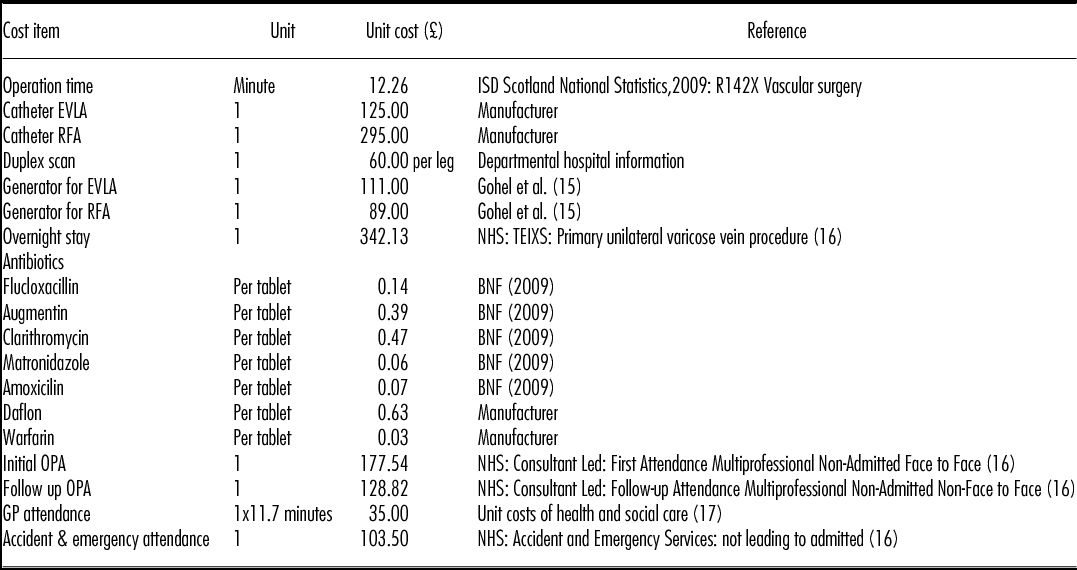
All patients were operated as day case. Health resources used by patients before, during and within 6 months of the intervention were collected (Table 1). After the intervention, patients were discharged with a supply of paracetamol and ibuprofen to be used if required. Patients were given a diary card to record any additional treatments received for postoperative problems (hospital and primary care visits and analgesic drugs taken). These data were communicated to the trial surgeons at 6 weeks and 6 months consultations.
Unit Costs

Unit costs were obtained from UK national sources and the device manufacturers and are detailed in Table 1. As all procedures were performed under general anesthesia, the cost of anesthesia and anesthetic drugs was assumed to be similar between the two groups and specific details were therefore not calculated. The patient's occupation and number of days until return to work were also recorded by patients in their diaries. An estimate of the cost of sick leave was calculated using an estimate of average weekly wages (based on occupation) obtained from the annual survey of earnings (18).
Statistical Analysis of Clinical and Quality of Life Outcomes
Sample size calculations for the trial were based on estimated levels of postprocedural pain at 3 and 10 days resulted in a minimum sample size of 47 patients per group (total 94 patients) (Reference Shepherd, Gohel and Brown8). Analyses were performed according to a predefined analysis plan using Stata® software version 10.0 (StataCorp, College Station, TX). Quality of life and clinical improvements were evaluated using analysis of co-variance (ANCOVA), which adjusted changes in outcome for baseline values. In addition, primary adjustment was made for age, sex, body mass index, clinical disease severity, number of truncal veins ablated on the trial leg, total length of vein ablated on the trial leg and number of phlebectomies on the trial leg, bilateral disease and the presence of deep venous incompetence.
Cost-Effectiveness Analysis
Cost-effectiveness was assessed using in-trial patient level analysis. The analysis was performed on an intention to treat basis, including all patients in their randomized groups. The analysis was primarily from the perspective of the United Kingdom National Health Service, although societal costs incurred due to sick leave were also calculated but not included in cost-effectiveness analysis. Costs were calculated in Pounds sterling at 2009 prices (the year the trial was conducted) and converted to euros at Purchasing Power Parity (£1= €1.212, www.oecd.org/std/prices-ppp).
Results of the SF12v2 were used to calculate preference-weighted health-related quality of life (HRQOL) or utility indices at each time point (Reference Brazier and Roberts19). Quality-adjusted life-years (QALYs) were calculated for each patient for the 6-month duration of the trial as the “area under the curve.” The mean difference in QALYs between the treatments was calculated, adjusting for baseline differences in HRQOL. The incremental cost-effectiveness ratio (ICER) was derived as the ratio of the difference in QALYs to the difference in expected cost between the treatment modalities over 6 months.
As the cost-effectiveness analysis summarizes many variables recording resource use, costs and HRQOL at multiple time points, even a small number of missing observations can considerably reduce the effective sample size and potentially affect the results. Therefore missing data were imputed in the following way. Missing variables at baseline were imputed using the unconditional mean: theoretical work suggests this approach gives acceptable results (Reference Faria, Gomes, Epstein and White20). Missing variables at 6-month follow-up (costs and utility variables) were imputed using multiple imputation using chained equations, which properly represents the uncertainty arising from the prediction of the missing data. The variables used to predict missing utility data at follow up were: costs over 6 months, baseline utility index, sex, age, type of intervention, baseline AVVQ, baseline VCCS, and CEAP score. Fifteen datasets were created by the multiple imputation process. The mean differences in costs and QALYs between the treatments and the correlations between them were estimated assuming that costs and QALYs follow a bivariate normal distribution. Rubin's rules were used to average these estimates over all the imputed datasets (Reference Rubin21). From these parameters, the probability that RFA was more cost-effective was estimated for different values of the threshold cost-per-QALY from zero to £100,000 per QALY.
Meta-analysis
As well as the current study, four other RCTs have also compared these treatment modalities. Almeida et al. (Reference Almeida, Kaufman and Gockeritz7), Shepherd et al. (Reference Shepherd, Gohel and Brown8), Nordon et al. (Reference Nordon, Hinchliffe and Brar13), Goode et al. (Reference Goode, Chowdhury and Crockett22), and Rasmussen et al. (Reference Rasmussen, Lawaetz and Bjoern23) reported pain at 7–10 days using the Visual Analogue Scale questionnaire, and treatment failure rates between first month and first year. Two random-effects meta-analyses were carried out to synthesize these two outcomes across the available studies and obtain a more precise estimate of treatment effect. The Almeida et al. study was excluded from the treatment failure meta-analysis given that both EVLA and RFA treatments achieved 100 percent of success.
RESULTS
A total of 131 patients were randomized to RFA (n = 67) and EVLA (n = 64) over a 12-month period from July 2008 to June 2009. The patients included eighty-nine women (RFA = 47; EVLA = 42) and forty-two men (RFA = 20; EVLA = 22), with a mean (SD) age of 49 (SD Reference Gohel, Epstein and Davies15) years for RFA patients and 48 (SD 16) for EVLA patients (Reference Shepherd, Gohel and Brown8). One operation (EVLA) was cancelled owing to problems with theater equipment. One patient who was randomized to RFA received EVLA owing to nonavailability of RFA equipment and another patient who was randomized to RFA chose not to participate. 110 patients (84 percent) completed questionnaires at 6 months (RFA n = 56 and EVLA n = 54) (Supplementary Figure 1). Fourteen (11 percent) of patients had one or more missing SF-12v2 variables at baseline and thirty-seven (28 percent) of patients had one or more missing SF12v2 variables at 6 months. The median [IQR] times between operation and follow-up were similar between the two randomized groups; 189 (179–205) and 186 (174–232) days for the RFA and EVLA groups respectively. A t-test comparing log transformed times did not demonstrate statistical significance (p = .266).
Quality of Life
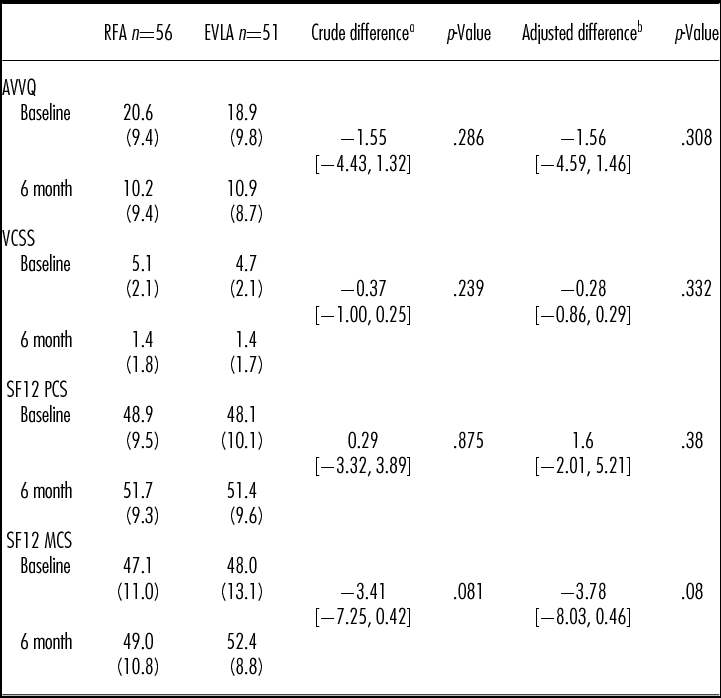
Improvements in quality of life seen at 6 weeks and reported in the original publication (Reference Shepherd, Gohel and Brown8) were maintained at 6 months. AVVQ Scores improved by mean of 10.4 and 8 points compared with baseline in the RFA and EVLA groups, respectively (p = .286 and p = .308 for crude and adjusted differences, respectively [ANCOVA]) (Table 2).
Analysis of Co-variance for Quality of Life and VCSS by Randomised Groups

Note. Values are mean (SD) unless indicated otherwise. Values in brackets are 95 percent confidence intervals.
a Adjusted for baseline value.
b Adjusted for baseline value as well as age, sex, body mass index of 30 kg/m2 or above, Venous Clinical Severity Score (VCSS) in the randomized leg (as a measure of severity of varicose vein disease), pattern of disease (great saphenous vein (GSV) versus GSV and small saphenous vein), length of vein ablated, number of phlebectomies (above or below knee), presence of deep vein disease, and unilateral versus bilateral disease.
RFA, radiofrequency ablation; EVLA, endovenous laser ablation; AVVQ, Aberdeen Varicose Vein Questionnaire, SF-12, Short Form 12; PCS, physical component score; MCS, mental component score.
Improvements in generic quality of life calculated using the SF12v2 were also maintained at 6 months and were comparable between the 2 groups (Table 2). Mean improvements of 2.8 and 3.3 points for the SF12v2 physical component score in the RFA and EVLA groups respectively were observed at 6 months (p = .875 unadjusted and p-.380 adjusted ANCOVA for the difference between the treatments). Mean improvements in the SF12v2 mental component score were 1.9 and 4.4 for RFA and EVLA, respectively, (p = .081 unadjusted and p = .080 adjusted ANCOVA for the difference between the treatments).
Clinical Improvements
Clinical improvements at 6 months compared with baseline, measured using the VCSS were comparable between the two groups. Mean improvements were 3.7 and 3.3 points for RFA versus EVLA respectively (p = .239 unadjusted and p = .332 adjusted ANCOVA for the difference between the treatments) (Table 2).
Great Saphenous Vein Ablation
Duplex scans were available for 109 patients at follow-up. There were five re-canalizations in the RFA group and 1 procedural failure due to an inability to advance the catheter to within 2 cm of the SFJ. In the EVLA group, there was one re-canalization and three procedural failures. Patients in whom successful GSV occlusion along the course of the treated vein, or successful occlusion above the knee was achieved were considered anatomical treatment successes. Those with persistent areas of above knee reflux or areas of re-canalization were classed as anatomical treatment failures. There was no significant difference in anatomical treatment success rates between the two treatment groups at 6 months (p = .52 chi square test) (Supplementary Figure 2). In the EVLA group, one patient presented with symptomatic recurrent varicosities originating from groin tributaries which appeared to be neovascular tissue on duplex imaging.
Small Saphenous and Anterior Thigh Vein Ablation
Twenty-seven patients underwent additional endovenous thermal ablation procedures for a refluxing short (n = 21) or anterior thigh vein (n = 6) on the randomized leg. Veins were classified as re-canalized, partially occluded or occluded (Supplementary Figure 3). Further endovenous ablation was required by one patient in the EVLA group for persistent symptomatic SSV reflux following re-canalization; however, the remaining patients were asymptomatic or declined further treatment. Three patients did not attend for a duplex scan (RFA n = 2; EVLA n = 1).
Additional Treatments Performed
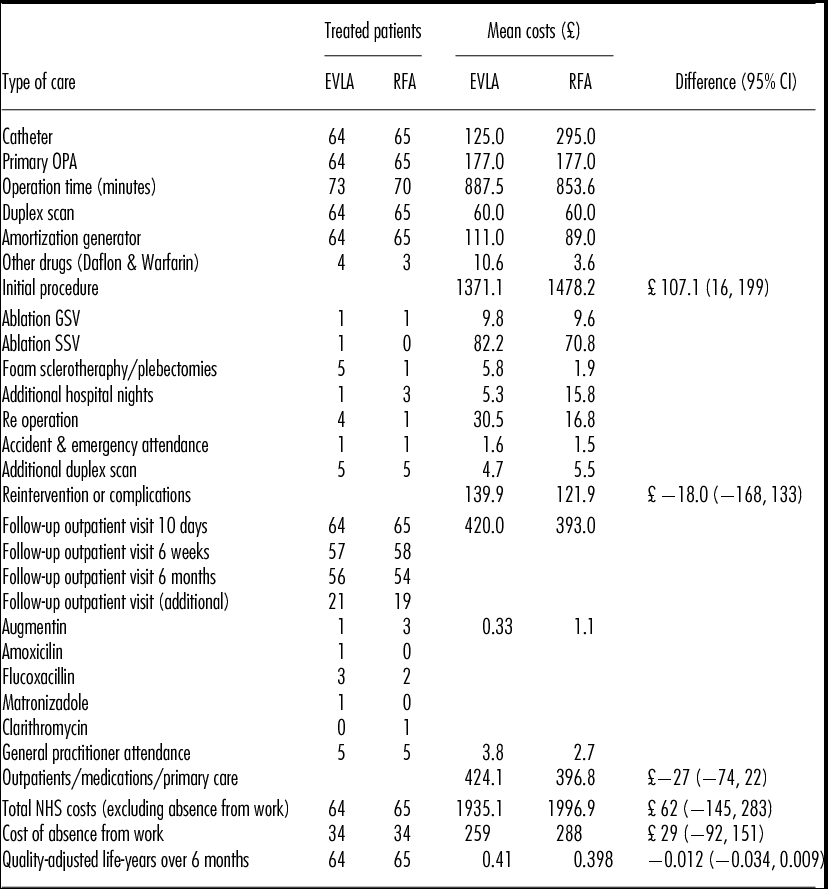
Nine patients were scheduled for additional procedures on the randomized leg up to the 6-month follow-up appointment. Of these, three underwent a further ablation procedure to the GSV (EVLA n = 1; RFA n = 1) or the SSV (EVLA n = 1) because of on-going symptoms in the presence of confirmed saphenous reflux on duplex ultrasonography (Table 3). Despite the intention of completing all treatment in a single sitting six patients (4.6 percent) (RFA n = 1; EVLA n = 5) underwent treatment for residual varicosities, consisting of either phlebectomy performed in an operating theatre under local anesthetic or foam sclerotherapy in the outpatient clinic. Treatment decisions were guided by the preferences of the clinician and patient.
Mean Costs and QALYs per Patient by Randomised Group within 6 Months

Note. Missing values were predicted using multiple imputation.
OPA, outpatient attendance; GSV, great saphenous vein; SSV, small saphenous vein.
Cost-Effectiveness Analysis
Costs and QALYs were similar between the groups over 6 months (Table 3). RFA was slightly more expensive, with mean difference in NHS costs between the modalities of £62 (95% CI: £-145 to £283) (€83.63, CI: €-175.74 to €342.99). RFA was slightly less effective, with mean difference in QALYs of -0.012 (95% CI: -0.034 to 0.009). Supplementary Figure 4 shows the probability that RFA would be the more cost-effective treatment modality, at different values of the threshold cost-per-QALY from zero to £100,000 per QALY. At a threshold of £20,000 per QALY, the probability that RFA is more cost-effective is only 0.11, that is, the probability that EVLA is the more cost-effective of the two alternative modalities is 0.89.
Meta-analysis
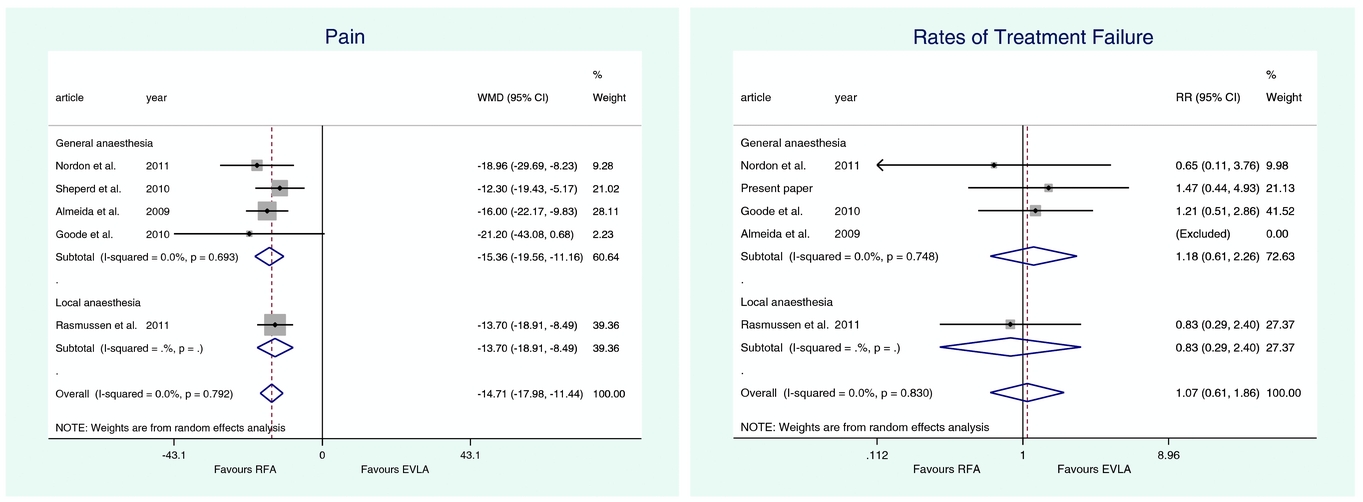
The meta-analysis results show there are no significant differences in treatment failure measured between 1 month and 1 year between treatments (p = .814). RFA is significantly associated with less postoperative pain at 7–10 days (p < .01) and this result is consistent across all five studies independently of type of anesthesia) (Figure 1).
Meta-analysis of differences in pain at 10 days postprocedure and treatment failure rate within first year.

DISCUSSION
The aim of our study was to evaluate clinical, anatomical, quality of life, and health economic outcomes at 6 months for patients treated with EVLA and RFA. Our results show that both RFA and EVLA result in excellent clinical improvements and gains in quality of life that are maintained at 6 months. We were unable to detect a significant difference between the groups based on clinical improvements, quality of life gains or anatomical occlusion rates. However, there was fewer re-canalizations in the EVLA group (n = 1), compared with the RFA group (n = 5). Anatomical treatment failures included procedural failures resulting in significant refluxing segments of the GVS above the knee, due to difficulties cannulating the vein or passing the catheter, in addition to re-canalized segments. Recommended LEEDs of >60 J/cm are recommended when using a 980-nm laser (Reference Theivacumar, Dellagrammaticas, Beale, Mavor and Gough24), and the reasons for the re-canalized GSV in the laser group is likely to be due to insufficient energy delivered (47 J/cm) to a vein of 10-cm diameter. Despite this, anatomical occlusion rates in the EVLA group appear to be comparable to other large published studies (Reference Van den Bos, Arends, Kockaert, Neumann and Nijsten4;Reference Rasmussen, Bjoern and Lawaetz25;Reference Theivacumar, Darwood and Gough26). However, the number of re-canalizations in the RFA group is somewhat disappointing in comparison to other published studies using the VNUS FAST device (Reference Creton, Pichot, Sessa and Proebstle6), and the reasons for this are unclear. All patients were treated according to recommendations from the manufacturers with a double treatment of the first segment and single treatments of each subsequent segment, regardless of the vein diameter, extrinsic compression was applied throughout in all cases. It has been suggested that energy delivery to the vein wall may be more complicated than purely looking at the energy delivered per cm based on the length of the segment. Endovenous fluence equivalence, taking into account the cross-sectional area of the vein treated, may provide a more accurate model of energy delivery; however, vein diameter is subject to significant change by several physiological and positional parameters (Reference Theivacumar, Dellagrammaticas, Beale, Mavor and Gough24,Reference Proebstle, Moehler and Herdemann27). In those patients who had re-canalized segment of GSV following RFA, the vein diameters were 8 mm, 9 mm, 12 mm, 12 mm, and 13 mm and may have contributed to the results.
Despite the intention to ablate from the lowest point of reflux, due to technical difficulties with cannulation, this was not possible in every of our cases and some patients had residual below knee reflux, however, the number of patients reporting symptoms was low, with very few patients requiring any further interventions. Furthermore, although literature has been shown that ablation from the lowest point of reflux results in significant improvements in quality of life in comparison to ablation of the GVS above the knee only (Reference Theivacumar, Dellagrammaticas, Mavor and Gough28), the overall relationship between anatomical reflux, disease severity and quality of life is poorly understood (Reference Shepherd, Gohel, Lim and Davies29).
Regarding health economic outcomes and quality of life, our results show that there are no significant differences in costs and QALYs at 6 months between the treatments. The RFA group reported significantly less pain at 10 days, but this advantage during the postoperative period does not make a measurable difference to HRQOL reported at 6 months. However, costs and QALYs are negatively correlated: higher costs are associated with poorer HRQOL (correlation of -0.115). Cost-effectiveness analysis addresses the question of which of these two treatment modalities offers the best value-for-money, given the evidence. Based on the data from this study, there is a high probability (89 percent) that EVLA is the more cost-effective of the two treatment modalities if the NHS is willing to pay £20,000 per QALY. Nevertheless absolute differences in costs and HRQOL are small. This study is a “within-trial” cost-effectiveness analysis, meaning that costs and QALYs are calculated as the average over the patients in each arm of the RCT. The study has some limitations. There was a considerable amount of missing data. The follow-up rate was 84 percent at 6 months, and 28 percent of the quality of life questionnaires were missing one or more response variables. In the economic analysis, we handled missing data by multiple imputation, following established methods (Reference Rubin21). It is possible that values of missing data are not predictable from observed variables, as we have assumed. Although this study has the longest follow-up of any randomized trial conducted so far with these procedures, it is still possible that differences between the treatments emerge after 6 months. Larger studies of longer term outcomes would be required to provide answers.
Current guidelines for varicose veins recommend endothermal ablation is generally conducted in outpatient facilities under local anesthetic. Nevertheless, the results of this trial will be relevant for patients who cannot or choose not to be treated under local anesthetic. Furthermore, clinical results appear consistent across the studies that have compared these modalities, in the United Kingdom and elsewhere, using general and local anesthetic, thereby lending strength to the generalizability of the clinical outcomes of this study to other settings. The costs of the treatments may vary between centers and countries.
In conclusion, EVLA and RFA result in comparable gains in quality of life and clinical improvements at 6 months, although RFA appears to be associated with less pain at 10 days. Based on the data from this study, EVLA is more likely to be cost-effective than RFA at 6 months. Nevertheless absolute differences in costs and HRQOL are small and so there is a strong case for leaving the choice to clinician and patient preference.
CONFLICTS OF INTEREST
This study was funded by the Mason Medical Research Foundation (registered charity), the Royal Society of Medicine Venous Forum and Imperial College London; these bodies had no input into the study design, data collection, data analysis, manuscript preparation or publication decisions. The authors declare no conflict of interest.