

Privatization, defined here as the sale of state-owned enterprises (SOEs),Footnote 1 is a phenomenon that has swept much of the world in the past 30 years. The process has been particularly striking across the so-called “developed democracies,” which have seen a post-war consensus regarding the benefits of state ownership erode sharply (Boix Reference Boix1997). Between 1980 and 2004, privatization revenues across 11 Western European countries totaled around $380 billion.Footnote 2 At root, I argue that privatization has had two important characteristics that shaped the political processes that underpinned it. First, it has been associated with improved economic performance making it a potentially attractive policy choice for governments. Second, it has also been associated with the imposition of significant costs in terms of labor redundancies, employment reforms, and other associated “efficiencies.” This latter feature is particularly important politically because these costs are very often concentrated disproportionately on elements of the traditional left-wing coalition. Where electoral systems reduce the incentive for, especially left-wing parties to respond to these constituencies facing concentrated costs, there is a greater likelihood that the benefits of improved economic performance will weigh more heavily in political decision making—and thus that privatization will be a less party-political act.
This paper makes two contributions to the literature. First, it provides a rather distinctive theoretical approach to the study of privatization politics, for which the traditional position has been to view it as an inherently right-wing policy. Rather than assuming it should be placed at a particular point of an ideological spectrum, I build a theory that is grounded in the material costs and benefits of the policy to different constituencies and the electoral incentives of their representatives.Footnote 3 One contribution of this paper is to add to a broader literature that has begun chipping away at some of the common views of public policies as exhibiting particular ideological traits. Examples of this development include work studying when, how, and why left-wing parties have used markets rather than state provision for the supply of public services to advance their goals (e.g., Klitgaard Reference Klitgaard2008; Gingrich Reference Gingrich2011; Hicks Reference Hicks2013; Hicks Reference Hicks2015). Second, it provides a methodological advance to the modeling of macro-level privatization by showing that it is important to take account of the prevailing size of the SOE sector when studying how much privatization is conducted. Although it may seem trivial to note that there can be little surprise at lower levels of privatization revenues when there is less available to privatize, the previous literature has ignored this point.
An existing literature has studied the specific question of whether left-wing parties are associated with lower privatization effort, but before outlining that literature, it is helpful to show why the simple partisanship story may not be correct. Figure 1 presents a scatter plot of the mean share of cabinet seats held by left-wing parties against the left-wing share of privatization revenues,Footnote 4 with the areas of country identifiers scaled by total privatization revenues for each country. Thus, deviation from the marked 45° line indicates whether the Left has privatized more or less than what might be considered their “fair” share on the basis of cabinet control during the period. First, if there were a tendency for left-wing parties to privatize less than other parties, we would expect countries to cluster more in the bottom right portion of the figure, where left-wing cabinet strength is larger than the share of revenues attributable to them. Clearly, the data do not conform to this pattern. Privatization is not an exclusively right-wing policy as left-wing parties have been responsible for privatization revenue shares ranging from negligible to the vast majority. Second, as shown by the sizes of the country identifiers, it does not appear to be the case that those countries where left-wing parties are stronger are the ones that have experienced less privatization (e.g., Greece and Sweden), as might be expected if right-wing parties felt constrained not to privatize in order to pander to the Left.
Scatter plot of the mean share of cabinet seats held by left-wing parties against the left-wing share of privatization revenues Note: the areas of country identifiers are scaled by total privatization revenues for each country. All figures are calculated for the period 1980–2004 (see footnote 4 for details).

Several other scholars have analyzed political issues surrounding privatization, but there has been disagreement over whether left-wing parties are related to lower levels of privatization. Boix (Reference Boix1997), Zohlnhöfer, Obinger and Wolf (Reference Zohlnhöfer, Obinger and Wolf2008), and Obinger, Reference Obinger, Schmitt and ZohlnhöferSchmitt and Zohlnhöfer (Reference Obinger, Schmitt and Zohlnhöfer2014) find statistically significant negative effects, whereas Bortolotti, Fantini and Siniscalco (Reference Bortolotti, Fantini and Siniscalco2003), Bortolotti and Siniscalco (Reference Bortolotti and Siniscalco2004), Henisz, Zelner and Guillén (Reference Henisz, Zelner and Guillén2005), and Schneider, Fink and Tenbucken (Reference Schneider, Fink and Tenbucken2005) largely find no effects. I argue that the empirical literature has failed to come to a firm conclusion regarding the effect of left-partisanship on privatization because earlier scholars have effectively estimated partisanship parameters that are averages for the effect of left-wing parties that are both for and against privatization. In this light, it is unsurprising that the estimated effects are often small or insignificantly different from zero.
There has been some work, both theoretical and empirical, that studied the tactical and strategic logics underpinning privatization programs. Feigenbaum and Henig (Reference Feigenbaum and Henig1994) proposed a three-way typology of the underlying reasoning for privatizations with “pragmatic” privatizations, essentially technocratic in nature, “tactical” privatizations explicitly political, and “systemic” privatization programs “intended to reshape the entire society by fundamentally altering economic and political institutions and by transforming economic and political interests” (Feigenbaum and Henig Reference Feigenbaum and Henig1994, 192). Although this typology is attractive in the abstract, it provides little in the way of predictive theoretical traction.
Studying South American privatization programs, Murillo (Reference Murillo2001) provides a theory to explain the resulting interactions between left-wing parties and labor unions. She argues that the critical explanatory factors in that region were the competition among left-wing parties for votes and the competition among unions for members. The theory, however, is premised on the idea that unions face great uncertainty about the effects of privatization and can come to trust left-wing parties not to hurt them unnecessarily. This uncertainty may have been the case in South America, but much of the privatization experience in Western Europe in the 1990s was informed by outcomes in earlier adopters and it is difficult to conclude that unions would not have foreseen the implications of privatization for their membership.
Despite a fairly large literature, then, there are reasons to think that the treatment of partisan influences over privatization has been underexamined. Consequently, I seek to advance the literature in this area, and do so by offering a theory of conditional partisanship rooted in the preferences of left-wing parties.Footnote 5 However, this paper also distinguishes itself from previous studies in at least two further ways. The theoretical account that I develop leads to hypotheses at both the individual level and the macro-policy level. I test these hypotheses separately, and so provide evidence supporting both the “micro foundations” of my argument and the macro implications of it. Finally, in testing the macro-level implications, I develop a more realistic empirical specification than has been used before by taking seriously the idea that privatization opportunities are likely to be limited by the size of the SOE sector itself.
Theory
The theory presented here rests on the idea that privatization is a phenomenon characterized by distributed benefits and concentrated costs. The distributed benefits of privatization have tended to come in the form of increased productivity and improved service. Meanwhile, the concentrated costs that accompany this have tended to come in the form of job losses in privatized companies and sectors. My claim, developed in detail below, is that the interaction of the representation of these distributed and concentrated interests with party politics leads to differing patterns of the politics of privatization.
Distributed Benefits and Concentrated Costs of Privatization
Two broad mechanisms through which privatization of SOEs bestows economic benefits have been proposed: ownership and competition. The consensus view, however, would seem to be that the latter is more important, but is often facilitated by a change to the private version of the former.
Early work argued that it was state ownership itself that reduced economic performance as a result of politicians seeking to maximize something other than corporate profits—such as employment (e.g., Pint Reference Pint1991; Boycko, Shleifer and Vishny Reference Boycko, Shleifer and Vishny1996). Empirical support for this general claim has been provided by a number of studies (e.g., Boardman and Vining Reference Boardman and Vining1989; Vining and Boardman Reference Vining and Boardman1992; Ehrlich et al. Reference Ehrlich, Gallais-Hamonno, Liu and Lutter1994; D’Souza and Megginson Reference D’Souza and Megginson1999). Dewenter and Malatesta (Reference Dewenter and Malatesta2001) partially questioned this reasoning by showing that corporate performance gains appear to have been realized in the years before the actual privatization occurred. However, deliberate pre-privatization reorganization was common, suggesting that privatization may have been causally related to performance gains even in these circumstances. A second line of reasoning focuses on competition as the cause of increased economic performance.Footnote 6 The sell-off of SOEs has often been associated with the introduction of more competitive environments for previous state-owned monopolists. Empirical support for this view is found by Alexandre and Charreaux (Reference Alexandre and Charreaux2004) and González-Páramo and Hernández de Cos (Reference González-Páramo and Hernández de Cos2005). The failure or inability to control for competition can also explain why some other studies found no effect from state ownership itself (e.g., Kole and Mulherin Reference Kole and Mulherin1997).
Of course, the manifestation of the concentrated costs of privatization is in many ways the corollary of those efficiency gains. A common theme in the theoretical literature is that politicians will tend to have a greater concern for employment levels than is economically efficient (e.g., Pint Reference Pint1991; Boycko Shleifer and Vishny Reference Boycko, Shleifer and Vishny1996). Robinson and Torvik (Reference Robinson and Torvik2005) make theoretical claims regarding the construction of “white elephants” that are socially inefficient, but politically useful. They argue that particular constituencies will gain employment to operate these “white elephants.” In either case, if politicians tend to over-hire when they control SOEs, it follows that privatization will see redundancies as that excess labor is shed by private-sector managers who are answerable to shareholders seeking profit maximization.
A cursory look at figures on employment changes for several prominent sectors during the privatization period suggests that the redundancies have been an important feature of the process. Schulten, Brandt and Hermann (Reference Schulten, Brandt and Hermann2008, table 2) provide data on employment changes for the electricity, gas, postal, and rail sectors across EU member states, and show that they vary from reductions of 12–40 percent for the period 1995–2004.Footnote 7 Taking just the prominent case of the privatization of British Telecom (BT), it is also possible to get a sense of the magnitude of changes that occurred. Florio (Reference Florio2003, 222) provides data showing that the average number of employees in the company dropped from around 240,000 in the 1980s to 160,000 in the 1990s. Although the specific timing of this change suggests that it was not privatization per se, it is far from clear that the shift to a stricter regulatory environment—that both sought to encourage competition and recognized BT’s dominant market position—would have occurred otherwise.Footnote 8
Given this evidence, it is unsurprising that the pattern of general empirical results with respect to the effect of privatization on employment is fairly consistently negative—albeit coming from a smaller literature. Although the evidence of Alexander and Charreaux (Reference Alexandre and Charreaux2004) is somewhat weaker, D’Souza and Megginson (Reference D’Souza and Megginson1999), Dewenter and Malatesta (Reference Dewenter and Malatesta2001), González-Páramo and Hernández de Cos (Reference González-Páramo and Hernández de Cos2005), and Schmitt (Reference Schmitt2014) find significant reductions in employment in privatized firms. At least some of the productivity gain from privatization appears to come from a reduction in the amount of labor for production in previous SOEs.
The Representation of Interests
The argument that I now develop links this pattern of distributed benefits and concentrated costs to partisan politics. I do so in a way that yields implications at both the level of individual preferences and of macro-level policy outcomes. The question is: Under what patterns of interest representation should we expect the concentrated costs to dominate the policy-making process, as opposed to the distributed benefits? That is to say, under what pattern of interest representation should we expect more privatization?
I suggest that an answer to these questions can be found in the different incentives that electoral systems provide to politicians to respond to concentrated versus distributed constituencies. Indeed, the theory that I propose is essentially a re-application of a prominent argument that developed in the trade literature. Various scholars have argued that small states that are dependent on free trade benefit from the encompassing nature of interest representation as it limits the influence of narrow anti-trade interests (e.g., Katzenstein Reference Katzenstein1985; Rogowski Reference Rogowski1987).Footnote 9 Trade, it is argued, exhibits the features of concentrated costs (e.g., Scheve and Slaughter Reference Scheve and Slaughter2001; Mayda and Rodrik Reference Mayda and Rodrik2005) and distributed benefits, making the extent to which organized interests internalize the latter of key importance in determining their support for openness (Olson Reference Olson1982).
The logic expressed by Rogowski is of particular relevance as he argues that proportional electoral systems yield a set of incentives for politicians to “resist protectionist pressures” and enables them to ignore demands for “the extraction of rents by particular firms, classes, or sectors” (Rogowski Reference Rogowski1987, 207–8). At the core of the argument is the idea that concentrated interests will hold great sway over elected representatives for whom they form a large proportion of the electorate—and that this is far more likely for single-member districts than for (more electoral proportionality inducing) multi-member districts. This characterizes the politics of concentrated interests, but an equivalent argument applies, of course, to the distributed interests. The benefits of trade are diffuse and small for any particular (geographic) constituency, which reduces the incentive of any single political representative to consider them salient. As the constituency represented by politicians gets larger, they come to encompass more of these diffuse benefits, making them more likely to be politically valued. Indeed, Rogowski (Reference Rogowski1987, 208) takes this general logic to be “almost self-evident.”
Rogowski’s theory goes as far as an argument that proportional representation was deliberately chosen by small open economies because of these features, but it makes no sense to go this far when applying it to privatization. However, it does follow rather naturally that the features of electoral proportionality that make it conducive to greater trade opennness will also make it conducive to the adoption of privatization as a policy. The sale of SOEs entails concentrated costs that more narrowly geographically oriented representatives will find it difficult to ignore, and distributed benefits that they will find it all too easy to ignore. In more proportional systems, such incentives are considerably undermined.
One way in which privatization policy should be distinguished from trade policy is in the partisan implications of these benefit versus cost incentives.Footnote 10 It is commonplace to consider that left-wing parties disproportionately tend to represent those who are most exposed to the costs of privatization—those employed in the public sector (e.g., Knutsen Reference Knutsen2005). By contrast, the standard partisan view sees parties of the Right as the representatives of capital and generally of upscale groups (Hibbs Reference Hibbs1977)—those who can be thought to face few of the costs but many of the benefits of privatization. The consequence of this partisan view is that there is much less reason to think that the impact of electoral proportionality will be felt by parties of the Right than parties of the Left. Parties of the Right tend not to represent the interests of the losers from privatization anyway, so the electoral system incentives are of limited relevance to them. For the Left, the electoral system has the capacity to re-orient their incentives from disproportionately representing the losers of privatization to representing a broader section of the electorate. To be clear, my argument is far from a claim that privatization will be uncontroversial and consensual in such systems. Privatization losers and their (relatively fewer) representatives are very likely to try to block sell-offs, but their ability to do so will be in the face of relative acceptance by other parts of the Left who can internalize more of the benefits of privatization. Assuming that parties respond in policy terms to these varying incentives, this discussion immediately leads to the following hypothesis:
HYPOTHESIS 1: Higher levels of electoral proportionality will tend to reduce the difference between left-wing parties and other parties in terms of privatization effort.
This hypothesis relates to macro-policy outcomes, but the theory can also be used to yield an individual-level implication that is testable. To the extent that political elites have a role in shaping the specific policy preferences of those that they represent, the electoral system should also be expected to have an impact on individual-level preferences. Lenz (Reference Lenz2009) has influentially argued that this kind of opinion leadership is important as voters have a tendency to adopt the policy positions of their preferred party. Indeed, Durant and Legge (Reference Durant and Legge2001) have already found an impact of political leaders on privatization preferences. This implies the next hypothesis:
HYPOTHESIS 2: Privatization will, other things equal, be more popular among voters identifying with left-wing parties in more proportional electoral systems than in less proportional electoral systems.
Having developed these hypotheses, I now move to test them. In the next section, I focus on Hypothesis 2, relating to individual-level preferences. In the following section, I go on to test Hypothesis 1, relating to macro-level policy choices.
Individual-Level Privatization Preferences
To test the individual-level hypothesis, it is necessary to use cross-national survey data to take advantage of variation in electoral proportionality.Footnote 11 Several surveys have asked questions about preferences regarding privatization of SOEs, but for my purpose, the “Role of Government” module from the International Social Survey Program (ISSP) in 1996 is ideal. It provides an identical question across many countries at a time when privatization was a prominent policy option. Furthermore, responses are cross-nationally comparable as respondents were effectively asked about their preferred “level” of privatization, not whether they wanted more or less compared with their respective national status quo. Specifically, respondents were asked, “Do you think [… the electricity sector] should mainly be run by private organisations or companies, or by government?” As an industry that was largely publicly owned, it provides a useful testing ground for the theoretical predictions of the model.Footnote 12 I code PrivElec as a binary variable equal to 1 for responses of “Mainly run by private organizations” and equal to 0 for responses of “Mainly run by government,” and take this measure as my dependent variable.Footnote 13
On the explanatory variable side, to test Hypothesis 2, I require individual-level measures of party identification and macro measures of electoral proportionality. For the former, I use a five-point scale from the ISSP survey that codes people into the following categories on the basis of their response to party affiliation questions: “far right,” “right, conservative,” “center, liberal,” “left, center left,” and “far left.” To maintain degrees of freedom, I use this as an interval scale (IdLeft) and so take advantage of its natural ordinal nature.Footnote 14 For electoral proportionality, I use the standard Gallagher (Reference Gallagher1991) least squares disproportionality index subtracted from 100 such that it becomes a proportionality index (PR).Footnote 15 The hypothesis implies the existence of an interaction effect (IdLeft·PR) such that greater proportionality reduces the size of the effect from party affiliation.
Finally, I employ control variables for which their exclusion may lead to questions regarding the theoretically relevant inferences.Footnote 16 Specifically, I use age (Age), years of education (EducationYears), an indicator of union membership (Union), an indicator of public-sector employment (PubSector), and within-country standardized income (Income).Footnote 17
Results
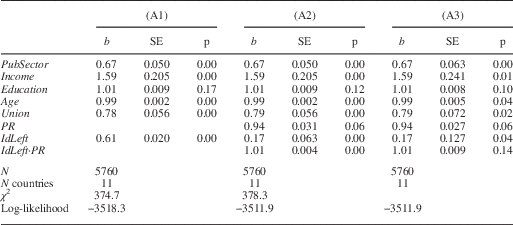
Table 1 presents the results of estimating a series of multilevel logit models that are used to test the hypothesis. A multilevel model is used to account for the fact that individuals are nested within countries. Initially, the only second-level predictor is PR, which reflects both the theoretical importance of this variable and the fact that I only have 11 observations at this level, and therefore reduced degrees of freedom.Footnote 18 Subsequently, I introduce additional second-level predictors to demonstrate the robustness of the initial findings.
Multilevel Logit Models of Support for Privatization of the Electricity Sector Across a Sample of Developed Democracies
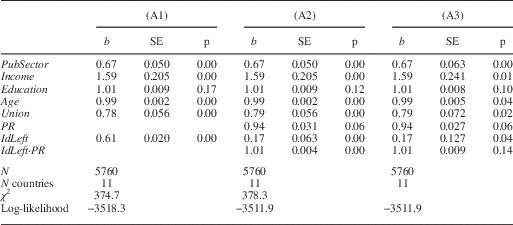
Note: odds ratios, standard errors, and p-values are presented in adjacent columns. Standard errors for model A3 are calculated using a country-level jackknife procedure (ISSP 1996).
Looking first to the control variables, they each perform well and their effects are extremely stable across all model specifications. The coefficients are presented in odds ratio form, so that inferences are based on values greater or less than 1. I find evidence that younger respondents are more favorable to privatization, although the effect is fairly small. Similarly, more educated respondents are also more favorable, but with a small size of effect. Taken with the finding that those with higher incomes are more favorable, a natural interpretation of each may be that the career risk associated with privatization is lower for these groups.
Turning to the inferences of relevance to the hypothesis, the evidence is strongly supportive. Model A1 provides a baseline specification without PR. Model A2 provides the basic test of Hypothesis 2, with the results indicating that the expected positive interaction of IdLeft·PR is present and statistically significant. Model A3 provides country-jackknifed estimates of standard errors for the same specification as model A2. The interaction effect drops somewhat below conventional levels of statistical significance, but this is in the context of a cross-national N of only 11. Nonetheless, this provides a note of caution on the inference—one that the more robust macro-level results go some way to alleviating in that they are estimated using a larger cross-national sample and yield no such robustness questions.
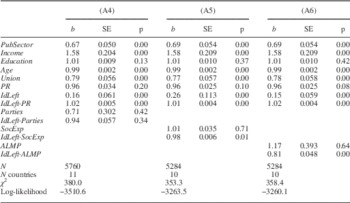
Notwithstanding these initial supportive results, it would be reasonable to question whether the cross-national variation in the influence of left–right party identification is really caused by electoral proportionality, rather than some other correlated aggregate variable. With the small country-N, there are limits to how far the data can be pushed in this area. However, Table 2 provides evidence that lends more support for the causal importance of the electoral system.
Multilevel Logit Models of Support for Privatization of the Electricity Sector Across a Sample of Developed Democracies

Note: odds ratios, standard errors, and p-values are presented in adjacent columns (ISSP 1996).
One concern may be that the effect does not run through proportionality as such, but rather the features of the party system that results from the electoral system. A larger number of parties may lead to a reduced impact of IdLeft on privatization preferences as the dimensionality of electoral competition is allowed to expand beyond the traditional left–right spectrum. As proportionality is associated with a greater number of parties, the effects estimated in Table 1 may capture the wrong mechanism. However, model A4 indicates that this concern is unfounded. When the interaction of IdLeft and the effective number of parties (Parties) is included together with the PR interaction,Footnote 19 it is only the latter that is statistically significant and has an effect in the correct direction.
Another concern may be that the concentrated costs associated with privatization may be ameliorated by welfare state and labor market policies that are, themselves, correlated with electoral proportionality. Where the welfare state is more generous to those who are unemployed, or where there is more extensive expenditure on active labor market policies (ALMP) aimed at placing such people in new employment, one may reasonably think that privatization would be less politically divisive. However, model A5 demonstrates that the estimated effect of PR does not run through social expenditure.Footnote 20 In fact, when controlling for the PR interaction effect, higher levels of SocExp actually make the effect of IdLeft stronger, not weaker. The same story is true when focusing specifically on expenditure that has the aim of facilitating re-employment (ALMP).Footnote 21
Before moving on to test the macro-level hypothesis, Figure 2 illustrates the magnitude of the conditioning effect of PR on individual-level partisanship. It shows that the marginal effect of left–right party identification in the least proportional countries in the sample is estimated to be about twice the magnitude of that for the most proportional countries in the sample.
Marginal effect of individual-level left–right identification on privatization preferences, conditional on PR. Note: estimated from model A2; 95 percent confidence intervals shown. The y-axis shows the marginal effect of a unit change in IdLeft, which itself ranges from 1 to 5.

Macro-Level Policy Outcomes
There is, then, good evidence to support the claim that the preferences of voters across countries are predictably influenced by prevailing electoral institutions. Given this initial support for the broad theoretical claim of this paper, I now turn attention to the hypothesis that relates to the actual policy choices of governments. Does this individual-level pattern filter through into macro-level policy outcomes? Although the descriptive data presented in Figure 1 are suggestive, in this section, more systematic tests are conducted by estimating a series of time-series cross-section models.
The Dependent Variable
The dependent variable in all estimated macro-level models is the annual per capita privatization revenues for a country (PrivRevPC i,t). This measure can be considered one of “privatization effort” in that it directly controls for country size, thus avoiding the problem of large privatizations in large countries dominating the analysis. The data are drawn from the Privatization Barometer databaseFootnote 22 and include all sales of SOEs during the sample period.Footnote 23 To have such an exhaustive data set available is very helpful; however, as with so many social scientific measures, it is not perfect. Based on the theory outlined above, a measure of the amount of (left-leaning) labor embodied in the privatized enterprises would be more appropriate. Unfortunately, no such measure is available. Measuring the “size” or “effort” of privatizations according to the revenues raised may under- or over-state “true” sizes as financial markets rise and fall, or even as politicians deliberately manipulate share pricing (e.g., Biais and Perotti Reference Biais and Perotti2002). Nonetheless, the measure used for privatization effort accords with much of the previous literature and is, arguably, the best available.
Explanatory Variables
Testing the argument advanced above requires a measure of left-wing government control to go with the measure of electoral proportionality (PR, as used above). To capture the former, I use the share of cabinet seats held by left-wing parties (GovLeft i,t) as provided by Armingeon et al. (Reference Armingeon, Leimgruber, Beyeler and Menegale2007).Footnote 24 The decision not to use a partisanship measure that includes a component of left–right ideology for each party within it is deliberate. To the extent that various left–right ideology measures consider privatization to be inherently right wing, they will tend to include a large component of the conceptual-dependent variable within them. It would be very problematic for testing the theory here if left-wing parties that engaged in privatization were systematically coded as relatively more right wing than those that did not. Note that testing Hypothesis 1 requires assessing the interaction between GovLeft and PR.
There is reason to believe that a number of other factors will have played an important role in determining how privatization has developed across countries. I discuss them here and include them as control variables in order to allay concerns that my core theoretical inferences may be a result of omitted variable bias. I also show that the inferences are robust to the exclusion of these controls.
Public finances have been held to be relevant to privatization decisions. A poor financial situation, in the form of high public debt levels (Bortolotti, Fantini and Siniscalco Reference Bortolotti, Fantini and Siniscalco2003) can create a need to privatize in the sense that the situation can be ameliorated by the revenues of a privatization program. Thus, I employ the PublicDebt i,t−1 variable that measures accumulated public debt as a percentage of gross domestic product (GDP).Footnote 25
Zohlnhöfer, Obinger and Wolf (Reference Zohlnhöfer, Obinger and Wolf2008, 116) present data suggesting that there have been shifts in party positions between the 1980s and the 1990s. That is, some kind of trend in favor of privatization across countries and parties. In order to capture this possible development, I employ a count variable simply equal to the year of each observation (Year t).
Policy diffusion is thought to be an important component of policy making generally, and there is evidence that it has been important for privatization (Meseguer Reference Meseguer2004; Schmitt Reference Schmitt2011). Following Simmons, Dobbin and Garrett (Reference Simmons, Dobbin and Garrett2006), four diffusion mechanisms are possible: “coercion,” “competition,” “learning,” and “emulation.” As they note themselves in their examples of the diffusion of liberalism, privatization would seem to be a prime candidate for competition- and learning-based diffusion. Following a similar approach to Henisz, Zelner and Guillén (Reference Henisz, Zelner and Guillén2005), I attempt to disaggregate some of these differing types of diffusion empirically and so estimate models with two variables capturing spatial lags with different weighting matrices. I estimate a model where the per capita privatization revenues in other countries are used as a predictor, and the weighting matrix, W Trade, is composed of bilateral trade openness.Footnote 26 The logic is that countries that have stronger economic ties are expected to have a stronger impact on each other—either through competitive economic pressures or through increased channels of information diffusion as a result of those ties. Meanwhile, a second variable is constructed where the weighting matrix is composed of country populations. This produces a variable Diffuse Pop=W Pop·PrivRevPC.Footnote 27 The expectation is that larger countries may have a stronger impact on others through a variety of possible channels, including emulation (owing to higher prominence of larger countries) or competition. The latter may operate as larger newly privatized enterprises tend to emerge from larger countries, and these may pose a greater threat of entry into international markets—perhaps because of greater access to capital.Footnote 28
On the substantive grounds that diffusion is unlikely to be instantaneous and the methodological grounds that inclusion of the contemporaneous spatial lag creates an endogeneity problem (Beck, Gleditsch and Beardsley Reference Beck, Gleditsch and Beardsley2006, 40), a lag of one period is introduced.Footnote 29 The rows of W are not standardized as this has substantive consequences that are unwarranted (Plümper and Neumayer Reference Plümper and Neumayer2010). Using Diffuse Trade as the example,Footnote 30 to do so would imply that it is the volume of trade between country A and B relative to that for A and C that matters, not the absolute magnitude of trade between A and B. This does not accord with the theory that economic ties are the source of diffusion. If trade between A and B and between A and C is very low, we should expect diffusion to be correspondingly low.
In terms of a government’s ability to privatize, Bortolotti, Fantini and Siniscalco (Reference Bortolotti, Fantini and Siniscalco2003) suggest that a “deep and liquid stock market” is an important consideration. As large portions of privatization programs across many countries have been pursued by public offerings on stock markets, the capacity of those markets to provide the required capital is likely to have been an important constraining consideration for governments. To control for this, I employ a variable corresponding to the total stock market capitalization within a country, per capita (MktCapPC t−1).Footnote 31 The measure is per capita so as to avoid the issue of larger countries having larger stock market capitalizations, but correspondingly larger capital requirements for their privatization programs. Again, the variable is lagged to try to avoid an endogeneity problem.
Boix (Reference Boix1997) suggests that legislatively weaker governments will be less able to pursue privatization programs as the chance of them being blocked from doing so would be higher. In order to capture this, I employ a variable measuring government fractionalization (GovFrac i,t), calculated as the probability of two randomly drawn legislators from the governing coalition being from different parties.Footnote 32 The expectation is that weaker and more divided governments will find it more difficult to privatize.
Modeling Techniques and Issues
The question arises of how to model the dependent variable. I follow Bortolotti and Siniscalco (Reference Bortolotti and Siniscalco2004) in using country-years as the unit of observation and estimating tobit models. This takes account of the fact that a value of 0 for the PrivRevPC i,t variable can correspond to a government being only very marginally against privatization and one being overwhelmingly against it—that is, the censored nature of the variable. However, I go beyond earlier studies by taking account of the fact that different countries will have, at any given time, different stocks of SOEs that are available for privatization. That is to say, it would be desirable to employ a variable in the models that captures the size of the SOE sector available for privatization. Low privatization levels are hardly surprising if there is nothing to privatize. Furthermore, one may reasonably suspect that the size of the SOE sector may be correlated with electoral systems because majoritarian countries tend to be less favorable to state intervention in general, so it is all the more important for my theoretical purposes to deal with this issue carefully. Thus, the preferred equation to estimate would be:
 $$PrivRevPC_{{i,t}} \,=\,\beta _{0} \,{\plus}\,\beta _{1} SOEPC_{{i,t{\minus}1}} \,{\plus}\,\beta {\bf Z}\,{\plus}\,\epsilon _{{i,t}} ,$$
where SOEPC i,t−1 is the lagged per capita size of the SOE sector for each country and β Z denotes vectors of other parameters and variables. The problem is that there are no reliable data for SOEPC i,t−1. Noting that the current size of the SOE sector in a country depends on the initial size of it and the amount that has been privatized already:Footnote 33
 $$SOEPC_{{i,t}} \,\approx\,SOEPC_{{i,0}} \,{\minus}\,\mathop{\sum}\limits_{\tau =0}^t PrivRevPC_{{i,\tau }} ,$$
this can be substituted into Equation 1 to yield
 $$PrivRevPC_{{i,t}} \,=\,\beta _{0} \,{\plus}\,\beta _{1} \left( {SOEPC_{{i,0}} \,{\minus}\,\mathop{\sum}\limits_{\tau =0}^{t{\minus}1} PrivRevPC_{{i,\tau }} } \right)\,{\plus}\,\beta {\bf Z}\,{\plus}\,\epsilon _{{i,t}} .$$
This form has lower data requirements but not quite low enough as there are no reliable data on the size of the SOE sector that is commensurate with PrivRevPC, even for just an early point in time. To avoid this problem, I estimate a model of the form
 $$PrivRevPC_{{i,t}} \,=\,\alpha _{i} \,{\minus}\,\beta _{1} \mathop{\sum}\limits_{\tau =0}^{t{\minus}1} PrivRevPC_{{i,\tau }} \,{\plus}\,\beta {\bf Z}\,{\plus}\,\epsilon _{{i,t}} ,$$
where α i≡β 0+β 1SOEPC i,0 denotes country-specific intercepts, which have replaced the initial SOEPC levels. As these intercepts clearly pick up other time invariant factors that affect privatization revenues (β 0), they do not constitute estimates of SOEPC i,0, but that is not important for my purpose.
Results
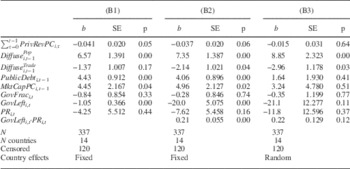
The results from estimating a series of models of privatization effort are presented in Table 3. Models B1 and B2 are estimated as standard tobit models with country fixed effects—as per the specification derived above. Model B3 re-estimates standard errors using a country-level jackknife procedure as a way of assessing the cross-national stability of the estimates.Footnote 34 In general, the models perform rather well.Footnote 35 Across all three models, the parameter estimate for cumulative privatization revenues is negative and quite accurately estimated. It appears that the variable is indeed controlling for the remaining size of the SOE sector.
Tobit Estimation of the Determinants of Privatization (PrivRevPC i,t) Across Countries

Note: maximum likelihood estimates with country fixed effects, except model B3, which has country random effects. Standard errors and p-values are presented in parallel columns, both of which for model B3 are calculated using a country-level jackknife procedure.
Although space limitations preclude dwelling for too long on control variable results, a few words are necessary.Footnote 36 Across the models, there is consistent support for the higher levels of public debt being associated with higher privatization effort. Stock market capitalization also performs fairly consistently across models—at least for my preferred specifications. The estimate of the coefficient on government fractionalization is consistently negatively signed, but its statistical significance never reaches conventionally accepted levels.
Given current scholarly interest in policy diffusion, it is worth commenting on the results for the variables capturing this aspect. The parameter estimates for the two diffusion variables are rather conflicting. For Diffuse Pop, estimated parameters are positive and statistically significant, indicating that privatizations conducted by larger EU members tended to lead to subsequent privatizations across other member states. By contrast, the results for Diffuse Trade suggest that diffusion among trading partners may actually have worked in reverse: with privatization by an important trading partner actually reducing “home” privatization effort.
On the evidence relevant to the hypothesis outlined above, the findings are rather consistent across models. Model B1 provides support for the idea that left-wing parties will, on average, tend to privatize less readily than other parties. Model B2 introduces the interaction effect between GovLeft and PR that is used to test Hypothesis 1. It provides strong support for the hypothesis in that left-wing parties have their largest negative effect on privatization revenues when electoral proportionality is low. Finally, the results for model B3 show that this inference is robust to the country-jackknife procedure.
These initial results are very encouraging, but the empirical tests can be pushed further. Table 4 provides for an assessment of the robustness of the findings in a number of ways. Model B4 uses a procedure suggested by Bartels (Reference Bartels2008) and Bell and Jones (Reference Bell and Jones2015) to enable the within- and between-country effects of each explanatory variable to be separated. The specification uses country-level random effects coupled with country-means of variables to capture between-country effects (which I denote with B superscripts) and differences-from-country-means of variables to capture within-country effects.Footnote 37 Reassuringly, the estimates from model B4 support Hypothesis 1, both within and between countries. Model B5 demonstrates that the inferences are robust to the exclusion of all variables that are not either structurally implied by Equation 4,Footnote 38 or directly required to test the hypothesis.Footnote 39 Finally, model B6 assesses whether there is an inferentially important pattern such that left-wing parties tend to adopt privatization toward the end of the sample period. If they were to learn from previous (implicitly right-wing) privatizations, they may feel more comfortable privatizing later. To assess this possibility, I include a time counter Year and interact it with GovLeft, with the expectation being for a positive coefficient such that left-wing governments become less negative about privatization at later points. The estimates do not support this view—either in terms of coefficient sign or statistical significance—but more importantly, the core inference regarding GovLeft·PR is unaffected.
Tobit Estimation of the Determinants of Privatization (PrivRevPC i,t) Across Countries

Note: maximum likelihood estimates with country random effects for model B4, and country fixed effects for models B5 and B6. Standard errors and p-values are presented in parallel columns.
As a final robustness check, Table 5 presents estimates that are analogous to those in Table 2. Model B7 demonstrates that the electoral proportionality effect does not seem to run through the effective number of legislative parties. Model B8 demonstrates that it is not the case that left-wing parties privatize more where higher social expenditure provides more of a safety net for those facing the costs of the policy. Likewise, nor do they privatize more where ALMP expenditure is higher.Footnote 40 In sum, the macro-level results provide good support for the hypotheses—and so for the theory more generally.
Tobit Estimation of the Determinants of Privatization (PrivRevPC i,t) Across Countries

Note: maximum likelihood estimates with country fixed effects. Standard errors and p-values are presented in parallel columns.
Before concluding, it is helpful to get a sense of the magnitude of the effects that have been estimated. To that end, Figure 3 illustrates how the partisanship effect varies with the level of electoral proportionality, as estimated by model B2. The figure is drawn for the sample range of PR and shows that left-wing incumbency has a strongly negative effect for medium and low levels of electoral proportionality, but that those parties are indistinguishable from others at high levels of proportionality. Partisanship effects on privatization are not always present. In plotting the figure, I adopt the recent suggestion by Berry, Golder and Milton (Reference Berry, Golder and Milton2012) to plot the sample distribution of the “conditioning” variable, in this case PR.Footnote 41 This indicates that there is a preponderance of data drawn from higher electoral proportionality contexts. A methodological and a substantive point are worth making, here. On the former, whereas the distribution of PR may elicit concern, the jackknifed estimates of model B3 provide reassurance regarding the robustness of the inference. On the latter, one intriguing implication of these results is that, for a large proportion of the country-years in the sample, left-wing parties were, on average, no different from other parties in their pursuit of privatization. In this light, the results lend greater support to the view advanced here that privatization itself is not an inherently right-wing policy.
Partisanship effect on privatization, conditional on PR. Note: estimated from model B2; 95 percent confidence intervals shown. The y-axis shows the marginal effect of a unit change in Left, which itself ranges from 0 to 100

Substantively, the electoral proportionality interaction is capable of explaining a non-trivial amount of variation in the dependent variable. For example, for a standard deviation change in the GovLeft variable, the change in the partisanship effect when moving from the lowest value of PR to the highest is worth around $195 per capita per year of privatization revenues. This compares with a sample standard deviation for the dependent variable of around $175 per capita. To put this in context, the estimated effect of a standard deviation change in one of the most commonly associated explanatory variables, PublicDebt, is $110. In absolute size, and relative to another prominent explanation, the estimated conditional partisanship effect is of substantive significance.
Conclusions
The results presented above suggest that the traditional understanding of privatization as an inherently right-wing policy is rather wide of the mark. Such a tendency can, perhaps, be attributed to a focus on the United Kingdom and its Thatcherite revolution during the 1980s (e.g., King Reference King1987). Having witnessed the militant miners bring down Edward Heath’s government in the early 1970s, the Tories were eager to ensure that a situation in which a union could hold the country to ransom could not recur. Such an interpretation became all the more prescient toward the end of the 1980s after a raft of trade union legislation had also been passed and Thatcher had won her famous battle with the National Union of Mineworkers. The French experience is also instructive, where privatization revenues show a notable negative correlation with Left cabinet seats as privatization programs stopped and started with the change of governments. At the same time, Durant and Legge describe how “In response [to the Juppé privatization programme], the French union movement revived, as public-sector strikes nearly crippled the nation’s economy” (Reference Durant and Legge2001, 313). Partisanship effects went hand-in-hand with public-sector labor strife.
However, although these cases are of great interest, it is clear that they are not typical of a more general political pattern. Left-wing parties have engaged in privatization programs as large as, or larger than, those of their right-wing oppositions in several European countries. To dismiss such activities as capitulation to the Right would appear to be wrong. Indeed, to the extent that greater electoral proportionality is causally related to the election of left-wing governments (Iversen and Soskice Reference Iversen and Soskice2006), the results here suggest that left-wing parties privatize more where they are stronger, not where they are weaker.Footnote 42 In Austria, the mid-1980s saw both the Socialist Party (SPÖ) and the conservative People’s Party embrace privatization, as well as broader deregulatory policies. Indeed, Meth-Cohn and Müller (Reference Meth-Cohn and Müller1994) describe the shift by the SPÖ finance minister, Franz Vranitzky, as a “quantum leap into supply-side economic policies,” and one for which “criticism within his party was relatively moderate” (Meth-Cohn and Müller Reference Meth-Cohn and Müller1994, 166). Furthermore, the logic of efficiency benefits from privatization is only just below the surface when they argue that (Meth-Cohn and Müller Reference Meth-Cohn and Müller1994, 166):
the SPÖ accepted that the state is not an optimal owner. A minister cannot run a firm in the same way as a private owner; under such a situation the enterprise belongs de facto to the management and the workers’ council, and beyond that to local and regional politicians and the unions.
Meanwhile, in Denmark, Christoffersen and Paldam (Reference Christoffersen and Paldam2004, 9–10) note that privatization was not politically controversial “for two reasons: The largest privatizations have been done by the Center-Left, and private ownership is in accordance with the values of a large majority of the population,” which meant that “neither the parties to the Right nor the trade unions could protest.”
The argument set out here also has implications for the period before privatization appeared on the agenda. If the theory holds for privatization, then it is plausible that it should hold for decisions regarding nationalization of enterprises and industries as well. This remains the case even though there was clearly a general trend from the mid 20th century away from a policy orientation favoring SOEs over privatized and competitive markets—itself perhaps explained by the evolution of ideas (e.g., Lindvall Reference Lindvall2009). If the nationalization period is also relevant for the theory, then we should expect to see SOEs taking on a smaller proportion of the economy in countries with more proportional electoral system. Sweden, it seems, accords with just this prediction as Pontusson (Reference Pontusson1989, 129) has noted that:
Sweden represents something of a paradox. In no other West European country has a reformist working-class party (or any other type of Left party) held government office for so long; yet public ownership of industrial/commercial enterprise is quite limited by comparative standards.
Turning attention to the pre-sample period also highlights an interesting feature of the theory and data. In a sense, the model outlined above is one of “disequilibrium.” Those countries which the theory predicts both left- and right-wing parties to be willing privatizers are, logically, the countries in which we should expect there to be nothing to privatize. If neither side wants SOEs, then why would anything have been nationalized in the first place? At least one explanation for some of this apparent off-equilibrium pattern in the data is possible. The outbreak of economic shocks in the past—specifically, the 1970s—led some governments to respond with greater economic intervention in order to shore up what were deemed to be important industries and enterprises. That this was often an exogenously imposed economic imperative rather than partisan opportunism can be seen in Sweden following the 1976 election, which resulted in the first non-Socialist government in almost half a century. Battling economic crisis, “the bourgeois parties nationalized more industry in their first three years in power than the Social Democrats had done in the previous forty-four years!” (Pontusson Reference Pontusson1991, 173–4). The 1970s, then, may provide a partial answer to the question of how richer parts of the world could have been in an off-equilibrium state at the start of the 1980s.
On the basis of the evidence presented here, when left-wing parties embrace privatization, there is every reason to believe that it is not a result of caving-in to right-wing pressure. Privatization is an economic policy that is seen to have the capacity to “raise all boats”—at least in the medium term—but the political costs of it are felt differentially by left-wing parties across countries. Where political institutions are such that there are electoral incentives for left-wing parties to internalize the policy’s benefits more than the costs, it appears that privatization can be rather a consensual policy, rather than simply a tool of partisan ideologues.