Introduction
Since the mid 1960s, several reports have linked the presence of depression to deficiencies in the serum concentration of vitamins B9 (folate) and B12 (Carney, Reference Carney1967; Reynolds et al., Reference Reynolds, Preece, Bailey and Coppen1970; Shorvon et al., Reference Shorvon, Carney, Chanarin and Reynolds1980), leading to suggestions that supplementation with these vitamins could potentially contribute to treat or prevent clinically significant depressive symptoms (Taylor et al., Reference Taylor, Carney, Goodwin and Geddes2004). Two recent systematic reviews of observational studies concluded that folate and vitamin B12 deficiencies are associated with increased risk of depression (Gilbody et al., Reference Gilbody, Lightfoot and Sheldon2007; Almeida et al., Reference Almeida, McCaul, Hankey, Norman, Jamrozik and Flicker2008), although reverse causality (i.e. depression leading to inadequate intake of food and consequent vitamin deficiency), bias and confounding could conceivably explain this association.
The best way to determine whether a certain exposure (e.g. low folate) is causally related to an outcome (e.g. depression) is to ascertain, by means of a sufficiently powered RCT, whether changes in the exposure (e.g. vitamin supplementation) cause the outcome to change (e.g. decreased severity of depressive symptoms). A decade ago, Taylor and colleagues completed a systematic review of RCTs of folate treatment of depressive disorders, with or without antidepressants, compared with placebo (Taylor et al., Reference Taylor, Carney, Geddes and Goodwin2003). The authors identified three studies that included a total of 247 participants (Godfrey et al., Reference Godfrey1990; Passeri et al., Reference Passeri1993; Coppen and Bailey, Reference Coppen and Bailey2000), although only two of them were suitable for inclusion in the meta-analysis (Godfrey et al., Reference Godfrey1990; Coppen and Bailey, Reference Coppen and Bailey2000). They found that treatment with folate reduced the scores of the Hamilton depression rating scale (HDRS) by an additional 2.6 points compared with placebo, and that more people in the active treatment group experienced significant clinical improvement (Taylor et al., Reference Taylor, Carney, Geddes and Goodwin2003). However, the small number of trials and patients treated (N = 124), as well as the fact that some participants may have not been depressed at the time of randomization (Godfrey et al., Reference Godfrey1990), created uncertainty about the external validity of these results.
Since the publication of this initial meta-analysis, several new trials of B-vitamin supplementation to treat or prevent depressive symptoms have been published. Their results seem generally consistent with the possibility that vitamin B12 and folate have antidepressant properties, although the evidence arising from each individual study is not compelling. We designed the present systematic review to determine if, compared with placebo treatment, the use of folate and/or vitamin B12:
-
1. reduces depression scale scores in people without a depressive disorder;
-
2. reduces depression scale scores in people with clinically significant depression;
-
3. is associated with clinically significant improvement in the treatment of people with clinically significant depressive symptoms;
-
4. decreases relapse of symptoms in people who recovered from a depressive episode;
-
5. prevents the onset of clinically significant symptoms of depression in people at risk.
Methods
Eligibility criteria
This systematic review pooled data from studies with the following characteristics:
-
1. randomized placebo-controlled trials of folate and/or vitamin B12 (with or without vitamin B6),
-
2. a minimum of four weeks of active treatment and follow up,
-
3. availability of valid depression measures at the time of randomization and study exit (or a suitable intermediate time point),
-
4. published in print or electronically by the 6th June 2014.
-
5. English language.
This review excluded studies that did not describe the dosage or duration of treatment with folate and/or vitamin B12, or that included people with dementia (such as Alzheimer's disease). RCTs that did not report data in an extractable format were also excluded: i.e. number of participants per group, mean ± standard deviation – SD – or standard error – SE – at baseline and study exit, mean difference ± SD/SE between baseline and study exit, proportion improved/relapsed at study exit, or proportion free of depression at study exit. We also excluded studies that used other micronutrients or vitamins in addition to vitamins B12, B6, and folic acid. If an eligible study had not reported data that could be extracted for a meta-analysis, the corresponding author was contacted and summary data requested.
Information source and search strategy
This review searched the PubMed, PsychInfo, Embase, and Cochrane databases, from inception to 6 June 2014, using the following terms and strategy: (vitamin B12 or vitamin B9 or folate or folic acid or cobalamin or cyanocobalamin) and (depression or depressive disorder or depressive symptoms) and (randomized controlled trial or RCT). The electronic search was supplemented by a manual review of manuscript, reference lists, and review articles.
Study selection and data collection process
OPA and AF independently reviewed the abstracts of all papers retrieved via the electronic and manual search strategies to determine whether they were likely to satisfy this review's eligibility criteria. The full text of manuscripts that seemed to report relevant data were subsequently printed and reviewed, and those containing useable information about changes in the severity of symptoms or depression state were selected for the meta-analyses. Eligibility was determined through consensus. These data were entered in an Excel spreadsheet that contained the following variables: name of author, year of publication, study design (randomized placebo-controlled trial: yes or no), number of participants, study setting, characteristics of participants, dosage of folate, dosage of vitamin B12, dosage of other B-vitamins, outcome measures, duration of treatment, and timeline of assessments.
Data items
This review used Review Manager version 5.2 (The Nordic Cochrane Centre, The Cochrane Collaboration, Copenhagen: 2012) to enter the mean change in depression scores between baseline and study endpoint for participants treated with vitamins and with placebo, alongside their respective SD. In the case of discrete outcomes (e.g. clinically significant improvement of depressive symptoms: yes/no), we retrieved information about the number of people fulfilling criteria for that outcome (e.g. number improved with vitamins and with placebo) as well as the total number of people exposed in each of the treatment groups (e.g. total number of people treated with vitamins and with placebo). Some trials reported depression scores and SDs at study entry and endpoint, but not the SD of the mean difference between the two assessments. In this case, we calculated the SD of the mean difference according to the formula: SDchange = √(SD1)2 + (SD2)2 – (2 × correlation × SD1 × SD2), where SD1 is the SD of the scale score at study entry and SD2 at the study endpoint.(Higgins and Green, Reference Higgins and Green2011. Available from www.cochrane-handbook.org) This review assumed zero correlation between assessments if information about the correlation was not available. This conservative approach overestimates the SD of the mean change, thereby minimizing the risk of type I error.
Risk of bias
This investigation rated the risk of bias as low, high, or uncertain for the following features of the study design using the criteria proposed by the Cochrane Collaboration: randomization, allocation concealment, blinding of participants, blinding of assessments, completeness of outcome data, selective reporting of outcome data, and other. The initial analyses included all randomized studies with valid data, regardless of the estimated risk of bias.
Summary measures, data synthesis, and risk of bias across studies
We considered that study participants had clinically significant symptoms of depression if they scored above a validated cut-point on a depression scale or fulfilled DSM-IV or ICD-10 criteria for a depressive episode. Similarly, we considered that participants had shown clinically significant improvement if depression scale scores declined 50% or more with treatment, or if they no longer fulfilled criteria for a depressive episode. We considered that people were at risk if there was evidence of depressive symptoms not fulfilling criteria for clinically significant depression (indicated prevention), history of past depression (secondary prevention), or a comorbidity associated with increased risk of depression (selective prevention).
Pooled data were summarized as standardized mean differences between groups (i.e. vitamins vs. placebo) on depression scale scores (random effects), OR of clinically significant improvement (defined as a decline of 50% or more on depression scores between baseline and the study endpoint; random effects), OR of relapse of symptoms following remission of depression (random effects), and risk ratio of depression onset among people at risk treated with B-vitamins compared with placebo (random effects).
This review used the I2 statistic as a measure of heterogeneity of studies included in the meta-analysis. The I2 describes the percentage of total variation between studies that is due to heterogeneity rather than chance (Higgins et al., Reference Higgins, Thompson, Deeks and Altman2003). Values range from 0% to 100%, with higher values indicating increasing heterogeneity.
The authors also completed a series of post-hoc analyses to ascertain how much each study contributed to the overall effect of the relevant meta-analysis. This process entailed the removal of one study at a time from the meta-analysis and evaluation of such exclusion on the overall effect estimate, which was then plotted in a graphic form to ascertain deviations from the main results. In addition, funnel plots were used to gauge possible publication bias.
Results
Study selection
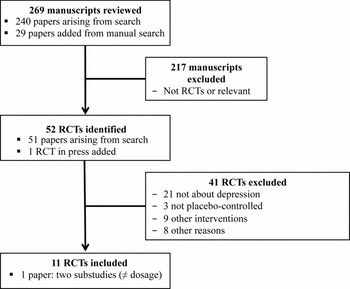
The electronic search yielded 269 manuscripts (supplementary list of references). Of those, 11 fulfilled the inclusion criteria for this review (Coppen et al., Reference Coppen, Chaudhry and Swade1986; Godfrey et al., Reference Godfrey1990; Coppen and Bailey, Reference Coppen and Bailey2000; Hvas et al., Reference Hvas, Juul, Lauritzen, Nexo and Ellegaard2004; Ford et al., Reference Ford, Flicker, Thomas, Norman, Jamrozik and Almeida2008; Resler et al., Reference Resler2008; Almeida et al., Reference Almeida, Marsh, Alfonso, Flicker, Davis and Hankey2010; Papakostas et al., Reference Papakostas2012; Walker et al., Reference Walker2012; Loria-Kohen et al., Reference Loria-Kohen, Gomez-Candela, Palma-Milla, Amador-Sastre, Hernanz and Bermejo2013; Almeida et al., Reference Almeida2014), including one study that reported the effect of two separate dosages of methylfolate (Papakostas et al., Reference Papakostas2012). For this particular trial, we only used data reported for the initial 30 days of treatment in order to make the design of the study (parallel design) comparable to that of other trials. Figure 1 illustrates the flow of manuscripts reviewed from the search to inclusion in this meta-analysis.
Flow of studies from search to selection for inclusion in the meta-analysis.

Characteristics of studies included in the meta-analysis and risk of bias within studies
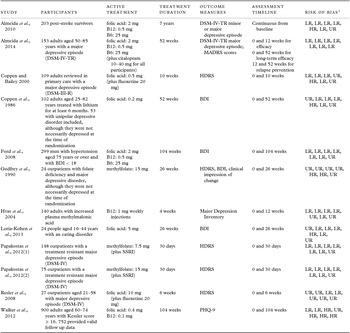
Table 1 presents a descriptive summary of the trials included in this review. Six of these trials reported changes in the severity of depressive symptoms over a period ranging from 4 to 104 weeks amongst adults without a depressive episode at the time of randomization (Coppen et al., Reference Coppen, Chaudhry and Swade1986; Godfrey et al., Reference Godfrey1990; Hvas et al., Reference Hvas, Juul, Lauritzen, Nexo and Ellegaard2004; Ford et al., Reference Ford, Flicker, Thomas, Norman, Jamrozik and Almeida2008; Walker et al., Reference Walker2012; Loria-Kohen et al., Reference Loria-Kohen, Gomez-Candela, Palma-Milla, Amador-Sastre, Hernanz and Bermejo2013). Another four placebo-controlled trials reported changes in the severity of depressive symptoms over a period of 4–12 weeks in people with a depressive episode treated with B-vitamins and an antidepressant (Coppen and Bailey, Reference Coppen and Bailey2000; Resler et al., Reference Resler2008; Papakostas et al., Reference Papakostas2012; Almeida et al., Reference Almeida2014), with three of them reporting additional data on clinical significant improvement (Coppen and Bailey, Reference Coppen and Bailey2000; Papakostas et al., Reference Papakostas2012; Almeida et al., Reference Almeida2014). One placebo-controlled trial reported the effect of folic acid, vitamin B12, and vitamin B6 on relapse prevention of a depressive disorder over 12 months (Almeida et al., Reference Almeida2014), and two on the benefit of these vitamins in reducing the onset of clinically significant symptoms of depression in people at risk (i.e. selective prevention) (Ford et al., Reference Ford, Flicker, Thomas, Norman, Jamrozik and Almeida2008; Almeida et al., Reference Almeida, Marsh, Alfonso, Flicker, Davis and Hankey2010). All studies selected for inclusion in these meta-analyses used valid measures of depression, although the perceived risk of bias varied. In addition to the risk of bias associated with the randomization, allocation concealment, blinding of participants and of assessment, completeness of outcome, and selective reporting, we created an “other” group that allowed us to identify and rate other potential problems in the design or conduction of studies. The study by Walker and colleagues (Walker et al., Reference Walker2012) was confounded by additional interventions (i.e. physical activity, diet, and mental health literacy) that could have potentially affected the final results of trial, although the effect of confounding should have been balanced by the stratified randomization procedures. For this reason, we retained this study in the analysis. In addition, we performed a series of sensitivity analyses that excluded individual studies from the calculation of the aggregate results, thereby providing an additional assessment of bias that could have been introduced by each study (because of disparate interventions, source of participants, study measures, etc.).
Characteristics of randomized placebo-controlled trials of B-vitamins included in the meta-analysis

*Risk of bias assessed for the following domains, in order: randomization, allocation concealment, blinding of participants, blinding of assessment, completeness of outcome data, selective reporting, other. LR: low risk, HR: high risk, UR: uncertain risk.
MADRS: Montgomery–Asberg depression rating scale; HDRS: Hamilton depression rating scale; BDI: Beck depression inventory; HADS-D: hospital anxiety and depression scale, depression subscale; PHQ-9: patient health questionnaire.
Results of studies and data synthesis
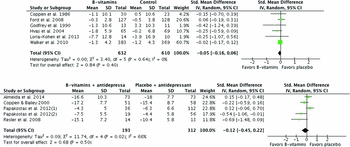
Figure 2(a) summarizes the data and the findings of individual studies designed to assess the effect of folate and vitamin B12 on depressive symptoms of adults without a depressive episode. The findings from the six studies included in the meta-analysis did not suggested benefit for the use of vitamins compared with placebo (standardized mean difference, SMD = −0.05; 95% confidence interval, 95% CI = −0.16, 0.06; z = 0.84, p = 0.40).
Summary data and synthesis of randomized placebo-controlled trials of B-vitamins for the treatment of depressive symptoms in people without (panel A) and with (panel B) a major depressive episode at the time of randomization. The squares indicate the standardized mean difference between the treatment groups for each study and the whiskers the 95% confidence limits of the standardized mean difference. The sizes of the squares are proportional to the relative contribution of the study to the calculation of the summary statistic. The diamond represents the summary effect of all studies (vertical axis), with the lateral tips indicating its 95% confidence limits.

Figure 2(b) shows the results of trials investigating the four to twelve-week efficacy of folate and/or vitamin B12 (with or without vitamin B6) as an adjunctive treatment for depression in people with a major depressive episode (i.e. vitamins/placebo offered in addition to antidepressant treatment). Two of the five trials reported a statistically significant beneficial effect of treatment with vitamins compared with placebo (Resler et al., Reference Resler2008; Papakostas et al., Reference Papakostas2012), although in the case of the study by Papakostas and colleagues only the higher 15 mg dosage of methylfolate improved symptoms and, in the trial by Resler and colleagues, the benefit of vitamin treatment was small and only borderline significant. Data synthesis was not supportive of the efficacy of adjunctive antidepressant treatment with vitamins (SMD = −0.12, 95% CI = −0.45, 0.22; z = 0.68, p = 0.50). There was evidence of heterogeneity across studies (I2 = 66%; p = 0.02).
Figure 3 summarizes efficacy data of three randomized placebo-controlled trials of folate and/or vitamin B12 (Coppen and Bailey, Reference Coppen and Bailey2000; Papakostas et al., Reference Papakostas2012; Almeida et al., Reference Almeida2014), one of which included two substudies (Papakostas et al., Reference Papakostas2012). The outcome of interest in these studies was the 50% reduction in the severity of depressive symptoms. One study found that folic acid improved the response to treatment with fluoxetine (Coppen and Bailey, Reference Coppen and Bailey2000), but the other three studies were negative. Summary statistics showed that treatment with B-vitamins did not increase the odds of response to antidepressant treatment (OR = 1.18, 95% CI = 0.49, 2.83; z = 0.36, p = 0.72).
Odds of significant clinical improvement after 4 to 12 weeks of treatment with antidepressants and B-vitamins or antidepressant and placebo. The squares indicate the OR and the whiskers the 95% confidence limits of the OR. The sizes of the squares are proportional to the relative contribution of the study to the calculation of the summary statistic. The diamond represents the summary effect of all studies (vertical axis), with the lateral tips indicating its 95% confidence limits (displayed on a log scale).

Only one study investigated the efficacy of B-vitamins (folic acid, vitamin B12, and vitamin B6) in reducing the risk of relapse after remission of symptoms among patients with a major depressive episode (Almeida et al., Reference Almeida2014), so that a meta-analysis was not possible.
Finally, two randomized placebo-controlled trials of B-vitamins reported data on the prevention of clinically significant symptoms of depression among adults at increased risk. The first recruited 299 men aged 75 years or older with hypertension into a 2-year trial of folic acid, vitamin B12, and vitamin B6 (Ford et al., Reference Ford, Flicker, Thomas, Norman, Jamrozik and Almeida2008). Of the 102 men randomly assigned treatment with vitamins, 4 scored 10 or more on the Beck depression inventory (i.e. clinically significant depressive symptoms) at the end of the study compared with 11 of the 123 participants treated with placebo. The second trial randomized post-stroke survivors to treatment with folic acid, vitamin B12, and vitamin B6 (n = 136) or placebo (n = 137) (Almeida et al., Reference Almeida, Marsh, Alfonso, Flicker, Davis and Hankey2010). Over a mean follow up period of 7 years of treatment, 26 and 38 of these participants had developed a major or minor depressive episode. The summary effect favored treatment with B-vitamins compared with placebo (risk ratio, RR = 0.65, 95% CI = 0.43, 0.98; z = 2.08, p = 0.04 – see figure 4).
Risk ratio of onset of clinically significant symptoms of depression in people at risk treated with folic acid, vitamin B12 and vitamin B6 compared with placebo. The squares indicate the risk ratio and the whiskers the 95% confidence limits of the risk ratio. The sizes of the squares are proportional to the relative contribution of the study to the calculation of the summary statistic. The diamond represents the summary effect of all studies (vertical axis), with the lateral tips indicating its 95% confidence limits (displayed on a log scale).

Risk of bias across studies
Heterogeneity across studies was measured with the I2 statistic. For trials assessing changes in the severity of depressive symptoms in people without depression I2 was 0%, for patients with depression I2 was 66%, respectively. I2 was 73% for trials assessing clinically significant improvement associated with folic acid and/or vitamin B12 treatment compared with placebo. The two trials of selective prevention of depression yielded an I2 of 0%.
This review also inspected the funnel plots for all meta-analyses reported – there was evidence of bias seemingly favoring the publication of trials reporting an antidepressant effect of folate and/or vitamin B12 compared with placebo for studies reporting change in the severity of depressive symptoms among people without a depressive disorder (Figure S1, available as supplementary material attached to the electronic version of this paper at www.journals.cambridge.org/jid_IPG). There was no clear evidence of publication bias for studies investigating clinically significant response to treatment with folate and/or vitamin B12 compared with placebo. Only two studies reported data on the prevention of depression with vitamins compared with placebo in adults at risk.
Additional analyses
We completed a series of sensitivity analyses to determine the contribution of each study to the overall results of the meta-analyses (Figure S2, available as supplementary material attached to the electronic version of this paper at www.journals.cambridge.org/jid_IPG). The study by Coppen and colleagues (Coppen et al., Reference Coppen, Chaudhry and Swade1986) seemed to bias the results in favor of treatment with vitamins, and increased variance of the final summary estimate for the reduction of depressive symptoms in people free of a major depressive episode. Conversely, Walker and colleagues (Walker et al., Reference Walker2010) reported results that were more negative than those of other included trials. Among the placebo-controlled trials of vitamins as adjunctive to improve response to antidepressant treatment, the study by Resler and colleagues (Resler et al., Reference Resler2008) seemed to favor the antidepressant effects of vitamins more markedly than other studies, in addition to contributing to increasing the variance of the final meta-analytical estimate. In contrast, the substudy by Papakostas and colleagues (Papakostas et al., Reference Papakostas2012) using 7.5 mg of methylfolate for 30 days and that by Almeida and colleagues (Almeida et al., Reference Almeida2014) using vitamins B6, B12, and folic acid for 12 weeks were more negative than average. Similar effects became apparent when investigating clinically significant improvement of depressive symptoms (Figure S2, available as supplementary material attached to the electronic version of this paper at www.journals.cambridge.org/jid_IPG). Finally, limiting the analysis to the two studies of people who showed evidence of vitamin B deficiency (Godfrey et al., Reference Godfrey1990; Hvas et al., Reference Hvas, Juul, Lauritzen, Nexo and Ellegaard2004) yielded a standardized mean difference of depression scores of −1.8 (95% CI = −3.9, 0.3) for people without clinically significant depressive symptoms.
Discussion
This systematic review and meta-analyses found that treatment with folate and/or vitamin B12 (with or without vitamin B6) does not decrease the severity of depressive symptoms over a period of several weeks in people with or without a depressive disorder. One trial found that the prolonged use of folic acid, vitamin B12, and vitamin B6 increased response to antidepressant treatment over one year, and decreased the risk of relapse of symptoms amongst those who had recovered after three months (Almeida et al., Reference Almeida2014). The results of two randomized placebo-controlled trials of selective prevention of depression favored the use of vitamins compared with placebo (Ford et al., Reference Ford, Flicker, Thomas, Norman, Jamrozik and Almeida2008; Almeida et al., Reference Almeida, Marsh, Alfonso, Flicker, Davis and Hankey2010). Taken together, the results of these meta-analyses suggest that the short-term use of vitamins (days to a few weeks) does not contribute to improve depressive symptoms, but more prolonged consumption (several weeks to years) may reduce the severity and the onset of clinically significant symptoms of depression in special populations.
Limitations
In order to minimize heterogeneity between studies, crude rather than statistically adjusted data were use (for the few studies where such data were available) and the analyses were limited to only two time-points for each study. Heterogeneity across studies could also have been driven by differences in the combination of the vitamins used (e.g. folate with or without vitamin B12), their dosages, and duration of treatment. We attempted to minimize these effects by excluding trials where vitamins other than B-vitamins had been used, and by grouping the analyses according to treatment duration. Nonetheless, heterogeneity across studies investigating the efficacy of B-vitamins as adjunctive to antidepressant treatment was still apparent (I2 = 66%).
In addition, the conservative technique used to calculate the SD of the mean difference would have minimized differences between the treatment arms. Hence, the summary estimates of the pooled analyses investigating standardized mean differences between the groups might have been susceptible to error, although such error most likely favored the rejection of differences between the treatment groups (type II error). Consequently, a small beneficial effect of treatment with vitamins cannot be dismissed.
The number of available randomized placebo-controlled trials of folate and/or vitamin B12 for the treatment and prevention of depression was small. Moreover, the analyses investigating the efficacy of vitamins in reducing the severity of depressive symptoms in people with depression revealed substantial heterogeneity between the studies, with the final results being unduly influenced by a small number of positive trials.
One relatively small trial reported that ongoing treatment with vitamins increases the 12-month response to antidepressant treatment and decreases relapse of symptoms amongst those who recover by the end of 3 months (Almeida et al., Reference Almeida2014). That study had the merit of having an unbiased design and of having used an intention-to-treat approach to the analyses. However, replication of those findings is required before the use of folic acid, vitamin B12, and vitamin B6 can be recommended as a long-term adjunctive treatment for major depression. Furthermore, due to the limited number of trials available for inclusion in this meta-analysis, we were unable to use meta-regression to investigate more systematically the effect of treatment duration on clinical outcomes. Hence, conclusions about the need for prolonged therapy remain tentative.
The two trials of selective prevention of depression reported secondary analyses of trials designed to address different primary endpoints: their results suggest that the use of folic acid, vitamin B12, and vitamin B6 reduces the risk of depression in people at risk. The VITATOPS-DEP analyzed data from a subsample of post-stroke adults recruited into a placebo-controlled trial of homocysteine lowering treatment with folic acid, vitamin B12, and vitamin B6 for the secondary prevention of cardiovascular events (VITATOPS, 2010). VITATOPS-DEP only had access to long-term survivors at one of several study sites, and the investigation of depressive episodes was retrospective (albeit structured) (Almeida et al., Reference Almeida, Marsh, Alfonso, Flicker, Davis and Hankey2010). Data from the trial by Ford and colleagues (Ford et al., Reference Ford, Flicker, Thomas, Norman, Jamrozik and Almeida2008) originated from an intervention designed to investigate whether homocysteine lowering with vitamins decreased the rate of cognitive decline in men free of clinically significant depressive symptoms at study entry (Ford et al., Reference Ford, Flicker, Thomas, Norman, Jamrozik and Almeida2008). Unlike VITATOPS-DEP, this trial made use of the entire cohort and its results indicated a small, but not statistically significant, decrease in the onset of clinically significant symptoms of depression over two years (Ford et al., Reference Ford, Flicker, Thomas, Norman, Jamrozik and Almeida2008). However, given the characteristics of the sample (men aged 75 years or over with hypertension), the external validity of the findings is far from certain.
Finally, we refrained from using imputation methods to estimate missing data from trials because we did not have access to individual study data and had concerns about making wrong assumptions about results and erroneously inflating the precision of the effect estimates. The potential consequence, in this case, would have been to declare as statistically significant effects associated with the interventions that were not real.
Conclusions
Folate and vitamin B12 are co-factors in metabolic pathways that are critical for cell function and survival, as well as for the synthesis of neurotransmitters, such as noradrenaline and serotonin (Bottiglieri, Reference Bottiglieri2005). Hence, using folate and vitamin B12 to mitigate symptoms of depression seems biologically plausible and is rationally supported by the findings of observational studies (Almeida et al., Reference Almeida, McCaul, Hankey, Norman, Jamrozik and Flicker2008). The results of the present meta-analyses do not conclusively demonstrate that these vitamins reduce depressive symptoms and syndromes, but neither do they suggest that these vitamins have no role in the management and prevention of depression. The limited number of studies available and their relatively undersized samples may have hindered the ability of this meta-analysis to detect small beneficial effects of treatment, if they do exist. In addition, three of the studies that reported some benefit associated with the use of vitamins included vitamin B6, which plays a role in facilitating the excretion of homocysteine (Bottiglieri, Reference Bottiglieri2005). This would suggest that lowering plasma homocysteine, either by facilitating its conversion to methionine (vitamin B12 and folic acid) or by increasing its excretion (vitamin B6), may be critical to decreasing depressive symptoms.
Data from the VITATOPS trial showed that the health gains associated with the use of B-vitamins may require long-term supplementation (Almeida et al., Reference Almeida, Marsh, Alfonso, Flicker, Davis and Hankey2010; VITATOPS, 2010), and findings from a large genetic epidemiological investigation suggest that benefits may be more evident in countries where enrichment of flour with folate is not mandated (Holmes et al., Reference Holmes2011). Taken together, these observations imply that people with suboptimal intake of folate and vitamin B12 may be the ones who benefit the most from treatment. The results of the B-VITAGE trial seem consistent with such interpretation: the use of vitamins did not improve antidepressant efficacy over 12 weeks, but improved response to treatment over 52 weeks, particularly those with high total plasma homocysteine (Almeida et al., Reference Almeida2014), which is a marker of the relative deficiency of folate and vitamin B12 (Bottiglieri, Reference Bottiglieri2005).
Future randomized placebo-controlled trials designed to investigate whether folate and vitamin B12 can improve response to antidepressant treatment should preferentially target adults with high total plasma homocysteine. These people are also the ones most likely to benefit from treatment to prevent the onset of clinically significant depressive symptoms, particularly if they have concurrent subsyndromal symptoms (indicated prevention) or a condition commonly associated with depression (selective prevention) (Almeida, Reference Almeida2014). These trials may require several months or years of ongoing treatment to demonstrate, or dismiss, the antidepressant properties of these vitamins.
Funding sources and conflict of interest
OPA and AHF are partly supported by an unrestricted grant from the Mental Health Commission of Western Australia, State Government of Western Australia, program grant C04793. The authors declare that there are no conflicts of interest relevant to this work.
Financial disclosures
The authors declare that there are no additional disclosures to report.
Author's roles
OA conceived the study and drafted the manuscript. OA and AF undertook the literature search, review of manuscripts, and data extraction. OA completed the analyses. AF and LF reviewed the analyses and the draft manuscript for accuracy and for important intellectual content. All authors consented to the submission of the manuscript to International Psychogeriatrics.
Supplementary Material
To view supplementary material for this article, please visit http://dx.doi.org/10.1017/S1041610215000046.