Introduction
Throughout the world the focus of agricultural policy is shifting from traditional subsidy and trade policies to conservation and environmental aspects of agriculture. This shift in policy focus has been encouraged by the incorporation of agriculture into the General Agreement on Tariffs and Trade in the mid-1990s and the recent Doha Round of multilateral trade negotiations. This shift in agricultural policy is also being driven by a growing public demand for the ecosystem services associated with agricultural land such as watershed protection and greenhouse gas mitigation. In developing countries, an additional possible co-benefit of providing farmers with payments for ecosystem services would be to contribute to broader economic development objectives such as poverty alleviation, food security, and sustainability. As yet there is insufficient experience with ecosystem service payments to know what their effects are likely to be on these development objectives.
The objective of this paper is to explore the potential impacts of payments for agricultural soil carbon sequestration on poverty of farm households and on the sustainability of agricultural systems, using economic theory combined with evidence from three case studies in Kenya, Peru, and Senegal. We focus specifically on agricultural soil carbon sequestration for several reasons. First, soil degradation – in many cases the result of or resulting in declining soil carbon contents – is widely regarded as a major factor contributing to the persistent problems of poverty and food insecurity, particularly in the most agriculturally marginal areas of the developing world (Lynam et al., Reference Lynam, Nandwa and Smaling1998). Second, soil carbon sequestration has been proposed as a way to meet the joint goals of mitigating greenhouse gas emissions while enhancing the productivity and sustainability of agricultural lands, both in the industrialized and developing countries (Lal et al., Reference Lal, Kimble, Follett and Cole1998; Soil Management CRSP, 2002). Moreover, due to the likely positive correlation between soil degradation and rural poverty, soil carbon sequestration might be a way to target farmers in the poorest, most environmentally vulnerable areas. Third, as yet soil carbon sequestration has not been widely implemented in the context of international agreements such as the Kyoto Protocol, or in national policies, so there is little information available from actual projects about the likely impacts.
After a brief introduction of the study sites, the first section discusses the economic analysis of soil carbon sequestration contracts, and concludes with a set of testable hypotheses about the impacts of carbon contracts on poverty and sustainability. The next section describes the simulation methods used in the three case studies, and then provides a description of the three studies in Kenya, Peru, and Senegal. The following section uses results from case studies to address the hypotheses identified in the first section. The paper concludes with a discussion of policy implications.
The case studies
Machakos, Kenya
The Machakos study area includes Machakos, Makueni, and Mwingi districts, is located southeast of Nairobi, and ranges in altitude between 400 to 2,100 meters above sea level. The area is approximately 20,000 km2 in size and is located between 0°70′ and 3°00′ southern latitude and between 36°87′ and 38°51′ eastern longitude. The semi-arid climate in the study area has low, highly variable rainfall, distributed in two rainy seasons. The annual rainfall average ranges from 500 to 1,300 mm and mean annual temperature vary from 15 °C to 25 °C. Soils in the region are rather shallow, generally deficient in nitrogen and phosphorus and low in organic matter. Moreover, low infiltration rates and susceptibility to sealing makes them prone to erosion, especially since most of the rains occur at the beginning of the growing season when the land is still bare. The region suffered extensive soil degradation in the early to mid twentieth century, at which time government programs caused large areas to be terraced. The success of these programs has been documented by Tiffen et al. (Reference Tiffen, Mortimore and Gichuki1994). Though the region is highly dependant on agriculture, its population obtains significant income from non-farming activities inside and outside the district's boundary. The farms can be characterized as subsistence-oriented mixed farming systems that include both crop and livestock production. Maize is the most important staple crop that is sold for cash, and a wide variety of subsistence crops are grown, such as vegetables, fruits, and tubers.
Farm survey data were obtained from studies conducted in the 1997–2001 period. The data covered 120 households in six villages with detailed input and output data for nearly 2,700 fields. Further description of the data can be found in de Jager et al. (Reference de Jager, Onduru, van Wijk, Vlaming and Gachini2001) and Gachimbi et al. (Reference Gachimbi, Keulen, Thuranira, Karuku, Jager, Nguluu, Ikombo, Kinama, Itabari and Nandwa2005). Two of the villages in the study produce vegetables with irrigation and market them to urban areas. Maize yields are generally low and crop failure is widespread. Livestock was traditionally managed by letting it graze freely, but intensive zero-grazing units are proliferating in the region in recent years and their importance for nutrient recycling is considerable. Details of the economic models are provided in Antle et al. (Reference Antle, Stoorvogel and Valdivia2005a). The carbon contracts modelled require farmers to utilize minimum amounts of organic fertilizer (600 kg/ha/season) and mineral fertilizer (60 kg/ha/year).
Cajamarca, Peru
The study focuses on the La Encañada watershed in the Cajamarca region in northern Peru. The 10 km2 watershed ranges between 2,950 to 4,000 meters above sea level and is located between 7°00′ and 7°07′ southern latitude and between 78°15′ and 78°22′ western longitude. Average annual rainfall is low ranging between 430 mm/year in the valleys up to 550 mm/year in the higher parts of the watershed (Romero and Stroosnijder, Reference Romero and Stroosnijder2001). Soils are shallow and calcaric clay matured on limestone parent material and more profound, low in calcium, clay soils matured on claystone parent material. This region is characterized by three agroecozones: the valley floors, the lower hillsides, and the upper hillsides. Milk production dominates in the valley floors where access to irrigation allows for cultivation of permanent pastures. In the lower hillsides where little irrigation is available, field crops dominate the production system, including Andean tubers, legumes, cereals, and pasture. Cultivation in this zone occurs in two seasons, December to May and June to September/November. In the upper hills where risk of frost is high, natural pastures dominate the landscape.
The data used in this analysis were collected through farm surveys conducted in 1997–1999 for a random stratified sample of 40 farm households in five communities in the watershed (see Valdivia, Reference Valdivia1999, Reference Valdivia2002; and Valdivia and Antle, Reference Valdivia and Antle2002 for further details). The data show that crop yields are low and parcel size is small, as is typical of this type of semi-subsistence agriculture. Size distributions of the parcels and farms are highly skewed, with a large number of very small parcels and farms and a small number of much larger parcels and farms. The analysis reported here is based on the lower-hillside region where cropland is the principal land use. Valdivia (Reference Valdivia2002) and Antle et al. (Reference Antle, Valdivia, Crissman, Stoorvogel and Yanggen2005b) provide details on the economic models used in the simulations. Antle et al. (Reference Antle, Meijerink, Jager, Stoorvogel and Vallejo2007) provide details of the carbon sequestration analysis, which is based on the adoption of terraces and terraces with agroforestry (trees planted on the tops of terrace walls).
Southern Peanut Basin, Senegal
The Nioro region of Senegal is in the southern part of Senegal's ‘peanut basin’ occupying the central part of the country. Nioro contains about 103,000 hectares of cropped area, or about 5 per cent of Senegal's agricultural area, and lies in the sudano-sahelian zone of the peanut basin, situated between 13°35′ and 13°50′ northern latitude and 16°00′ and 16°30′ western longitude with an average elevation of 40 meters above sea level. The rainy season lasts from June to October, and the total annual rainfall is about 750 mm. Annual temperatures average 27,5 °C and the mean maximum and minimum temperatures are respectively 38 °C and 15 °C. Most soils in the Nioro area have been formed in materials that originate from ironstone or the underlying sandstones. On the ironstone plateaus, soils are stony and shallow. On the glacis, terraces and bas-fonds, soils are deep. In general, the clay content increases with soil depth. Millet and peanuts, grown in annual rotation, are the two main crops. These two crops represent almost 90 per cent of Senegal's cropped area in most years.
The data used in this study are cross sectional and come from farm surveys organized and conducted by the Ecole Nationale d'Economie Appliquée in 2001. More than a hundred households in 13 villages in the Nioro area were surveyed to collect detailed socioeconomic and agricultural production data, including household demographic characteristics, labor availability, annual food grain production and consumption, annual income and expenses, and agricultural inputs and outputs. Diagana et al. (Reference Diagana, Antle, Stoorvogel and Gray2007) provide a detailed description of the economic models used and the specification of the carbon contracts based on incorporation of crop residues and application of mineral fertilizer.
Economic analysis of soil carbon sequestration contracts
In this section we present the conceptual framework that is used as the basis for the simulation studies described in the next section. The economic analysis of agricultural carbon sequestration begins with a characterization of the initial conditions before farmers have the option to participate in carbon contracts. Antle et al. (Reference Antle, Capalbo, Mooney, Elliott and Paustian2003) assume that in the initial conditions without carbon contracts, farmers adopt those land use and management practices that maximize economic returns (adjusted for risk if farmers are risk averse), under the assumption of well-functioning factor and capital markets and well-informed farmers. These assumptions imply that from the farmer's perspective, the initial conditions represent an efficient allocation of resources, absent payments for carbon sequestration. Importantly, this does not mean that farmers are managing soil carbon stocks efficiently from a social perspective if a reduction of greenhouse gas concentrations has a positive social value.
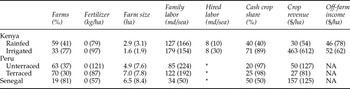
In the context of developing countries, there is much evidence that productivity is constrained by low levels of soil organic matter and consequently soil fertility (Kherallah et al., Reference Kherallah, Delgado, Gabre-Madhin, Minot and Johnson2002; Koning et al., Reference Koning, Heering and Kauffman2001; Sanchez, Reference Sanchez2002; Scherr, Reference Scherr1999). The literature identifies many factors contributing to this situation, including: policies that discriminate against agriculture; high transportation costs, coupled with imperfect factor and capital markets; high population densities and rapidly growing populations; lack of accurate information about the long-term consequences of management decisions, particularly when it involves factors such as soil fertility that are difficult to observe. In the analysis presented here we assume that farmers are rational and make management decisions to maximize economic returns, but we recognize that those decisions may be the result of various factors that lead to a loss of soil productivity over time. Indeed, in the case studies introduced above, field measurements show that productivity is constrained by low levels of soil organic matter. The goal of the analysis is to simulate the effects of introducing soil carbon contracts that require farmers to increase incorporation of organic matter into the soil and to increase the use of mineral fertilizer, and to adopt soil conservation investments such as terraces and agroforestry. However, it is important to note that in the baseline conditions that are observed without carbon contracts, some farmers already apply relatively high rates of organic and mineral fertilizers, or have constructed terraces, but in most cases adoption rates are low. Table 1 shows that in the three case studies 20–76 per cent of farms did not use any mineral fertilizer on their cash crops. The data also show that on subsistence crops most farmers used lower rates of organic fertilizer and almost no mineral fertilizer. The data from the Peru case study show that about 18 per cent of the fields in the region are terraced, while the average field slope in the region is over 20 per cent.
Fertilizer use and farm characteristics in three case studies

Notes: First number is value for farms not using mineral fertilizer; second number in parentheses is for farms using mineral fertilizer.
Fertilizer = average total kg active ingredient (N, P, K) applied on cash crop fields.
Off-farm income = off-farm income divided by farm size, converted to USD.
Cash Crop Share = share of cash crop revenue in total revenue.
* = hired labor included in family labor. NA = not available.
Contract design
In the case studies, the simulated carbon contracts provide payments to farmers and require them to adopt certain land use or management practices. In the cases of Senegal and Kenya, the contracts are based on incorporation of crop residues and application of organic and mineral fertilizers at specified rates; the Peru study considers adoption of terracing and agroforestry practices. When fertilizer use is required, a key assumption we make is that farmers participating in carbon contracts have access to fertilizer at the market price when they are planting their crops, and have the cash available to purchase the fertilizer when it is needed. Thus, if farmers' access to fertilizer is being constrained by imperfections in fertilizer markets, we assume that the organization (either governmental or non-governmental) acting as an intermediary to facilitate carbon contracts takes whatever actions are needed to make the quantities of fertilizer required under the contract available to farmers. In the Peru study, we consider the case wherein farmers must pay the full price of the soil conservation investments.
The economic simulations for the three case studies show that farmers using low levels of fertilizer inputs would generally benefit economically from using at least as much as required in the carbon contracts. This finding supports the general view that factors such as credit and fertilizer availability at planting time constrain profitable use of fertilizer. One way that fertilizer use could be financed is by providing the carbon payments in the form of fertilizer (Antle and Diagana, Reference Antle and Diagana2003). However, calculations show that carbon payments at the beginning of the season would not be sufficient to provide all of the fertilizer needed for the contracts. For example, the simulations presented below for Kenya assume farmers utilize at least 60 kg N/ha per season and at least 600 kg of organic fertilizer/ha per season. Under these assumptions, simulations show that farmers who do not use any mineral fertilizer and low rates of organic amendments would obtain an increase of about 0.6 MgC/ha/yr, or about 0.3 MgC/ha per season (throughout we use MgC to denote mega-gram or metric ton of carbon). If the price of carbon were $50/MgC, then the payment would provide a payment of $15/ha per season. With a fertilizer price of about $0.40/kg, this would provide the farmer with about 38 kg of fertilizer if the payments were made in kind, thus falling short of the 60 kg required under the contract. In addition, most farmers would also need to increase their use of organic fertilizer.
In the case study of terracing in Peru, the issue of financing adoption of the conservation practices may be even more critical. The cost of constructing terraces on 1 hectare is estimated to be about $300/ha and the cost of maintaining them is about $65/ha/yr (Valdivia, Reference Valdivia2002). With an average carbon rate of less than 1 MgC/ha/yr, at a carbon price of $50/MgC, farmers would receive less than $50/ha/yr; thus the carbon payments would cover part of the maintenance costs, but not the initial investment. Thus, we have to consider the following analysis in light of these possible constraints on adoption.
The carbon payments each season could be based either on the number of hectares on which these practices are adopted (a per hectare payment), or on the expected amount of carbon sequestered. In the latter case, the contract is based on a per-tonne payment mechanism. As Antle et al. (Reference Antle, Capalbo, Mooney, Elliott and Paustian2003) show, the per-tonne payment mechanism is economically more efficient because it pays farmers per unit of environmental service provided rather than per hectare of land under contract regardless of the amount of carbon sequestered. Accordingly, the case studies presented below simulate per-tonne contracts based on carbon rates estimated by agro-ecozone. In other words, the carbon contract specifies a payment based on the price of carbon and the carbon rate estimated for the zone in which each field is located. We assume that many individual farm fields are aggregated to make up a standard marketable contract (e.g., 1,000 metric tones of carbon). Carbon rates are verified for each contract using periodic randomly sampled soil measurements. Analysis by Mooney et al. (Reference Mooney, Antle, Capalbo and Paustian2004) indicates that these measurement and monitoring costs are likely to be small relative to the value of the carbon sequestered. In the case of contract default, several possible mechanisms could be used. One option would be for the entity aggregating contracts to discount carbon rates for risk of default (in effect, maintaining an insurance pool of sequestered carbon to offset defaults). Another option would be to require repayment by defaulting farmers, although that may not be feasible for small, poor farms.
Transaction costs
Setting up and verifying carbon contracts and insuring against default will involve transaction costs that also must be estimated and factored into the analysis. Few data are available to estimate transaction costs for agricultural soil carbon sequestration (see Mooney et al., Reference Mooney, Antle, Capalbo and Paustian2004; International Energy Agency, 2005; Paustian et al., Reference Paustian, Antle, Sheehan and Paul2006). Some analysts argue that these transaction costs could be high for organizing small-scale farmers to adopt practices on enough hectares to constitute marketable quantities of carbon, but as yet no actual pilot projects have been implemented in which such costs could be quantified. In the case studies presented here, because reliable data on transaction costs are not available, transaction costs are included in a sensitivity analysis.
Important informational issues arise in defining and verifying compliance with carbon contracts and other contracts for payments for environmental services. Soil carbon accumulation is a function of past land use and management practices. Whereas it is relatively low-cost to verify adoption of soil conservation investments such as terracing and agroforestry, basing carbon payments on use of variable inputs such as organic and mineral fertilizer raises the problem of knowing past practices as well as monitoring compliance with the contract. Essentially, there is an asymmetric information problem because farmers know their past and current practices, but the entity responsible for verifying compliance with contract does not. Efficient solutions to the asymmetric information problem depend on designing incentive mechanisms that lower the cost of verifying compliance. For example, successful micro-credit programs have utilized self-enforcement mechanisms. However, if these information problems cannot be addressed at low cost then there will be incentives for many farmers to default on carbon contracts, similar to the problems encountered in credit markets (e.g., see Blackman, Reference Blackman2001).
Risk and adoption of carbon-sequestering practices
Much research has addressed the impact of risk and risk aversion on farmers' adoption of technology, particularly in developing countries (Sunding and Zilberman, Reference Sunding, Zilberman, Gardner and Rausser2001). In the case studies, risk is not formally incorporated, and it is important to note that risk could impact farmers' willingness to participate in carbon contracts both positively and negatively. On the negative side, the use of inputs such as mineral fertilizer is often said to increase production risk. However, increased use of organic fertilizers and incorporation of crop residues and other organic matter is typically assumed to stabilize production (e.g., by improving water-holding capacity of the soil). Similarly, the use of terracing and other soil conservation practices is generally believed to improve water availability and thus both stabilize and increase productivity. Thus, the net risk effect of the set of practices being adopted is not clear. In the case studies from Kenya and Senegal, econometric tests did not support the hypothesis that either organic or mineral fertilizer were risk-increasing inputs. Also on the positive side, carbon payments would appear to represent a stable source of income as compared to income from risky crops, although there could be some risk of default on the contract as well as possible policy risk if the payments were being made by an unreliable governmental or non-governmental entity. Finally, because of concerns about permanence of soil carbon, some have argued that carbon contracts would require farmers to adopt and maintain appropriate land use and management practices for long periods of time, say 20 years or longer. Such long-term contracts would impose costs on farmers in the form of forgone option value due to uncertainty about the long-term productivity benefits of the practices, price uncertainty, and political risk. However, it is not correct that carbon contracts would have to require such long-term commitments by farmers. Instead, farmers can be offered relatively short-term contracts with the option to renew, with the price appropriately adjusted to reflect the implied non-permanence of the carbon (e.g., see Lewandrowski et al., Reference Lewandrowski, Peters, Jones, House, Sperow, Eve and Paustian2004). Thus, while the net effect of carbon contracts on farmers' perceptions of production and income risk are not entirely clear, both logic and available evidence do not suggest that farmers would perceive them as substantially increasing the risk they face, and may well decrease risk.
Modeling farmer participation in carbon contracts
Following Antle and Diagana (Reference Antle and Diagana2003) the analysis is formalized by assuming that to increase the stock of soil organic carbon (SOC) on a land unit, a farmer must make a change from production system i (conventional) that had been followed over some previous period (the historical land-use baseline) to some alternative (conservation) system s. We assume that utilization of management practice i up to time 0 results in a SOC level of C(i), and adoption of practice s at time 0 causes the level to increase to an equilibrium C(s) at time T. At time T, the soil reaches a new level at which the level of soil C stabilizes until further changes in management occur. In defining ex ante carbon contracts, we emphasize that the expected change in carbon accumulation is the relevant variable; the actual rate of carbon accumulation will typically only be verified for the land units aggregated into a contract, as discussed by Antle et al. (Reference Antle, Capalbo, Mooney, Elliott and Paustian2003). This expected change in carbon is assumed to be estimated by agro-ecozone and past land-use practices, with all farmers in the contract in that zone receiving credit for the same rate, as explained further below.
With a per-ton carbon contract, the farmer receives a payment of $Pt per ton of C sequestered each time period, so if the farmer changes from practice i to practice s and soil C is expected to increase by Δct(i,s) tons per hectare per period, the farmer receives a payment of PtΔct(i,s) per hectare per period. The net present value (NPV) of changing from system i to system s for T periods is given by

where Dt = (1/(1+r))t and r is the interest rate per time period, NR(pt, wt, zt, s) is expected net returns per hectare for system s in period t, given product price pt, input prices wt, and capital services zt; gt(i,s) = gt if a per-hectare contract, or gt(i,s) = PtΔct(i,s) if a per-ton contract; Mt(i,s) is the variable cost per period for changing from system i to s; and I(i,s) is the fixed cost for changing from system i to system s (both variable and fixed costs of adoption may include transaction costs). If the farmer does not participate in the contract and continues producing with system i, then gt(i,s) = Mt(i,s) = I(i,s) = 0 and the farmer earns NPV(i). The farmer enters the contract if and only if NPV(i,s) > NPV(i), and does not enter the contract otherwise.
To simplify this discussion, it is useful to consider the special case where NR(p, w, z, s), P, Δc(i,s), and M(i,s) are constant over time. If we also let the fixed investment be converted into an equivalent annuity of fc(i,s) dollars per period, then the expression NPV(i,s) > NPV(i) can be simplified to

Note that under these assumptions, if it is profitable to enter the contract in one period, it is profitable in all periods regardless of the discount rate. More generally, the discount rate will play an important role, as in the analysis of terracing in Peru. This expression has several implications for analysis of adoption of soil carbon sequestration practices.
In the initial equilibrium in which there are no payments available for carbon sequestration, g = 0, and the farmer adopts the conservation practice s only if it provides higher net returns than the conventional practice i. When a carbon contract is offered for adoption of practices that sequester carbon, g > 0 and we can rewrite equation (2) as

The expression on the right-hand side is the opportunity cost for switching to system s from system i. The farmer will switch practices when the opportunity cost is less than the payment per period. In the case of a per-ton contract, g(i,s) = PΔc(i,s) and the condition for participation in the contract can be expressed as

showing that the farmer will be willing to enter a carbon contract when the price per tonne of carbon is greater than the opportunity cost per tonne.
A critical feature of equation (4) is the spatial variation in the opportunity cost. Net returns to the conventional and alternative practices are site-specific. Some components of the variable and fixed costs of changing practices may be site-specific (e.g., the cost of constructing a terrace), whereas transaction costs may be spatially invariant. The denominator of (4), the expected rate of carbon accumulation, is specific to the agro-ecozone where the land unit is located, as noted above. Thus, the participation by farmers in carbon contracts depends on the spatial distribution of the opportunity cost of changing practices. Those land units with opportunity cost less than P will participate in the contract, and those land units with a higher opportunity cost will not participate. Summing the quantities of carbon across participating land units at each price gives the carbon supply curve for the region.
In the discussion thus far, we have assumed that the practices i and s involve a binary choice, such as the use of terracing on a field. In the case of incorporation of organic matter and use of fertilizer, however, while it is true that many farmers use no fertilizer, many farmers may use positive amounts but less than the quantities required by the carbon contract. In that case, the carbon rate used to calculate the payment is adjusted to reflect the fact that a smaller amount of carbon will be added to the soil before the new equilibrium stock of carbon is attained. The simulation studies discussed below assume that for a required input rate xc specified in the contract, farmers who have been using a baseline rate xb less than xc receive credit for a carbon rate in proportion to the difference between the base rate and the contract rate, and receive zero credit otherwise

The baseline rate of input use is defined as the average rate used by the farmer on a field, over a specified period of time, before the field was entered into a carbon contract.
Carbon sequestration, poverty, and food insecurity
Once the analysis of farmer participation in carbon contracts is carried out we can investigate the question of whether farmers are better off, in terms of income and food security, by participating in a carbon contract. When there is a net benefit, there is the question of how those benefits are distributed.
Carbon contracts that provide cash payments or payments in kind contribute to household income. However, the impact on farm production and income is less clear. We assume that rational farmers who participate do perceive a net economic gain, but for farmers facing a positive opportunity cost to adoption of the carbon-sequestering practice, the net impact on income is less than the payment for all except the marginal land unit. The impact on food security will depend on the production impacts of the alternative practice. In most cases, practices that increase soil carbon are expected to improve both average productivity and stabilize production, thus enhancing food security of semi-subsistence households that depend on their own production for food security.
The distributional effects of payments for environmental services depend on a number of factors as well. From the regional or national perspective, it is a well-established fact that rural households in developing countries typically have lower incomes and are less food-secure than urban households. Data from recent poverty-mapping research (Government of Kenya, 2003) show this fact clearly for Kenya, where rural poverty rates exceed 50 per cent in most areas and 90 per cent in some areas. Data from Peru show similar patterns, with poverty among rural house holds occuring at much higher rates than among urban households (Interinstitutional Commission, 2005; Zeller et al., Reference Zeller, Johannsen and 2005), and the survey data utilized in the case study show that poverty rates in rural Senegal are also extremely high. Therefore, environmental service payment schemes should contribute to poverty reduction and food insecurity in rural areas. However, because the payments for environmental services primarily benefit the owners of land, the impact will also depend on the pattern of land ownership and the prevalence of landless poor in rural areas. On the one hand, payments for afforestation or improved forestry management may largely go to land owners with relatively high incomes when land ownership is highly skewed. On the other hand, in areas where the principal land use is small-scale agriculture, and payments are based on adoption of agricultural practices, payments for environmental services will go primarily to rural households, and most of these households will have low incomes.
There is also the question of how payments for environmental services will be distributed within rural farm household populations. Equation (5) shows that the rate of carbon sequestration credited to a farmer in a carbon contract depends on prior adoption of the practice. To the extent that adoption of more sustainable practices is constrained by factors associated with poverty and food insecurity, carbon contracts based on adoption should tend to target farm households that are poor and food insecure. The data in table 1 indicate that in the three case studies, there is a tendency for farm households that do not use mineral fertilizer on cash crops and that do not adopt terraces to be smaller, to have lower farm and off-farm income, and to be less specialized in cash crop production (although the direction of causality in these relationships is not clear).
Equation (4) shows that the opportunity cost of adopting the carbon-sequestering practice s depends on two factors. In the numerator is the forgone returns from changing from the conventional practice i to the alternative practice s. Typically, the conventional practice (e.g., not using soil conservation practices or using low rates of organic matter incorporation) has the highest productivity on the land with inherently favorable soil and climatic properties, and the value of the conservation practice may be relatively low in these favorable conditions. Therefore, the forgone returns to adopting the carbon-sequestering practices are likely to be high on relatively good land and low on marginal lands. The opportunity cost also depends on how much carbon is sequestered per hectare (the denominator of equation (4)). Land with favorable properties may have the highest potential for carbon sequestration, even if the land is not highly degraded, as compared to marginally productive land. An interesting side effect is that those lands produce the largest quantities of crop residues and consequently farmers will have larger amounts of organic amendments available for incorporation. Therefore, marginal lands are not necessarily more economically efficient at sequestering carbon, and indeed the opposite may be true.
In some cases, the opportunity cost of adopting carbon-sequestering practices may actually be negative when factor market distortions or imperfect information cause farmers not to adopt profitable conservation practices. For example, the farmer may perceive that the opportunity cost of adoption is positive due to uncertainty about the future productivity of the conserving practice. Payments for carbon sequestration may induce such a farmer to adopt, and then learn that the practice is profitable even without an incentive payment. To the extent that these uncertainties are correlated with poverty and food insecurity, then carbon payments would indeed target benefits to the most poor and food-insecure farmers.
Finally, transaction costs could also impact the participation of farms differentially in terms of land quality and size. Larger, wealthier farms are more likely to be located on more favorable land where carbon rates are higher. Equation (4) shows that the opportunity cost of a fixed transaction cost will be smaller per unit of carbon sequestered where carbon rates are higher. Similarly, if there is a component of transaction costs that is fixed per farm (e.g., associated with learning about carbon contracts), then the average transaction cost per hectare will be lower for larger farms (Antle, Reference Antle2002).
Hypotheses: poverty, food security, and sustainability
The preceding discussion shows that there are a variety of factors affecting adoption of practices that increase soil carbon and the sustainability of production systems. The impact of these practices and carbon payments on poverty also depends on a number of factors. We can conclude that the net effect of these various factors is an empirical question. In summary, we have the following hypotheses about the impacts of carbon sequestration on poverty, food security, and sustainability:
H1: Carbon contracts increase adoption of sustainable practices.
H2: Carbon contracts transform unsustainable agricultural systems into sustainable systems.
H3: Carbon contracts increase aggregate rural income.
H4: Carbon contracts reduce poverty and food insecurity in the rural farm population.
H5: The impacts of carbon contracts on poverty and food insecurity are greatest in the poorest regions and households.
H6: Transaction costs substantially reduce participation in carbon contracts.
Simulation model design and implementation
All three of the case studies are based on the simulation methods described in Antle and Capalbo (Reference Antle and Capalbo2001), Stoorvogel et al. (Reference Stoorvogel, Antle, Crissman and Bowen2001, Reference Stoorvogel, Antle, Crissman and Bowen2004). Since the models used in each case study are presented in detail elsewhere as noted below, we provide a general overview of the simulation model approach here and refer the reader to the supporting publications for further information.
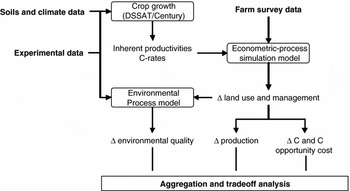
Each of the three case studies was executed using the tradeoff analysis modeling approach implemented with the Tradeoff Analysis software. In this approach, spatially explicit disciplinary data and models are coupled to simulate the production system, following the scheme presented in figure 1. The Tradeoff Analysis system consists of several components (Stoorvogel et al., Reference Stoorvogel, Antle, Crissman and Bowen2001):
Integrated assessment of soil carbon sequestration (Antle, Reference Antle2002).

Data: The model begins with three types of data: environmental data, farm survey data, and experimental data. Environmental data describe the spatial variation in soils and climate and are organized in a GIS format. They are used as inputs into the bio-physical models and to stratify the study area. Farm survey data describe the way farmers take decisions about land management. This decision-making process is described in the econometric production models. The tradeoff analysis uses crop models to describe the inherent productivity of farmers' fields (as an important driving factor in their decision-making process) and environmental impact models to estimate the impact on soil and water resources (e.g., soil erosion, pesticide leaching). These mechanistic models need to be calibrated to local conditions using experimental data.
Crop models: Crop (and if appropriate, livestock) models in the DSSAT format are used to estimate the spatial and temporal variation in indexes of inherent productivity of the land (crop yield estimated with standard management) that is driven by soil and climate variations. These measures of inherent productivity are used as inputs into the economic models to explain variation in management decisions of farmers. When the DSSAT/Century model is used, both crop yields and soil C values are passed to the economic analysis (Tsuji et al., Reference Tsuji, Uehara and Balas1994; Gijsman et al., Reference Gijsman, Hogeboom, Parton and Kerridge2002).
Economic simulation models: Econometric production models are estimated using the farm survey data and the inherent productivity indexes derived from the crop models. Parameters for spatial distributions of prices and other exogenous variables in the production models are estimated using the survey data. Using a spatial characterization of the farm population, a random sample of farm and field locations is sampled in the agro-ecozones to be simulated. An econometric-process simulation model utilizes the production model and price distribution parameters to simulate the land use and management decisions of farmers on a site-specific basis.
Environmental process models: As appropriate to the analysis, the management decisions from the economic simulation model (e.g., land use, fertilizer use, pesticide applications) can be used as inputs into environmental process models to estimate impacts on soil quality, pesticide fate, and other environmental processes of interest.
Scenario definition, model execution, and analysis of outcomes: For each policy or technology scenario of interest to policy decision makers, the simulation model is executed for a series of price or other parameter settings. Changes in prices and other parameters can be used to induce changes in management that in turn induce tradeoffs between economic and environmental outcomes. In the analysis of soil C sequestration, key parameters are the requirements for participation in a carbon contract and the price of carbon. Economic outcomes from the econometric-process simulation model (e.g., participation in carbon contracts, value of crop, and livestock production) can be aggregated to represent a spatial unit made up of many fields (e.g., the farms participating in a carbon contract).
Application of the tradeoff analysis model to analysis of soil C sequestration: The tradeoff analysis model can be used to analyze the potential for soil C sequestration contracts as shown in figure 1. The first step is to assemble the data needed, including the data for implementation of the crop growth and soil carbon models (e.g., the DSSAT/Century model – see Gijsman et al., Reference Gijsman, Hogeboom, Parton and Kerridge2002) and the econometric-process simulation model for the region to be analyzed. In addition, any relevant scenarios regarding alternative production technologies that could be used to sequester soil C and the types of contracts that would be used need to be assembled. The crop and carbon simulation models are executed for the set of fields that being used in the analysis (this could be a set of fields randomly sampled from the region being analyzed using a map of the region, or a set of fields randomly sampled in a production survey). Crop yields and soil C values are saved in a file that becomes an input into the econometric-process simulation model. This economic model simulates farmer's land use and management decisions for the baseline case of no carbon contracts, and for the types of contracts that farmers could be offered. The economic model creates an output file containing the farmer's land use and management decisions and the changes in soil C associated with those decisions. This information is passed to other environmental process models to analyze other environmental impacts such as soil erosion or fate of pesticides. Finally, the results of the various models are combined into an output file that can be aggregated to represent the region and used for various types of analysis. For the analysis of soil C sequestration, a principal use of this output is to construct a supply curve for soil C corresponding to each type of contract that was simulated. If other environmental process models were included in the analysis, it is also possible to assess tradeoffs with other environmental impacts, such as soil erosion, water quality, and future soil productivity.
Evidence on carbon sequestration, poverty, food security, and sustainability
H1: Carbon contracts increase adoption of sustainable practices
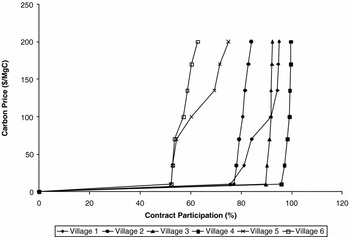
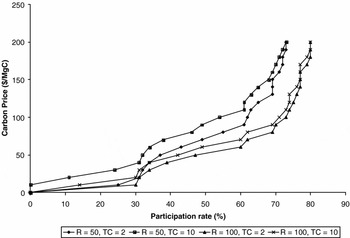
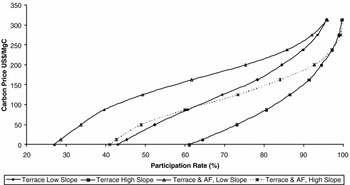
Figures 2–4 show simulated contract participation rates for the three case studies. All three studies support the hypothesis that carbon contracts would substantially increase adoption of carbon-sequestering practices, although the degree of participation would depend importantly on the price of carbon and other factors such as transaction costs, and the rate of participation would vary spatially according to local bio-physical and economic conditions.
Simulated participation in carbon contracts, Machakos, Kenya.

Simulated participation in carbon contracts, Senegal peanut basin (R denotes percent of crop residue incorporation, TC denotes transaction cost in dollars per hectare per season).

Simulated participation in carbon contracts, Cajamarca, Peru, for adoption of terraces and agroforestry on fields with low and high slopes.

The results on contract participation in Kenya are stratified by village (figure 2). Villages 1–4 are characterized by rainfed agriculture, whereas villages 5 and 6 are predominantly irrigated vegetable production. As table 1 shows, fertilizer use is relatively high in irrigated agriculture, but very low in rainfed crops. This fact explains the pattern shown in figure 2, with very high participation rates in villages 1–4 and lower rates in villages 5 and 6. Recall that the simulations are based on the assumption that the fertilizer required by the contract is available to farmers at the prevailing market price, and that they have the resources available to buy it, possibly by making the carbon payments in the form of fertilizer. The economic simulations show that most farms that are utilizing zero or low rates of fertilizer would earn higher returns by using more fertilizer, even if they pay the market price. Thus, these findings are consistent with the hypothesis that farmers in this region generally are under-utilizing fertilizer because of constraints on fertilizer availability or financing, not because the fertilizer price makes fertilizer unprofitable.
Figure 3 shows participation in carbon contracts simulated in the peanut basin of Senegal. The analysis is not stratified by region due to the relatively small amount of spatial variation in conditions in the study area. The figure shows results for simulations assuming farmers increase use of mineral fertilizer and also increase incorporation of crop residues into the soil, with two assumptions about transaction costs (discussed below). The simulations show a pattern similar to Kenya, but with generally lower participation rates, presumably because a much higher percentage of farms use fertilizer without carbon contracts (81 per cent in Senegal, compared to 41 per cent of rainfed farms in Kenya, table 1).
Figure 4 shows carbon contract participation in Peru for terracing investments alone, and for terracing combined with agroforestry. The simulations were conducted for terraces on fields with low slopes and high slopes, to represent the effects on land with more and less favorable productivity characteristics. The points on the horizontal axis with a zero carbon price represent the rates of adoption without carbon payments. Terracing alone is profitable for a larger proportion of fields at zero or low carbon prices, and profitable for a substantially higher proportion of steeply sloped fields.
The various case studies show that carbon payments do increase the adoption of more sustainable practices. However, it should be noted that, depending on the agro-ecological conditions, carbon contracts do not necessarily result in positive carbon gains but rather result in a decrease in carbon losses over time.
H2: Carbon contracts transform unsustainable agricultural systems into sustainable systems
The results from the three studies suggest that in some cases, the combination of appropriate practices and sufficiently high carbon payments could move production systems to a much higher degree of sustainability, but in some areas that are experiencing high rates of degradation this could not be attained at plausible carbon prices.
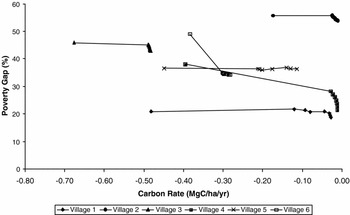
Figure 5 shows the impact of carbon contracts on the average rate of change in soil carbon simulated for farms in the Machakos, Kenya villages, in the base case (the value on the x-axis at a zero carbon price) and with farmers participating in carbon contracts. The data show that without carbon contracts, the rate of change in soil carbon ranges from −0.17 to −0.68 MgC/ha/yr across the six villages. With introduction of carbon contracts, this rate approaches zero for villages 1, 2, and 4, and is reduced from about −0.46 to about −0.20 MgC/ha/yr for village 4. Villages 3 and 6 see their rates of carbon loss reduced but remain relatively high. In this case the carbon contract results in a reduction in the rate of soil carbon loss, but the system remains unsustainable because there is an ongoing net loss of soil organic carbon. The implication is that the system will eventually approach a low-level equilibrium for both soil carbon stocks and crop productivity. In this case the carbon contract results in lower rate of soil carbon loss, but the system remains unsustainable.
Rate of change in soil carbon versus poverty gap with carbon contracts, Machakos, Kenya (Left-most point corresponds to a zero carbon price, the price increases to $200/MgC at the right-most point).

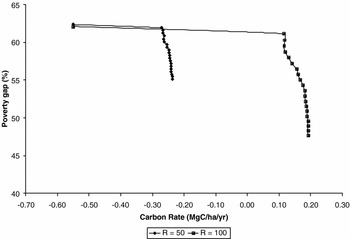
Data from the Senegal study showed a baseline rate of change in soil carbon of about −0.60 MgC/ha/yr (figure 6), similar to the high rates of loss found in some of the Kenyan sites. When 50 per cent of crop residues are incorporated, the rate of carbon loss declines by about half, but is still near –0.30 MgC/ha/yr. Under the scenario of 100 per cent residue incorporation, however, the average rate of change in soil carbon is greater than 0.10 MgC/ha/yr. The main effect on the carbon rate comes from the increased residue incorporation by farmers who are induced to enter contracts at a low carbon price in order to gain access to fertilizer, as shown by the fact that the average carbon rate is little affected by a higher price of carbon.
Rate of change in soil carbon versus poverty gap with carbon contracts, Senegal peanut basin (Left-most point corresponds to a zero carbon price, the price increases to $200/MgC at the right-most point; R denotes percent of crop residue incorporation required in the carbon contract).

Taken together, the Kenya and Senegal studies tell a similar story about the impacts of contracts based on increased use of organic material and mineral fertilizer. In areas where rates of carbon loss are relatively low, carbon contracts appear to have the potential to stabilize soil carbon stocks, but in areas where the rates of loss are relatively high, carbon contracts are unlikely to transform unsustainable systems to sustainable ones unless carbon prices are extremely high and farmers radically increase the amount of crop residue being incorporated into the soil (i.e., in the range of $200/MgC or higher).
Field research in Peru showed that terracing would increase soil carbon by about 6 MgC/ha/yr over ten years, and then stabilize soil C at that level or continue to increase gradually until a somewhat higher equilibrium soil C stock was attained. The terracing study showed that carbon contracts would increase adoption of terracing from 43 to 61 per cent on low-slope fields at a carbon price of $100/MgC, and from 61 to 81 per cent on high-slope fields at $100/MgC, but would not approach 100 per cent adoption until the carbon price were as high as $300/MgC (figure 4). The Peru study also showed that, due to the costs of agroforestry investments, the adoption rate of terraces with agroforestry would be lower without carbon contracts, but due to the higher carbon rates associated with the combination of terracing and agroforestry, the increase in adoption would be greater, so that at sufficiently high carbon prices the overall rate of adoption could be higher. Thus, we can conclude that in the case of terracing and agroforesty in Peru, carbon contracts would increase the sustainability of the system, but the degree of improvement would be sensitive to the price of carbon and the vulnerability of the field to degradation.
H3: Carbon contracts increase aggregate rural income
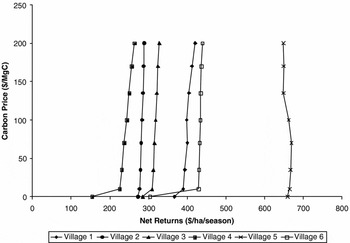
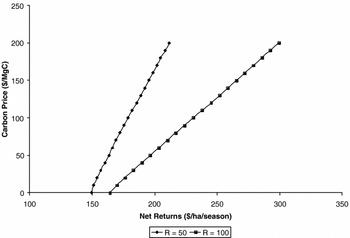
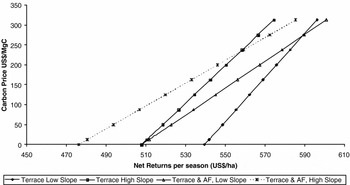
Figures 7, 8, and 9 show net returns per hectare in the three study areas, with the point at a zero carbon price indicating the returns without carbon contracts. These figures show that returns respond somewhat differently in each case. In Kenya, the main effect comes from farmers entering into contacts and using more fertilizer, hence the carbon price has a relatively small effect on revenue. In Senegal and Peru, participation increases more gradually with the carbon price, and consequently the revenue effect is greater, particularly in the scenarios in which carbon rates are higher.
Net returns with carbon contracts in Machakos, Kenya.

Net returns per hectare with carbon contracts in the Senegal peanut basin.

H4: Carbon contracts reduce poverty and food insecurity in the rural farm population
Data were available for household income for the Kenya and Senegal studies. Figures 5 and 6 show the poverty gap for the Kenya and Senegal study areas, where the poverty gap is defined as the Foster et al. (Reference Foster, Greer and Thorbecke1984) poverty index for population size N, α = 1 and the poverty line PL set equal to $1/day per household member

The data from Kenya show that carbon contracts have a relatively small impact on poverty in most of the villages, even as the carbon price increases towards the upper limit of $200/MgC in the simulation. Two villages show a more substantial effect of both the initial entry into contracts and a higher price. The simulations for Senegal show little effect of the initial entry into contracts at a low price. However, a higher carbon price has some impact on poverty, particularly for the scenario of 100 per cent residue incorporation, lowering the poverty gap index from over 60 per cent to less than 50 per cent.
H5: The impacts of carbon contracts on poverty and food insecurity are greatest in the poorest regions and households
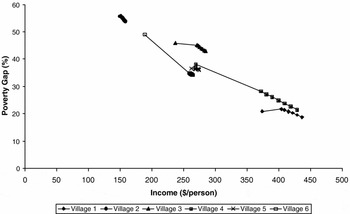
Figure 5 provides little evidence to support this hypothesis, as it shows that carbon contracts reduce poverty the most in villages 4 and 6, yet villages 2 has the highest initial poverty gap and carbon contracts appear to have little effect on poverty there. This fact is confirmed by figure 10 which shows the relationship between income per person and the poverty gap as the carbon price varies from zero to $200/MgC. In Senegal, where the poverty level is similar to the poorer villages in Kenya, the impact on poverty is also small unless the carbon price is above $100/MgC. Although household data were not available for the Peru study, figure 9 shows little difference in the effect of carbon payments in the low-slope and high-slope fields, indicating that the effect on poverty would not be different between farms with predominantly lower or higher slopes.
Net returns with carbon contracts in Cajamarca, Peru, for adoption of terraces and agroforesty on fields with low and high slopes.

Average income per person versus poverty gap with carbon contracts in Machakos, Kenya (Left-most point corresponds to a zero carbon price, the price increases to $200/MgC at the right-most point).

H6: Transaction costs substantially reduce participation in carbon contracts
Figure 3 shows results from Senegal with transaction costs at a relatively low value ($2 per hectare) and a relatively high value ($10 per hectare). The simulations show that the effect of the higher transaction cost is small for the case in which all crop residues are incorporated, because the carbon rate is sufficiently high to offset the effect of the transaction cost on the opportunity cost per ton of carbon. However, in the scenario with 50 per cent residue incorporation, the higher transaction cost does have a substantial effect on the participation rate, reducing it from 25 per cent to zero when the carbon price is $10/MgC, but having a smaller impact as the carbon price increases. Similar results were obtained in the Kenya simulations.
Conclusions
This paper explores the potential impacts of payments for agricultural soil carbon sequestration on poverty of farm households and on the sustainability of agricultural systems, using economic theory combined with evidence from three case studies in Kenya, Peru, and Senegal. The first section of the paper uses economic analysis to show that there are a variety of technical and economic factors affecting adoption of practices that increase soil carbon and the sustainability of production systems. Likewise many of these factors will impact how payments for environmental services such as carbon sequestration could affect poverty in the farm population of developing countries. Therefore, the net effect of these various factors on participation in carbon contracts and the impact on poverty and sustainability is an empirical question. Six hypotheses were identified, which were then tested using simulations from the three case studies.
All three studies support the first hypothesis that carbon contracts would substantially increase adoption of carbon-sequestering practices, although the degree of participation would depend importantly on the price of carbon and other factors such as transaction costs, and the rate of participation would vary spatially according to local bio-physical and economic conditions.
The second hypothesis is that carbon contracts transform unsustainable agricultural systems into sustainable systems. The results from the three studies suggest that in some cases, the combination of appropriate practices and sufficiently high carbon payments could move production systems to a much higher degree of sustainability and stabilize carbon stocks at higher levels than would have otherwise been the case. However, in areas that are experiencing high rates of degradation this transition to a more sustainable system is not likely to be attained at plausible carbon prices.
The case studies support the hypothesis that carbon contracts would increase aggregate income in rural areas, but the impacts on poverty were found to be relatively small. Moreover, neither the economic analysis presented, nor the results of the case studies, support the hypothesis that the impacts of carbon contracts on poverty and food insecurity are necessarily greatest in the poorest regions and households.
Finally, transaction costs were found to have a substantial effect on participation in carbon contracts in areas where expected rates of carbon accumulation are low and when carbon prices are low. This finding means that the impacts of transaction costs on participation are likely to be greatest in marginal areas – such as semi-arid areas with sandy soils – where soil carbon accumulation rates are typically lower than in areas with better soils and more rainfall or access to irrigation.
In conclusion, the economic analysis presented in this paper, and the empirical results of the three case studies, all suggest that the likely impact of carbon contracts will be to raise rural incomes and reduce the rate of soil carbon loss. In some cases, for example when it is feasible to substantially increase the incorporation of organic matter at relatively low cost, carbon contracts may be able to stabilize soil carbon stocks at a higher level than would otherwise be economically feasible. Given that rural areas dominated by small farms are typically the poorest parts of most developing countries, these findings suggest that carbon payments could have a positive impact on the sustainability of these systems while also reducing poverty. However, these conclusions must be tempered by the finding that the impacts on poverty are likely to be relatively small, and in areas where degradation is highest and people are often poorest, carbon payments do not appear to be capable of transforming unsustainable systems into sustainable ones. Additionally, as noted in the economic analysis presented in this paper, the participation of poor farmers in carbon contracts is likely to be constrained by the same factors that have inhibited their use of more productive, more sustainable practices in the first place. Thus, payments for environmental services are not a pancea and are most likely to have a positive impact when they are implemented in an enabling economic and institutional environment.