1. Introduction
A liquid filament or ligament is an elongated drop that consists of a slender central section that is capped off by two bulbous ends. Such filaments occur widely in both industrial processes and nature. Well known situations in which they arise include drop-on-demand ink jet printing (Basaran, Gao & Bhat Reference Basaran, Gao and Bhat2013; Castrejón-Pita et al. Reference Castrejón-Pita, Baxter, Morgan, Temple, Martin and Hutchings2013) and drop-on-demand-based applications in diverse fields (Yeo et al. Reference Yeo, Chen, Basaran and Park2004; Derby Reference Derby2010) where both the primary/main drops and the satellite droplets resemble filaments, and when satellite droplets form while liquid drips at a low flow rate from a nozzle during particle production and surface tension measurement (Zhang, Harris & BasaranReference Zhang, Harris and Basaran1994; Basaran Reference Basaran2002). Filaments are also routinely formed when liquid is sprayed from nozzles in crop spraying and atomization coating applications or in naturally occurring fountains and sprays (Eggers Reference Eggers2005; Eggers & Villermaux Reference Eggers and Villermaux2008). In many of these situations, whether the filament contracts to a single spherical droplet or breaks into many smaller droplets – satellites or fines – is critically important from a performance standpoint.
While filaments come in a variety of configurations (Notz, Chen & Basaran Reference Notz, Chen and Basaran2001; Notz & Basaran Reference Notz and Basaran2004; Planchette et al. Reference Planchette, Marangon, Hsiao and Brenn2019), the most commonly studied type is a so-called symmetric filament whose initial configuration is a cylinder of radius  $R$ that is terminated at its two ends by two identical hemispherical caps each of radius
 $R$ and whose length equals
 $2\tilde {L}_0$, and the fluid within which is quiescent. In many situations and in the present paper, the fluid exterior to the filament is a passive gas that exerts a constant pressure on the filament. Although liquids used in applications can be simple or complex, the most often studied filaments are incompressible Newtonian fluids of constant density
 $\rho$, viscosity
 $\mu$ and surface tension
 $\tilde {\sigma }_p$. Because of surface tension, such filaments contract and their final fates, i.e. whether they undergo breakup or no breakup, depend solely on two dimensionless groups: the Ohnesorge number
 $Oh = \mu /(\rho R \tilde {\sigma }_p )^{1/2}$ and the initial aspect ratio
 $L_{0}=\tilde {L}_{0}/R$. The contraction dynamics of such filaments has been studied extensively over the past two decades (Schulkes Reference Schulkes1996; Notz & Basaran Reference Notz and Basaran2004; Castrejón-Pita, Castrejón-Pita & Hutchings Reference Castrejón-Pita, Castrejón-Pita and Hutchings2012; Driessen et al. Reference Driessen, Jeurissen, Wijshoff, Toschi and Lohse2013; Wang et al. Reference Wang, Contò, Naz, Castrejón-Pita, Castrejón-Pita, Bailey, Wang, Feng and Sui2019), culminating with a recent comprehensive study of the dynamics that resulted in the construction of a phase diagram in
 $Oh$–
 $L_{0}$ space spanning nearly four orders of magnitude variation in both parameters (Anthony et al. Reference Anthony, Kamat, Harris and Basaran2019). The goal of this paper is to report novel dynamics that arises when the interface of a nearly inviscid (
 $Oh\approx 10^{-3}$) filament is covered with surfactant.
As first shown by Notz & Basaran (Reference Notz and Basaran2004) for nearly inviscid filaments, there exists a critical aspect ratio  $L_{0,c}$ such that filaments of
 $L_0<L_{0,c}$ do not break while filaments of
 $L_0 \ge L_{0,c}$ break up. Long, slender filaments of
 $L_0 \ge L_{0,c}$ that do undergo breakup do so by the endpinching mechanism initially discovered by Stone, Bentley & Leal (Reference Stone, Bentley and Leal1986) who were studying a physical problem that had considerable differences compared with the one being studied here. Although Leal and coworkers (Stone et al. Reference Stone, Bentley and Leal1986; Stone & Leal Reference Stone and Leal1989b, Reference Stone and Leala) used an apparatus similar to Taylor's four-roll mill to study the breakup of viscous liquid drops in a dynamically active but less viscous external liquid under Stokes/creeping flow conditions, i.e. under conditions of no inertia or at zero Reynolds number in both the filament and the surrounding fluid, the mechanism of breakup in their studies was virtually identical to that observed by Notz & Basaran (Reference Notz and Basaran2004) in whose study inertia was dominant compared with viscous force in the filament and the surrounding fluid was a passive gas. Leal and coworkers showed that stretched drops, when allowed to contract or retract, undergo repeated localized pinch-off near the ends of the filament or undergo endpinching, leaving in the aftermath a train of smaller spherical droplets. While the physics of the contraction of nearly inviscid Newtonian filaments is now fully characterized (Anthony et al. Reference Anthony, Kamat, Harris and Basaran2019), in many of the aforementioned applications surfactants, or surface-active agents which lower surface tension, may be present at the interface by either design or accident. However, despite the existence of a large body of work describing the effect of surfactants in various free surface flows in general and thread breakup in particular (Ambravaneswaran & Basaran Reference Ambravaneswaran and Basaran1999; Timmermans & ListerReference Timmermans and Lister2002; Liao, Franses & Basaran Reference Liao, Franses and Basaran2006b; McGough & Basaran Reference McGough and Basaran2006; Kamat etal. Reference Kamat, Wagoner, Thete and Basaran2018; Martínez-Calvo et al. Reference Martínez-Calvo, Rivero-Rodríguez, Scheid and Sevilla2020), investigations on the effects of surfactants on the contraction of filaments surrounded by a passive gas at finite Reynolds number are sorely lacking. Remedying this situation is a goal of this work.
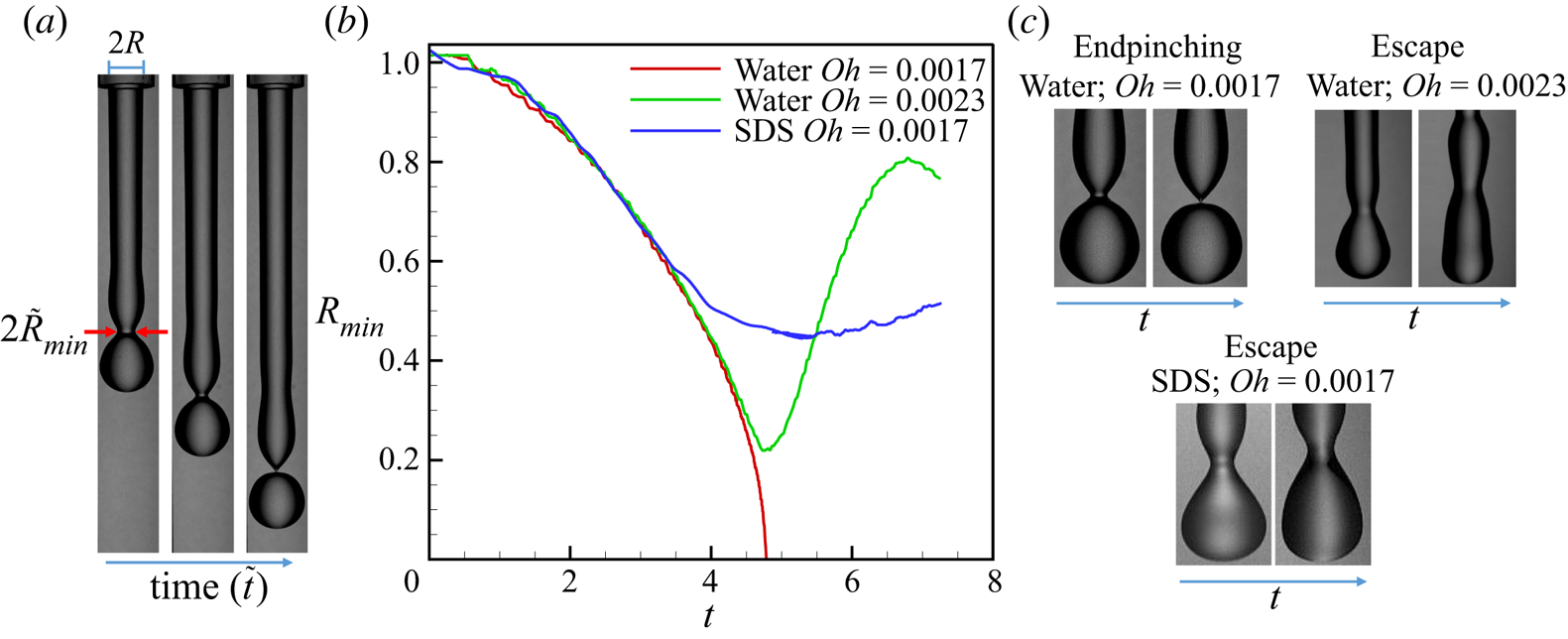
To illustrate the novel physical phenomenon that is of interest, a quick overview will be given of experiments that will be described in greater detail in a future publication. Motivated by earlier experimental work by Hoepffner & Paré (Reference Hoepffner and Paré2013) who studied filaments with clean interfaces, in our experiments we fill a fixed vertical tube with liquid and then send the liquid into free fall by gravity, as depicted in figure 1(a). As the column of liquid exits the tube, a liquid filament forms and resembles one half or end of a free symmetric filament. To quantify the dynamics of pinch-off, the filament's minimum radius  $\tilde {R}_{min}$ is tracked as a function of time
 $\tilde {t}$. Figure 1(b) shows the variation of the filament's normalized minimum radius with normalized time for three filaments. For a Newtonian fluid of
 $Oh= 0.0017$, the filament pinches off by endpinching and
 $R_{min}$ decreases monotonically with time until breakup. Surprisingly, when a surfactant (sodium dodecyl sulphate, SDS, at a concentration of 3.92 mM) is added to this Newtonian filament, the dynamics initially follows that of a surfactant-free filament but suddenly changes course such that pinch-off is avoided. This escape from endpinching is well known for Newtonian filaments of larger viscosity, but a comparison of the dynamics of the surfactant-covered filament with a slightly more viscous filament without surfactant of
 $Oh=0.0023$ reveals stark differences between the two cases.
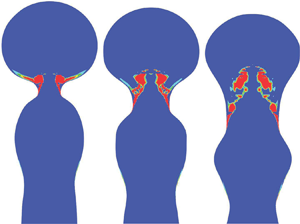
Experimental results on endpinching and escape from endpinching.  $(a)$ Images showing the generation or formation of a filament from a nozzle and the evolution in time
 $\tilde {t}$ of the filament's shape. In the image showing the filament at the earliest time, twice the radius of the filament
 $2R$ as it exits from the nozzle and twice the minimum radius of the filament's neck,
 $2\tilde {R}_{min}$, are also identified.
 $(b)$ Variation with normalized time
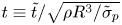 $t \equiv \tilde {t}/\sqrt {\rho R^3/\tilde {\sigma }_p}$ of the normalized minimum filament radius
 $R_{min} \equiv \tilde {R}_{min}/R$ from three experiments. Red curve: water,
 $Oh=0.0017$. Green curve: water,
 $Oh=0.0023$. Blue curve: water plus SDS (labelled as SDS),
 $Oh=0.0017$. As also shown by the images depicted in the next part of the figure, the filament of water of
 $Oh=0.0017$ endpinches whereas the other two filaments escape from endpinching.
 $(c)$ Sets of images showing the filaments at two instants in time. Endpinching: water filament of
 $Oh=0.0017$ prior to (left) and at the incipience of (right) endpinching. Escape (water): water filament of
 $Oh=0.0023$ appearing on the cusp of breaking (left) and then shortly after it has escaped endpinching (right). Escape (SDS): surfactant-covered filament of
 $Oh=0.017$ appearing on the verge of endpinching (left) and then after it has undergone surfactant-driven escape from endpinching (right). In panels (a) and (c), the arrows indicate the direction in which time,
 $\tilde {t}$ or
 $t$, is increasing.

In this work, we use numerical simulations to analyse the effect of insoluble surfactants on the dynamics of contraction of a filament of a Newtonian liquid which would undergo endpinching if its surface were clean or devoid of surfactant. To orient our study, we take a well characterized Newtonian filament of  $Oh= 0.001$ and
 $L_{0} = 15$, and investigate the dynamical variations that take place when insoluble surfactants are deposited on the filament's surface.
It is important to note that SDS used in the aforementioned experiments is soluble in glycerol–water mixtures. However, its solubility does not affect the surface tension or its gradient along the filament interface during the retraction and pinch-off process because the time scale of the flow is a few milliseconds while the characteristic time for surfactant adsorption–desorption from the interface is hundreds of milliseconds. Therefore, during filament contraction and pinch-off, the surfactant effectively behaves like a purely insoluble surfactant that resides solely on the interface. This fact has been well demonstrated in recent works studying droplet pinch-off (Roché et al. Reference Roché, Aytouna, Bonn and Kellay2009; Kamat et al. Reference Kamat, Wagoner, Thete and Basaran2018) where numerical simulations considering insoluble surfactants and experiments using SDS in glycerol–water mixtures have been shown to be in excellent accord with one another. Hence, the use of the surfactant insolubility assumption is well justified in the simulations.
The rest of the paper is organized as follows. The problem statement and the governing equations are presented in § 2. The numerical method used to solve the governing equations is summarized in § 3. We then report in the following four sections results and discussion of the various aspects of the dynamics as follows. In the next two sections, by taking advantage of simulation results, first we peer into the flows that lead to endpinching when surfactants are absent in § 4, and thereafter in § 5 demonstrate escape from endpinching when surfactants are added. Details of surfactant-driven escape are provided in § 6 where we observe that surfactants can abet the escape from endpinching through a mechanism different to the boundary layer proposal of Hoepffner & Paré (Reference Hoepffner and Paré2013), and show conclusively that this process is primarily driven by Marangoni stresses acting in the vicinity of the about-to-pinch neck of a retracting filament. In § 7, an analysis is presented of the key role of vorticity in all escape phenomena. Concluding remarks are provided in § 8 and a short summary of future work that can be undertaken for advancing this field.
2. Problem statement and mathematical formulation
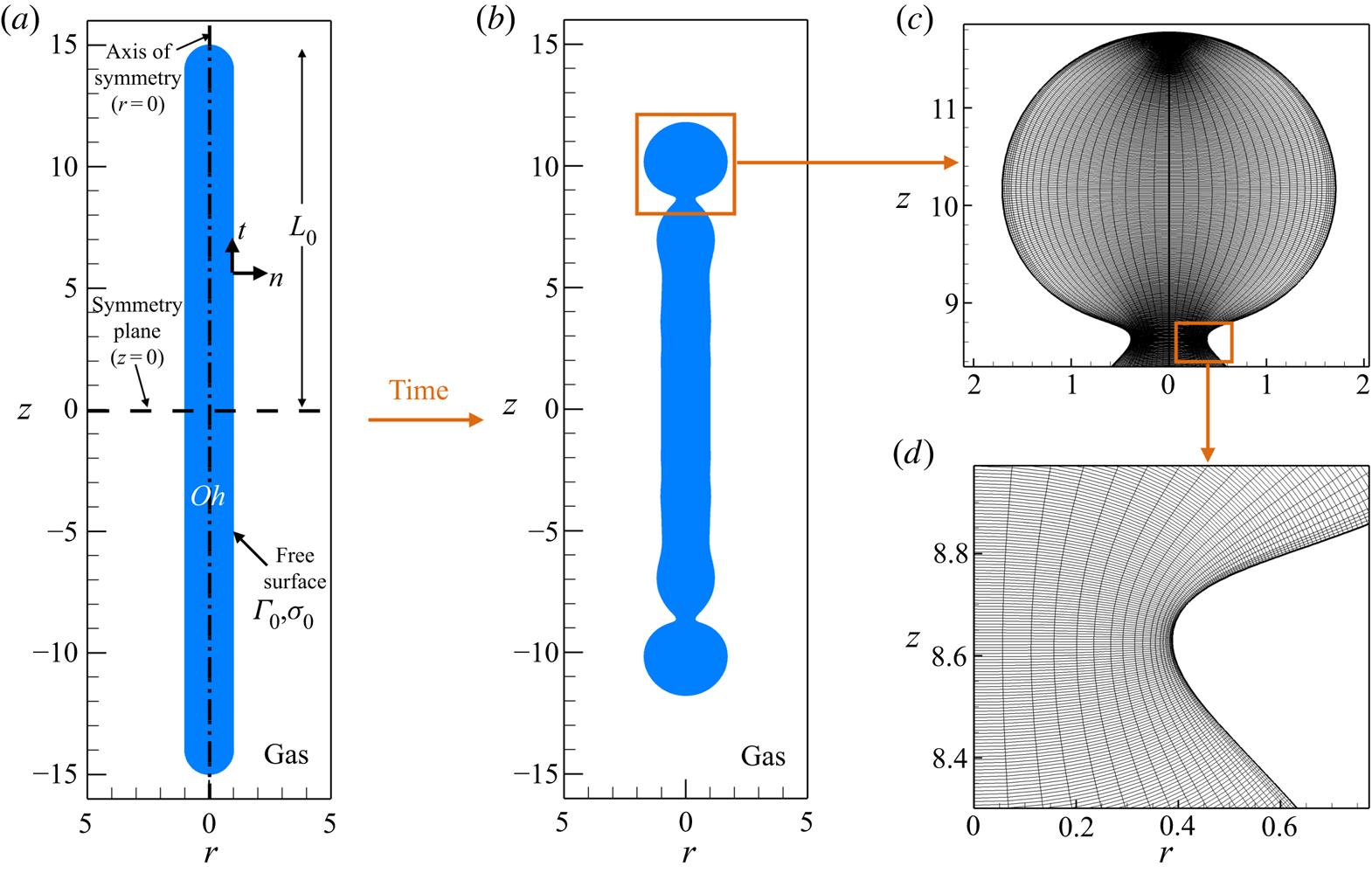
The system, shown in figure 2, is an ideal filament which, as discussed in § 1, is an axisymmetric cylinder of radius  $R$ and finite length
 $2\tilde {L}_{0}$ with hemispherical caps at its two ends. The filament is comprised of an isothermal, incompressible Newtonian liquid (or, solvent) with constant density
 $\rho$ and viscosity
 $\mu$, and is surrounded by a dynamically passive gas that exerts a constant pressure, which is taken to be the pressure datum, on the filament. The surface tension of the liquid–gas (L–G) interface separating a filament of pure liquid from the exterior passive gas is
 $\tilde {\sigma }_{p}$. The fluid within the filament is initially quiescent or at rest, viz. the fluid velocity
 $\tilde {\boldsymbol {v}} = \boldsymbol {0}$ at time
 $\tilde {t} = 0$. The filament's surface is covered with an insoluble, non-volatile surfactant. At
 $\tilde {t} = 0$, the initial concentration of surfactant is uniform and given by
 $\tilde {\varGamma }_{0}$, and the resultant initial surface tension distribution
 $\tilde {\sigma } _0$ is also uniform and is such that
 $\tilde {\sigma }_{0} \le \tilde {\sigma }_{p}$. We employ a cylindrical coordinate system
 $(\tilde {r},\theta ,\tilde {z})$ where
 $\tilde {r}$ and
 $\tilde {z}$ are the radial and axial coordinates measured from the centre of mass of the filament, and
 $\theta$ is the azimuthal angle. Due to the axisymmetry of the problem, the dynamics are independent of
 $\theta$ and the problem can be effectively reduced to a two-dimensional problem in
 $\tilde {r}$ and
 $\tilde {z}$. Moreover, it is taken here that the dynamics is mirror-symmetric about the midplane of the filament (
 $\tilde {z}=0$). Thus, the problem domain consists of one quadrant of the
 $(\tilde {r}, \tilde {z})$ plane, where
 $\tilde {r}, \tilde {z} \ge 0$, that is bounded by the axis of symmetry, the plane of symmetry, and the filament's free surface.
A contracting surfactant-laden filament: definition sketch and computational mesh/grid used in simulations.  $(a)$ The initial state of the filament.
 $(b)$ The filament after it has contracted for some time.
 $(c,d)$ A blow-up or zoomed-in view of the computational mesh constructed by elliptic mesh generation in the bulbous end and neck regions
 $(c)$ and a further zoomed-in view of the mesh in the neck (
 $d$). In parts of this figure
 $(a,b)$ and some others in the rest of the paper, following pioneering works in the field (see, e.g. Stone & Leal Reference Stone and Leal1989b), cross-sections of entire filaments are shown even though the filaments are axisymmetric and have a plane of symmetry. As explained in the text, the problem domain, however, consists of a quarter of a filament's cross-section in the
 $(r,z)$-plane.

The problem is cast in dimensionless form by normalizing length with  $R$, time with the inertial-capillary time scale
 $t_{c}= (\rho R^{3}/\tilde {\sigma }_{p})^{1/2}$, stress with
 $\mu /t_{c}$, the surfactant concentration with its value at maximum packing
 $\tilde {\varGamma }_{m}$, and surface tension with
 $\tilde {\sigma }_{p}$. Hereafter, variables without tildes over them will denote the dimensionless counterparts of those with tildes, e.g.
 $\tilde {t}$ and
 $t$ stand for dimensional and dimensionless time, respectively.
The bulk flow of the viscous liquid within the contracting filament is governed by the incompressible forms of the dimensionless continuity and Navier–Stokes equations
 \begin{gather} \boldsymbol{\nabla}\boldsymbol{\cdot} \boldsymbol{v} = 0, \end{gather}
 \begin{gather} \frac{\partial \boldsymbol{v}}{\partial t} + \boldsymbol{v}\boldsymbol{\cdot} \boldsymbol{\nabla} \boldsymbol{v} = \boldsymbol{\nabla} \boldsymbol{\cdot} \boldsymbol{\mathsf{T}}, \end{gather}
where  $\boldsymbol{\mathsf{T}}= -p \boldsymbol{\mathsf{I}} + Oh[ \boldsymbol {\nabla }\boldsymbol {v} + (\boldsymbol {\nabla }\boldsymbol {v})^{T} ]$ is the total stress tensor for a Newtonian fluid,
 $\boldsymbol{\mathsf{I}}$ is the identity tensor, and
 $p$ is the pressure. At the L–G interface, the counterparts of the previous two equations are of course the kinematic and traction boundary conditions
 \begin{gather} \boldsymbol{n} \boldsymbol{\cdot} (\boldsymbol{v} - \boldsymbol{v}_{s})= 0, \end{gather}
 \begin{gather} \boldsymbol{n} \boldsymbol{\cdot} \boldsymbol{\mathsf{T}}= 2\mathcal{H} \sigma \boldsymbol{n} + \boldsymbol{\nabla}_{s}\sigma, \end{gather}
where  $\boldsymbol {n}$ is the outward pointing unit normal,
 $\boldsymbol {v}_{s}$ is the instantaneous local velocity of the free surface,
 $2\mathcal {H}= -\boldsymbol {\nabla }_{s}\boldsymbol {\cdot } \boldsymbol {n}$ is twice the local mean curvature of the free surface and
 $\boldsymbol {\nabla }_{s} = \boldsymbol {\nabla } - \boldsymbol {n}\boldsymbol {n}\boldsymbol {\cdot }\boldsymbol {\nabla }$ is the surface gradient operator. The tangential component of the traction vector
 $\boldsymbol {n} \boldsymbol {\cdot } \boldsymbol{\mathsf{T}}$ is non-trivial only when there is a gradient of surface tension
 $\sigma$ at the free surface, and is commonly referred to as the Marangoni stress (Scriven & Sternling Reference Scriven and Sternling1960)
 \begin{equation} \boldsymbol{n} \boldsymbol{\cdot} \boldsymbol{\mathsf{T}} \boldsymbol{\cdot} \boldsymbol{t} \equiv T_{nt}= \boldsymbol{t}\boldsymbol{\cdot} \boldsymbol{\nabla}_{s}\sigma, \end{equation}
where  $\boldsymbol {t}$ is the unit tangent to the free surface. The surface tension
 $\sigma$ of the free surface is related to the local concentration of surfactant
 $\varGamma$ on the surface by the Szyszkowski equation of state (Rosen Reference Rosen2004; Liao et al. Reference Liao, Franses and Basaran2006b)
 \begin{equation} \sigma= 1 + \beta \ln( 1 - \varGamma), \end{equation}
where  $\beta = \tilde {\varGamma }_{m}R_{gas}T_{abs}/\tilde {\sigma }_{p}$ is the dimensionless surfactant strength parameter. Here
 $R_{gas} = 8.314\ \textrm {J}\,\textrm {mol}^{-1}\,\textrm {K}$ is the universal gas constant and
 $T_{abs}$ is the absolute temperature of the isothermal system. Additionally, the bulk flows can convect and redistribute the surfactant species on the free surface. The surfactant concentration is governed by the surface convection–diffusion equation (Stone Reference Stone1990) which, separating the fundamental transport mechanisms – convection
 $\dot {\varGamma }_{con}$, normal dilatation
 $\dot {\varGamma }_{dil}$, tangential stretching
 $\dot {\varGamma }_{str}$ and diffusion
 $\dot {\varGamma }_{dif}$ – is given by
 \begin{equation} \frac{\partial \varGamma}{\partial t} + \underbrace{\boldsymbol{v}\boldsymbol{\cdot}\boldsymbol{\nabla}_{s}\varGamma}_{\textit{Convection}} + \underbrace{\varGamma v_{n}(\boldsymbol{\nabla}_{s}\boldsymbol{\cdot} \boldsymbol{n})}_{\textit{Normal dilatation}} + \underbrace{\varGamma(\boldsymbol{\nabla}_{s}\boldsymbol{\cdot} v_{t}\boldsymbol{t})}_{\textit{Tangential stretching}} - \underbrace{\frac{1}{Pe}\boldsymbol{\nabla}_{s}^{2}\varGamma}_{\textit{Diffusion}}= 0, \end{equation}
where  $v_{n}= \boldsymbol {n} \boldsymbol {\cdot }\boldsymbol {v}$ and
 $v_{t} = \boldsymbol {t} \boldsymbol {\cdot } \boldsymbol {v}$ are the components of the velocity normal and tangential to the free surface,
 $Pe = R^{2}/(t_{c}D_{s}) = D_{s}^{-1}(R\tilde {\sigma }_{p}/\rho )^{1/2}$ is the surface Péclet number measuring the relative importance of convection to diffusion and
 $D_{s}$ is the surface diffusivity of the surfactant at the interface.
The system is axisymmetric about the  $z$-axis, or
 $r= 0$, and symmetric about the plane
 $z = 0$; along these boundaries, the following boundary conditions are imposed on the flow field:
 \begin{equation} \boldsymbol{n}\boldsymbol{\cdot} \boldsymbol{\mathsf{T}} \boldsymbol{\cdot}\boldsymbol{t}= 0 \quad \text{and} \quad \boldsymbol{n}\boldsymbol{\cdot} \boldsymbol{v} = 0. \end{equation}
The filament shape and surfactant concentration also obey axisymmetry and symmetry boundary conditions at  $r=0$ and
 $z=0$ where the free surface profile intersects the
 $z$-axis and the plane of symmetry, respectively. For the filament profile, the two symmetry conditions are imposed as
 $\boldsymbol {t} \boldsymbol {\cdot } \boldsymbol {e}_z = 0$ and
 $\boldsymbol {t} \boldsymbol {\cdot } \boldsymbol {e}_r = 0$, where
 $\boldsymbol {e}_z$ and
 $\boldsymbol {e}_r$ are unit vectors in the axial and radial directions. For the surfactant concentration, the symmetry conditions are imposed by setting
 $\boldsymbol {t}\boldsymbol {\cdot } \boldsymbol {\nabla }_{s}\varGamma = 0$ at both locations.
3. Numerical method
The simulations rely on an algorithm that is based on the finite element method (Strang & Fix Reference Strang and Fix1973) and a sharp interface representation of the free surface of the filament. More specifically, (2.1) to (2.8) are solved simultaneously as an initial boundary value problem by a fully implicit, method of lines (known as MOL), arbitrary Lagrangian–Eulerian (known as ALE) algorithm using the Galerkin finite element method with elliptic mesh generation (Christodoulou & Scriven Reference Christodoulou and Scriven1992) for spatial discretization and a finite difference predictor–corrector scheme for time integration with adaptive time step-size control (Gresho, Lee & Sani Reference Gresho, Lee, Sani, Taylor and Morgan1979).
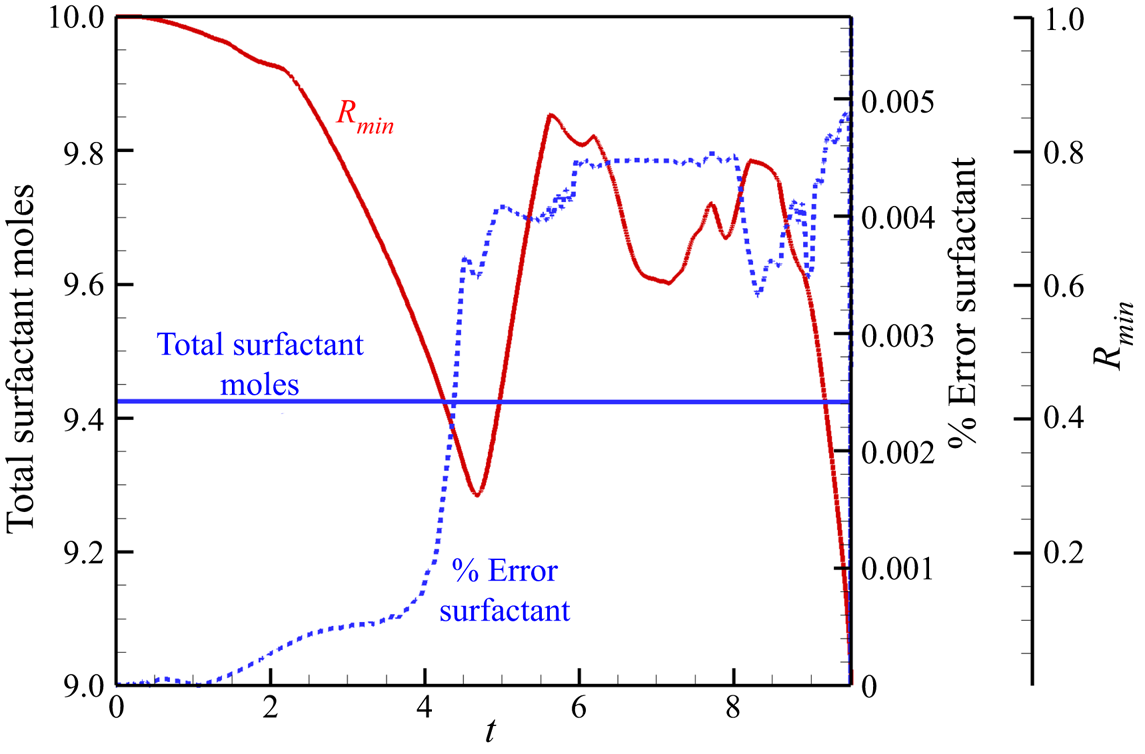
The code was benchmarked against the simulations of Notz & Basaran (Reference Notz and Basaran2004) on contraction of surfactant-free filaments and those of Liao et al. (Reference Liao, Franses and Basaran2006b) on pinch-off of surfactant-covered liquid bridges. Additionally, the code conserved volume and surfactant moles with a relative error of less than  $0.1\,\%$ (cf. figure 3). Details of the numerical technique, including the implementation of the elliptic mesh generation algorithm, can be found in Notz & Basaran (Reference Notz and Basaran2004) and Liao et al. (Reference Liao, Franses and Basaran2006b).
Variation of total moles of surfactant (solid blue line, ‘total surfactant moles’), per cent change in the total amount of surfactant (dotted blue curve, ‘% error surfactant’) and minimum neck radius  $R_{min}$ (solid red curve) with time
 $t$. The total amount of surfactant is that for one half of the filament, the initial value of which equals
 $3 {\rm \pi}$. It should be noted that different axes are used for the three dependent variables. Here,
 $Oh = 0.001$,
 $L_0 = 15$,
 $\varGamma _0 = 0.1$,
 $\beta = 0.05$ and
 $Pe = 10$.

4. Endpinching of surfactant-free filaments
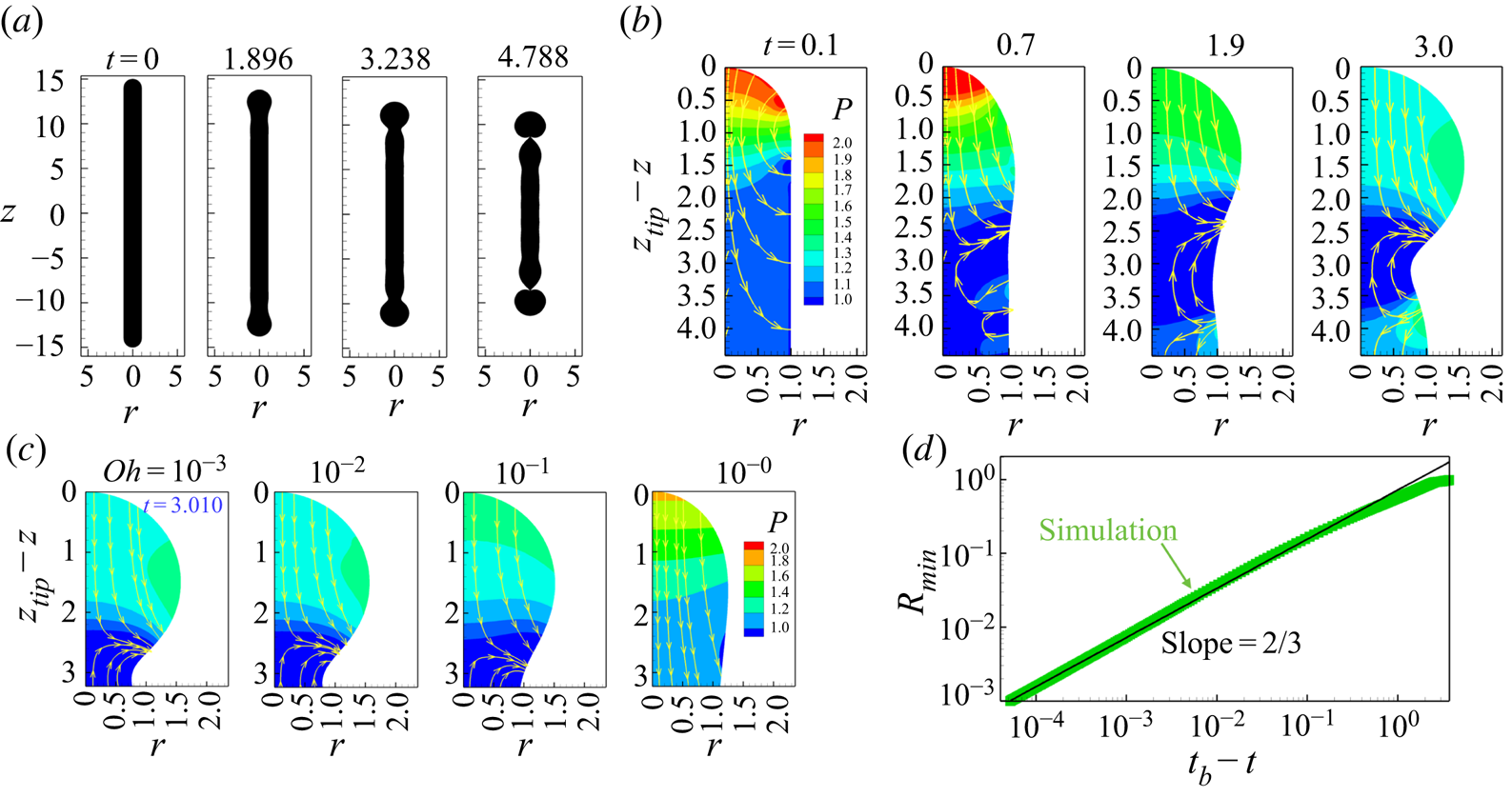
Figure 4(a) shows the evolution in time of the shape of a filament of  $L_{0} = 15$ and
 $Oh = 0.001$. On account of the initial shape of the filament (leftmost frame), a capillary pressure gradient exists at
 $t=0$ between the hemispherical tip where the pressure equals two and the cylindrical body of the filament where the pressure equals unity. This pressure difference causes liquid to flow from the hemispherical tip into the cylinder. At low
 $Oh$, the compressional stress produced by the flow does not diffuse effectively into the cylindrical portion of the filament and within which the fluid remains stationary at early times. Therefore, when fluid flowing from the tip encounters viscous resistance on account of the existence of the stationary body fluid in the cylinder, its motion is instantly arrested and a stagnation zone forms close to the tip. As the tip recedes, fluid continues to accumulate at this stagnation zone, causing the free surface to bulge – a key initial step in the dynamical response of all endpinching filaments. As the bulb grows, the in-plane curvature of the interface becomes more negative where the bulge connects to the cylindrical section of the filament. At the same time, as shown in figure 4(b), capillary waves are excited on the surface of the cylindrical thread which get progressively weaker with increasing distance measured from the filament's tip.
Endpinching and bulb formation in surfactant-free filaments.  $(a)$ Time evolution of the shape of a filament of
 $Oh= 0.001$ and
 $L_{0} = 15$ undergoing endpinching.
 $(b)$ Bulb formation process for the filament from panel
 $(a)$.
 $(c)$ Snapshots at
 $t=3.01$ of bulged tips of filaments of
 $Oh = 0.001$,
 $0.01$,
 $0.1$ and
 $1$. For all filaments, the initial aspect ratio
 $L_{0}= 15$.
 $(d)$ Scaling of the computed value of the minimum neck radius
 $R_{min}$ (green symbols, simulation) with time from breakup
 $t_{b} - t$ for the filament of panel
 $(a)$ agrees with that predicted by inertio-capillary scaling theory (black line of slope = 2/3 and intercept =
 $\ln \, (0.712)$). Here, as in panel (a),
 $Oh= 0.001$ and
 $L_{0} = 15$.

Once the bulb is formed and capillary waves are triggered, the dynamics that ensues and eventually results in the thinning and breakup of the filament's neck follows the intermediate and late stages of inertio-capillary pinch-off (Chen & Steen Reference Chen and Steen1997; Day, Hinch & Lister Reference Day, Hinch and Lister1998). During the early stages of the dynamics, the pressure in the neck is small owing to the large negative in-plane curvature at that location and is surrounded on either side by two higher pressure regions – the bulb and the bulged section of the thread. During this period, the thinning of the thread is set by the upward flow in the neck which is driven by the positive thread-side pressure drop, as shown figure 4(b) at  $t=$ 1.9 and 3.0. Also, during this period, as the fluid axially accelerates in the neck,
 $\partial v/\partial z > 0$. From either the general equation of conservation of mass (2.1) or slender-jet theory (Eggers & Dupont Reference Eggers and Dupont1994), the radial velocity to the leading order is given by
 $u \approx -(r/2) \partial v/\partial z$. Hence, both the fluid and the interface move radially inward such that at the filament's surface
 $u \approx \textrm {d}R_{min}/\textrm {d}t< 0$. Plainly, the thinning process is self-aggrandizing: as the neck thins, the pressure gradient grows, thus resulting in stronger upward flow in the neck, which in turn further accelerates the thinning of the neck. As an aside, it is instructive to note that the extent of bulb and neck formation and the accelerated thinning of the neck, and the propensity to endpinch become diminished and eventually disappear as
 $Oh$ increases, as shown in figure 4(c) for filaments for which the Ohnesorge number has been increased by a decade in succession over the range 0.001–1. Returning back to the case of the filament of
 $Oh=0.001$, figure 4(d) shows the radial scaling predicted from the simulations which depicts the variation of
 $R_{min}$ with time measured from pinch-off,
 $t_{b}-t$ where
 $t_b$ stands for the breakup time, for a filament undergoing endpinching. The computed results and the value of the radial scaling exponent and prefactor of
 $0.712$ determined from the simulations are seen to be in excellent accord with inertio-capillary breakup theory which predicts a power law exponent of
 $2/3$ (Chen & Steen Reference Chen and Steen1997; Day et al. Reference Day, Hinch and Lister1998) and a prefactor of
 ${\approx }0.7$ (Eggers & Villermaux Reference Eggers and Villermaux2008), and thereby confirm the dominant force balance involved in the dynamics of endpinching. In summary, endpinching is a hybrid process consisting of the initial formation of the bulb, neck and capillary waves, which then gives way to a dynamics where the neck follows and ultimately succumbs to pinch-off as dictated by inertio-capillary breakup theory.
In the next section, a uniform monolayer of surfactant is added to the filament so that  $\varGamma (s,t= 0) = \varGamma _{0}$ where
 $s$ is arclength measured along the L–G interface. By focusing almost exclusively on filaments of
 $Oh = 0.001$ and
 $L_{0} = 15$, the values of
 $\beta$ and
 $Pe$ are varied to elucidate the dynamical modifications that take place in filament contraction due to the presence of surfactants at the L–G interface.
5. Surfactant-driven escape from endpinching
Figure 5 shows the instantaneous shape and surfactant concentration profile along the L–G interface during the retraction of a surfactant-laden filament whose surface is initially covered uniformly with surfactant at a concentration given by  $\varGamma _{0} = 0.1$, and for which
 $\beta = 0.3$ and
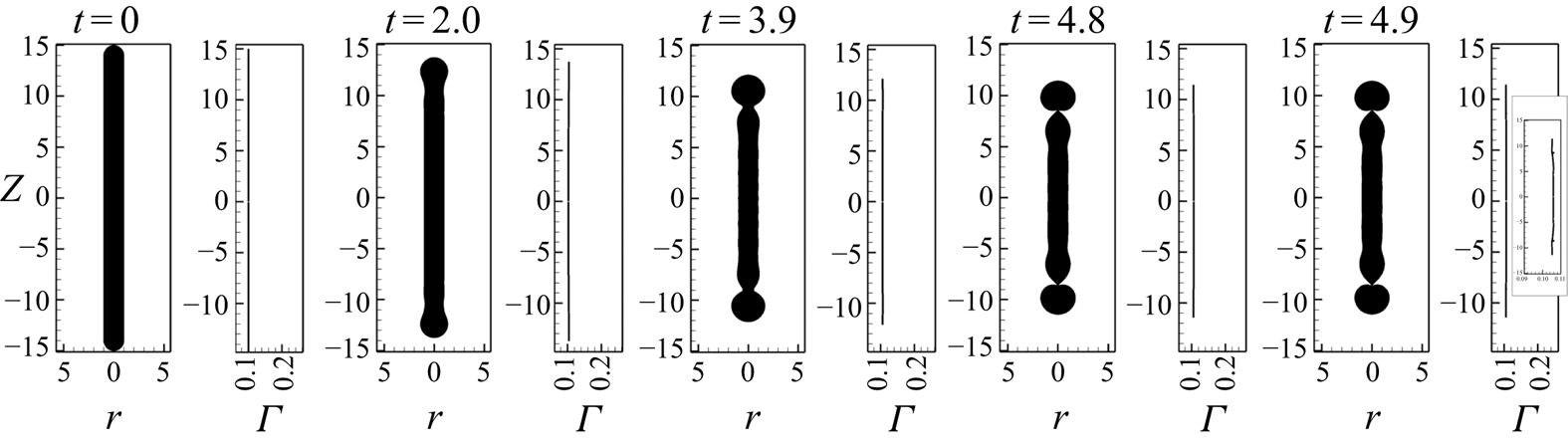
 $Pe = 0.01$. Much like its surfactant-free counterpart, this filament endpinches and its breakup shape is virtually identical to that of its surfactant-free counterpart. For the surfactant-covered filament, because
 $Pe$ is small, surfactant diffusion is dominant over surfactant convection which, therefore, results in the surfactant density
 $\varGamma$ profile remaining virtually perfectly uniform throughout the filament's retraction. The presence of surfactant in this case hence merely serves to uniformly lower the dimensionless surface tension of the filament below unity. As the retraction/endpinching process is driven by surface tension, the contraction process is therefore slower and the breakup time is slightly larger for the surfactant-covered filament compared with its surfactant-free counterpart shown in figure 4(a). Next, we increase
 $Pe$ by four orders of magnitude to investigate whether convection of surfactants has a more profound effect on filament retraction than has been observed so far.
Endpinching of a surfactant-covered filament. Time evolution of the computed shape and surfactant concentration at the interface of a contracting filament of  $Oh= 0.001$,
 $L_{0} = 15$,
 $\varGamma = 0.1$,
 $\beta = 0.3$ and
 $Pe = 0.01$. In this figure and the next, at each instant in time, the filament shape is shown on the left and the surfactant concentration
 $\varGamma$ on the right. At the latest time
 $t=4.9$, a zoomed-in view of the surfactant concentration profile is shown as an inset where the range of axis values of
 $\varGamma$ varies between 0.09 and 0.11.

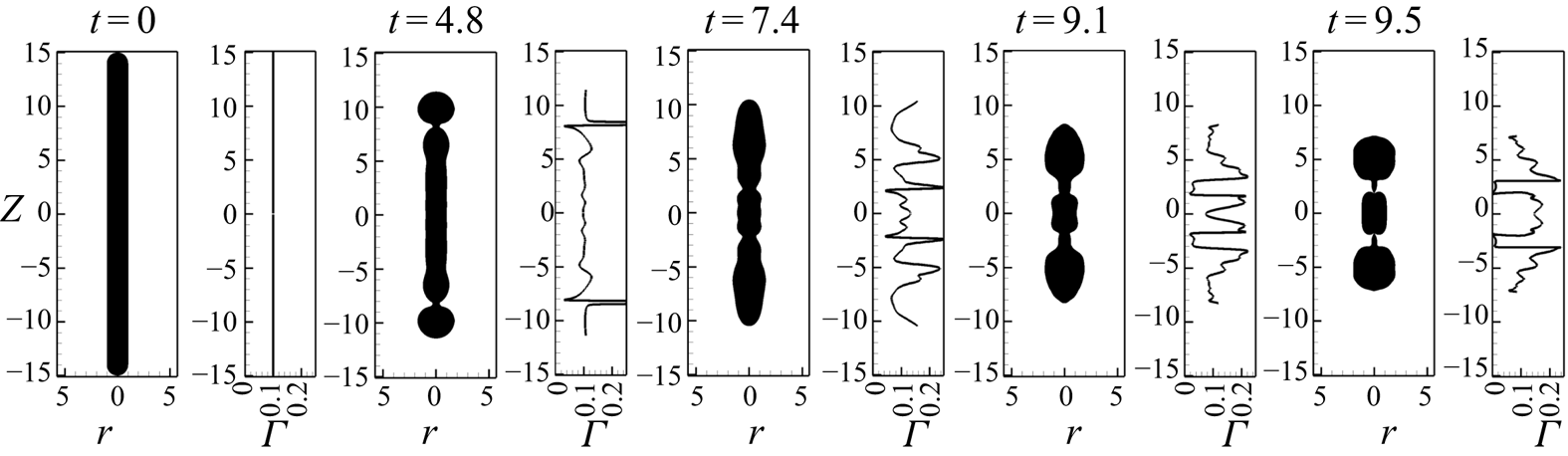
Figure 6 shows the time evolution of the shape and surfactant concentration for a filament of  $\varGamma = 0.1$,
 $\beta = 0.05$ and
 $Pe = 10$. The breakup shape in this case (
 $Pe=10$) looks drastically different compared with the earlier case when
 $Pe=0.01$: while the filament of
 $Pe=10$ appears to have endpinched, it is markedly shorter at breakup compared with the filament of
 $Pe=0.01$ and the three droplets that result from the breakup of the filament of
 $Pe=10$ are quite similar in size. The filament shape and surfactant concentration profiles at
 $t=4.8$ in figure 6 are noteworthy from the following standpoints. First, the surfactant concentration has largely remained unchanged within the blob and also, albeit to a lesser degree, in the cylindrical thread until this instant in time. Second, the strong upward flows in the neck tend to convect surfactant from the thread-side portion of the neck into the bulb, thereby producing a large gradient in
 $\varGamma$ at the neck. Third, although the dynamics up to this point for the filament of moderate Péclet number (
 $Pe=10$) is virtually identical to that in an endpinching filament of lower Péclet number (
 $Pe=0.01$), the similarities between the dynamics in the two cases end after this point in time. Beyond this point, the neck of the filament of
 $Pe=10$ stops thinning and begins to reopen, and large-amplitude capillary waves form in what was earlier the cylindrical section of the filament. The flows accompanying the capillary waves cause the surfactant concentration to become highly non-uniform along the previously cylindrical body of the filament. As the filament contracts further, the local filament radius at the second (as one moves from the filament's tip towards its centre) local minimum in the interface shape profile begins to decrease rapidly in time. As the thinning continues and the filament further contracts, the inertio-capillary breakup mechanism kicks in and the filament undergoes pinch-off at that locale. At pinch-off, two large droplets located at the two ends of the filament are connected to the centre satellite droplet by short tail-like structures, as shown by the profile at
 $t=9.5$ in figure 6.
Escape from endpinching and eventual breakup of a surfactant-covered filament. Time evolution of the computed shape and surfactant concentration at the interface of a contracting filament of  $Oh= 0.001$,
 $L_{0} = 15$,
 $\varGamma = 0.1$,
 $\beta = 0.05$ and
 $Pe = 10$.

It is well known that surfactant-free filaments of intermediate Ohnesorge numbers,  $Oh \approx 0.01$, can escape endpinching by a viscous mechanism (Hoepffner & Paré Reference Hoepffner and Paré2013). It is also known that this mechanism, however, is inoperative in low
 $Oh$ filaments and a surfactant-free filament of
 $Oh= 0.001$ of any initial aspect ratio
 $L_0 \ge 6$ must break by endpinching (Anthony et al. Reference Anthony, Kamat, Harris and Basaran2019). At first, it seems plausible that endpinching is arrested in the presence of surfactants because the concomitant lowering of surface tension raises the effective
 $Oh$ of the surfactant-laden filament above the value of 0.001 for the surfactant-free filament. As the surface tension in the blob remains nearly uniform and equal to its initial value before the escape event, one can compute an effective Ohnesorge number as
 $Oh_{eff} = \mu /(\rho R \tilde {\sigma }_{0})^{1/2} = Oh/\sqrt {\sigma _{0}}$. However, for
 $Oh = 0.001$,
 $\beta = 0.2$ and
 $\varGamma _{0} = 0.1$, the resulting value of the effective Ohnesorge number
 $Oh_{eff} = 1.03\times 10^{-3}$. As this value of the effective Ohnesorge number
 $Oh_{eff}$ is so close to the value of
 $Oh$, surface tension lowering alone cannot possibly be responsible for escape from endpinching. Moreover, if merely lowering surface tension or increasing the effective Ohnesorge number is the cause of the escape, this fact does not explain why the escape process does not occur at small
 $Pe$. When they are all taken together, the previously listed observations imply that Marangoni stress
 $T_{nt}$ arising from surface tension gradients due to surfactant concentration gradients when
 $Pe \gg 1$, as in figure 6, may play a critical role in the contraction of surfactant-covered filaments. In the following section, we describe the mechanics of surfactant-driven escape from endpinching and provide insights into thefundamental forces at play.
6. The mechanism of surfactant-driven escape from endpinching
It was discussed in § 4 how endpinching is a cumulative outcome of the localized dynamics of initial bulb and neck formation, which is then followed by the inertio-capillary acceleration of the fluid through the neck from the thread into the bulb. Therefore, when a filament escapes endpinching, one of these processes must be dynamically arrested. We show here that in surfactant-laden filaments, the first of the aforementioned effects, blob and neck formation, proceeds as normal whereas the latter one, inertio-capillary thinning and pinch-off, is strongly influenced by the presence of surfactants. In order to gain insights into how the physics plays out, it is instructive first to examine the manner in which the bulk flows affect the distribution of surfactant at the free surface.
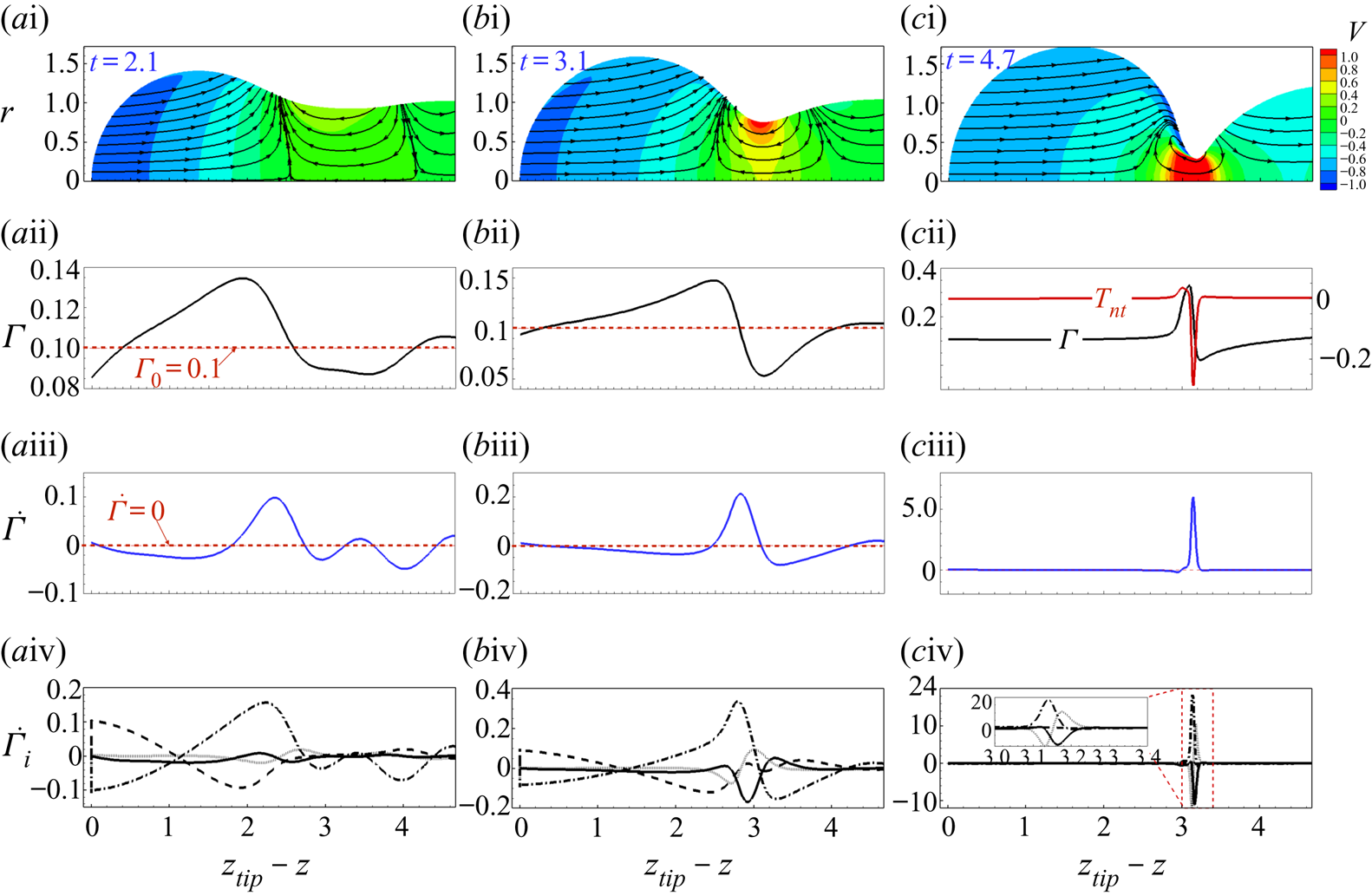
Figure 7(a) depicts at an early time ( $t=2.1$) the filament of figure 6 and certain details of the flow within it and surfactant transport along its interface. Here and throughout figure 7, the axial distance from the tip
 $z_{tip}-z$ is used as the horizontal axis in lieu of the axial coordinate
 $z$. The top frame in figure 7(a) shows the filament in which attention is focused on the region near the tip. Also shown there are the instantaneous streamlines and contours of the axial velocity within the filament. At this instant in time, the retraction process has been under way for some time and bulb formation at the tips has already been initiated. Under the capillary pressure gradient, the fluid flows from the filament's tip toward the filament's centre at the Taylor–Culick (Taylor Reference Taylor1959; Culick Reference Culick1960) (or capillary) velocity scale so that
 $v = -1$ in the large region adjacent to the filament's tip. Hindered by the viscous resistance that it feels as the fluid moves downstream, the flow then sharply turns radially outward and begins accumulating underneath the free surface a small distance
 $z_{tip}-z = 2.3 \sim O(1)$ from the tip. The second and third frames from the top in figure 7(a) show the variation of surfactant concentration
 $\varGamma$ and the instantaneous rate of change of concentration
 $\dot {\varGamma }$ as a function of
 $z_{tip}-z$ at the free surface. The bottom frame of figure 7(a) shows the detailed breakdown of the processes that contribute to the net rate of change of
 $\varGamma$ – namely, those due to convection
 $\dot {\varGamma }_{conv}$ (solid line), normal dilatation of the free surface
 $\dot {\varGamma }_{dil}$ (dashed line), tangential stretching of the free surface
 $\dot {\varGamma }_{str}$ (dashed-dotted line) and diffusion
 $\dot {\varGamma }_{diff}$ (dotted line). Since surfactant is evacuated from the tip,
 $\dot {\varGamma } < 0$ there due nearly entirely to convection, and on account of the fact that dilatation and stretching caused by the bulging of the tip cancel each other out and, moreover, because diffusion is negligible. The surfactant that is transported away from the tip then accumulates near the stagnation zone at the free surface near the nascent neck. There,
 $\dot {\varGamma } > 0$ primarily due to the tangential constriction
 $\dot {\varGamma }_{str} > 0$ of the free surface. Thevariation of
 $\varGamma$ along the free surface at this stage is small,
 $\sim O(0.01)$, as the flow is weak and the amplitude of the surface deformation is small.
Surfactant redistribution and Marangoni stress generation leading to but before escape from endpinching for the filament of figure 6. (ai, bi, ci) Instantaneous shapes of and streamlines and axial velocity  $v$ contours within the filament. (aii, bii, cii) Instantaneous surfactant concentration
 $\varGamma$ and, in one case, Marangoni stress
 $T_{nt}$, profiles along the filament's free surface. (aiii, biii, ciii) Profile of the instantaneous rate of change of surfactant concentration
 $\dot {\varGamma }$ along the filament. (aiv, biv, civ) Profiles of the individual contributions
 $\dot \varGamma _{i}$ to the total rate of change
 $\dot {\varGamma }$ (see text) along the filament.
 $(a)$ Dynamics at early times:
 $t = 2.1$. The value of the initial surfactant concentration
 $\varGamma _0=0.1$ is stated in panel (ii) and marked by a dashed straight line both here and at the next instant in time. The location where
 $\dot {\varGamma } =0$ is shown in panel (iii) and marked by a dashed straight line here and at the next instant in time.
 $(b)$ Dynamics once the blob has formed:
 $t = 3.1$.
 $(c)$ Dynamics just before escape:
 $t = 4.7$. In panel (ii), the Marangoni stress
 $T_{nt}$ profile is shown along with the surfactant concentration
 $\varGamma$ profile.

Figure 7(b) shows the shape and details of the flow within, and surfactant transport along, the interface for the same filament as in figure 7(a) albeit at a later time ( $t = 3.1$). Here, the bulge has assumed an almost spherical blob-like shape, a distinct minimum has formed in the neck connecting the blob to the cylinder, and the inertio-capillary flow has been set up in the neck. The endpinching process has thus been initiated. The axial velocity is now larger in the neck, with the flow initiating from the thread-side stagnation zone and terminating in the blob-side stagnation zone. The surfactant concentration
 $\varGamma$ peaks at the blob-side stagnation zone due to prior accumulation, and drops suddenly and precipitously at the neck. As the velocities are still
 $O(1)$ in the neck, convection is relatively weak, and tangential stretching is the dominant mechanism affecting
 $\dot {\varGamma }$. The slow growth of the blob lends it a small, negative
 $\dot {\varGamma }$ owing to normal dilatation. The large peak in the
 $\dot {\varGamma }$ profile occurs near the blob-side stagnation zone due to strong tangential constriction (
 $\dot {\varGamma }_{str}>0$) at that location, whereas the negative drop in the neck is mainly due to the tangential stretching (
 $\dot {\varGamma }_{str}<0$) caused by the flow. The nature of the flow and surfactant transport that has just been described thereby result in the creation of a large surface gradient in
 $\varGamma$ on the immediate blob-side of the neck. This state of affairs and the magnitude of the surface gradient only exacerbate in time, as made evident by figure 7(c) which shows the same filament at yet a later time (
 $t = 4.7$). While diffusion is active in trying to dampen these effects as
 $Pe$ is in the intermediate range in this case, it is fighting a losing battle and is hence overshadowed by the dominant role played by tangential stretching.
In the second from the top panel of figure 7(c), it proves instructive at  $t=4.7$ to plot the Marangoni stress profile along with the surfactant concentration profile. The Marangoni stress
 $T_{nt}$ is given by
 \begin{equation} T_{nt}= - \frac {\beta}{1 - \varGamma} \left ( \boldsymbol{t} \boldsymbol{\cdot} \boldsymbol{\nabla}_{s}\varGamma \right )\!. \end{equation}
The figure makes plain that a large negative spike in the Marangoni stress profile exists just upstream of the neck at this instant in time. Moreover,  $\dot {\varGamma }$ is large near the blob-side stagnation zone owing predominantly to tangential stretching, which only serves to enhance the magnitude of the negative
 $T_{nt}$ in this region.
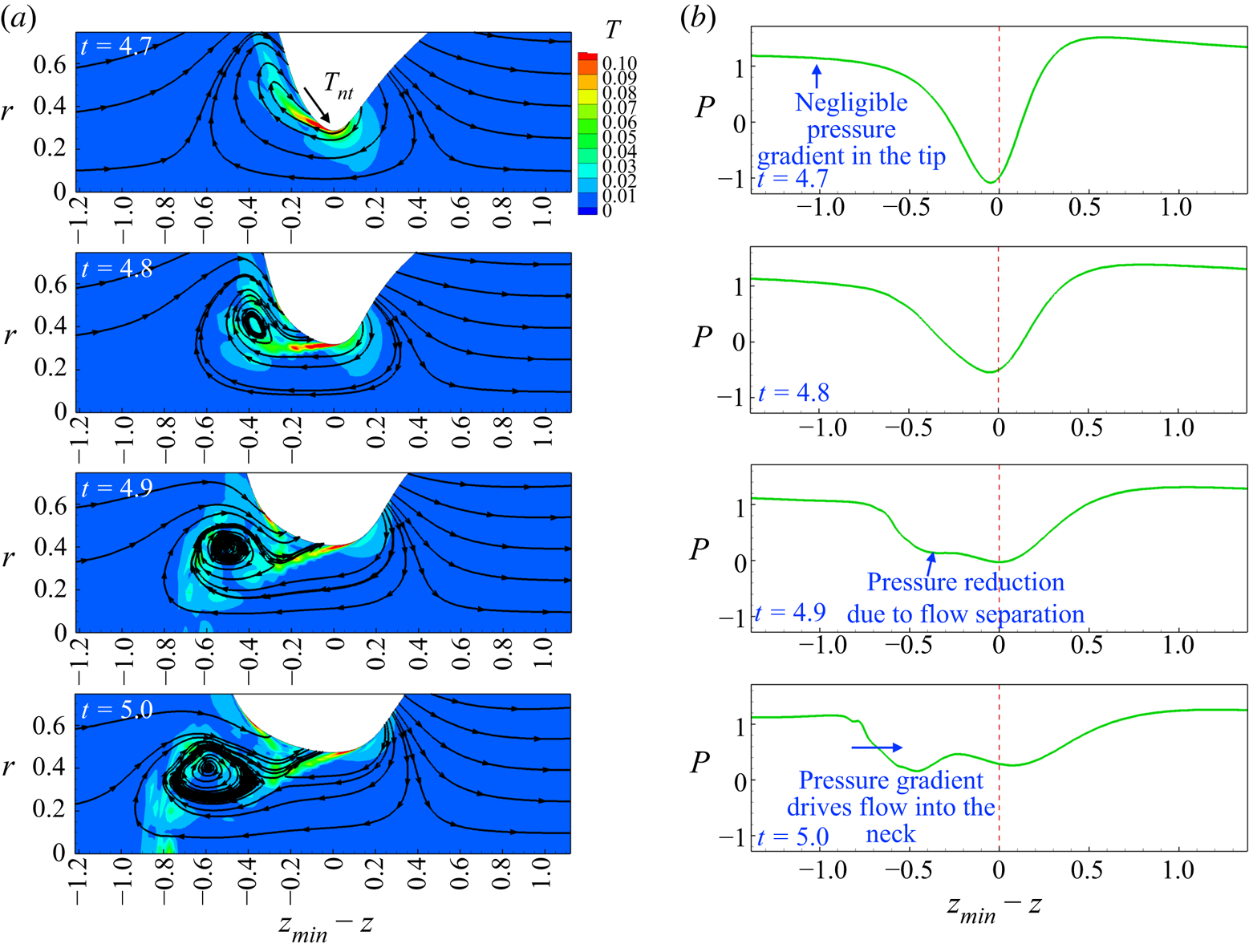
The aforementioned growing Marangoni stress runs counter to the direction of the inertio-capillary flow in the neck. As a result, the free surface acts similarly to the moving plate in an axisymmetric driven cavity and is tantamount to a source of shear stress that is opposed to the direction of flow. The top frame of figure 8(a) shows a magnified view of the neck at this time. Here, the contours depict the magnitude of the viscous stress  $\tau = Oh\dot {\gamma }$, where
 $\dot {\gamma }$ is twice the second invariant of the rate-of-deformation tensor
 $\boldsymbol{\mathsf{D}} = \boldsymbol {\nabla }\boldsymbol {v} + (\boldsymbol {\nabla }\boldsymbol {v})^{T}$. It can be clearly seen from this figure that the large spike in Marangoni stress
 $T_{nt}$ lends a high value of
 $\tau$ that is concentrated at the free surface near the neck. This stress causes the fluid on the blob-side of the neck to reverse direction in a thin boundary layer that is adjacent to the free surface, as depicted by the instantaneous streamlines. Over time, the Marangoni stress grows in magnitude and strengthens this reversal. The flow then separates from the free surface, giving rise to a vortex ring, as can be seen at
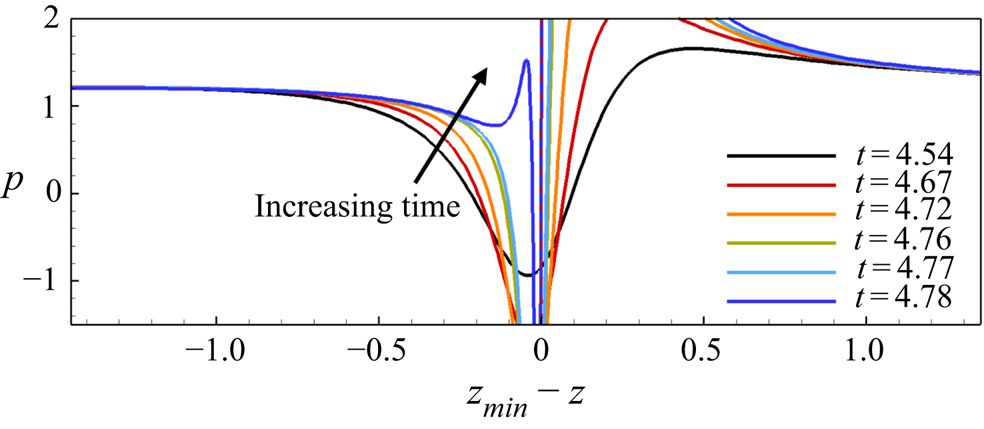
 $t = 4.8$ in figure 8(a). The flow separation causes the blob-side pressure to drop (see figure 8b), or results in a ‘head loss’ as hypothesized by Hoepffner & Paré (Reference Hoepffner and Paré2013). Subsequently, fluid from the tip enters the boundary layer and flows toward the neck, filling it with fluid, as can be seen at
 $t = 4.9$, thereby not only countering but negating the thinning effect of the bulk flow. As a result, the filament successfully escapes endpinching, and the neck begins to reopen by
 $t = 5.0$.
Physics of surfactant-driven escape from endpinching: zoomed-in views of the neck showing flow, stress and pressure profiles.  $(a)$ Top to bottom: evolution in time of the filament profiles near the neck and instantaneous streamlines and stress contours (see text) within the filament. Contour values of the stress
 $T$ are shown at top right. A large Marangoni stress
 $T_{nt}$ already exists at the interface at the earliest time, as indicated in the panel at
 $t=4.7$. As the panels from top to bottom show, the vortex ring is clearly visible at
 $t=4.8$ and the vortex has detached from the surface at
 $t=5.0$.
 $(b)$ Pressure profiles during escape show the ‘head loss’ that occurs due to flow separation, as predicted by Hoepffner & Paré (Reference Hoepffner and Paré2013).

To contrast the dynamics of the surfactant-covered filament that escapes endpinching and which has just been discussed from that of a surfactant-free filament that endpinches, figure 9 shows the time evolution of the pressure profile in the endpinching filament from figure 4(a) ( $Oh = 10^{-3}$,
 $L_0 = 15$,
 $\varGamma _0 = 0$). For the surfactant-free filament, in all the profiles leading up to pinch-off, the secondary pressure minimum in the blob (viz.
 $z_{min} - z < 0$) is noticeably absent, thereby demonstrating it to be a key physical signature of the escape process.
Time evolution of pressure profiles in the blob of a surfactant-free filament undergoing endpinching. Here,  $Oh = 0.001$ and
 $L_0 = 15$. Notice the absence of the ‘head loss’, or the secondary pressure minimum in the blob (
 $z_{min}-z < 0$) that is seen in the surfactant-laden case (cf. figure 8b).

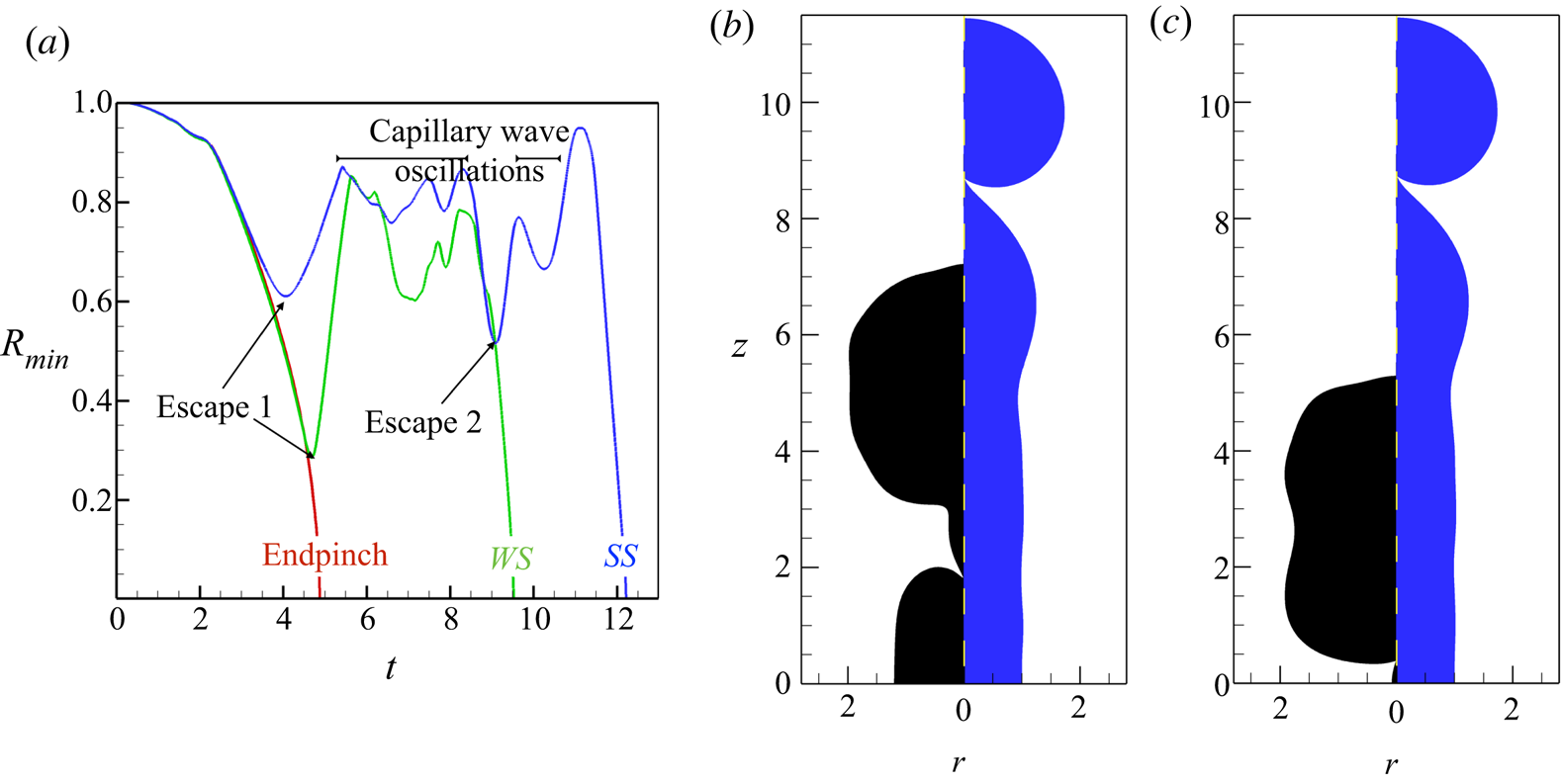
To provide more conclusive evidence that the escape process is indeed driven by Marangoni stress, figure 10(b,c) shows the results of simulations that have been carried out for the same filaments as in figures 6 and 7, respectively, albeit with the Marangoni stress artificially turned off. This is achieved in the Galerkin finite element method formulation by switching off the term  $\boldsymbol {t}\boldsymbol {\cdot } \boldsymbol {\nabla }_{s}\sigma$ in (2.4). As a result, the surfactants are still distributed non-uniformly according to (2.7) and lead to differential lowering in surface tension, but do not produce a tangential stress on the interface. In accordance with our expectations, filaments with the Marangoni stress turned off do not escape endpinching. In summary, it has been demonstrated here in detail how surfactants, by generating Marangoni stress on the free surface, can retard and arrest endpinching of filaments even when the
 $Oh$ (or filament viscosity) is small.
Demonstration that Marangoni stress is essential for escape from endpinching.  $(a)$ Computed variation of the minimum radius of the neck
 $R_{min}$ with time
 $t$ for filaments of
 $Oh=0.001$ and
 $L_0=15$. The filament without surfactant (red curve) endpinches. The surfactant-covered filaments (green and blue curves), both of which have
 $\varGamma _0=0.1$, escape from endpinching. The filament that is identified as WS (green curve), and for which
 $\beta = 0.05$ and
 $Pe=10$, escapes endpinching once. The filament that is identified as SS (blue curve), and for which
 $\beta = 0.2$ and
 $Pe=1000$, escapes endpinching twice. The reopening of the neck, and escape from endpinching, shown here is a consequence of the presence of surfactants at the L–G interface. (
 $b,c$) Shapes of surfactant-covered filaments at breakup: WS case, (b), and SS case,(c). In each panel, a side-by-side comparison is provided of the breakup shapes of filaments with the full model, i.e. with the Marangoni stress turned on (left-hand side of the axis of symmetry, profile shaded black) and that with the Marangoni stress turned off (right-hand side of the axis of symmetry, profile shaded blue). As can be seen from the filaments shaded in blue, artificially turning off Marangoni stress for the two surfactant-covered filaments of panel
 $(a)$ leads to endpinching.

7. Escape from endpinching and vorticity generation at the free surface
Escape from endpinching is well known to occur also in surfactant-free filaments of intermediate Ohnesorge numbers ( $Oh \approx 10^{-2}$), as first shown by Notz & Basaran (Reference Notz and Basaran2004). Simulations reveal that these filaments can undergo several – up to as many as 10 – escape events during retraction, and that this process is independent of
 $L_{0}$ as long as the initial aspect ratio lies above the critical value
 $L_{0,c}$ required for pinch-off (Anthony etal. Reference Anthony, Kamat, Harris and Basaran2019). Interestingly, we observe several similarities between surfactant-driven escape from endpinching studied in the previous section and that in surfactant-free filaments (Hoepffner & Paré Reference Hoepffner and Paré2013). A common feature of the dynamics in the two cases is the reversal of flow within a boundary layer which forms at the free surface. The boundary layer formation in surfactant-free filaments is driven by a viscous mechanism and therefore only occurs at higher values of
 $Oh$ whereas it is driven by Marangoni stress in the presence of surfactants and can therefore also occur at low
 $Oh$. In both cases, however, this reversal drives flow separation to take place which then results in the formation of a vortex ring in the blob, as can be clearly seen in figure 8 as well as in the experiments of Hoepffner & Paré (Reference Hoepffner and Paré2013).
The similarities in the two cases raise some important questions. First, why does a viscous boundary layer originate at the free surface at intermediate  $Oh$ in surfactant-free filaments? Second, how is it possible that two very distinct physical phenomena – Marangoni stresses at a filament's free surface and viscous effects in the filament's bulk – can cause the occurrence of the same set of complex physics that result in escape from endpinching? Specifically, it is natural to ask whether all escape events in filaments can be characterized as a single physical process. To answer these questions, it is useful to note that the formation of a boundary layer within a potential flow field goes hand in hand with the generation of vorticity
 $\boldsymbol {w}= \boldsymbol {\nabla } \times \boldsymbol {v}$ in that region (Lighthill Reference Lighthill1963; Deen Reference Deen2012). Therefore, it should be possible to appreciate the physical origins of boundary layer formation (and hence escape from endpinching), and to understand its dependence on system parameters, by studying the rate of change of vorticity in a contracting filament.
The introduction of vorticity into free surface flows via boundary layers has been extensively studied in the literature (Rood Reference Rood1994; Lundgren & Koumoutsakos Reference Lundgren and Koumoutsakos1999; Brøns et al. Reference Brøns, Thompson, Leweke and Hourigan2014). The starting point of such analyses is the microscopic vorticity transport equation. This well known equation is obtained by taking the curl of the momentum equation (2.2), thereby eliminating the pressure gradient term, and can be written as
 \begin{equation} \frac{\textrm{D}\boldsymbol{w}}{\textrm{D}t}= \boldsymbol{w}\boldsymbol{\cdot} \boldsymbol{\nabla}\boldsymbol{v} + Oh\boldsymbol{\nabla}^{2}\boldsymbol{w}. \end{equation}
The rate of generation of vorticity in a macroscopic volume  $V(t)$ enclosed by the free surface
 $S(t)$ can then be obtained by integrating (7.1) over
 $V(t)$ and applying the appropriate kinematic (2.3) and traction (2.4) boundary conditions at the free surface. In a surfactant-free filament the macroscopic vorticity balance is
 \begin{equation} \frac{\textrm{D}}{\textrm{D}t} \int_{V(t)}\boldsymbol{w} \, \text{d}V= \int_{V(t)}\boldsymbol{w}\boldsymbol{\cdot} \boldsymbol{\nabla}\boldsymbol{v} \, \text{d}V + 2Oh \int_{S(t)} \boldsymbol{e}_{\theta}\boldsymbol{n}\boldsymbol{\cdot}\boldsymbol{\nabla}\left( \frac{\partial v_{n}}{\partial s} - \kappa_t v_{t}\right)\,\text{d}S, \end{equation}
where  $\boldsymbol {e}_{\theta }$ is the unit vector pointing in the azimuthal direction and
 $\kappa _t$ is the principal curvature of the free surface in the plane of flow. The first term is the rate of accumulation of vorticity in
 $V(t)$. The second term describes the local amplification of vorticity produced by stretching of vortex lines. The last term on the right-hand side of (7.2), a surface integral over the free surface, is the source term for vorticity. For an initially irrotational flow, vorticity is generated at the free surface and diffuses into the bulk from the L–G interface; the terms in the integral clearly show that the highest vorticity flux occurs in regions of high in-plane curvature where the tangential velocity is non-zero and the interface is undergoing motion in the direction normal to itself.
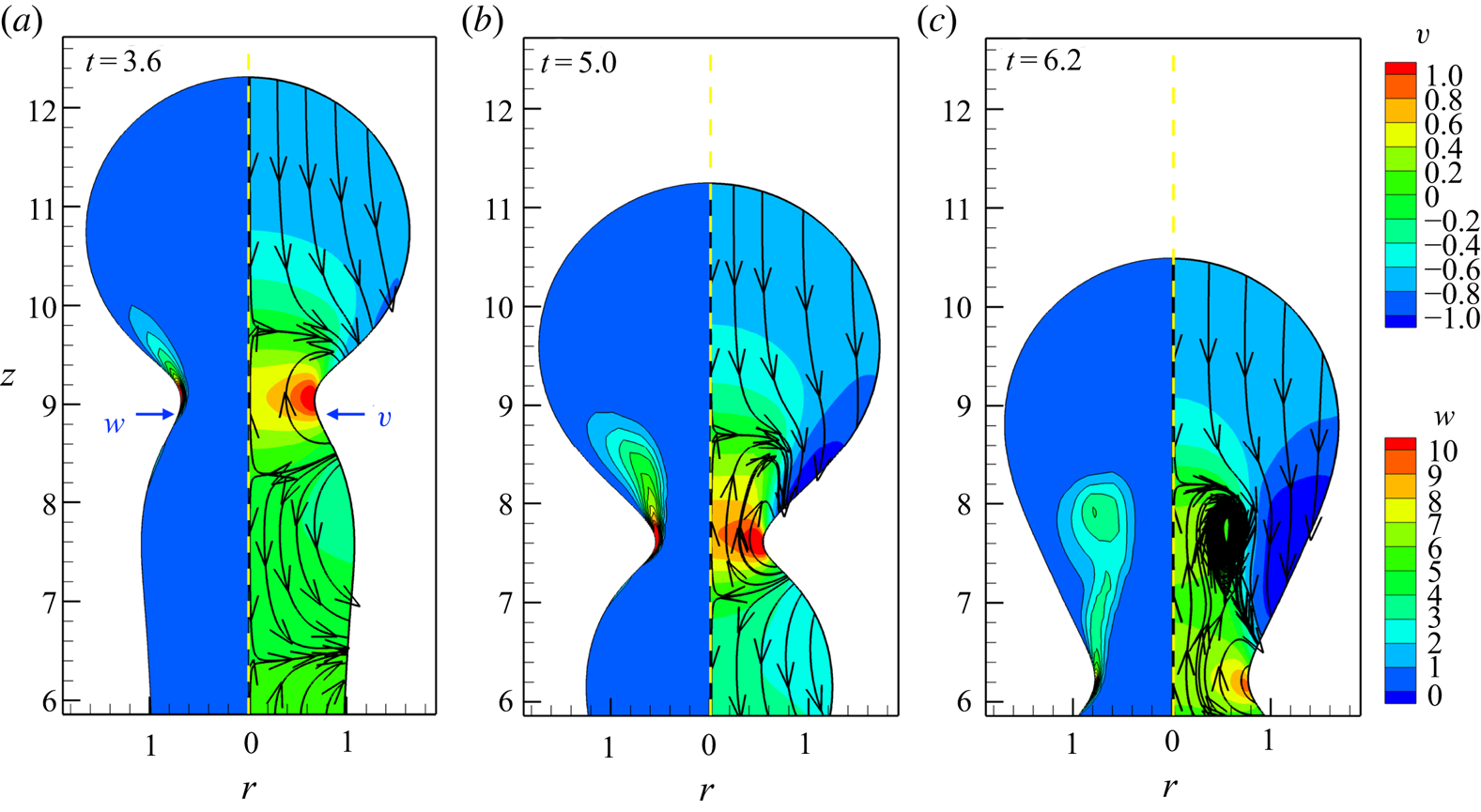
A perfect example of such a region is the thinning neck of a filament as it approaches endpinching. This is clearly evident in figure 11 which shows vorticity contours and streamlines for the filament of  $Oh = 0.01$ and
 $L_{0}=15$ during the escape process. At early times (a), the flow around the highly curved neck leads to the generation of small vorticity in its vicinity. As time proceeds, the curvature of the neck increases, and by
 $t = 5.0$ (b) a large amount of vorticity can be observed on the blob-side of the neck where the curvature, the rate of thinning of the neck, and the accompanying fluid motion in the normal direction to the interface, and that in the tangential direction to the free surface are all large. This vorticity generation coincides with the formation of the noticeable velocity boundary layer that is attached to the free surface, a substantive flow tangential to the free surface, and where flow separation will soon commence. These developments in the flow field signal that the escape process has thus begun: soon the back-flow within the boundary layer will refill the neck with fluid from the tip and cause it to reopen (Hoepffner & Paré Reference Hoepffner and Paré2013). After the filament escapes endpinching, at
 $t = 6.2$ (c), the viscous diffusion of the vorticity into the bulk leads to the growth of the boundary layer and the separation of the vortex ring.
Vorticity and boundary layer formation in a surfactant-free filament of  $Oh= 0.01$ and
 $L_{0}=15$ undergoing escape from endpinching. Snapshots of the dynamics at three different instants in time: at early times as blob formation is occurring (a), at an instant just prior to escape (b) and at an instant after escape (c). In each panel, aside from the filament profile, contours of the axial velocity
 $v$ along with the instantaneous streamlines indicating the direction of flow are shown to the right of the axis of symmetry
 $r=0$ and contours of the norm of the vorticity
 $w = \|\boldsymbol {w}\|$ are shown to the left of
 $r=0$. Contour legends for each variable that apply to all three panels are shown on the extreme right.

The time scale for vorticity generation  $t_w$ can be obtained by balancing the first and last terms from (7.2), and is found to be the inertial-viscous time scale
 $t_{\boldsymbol {w}} = t_{c}/Oh = \rho R^{2}/\mu$. When
 $Oh$ is sufficiently small,
 $t_{\boldsymbol {w}}$ is significantly larger than
 $t_{c}$, the time scale over which inertio-capillary pinch-off takes place. Therefore when
 $Oh \to 0$, significant vorticity generation cannot take place before pinch-off occurs in low-
 $Oh$ filaments. This realization helps explain why these filaments cannot escape endpinching.
The discussion provided in the previous paragraphs can be extended to elucidate why low- $Oh$ filaments can escape endpinching when they are covered with surfactant. In the presence of surfactants, the tangential stress boundary condition at the free surface (2.4) has an added term proportional to
 $\boldsymbol {\nabla }_{s}\sigma$. Under this modification, the macroscopic vorticity balance becomes (see also Xu Reference Xu2007)
 \begin{align} \frac{\textrm{D}}{\textrm{D}t} \int_{V(t)}\boldsymbol{w} \, \text{d}V&= \int_{V(t)}\boldsymbol{w}\boldsymbol{\cdot} \boldsymbol{\nabla}\boldsymbol{v} \, \text{d}V + 2Oh \int_{S(t)} \boldsymbol{e}_{\theta}\boldsymbol{n}\boldsymbol{\cdot}\boldsymbol{\nabla}\left( \frac{\partial v_{n}}{\partial s} - \kappa_t v_{t}\right)\,\text{d}S\nonumber\\ &\quad + \int_{S(t)} \boldsymbol{e}_{\theta}\boldsymbol{n}\boldsymbol{\cdot}\boldsymbol{\nabla}(- T_{nt}) \, \text{d}S. \end{align}
It is noteworthy that a new contribution to vorticity generation (that last surface integral on the right-hand side of the equation) arising from the Marangoni stress at the free surface  $T_{nt}= \boldsymbol {t}\boldsymbol {\cdot } \boldsymbol {\nabla }_{s}\sigma$ has now entered the vorticity balance. Moreover, it is important to note that this Marangoni-driven flux of vorticity from the free surface is independent of
 $Oh$ and is therefore active even in nearly inviscid filaments, i.e. as
 $Oh \to 0$. Furthermore, the vorticity flux due to the action of the Marangoni stress is large when the magnitude of
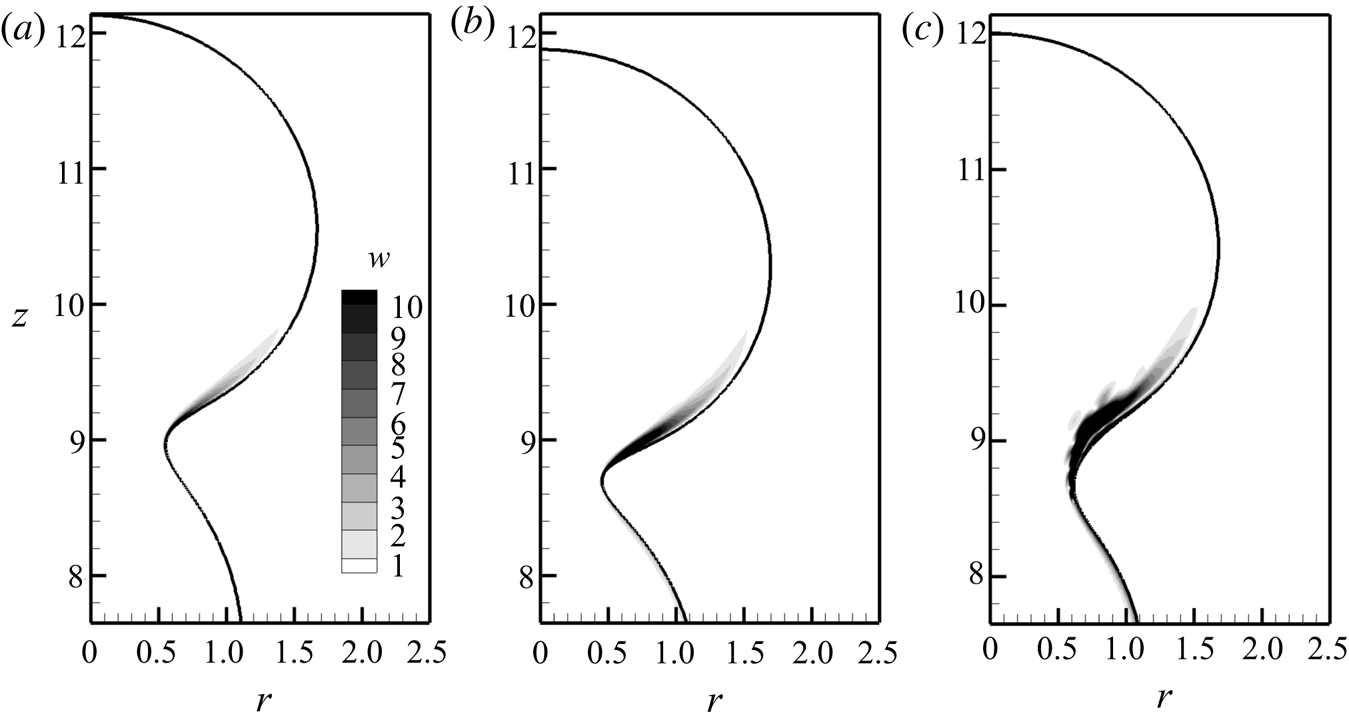
 $T_{nt}$ is large and its sign negative. Both of these conditions are always true on the blob-side in the vicinity of the neck in filaments undergoing breakup (cf. figure 7c). A large amount of vorticity is generated in only those filaments that escape endpinching, as can be seen in simulation results shown in figure 12.
Vorticity in surfactant-covered filaments of  $Oh= 0.001$,
 $L_{0}=15$ and
 $\varGamma _0=0.1$. Filament profiles and contours of the norm of the vorticity
 $w = \|\boldsymbol {w}\|$ for
 $(a)$ a filament of
 $\beta =0.3$ and
 $Pe=0.01$ at
 $t=3.9$,
 $(b)$ a filament of
 $\beta =0.05$ and
 $Pe=10$ at
 $t=4.2$ and
 $(c)$ a filament of
 $\beta =0.2$ and
 $Pe=1,000$ at
 $t=4.2$. The contour legend for
 $w$ shown in panel
 $(a)$ applies in (
 $a$)–(
 $c$). The figure makes plain that large vorticity accumulation is a prerequisite for escape from endpinching (cases
 $b$ and
 $c$).

For  $Oh \ll 1$, vorticity generation is wholly reliant on the last term in the macroscopic vorticity equation. Balancing the first and the last terms in the macroscopic vorticity equation shows that owing to the presence of surfactants, vorticity is now generated over a time scale equal to the capillary time scale:
 $t_{\boldsymbol {w}} \approx t_{c}$. As a result, velocity reversal and boundary layer formation can occur on the time scale of pinch-off and surfactants can thereby induce escape from endpinching in filaments of low and intermediate values of
 $Oh$. For larger values of
 $Oh$, i.e.
 $Oh \sim 1$ and
 $Oh \gg 1$, a large amount of vorticity is still generated at the interface and transferred to the bulk but these effects are negated by the large viscous dissipation in the bulk, as has already been demonstrated in previous work (Notz & Basaran Reference Notz and Basaran2004).
8. Concluding remarks and future work
According to the foregoing results, escape from endpinching is driven by the same physical mechanism in both surfactant-free and surfactant-laden filaments. In both cases, the escape is due to large vorticity generation in the vicinity of the thinning neck of contracting filaments. Presence of surfactants at the L–G interface introduces an additional means due to the action of Marangoni stresses for filaments to escape from endpinching over and beyond what is possible in surfactant-free filaments. Hence, surfactant-covered filaments can escape from endpinching even in the limit of vanishingly small Ohnesorge number whereas surfactant-free filaments can only escape from endpinching when the Ohnesorge number is sufficiently large (Notz & Basaran Reference Notz and Basaran2004; Hoepffner & Paré Reference Hoepffner and Paré2013). Moreover, in any filament, if vorticity generation and accumulation can occur on the time scale of pinch-off, then that filament can escape endpinching as it contracts. This is a noteworthy finding as spray formulations in industry are typically non-Newtonian in nature, and contain suspended particles or dissolved polymers and/or surface active compounds. The significance arises from the fact that droplet size distributions in such sprays are governed to a large extent by the filament retraction and breakup process (Villermaux Reference Villermaux2007; Fezzaa & Wang Reference Fezzaa and Wang2008; Planchette et al. Reference Planchette, Marangon, Hsiao and Brenn2019). Therefore, one direct and important future application of the basic fluid mechanical understanding on vorticity generation and dissipation resulting from the present paper would be to provide important guidance on predicting the prevalence and significance of endpinching in a distribution of filaments formed in industrially relevant spray or atomization systems.
Filaments of sufficiently small aspect ratios do not break but can undergo oscillations and exhibit rich nonlinear dynamics (Notz & Basaran Reference Notz and Basaran2004; Anthony et al. Reference Anthony, Kamat, Harris and Basaran2019). The oscillations of such free elongated drops (Lundgren & Mansour Reference Lundgren and Mansour1988; Patzek et al. Reference Patzek, Benner, Basaran and Scriven1991; Basaran Reference Basaran1992; Apfel et al. Reference Apfel, Tian, Jankovsky, Shi, Chen, Holt, Trinh, Croonquist, Thornton and Sacco1997) as well as those of supported drops (Basaran & De Paoli Reference Basaran and De Paoli1994; Wilkes & Basaran Reference Wilkes and Basaran1997) and free/supported bubbles (Glazman Reference Glazman1984; Fyrillas & Szeri Reference Fyrillas and Szeri1995; Johnson & Stebe Reference Johnson and Stebe1994) are also of interest, e.g. in measurement of dynamic surface tension and other physical properties (Franses, Basaran & Chang Reference Franses, Basaran and Chang1996; Liao, Basaran & Franses Reference Liao, Basaran and Franses2006a). Current understanding of oscillations in such surfactant-laden systems is in its infancy compared with that of drops/bubbles of Newtonian fluids with clean interfaces, experimental investigations into surfactant effects are severely lacking in their appreciation of Marangoni stress effects. For example, in a recent study on drop breakup, Ponce-Torres et al. (Reference Ponce-Torres, Montanero, Herrada, Vega and Vega2017) have carried out a theoretical analysis in which they have accounted for various effects due to the presence of surfactants at an interface. However, they have not accounted for the effects of Marangoni stresses when developing fits to data on frequencies of drop oscillations that they have obtained from experiments. Carrying out research aimed at overcoming these limitations constitutes a noteworthy and fruitful area of future study in fluid mechanics.
In addition to surface tension lowering and Marangoni stresses, surfactants also induce surface rheological effects when they deform against themselves at fluid interfaces (Wee et al. Reference Wee, Wagoner, Kamat and Basaran2020). Surprisingly, little work has been done on problems involving interface rupture when surface viscosities are important. For example, Ponce-Torres et al. (Reference Ponce-Torres, Montanero, Herrada, Vega and Vega2017) have uncovered that the increase in surfactant accumulation in satellite droplets during drop formation cannot be explained without accounting for surface viscosities and Martínez-Calvo & Sevilla (Reference Martínez-Calvo and Sevilla2018) have shown that surface viscosities have a stabilizing influence on the dynamics in the Rayleigh–Plateau instability of liquid jets covered with a monolayer of insoluble surfactant. It would be of great fundamental and practical importance if analyses were carried out to study contraction of filaments in the presence of surface rheological effects by accounting for the effects of surface viscosities as in the aforementioned papers (Ponce-Torres et al. Reference Ponce-Torres, Montanero, Herrada, Vega and Vega2017; Martínez-Calvo & Sevilla Reference Martínez-Calvo and Sevilla2018).
A key aspect of the numerical analysis presented here is investigating whether Marangoni stress or the local lowering of surface tension – solutocapillary effect – is the dominant mechanism that determines whether escape from endpinching occurs during filament contraction. Historically, the approach taken to answer this question has been to use small values of the Péclet number ( $Pe \ll 1$) or making the surfactant highly diffusive in order to eliminate surfactant concentration gradients to conclude whether Marangoni stress is weak or subdominant (Milliken, Stone & Leal Reference Milliken, Stone and Leal1993; Craster, Matar & Papageorgiou Reference Craster, Matar and Papageorgiou2002) in a given free surface flow. However, that approach has the effect of simultaneously altering both the Marangoni and local solutocapillary effects, and is therefore not completely reliable. Here, we show the importance of Marangoni stress in escape by selectively turning-off Marangoni stress terms (cf. figure 10) in the traction boundary condition, a feat that is readily accomplished in a simulation but would be difficult if not impossible to realize in the laboratory. This approach was first used by Kamat et al. (Reference Kamat, Wagoner, Thete and Basaran2018) and it has allowed us here to make an unequivocal conclusion: Marangoni stress is the dominant mechanism in escape, as escape does not occur when Marangoni stresses are turned off but the solutocapillary effects continue to act without being impeded. Surfactant-laden free surface flows are typically complex and the different forces at play have codependencies that make it difficult to delineate the individual effect of each physical mechanism in isolation of others (Scriven & Sternling Reference Scriven and Sternling1960). According to the foregoing analyses, the technique employed here will prove useful in future investigations of free surface flows of surfactant-laden fluids. Indeed, this approach is likely to be especially useful in determining the importance of surface viscosities compared with the classical surface tension effects considered here, a debate that has not yet been conclusively settled.
In this paper and in virtually all others that have heretofore addressed the dynamics of contracting filaments, attention has been focused on the dynamics that occurs prior and up to the instant of first pinch-off (Notz & Basaran Reference Notz and Basaran2004; Wang et al. Reference Wang, Contò, Naz, Castrejón-Pita, Castrejón-Pita, Bailey, Wang, Feng and Sui2019). The algorithm employed in this paper can be used to simulate the dynamics in the aftermath of the first pinch-off, as shown in Basaran et al. (Reference Basaran, Gao and Bhat2013). Among other things, it would be worthwhile to investigate how surfactants can modify the dynamics as a filament undergoes repeated pinch-offs as it recoils.
Acknowledgments
O.A.B. acknowledges with thanks the financial support provided by the Purdue Process Safety and Assurance Center (P2SAC) and the Gedge Professorship. A.A.C.P. is funded by the Royal Society through a University Research Fellowship URF/R/180016.
Declaration of interests
The authors report no conflict of interest.