Non-suicidal self-injury (NSSI) is the intentional destruction of body tissue without suicidal intent (Nock & Favazza, Reference Nock, Favazza and Nock2009). The prevalence of NSSI among adolescents and young adults ranges from 13% to 23% (Ross & Heath, Reference Devries2002; Jacobson & Gould, Reference Jacobson and Gould2007). NSSI typically begins in adolescence (Ross & Heath, Reference Ross and Heath2002; Whitlock & Knox, Reference Whitlock and Knox2007), and women are more likely than men to report lifetime NSSI (Bresin & Schoenleber, Reference Bresin and Schoenleber2015).
In contrast to NSSI, suicidal thoughts and behaviors (STBs) include intent to die [e.g. suicidal ideation (SI) and suicide attempts (SAs); Mann, Reference Mann2002]. Approximately 13.5% of adults in a nationally representative survey reported lifetime SI and 4.6% reported lifetime SA (Kessler et al. Reference Kessler, Borges and Walters1999). Similar to NSSI, STBs often begin in adolescence (Nock et al. Reference Nock2008; Darke et al. Reference Darke2010), and women are more likely to attempt suicide than men (Nock et al. Reference Nock2008). STBs are differentiated from NSSI in terms of the frequency and lethality of the behaviors, feelings of hopelessness, and attitudes about life (Guertin et al. Reference Guertin2001; Muehlenkamp & Gutierrez, Reference Muehlenkamp and Gutierrez2004; Muehlenkamp & Gutierrez, Reference Muehlenkamp and Gutierrez2007).
NSSI and STBs co-occur: 70% of inpatient and 50% of community adolescents who engage in NSSI report at least one lifetime suicide attempt (Nock et al. Reference Nock2006; Muehlenkamp & Gutierrez, Reference Muehlenkamp and Gutierrez2007). Co-occurring NSSI and STBs confer greater risk for negative outcomes than NSSI or STBs alone. In comparison to individuals who engage only in STBs, individuals who engage in both NSSI and STBs exhibit increased rates of suicidal ideation, plans, and attempts (Whitlock & Knox, Reference Whitlock and Knox2007). They report using more lethal means to attempt suicide (Andover & Gibb, Reference Andover and Gibb2010) and endorse greater frequency of self-harm (Jacobson et al. Reference Jacobson2008) and a higher likelihood of engaging in moderate-to-severe forms of NSSI (Lloyd-Richardson et al. Reference Lloyd-Richardson2007).
Several theories seek to explain the relation between NSSI and STBs (see, e.g. Selby et al. Reference Selby2015). One theory suggests that NSSI and STBs are on a continuum, with NSSI at one end and completed suicide at the other (Linehan, Reference Linehan1986; Muehlenkamp, Reference Muehlenkamp2005). This is supported by many cross-sectional studies and several longitudinal analyses (e.g. Ribeiro et al. Reference Ribeiro2016; Willoughby et al. Reference Willoughby, Heffer and Hamza2015) that have found NSSI to be predictive of STBs. Similarly, Joiner's theory of an acquired capability for suicide proposes that NSSI is a precursor to STBs and facilitates habituation to the fear and pain associated with self-harm and ultimately taking one's life (Joiner, Reference Joiner2005). This is supported by research suggesting that individuals who engage in NSSI report increased pain tolerance and suicidal capability (Hooley et al. Reference Hooley2010; Franklin et al. Reference Franklin, Hessel and Prinstein2011). In addition, more frequent NSSI, using various methods of NSSI, and number of years spent engaging in NSSI have been found to predict the frequency and lethality of suicide attempts (Nock et al. Reference Nock2006; Andover & Gibb, Reference Andover and Gibb2010).
Another theory suggests that the relation between NSSI and STBs reflects common risk factors, including psychiatric disorders and heritable influences (Nock et al. Reference Nock2006; Sher & Stanley, Reference Sher, Stanley and Nock2009). Maciejewski et al. (Reference Maciejewski2014) observed that the correlation between lifetime NSSI and SI was predominantly explained by shared genetic factors (76% for men, 62% for women). Durrett (Reference Durrett2006), employing a sample of female twins, found that genetic influences explained 47% of the relation between NSSI and suicide attempts. However, no genetically informative studies have modeled NSSI, SI, and SA simultaneously. Estimating the genetic and environmental contributions common to all three outcomes can help to capture a greater range of severity in psychopathology and impairment and inform theoretical and etiologic models of the relations between NSSI and STBs.
Trauma exposure has been linked with NSSI and STBs (Turner et al. Reference Turner2012; Devries et al. Reference Devries2014; Dworkin et al. Reference Dworkin2017; Liu et al. Reference Liu2018). The extent to which these associations reflect causal mechanisms, however, remains unclear. Heritable factors have been found to play a role in exposure to certain types of traumatic events, including assaultive trauma (McCutcheon et al. Reference McCutcheon2009; Afifi et al. Reference Afifi2010). In addition, common genetic influences underlie trauma exposure and PTSD (Sartor et al. Reference Sartor2011) and other psychiatric conditions associated with self-harm and suicide, including depression (Koenen et al. Reference Koenen2008; Afifi et al. Reference Afifi2010; Sartor et al. Reference Sartor2012). Thus, genetic influences may increase vulnerability to both traumatic experiences and psychopathology.
However, genetically informed studies also indicate that trauma exposure may confer direct risk for self-injurious thoughts and behaviors. Studies of discordant twins, which control for family background factors that may confound associations between trauma and psychopathology, suggest that childhood sexual abuse is associated with risk for later SA (Nelson et al. Reference Nelson2002) and other mental health problems (Kendler et al. Reference Kendler2000), and trauma exposure and victimization in adolescence and young adulthood are related to risk for psychopathology (e.g. Brown et al. Reference Brown2014; Schaefer et al. Reference Schaefer2017). [It should be noted, however, that discordant twin studies of trauma exposure and STBs are limited, and other analyses (e.g. Dinwiddie et al. Reference Dinwiddie2000) have obtained more modest or non-significant within-pair associations.]
Similar inferences regarding causality may be drawn from biometric models. If trauma exposure itself increases risk for self-injurious thoughts and behaviors, one would expect to observe the relation after controlling for common heritable and environmental influences. Thus, significant overlap in their unique environmental influences would provide evidence of a ‘quasi-causal’ relation (Turkheimer & Harden, Reference Turkheimer, Harden, Reis and Judd2014). [The term ‘quasi-causal’ is used because although within-twin-pair analyses control for a range of unmeasured risk factors, they may be confounded by variables that differ within pairs and relate to both the exposure and the outcome (Turkheimer & Harden, Reference Turkheimer, Harden, Reis and Judd2014).] To date, no research has examined the genetic and environmental overlap between trauma exposure and the full range of self-injurious thoughts and behaviors. Such work is necessary to further our understanding of the associations between traumatic experiences and life-threatening behaviors, and guide the development of appropriate assessment and treatment strategies.
This study employed data from two population-based twin samples to conduct a multivariate behavioral genetic analysis of high-risk trauma exposure and self-injurious thoughts and behaviors. First, we estimated the genetic and environmental contributions to high-risk trauma. Second, we estimated the shared and unique genetic and environmental contributions to NSSI, SI, and SA. Finally, we modeled high-risk trauma and self-injurious thoughts and behaviors simultaneously to examine the degree of overlap in their genetic and environmental influences. Significant genetic and/or shared environmental overlap would provide evidence that a common familial liability explains their association. A significant relation between their unique environmental influences would provide evidence that high-risk trauma exposure may exert some influence on the general risk for self-injurious thoughts and behaviors.
We proposed three hypotheses. First, we hypothesized that high-risk trauma exposure would be partly explained by genetic factors. Second, we hypothesized that NSSI, SI, and SA would share significant genetic liability. Finally, we predicted that there would be significant genetic overlap between high-risk trauma and self-injurious thoughts and behaviors.
Methods
Participants
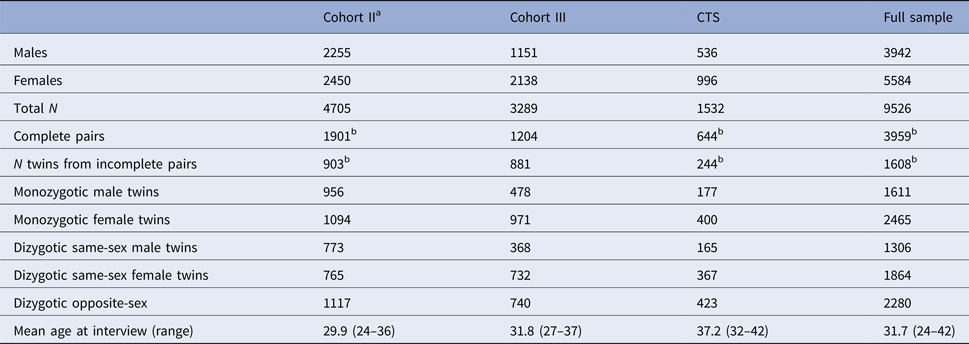
Participants were 9526 monozygotic (MZ) and dizygotic (DZ) twins from two cohorts of the Australian Twin Registry (Table 1). Cohort II completed a diagnostic interview based on the Semi-Structured Assessment for the Genetics of Alcoholism (SSAGA-OZ; Bucholz et al. Reference Bucholz1994) between 1996 and 2000 (n = 6265 twins; Heath et al. Reference Heath2001; Knopik et al. Reference Knopik2004). A separate sample, Cohort III, completed an interview based on the SSAGA-OZ in 2005–2009 (n = 3348 twins and 476 non-twin siblings; Lynskey et al. Reference Lynskey2012). Also included were data from the Childhood Trauma Study (CTS; n = 3434), which includes twins from Cohort II identified by responses to screening questions indicating childhood abuse (n = 1532; Nelson et al. Reference Nelson2010). In 2003–2008, CTS participants completed interviews modified from the SSAGA-OZ and the Christchurch Trauma Assessment (Fergusson et al. Reference Fergusson1989; Lynskey & Fergusson, Reference Lynskey and Fergusson1997). Some members of Cohort II (n = 44 of the present sample) also provided data through the Nicotine Addiction Genetics Study, a multisite genetic study of tobacco use and related behaviors (Saccone et al. Reference Saccone2007).
Sample characteristics
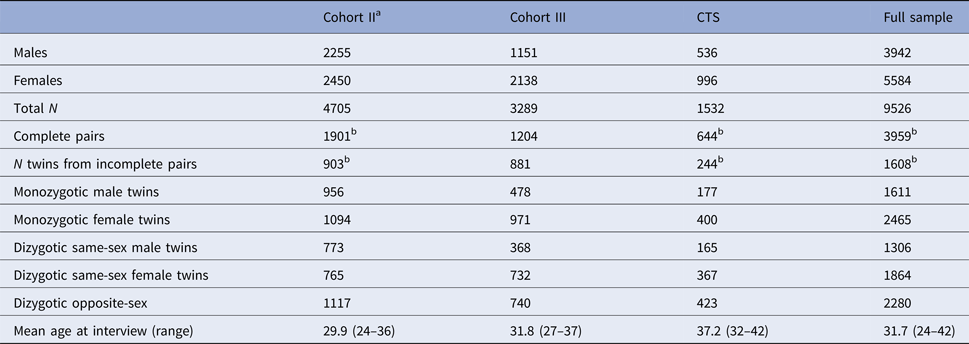
a Indicates twins from Cohort II who completed the 1996–2000 assessment but did not participate in the Childhood Trauma Study.
b There were 210 twin pairs (n = 420 individual twins) from Cohort II in which one twin participated in the CTS assessment and their co-twin did not. These individuals are excluded from the totals for complete pairs and included in the totals for incomplete pairs within Cohort II and CTS. Thus, the Ns derived when summing across the sub-samples differ from the Ns reported for the full sample (n pairs = 3749 v. 3959; n subjects = 2028 v. 1608).
The 9526 participants included in the analyses consisted of twins who provided data for at least one outcome. Individuals with missing data were included (see Statistical analysis section). CTS participants were independent of Cohort II participants in all analyses.
Procedure
The Cohort II assessment was administered by telephone using a paper interview, and the Cohort III and CTS assessments were administered by telephone using computer-assisted interviews. Trained lay interviewers were unaware of the status of the co-twin. Participants provided written and verbal consent. Study procedures were approved by the ethical review boards at the Washington University School of Medicine and the Queensland Institute of Medical Research.
Measures
Non-suicidal self-injury
All participants were asked if they had ever harmed themselves on purpose, other than times when they tried to take their own lives, and were asked what they had done. NSSI was coded as a dichotomous variable indicating whether an individual had ever engaged in any self-harm. Participants administered multiple assessments of NSSI were coded as positive if they endorsed NSSI on at least one assessment.
Suicidal ideation
All participants were queried, ‘Have you ever thought about taking your own life?’ In Cohort III and CTS, SI was also queried within the assessment of major depressive disorder (MDD). Because the Cohort II assessment of SI within the MDD module included passive wish for death, this item was not used. SI was coded as a binary variable indicating if individuals had ever reported ideation. Participants administered multiple assessments of SI were coded as positive if they endorsed ideation on at least one assessment.
Suicide attempt
Participants in all samples, regardless of their history of SI, were asked, ‘Have you ever tried to take your own life?’ SA was also queried during the assessment of MDD. SA was operationalized as a dichotomous variable indicating if individuals had ever tried to take their own life. Respondents who endorsed SA on any assessment were coded as positive.
High-risk trauma exposure
History of trauma exposure was assessed among all Cohort II participants. Trauma exposure was coded as a binary variable indicating whether an individual reported having ever experienced a high-risk traumatic event. CTS participants who reported high-risk trauma at either the 1996–2000 interview or the 2003–2008 interview were coded as positive. HRT was defined to include exposure to rape, sexual molestation, physical abuse during childhood, and serious neglect during childhood. Individuals who reported no trauma or traumatic experiences defined as low risk (e.g. fire, flood, natural disaster) were coded as unaffected. Traumatic events were classified empirically based on the relative risk of PTSD associated with each event (Sartor et al. Reference Sartor2012). Traumatic event exposure was not assessed in Cohort III participants and thus they were coded as missing for trauma exposure.
Statistical analysis
Descriptive analyses were performed using both Mplus (version 7; Muthén & Muthén, Reference Muthén and Muthén1998–2015) and SAS (version 9.4; SAS Institute Inc., Cary, NC). Survey analysis procedures were employed to obtain correct standard errors. Data were treated as clustered in all analyses, with the family number for each twin pair specified as the clustering variable.
Twin modeling
Biometric models were fitted directly to the raw data by the method of robust weighted least squares (WLSMV) using Mplus. Biometric modeling provides the opportunity to decompose the variance of a trait and the covariance among traits into additive genetic (A), dominant genetic (D), shared environmental (C), and non-shared environmental (E) components. D and C are confounded within the twin design and are estimated in separate models. Univariate model fitting was conducted with high-risk trauma. We fit a common pathway model (CPM; online Supplementary Fig. S1) to the data for NSSI, SI, and SA. The CPM specifies genetic, shared environmental or dominant genetic, and unique environmental factors that are common to all outcomes and are mediated through a latent phenotype (indicated here as ‘self-injurious thoughts and behaviors’). In addition, the model specifies genetic and environmental factors that are specific to all outcomes.
To evaluate the genetic and environmental overlap between high-risk trauma and self-injurious thoughts and behaviors, we fit a correlated factors model to the data (online Supplementary Fig. S2). In this model, the relation between outcomes is modeled in terms of correlations in the underlying genetic and environmental influences. These correlations indicate the degree to which the genetic and environmental influences on high-risk trauma exposure are the same as the genetic and environmental influences on self-injurious thoughts and behaviors. Consistent with the CPM, sources of variation in NSSI, SI, and SA are also modeled at the residual levels.
Evidence for sex differences was tested by comparing the fits of models that allowed parameter estimates for men and women to vary with the fits of models that equated estimates. Nested models were compared using the Satorra–Bentler scaled χ2 difference test. Cohort/study was included as a covariate. All 9526 individuals who provided data for at least one phenotype were included in the multivariate models. WLSMV accommodates missing data, though under somewhat more restrictive missing data assumptions than full information maximum likelihood (Asparouhov & Muthén, Reference Asparouhov and Muthén2010).
Results
Descriptive analyses
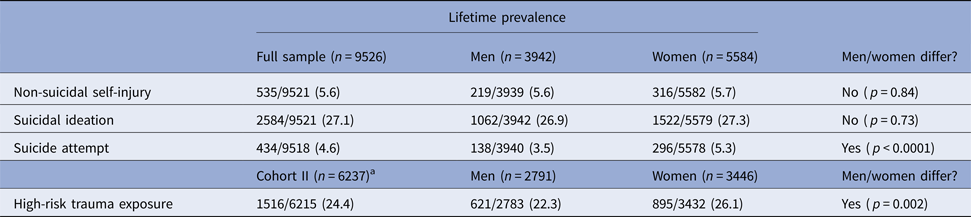
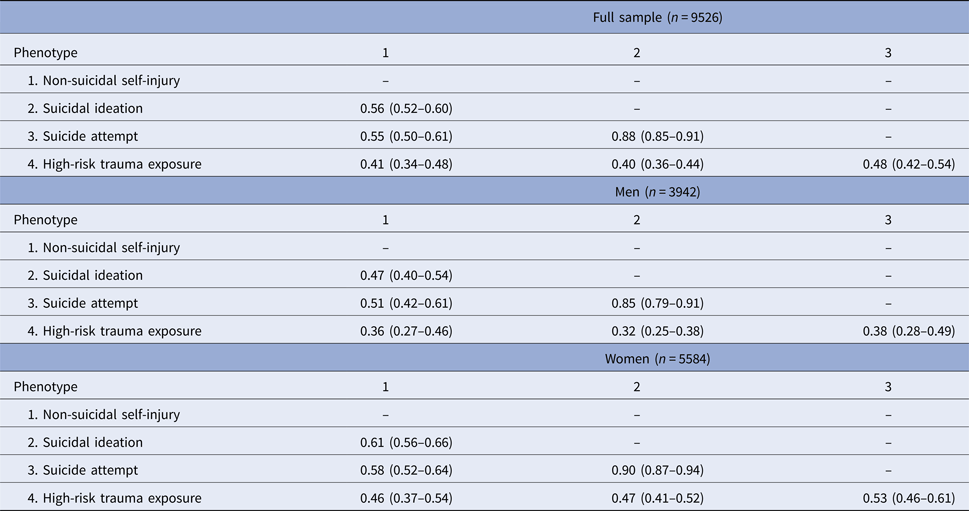
Table 2 displays the prevalence rates for HRT, NSSI, SI, and SA. Tetrachoric correlations between all phenotypes are reported in Table 3. Correlations among NSSI and STBs were large (rs = 0.55–0.88), and HRT was moderately correlated with self-injurious thoughts and behaviors (rs = 0.40–0.48). Nearly all individuals [430 (99.1%) of 434] who reported SA also reported SI.
Prevalences of non-suicidal self-injury, suicidal ideation, suicide attempt, and high-risk trauma exposure
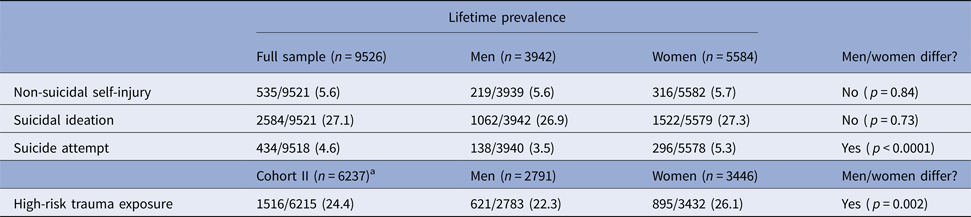
a Includes 1532 twins who also participated in the Childhood Trauma Study.
Values are numbers (percentages).
All χ2 tests have 1 df.
Tetrachoric correlations between non-suicidal self-injury, suicidal ideation, suicide attempt, and high-risk trauma exposure
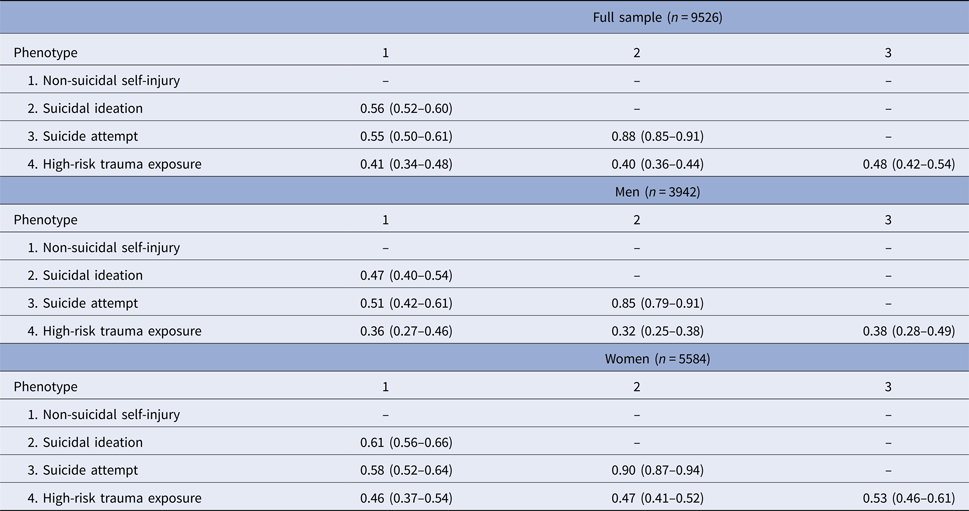
Correlations were estimated including individuals with missing data and controlling for cohort/sample.
Ninety-five percent confidence limits presented in the brackets.
Nearly all individuals [430 (99.1%) of 434] who reported suicide attempt also reported suicidal ideation, producing very high correlations between the phenotypes.
The odds of reporting SI and SA were significantly higher among individuals who reported NSSI [ideation: odds ratio (OR) 8.20, 95% CI (6.26–10.76); attempt: OR 9.85 (7.34–13.22)], and risk for SA was significantly elevated among individuals with SI [OR 222.03 (82.76–595.70)]. Associations remained significant after adjusting for high-risk trauma (online Supplementary Table S1). The wide confidence limits indicate that the associations between SI and SA were not precisely estimated, likely due to the low prevalence of SA and the variables’ collinearity. However, the lower bounds for all estimates were well above zero.
Twin correlations
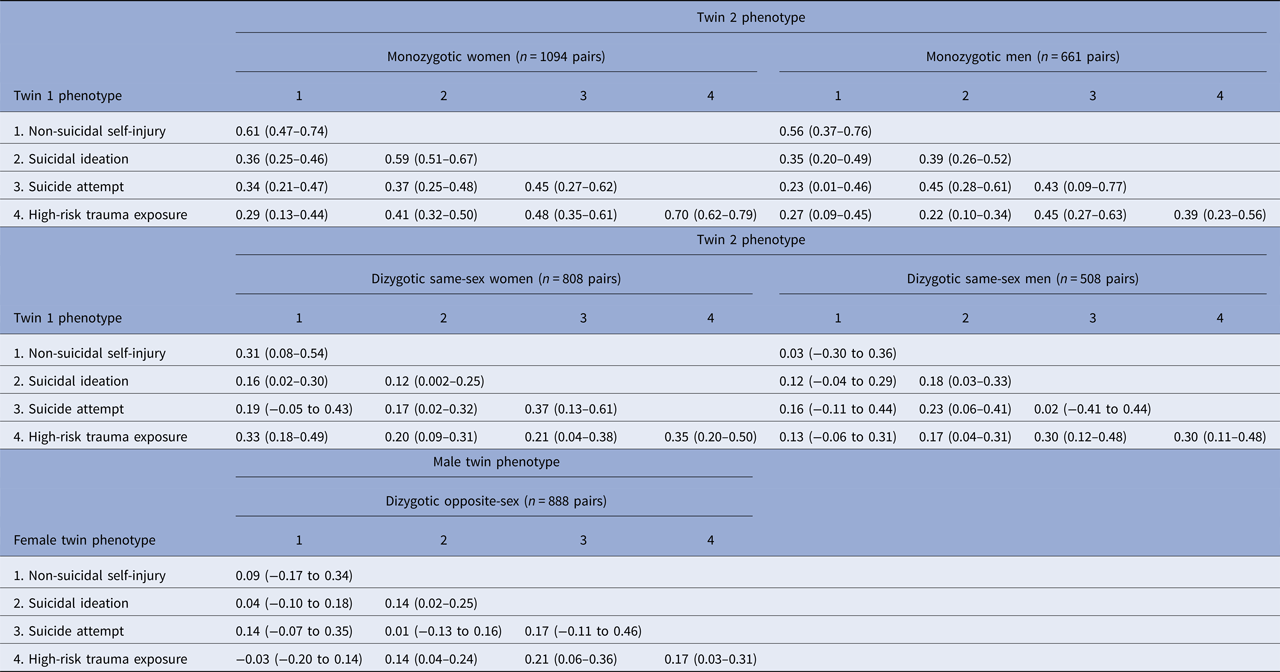
Inspection of Table 4 reveals that: (1) the within-trait MZ correlations were larger than the DZ correlations, indicating genetic influences on all phenotypes studied; (2) nearly all cross-trait MZ correlations were larger than the corresponding DZ correlations, implicating genetic influences on (a) the covariation among NSSI, SI, and SA, and (b) the covariation between high-risk trauma exposure and self-injurious thoughts and behaviors; (3) the within-trait DZ correlations for SI were less than half the MZ correlations, suggesting dominant genetic effects; and (4) for SA, the within-trait DZ correlation was greater than half the MZ correlation among women and less than half the MZ correlation among men, suggesting shared environmental influences among women and dominant genetic influences among men.
Within-trait and cross-trait twin correlations for non-suicidal self-injury, suicidal ideation, suicide attempt, and high-risk trauma exposure
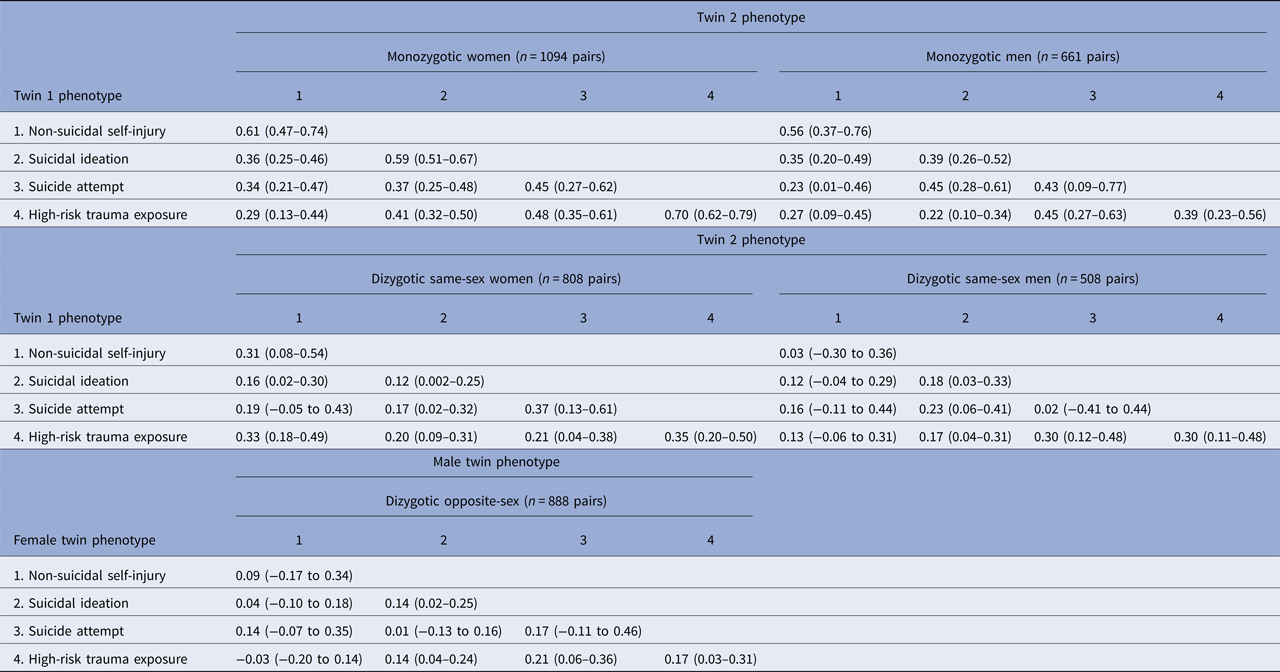
Twin correlations were estimated controlling for cohort/sample.
Also included in the analyses were data from 1608 single twins: 277 monozygotic women, 289 monozygotic men, 248 dizygotic same-sex women, 290 dizygotic same-sex men, and 504 dizygotic opposite-sex.
Ninety-five percent confidence limits presented in the brackets.
Biometric model fitting
Full models
Approximately two-thirds of the variation in HRT was attributable to genetic factors [A = 0.62 (0.34–0.90); online Supplementary Table S2]. Given the varying patterns of twin correlations across phenotypes, we fit ACE and ADE common pathway models to the data for NSSI, SI, and SA. Both models fit very well (RMSEA < 0.02). Proportions of variation in these outcomes attributable to common and specific genetic and environmental factors are displayed in online Supplementary Tables S3 and S4, and standardized path estimates are provided in online Supplementary Figs. S3–S6. Both models indicated that the common factor was 54–55% heritable in men and 51–52% heritable in women (for the ADE model, the sum of the A and D estimates yields the heritability coefficient). The remaining 45–46% (among men) and 48–49% (among women) of the variation was attributable to the non-shared environment. The majority of the genetic variation in SI and SA was attributable to common influences. For NSSI, however, specific genetic influences explained 33–36% of the variation among men and 46% of the variation among women (Tables S3 and S4).
Reduced models
Shared environmental influences on high-risk trauma could be constrained to zero without a significant decrement in model fit (Δχ2 = 1.07, df = 2, p = 0.59). Similarly, common and specific shared environmental factors explained a negligible proportion of the variation in self-injurious thoughts and behaviors and could be dropped from the model (online Supplementary Table S5). Within the ADE CPM, A and D could be constrained to zero individually, but constraining them both to zero resulted in a significant decrement in fit (online Supplementary Table S5). We elected to fit A and E factors within the correlated factors model, as (1) the presence of dominant genetic variance in the absence of additive genetic variance is possible, but practically unlikely; (2) separate A and D estimates should be treated with caution, as they are highly confounded and imprecise when estimated simultaneously; and (3) within the AE model, A captures both additive and non-additive genetic variation. Indeed, the heritability coefficients obtained within the AE CPM were the same as those observed within the ACE and ADE models (men: h 2 = 54%, women: h 2 = 51%).
Sex differences
When comparing the fits of models that allowed the parameter estimates for men and women to differ to models that constrained the estimates to be equal, there was evidence of a sex difference for high-risk trauma (Δχ2 = 18.03, df = 3, p < 0.001). Within the ACE and ADE CPMs, the paths from the latent factor to NSSI, SI, and SA could be equated across men and women, as could the common genetic and environmental factors. Constraining the variable-specific factors, however, resulted in a significant decrement in model fit (online Supplementary Table S6). Given the evidence for sex differences, correlated factors models were fit separately in men and women.
Correlated factors models
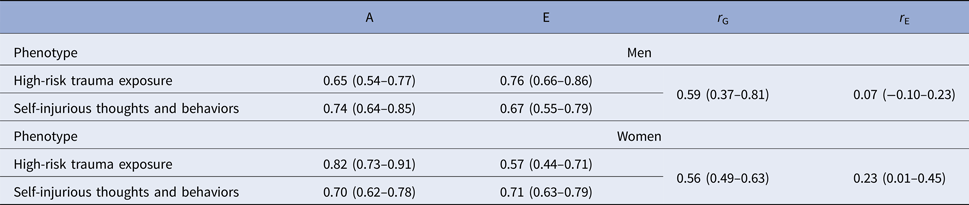
Table 5 displays the A and E estimates for HRT and self-injurious thoughts and behaviors, as well as the genetic and environmental correlations derived from the correlated factors models. All parameter estimates, including residual parameters, are depicted in online Supplementary Figs. S7 and S8. The genetic correlations between HRT and self-injurious thoughts and behaviors were large and significant in both men [r G = 0.59 (0.37–0.81)] and women [r G = 0.56 (0.49–0.63)], suggesting the covariation between these outcomes is partly attributable to shared heritable risk factors. After accounting for the familial overlap between trauma exposure and self-injurious thoughts and behaviors, we observed a significant unique environmental correlation among women [although the lower bound of the estimate was very close to zero; r E = 0.23 (0.01–0.45)]. The unique environmental correlation was not significant among men [r E = 0.07 (−0.10 to 0.23)].
Standardized parameter estimates and genetic and environmental correlations from the correlated factors model
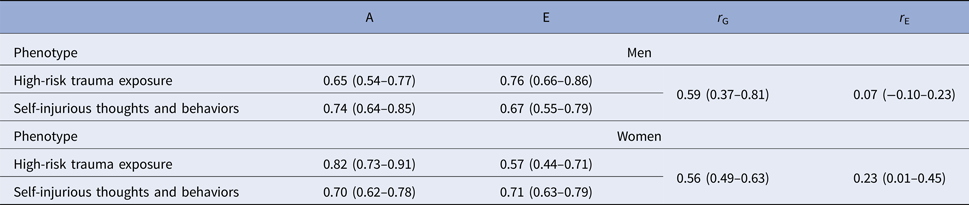
A, additive genetic; E, unique environment; r G, genetic correlation; r E, unique environmental correlation.
A and E path estimates can be squared to obtain the proportion of variation in each outcome that is attributable to genetic and unique environmental influences, respectively.
Ninety-five percent confidence limits presented in the brackets.
Discussion
This report furthers our understanding of (1) the etiology and co-occurrence of NSSI, SI, and SA; and (2) the link between traumatic experiences and self-injurious thoughts and behaviors. We found that a significant proportion of the variation in NSSI, SI, and SA is attributable to genetic and unique environmental factors that are common to all three phenotypes. In addition, liability to self-injurious thoughts and behaviors results in part from genetic influences that are shared with high-risk trauma exposure. We observed a significant (though modest) unique environmental correlation in females, suggesting that HRT may confer some risk for self-injurious thoughts and behaviors among women.
Univariate heritability estimates
Present findings align with prior literature implicating heritable factors in trauma exposure, with higher heritability estimates observed for more severe events (e.g. assault; Afifi et al. Reference Afifi2010; Ehlers et al. Reference Ehlers2013; Stein et al. Reference Stein2002). In addition, results are broadly consistent with previous studies documenting genetic influences on NSSI and suicidality (Durrett, Reference Durrett2006; Maciejewski et al. Reference Maciejewski2014; Dutta et al. Reference Dutta2017; Statham et al. Reference Statham1998). The DZ twin-pair correlation obtained in Durrett's (Reference Durrett2006) analysis of NSSI (r = 0.37) was not as small as those observed in the present analysis; however, differences may be due to variability in participant ages across studies.
Self-injurious thoughts and behaviors
Much of the variation in SI and SA was explained by genetic influences shared with NSSI. This aligns with theories that the association between NSSI and STBs arises in part from a common inherited liability (Nock et al. Reference Nock2006; Sher & Stanley, Reference Sher, Stanley and Nock2009). What factors comprise these genetic influences? Our understanding may be furthered by extending the Research Domain Criteria model to suicidal behavior (Glenn et al. Reference Glenn2017). Two vulnerability factors with which NSSI and suicidality have been well associated are impulsivity and negative emotion dysregulation (Nock et al. Reference Nock, Favazza and Nock2009; APA, 2013; Bresin et al. Reference Bresin, Carter and Gordon2013; Klonsky & May, Reference Klonsky and May2014; Hamza et al. Reference Hamza, Willoughby and Heffer2015; Glenn et al. Reference Glenn2017). As GWAS of suicidal behaviors to date have failed to identify genome-wide significant associations (Mullins et al. Reference Mullins2014; Galfalvy et al. Reference Galfalvy2015), future GWAS focusing on these endophenotypes may have more success.
Prior studies, however, report relations between NSSI and STBs even after adjusting for psychopathology dimensions related to impulsivity and negative affect (Klonsky et al. Reference Klonsky, May and Glenn2013). Therefore, it seems unlikely that biological influences on impulsivity and negative emotion dysregulation can entirely account for the co-occurrence of self-injurious thoughts and behaviors. Indeed, a significant proportion of the covariation among NSSI and STBs in the present study was explained by unique environmental influences, which were not entirely attributable to high-risk traumatic events. Prior research on self-injurious thoughts and behaviors suggests additional candidates, including types of victimization not assessed in this study [e.g. intimate partner violence (Levesque et al. Reference Levesque2010; Vaughn et al. Reference Vaughn2015) and peer victimization and bullying (Fisher et al. Reference Fisher2012; van Geel et al. Reference van Geel, Vedder and Tanilon2014)], as well as other adverse life experiences (Skegg, Reference Skegg2005).
Although the majority of genetic variance in SI and SA was explained by common factors, 33–36% (among men) and 46% (among women) of the variation in NSSI was attributable to unique genetic influences. NSSI is associated with a range of emotional disorders (e.g. Cox et al. Reference Cox2012; Bentley et al. Reference Bentley2015) and is a diagnostic criterion for borderline personality disorder (American Psychiatric Association, 2013). Some have called for creating a separate diagnostic category for NSSI (e.g. Selby et al. Reference Selby2015) and cite this seeming ubiquity across categories, as well as evidence for NSSI's incremental validity in predicting poorer outcome, as support for a cross-diagnostic dimension of psychopathology that deserves study in its own right. Our data cannot resolve this question; however, they do suggest that some of the heritable risk factors for NSSI are distinct from those for STBs.
It is important to note that although we fit a common pathway model to the data for self-injurious thoughts and behaviors, other models may offer alternative advantages or insights. For instance, SA may be considered contingent upon prior SI. Two-stage models, such as causal–common–contingent models (e.g. Edwards et al. Reference Edwards2011), could help to capture this data structure and allow for exploration of the progression between NSSI and STBs.
Correlated factors model
To our knowledge, this is the first study to examine the genetic overlap between trauma exposure and self-injurious thoughts and behaviors. However, our finding of significant genetic covariance is consistent with results from genetically informative studies of traumatic experiences and psychiatric disorders, including depression and PTSD (Koenen et al. Reference Koenen2008; Afifi et al. Reference Afifi2010; Sartor et al. Reference Sartor2012). Because trauma is an exposure rather than a direct behavior, shared genetic influences could reflect heritable characteristics that influence vulnerability to both victimization and psychopathology [e.g. personality traits such as neuroticism and antisociality (Jang et al. Reference Jang2003; Parslow et al. Reference Parslow, Jorm and Christensen2006) and emotion regulation difficulties]. In addition, ‘common’ genetic factors may operate through phenotypic causality, in which heritable features influence exposure to traumatic events and the experience of being traumatized makes an individual more likely to engage in self-injurious behaviors (or vice versa).
We observed a significant (albeit modest) unique environmental correlation between HRT and self-injurious thoughts and behaviors among women. This suggests that in females, high-risk trauma may confer some direct risk for self-harm and suicide. This aligns with a prior discordant twin analysis of childhood sexual abuse and SA (Nelson et al. Reference Nelson2002) and several twin studies of victimization and other psychopathology (e.g. Kendler et al. Reference Kendler2000; Brown et al. Reference Brown2014; Schaefer et al. Reference Schaefer2017).
We did not observe a significant unique environmental correlation among men. This may, however, have been attributable to reduced statistical power, as our sample comprised fewer men than women and the prevalence of trauma exposure was lower among men. In addition, strong causal conclusions cannot be drawn solely from the present findings, as (a) they concern cross-sectional data, and (b) within-twin-pair associations may be confounded by twin-specific environmental differences that relate to both trauma exposure and self-injurious thoughts and behaviors. However, regardless of the extent to which associations reflect causal factors, prevention of trauma exposure should remain a top clinical and public health priority. The deleterious consequences of maltreatment and victimization for health and development are well documented (Keyes et al. Reference Keyes2012; Schaefer et al. Reference Schaefer2017). Minimizing individuals’ exposure to trauma may help reduce liability to a broad range of psychopathology (Schaefer et al. Reference Schaefer2017), which may also reduce risk for life-threatening behaviors.
Limitations
Findings should be interpreted in the context of some limitations. First, the sample consisted of Australian Caucasians, which restricts generalizability. Second, data were collected retrospectively and thus prone to retrospective biases. Relatedly, we could not determine the temporal ordering of behaviors; in particular, whether traumatic experiences preceded NSSI and STBs. These issues limit causal inference. Third, although we differentiated between low- and high-risk trauma, we could not conduct fine-grained analyses of different types of high-risk traumatic events (e.g. childhood maltreatment v. later-life victimization). This represents an important goal for future research. In addition, operationalizing trauma exposure dimensionally (e.g. according to the number or severity of experiences) may increase statistical power to detect potential within-twin-pair associations with self-injurious thoughts and behaviors. Finally, the CTS design oversampled for families in which twins reported childhood maltreatment. To the extent that the relation between trauma and self-injurious thoughts and behaviors in this high-risk group differs from that in the general population, generalizability may be limited. However, we also included trauma data from the community-based full Cohort II sample, which helps to reduce concerns about possible ascertainment bias.
Conclusions
Individuals engaging in NSSI are at increased risk for SI and SA, and common heritable factors contribute significantly to these associations. Future research should investigate the mechanisms underlying this shared genetic vulnerability, as well as environmental factors that modify expression of this liability and risk for progression from NSSI to completed suicide. Preventing trauma exposure may help to mitigate risk for self-harm and suicide, either directly or indirectly via reductions in liability to psychopathology more broadly. In addition, targeting pre-existing vulnerability factors could significantly reduce risk for life-threatening behaviors among those who have experienced trauma.
Supplementary material
The supplementary material for this article can be found at https://doi.org/10.1017/S0033291718001034.
Acknowledgements
This work was supported by National Institute on Alcohol Abuse and Alcoholism grants AA023419 (LR), AA013446 (EN), AA017688, AA011998, AA07580, AA13321, and AA007728 (AH); and National Institute on Drug Abuse grants DA040411, DA32573 (AA), DA012854 (PM), and DA18267 (ML).
Declaration of interest
None.