Introduction
Worldwide, the lifetime prevalence of schizophrenia is 0.4%, and among causes of disability in individuals between 18 and 45 years of age, schizophrenia ranks third.Reference Brundtland1, Reference Mura, Petretto, Bhat and Carta2 Dopamine D2 receptor blockade by antipsychotic agents is the mainstay of treatment for patients with schizophrenia; these agents have long demonstrated usefulness in reducing positive symptoms, with questionable differences in efficacy among the different antipsychotic agents, with the exception of clozapine. However, differences among the other antipsychotics that are generally not evident in short-term (e.g., 6-week) trials may become evident during longer-term (e.g., 2-year) studies. Differences may also manifest when comparing short-term and long-term studies of the same antipsychotic. Unfortunately, the majority of research has focused on the short-term use of various agents. Even among studies that strive to evaluate antipsychotic efficacy over longer periods of time, it is difficult to assess long-term benefits of antipsychotic treatment due to exceedingly high discontinuation rates. For example, in the Clinical Antipsychotic Trials of Intervention Effectiveness (CATIE) Schizophrenia Trial, 74% of patients discontinued antipsychotic treatment before the end of the 18-month study.Reference Manschreck and Boshes3 The CATIE trial compared the efficacy and tolerability of the conventional, first-generation antipsychotic (FGA) perphenazine with several different atypical, second-generation antipsychotics (SGAs), including risperidone, olanzapine, quetiapine, and ziprasidone. No differences in efficacy were found among the different antipsychotics; however, it is impossible to assess the longer-term differences that may have become apparent had fewer patients discontinued treatment. In a study by Mullins etal.,Reference Mullins, Obeidat, Cuffel, Naradzay and Loebel4 the authors found that regardless of antipsychotic agent (aripiprazole, risperidone, or ziprasidone), the vast majority of patients (90.4%) had discontinued their treatment by the end of the 1-year follow-up period. In another study, one of the strongest predictors of antipsychotic discontinuation was patient perception that the medication was not working; patients who perceived benefit from their antipsychotic were more likely to continue treatment over the long term.Reference Glick, Correll and Altamura5 These data underscore the importance of finding the “right” medication for the “right” patient in order to promote long-term treatment continuation.
Several articles, including one published in a recent issue of this journal, have discussed why patients with schizophrenia don't take their medicine.Reference Morrissette and Cutler6–Reference Llorca10 In this review article, we present some of the data indicating why patients with schizophrenia should take their medicine.
What Happens When Patients with Schizophrenia Don't Take Their Medicine?
Schizophrenia is a highly debilitating and chronic disorder with alarming relapse rates. As many as 65% of patients with schizophrenia relapse within 3 years of their first episode, and nearly 82% relapse within 5 years of their first episode.Reference Robinson, Woerner and Alvir11, Reference Caseiro, Perez-Iglesias and Mata12 Many of those who relapse require expensive hospitalization, which can seriously impede any efforts toward recovery. One of the most cited predictors of psychotic relapse is medication nonadherence; alarmingly, patients with schizophrenia who discontinue antipsychotic medication have a 5-fold increase in risk of relapse.Reference Robinson, Woerner and Alvir11, Reference Caseiro, Perez-Iglesias and Mata12 Moreover, patients who relapse after a first episode of schizophrenia are more often nonadherent (70%) compared with patients who do not relapse (25%).Reference Ucok, Polat, Cakir and Genc13 Even partial nonadherence increases the risk of relapse; a gap in medication as brief as 1–10 days is associated with a 2-fold increase in risk of hospitalization.Reference Subotnik, Nuechterlein and Ventura14, Reference Weiden, Kozma, Grogg and Locklear15
For obvious ethical reasons, long-term studies comparing outcomes in patients with schizophrenia who are taking an antipsychotic versus those taking placebo are not commonly done; however, there are a few studies that have investigated such scenarios. In fact, a Cochrane Database Systematic Review found that maintenance treatment with antipsychotics is associated with relapse prevention, decreased hospitalization, and improved quality of life compared with treatment with placebo.Reference Leucht, Tardy, Komossa, Heres, Kissling and Davis16 Another recent meta-analysis found that patients given placebo had an increased risk of relapse, hospitalization, worsened symptoms, increased aggressive behaviors, and reduced quality of life compared with patients taking any antipsychotic.Reference Leucht, Tardy and Komossa17 These effects were seen for up to 2 years of follow-up, but the difference between patients taking any antipsychotic and those taking placebo decreased over time. One explanation for the reduction in effect size is that nearly all (90%) patients taking placebo had relapsed by the end of these longer-term studies, making statistical significance difficult to assess.Reference Leucht, Tardy and Komossa17 Patients not taking any antipsychotic also have increased mortality. In a large 11-year follow-up study of Finnish patients, mortality was 10 times higher in patients not taking any antipsychotic compared with those taking any antipsychotic.Reference Tiihonen, Lonnqvist and Wahlbeck18 Interestingly, there was an inverse correlation between length of treatment and mortality rate such that the longer a patient was taking an antipsychotic, the lower the risk of death by any cause.Reference Tiihonen, Lonnqvist and Wahlbeck18 The results of these studies seem clear: patients with schizophrenia who maintain antipsychotic treatment fare much better than those who don't take any antipsychotic.
Do all patients with schizophrenia require long-term treatment with an antipsychotic? There are some data to suggest that approximately 20% of patients with schizophrenia will experience only a single psychotic episode and may not require life-long antipsychotic treatment.Reference Alvarez-Jimenez, Gleeson and Henry19 However, this small percentage of patients has been suggested to have greater resiliency, better premorbid development, less vulnerability to anxiety, and better neurocognitive skills than most patients with schizophrenia.Reference Harrow, Jobe and Faull20, Reference Dell'osso, Glick, Baldwin and Altamura21 In patients with these favorable characteristics, it may be possible to attempt a trial of no antipsychotic treatment. However, the decision to discontinue antipsychotic treatment must be made on an individual patient basis. This decision is not without substantial risks and is likely to be successful in only a limited number of patients with schizophrenia.
What Happens When Patients with Schizophrenia Do Take Their Medicine?
Time as a Drug
Effective antipsychotic treatment often has an immediate impact on the positive symptoms of schizophrenia. Several studies have shown that continued use of an antipsychotic can maintain the response seen soon after treatment initiation.Reference Stahl, Cucchiaro, Simonelli, Hsu, Pikalov and Loebel22–Reference Hirsch, Kissling, Bauml, Power and O'Connor24 Perhaps more interesting are the studies that show steady further improvement in symptoms of schizophrenia with long-term continuation of treatment. Although patients with schizophrenia often show early, robust response following the initiation of antipsychotic treatment, this is not always the case.Reference Emsley, Rabinowitz and Medori25 The time to response may in fact be longer, especially for patients with treatment-resistant schizophrenia.Reference Lieberman, Kane and Safferman26 Emsley etal. showed that among 522 patients with first-episode schizophrenia, 22.5% did not respond until 4 weeks of antipsychotic treatment and 11.2% required 8 weeks of treatment before having a therapeutic response.Reference Emsley, Rabinowitz and Medori25 Shulte has shown in a recent review that response to clozapine may not occur in the early stages of treatment for many patients.Reference Schulte27 Meltzer etal. found that the response rate to clozapine increased from 37% after 3 months of clozapine treatment to 61% after 6 months of clozapine treatment.Reference Meltzer, Burnett, Bastani and Ramirez28 Rosenheck etal. found that 13% of patients required a year before showing response to clozapine.Reference Rosenheck, Evans and Herz29 As these studies indicate, nonresponse to antipsychotic treatment immediately following the initiation of treatment is not necessarily predictive of long-term nonresponse.
Unfortunately, many patients are switched from one antipsychotic to another if robust improvement is not seen after a few weeks. This tendency to switch from one antipsychotic to another after a short-term trial negates the possibility of using time as a drug, and data have indicated that switching antipsychotics may increase the risk of discontinuation and reduced symptom control.Reference Covell, McEvoy and Schooler30 For example, in the CATIE trial, patients who were switched from one antipsychotic to another had much higher discontinuation rates compared with those who stayed on their current antipsychotic (70% vs. 50%) and had limited success in symptom improvement.Reference Essock, Covell, Davis, Stroup, Rosenheck and Lieberman31, Reference Rosenheck, Davis and Covell32 It is important to note that when switching antipsychotics, the choice of any particular agent does not seem to matter. Data suggest that every effort to optimize treatment with one antipsychotic, including a longer trial duration, should be made before making the decision to switch to a different antipsychotic. The bottom line: find an antipsychotic that is tolerable and that shows at least some efficacy for the individual patient, then stick with it for a while.
Negative, affective, and cognitive symptoms of schizophrenia are often much more difficult to treat than positive symptoms. Although there was much hope that the introduction of the SGAs would provide more effective treatments for non-positive symptoms of schizophrenia, there is some debate as to whether the SGAs have fulfilled this objective. The CATIE trial did not find superiority of SGAs over FGAs, nor did it find superiority among individual SGAs.Reference Manschreck and Boshes3 However, the CATIE trial may not have been long enough (especially given the high discontinuation rate) to discover differences between individual antipsychotics. Since the CATIE trial, several new atypical antipsychotics have been added to the clinician's toolbox: aripiprazole, iloperidone, asenapine, and lurasidone. The molecular binding profiles of these newer antipsychotics may offer more effective treatments for non-positive symptom domains.
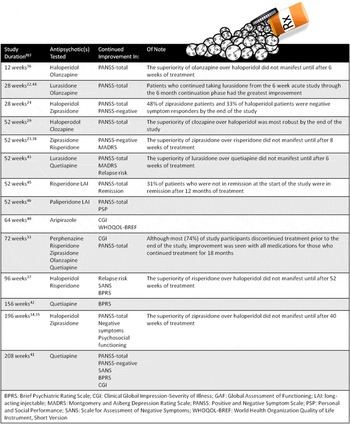
This review article is not necessarily aimed at indicating the superior efficacy of one antipsychotic agent over another. What is more striking in the available data from long-term studies is that patients who continue taking any antipsychotic for long periods of time often show gradual but continual improvement in many of the symptoms of schizophrenia. Although the changes that occur with time may seem relatively small, it is important to note that even a small change on a rating scale can be quite significant for an individual patient. Several studies that have shown beneficial outcomes from long-term antipsychotic treatment are discussed below and summarized in Table 1.
Time as a Drug?

Long-term Studies: SGAs vs. FGAs
Although the discontinuation rate in the CATIE trial was quite high (74%), for those who continued taking medication throughout the 18-month study, continued benefit was seen on both the Clinical Global Impression–Severity of Illness (CGI-S) Scale and the Positive and Negative Syndrome Scale (PANSS) for all of the antipsychotics studied (perphenazine, risperidone, ziprasidone, olanzapine, and quetiapine).Reference Lieberman, Stroup and McEvoy33
Hirsch etal. evaluated the efficacy of ziprasidone and haloperidol in a 28-week study of patients with schizophrenia.Reference Hirsch, Kissling, Bauml, Power and O'Connor24 The authors reported that PANSS scores improved gradually for patients taking either ziprasidone or haloperidol for the duration of the study. Of note is that by the end of the 28-week study, 48% of patients taking ziprasidone were “negative symptom responders” (classified as ≥ 20% improvement on the PANSS-negative subscale) compared with 33% of patients taking haloperidol (p < 0.05).
Ziprasidone versus haloperidol treatment was also investigated in a 196-week continuation study done by Potkin etal.Reference Potkin, Weiden, Loebel, Warrington, Watsky and Siu34 Both the ziprasidone and haloperidol treatment groups showed robust response during the original 40-week study, with no difference in efficacy between the 2 drugs. During the extension study, however, patients taking ziprasidone showed significantly greater likelihood of attaining remission and improved quality of life compared with patients taking haloperidol (p = 0.006 and 0.004, respectively). Patients in the ziprasidone treatment group also showed greater improvement in PANSS total score compared with those taking haloperidol (p < 0.05); this difference became significant only after week 124. Stahl etal. also found that patients taking ziprasidone had greater improvement in negative symptoms compared with those taking haloperidol (p = 0.005); again, this difference between the 2 drugs did not become apparent until after 40 weeks of treatment.Reference Stahl, Malla and Newcomer35 Although ziprasidone appeared superior to haloperidol on each of the measured outcomes of this study, it should be noted that continued improvement was seen in both treatment groups as a function of time.
In a comparison study between an SGA and an FGA, Lieberman and colleagues conducted a 12-week study of olanzapine and haloperidol.Reference Lieberman, Tollefson and Tohen36 Both treatments showed continual improvement in PANSS score over the course of the study; however, mean change in PANSS score was greater for treatment with olanzapine in weeks 6 through 12 (p < 0.02).
Marder etal. looked at 2-year outcomes of treatment with either risperidone or haloperidol.Reference Marder, Glynn and Wirshing37 Patients taking risperidone trended toward a decreased risk of relapse compared with those taking haloperidol; however, this difference did not become apparent until after week 52. Although patients taking either risperidone or haloperidol showed improvements on both the Scale for the Assessment of Negative Symptoms (SANS) and the Brief Psychiatric Rating Scale (BPRS) total score, risperidone was significantly more efficacious for affective and negative symptoms compared with haloperidol.
Rosenheck etal. compared 12-month treatment with clozapine versus haloperidol.Reference Rosenheck, Evans and Herz29 Both treatment groups showed continued improvement on the PANSS, but clozapine appeared superior to haloperidol (p < 0.01). Interestingly, although improvements in symptoms were most evident during the first 6 weeks of the study, improvements in quality of life (again, favoring clozapine) were most robust after 1 year.
Long-term Studies: SGAs
Addington etal. did a 44-week continuation study comparing ziprasidone and risperidone in 139 patients with schizophrenia or schizoaffective disorder.Reference Addington, Labelle, Kulkarni, Johnson, Loebel and Mandel23 Both ziprasidone and risperidone were found to be efficacious during the original 8-week study, although no significant differences on several outcomes (PANSS total, PANSS-negative, CGI, BPRSd, and Global Assessment of Functioning (GAF)) were seen between the 2 drugs.Reference Addington, Pantelis, Dineen, Benattia and Romano38 However, during the 44-week extension period, in addition to the maintenance of response for both drugs, ziprasidone showed superiority over risperidone on both the PANSS-negative subscale (not significant) and the Montgomery–Åsberg Depression Rating Scale (MADRS) (p < 0.05), indicating that long-term treatment with ziprasidone may be beneficial for treating affective and negative symptoms of schizophrenia and may have therapeutic effects on positive symptoms.Reference Addington, Labelle, Kulkarni, Johnson, Loebel and Mandel23
In a 52-week extension study of a 26-week trial, Chrzanowski etal. looked at the effectiveness of aripiprazole versus olanzapine in 310 patients with schizophrenia.Reference Chrzanowski, Marcus, Torbeyns, Nyilas and McQuade39 The authors found that regardless of their antipsychotic treatment, patients who completed the study showed continued improvement on the PANSS over the 52-week period, resulting in a 10% mean improvement from baseline.
Long-term treatment with aripiprazole was also investigated in a 64-week study of 153 patients with schizophrenia or schizoaffective disorder.Reference Hsieh, Lin and Chen40 In patients taking aripiprazole for the duration of the study, improvements in both symptoms (measured by the CGI-I) and quality of life (measured by the short version of the World Health Organization Quality of Life instrument (WHOQOL-BREF)) were reported.
Kasper and colleagues have investigated quetiapine in several long-term studies. In one 208-week study, quetiapine was shown to induce continued improvement on the PANSS, including both the positive and negative subscales, the SANS, the BPRS, and the CGI.Reference Kasper, Brecher, Fitton and Jones41 In another study, Kasper etal. found continued improvement in anxiety and depression (BPRS Factor 1) after 156 weeks of treatment with quetiapine.Reference Kasper42
Loebel etal. compared lurasidone, the most recently approved SGA, with quetiapine in a 12-month study.Reference Loebel, Cucchiano, Xu, Sarma, Pikalov and Kane43 Both treatments showed improvement on the PANSS and the MADRS during the original, acute 6-week study. However, continued improvement was seen over the 12-month study duration for lurasidone. Additionally, patients taking lurasidone had a reduced risk of relapse compared with those taking quetiapine, and this difference between the 2 drugs increased over time.
Lurasidone has also been compared with olanzapine in a 6-month study.Reference Stahl, Cucchiaro, Simonelli, Hsu, Pikalov and Loebel22, Reference Stahl, Bollu, Pikalov, Hsu and Loebel44 During the original 6-week study, both lurasidone and olanzapine showed robust improvement in PANSS total score, and all treatment groups showed continued improvement over the duration of the study. However, patients taking lurasidone during the original 6-week study who continued taking it during the 6-month extension study showed greater improvement in PANSS total score compared with those who were switched from olanzapine during the original 6-week study to lurasidone in the 6-month extension study.
Long-Acting Depot Antipsychotics
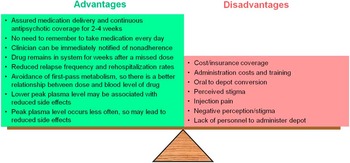
To achieve the potential benefits of long-term treatment, medication adherence is, of course, critical. One strategy for increasing medication adherence is through the use of long-acting depot formulations of antipsychotics. Such formulations have been shown to improve both symptoms of schizophrenia and functional outcomes.Reference Kissling, Heres and Lloyd45, Reference Gopal, Vijapurkar, Lim, Morozova, Eerdekens and Hough46 Depot antipsychotics have several possible benefits over their oral counterparts (Figure 1). A recent meta-analysis showed that both FGA and SGA depot formulations are associated with reduced relapse rates.Reference Leucht, Heres, Kane, Kissling, Davis and Leucht47 However, the primary advantage of depot antipsychotics over oral formulations is probably not due to any profound increase in efficacy; rather, the more dependable method of delivery of depot formulations allows for continued antipsychotic treatment. In particular, better outcomes and improved adherence may be due to the clear evidence of nonadherence when a patient misses their appointment at the clinic and the treatment team is notified. In other words, oral antipsychotics would likely be just as effective as depot formulations if patients would be more diligent about taking a pill or 2 every day. One possible exception is that depot formulations allow for more constant plasma drug levels.Reference Ereshefsky and Mascarenas48 With depot antipsychotics, peak plasma concentration occurs only once a week or once or twice a month, depending on the injection interval, whereas peak drug concentration occurs once or twice a day with oral formulations. This is important because side effects of antipsychotics often occur when drug levels are at their highest. Thus, it can be expected that side effects of depot antipsychotics may occur less often and be more tolerable compared with those of their oral counterparts. In support of this idea, there are data to indicate improved tolerability and patient satisfaction with depot antipsychotics.Reference Gopal, Vijapurkar, Lim, Morozova, Eerdekens and Hough46, Reference Tiihonen, Haukka, Taylor, Haddad, Patel and Korhonen49, Reference Wheeler, Vanderpyl, Carswell, Stojkovic and Robinson50 There is also some evidence to suggest that the differences in efficacy between depot and oral antipsychotics may emerge over time, likely due to increased treatment adherence imparted by depot formulations.Reference Gaebel, Schreiner and Bergmans51, Reference Keks, Ingham, Khan and Karcher52 In a study investigating the efficacy of depot risperidone, Kissling etal. showed continued improvement in PANSS score over the 12-month study period; moreover, 31% of patients who were not in remission at the start of the study were in remission after 12 months of treatment with depot risperidone.Reference Kissling, Heres and Lloyd45 In a 52-week extension study, Gopal etal. investigated the efficacy of the depot formulation paliperidone palmitate in 388 patients with schizophrenia and found that patients taking depot paliperidone showed continued improvement on both the PANSS and the Personal and Social Performance (PSP) Scale.Reference Gopal, Vijapurkar, Lim, Morozova, Eerdekens and Hough46
Pros and Cons of Depot Antipsychotics

One recent study did not find any differences in efficacy between oral and depot antipsychotics.Reference Rosenheck, Krystal and Lew53 The superiority of depot antipsychotics found in most other studies is strengthened by the fact that most patients on depot antipsychotics have more severe forms of schizophrenia compared with those not on depot antipsychotics.Reference Tiihonen, Haukka, Taylor, Haddad, Patel and Korhonen49 The impact of depot antipsychotics on symptom reduction, quality of life, relapse, and rehospitalization has led to the suggestion that depot formulations should not be reserved for patients with the most severe forms of schizophrenia.Reference Altamura, Aguglia and Bassi54
Several depot formulations of FGAs are available, and may be more cost-effective than SGA depots. Among the SGAs, depot formulations of olanzapine, risperidone, and paliperidone are available. A depot version of aripiprazole is in late clinical trials and has so far shown good efficacy with excellent tolerabilty.Reference Carson, Perry and Sanchez55–Reference Kane, Sanchez and Perry58
Is Long-Term Treatment Worth the Cost?
Economic Costs
There are several potential arguments against the use of depot or oral antipsychotics over the long term. One argument is that antipsychotic medications, especially the more recently developed depot formulations, are quite expensive. However, given the evidence that maintenance treatment with antipsychotics can significantly reduce the risk of relapse and hospitalization, the use of these agents may be justified. Avoiding crisis events is important to the quality of life and recovery goals of the patient, and the direct and indirect costs of treating schizophrenia are estimated to be over $60 billion, with as much as two-thirds of that expense being due to hospitalization. In fact, a recent study indicated that total costs drop from $12,551.70 in the 6 months prior to depot initiation to $9,481.30 in the 6 months after a depot antipsychotic is started (p = 0.003).Reference Peng, Ascher-Svanum and Faries59 Most of the cost/benefit analyses done to date do not take into account some of the monetary gains associated with antipsychotic use (e.g., increased productivity due to increased engagement in the workforce, reduced use of welfare services, and reduced death from suicide), as these can be difficult to estimate. Moreover, such analyses do not account for the less quantifiable benefits of antipsychotic use, such as improved quality of life, satisfaction for patients and their families, and hope for the future.
Brain Structure
There is some debate regarding the effects of antipsychotics on brain structure. Unfortunately, it has been difficult to differentiate these effects from the brain changes that occur as part of the disease process of schizophrenia. Although some research has suggested that antipsychotic use may reduce cortical volume in patients with schizophrenia, there are abundant data to suggest that antipsychotics, most notably atypical antipsychotics, prevent the volume loss that is an integral part of schizophrenia pathophysiology.Reference Boonstra, van Haren and Schnack60–Reference Shepherd, Laurens, Matheson, Carr and Green65 In fact, most studies show that antipsychotic use is associated with increased volume in the nucleus accumbens and the putamen and that this enlargement is correlated with improvement in positive symptoms.Reference Li, Chen and Deng66 It has been suggested that atypical antipsychotics do not necessarily cause volume increases or decreases, but rather “normalize” the structures altered by the disease process, perhaps by affecting neuroplasticity.Reference Leung, Cheung and Yu62 The delayed benefits of long-term treatment may be related to the time required for these antipsychotic-induced structural changes to occur.
Dopamine Supersensitivity
Contrary to the long-term efficacy data discussed in the previous sections, it has been suggested that antipsychotic efficacy may actually diminish with time due to treatment-induced dopamine supersensitivity.Reference Seeman67 Dopamine supersensitivity is believed to result from sustained high doses of dopamine antagonists. However, continuous high occupancy (≥ 65%) may not be entirely necessary, as indicated by a study by Remington etal.Reference Remington, Mamo and Labelle68 Strategies that may help to avoid dopamine supersensitivity over long-term antipsychotic treatment include using the lowest effective dose, utilizing depot formulations, and using antipsychotics with dopamine D2 receptor partial agonism (e.g., aripiprazole) rather than those with full D2 receptor antagonism. There is also some evidence that intermittent, alternate-day dosing may prevent dopamine supersensitivity; however, this strategy may be risky given evidence that even small gaps in antipsychotic treatment can significantly increase the risk of relapse.Reference Remington and Kapur69
Side Effects
The blockade of dopamine D2 receptors not only reduces psychosis, but can also induce intolerable side effects, including movement disorders such as extrapyramidal syndrome (EPS), tardive dyskinesia, akathisia, and parkinsonism. This risk of movement-associated effects is greater for FGAs compared with SGAs. However, SGAs have other side effects associated with them, most notably those affecting weight and other cardiometabolic parameters. These cardiometabolic risks have led to concern about the potential negative health impact of long-term antipsychotic use. Surprisingly, a recent analysis showed that FGAs were associated with twice the risk of cardiovascular mortality compared with SGAs.Reference Bushe, Taylor and Haukka70 With time, antipsychotic-induced side effects may diminish, and in fact, some SGAs (e.g., lurasidone and aripiprazole) are associated with weight reduction and improvement in other cardiometabolic parameters.Reference Stahl, Cucchiaro, Simonelli, Hsu, Pikalov and Loebel22, Reference Hsieh, Lin and Chen40, Reference Kasper, Brecher, Fitton and Jones41, Reference Gopal, Vijapurkar, Lim, Morozova, Eerdekens and Hough46 Of course, not every patient will experience intolerable side effects from a particular medication; therefore, it is necessary to match the “right” antipsychotic with the individual patient.
Conclusion
Mental illness is certainly no joke; however, when it comes to optimizing outcomes for patients with schizophrenia, timing and delivery may be as important as they are to any punch line. With the disturbingly high rates of medication discontinuation and nonadherence, the benefits of long-term treatment may be difficult to achieve. Once a patient is matched with an adequately dosed antipsychotic that is tolerable and at least somewhat effective, optimal outcomes may depend on the patient continuing to take that particular antipsychotic for many years. The availability of long-acting depot formulations may provide a treatment strategy that promotes the necessary long-term continuation of antipsychotic treatment.
Acknowledgment
Financial support: This CME supplement is supported by an educational grant from Sunovion Pharmaceuticals Inc.
Disclosures
Debbi Ann Morrissette, PhD, is an adjunct professor of biological sciences at California State University in San Marcos and a medical writer at the Neuroscience Education Institute in Carlsbad, CA. Dr. Morrissette has no financial relationships to disclose.
Stephen M. Stahl, MD, PhD, is an adjunct professor of psychiatry at the University of California, San Diego School of Medicine and an honorary visiting senior fellow at the University of Cambridge in the UK. Dr. Stahl receives research support from AstraZeneca, CeNeRx BioPharma, Forest, Genomind, Lilly, Merck, Neuronetics, Pamlab, Pfizer, Roche, Sunovion, Servier, Shire, Torrent, and Trovis; is a consultant to Abbott, ACADIA, AstraZeneca, AVANIR, BioMarin, Bristol-Myers Squibb, CeNeRx, Forest, Genomind, GlaxoSmithKline, Johnson & Johnson, Lilly, Lundbeck, Merck, Mylan (f/k/a Dey), Neuronetics, Novartis, Noven, Ono Pharma, Orexigen, Otsuka America, Pamlab, Pfizer, RCT LOGIC, Rexahn, Roche, Servier, Shire, Sunovion, Trius, Trovis, and Valeant; is on the speakers bureaus of Arbor Scientia, AstraZeneca, Forest, Johnson & Johnson, Lilly, Merck, Pfizer, Servier, and Sunovion: and is a board member at Genomind
No writing assistance was utilized in the production of this article.
CME Posttest and Certificate
CME Credit Expiration Date :October 31, 2015
CME Posttest Study Guide
NOTE: The posttest can only be submitted online.The below posttest questions have been provided solely as a study tool to prepare for your online submission. Faxed/mailed copies of the posttest cannot be processedand will be returned to the sender. If you do not have access to a computer, contact customer service at 888-535-5600.
“Oral Antipsychotic Update: A Brief Review of New and Investigational Agents for the Treatment of Schizophrenia”
1. A 34-year-old patient with schizophrenia is not responding to her current antipsychotic treatment with risperidone. You are contemplating switching this patient to iloperidone knowing that the initial dose of iloperidone will be low and will be increased over several days before reaching the therapeutic dose. Iloperidone must be titrated slowly due to its strong binding affinity at which receptor?
a. Serotonin 5HT1A
b. Histamine H1
c. Alpha 1 adrenergic
d. Dopamine D3
2. Trevor is a 42-year-old patient with bipolar disorder and psychosis. Which of the newly available antipsychotics is FDA-approved for the treatment of both schizophrenia and bipolar disorder?
a. Asenapine
b. Iloperidone
c. Lurasidone
d. All of the above
e. None of the above
3. Michelle is a 22-year-old patient with schizophrenia. She also suffers with anorexia and often goes several days without eating. Which of the newly available antipsychotics must be taken with a meal of at least 350 calories?
a. Asenapine
b. Iloperidone
c. Lurasidone
d. All of the above
e. None of the above
4. Which of the following agents in development for the treatment of schizophrenia is a partial agonist at dopamine D2 receptors?
a. Cariprazine
b. Brexpiprazole
c. Bitopertin
d. Both cariprazine and brexpiprazole
e. Both brexpiprazole and bitopertin
f. Both cariprazine and bitopertin
“Optimizing Outcomes in Schizophrenia: Long-acting Depots and Long-term Treatment”
1. Molly is a 42-year-old patient with schizophrenia. She had been taking an atypical antipsychotic with some benefit but recently decided, against your advice, to discontinue taking her medication. You explain to this patient that discontinuing antipsychotic treatment has been associated with:
a. A 2-fold increase in the risk of rehospitalization
b. A 5-fold increase in the risk of relapse
c. A 20-fold increase in the risk of death
d. All of the above
2. A 26-year-old patient with first-episode schizophrenia started antipsychotic treatment 2 weeks ago. She is tolerating the medication well but her parents are anxious to see an improvement in their daughter's symptoms. Approximately what percentage of first-episode patients require at least 8 weeks of treatment before showing a therapeutic response to antipsychotic treatment?
a. 5%
b. 7%
c. 9%
d. 11%
3. Mark is a 37-year-old patient with schizoaffective disorder. He is overweight (BMI = 33) and has a family history of cardiovascular disease. Which of the following antipsychotics may be the best choice for avoiding treatment-induced cardiometabolic side effects?
a. Lurasidone
b. Olanzapine
c. Ziprasidone
4. Paula is a 53-year-old patient with schizophrenia and a long history of treatment nonadherence. She has recently been hospitalized secondary to “forgeting to take” her oral ziprasidone treatment for the past 3 months. Which of the following antipsychotics is available in a long-acting depot formulation?
a. Asenapine
b. Olanzapine
c. Paliperidone
d. Ziprasidone
CME Online Posttest and Certificate
To receive your certificate of CME credit or participation, complete the posttest and activity evaluation, available only online at www.neiglobal.com/CME under ‘‘CNS Spectrums’’. If a passing score of 70% or more is attained (required to receive credit), you can immediately print your certificate. There is no fee. Questions? call 888-535-5600 or email customerservice@neiglobal.com.