Aging is associated with an increased ability to regulate emotions, and older adults experience fewer negative emotions (Mather & Carstensen, Reference Mather and Carstensen2005). Compared with younger participants, older participants report fewer negative emotional experiences and greater emotional control (Gross et al., Reference Gross, Carstensen, Pasupathi, Tsai, Skorpen and Hsu1997). This effect has been theoretically framed in the Socioemotional Selectivity Theory (SST) (Carstensen, Isaacowitz, & Charles, Reference Carstensen, Isaacowitz and Charles1999), which proposes that older adults employ cognitive strategies to improve emotion regulation because they are more focused on emotional goals (Mather & Carstensen, Reference Mather and Carstensen2005). According to SST, goals are planned in terms of future time perception. When people perceive time as expansive, as they typically do in youth, they tend to focus energy on preparing for the future by acquiring new knowledge and expanding their horizons. In contrast, when people perceive boundaries on their life-time, they direct attention to emotionally meaningful aspects of life that provide immediate gratification. By emphasizing emotional well-being in the present, older adults optimize the time they have remaining (Kryla-Lingthall & Mather, Reference Kryla-Lingthall, Mather, Bengtson, Silverstein, Putney and Gans2009). As a consequence of this enhanced investment in emotional regulation, maturity and age are positively associated with well-being (Sheldon & Kasser, Reference Sheldon and Kasser2001).
The learning of the regulation of our emotions is based on the processing and interpretation of our past personal emotions associated to a concrete event (e.g., why did I feel sad the first time my school friends did not invite me to a party?). According to the CaRFAX model (Williams et al., Reference Williams, Barnhofer, Crane, Herman, Raes, Watkins and Dalgleish2007) and further research (Sumner, Reference Sumner2012), rumination is primarily involved in the processing of autobiographical past experiences. Research has shown that, compared with a rumination induction, a distraction procedure reduces overgeneral autobiographical memory in depression (Watkins & Teasdale, Reference Watkins and Teasdale2001). That autobiographical and emotional information can be processed using repetitive thinking (brooding) or letting it pass (distraction). The result of the processing of those emotional situations using rumination or distraction helps to the solution of future situations where similar emotional information could be involved. Depression level would be the final outcome of the interaction of those cognitive variables.
One mechanism by which emotional well-being may be enhanced is through the selection of effective cognitive strategies. Depending on the context and the form of use, problem solving, distraction, rumination, and autobiographical memory may act as potential cognitive strategies used more by older adults to improve emotional well-being, relative to younger adults. The current research aims to confirm previous age and gender differences in these emotion regulation strategies when individuals are in a depressed state and their pattern of association with depression symptoms. In addition, we will also test the possible mediator effect of the variable of rumination for age and gender differences on depression scores.
Age differences in emotion regulation strategies and depression
Ruminative thinking is repetitive, prolonged, and recurrent thought about oneself, one’s concerns and one’s negative experiences (Nolen-Hoeksema, Reference Nolen-Hoeksema1991). Abstract rumination focused on causes and consequences of our feelings has a negative impact on psychological well-being (Watkins, Reference Watkins2008). Most importantly, repetitive thinking has negative consequences on the onset and maintenance of depression and anxiety (Watkins, Reference Watkins2008). Recent research suggests that redemption sequences in the process of reminiscence, that is, memories containing tension can concern an originally past negative event that now is perceived as positive or good, may explain differences by age in the interaction between brooding rumination and the valence of autobiographical memories and depression scores. In older participants, the interaction between brooding and positive autobiographical memories significantly explained the variance of mood scores (Ricarte, Ros, Serrano, Martinez-Lorca, & Latorre, Reference Ricarte, Ros, Serrano, Martinez-Lorca and Latorre2015). Although trait repetitive thought has been found to be associated with lower psychological well-being in older adults (Segerstrom, Roach, Evans, Schipper, & Darville, Reference Segerstrom, Roach, Evans, Schipper and Darville2010), other authors found that age differences in negative affect were mediated by defensiveness and life events but not by rumination (Thomsen, Mehlsen, Viidik, Sommerlund, & Zachariae, Reference Thomsen, Mehlsen, Viidik, Sommerlund and Zachariae2005).
Rumination has also been found to have negative effects on adaptive emotional regulatory strategies, including disrupting effective problem-solving (Watkins & Moulds, Reference Watkins and Moulds2005) and maintaining recall of categoric autobiographical memories in depression (Watkins & Teasdale, Reference Watkins and Teasdale2001). The experimental induction of distraction (e.g., focus on an image), as the opposite of rumination, decreases depression ratings (Donaldson, Lam, & Mathews, Reference Donaldson, Lam and Mathews2007) and it has been suggested that interventions based on distractive coping may be useful in patients with long-standing depression (Huffziger, Reinhard, & Kuehner, Reference Huffziger, Reinhard and Kuehner2009). In older adults, the ability to implement emotional behavioral suppression is kept with age (Shiota & Levenson, Reference Shiota and Levenson2009), suggesting the preservation in the ability to employ strategies of distraction. In fact, older adults report more use of distraction-type strategies when they describe their own everyday problems than young (Blanchard-Fields, Stein, & Watson, Reference Blanchard-Fields, Stein and Watson2004). Among youth samples distraction intervention is more effective in reducing rumination than problem solving intervention (Hilt & Pollak, Reference Hilt and Pollak2012). Older adults select more effective strategies for interpersonal problems (Blanchard-Fields, Mienaltowski, & Seay, Reference Blanchard-Fields, Mienaltowski and Seay2007). However, age differences in problem solving depend on several variables such us the type of problems being solved or their cognitive load. For example, when the everyday problem solving is representative of their own age group, age-related declines in performance are not observed (Artistico, Orom, Cervone, Krauss, & Houston, Reference Artistico, Orom, Cervone, Krauss and Houston2010). In fact, older adults enhance control resources for a better processing of positive emotional information than young adults (Mather & Knight, Reference Mather and Knight2005). Older adults, compared to young participants, showed the greatest benefits of positive reappraisal instruction (the individual attends to the negative event, but also recognizes its positive aspects and outcomes) on emotional and physiological responses to disgusting film clips (Shiota & Levenson, Reference Shiota and Levenson2009). Broadly speaking, intentional regulation of negative emotions is less costly for older adults than for young adults (Scheibe & Blanchard-Fields, Reference Scheibe and Blanchard-Fields2009).
Autobiographical memory is essential for future personal problem solving as it helps us to keep in the memory relevant pieces of past information that we compare with each other to select the most appropriated solution (Williams et al., Reference Williams, Barnhofer, Crane, Herman, Raes, Watkins and Dalgleish2007). High scores on specific autobiographical memory are associated with high scores on life satisfaction in older adults (Ricarte et al., Reference Ricarte, Latorre, Ros, Navarro, Aguilar and Serrano2011). Specific autobiographical memories decreases significantly in its specificity when negative rumination is activated (Watkins, Reference Watkins2008). Autobiographical memory, which is “the aspect of memory that is concerned with the recollection of personally experienced past events” (Williams et al., Reference Williams, Barnhofer, Crane, Herman, Raes, Watkins and Dalgleish2007), plays an important role in the maintenance of depression. When asked to recall memories of specific autobiographical events (life experiences lasting less than 24 hours), depressed patients are more likely than controls to retrieve overgeneral categoric memories that are summaries of repeated occasions, for example, making mistakes (Watkins & Teasdale, Reference Watkins and Teasdale2001). Categorical autobiographical memory recall is associated with deficits in interpersonal problem-solving and predicts a poorer prognosis in depression (Goddard, Dritschel, & Burton, Reference Goddard, Dritschel and Burton1996). Although there is accumulating evidence showing that older adults recall fewer negative autobiographical memories than younger adults (Ros & Latorre, Reference Ros and Latorre2010) some studies have not obtained this positivity effect in older people (Alea, Bluck, & Semegon, Reference Alea, Bluck and Semegon2004). Older adults are less skilled than young adults at recalling episodic details of events from life (Levine, Svoboda, Hay, Winocur, & Moscovitch, Reference Levine, Svoboda, Hay, Winocur and Moscovitch2002), whereas older adults recall more semantic details than younger counterparts (St. Jacques & Levine, Reference St Jacques and Levine2007). However, specific autobiographical memory predicts the performance of problem solving in young and older adults (Beaman, Pushkar, Etezadi, Bye, & Conway, Reference Beaman, Pushkar, Etezadi, Bye and Conway2007). The relationship between specific memory recall and mood may also change with age. A meta-analysis with samples of adults showed that the relationship between specific memories and follow-up depressive symptoms became greater with increasing age (Sumner, Griffith, & Mineka, Reference Sumner, Griffith and Mineka2010). Ricarte et al. (Reference Ricarte, Latorre, Ros, Navarro, Aguilar and Serrano2011) found a positive correlation between specific autobiographical memory and life satisfaction in older non-depressed adults.
Gender differences in emotion regulation strategies and depression
Women are approximately twice as likely as men to experience depression (Nolen-Hoeksema, Reference Nolen-Hoeksema1990). Rumination can mediate gender differences in depression as a passive coping approach adopted by women to face stressful events (Nolen-Hoeksema, Larson, & Grayson, Reference Nolen-Hoeksema, Larson and Grayson1999) with females consistently reporting higher trait rumination than males (Lopez, Driscoll, & Kistner, Reference Lopez, Driscoll and Kistner2009). After controlling for initial levels of rumination, gender was not a significant predictor of depression in a prospective study examining depression on two separate assessment points (Butler & Nolen-Hoeksema, Reference Butler and Nolen-Hoeksema1994). In turn, the increased trait rumination typically found in women may impair other adaptive emotion regulatory strategies such us problem solving, distraction or autobiographical recall. Some authors suggest that women’s lower well-being could be related to their use of more maladaptive coping strategies than men in regulating their emotions (Aldao, Nolen-Hoeksema, & Schweizer, Reference Aldao, Nolen-Hoeksema and Schweizer2010).
Regarding gender differences in the functioning of autobiographical memory, women recall a higher number of specific memories than men (Heron et al., Reference Heron, Crane, Gunnell, Lewis, Evans and Williams2012). In addition, the association between repressive coping (characterized by the avoidance of threatening information and the failure to report negative emotions in situations where such emotions are appropriate), and autobiographical overgenerality with depression scores, is significant in women but not in men (Ros et al., Reference Ros, Ricarte, Serrano, Nieto, Aguilar and Latorre2014).
We hypothesize that older participants, in comparison to younger participants, will show higher scores on problem solving and distraction but lower scores on rumination and depression symptoms. We further hypothesize that women will report more rumination and depressive symptoms than men, and that men will score higher on problem solving and distraction than women. Finally, we hypothesize that ruminative thinking will act as a significant mediator for the effects of age and gender on depression scores when individuals are in a depressed state.
Methods
Procedure
All participants were recruited from the student body of the University of Castilla-La Mancha. The sample of older participants was recruited from the specific schemes known as the University of Experience and the Jose Saramago University offered by the University to people over the age of 50. Questionnaires were administered in a city centre public library in two independent sessions of a total duration of 90 to 120 min. The younger participants (n = 51) ranged from 18 to 29 years old (M: 21.65, SD: 3.04). The older participants (n = 51) ranged from 50 to 76 years old (M: 63.67, SD: 6.11). The groups did not differ in gender distribution (62% of the older sample and 56.9% of the younger sample were female). All participants were Caucasian. Participation was voluntary and unremunerated. There were marginally significant differences between age groups in number of years of education (older adults: 15.49 ± 3.25; young adults: 16.49 ± 1.63), F(1, 101) = 3.84, p = .053. There is a generational effect on years of education as only 19% of the older adults Spanish population have university degrees compared to 39% of younger adults (OECD, 2013).
Materials
Emotion regulation strategies
The Response Styles Questionnaire (RSQ) reduced to 25 items and validated for a Spanish population (Extremera & Fernandez-Berrocal, Reference Extremera and Fernandez-Berrocal2006). Using a Likert-type scale (1 = never, 2 = sometimes, 3 = often, 4 = always) participants were requested to select the frequency of thoughts or actions in which they are generally involved when they feel discouraged, sad, or depressed. This short-version assesses the factors of rumination with 10 items, Cronbach’s Alpha = .90, problem solving with 4 items, Cronbach’s Alpha = .69 and distraction with 11 items, Cronbach’s Alpha = .90 (Lima, Fernández-Berrocal, Extremera, & Queirós, Reference Lima, Fernández-Berrocal, Extremera and Queirós2006). Higher scores represent greater use of rumination, distraction and problem solving when participants feel in negative mood. A Cronbach’s alpha of .75 was obtained for the complete scale in the current sample with the concrete Cronbach’s alpha values for rumination = .84, problem solving = .67 and distraction = .79.
Sentence completion for events from the past test (SCEPT) (Raes, Hermans, Williams, & Eelen, Reference Raes, Hermans, Williams and Eelen2007)
Autobiographical memories were recorded using 11 short uncompleted sentences employed as cues, to which participants were asked to complete the stem of the sentence by writing on the questionnaire. The Spanish translated version of the SCEPT was previously validated in 133 university students (64.7% women). Inter-rater agreement calculated on 15% of the total obtained sentences was 92%, Kappa = .89. Two independent researchers categorized responses on the SCEPT. Sentences describing unique events lasting less than 24 hours were categorized as specific memories (e.g., “My wedding day”); sentences describing repeated summaries of events were categorized as categoric memories (e.g., “Every time I saw you”); sentences describing events lasting longer than 24 hours or periods of life were categorized as extended memories (e.g., “When I was a child”). The total maximum score for the different categories of autobiographical retrieval is 11 points. However, sentences completed with the name of persons, animals, or things, the same topic in different sentences, expression of feelings not associated with an event or a period of time, as well as the lack of response, were categorized as non-responses.
Depression scores
Centre for Epidemiologic Studies-Depression (CES-D) translated into Spanish (Latorre & Montañés, Reference Latorre and Montañés1997), is a short self-report scale designed to measure depressive symptoms in the general population. It is widely used in research with adults of all ages, with high reliability, internal consistency, and good discriminant and construct validity (Radloff, Reference Radloff1977; Radloff & Teri, Reference Radloff and Teri1986). The Cronbach’s alpha in the current study was .88. The total score ranges from 0 to 60 with the higher scores indicating more symptoms of depression.
The measure of autobiographical memory was given first to avoid any carry- over effect of emotion assessment on this variable. Depression and autobiographical memories are mutually associated (Williams et al., Reference Williams, Barnhofer, Crane, Herman, Raes, Watkins and Dalgleish2007). The remaining measures were trait measures asking participants in general terms to summarize their life perception or their depression symptoms during a specific period of time (at least one week). There were no state measures (e.g., “how do you feel right now”). Order of presentation of measures was: SCEPT, RSQ and CES-D.
Results
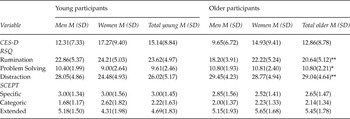
Table 1 shows means and standard deviations of variables by age group and gender. A MANCOVA with age-group and gender as fixed factors was performed with CES-D, rumination, problem solving, distraction, and specific, categoric and extended memories, as dependent measures. Box´s Test of equality of covariance matrices and Levene’s Test of equality of error variances were not significant (all ps > .12).
Mean (M) and Standard Deviations (SD) for variables in the study by group of age and gender

Note: *p < .05; **p < .01 (significant differences by group of age). CES-D: Centre for Epidemiologic Studies-Depression; RSQ: The Response Styles Questionnaire; SCEPT: Sentence Completion for Events from the Past Test; Specific: number of autobiographical memories lasting less than 24 hours; Categoric: number of summary type autobiographical memories; Extended: number of autobiographical memories referred to a period of time.
A main general effect of the age-group and gender factors was obtained, F(7, 92) = 4.24, p < .001, η2 = .24 and F(7, 92) = 3.04, p = .006, η2 = .19; respectively. However, the age-group by gender interaction was not significant, F(7, 92) = 1.29, p = .26, η2 = .09.
Differences on CES-D
Older adults showed lower scores on CES-D than young participants, although not significantly, F(1,98) = 2.12, p = .15, η2 = .02. Women presented higher scores on CES-D than men, F(1,98) = 8.89, p = .004, η2 = .08.
Differences on rumination, problem solving, and distraction
Younger participants reported greater use of rumination than older participants, F(1, 98) = 11.43, p = .001, η2 = .10. However, older participants reported greater use of problem solving and distraction strategies when in a depressed mood than younger participants, F(1, 98) = 5.57, p = .020, η2 = .05, F(1, 98) = 8.71, p = .004, η2 = .08; respectively. Women reported significantly higher levels of rumination than men, F(1, 98) = 7.46, p = .007, η 2 = .07, whereas men scored higher on distraction than women F(1, 98) = 4.82, p = .03, η 2 = .05.
Differences on autobiographical recall
There were no significant effects of age, gender, or interaction of age by gender on the recall of specific and extended autobiographical memories (all ps > .06). Although the difference was marginally significant, women scored higher than men on categoric memories, F(1, 98) = 3.8, p = .052, η2 = .04.
Rumination as mediator variable
Mediation analyses were carried out with the macro “INDIRECT” for SPSS developed by Preacher and Hayes. Footnote 1 The macro (Preacher & Hayes, Reference Preacher and Hayes2004, Reference Preacher and Hayes2008) is designed to estimate the direct and indirect effect of variables using ordinary logistic regressions based on the definition of mediator variable formulated by Baron and Kenny (Baron & Kenny, Reference Baron and Kenny1986). In addition, statistics for mediation in these regressions are obtained after bootstrapping. Bootstrapping is a nonparametric resampling with replacement procedure that involves repeatedly sampling from the data set and estimating the indirect effect in each resampled data set, increasing the confidence of results for small samples (Preacher & Hayes, Reference Preacher and Hayes2008). Following Preacher and Hayes’ suggestions, the number of bootstrap resampling chosen in the current analyses was 5000. Bootstrap confidence intervals of 95% and 99% were selected to test mediation effects over the widely used Sobel test because of the unrealistic assumption the test makes about the shape of the sampling distribution of the indirect effect (Hayes, Reference Hayes2009; Preacher & Hayes, Reference Preacher and Hayes2008). When the effect of the dependent variable (X) on the dependent variable (Y) decreases by a nontrivial amount, but not to zero, partial mediation is said to have occurred. So, if zero does not occur between the lower limit (LL) and the upper limit (UP) of the bootstrapped confidence interval, then we can conclude that the indirect effect is significant.
Rumination as mediator variable between age (X) and CES-D (Y) effects
Age had an estimated negative direct effect on rumination, t = –2.74, p = .007. Rumination had direct effects on CES-D scores, t = 6.64, p = < .001. Age had no effects on CES-D scores, t = –1.01, p = .31. Mediation effect by bootstrapping can be observed even when the independent variable had no direct effects on the dependent variable (see Preacher & Hayes, Reference Preacher and Hayes2004, second example). The true indirect effect was estimated to lie between –.1114 (LL) and –.0173 (UL) with 95% confidence and between –.1332 (LL) and –.0047 (UL) with 99% confidence. Because zero was not in the 99% confidence interval, we can conclude that the indirect effect of rumination was significantly different from zero at p < .01. In addition, the negative, albeit nonsignificant, relationship between age and depression was smaller after controlling for rumination, t = .58, p = .56. The overall model was significant, R 2 adj = .30, F(2, 99) = 22.73, p < .001.
Rumination as mediator variable between gender (X) and CES-D (Y) effects
Gender had a direct effect on rumination, t = 2.46, p = .015. Rumination had direct effects on CES-D scores, t = 6.18, p < .004. Gender had direct effects on CES-D scores, t = 2.92, p = .31. The true indirect effect of rumination was estimated to lie between .5329 (LL) and 4.1810 (UL) with 95% confidence and between –.1671 (LL) and 4.7796 (UL) with 99% confidence. Because zero was not in the 95% confidence interval, we can conclude that the indirect effect of rumination was significantly different from zero at p < .05. In addition, the significant relationship between gender and depression was non-significant after controlling for rumination, t = 1.84, p = .07. The overall model was significant, R 2 adj = .32, F(2, 99) = 24.96, p < .001.
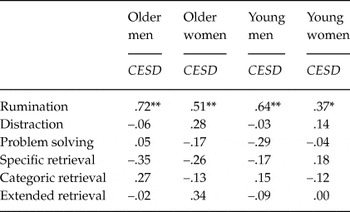
Table 2 shows correlations between emotional regulatory strategies, type of autobiographical memory and depression scores by age and gender.
Pearson’s correlations between emotional regulatory strategies, type of autobiographical memory and depression scores (CESD) by age and gender

Note: CESD = Centre for Epidemiologic Studies-Depression; Specific: number of autobiographical memories lasting less than 24 hours; Categoric: number of summary type autobiographical memory; Extended: number of autobiographical memories referred to a period of time.
* p < .05; **p < .01.
Discussion
Consistent with our hypotheses and previous research adaptive emotional regulatory strategies increased with age. Older participants endorsed more frequent use of helpful problem solving and distraction and less frequent use of maladaptive rumination when they felt sad or depressed, relative to younger participants. As expected, older adults presented lower levels of depression than their younger counterparts. Consistent with our hypotheses and previous findings, women used less distraction and more rumination than men in response to sadness and depressed mood, and reported higher depression scores than men. The current findings further confirm previous findings regarding the relevance of rumination as an important variable in mental health and extend this relationship to older adults, with the association between depression scores and age reducing when rumination was entered in the analysis of regression. Rumination was also demonstrated to mediate the effect of gender on depression, replicating a robust finding.
Contrary to hypotheses, specificity of autobiographical recall did not differ as a function of age. If rumination decreases with age and rumination decreases specific autobiographical memory retrieval (Watkins & Teasdale, Reference Watkins and Teasdale2001), a plausible hypothesis is that older adults would recall higher levels of specific memories than young participants. However, this was not found. Moreover, recent experiments and a prospective longitudinal clinical study using the autobiographical memory task, also found that memory specificity may not be a useful marker for vulnerability for clinical depression in older adults (Haringsma, Spinhoven, Engels, & van der Leeden, Reference Haringsma, Spinhoven, Engels and van der Leeden2010). Thus, although aging appears to bias people to focus on positive aspects of experience, this bias does not appear to act by influencing the relative retrieval of specific autobiographical memories (Gallo, Korthauer, McDonough, Teshale, & Johnson, Reference Gallo, Korthauer, McDonough, Teshale and Johnson2011). The lack of differences in specific memories between older and young adults found in the current research must be taken with caution. Previous research in this field has been carried out using the Autobiographical Memory Test (AMT) (Williams & Broadbent, Reference Williams and Broadbent1986). However, we used the Sentence Completion for Events from the Past Test (SCEPT; Raes et al., Reference Raes, Hermans, Williams and Eelen2007) that shows a higher power to capture overgenerality than specificity compared to the AMT (Raes et al., Reference Raes, Hermans, Williams and Eelen2007).
Overall, these results support the premises of the SST (Carstensen et al., Reference Carstensen, Isaacowitz and Charles1999) as older adults were more likely to select problem solving and distraction strategies, consistent with focusing on emotional goals in the context of reduced perceived lifetime relative to younger adults who more likely to ruminate to obtain knowledge about their feelings to be applied in future life experiences. According to the positivity effect, distraction may be considered a strategy used by older people to move their attention away from negative stimuli (Coats, Reference Coats2007). These findings indicate that as well as changes in cognitive reappraisal with age (John & Gross, Reference John and Gross2004), there are also important differences in the emotional regulation styles (problem-solving and distraction versus rumination) adopted in response to sad and depressed mood at different ages. It has been suggested that the increment in social problem solving in adulthood may be the consequence of adopting the emotional regulation strategy of reappraisal (changing the way one thinks about potentially emotion-eliciting event) (Scheibe & Carstensen, Reference Scheibe and Carstensen2010). Improved emotion regulation in older age has led to the hypothesis that trait rumination decreases with age and may mediate the effects of age on emotional well-being (Erskine, Kvavilashvili, Conway, & Myers, Reference Erskine, Kvavilashvili, Conway and Myers2007).
The current research has several methodological limitations. First, the order of measures was not counterbalanced. Thus, there were no control on confounding effects of the order in the application of measures. Second, the sample size is small, especially to obtain gender by age interactions. Third, we need more age cohorts and more longitudinal studies to establish precise predictions about the evolution of cognitive strategies with age. Fourth, the correlational nature of data limits conclusions. Further experimental research assessing the effects of the induction of categoric memories and rumination on adaptive emotion regulation strategies and on depression in men and women and at different age groups is needed to test causality. Clinical trials analyzing the effects on interventions to reduce rumination, such as rumination-focused CBT (Watkins et al., Reference Watkins, Mullan, Wingrove, Rimes, Steiner, Bathurst and Scott2011) would provide proof-of-principle that rumination plays a causal role in poor emotional regulation and increased depression in those older adults more vulnerable to depression. High scores on rumination mediated depressive symptoms in healthy older and young adults. In fact, as can be observed in table 2, rumination was significantly correlated with depression through both groups of age and gender. Thus, cognitive therapy that reduces rumination and increases distraction and problem-solving may reduce onset and relapse of depression (Wilkinson, Croudace, & Goodyer, Reference Wilkinson, Croudace and Goodyer2013).
In conclusion, the major contribution of this research is the first examination of a range of emotional coping strategies together in both older and younger adults, confirming that an important emotional regulation strategy – rumination- becomes less frequent on average with increasing age. Although this association has been previously reported and/or suggested, studies assessing rumination and adaptive emotion regulation strategies in older samples are still scarce and replication is required to confirm the reliability of this observation.
Thanks to Professors Rigoberto López, Concha Fabeiro, Diosina Lozano, and David Igual for their help in the selection of the sample.