I have two major aims in this and its companion paper. My first is to examine the broad implications of arguments in the encyclical Fides et Ratio (henceforth: FR) from the standpoint of the overall debate between theology and religion, science and philosophy.Footnote 1Footnote 2 Second, within the framework established by FR, I wish to consider any implications the encyclical might have for specific debates and interactions between psychology and theology, especially but not exclusively cultural psychology and theology.
My initial working hypothesis is that FR does indeed have important implications which go beyond its more immediate focus on the interpenetration of faith and reason, and the relation between theology and philosophy. Its message, I suggest, can act centripetally to counteract otherwise underconstrained or centrifugal tendencies in secular knowledge. In other words the position outlined in FR has the potential to act as a unifying focus or attractor in explanatory space. In looking to support this hypothesis, I will also assume that FR can be approached from either a faith or non-faith perspective. From the former position the mainly positive arguments I adduce in support of FR's integrative and constraining role may then meet with more favour. I leave it to others, from different confessional faith perspectives or none, to mount systematic counter arguments; these I welcome in due course in the spirit of ongoing dialogue captured so well, as it happens, by FR. (For the record, my own theological sympathies are broadly Thomist though I do not make any explicit or detailed connections here with this tradition).
In this paper, after a brief summary of some of the main themes of FR, I introduce in more detail my conception of explanatory constraints indicating how FR contributes to these, and identify some of the positions they rule out. I then briefly detail possible reactions to the deployment of such constraints especially by non-theists, and consider how the Christian apologist might respond. In paper 2, having outlined some general issues of the relation between anthropologies and ontologies, I review a recent cultural psychological approach to the person, which I personally find helpful in dialogue with theology. As I have already introduced its key characteristics elsewhere,Footnote 3 I shall concentrate only on those dimensions especially germane to the issue of interdisciplinarity and FR. I then examine specific types of interactions between psychology and theology, relating these, where possible, to relevant sections of FR.
To a large extent many of the points I discuss are already embedded within FR and the two papers could be said merely to represent their re-arrangement. However, reorganisations do occasionally result in new insights. In offering mine I seek to progress the next generation of the science, philosophy and religion debate toward the point where there is more serious discussion of interdisciplinary interactions and potential for explanatory convergence rather than simply of disciplinary compatibilities.Footnote 4
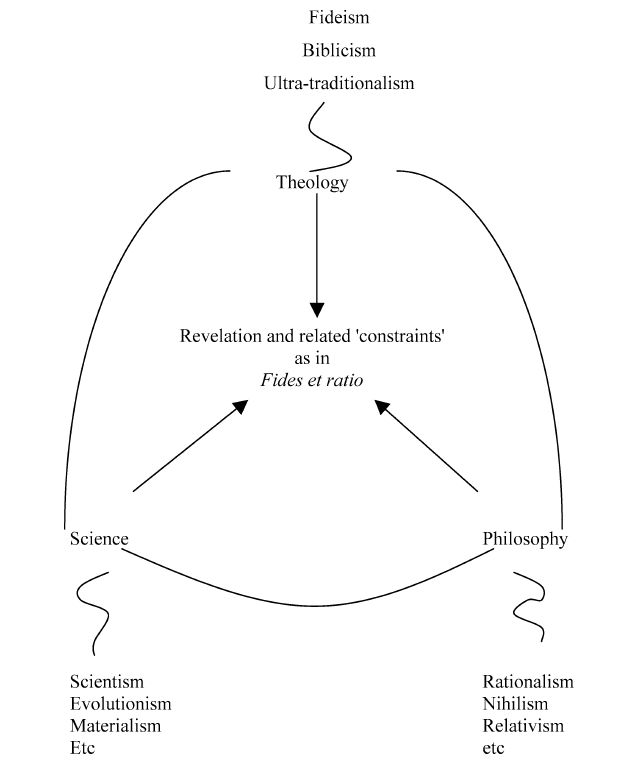
Before considering the issues in detail, and in a break from the no-pictures tradition of theology articles, Figure 1 summarises the essay's overall argument diagrammatically. Science, philosophy and theology are each capable of generating accounts without due regard for those in other areas. FR operates centrally to govern the overall coherence of the system.
Inter-relationships between Christian theology, philosophy and science. Taken singly, or in pairs, all these endeavours can lead to underconstrained, ‘centrifugal’ explanations (fideism, scientism, nihilism etc) which flourish without due regard for other accounts. Considered together, mutual constraints from reason, faith, truth, being, tradition and Christian Revelation rule out many such explanations. The arguments in Fides et Ratio strengthen the reasons for observing just such a critical set of mutual constraints, offering a useful centripetal force to balance otherwise centrifugal, secular or religious forces, while still respecting disciplinary autonomy.

In the model, philosophical and theological accounts and those derived initially from science are either unconstrained, overconstrained, partially constrained, or fully constrained. In general, the space outside the bounded area of the diagram is occupied by many unconstrained yet inflated accounts, frequently depending on one often limited perspective, such as biblicism, evolutionism, anti-realism and so on. Such accounts, unconstrained by other disciplines, will often paradoxically be found to be overly limited, and are in that sense overconstrained by arguments from within their own discipline.Footnote 5 Interactions between pairs of domains on the other hand may result in their mutual adherence to partial constraints. So, for example, science and religion/theology might establish a minimal compatibilism but stop short of convergence in the unity of truth; philosophy and theology might get no further than deism without agreement on Revelation; a Kuhnian consensus might be the limited result of a philosophy of science which ignores being and metaphysics. Entry into the space within the bounded area, however, depends crucially on satisfaction of FR's superordinate, full constraints.
I use the term constraints frequently in this paper but do so cautiously and with some reservation, and must now specify it more clearly. By constraints I do not mean any unwarranted or authoritarian limits or controls on explanations, secular or religious. Rather I use the term to signify that arguments which abide by constraints are those which acknowledge and incorporate principles or criteria that they must in some sense obey or satisfy. So, for example, a philosophical argument which acknowledges the constraints of realist ontology must reckon with a real world of objects and entities at least partially independent of their observers. Or, a theology which acknowledges the constraint of history will need to consider the tradition constituted and constitutive nature of human experience when discussing the interpretation of scripture or the formulation of dogma. No attempt to restrict disciplinary autonomy is therefore intended in the use of the term ‘constraints’, it is simply used to connote sets of factors or dimensions which some purveyors of explanations choose to take into account and others do not.
In fact, the diagram shows how the centrality of the arguments expressed in FR can be accepted without severely compromising the autonomy of other disciplines. Adopting the position of FR allows one to see clearly the implications of other disciplinary positions, whether scientific, philosophical or theological as contextualised by a particular set of arguments on faith and reason. But it is equally possible to adopt the independent standpoint of, say, one of the sciences or philosophy and prosecute these, while remaining confident that their methods and internal workings remain immune from (direct) interference from FR's perspective, although they are ultimately capable of being governed by such a perspective. In addition, connections between science and philosophy, philosophy and theology, and theology and science are all potentially influenced by FR, but are also freely available as independent standpoints if desired. In other words FR can be interpreted as suggesting that (dogmatic) theological accounts can take their proper place in explanatory space, without unduly constricting the activities of other areas, or their interconnections.
Perhaps a well known, cosmological analogy might better illustrate some of these general ideas. Consider a typical solar system such as our own. Gas and solid particles travelling too fast to be held by the sun's gravitational field will have escaped the sun's influence in the past, and headed off into lifeless space. Gas and particles moving at orbital speed, on the other hand, agglomerated into planets and other objects. The existence and motions of planets around the sun are, therefore, undoubtedly governed by our sun's gravitational influence, but many of the activities or processes on those planets are obviously not directly controlled or micro-managed by the sun. To this extent the sun might be said to be superordinate in the system as a whole, and thereby influential over its planetary subsystems, without being deterministic. Suppose then we equate our ‘space’ of explanations, religious and secular, with a solar system, Revelation and FR (as reflections on the truths of Revelation) with the sun, and other secular disciplines as its planets. Underconstrained accounts in this scheme are then simply those entities that have escaped the ‘gravitational pull’ of FR's constraining arguments. They are no longer in this particular region of explanatory space, and so neither are they necessarily subject to other influences from partner disciplines. Such arguments as do remain and are consonant with those of FR, continue under its sway, and are also mutually implicative, just as, say, the orbit of Mars is compatible with that of the Earth with both orbits harmoniously governed by the sun. Without wishing to push the analogy too far, a further parallel can be drawn. As we know very well, different astronomical viewpoints can be adopted for mapping purposes. A heliocentric view provides for a simpler, and more intellectually satisfying picture of the inter-relationships of planets and sun, than one which is geocentric. Similarly, FR offers a credible, privileged, ortho-logical Footnote 6 position in explanatory space, from which certain secular accounts can be seen to cohere. Adopting the standpoint of secular disciplines, by contrast, and attempting then to see the whole is like trying to map planetary motions from earth. It is still possible to glimpse the overall picture, but the exercise may involve far more special pleading, explanatory ‘epicycles’ we might say, than would be required were we do our mapping from the centre. Viewpoint, therefore, critically influences the ease and likelihood that a satisfying overall pattern is seen, the coherence of the whole in this case.Footnote 6
I will try to make good some of these claims, after a briefly summarising the major themes of FR.
Fides et Ratio: a brief summary
The encyclical Fides et Ratio is a rich and complex document based around a simple idea: ‘Sure of her competence as the bearer of the Revelation of Jesus Christ, the Church reaffirms the need to reflect upon truth’, and, in so doing to concentrate ‘on the theme of truth itself and on its foundation in relation to faith.’ (FR6). At the centre of the document lie three key concepts: the unity of truth under Revelation, the reasonableness of faith and the trustworthiness of reason. FR affirms that far from being mutually exclusive, faith and reason are mutually supportive and implicative. Thus, while the document is wide ranging it centres on the proper relation between faith, reason, Christian theology and philosophy. This raises a number of further issues which FR partially addresses: on the nature explanation, the continued need for metaphysics and reflection on being, the nature of the human person, the unity of knowledge, the openness of the Catholic tradition to philosophical and secular enquiry, and the mutual benefits which flow from a proper relation between theology and philosophy, the ancilla or handmaiden of theology.
FR's structure reflects well the balance of its overall approach. Following an initial scene setting introduction its first chapter examines the centrality of the concept of Revelation, clearly establishing its Christological basis. ‘The knowledge which the church offers…has its origin ….in the word of God which she has received in faith.’ (FR 7). Nevertheless, despite the primacy of Revelation and the fact that ‘the knowledge which the human being has of God perfects all that the human mind can know about life..’ (ibid.), ‘the truth attained by philosophy and the truth of Revelation are neither identical nor mutually exclusive.’ (FR 8). Even so, the knowledge obtained by faith and reason differ in source and object. ‘Philosophy and the sciences function within the order of natural reason; while faith, enlightened and guided by the Spirit, recognizes in the message of salvation the “fullness of grace and truth” (cf. Jn 1:14) which God has willed to reveal in history and definitively through his Son, Jesus Christ (cf. Jn 5:9; Jn 5:31-32).’ (FR 9, italics added). The centrality of Christ in Revelation is such that “only in the mystery of the incarnate Word does the mystery of man take on light.” (FR 12, quoting Gaudium et Spes). ‘Seen in any other terms, the mystery of personal existence remains an insoluble riddle.” (FR 12). Faith in Revelation is first and foremost an obedient response to God, ‘a moment of fundamental decision…in which the intellect and will display their spiritual nature, enabling the subject to act in such a way which realizes personal freedom to the full.’ (FR13). Making a ‘novel’ point for philosophical learning, and succinctly capturing the space for reason to operate, FR 14 states: ‘Revelation has set within history a point of reference which cannot be ignored…Yet this knowledge refers back constantly to the mystery of God which the human mind cannot exhaust but can only receive and embrace in faith. Between these two poles, reason has its own specific field in which it can enquire and understand, restricted only by its finiteness before the mystery of the infinite God.’
In the following two chapters, FR then examines the dual directions in which the dynamic of reason and faith can operate: from belief to understanding (faith seeking understanding) and from understanding to belief. As I will be dealing with the implications of this dynamic later when discussing links between psychology and theology, I will not pursue its details at this point. I do wish however to draw attention to a recurrent theme in both chapters and throughout FR. Despite having different starting points, faith and reason are not unified routes to different truths but are different routes to a unified truth. Accordingly, FR emphasises both the unity of truth and the common project in its pursuit that requires both faith and reason.Footnote 7 Thus ‘(w)hat is distinctive in the Biblical text is that there is a profound and indissoluble unity between the knowledge of reason and the knowledge of faith’. (FR16, see also FR34). But the union is not a simple one and the Christian's attitude to philosophy requires ‘thoroughgoing discernment’. (FR23). At times, in fact, this union can be challenged, but challenged only to go further. In an interesting alternative to Wittgenstein's metaphor of the religious thinker who walks a tightrope between belief and unbelief, we read: ‘The preaching of Christ crucified is the reef upon which the link between faith and philosophy can break up, but it is also the reef beyond which the two can set forth upon the boundless ocean of truth. Here we see not only the border between reason and faith, but also the space where the two may meet.’ (FR23). Nevertheless truth is to be found and is universal: ‘Every truth - if it really is a truth - presents itself as a universal, even if it is not the whole truth. If something is true, then it must be true for all people at all times.’ (FR 27). Furthermore we can have confidence in truth's unity. I quote at length, and therefore emphasise the following, for it is critical for the science and religion debate:
This truth, which God reveals to us in Jesus Christ, is not opposed to the truths which philosophy perceives. On the contrary the two modes of knowledge lead to truth in all its fullness. The unity of truth is a fundamental premise of reasoning, as the principle of non-contradiction makes clear. Revelation renders this unity certain, showing that the God of creation is also the God of salvation history. It is the one and the same God who establishes and guarantees the intelligibility and reasonableness of the natural order of things, upon which scientists confidently depend and who reveals himself as the Father of our Lord Jesus Christ. This unity of truth, natural and revealed, is embodied in a living and personal way in Christ, as the Apostle reminds us: “Truth is in Jesus”(cf. Eph 4:21; Col 1:15-20). He is the eternal Word in whom all things were created, and he is the incarnate Word who in his entire person reveals the Father (cf. Jn 1:14, 18). What human reasons seeks “without knowing it” (cf. Acts 17:23) can be found only through Christ: what is revealed in him is “the full truth” (cf. Jn 1:14-16) of everything which was created in him and through him and which therefore in him finds its fulfilment (cf. Col 1:17).
The journey toward this truth means going ‘beyond the stage of simple believing (as) Christian faith immerses human beings in the order of grace, which enables them to share in the mystery of Christ, which in turn offers them a true and coherent knowledge of the Triune God.’ (FR33).
Chapter 4 then charts the relationship between faith and reason from a historical perspective, surveying critical moments in their encounter. The chapter thus serves both as a manifesto for the ‘common project’ of faith and reason dating from the time of the Cappadocian fathers, Dionysius the Areopagite and St. Augustine, while also charting its highs and lows. Thus, for example, ‘The Bishop of Hippo succeeded in producing the first great synthesis of philosophy and theology…In him the great unity of knowledge, grounded in the thought of the Bible, was both confirmed and sustained by a depth of speculative thinking.’ (FR 40). In scholastic philosophy the role of reason becomes even more prominent, but always the balance between faith and reason is asserted. For Anselm ‘the priority of faith is not in competition with the search which is proper to reason’ and ‘(r)eason is not asked to pass judgement on the contents of faith.’ (FR 42). While Aquinas in arguing that ‘(b)oth the light of reason and the light of faith come from God’ was able to effect ‘a reconciliation between the secularity of the world and the radicality of the Gospel.’ (FR 43). On the other hand, since the late Mediaeval period onwards and culminating in the past two hundred years, a number of philosophical, religious and cultural developments have pressured and broken the unified approach. This has not only resulted in a crisis of rationalism, but also the appearance of nihilism. Thus in some cases ‘some philosophers have abandoned the search for truth in itself and made their sole aim the attainment of a subjective certainty or a pragmatic sense of utility. This in turn has obscured the dignity of reason, which is no longer equipped to know the truth and seek the absolute.’ (FR 47).
By contrast, the Magisterium, as Chapter 5 documents, has always been alert to the need to maintain the balance between faith and reason, and has been ready to speak out when philosophical positions at variance with or threatening it have emerged. The Magisterium effectively brings to bear the deposit of faith, safeguarded in the Catholic tradition, and backed by its teaching authority. These Magisterial intervention are not wholly negative but ‘are intended above all to prompt, promote and encourage philosophical enquiry’, while stressing that ‘no historical form of philosophy can legitimately claim to embrace the totality of truth, nor to be the complete explanation of the human being, of the world and of the human being's relationship with God.’ (FR 51).
Chapter 6 then reviews the interaction between philosophy and theology in detail. Philosophy is seen as ancillary to theology, but still autonomous. The two disciplines have much to offer each other and are related in a circular fashion. ‘Theology's source and starting-point must always be the word of God revealed in history, while its final goal will be an understanding of that word which increases with each passing generation. Yet, since God's word is Truth (cf. Jn 17:17), the human search for truth - philosophy, pursued in keeping with its own rules - can only help to understand God's word better.’ (FR 73). It is probably worth mentioning here that I read philosophy as sufficiently broad as to encompass the philosophical positions derived from the sciences. In addition the encyclical stresses in several places the benefits to be gained from secular, scientific knowledge in general, though at times it conveys the impression that it is philosophy which has most to offer to theology. We shall return to this issue in the next paper.
Fides et Ratio closes with reflections on the current requirements for theology and philosophy. In the face of a fragmentation of knowledge occasioned by perspectives ‘often of a scientific temper, … philosophy needs to recover its sapiential function as a search for the ultimate and overarching meaning of life…. In doing so, it will be not only the decisive factor which determines the foundations and limits of the different fields of scientific understanding, but will also take its place as the ultimate framework of the unity of human knowledge and action, leading them to converge towards a final goal and meaning.’ (FR 81, italics added). Yet this task cannot be performed unless philosophy has confidence to ‘verify the human capacity to know the truth,’ and the possibility of the intellect with certitude ‘to attain to reality itself as knowable’ even though in a way which is weak and partially obscured. (FR 82). In turn, the unity of truth, and trust in the knowability of reality are only possible if philosophy recovers its metaphysical vision and a sense of the beyond. Various philosophical and scientistic positions are then ruled out, as we shall see shortly. Finally, theology has as its chief purpose to provide an understanding of Revelation, with philosophy acting as its ancilla or handmaiden.
‘In short, Christian Revelation becomes the true point of encounter between philosophical and theological thinking in their reciprocal relationship.’ (FR 79).
To engage in this encounter, theology will need to return to a philosophy of being. Pressing problems for the joint enterprise to solve are then the relationship of meaning and truth as these develop and unfold through history. Also, and linked to this, to consider ‘how one can reconcile the absoluteness and universality of truth with the unavoidable historical and cultural conditioning of the formulas which express that truth.’ (FR 95).Footnote 8
Explanatory constraints in FR
In this section, I explore the idea of FR as offering a set of explanatory constraints in more detail.
While the generation of potential or plausible solutions to many problems is often facilitated by the removal of constraints which are unnecessary,Footnote 9 the selection of actual or appropriate solutions generally requires the re-imposition of those which are necessary. Sonnets, sonatas, soccer games, haiku and paintings in the Sistine chapel are all benefited rather than restricted by the forms and restrictions, which they must satisfy. Indeed they would not exist without them. The human body, too, has many functions to perform, but these must be accomplished within strict physico-temporal and physiological limits. What is true of such artistic and physical forms is likely also to be true of our explanations. If, that is, we hold to the idea that Truth, in its unity, exists, and our true explanations are seen to be mutually implicative.Footnote 10
In this section, after briefly listing some of what I consider to be unconstrained positions derived from science, philosophy and theology, I provide some typical examples to indicate how constraints, within or between domains, can be effective in qualifying positions which otherwise tend to a premature globalism. I then tease out the major, cohering constraint-dimensions within FR, noting with each some of the positions they challenge, in order to show that FR has within itself the explanatory power to govern arguments across all three areas of knowledge even though its explicit focus is on philosophy and theology.
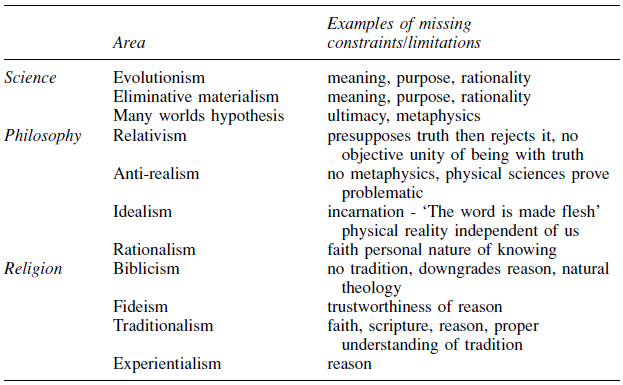
Left alone, then, philosophy, science and general Christian theology can suffer from underconstraints resulting in explanations which otherwise would be ruled out or shown to be inadequate if the legitimacy of such constraints is accepted. Table 1 lists just some of these, many of which are identifiable in FR.
Philosophical and theological positions generated by scientific, philosophical and theological perspectives and selected constraints which, if acknowledged, would help to qualify or refute the position in question.

Consider as an example evolutionism. This takes as its starting point the scientific neo-Darwinian account of evolution by natural selection, and extends this to form an overarching story, now deemed to be sufficient as well as necessary to account for the emergence, not simply of life, but of rationality and mind too. In its more radical variants, evolutionism, or selectionism as it is sometimes known, has even been extended into a more general account covering the behaviour of a variety of organisms, the formation of neural networks and even cosmogenesis itself. Footnote 11 Now the scientific strengths or weaknesses of these various selectionist theories are not at issue here. Their adequacy as scientific theories can, and should, be established with normal scientific methods and procedures. What is at issue, with these and similar scientisms, is the illegitimate extension and promotion of, in this case, evolutionary ideas into a global philosophical account of the way (all) things are. For this to be accomplished, two sleights of hand have to be performed. First, commonsense notions of meaning and reason have to be presupposed, even though they are effectively ruled out by the theory in question. For there to be any rational discourse about evolution in the first place, it has to be assumed that human thought is in some sense rational. Yet, as Roger Trigg for instance has capably shown, a consistent evolutionism undermines any independent support for the power of reason, while requiring (independent) reason to recruit support for itself.Footnote 12 Evolutionism thus justifies reason's fit with truth on the grounds that evolutionary adaptations would be expected to result in a suitable match between our abilities and the world, yet presupposes that fit to account for the truth of the theory of evolution. As he indicates the argument is circular:
‘We are in touch with the world because we have evolved to be. How do we know we have evolved? The theory of evolution tells us so. How could we know the theory offers a true account of the world? The answer is that it is because our minds are attuned to the world and that is the result of evolution. So we go on.’Footnote 13
Second, the fact that evolution alone can be used to account for structural change in life forms without appeal to purpose, is then used to infer that such life forms do not, or worse cannot, exhibit purpose at all in their activities, since all is due to chance and necessity. In other words the constraint of purpose, at some level, is sidelined and then illegitimately shown to be unnecessary. But yet again, such a global theory then runs into several embarrassments not least of trying to explain the highly purposive actions of evolutionary biologists themselves as they promote their careers!
But we can turn these arguments around. Far from being embarrassing hidden constructs, reason and meaning are essential for coherent discourse and must, therefore, if entertained, show up the limits of evolutionary arguments. Or again, we might argue, on religious or psychological grounds, say, that human behaviour is future oriented, purposive and open, then the need either to qualify or restrict too enthusiastic an evolutionism becomes obvious (FR 54). In both cases, constraints ignored by the global position of evolutionism, if re-entertained, immediately establish it localism, as is also the case with materialist approaches to mind.
Turning to another discipline, within philosophy itself a position such as anti-realism tends to flourish where either the possibility of metaphysics is ruled out, or when there is confusion and conflation between how we come to know something and what it is that we know (FR 55). Anti-realism often emerges when epistemology obscures ontology, by contrast re-instating a proper concern with metaphysical ontology can lead to the eclipse of anti-realism. As John Searle has also pointed out realism is not an epistemic issue, it is ‘…an ontological theory: It says that there exists a reality totally independent of our representations.’Footnote 14
The complex of theological ideas has over the centuries yielded positions like Biblicism, fideism or radical traditionalism which emphasise limited routes to religious truth, downplaying reason, living tradition and the safeguarding role of authority (FR 52, 55, 56, 61). Re-emphasising these other neglected dimensions puts a brake on unrestrained, uni-dimensional theologies.
Now it is clearly not the case that these positions, or any of the others in Table 1 for that matter, cannot be qualified or tempered by one or more inputs from either their own or the other domains. They all can in their various ways. Thus, for instance, the claim that neo-Darwinian arguments may be necessary to account for changes in life forms may well be perfectly true. Nevertheless, powerful arguments can be advanced from within the life sciences themselves to show that such approaches may be insufficient as full accounts of the emergence of complexity and new life forms.Footnote 15 If in the physical sciences, we are prepared to accept some of the arguments concerning ultimate being from metaphysics, claims such as the many worlds hypothesis or, say, anti-realist positions begin to fragment. In the former case because of the failure to ask questions of sufficient ultimacy, in the latter because of a failure to grasp notions of being at all.Footnote 16 Likewise, radical empiricism gets a severe knock not only from arguments regarding the categorial nature of knowing, but also from claims that Revelation is a valid route to knowledge. Idealism too is undermined by assumptions that there exists a (physical) reality independent of ourselves. From within theology itself, positions such as extreme Biblicism or fideism can be seen as biased approaches to the theological project. Both represent in different ways a discomfort with reason (FR 55,56,62). The former questioning its complete adequacy as a secure mode of transport, the latter considering it too unseaworthy a vessel to sail beyond the reef to the ocean of truth. Similarly, philosophical as well as theological arguments can be brought to bear against experiential-expressive approaches to doctrine or theological method (FR 83). Even analytical philosophy has its own means to curb its own excesses,Footnote 17 though it is not obvious that the same is true for all types of philosophy.
In all of these cases, and more, one or more qualifying arguments can be brought to bear from various directions, including the home discipline, to limit otherwise overextended conclusions which derive from overly limited premises. But, and this is my key point regarding the importance of FR, these constraints, or qualifying arguments, vary from case to case; at no single point within the framework of secular knowledge do they cohere into an organised or an easily recognised pattern which can be effectively deployed as a whole. On the other hand, it is precisely as a well-defined pattern that they cohere (are brought together) in the encyclical FR. Read positively, FR is a powerful piece of Catholic dogmatic theology, but read negatively it offers equally powerful clues as to what is inadequate, what is ignored or what is not present in any or all secular systems which otherwise make claims to universality. In other words it shows up their limited idolatry, by identifying in one place, the explanatory constraints which, if adhered to, will help liberate them from their premature claims of ultimacy. Moreover, it does so encouragingly by emphasising the beauty of the coherent whole, not the inadequacy of the incoherent parts. It is as if secularity has managed to provide many of the necessary coloured elements to make a kaleidoscopic pattern. Each part on its own is able to offer us alluring views and colours when used as an eye glass, perhaps, but lacking the other parts, the instrument itself, and the eye of faith, the whole simply cannot be seen.Footnote 18
So what sorts of constraints are there? There are of course many possible general constraints on our explanations. Some will be cultural, others traditional, others philosophical, others scientific, others merely logical and so on. In the case of FR, we can usefully think of these under five broad headings: epistemic and methodological; ontological; meaning and truth; tradition, and constraints to do with the dignity of the person and the person of Christ.
Epistemic and methodological constraints
Acceptance of the legitimacy of faith in Revelation imposes important epistemological constraints on other concepts. To begin with, it implies that reason itself is a gift from God. Reason's subordinacy under Revelation (and the intelligibility of reality which Revelation guarantees) assures the trustworthiness of reason itself, ‘infused ..with the richness drawn from Revelation.’ (FR 41). It also implies that truth exists and is to some degree knowable. The dual benefit of the knowability of truth and the trustworthiness and faithfulness of reason (FR 56), serves as a powerful anchor in any explanatory scheme, even though the reason in question may so often be flawed and imperfect,Footnote 19 and human knowledge ‘seen through a glass darkly’,Footnote 20 since ‘reason…. can always go beyond what it has already achieved.’ (FR 42). A limited deism, for example, is immediately ruled out, as is the prospect of a sustaining but unrevealing God, for trust in Revelation necessarily means a role for deus se revelans as well as deus per se. ‘Deprived of what Revelation offers, reason…(is in) …danger of losing sight of its final goal.’ (FR 48).
The duality of faith and reason also suggests a model of the person in which these are not lesser and greater ways of knowing but, though different, are equally indispensable. ‘The fundamental harmony between the knowledge of faith and the knowledge of philosophy is once again confirmed.’ (FR 42). The resulting model is far from the ultra-rational ideal of the late Enlightenment, with no room for belief or probable knowledge, but equally too it is distant from the fideistic, which ‘runs the grave risk of withering into myth or superstition’. (FR 48, also FR 52,55).
The emphasis on faith-entwined reason also calls into question the ability of psychology alone to offer a full and complete account of the person - especially when conflated into psychologism. ‘The invitation addressed to theologians to engage the human sciences….should not be interpreted as an implicit authorization to marginalize philosophy…’ (FR 61, also FR 69). Any such overclaims for psychology, I suggest, easily miss the fact that it is unable, single-handedly, to offer accounts of the meaning of belief, even if it is able to account for the self-shaping mechanics of belief. I shall return to this important point in the second of these two papers.
Acknowledging the interaction between faith and reason also protects against crude partitioning of explanations into, say, radical empiricism and idealism, or objectivism and subjectivism, and guards against the reduction of philosophy to either ‘the attainment of a subjective certainty or a pragmatic sense of utility.’ (FR 47). Knowledge depends on faith and faith seeks understanding and neither is derived totally from sensory, existential or conceptual sources.
All of these conceptual positions are ruled out by faith-reason duality, but there are crucial, wider methodological implications too. The intertwining of faith and reason implies that all acts of knowing have a faith component while acts of faith have a rational dynamic, though there is a need ‘to affirm the transcendence and precedence of the mysteries of faith over the findings of philosophy.’(FR 53). Two key chapters illustrate the twin directions in which this intertwining takes place as we saw earlier, from faith to understanding and from understanding to faith.Footnote 21
Constraints of being/ontological constraints
FR is realist in its ontology (FR 60,66,97). Moreover and following from this, ultimate reality, which exceeds our human ability to grasp in its completeness, can be approached given our transcendent abilities (FR 60,67). Not only, therefore does the encyclical rule out relativist (FR 5), nihilist and immanentist positions (FR 81), it repeatedly states that philosophy needs to re-acknowledge the importance and role of metaphysics in its explanations (FR 46, 83). Once confidence in metaphysics and the ultimate benevolence of being is lost as is often the case nowadays (FR 5,47), a corresponding distrust in the power of reason generally follows (FR 5, 61).
The call to metaphysics is important in that it rules out sceptical epistemologies. It also negates or severely qualifies penultimate cosmologies (such as many world views) which fall short of considering the ultimate reasons for existence and being, their proponents having presumably abandoned ‘the sapiential horizon…in the search for truth which points beyond to something higher than the object of study.’ (FR 106). On the whole though, it suggests that humankind is teleologically driven to search for the unknowable God: ‘The thirst for truth is so rooted in the human heart that to be obliged to ignore it would cast our existence into jeopardy.’ (FR 29). Truth is knowable and there is a ‘moral obligation’ to seek it and hold to it once known (FR 25, 26), and the Revelation of truth ‘stirs the mind to ceaseless effort’ (FR 14).
Constraints of meaning and truth
Nor is the search for unified truth in vain; FR is clear in its assertion that there is a unity of truth, with its source and origin in God (FR 22), and we are given the Wisdom to make judgements ‘according to divine truth’ by the Holy Spirit (FR 44). ‘Every truth - if it really is truth - presents itself as universal, even if it not the whole truth. If something is true, then it must be true for all people and at all times.’ (FR 27).
Beyond universality, people also seek an absolute (FR 27). This searching, which defines the human condition, is not always successful or straightforward. Not only are some truths hard to attain, for reasons of human weakness (FR 28), we simply have to take many on trust (FR 31,32). So, ‘the one who seeks the truth is also the one who lives by belief’. (FR31).
The unity of truth, grounded in God and sought through faith and reason, has a number of important implications and exercises powerful constraints on other attempts at explanation. One of its central implications, which is explored here, is that different disciplinary approaches to truth, where valid, must necessarily converge on or point to a unified truth. In this sense, the unity of knowledge is a lure beyond the present horizon which pulls all honest, truth seeking endeavours forward. The unity of truth is not simply a ground and a support of all our endeavours, it is also our goal.
The converse of this is that the unity of truth exercises equally powerful constraints on philosophical positions which lead to the fragmentation of knowledge and the current ‘crisis of meaning’, offering support to ‘the possibility of a knowledge which is objectively true, even if it is not perfect.’ (FR 82, 44), clearly this discredits relativism and the postmodern denial of the ‘grand narrative’. ‘A philosophy denying the possibility of an ultimate and over-arching meaning would be not only ill-adapted to its task, but false.’ (FR 81). In addition, ‘(t)he segmentation of knowledge with its splintered approach to truth and consequent fragmentation of meaning, keeps people today from coming to an inner unity.’ (FR 85). The ultimacy of absolute truth also rules out scientism. Unchecked, scientism can bring two dangers, first ‘it leads to the impoverishment of human thought, which no longer addresses the ultimate problems’, second, by ruling out ethical critique, ‘the scientistic mentality has succeeded in leading many to think that if something is technically possible it is therefore morally admissible.’ (FR 88).
Constraints of tradition
While not a major part focus of FR the idea that belief and knowledge emerge from and contribute to living traditions is also emphasised. ‘Human beings are both child and parent of the culture in which they are immersed.’ (FR 71). Thus the cultural context ‘permeates the living of the Christian faith which contributes little by little to shaping that context.’ (ibid.). Indeed, the importance of time as a dimension in Christianity is mentioned early in the document (FR 11): because ‘(t)heology's starting point must always be the word of God revealed in history, while its final goal will be an understanding of that word which increases with each passing generation.’ (FR 74). Just as we are grounded in and seek the truth, so we are poised between the revealed word and its full understanding. Moreover, this ‘journey’ is unstoppable (FR 33).
Tradition helps carry belief from one generation to the next, being shaped in the process, but it also constrains accounts based on cultural-linguistic relativity. ‘The human being can still express truths which surpass the phenomenon of language. Truth can never be confined to time and culture.’ (FR 95) To be valid from one generation to the next truth must be enduring (FR 96). Together with the idea that truth is unified, its enduring quality also allows us to reject various forms of eclecticism too in which ideas, drawn from various sources are deployed without regard for their mutual coherence. This is because eclecticism not only offers a fragmented truth, but also can harbour a historicism which treats ‘truth’ as totally contextually dependent (FR 86, 87).
Powerful through it is, tradition does raise issues for philosophers and theologians specifically ‘how one can reconcile the absoluteness and the universality of truth, with the unavoidable historical and cultural conditioning of the formulas which express that truth.’ (FR 95). Having the faith that truth transcends language as well as time offers a glimmer of a way through (FR 96).Footnote 22
Person in Christ - Christ as model
From the initial statements of the importance of Revelation through its considerations of epistemology, ontology, meaning and truth, the arguments in FR point toward one central claim: the centrality of the Word embodied in Christ who reveals what is true about ourselves and the ultimate. He is the unifying, overall constraint.
This argument weaves subtly through FR. ‘Jesus Christ is “the way the truth and the life”.’(FR2) In his connection with the source of all truth, ‘(t)his unity of Truth, natural and revealed is embodied in a living and personal way.’ (FR34). Hence, Christ reveals the truth in ‘….the sacramental quality of Revelation, and especially to the sign of the Eucharist, in which the indissoluble unity between the signifier and the signified makes it possible to grasp the depths of the mystery.’ (FR13)
Yet, this mystery is easily overlooked since, ‘(f)rom that time (the fall) onwards the human capacity to know the truth was impaired by an aversion to the One who is the source and origin of truth….(but) the coming of Christ was the saving event which redeemed reason from its weakness.’ (FR 22).
Acknowledging it, however, recentres the whole of our debate: ‘It is not the wisdom of words, but the Word of Wisdom which St Paul offers as the criterion of both truth and salvation.’(FR 23). It also exemplifies, in a perfect way, the fact that ‘(t)he more human beings know reality and the world, the more they know themselves and their uniqueness, (with the question of the meaning of things and of their very existence, becoming ever more pressing).’ (FR1).
For the debate between science, philosophy and religion this Christocentric view is important in four critical ways:
-
1. Once accepted, Revelation pulls all the other constraints together: ultimate being, truth, knowledge, meaning and the perfection of our humanity cohere in Christ who is known throughout the ages.
-
2. Revelation suggests that a full understanding of (ultimate) reality presupposes a full and proper understanding of (ultimate) personhood, and that understanding the unity of truth and its relation to personhood is only fully achievable with the help and acceptance of Revelation.
-
3. By annihilating the gap between Creator and creature, Christ and the Eucharist, offer a visible route into truth, and point beyond themselves to the depths of that final mystery.Footnote 23 Since, ‘he is the image of the invisible God, the firstborn of all creation; for in him all things in heaven and earth were created, things visible and invisible…’ (Col. 1:15-16).
-
4. More prosaically, but critically, it further suggests that any accounts of (knowing) reality which exclude or fail to acknowledge the knowing subject, or of the knowing subject without commitment to truth and reality will most likely be found to be incomplete.
As derivations from the central Christic constraint, these postulates, then, have equally crucial relevance for the specific debate between theology and psychology as we shall see in paper 2.
Some secular reactions and conclusions
Once theism is accepted as having a potential governing role, the first four constraints might even be seen to have explanatory force from a tolerant secular perspective. After all, a secularist, need not accept the specific or detailed content of Revelation, but still might concede, for the sake of argument, that should theism turn out to be true it would be reasonable to suppose that it legitimates and links faith and reason as FR suggests. In other words a secularist, at least if untainted by postmodernism, might accept the potential validity of the constraints identified in the form of a hypothesis: ‘If theism is true, then such and such limits on our explanations will follow’. To do this, after all, relies mainly on their use of reason, and their temporary suspension of disbelief.
However when it comes to the key constraint of FR, the centrality of Christ and the model of Christ for the person, our secularist is likely to cavil. For here we have a claim that is dependent on understanding specific content of Revelation, viz. that Christ is the way the truth and the life. Our secularist is likely to treat this with some reservation not to say downright scepticism. This is because if FR's arguments are true, a full (or at least a mature) understanding of this key revelatory claim is normally likely to follow the gift of faith, pari passu, such faith is more likely to emerge in the first place out of understanding which arises from indwelling the Christian tradition. Therefore, without any paradox, to the extent that FR contains true arguments, its own faith-reason dynamic is recursively applicable to its readers. Those in the faith are immediately differently positioned in their reading from those who are not. Conversely, those readers who have not yet fully received the gift of faith, nor begun the journey of understanding toward faith, will most likely find FR's arguments difficult to assent to, if not to comprehend. In this sense, for the believer, faith is quite likely to precede reasoning, but subsequent right reasoning can lead one to God.Footnote 24
This overall requirement, strongly emphasised by FR, that reason and truth ultimately depend on Revelation of God by Christ, is likely to strike a convinced secularist or non-theist as the most severe breach of parsimony imaginable. Quoting Ockham's razor,Footnote 25 she may claim that reason alone, where reason is understood in the sense of ratiocination, supported where appropriate by empirical evidence, is sufficient for all human knowing. Whereas, any posited dependence, through faith or otherwise, on specific Revelation, and the derivation and use of an expanded concept of reason following from this, are superfluous. Yet, through the interlinking of faith and an open concept of reason, it appears possible for us to show the range of an otherwise large set of secular explanations to have been reduced, and the (valid) remainder brought into a closer coherence. Thus we can legitimately argue for the plausibility of this overall, integrative, argument structure. We do so by showing how seemingly disparate areas of knowledge can be unified in principle at some future point; we offer a more parsimonious account of knowledge in general than one which accepts or fails to challenge and may even treat as inevitable the current fragmentation of knowledge. Thus we might achieve some success in our apologetics.
This suggests, then, an important complementary principle to Ockham's, viz. where constraints or explanatory limits obtain and are necessary, they should always be obeyed.Footnote 26 Failure to abide by what I am emboldened to call ‘Hampson's razor’, by ignoring legitimate explanatory constraints, can, I suggest, encourage a subsequent explanatory explosion. This explosion then results in the very breach of parsimony, through the proliferation of invalid arguments, that I assume our non-theist so sensibly seeks to avoid. Do not multiply entities beyond necessity, for sure, but should one of the entities turn out to be a necessary constraint, its hasty rejection will surely permit the proliferation of other entities we might otherwise wish to control. The moral is that Ockham's razor should not be wielded indiscriminately, without due regard for future consequences. After all, clearing what we now think of as weeds but which turn out to be good plants, invariably leaves more space for weeds to grow later.
Success of this apologetic strategy hinges on to two important associated issues. First, whether the constraints, discussed in this essay, are accepted in any sense as necessary. Here it is important to distinguish between necessary constraints needed to ensure explanatory adequacy within a knowledge domain, assuming currently accepted socially influenced notions of adequacy, and those necessary constraints needed to ensure coherence between domains. It is, of course, the latter set which are under discussion here, and these need not imply the former. To make matters more difficult, our secularist who will typically be found within a particular domain is likely to resist the supposed illiberal extension of what she sees as extra-domain arguments on the grounds that they unreasonably limit her exploratory freedom. To this one can only suggest: look at the whole picture. A second crucial issue is whether we can persuade the secularist to entertain the possibility of Revelation at all, even if only temporarily, for the sake of argument we might say, to permit us to demonstrate the overall preservation of parsimony using our inter-domain constraints. I have to admit some doubts as to whether persuasion alone will prove sufficient here, especially if it is working against years of secular, cultural counter-conditioning.
Finally, it might be argued that this paper merely affirms the arguments in FR in a circular fashion. After all, highlighting FR's key constraints is effectively to highlight its key points. These are no more constraints than simple assertions. This, of course, overlooks the fact that it is the potential adherence to or compatibility with FR's arguments, viewed by secular, disciplinary positions precisely as constraints on or as components of their own arguments, which is the point at issue. To the extent that they do abide by such limits, other secular disciplines gain admittance as easy dialogue partners with Catholic dogmatic theology. To the extent that they fail they will generally be self-excluded from dialogue or bring considerable barriers with them to the table, even though in principle right reasoning should allow us to prevail and reach out to any position. A further important implication follows from FR's having several constraints which cohere: a wide range of positions, from science, philosophy and theology are more easily brought into potentially closer relationship, not only with FR, but with each other. FR, therefore, has a powerful, integrative, interdisciplinary function not simply a gate-keeping one. Regrettably, though, some expressions of secularity are simply too variant from Catholicism for it to take them too seriously or for dialogue to be practicable even if it is not strictly impossible. But more positively, many expressions are clearly compatible with it.
It is, I suggest, the proper function of a wise apologetics backed by an equally sapiential philosophy to appreciate, and, where appropriate, to make this distinction.