INTRODUCTION
The hawksbill turtle (Eretmochelys imbricata) is a medium-sized marine turtle, which has a curved carapace length of up to 95 cm and a body weight of up to 75 kg at maturity (Hirth, Reference Hirth1980; Witzell, Reference Witzell1983; Spotila, Reference Spotila2003). The hawksbill turtle is a widespread species found in circumtropical regions in the Atlantic (McClenachan et al., Reference McClenachan, Jackson and Newman2006; Beggs et al., Reference Beggs, Horrocks and Krueger2007), Pacific and Indian Oceans (Chan et al., Reference Chan, Joseph and Liew1999; Limpus, Reference Limpus2009; Stiles, Reference Stiles2009). This species has been exploited historically for its shell, eggs and meat (Fleming, Reference Fleming2001). Specifically, the beautifully marked carapacial scutes have been used for ‘tortoiseshell’ products known as bekko (Campbell, Reference Campbell, Lutz, Musick and Wyneken2003; Mortimer & Donnelly, Reference Mortimer and Donnelly2008). An increase in the number of nests has been reported in some regions such as Barbados in the Caribbean (Beggs et al., Reference Beggs, Horrocks and Krueger2007), possibly due to recent conservation efforts, but nesting populations have been depleted relative to historical levels, for example in Terengganu in Malaysia (Chan, Reference Chan2006), the Caribbean region (McClenachan et al., Reference McClenachan, Jackson and Newman2006) and the Dominican Republic (Revuelta et al., Reference Revuelta, León, Feliz, Godley, Raga and Tomas2012, Reference Revuelta, León, Aznar, Raga and Tomas2013). The International Union for the Conservation of Nature (IUCN) lists the hawksbill turtle as Critically Endangered on its Red List (Mortimer & Donnelly, Reference Mortimer and Donnelly2008).
Since poaching of eggs and disturbance during nesting at beaches are major threats to marine turtles (Mortimer, Reference Mortimer, Eckert, Bjorndal, Abreu-Grobois and Donnelly1999; Chan, Reference Chan2006), there is a need for information concerning spatial and temporal nesting preferences for the conservation and management of the Critically Endangered hawksbill turtle. Preferred nesting sites suggested that the slope and elevation of beaches are important factors for the selection of nesting beaches by hawksbill turtles (Horrocks & Scott, Reference Horrocks and Scott1991; Zare et al., Reference Zare, Vaghefi and Kamel2012). Sand characteristics (see Foley et al., Reference Foley, Peck and Harman2006) may also influence their nesting choice. However, areas with human habitation may negatively affect sea turtle nesting because of disturbance caused by humans and artificial lighting (Witherington, Reference Witherington1992; Lutcavage et al., Reference Lutcavage, Plotkin, Witherington, Lutz, Lutz and Musick1997). Differences in these characteristics can be used to hypothesize that nesting distribution of hawksbill turtles among neighbouring beaches is not uniform. In addition, previous studies have shown that, within beaches, hawksbill turtles prefer to nest in vegetated areas (Horrocks & Scott, Reference Horrocks and Scott1991; Kamel & Mrosovsky, Reference Kamel and Mrosovsky2005; Zare et al., Reference Zare, Vaghefi and Kamel2012; Revuelta et al., Reference Revuelta, León, Feliz, Godley, Raga and Tomas2012, Reference Revuelta, León, Aznar, Raga and Tomas2013) and preferably in woody vegetation (Liles et al., Reference Liles, Peterson, Seminoff, Altamirano, Henríquez, Gaos, Gadea, Urteaga, Torres, Wallace and Peterson2015). However, there can be population or individual variation in nesting preference, with some individuals preferring open sandy areas (Bjorndal & Bolten, Reference Bjorndal and Bolten1992; Kamel & Mrosovsky, Reference Kamel and Mrosovsky2005, Reference Kamel and Mrosovsky2006).
Temporal preferences are both annual (seasonal) for nesting and daily for beach emergence times. Seasonal peaks in nesting times have been reported for hawksbill turtles (Mortimer & Bresson, Reference Mortimer and Bresson1999; Limpus et al., Reference Limpus, Miller, Chatto, Limpus and Miller2000; Beggs et al., Reference Beggs, Horrocks and Krueger2007; Revuelta et al., Reference Revuelta, León, Feliz, Godley, Raga and Tomas2012), while year-round nesting has also been observed in tropical rookeries (Chan et al., Reference Chan, Joseph and Liew1999; Beggs et al., Reference Beggs, Horrocks and Krueger2007; Limpus, Reference Limpus2009; Revuelta et al., Reference Revuelta, León, Feliz, Godley, Raga and Tomas2012). Probable factors affecting seasonal nesting are temperature, rainfall and the monsoon. The hawksbill turtles in Seychelles nest during the north-west monsoon when rainfall is heavy (August to March; Mortimer & Bresson, Reference Mortimer and Bresson1999; Allen et al., Reference Allen, Shah, Grant, Derand and Bell2010). However, in Barbados, hawksbill turtles prefer to nest on beaches that are protected from wave impact (Horrocks & Scott, Reference Horrocks and Scott1991). This finding indicates that fewer turtles may nest on beaches in Asia during the seasonal, monsoon-driven, onshore winds. Daily on-beach emergence times have been reported as being around midnight for hawksbill turtles worldwide (Chan et al., Reference Chan, Joseph and Liew1999; Beggs et al., Reference Beggs, Horrocks and Krueger2007; Hesni et al., Reference Hesni, Tabib and Ramaki2016), but diurnal nesting can be common (Mortimer & Bresson, Reference Mortimer and Bresson1999) or else occasionally observed (Beggs et al., Reference Beggs, Horrocks and Krueger2007).
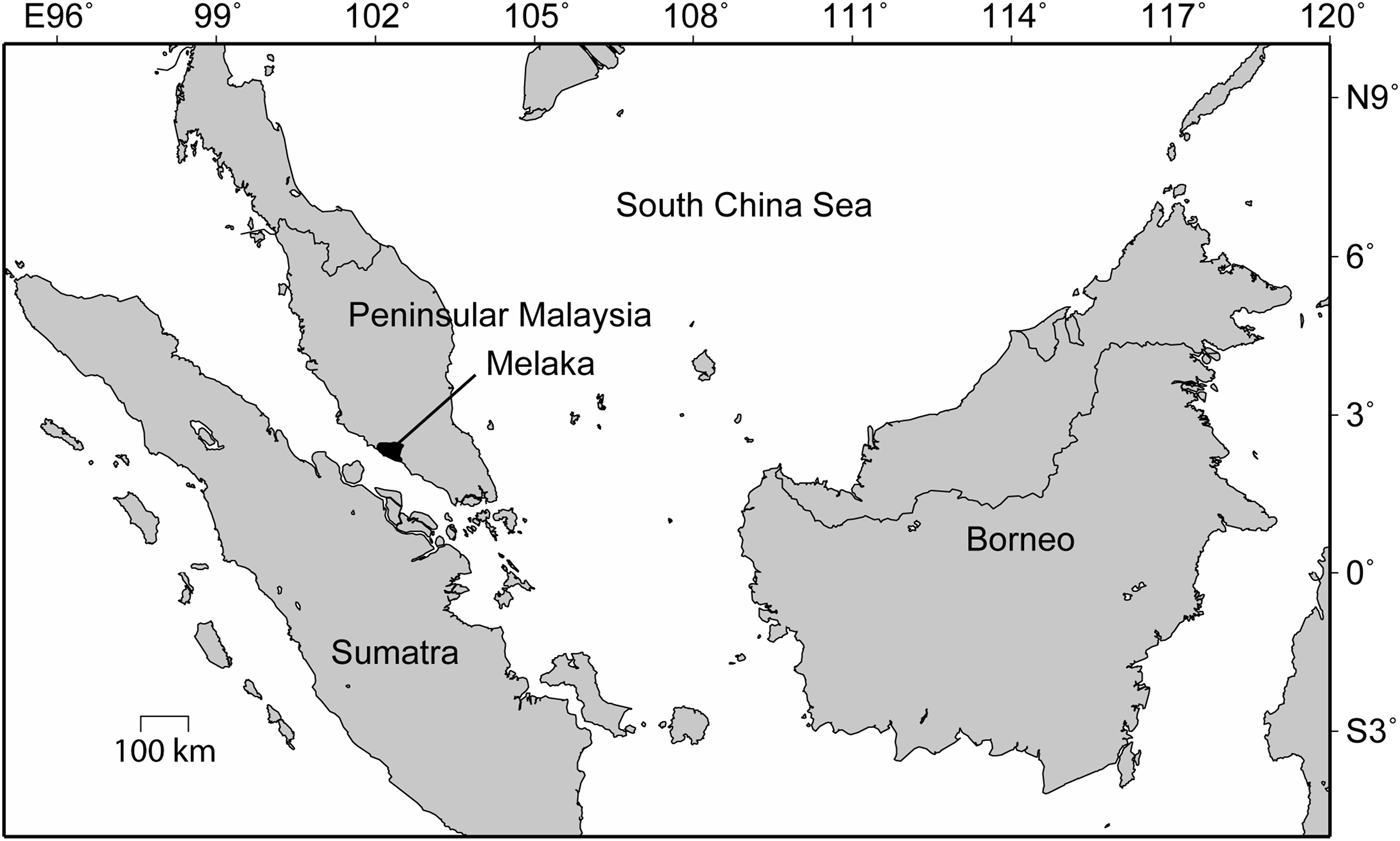
Hence, the above variations suggest that further studies of the spatial and temporal nesting preferences of hawksbill turtles are required. Therefore, this study investigated nesting of hawksbill turtles at Melaka, Malaysia (Figure 1). Melaka is one of the largest rookeries of hawksbill turtles in Malaysia (>350 nests per year) and hawksbill turtles nest on several beaches in this region (Mortimer et al., Reference Mortimer, Ahmad and Kaslan1993; Chan, Reference Chan2006). Conservation efforts (e.g. establishment of a sanctuary) have been ongoing since 1987 in Melaka (Mortimer, Reference Mortimer1988), and insights into nesting preferences would contribute to the effective conservation of hawksbill turtles. This study investigated: (1) geographic variation in the number of nests among beaches and specifically whether the number of nests was distributed uniformly or non-uniformly along beaches; (2) nest site selection and whether hawksbill turtles prefer woody vegetation zones or other zones; (3) seasonality in nesting, and whether nesting was observed more frequently in the monsoon season; and (4) preference regarding emergence hour, specifically at what time of day hawksbill turtles nested.
Location of Melaka.

MATERIALS AND METHODS
Study area and beach surveys
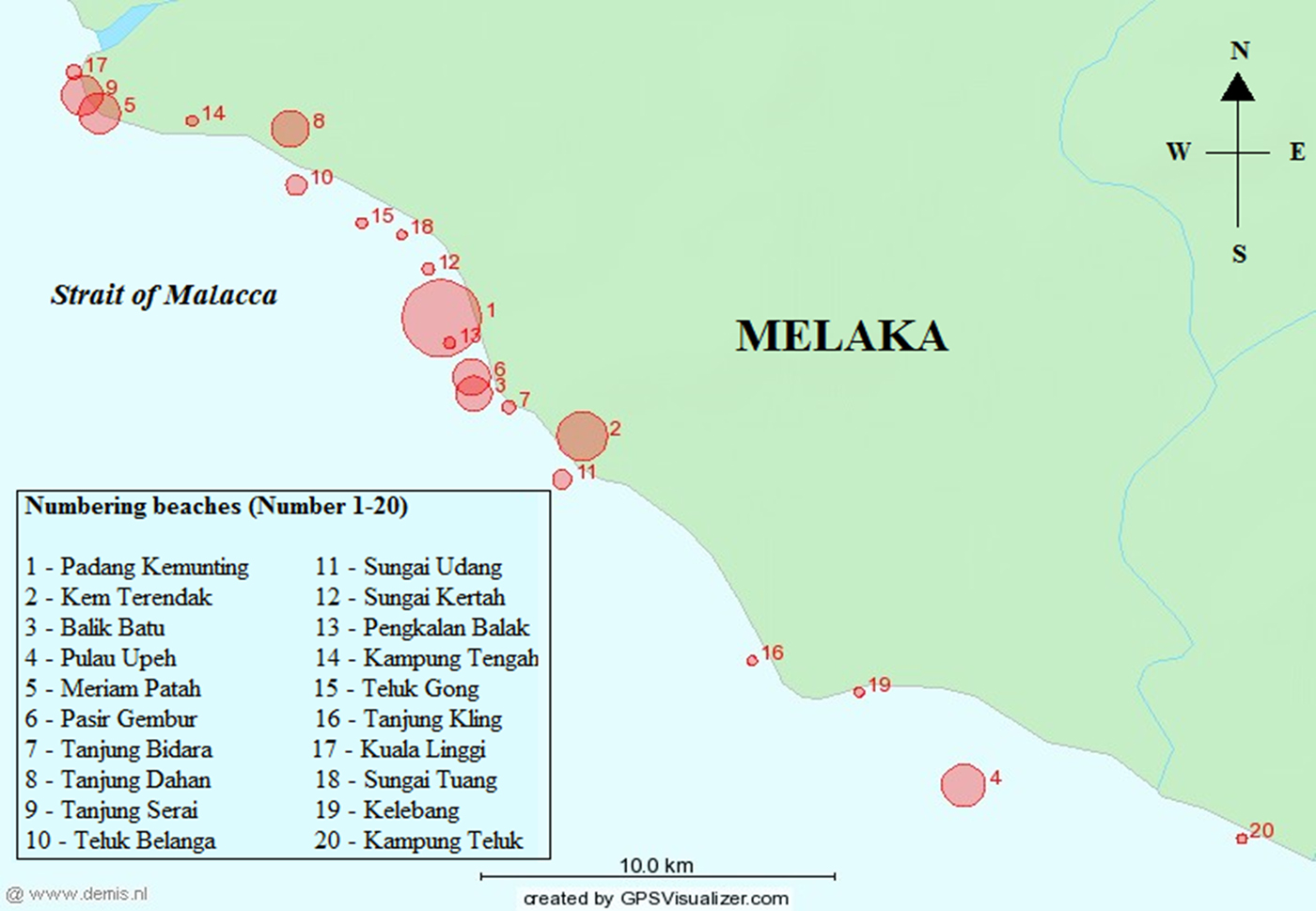
The nocturnal surveys were performed along Melaka beaches by local rangers and staff members hired by the Department of Fisheries in Malaysia (DoF), Padang Kemunting Turtle Conservation Centre and the World Wildlife Fund (WWF) from January until December in 2013 and 2014 (2 years). Intensive beach patrolling was performed from 20:00 to 06:00 h every night at nine beaches by placing at least two staff members at each beach location. These locations included: Tanjung Serai, Meriam Patah, Tanjung Dahan, Teluk Belanga, Teluk Gong, Sungai Tuang, Padang Kemunting, Pasir Gembur and Kem Terendak (Figure 2). Staff members followed standard operating procedures according to the official DoF guidelines. For example, rangers were required to communicate hourly concerning beach activity using walkie-talkies (Sukarno et al., Reference Sukarno, Mohamed-Ridzuan, Mohamad-Zabawi, Mohd-Najib, Abdul-Aziim, Mansor, Azwa, Farizan, Mohd-Khalil-Khasah, Robert, Abd-Karim, Zakaria, Syed Abdullah, Zulkifli, Wahidah, Abdul-Wahab and Norul-Fahiezah2007). The beaches were checked for any tracks of landing turtles by using minimal light such as red torchlights. During surveys, rangers walked slowly and silently along the beach, and wore the official DoF or WWF shirts (Sukarno et al., Reference Sukarno, Mohamed-Ridzuan, Mohamad-Zabawi, Mohd-Najib, Abdul-Aziim, Mansor, Azwa, Farizan, Mohd-Khalil-Khasah, Robert, Abd-Karim, Zakaria, Syed Abdullah, Zulkifli, Wahidah, Abdul-Wahab and Norul-Fahiezah2007).
Location of the 20 beaches surveyed at Melaka. The areas of circles are proportional to observed number of nests.

When landing turtles were identified along beaches at night, the torchlights were switched off. Nesting activity was monitored from 5 metres away from the turtle. After the turtle had finished nesting, the eggs were slowly moved inside the pail. The number of nests, location of nests, number of eggs per nest (i.e. clutch size), and time of nesting (i.e. emergence hour) were recorded. The location of nests was categorized as follows: woody vegetation area, open sand area, grassy area or backshore of the beach. The woody vegetation area was defined as an area with vegetation coverage composed of shrubs and bushy vegetation, while the grassy area was an area composed of only grassy species. The open sand area was defined as an area with no vegetation coverage, and the backshore of the beach was defined as a foredune area that consisted of rocks or thorny trees, connecting the beach to roads, forests or hills. When the hawksbill turtle nests were located in the woody vegetation area or the grassy area, the species of trees and grasses were identified. Eggs were transported to the hatchery according to the procedure given in Sukarno et al. (Reference Sukarno, Mohamed-Ridzuan, Mohamad-Zabawi, Mohd-Najib, Abdul-Aziim, Mansor, Azwa, Farizan, Mohd-Khalil-Khasah, Robert, Abd-Karim, Zakaria, Syed Abdullah, Zulkifli, Wahidah, Abdul-Wahab and Norul-Fahiezah2007) to protect the eggs from human poachers.
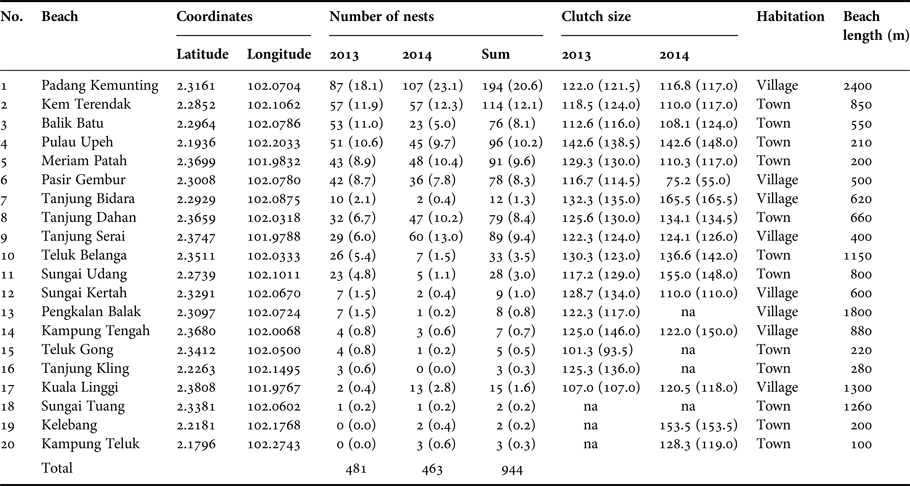
Pulau Upeh is an island (Figure 2) where a beach patrol was performed every day by taking a boat from the mainland and patrol timings depended on tide levels. Rangers were placed at Pulau Upeh according to shifts, but not necessarily every night. Eggs found at Pulau Upeh were transferred to the mainland the next morning by boat for incubation in the hatchery. The other beaches of Balik Batu, Tanjung Bidara, Sungai Udang, Sungai Kertah, Pengkalan Balak, Kampung Tengah, Tanjung Kling, Kuala Linggi, Kelebang and Kampung Teluk (Figure 2) were surveyed depending on information from local residents or once a week. Diurnal surveys were not regularly performed in Melaka for logistical reasons and because of staff shortages. However, the information on diurnal landings and nesting of hawksbill turtles was based on reports from local residents and visitors. Once these reports were received, the rangers and staff members verified the nests and recorded the information at the nesting site. Altogether, 20 nesting beaches (Figure 2, Table 1) were surveyed and annual data were summarized by the DoF. We analysed the data supplied by the DoF who gave permission for this research.
Coordinates of the beaches, number of nests of hawksbill turtles (percentage in parentheses), mean (median in parentheses) clutch size, type of human habitation adjacent to beaches, and beach length of surveyed beaches in Melaka.

Data analysis
Before presenting the geographic variations in the number of nests among beaches, a Spearman's rank correlation of the numbers of nests at beaches between 2013 and 2014 was calculated to analyse the trend in the number of nests found over the two years. A rank coefficient was chosen because few nests were found on some beaches and fluctuated annually, meaning that the data were non-parametric. The numbers of nests observed in 2013 and 2014 were summed, and the effects of beach length and types of human habitation on the number of nests were tested using Poisson regression modelling. Based on the ambient environment, an undeveloped village or a developed town was assigned to each beach as a type of human habitation (Table 1). Because data were overdispersed, the regression model was corrected utilizing a quasipoisson model. Geographic variation in the number of nests was illustrated graphically by using GPS Visualizer (2015).
Mean and median values of clutch size were also calculated at each beach. Nest site selection within beaches was tested by a two-way analysis of variance (ANOVA), in which the response variable was the number of nests and explanatory variables included location of nests and the year, with no interaction. Post hoc pairwise comparisons were performed by a Tukey's honestly significant difference (HSD) test. Meeting of the assumptions for ANOVA was confirmed through the diagnosis of the residuals. Seasonality in nesting was summarized as monthly number of nests. One sample chi-squared test (i.e. goodness-of-fit test) was used to analyse the uniformity of the emergence hour by comparing the number of turtles observed at 2-hourly intervals at night. Statistical analysis was performed using R ver. 3.2.4 (R Core Team, 2016).
RESULTS
Geographic nest distribution
A total of 481 nests was observed in 2013 (mean nests per beach = 24.1, range = 0–87). The highest number of nests was recorded at Padang Kemunting (87 nests, 18.1% of total nests), followed by Kem Terendak, Balik Batu, Pulau Upeh, Meriam Patah, Pasir Gembur, Tanjung Dahan, Tanjung Serai, Teluk Belanga and Sungai Udang (Table 1). Ten nesting beaches had 10 nests or fewer. These included Tanjung Bidara, Sungai Kertah, Pengkalan Balak, Kampung Tengah, Teluk Gong, Tanjung Kling, Kuala Linggi and Sungai Tuang (Table 1). No nests were recorded at Kelebang and Kampung Teluk in 2013.
In 2014, 463 nests (mean nests per beach = 23.2, range = 0–107) were observed. As in 2013, the highest number of nests was recorded at Padang Kemunting (107 nests). However, there were differences between 2013 and 2014. For example, the second highest number of nests in 2014 was observed at Tanjung Serai (60 nests) while in 2013 it was the eighth highest (29 nests) (Table 1). Ten nests or fewer were recorded at 11 beaches, eight of which also had 10 or fewer nests in 2013. These included Kampung Tengah, Kampung Teluk, Tanjung Bidara, Sungai Kertah, Kelebang, Pengkalan Balak, Sungai Tuang and Teluk Gong (Table 1). The numbers of nests were seven and five at Teluk Belanga and Sungai Udang, respectively, whereas more than 20 nests were observed at these beaches in 2013. In 2014, no nests were observed at Tanjung Kling.
Despite these annual differences in the number of nests among beaches, the rank of the number of nests among beaches in 2013 and 2014 (Table 1) showed a significant correlation (Spearman's rank correlation coefficient ρ = 0.779, N = 20, P < 0.01). Conversely, there was no significant effect of beach length (F = 1.64, df = 1, 17, P > 0.05) or types of human habitation (F = 0.11, df = 1, 17, P > 0.05) on the number of nests. Non-uniformity in geographic nest distribution can be seen in Figure 2.
Clutch size
The clutch size ranged from 9 to 212 eggs (mean ± SD = 123.5 ± 32.3, median = 124) in 2013, and from 10 to 198 eggs (118.5 ± 39.7, median = 123) in 2014. The total number of eggs was 59,211 eggs (mean per month = 4935.8 ± 4795.7) in 2013, and 56,302 eggs (mean ± SD per month = 4691.8 ± 4168.3) in 2014. Overall, the total number of eggs collected in 2013 was higher than in 2014, but the median clutch sizes for both years were similar. The clutch size varied among nests and beaches. For example, at Pasir Gembur, a small clutch size was observed relatively often in 2014, resulting in small mean and median values (Table 1).
Nest site selection
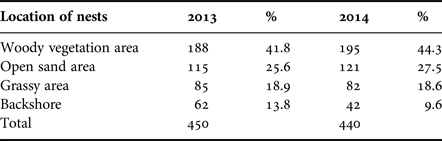
The location of nests was recorded in 450 of 481 nests (93.6%) in 2013, and 440 of 463 nests (95.0%) in 2014. The location of nests deposited near the swashes, abnormal areas (e.g. under a cottage), or during bad weather conditions was not recorded. A high percentage of nests, 188 (41.8%) and 195 (44.3%) in 2013 and 2014 respectively, were recorded within the woody vegetation areas (Table 2). The woody vegetation areas contained various types of shrubs and trees, such as sea lettuce (Scaevola taccada), pandanus trees (Pandanus odoratissimus), casuarina trees (Casuarina equisetifolia), tropical-almond trees (Terminalia catappa) and coconut trees (Cocos nucifera). More nests were located in S. taccada vegetation (119 out of 188 nests in 2013 and 125 out of 195 nests in 2014) than in any other woody vegetation type. In 2013, the second highest nest preference area was open sand (115 nests, 25.6%), followed by grassy areas (85 nests, 18.9%), and the backshore of beaches (62 nests, 13.8%). Similarly, in 2014, the second highest nest preference area was open sand (121 nests, 27.5%), followed by grassy areas (82 nests, 18.6%), and the backshore of beaches (42 nests, 9.5%). ANOVA indicated a significant effect of location of nests (F = 91.82, df = 3, 3, P < 0.01), but not of year (F = 0.16, df = 1, 3, P > 0.05). Tukey HSD tests indicated that more nests occurred in woody vegetation areas compared with other areas (P < 0.05 in comparison with open sand area, P < 0.01 in comparison with grassy areas and the backshore).
Number of nests deposited in each category of location in 2013 and 2014.

Seasonality in nesting
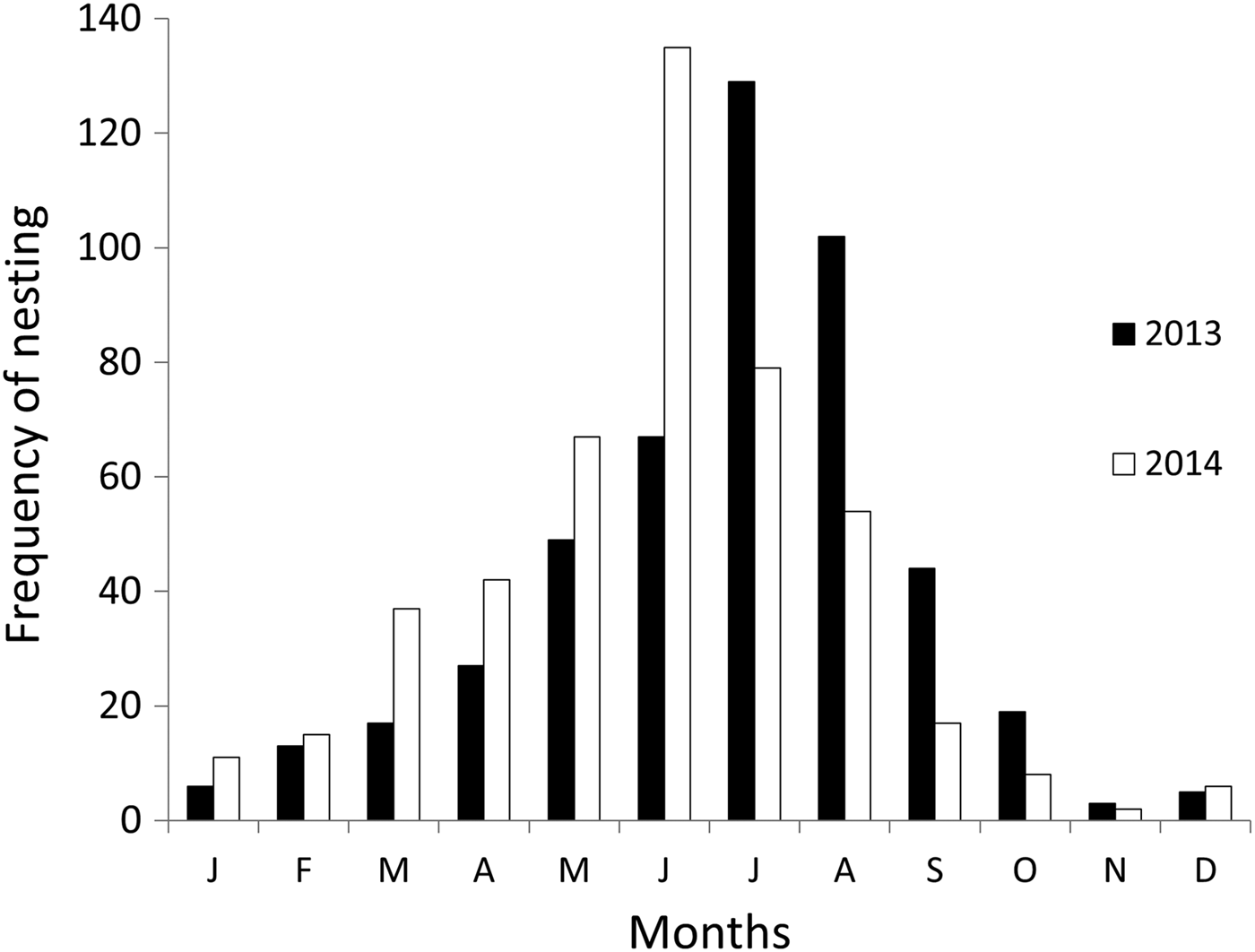
The monthly number of nests (Figure 3) showed that hawksbill turtles nest year-round, but the peak period was between May and August in both years (347 nests, 72.1% of nests in 2013; 329 nests, 71.1% of nests in 2014). In both years, the number of nests increased from January to June, and decreased from July to November.
Monthly number of nests of the hawksbill turtle.

Emergence hour
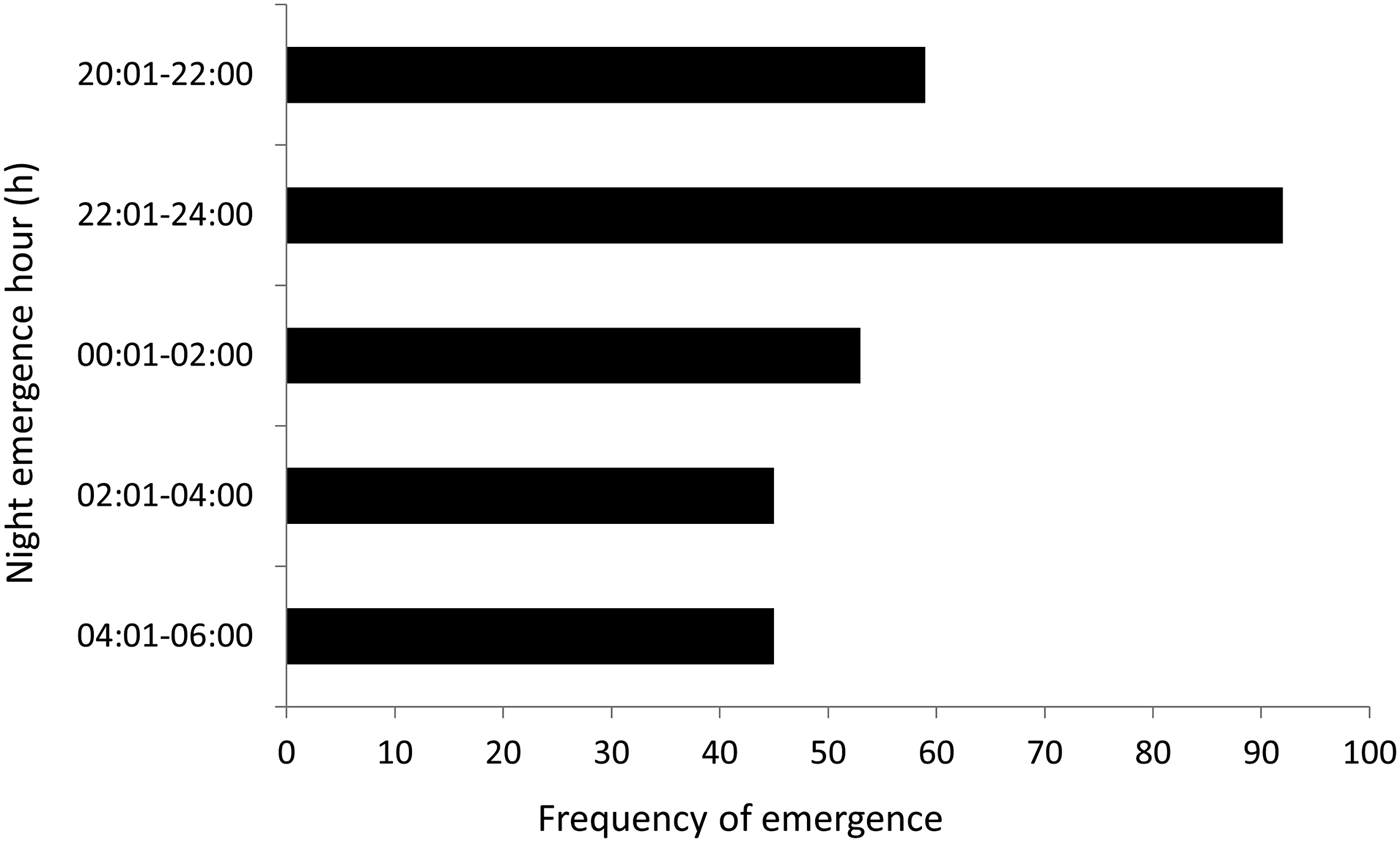
The emergence hour during night-time was recorded in 294 of 463 nests (63.5%) in 2014. Incomplete data were due to bad weather and missed turtles. The pattern of emergences during night-time (Figure 4) was not uniformly distributed (χ 2 = 25.8, df = 4, P < 0.01). Hawksbill turtles emerged most frequently during 22:01–24:00 h (N = 92, 31.3%). The second most preferred night-time emergence hour was between 20:01–22:00 h (N = 59, 20.1%), followed by the hours between 00:01–02:00 h (N = 53, 18.0%). Out of 463 nests, 100 nests were recorded as deposited during the daytime between 06:00–18:00 h in 2014 based on local residence reports, and of these 100 nests, turtles were estimated to emerge most frequently between 06:01–08:00 h (N = 64, 64.0%).
Emergence hours of the hawksbill turtle in 2014.

DISCUSSION
In South-east Asia, where green turtles are common, hawksbill turtles are known to nest only in a limited number of regions, such as Melaka (Chan, Reference Chan2006) and Sabah (Chan et al., Reference Chan, Joseph and Liew1999) in Malaysia and in Vietnam (Stiles, Reference Stiles2009). The annual number of nests in Melaka was estimated to be more than 350 (Mortimer et al., Reference Mortimer, Ahmad and Kaslan1993). This study revealed that, recently, annual nests of hawksbill turtles numbered 450–500. During the survey in 2013 and 2014, no green turtle landings were recorded at all 20 beaches surveyed in Melaka. Hawksbill and green turtles sometimes nest in the same locations (e.g. Bjorndal et al., Reference Bjorndal, Carr, Meylan and Mortimer1985; Mortimer et al., Reference Mortimer, Camille and Boniface2011; Revuelta et al., Reference Revuelta, León, Feliz, Godley, Raga and Tomas2012), but the difference in nesting locations might be attributable to interspecific differences in nest site preferences or population trends. In Mexico, hawksbill turtles prefer to nest at flatter beaches, compared with green turtles (Cuevas et al., Reference Cuevas, Liceaga-Correa and Mariño-Tapia2010). However, preference in beach nesting sites varies regionally – for example, hawksbill turtles in Barbados prefer a steep beach (Horrocks & Scott, Reference Horrocks and Scott1991). A comparison of beach characteristics between beaches in Melaka and in other parts of Malaysia, where green turtles nest, is required in further studies to gain insights of the interspecific differences. The other turtle species observed during the nocturnal survey was the painted terrapin (Batagur borneoensis, or ‘tuntung laut’) (WWF Malaysia, personal communication). Painted terrapins frequently nest on oceanic beaches (Turtle Conservation Coalition, 2011), and river terrapins (Batagur baska, or ‘tuntung sungai’) were also reported to nest at Melaka beaches (Mortimer et al., Reference Mortimer, Ahmad and Kaslan1993). The nests of painted terrapins were poached due to delayed patrolling at sites, and the details of the nests were difficult to record (WWF Malaysia, personal communication).
The distribution of nests of hawksbill turtles were not uniform among the 20 beaches surveyed at Melaka. If hawksbill turtles landed on and nested at beaches randomly, it is hypothesized that the number of nests would increase with beach length, but this hypothesis was not supported in this study. A significant correlation between the number of nests in 2013 and 2014 indicates that the non-uniformity was not because of incidental temporal variation, but from the preferences in nesting beaches shown by hawksbill turtles. In this study, although small clutch sizes were observed in some nests, possibly due to partial poaching, there were no general relationships between clutch size and the number of nests on beaches. In addition, the type of human habitation did not significantly affect the number of nests. As turtle eggs have been traditionally and legally consumed in Peninsular Malaysia (Chan, Reference Chan2006; Aini Hasanah et al., Reference Aini Hasanah, Fadzly and Foo2013), nests at beaches adjacent to villages have historically been exposed to relatively high poaching risk. Hence the hypothesis is that the number of nests at beaches adjacent to villages has declined. On the other hand, beaches adjacent to the towns may be exposed to more artificial lighting that disturbs sea turtle nesting, and therefore this may also result in fewer nests (Witherington, Reference Witherington1992; Lutcavage et al., Reference Lutcavage, Plotkin, Witherington, Lutz, Lutz and Musick1997). However, neither of these hypotheses was significantly supported in this study.
One possible reason for the non-uniformity in geographic nest distribution is the difference in vegetation. This study showed that hawksbill turtles at Melaka preferred to build their nests within the woody vegetation zone, similar to the results of a previous study undertaken in 1990 and 1991 (Mortimer et al., Reference Mortimer, Ahmad and Kaslan1993). Previous studies report a nesting preference of hawksbill turtles for vegetated areas (Horrocks & Scott, Reference Horrocks and Scott1991; Kamel & Mrosovsky, Reference Kamel and Mrosovsky2005; Zare et al., Reference Zare, Vaghefi and Kamel2012; Revuelta et al., Reference Revuelta, León, Feliz, Godley, Raga and Tomas2012, Reference Revuelta, León, Aznar, Raga and Tomas2013), especially for woody vegetation (Liles et al., Reference Liles, Peterson, Seminoff, Altamirano, Henríquez, Gaos, Gadea, Urteaga, Torres, Wallace and Peterson2015), although open sand areas have been preferred by some hawksbill populations or individuals (Bjorndal & Bolten, Reference Bjorndal and Bolten1992; Kamel & Mrosovsky, Reference Kamel and Mrosovsky2005, Reference Kamel and Mrosovsky2006). The holding of sand by root systems of vegetation, including bushes and trees, may help turtles to dig nest chambers (Brown & Macdonald, Reference Brown and Macdonald1995; Mortimer, Reference Mortimer and Bjorndal1995) and allow hatchlings to emerge from the nests (Horrocks & Scott, Reference Horrocks and Scott1991; Turkozan et al., Reference Turkozan, Yamamoto and Yilmaz2011), whereas tough and hard roots systems may act as a deterrent in nest construction and hinder the emergence of hatchlings.
In Melaka, beaches with a relatively high number of hawksbill turtle nesting areas, such as Padang Kemunting, Kem Terendak, Pasir Gembur, Pulau Upeh, Tanjung Serai, Meriam Patah and Tanjung Dahan, are populated with sea lettuce vegetation (S. taccada). Although the superiority of S. taccada vegetation for sea turtle nests in comparison to the other woody vegetation remains to be determined, the presence of woody vegetation including S. taccada provides shelter, privacy and darkness that protect turtles from predators and humans (Sarahaizad et al., Reference Sarahaizad, Mansor and Shahrul Anuar2012a). Turtles prefer to build nests at certain distances from the tide line, and the existence of woody vegetation at a certain distance from tide lines may provide optimal temperature and humidity (Sarahaizad et al., Reference Sarahaizad, Shahrul Anuar and Mansor2012b). Higher sand temperature generally promotes marine turtle nesting (Godley et al., Reference Godley, Broderick, Frauenstein, Glen and Hays2002; López-Castro et al., Reference López-Castro, Carmona and Nichols2004), but excessive heating has a negative effect on hatching of eggs and survivorship of hatchlings (Fisher et al., Reference Fisher, Godfrey and Owens2014; Howard et al., Reference Howard, Bell and Pike2014). Therefore, the shelter from excessive heating provided by woody vegetation possibly provides preferable nesting sites.
In Melaka, the hawksbill turtle was observed to nest all year round, and the peak period occurred between May and August in both 2013 and 2014. A year-round nesting pattern was observed in hawksbill turtles in Sabah, Malaysia (Chan et al., Reference Chan, Joseph and Liew1999), Australia (Limpus, Reference Limpus2009), Barbados (Beggs et al., Reference Beggs, Horrocks and Krueger2007) and the Dominican Republic (Revuelta et al., Reference Revuelta, León, Feliz, Godley, Raga and Tomas2012). In tropical South-east Asian regions, green turtles also show year-round nesting (e.g. Thailand; Yasuda et al., Reference Yasuda, Tanaka, Kittiwattanawong, Mitamura, Klom-In and Arai2006). The peak nesting periods of hawksbill turtles in Melaka observed in this study were similar to that reported in previous studies in Barbados (June–August; Beggs et al., Reference Beggs, Horrocks and Krueger2007), Australia (July–October; Limpus et al., Reference Limpus, Miller, Chatto, Limpus and Miller2000), Dominican Republic (June–November; Revuelta et al., Reference Revuelta, León, Feliz, Godley, Raga and Tomas2012) and Melaka in 1990 and 1991 (Mortimer et al., Reference Mortimer, Ahmad and Kaslan1993).
In Melaka, the peak nesting period of hawksbill turtles was observed during the south-west monsoon season from the end of May and early June until the end of September (MOSTI, 2015). The winds during this season are weaker than those during the north-east monsoon season from November to March (MOSTI, 2015), and the stronger wind may limit nesting in November–March. Similar seasonal nesting patterns were recorded for a green turtle population in Terengganu, Malaysia (Aini Hasanah et al., Reference Aini Hasanah, Fadzly, Amiruddin and Nurolhuda2014). In Melaka, rainfall peaks during April–May and October–November, and June and February are relatively dry (MOSTI, 2015). The difference between hawksbill turtle nesting and rainfall patterns in Melaka indicates that rainfall is not a primary factor affecting nesting, although in Seychelles many nests of turtles were observed during the rainy season, possibly because digging nests is easier during the season (Mortimer & Bresson, Reference Mortimer and Bresson1999).
Although diurnal nesting of hawksbill turtles was sometimes observed, hawksbill turtles at Melaka landed mainly before midnight, particularly in the period 2 hours before midnight. Conversely, hawksbill turtles in Seychelles were generally observed to be diurnal nesters (Mortimer & Bresson, Reference Mortimer and Bresson1999), but nesting times in the present study were more similar to those in Barbados (Beggs et al., Reference Beggs, Horrocks and Krueger2007). Over an 8-year period, Beggs et al. (Reference Beggs, Horrocks and Krueger2007) found that 75% of all hawksbill turtle nesting occurred between 20:00 and 01:00 h, and only 32 diurnal nests were recorded. Peak hawksbill turtle nesting time occurred during night-time before midnight in Sabah, Malaysia (Chan et al., Reference Chan, Joseph and Liew1999) and between 22:00 and 01:00 h in Kish Island, Persian Gulf (Hesni et al., Reference Hesni, Tabib and Ramaki2016). The green turtle also prefers to nest during the period around midnight in Taiwan (Chen & Cheng, Reference Chen and Cheng1995) and in Terengganu, Malaysia (Aini Hasanah et al., Reference Aini Hasanah, Fadzly, Amiruddin and Nurolhuda2014).
The hawksbill turtle has been listed as a Critically Endangered species (Mortimer & Donnelly, Reference Mortimer and Donnelly2008), and information concerning its spatial and temporal nesting preferences provides basic information to help in its conservation. In the present study, following the work of Mortimer et al. (Reference Mortimer, Ahmad and Kaslan1993), intensive survey in Melaka indicated non-uniformity in the distribution of nests among beaches, with woody vegetation zones being the most common nesting sites; nesting was seasonal, and nesting was most frequently close to midnight. Although low genetic diversity of the hawksbill turtle population in Melaka (Nishizawa et al., Reference Nishizawa, Joseph and Chong2016) may indicate a past decline in population size possibly attributable to an anthropogenically related non-uniformity in nesting, this study found no significant effect on the number of nests on beaches adjacent to different types of human habitation. Conversely, because small clutch sizes have been observed both at beaches next to villages (e.g. Pasir Gembur in 2014) and next to towns (e.g. Teluk Gong in 2013), the effects of possible ongoing partial poaching should be monitored. Further studies should include the effect of characteristics of beaches apart from vegetation, such as the slope and elevation (see Horrocks & Scott, Reference Horrocks and Scott1991; Zare et al., Reference Zare, Vaghefi and Kamel2012) and sand properties (see Foley et al., Reference Foley, Peck and Harman2006), on nesting preferences. Long-term monitoring, including noting the dynamics between the number of nests and changes in the environment, may also provide a more detailed understanding of the hawksbill turtle nesting.
ACKNOWLEDGEMENTS
This work is part of a PhD project. This study was performed in collaboration with the Department of Fisheries in Malaysia (DoF) and the World Wildlife Fund (WWF). We would like to thank the staff of DoF (Melaka), WWF, the School of Biological Sciences, Universiti Sains Malaysia (USM) and the Centre for Marine and Coastal studies (CEMACS) for their services rendered, work permission and transportation provided throughout the research in Melaka. We thank Dr Zainudin Arsad from USM for conducting a short course on experimental data analysis, fieldwork students from the Universiti Malaysia Sarawak (UNIMAS), and postgraduate students from USM for assisting with this project. We thank two anonymous reviewers for constructive comments on this manuscript. We thank Seaturtle.org for providing the Maptool programme which was used to create the Melaka Map.
FINANCIAL SUPPORT
The first author is sponsored by MyBrain15 (MyPhD) of the Ministry of Education Malaysia and Postgraduate Research Grant Scheme (PRGS) of Universiti Sains Malaysia (USM). The research by S.A.M.S. is supported by a Grant from USM and the Ministry of Education Malaysia (Grant no: 6711134).