I. INTRODUCTION
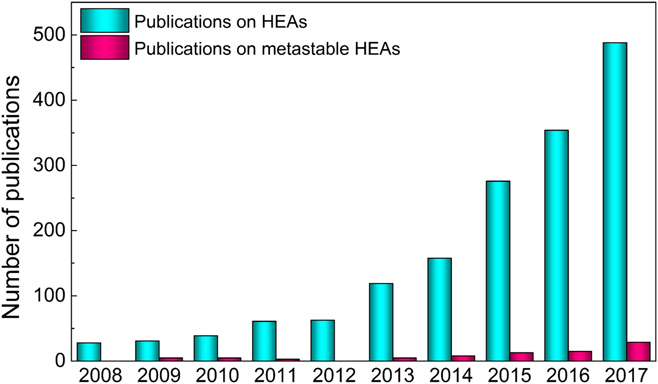
High-entropy alloys (HEAs), or compositionally complex alloys, have arguably become the fastest growing research direction in metallurgy in the last decade.Reference Cantor, Chang, Knight and Vincent1–Reference Miracle and Senkov3 Majority of the research efforts in the initial part of this period focused on assessing the validity of the originally proposed HEA concept, i.e., configurational entropy-maximization can stabilize heavily alloyed single-phase solid solutions. While these proof-of-principle investigations have significantly contributed to the fundamentals of solid solution thermodynamics, the widely studied single-phase HEA microstructures are often not promising from the perspective of property requirements for engineering applications. It is known from decades of optimization of traditional alloy systems (e.g., Fe-, Al-, Ni-, and Ti-) that single-phase alloys can rarely exhibit competitive property combinations. In fact, exceptional toughness, ductility, and strength levels are usually achieved by utilizing different states of metastability.Reference Fischer, Reisner, Werner, Tanaka, Cailletaud and Antretter4–Reference Lu, Shen, Chen, Qian and Lu7 Despite the apparent importance of metastability, research on metastability in HEAs has been developing rather slowly (Fig. 1) and still consists of a small fraction of HEA-related investigations (Fig. 1). The main goal of this paper is to provide an overview of the past work on metastability in HEAs, to help guide and motivate future research activities in this direction.
Statistics for publications on HEAs and metastable HEAs in the recent decade (the total number of publications on HEAs was obtained from Web of Science and Scopus by the keyword “high-entropy alloys”. Metastable HEAs were specified based on the following three criteria: (i) whether or not there exist an evident metastable-to-stable transition in composition or structure with respect to boundary conditions; (ii) whether or not such a transition has a significant influence on the HEAs’ properties; and (iii) whether or not the HEAs are purposefully designed to be metastable. The number of publications on metastable HEAs was sorted out both manually and by adding constraint of “metastable” to the keyword).

Comprehensive overviews of metastable states of alloys are provided in physical metallurgy textbooks.Reference Cahn and Haasen8 While such a basic review need not be repeated here, the definition and classification of metastability are briefly presented for the sake of completeness. A “metastable” system, following the definition of the inventor of the terminology Ostwald,Reference Ostwald9 persists in its existing state when undisturbed or subject to disturbances smaller than some small or infinitesimal amount, but passes to a more stable state when subject to greater disturbances. Using more thermodynamical terminology, such metastable states correspond to states which have excess free energy compared to that of equilibrium states. According to Turnbull,Reference Turnbull10 three kinds of metastability can be identified, which would lead to the creation of such an excess free energy: morphological (arising from crystallographic defects), compositional (arising from extended solid solutions), and structural (arising from metastable phases). Often such effects present simultaneously since processing treatments that lead to metastability (e.g., quenching from elevated temperatures) generate multiple microstructural changes. In what follows, we discuss present findings on metastability in HEAs by specifically focusing on compositional and structural metastability. Excess free energy contributions from morphological effects are not discussed separately, although grain refinement and coarsening effects are discussed briefly as a subsection of the chapter on structural metastability.
II. COMPOSITIONAL METASTABILITY IN HEAS
The concept, HEA, was proposed based on the assumption that the high mixing entropy can assist compositionally complex alloys to form simple microstructure.Reference Yeh, Chen, Lin, Gan, Chin, Shun, Tsau and Chang2 This concept is not initially restricted to single-phase solid solutions; however, numerous studies have been focused on finding stable single-phase solid solutions in the first decade since this concept was proposed.Reference Miracle and Senkov3 The most widely studied single-phase HEAs are CoCrFeMnNi with face-centered cubic structure (FCC),Reference Cantor, Chang, Knight and Vincent1 VNbMoTaW with body-centered cubic structure (BCC),Reference Senkov, Wilks, Scott and Miracle11 and HoDyYGdTb with hexagonal close packed structure (HCP).Reference Takeuchi, Amiya, Wada, Yubuta and Zhang12 The main argument for the phase stability of single-phase HEAs is that the high mixing entropy decreases the Gibbs free energy of the alloy systems according to ΔG mix = ΔH mix − TΔS mix.Reference Zhang, Zuo, Tang, Gao, Dahmen, Liaw and Lu13 Nevertheless, the effect of mixing entropy on the Gibbs free energy changes with temperature. The mixing entropy exhibits a significant contribution at elevated temperatures, while it plays less important role at medium or low temperatures. In addition, enthalpy also affects the phase stability of alloys and sometimes leads to phase separation even at high mixing entropy states.Reference Otto, Yang, Bei and George14 In light of these two reasons, a series of work has been accomplished to clarify the phase stability mechanisms of single-phase HEAs and explore their metastable nature at medium and low temperatures. To summarize the temperature and composition-dependent metasatbility of HEAs, we first focus on two typical thermodynamically metastable phenomena: supersaturated solid solution and spinodal decomposition. Strategies of utilizing the metastability of HEAs are reviewed, and a brief discussion on the unique properties of precipitates within HEAs is also presented.
A. Spinodal decomposition
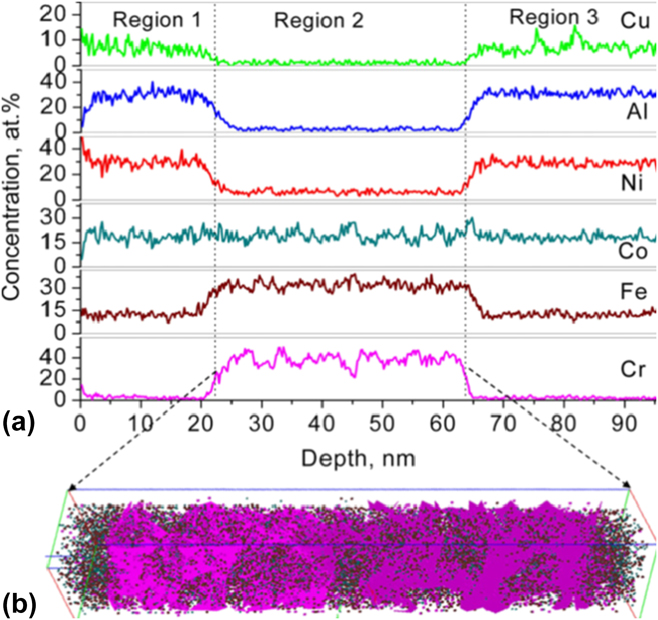
In 2004, Yeh et al.Reference Yeh, Chen, Lin, Gan, Chin, Shun, Tsau and Chang2 reported the spinodal microstructure of disordered BCC and ordered BCC phase in AlxCoCrCuFeNi HEAs. This spinodal decomposition results from the diminishing entropy stabilization effect at lower temperatures. Following Yeh’s work, a series of workReference Tong, Chen, Yeh, Lin, Chen, Shun and Chang15–Reference Tung, Yeh, Shun, Chen, Huang and Chen23 has been carried out to characterize the effects of different elements on the microstructures and mechanical properties of the AlxCoCrCuFeNi HEAs, but the spinodal decomposition in HEAs was not further illustrated. In 2015, Santodonato et al.Reference Santodonato, Zhang, Feygenson, Parish, Gao, Weber, Neuefeind, Tang and Liaw24 systematically investigated the structural evolution of the Al1.3CoCrCuFeNi HEA by neutron diffraction and atom probe tomography (APT). They reported that the B2 phase transformed into a B2/BCC spinodal structure upon cooling. This decomposition occurred when the temperature was lower than 600 °C. Their APT and energy dispersive X-ray spectroscopy (EDS) results showed that the spinodal B2 phase composition was Al1.3Co0.79Fe0.51Ni while the spinodal BCC phase composition was Co0.21CrFe0.49. Similar spinodal decomposition was also found within the AlCoCrFeNi,Reference Manzoni, Daoud, Völkl, Glatzel and Wanderka25 AlCrFeMnNi,Reference Munitz, Meshi and Kaufman26 AlCoCrCuFeNi,Reference Singh, Wanderka, Kiefer, Siemensmeyer and Banhart27,Reference Singh, Wanderka, Murty, Glatzel and Banhart28 Al0.5CoCrCuFeNi,Reference Xu, Liu, Guo, Hirata, Fujita, Nieh, Liu and Chen29 and Al0.5CoCrFeNiReference Knipling, Tharpe and Liaw30 HEAs. Figure 2 shows a typical APT analysis of the decomposition within the AlCoCrCuFeNi HEA. The B2 phase regions (1 and 3) are rich in Ni and Al, while the BCC phase region (2) is rich in Cr and Fe. The HEA systems that show spinodal decomposition all consist of Al–Ni–Cr–Fe and the B2/BCC spinodal structure. The occurrence of the NiAl intermetallic compound (B2 structure) and Fe–Cr solid solution (BCC structure) has evidenced the governing role of enthalpy within these systems. HEAs synthesized from elements with significant difference in mixing enthalpy (such as Al–Ni and Fe–Cr) are prone to undergo such decomposition.Reference Singh, Wanderka, Murty, Glatzel and Banhart28 The spinodal decomposition characteristics of HEAs enable a remarkable potential for magnetic HEA design.
(a) Concentration depth profiles of all alloying elements in the as-cast AlCoCrCuFeNi HEA (analyzed volume 9.5 × 9.5 × 93 nm3); (b) atom clusters containing more than 30 at.% Fe and 20 at.% Co are superimposed on the iso-surface defined by 42 at.% Cr in region 2 (6.2 × 6.2 × 46 nm3). Dots represent the positions of individual atoms.Reference Singh, Wanderka, Kiefer, Siemensmeyer and Banhart27 Reprinted with permission from Ref. Reference Singh, Wanderka, Kiefer, Siemensmeyer and Banhart27.

B. Supersaturated solid solutions
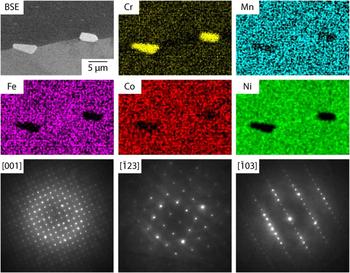
The first high-entropy solid solution CoCrFeMnNi was officially reported in 2004 by Cantor et al.Reference Cantor, Chang, Knight and Vincent1 and was subsequently proved to possess excellent fracture toughness, high strength, and superior ductility even at cryogenic temperatures.Reference Otto, Dlouhý, Somsen, Bei, Eggeler and George31,Reference Gludovatz, Hohenwarter, Catoor, Chang, George and Ritchie32 In the past decade, a wide range of high-entropy systems has been developed to find single-phase solid solution and address the phase selection rule of the single-phase HEAs.Reference Zhang, Zuo, Tang, Gao, Dahmen, Liaw and Lu13,Reference Yeh, Chen, Lin and Chen33–Reference Yeh35 However, most HEAs still consist of complex microstructures and only very few single-phase high-entropy systems, i.e., CoCrFeMnNi,Reference Cantor, Chang, Knight and Vincent1 VNbMoTaW,Reference Senkov, Wilks, Scott and Miracle11 and HoDyYGdTb,Reference Takeuchi, Amiya, Wada, Yubuta and Zhang12 were found. In 2013, Otto et al.Reference Otto, Yang, Bei and George14 designed a series of experiments to investigate the effects of enthalpy and entropy on the phase stability of HEAs. Their results highlighted the significant contribution of enthalpy and nonconfigurational entropy to phase stability of HEAs. The configurational entropy only dominates the mixing Gibbs free energy in ideal cases, where the alloy is single-phase and rigorously yields the ideal solution postulate. Following this idea, the phase stability of single-phase HEAs, i.e., CoCrFeMnNi HEA, has been proved to vary once temperature decreases because of the temperature-dependent contribution of mixing entropy to total Gibbs free energy. In 2016, almost at the same time, Pickering et al.Reference Pickering, Muñoz-Moreno, Stone and Jones36 and Otto et al.Reference Otto, Dlouhý, Pradeep, Kuběnová, Raabe, Eggeler and George37 reported that the CoCrFeMnNi HEA decomposed after long-period annealing at intermediate temperatures. Figure 3 shows the microstructure, EDS mapping, and selected area electron diffraction (SAED) patterns of the CoCrFeMnNi HEA heat treated at 700 °C for 1000 h. A Cr-rich σ phase precipitates along the grain boundary (GB). At higher temperatures above 900 °C, the CoCrFeMnNi HEA displays single FCC structure, while at lower temperatures (500 °C), three different phases (L10-NiMn, B2-FeCo, and Cr-rich BCC phases) precipitate from the single-phase CoCrFeMnNi HEA. These two studies indicate that CoCrFeMnNi is a supersaturated solid solution at intermediate temperatures and will decompose after aging for sufficient time. Afterwards, He et al.Reference He, Wang, Wu, Li, Wang and Liu38 found the metastable nature of the CoCrFeNi HEA, and Stepanov et al.Reference Stepanov, Yurchenko, Zherebtsov, Tikhonovsky and Salishchev39 reported the precipitation behavior in a typical single-phase BCC HfNbTaTiZr HEA. In addition, many other HEAs have been proved to exhibit single-phase structure at as-cast or homogenized states, while complex microstructures after annealing.Reference Miracle and Senkov3,Reference Wang, Guo and Liu40,Reference Rao, Diao, Ocelík, Vainchtein, Zhang, Kuo, Tang, Guo, Poplawsky, Zhou, Liaw and De Hosson41 All these findings validate that the single-phase HEAs are supersaturated solid solution at low temperatures, which stimulates growing interest in precipitation-strengthened HEAs.
Back scattered electron (BSE) image, EDS maps, and SAED patterns from the GB precipitate that appeared bright in BSE imaging in CrMnFeCoNi homogenized and then heat treated for 1000 h at 700 °C.Reference Pickering, Muñoz-Moreno, Stone and Jones36 Reprinted with permission from Ref. Reference Pickering, Muñoz-Moreno, Stone and Jones36 (CC BY 4.0: https://creativecommons.org/licenses/by/4.0/legalcode).

C. Precipitation-strengthened HEAs
Single-phase HEAs with FCC crystal structures possess superior ductility as well as fracture toughness, but unsatisfactory strength. Precipitation-strengthening is a relatively effective approach to enhance the strength of ductile materials. Based on the understanding of the metastability of the HEAs, researchers turned to strengthen FCC HEAs by precipitation. Although the enhanced properties of precipitation-strengthened HEAs may not be directly due to the metastability of the HEAs, the desired precipitates are obtained by taking advantage of the metastability. The precipitation-strengthened HEAs can be categorized into two groups according to the types of precipitates. The first group is coherent precipitates, such as the γ′ phase. The second group is intermetallic precipitates, such as the σ and the μ phases. A great amount of work has been accomplished towards precipitates within different HEA systems,Reference Gwalani, Soni, Choudhuri, Lee, Hwang, Nam, Ryu, Hong and Banerjee42–Reference Shun, Hung and Lee51 which greatly contributes to a better understanding of the alloying behavior of HEAs. While in the following discussion, we solely focus on research that intentionally made use of the metastability nature of HEAs.
Inspired by the design of commercial superalloys,Reference Wang, Huang, Wang and Liu52 the γ′ phase was introduced into FCC HEAs.Reference He, Wang, Huang, Xu, Chen, Wu, Liu, Nieh, An and Lu53 The Al and Ti elements with appropriate contents were simultaneously introduced into the FCC matrix to obtain a supersaturated solid solution at high temperature and to achieve nanoscale γ′ particles by annealing at intermediate temperatures. The representative γ′-strengthened HEAs are (CoCrFeNi)94Al4Ti2,Reference He, Wang, Huang, Xu, Chen, Wu, Liu, Nieh, An and Lu53 (CoCrNi)94Al3Ti3,Reference Zhao, Yang, Tong, Wang, Luan, Jiao, Chen, Yang, Hu, Liu and Kai54 and Co1.5CrFeNi1.5Al0.2Ti0.3Reference Ming, Bi and Wang55 HEAs. The as-homogenized (CoCrFeNi)94Al4Ti2 HEA exhibits a tensile strength of 500 MPa and an elongation of 65%, while a better balance between strength (1100 MPa) and ductility (35%) was achieved by precipitation-strengthening. This HEA can be further strengthened by incorporating other strengthening mechanisms, such as dislocation strengthening. (CoCrFeNi)94Al4Ti2 HEA is the first intentionally designed γ′-strengthened HEA and obtains superior compressive properties; however, the precipitation pathways within this HEA are relatively complex. Apart from the desirable nanosized γ′ phase, a Ni2Al-type L21 phase can also precipitate from the matrix as well. The L21 phase possesses a large particle size and distributes at the GB, resulting in a negative effect on the mechanical properties of (CoCrFeNi)94AlxTiy HEAs.Reference He, Wang, Wu, Liu, Mao, Nieh and Lu56
A well-controlled γ′/γ microstructure was obtained in the (CoCrNi)94Al3Ti3 HEA,Reference Zhao, Yang, Tong, Wang, Luan, Jiao, Chen, Yang, Hu, Liu and Kai54 which exhibits a single FCC phase after solution treatment at elevated temperatures. This single-phase HEA becomes supersaturated solid solution as the temperature decreases. The nanoscale γ′ phase is easily obtained by annealing this supersaturated solid solution at 800 °C for 1 h. It is noteworthy that the L21 phase dose not present in this HEA. The apparent distinction between the (CoCrNi)94Al3Ti3 and (CoCrFeNi)94Al4Ti2 HEAs results from the fact that Fe is excluded in the former one. Such a phenomenon suggests that fine optimization of Fe content is essential when designing the γ′ phase in the CoCrFeNi-based HEAs. With the single γ′/γ microstructure, the (CoCrNi)94Al3Ti3 HEA achieves an unprecedented increase of 70% in yield strength and 40% in tensile strength without sacrificing too much ductility. Interestingly, the γ′ phase near GB in the (CoCrNi)94Al3Ti3 HEA displays a plate-like shape, which is a typical sign of discontinuous precipitation. This factor has been well addressed in a recent publication.Reference Chang and Yeh57 Experimental analyses indicate that the chemical instability of supersaturated solid solution and GB excess energy both contribute to the formation of the plate-like precipitates. Such a phenomenon can be suppressed either through increasing gamma-prime solvus, or alleviating the mobility of grain boundaries.
The Co1.5CrFeNi1.5Al0.2Ti0.3 HEA was recently developed by Ming et al.Reference Ming, Bi and Wang55 The size and shape of the γ′ phase in this HEA were well controlled and the effect of γ′ size on the mechanical properties was systematically investigated. An excellent chemical stability of supersaturated solid solution was obtained by a long-period solid solution heat treatment, which consequently avoided the formation of the plate-like γ′ phase. The L21 phase was also effectively suppressed by decreasing the Fe and Cr content. The spherical γ′ phase with a size of ∼10 nm dispersedly precipitated from the supersaturated matrix and contributed to a dramatic precipitation-strengthening effect. The Co1.5CrFeNi1.5Al0.2Ti0.3 HEA with small-size γ′ particles exhibits a yield strength of 750 MPa and an elongation of 40%. With increasing particle size, the ductility of the Co1.5CrFeNi1.5Al0.2Ti0.3 HEA decreases evidently. The inferior ductility associated with the long aging time is ascribed to the strong barrier of dislocation motion, where gliding dislocations can only bypass the interfacial precipitates by forming Orowan loops.
Strengthening HEAs by using intermetallic compounds is another novel approach. Intermetallic compounds were originally believed to be deteriorated to the ductility. Nevertheless, a good balance between strength (1200 MPa) and ductility (19%) was reported in the CoCrFeNiMo0.3 HEA with σ and μ phases.Reference Liu, Lu, He, Luan, Wang, Liu, Liu, Chen and Liu58 The σ and μ phases were obtained by annealing the supersaturated CoCrFeNiMo0.3 HEA in 800–900 °C temperature range. The mechanism of intermetallic compound-strengthening is attributed to the fact that the FCC high-entropy matrix exhibits a significantly high work hardening exponent of 0.75 suppressing the propagation of microcracks at these brittle particles. Following this idea, the Cr15Fe20Co35Ni20Mo10 HEA was developed.Reference Ming, Bi and Wang59 By tuning the composition, a supersaturated solid solution with exceptional ductility and strain hardening capability has also been achieved. Optimizing thermal–mechanical processing condition has also been proved to enable the precipitation of intermetallic precipitates in the metastable Cr15Fe20Co35Ni20Mo10 HEAs. With these precipitates in the ductile matrix, a high strength of 1410 MPa and a ductility of 12% were achieved.
D. High-entropy precipitates in the high-entropy matrix
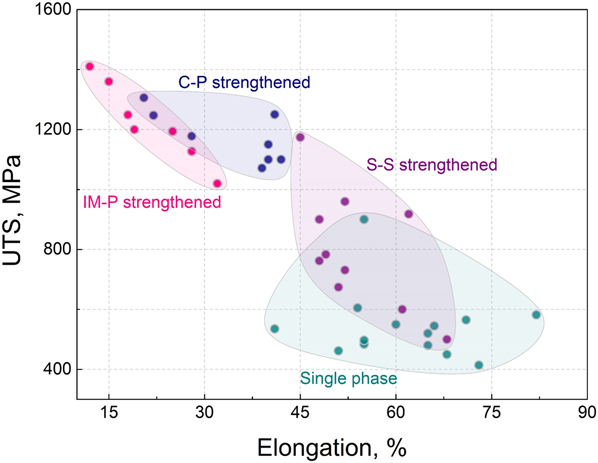
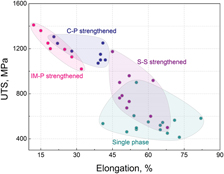
Supersaturated solid solutions and precipitation-strengthening are both classical metallurgical phenomena in metallic materials; however, the high-entropy design gives rise to several novel and promising properties. Fig. 4 summarizes the mechanical properties of the single-phase, solid solution strengthened, coherent precipitates strengthened, and intermetallic precipitates strengthened HEAs. The effectiveness of the precipitation-strengthening is well demonstrated in Fig. 4. The single-phase HEAs show relatively high elongation with low strength. The additional alloying elements contribute to limited increasing strength mainly by solid solution strengthening. The precipitation-strengthened HEAs possess much higher strength than single-phase HEAs. Interestingly, some of the HEAs strengthened by intermetallic compounds are comparable with the coherent γ′-strengthened HEAs. Such unique behavior is owing to the superior work hardening capability of the FCC high-entropy matrix. In addition, FCC single-phase HEAs usually exhibit relatively low stacking fault energy.Reference Gludovatz, Hohenwarter, Catoor, Chang, George and Ritchie32,Reference Zaddach, Scattergood and Koch60–Reference Zhang, Zhuang, Hu, Kai and Liu62 This low stacking fault energy enables these HEAs to combine deformation modules of dislocation glide, faulting, twining, and deformation-induced phase transformation,Reference Otto, Dlouhý, Somsen, Bei, Eggeler and George31,Reference Gludovatz, Hohenwarter, Catoor, Chang, George and Ritchie32,Reference Laplanche, Kostka, Reinhart, Hunfeld, Eggeler and George63–Reference Miao, Slone, Smith, Niu, Bei, Ghazisaeidi, Pharr and Mills65 which contributes to an excellent work hardening capability. In particular, this also leads to the simultaneous enhancement of strength and ductility at cryogenic temperatures.Reference Otto, Dlouhý, Somsen, Bei, Eggeler and George31,Reference Gludovatz, Hohenwarter, Catoor, Chang, George and Ritchie32 The exceptional work hardening capability of the high-entropy matrix enables a larger degree of freedom to design optimal precipitates.
The UTS versus elongation plot for single-phase, solid-solution (S-S) strengthened, coherent-precipitate (C-P) strengthened, and intermetallic-precipitate (IM-P) strengthened HEAs. Data were excerpted from Refs. Reference Zhao, Yang, Zhu, Chen, Yang, Hu, Liu and Kai44, Reference He, Wang, Huang, Xu, Chen, Wu, Liu, Nieh, An and Lu53–Reference Ming, Bi and Wang55, Reference Chang and Yeh57–Reference Zaddach, Scattergood and Koch60, and Reference Han, Wei, Tong, Chen, Zhao, Wang, He, Yang, Zhao, Shimizu, Inoue, Nagai, Hu, Liu and Kai66.

Precipitates within HEAs also display complex chemical compositions. The APT results show that the Ni3Al-type γ′ phase in HEAs consists of a large amount of Co, Ti, and relatively small amounts of Fe and Cr.Reference He, Wang, Huang, Xu, Chen, Wu, Liu, Nieh, An and Lu53,Reference Zhao, Yang, Tong, Wang, Luan, Jiao, Chen, Yang, Hu, Liu and Kai54,Reference Han, Wei, Tong, Chen, Zhao, Wang, He, Yang, Zhao, Shimizu, Inoue, Nagai, Hu, Liu and Kai66 The Cr-rich σ phase within the CoCrFeNiMn HEAs also contains more than 50% of Co, Fe, Mn, and Ni.Reference Otto, Dlouhý, Pradeep, Kuběnová, Raabe, Eggeler and George37 It should be pointed out that these precipitates with complex chemical compositions also reflect the concept of high-entropy precipitates. The high-entropy precipitates within HEAs have been proved to possess unique properties compared to their conventional counterparts. For example, Zhao et al.Reference Zhao, Chen, Lu and Nieh67 reported that the coarsening of the γ′ phase in the (CoCrFeNi)94Al4Ti2 was much slower than that in the commercial Ni-based alloys. The γ′/γ antiphase boundary energy varies with additional alloying elements.Reference Dimiduk, Thompson and Williams68 Zhao et al.Reference Zhao, Yang, Tong, Wang, Luan, Jiao, Chen, Yang, Hu, Liu and Kai54 reported the antiphase boundary shearing behavior during deformation, which might result from the complex composition of the (Ni, Co, Cr)3(Ti, Al) γ′ phase.
Precipitation-strengthened HEAs which combine the high-entropy matrix and the high-entropy precipitates exhibit promising potential for engineering applications. To make full use of these advantages of HEAs, developing new precipitation-strengthened HEAs with a matrix with low stacking fault energy and precipitates with tunable chemical compositions is suggested.
III. STRUCTURAL METASTABILITY IN HEAS
A. Polymorphism
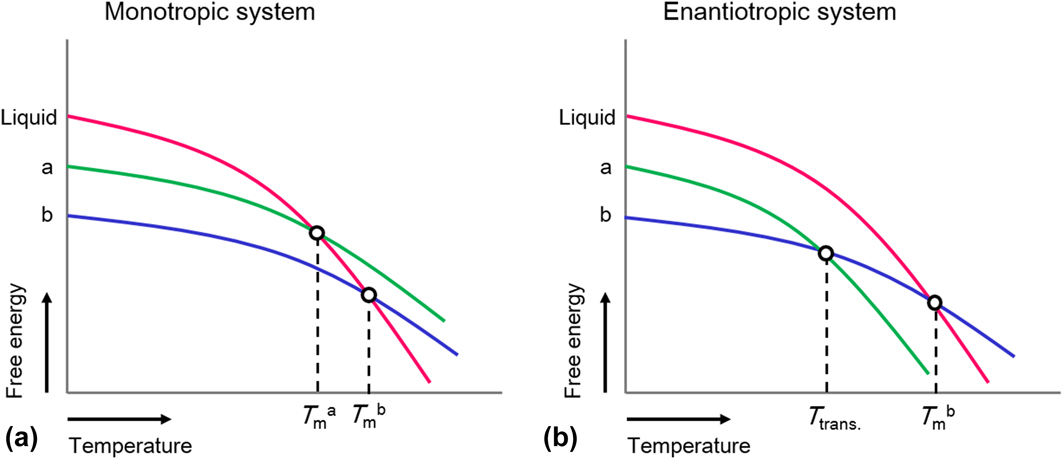
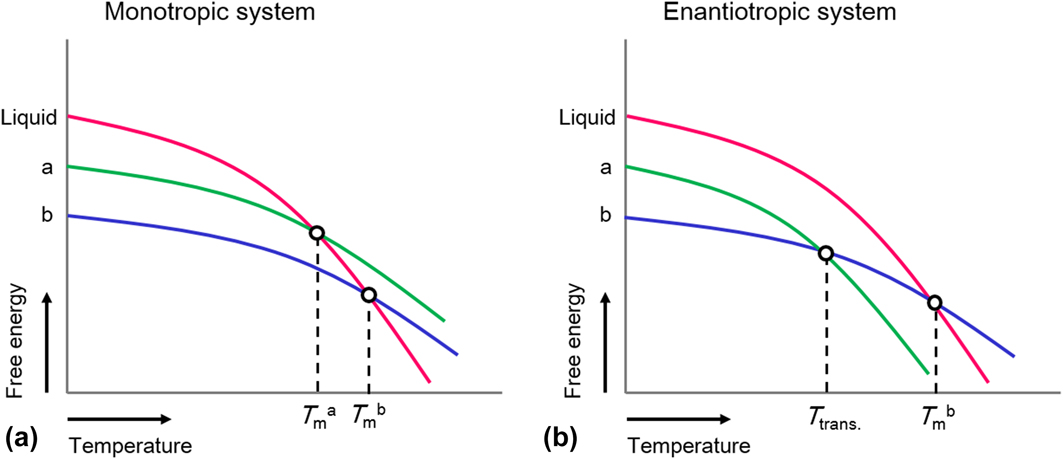
The origination of the polymorphism study can be dated back to the 1900s, when Ostwald coined the postulate that almost any substance was able to exist in two or more phases if given the appropriate boundary conditions.Reference Lee69 In materials science or condensed matter physics, polymorphism is referred to the occurrence of different crystal structures within a certain solid. The corresponded polymorphic transition is intrinsically a critical phenomenon that brings about the fluctuations in chemical, physical, and mechanical properties. From a thermodynamics point of view, the solid-state polymorphism phenomena can be classified into two categories: monotropic and enantiotropic transition.Reference Lee69 In a monotropic system, the free energy curve of each polymorph will not intersect until the temperature reaches the highest melting point amongst all the polymorphs [Fig. 5(a)]. This indicates the irreversible nature of the transition that takes place below any melting point. On the contrary, in an enantiotropic system, free energy curves intersect below various melting points [Fig. 5(b)]. Such a characteristic implies the possibility to reversibly stabilize a certain polymorph by adjusting the boundary conditions. Nonetheless, the aforementioned two types of transitions share the common feature of evolving from a metastable state to a stable state, which results from the various stabilities of polymorphs.
A comparison between monotropic system (a) and enantiotropic system (b).
Owing to the engineered configurational entropy, HEAs usually exhibit a high-symmetric single-phase structure.Reference Miracle and Senkov3 These entropy-stabilized solid solution alloys were once believed to possess significant structural stability at elevated temperatures and extensive loads. The previously reviewed long period thermal stability investigations have evidenced the intrinsically metastable nature of a series of HEAs. Will these entropy-stabilized alloys always preserve one certain crystal structure even under extremely high pressure?
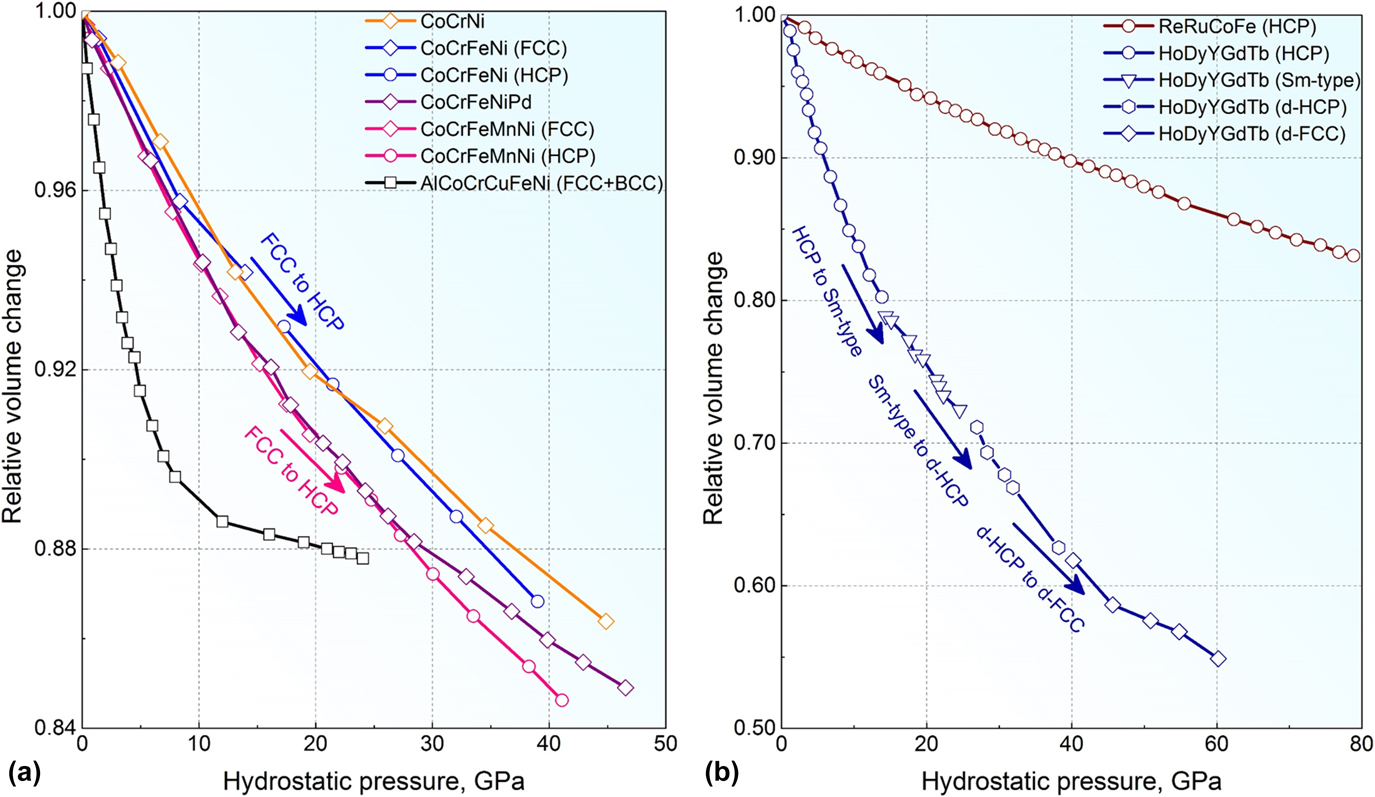
In light of this, a series of investigations have been accomplished in recent years focusing on the conventional CoCrNi-based FCC HEAsReference Zhang, Wu, Lou, Zeng, Prakapenka, Greenberg, Ren, Yan, Okasinski, Liu, Liu, Zeng and Lu70–Reference Huang, Lin, Jain, Shieh, Wang, Chuang, Liao, Zhang, Huang and Lam74 [Fig. 6(a)] as well as rare-earth HEAsReference Ahmad, Su, Liu, Ståhl, Wu, Hui, Ruett, Gutowski, Glazyrin and Liermann72,Reference Yu, Zhang, Ning, Ma, Zhang, Li, Liaw, Li and Liu75 [Fig. 6(b)]. As reported by Zhang et al.,Reference Zhang, Zhao, Jin, Bei, Popov, Park, Neuefeind, Weber and Zhang71 no significant structural transition was observed within the medium entropy CoCrNi alloy even under a hydrostatic pressure level of 50 GPa. When this basic alloy system is alloyed with Fe or Fe and Mn, the FCC to HCP polymorphic transition is detected to take place.Reference Zhang, Wu, Lou, Zeng, Prakapenka, Greenberg, Ren, Yan, Okasinski, Liu, Liu, Zeng and Lu70,Reference Zhang, Zhao, Jin, Bei, Popov, Park, Neuefeind, Weber and Zhang71 However, such a transition displays so sluggish characteristic that it does not complete even at around 40 GPa.Reference Zhang, Wu, Lou, Zeng, Prakapenka, Greenberg, Ren, Yan, Okasinski, Liu, Liu, Zeng and Lu70,Reference Zhang, Zhao, Jin, Bei, Popov, Park, Neuefeind, Weber and Zhang71 Polymorphic transition is not detected within either CoCrFeNiPd or AlCoCrCuFeNi alloy up to 50 GPa.Reference Zhang, Zhao, Jin, Bei, Popov, Park, Neuefeind, Weber and Zhang71,Reference Li, Xiao, Yu, Zhang, Liaw, Li and Liu73 It should be noted that the volumetric response of the AlCoCrCuFeNi HEA displays a remarkable discrepancy from the trends of other HEAs summarized in this category. When it comes to rare earth HEAs, the situation is even more complex. The ReRuCoFe HEA possesses a relatively stable HCP structure with increasing pressure up to 60 GPa.Reference Ahmad, Su, Liu, Ståhl, Wu, Hui, Ruett, Gutowski, Glazyrin and Liermann72 In contrast, the HoDyYGdTb HEA displays rather complex polymorphic transitions: it evolves from a conventional HCP structure through a Sm-type and a double HCP structure, then eventually ends up with a distorted FCC structure.Reference Yu, Zhang, Ning, Ma, Zhang, Li, Liaw, Li and Liu75
A summary of recent investigations toward HEAs under high-pressure: (a) CoCrNi-based HEAsReference Zhang, Wu, Lou, Zeng, Prakapenka, Greenberg, Ren, Yan, Okasinski, Liu, Liu, Zeng and Lu70–Reference Huang, Lin, Jain, Shieh, Wang, Chuang, Liao, Zhang, Huang and Lam74; (b) rare-earth HEAs.Reference Ahmad, Su, Liu, Ståhl, Wu, Hui, Ruett, Gutowski, Glazyrin and Liermann72,Reference Yu, Zhang, Ning, Ma, Zhang, Li, Liaw, Li and Liu75

Current opinions toward the mechanisms of polymorphic transitions within these HEAs vary with scales. In terms of atomic scale, Ma et al.Reference Ma, Grabowski, Körmann, Neugebauer and Raabe76 have validated that within the CoCrFeMnNi HEA, the HCP phase was thermodynamically more stable at lower temperature or under higher pressure compared to the FCC phase. Owing to the similar atomic packing characteristics between HCP and FCC structures, the HCP structure can be obtained by introducing layers of stacking faults within the FCC structure.Reference Olson and Cohen77–Reference Olson and Cohen80 However, the kinetic energy barrier for the polymorphic transition of the CoCrFeMnNi HEA is remarkably high that it cannot be overcome unless the boundary conditions are varied to an extreme extent.Reference Zhang, Wu, Lou, Zeng, Prakapenka, Greenberg, Ren, Yan, Okasinski, Liu, Liu, Zeng and Lu70 In other words, it is the high hydrostatic pressure that assists to overcome such an energy barrier, which facilities the FCC–HCP polymorphic transition. In the electronic scale, Yu et al.Reference Yu, Zhang, Ning, Ma, Zhang, Li, Liaw, Li and Liu75 addressed that the polymorphic transition of the HoDyYGdTb HEA was somehow linked with the d-band occupancy states. Owing to the high hydrostatic pressure, the s-d charge transfer within the heavily alloyed system brings about the increasing number of electrons in d-bands. This results in the variation of the bonding characteristics, which in turn accounts for the sequential polymorphic transition. Nonetheless, more quantitative mechanisms toward the correlation between the high-configurational entropy and the polymorphic transitions still remain to be investigated.
Apart from understanding the unique polymorphic transition mechanisms of HEAs, another intriguing fundamental issue is to construct the equation of state (EOS) for these heavily alloyed solids under high-pressure (namely, the pressure–volume relation). So far, limited work has been accomplished toward such a topic. The third order Birch–Murnaghan (M–B) equation has been widely applied to construct the EOS of compressed solidsReference Birch81:
 $$p = {3 \over 2}{K_0}\left[ {{{\left( {{{{V_p}} \over {{V_{\rm{0}}}}}} \right)}^{{{ - 7} / 3}}} - {{\left( {{{{V_p}} \over {{V_{\rm{0}}}}}} \right)}^{{{ - 5} / 3}}}} \right]\left\{ {1 - {3 \over 4}\left( {4 - K_0^\prime } \right)\left[ {{{\left( {{{{V_p}} \over {{V_0}}}} \right)}^{{{ - 2} / 3}}} - 1} \right]} \right\}\quad ,$$
where p is the hydrostatic pressure, V p and V 0 are the unit cell volume at a pressure level of p and zero, K 0 and K 0′ represent the bulk modulus of the solid at zero pressure and the first pressure derivative. Under this configuration, Ahmad et al.Reference Ahmad, Su, Liu, Ståhl, Wu, Hui, Ruett, Gutowski, Glazyrin and Liermann72 constructed the EOS for both the FCC-CoCrFeMnNi HEA and the HCP-ReRuCoFe HEA by regression analyses. A more general Bridgman equation can also be used to construct the EOSReference Bridgman82:
 $${{{V_p}} \over {{V_0}}} = \sum\limits_{i = 0}^n {a_i^i{p^i}\quad ,}$$
where p is the hydrostatic pressure, V p and V 0 denote the unit cell volume at p and zero pressure, and a i is the ith phenomenological parameter. Following the Bridgman’s formalism, Li et al.Reference Li, Xiao, Yu, Zhang, Liaw, Li and Liu85 built the EOS for the BCC + FCC dual phase AlCoCrCuFeNi HEA.
Investigations toward polymorphic transitions within HEAs have validated the metastable nature of these entropy-stabilized solid solution alloys. Apart from the temperature effects, more attention is suggested to be focused on understanding the metastability of HEAs with respect to high-pressure. Such effort will not only benefit the theoretical fundamentals but also contribute to a comprehensive metastability framework of HEAs under extreme circumstances.
B. Mechanically induced transformations in HEAs
Early research work on HEAs aimed at configurational entropy maximization, for the development of multicomponent, equiatomic alloys with single-phase solid solutions. Nonetheless, configurational entropy-based criteria alone cannot guarantee stability, as demonstrated by Otto et al. and others.Reference Otto, Yang, Bei and George14,Reference Senkov, Miller, Miracle and Woodward83 These observations led to the relaxation of the imposed compositional criteria for HEAs, and exploration of new compositional regimes, such as nonequiatomic HEAsReference Tasan, Deng, Pradeep, Yao, Springer and Raabe84,Reference Pradeep, Tasan, Yao, Deng, Springer and Raabe86 and HEAs with interstitial alloying elements.Reference Wang, Baker, Cai, Chen, Poplawsky and Guo87–Reference Wang, Baker, Guo and Poplawsky90 Yao et al.Reference Yao, Pradeep, Tasan and Raabe91 started from the equiatomic FeMnNiCoCr system to produce a nonequiatomic Fe40Mn27Ni26Co5Cr2 (at.%) HEA and demonstrated that the resulting single-phase (FCC) solid solution similarly has high thermal and mechanical stability. Li et al.Reference Li, Tasan, Springer, Gault and Raabe88 and Wang et al.Reference Wang, Baker, Cai, Chen, Poplawsky and Guo87 demonstrated that carbon, despite being an interstitial alloying element, can be used in the FeMnNiCoCr and FeNiMnAlCr systems, to improve strength–ductility combinations.
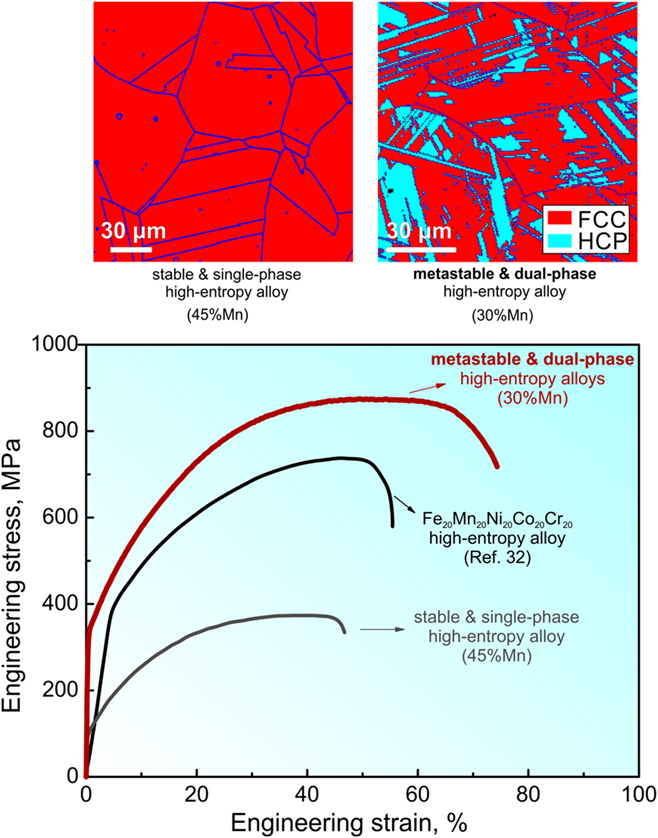
These investigations and others alike motivated an important new design strategy for new HEAs. If single-phase solid solutions can be achieved in nonequiatomic alloys without sacrificing property benefits of HEAs (such as massive solid solution strengthening), composition modifications that would further reduce the single-phase stability can also be explored. This paved the way for the development of twinning-induced plasticity (TWIP) HEAs and transformation-induced plasticity (TRIP) HEAs.Reference Yao, Pradeep, Tasan and Raabe91–Reference Li, Tasan, Pradeep and Raabe94 In one of the pioneering studies of metastable HEAs, Li et al. demonstrated in the FeMnCoCr system that the Mn content can be modified to switch between dislocation-plasticity governed HEA, TWIP HEA, TRIP HEA, and a dual-phase TRIP HEA (Fig. 7).Reference Li, Pradeep, Deng, Raabe and Tasan93
By reducing Mn content, the stability of the matrix austenite phase can be reduced, leading to the formation of HCP both during quenching, and during mechanical testing. As a result, the achieved mechanical properties are superior to stable single-phase structures.

What is noteworthy in the design of metastable high-entropy dual-phase alloys is the reduction of both thermal and mechanical stability, to create the resulting microstructure and properties. In contrast to the equiatomic Fe20Mn20Ni20Co20Cr20 (at.%) that develops a stable FCC structure upon cooling from the high temperature single-phase region, the nonequiatomic Fe50Mn30Co10Cr10 (at.%) system exhibits partial martensitic transformation to the HCP phase when quenching. This type of partial martensitic transformation during quenching is key in avoiding alloying element partitioning, i.e., development of high-entropy phases of identical chemical composition.Reference Li, Pradeep, Deng, Raabe and Tasan93,Reference Raabe, Tasan, Springer and Bausch95 The metastable nature of the room temperature FCC phase leads to the mechanically induced martensitic transformation, and an increase of both ductility and strength. These mechanisms have been utilized by other researchers as well.Reference Fischer, Reisner, Werner, Tanaka, Cailletaud and Antretter4,Reference De Cooman, Estrin and Kim96
Although metastable HEAs show improved property combinations compared to stable HEAs, their design has mostly been carried out based on high-throughput screening approaches, rather than by utilization computational predictions. An interesting work in the latter direction was of Ma et al., where predictive capabilities of the calculation of phase diagram (CALPHAD) approach was assessed for the equiatomic and nonequiatomic FeMnNiCoCr alloys.Reference Ma, Yao, Pradeep, Tasan, Springer and Raabe97 The results demonstrated that systematic CALPHAD simulations can help predict equilibrium phase formation at high-temperatures or after nonequilibrium solidification processes, as well as some martensitic transformation effects.
C. Grain coarsening
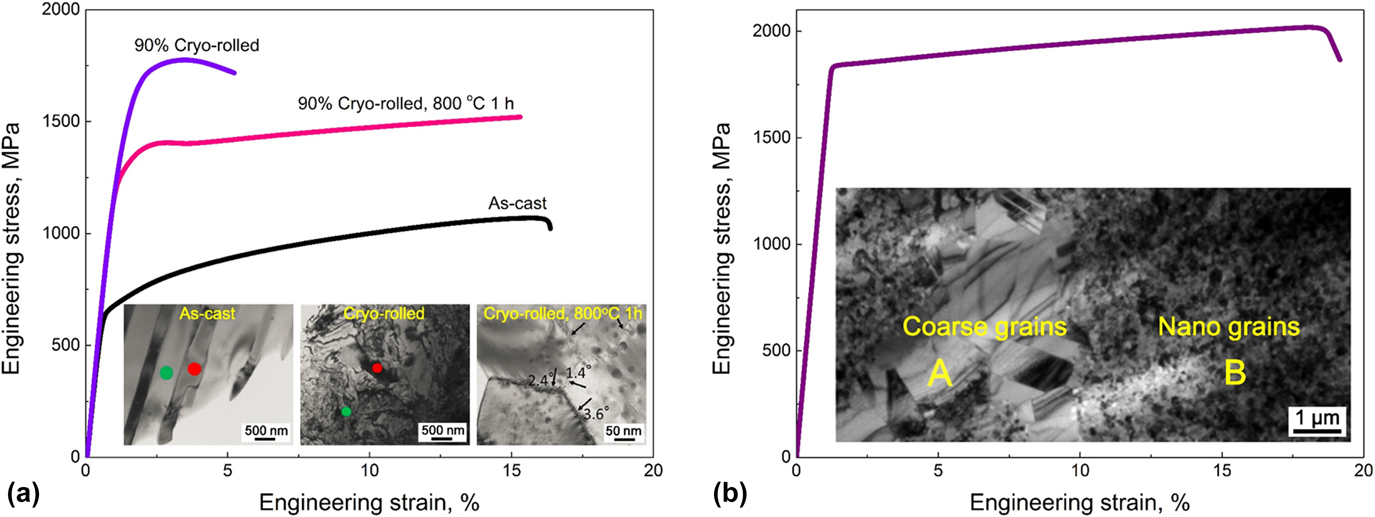
Owing to the superior strength and excellent wear and fatigue resistance, nanocrystalline metals have stimulated extensive research interest compared to their bulk counterparts.Reference Detor and Schuh98 As one of the cost-effective methods to achieve nanocrystalline structure in bulk metallic solids, severe plastic deformation (SPD) techniques, such as high-pressure torsion, heavy cold, and cryo-rolling (HCR) have been widely utilized to also fabricate nanostructured HEAs. An abundance of investigations have emerged in the literature focusing on microstructural characteristics, defect evolution as well as mechanical properties for HEAs after SPD.Reference Stepanov, Yurchenko, Gridneva, Zherebtsov, Ivanisenko and Salishchev99–Reference Wu, Ni, Liu, Liu and Song109 A recent work by Bhattacharjee et al.Reference Bhattacharjee, Wani, Sheikh, Clark, Okawa, Guo, Bhattacharjee and Tsuji106 reported that the nanolamellar AlCoCrFeNi2.1 HEA, which was achieved by cryo-rolling and annealing processes, exhibited a remarkable increase in both the yield strength and the ultimate tensile strength (UTS) without sacrificing too much ductility [Fig. 8(a)]. Such unique characteristics were mainly attributed to the formation of a hierarchical microstructure after SPD. Heczel et al.Reference Heczel, Kawasaki, Lábár, Jang, Langdon and Gubicza108 quantified the defect evolution features such as dislocation density and twin-fault probability for an equiatomic CoCrFeMnNi HEA produced by HPT and successfully explained the enhanced mechanical properties. In the powder scale, mechanical alloying (MA) (often corresponded with various sintering techniques) is another viable approach to fabricate nanostructured bulk metallic solids.Reference babu, Sivaprasad, Muthupandi and Szpunar110–Reference Fu, MacDonald, Zhang, Wu, Chen, Ivanisenko, Hahn and Lavernia113 In such processes, uniform solid solution phase is achieved owing to the high-energy mechanical milling. Fu et al.Reference Fu, MacDonald, Zhang, Wu, Chen, Ivanisenko, Hahn and Lavernia113 reported a design of a nanostructured medium entropy TiFeCoNi alloy (MEA) via MA and spark plasma sintering (SPS) technique. This single FCC phase MEA displayed a unique multiscale grains characteristics with distinctively coarse grains (>1 μm) together with nanograins. They also confirmed that the nanostructured MEA kept a desirable balance between strength and ductility: with ultra-high compressive yield strength up to 1795 MPa and fracture strain of approximately 20% [Fig. 8(b)].
Superior mechanical properties of nanocrystalline HEAs and MEAs: (a) Uniaxial tensile properties of nanolamellar HEAs produced by cryo-rollingReference Bhattacharjee, Wani, Sheikh, Clark, Okawa, Guo, Bhattacharjee and Tsuji106; (b) Uniaxial compressive properties of an MEA with multiscale grains fabricated by MA and SPS (regime A: coarse grains; regime B: nanograins).Reference Fu, MacDonald, Zhang, Wu, Chen, Ivanisenko, Hahn and Lavernia113

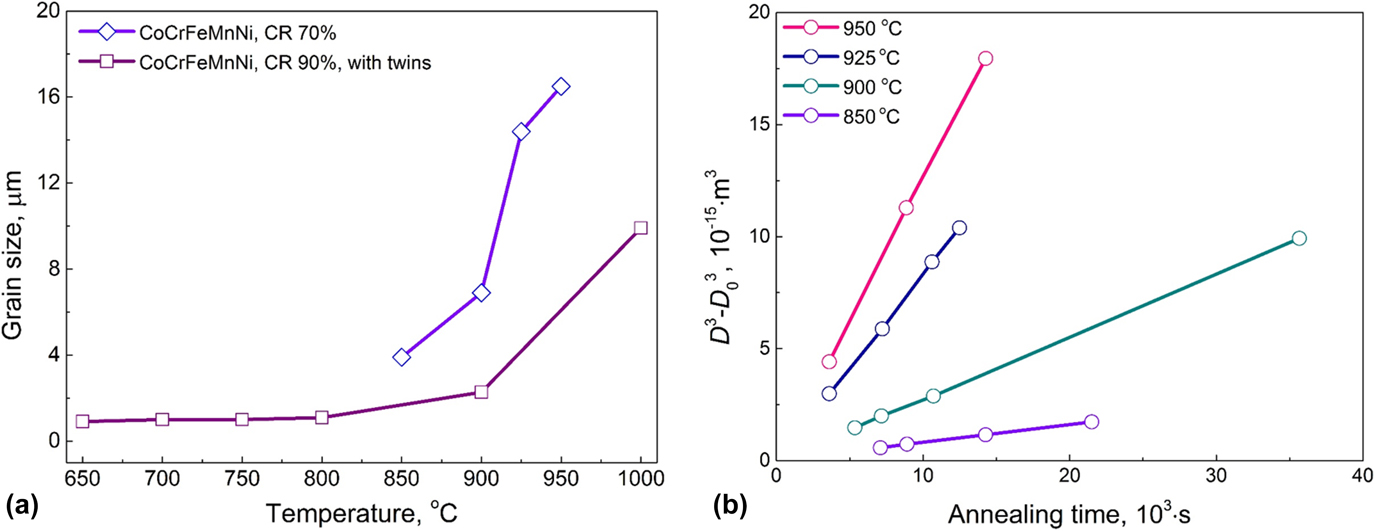
Even though the nanocrystalline HEAs produced by various SPD techniques have demonstrated superior mechanical properties, their intrinsically metastable nature still exhibits significant potential to drive the systems away from nanocrystallinity, bringing about grain coarsening even at ambient temperature. A series of studies have been reported in the literature aiming to examine the structural stability of HEAs after SPD.Reference Schuh, Mendez-Martin, Völker, George, Clemens, Pippan and Hohenwarter114–Reference Bhattacharjee, Sathiaraj, Zaid, Gatti, Lee, Tsai and Yeh117 In particular, Schuh et al.Reference Schuh, Mendez-Martin, Völker, George, Clemens, Pippan and Hohenwarter114 investigated the microstructural and compositional evolution of a nanocrystalline CoCrFeMnNi HEA after HPT. They demonstrated that the mechanical properties underwent an unexpected softening response which was attributed to the interactions between structural and compositional metastability. Bhattacharjee et al.Reference Bhattacharjee, Sathiaraj, Zaid, Gatti, Lee, Tsai and Yeh117 and Liu et al.,Reference Liu, Wu, He, Nieh and Lu116 respectively, studied the grain coarsening kinetics of equiatomic CoCrFeMnNi HEA after HCR. As summarized in Fig. 9(a), the grain coarsening tendency exhibits a significant expedition as temperature rises beyond 800 °C. Liu et al.Reference Liu, Wu, He, Nieh and Lu116 also demonstrated that the grain coarsening kinetics yielded a power law of three with a nominal activation energy of 321.7 kJ/mol [Fig. 9(b)].
Grain coarsening characteristics of CoCrFeMnNi HEAs after HPT: (a) grain size versus temperatureReference Liu, Wu, He, Nieh and Lu116,Reference Bhattacharjee, Sathiaraj, Zaid, Gatti, Lee, Tsai and Yeh117 ; (b) grain coarsening kinetics.Reference Liu, Wu, He, Nieh and Lu116

The aforementioned effort has systematically clarified the enhanced mechanical properties and the grain coarsening characteristics of HEAs after SPD. One fundamental question remains to be answered: would it be possible to employ the high-configurational entropy as a strategy to stabilize the nanocrystalline structure? In terms of thermodynamics, the Gibbs adsorption isotherm states
 $${\rm{d}}{\gamma _{{\rm{GB}}}} = {S^{{\rm{ex}}}}{\rm{d}}T - \sum\limits_i {{\Gamma _i}{\rm{d}}{\mu _i}} \quad ,$$
where γGB denotes the GB energy, S ex is the excess entropy and the excess concentration at GB, Γi and μi represent the excess solute quantity and the chemical potential of the ith element at GB. Within a saturated system, it is also recognized that the variation of GB energy with respect to temperature yields
 $${\left( {{{\partial {\gamma _{{\rm{GB}}}}} \over {\partial T}}} \right)_{p,{X_i}}} \approx {\left( {{{\partial {\gamma _{{\rm{GB}}}}} \over {\partial T}}} \right)_{p,{\mu _i}}} = - {S^{{\rm{ex}}}}\quad ,$$
therefore, the GB energy is theoretically feasible to be tuned down via a large positive excess entropy with increasing temperature. Considering an n component system, the GB energy can be expressed asReference Wynblatt and Chatain118
 $${\gamma _{{\rm{GB}}}} = \gamma _{{\rm{GB}}}^\Theta - 2n\sum\limits_{i \ne 0} {X_{{\rm{GB}}}^i\Delta {H_{{\rm{ads}}{\rm{.}}}}} + 2n\sum\limits_i {{k_{\rm{B}}}TX_{{\rm{GB}}}^i\ln \left( {{{X_{{\rm{GB}}}^i} \over {X_{{\rm{Bulk}}}^i}}} \right) + {\gamma _{{\rm{nonideal}}}}\quad ,}$$
in which  $\gamma _{{\rm{GB}}}^\Theta$ is the reference state where there is no adsorption,
 $X_{{\rm{GB}}}^i$ and
 $X_{{\rm{Bulk}}}^i$ are the GB and bulk composition, ΔH ads., T, k B, and γnonideal represent the adsorption enthalpy, temperature, Boltzmann constant, and nonideal correction term. In Eq. (5), the GB and bulk composition terms can be determined via the McLean–Langmuir equationReference MacLean119:
 $$\ln \left( {{{X_{{\rm{GB}}}^k} \over {X_{{\rm{Bulk}}}^i}}} \right) = {{X_{{\rm{Bulk}}}^k} \over {X_{{\rm{Bulk}}}^i}}\exp \left( { - {{\Delta {H_{{\rm{ads}}{\rm{.}}}}} \over {{k_{\rm{B}}}T}}} \right)\quad .$$
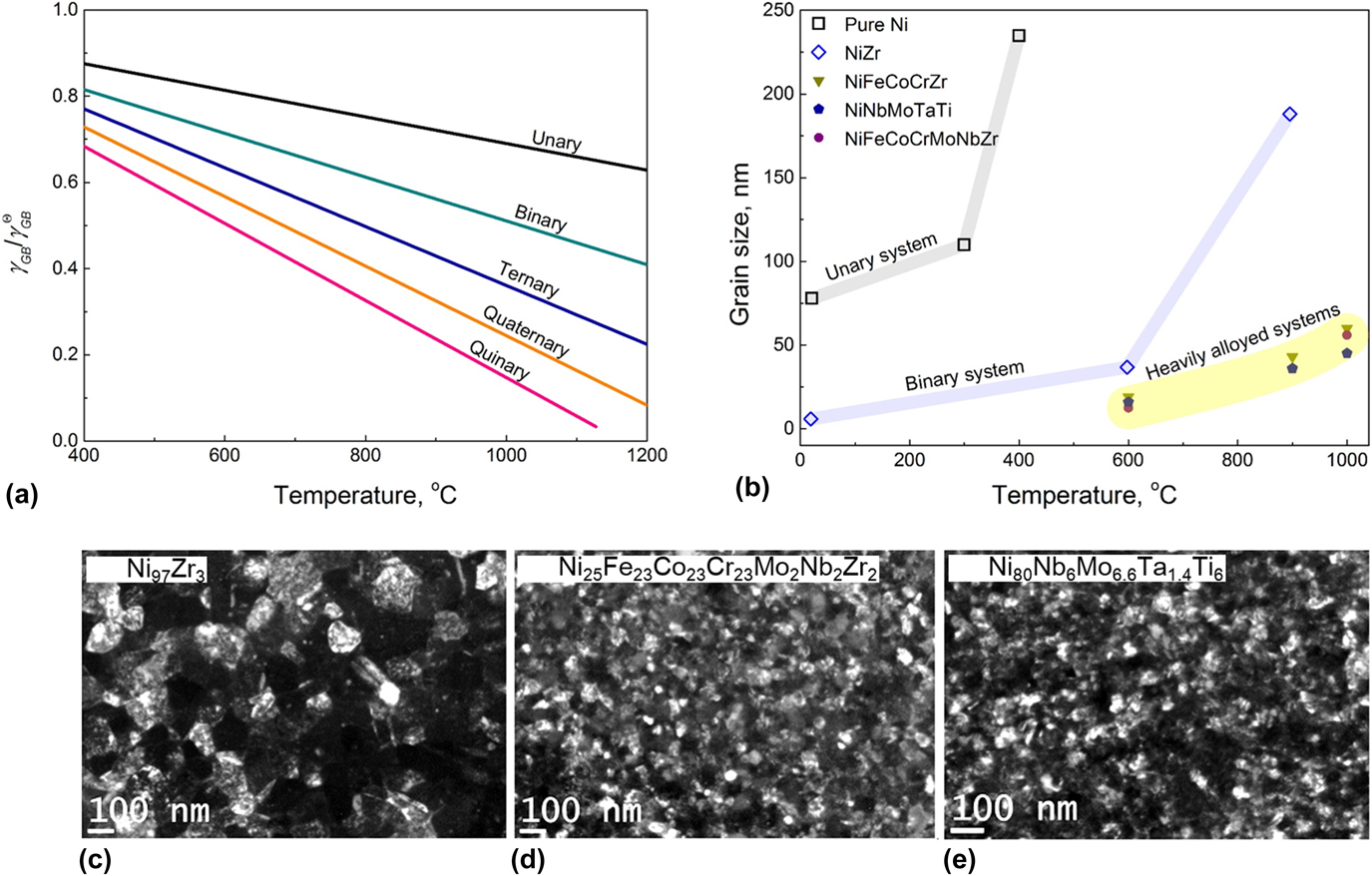
Under this thermodynamic framework, Zhou et al.Reference Zhou, Hu, Huang and Luo120 performed a numerical experiment within a series of hypothetical alloy systems. As illustrated in Fig. 10(a), with increasing temperature, the ratio of GB energy to its reference state exhibits a linearly decreasing trend, which validates the aforementioned theory. Zhou et al.Reference Zhou, Hu, Huang and Luo120 further proved this concept by comparing the grain coarsening kinetics among nanocrystalline pure Ni, binary NiZr alloy, single-phase high-entropy NiFeCoCrZr, NiNbMoTaTi, and NiFeCoCrMoNbZr alloys. It is evident from the statistical data that the heavily alloyed systems display a remarkably sluggish grain growth kinetics.
Entropy as a strategy to stabilize nanograinsReference Zhou, Hu, Huang and Luo120: (a) numerical experiments within hypothetical alloy systems; (b) grain size versus temperature of various alloys; (c)–(e) TEM dark-field images of selected alloys after annealing at 900 °C for 5 h. Reprinted with permission from Ref. Reference Zhou, Hu, Huang and Luo120.

Nanocrystalline HEAs fabricated by SPD methods have been proved to possess superior mechanical properties compared with their coarse-grain counterparts. Nonetheless, their metastable characteristics result in the grain coarsening tendency as temperature increases. The high-entropy concept has been proved theoretically and validated experimentally to be a potential strategy to overcome such a shortage.
IV. CONCLUSIONS
The past decade has witnessed the remarkable momentum of HEA research. In addition to existing research directions within the community, growing interest in metastable HEAs is expected to be continued. Under the metastable framework, future outlooks are briefly summarized as follows:
(1) The compositional metastability nature of HEAs enables a large degree of freedom for precipitation design. Making full use of the extensive solid solution strengthening and simultaneously incorporating various precipitates are suggested as promising strategies to balance strength and ductility at both ambient and elevated temperatures. In addition, much attention shall be directed to metastable HEAs with lower stacking fault energy.
(2) Nanocrystalline HEAs produced by various SPD techniques have been evidenced to exhibit exceptional mechanical performances. In a sense to alleviate the serious grain coarsening tendency, the high-entropy concept itself is also proposed as a potential strategy to further stabilize nanograins. Fundamental insights into tuning the defect structure, extending thermodynamic and kinetic theories to nondilute solution regimes still remain to be explored.
(3) The idea of phase transformation-induced plasticity in steel research has been successfully adapted to mechanically metastable HEA design. Such successful experiences also inspire a broader interpretation of the original high-entropy concept. To explore the wider world of nonequiatomic metastable HEAs, high throughput experimental and computational approaches are expected to be further developed.
ACKNOWLEDGMENTS
Shaolou Wei thanks Mr. Wujie Wang and Ms. Yuntong Zhu for fruitful discussions on chemical thermodynamics. Feng He is deeply indebted to the China Scholarship Council (CSC) for financial support.