




In the late 1830s, the Northern Star emerged, for a time, as the most widely circulated of all provincial newspapers in Britain. At its peak, it sold around 50,000 to 80,000 copies a week and circulated among a readership of at least half a million.Footnote 1 At once a national and a local (Leeds-based until 1844) weekly newspaper, the Northern Star brought together “the isolated sections of the people” and pointed with pride to its discovery of “an entirely new class of readers”, the working classes, and to its devotion “to the interests of Democracy”.Footnote 2 Social and labour historians, along with cultural studies and literary scholars, have examined, in some detail, the crucial role of the Star in the movement and in popular culture.Footnote 3 They have also begun to explore a related but rather different question: how did Chartist readers read the Northern Star?
It is impossible, of course, to capture, in an unmediated way, something as fleeting and personal as reading a newspaper. Reading a nineteenth-century newspaper also involved a “vast number of acts of reading” as readers engaged with a wide range of different kinds of texts (current news, speeches in parliament or at a Chartist meeting, addresses, book reviews, sensational stories about murder and natural disasters, poetry and serialized fiction, advertisements and market reports, and even secret messages).Footnote 4 The physical setting, the reading site or space, mattered. “Much depends upon when and where”, Charles Lamb pointed out, an act of reading took place. The mode of reading (aloud or silent) also affected the meaning of a text. Hearing the current issue of the Star newspaper read aloud and discussed at a gathering of friends and neighbours on a Sunday morning, and silently reading a two-week-old issue alone and by candlelight after the day’s labour, were two very different things.Footnote 5
One way of dealing with these issues is to focus on what historians of reading call the “reading experience”. The authority on this concept, The Reading Experience Database (RED), 1450–1945, defines a reading experience as “a recorded engagement with a written or printed text – beyond the mere fact of possession”.Footnote 6 Of the many ways of reading the Northern Star, one of the most revealing and well-documented was the practice of friends and neighbours or workmates clubbing together to buy a shared copy (at 4½d.); after selecting a reader, they listened as a group to an oral reading of that week’s issue and took part, sometimes paragraph by paragraph, in a far-ranging and “quite warm” discussion of its contents.Footnote 7 In doing so, these Northern Star reading groups drew upon a reading strategy that was familiar to members of the working classes and to radical readers. When the weavers in “Willie Semple’s Club” met in the cobbler’s cramped apartment to hear the latest from the Black Dwarf or the Glasgow Chronicle, they took turns as the designated reader. That evening’s reader “had the use of a candle, contributed from the general fund. The audience were intense listeners, and generally all remark was suspended until the news of the day had been exhausted. Then the more important topics were taken up and discussed”. The debates that followed often went to “vociferous extremes” and touched on a wide range of topics, from the abolition of the House of Lords and the monarchy to universal suffrage and equality in property.Footnote 8
This kind of discussion and “public reasoning” was crucial to the democratic politics of Chartism and indeed to “the roots of democracy across the globe”.Footnote 9 In this article, I will explore this “underrepresented” area in the history of reading, group reading, and will focus on these “intense listeners” and their oral and collective readings of the Northern Star. Footnote 10 These reading experiences have been gleaned from the Northern Star and contemporary newspapers, but, above all, from autobiographies and later local histories and newspapers. Grounded in the practices and problems of working-class life, these group readings point to, I would argue, the interplay of print and oral cultures in Chartist politics and to the crucial roles of discussion and sociability for Chartist listeners and readers. To paraphrase Abigail Williams, reading the Northern Star aloud “knitted people together” and represented an important way of participating in this mass movement for democratic reform.Footnote 11 This approach to reading also served as a way of drawing in and including women and children and “imperfect” readers.Footnote 12
Problems of the Working-Class Reader
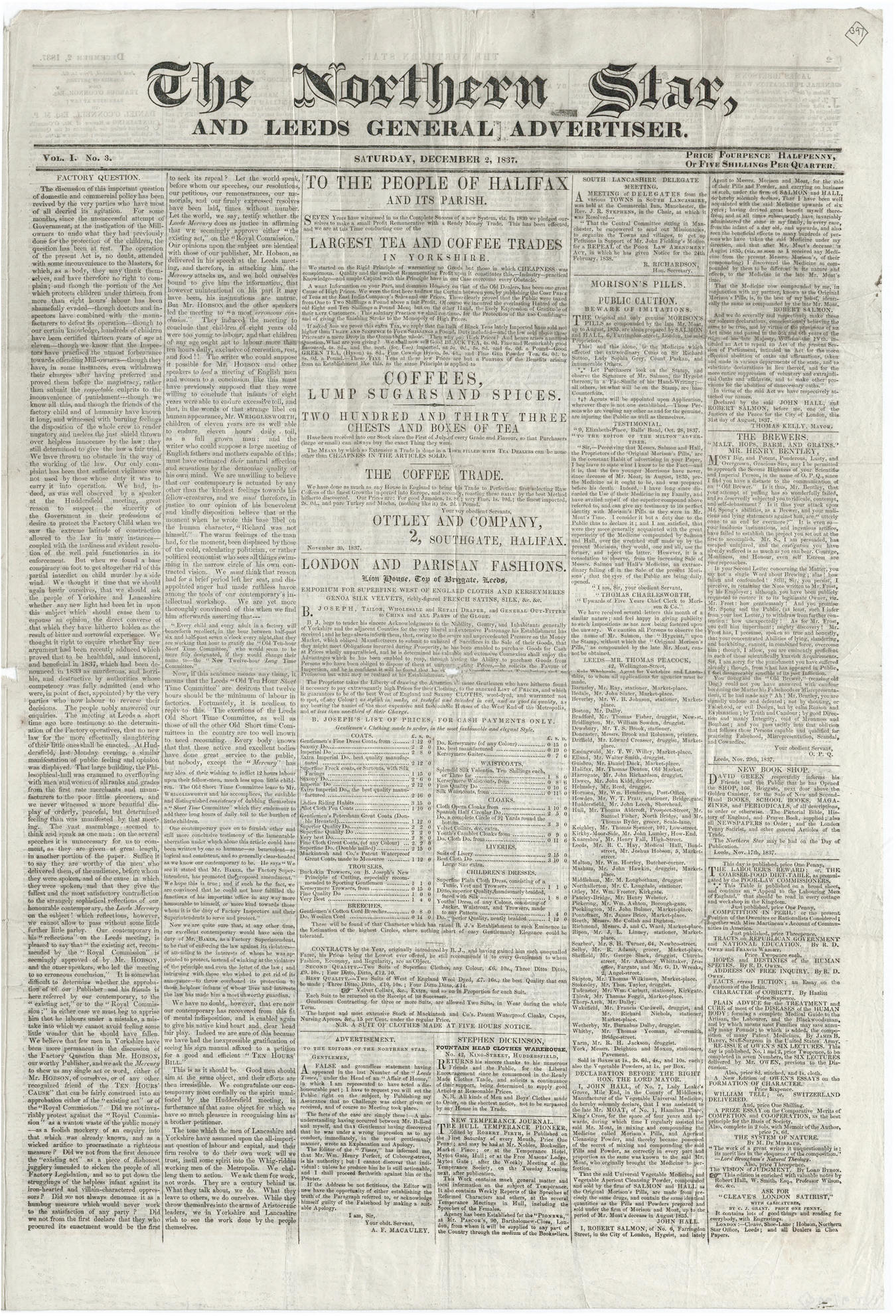
The practice of reading aloud the Northern Star was also a way of solving, or at least mitigating, some of the common problems of this “new class of readers”. The physical layout of the Northern Star, with its “solid columns of print”, could be intimidating to those “who had acquired little more than the basic reading skills”.Footnote 13 In this sense, though, the Star was hardly unique; it closely resembled the national and regional newspapers of the day. From the very beginning, it took the form of a large (around 41 × 59 cm) broadsheet newspaper with six columns of densely printed, tiny type on each of its eight pages, with few paragraph breaks.Footnote 14 Vigorous and personal in its style, at times “coarse, being well sprinkled with expletives, often set forth in capitals”, O’Connor’s weekly letter to “fustian jackets, blistered hands and unshorn chins” was clearly intended to be read aloud. The capitals, spacing, font sizes, and punctuation marks in O’Connor’s weekly letter acted as “vocal cues” for those who read it aloud.Footnote 15 A sizable amount of the paper’s content consisted, however, of lengthy, detailed accounts of meetings, speeches, and lectures as well as national and international news; these typically made only limited use of these kinds of “vocal cues”. With a few exceptions, its columns were entirely devoted to text, with up to 80,000 words per issue; moreover, there were, as Malcolm Chase has pointed out, barely a dozen illustrations in nearly 800 issues (Figure 1).Footnote 16
The earliest surviving copy of the Northern Star, from 2 December 1837.

Figure 1 Long description
The front page of the Northern Star, dated 2 December 1837, features a large masthead at the top with the title”The Northern Star and Leeds General Advertiser”. The layout includes multiple narrow columns of dense, small serif type. Prominent boxed advertisements are centered on the page. The tone is formal, typical of nineteenth-century newspaper language. Key sections include a notice to the people of Halifax, advertisements for coffee, lump sugars and spices, and a message from the proprietor about arrangements with Mr. John Sykes, Bookseller, Northgate. The masthead reads: ′Vol. 1. No. 9. Price 4 one half d.′ The page is organized with bold and uppercase headings and the advertisements are visually distinct with boxed formatting.
This layout made for difficult reading, especially if you had poor vision (or relied on candlelight or firelight). “Very few persons past the age of 40”, observed the physician William Kitchiner, “can see quite so well by Candle-light, as they could before that Age”.Footnote 17 Eyesight, a contemporary optician added, “is materially injured by a variety of well-known causes (too numerous to mention) which are incidental to many avocations, and very prevalent among the working classes”.Footnote 18 Some of these “well-known causes” of visual impairment and blindness included: loss of vision due to smallpox or measles, accidents or work injuries (“a piece of hot iron in one eye”), ophthalmia, and cataracts.Footnote 19 Mule spinners, and other skilled workers, like jewellers and watchmakers, whose work demanded constant strain on their eyes, often struggled with nearsightedness or lost their positions “through want of sight” after they passed the age of fifty.Footnote 20 “Poor, uncorrected eyesight among readers, particularly elderly readers”, Simon Eliot has concluded, “must have been more common then [in the Victorian age] than now”.Footnote 21 To some degree, dyslexia, or “word-blindness”, as it was originally called, also probably affected a sizable minority of potential Star readers, young and old alike.Footnote 22
The easiest solution to “the natural decay of sight” and to some of the more routine “disorders” of the eye was to purchase a pair of spectacles; this could be a life-altering event. “I saw”, recalled the miner Edward Rymer about a pair that he tried on at a wholesale market, “a new world about me, and I became almost wild with joy and amazement […] I could see objects eight or nine miles from me. Better still, I could see and read the names on signs in streets or at stations. I could view the landscape and behold my wife in the distance”.Footnote 23 On the streets of London, spectacles of questionable quality could be purchased for as little as 4d. or 9d., but the pair of double concave lenses that Rymer bought (and considered a bargain) retailed at 3s. 6d., a price beyond the limited means of most working men and women.Footnote 24 To avoid this kind of serious outlay, those who were in need could always borrow a pair from a friend or neighbour. The “greatly prized” spectacles of Old Nance were always in demand in her village, where “every person who wanted to do a bit of fine sewing or anything requiring young vision in old eyes would borrow them”.Footnote 25
Vision issues aside, the physical layout of the Star and its densely packed columns of text represented a very real challenge to the “imperfect” reading skills of its intended audience.Footnote 26 In the late 1830s, full, “technical” literacy, or the ability to read and write with some degree of fluency, probably eluded the majority of working-class adults, but most were at least “imperfect” readers.Footnote 27 This meant that many read at a very basic level and often lacked, as Samuel Smiles put it, the “means and opportunities” to practice their reading skills; in fact, many working men and women eventually lost “the art of reading in their adult years”.Footnote 28 It is important, however, to bear in mind that in this period neither poor reading skills nor illiteracy carried any real social stigma for most members of the working classes; moreover, literacy was, as Andrew Hobbs has pointed out, “a shared communal asset”, one that enabled those who could not read to enjoy a newspaper.Footnote 29
In the 1830s and 1840s, newspaper reading was also a communal activity because of the scarcity and expense of newspapers. Finding a copy of the Northern Star was not an easy task. Respectable news agents and booksellers typically objected to its radical politics and refused to carry the Star or take orders for the paper; some “treacherous agents” even tried “to Burke” the Star, “by wrapping it up in Weekly Chronicle bills, or selling the nuisance in its stead”.Footnote 30 Magistrates routinely threatened the landlords of hotels or taverns that took in the Star or made rooms available to Chartists.Footnote 31 Train stations and railway stalls often banned its display and sale.Footnote 32 As a stamped newspaper, the Northern Star was able, however, to publish current news and enjoyed free postal delivery, but “that little red spot” (the newspaper stamp) in the corner of the page, along with other “taxes on knowledge”, raised the price of the weekly issue to 4½d. and in effect made “the poor man’s paper dearer”.Footnote 33 This was, after all, the real purpose of the taxes on knowledge – not to raise revenue, but to limit access to print and to prevent the circulation of subversive ideas among the working classes.
Reading Sites, Reading Experiences
When the Chartists turned to the practice of reading aloud the Northern Star, they adopted a well-established, familiar reading strategy. The radical tradition of meeting in small groups to read and discuss newspapers, like the Evening Mail or the Black Dwarf, stretched back from the 1832 Reform Bill crisis to the days of Peterloo and the Blanketeers to the “readings, conversations, and discussions” of the London Corresponding Society during the 1790s. “At the height of the reform agitation”, William Farish noted about Carlisle in 1832, “it was common for the men in our shop to gather round the fire about nine, and, with me in the middle as reader, go through the debates until long after midnight. Thus, with corrections from one and another, I learned to read, and thus likewise, at fourteen, I became somewhat of an advanced politician”.Footnote 34 The communal readings of the Star took place in a variety of different settings – the home, the workplace, the Chartist association room, some “retired” spot out of doors, and the public house or tavern. These different reading sites or spaces, together with contact and interaction with other readers, shaped the reading experience and meaning itself. For many of the “imperfect” readers who participated in these communal readings of the Northern Star, “the social and affective relationships surrounding the reading experience” were, indeed, as important as “the meaning of particular texts”. In reading and listening to the Northern Star, sociability and the simple pleasures of life intertwined with democratic politics and dreams of a different world.Footnote 35
Among his memories of childhood and adolescence, one that stood out for W.E. Adams was Sunday mornings with the Northern Star in the kitchen of his grandmother’s house. Raised in her home in Cheltenham Spa, he grew up in a deeply committed radical family; his grandmother and aunts, who made their livings as washerwomen, read Cobbett and Paine and supported the Chartist “national holiday” in August 1839. The long hours of work and limited leisure time of his relatives (and of most workers) gave the weekly readings of the Northern Star, a Saturday newspaper, a distinctive rhythm. These communal readings in the home usually took place in the evening or on the weekend. Sunday was, of course, the only real day of leisure for the working classes, and reading the Star, “instead of going to church”, challenged the Sabbatarianism of the day, with its prohibition of reading newspapers or secular works.Footnote 36 For friends and neighbours, like the “crippled shoemaker” Larry, Sunday morning with the Star was a social occasion, one that combined politics with food, conversation, and sometimes a leisurely smoke. In his autobiography, Adams fondly recreated some of the rituals of this social get-together, like the drying and cutting of the pages of the Star:
Larry […] made his appearance every Sunday morning, as regular as clockwork, with a copy of the Northern Star, damp from the press, for the purpose of hearing some member of our household read out to him and others “Feargus’s letter”. The paper had first to be dried before the fire, and then carefully and evenly cut, so as not to damage a single line of the most sacred production. This done, Larry, placidly smoking his cutty pipe, which he occasionally thrust into the grate for a light, settled himself to listen […] to the message of the great Feargus, watching and now and then turning the little joint as it hung and twirled before the kitchen fire, and interjecting occasional chuckles of approval as some particularly emphatic sentiment was read aloud.Footnote 37
In the case of Larry and many readers, O’Connor’s letter on the first page of the Star was often the high point of the weekly meeting; in this age of oratory, Chartist readers and listeners also relished the reading aloud of speeches by O’Connor and other leaders of the movement.Footnote 38 On long winter evenings, “the fire-eating politicians” of Spen Valley gathered at the home of Benny Beaumont to hear him read from the Star “the stirring orations of Bronterre O’Brien, Julian Harney, Henry Vincent, Ernest Jones, or the great Feargus himself”. Thomas Hayes, like John Arlom and his father, admired another regular feature of the Star in the 1840s – “Mr. Harney’s weekly letters signed ‘L’Ami du Peuple’, headed with a motto from Byron about a drop of ink making millions think”.Footnote 39
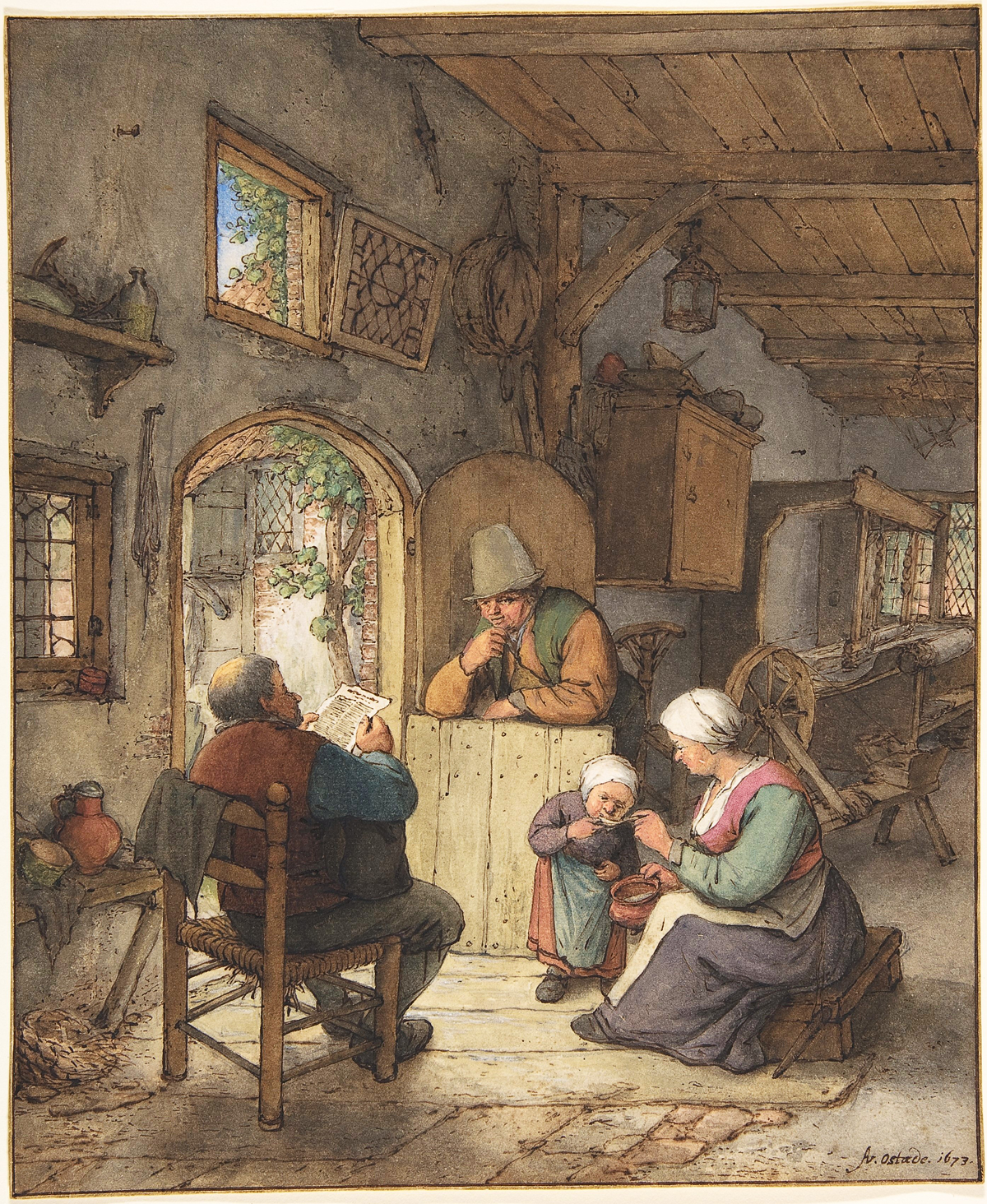
On these Sunday mornings in the kitchen, the teenage Adams or “some member of our household”, possibly one of his female relatives, acted as the reader. There was nothing unusual about this practice; in the home, women and children often served as readers and participated in the discussions. “My parents lived in Platt Street, Hyde”, noted Samuel Shaw, “and my father and his friends would gather in our kitchen, where my mother, who was a good reader, would read aloud from the Northern Star”. In a similar fashion, “when I was quite a boy”, recalled John Arlom, “my Saturday’s work was reading the ‘Northern Star’ to our family circle. As soon as the paper came, my father would say, ‘Come, take up the paper, and see first of all if George Julian has owt in this week’. George Julian was my father’s political high priest” (Figure 2).Footnote 40
Adriaen van Ostade, “Reading the News at the Weavers’ Cottage”, Haarlem, Dutch Republic, 1673.

In some cases, the selection of a young person or child to act as reader was a variation of what Samuel Bamford called the “fire-side education” of the young by their parents; as a designated reader, the fourteen-year-old William Farish learned a great deal, “with corrections from one and another” in the newspaper group, and grew more confident and skilful in his abilities as a reader.Footnote 41 Being the designated reader, in turn, honed critical thinking skills and promoted independence of thought. “My father”, Thomas Spence recalled, “used to make my Brothers and me read the Bible to him while working at his business, and at the End of every Chapter encouraged us to give our opinions on what we had just read. By these Means, I acquired an early habit of reflecting on every Occurrence which past before me as well as on what I read”.Footnote 42 This approach was also a way of introducing young people to the democratic ideas and practices of the movement and of using youthful eyes and literacy to include those with “imperfect” vision or reading skills.Footnote 43
This was the case as well with oral and collective readings of newspapers at work. In most workshops, there were more than a few “imperfect” readers, but at the same time, there was often a high level of interest. Around the time that John Buckley completed his apprenticeship as a carpenter and joiner, copies of the Star circulated among almost every workshop in his town.Footnote 44 Inspired by “the spirit of Radicalism”, members of the trade loaned pamphlets and newspapers to interested parties and opened up the communal readings and discussions to include neighbours; they often chose a youngster as reader “because his time was of least value”.Footnote 45 Around age ten, William Lindsay undertook the task of reading aloud the Aberdeen Journal and Aberdeen Herald for the journeymen in his father’s boot and shoemaker shop. “Previous to this”, Lindsay observed, “they read turn-about, but when they found that I could read fairly well they offered me a small sum weekly for reading to them – that arrangement suited my taste and saved their working time”. Several unlettered factory girls regularly attended the readings with their sewing and darning and manifested, Lindsay emphasized, a real interest in the proceedings; they also frequently asked the young Lindsay to read their love letters aloud to them.Footnote 46 In Horton, near Bradford, the wool combers’ shops served as “centres for the dissemination of political information” during the early years of Chartism and likewise welcomed neighbours to attend the newspaper readings. “The Northern Star”, noted William Cudworth, “was always subscribed for, and if a school lad could be got for a reader he was sure of a good audience, as all the neighbours who could find room congregated to hear him. The enthusiasm of some of these men was something remarkable”.Footnote 47 After (and sometimes during) the reading of the Star, conversation and discussion unfolded as members of the group talked about the news and political issues of the day. “After tea a short article would be read from the Northern Star”, Daniel Merrick remarked about his experiences in a knitters’ workshop, “and this would form the subject matter for consideration and chat during the remainder of the day”.Footnote 48
In their association rooms, Chartists read aloud or recited a variety of different texts, like the poems of Robert Burns or Volney’s Ruins of Empire, and made available for reading and discussion small libraries of radical and Enlightenment texts (along with novels and poetry) and a diverse collection of newspapers.Footnote 49 In early 1839, members of the Working Men’s Association in the small village of Cumnock consumed a wide range of newspaper titles: “6 copies of the Northern Star 2 of the True Scotsman 1 Operative 1 Charter and 2 of the Ayrshire Examiner beside […] Radical and Whig and Tory prints for their various coteries”.Footnote 50 Along with the Northern Star, the Hyde and Ashton associations took in during the 1840s the Chartist Pilot, the Miners’ Advocate, the Nation, the London Telegraph, and the Liverpool Mercury.Footnote 51 Admission was free, and those who visited association rooms could enjoy the fire and conversation and could read the newspapers themselves, or as an alternative, they could listen to, on certain evenings, dramatic readings by “an excellent reader” and could take part in discussions on “subjects connected to the agitation” or on the weekly readings.Footnote 52 At the Chartist reading room in Royton, newspapers were also used as a way of providing interested parties with an opportunity to improve their reading skills. “Here a young man was reading”, remarked one visitor, “in a very laborious but imperfect manner, what appeared to be his lesson – a paragraph from a newspaper or periodical. Three other young fellows sat near him, beside a stove, and a rather tidy-looking Irish tailor was whiffing his pipe, and keeping his toes warm by the fire: he was the head master, as I was given to understand”.Footnote 53
The sociability and free and easy atmosphere of most Chartist association rooms came through clearly in a letter to the editor from John Walker, of Mossley, a small cotton town near Ashton-under-Lyne. The sixty members of the Working Men’s Association there took in the Northern Star as well as other newspapers and took pride in their openness and “friendly discussions” on political questions. “We have”, Walker claimed, “no secrets; we admit any body, whether they are members or not; we read the news of the week, and discuss it paragraph by paragraph, as it is read. We have a good fire in the room, and so it is that we spend our leisure hours, without even coming in contact with drunkenness or immorality”.Footnote 54 The “paragraph by paragraph” approach was common among autodidacts, like John Horsefield, who “read indiscriminately all that I could lay my hands on […] from beginning to end, without overlooking any of its contents”.Footnote 55 As a reading strategy, this slow and careful reading of the newspaper was not for everyone. The fictional Mr. Nutts and his customer Mr. Slowgoe, characters in “The Barber’s Chair”, a regular feature in Douglas Jerrold’s Weekly Newspaper, took opposing views on the issue of how to read a newspaper:
Nutts. Minutes, Mr. Slowgoe, are the small change of life. Can’t wait for nobody. I’ll take you, then, Mr. Limpy. (Limpy takes the chair.) It makes my flesh crawl to see some folks with a newspaper. They go through it for all the world like a caterpillar through a cabbage leaf. Slowgoe. Well, for my part, I like to chew my news. I think a newspaper’s like a dinner; doesn’t do you half the good if it’s bolted.Footnote 56
When the weather cooperated, in late spring and summer, reading the Northern Star out of doors was a possibility. This alternative to the association room or the home served as a way of finding some privacy and quiet (always in short supply for Chartist readers) and of evading the watchful eyes of unsympathetic neighbours or the local constables.Footnote 57 At the time, many people simply enjoyed a day out and rambling and thought nothing of going on a walk “twenty miles each way” on a rare day of leisure.Footnote 58 On “a genial and bright April day”, Farish went on an extended walk through the Cheshire countryside and along the way read in the Star “an interesting review of ‘The Purgatory of Suicides’, which Thomas Cooper had just issued from the prison where, as a Chartist, he had been paying the penalty for his freedom of political speech”.Footnote 59 For Robert Gammage, “the height of enjoyment” was to spend Sunday afternoon with the Northern Star “in a pleasant little bower at the top of the garden, shaded from the rays of the sun by a beautiful sycamore tree”. Later in the day, he and a friend took a walk “into the country, often through the lovely park belonging to the Earl of Digby”.Footnote 60
Northern Star reading groups also liked to take advantage of the chance to read outside “in some retired place”. “We think of meeting on a Sunday morning”, George Robinson told Thomas Cooper about the Hinchley Chartists, “at some central spot between us and the villages and reading the Star and conversing together when weather is fair otherwise at my house”.Footnote 61 As a schoolboy, every Saturday afternoon Thomas Hayes walked from Newton Heath to Abel Heywood’s bookshop in Manchester (about 2–3 miles one way) and brought back “a penny number” and the latest issue of the Star. “In the afternoons”, he recalled, “I read aloud much of these for the edification of others, and I doubt not derived some good myself”.Footnote 62 In nearby Oldham, Benjamin Grime spent the Saturdays of his early days in a similar fashion. Walking from North Moor, across Tommyfield, he picked up the Northern Star, “the joint property of his father and a few of the neighbours”, at the bookshop of the veteran radical John Knight. “The paper would then be read”, he recalled, “in some retired place, on the grass if in summer, or it would be read over the ‘tot of whoam-brewed’ at some of the hush shops which could then be found in every street within a few yards of each other”.Footnote 63
Among the working classes, the practice of reading newspapers in taverns and public houses, and in unlicensed and illicit “hush shops”, was well-established by the 1830s. “In many instances”, Cooke Taylor noted about Manchester, “the newspaper was the chief attraction of the public-house, especially on Sunday, and that operatives ceased to frequent the tavern when they could obtain intelligence elsewhere”. In Royton, the Hope and Anchor, a “respectable” ale house, even had “a public circulating library”, with over seven hundred volumes, “kept in three large presses, secured by lock and key”.Footnote 64 Reading and drinking aside, the public house also represented, as Martin Hewitt has pointed out, a “primary arena of political discussion and argument”. In Nottingham, at the Sign of the Feargus O’Connor, Chartists met every Sunday evening at seven o’clock for a reading of the Northern Star and the Evening Star (a short-lived Chartist daily newspaper); after the reading, a “free discussion” took place.Footnote 65 The Labour and Health Inn, Halifax, offered hot dinners, ale, and porter and took in the Sun, the Northern Star, and the York Courant. Footnote 66 After being read “indoors” in the pub or tavern for several days, copies of the newspapers often then “travelled all over the neighbourhood” and eventually returned home “much the worse for wear and tear”.Footnote 67
Sometimes, publicans even gave dramatic readings to their customers. At his Liverpool pub, on Sunday evenings, John McArdle always delivered, as John Denvir recalled, a vivid performance of the speeches by Daniel O’Connell and others from the current issue of the Nation:
It used to be a great treat to hear John McArdle, on a Sunday night, reading the “Nation”, which then cost sixpence, and was, therefore, not so easily accessible, to an admiring audience […] The elder McArdle was a big, imposing looking man, with a voice to match, who gave the speeches of O’Connell and the other orators of Conciliation Hall with such effect that the applause was always given exactly in the right places, and with as much heartiness as if greeting the original speakers.Footnote 68
“A big, imposing looking man, with a voice to match”, McArdle dramatically recreated speeches from the Nation and was able to elicit applause “exactly in the right places”. On certain occasions, Chartist tavern keepers and publicans also put on a show. While in London as Bradford’s delegate to the National Convention, Peter Bussey sent his wife daily reports of its proceedings in early 1839; she, in turn, read aloud his letters to attentive audiences at their establishment, the Roebuck Inn, Bradford. Their beerhouse was transformed, Thomas Frost noted with a touch of sarcasm, into “a theatre; there was a rush for early places, and all paid for admission”.Footnote 69
In both cases, the physical setting and the voices and personalities of readers clearly affected listeners and the meaning of the text itself. The difference between reading the lines of a text and hearing them read aloud by a skillful reader was like the difference “between looking on a black and white engraving and the coloured picture from which it has been taken”.Footnote 70 Stamina and a strong voice also mattered, especially when the reading proceeded slowly, article by article, from the front page to the last page, sometimes for hours at a time, “with occasional questions and episodical remarks”.Footnote 71 One reader “with a powerful voice which seems to borrow its notes from the voice of a locomotive, declaims to his fellow-workers, all of them being fervid Chartists, the contents of the gigantic newspaper from the date to the name of the publisher”.Footnote 72 Other newspaper readers were careful to pause for dramatic effect, to vary the tone and pitch, and to do different voices.Footnote 73 But even a plain, unadorned style of reading by a young or inexperienced reader could excite “the attentions” and awaken “the feelings of the auditors” and could deepen as well the convictions and confidence of the young reader.Footnote 74 An oral reading of the Northern Star in the familiar local patois, like “the rich Lancashire accent” of Samuel Fielden’s father and friends, could heighten, moreover, the emotional impact of stories about meetings and events in faraway places and could bring them to life.Footnote 75
Conclusion
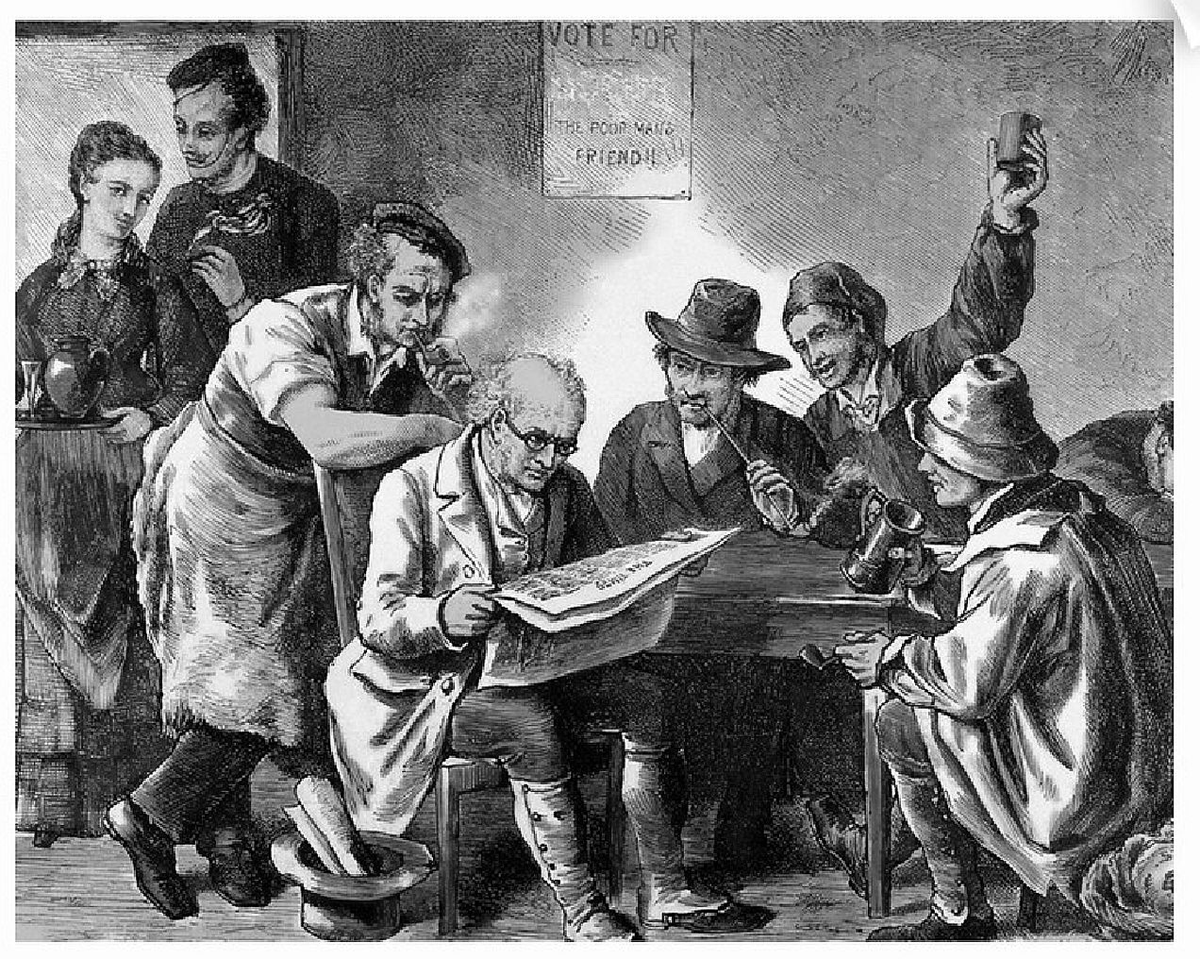
This study of the Northern Star and its readers and listeners provides several insights into the practice of oral and collective reading and into the movement itself. The blending together of sociability and the back and forth of debate was, above all, crucial to these group readings of the Star and to the Chartist approach to democracy, with its emphasis on “freedom of discussion” and face-to-face politics and participation.Footnote 76 The style and delivery of the reader and the social and physical setting also clearly affected the reading experience and group discussion. In the informal, intimate setting of the home, women and children acted as readers and took part, along with unlettered listeners, in the discussions. In the public house and tavern, a different set of conditions prevailed; these establishments were typically less welcoming to women and children and louder and rowdier. The noise and frequent calls for “pots, pipes, and screws”, one critic complained, undermined any attempt at “instruction and debate” and broke everyone’s “chain of thought”.Footnote 77 Whatever the physical setting, these oral and collective readings consisted of many very different “acts of reading”, particularly if readers took a slow, leisurely approach, “like a caterpillar through a cabbage leaf”.Footnote 78 These “acts of reading” included lead articles and letters from O’Connor and others, along with accounts of parliamentary and Chartist speeches and news, but members of the Star reading groups also heard and debated the details of financial accounts from the National Charter Association (and the extravagant “coach-hire” charges of certain Chartist lecturers) and reacted with indignation to letters in the Star about the sufferings and privations of Chartist prisoners (Figure 3).Footnote 79
“Reading the Newspaper in the Tavern”, engraving by Ebenezer Newman Downard, US, 1876. Public Domain.

These many different “acts of reading”, and the discussions and debates that ensued, helped to create a “bond of union” and stirred up what William Lovett called “new feelings, hopes, and aspirations”.Footnote 80 At certain moments, reading aloud stories from the Star gave a sense of drama and urgency to the unfolding of events and led to wide-ranging discussions about tactics and strategy and about social and political change. In August 1842, when the general strike for a fair day’s wage and the Charter was underway, a Northern Star reading group met every Sunday morning in the home of Ben Brierley’s father in Hollinwood “to hear what prospect there was of the expected ‘smash-up’ taking place”. The young Brierley read aloud the Star to his father and five neighbours “so that all could hear at the same time”. Fired up by the latest news, members of their group envisioned a rising of “ten thousand trained pikemen” and the abolition of the House of Lords and the monarchy, and the creation of a republic. Brierley himself took part in the strike, “disguised by appearing in my shirt sleeves, my paper cap, and the leather apron I wore at my velvet loom”.Footnote 81
An avid reader of the Northern Star, the teenage J. Kavanagh closely followed “the mighty wave of revolution that passed over Europe in 1848” and experienced, like Brierley, a surge of optimism about the power of “the people” and the potential for revolutionary change. In late February, the first news of the collapse of the French monarchy had an “electrical” effect on Chartist audiences. One Sunday night, Kavanagh read aloud to a household full of listeners in Barnsley ten columns about “the stirring scenes in Paris” and the flight of the king, Louis Philippe. The Chartists and the Young Ireland Repealers, he added, “were jubilant”, for they believed “that the revolutionary waves would soon beat up against the White Cliffs of Dover, overleap their heights and in the end engulph London, with its royalty and oligarchy, in a sea of ruin”.Footnote 82 Of course, things turned out rather differently in 1848 (as they did in 1842). Even though Brierley and Kavanagh distanced themselves, in their later years, from the revolutionary dreams of their youth, their Northern Star reading experiences demonstrated how at the time these communal readings and discussions could bind together scattered bands of readers and listeners and could create, if only for a moment, a sense that anything was possible.

 Open access

