Fear of falling (FoF) is a lasting concern about falling that can lead to a vicious cycle of reduced balance confidence, activity avoidance, deconditioning, postural instability, and falls (Hadjistavropoulos, Delbaere, & Fitzgerald, Reference Hadjistavropoulos, Delbaere and Fitzgerald2011). Older adults with diabetes mellitus (DM) are 2.73 times (95% CI [1.61-4.63]) more likely to experience multiple falls (Volpato, Leveille, Blaum, Fried, & Guralnik, Reference Volpato, Leveille, Blaum, Fried and Guralnik2005) and 1.70 times (95% CI [1.30-2.20]) more likely to have a hip fracture (Janghorbani, Van Dam, Willett, & Hu, Reference Janghorbani, Van Dam, Willett and Hu2007) when compared to older adults without DM. Given the devastating consequences of falls, it is not surprising that FoF is more prevalent in older adults with DM (66.3%) than those without DM (48.4%) (Roman de Mettelinge, Cambier, Calders, Van Den Noortgate, & Delbaere, Reference Roman de Mettelinge, Cambier, Calders, Van Den Noortgate and Delbaere2013). However, FoF has been primarily assessed with a single dichotomous question – “Are you afraid of falling?” – posed to older adults with DM (Bruce, Hunter, Peters, Davis, & Davis, Reference Bruce, Hunter, Peters, Davis and Davis2015; Lalli et al., Reference Lalli, Chan, Garven, Midha, Chan, Brady and Toth2013; Munshi, Hayes, Iwata, Lee, & Weinger, Reference Munshi, Hayes, Iwata, Lee and Weinger2012; Powell, Carnegie, & Burke, Reference Powell, Carnegie and Burke2006; Roman de Mettelinge et al., Reference Roman de Mettelinge, Cambier, Calders, Van Den Noortgate and Delbaere2013) and which answers to the question provide no information on FoF severity.
FoF has been primarily attributed to poor physical performance, particularly mobility and balance impairments in older adults with DM (Bruce et al., Reference Bruce, Hunter, Peters, Davis and Davis2015; Lalli et al., Reference Lalli, Chan, Garven, Midha, Chan, Brady and Toth2013; Munshi et al., Reference Munshi, Hayes, Iwata, Lee and Weinger2012; Roman de Mettelinge et al., Reference Roman de Mettelinge, Cambier, Calders, Van Den Noortgate and Delbaere2013). However, several other determinants for developing FoF overlap with the consequences/complications of DM, including but not limited to falls, muscle weakness, sensory impairments, depression, and cognitive decline (Deshpande, Metter, Lauretani, Bandinelli, & Ferrucci, Reference Deshpande, Metter, Lauretani, Bandinelli and Ferrucci2009; Foote, Giuseffi, & Munshi, Reference Foote, Giuseffi and Munshi2013; Scheffer, Schuurmans, Dijk, Hooft, & Rooij, Reference Scheffer, Schuurmans, Dijk, Hooft and Rooij2008). Therefore, it is possible that the cumulative effect of these DM-related consequences may contribute to higher FoF severity and, consequently, greater activity restriction and deconditioning in older adults with DM. However, we could cite no studies that investigated how these factors contribute to FoF in older adults with DM. This information is critical for the development of protocols for screening and tailored interventions to help break the vicious cycle of FoF and improve physical function and quality of life in older adults with DM.
Therefore, this study compared the prevalence and severity of FoF in older adults with and without DM, and identified which FoF determinants contribute to FoF severity in older adults with DM. It is hypothesized that FoF will be more prevalent and of higher severity overall in older adults with DM than those without DM and the difference in the severity will be particularly higher for activities that may impose greater challenges on postural control. Further, FoF determinants in older adults with DM will be identified in more than just the physical domain.
Methods
Subjects
The International Mobility in Aging Study (IMIAS) is an ongoing multisite longitudinal study aimed to better understand how to prevent or slow down the loss of mobility in older adults. The Canadian IMIAS sample consists of 799 age- and sex-matched community-dwelling older adults (aged 65–74) from Kingston, Ontario (n = 398) and Saint-Hyacinthe, Quebec (n = 401). For initial recruitment, we excluded participants if they had more than four errors on the Leganes Cognitive Test (LCT) orientation scale (De Yébenes et al., Reference De Yébenes, Otero, Zunzunegui, Rodríguez-Laso, Sánchez-Sánchez and Del Ser2003) resulting from potential inability to complete study procedures. Ethics was approved by respective university ethics boards in accordance with the Declaration of Helsinki. Additional details of study design are included in previous publications (Pirkle, de Albuquerque Sousa, Alvarado, & Zunzunegui, Reference Pirkle, de Albuquerque Sousa, Alvarado and Zunzunegui2014; Zunzunegui et al., Reference Zunzunegui, Alvarado, Guerra, Gómez, Ylli and Guralnik2015).
For the present study, we used baseline data collected in 2012. Participants were excluded for possible dementia (LCT ≤ 22) and incomplete FoF questionnaires. Blood samples were provided by 78 per cent of the Canadian IMIAS sample at a local hospital to obtain glycated hemoglobin (HbA1c) values. DM was ascertained by HbA1c ≥ 6.5 per cent (Goldenberg & Punthakee, Reference Goldenberg and Punthakee2013) or self-reported physician’s diagnosis when HbA1c < 6.5 per cent (48 mmol/mol) or when HbA1c values were not available.
Outcome Measures
FoF Prevalence and Severity
FoF was assessed with the Falls Efficacy Scale–International (FES-I) questionnaire of 16 activities measured on a 4-point Likert scale [1(not concerned at all) to 4(very concerned)] and summed for total FES-I score (range:16–64) with good reliability and validity in community-dwelling older adults (Delbaere, Close, Mikolaizak et al., Reference Delbaere, Close, Brodaty, Sachdev and Lord2010). FES-I scores were classified as no (FES-I score = 16), low (FES-I = 17–19), moderate (FES-I = 20–27), and high (FES-I ≥ 28) concern about falling (Delbaere, Close, Mikolaizak et al., Reference Delbaere, Close, Mikolaizak, Sachdev, Brodaty and Lord2010).
FoF Determinants
Demographic and Health-related Domain
Demographic factors of age, sex, and body mass index (BMI; kg/m2) were recorded. Co-morbidity was the total number of chronic conditions (range: 0–7; hypertension, cancer, chronic lung disease, heart disease, stroke, arthritis, osteoporosis). Total years of education and fall history in the past year were obtained. HbA1c was obtained as a percentage and classified as on target (HbA1C < 8% [64 mmol/mol]) or not at target (HbA1C ≥ 8% [64 mmol/mol]) (Mayo Clinic, 2013).
Physical Domain
Physical performance was assessed with the Short Physical Performance Battery (SPPB) which includes (1) a hierarchical test of standing balance, (2) a 4-metre walk, and (3) five repeated chair stands (Guralnik et al., Reference Guralnik, Simonsick, Ferrucci, Glynn, Berkman, Blazer and Wallace1994). SPPB total scores ranged from 0–12, and < 8 is an established cut-off for poor physical performance (Zunzunegui et al., Reference Zunzunegui, Alvarado, Guerra, Gómez, Ylli and Guralnik2015). The SPPB has excellent reliability and validity in community-dwelling older adults across a broad spectrum of functional abilities and is predictive of adverse outcomes (e.g., hospitalization; Guralnik et al., Reference Guralnik, Simonsick, Ferrucci, Glynn, Berkman, Blazer and Wallace1994). Use of a walking aid to walk a quarter mile was recorded (yes/no). Visual acuity was assessed binocularly with usual corrective lenses using the Early Treatment Diabetic Retinopathy Study (ETDRS) Tumbling E Chart placed at a distance of 2 metres. Total number of correctly identified E’s was recorded. Maximum grip strength (kg) was measured with a Jamar handheld dynamometer (Promedics, Blackburn) of the self-reported dominant hand in a seated position with 90 degrees of elbow flexion over three trials.
Psychological Domain
Depressive symptoms were evaluated with the Centre for Epidemiological Studies–Depression Scale (CES-D), an assessment tool with good-to-excellent reliability and validity in a community-dwelling population (Radloff, Reference Radloff1977). Total CES-D scores ranged from 0–60 with higher scores indicating more depressive symptoms and ≥ 16 clinical depression symptoms (Radloff, Reference Radloff1977). Cognitive function was evaluated with the Montreal Cognitive Assessment (MoCA). Total MoCA scores ranged from 0–30, higher scores indicating better cognitive function (Nasreddine et al., Reference Nasreddine, Phillips, Bédirian, Charbonneau, Whitehead, Collin and Chertkow2005). The MoCA is a screening tool with high sensitivity and specificity to detect MCI in community-dwelling populations (Nasreddine et al., Reference Nasreddine, Phillips, Bédirian, Charbonneau, Whitehead, Collin and Chertkow2005).
Social Domain
Social support from spouse, children, family (i.e., brothers, sisters, nephews, nieces, and/or grandchildren), and friends was quantified on respective subscales of the IMIAS Social Network and Social Support (IMIAS-SNSS) (Ibrahim, Alvarado, & Zunzunegui, n.d.). Each subscale included six items scored on a 5-point Likert scale [0(never) to 5(always)] and higher scores indicating higher levels of social support. Living arrangement was recorded (living alone/not living alone) as a measure of proximity of help or assistance if a fall were to happen at home.
Statistical Analysis
Data with skewed distributions were log10 transformed and back-transformed for data presentation, as appropriate. Missing data were replaced with overall mean (visual acuity, n = 2; grip strength, n = 9) and median (use of assistive device, n = 5) values. Logistic regression adjusted for age and sex were used to examine differences in FoF prevalence overall (yes/no) and by FES-I category between the DM-group and noDM-group. In those who reported FoF, we used separate general linear models adjusted for age and sex to examine differences in FoF severity overall and each FES-I item between the DM-group and noDM-group. We applied separate general linear models and Chi-square analysis to examine differences in FoF determinants between the DM-group and noDM-group.
The preliminary analyses we conducted let us determine an FES-I category threshold (low, moderate, or high) where FoF determinants differed significantly different from those classified with no FoF. FoF determinants were not significantly different between no and low FoF (all p > .05); however, significant differences were found between no and moderate FoF (p < .05; data not shown). Therefore, we collapsed FES-I categories into no-low and moderate-high categories for the subsequent analyses. Separate general linear models and logistic regressions adjusted for age and sex were used, as appropriate, to explore differences in FoF determinants between older adults with DM who had no-low and moderate-to-high FoF. We included FoF determinants at the p < .10 level as independent variables in a multivariable linear regression model adjusted for age and sex of FoF severity in the DM-group. Poisson regression was conducted as a post hoc analysis to estimate prevalence ratios (PR) of moderate-to-high FoF compared to no-low FoF for the significant FoF determinants in the DM-group. Separate general linear models were used to see if the cumulative effect of the significant FoF determinants contributed to higher FoF severity in older adults with DM. Associations with p < .05 were considered statistically significant (SPSS, Version 22).
Results
Of the 799 participants in our Canadian IIMIAS sample, we excluded seven for possible dementia (LCT ≤ 22) and 31 for incomplete FES-I questionnaires. Of the remaining 761 participants, 141 (83 with HbA1c ≥ 6.5% [48 mmol/mol], 37 with HbA1c < 6.5% [48 mmol/mol] with physician’s diagnosis, and 21 with physician’s diagnosis only) were identified with DM (DM-group) and 620 without DM (noDM-group). Of the available data, we identified 11 per cent of older adults as having glycemic control not at target (HbA1c ≥ 8% [64 mmol/mol]).
FoF Prevalence and Severity
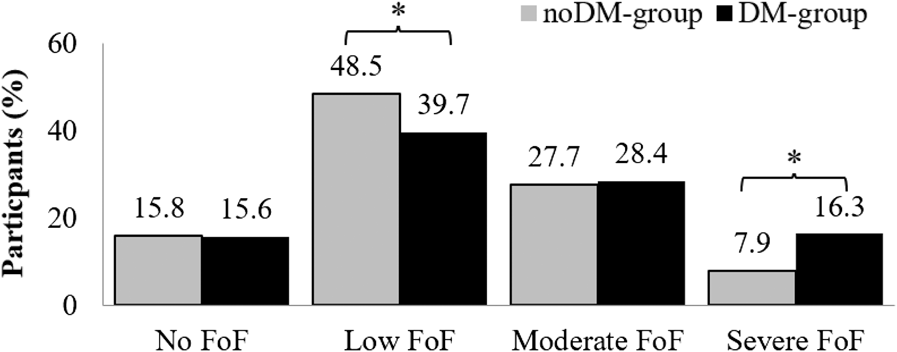
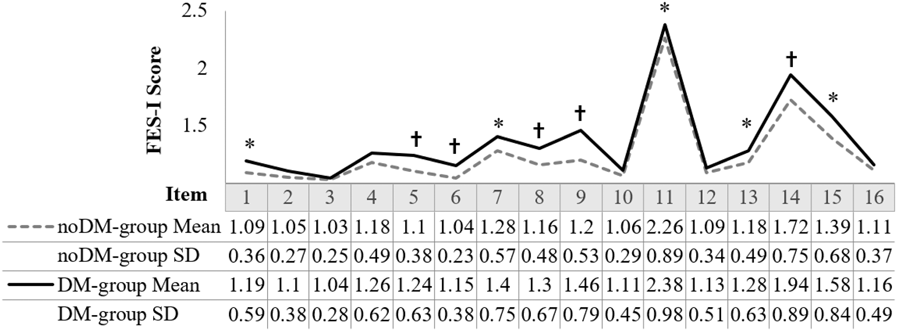
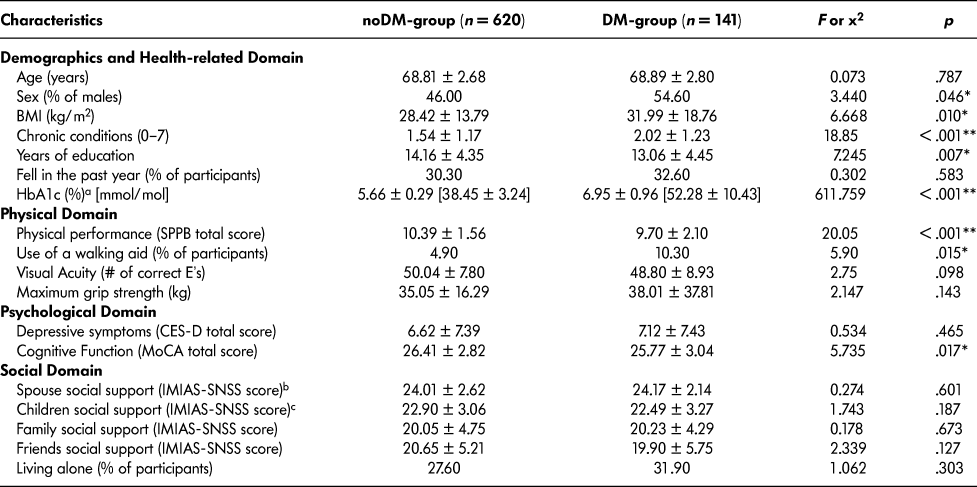
Overall FoF prevalence adjusted for age and sex was not significantly different between groups (DM-group: 84.4%; noDM-group: 84.1%, p = .449). However, FoF prevalence adjusted for age and sex revealed that the DM-group had significantly fewer participants in the low (noDM-group = 48.5% and DM-group = 39.7%; group difference of 8.8%, p = 0.025) and more in the high (noDM-group = 7.9% and DM-group = 16.3%; group-difference of 8.4%, p = .002) FES-I categories than noDM-group (Figure 1). In those who reported FoF, FoF severity adjusted for age and sex was significantly higher overall (DM-group: 22.75 ± 7.80; noDM-group: 20.70 ± 5.31, p < .001) and in 10 of 16 FES-I items in the DM-group than in the noDM-group (all p < .05; Figure 2). The largest group differences were identified while reaching for something above your head or on the ground (item 9), walking on an uneven surface (item 14), and walking up or down a slope (item 15). Separate post hoc general linear models revealed large reductions in power and effect sizes of the group differences in FoF severity overall (Δobserved power = 0.870, Δηp2 = 0.02), item 9 (Δobserved power = 0.278, Δηp2 = 0.024), item 14 (Δobserved power = 0.722, Δηp2 = 0.015) and item 15 (Δobserved power = 0.708 ,Δηp2 = 0.011) after further adjustment for the FoF determinants that were significantly different between groups outlined in Table 1 (BMI; chronic conditions; years of education; HbA1c [%], SPPB total score; use of walking aid; MoCA total score) in addition to age and sex. Only SPPB total score (physical performance) and use of walking aid were significant co-variates that differentiated between the DM-group and noDM-group (both p < .001).
Fear of falling prevalence in older adults with and without diabetes mellitus
Note. Fear of falling (FoF) prevalence adjusted for age and sex between groups in the Falls Efficacy Scale–International (FES-I) categories of no (FES-I score = 16), low (FES-I score = 17–19), moderate (FES-I score = 20–27) and high (FES-I score ≥ 28) concern about falling. DM-group had significantly (8.8%) fewer participants in the low (p = .025) and 8.4% more in the high (p = .002) FES-I categories than noDM-group.
* p < .05.

Fear of falling severity in older adults with and without diabetes mellitus
Note. Fear of falling (FoF) severity, adjusted for age and sex, across individual items included in the Falls Efficacy Scale–International (FES-I) in older adults with (solid line; DM-group) and without (dashed line; noDM-group) diabetes mellitus. FoF severity was significantly higher in 10 of 16 FES-I items in the DM-group than noDM-group. * p < .05. † p < .001.

Fear of falling determinants in older adults with and without diabetes mellitus

Note. Data are means (SD) unless described otherwise. BMI = Body Mass Index; HbA1c = glycated hemoglobin; CES-D = Centre for Epidemiological Studies–Depression Scale; IMIAS-SNSS = International Aging in Mobility Study – Social Networks and Social Support; MoCA = Montreal Cognitive Assessment; SPPB = Short Physical Performance Battery. aHbA1c was available in 591/761 participants. Only participants with a spouse (n = 510)b and children (n = 669)c were included in these analyses.
The DM-group had significantly more males (p = .046), higher BMI (p = .010), more chronic conditions (p < .001), less education (p = .007), higher HbA1c (p < .001), poor physical performance (p < .001) and lower cognition (p = .017) than noDM-group.
* p < .05, ** p < .001.
FoF Determinants
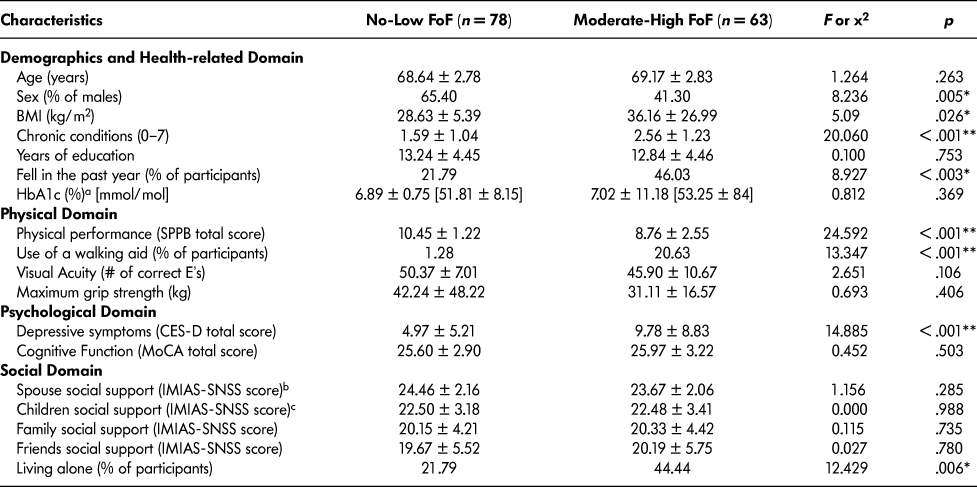
Table 2 outlines differences in FoF determinants adjusted for age and sex in the DM-group between those with no-low and moderate-high FoF. Determinants that were considerably different between these two groups (p < .20) were included as independent variables in a multivariable linear regression adjusted for age and sex of FoF severity in the DM-group. Significant determinants of FoF severity were being female (p = .005), having a fall history (p = 0.038), exhibiting poor physical performance (p < .001), and manifesting more depressive symptoms (p = .008). To gain further insight into these findings, physical performance (SPPB < 8, poor physical performance; SPPB ≥ 8 good physical performance) and depression (CES-D >16 clinical depression symptoms; CES-D ≤ 16 no-depression) scores were also dichotomized. Poisson regression with robust variance was used as a post hoc analysis to estimate the prevalence ratio of moderate-to-high FoF. In the DM-group, moderate-to-high FoF was significantly more likely in those with poor physical performance (PR = 2.00, 95% CI [1.44, 2.74], p < .001), women (PR = 1.70, 95% CI [1.21, 2.38], p = .002), fall history (PR = 1.54, 95% CI [1.10, 2.15], p = .012) and clinical depression symptoms (PR = 1.48, 95% CI [1.01, 2.18], p = .047) when compared to the no-low FoF category.
Determinants of higher fear of falling severity in older adults with diabetes mellitus

Note. Falls Efficacy Scale–International (FES-I) categories were merged to no-low (FES-I score = 16–19) and moderate-high (FES-I score ≥ 20) concern about falling in older adults with diabetes mellitus (DM-group). Fear of falling determinants adjusted for age and sex that were identified to be significantly different (p > .20) between the no-low and moderate-high FES-I categories were included in the linear regression analysis. Data are means (SD) unless described otherwise.
BMI = Body Mass Index; CES-D = Centre for Epidemiological Studies–Depression Scale; HbA1c = glycated hemoglobin; IMIAS-SNSS = International Aging in Mobility Study – Social Networks and Social Support; MoCA = Montreal Cognitive Assessment; SPPB = Short Physical Performance Battery; aHbA1c was available in 120 of the 141 participants. Only participants with a spouse (n = 90)b and children (n = 122)c were included in these analyses.
* p < .05, ** p < .001.
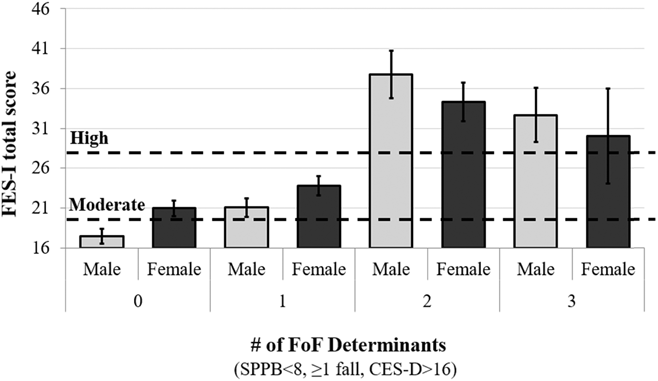
Poor physical performance, women, fall history, and clinical depressive symptoms were the factors we used to examine if the cumulative effect of these significant FoF determinants contributes to higher FoF severity in older adults with DM (Figure 3). The number of significant FoF determinants were identified (0–3) and stratified by sex. Females who had 0 or 1 FoF determinant had higher FoF severity (FES-I total score) than males (p < .05). However, regardless of sex, the presence of two or more FoF determinants resulted in significantly higher FoF severity in older adults with DM (p < .05).
The cumulative effect of fear of falling determinants in older adults with diabetes mellitus
Note. The cumulative effect of determinants on fear of falling (FoF) severity as quantified by the Fall Efficacy Scale–International (FES-I) total score in older adults with diabetes mellitus (DM) stratified by sex. FES-I score = 20–27 and FES-I score ≥ 28 was indicative of moderate and high FoF severity respectively. The number of significant modifiable FoF determinants were identified on a scale from 0–3 as poor physical performance (Short Physical Performance Battery [SPPB] < 8), fall history (≥ 1 fall), and clinical depressive symptoms (Center for Epidemiological Studies–Depression [CES-D] > 16). Results indicated females who had 0 or 1 FoF determinant(s) had higher FES-I total scores than males (p < .05). However, regardless of sex, the presence of 2 or more FoF determinants resulted in significantly higher FES-I total scores in older adults with DM (p < .05).

Discussion
To our knowledge, this is the first study that conducted an in-depth investigation of FoF prevalence, severity, and determinants in older adults with DM. FoF in the high concern FES-I category was more prevalent in the DM-group than noDM-group. Of those who reported FoF, FoF was of higher severity overall and in 10 of 16 FES-I activities in the DM-group than in the noDM-group. Significant determinants of moderate-to-high FoF in the DM-group were poor physical performance, being female, having a fall history in the past year, and exhibiting clinical depression symptoms.
High Concern of FoF More Prevalent in Older Adults with DM
FoF was highly prevalent in older adults with DM (84.4%). Although the overall FoF prevalence was not significantly different between groups, the DM-group had significantly 8.8 per cent fewer participants in the low concern and 8.4 per cent more in the high concern FES-I categories than the noDM-group. Therefore, the use of overall FoF prevalence in older adults with DM may be misleading, and FES-I categorization may be more useful to identify those with high concerns of FoF. High concerns of FoF may lead to excessive activity restriction (Deshpande et al., Reference Deshpande, Metter, Bandinelli, Lauretani, Windham and Ferrucci2008) that can potentially cause physical deconditioning, loss of independence, and reduced quality of life (Delbaere, Close, Brodaty, Sachdev, & Lord, Reference Delbaere, Close, Brodaty, Sachdev and Lord2010; Donoghue, Cronin, Savva, O’Regan, & Kenny, Reference Donoghue, Cronin, Savva, O’Regan and Kenny2013).
FoF of Higher Severity in 10 of 16 FES-I Activities
FoF severity was significantly higher in 10 of the 16 FES-I activities in the DM-group than noDM-group. The largest group differences were identified as reaching for something above your head or on the ground (item 9; see Figure 1), walking on an uneven surface (item 14), and walking up or down a slope (item 15). The DM-group had worse physical performance, and more participants used a walking aid than the noDM-group. DM-related declines in multiple sensorimotor and cognitive systems responsible for balance can lead to postural instability, poor physical performance, and mobility-related declines (Hewston & Deshpande, Reference Hewston and Deshpande2016) and subsequently may contribute to increased FoF severity (Sharaf & Ibrahim, Reference Sharaf and Ibrahim2008).
For example, long-term hyperglycemia can cause inflammation and reduced sensitivity of the highly active metabolic vasculature in the inner ear (Rybak, Reference Rybak1995) which may contribute to postural instability during rapid head movements while reaching for something. Furthermore, DM-related declines in one or more sensory systems also reduces the sensory redundancy available to the central nervous system which may lead to postural instability during activities that may impose greater challenges on postural control such as walking on an uneven surface or up/down a slope. Therefore, reaching for something above your head or on the ground (item 9), walking on an uneven surface (item 14), and walking up or down a slope (item 15) may represent activities that can or should be targeted in intervention programs to reduce FoF severity in this population. Interestingly, the group difference in FoF severity while walking on a slippery surface (item 11) was not as large and may suggest that this activity is perceived as highly challenging by both older adults with and without DM.
Significant Determinants of Higher FoF Severity in Older Adults with DM
As expected, poor physical performance (SPPB < 8) and being female were identified as the primary determinants of higher FoF severity in the DM-group. Older adults with DM with poor physical performance were twice as likely to have moderate-to-high FoF than older adults with no-low FoF, and 90.5 per cent of those with poor physical performance had moderate-to-high FoF. Higher FoF severity in females is consistently reported in the literature (Pohl, Ahlgren, Nordin, Lundquist, & Lundin-Olsson, Reference Pohl, Ahlgren, Nordin, Lundquist and Lundin-Olsson2015; Scheffer et al., Reference Scheffer, Schuurmans, Dijk, Hooft and Rooij2008). Females were 1.7 times more likely to have moderate-to-high FoF than no-low FoF, and moderate-to-high FoF was identified in 58.7 per cent of females and 41.3 per cent of males in the DM-group. However, DM is more prevalent in males than females (International Diabetes Foundation, 8th ed., 2017), and males may feel inhibited to express FoF due to the perceived stigma attached to the admission of fear on their masculinity (Sharaf & Ibrahim, Reference Sharaf and Ibrahim2008). Therefore, FoF should not be overlooked in males with DM.
Falls can lead to increased FoF severity as a result of previous injury, loss of independence, and/or social embarrassment (Scheffer et al., Reference Scheffer, Schuurmans, Dijk, Hooft and Rooij2008; Sharaf & Ibrahim, Reference Sharaf and Ibrahim2008). Older adults with DM who fell in the past year were 1.54 times more likely to have moderate-to-high FoF than no-low FoF, and 63 per cent of fallers had moderate-to-high FoF. However, longitudinal investigation is warranted to understand the temporal relationship between FoF and falls in older adults with DM.
The prevalence of clinical depression symptoms (CES-D ≥ 16) in the DM-group (10%) was double that of those with no co-morbidities (4.1%). It is known depression can erode one’s self-confidence to perform activities which may lead to activity restriction and subsequently FoF (Sharaf & Ibrahim, Reference Sharaf and Ibrahim2008). However, this is the first study to identify the presence of clinical depression symptoms in older adults with DM as a significant FoF determinant. Older adults with DM with clinical depression symptoms were 1.48 times more likely to have moderate-to-high FoF than no-low FoF, and 78 per cent with clinical depression symptoms were classified with moderate-to-high FoF. Therefore, older adults with DM with clinical depression symptoms may also benefit from FoF interventions.
Two or More FoF Determinants: Significantly Higher FoF Severity
This is the first study to document that the cumulative effect of DM-related consequences (poor physical performance, fall history, clinical depressive symptoms) contributed to significantly higher FoF severity in older adults with DM. Specifically, regardless of sex, the presence of two or more of these FoF determinants resulted in significantly higher FoF severity in older adults with DM and FoF severity to exceed the high FoF threshold (FES-I ≥ 28). Clinically, high FoF severity is associated with adverse outcomes such as loss of confidence, higher levels of anxiety, social withdrawal, and activity restriction (Delbaere, Close, Mikolaizak et al., Reference Delbaere, Close, Brodaty, Sachdev and Lord2010; Hadjistavropoulos et al., Reference Hadjistavropoulos, Delbaere and Fitzgerald2011; Young & Williams, Reference Young and Williams2015). Therefore, additional protocols for screening and tailored interventions may be necessary for older adults with DM. Overall, we recommend that protocols for screening physical performance, fall history, and clinical depression symptoms may be advantageous in both men and women with DM who are aged 65 and older.
Study Limitations
A major limitation of this study is the cross-sectional design. A longitudinal study is warranted to validate causal relationships. Participants with possible dementia were excluded as the FES-I has not been validated in this population. Evaluation of sensory functions were not available and, therefore, only theoretical postulations could be made. Anxiety and personal mastery are known FoF determinants but were unavailable in this data set. DM descriptors of length of time since DM diagnosis and classification (type 1 diabetes; type 2 diabetes; gestational diabetes) were not available as yet, so this fact may also partially explain the variance in FoF severity.
Clinical Implications
In community-dwelling older adults, FoF in the high concern FES-I category was more prevalent and of higher severity in those with DM than noDM. Early detection is critical to break the vicious cycle of FoF. Glycemic control was not a significant FoF determinant in older adults with DM in this study group, possibly because from the available HbA1c values, only 11 per cent of older adults were identified as having glycemic control not at target (HbA1c ≥ 8% [64 mmol/mol]) (Mayo Clinic, 2013). However, we recommend that additional protocols for screening and tailored interventions may be necessary for older adults with DM. Specifically, protocols for screening physical performance, fall history, and clinical depression symptoms may be advantageous in both men and women with DM. The cumulative effect of two or more FoF determinants (poor physical performance, fall history, clinical depressive symptoms) resulted in FoF severity to exceed the high FoF threshold (FES-I ≥ 28) and may be associated with increased fall risk. However, a longitudinal study is warranted to validate causal relationships.
Conclusions
FoF in the high concern FES-I category was more prevalent, and FoF was of higher severity overall and in 10 of 16 FES-I activities, in older adults with DM than in those without DM. Poor physical performance, being female, fall history, and clinical depression symptoms were significant determinants of higher FoF severity in older adults with DM. The cumulative effect of two or more FoF determinants resulted in FoF severity to exceed the high FoF threshold (FES-I ≥ 28). Therefore, we recommend protocols for screening and tailored interventions for physical performance, fall history, and clinical depression symptoms may be advantageous to reduce FoF severity in both men and women with DM and who are aged 65 and older.