Introduction
In recent years, researchers have continued to expand the perspective of human resource management (HRM) practices, such as strategy (Delery & Roumpi, Reference Delery and Roumpi2017) and innovation (Agarwala, Reference Agarwala2003), but HRM is currently limited in the extent to which it integrates ethics and responsibility (Shen & Benson, Reference Shen and Benson2016). In management practices, managers also increasingly focus on how to integrate social responsibility into HRM practices (Morgeson, Aguinis, Waldman, & Siegel, Reference Morgeson, Aguinis, Waldman and Siegel2013). Shen and Zhu (Reference Shen and Zhu2011) proposed the concept of socially responsible human resource management (SR-HRM) to integrate social responsibility into all aspects of HRM and defined SR-HRM as a series of corporate social responsibility (CSR) practices for employees. SR-HRM emphasizes fulfilling obligations to employees and external stakeholders (Shen & Zhu, Reference Shen and Zhu2011). In general, organizations that adopt SR-HRM provide better benefits to their employees (such as superior pay and publicly funded travel), and SR-HRM focuses more squarely on the needs and expectations of employees. Because the company's emphasis on and fulfillment of social responsibility are organizational attractions for employees, SR-HRM may be an important measure to retain employees (Ng, Yam, & Aguinis, Reference Ng, Yam and Aguinis2019).
Although several studies have revealed the negative relationship between SR-HRM and employees' turnover intention (Kundu & Gahlawat, Reference Kundu and Gahlawat2015; Nie, Lämsä, & Pučėtaitė, Reference Nie, Lämsä and Pučėtaitė2018), the linkage was limited in its exploration. And studies are limited to employees' job attitudes, such as job satisfaction (Kundu & Gahlawat, Reference Kundu and Gahlawat2015) and organizational commitment (Qablan & Farmanesh, Reference Qablan and Farmanesh2019), which have a major omission that ignoring individual emotional reaction as the explanatory model. Researchers call for more studies that focus on the role of emotion in the impact of SR-HRM on individual outcomes (Shao, Zhou, Gao, Long, & Xiong, Reference Shao, Zhou, Gao, Long and Xiong2019b; Shen & Zhang, Reference Shen and Zhang2019). The individual engages, maintains, and exchanges relationships with organizations for the expected return, and he will take responsive actions based on this exchange relationship (Blau, Reference Blau1968). Psychological contract violation (PCV) is an emotional reaction of the individual unfulfilled expectation based on a reciprocal relationship (Jiang, Chen, Sun, & Yang, Reference Jiang, Chen, Sun and Yang2017). Previous studies also suggested that employees may feel inconsistent between real compensation and expectation after judging the exchange relationship, and this psychological recognition would arise this negative emotion (Arshad & Sparrow, Reference Arshad and Sparrow2010; Bao, Olson, Parayitam, & Zhao, Reference Bao, Olson, Parayitam and Zhao2011), employees thus chose to take actions for revenge. As such, PCV may be the crucial internal mechanism to explain how SR-HRM influences turnover intention. Drawing on the discrepancy model of PCV, we aim to explore the mediating effect of PCV between SR-HRM and turnover intention.
Moreover, not all employees who violate the psychological contract will adapt to take a negative response. According to the discrepancy model of PCV, individual differences (such as conscientiousness, culture value, and benevolence) are essential moderators of the intensity of employees' responses to perceived PCV (Turnley & Feldman, Reference Turnley and Feldman1999). A growing body of researchclaims that moral identity plays a self-regulatory role in individual decision-making, especially in behavioral decisions that may potentially damage organizations (Thornton & Rupp, Reference Thornton and Rupp2015). In line with this, our study argues that individual moral identity is a vital boundary condition in PCV–turnover intention association.
Taken together, this study tries to enrich the current studies by exploring a moderated-mediation model. We intend to make some contributions to the existing literature and management practices. First, the limited empirical literature does not fully explain how and when SR-HRM decreases the intention of employees to leave. This study attaches importance to employees' emotional processes, through which SR-HRM is associated with employees' attitudes and behaviors. According to the discrepancy model of PCV, we assume PCV as a mediator in the SR-HRM–turnover intention linkage and fill in the research gap of emotional processes related to this negative relationship. Besides, understanding how SR-HRM influences turnover intention also enriches the study on the negative outcome of SR-HRM and provides tangible research evidence for the PCV discrepant perspective. Second, in response to the call by Suazo and Stone-Romero (Reference Suazo and Stone-Romero2011), our study aims to investigate the moderating effect of individual cognition on the PCV–turnover linkage. To our knowledge, previous research has not explored the boundary effect of moral identity on the relationship between PCV and turnover. In addition, our study expands the application of CSR at the micro level of organizations by focusing on the impact of SR-HRM on employees. Finally, this study provides a new way for the organization to decrease employees' turnover intention by adopting SR-HRM practices to fulfill subordinates' psychological contracts and improve employee ethics.
Theory and hypotheses
The Discrepancy model of PCV
PCV is the individual emotional response to the organization's failure to fulfill its promise. However, the academic community has not yet reached a consensus on the extent of PCV. Inaddition, not all employees in an organization will revenge when they perceive that the organization has not met the psychological contract. Thus, Turnley and Feldman (Reference Turnley and Feldman1999) proposed the discrepancy model of PCV, which aimed to explore how employees form PCV and to understand when employees will take vengeance on violations. Employees do not always regard unsatisfied promises as PCV, and not all employees' perceptions of PCV will be transformed into specific retaliatory behaviors, which are important points of the discrepancy model of PCV. On the one hand, this model points out that the expected source, the specific factors of violation and the different characteristics are the main factors leading to the formation of PCV (Turnley & Feldman, Reference Turnley and Feldman1999). Compared with direct leadership, when employees' expectations come from human resource professionals or organizational practices, they are less likely to regard such unmet expectations as PCV. The difference of compensation factors (e.g., salary amount and performance pay) is more likely to be regarded as PCV than other factors. The trade-off between excessive reward and insufficient reward affects the possibility of employees interpreting unsatisfied commitment as PCV. On the other hand, this model also emphasizes the moderating effects of individual differences (fairness sensitivity and responsibility, etc.), organizational practices (procedural and interactive fairness and quality of work relationship, etc.), and labor market environment (exit cost and employee replaceability, etc.) on the transformation of PCV perception into revengeful behavior. Therefore, the discrepancy model of PCV provides an explanatory framework for the formation of PCV and its impact on employees' subsequent attitudes and behaviors.
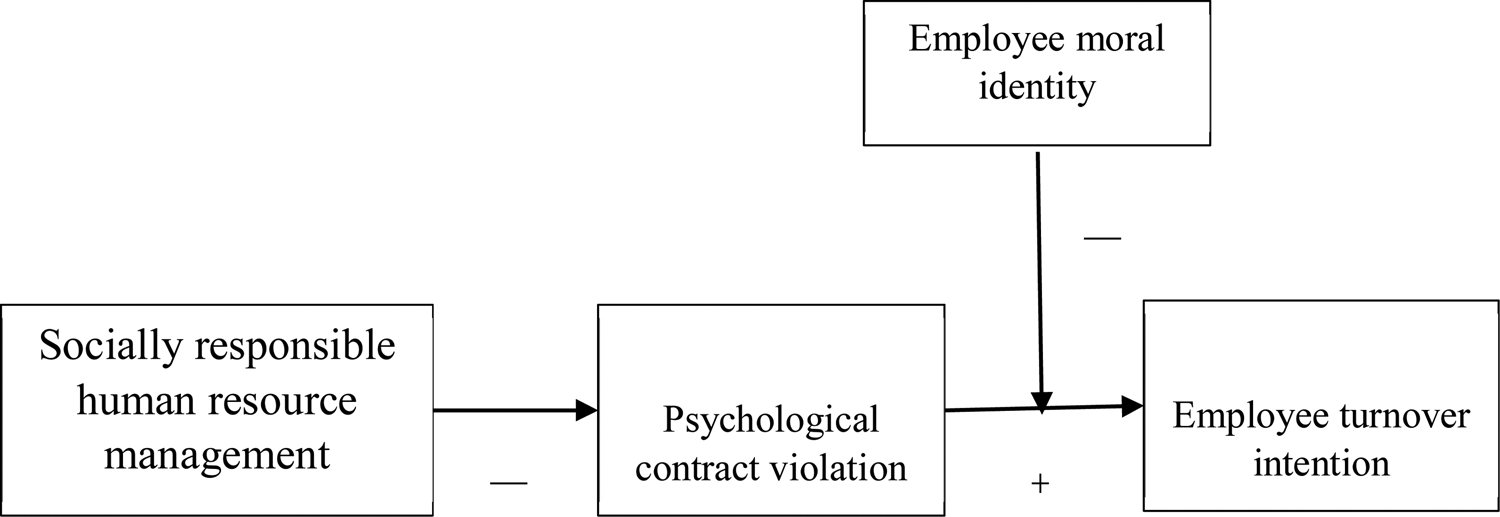
Human resource practices are important communication devices (Guzzo & Noonan, Reference Guzzo and Noonan1994) and convey signals that are relevant to employee psychological contracts (Sonnenberg, Koene, & Paauwe, Reference Sonnenberg, Koene and Paauwe2011). SR-HRM is a new HRM practice in the organization, which is an important source of employee expectation and an important factor affecting the formation of the psychological contract. This is because organizations adopting SR-HRM provide CSR training, superior pay in the industry and extra welfare for employees. And these organizations also recruit socially responsible employees and assess employee social performance (Preuss, Haunschild, & Matten, Reference Preuss, Haunschild and Matten2009; Shen & Benson, Reference Shen and Benson2016). Based on the PCV discrepancy model, SR-HRM provides a better working environment for employees, emphasizes the social responsibility of the organization, which can not only reduce the possibility of employees not meeting their commitments, but also provide external attribution for employees to perceive the expected and actual differences. Therefore, SR-HRM can reduce employees' PCV and thus reduce their negative reactions (e.g., turnover intention). In addition, this model also points out that individual differences lead not all employees to react with retaliation when they perceive PCV. Moral identity is a stable moral trait for individuals to know themselves (Aquino & Reed, Reference Aquino and Reed2002). It can regulate individual behavior, make individuals tend to act in accordance with moral quality, and weaken the negative emotional response produced by PCV (Aquino, Reed, Thau, & Freeman, Reference Aquino, Reed, Thau and Freeman2007; Reed & Aquino, Reference Reed and Aquino2003). Based on this model, we propose a conceptual model to explain how and when SR-HRM can restrain employees' turnover intention (as shown in Figure 1). We suggest that PCV as a new exploratory mechanism to explain how SR-HRM reduces employees' turnover intention and verified the influence of individual moral identity in this process.
The theoretical model.

SR-HRM and psychological contract violation
Previous studies found that SR-HRM impacts employees' attitudes and cognitions to their organizations (Barrena-Martinez, López-Fernández, & Romero-Fernández, Reference Barrena-Martinez, López-Fernández and Romero-Fernández2019; Celma, Martinez-Garcia, & Raya, Reference Celma, Martinez-Garcia and Raya2018; Shen & Zhang, Reference Shen and Zhang2019; Zhao & Zhou, Reference Zhao and Zhou2021; Zhao, Zhou, He, & Jiang, Reference Zhao, Zhou, He and Jiang2021). Besides, human resource practices are regarded by employees as an official commitment (Tsui, Pearce, Porter, & Pripoli, Reference Tsui, Pearce, Porter and Pripoli1997), employees' perception of CSR influences the understanding of the organization-employee exchange relationship (Farooq, Payaud, Merunka, & Valette-Florence, Reference Farooq, Payaud, Merunka and Valette-Florence2013). Therefore, SR-HRM may be regarded as an organizational commitment to employees, triggers their expected return, which in turn influences the form and change of their psychological contract.
PCV can be defined as a strong emotional reaction when an employee believes that the organization has not adequately performed the promise obligations to employees (Morrison & Robinson, Reference Morrison and Robinson1997). This emotion response (i.e., PCV) can be triggered by the discrepancy cognition of actual and expected return in the exchange relationship between organization and employee (Thompson & Bunderson, Reference Thompson and Bunderson2003). Research shows that individual psychological contract is not immutable (Rousseau, Hansen, & Tomprou, Reference Rousseau, Hansen and Tomprou2018), and can even arise violation of psychological contracts (Bankins, Reference Bankins2015; Turnley & Feldman, Reference Turnley and Feldman1999).
According to the discrepancy model of PCV, employee violation of psychological contract comes from the interpret of individual discrepancy perception. Therefore, we can infer that there are two ways for the organization to reduce employees' PCV, one is to avoid the emergence of an individual discrepancy, the other is to influence the process of individually interpret discrepancy. Some research has examined that HRM could help fulfill employees' psychological contracts in some efficient ways (Katou, Reference Katou2015; Katou & Budhwar, Reference Katou and Budhwar2012; Sabine, Ursula, & Martin, Reference Sabine, Ursula and Martin2012). SR-HRM emphasizes responsible awareness. Organizations adopting SR-HRM pay wage on time and provide training opportunities, employees in these enterprises prefer to keep their promises, and thus they may have the perception that organizations abide the exchange rule and seldom develop the discrepancy feelings. SR-HRM is conducive to maintain reciprocal relationship and increases employee job satisfaction (Dechawatanapaisal, Reference Dechawatanapaisal2018; Kundu & Gahlawat, Reference Kundu and Gahlawat2015), which also decreases the possibility of individual discrepancy perception.
Besides, research found that individual PCV may also be caused by the exchange relationship between employee and supervisor (Jiang et al., Reference Jiang, Chen, Sun and Yang2017). However, Turnley and Feldman (Reference Turnley and Feldman1999) proposed that employees who get more in one area are less likely to interpret the difference in another area as PCV. SR-HRM provides the employee with superior pay in the industry (Shen & Benson, Reference Shen and Benson2016), it can weaken the possibility of interpreting the perceived discrepancy from other areas (such as a supervisor) as PCV. Furthermore, the discrepancy model of PCV indicates that individual attribution for organizational violation of exchange norm affects their PCV formation process (Turnley & Feldman, Reference Turnley and Feldman1999). SR-HRM not only undertakes CSR for employees but also stresses the fulfillment of general CSR for the public. Shen and Zhang (Reference Shen and Zhang2019) claim that SR-HRM develops an organizational CSR climate through a series of practices (such as accessing social performance and providing CSR training), increases individual CSR perception and motives their empathy (Kim, Lacey, Kim, & Suh, Reference Kim, Lacey, Kim and Suh2019; Shao, Zhou, & Gao, Reference Shao, Zhou and Gao2019a) and trust in the organization (Hansen, Dunford, Boss, Boss, & Angermeier, Reference Hansen, Dunford, Boss, Boss and Angermeier2011). Therefore, employees may attribute it to external factors (such as CSR for external stakeholders) when employees have a discrepancy perception between reality and expectation. DiFonzo, Alongi, and Wiele (Reference DiFonzo, Alongi and Wiele2018) also confirmed that employees might not raise negative emotions after perceiving unfulfilled promises. Employees may believe that organizations have no intention of causing unfulfilled commitments and less likely to have the feeling of PCV. Taken together, we propose:
Hypothesis 1: SR-HRM is negatively related to PCV.
The mediating role of PCV
The psychological contract is the individual belief on exchange relationship (Rousseau, Reference Rousseau1989), employees may have the perception of PCV for that they believe organizations break the exchange relationship and feel the difference between reality and expectation (Morrison & Robinson, Reference Morrison and Robinson1997). More specifically, such violation may be manifested as the feelings such as betrayal, anger, and frustration, the negative emotion of PCV can lead to employees' attitudinal and behavioral reactions (Priesemuth & Taylor, Reference Priesemuth and Taylor2016). Prior studies have found that organizations could impact employees' attitudes and behaviors by changing their emotional reactions (Abdelmotaleb & Saha, Reference Abdelmotaleb and Saha2020; Shao, Zhou, & Gao, Reference Shao, Zhou and Gao2019a; Sonnentag & Starzyk, Reference Sonnentag and Starzyk2015). The discrepancy model of PCV further suggests that PCV will also influence employees' attitudes and behaviors when some factors cause feelings of difference between expectation and reality (Turnley & Feldman, Reference Turnley and Feldman1999). Therefore, we can infer that PCV may be a potential mechanism to explain the association between SR-HRM and turnover intention.
PCV arises from the changes of the exchange relationship. And reciprocity norm also suggests employees will not only return those who help themselves but also take revenge on those who hurt themselves (Falk & Fischbacher, Reference Falk and Fischbacher2006; Gouldner, Reference Gouldner1960). To keep the balance of exchange and relax their negative emotions of PCV, employees may intend to perform adverse attitudes and actions to the organization when they feel anger for the unfulfilled promise. Therefore, employees may emerge negative attitudes and behaviors to revenge organizations when their organizations fail to achieve the promise (Bao et al., Reference Bao, Olson, Parayitam and Zhao2011). Many studies proposed that turnover intention was employees' non-negligible response when they had the perception of PCV (Peng, Wong, & Song, Reference Peng, Wong and Song2016; Si, Wei, & Li, Reference Si, Wei and Li2008). Employees who perceive PCV commonly express the feeling of anger and sadness (Priesemuth & Taylor, Reference Priesemuth and Taylor2016), the negative mood may lead to employees' turnover intention by activating their perceptions of negative work experiences (Chi & Yang, Reference Chi and Yang2015). Mölders, Brosi, Spörrle, and Welpe (Reference Mölders, Brosi, Spörrle and Welpe2017) also further verified that negative emotion would cause employees' intention to leave. Meanwhile, some studies propose that employees will be likely to have the intention to leave when they develop betrayal feelings from the organization (Aykan, Reference Aykan2014; Salin & Notelaers, Reference Salin and Notelaers2017; Stoner & Gallagher, Reference Stoner and Gallagher2010; Suarthana & Riana, Reference Suarthana and Riana2016). Arshad (Reference Arshad2016) also confirmed that PCV was positively correlated with turnover intention through empirical research. Overall, PCV may motivate employees to emerge turnover intention for the balanced exchange relationship.
According to the logic above, an organization undertakes the internal and external social responsibility through a series of SR-HRM practices, which strengthens employees' trust and maintains the exchange norms between employees and organizations. The discrepancy model of PCV suggests that the conditions causing PCV include some factors, such as payment, training opportunities, and extra benefits (Turnley & Feldman, Reference Turnley and Feldman1999). SR-HRM provides a series of practices to reduce the preconditions for the PCV and gives an external factor for the attribution of employee discrepancy. As such, employees have fewer discrepancy perceptions from reality and organization promises. SR-HRM also decreases the possibility that employees interpret individual discrepancy causing from other parties. SR-HRM can restrain the emergence of employees' negative emotions of PCV, and in turn, reduce the possibility of turnover intention. Taken together, we propose:
Hypothesis 2: PCV mediates the linkage between SR-HRM and turnover intention.
The Moderating role of moral identity
Previous studies have shown that PCV has a negative effect on employees' attitude and behavior (Jiang et al., Reference Jiang, Chen, Sun and Yang2017; Salin & Notelaers, Reference Salin and Notelaers2020). However, the employee may not always take negative revenge (Turnley & Feldman, Reference Turnley and Feldman1999). The discrepancy model of PCV indicated that the process of PCV on employees' attitudes and behaviors would be affected by some factors, such as age (Kraak, Lunardo, Herrbach, & Durrieu, Reference Kraak, Lunardo, Herrbach and Durrieu2017) and benevolence (Salin & Notelaers, Reference Salin and Notelaers2017). Raja, Johns, and Ntalianis (Reference Raja, Johns and Ntalianis2004) stress that personal characters were vital factors to explain individual differences in response to PCV. A growing number of studies indicated that individual moral characteristics were associated with employees' negative performance (Fida et al., Reference Fida, Tramontano, Paciello, Guglielmetti, Gilardi, Probst and Barbaranelli2018; Huang, Wellman, Ashford, Lee, & Wang, Reference Huang, Wellman, Ashford, Lee and Wang2017; Wang, Fu, Qiu, Moore, & Wang, Reference Wang, Fu, Qiu, Moore and Wang2017). Samnani, Salamon, and Singh (Reference Samnani, Salamon and Singh2013) also verified employee moral characteristics moderated the relationship between employee emotion and negative behavior. In this study, we consider moral identity as the boundary condition of the linkage between PCV and turnover intention.
Moral identity is individual cognition of self-concept, and Aquino and Reed (Reference Aquino and Reed2002) defined moral identity as a self-conception organized around a series of moral traits, such as honesty, commitment, loyal, kindness, and friendliness, which are valued by the individuals. In line with this definition, moral identity emphasizes individual willingness to ethically behave and whether they want to be regarded as a moral person. Employees may intend to leave when they have negative emotions of PCV, but individual recognition influences employees' behavioral decision making (Bandura, Reference Bandura2001). As an individual moral recognition, individuals who have a high-moral identity should be consistent with the conceptions of their moral self (Aquino & Reed, Reference Aquino and Reed2002), they have the strong self-control ability and strive to assure their behavior conform to moral standards. Besides, high-moral identity employees seldom perform revenge responses (Skarlicki & Rupp, Reference Skarlicki and Rupp2010). Therefore, we can infer that moral identity may restrain the process of PCV on turnover intention.
Moral identity is regarded as the self-regulatory mechanism which motives and conducts individual psychological and behavioral expression when individuals are with high moral identity (Hart, Atkins, & Ford, Reference Hart, Atkins and Ford1998; Liu, Zhao, Jiang, & Li, Reference Liu, Zhao, Jiang and Li2015; Skarlicki, Jaarsveld, & Walker, Reference Skarlicki, Jaarsveld and Walker2008). Previous research has provided evidence to support the self-regulatory mechanism of moral identity to individual attitudes and behaviors in a different situation (Skarlicki, Jaarsveld, & Walker, Reference Skarlicki, Jaarsveld and Walker2008; Wu, Sun, Zhang, & Wang, Reference Wu, Sun, Zhang and Wang2016). High-moral identity employees are less likely to change individual moral recognition and take actions to damage organizations even in injustice conditions (Wu, Sun, Fu, & Liu, Reference Wu, Sun, Fu and Liu2014). Reynolds and Ceranic (Reference Reynolds and Ceranic2007) also proposed that moral identity motivated individuals to behave ethically to maintain their self-consistency. Therefore, high-moral identity indicates that employees regard commitment and good care as the self-concept and the core of their definition (Aquino & Reed, Reference Aquino and Reed2002). The high-moral identity employees will be strongly attracted to organizational ethical practice than those with low levels of moral identity (DeGrassi, Reference DeGrassi2019). They emphasize the moral goal and want to be considered as a moral person. Thus, to keep the consistency of behavior and recognition, high-moral identity employees will control their behaviors and continue to keep their promise instead of intending to leave when they perceive the violation of a psychological contract.
In contrast, people with low levels of identity have the disposition to focus on the benefit but care less about ethics, and their moral values are not internalized (Wang et al., Reference Wang, Fu, Qiu, Moore and Wang2017). Employees with low-moral identity emphasize the benefit they lost and ignore the virtue of loyal and responsibility when they perceive the PCV. Moreover, they possibly intend to turnover for revenge in the view of negative reciprocity. Given these discussions, moral identity can make employees' behavior consistent with their moral cognition. PCV more possibly leads to turnover intention when employees are with low-moral identity. In other words, moral identity may moderate the association between PCV and turnover intention. Therefore, we hypothesize that:
Hypothesis 3: moral identity and PCV interact to influence turnover intention, such that PCV relates to turnover intention more strongly when employees have a lower (versus to a higher) moral identity.
Integrating the above theoretical arguments and empirical studies, we have argued how SR-HRM weakens turnover intention by reducing employees' perception of PCV and hypothesized that moral identity could modify the effect of PCV on employees' turnover intention. Based on these, we believe that moral identity, as a vital self-moral cognition, restrains the consistency of employees' attitudes and behaviors with their cognitions. High-moral identity may affect employees' perception of SR-HRM and response to PCV, which may weaken the negative linking of SR-HRM and employees' turnover intention via PCV. We accordingly propose:
Hypothesis 4: moral identity has a moderating effect on the indirect impact between SR-HRM and turnover intention through PCV, such that the indirect impact will be stronger for individuals who are low-moral identity compared with those who are high-moral identity.
Materials and methods
Sample and procedure
To test our theoretical model, the interviewees of this study are from four Internet enterprises in Shanghai, all of which have a relatively large scale (each enterprise has more than 500 employees), and the samples are mainly from several departments, such as human resources, marketing, and R&D. The target enterprises selected in this study pay attention to the fulfillment of social responsibility, attach importance to employees' CSR, and carry out a series of CSR practices, such as flexible work practice, employee gym, and encouraging employees to participate in donations and other public welfare activities.
Compared with senior leaders and middle managers, the turnover rate of ordinary employees is higher, and the target group of this study is mainly entry-level employees. With the assistance of human resource managers, the researchers randomly selected employees in each department of the enterprise according to their job number to determine the survey participants. And then we sent e-mails to 100 participants in each enterprise to ask them to complete the survey. In the e-mail, we told the purpose of the survey and the process of filling in the questionnaire to the participants. The participants need to complete the questionnaire independently. Besides, we promised that all data was only used for academic research and not involved personal privacy.
To avoid the possible influence of common method variance, a two-stage longitudinal research design was used to test our theoretical hypothesis in this study. And the interval between the two phases was two weeks. We used the prepared number to match the questionnaires at different stages. In the first stages (Time 1), we distributed the questionnaires on SR-HRM, moral identity, PCV, and demographic variables to 400 participants, among which 335 were returned, giving a response rate of 83.75%. After two weeks (Time 2), according to the same procedure in the first stage, the 335 respondents were asked to complete the measures of turnover intention. Finally, we collected 284 valid questionnaires after removing the invalid questionnaires with an overall response rate of 71%. Among our sample of 284 subordinates, 53.9% were male, about 56% had a bachelor's degree, the average age of investigated employees and their mean organizational tenure was 36 and 4.48 years.
Measures
All Measure scales were initially developed in English, which were translated and back-translated into Chinese (Brislin, Reference Brislin1970). A 5-point Likert scale ranging from ‘1 (strongly disagree)’ to ‘5 (strongly agree)’ was used to measure all variables.
SR-HRM. We assessed SR-HRM using Shen and Benson's (Reference Shen and Benson2016) six-item scale. A sample item was: ‘my company considers person identity CSR identity fit in recruitment and selection.’ The Cronbach's alpha of this scale in this study was .91.
PCV. We used Priesemuth and Taylor's (Reference Priesemuth and Taylor2016) four-item scale to measure PCV. Sample items included, ‘I feel a great deal of anger toward my organization.’ The Cronbach's alpha of the scale was .88.
Moral identity. We used eight items developed by Aquino and Reed (Reference Aquino and Reed2002) to measure moral identity. We list the words of several moral traits before the items. A sample item was: ‘It would make me feel good to be a person who has these characteristics.’ In this study, the scales' Cronbach's alpha was .92.
Turnover intention. Scott et al., (Reference Scott, Connaughton, Diaz-Saenz, Maguire, Ramirez, Richardson and Morgan1999) four-item scale was adopted to measure turnover intention. One of the sample items was: ‘I would prefer another more ideal job than the one I now work in.’ Cronbach's alpha was .80.
Control variables. According to the study of Shen and Zhang (Reference Shen and Zhang2019), we controlled several variables, such as employees' gender, age, education, and job tenure, mainly because these variables are likely to have an impact on employees' attitudes towards organizational social responsibility and their moral values.
Results
Confirmatory factor analysis (CFA)
We examined the discrimination validity of our hypothesized model with a series of CFA. Asindicated in Table 1, the proposed four-factor model of SR-HRM, PCV, moral identity, and turnover intention had an excellent fit to the data and outperformed the alternative models. Therefore, the CFA results confirmed that the four constructs had good discriminant validity in the present study.
Result of confirmatory factor analysis of measurement models

SR-HRM, socially responsible HRM; PCV, psychological contract violation; MI, moral identity; TI, turnover intention.
χ2, overall chi-square; df, degree of freedom; RMSEA, root mean square error of approximation; CFI, comparative fit index; TLI, tucker-lewis index.
Note. N = 284.
+ represents two factors merge into one.
Descriptive statistics and correlations
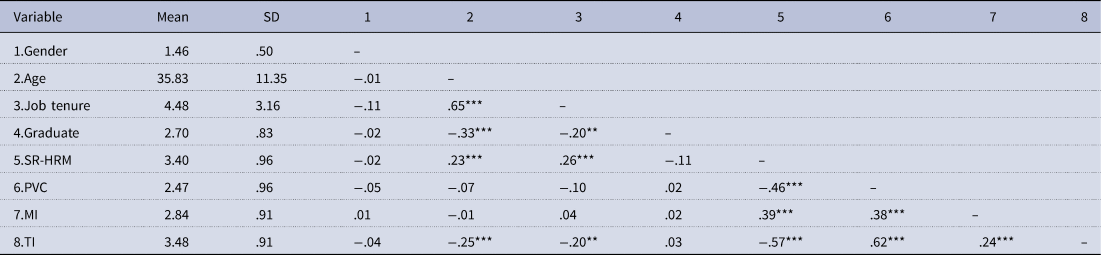
The means, standard deviations, and correlations among the study variables were reported inTable 2. SR-HRM was negatively related to PCV (r = −.46, p < .001) and turnover intention (r = −.57, p < .001); PCV was positively correlated with turnover intention (r = .62, p < .001).
Mean, standard deviation, and correlation for the study variables
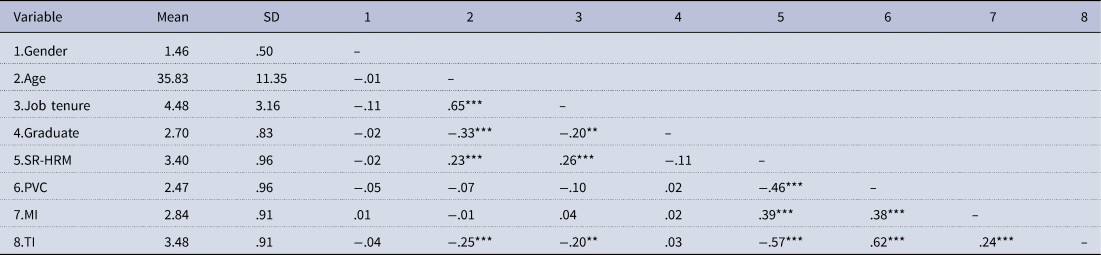
SR-HRM, socially responsible HRM; PCV, psychological contract violation; MI, moral identity; TI, turnover intention.
Note. N = 284.
* p < .05; **p < .01; ***p < .001.
Hypothesis testing
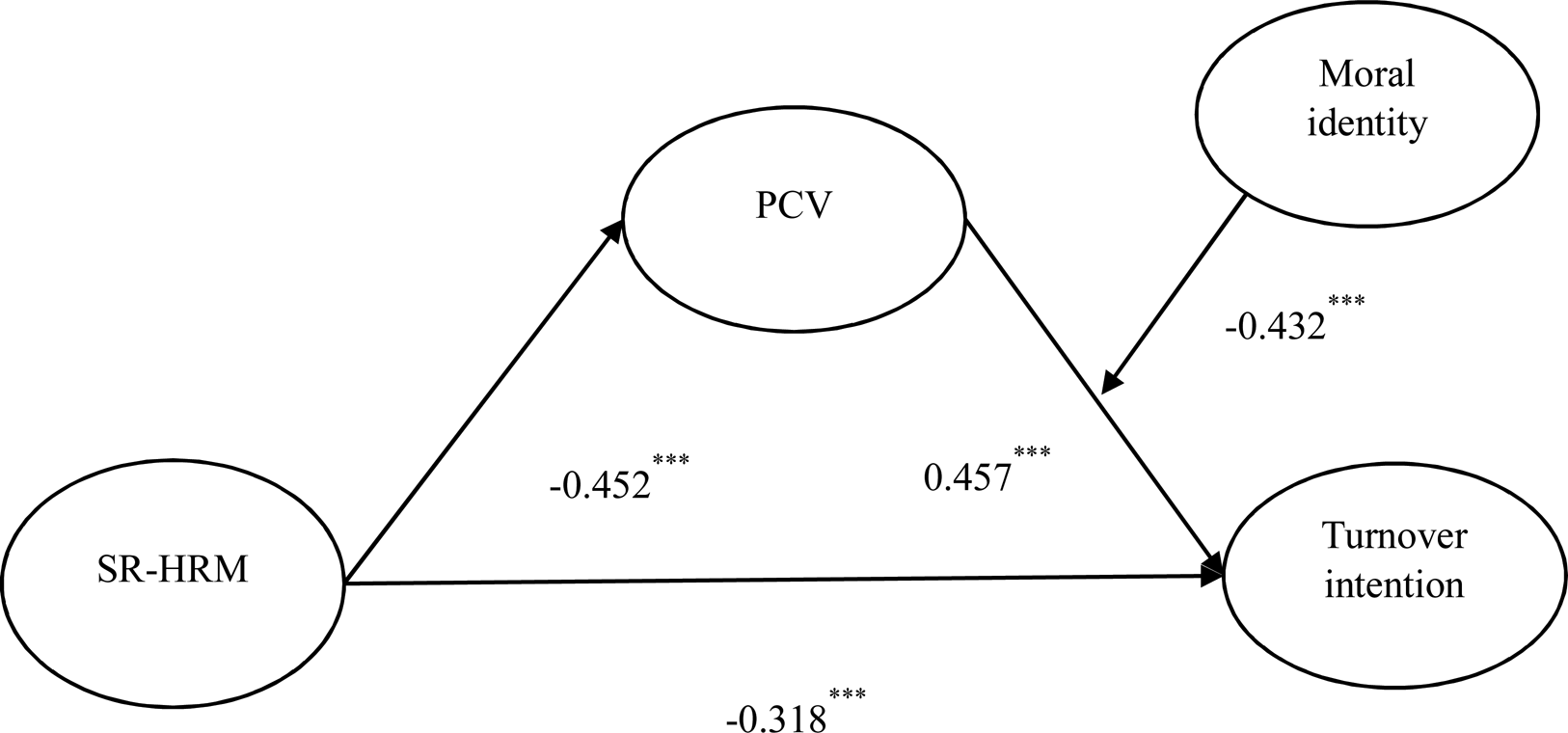
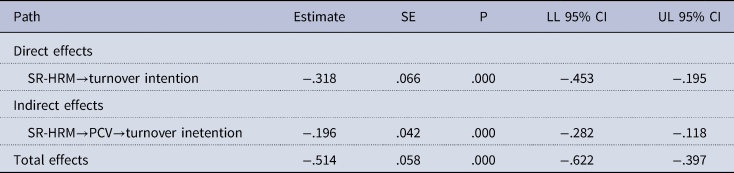
The bootstrap method has higher test power and does not require the test statistics to obey normal distribution. Therefore, the bootstrap method is favored by more and more scholars in studies testing mediating effects. We tested the assumptions using the bootstrap estimation procedure with the help of Mplus 7.4 and process software. The results are shown in Figure 2 and Table 3. After controlling for four variables: gender, age, job tenure, and education. From the results in Table 3, we found a negative relationship between SR-HRM and PCV (β = −.452, p < .001). Thus, the result provided support for Hypothesis 1.The path coefficient between PCV and turnover intention was .457 and the p-value was lower than .001. Besides, SR-HRM positively reduces employees' turnover intention [β = −.514, SE = .058, p < .001, 95% CI = (−.662, −.397)]. The direct effect of SR-HRM on turnover intention is negative and significant [β = −.196, SE = .042, p < .001, 95% CI = (−.282, −.118)]. Therefore, Hypothesis 2 was supported.
The path diagram of model.

The result of mediating effect

LL, lower limit; UL, upper limit; CI, confidence interval.
Note. N = 284.
Control variables include gender, age, job tenure, and education.
Bootstrap sample size = 10,000.
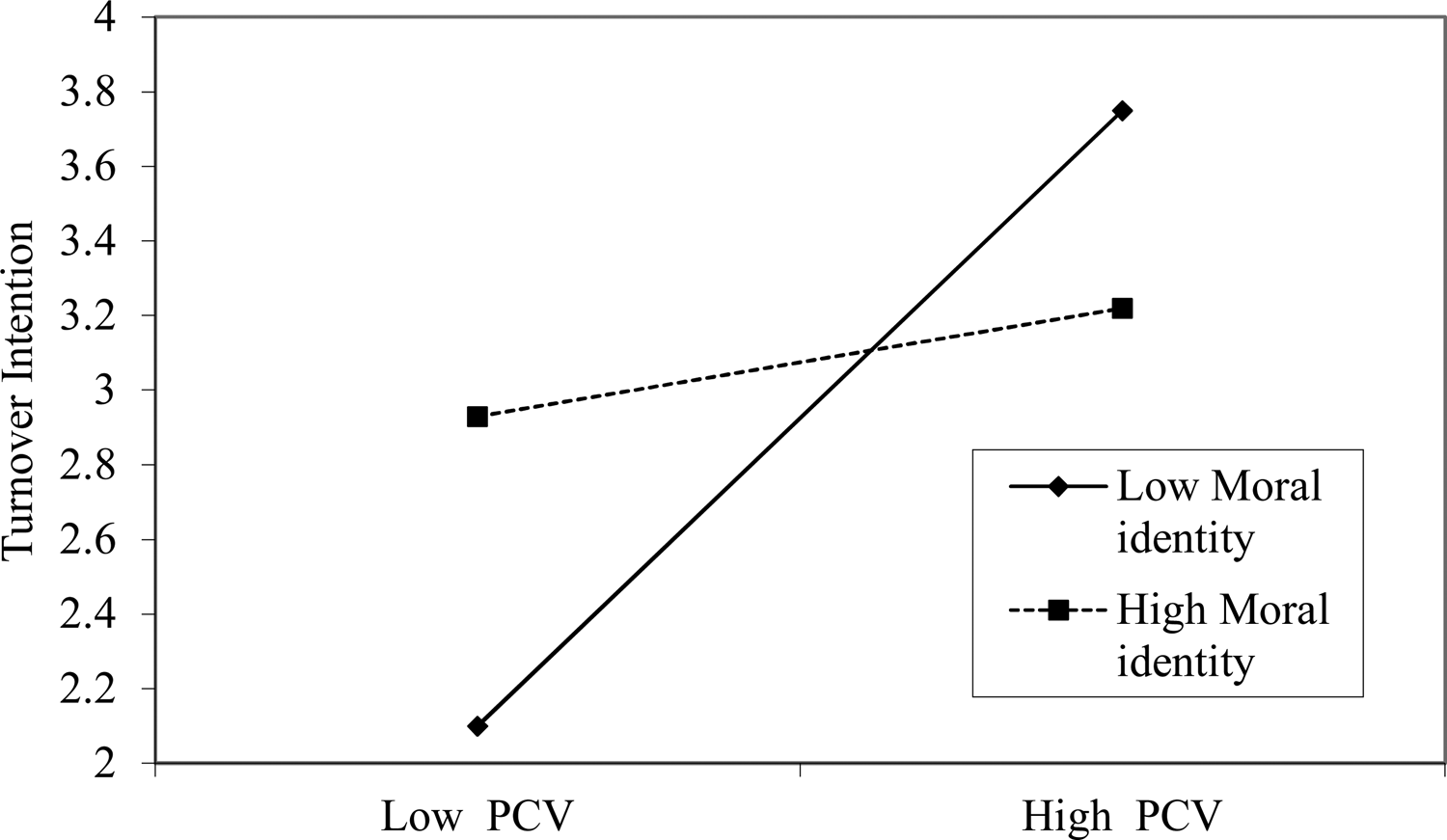
Hypothesis 3 proposed that moral identity and PCV interact to influence turnover intention. As presented in Figure 2, the interaction of PCV and moral identity had a significant effect on turnover intention (β = −.432, p < .001). To better comprehend the interpretation of the interaction, this study plotted the PCV-turnover intention linkage for employees with different moral identity (i.e., one standard deviation above and below the mean of moral identity). Theplot in Figure 3 shows that the positive linking of PCV on turnover intention was significant for employees who have a low-moral identity but became insignificant for the employees who have a high-moral identity. Taken together, these results provided support for Hypothesis 3.
Interaction of PCV and moral identity on turnover intention.

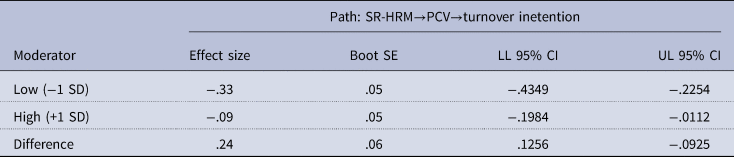
Hypothesis 4 proposed that moral identity will moderate the indirect effect of SR-HRM on employees' turnover intention via PCV. According to the suggestions of Borau, El Akremi, Elgaaied-Gambier, Hamdi-Kidar, and Ranchoux (Reference Borau, El Akremi, Elgaaied-Gambier, Hamdi-Kidar and Ranchoux2015), we used the coefficient product method proposed by Hayes (Reference Hayes2013) to conduct a moderating mediation SEM analysis and verified the Hypothesis 4.The results found that the coefficient was −.241 (p < .01), Hypothesis 4 was supported. In addition, we also use the difference analysis method proposed by Edwards and Lambert (Reference Edwards and Lambert2007) to further verify Hypothesis 4.This method is to judge whether the moderated mediating effect is significant by directly testing the significance of the difference of mediating effect, and to simultaneously test the moderating effect of moral identity on the mediating effect of PCV between SR-HRM and turnover intention. According to the bootstrap results in Table 4, under the condition of low moral identity (1 S.D. below the mean), the indirect and negative influence of SR-HRM on turnover intention via PCV was significant (Effect size = −.33, boot SE = .05, 95% bootstrap CIs from −.4349 to −.2254, not containing zero). When employees have a high moral identity (1 SD above the mean), the indirect and negative influence of SR-HRM on turnover intention via PCV was significant (Effect size = −.09, boot SE = .05, 95% bootstrap CIs from −.1984 to −.0112, not containing zero). Moreover, the indirect effect of SR-HRM on turnover intention via PCV had a significant difference under different levels of moral identity (Effect size = .24, boot SE = .06, 95% bootstrap CIs from .1256 to .3469, not containing zero). In summary, we had evidence to support Hypothesis 4.
The results for the moderated mediation effect

LL, lower limit; UL, upper limit; CI, confidence interval.
Note. N = 284.
Low = 1 SD below the mean; High = 1 s.d. above the mean.
Control variables include gender, age, job tenure, graduate.
Bootstrap sample size = 10,000.
Discussion
The Internet industry is a knowledge-intensive industry, and enterprise development is highly dependent on technological and product innovation. For Internet enterprises, employees are not only factors of production, but also a strategic resource with inherent creativity and constructiveness. Therefore, HRM is especially important for Internet enterprises. According to the data of China overall salary survey by Mercer in 2019, in the first half of 2019, the active turnover rate of employees in Chinese enterprises was 7.1%, the Internet industry became the industry with the highest voluntary turnover rate of Chinese employees in the first half of the year, it was 13.3%. We can infer that the high turnover rate is a common problem in the Internet industry. Employees in Internet enterprises are usually young, highly qualified, and focus on self-worth. They have good autonomy and challenge spirit (Eckhardt, Laumer, Maier, & Weitzel, Reference Eckhardt, Laumer, Maier and Weitzel2016). And employees face the industry situation of high work pressure and many external job-hopping opportunities. Especially, the young ordinary employees are more susceptible to the enterprises' internal management policies, which affects their turnover rate.
The high turnover rate has become a problem that Internet enterprise managers can hardly ignore. HRM is an important measure for organizations to influence employees' turnover (Huselid, Reference Huselid1995; Li, Rees, & Branine, Reference Li, Rees and Branine2019), and many studies explored the inhibitory effect of new HRM practices and CSR on turnover intention (Farooq, Farooq, & Cheffi, Reference Farooq, Farooq and Cheffi2019; Safavi & Karatepe, Reference Safavi and Karatepe2017). Besides, researchers have also confirmed that SR-HRM, a new type of HRM practice, reduced employees' willingness to leave (Nie, Lämsä, & Pučėtaitė, Reference Nie, Lämsä and Pučėtaitė2018). However, the process of how SR-HRM reduces employees' turnover has not yet been fully explained. Based on the discrepancy model of PCV proposed by Turnley and Feldman (Reference Turnley and Feldman1999), our study investigated the impact of SR-HRM on turnover intention, primarily explored the critical mediating role of PCV, and identified the boundary conditions for such effects. We used a two-wave time-lagged design to examine our theoretical model and found that: (a) PCV mediated the linkage between SR-HRM and turnover intention; (b) moral identity not only moderated the positive effect of PCV on turnover intention but weakened the indirect influence of SR-HRM on turnover intention via PCV. Taken together, the results suggest that SR-HRM reduces the possibility of PCV formation, thereby reducing employees' intention to leave. Besides, the employees who have a high moral identity have fewer retaliatory actions despiteperceiving PCV. In other words, Moral identity further weakens the effect of PCV on employees' turnover intention.
Theoretical implications
The findings of our study contribute to the literature in several ways. Firstly, an important contribution of this study is to explore the mechanism of SR-HRM outcomes by applying the discrepancy model of PCV. The discrepancy model of PCV emphasizes the individual differences in the formation of PCV and retaliation behaviors. And this study verifies the validity of the model, provides tangible research evidence for the PCV discrepant perspective, and further expands the PCV discrepancy theory. In addition, our study extends the theoretical basis and effect mechanism of SR-HRM studies by applying the discrepancy model of PCV. Furthermore, this study explores the impact of SR-HRM on employees to expand the specific application of CSR at the micro level of organizations. On the one hand, we extend the views of Morgeson et al., (Reference Morgeson, Aguinis, Waldman and Siegel2013) on the development of CSR and HRM integration. On the other hand, our research helps to delve into the potential ethical attributes of SR-HRM, responding to Abdelmotaleb and Saha's (Reference Abdelmotaleb and Saha2020) call to focus on the ethical application of SR-HRM. Insummary, this study enriches the research findings on the ethical dimension of SR-HRM by revealing the role of SR-HRM in influencing employees' unethical behaviors.
Specifically, this study finds that SR-HRM can reduce the turnover intention of employees through decreasing PCV, which extends Nie, Lämsä, and Pučėtaitė (Reference Nie, Lämsä and Pučėtaitė2018)'s findings. Besides, this finding shows that SR-HRM can not only reduce employees' turnover intention by influencing employees' work attitude (Qablan & Farmanesh, Reference Qablan and Farmanesh2019), but also affect employees' emotional reaction and reduce such behavior, which provides a new insight into SR-HRM research. Previous literatures on the effect of SR-HRM on turnover intention simply focused on individual job attitudes and psychological cognition, neglecting the role of individual emotional reaction. Employees' emotional reaction is an important explanatory model to explain employee attitude and behavior in the workplace (Kong, Gong, Sajjad, Yang, & Zhao, Reference Kong, Gong, Sajjad, Yang and Zhao2019). Our studies paid attention to employee negative emotional reactions causing by the changing of psychological contract and examined the role of individual emotional reactions (i.e., PCV) in the restrain process of SR-HRM on turnover intention. The results found that SR-HRM could decrease the possibility of employee PCV occurrence, and in turn, reduce their intention to leave. This study further explored the emotional process between SR-HRM and turnover intention, open the ‘dark box’ of emotional reaction in this negative relationship. We respond to the appeal of Kundu and Gahlawat (Reference Kundu and Gahlawat2015) to explore more research insight to explain how SR-HRM influences employees' turnover intention. Moreover, this study also enriches research concerning the emotional mechanism of SR-HRM on employee attitude and behavior. PCV, as an emotional reaction causing by individual cognition, provides a new entry point of emotional mechanism between SR-HRM and employee behavior for future research.
Finally, this article provides a new boundary condition for SR-HRM literature by incorporating individual traits into the effect of SR-HRM on employee outcomes. Salin and Notelaers (Reference Salin and Notelaers2017) pointed out that benevolent employees are more likely to arise PCV and quit the organization. However, our findings indicated that high moral employees are less likely to exit though they have the feeling of PCV. Our finding suggests that good individual traits have a double-edged sword effect on the mechanism of individual PCV. It not only stimulates employees' PCV more easily, but also inhibits individual negative reactions to PCV. In addition, our study expands the research of moral identity and further verifies the moderating role of moral identity. This study also answers the call of Nie, Lämsä, and Pučėtaitė (Reference Nie, Lämsä and Pučėtaitė2018) to emphasize the boundary conditions when exploring the influence of SR-HRM on employees' turnover intention by identifying the moderating impact of moral identity in the internal mechanism of SR-HRM. Besides, we enrich the moderators in the discrepancy model of PCV by exploring how the individual difference of moral cognition influences employees responding to the negative emotion of the violation. Tomprou, Rousseau, and Hansen (Reference Tomprou, Rousseau and Hansen2015) also pointed out that individuals perceive that PCV can trigger self-regulatory processes, thus weakening the negative reaction brought by this negative emotion. Our finds focus on the weakened role of individual moral cognition on employees' retaliation choices, which helps scholars more comprehensively understand the process of employee reaction to their negative emotion.
Practical implications
Our research provides a guide for organizations on how to intervene in employees' turnover intention through the perspective of SR-HRM. First, SR-HRM can impair employees' intention to leave. Therefore, the organizations should implement a series of SR-HRM practices to retain employees. Employees in Internet enterprises usually have a high level of knowledge, pursue self-worth, and are full of autonomy and challenge spirit (Eckhardt et al., Reference Eckhardt, Laumer, Maier and Weitzel2016). Managers need to fit the characteristics of employees when formulating measures of SR-HRM. On the one hand, SR-HRM enhances the material attractiveness of employees. For example, organizations provide more training opportunities, set up flexible working hours, and provide paid public welfare leave, etc. On the other hand, SR-HRM improves employees' sense of organizational honor. For example, organizations post model employees' photos in the company and publicize employees who have made outstanding contributions to CSR in the public media. Besides, the organization provides CSR training for employees to increase their responsible awareness and empathy, thus reducing employee turnover intention.
Second, our study found that SR-HRM can decrease employee turnover intention by avoiding the formation of PCV. It is vital for managers on how to reduce employees' perception of PCV, which can fortify the influence of SR-HRM on turnover intention. Therefore, organizations should keep words for their employees and carry out all regulations of SR-HRM. Moreover, managers should make timely explanations if organizations fail to achieve their promises, they need to convey the message that the unfulfilled promises causing by external factors.
Finally, our research findings suggest that individual characteristics (e.g., moral identity) can weaken employees' intention to revenge when they have negative emotions of PCV. Therefore, the organizations should try to recruit moral employees and foster employee ethics values and reinforce their loyalty to organizations. The organization can analyze employee character through questionnaires and other ways in the process of recruitment. The organization can also integrate ethics into their corporate culture and convey it to employees.
Limitations and future directions
Although our study contributes to the existing knowledge, this article also has some limitations. First, there might be some biases associated with a common method since the same participants assessed all the variables. Although we conducted a two-stage survey to minimize the effect of self-report, it is difficult to avoid the common method biases completely. Future research should try to collect information from multiple sources, such as colleagues and leaders, which can increase the reliability of data acquisition.
Second, we collected data only in Chinese organizations, which may contaminate the generalizability of research results. There are notable differences between Chinese and western cultural contexts. This may impact the employees' cognition of moral. Explicitly speaking, Chinese culture emphasizes the importance of virtue, and employees may perform more moral identity to the organizations. As such, there may be some other exciting findings by testing our model in the different cultural contexts in future research. In addition, considering that compared with middle and senior managers, ordinary employees have a higher turnover rate and are more susceptible to corporate management policies, the samples of this study are mainly ordinary employees of Internet enterprises. However, such results have some limitations, and future studies can focus on employees at higher levels in the organization and explore the impact of SR-HRM on middle and top managers. Middle and upper managers may be the ones who make or refine the organizational management policies, so we can consider whether the implementation of SR-HRM will enhance their organizational loyalty or affect their leadership style. Similarly, our research sample mainly focuses on the Internet industry, which also limits the generalizability of the findings. Future research could explore related phenomena in other industries, such as the FMCG (fast-moving consumer goods) industry and manufacturing industry.
Third, we explored a new internal mechanism between SR-HRM and employee outcomes. According to the discrepancy model of PCV, our research explored and verified the mediating impact of PCV and the boundary role of moral identity. Future research could explore other paths, such as organizational support to explain how SR-HRM affects employees' turnover intention. SR-HRM practices provide various resources for employee development, and they will have the perception of organizational support. Employees who perceived corporate support intend to express a strong sense of belonging and loyalty to their organizations (Robert, Robin, & Steven, Reference Robert, Robin and Steven1986). We can attempt to expound on the indirect association between SR-HRM and turnover intention via the perception of organizational support. Besides, the individual traits of conscientiousness and empathy can influence employees' approval of CSR (Lee, Reference Lee2016). Therefore, it is necessary to consider these personality traits into the boundary conditions of the model in future research, such as conscientiousness and empathy. Previous studies have found that high LMX affects employees' commitment to the organization (Eisenberger et al., Reference Eisenberger, Karagonlar, Stinglhamber, Neves, Becker and Gonzalez-Morales2010) and reduces the perception of PCV. In addition, high LMX can also moderate employees' negative reactions to PCV (Doden, Grote, & Rigotti, Reference Doden, Grote and Rigotti2018). Workplace friendship weakens the relationship between PCV and employees' negative reactions (Rai & Agarwal, Reference Rai and Agarwal2018). In other words, different leadership between employees and leaders, as well as co-worker relations, will lead to different PCV reactions of employees. Therefore, it is necessary to explore the influence of team-level and leader-level factors on individual differences in PCV response. Moreover, we can explore the impact of different types of SR-HRM on employees' turnover intention in the following study.
Acknowledgements
This work was supported by the National Natural Science Foundation of China (72172086 and 71772116) and “Shuguang Program” supported by Shanghai Education Development Foundation and Shanghai Municipal Education Commission (21SG41).
Prof. Hongdan Zhao is a professor at the Department of Business Administration at the Shanghai University. His primary research interests cover organizational behavior, human resource management, and leadership. He is currently analyzing the contribution of socially responsible human resource management and knowledge hiding behavior. He has published in journals such as Journal of Organizational Behavior, Journal of Business Ethics, and Human Resource Management Journal.
Yuanhua Chen is a postgraduate at the Department of Business Administration at the Shanghai University. His primary research direction is organizational behavior, human resource management, and leadership. He has published in journals such as Journal of Business Ethics, Journal of Industrial Engineering/Engineering Management.
Yujuan Xu is a postgraduate at the Department of Business Administration at the Shanghai University. Her primary research direction are organizational behavior and human resource management. She has published articles in Frontiers in Economics and Management and has written case articles on corporate social responsibility.
Qiongyao Zhou is a PhD candidate at Antai College of Economics & Management, Shanghai Jiao Tong University. Her research interests focus on socially responsible human resource management and responsible leadership. She has published in journals such as Journal of Business Ethics, International Journal of Hospitality Management.