Background
Argentina, a large country situated at the southern end of the Americas, covers 3.7 million square kilometres and has a population of about 40 million people. By comparison, India has 20 times Argentina's population with almost the same territory. The vastness of the land and the relatively low population density, together with substantial immigration at the turn of the nineteenth century, have shaped a country with unique socio-demographic characteristics, as well as an unusual degree of urbanization. Nearly 85% of the population is Caucasian and the remainder is native-Indian and mestizo offspring (of mixed European and Indigenous heritage).
In the century prior to 1914, the population in Argentina had doubled every 20 years, with foreigners making up 30% of the total. The flow of European migrants stopped in 1930, but resumed again at the end of World War II, although with much lower intensity, with a little more than half a million people arriving between 1945 and 1948. These new Americans settled mainly in the largest cities, such as Buenos Aires, and Argentina shares with Chile and Uruguay the distinction of being one of the most urbanized countries in the world.Reference Stocker, Waitzkin and Iriart1, Reference Strejilevich and Strejilevich2 Thus in spite of having a strongly developed agrarian economy, more than the 80% of the Argentine population live in a city.Reference Strejilevich and Strejilevich2
Ageing of the Argentine population
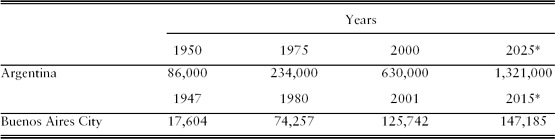
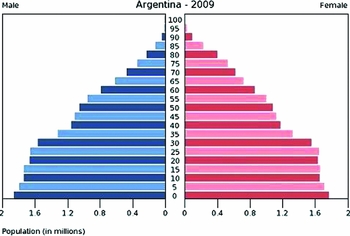
Argentina has witnessed a rapid growth in its older population (>65 years) over the last three decades, from less than 7% to nearly 10%. The proportion is expected to continue to rise to 16% by 2025. These figures place Argentina among those countries with the oldest population in Latin America.Reference Lloyd-Sherlock3 This trend is even more evident in Buenos Aires City, where more than 17% of the population is now aged 65 years or more, comparable to many European cities.4Table 1 details the population aged 80 and above in 1950–2025. Over the last decade the elderly population has increased in both absolute and relative terms, with the base of the population pyramid narrowing due to a lower fertility rate and the peak of the pyramid widening because of an increase in life expectancy (Figure 1). In many developed countries, it took a century for the older population to rise from 8 to 12%; in Argentina, similar changes have taken place in just 40 years. Projections to 2025 predict that more than 1 million people will then be aged 80 years or more.5 Current population life expectancy is 74 years.
Population aged 80 and above in Argentina and in Buenos Aires City, 1950–20254, Reference Redondo31
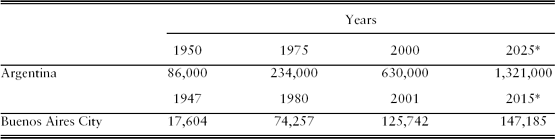
*Median variant projection.
Population pyramid of Argentina, INDEC 2009.

Unlike in Western Europe and North America, Argentina as in many other countries in Latin America has become older without necessarily becoming richer. High unemployment rates in recent years have meant that many young people have been depending on the pension of an elderly relative living at home, though most older people live alone in their households or with their elderly spouse.
The Argentine health care system
The Argentine health care system is characterized by an excessive fragmentation. On the one hand, there is a public sector whose national, provincial and municipal arms have a high degree of autonomy. On the other hand, there are a series of heterogeneous agencies that deliver medical care and that are supported by the social security system. Finally, there is an important private sector based on mutual benefit societies, pre-paid health care systems and for-profit hospitals. A lack of co-ordination between each one of these sectors means that the inter-relation between them is very complex.Reference Lloyd-Sherlock and Novick6
The public system was strongly enhanced in the 1940s under a legal entitlement (Universal Coverage Dogma), which promised free access to health care for the whole population, covering the costs of both in-patient and out-patient care. This coverage is provided by federal or state authorities and benefits approximately 42% of the population. Unfortunately, it has failed to provide effective medical care because of its huge bureaucratic structure and limited resources. The social security system provides assistance to 50% of the population, in-patients and out-patients with acute and chronic conditions. Union health systems (‘Obras Sociales’) and PAMI offer medical care only to their members. The private health care system has been growing since the 1980s as a result of changes in the regulatory framework allowed by a more free-market economy, although this growth has stopped during the last few years. The sector accounts for only 8% of the county's health care services, but new governmental regulations are being enacted to integrate the social security and private systems.
There are 265 medical doctors per 100,000 inhabitants. Although these numbers clearly exceed those necessary to satisfy health care needs, nurses represent a much scarcer human resource, with only 77 per 100,000 inhabitants. Volunteer workers, junior physicians in training and relatives partially balance this shortage. Although both medical and nursing trainees and social workers receive some training in geriatrics, there is no specific training for pharmacists.
Argentina still lacks a nationwide health care system specifically designed for the elderly population and proper health care coverage is not guaranteed to everyone in the country. The majority of the approximately 4.5 million older people now living in Argentina are protected under the Instituto Nacional de Servicios Sociales para Jubilados y Pensionados (PAMI – National Health Insurance Programme for the Elderly), or by union or private care organizations. Some elderly people have double or triple health coverage, but 18% of the total population over 65 are uninsured, constituting one of the most vulnerable sections of society.4
PAMI provides state-run coverage for disabled or senior citizens, covering services analogous to American Medicare and Medicaid. It is offered to all ages as an entitlement for those with a defined level of disability. There are other eligibilities for PAMI, but their complexity is beyond the scope of this paper.
The union health systems, which provide services to approximately 400,000 older beneficiaries, represent the second type of health coverage. These services cover acute in-patient and out-patient care, and limited nursing home and home care services (including doctor's visits). Patients may be treated at different hospitals, but with varying financial coverage.
The private health care system is composed of health companies, health maintenance organizations and health insurers. Only the higher socioeconomic classes can afford their high fees, and so only 8% of Argentine seniors can select a private health insurance provider. The pre-paid systems cover acute care, out-patient care and doctor's visits. Home care is an option, especially after hospital discharge, but nursing home care is not usually covered, resulting in a great financial burden for many families.
The number of long-term care facilities has grown significantly since 1970 through entrepreneurial initiatives, as well as the contracts PAMI signed with privately owned nursing homes. There are currently about 70,000 long-term care beds in the country based in 600 facilities, and they provide a wide range of services. Nursing homes must have a medical director, regardless of whether he is or is not a geriatrician. Although clinical guidelines do exist, they are seldom followed and staff who are undertrained and overworked frequently take care of institutionalized elderly. Unfortunately, accurate data on the quality of the services delivered by different health providers are not available.
Home care is still developing and most doctors practising home care medicine do so as a second job. Only 2% of senior citizens live in adapted housing, residential homes, or nursing homes. One possible explanation for this low rate in comparison with that found in other countries could be the strong influence of Catholic and Jewish religions, which emphasize that the care of older people is primarily a family commitment.
Under a new Argentine law enacted in 2002, physicians must primarily prescribe medications using their generic names and they can be purchased only in pharmacies. A considerable discount is given (usually ranging from 40 to 70%) on the total cost, depending on the type of medications and health coverage. Drugs for some chronic illnesses, such as insulin, are supplied at no cost. Before 2002, medications were prescribed and purchased under their brand names and generics were not available.Reference Montero-Odasso, Przygoda, Redondo, Adamson and Kaplan7
Developments in geriatric and gerontological care in Argentina
Unfortunately, there is as yet no comprehensive model of modern geriatric care in Argentina and we persist with our old-fashioned geriatric institute, with little innovation in the delivery of health and social support. There are some attempts at special care units and model institutions, but this is not common practice all over the country.
The Jewish community built a big, modern and innovative nursing home in Buenos Aires City in 2006, which includes a special in-patient dementia unit, an acute geriatric unit, a synagogue, big leisure areas and a shopping centre, as well as rehabilitation programmes and a multidisciplinary team of workers at the front line of knowledge. The package sets a standard of care that is above other institutions in the country. In the Italian Hospital of San Justo we have inside a modern hospital for acute care, a nursing home and a specialized care unit for those with advanced dementia. This lingers from the time of the asylum for Italian pilgrims or their relatives, supported by the Italian Welfare Society of Buenos Aires and the Italian government since 1922.
There is little national legislation specific for older people in Argentina, though some provinces have local laws about meeting health and social needs of the elderly population and about their rights and obligations. Other attempts, such as the national retirement system and the national health and care programme for the elderly (PAMI), are not all managed by people with geriatric knowledge and so are unsatisfactory. There are more general laws to protect the handicapped and a limited number of nursing homes supported by government, but these are not specifically for elderly people.Reference Barrientos and Lloyd-Sherlock8 Whilst union health programmes are common throughout Argentina, none has an elderly health care programme and, on retirement, all union members pass immediately to the PAMI national care system.
The most developed care programmes for older people are in the private sector, but these are, of course, not free and cover only 8% of the population. The Italian Hospital of Buenos Aires has a pre-paid health system (like an American Health Maintenance Organization) that accepts old people over 80 years and covers ambulatory and hospital in-patient care, but not long-term care. It is responsible for more than 30,000 people and has a big and well-qualified team of geriatricians to take care of them. This group of professionals has developed many geriatric programmes such as falls prevention, dementia care giver support teams, chronic disease managed care programmes, special diagnostic clinics for dementia and falls and surveillance systems for drugs management and depression. There are also community programmes such as memory workshops, Yoga, Tai Chi, keep fit, nutritional advice, literature workshops and others.
The private sector also includes a wide variety of other care programmes, such as day hospitals for dementing or psychogeriatric patients, geriatric hotels providing respite admissions for people living at home and long-term care institutions or nursing homes. These tend to be based in the main cities. In smaller towns there are very limited services for handicapped or chronically ill people, or simply for those over 65 without social support, even in the private sector, and choice is limited to just ambulatory or acute in-patient care, paid for by PAMI.
Geriatric and gerontological education and research
The Secretary of Health, a branch of the Health Ministry, recognized geriatric medicine as a speciality in 1977. Since then, almost 600 doctors have completed their postgraduate training in the speciality all over the country. It is not uncommon for the practice of geriatric medicine to be closely integrated with internal medicine. Therefore, geriatricians perform general medical care for older adult patients, spending just a small percentage of their time on specific geriatric tasks.
There are two basic routes for obtaining specialization in geriatric medicine in Argentina. On the one hand, there is an additional 2-year geriatric fellowship after board certification in internal medicine or family medicine. Currently, only three Argentine schools of medicine certify graduate doctors as geriatricians in this way. Alternatively, the Sociedad Argentina de Gerontología y Geriatría (Argentine Society of Gerontology and Geriatrics) organizes a 2-year course, supported by commission of the Ministry of Health. Those eligible must be medical graduates, with at least 3 years previous training in internal medicine. No comprehensive training programme is available for nurses who want to specialize in geriatrics.
Physical medicine and rehabilitation is not a well-recognized medical speciality as a result of the poor salaries offered. Moreover, the country lacks a reasonable number of physiotherapists to provide adequate care to Argentine seniors.
Since last year, the Sociedad Argentina de Gerontología y Geriatría gives an elective course in geriatrics for medical students at the School of Medicine at Buenos Aires University.
In recent years, some institutions have begun to work on gerontological research. Psychological or sociological reviews and epidemiological studies have been undertaken by researchers of CONICET,9 the National Scientific and Technical Research Council, and by ISALUD University, a private educational institute. In the clinical field, the most developed area is in neurology, for example with recently published papers relating to dementia diagnosis,Reference Dillon, Allegri, Serrano, Iturry, Salgado, Glaser and Taragano10–Reference Mías, Sassi, Masih, Querejeta and Krawchik12 strokeReference Rojas, Zurrú, Romano, Patrucco and Cristiano13 and psychogeriatric syndromes.Reference Montero-Odasso, Schapira, Duque, Chercovsky, Fernández-Otero, Kaplan and Camera14 Many of these studies have been conducted by interested neurologists and psychiatrists. Geriatricians have also often contributed to studies of dementia care,Reference Machnicki, Allegri, Dillon, Serrano and Taragano15 health promotion and prevention in primary care, renal physiology,Reference Musso and Macías-Núñez16, Reference Musso, Reynaldi, Martinez, Pierángelo, Vilas and Algranati17 metabolic bone disease,Reference Montero-Odasso and Duque18, Reference Masoni, Morosano, Tomat, Pezzotto and Sánchez19 functional assessmentReference Montero-Odasso, Schapira, Varela, Pitteri, Soriano, Kaplan, Camera and Mayorga20, Reference Gleichgerrcht, Camino, Roca, Torralva and Manes21 and nursing home care.Reference Abramovich23, Reference Matusevich24 In a few schools of medicine, development of gerontological research is under consideration and there are already some centres where basic gerontological research, such as mathematical models of cognition, animal studies in senescence, or pain assessment tools or therapeutic models, is being conducted.Reference Cardinali, Esquifino, Srinivasan and Pandi-Perumal25, Reference Albareda, Olivera, Laucella, Alvarez, Fernandez, Lococo, Viotti, Tarleton and Postan26 A major challenge for the future is to increase research activity in geriatrics and gerontology and to generate more publications in high-quality indexed journals.Reference Montero-Odasso, Przygoda, Redondo, Adamson and Kaplan7, Reference Chalita27–Reference Kaplan30
Conflicts of interest
The authors declared no conflicts of interest.