Introduction
Puberty could be defined as the age of the female when oestrus is first detected and is followed by characteristic cyclic ovarian activity, resulting in the ability to produce viable offspring (Plant, Reference Plant1988). The onset of puberty is the outcome of a series of complex developmental events that occur within the reproductive endocrine axis. Maturation of the axis in female livestock includes a decrease in hypothalamic sensitivity to oestradiol secreted from ovarian follicles. The decreased sensitivity originates, just before the onset of puberty, a high-frequency rhythm of gonadotropin-releasing hormone (GnRH) secretion and a sustained rise in basal luteinising hormone (LH) secretion as the frequency of LH pulses increases, and the follicular phase begins, leading to the first LH surge and ovulation (Foster and Jackson, Reference Foster and Jackson2006).
Several factors could play a role in the attainment of puberty in the female goat. These include genetic and environmental factors and the interaction between them (Land, Reference Land1978). The environmental factors involve season of birth, nutritional status including body weight (BW), total body fat, metabolites (glucose, cholesterol, tri-glycerides), and metabolic hormones, such as IGF-I, insulin, and leptin (Yelich et al., Reference Yelich, Wettemann, Marston and Spicer1996; Cheung et al., Reference Cheung, Thornton, Kuijper, Weigle, Clifton and Steiner1997) and the male effect (Schinckel, Reference Schinckel1954; Greyling and Van Niekerk, Reference Greyling and Van Niekerk1990).
Photoperiod is the primary factor controlling seasonal reproduction, but mainly in breeds originated in temperate latitudes (Turek and Campbell, Reference Turek and Campbell1979). Depending on the time of the year kids are born, they experience different photoperiodic stimuli, so that age at puberty differs according to the season of birth. In northern Mexico, Creole she-kids born in May commenced ovulatory activity at an earlier age than those born in January and October (Delgadillo et al., Reference Delgadillo, De Santiago-Miramontes and Carrillo2007). Papachristoforou et al. (Reference Papachristoforou, Koumas and Photiou2000) observed that Damascus females born in October–November or in February attain puberty at the same time – the following autumn.
Numerous studies have demonstrated a close association between body growth, nutritional status and the timing of puberty onset. In rodents (Merry and Holehan, Reference Merry and Holehan1979), sheep (Foster and Olster, Reference Foster and Olster1985) and cattle (Schillo, Reference Schillo1992) energy deficiency retards growth and delays the onset of puberty. Several lines of evidence from earlier investigations suggested that critical BW (Frisch and Revelle, Reference Frisch and Revelle1970) or critical body composition (Frisch et al., Reference Frisch, Hegsted and Yoshinaga1977) somehow initiates puberty in mammals. Suttie et al. (Reference Suttie, Foster, Veenvliet, Manley and Corson1991) indicated that BW and body fatness are a consequence of, or correlate, metabolic changes occurring before and around the onset of puberty, and proposed that blood-borne substances, which may be metabolites, hormones or a combination, affect the reproductive system and initiate puberty.
There is a wealth of information on the reproductive patterns of various goat breeds at middle (>25°) and high (>40°) latitudes (Papachristoforou et al., Reference Papachristoforou, Koumas and Photiou2000; Freitas et al., Reference Freitas, Lopes-Junior, Rondita, Salmito-Vanderley, Salles, Simplício, Baril and Saumande2004), but very little about Spanish breeds of goats. The Payoya goat, a Spanish endangered goat breed, is adapted to the environmental conditions of the Mediterranean area. Recently, our group has demonstrated that this breed shows a clear seasonality of reproduction, with a mating season that extends from August–September to January (Zarazaga et al., Reference Zarazaga, Guzmán, Domínguez, Pérez and Prieto2005). However, there are no data about the onset of puberty of the goat kids and the effect of nutrition or season of birth on the onset of puberty.
This study was designed to examine, in Payoya goat kids, the effect of nutrition level and birth date on different parameters at the onset of puberty.
Material and methods
Animals
Two experiments were carried out at the experimental farm of the University of Huelva (latitude 37°15′). For Experiment 1 goat kids were born in autumn (the mean date of birth was 7 November ± 0.93) and those born in winter (the mean date of birth was 7 February ± 0.91) for Experiment 2. Experiment 1 started on 20 June when the animals were 221.4 ± 0.9 days old and Experiment 2 started on 29 August, when goat kids were 202.4 ± 0.9 days old. Both experiments finished on 12 December, when the animals were 399.4 ± 0.9 days and 307.4 ± 0.9 days old for Experiments 1 and 2, respectively. During the experimental period (179 and 106 days for experiments 1 and 2, respectively), animals were kept permanently in communal yards with an uncovered area and without any supplementary light. Animals of each experiment were kept together.
For each experiment, two groups of entire female kids were used, differing in their level of nutrition. The kids were assigned at random for the experimental groups: control group (C, groups: C1, n = 14; C2, n = 12, groups) and high-nutrition group (H, groups; H1, n = 13; H2, n = 13, groups). Groups of each birth date were balanced for live weight (LW), body condition score (BCS) (Hervieu et al., Reference Hervieu, Morand-Fehr, Schmidely, Fedele and Delfa1991), and type of birth (single, double, and three or more kids). The level of feeding was adjusted weekly according to LW so that the animals would gain about 50 and 100 g per day for groups C and H, respectively (Agricultural and Food Research Council, 1998). The animals were fed on barley straw and concentrate diet. The diet offered to both the C and H groups met the animals’ requirements for nitrogen, minerals and vitamins, whereas the metabolisable energy was restricted according to the planned growth rate of the animals. Concentrate was offered once a day and distributed individually; barley straw was administered ad libitum. The animals had free access to water and mineral blocks containing oligoelements and vitamins.
Management
From the start of each experiment, LW and BCS were recorded weekly for all animals, and BCS was always tested by the same handler. To avoid a possible male effect that could modify the normal onset of puberty, bucks were allocated close to the experimental goat kids. Oestrous activity was tested daily, using five young entire aproned males. The males were kept in with the females during at least 1 h for each experimental group. Females standing at mounting by the male were considered in oestrus (Mauléon and Dauzier, Reference Mauléon and Dauzier1965). Ovulation rate was evaluated by laparoscopy 7 days after positive identification of oestrus. The goats received a sedative intramuscular injection (Rompun®; Bayer, Barcelona, Spain) prior to laparoscopy. During laparoscopy, the animals were placed in dorsal recumbency on a cradle at a 45° angle. A 7 mm laparoscope (Karl Storz, Tuttlingen, Germany) was used for visualisation, and the ovaries were exposed by pulling the fimbria in different directions with atraumatic forceps. The number of ovulations was recorded for each ovary by an expert operator.
Blood samples were collected weekly to confirm ovarian activity and to determine silent ovulations or oestrus without ovulation before the first behavioural oestrus. All blood samples were collected by jugular venipuncture in tubes containing heparin. Plasma was obtained after centrifugation at 3000 × g for 30 min and stored at −20°C until assay.
Hormone assays
Plasma progesterone concentrations were determined by radioimmunoassay, using the technique described by Terqui and Thimonier (Reference Terqui and Thimonier1974). The sensitivity of the assay was 0.125 ng/ml. The intra- and interassay coefficient of variation was 4.6% and 6.1%, respectively.
Definitions of reproductive activity
For each goat kid, the date of the last plasma progesterone value below baseline that was followed by the first extended cyclic pattern was taken as the onset of ovulatory activity. Ovulatory activity was confirmed when two or more consecutive plasma samples had progesterone concentrations above baseline (0.5 ng/ml; Gómez-Brunet et al., 2003; Gaafar et al., Reference Gaafar, Gabr and Teleb2005) with subsequent cyclicity. The mean date of the onset of puberty was defined as the date of the first oestrus detected by males with subsequent cyclicity.
Patterns of sexual activity observed during the onset of reproductive activity were grouped as (i) oestrous cycle, when detected oestrous behaviour was accompanied by an increase in serum progesterone levels above 0.5 ng/ml; (ii) silent ovulation, when an increase in serum progesterone levels above 0.5 ng/ml in at least two consecutive samples occurred but was not preceded by detected oestrous behaviour; (iii) anovulatory oestrus, when detected oestrous behaviour was not accompanied by an increase in serum progesterone; (iv) ovulation rate of each detected cycle; and (v) percentage of goat kids showing oestrus.
Statistical analysis
The effect of nutrition level on BW, BCS and progesterone concentrations was analysed using an ANOVA for repeated measures for each birth date. The daily gain (g/day), total gain weight, date of the onset of ovulatory activity and the onset of puberty (first detected oestrus with subsequent cyclicity) for each goat kid were assessed. Two-way ANOVA was used to evaluate the effect of nutrition level and birth date on the daily gain (g/day), total gain weight, the date of the first ovulatory activity, date of the first oestrus, ovulation rate at the first detected oestrus, and LW or BCS at each moment. The percentage of incidence of ovarian activity and the percentage of detected oestrus between groups were compared using the χ 2-test. The mean (±s.e.) for ovulation rate was calculated at the first detected oestrus and for each group. One-way ANOVA was used to evaluate the effect of nutrition on ovulation rate at the first oestrus. To study the effect of LW or the BCS on the onset of ovulatory activity or on the first detected oestrus and ovulation rate at that moment, the animals were divided into groups depending on their LW or BCS at those moments. In Experiment 1: group 1, LW < 30 kg (n = 6), and group 2, LW ⩾ 30 kg (n = 16) (30 kg represents around the 56% of the adult LW); in Experiment 2: group 1, LW < 23 kg (n = 7) and group 2, LW ⩾ 23 kg (n = 14) (23 kg represents around the 43% of the adult LW) (Zarazaga et al., Reference Zarazaga, Guzmán, Domínguez, Pérez and Prieto2005); or, depending on their BCS at the same time: group A, BCS ⩽ 2.50, (n = 5 and 10 for Experiments 1 and 2, respectively) and group B, BCS ⩾ 2.75 (n = 17 and 11 for Experiments 1 and 2, respectively) for both experiments. Data analysis was performed using the ‘Statistical Package for the Social Sciences’ package (SPSS, 1999).
Results
Effect of nutrition on body weight and body condition score
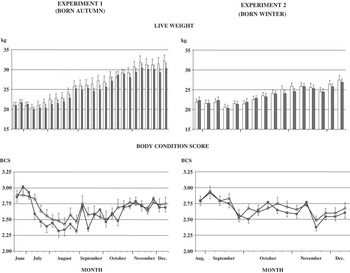
The nutrition treatment had no effect on BW or BCS (Figure 1). At the start of the experiments, groups for each experiment had similar BW and BCS. No nutrition–time interaction was observed for BW or BCS, although an effect of time on the two variables (P < 0.001) was observed in both experiments. Both groups increased BW during each experiment, indicating that both levels of nutrition allowed the growth of the animals.
Weekly mean (±s.e.) for live weight and body condition score of Payoya goat kids born in winter (Experiment 1) or autumn (Experiment 2) and fed to gain about 50 and 100 g per day for groups C (▒) and H (␣), respectively.

The growth of the goat kids was different between groups on the first experiment (P < 0.05) (69.7 ± 6.3 v. 53.2 ± 4.9 g/day for the H1 and C1 groups, respectively) and no effect of the level of nutrition on growth parameter was observed on the second experiment (53.8 ± 6.4 v. 43.6 ± 5.3 g/day for the H2 and C2 groups, respectively). This growth allowed the body gain during the experimental period to be different between groups in the first experiment (P < 0.05) (12.2 ± 1.1 v. 9.3 ± 0.9 kg for the H1 and C1 groups, respectively). However, the duration of the second experiment was not able to induce differences between groups (5.7 ± 0.7 v. 4.6 ± 0.5 kg for the H2 and C2 groups, respectively).
Effect of nutrition on onset of puberty
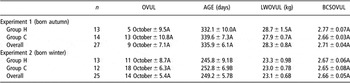
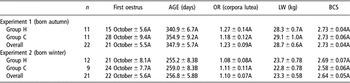
Table 1 shows the results obtained for the onset of ovarian activity, and Table 2 for the first oestrus, depending on the level of nutrition for each experiment. No effect of nutrition level was observed for date of the first ovarian activity, date of the first oestrus, ovulation rate at this moment, or LW or BCS at the onset of the ovarian activity or first oestrus for the two experiments. A clear effect of the date of birth (age) was observed only on the LW of the animals at the first ovarian activity or the first detected oestrus (P < 0.001). The goat kids born in winter had a lower LW than goat kids born in autumn (18.8% and 18.4% lower LW than those born in autumn for the date of the first ovarian activity or the first detected oestrus, respectively).
Mean date (day/month) of onset of ovulatory activity (OVUL), age (AGE, days), live weight (LWOVUL, kg) and body condition score at the first ovarian activity (BCSOVUL) in female Payoya goat kids born in autumn (Experiment 1) and winter (Experiment 2) and fed to gain about 50 and 100 g per day for groups C and H, respectively

Means with different letters at the same variable within the same column and the same group are significantly different (A, B: P < 0.001).
Mean date (day/month) at the first detected oestrus, age (AGE, days), ovulation rate (OR), live weight (LW, kg) and body condition score (BCS) at this moment in female Payoya goat kids born in autumn (Experiment 1) and winter (Experiment 2) and fed to gain about 50 and 100 g per day for groups C and H, respectively

Means with different letters at the same variable within the same column and the same group are significantly different (A, B: P < 0.001).
Categories of LW (Experiment 1: LW < 30 kg v. ⩾ 30 kg; Experiment 2: LW < 23 kg v. ⩾ 23 kg) had no effect on the onset of ovarian activity or the first oestrus. However, date of the first detected oestrus was positively affected by the BCS at this time in the kids born in winter (10 October ±6.3 v. 5 November ±7.7, for BCS ⩾ 2.75 and ⩽ 2.50, respectively, P < 0.05)
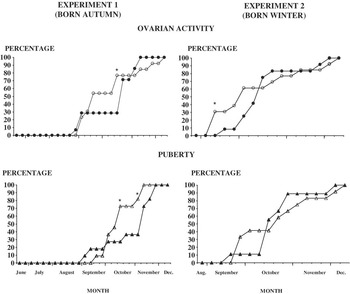
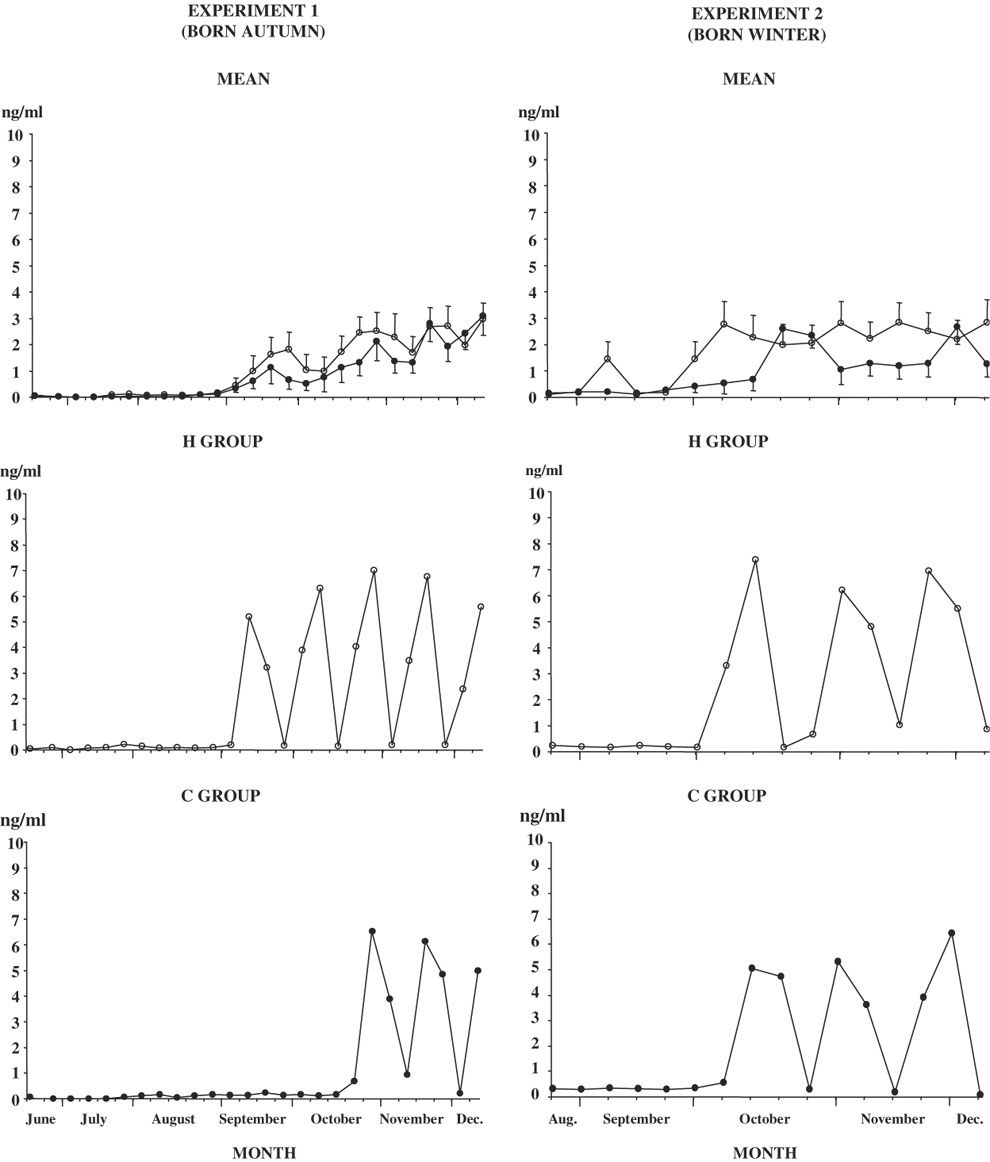
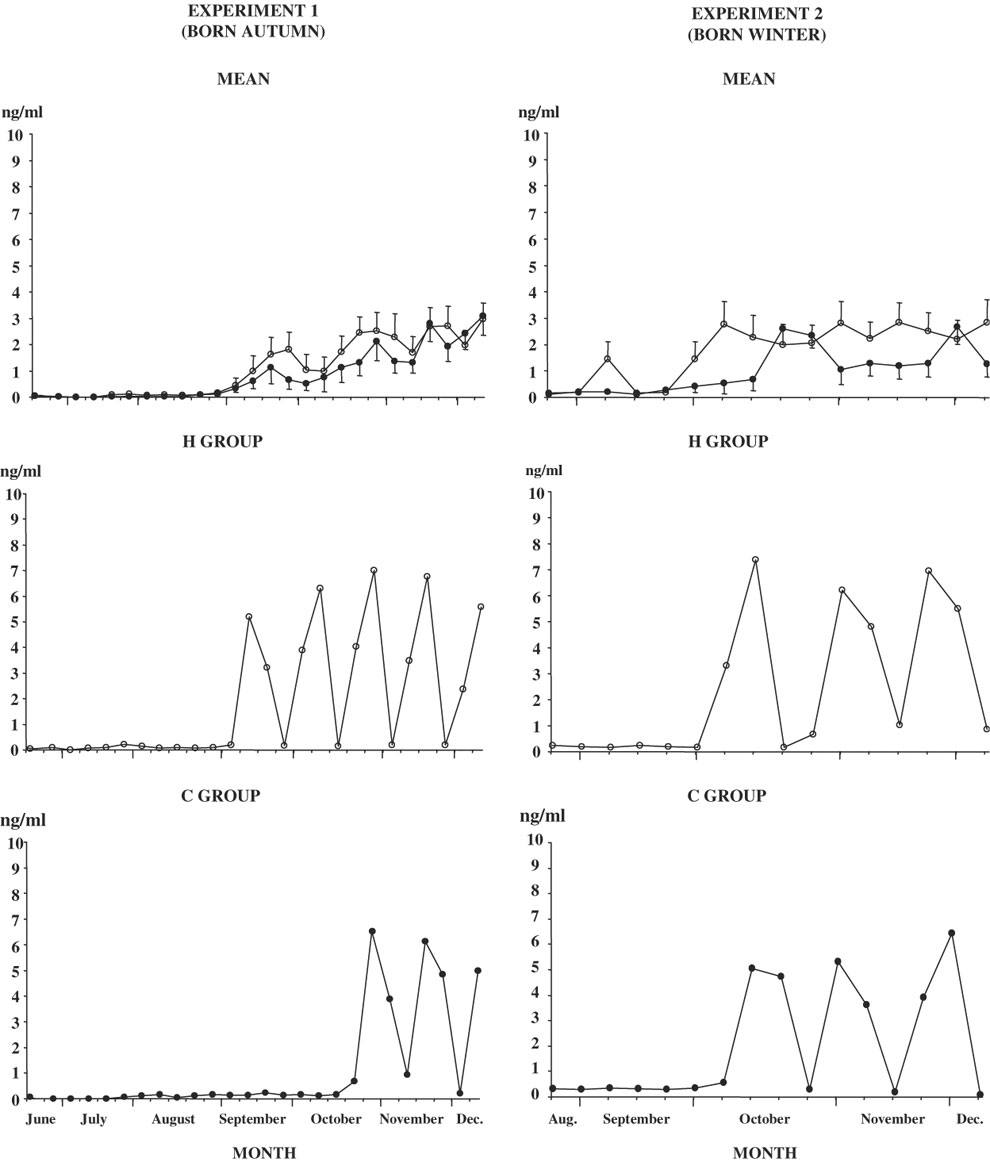
Figure 2 shows the weekly mean percentage of goat kids showing reproductive activity (ovulatory activity or first oestrus). There were differences between the groups in the first experiment (ovarian activity or first oestrus) (P < 0.05). On 17 October, more than 70% of the goat kids of group H were reproductively active, but only 27% in group C had attained reproductive activity. No effect of nutrition level on progesterone concentrations was observed, but there was a very marked effect of time (P < 0.001) (Figure 3).
Weekly percentage of entire goat kids showing reproductive activity: ovarian activity (○) or oestrous activity (▵) of Payoya goat kids born in autumn (Experiment 1) or winter (Experiment 2) and fed to gain about 50 g (group C) and 100 g (group H) per day. For group C, filled symbols are used, and for group H, white symbols.

Weekly progesterone plasma concentrations of Payoya goat kids born in autumn (Experiment 1) or winter (Experiment 2) fed to gain about 50 g (group C) and 100 g (group H) per day. For group C, filled symbols are used, and for group H, white symbols. Values from one representative goat kid of each nutrition group for groups C (filled symbols) and H (white symbols) are presented.
Irregular sexual activity (silent ovulation or oestrus without ovulation) was frequently observed before the first detected oestrus in Experiment 1 (74.7% of the first reproductive activity was irregular, P < 0.01); however, no differences were observed for the goat kids born in winter (48% of the first reproductive activity was irregular). During the experiments, there was a higher proportion of normal oestrous cycles (69.9%) (P < 0.01) (ovulation associated with oestrus) compared with either silent ovulations (29.5%) or oestrus without ovulation (0.6%).
Effect of nutrition on ovulation rate
No effect of nutrition level on ovulation rate was observed (Table 2); the overall mean of ovulation rate was 1.23 ± 0.09 and 1.10 ± 0.07 corpora lutea for Experiments 1 and 2, respectively. The LW of the goat kids had a large effect on ovulation rate at the first detected oestrus of the goats kids born in November (<30 kg n = 16 v. ⩾30 kg n = 6) (1.06 ± 0.06 v. 1.67 ± 0.21 corpora lutea, respectively, P < 0.01) but not on the goats kids born in February (<23 kg n = 7 v. ⩾23 kg n = 14) (1.00 ± 0.00 v. 1.14 ± 0.10 corpora lutea, respectively). When ANOVA with experiment and LW-like factors was performed, the effect of LW was highly significant (P < 0.01) (1.30 ± 0.10 v. 1.04 ± 0.04 corpora lutea, for the heaviest and for the lightest goat kids, respectively) and an interaction between both variables was observed (P < 0.05). Ovulation rate was not affected by BCS (A: ⩽2.50 v. B: ⩾2.75) in either experiment.
Discussion
The present study demonstrated that Spanish Payoya goat kids born in November or February initiate their puberty during the adult breeding season, and independently of their level of nutrition, indicating that the date of birth (age) is the main factor controlling the onset of puberty.
These findings are in agreement with those in the bibliography. In Damascus goats (Papachristoforou et al., Reference Papachristoforou, Koumas and Photiou2000), females born in autumn reached puberty the following autumn at the same time as those born in winter, but with a greater age and weight. Similar results have been shown by Freitas et al. (Reference Freitas, Lopes-Junior, Rondita, Salmito-Vanderley, Salles, Simplício, Baril and Saumande2004), working with Anglo-Nubian and Saanen goats under tropical conditions, or Deveson et al. (Reference Deveson, Forsyth and Arendt1992), working with Saanen goats in Europe. Boer goat kids weaned during the normal breeding season (April/May) exhibit oestrus significantly earlier than those weaned in December (outside the natural season) (Greyling and Van Niekerk, Reference Greyling and Van Niekerk1990). Creole goat kids born in May began their ovulatory activity at an earlier age compared with kids born in January or October (Delgadillo et al., Reference Delgadillo, De Santiago-Miramontes and Carrillo2007). In all cases, kids attained puberty during the first breeding season after birth. This result indicates a strong seasonal effect on the onset of reproductive activity in this species, with photoperiod apparently playing a key role, since in sheep and goats the effects of photoperiod on reproduction are mediated by similar physiological mechanisms (Chemineau et al., Reference Chemineau, Martin, Saumande and Normant1988).
The onset of ovarian activity for the goat kids differs from the onset of ovarian activity described for adult Payoya female goats, demonstrated in the first fortnight of August (Zarazaga et al., Reference Zarazaga, Guzmán, Domínguez, Pérez and Prieto2005). A similar result has been shown in Damascus goats – she-kids born in autumn had their first ovulation on 1 November, and those born in February, on 27 October (in the same experiment, adult goats had their first ovarian activity on 20 September) and in ewes (Papachristoforou et al., Reference Papachristoforou, Koumas and Photiou2000).
In the present study, the LW of autumn-born goat kids in August was similar to the respective value for the winter-born females at puberty (23.1 ± 0.04 v. 23.1 ± 0.6 kg, for autumn- and winter-born goat kids, respectively). Since age and LW in Experiment 1 were not limiting factors for initiation of pubertal events for the normal breeding season of this breed, the delay was probably due to photoperiodic influences (Forcada et al., Reference Forcada, Abecia and Zarazaga1991). For normal sexual maturation, goat kids and ewe lambs must be exposed to long days during development (Foster et al., Reference Foster, Yellon, Ebling and Claypool1988), and under natural conditions, this happens during late spring and summer. Exposure to long photoperiods seems to be related to the activation of the system regulating gonadotropin secretion, as shown in intact (Pelletier and Almeida, Reference Pelletier and Almeida1987) and ovariectomised ewes (Sanford et al., Reference Sanford, Howland and Palmer1984).
In the young, BW is of great significance, as the attainment of puberty is dependent on the animal’s reaching a certain critical BW (Gordon, Reference Gordon1975). Generally, breeding in goats should be delayed until the animal has attained 60% to 75% of its mature BW (Smith, Reference Smith1980). For Boer goats, the mean BW at puberty has been established as 30.6 ± 7.2 kg for animals on a high-energy diet and 27.5 ± 4.3 kg on a low-energy diet (Greyling, 1988). These BWs are comparable to those for Saanen goats and are heavier than those reported for Creole goats (24 kg in Venezuela, and 25 to 30 kg in northern Mexico) (Delgadillo and Malpaux, 1996). In our study, the BW at puberty was lower than 60% to 75% of the mature BW, indicating that for Payoya goats the critical BW to initiate puberty is around 50% of the mature BW, which is 54 kg (Zarazaga et al., Reference Zarazaga, Guzmán, Domínguez, Pérez and Prieto2005).
The lack of effect of nutrition on LW at puberty (ovarian activity or oestrous activity) probably was because the growth of the H groups was lower than expected. When the growth of the animals during the experimental period was analysed, it demonstrated that the growth was adequate according to the level of nutrition for the control groups, but it was reduced in relation to the experimental design for the H groups. This fact could be explained because for this breed the maximal growth of the animals is around 60 to 80 g/day, and the H group was unable to attempt the expected growth. Other explanations could be the duration of the experiment, and this reason is applicable principally for the second experiment because the duration of the first experiment allowed the body gain to be higher in the H than in the C group. Our objective with the control group was to determine the onset of reproductive activity of the Payoya goat kids, and whether this puberty could be modulated with a higher level of nutrition, but we were not interested in inducing an under-nutrition that reduced body growth. This could explain why no effect of nutrition on the onset of ovarian activity or onset of oestrous activity or on LW at those moments was observed in either of the two experiments. Forcada et al. (Reference Forcada, Abecia and Zarazaga1991), working with ewe lambs receiving different nutrition levels, did not observe a nutritional effect on the age of puberty. This reinforces the role of the natural photoperiod at the time of the first reproductive cycle. Other authors have shown a positive effect of different kinds of supplementation on pubertal oestrus: e.g. Malau-Aduli et al. (Reference Malau-Aduli, Eduvie, Lakpini and Malau-Aduli2005) observe a positive effect of ration supplementation with crop residue on the age at the first ovarian activity compared with a control group that had a very low growth rate observed, indicating an apparent under-nutrition.
No effect of nutrition on ovulation rate at puberty in goat kids born either in autumn or in winter was observed. It seems clear from the literature that the effect of nutrition level on ovulation rate at puberty in females born outside the breeding season is not important (Keane, Reference Keane1974). This supports the results in the bibliography, indicating that nutrition has a reduced effect on this reproductive variable in animals with high ovulation rate, such as goats (Gunn, Reference Gunn1983). However, in November-born animals, a positive effect of LW on this parameter was observed. To our knowledge, no such results are published in goats. In ewe lambs, Bizelis et al. (Reference Bizelis, Deligeorgis and Rogdakis1990) observed a significantly higher ovulation rate in the heaviest ewe lambs studied. The reason could be that heavier animals had a better development, allowing them to attain an ovulation rate similar to that of adult goats. The interaction observed between experiment and categories of LW reinforces this observation, indicating that for this breed the minimum BW necessary to obtain an effect on ovulation rate is about 60% of the adult LW. The mean LW in the first experiment for each category was 32.3 ± 0.8 v. 27.3 ± 0.4 kg, for the heavier and lighter categories, and in the second experiment it was 24.6 ± 0.4 v. 20.8 ± 0.5 kg, for the heavier and lighter categories, and only ovulation rate of the heaviest of the first experiment was statistically different from the other groups.
The attainment of puberty in goats is associated with a large discrepancy between oestrus and luteal function. Our results are similar to those of Delgadillo et al. (Reference Delgadillo, Malpaux and Chemineau1997). They found 50% of the initial behavioural period of oestrus not to be associated with luteal function, and 36% of the first detected period of luteal function not to be associated with oestrus. Freitas et al. (Reference Freitas, Lopes-Junior, Rondita, Salmito-Vanderley, Salles, Simplício, Baril and Saumande2004) obtained similar results, with some 44% of irregular activities before the first detected oestrus. This information is useful in understanding some failures in fertilisation that occur in goats mated close to the onset of puberty.
Conclusion
The conditions of the present experiment demonstrate that the age at puberty is very dependent upon the season of birth. Moreover, it was observed that the heavier animals, born in November, had a higher ovulation rate. Thus, there could be some benefit in breeding the goat kids at a higher LW to obtain a higher prolificacy at the first kidding, as a consequence of a higher ovulation rate at puberty.
Acknowledgements
The authors wish to thank the Assay Laboratory of the Station de Physiologie de la Reproduction et des Comportements (INRA, Nouzilly, France) for carrying out the radioimmunoassay. This work was supported by Grant RZ00-019 from C.I.C.Y.T.–I.N.I.A. (Spain).