


INTRODUCTION
In the context of road safety research, it can be argued that the most compelling statistic of whether any behavioral measure is worthy of investigation is whether it is associated with crash risk, given that the reduction of crashes is the key goal of the field. The most direct measure of crash risk is an individual’s crash involvement. The problem is that crash involvement is fraught with methodological and psychometric problems when used as an indicator of a driver’s risk of crashing (where “risk of crashing” is viewed as a trait that we want to predict using behavioral and other measures).
One manifestation of this problem is that crash involvement is notoriously inconsistent over time. Work reviewed by Elander, West, and French (Reference Elander, West and French1993) indicates that a correlation of around 0.3 between crash rates over two consecutive time periods is typical. This correlation could be viewed as a test–retest measure of the psychometric reliability of crash involvement (when used as a measure of a driver’s risk of crashing), which would be considered poor. This lack of reliability is likely to be due to several factors. First, crashes are rare events. For example, Evans (Reference Evans1991) estimated that the average driver has one crash every 10 years. That is, one needs to recruit hundreds of drivers to gather even a modest sample of recently crash-involved individuals. Second, all methods of recording crashes are problematic (Elander et al., Reference Elander, West and French1993). For example, for self-reported measures, it has been demonstrated that drivers forget (or increasingly fail to report) crash involvement at a rate of approximately 30% per year (Maycock, Lockwood, & Lester, Reference Maycock, Lockwood and Lester1991). On the other hand, police crash records only tend to sample more serious incidents. For example, Anstey, Wood, Caldwell, Kerr, and Lord (Reference Anstey, Wood, Caldwell, Kerr and Lord2009) found that while 22.3% of a sample of older drivers reported a crash within the previous 5 years, only 3.2% had police crash records. Third, crashes are typically caused by multiple factors, including chance. That is, involvement in a crash does not necessarily mean that an individual is a poor driver or even that they are at particularly high risk of crashing again: the crash may not have been the driver’s fault.
In light of these factors, it is perhaps surprising that any statistically reliable association between crash involvement and any single behavioral measure has been found. Despite all this, several studies have found performance in hazard perception tests to be associated with crash involvement (Horswill & McKenna, Reference Horswill, McKenna, Banbury and Tremblay2004).
Hazard perception in the context of driving can be defined as the ability to anticipate potentially dangerous situations on the road ahead. It is typically measured using video-based tests and has been found to correlate with previous crash involvement in several studies involving cross-age samples (Darby, Murray, & Raeside, Reference Darby, Murray and Raeside2009; McKenna & Horswill, Reference McKenna and Horswill1999; Quimby, Maycock, Carter, Dixon, & Wall, Reference Quimby, Maycock, Carter, Dixon and Wall1986). It has also been found to predict certain crash types prospectively in novice drivers (Wells, Tong, Sexton, Grayson, & Jones, Reference Wells, Tong, Sexton, Grayson and Jones2008).
Hazard perception tests have been reported to distinguish between novice and experienced drivers, consistent with the substantial differences in crash rates between these groups (Horswill et al., Reference Horswill, Marrington, McCullough, Wood, Pachana and McWilliam2008; Smith, Horswill, Chambers, & Wetton, Reference Smith, Horswill, Chambers and Wetton2009). Quimby and Watts (Reference Quimby and Watts1981) tested a cross-age sample and found that hazard perception was fastest for mid-age drivers (35–54 years) and slowest for both young drivers (<25 years) and older drivers (>65 years). Horswill, Pachana, Wood, Marrington, McWilliam, and McCullough (Reference Horswill, Pachana, Wood, Marrington, McWilliam and McCullough2009) found that healthy old-old (75–84) drivers were significantly slower at hazard perception than healthy young-old (65–74) and mid-age (35–55 years) drivers where the latter groups did not differ (groups were matched for education level, gender, and vocabulary).
We present the first data in which the relationship between hazard perception and self-reported crash rates has been examined in a sample of drivers aged 65 and over. It is important to consider older drivers separately because the mechanisms underlying hazard perception have been argued to be different to that of younger populations (Horswill, Kemala, Wetton, Scialfa, & Pachana, in press). For younger drivers, inexperience is likely to be the key factor mediating hazard perception ability, consistent with the novice/experienced driver differences previously noted. In contrast, older drivers are not usually hampered by lack of experience: many have been driving for over half a century. Instead, Horswill et al. (Reference Horswill, Marrington, McCullough, Wood, Pachana and McWilliam2008) proposed that, for older drivers, hazard perception ability was likely to be mediated by age-related cognitive, sensory, and motor deficits. In a sample of healthy drivers aged 65 and older, they found that hazard perception ability was associated with individual differences in useful field of view, contrast sensitivity, and simple reaction time.
It is not a foregone conclusion that hazard perception will be associated with crash rates in older drivers. For example, older drivers are known to moderate their driving to compensate for perceived deficits by avoiding driving at night, during peak-hour traffic, and during bad weather, as well as limiting the distance driven (Keeffe, Jin, Weih, McCarty, & Taylor, Reference Keeffe, Jin, Weih, McCarty and Taylor2002). It is conceivable that these strategies could compensate for increases in crash risk resulting from poor hazard perception.
If an association is found then it would provide (1) a strong indicator of validity for the type of hazard perception test used, in the sense that it would be shown to be associated with a real world safety outcome, and (2) an imperative to justify the investigation of hazard perception as an approach to improving road safety. As a comparison, we also included an established measure found to be associated with crash involvement in older adults across several previous studies, namely a version of the useful field of view (De Raedt & Ponjaert-Kristoffersen, Reference De Raedt and Ponjaert-Kristoffersen2000; Goode et al., Reference Goode, Ball, Sloane, Roenker, Roth and Myers1998; Owsley et al., Reference Owsley, Ball, McGwin, Sloane, Roenker and White1998; Owsley, Ball, Sloane, Roenker, & Bruni, Reference Owsley, Ball, Sloane, Roenker and Bruni1991; Sims, McGwin, Allman, Ball, & Owsley, Reference Sims, McGwin, Allman, Ball and Owsley2000).
METHOD
Participants
A sample of 2707 individuals aged 65 years and over were selected at random from the local electoral roll and invited to take part in the study if eligible (participants were required to be active drivers). Three hundred eight (11.38%) drivers volunteered to take part and 271 drivers provided complete data on hazard perception, self-reported crash involvement, driving frequency, and kilometers driven per week. Of those who did not provide complete data (1) 10 individuals failed to complete at least 50% of the items in the hazard perception test (due to motion sickness), (2) 15 individuals failed to adhere to the hazard perception test instructions, (3) four individuals did not attempt the hazard perception test at all, (4) 17 left the kilometers driven item blank, (5) 13 left the driving frequency item blank, and (6) 10 left the crash involvement item blank (note that many individuals fell into multiple categories). The final sample for analysis was comprised of 271 drivers, aged between 65 and 96 years (M = 74.84; SD = 6.88; 34.3% female), who reported driving an average of 188 km per week (SD 143) and had been driving for 52.83 years (SD 8.42; range, 12 to 75 years). A total of 23.6% of the sample indicated that they had been involved in at least one crash over the previous 5 years [this is consistent with the figure of 22.3% found by Anstey et al. (Reference Anstey, Wood, Caldwell, Kerr and Lord2009) in their previous self-reported crash study]. 68.3% of the sample reported that they drove every day. Participants gave informed consent and the study had ethical approval from the Australian National University.
Materials and Procedure
Participants completed a shortened version of a video-based measure of hazard perception (the ACT hazard perception test). The full length test has previously been validated (Wetton, Horswill, Hatherly, Wood, Pachana, & Anstey, in press) via its ability to (1) distinguish between novice and experienced drivers, (2) correlate with other measures of hazard perception, (3) correlate with age in a sample of older drivers, and (4) correlate with measures that have been found to be associated with crash risk in older drivers, namely useful field of view and contrast sensitivity (Owsley et al., Reference Owsley, Ball, Sloane, Roenker and Bruni1991).
The ACT hazard perception test involved participants viewing video footage of real traffic situations filmed from the driver’s perspective. In the present study, the footage was displayed on a 32” LCD touchscreen. Participants viewed unstaged potential traffic conflicts (a traffic conflict was defined as an incident in which the camera car might have to slow or steer to avoid a collision with another road user). Participants were required to touch any road user (stationary or moving vehicles, cyclists, or pedestrians) that could be involved in a traffic conflict with the camera car. They were asked to respond as early and as quickly as possible. In one example scene (Figure 1), the camera car is travelling along a freeway and an on-ramp joining the freeway becomes visible through trees. A truck is travelling along this on-ramp, and it is possible to predict that the truck will join the freeway and come into conflict with the camera car. Drivers with good hazard perception ability would be expected to anticipate this conflict from early cues (e.g., the trajectory of the truck) but drivers with poor hazard perception ability would be expected to respond only when the truck pulls into the path of the camera car. Note that this test was specifically designed as a response time measure and not as a hit rate measure. Clips were chosen to fulfill this remit (for example, the clips were selected so that most drivers would be likely to respond eventually). This was to avoid the ambiguity associated with missing responses, which could be due to drivers (1) not seeing the hazard or (2) seeing the hazard but not considering the event worth responding to. With the current approach, we could be confident that there was a general consensus among participants that each event was indeed hazardous.
An example scene from the ACT hazard perception test (note that the original stimuli were presented in color and were of higher resolution).

Due to time constraints in the testing session, a shortened version of the ACT hazard perception test was created using 22 items (of the 68 items in the original test). Items were selected to maximize the magnitude of novice/experienced differences, quality of image, and quality of traffic conflict (e.g., whether the traffic conflict could be regarded as ambiguous), while minimizing miss rates and replication of scene content. The test was scored by calculating the mean response time to the 22 incidents: item raw scores were converted into z scores, averaged (items where participants did not respond were excluded), and then converted into an overall response time using the mean and SD of responses from all participants across all scenes (this conversion back to a response time was done to aid interpretation of outcomes).
Participants also completed a measure of useful field of view (UFOV®). This was assessed using a measure based on subtest two of the PC version of the UFOV® test (Edwards, Vance, Wadley, Cissell, Roenker, & Ball, Reference Edwards, Vance, Wadley, Cissell, Roenker and Ball2005). This subtest involves rapid presentation of dual targets: a white stylized outline figure of either a car or a truck in the centre of the screen, and a car figure located at a 10 cm radius (on screen) from the point of fixation at one of the eight cardinal or intercardinal locations (i.e., N, NE, E, SE, S, SW, W). Note that this test differs slightly from the standard UFOV® test (Ball & Owsley, Reference Ball and Owsley1993) as, in the PC version of the test, targets were presented at a single distance from fixation, which tends to lead to faster threshold estimates than with the standard test (see Edwards et al., Reference Edwards, Vance, Wadley, Cissell, Roenker and Ball2005). In the present study, the screen size was larger (32”) than that used in the original PC version of the test (17”) but the image was adjusted so the stimuli were the same size on the screen as in the original tests. Following stimulus presentation and a random noise mask, participants were required to make a discrimination response to the central target (“was it a car or a truck?”), and a localization response to the peripheral target (“at which of the eight peripheral locations did it occur?”). A double staircase procedure adjusted the presentation duration (in intervals of 16.66 ms, starting at 250 ms) until six reversals (i.e., correct to incorrect response or vice versa) had been recorded, and threshold speed was calculated as the average of the presentation durations at the last four reversals. This subtest and version of the UFOV® has been shown to be highly correlated with previous versions (Edwards et al., Reference Edwards, Ross, Wadley, Clay, Crowe and Roenker2006), and to have similar high reliability and validity (Edwards et al., Reference Edwards, Vance, Wadley, Cissell, Roenker and Ball2005).
Participants indicated how often they drove per week (5-point scale, labeled “once a week”, “1–2 times per week”, “2–3 times per week”, “3–6 times per week”, and “every day”), the number of kilometers driven per week, and whether they had been involved in a traffic accident as a driver within the previous 5 years. Note that Anstey et al. (Reference Anstey, Wood, Caldwell, Kerr and Lord2009) described evidence indicating that retrospective self-reported crashes over 5 years may be a better measure of crash risk than state crash records for older drivers in an Australian sample. Participants also completed a battery of cognitive and vision tests that were not analyzed in the present article.
RESULTS
Alpha was set at 5%. The internal consistency of the shortened hazard perception test was estimated by inserting means at the item level for any missing responses (a conservative strategy) and was found to be acceptable (Cronbach’s alpha = .87). A logistic regression was carried out with self-reported crash involvement as the dependent variable and mean hazard perception response latency as the independent variable and a significant association was found, Odds Ratio = 1.40; 95% CI, 1.04, 1.89; p = .028. The mean hazard perception response time was 5.49 s (SD 0.91) for the 207 crash-free drivers and 5.79 s (SD 1.04) for the 64 crash-involved drivers. A second logistic regression also included driving frequency and kilometers per week to control for exposure. To reduce skew, driving frequency was converted into a dichotomous variable (drive every day versus drive six times per week or less) and a logarithmic transformation was applied to kilometers driven per week. When these two variables were included in the logistic regression, the effect of hazard perception response times on crash involvement remained significant, Odds Ratio = 1.42; 95% CI, 1.04, 1.93; p = .026. The hazard perception/crash involvement effect also remained significant when age and sex (potential mediating variables) were included as additional covariates, Odds Ratio = 1.50; 95% CI, 1.08, 2.10; p = .016.
As described above, the hazard perception test was designed a priori as a response time measure rather than a hit rate measure. Nonetheless we conducted another logistic regression using the proportion of clips that participants responded to as the independent variable, to see whether this had any association with crash involvement. No significant association was found, p = .449.
The UFOV® measure was transformed (square root) to minimize skew and was also entered into a logistic regression with crash involvement as the dependent variable (note that there were 12 individuals in the present sample who did not complete the UFOV®). UFOV® was found to be significantly associated with crash involvement, Odds Ratio = 1.09; 95% CI, 1.02, 1.16; p = .009, where the crash-free drivers obtained a mean threshold of 118ms (SD 96) and the crash-involved drivers obtained 155 ms (SD 110). As with hazard perception, we conducted two more logistic regressions controlling for driving frequency and kilometers per week to control for exposure, and then additionally controlling for age and sex. The effect of UFOV® on crash involvement remained significant in both cases (Odds Ratio = 1.10; 95% CI, 1.02, 1.17; p = .008; Odds Ratio = 1.11; 95% CI, 1.03, 1.20; p = .006, respectively).
The correlation between UFOV® and the hazard perception test score was significant, r = .29; n = 259; p < .001. To determine whether the hazard perception and the UFOV® tests could account for unique variance in accident involvement independent of one another, we conducted a further logistic regression, with hazard perception response time, UFOV® threshold, driving frequency, kilometers per week, age, and sex as independent variables and crash involvement as the dependent variable. The effects of both hazard perception, Odds Ratio = 1.43; 95% CI, 1.02, 2.001; p = .040, and UFOV®, Odds Ratio = 1.10; 95% CI, 1.02, 1.19; p = .013, on crash involvement remained significant.
Both the hazard perception and UFOV® scores were converted into dichotomous pass/fail variable to aid in interpretation of the effect sizes. A receiver operating characteristic (ROC) curve analysis was used to define the pass mark, where crash involvement was the state variable. The pass mark for the hazard perception test was chosen to be 6.682 s (12.5% of the sample responded slower than this cut off and hence failed the test), which was the point on the ROC curve at which the sum of sensitivity and specificity was highest, and was selected to maximize discrimination between the crash-involved and crash-free groups (De Monte, Geffen, May, & McFarland, Reference De Monte, Geffen, May and McFarland2004). Using the same technique, the pass mark for the UFOV® measure was chosen to be 48.33 ms (67.9% of the sample had a threshold higher than this value and hence failed the test). Note that the UFOV® pass mark would not be considered to be a clinically practical cut off when using the UFOV® to determine fitness-to-drive (the pass mark selected represents very good performance): it was calculated purely to allow us to calculate a crash-involvement effect size that was comparable with the effect size obtained from the hazard perception test.
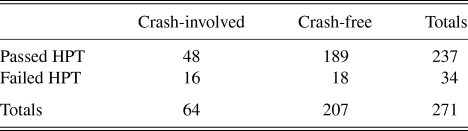
Hazard perception test pass/fail was entered as a dichotomous variable into a logistic regression to predict crash involvement. For ease of interpretation we converted the odds ratios produced by the logistic regression analysis into likelihood ratios using the formula provided by Zhang and Yu (Reference Zhang and Yu1998). Hazard perception test outcome was associated with crash involvement with a likelihood ratio of 2.32 (95% CI, 1.46, 3.22) This indicated that individuals who failed the ACT hazard perception test were 2.32 times more likely to self-report a crash during the previous 5 years compared with those who passed (see Table 1 for the frequency table). The likelihood ratio controlling for driving frequency and kilometers per week was 2.37 (95% CI, 1.49, 3.28).
Frequencies for crash-involvement by hazard perception test (HPT) outcome
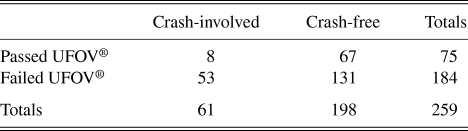
We completed the same procedure for the UFOV® measure (see Table 2 for the frequency table). Individuals who failed the UFOV® test were 2.70 times (95% CI, 1.44, 4.44) more likely to have reported a crash than those who passed. The likelihood ratio became 2.77 (95% CI, 1.47, 4.55), when driving frequency and kilometers per week were controlled for. When hazard perception, UFOV®, driving frequency, kilometers per week, age, and sex were entered together as independent variables, the likelihood ratio became 2.52 (95% CI, 1.56, 3.48) for hazard perception and 2.95 (95% CI, 1.53, 4.86) for UFOV®.
Frequencies for crash-involvement by Useful Field Of View (UFOV®) outcome
DISCUSSION
We found a significant association between self-reported crash history and hazard perception ability in a sample of older drivers; the first time such a relationship has been reported. This effect is not mediated by age, sex, or driving exposure. The magnitude of the effect found compares favorably with a previously established measure known to be associated with crash risk, namely useful field of view. Also, hazard perception and useful field of view accounted for variance in crash involvement independent of one another. One potential avenue for further research would be to gather information about the details of participants’ crashes (for example, whether they were at-fault or whether hazard perception was likely to have been a factor in the crash, etc), to reduce noise in the data that might be suppressing the crash relationships.
To give an idea of the implications of the 0.3-s response time difference between the crash-involved and crash-free drivers, this would translate into 5 meters of additional travel when driving at 60 kph, which could plausibly translate into the difference between having and not having a crash. This suggests that hazard perception ability could be a factor in explaining the crash risk of older adults. Of course, as with any correlational study, the possibility remains that this difference might not reflect a causal relationship or that the causality might be in the opposite direction to that proposed, where the experience of crashing somehow results in a decline in hazard perception. However, the latter does not seem particularly plausible (remembering that we controlled for driving exposure): one would presume that it would be more likely that the experience of crashing would lead to drivers being more vigilant and responsive, which would counteract the relationship found. In contrast, there are theoretical reasons for expecting poor hazard perception would lead to greater crash risk: if a driver is slow to anticipate dangerous events on the road ahead then they would be expected to be less likely to avoid them, potentially resulting in a collision with an object or another vehicle.
The findings have implications for driving research, driver assessment, and driver training and establishes the hazard perception test as a valid measure of driving performance, in that it is associated with on-road safety outcomes. Video-based hazard perception tests have several advantages over real-world measures of driving, including (1) the ability to present rare (we estimate that each of the 22 events shown took 1–2 hr of driving in normal traffic to obtain) and potentially dangerous events in a short time frame with no risk to the participant or examiner, (2) a high level of experimental control (all participants experience the same stimuli), and (3) a relatively low cost (the test can be run on a standard computer with a touch-screen attached). It is possible that the hazard perception test, combined with other measures, could be useful as an assessment of fitness-to-drive for older adults.
In terms of safety interventions, Horswill et al. (in press) found that the hazard perception scores of a sample of older drivers could be improved by a short video-based training intervention. While it is not yet possible to say whether this type of training would generalize to changes in actual crash risk, the present findings give grounds for optimism that changing performance in a hazard perception test may yield beneficial real world outcomes.
ACKNOWLEDGMENTS
This research was funded by the Australian Research Council and NRMA-ACT Road Safety Trust (Linkage Grant LP0668078). We acknowledge the help of Ada Tam and Amy Dawel in collecting, entering, and cleaning the data and Mark Wetton for his contribution in creating the ACT hazard perception test. We confirm that the information in this manuscript and the manuscript itself has never been published either electronically or in print and that none of the authors has any financial or other conflict of interest.



