Thus, this commentary focuses on the prestige of I-O psychology and management journals in business schools. Specifically, we compare the individual views of journal prestige that Highhouse et al. (Reference Highhouse, Zickar and Melick2020) reported with institutional views of journal prestige based on our survey of business schools. This comparison reflects the well-established notion in multilevel theory that the same construct may have different meanings (i.e., is not isomorphic) across levels of analysis (Chan, Reference Chan1998). In this case, assessments of journal prestige at the institution (i.e., business school) level may be different from the collective perceptions of the individual scholars within each institution. Journal prestige at the individual level represents the degree to which a journal is “widely admired [perceived] for publishing quality scholarship” (Highhouse et al., Reference Highhouse, Zickar and Melick2020, p. 273). In contrast, journal prestige at the institution level is often driven by an institution’s emphasis on legitimacy and efficiency (e.g., reliance on external journal lists and rankingsFootnote
1
), as well as by administrator attributes (e.g., deans’ functional backgrounds, values, and beliefs) and other factors such as institutional history and politics. Institutional assessments of journal prestige directly influence promotion and tenure (P&T) processes and decisions such that articles published in a specific journal often are assessed as a dichotomy (“A” or nothing) or a trichotomy (“A”, “A-,” or nothing) rather than on a continuum (e.g., A, A-, B+, B, etc.). In fact, most business schools adopt a dichotomy or trichotomy system for P&T purposes with as many as six “A” publications required for tenure at some research-intensive business schools (Glick et al., Reference Glick, Miller and Cardinal2007).
Survey of management scholars in business schools
In November 2017, the first author created an institution-by-journal matrix and shared it with at least one faculty member at about 100 business schools with the following instructions:
We believe that it would be very useful to compile and share information about what journals are viewed as top-tier (“A”) journals that count for promotion and tenure (P&T) at different business schools as there is some variation across schools. “A-” is a bit below “A,” but counts for P&T when combined with publications in other A journals.
As of February 2020, 80 schools have participated in the survey, 71 of which reside across 34 states in the United States and nine that reside outside of the United States (two schools in Australia, one in Canada, two in Hong Kong, three in Singapore [one of which also has a primary campus in France], and one in the UK). We verified the accuracy of the data by comparing them with the formal journal lists obtained from a department chair or senior faculty member at roughly a half of the schools included in the survey. Nonetheless, some of the data may be outdated or inaccurate.
Of the 80 schools represented, 72 (90%) reported that they had a formal list of top-tier journals for P&T purposes and eight (10%) schools reported they did not have a formal list.Footnote
2
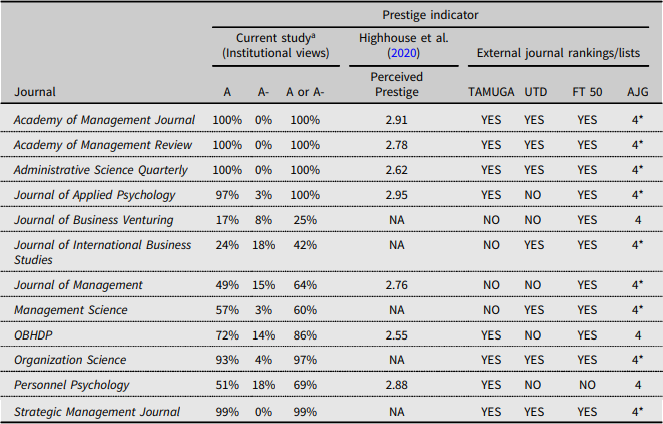
Table 1 provides results for the 72 schools that have a formal list. All of these schools consider Academy of Management Journal (AMJ), Academy of Management Review (AMR), and Administrative Science Quarterly (ASQ) as top-tier journals. Further, nearly all schools view Strategic Management Journal (SMJ; 71, 99%), Journal of Applied Psychology (JAP; 70, 97%), and Organizational Science (OS; 67, 93%) as top-tier, and most schools consider Organizational Behavior and Human Decision Processes (OBHDP; 52, 72%) a top-tier outlet. In addition, roughly half of the schools view Management Science (MS; 41, 57%), Personnel Psychology (PPsych; 37, 51%), and Journal of Management (JOM; 35, 49%) as top tier. Other journals considered top tier by some schools include Journal of International Business Studies (JIBS; 17, 24%) and Journal of Business Venturing (JBV; 12, 17%). Finally, many of these journals are viewed as “A-” journals in business schools that use a tiered system (see Table 1), including PPsych and JIBS (both 13 additional schools), JOM (11 additional schools), JBV (six additional schools), OS (three additional schools), MS (two additional schools), and JAP (one additional school).Footnote
3
Table 1.
Indicators of the Prestige of I-O and Management Journals
We note several key differences between these institution-level results and the individual-level journal prestige ratings that Highhouse et al. (Reference Highhouse, Zickar and Melick2020) reported. First, Highhouse et al. noted that “JAP and PPsych continue to be the flagship journals in I-O psychology” (p. 276). Although PPsych is perceived to be the third most prestigious journal at the individual level among management scholars (see Table 3 of Highhouse et al., Reference Highhouse, Zickar and Melick2020), it is considered noticeably less prestigious at the institutional level (see Table 1 of the current study). Interestingly, this tendency is somewhat stronger in business schools outside of the United States. Second, Organizational Research Methods is perceived to be the sixth most prestigious journal among management scholars (see Table 3 in the Highhouse et al.), but few business schools consider it an A-level journal. Third, although most business schools view SMJ as top tier, this journal was not included in Highhouse et al.’s research, nor were MS, JIBS, or JBV, which some or many of the business schools in our survey consider top tier. Fourth, we asked survey respondents to list any less-traditional management journals their schools view as top tier. Several journals were mentioned multiple times, including Journal of Personality and Social Psychology, Journal of Experimental Social Psychology*, Personality and Social Psychology Bulletin*, Psychological Review*, Psychological Science*, Psychological Bulletin*, American Sociological Review*, American Journal of Sociology*, and Entrepreneurship Theory and Practice*. Many of these journals (marked with an asterisk) were not included in Highhouse et al.’s study.
We also note some similarities and differences between the results of our institution-level survey and external journal lists and rankings. On one hand, the more “macro” management journals the business schools in our survey tend to view as top tier are similar to the macro journals in the external lists and rankings. For instance, AMJ, AMR, ASQ, OS, and SMJ appear in the UTD, FT 50, and TAMUGA lists. On the other hand, there is less convergence regarding the more “micro” journals. For example, although nearly all the business schools in our survey view JAP as an A-level journal, it is not included in the UTD list. Similarly, OBHDP is viewed as an A-level journal by 72% of the business schools in our survey, but it is not in the UTD list and is rated as a “4” rather than “4*” journal by the AJG. Moreover, although PPsych is viewed as an A-level journal by more than half of business schools (and as an A- journal by several other schools), it is not included in the UTD or FT 50 lists and it is a “4” rather than “4*” journal in the AJG. And, JOM is considered an A-level journal by almost half of business schools (and is viewed as an A- journal by others), but this journal does not appear in either the TAMUGA or UTD lists.
Viewed from a construct validity perspective, such differences suggest that some of these journal lists may be deficient or contaminated as measures of research quality.Footnote
4
From a decision-making perspective, these differences are concerning because these external lists might influence business schools to limit the already relatively small number of top-tier journals available to scholars interested in topics that are not a good fit for more macro-oriented journals. For instance, micro-oriented scholars in business schools that rely on the UTD journal list may have only one or two top-tier journals (i.e., AMJ and possibly OS) to which they can submit their work.
Although this commentary focuses primarily on the institutional-level prestige of individual journals, we briefly examine the similarity of top-tier journal lists across institutions.Footnote
5
The data we could access show that 32 (44%) of the business schools in our survey include all journals in the TAMUGA list in their list of top-tier journals, and most schools include all TAMUGA journals except one or two journals (e.g., PPsych and/or OBHDP). Thus, the top-tier journal lists of many business schools appear to overlap more with the TAMUGA list than with the other journal lists.Footnote
6
Future research should examine what institutional factors influence similarities and differences in top-tier journal lists across institutions.
In closing, we thank Highhouse et al. (Reference Highhouse, Zickar and Melick2020) for continuing the dialogue regarding journal prestige, and we hope our survey of business schools and commentary provide an additional perspective on this important topic. For example, administrators (e.g., deans, department chairs, and P&T committees) may find this commentary useful for developing or revising their journal lists. For current and aspiring scholars, the present findings might help them better understand the journals business schools tend to view as prestigious and consider in P&T decisions. The findings could be particularly interesting to scholars who are considering moving from a psychology department to a business school or from their current business school to a different business school.
Finally, we are concerned that too much attention to extrinsic motivators such as journal rankings and impact factors may detract I-O psychology and management scholars from pursuing research questions that are intrinsically motivating and could influence theory and practice, for example, studies that have important implications for research or practice but that do not make a strong enough theoretical contribution for some top-tier journals. At the same time, naïveté and ignorance concerning this matter are not bliss. We encourage scholars to try to find a balance between extrinsic and intrinsic motivators in assessing potential outlets for their work. Furthermore, we encourage institutions to consider multiple factors and sources of evidence to evaluate faculty research productivity and not rely solely on any particular journal list or ranking.




 You have
Access
This commentary was motivated by three observations from Highhouse et al.’s (Reference Highhouse, Zickar and Melick2020) survey of SIOP members’ perceptions of journal prestige: first, 52% of the 557 respondents (N = 290) were in business schools or schools of labor and industrial relations; second, the finding that “the most prestigious journals identified in our survey are also dominated by management scholarship, and nearly all of them have chief editors located in business schools” (p. 286); and third, the authors’ conclusion that “the flight of prominent I-O psychologists from psychology departments to business schools has influenced the nature of the research published in our leading journals as well as the nature of topics pursued by I-O scholars” (p. 286).
Thus, this commentary focuses on the prestige of I-O psychology and management journals in business schools. Specifically, we compare the individual views of journal prestige that Highhouse et al. (Reference Highhouse, Zickar and Melick2020) reported with institutional views of journal prestige based on our survey of business schools. This comparison reflects the well-established notion in multilevel theory that the same construct may have different meanings (i.e., is not isomorphic) across levels of analysis (Chan, Reference Chan1998). In this case, assessments of journal prestige at the institution (i.e., business school) level may be different from the collective perceptions of the individual scholars within each institution. Journal prestige at the individual level represents the degree to which a journal is “widely admired [perceived] for publishing quality scholarship” (Highhouse et al., Reference Highhouse, Zickar and Melick2020, p. 273). In contrast, journal prestige at the institution level is often driven by an institution’s emphasis on legitimacy and efficiency (e.g., reliance on external journal lists and rankingsFootnote 1 ), as well as by administrator attributes (e.g., deans’ functional backgrounds, values, and beliefs) and other factors such as institutional history and politics. Institutional assessments of journal prestige directly influence promotion and tenure (P&T) processes and decisions such that articles published in a specific journal often are assessed as a dichotomy (“A” or nothing) or a trichotomy (“A”, “A-,” or nothing) rather than on a continuum (e.g., A, A-, B+, B, etc.). In fact, most business schools adopt a dichotomy or trichotomy system for P&T purposes with as many as six “A” publications required for tenure at some research-intensive business schools (Glick et al., Reference Glick, Miller and Cardinal2007).
Survey of management scholars in business schools
In November 2017, the first author created an institution-by-journal matrix and shared it with at least one faculty member at about 100 business schools with the following instructions:
We believe that it would be very useful to compile and share information about what journals are viewed as top-tier (“A”) journals that count for promotion and tenure (P&T) at different business schools as there is some variation across schools. “A-” is a bit below “A,” but counts for P&T when combined with publications in other A journals.
As of February 2020, 80 schools have participated in the survey, 71 of which reside across 34 states in the United States and nine that reside outside of the United States (two schools in Australia, one in Canada, two in Hong Kong, three in Singapore [one of which also has a primary campus in France], and one in the UK). We verified the accuracy of the data by comparing them with the formal journal lists obtained from a department chair or senior faculty member at roughly a half of the schools included in the survey. Nonetheless, some of the data may be outdated or inaccurate.
Of the 80 schools represented, 72 (90%) reported that they had a formal list of top-tier journals for P&T purposes and eight (10%) schools reported they did not have a formal list.Footnote 2 Table 1 provides results for the 72 schools that have a formal list. All of these schools consider Academy of Management Journal (AMJ), Academy of Management Review (AMR), and Administrative Science Quarterly (ASQ) as top-tier journals. Further, nearly all schools view Strategic Management Journal (SMJ; 71, 99%), Journal of Applied Psychology (JAP; 70, 97%), and Organizational Science (OS; 67, 93%) as top-tier, and most schools consider Organizational Behavior and Human Decision Processes (OBHDP; 52, 72%) a top-tier outlet. In addition, roughly half of the schools view Management Science (MS; 41, 57%), Personnel Psychology (PPsych; 37, 51%), and Journal of Management (JOM; 35, 49%) as top tier. Other journals considered top tier by some schools include Journal of International Business Studies (JIBS; 17, 24%) and Journal of Business Venturing (JBV; 12, 17%). Finally, many of these journals are viewed as “A-” journals in business schools that use a tiered system (see Table 1), including PPsych and JIBS (both 13 additional schools), JOM (11 additional schools), JBV (six additional schools), OS (three additional schools), MS (two additional schools), and JAP (one additional school).Footnote 3
Indicators of the Prestige of I-O and Management Journals
Note. A = counts for P&T. A- = counts for P&T when combined with publications in other A journals. The values in the “perceived prestige” column are based on the prestige ratings by 290 management scholars (also SIOP members) reported in Table 3 of Highhouse et al. (Reference Highhouse, Zickar and Melick2020). The survey used a 3-point scale where 3 = a journal that publishes uniformly high-quality studies in terms of both content and method and 1 = a journal that routinely publishes low-quality research with suspect methodology. NA = not available. TAMUGA = the Texas A&M/University of Georgia Rankings of Management Department Research Productivity; UTD = The UTD Top 100 Business School Research Ranking; FT = Financial Times 50 journals; AJG = the Academic Journal Guide. The AJG “4*” journals are those that are recognized worldwide for excellence and the AJG “4” journals represent top journals in their field.
a n = 72 business schools.
We note several key differences between these institution-level results and the individual-level journal prestige ratings that Highhouse et al. (Reference Highhouse, Zickar and Melick2020) reported. First, Highhouse et al. noted that “JAP and PPsych continue to be the flagship journals in I-O psychology” (p. 276). Although PPsych is perceived to be the third most prestigious journal at the individual level among management scholars (see Table 3 of Highhouse et al., Reference Highhouse, Zickar and Melick2020), it is considered noticeably less prestigious at the institutional level (see Table 1 of the current study). Interestingly, this tendency is somewhat stronger in business schools outside of the United States. Second, Organizational Research Methods is perceived to be the sixth most prestigious journal among management scholars (see Table 3 in the Highhouse et al.), but few business schools consider it an A-level journal. Third, although most business schools view SMJ as top tier, this journal was not included in Highhouse et al.’s research, nor were MS, JIBS, or JBV, which some or many of the business schools in our survey consider top tier. Fourth, we asked survey respondents to list any less-traditional management journals their schools view as top tier. Several journals were mentioned multiple times, including Journal of Personality and Social Psychology, Journal of Experimental Social Psychology*, Personality and Social Psychology Bulletin*, Psychological Review*, Psychological Science*, Psychological Bulletin*, American Sociological Review*, American Journal of Sociology*, and Entrepreneurship Theory and Practice*. Many of these journals (marked with an asterisk) were not included in Highhouse et al.’s study.
We also note some similarities and differences between the results of our institution-level survey and external journal lists and rankings. On one hand, the more “macro” management journals the business schools in our survey tend to view as top tier are similar to the macro journals in the external lists and rankings. For instance, AMJ, AMR, ASQ, OS, and SMJ appear in the UTD, FT 50, and TAMUGA lists. On the other hand, there is less convergence regarding the more “micro” journals. For example, although nearly all the business schools in our survey view JAP as an A-level journal, it is not included in the UTD list. Similarly, OBHDP is viewed as an A-level journal by 72% of the business schools in our survey, but it is not in the UTD list and is rated as a “4” rather than “4*” journal by the AJG. Moreover, although PPsych is viewed as an A-level journal by more than half of business schools (and as an A- journal by several other schools), it is not included in the UTD or FT 50 lists and it is a “4” rather than “4*” journal in the AJG. And, JOM is considered an A-level journal by almost half of business schools (and is viewed as an A- journal by others), but this journal does not appear in either the TAMUGA or UTD lists.
Viewed from a construct validity perspective, such differences suggest that some of these journal lists may be deficient or contaminated as measures of research quality.Footnote 4 From a decision-making perspective, these differences are concerning because these external lists might influence business schools to limit the already relatively small number of top-tier journals available to scholars interested in topics that are not a good fit for more macro-oriented journals. For instance, micro-oriented scholars in business schools that rely on the UTD journal list may have only one or two top-tier journals (i.e., AMJ and possibly OS) to which they can submit their work.
Although this commentary focuses primarily on the institutional-level prestige of individual journals, we briefly examine the similarity of top-tier journal lists across institutions.Footnote 5 The data we could access show that 32 (44%) of the business schools in our survey include all journals in the TAMUGA list in their list of top-tier journals, and most schools include all TAMUGA journals except one or two journals (e.g., PPsych and/or OBHDP). Thus, the top-tier journal lists of many business schools appear to overlap more with the TAMUGA list than with the other journal lists.Footnote 6 Future research should examine what institutional factors influence similarities and differences in top-tier journal lists across institutions.
In closing, we thank Highhouse et al. (Reference Highhouse, Zickar and Melick2020) for continuing the dialogue regarding journal prestige, and we hope our survey of business schools and commentary provide an additional perspective on this important topic. For example, administrators (e.g., deans, department chairs, and P&T committees) may find this commentary useful for developing or revising their journal lists. For current and aspiring scholars, the present findings might help them better understand the journals business schools tend to view as prestigious and consider in P&T decisions. The findings could be particularly interesting to scholars who are considering moving from a psychology department to a business school or from their current business school to a different business school.
Finally, we are concerned that too much attention to extrinsic motivators such as journal rankings and impact factors may detract I-O psychology and management scholars from pursuing research questions that are intrinsically motivating and could influence theory and practice, for example, studies that have important implications for research or practice but that do not make a strong enough theoretical contribution for some top-tier journals. At the same time, naïveté and ignorance concerning this matter are not bliss. We encourage scholars to try to find a balance between extrinsic and intrinsic motivators in assessing potential outlets for their work. Furthermore, we encourage institutions to consider multiple factors and sources of evidence to evaluate faculty research productivity and not rely solely on any particular journal list or ranking.