INTRODUCTION
The acquisition of RCs has attracted much interest in the past four decades. Recent studies have shown that children learning different languages – both monolinguals and bilinguals – produce RCs as young as around age two (e.g. Diessel & Tomasello, Reference Diessel and Tomasello2000; Ozeki & Shirai, Reference Ozeki, Shirai, Matsumoto, Oshima, Robinson and Sells2007; Yip & Matthews, Reference Yip and Matthews2007a). But conflicting patterns of acquisition have been found in languages with different structural formations of RCs. Children learning languages with post-nominal RCs in European languages such as English or German produce subject (SU) relatives (e.g. the man who came late) earlier than direct object (DO) relatives (e.g. the book I bought) and oblique (OBL) relatives (e.g. the man I talked with) (e.g. Brandt et al., Reference Brandt, Diessel and Tomasello2008; Diessel, Reference Diessel2004; Diessel & Tomasello, Reference Diessel and Tomasello2000). In contrast, children learning languages with prenominal RCs such as Japanese or Cantonese do not show an advantage of SU relatives over DO relatives. For example, Japanese-learning children start to produce SU, DO, and OBL relatives at a similar age with similar frequencies (Ozeki & Shirai, Reference Ozeki, Shirai, Matsumoto, Oshima, Robinson and Sells2007); and Cantonese-learning children produce DO relatives earlier than or simultaneously with SU relatives (Chan, Lau & Lieven, Reference Chan, Lau and Lieven2007; Chan, Matthews & Yip, Reference Chan, Matthews, Yip and Kidd2011; Yip & Matthews, Reference Yip and Matthews2007a, Reference Yip and Matthews2007b). Studies of Mandarin-learning children show varied findings – some reveal an advantage of SU over DO RCs in production (e.g. Hsu, Hermon & Zukowski, Reference Hsu, Hermon and Zukowski2009) whereas others find no such advantage (see Chan et al., Reference Chan, Matthews, Yip and Kidd2011, for a review).
These cross-linguistic differences raise the questions of how typological variations influence the process of language acquisition and what language-specific and/or universal factors contribute to the different emergent types of RCs in early child speech. Mandarin represents an interesting case for testing various theories of acquisition of RCs. It has a rare combination of basic SVO word order in main clauses, like English and many other European languages, but prenominal (head-final) RCs, where the RC precedes the head noun (Hawkins, Reference Hawkins1990; Keenan, Reference Keenan and Shopen1985), and therefore the predictions for the order of acquisition are different from postnominal (head-initial) RC languages (e.g. O'Grady, Reference O'Grady and Kidd2011; Chan et al., Reference Chan, Matthews, Yip and Kidd2011). No detailed studies have investigated the emergence and developmental trajectory of RCs in the longitudinal spontaneous speech of young monolingual Mandarin-learning children and their caregivers. This study will fill this gap by analyzing the spontaneous production of RCs by four monolingual Mandarin-learning children (age range 0;11 to 3;5) and their input. In the remainder of the paper, we first describe the structure of RCs in Mandarin, and briefly review research on RC acquisition cross-linguistically. Then we present our data and discuss the results with reference to children learning other languages. We propose that acquisition patterns can be explained by a multifactorial usage-based learning account.
Mandarin RCs
A RC can be syntactically defined as a subordinate clause that modifies a noun or noun phrase in an associated matrix clause (Diessel & Tomasello, Reference Diessel and Tomasello2000). Mandarin RCs are prenominal and marked by a grammatical morpheme, the relativizer de, as shown in (1). RCs are indicated in the square brackets and the relativized position is underlined.
(1) wo xi-huan [ RCMengmeng die __] de na ge chuan.Footnote 1
I like Mengmeng fold rl that cl boat
‘I like that (paper) boat that Mengmeng folded.’
In (1), the RC Mengmeng die ‘Mengmeng folded’ precedes the head noun chuan ‘boat’ and is marked by the relativizer de between the head noun and the RC. Mandarin has SVO word order and allows frequent omission of arguments, so the basic configuration of a RC can be characterized as in (2) (omissible elements in parentheses):
(2) [RC (S) V (O)] de [NP (Dem CL) N]
Resumptive pronouns are required for indirect objects, obliques, genitive phrases, and objects of comparison (Chao, Reference Chao1968; Li & Thompson, Reference Li and Thompson1981), as in (3), an oblique RC, in which ta ‘him’ is a resumptive element.
(3) daishu ti le [ RCgei ta shua ya] de zhu.
kangaroo kick pfv for him brush teeth rl pig
‘The kangaroo kicked the pig that brushed his teeth (for him).’
As shown above, RCs in Mandarin differ from English in (a) being prenominal; and (b) requiring resumptive pronouns for RCs other than subject or object relatives. They also differ from other prenominal RC languages such as Japanese, in (c) basic word order (SVO in Mandarin and SOV in Japanese); (d) frequent omission of head nouns (i.e. headless RCs are common); and (e) using an explicit RC marker de between the modifier and the modified.
Mandarin also has ‘gapless’ RCs in which the head noun does not have a traceable syntactic position in the RC, as in (4) (see Yip & Matthews, Reference Yip and Matthews2007a, for similar examples in Cantonese). The gapless RCs show the same structure with appositive clauses (AC), as in (5).
(4) [ RCxiao xiong guo shengri] de lazhu.
little bear celebrate birthday rl candle
‘The candles that were used for little bear to celebrate his birthday.’
(5) [ ACta qushi de xiaoxi] shi wo hen nanguo.
he die rl news make me very sad
‘The news that he died made me very sad.’
Comrie (Reference Comrie, Boeder, Schroeder, Wagner and Wildgen1998, Reference Comrie and Ramat2002) proposed that various Asian languages, including Mandarin and Japanese, had only attributive clauses, which involved no gap in the relativized position and had the structure of merely attaching a modifying clause to a head noun. His argument was supported by the syntactic differences between European languages and Asian languages. For example, Mandarin RCs did not show overt movement, while English RCs had been assumed to involve wh-movement (wh-relatives). As a consequence, movement constraints (such as the subjacency condition; see Haig, Reference Haig1996) did not hold between the relativized position and the head noun.
Theoretical accounts for acquisition of RCs
The Noun Phrase Accessibility Hierarchy (NPAH; Keenan & Comrie, Reference Keenan and Comrie1977) is a well-known descriptive generalization of the cross-linguistic relativizability of noun phrases, and has been applied to characterize the developmental patterns of different types of RCs cross-linguistically in first (e.g. Diessel & Tomasello, Reference Diessel and Tomasello2005; Keenan & Hawkins, Reference Keenan, Hawkins and Keenan1987; Ozeki & Shirai, Reference Ozeki, Shirai, Matsumoto, Oshima, Robinson and Sells2007) and second (e.g. Doughty, Reference Doughty1991; Gass, Reference Gass1979) language acquisition. This hierarchy predicts the relativizability of the head nouns that occur in different syntactic positions in the RC: SU > DO > IO > OBL > GEN > OCOMP. Subject relatives (i.e. the head noun functions as the subject of the RC, e.g. the man who died) are the easiest to relativize, followed by direct object (DO) relatives (e.g. the book I bought), indirect object (IO) relatives (e.g. the man I gave the book), oblique (OBL) relatives (e.g. the man I talked with), and genitive (GEN) relatives (e.g. the man whose father is sick), and finally object of comparison (OCOMP) relatives (e.g. the man that I am taller than). The prediction is that if a language can relativize on a syntactic position on the lower end of this hierarchy, it can also relativize on any other NPs higher on the hierarchy. The NPAH characterizes the structural difficulties in forming RCs, and linguists have argued that the underlying mechanism for this hierarchy is the processing cost involved for different relativized positions.
The implication of the NPAH for first language acquisition is that children, like adults, should be subject to the same processing constraints and so the order of the acquisition should reflect the NPAH – children will learn the RCs on the higher end of the hierarchy earlier or simultaneously with those on the lower end (Hawkins, Reference Hawkins2007). For example, children will experience less difficulty with subject RCs than the object counterparts. The primacy of subject relatives has been supported by many experimental studies of children learning postnominal RC languages such as English (e.g. Keenan & Hawkins, Reference Keenan, Hawkins and Keenan1987), Hebrew (Friedmann, Belletti & Rizzi, Reference Friedmann, Belletti and Rizzi2009), Indonesian (Tjung, Reference Tjung2006), and Persian (Rahmany, Marefat & Kidd, Reference Rahmany, Marefat and Kidd2011).
The NPAH, however, does not seem to characterize the acquisition trajectory revealed in longitudinal studies of East Asian languages, in which subject relatives are not produced earlier than object relatives (Ozeki & Shirai, Reference Ozeki, Shirai, Matsumoto, Oshima, Robinson and Sells2007, Reference Ozeki and Shirai2010; Yip & Matthews, Reference Yip and Matthews2007a, Reference Yip and Matthews2007b). Ozeki and Shirai (Reference Ozeki, Shirai, Matsumoto, Oshima, Robinson and Sells2007) reported that subject RCs emerged simultaneously with object RCs with similar frequency in early Japanese child speech. Yip and Matthews (Reference Yip and Matthews2007a, Reference Yip and Matthews2007b) found that object RCs emerge simultaneously or earlier than subject relatives in Cantonese in the speech of Cantonese–English bilingual children. Ozeki and Shirai (Reference Ozeki, Shirai, Matsumoto, Oshima, Robinson and Sells2007) proposed that the different developmental trajectory resulted from cross-linguistic differences in the structure of RCs between Asian languages vs. European languages in that learning to produce RCs in Japanese involved merely attaching a modifying clause to the head noun regardless of grammatical relations. They suggested that their data supported Comrie's (Reference Comrie, Boeder, Schroeder, Wagner and Wildgen1998, Reference Comrie and Ramat2002, Reference Comrie2007) typology of RCs in which East Asian languages had only attributive (noun-modifying) clauses that did not involve gaps, as English RCs do. Yip and Matthews (Reference Yip and Matthews2007a, Reference Yip and Matthews2007b) proposed a similar account for their Cantonese data, emphasizing the typological nature of Cantonese RCs as attributive clauses. Yip and Matthews also argued for Hawkins' (Reference Hawkins2004) view of the NPAH as essentially determined by processing demands, and suggested that the acquisition process could be counteracted by other processing factors, such as the similarity between the main clause structure and object relatives in Cantonese.
Processing has long been argued to determine the course of language development (Bates & MacWhinney, Reference Bates, MacWhinney, MacWhinney and Bates1989; F. Chang, Dell & Bock, Reference Chang, Dell and Bock2006; O'Grady, Reference O'Grady and Kidd2011). O'Grady (Reference O'Grady and Kidd2011) proposed that a particular developmental trajectory (the Path Problem, in his term) could be explained by the Difficulty Principle, where processing difficulty should impede use and mastery of particular form–meaning mappings. He argued that factors that were important to account for processing difficulty were also relevant for explaining the developmental trajectory of language acquisition of RCs. These factors included prominence of the referent of the head noun within the RC, the filler–gap dependencies that unfold in the course of incremental processing, and the statistical frequency of the distribution of RC type in the input and animacy of the head nouns (cf. also Fitz, Chang & Christiansen, Reference Fitz, Chang, Christiansen and Kidd2011; Ozeki & Shirai, Reference Ozeki, Shirai, Matsumoto, Oshima, Robinson and Sells2007; 2010 for the influence of input frequency), as well as semantic factors such as the animacy of head nouns (cf. also Arnon, Reference Arnon2010; Brandt & Kidd, Reference Brandt, Kidd and Schönefeld2011; Brandt, Kidd, Lieven & Tomasello, Reference Brandt, Kidd, Lieven and Tomasello2009; Kidd, Brandt, Lieven & Tomasello, Reference Kidd, Brandt, Lieven and Tomasello2007). A number of studies have addressed processing factors in the production of RCs in early child language, as reviewed below.
Diessel and Tomasello (Reference Diessel and Tomasello2000) considered processing as a general constraint on early production of RCs – simpler ones were produced earlier than complex ones and more complex relative constructions emerge with increasing age when children develop higher processing capacity. They drew this conclusion on the basis of detailed analysis of the production of RCs in naturalistic longitudinal data of four English-learning children aged from 1;9 to 5;2. They found that the production of English-learning children's RCs followed the order of SU > DO > OBL, and that the majority of the SU RCs contained an intransitive verb. They also noted that according to the syntactic position of the head noun in the matrix clause the majority of the early RCs in English-learning children's speech were those attached to the predicate nominal of a copular clause (i.e. PN, predicate nominal RCs), as in (6) and (7), or an isolated noun phrase (NP), as in (8) (Diessel and Tomasello, Reference Diessel and Tomasello2000, pp. 135–136):
(6) Here's a tiger that's gonna scare him.
(7) This is the sugar that goes in there.
(8) Another picture that I made.
Diessel and Tomasello (Reference Diessel and Tomasello2000) suggested that these sentences were simple in terms of syntax and semantics – syntactically they involved the same sequence of grammatical relations, i.e. SVO as an ordinary (in)transitive clause, and semantically they involved a single proposition. The learning process was characterized as starting from a simple sentence to a gradual development of more complex relative constructions that became increasingly different from simple sentences. A similar argument has been made based on the developmental patterns in a case study of a German-learning child's data from age 2;0 to 5;0 (Brandt et al., Reference Brandt, Diessel and Tomasello2008). The earliest RCs (around age two) were topicalization constructions that contained only a single proposition and expressed the actor prior to other participants. SU RCs were the majority, followed by DO RCs and OBL RCs, which conformed to the prediction of the NPAH.
Based on their study of longitudinal naturalistic data, Diessel and Tomasello (Reference Diessel and Tomasello2005) further examined how propositional simplicity influenced the order of acquisition in English and German RCs using elicited imitation. They showed that children had less difficulty with RCs embedded in predicate nominal constructions than those attached to the direct object of transitive main clause. Among all the PN relatives, they found that both English- and German-speaking children had higher accuracy in imitating S-relatives (i.e. subject RCs with an intransitive verb) than A- (i.e. SU relatives with a transitive verb), P- (i.e. DO RCs with a transitive verb), IO, OBL, and Genitive relatives.
Diessel and Tomasello and others further proposed a multifactorial usage-based account for the acquisition of complex sentences (e.g. Brandt et al., Reference Brandt, Diessel and Tomasello2008; Diessel, Reference Diessel2004, Reference Diessel2007, Reference Diessel, Givon and Shibatani2009; Diessel & Tomasello, Reference Diessel and Tomasello2000, Reference Diessel and Tomasello2005). In this account, children acquire RCs in a piecemeal, bottom-up fashion by building new RC constructions upon simpler constructions that they already know. The earliest RCs are simple syntactically and semantically, and built on item-specific constructions that are deeply entrenched at the time when children begin to use RCs. For example, English-speaking children's early RCs (the PN relatives) involve a single proposition and reflect the expansion of simple clause structure, e.g. the SVO structure. The advantage of SU RCs is a result of this learning process. The acquisition process is also influenced by the language-specific distributional frequency of constructional structures in the input, including both item-specific ones at early development and abstract syntactic schemas extracted from concrete inter-related constructions in later development. Diessel (Reference Diessel2007) further extended the usage-based learning account to East Asian languages. He suggested that even though East Asian RCs were structurally very different from RCs in English and other European languages, the process of the acquisition showed striking similarities. Early relatives across these languages all tended to involve the same sequence of nouns and verbs as ordinary (in)transitive clauses, involve the prototypical link between grammatical relations and semantic roles, and be embedded in structures that describe only a single state of affairs.
Overall, the majority of the theoretical accounts for the acquisition of RC production have focused on the syntactic role of the head noun inside the RC. The acquisition patterns found in English and German longitudinal production data are compatible with the NPAH, but the acquisition patterns in East Asian languages with prenominal RCs, such as Japanese or Cantonese, do not follow the predictions of the NPAH. The explanation for this divergence involves language-specific formation of RCs and processing factors such as structural simplicity, distributional frequency, animacy, and word order (Diessel & Tomasello, Reference Diessel and Tomasello2000, Reference Diessel and Tomasello2005; O'Grady, Reference O'Grady and Kidd2011). This line of argument is consistent with the usage-based learning account in that constructions that are simpler syntactically and/or semantically would be acquired earlier than those more complex ones and that the distributional frequency of the input would influence the acquisition trajectory (e.g. more frequently encountered constructions will be more readily activated and thus easier to use).
How does Mandarin fit in this theoretical debate on the acquisition of complex constructions like RCs? Do SU relatives emerge earlier than DO relatives developmentally? All the prior studies of Mandarin children's acquisition of RCs involved experimental paradigms and presented an unclear order of acquisition in both comprehension (H.-W. Chang, Reference Chang1984; Lee, Reference Lee and Lee1992) and production (Y.-Y. Cheng, Reference Cheng1995; Chiu, Reference Chiu1996; Hsu et al., Reference Hsu, Hermon and Zukowski2009; Ning & Liu, Reference Ning and Liu2009; Su, Reference Su2004). Some of these studies (Lee, Reference Lee and Lee1992; Y.-Y. Cheng, Reference Cheng1995; Hsu et al., Reference Hsu, Hermon and Zukowski2009) found an advantage of SU over DO relatives whereas others found either no advantage (H.-W. Chang, Reference Chang1984; Su, Reference Su2004) or an advantage of DO over SU relatives (Ning & Liu, Reference Ning and Liu2009). Most of these studies focused on children at a comparatively later age (four and above). No studies have investigated how structural complexity interacts with the use of RCs in both child and child-directed speech. Detailed analysis of longitudinal data is thus important if we are to uncover the formal and functional characteristics of the development of RCs in child language to establish the exact nature of RC use (Juffs, Reference Juffs2007).The following section presents our analysis of RC production in longitudinal naturalistic speech.
CURRENT STUDY
Data
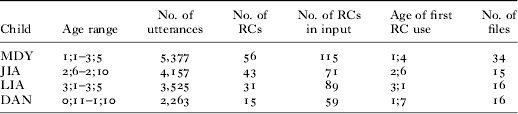
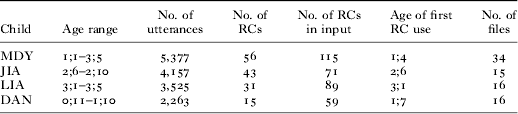
The present study included and analyzed naturalistic data of four children who produced more than ten RCs from the Fang corpus (Min, Reference Min1994). Those children varied in age at the start of data collection, as did the length of the periods they were observed for. The age range of these children was from 0;11 to 3;5. All the data were collected in Beijing during the late 1980s and the early 1990s in natural situations at the target child's home. The sessions all involved multiple adult caregivers interacting with the child, as is typical for Chinese children. Since caregivers typically include not only the parents, but also the grandparents, or live-in aunts or nannies in China, we analyzed the child-directed speech (input) from all the caregivers, including occasional visitors who happened to be in the data session (Min, Reference Min1994). All the data have been transcribed in Pinyin, the official Mandarin Romanization system used in China, and follow the transcription format of CHAT (MacWhinney, Reference MacWhinney2000). Table 1 summarizes the background information about the four target children. The three-letter code (e.g. MDY) represents the target child.
Background information about the four target children from the longitudinal naturalistic speech corpus
Data coding and analysis
We extracted and coded all the instances of noun-modifying clauses headed by the RC marker de, using the Computerized Language Analysis (CLAN) program (MacWhinney, Reference MacWhinney2000). We included all the sentences that contained a RC. Table 1 shows the total number of files and the total number of RCs produced by each child during the period of data collection. Overall the children produced relatively small numbers of RCs (token frequency range 15–56 per child; cf. 26–193 in Diessel & Tomasello, Reference Diessel and Tomasello2000), perhaps due to the very young age of the target children and the low density of data collection.
RCs are usually classified according to two structural features (following Diessel & Tomasello, Reference Diessel and Tomasello2000, and Ozeki & Shirai, Reference Ozeki, Shirai, Matsumoto, Oshima, Robinson and Sells2007): (a) the syntactic role of the head noun, that is, the noun phrase modified by the RC, in the matrix clause (SUBJ, OBJ, OBL, PN, etc.); and (b) the syntactic role of the element that is relativized inside the RC (i.e. grammatical relations) (SU, DO, OBL, etc.) These codings are illustrated below with sample RCs from the target children.
Regarding (a), RCs were classified into five types depending on the role of their head noun in the matrix clause, as follows:
PN = predicate nominal (RC that modifies a predicate NP in a copula clause)
(9) (MDY 2;3)
zhe shi [wo da] de fangzi.
this is I construct rl house
‘This is the house [that I made].’
NP = isolated noun phrase (RC that modifies an isolated NP)
(10) (MDY 1;10)
[baba mai] de ban.
daddy bought rl board
‘the board [that daddy bought]’
SUBJ = subject (RC that modifies a subject NP in the matrix clause)
(11) (MDY 2;0)
zhe hui [shuijiao] de hao le.
this time sleep rl ready pfv
‘The one [that slept] is ready right now.’
OBJ = object (RC that modifies an object NP in the matrix clause)
(12) (JIA 2;8)
peng-dao yi ge [wa tu] de ren.
meet-arrive one cl dig earth rl person
‘I met a person [who was digging the earth].’
OBL = oblique (RC that modifies an oblique NP in the matrix clause)
(13) (MDY 3;0)
xiaohai bu neng zai [guanxian bu hao] de
children not can at light not good rl
difang kan shu.
place read book
‘It is said that a child should not read in places [where the light is no good].’
Regarding (b), the syntactic role of the head noun in the RC, the tokens of RCs were classified as follows:
SU = subject relative
(14) (MDY 3;0)
[na ge you yuanquan] de na ge huai le.
that CL have circle rl that CL break pfv
‘That one [that has circles] broke.’
DO = direct object relative
(15) (MDY 3;0)
[wo chuan] de na lan de kuzi jiu da.
I wear rl that blue de pants just big
‘The blue pants [that I wore] are big.'
OBL = Oblique relative
(16) (MDY 3;3)
[guan xiao dongwu] de longzi li.
shut small animal rl cage in
‘In the cage in which [small animals were enclosed].’
NoGR = No grammatical relation (The head noun does not hold any syntactic position in the RC, i.e. gapless RCs.)
(17) (MDY 3;4)
zhui dao yi ge [mei lu] de difang.
chase arrive one CL no road RL place
‘They chased to a place in which [there is no road].’
Inter-coder reliability of the coding was calculated by comparing our coding with the coding by a second Chinese native-speaking linguist. About 22% of the transcript files (i.e. 18 files) were randomly selected for the second coder to code and all the RCs (121 in total) in these files were coded into different types based on the syntactic position of the head noun in the matrix clause and in the subordinate clause. Out of the total of 121 RCs, 115 were given the same codes as the original, thus yielding a reliability of 95%.
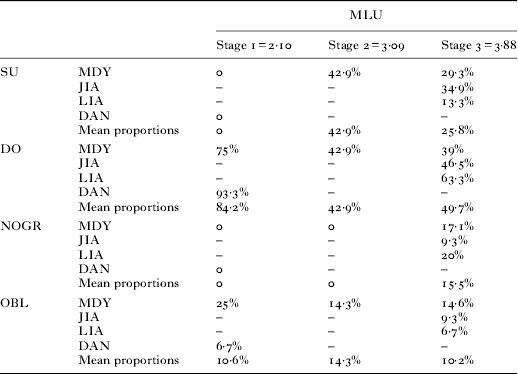
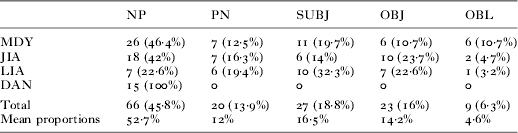
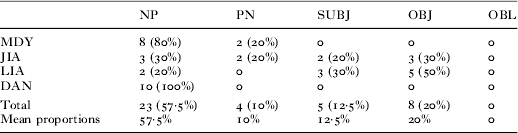
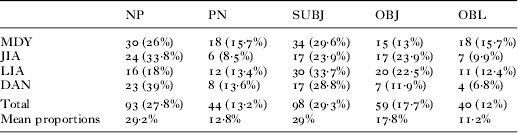
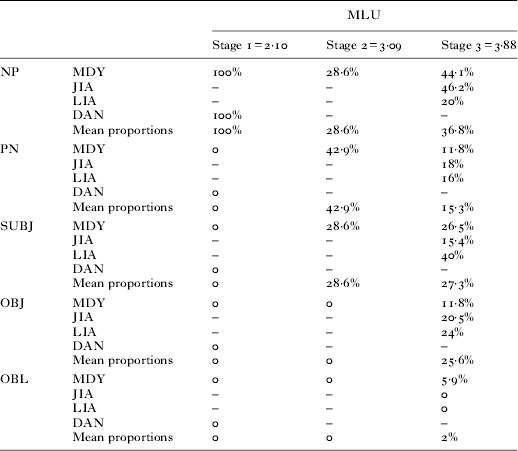
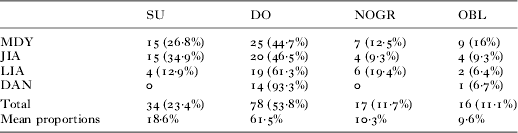
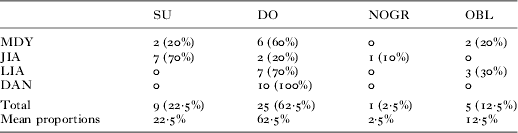
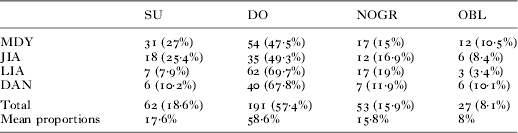
In the following discussion, we often refer to percentages of RC types. This is based on the average percentages from each child/child-directed speech; that is, each child's ratio of the use of a particular RC type (e.g. SU relatives) was calculated first, and then it was averaged across the four children (following Diessel & Tomasello, Reference Diessel and Tomasello2000, and Ozeki & Shirai, Reference Ozeki, Shirai, Matsumoto, Oshima, Robinson and Sells2007). The raw numbers and proportions of RCs of each child and their input are reported in Tables 3–10 in the Appendix.
RESULTS AND DISCUSSION
Our data analyses focus on the emergence of different types of RCs based on (a) the head noun in the matrix clause, and (b) the relativized position in the RC. We discuss the results in comparison with English (Diessel & Tomasello, Reference Diessel and Tomasello2000) and Japanese (Ozeki & Shirai, Reference Ozeki, Shirai, Matsumoto, Oshima, Robinson and Sells2007).
Syntactic role of the head noun in the matrix clause
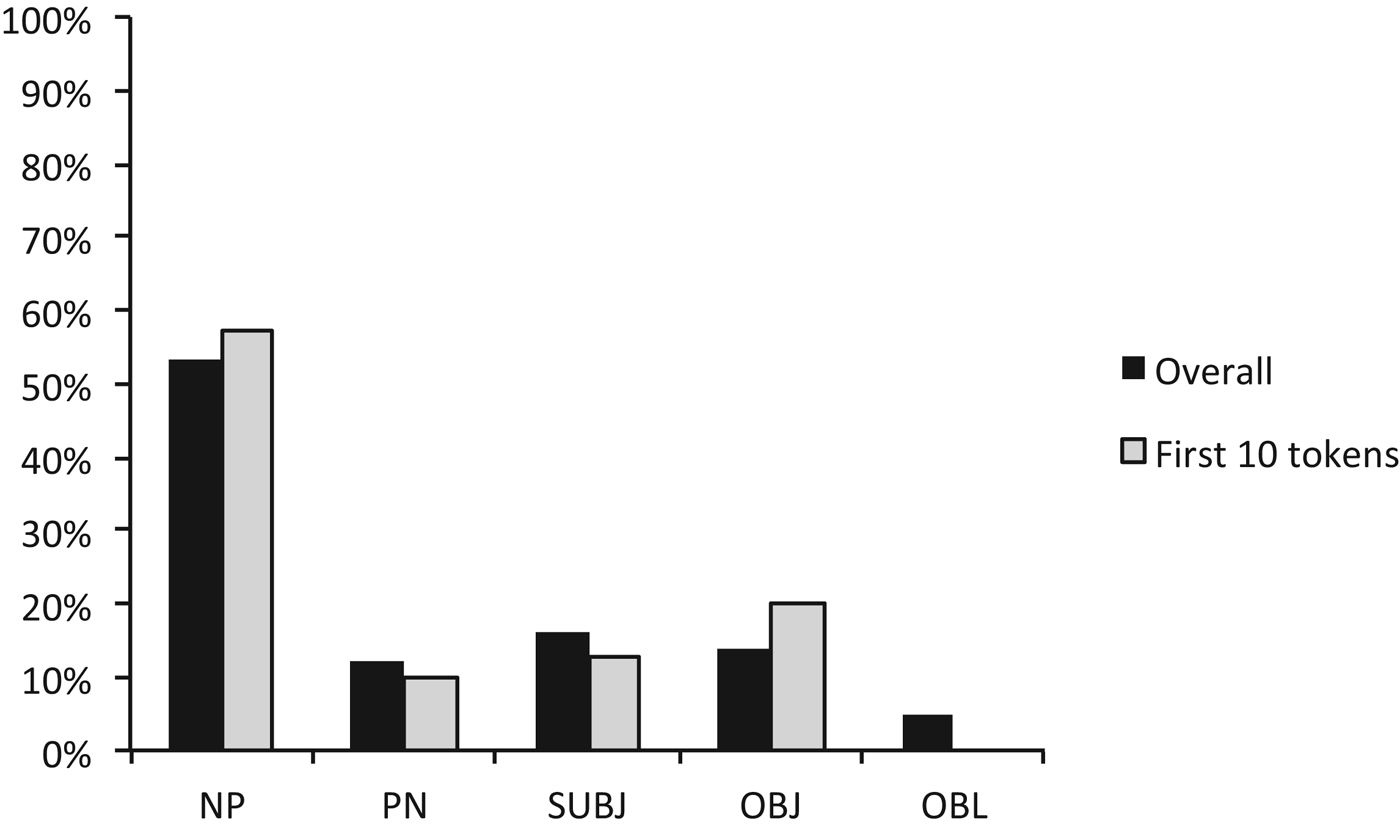
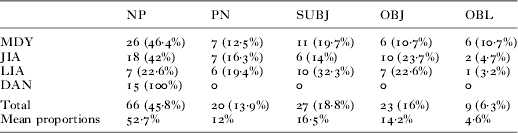
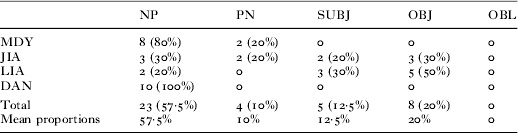
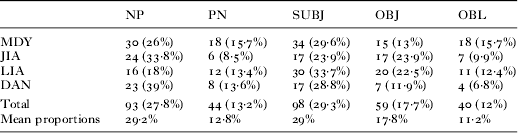
Figure 1 shows the mean proportions of RCs by syntactic position inside the matrix clauses in the children's speech. It is evident that the predominant type is the isolated NP RCs (e.g. [baba mai de] ban ‘the board daddy bought’) in the overall distribution (52·7%). RCs modifying an oblique object are very rare (4·6%). Predicate nominal (PN), SUBJ, and OBJ relatives are similar in the overall distribution frequency (12–16%). A similar distributional pattern is found in the first 10 RCs across the children (see Tables 3 and 4 in the ‘Appendix’ for details of individual children's use of RCs).
Children's RCs by syntactic position inside the matrix clauses (mean proportions).

This pattern is different from that in English (Diessel & Tomasello, Reference Diessel and Tomasello2000) and in Japanese (Ozeki & Shirai, Reference Ozeki, Shirai, Matsumoto, Oshima, Robinson and Sells2007). In English, the most frequent are PN relatives (e.g. Here is a tiger [that's gonna scare him]), and in Japanese the most frequent were SUBJ relatives (i.e. RCs that modify the subject of the matrix clause). Ozeki and Shirai (Reference Ozeki, Shirai, Matsumoto, Oshima, Robinson and Sells2007) proposed that the low frequency of presentational relatives in Japanese might be due to two reasons – a different information structure in postnominal vs. prenominal RCs and the center-embeddedness of presentational RCs in Japanese. In prenominal RC languages like Japanese, new information and comments on the referent are stated before the new referent is introduced, which sometimes results in an unnatural order of information flow. In contrast, in postnominal RC languages like English, the new referent is introduced first, followed by new information and comments. The low frequency of PN relatives in Mandarin may be due to the fact that Mandarin also has prenominal RCs, and PN relatives are center-embedded.
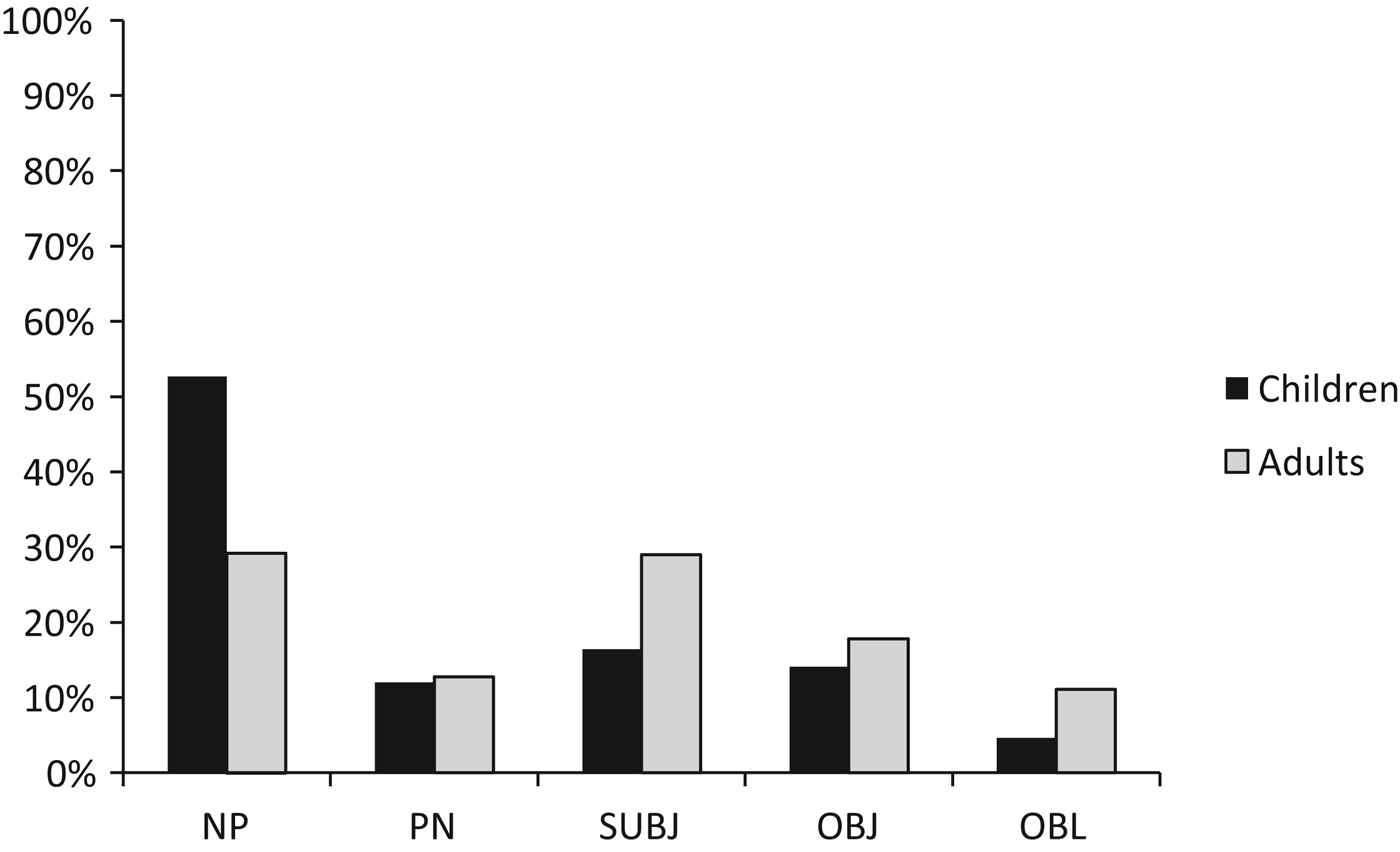
But why are the isolated NP relatives the most frequent in early child Mandarin? One possible reason is the influence of the input. We thus compared the distribution of the RC types in the input with that in the child speech, and the results are shown in Figure 2 (see Table 5 in the ‘Appendix’ for details of parental use of RCs).
Children's and caregivers’ RCs by syntactic position inside the matrix clauses (mean proportions).
The most frequent RCs in the input are the isolated NP relatives (29·2%) and SUBJ relatives (29%). A closer look at the input to individual children shows that the caregivers’ speech in three out of the four children (MDY, JIA, and DAN) exhibits a similar or higher frequency distribution of isolated NP relatives in comparison to SUBJ relatives (see Table 5). And these three children all show a dominance of isolated NP relatives. The parental speech of the child LIA exhibits higher frequency of SUBJ relatives (33·7%) than the isolated NP type (18%), and the same trend is seen in LIA's speech. It seems that the input distribution corresponds with all the children's use of RCs. An additional reason for the overall predominance of isolated NP relatives may be their structural simplicity. Compared with the other four types of RCs, isolated NP relatives are left-branching, involve only one clause, and resemble a simple sentence in word order. Take sentence (10) (repeated here as (18)), for example.
(18) (MDY 1;10)
[baba mai] de ban.
daddy bought rl board
‘the board [that Daddy bought]’
This example resembles its counterpart simple sentence baba mai ban ‘daddy bought the board’ in showing the same SVO word order. The modification of the head noun is realized by simply inserting the relativizer de between the RC and the head noun. It is possible that children's early production of isolated NP relatives comes from their structural simplicity and similarity with the typical simple sentence word order in Mandarin. This hypothesis is consistent with Diessel and Tomasello's (Reference Diessel and Tomasello2000, Reference Diessel and Tomasello2005) constructivist approach to language learning – complex constructions are built upon simple ones in a piecemeal learning fashion. If that is true, we may also see an increase of complex RCs and a decrease in simpler ones longitudinally.
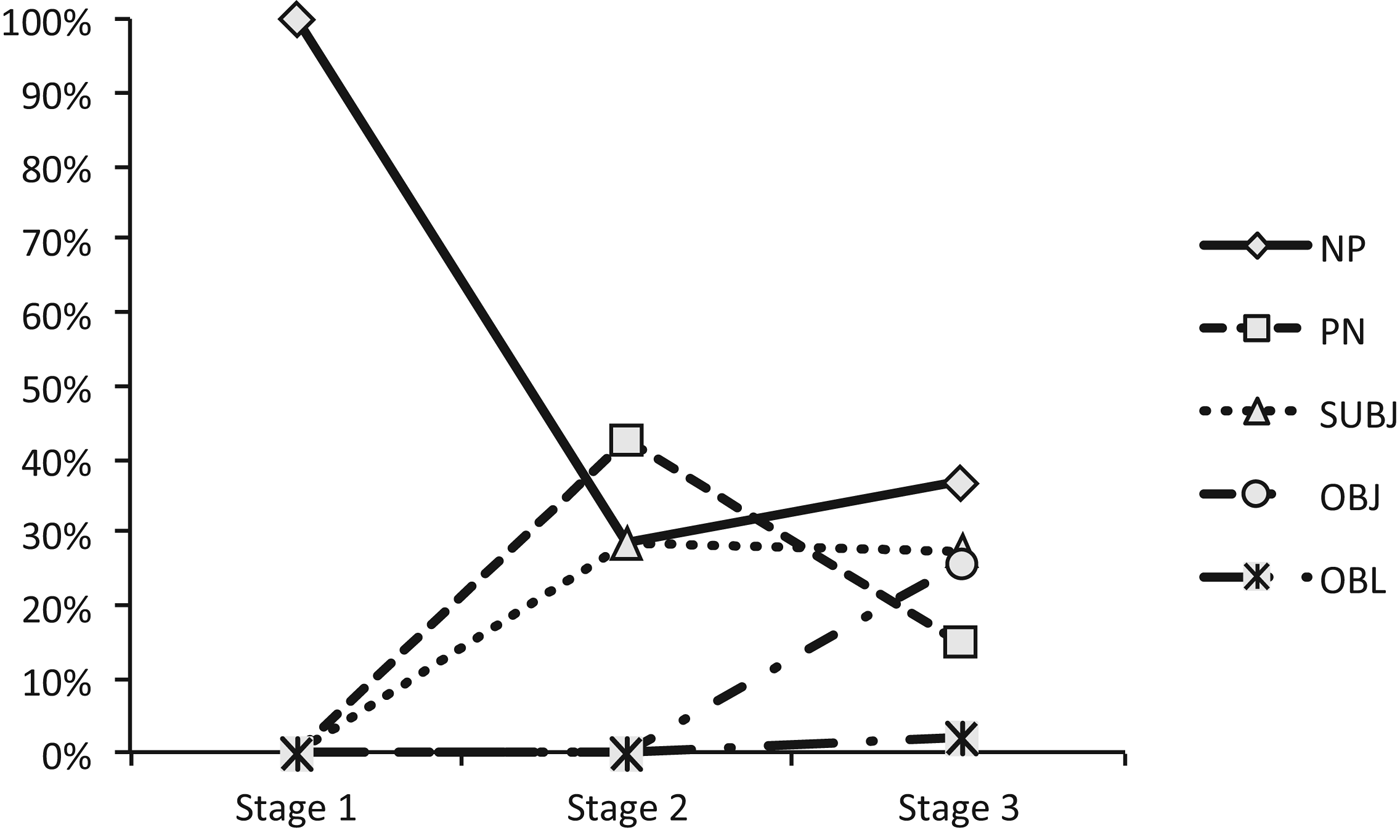
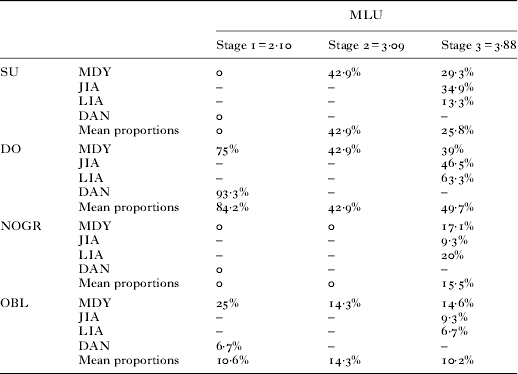
To see the development of RCs, we calculated the proportions of different types of RC in the children's speech longitudinally. We divided the children's RCs into three stages according to their MLU levels, as MLU has been widely used as a reliable tool for measuring early morphosyntactic development, rather than absolute age across languages (e.g. Brown, Reference Brown1973, for English; Cheung, Reference Cheung1998, for Mandarin). We used the CLAN program (MacWhinney, Reference MacWhinney2000) and calculated every child's MLU in each file on the basis of her/his full set of utterances. At Stage 1, the MLU is about 2·10 (children's age range 1;4–2;0); at Stage 2, the MLU is about 3·09 (1;9–2;7), and at Stage 3, the MLU is about 3·88 (2;6–3;5). We then counted the total number of different types of RC at each stage and calculated the mean proportions of each type at each stage. Figure 3 shows the development of children's RCs as measured by their MLU levels (see Table 6 in the ‘Appendix’ for details of individual children's RCs at different stages).
Development of children's RCs by syntactic position inside the matrix clauses (mean proportions).
As shown in Figure 3, isolated NP relatives predominate at Stage 1 (100%) and decrease dramatically at Stages 2 and 3 (down to about 28%). Oblique relatives remain very rare across the three stages, and OBJ relatives do not increase until Stage 3. The other two types of relative increase dramatically at Stage 2: PN relatives become the second most frequent (42·9%), followed by SUBJ relatives (29%). At Stage 3, PN relatives drop to 15·3%, and OBJ relatives increase to 25·6%, similar to the proportion of the SUBJ relatives. The developmental pattern shows that simpler relatives, such as isolated NP relatives, predominate at the beginning but drop sharply later. A gradual increase occurs in the structural complexity of RCs with the children's syntactic growth. The order of increase in frequency reflects the possible influence of structural complexity at stage 2: PN > SUBJ > OBJ/OBL. PN relatives are mono-propositional semantically, and syntactically involve attaching a RC to a copular verb (Diessel & Tomasello, Reference Diessel and Tomasello2000). In Mandarin there is only one copular verb, shi. Thus PN relatives are simpler than SUBJ, OBJ, and OBL relatives in Mandarin. SUBJ relatives are left-branching (see (11), for example), whereas OBJ relatives are center-embedded in Mandarin (see (12), for example). The syntactic complexity of OBL relatives probably results in their rare occurrence for young children below age 3;6. At Stage 3, when children are linguistically more developed, we see an increase in structurally more complex SUBJ (27·3%) and OBJ relatives (25·6%) and a drop in the structurally simpler PN relatives (15·3%).
The overall analysis of the syntactic position of the head noun in the matrix clause shows that Mandarin children go through a developmental trajectory different from the postnominal RC language English and the prenominal RC language Japanese. The earliest dominant type is the isolated NP relatives in Mandarin, in contrast to the PN relatives in English and SUBJ relatives in Japanese. The PN relatives and the SUBJ relatives become the second most frequent only when the children are linguistically more developed (i.e. at Stage 2). This dominance of the isolated NP relatives seems to partially come from the influence of input, as all the children show a correspondence with their input. The structural simplicity, i.e. similarity to canonical simplex sentences (Diessel, Reference Diessel2007), also seems to play a key role in the dominance of isolated NP relatives in early child speech, and the children's syntactic growth predicts an increase in complex relatives and decrease in simple ones. The overall developmental pattern supports the usage-based account for learning complex sentences.
Syntactic role of the head noun in the RC
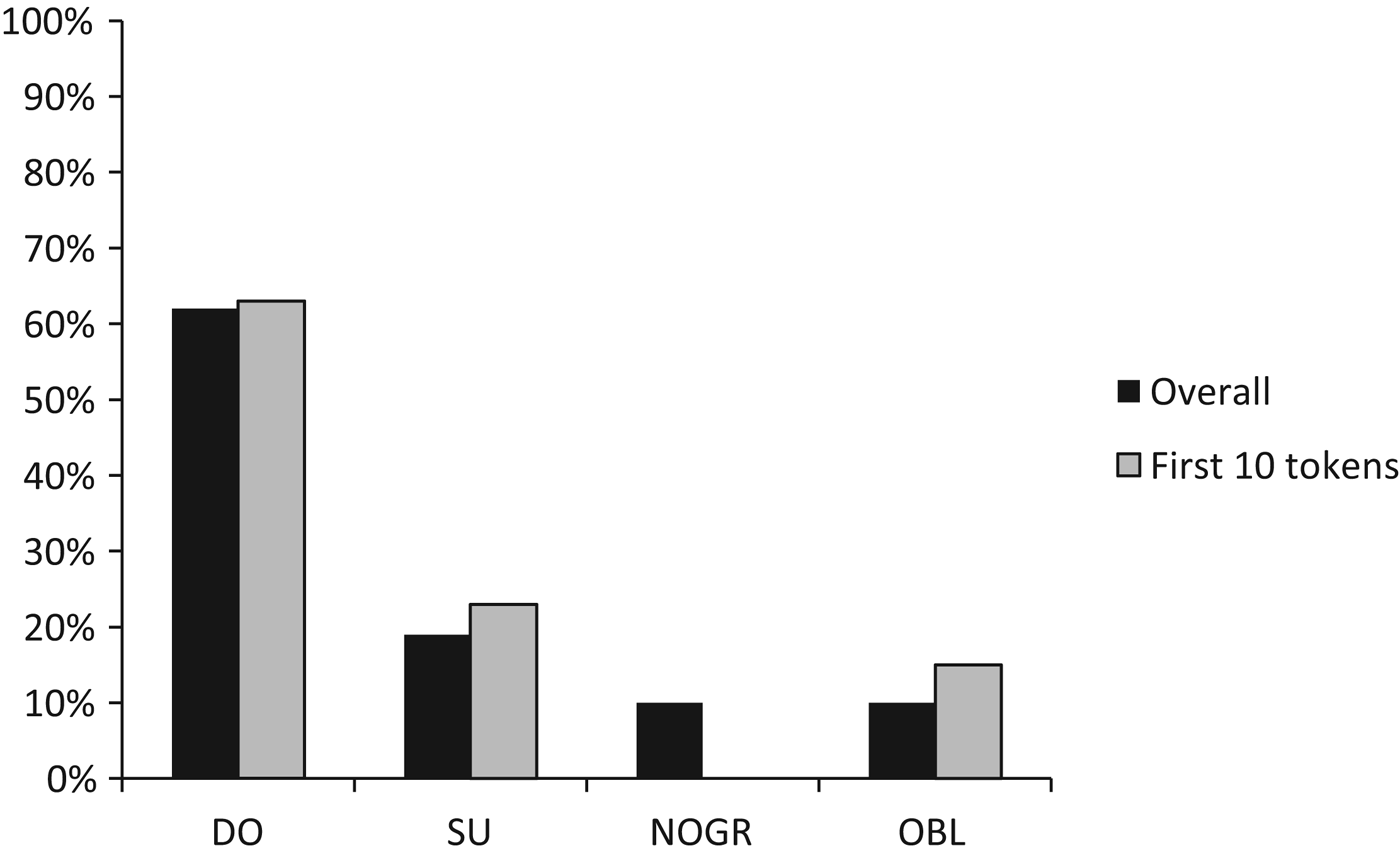
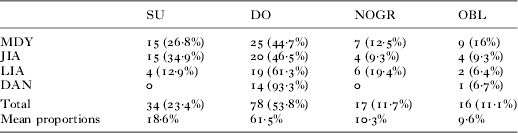
Figure 4 shows the mean proportions of RC types in the children's speech according to the syntactic role of the head noun inside the RC (see Tables 7 and 8 in the ‘Appendix’ for details of individual children's use of RCs). It is evident that the DO relatives are predominant (61·5%). SU relatives comprise 18·6%, and gapless and oblique relatives each form a small proportion (10·3%). The same pattern is seen in the children's first ten RCs. The predominance of DO relatives in Mandarin is in sharp contrast to the developmental pattern in English (Diessel & Tomasello, Reference Diessel and Tomasello2000) and in Japanese (Ozeki & Shirai, Reference Ozeki, Shirai, Matsumoto, Oshima, Robinson and Sells2007). English-speaking children show a strong primacy of SU relatives over DO relatives whereas Japanese-speaking children show a similar distribution of both types. SU relatives also dominate the first ten relatives in English children's speech, and in Japanese both SU and DO relatives emerge simultaneously.
Children's RCs by syntactic position inside the RCs (mean proportions).
How do we account for this difference between Mandarin, English, and Japanese? We propose that two possible factors may be playing a role. First, Mandarin DO relatives exhibit the same typical SVO word order as canonical simple sentences (see a similar argument for English and Cantonese in Diessel, Reference Diessel2007; Yip & Matthews, Reference Yip and Matthews2007b), except for the insertion of the relativizer de between the verb and the head noun. In contrast, SU relatives have VOS word order and the head noun is located at the end after the introduction of the predicate phrase in the RC (see (14), for example). This reversed word order may be more difficult than the canonical SVO word order and thus it may take children a longer time to learn.
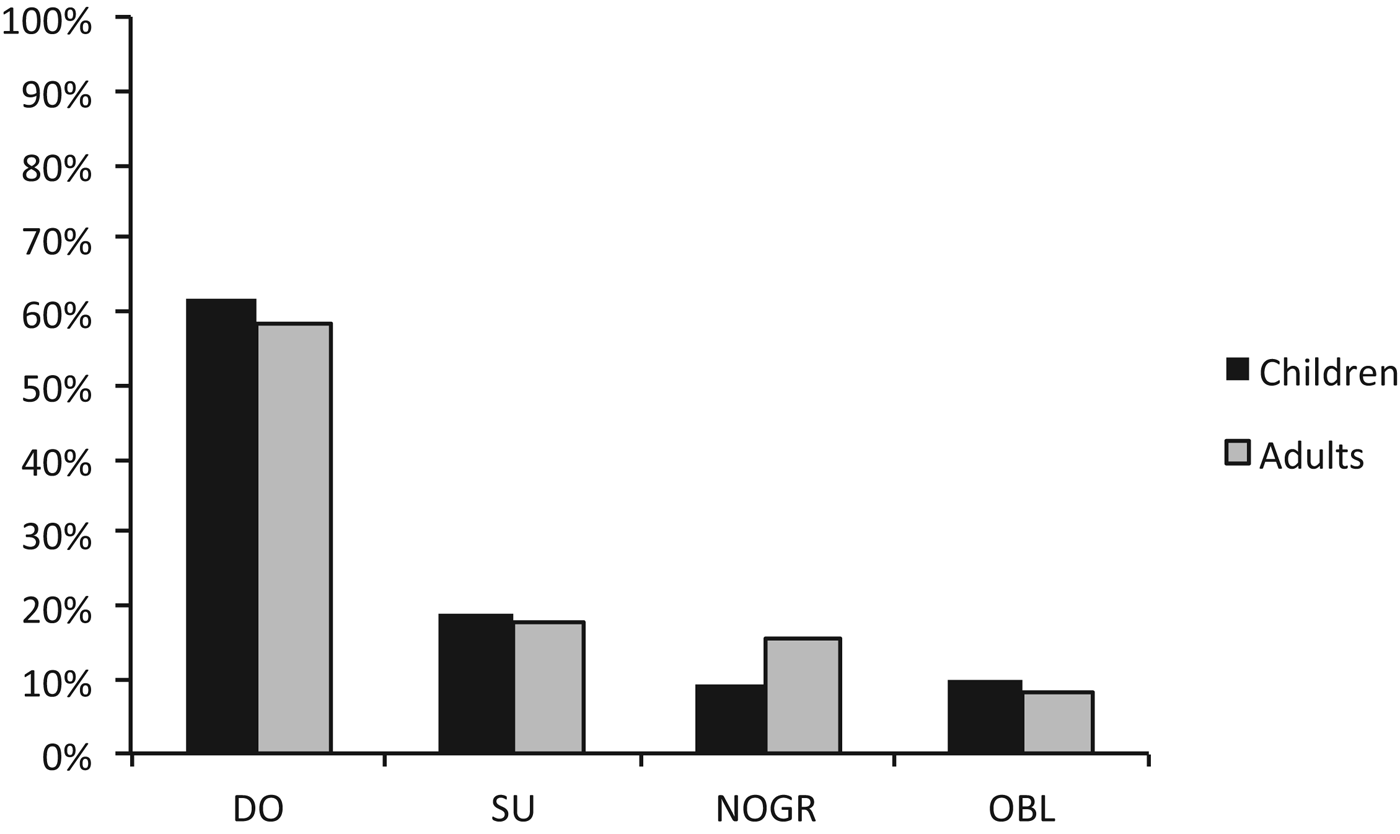
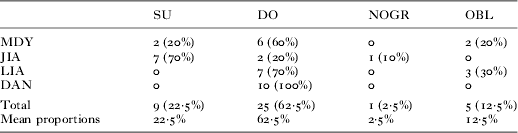
The second factor is the input. Figure 5 presents the mean proportions of the RC types by the syntactic position of head noun in the RC in the speech of the children and the caregivers (see Table 9 in the ‘Appendix’ for details of the use of RCs in the parental speech of each child). The DO relatives (58·6%) are more frequent than SU relatives (17·6%). The distribution of other three types of relative is also similar between the children and the caregivers. It is possible that the object primacy in the children's speech reflects an influence of the adult input. We will address the role of input in detail in the ‘General discussion’ section.
Children's and caregivers’ RCs by syntactic position inside the RCs (mean proportions).
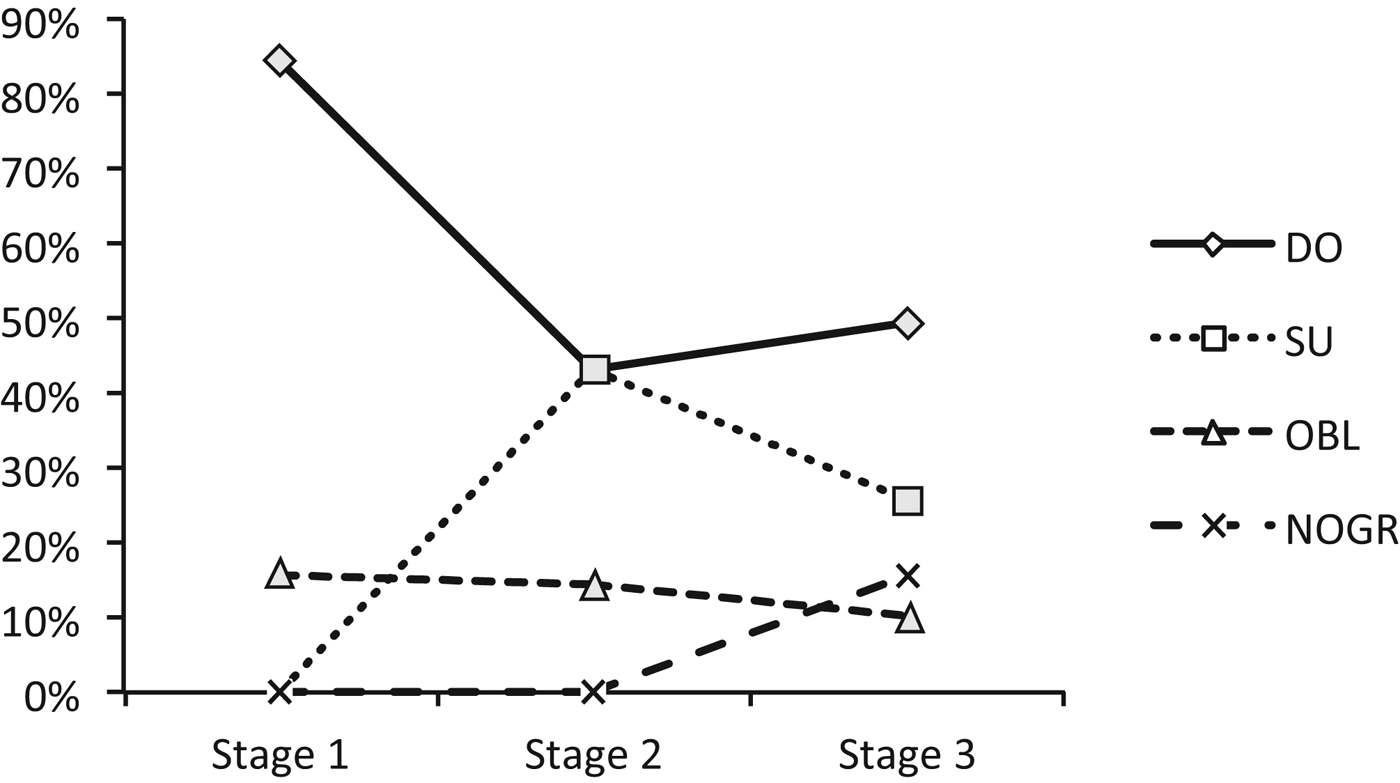
To see developmental changes in RC types by the syntactic position of the head noun inside the RC, we also analyzed the children's RCs according to their MLU levels. We again divided their relatives into the same three stages (as we did in the analysis of RC types by the syntactic position in the matrix clause).
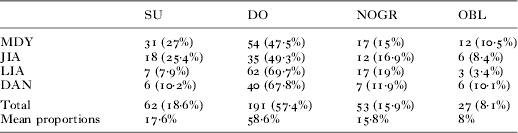
Figure 6 shows the mean proportions of different RC types at the three stages (see Table 10 in the ‘Appendix’ for details of individual children's development of different RCs). DO relatives predominate early production (84·2%) and decrease gradually with children's syntactic growth, but they still remain the most frequent (49·7%) at the final stage of our data. SU relatives, in contrast, are rare at the early stage and increase dramatically at Stage 2 (42·9%). Oblique and gapless relatives are infrequently used across the three stages (10–15%), which probably results from their structural complexity and low frequency in the input (see Figure 5).
Longitudinal development of children's RCs by syntactic position inside the RCs (mean proportions).
In sum, Mandarin children produce DO relatives more frequently than other types of relative. There is thus no subject primacy as predicted by the NPAH in early child Mandarin. This pattern contrasts sharply with those found in English (SU > DO > OBL) and Japanese (SU = DO = OBL). The predominance of DO relatives may possibly result from the inherent formal properties of DO relatives – the resemblance of DO relatives to simple sentence structure as well as the input frequency of DO relatives. In the next section, we will discuss these factors in more detail.
GENERAL DISCUSSION AND CONCLUSION
We have analyzed the development of RCs in Mandarin according to the syntactic position of the head noun in the matrix clause and its relativized position inside the RC. We found that the developmental trajectory of RC production in Mandarin differed from that in English (a postnominal RC language) and Japanese (a prenominal RC language) for which comparable analyses have been done (Diessel & Tomasello, Reference Diessel and Tomasello2000; Ozeki & Shirai, Reference Ozeki, Shirai, Matsumoto, Oshima, Robinson and Sells2007). The differences are summarized in Table 2. The symbol “>” indicates higher proportion and earlier emergence in production.
Summary of RC development in Mandarin, English, and Japanese

* Diessel & Tomasello (Reference Diessel and Tomasello2000).
** Ozeki & Shirai (Reference Ozeki, Shirai, Matsumoto, Oshima, Robinson and Sells2007).
These cross-linguistic differences suggest that the inter-typological (prenominal vs. postnominal RC clause languages) and intra-typological (prenominal RC clause languages) differences play an important role in shaping the developmental trajectory, and that different emergent orders of RCs reflect a gradual learning process from simple to more complex constructions, and structural simplicity is language-specific.
Syntactic role of the head noun in the matrix clause
In terms of the syntactic role of the head noun in the matrix clause, predicate nominal relatives are not the most frequent in early Mandarin-speaking children's speech, similar to Japanese-speaking children, but different from English-speaking children. This is probably due to the prenominal position of RCs in Mandarin. As in Japanese, Mandarin presentational RCs are center-embedded, and new information and comments on the referent are stated before the new referent is introduced, resulting in an unnatural order of information flow. These lead to the rarity of presentational relatives in Mandarin child speech, as in Japanese.
Isolated NP relatives are found to be the most frequent and the earliest type of relative in Mandarin. As we suggested earlier, an important reason for this pattern may be the formal structural similarity between RC and the noun modification of words and phrases in Mandarin (cf. a similar view in Chan et al., Reference Chan, Matthews, Yip and Kidd2011; Diessel, Reference Diessel2007). In noun modification constructions, the modifier (e.g. an adjective or an adjectival phrase) and the head noun are connected by the morpheme de (as in (19), below), which is identical to the relativizer de in a RC.
(19) baba de ban
daddy de board
‘daddy's board’
The relativizer de has been argued to be a generic modification marker, which appears with all prenominal modifiers, such as adjectival modifiers, possessors and RCs (L. L.-S. Cheng & Sybesma, Reference Cheng, Sybesma, Broekhuis, Corver, Huybregts, Kleinhenz and Koster2006). Comrie (Reference Comrie1996, Reference Comrie, Boeder, Schroeder, Wagner and Wildgen1998) proposed that Mandarin RCs are a subtype of attributive clauses, involving no gap in the relativized position, and have the structure of merely attaching a modifying clause to a head noun. Based on Comrie's proposal, Ozeki and Shirai predicted that children would acquire these constructions simultaneously (2007), or they could rely on the noun modification constructions they have acquired (2010). Our data are consistent with this argument – all the children have been producing noun modification constructions in isolated NPs before or simultaneously with their first RCs. For example, among the three children who produced RCs at a very young age, DAN produced his first RC at 1;7·25. He was simultaneously producing a variety of noun-modifying constructions which involved modifiers of adjectives (14 tokens), nouns (3 tokens), demonstratives (3 tokens), and classifiers (1 token). And 8·5% of his noun-modifying constructions were isolated NPs. Another child, MDY, produced RCs at 1;4 and showed similar productivity in the noun-modifying constructions. Nominal and adjectival modifiers were the most frequent in her early noun-modifying constructions, and they all appeared in isolated NPs. This finding is also consistent with Matthews and Yip (Reference Matthews, Yip and Ramat2003), in that Cantonese children's RCs developed on earlier adjectival modification constructions.
An additional factor contributing to the prevalence of isolated NPs may be the fact that they are structurally simpler than full sentences with a predicate, as they contain only a complex NP with an embedded RC. Our data illustrate that even for the noun-modifying constructions, children start with isolated NPs before they add more linguistic elements such as predicates.
Why object primacy for Mandarin?
Turning to the syntactic role (i.e. grammatical relations) of the head noun inside the RCs, the most striking finding is that DO relatives emerge early and remain the most frequent type in the Mandarin-learning children's speech. This pattern diverges from the well-established subject primacy over object relatives in English and other European languages. The Mandarin data provide strong evidence that DO relatives are not necessarily more difficult than SU relatives cross-linguistically. This result corroborates the same object primacy found in Cantonese, another Chinese language (Chan et al., Reference Chan, Matthews, Yip and Kidd2011; Yip & Matthews, Reference Yip and Matthews2007a, Reference Yip and Matthews2007b).
What specific factors contribute to the predominance of DO relatives in Mandarin? As discussed in the ‘Results’ section, two factors may have played a role: the similarity of the surface word order of DO relatives and simple SVO sentence structure, and the input. The first factor, the similarity to a simple SVO sentence, points to the effect of the Mandarin-specific structure of RCs on acquisition, as was the case for the early development of isolated NPs. We can illustrate the structural difference between a RC in (18) (repeated here as (20)) and its counterpart transitive sentence in (21). Both show a basic SVO surface order. The only difference is the insertion of the relativizer de between the verb and the object in the RC.
(20) [baba mai] de ban.
daddy buy rl board
‘the board that daddy bought'
(21) baba mai ban.
daddy buy board
‘Daddy bought board.’
Comrie (Reference Comrie2007) has suggested that the resemblance of DO relatives to simple clause structure in Mandarin is a factor that can lead to greater ease of acquisition of object relativization than subject relativization (see a similar proposal in Brandt & Kidd, Reference Brandt, Kidd and Schönefeld2011; Chan et al., Reference Chan, Matthews, Yip and Kidd2011; Diessel, Reference Diessel2007). Comparing examples (19), (20), and (21), we can see that the simple transitive sentence, noun modification, and RC are very similar in structure in Mandarin. Thus, in the acquisition of Mandarin, the simple SVO structure could function as the basis for the emergence of noun-modifying constructions for both isolated NPs and DO relatives. This proposal is consistent with Fitz et al.,'s (Reference Fitz, Chang, Christiansen and Kidd2011) connectionist modeling of the acquisition and procession of RCs, and their conclusion that different structures could mutually constrain each other, and structurally similar word sequences and constructions could affect syntactic acquisition.
Furthermore, a unified account is needed for the developmental trajectory of RCs, which takes into account the syntactic position in both the matrix and the subordinate clause. To this end, we looked closely at the case of the child MDY, who has the longest period of data collection. We found that in the most frequent type of relative, the isolated NP relatives, 50% are DO relatives. The combination of an isolated NP and a DO relative (see (20) for an example) is structurally the simplest possible relative in Mandarin, due to its similarity to the simple SVO sentence, and they are the most frequent in MDY's RC production. We also analyzed the verbs in the RCs and found that the majority of the verbs (80·4%) are transitive, but 60% had only one argument and 14% had no argument. Our results therefore converge with the processing-based learning account (e.g. O'Grady Reference O'Grady and Kidd2011), which predicts that children master less difficult patterns before more difficult ones, and processing difficulty impedes use and mastery of particular form–meaning mappings. This view is also consistent with the usage-based account (e.g. Diessel & Tomasello, Reference Diessel and Tomasello2000) that processing capacity functions as a general constraint on simple syntactic structures in early child speech.
The second important factor influencing the development is the distributional pattern in the input. We have shown that in the child-directed speech, Mandarin-speaking adults used DO relatives more frequently than other types. The child's use of DO relatives is likely a reflection of the input. Ozeki and Shirai (Reference Ozeki, Shirai, Matsumoto, Oshima, Robinson and Sells2007) also found an effect of input – Japanese children resembled their parents in producing similar proportions of SU and DO relatives. The suggested role of input in this area has been confirmed in computational models, where the production of SU and DO relatives could change by varying properties of the input from which the model learned (Fitz et al., Reference Fitz, Chang, Christiansen and Kidd2011). Recent studies of the processing of object relatives in English (Brandt et al., Reference Brandt, Kidd, Lieven and Tomasello2009; Kidd et al., Reference Kidd, Brandt, Lieven and Tomasello2007) and Hebrew (Arnon, Reference Arnon2010) also show that input frequency contributes to children's ease with inanimate-head object RCs and pronominal subject.Footnote 2 However, the role of input does not seem to explain the fact that English-speaking children defy input frequency (Diessel, Reference Diessel2004) and acquire SU earlier than DO relatives. We will address this discrepancy in the section below.
Pre- vs. post-modification, the NPAH, or multiple factors?
Taking the results from Mandarin, Cantonese, and Japanese together, it is tempting to hypothesize that the lack of SU primacy is a result of the structural difference between prenominal and postnominal RC languages due to differences in the positioning of the RC and the requirement for an explicit relative pronoun. However, children learning Turkish, also a prenominal language without a relative pronoun, show a strong subject primacy (Özge, Marinis & Zeyrek, Reference Özge, Marinis, Zeyrek, Chandlee, Franich, Iserman and Keil2010; Slobin, Reference Slobin, Slobin and Zimmer1986). How can we account for this intra-typological variation?
Ozeki and Shirai (Reference Ozeki, Shirai, Matsumoto, Oshima, Robinson and Sells2007) suggested that the different learning patterns between Japanese and Turkish were due to the formal morphological complexity involved in the Turkish RC formation. As noted above, Comrie's new typology proposes that Turkish is a RC language, while Japanese (and Mandarin) is an attributive clause language. Thus, different learning trajectories in prenominal RC languages suggest that the learning variations result from intra-typological ‘structural’ differences in terms of RC formation.
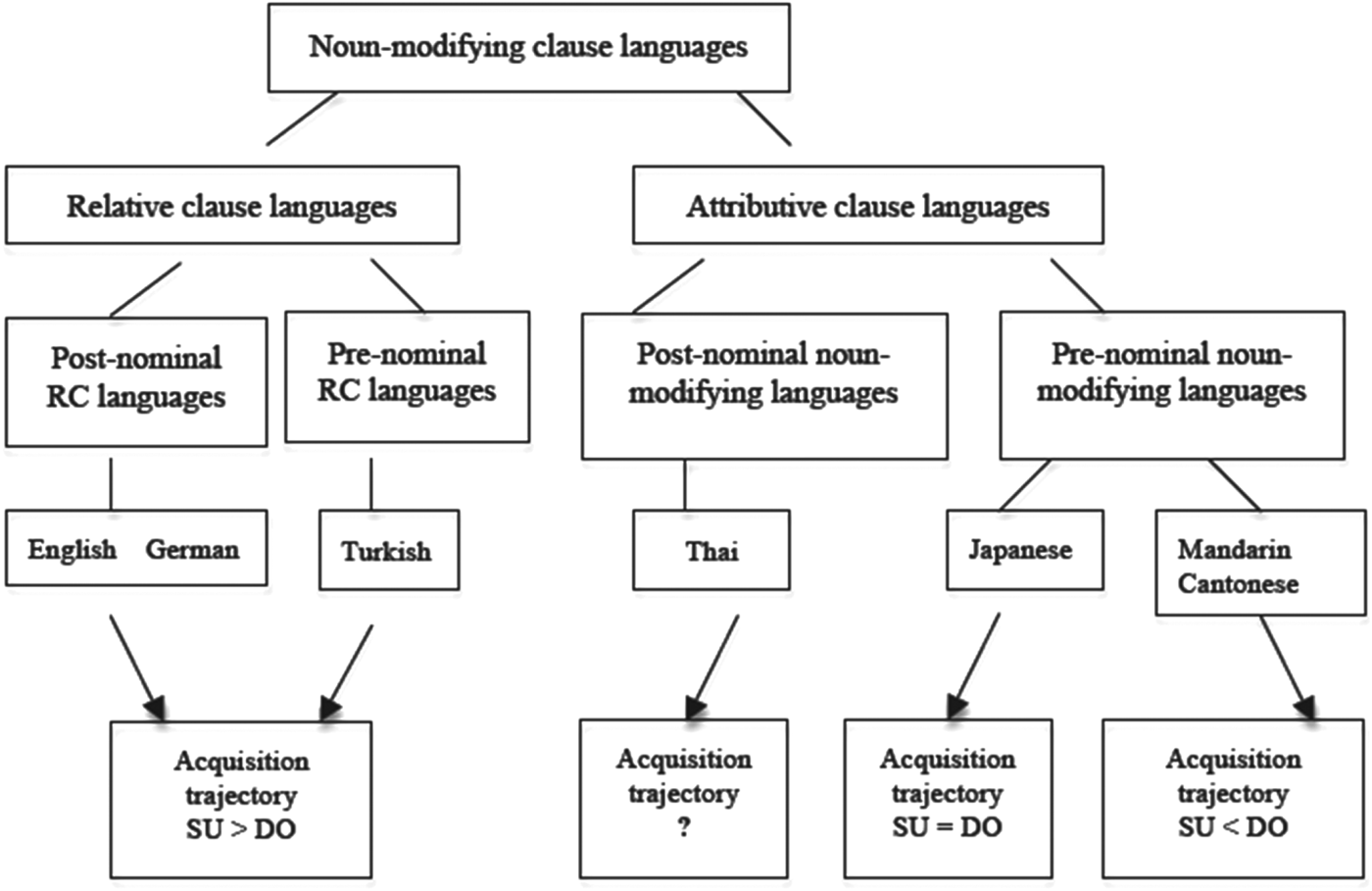
To elaborate, Comrie proposes that the typology of RCs is best seen as a two-way distinction – at one end, languages having typical RCs that involve gaps (such as English and German), and at the other end, languages having only attributive clauses (such as Mandarin, Japanese, and Cantonese). This dichotomy entails a consistent pattern in acquisition regarding SU vs. DO relatives cross-linguistically. Figure 7 is a schematic representation of the typology of noun-modifying clauses and their acquisition cross-linguistically, illustrated with representative languages.
Schematic representation of the typology of noun-modifying clauses and implication for their acquisition across languages. note: The question mark indicates languages that have postnominal clauses that are attributive (e.g. Comrie, Reference Comrie1996), for which no acquisition data are available. Future studies should explore this type of language (Ozeki, Reference Ozeki2008, p. 266).
As Figure 7 shows, RC languages include both postnominal RC languages (e.g. English, German) and prenominal RC languages (e.g. Turkish). In this type of language, there is a primacy of SU relatives over DO relatives due to structural reasons (i.e. the formal complexity involved in relativizing different syntactic positions, as reflected in the NPAH). In contrast, in attributive clause languages, various factors jointly determine the order of acquisition of SU, DO, and other types of relative, which include input and similarity to the canonical simple sentence.
This explains why English-speaking children defy input frequency (Diessel, Reference Diessel2004; Diessel & Tomasello, Reference Diessel and Tomasello2000) and acquire SU earlier than DO relatives, whereas Mandarin-speaking children follow input frequency and DO precedes SU relatives. We suggest above that this is due to their similarities to simple sentences on which RCs are built, in addition to the influence of input frequency. Another possibility, though not mutually exclusive, is that cross-linguistic developmental differences are due to the fact that English is a RC language, while Mandarin is an attributive clause language in Comrie's typology. One of Comrie's defining features of the RC is that its grammatical relations (i.e. SU vs. DO vs. OBL, etc.) have formal consequences, while for the attributive clause they do not (i.e. they all have the same form), as in the case of Japanese or Mandarin. This is why the acquisition of RC languages is generally governed by grammatical relations (i.e. the NPAH), but not that of attributive clause languages. More specifically, we suggest that SU relatives in English may be easier because of their formal transparency: SU relatives always have relative marker (which, that, or who), marking subordination and grammatical relations explicitly all the time, while DO relatives sometimes do (e.g. the girl that/who I saw), and sometimes do not (e.g. the girl I saw), which makes it more difficult for children to parse, and thus acquire. This hypothesis is theoretically interesting and leads to further typological generalizations. Comrie's RC languages (including Turkish) generally have SU acquired earlier than DO relatives because of their formal complexity, while in attributive clause languages it depends more on other multiple factors, and that is why so many studies in East Asian languages show conflicting results. We, of course, do not predict that all RC languages will show the same results – it is just that formal complexity is a powerful determiner, but if other factors override it, SU = DO or even SU < DO is possible. This hypothesis should be tested in future research.
We take a multiple-factorial, usage-based approach to the acquisition of noun-modifying clauses (i.e. both relative and attributive clauses), in which similarity to simple sentence structure, similarity to adjectival modification, input frequency, and the formal complexity of the target structure interact and determine whether subject primacy is observed. While we reject the approach that takes syntactic structure (such as NPAH) as the sole predictor, it appears that Comrie's typology (RC vs. attributive clause) is a very strong predictor; all RC languages that have been studied (English, German, and Turkish) exhibit subject primacy, and we argued above that this is due to the formal complexity involved in RC formation in RC languages. Children have to compute the formal properties of subject vs. object (and other types of) relatives to correctly parse and produce a RC, which will be a burden for processing/acquisition. Thus the current hypothesis is that for RC languages, the weight of formal complexity as a predictive factor of RC acquisition is very strong (see English RC acquisition, which defies input frequency and shows subject primacy). The reason that SU relatives are easier, we suggest, is their processing ease, which is why they are instantiated arguably in all languages that have a RC (Keenan & Comrie, 1977), which in turn makes them formally less complex than other types of RC. Thus, we would predict that if there is a language in which formal complexity is higher for SU than DO, DO is acquired earlier, even in a RC language. This hypothesis should be tested with more cross-linguistic data.
In conclusion, our study has shown that the acquisition of RCs is shaped by the language-specific formation of RCs, rather than the NPAH or other purely structure-based accounts. Children construct complex RCs from simpler constructions and what makes a particular structure easier is language-specific. Children are sensitive to the distributional patterns in their input and the formal complexity of the target from an early age.
Appendix: summary tables of data
Total number of PN, NP, SUBJ, OBJ, and OBL RCs in child speech
First ten PN, NP, SUBJ, OBJ, and OBL RCs in child speech
Total number of PN, NP, SUBJ, OBJ, and OBL RCs in caregiver speech
Development of PN, NP, SUBJ, OBJ, and OBL RCs measured by MLU
Total number of SU, DO, NOGR, and OBL RCs in child speech
First ten SU, DO, NOGR, and OBL RCs
Total number of SU, DO, NOGR, and OBL RCs in caregiver speech
Development of SU, DO, NOGR, and OBL RCs measured by MLU