INTRODUCTION
At the July 1933 congress of the Section française de l'International ouvrière (SFIO)—that is, the French Socialist PartyFootnote 1—members of the party's right-wing faction mounted what came to be perceived as an assault on the party's revolutionary doctrine. Alarmed by the rise of fascism and the party's inaction in the face of economic crisis, they called for a revision of the party's traditional proletarian orientation. What was now needed, they asserted, was a strong state capable of rallying the middle classes, and to that end it was proposed that the party take up “order,” “authority,” and “nation” as its new watchwords. The “neo-socialists,” as they came to be called, were accused of flirting with fascism and were soon expelled from the SFIO, taking with them seven senators, twenty-eight deputies, and about thirty thousand members (Lefranc Reference Lefranc1982; Ligou Reference Ligou1962). The schismatics subsequently founded a new political party, the Parti socialiste de France (PSdF), with “neo-socialism” as its doctrinal basis. Ten years later, several neo-socialists would become notorious Nazi sympathizers, seemingly confirming the interpretation of neo-socialism as a proto-fascist heresy.Footnote 2
The 1933 schism has commonly been referred to as the “neo-socialist schism,” and it is often presumed that it was provoked by the neo-socialists’ doctrinal revision (e.g., Ligou Reference Ligou1962: 390; White Reference White1992: 104). However, the neo-socialists were not formally expelled for their doctrinal heresy, but rather for their indiscipline relating to questions of parliamentary strategy. Indeed, the schism was the culmination of a long factional conflict within the party between “participationists,” that is, those favoring Socialist ministerial participation in bourgeois (non-socialist) governments, and the “anti-participationist” party majority.
Even when the centrality of this factional conflict to the 1933 schism is recognized, specialists on French socialism have tended to interpret the schism as the conjunction of two parallel challenges to party orthodoxy. On one hand were reformist parliamentarians whose objections to the party line were largely tactical. On the other were supposedly authentic neo-socialists who “demanded a complete revamping of Socialist theory and action” (Colton Reference Colton1966: 82). According to Grossman, the “Neo-Socialist split of 1933 combined those elements in the party favoring participation with elements favoring a more basic doctrinal revision” (Reference Grossman1985: 48). In this view, the 1933 schism was driven by two concurrent challenges, one tactical and the other doctrinal. If the participationists’ intransigence over tactics was the proximate cause of the schism, the neo-socialists’ doctrinal revision constituted its ultimate cause.
But this interpretation is only partially correct. By the time the schism became official in November 1933, neo-socialism had indeed come to represent a doctrinal alternative to traditional socialism. But the historiography has tended to unduly reify neo-socialism, as if it emerged as a coherent doctrinal alternative ready-made from the heads of its founders. Moreover, the extant historiography has also erred in taking the analytical distinction between tactics and doctrine at face value.
The neo-socialist schism is interesting not because it is unique, but rather because the prevailing historical accounts of it reproduce biases in the sociological literature on schisms more generally—namely, the tendency to treat internal organizational heterogeneity statically. Though the literature focuses on the conditions under which such heterogeneity becomes schismatic, much less attention has been paid to the ways in which internal classifications and the meanings attached to them can be dynamically altered through the schismatic process itself, generating new identifications. The 1933 schism is an especially fruitful case for critically examining the relationship between factional conflict, the process of schism, and doctrinal innovation.
Against prevailing accounts, I argue that the history of neo-socialism was inscribed within the history of the factional conflict over ministerial participation. The neo-socialists were not an identifiable group until 1933, before which neo-socialism as such, that is, as a self-conscious and widely recognized doctrinal alternative, did not exist. As fervent participationists, the neo-socialists were initially focused on reorienting the SFIO's parliamentary action. Neo-socialism only came to be elaborated and recognized as a distinct doctrine in and through the factional conflict over ministerial participation.
Crucial to this process was the discursive mobilization of the distinction between “tactics” and “doctrine.” I do not assume that this distinction has any analytical value, such that some issues are considered inherently tactical (e.g., participation) and others doctrinal (e.g., neo-socialism). I argue, instead, that the distinction functioned within the party as an axiological operator, as a polemical device defining the limits of legitimate discourse (Sapiro Reference Sapiro2004). Doctrine was sacrosanct, yet the line dividing “doctrine” and “tactics” was fluid. Thus, whether what came to be labeled as “neo-socialism” constituted a doctrinal heresy or an innocent tactical disagreement was not self-evident, but rather the object of a classification struggle.
This struggle over the meaning of neo-socialism was an element in the factional conflict over ministerial participation, and its outcome depended on the factional balance of forces. So long as the party incumbents who were hostile to participation were secure in their majority, it could be agreed that the factional debate concerned only a tactical question. But as the challenge from the participationist faction grew and threatened to overturn this majority, the party's left-wing faction began accusing the participationists of a doctrinal heresy in order to delegitimize them. At first, the participationists resisted this label and insisted on their doctrinal fidelity. It was only when a schism became a near certainty that a segment of the party's right began to explicitly recast their challenge as a doctrinal one and took up the “neo-socialist” label. What started as a tactical disagreement was thus transmuted into a doctrinal controversy, and what was initially a polemical label imposed on the challengers to discredit them became the foundation of their new political identity, precisely at a point when a new political identity became necessary. Neo-socialism's existence as a coherent and self-conscious revision of socialist doctrine was thus less a cause of the 1933 schism than its product.
My paper proceeds as follows: first, I give a brief overview of the sociological literature on schism and political identity and outline my own approach. I then discuss the place of doctrine in the SFIO and consider its significance in explaining the 1933 schism. I follow this with a theorization of the discursive function of the “doctrine”/“tactics” distinction within the party. The paper's second half is an analytic narrative of the factional conflict within the SFIO and the emergence of “neo-socialism.”
SCHISM AND POLITICAL IDENTITY
I argue that the 1933 schism was not simply the expression of a self-same and coherent neo-socialist revision; rather, neo-socialism as a distinct doctrine emerged from the schismatic process itself. That is, neo-socialism was not a pre-constituted political identity, but was instead constituted in and through the schism. This has implications for how we understand schisms and political identity more generally.
The sociological literature on organizational schism—defined here as any formal split from an organization due to disagreement over its purpose or practice—spans a variety of substantive fields, including the study of religion (Bruce Reference Bruce1990; Bryant Reference Bryant1993; Liebman, Sutton, and Wuthnow Reference Liebman, Sutton and Wuthnow1988; Stark and Bainbridge Reference Stark and Bainbridge1996; Sutton and Chaves Reference Sutton and Chaves2004; Wallis Reference Wallis1979), political parties (Balinski and Young Reference Balinski and Young1978; Graham Reference Graham1994; Nyomarkay Reference Nyomarkay1967; Sani and Reicher Reference Sani and Reicher1998; Schorske Reference Schorske1955), social movements (Ansell Reference Ansell2001; Balser Reference Balser1997; Gamson Reference Gamson1975; Zald and Ash Reference Zald and Ash1966), and organizations (Defrance Reference Defrance1989; Dyck and Starke Reference Dyck and Starke1999; Hirschman Reference Hirschman1970; Pondy Reference Pondy1967). Though this literature remains diffuse, it does evince some general tendencies. It has been primarily concerned with identifying factors determining the likelihood of organizational schism. Researchers have variously pointed to the morphological characteristics of organizations (Liebman, Sutton, and Wuthnow Reference Liebman, Sutton and Wuthnow1988), processes of organizational closure (Ansell Reference Ansell2001; Sutton and Chaves Reference Sutton and Chaves2004), social differentiation within organizations (Niebuhr Reference Niebuhr1929), the nature of organizational legitimacy (Bruce Reference Bruce1990; Nyomarkay Reference Nyomarkay1967; Wallis Reference Wallis1979; Zald and Ash Reference Zald and Ash1966), and environmental factors (Balser Reference Balser1997). In looking to such institutional factors to explain propensity to schism, much of this literature challenges the presumption that schisms are caused by ideational heterogeneity within organizations. As Gamson (Reference Gamson1975) has noted, heterogeneity is a natural feature of all organizations, whereas not all organizations are prone to schism. Schisms thus do not simply express heterogeneity, but rather represent an institutional failure to solve the problem of internal conflict. This is consistent with one of my arguments in this paper: that the 1933 schism was not the necessary outcome of a pre-existing doctrinal conflict between neo-socialism and traditional socialism.
But if this schism was not predetermined by doctrinal disagreements, neither were intra-party conflicts always-already understood to be “doctrinal” in nature. Indeed, my argument is not that neo-socialism only became schismatic once certain institutional or environmental conditions were met, but rather that the very elaboration of neo-socialism as a distinct doctrine was an emergent outcome of the process of schism. This highlights a limitation in the literature on schisms: though the reduction of schism to intra-organizational heterogeneity is rejected, this heterogeneity is still conceptualized in largely static terms. Internal disagreements are generally assumed to be fixed, with the question being under what conditions these fixed disagreements become schismatic. Much less attention has been paid to the ways in which the dynamics of schism reclassify existing divisions, thereby creating new identifications.
One promising move in the literature has been the attempt to develop a “process model” of group exit (Balser Reference Balser1997; Dyck and Starke Reference Dyck and Starke1999). For example, in their critical discussion of Hirschman's (Reference Hirschman1970) “exit, voice, loyalty” paradigm, Dyck and Starke (Reference Dyck and Starke1999) argue that exit, voice, and loyalty are all phases in a schismatic process marked by a series of cognitive shifts that shape actors’ group and sub-group identifications. This approach broadly resonates with a growing literature that highlights the ways in which political identities, motivations, and interests are contingently constituted through short-term interactional processes within shifting local contexts. For example, Walder (Reference Walder2009a) has criticized the literature on social movements for treating movement motivations as fixed and given and has called instead for a reorientation of political sociology back toward an examination of the structural determinations of collective political identity. However, he urges us to rethink what is meant by structure. Against structural accounts that locate the determinants of collective identity in macro-structural conditions, Walder highlights studies that emphasize local and short-term contingent processes that shape political orientations (e.g., Markoff Reference Markoff1985; Reference Markoff1988; Reference Markoff1997; Shapiro and Markoff Reference Shapiro and Markoff1998; Tilly Reference Tilly1964; Traugott Reference Traugott1980; Reference Traugott1985).
In his own work on factional struggles during the Chinese Cultural Revolution, Walder (Reference Walder2006; Reference Walder2009b) argues that factional identities were not fixed by actors’ social position but were instead “emergent properties” of highly localized conflicts within rapidly shifting political contexts. These shifts rendered the straightforward expression of prior commitments problematic and forced actors to make consequential choices in ambiguous circumstances. These choices, in turn, generated new interests, identities, and antagonisms, and thereby realigned the political landscape. In the same vein, Slez and Martin (Reference Slez and Martin2007) have put forth a model of political action that is sensitive to temporal context. Whereas a linear model of political action “assumes that all interests are fixed and that the corresponding actions are conditionally independent across time,” they argue that the substantive meaning of certain issues is sometimes conditional on past political action in a path-dependent way, such that actors’ interests become realigned in time as they engage in an “iterative process of position-taking” within a structural context continually altered by the congealed effects of past actions (ibid.: 45–46).
An interactional view of how movement identities are formed in and through contentious episodes is also shared by McAdam, Tarrow, and Tilly (Reference McAdam, Tarrow and Tilly2001). Likewise, Ermakoff has criticized explanations of political commitment predicated on the idea that “conjunctures precipitate latent dispositions” (Reference Ermakoff2008: 176). In his study of the 1933 and 1940 parliamentary votes empowering Hitler and Pétain, respectively, he instead develops a model of collective alignment that emphasizes the contingent nature of political preference formation under troubled circumstances (ibid.). More recently, Jansen (Reference Jansen2016) has drawn inspiration from pragmatism to suggest that the emergence of new modes of political practice can be explained by what he calls “situated political innovation”—an interactional and iterative process by which collective actors confronted with problematic situations fashion novel political repertoires through recombination and experimentation.
Also relevant is Dobry's “relational perspective” on political ideologies (Reference Dobry and Dobry2003). This “relational perspective” is opposed to what Dobry calls a “classificatory logic,” according to which political ideologies have fixed and bounded essences which manifest themselves in practice and on the basis of which various political phenomena can be classified. A “relational perspective” instead highlights the plasticity of ideologies and the porousness of their boundaries. It interprets political practices in relation to specific “contexts of action” within which agents act and define themselves in relation to others (ibid.: 47). In Dobry's view, political ideologies and their boundaries are constituted relationally through such classification struggles within competitive political fields.
My argument builds on the above perspectives on the contingent, processual, and interactional formation of political identities, which I define here as relatively coherent sets of political beliefs that are explicitly differentiated from other such sets in such a way as to mark out distinct positions within the political field. I do so to advance an account of schism that foregrounds its character as a classification struggle. Schisms, I suggest, do not simply ratify pre-existing divisions; the schismatic process is what renders divisions meaningful, and this process can constitute the very divisions that are subsequently presumed to have been at the origin of it. In other words, the process of schism itself can generate schismatic identities.
ANALYTICAL STRATEGY AND SOURCES
My analysis here is drawn from a broader study of the neo-socialists’ political trajectory. This trajectory generally followed a path-dependent logic. Goldstone defines path dependence as “a property of a system such that the outcome over a period of time is not determined by any particular set of initial conditions” (Reference Goldstone1998: 834). Mahoney further specifies “reactive sequences” as a particular type of path dependence in which a contingent “breakpoint” intervenes to set off a chain of “temporally and causally connected events” leading to the outcome of interest. Each event in such a sequence is “both a reaction to antecedent events and a cause of subsequent events” (Reference Mahoney2000: 526). The outcome of interest in this paper is the 1933 schism and the emergence from it of neo-socialism as a distinct political identity. This was path-dependent in the sense that, as I will show, it cannot be deduced from initial conditions within the SFIO. It was instead the product of a “reactive sequence” in which an intervening event—the shift in the balance of factional forces—triggered a series of moves and counter-moves that culminated in the “neo-socialist schism.”
Mahoney suggests that historical narrative offers “an especially useful method for making sense of the multiple steps in a reactive sequence” (ibid.: 530). Others have also noted that the ability of narrative to capture unfolding processes over time makes it uniquely appropriate in constructing explanatory accounts of cases characterized by path dependence and contingency (Aminzade Reference Aminzade1992; Sewell Reference Sewell2005; Somers Reference Somers1992). My analytical strategy is thus to reconstruct as completely as possible a blow-by-blow narrative account of the factional conflict within the SFIO. In doing so, I pay particular attention to semiotic chains of meaning-making, tracing the “semiotic career” of key terms like “doctrine” and “neo-socialism.” I, in turn, have used the principles of abductive analysis to construct a theoretically informed narrative that makes sense of this data and explains the observed variation over time (Tavory and Timmermans Reference Tavory and Timmermans2014). In other words, I have used theory to articulate an “analytic narrative” that, by reconstructing how, also accounts for why “neo-socialism” was invented (Aminzade Reference Aminzade1992: 457).
I have been able to capture the unfolding process of meaning-making thanks to the abundance of available primary source material. My analysis is based on a close reading of the national-level Socialist party press between 1926 and 1933. The factional conflict played out publicly on the pages of the SFIO's national daily, Le Populaire, as well as in weekly factional papers like La Bataille Socialiste and La Vie Socialiste. I exhaustively scanned these and a selection of other Socialist journals, books, and pamphlets for content relating to ministerial participation or doctrinal revisionism. I also consulted the stenographic minutes of every national party congress in this period. Between these sources, I was able to read nearly every printed intervention in the factional conflict that led to the 1933 schism, at least at the national level. Digitizing this material also made possible basic word searches to roughly track the frequency of key terms.
EXPLAINING THE 1933 “NEO-SOCIALIST SCHISM”: DOCTRINAL HERESY OR FACTIONAL CONFLICT?
The SFIO's political identity was anchored in its doctrine. The party was formed with the 1905 merger of several competing parties representing the socialist movement's reformist and revolutionary wings (Ansell Reference Ansell2001; Lefranc Reference Lefranc1963). The resulting “Unity Pact,” expressing party doctrine, unequivocally affirmed the revolutionary class character of the party (Parti socialiste SFIO 1905). Nonetheless, the party also acknowledged the revolutionary value of reforms, thereby attempting to reconcile revolutionary and reformist tendencies. So, while Socialist deputies were enjoined to oppose the bourgeois regime, they were equally obligated to pursue whatever reforms they could within the existing order.
It is tempting to see in this hedging between revolution and reform a sign of doctrinal incoherence. This, however, misses the point. It was “precisely because the foundations of socialist unification were so shaky” that “there was a tendency to make a fetish of the principle of unity” (Judt Reference Judt1986: 116). It was the ambiguous relation of reform to revolution within it that allowed “doctrine” to become “the cement of the organization” by glossing over factional disagreements (Bergounioux and Grunberg Reference Bergounioux and Grunberg2005: 90). For the party left, doctrine guaranteed the party's revolutionary vocation, whereas for the party right it gave meaning and direction to its pursuit of reforms.
The importance of “doctrine” to party identity can be gleaned from the countless appeals to it in the party press. SFIO secretary-general Paul Faure wrote that “doctrine” was “our only reason for being, our ‘guardian angel’ that protects us against our own errors and possible weaknesses, the pure goddess whose golden robe is never tarnished by desertions or betrayals….”Footnote 3 Even after the 1920 Communist-Socialist schism, the reconstituted SFIO remained riven by opposing factions and unity was only secured by repeatedly invoking the party's doctrine and thus reaffirming its covenantal function (Ansell Reference Ansell2001; Judt Reference Judt1976).
Nevertheless, the sanctity of doctrine did not preclude all criticism of socialist orthodoxy. By the early 1930s, a younger generation of socialists grew impatient with this orthodoxy, which appeared increasingly anachronistic in the face of postwar economic transformations (Biard Reference Biard1985). Among this generation were Barthélémy Montagnon and Marcel Déat, both of whom would go on to become leading neo-socialists. Montagnon explicitly rejected what he considered to be an outdated reliance on Marxism and advocated a reorientation of socialist theory and practice toward a gradualist reformism capable of creating a community of interest with the middle class and its political expression, the center-left Parti radical, hereafter referred to as the “Radicals” (Montagnon Reference Montagnon1929). In a 1930 book, Déat (Reference Déat1930) noted that the Marxist prediction of growing proletarianization had failed to come true, and he called instead for a broad “anti-capitalist” front with the middle classes. Rejecting a chiliastic conception of revolution, he argued that socialists should penetrate the bourgeois state with the goal of initiating a series of structural reforms—through a stepwise socialization of economic power, profit, and lastly, property—capable of channeling capitalist development toward socialist ends.
It is tempting to see this as an early expression of neo-socialist doctrine. Indeed, scholars have traced the birth of neo-socialism back to Déat's book (Grossman Reference Grossman1975; Sternhell Reference Sternhell2000), with one calling it the “charter” of neo-socialism (Bergounioux Reference Bergounioux1978: 396). However, to treat Montagnon's and Déat's critiques as coherent articulations of neo-socialism such as it came to be understood in 1933 is problematic. Similar criticisms of orthodoxy were in fact made by other young socialists (e.g., Boivin, Lefranc, and Deixonne Reference Boivin, Lefranc and Deixonne1932; Moch Reference Moch1927; Philip Reference Philip1928). These were sometimes more explicit in their revisionism, but they did not provoke the same amount of controversy within the party. Only Montagnon and Déat came to be regarded as intellectual architects of a schismatic doctrine, whereas these others were spared official condemnation and remained within the party fold.
The neo-socialist schism thus cannot be satisfactorily explained by reference to heterodoxy alone. Challenging orthodoxy did not lead necessarily to schism. What, then, separated Déat and Montagnon from other heterodox figures? The answer is that they were active in the party faction advocating Socialist ministerial participation in a coalition government, whereas the others opposed this.
The question of what attitude to take vis-à-vis bourgeois governments had long been a contentious one within European socialism. Indeed, the single most divisive issue in the SFIO between the 1920 and 1933 schisms was the potential participation of the party as a junior coalition partner in a non-Socialist government, specifically one formed by the center-left republican Radicals. Whether or not the above-mentioned heterodox figures were considered doctrinally problematic ultimately depended on where they stood on this question.
This raises an important question: if neo-socialism only emerged as a distinct doctrinal identity in and through the factional conflict over ministerial participation, what was the doctrinal status of participation? The answer was in fact sufficiently ambiguous that both participationists and anti-participationists could claim doctrinal fidelity. The party's doctrine and its position on participation was supposedly defined by its “Charter,” which consisted of the 1905 “Unity Pact” (and the preceding resolutions of the Second International on which it was based) and the declarations immediately following the SFIO's reconstitution following the 1920 Communist-Socialist schism. The “Unity Pact” directed parliamentary deputies to “refuse the government all means that assure the domination of the bourgeoisie and its maintenance of power.” However, it also admitted the possibility of “exceptional circumstances” under which this injunction could legitimately be violated (Parti socialiste SFIO 1905: 14).
This pact was itself based on the 1904 Amsterdam resolution of the Second International. Following on the heels of the “revisionist controversy” in Germany, this resolution condemned revisionism and reaffirmed socialism's revolutionary calling. To this end, it proscribed “any participation in a government under bourgeois society, in conformity with the Kautsky resolution [passed at the 1900 congress of the International],” and rejected any “rapprochement with the bourgeois parties.” The “Kautsky resolution,” however, was itself ambiguous. For example, it warned that the “entry of an isolated socialist in a bourgeois government cannot be considered as the normal commencement of the conquest of political power, but only as a forced expedient, transitory and exceptional.” But, the motion added, “If, in a particular case, the political situation necessitates this dangerous experiment, this is a question of tactics and not of principle, the international Congress does not pronounce itself on this point, but, in any case, the entry of a socialist in a bourgeois government can be hoped to produce good results for the militant proletariat only if the socialist party, in its great majority, approves such an act, and if the socialist minister remains an agent of his party.”Footnote 4
While the documents that made up the “Charter” clearly established a fundamental opposition to the political order and expressly forbade measures such as participating in bourgeois governments and approving state budgets, they also left considerable room for interpretation. The 1921 manifesto of the reconstituted SFIO, for example, condemned “ministerialism” and specifically referenced Alexandre Millerand's controversial 1899 decision to join the Waldeck-Rousseau government over the opposition of his fellow socialists.Footnote 5 The “Kautsky resolution” likewise condemned the entry of “an isolated socialist” in a bourgeois cabinet. But it was an open question whether this proscription covered all forms of participation. Individual ministerial ambitions stood condemned, but what if those individuals were given the green light by the party? Were “participation” and “ministerialism” synonymous, or did the latter only refer to cases such as Millerand's?
The “Charter” also recognized the existence of “exceptional circumstances” under which ministerial participation was allowed. This came with certain conditions. Even under “exceptional circumstances” the decision to participate rested with the party and not with individual parliamentarians. Moreover, this decision had to be approved by a “great majority.” But what specifically constituted “exceptional circumstances” or a “great majority” and who had the authority to decide were not spelled out, and these would all become objects of contention.
Finally, the “Kautsky resolution” explicitly qualified the question of participation as one of “tactics and not of principle.” A salient distinction was thus introduced between “principle”—or, as it would later be rendered, “doctrine”—and “tactics.” But this distinction, too, was ambiguous. The “Charter” enshrined into doctrine a general hostility toward the bourgeois state. Participation was allowed, but only exceptionally and with suspicion. The 1904 Amsterdam resolution, the 1905 “Unity Pact,” and the 1921 manifesto all rejected participation as contrary to the SFIO's revolutionary mission. Yet the “Kautsky resolution” to which they referred recognized participation as a “tactical” problem. Depending on which passages from which document one cited, a plausible argument could be made either way about the doctrinal status of ministerial participation. Whether or not, and under what circumstances, a decision to enter a coalition government with bourgeois parties constituted a violation of party doctrine would become the central question dividing the SFIO before the 1933 schism.
THE “DOCTRINE”/“TACTICS” DISTINCTION AS AXIOLOGICAL OPERATOR
If the doctrinal status of participation was ambiguous, this was due to the arbitrary nature of the “doctrine”/“tactics” distinction itself. This distinction did not demarcate two objectively different orders of discourse, but rather served a polemical function by drawing the boundaries of acceptable debate. Furthermore, the line separating “doctrine” and “tactics” was not fixed, but an object of contention. The basic structuralist insight—that meaning does not inhere in things but is relationally constituted through difference—thus applies to the “doctrine”/“tactics” distinction (Saussure Reference Saussure1998; Lévi-Strauss Reference Lévi-Strauss1963).
To grasp how the “doctrine”/“tactics” distinction operated in party debates, it should be understood relationally (Bourdieu Reference Bourdieu1989; Emirbayer Reference Emirbayer1997). While “doctrine” denoted the inviolable sacred core of Socialist identity and “tactics” all that was profane and thus open to debate, what these terms actually signified was the relation of the sacred to the profane itself, not any essential quality of the discursive utterances assigned to either category (Durkheim Reference Durkheim1995). This distinction did not denote a fixed classification of utterances, some of which were legitimate and others not, but rather a relation of difference between legitimate and illegitimate party discourse as such.
The distinction thus functioned much like what Sapiro has called an axiological operator (2004). Sapiro defines axiological operators as those “ethical categories of scholastic understanding that confer on systems of cultural oppositions their ‘sense', in the double acceptation of meaning and of orientation in space,” for example, “the high and the low” and “the honorable and the dishonorable” (ibid.: 21). The social efficacy of axiological operators lies “in their capacity to realize the symbolic unification of systems of classification or of heterogeneous types of hierarchies, in the order of values and in the institutional order” (ibid.). As such, the distinctions designated by axiological operators are major stakes of symbolic struggles, with each side seeking to impose a definition of the situation in which their position aligns with the honorable term of the discursive opposition and their opponents are relegated to the dishonorable term.
The “doctrine”/“tactics” distinction functioned as an axiological operator within the SFIO in several ways. First, it ordered party debates by distinguishing honorable from dishonorable challenges to party policy. Challenging party tactics was fair play, but to challenge its doctrine was to risk delegitimization. Second, it organized and gave meaning to a host of other discursive oppositions mobilized within party debates, including those between reform/revolution, activism/quietism, democracy/dictatorship, and realism/utopianism. In moments of relative unity, these secondary oppositions remained largely disarticulated from one other. When factional tensions flared, however, factional actors sought to discursively align these oppositions in self-interested ways, with the meaning of the “doctrine”/“tactics” distinction and its appropriate application becoming the object of a symbolic classification struggle.
As I elaborate below, both proponents and opponents of ministerial participation initially agreed that the question was only tactical in nature. As the conflict escalated, however, the anti-participationists began accusing the participationists of engaging in a doctrinal revision. At first, the latter affirmed their doctrinal fidelity and attempted to turn back the accusation of revisionism against the former. Eventually, though, the anti-participationists succeeded in imposing their definition of the situation, and in an example of what Kestel has called the “successful assignation of identity” by “entrepreneurs of classification,” the neo-socialists themselves came to internalize this frame (Kestel Reference Kestel2012: 139, 141).
As an axiological operator, the “doctrine”/“tactics” distinction was therefore also a kind of performative speech act whose illocutionary force was to define the boundaries of acceptable socialist discourse (Austin Reference Austin1962). Utterances did not fall outside the bounds of legitimate debate because they naturally pertained to the realm of “doctrine.” Rather, they only came to be labeled as “doctrinal” as a consequence of efforts by incumbent factional actors to delegitimize challengers. As stakes and weapons in a classification struggle, the categories of “doctrine” and “tactics” were thus polemical, not analytical.
Before they eventually assumed the label themselves, “neo-socialism” was first imposed on the participationists as a term of dishonor implying doctrinal infidelity. This public accusation of heresy in the course of the factional conflict thus functioned as an act of “institution and destitution” through which an individual or group “indicates to someone that he possesses such and such property, and indicates to him at the same time that he must conduct himself in accordance with the social essence which is thereby assigned to him” (Bourdieu Reference Bourdieu1991: 106). However, as Bourdieu points out, the performative efficacy of this act of naming does not lie in any inherent properties of the word itself, but in the social conditions of its utterance. The ability to successfully impose a legitimate vision of the social world is dependent on the accumulated symbolic capital of the speaker, the degree to which the speaker is recognized to speak in the name of the group (Reference Bourdieu1989; Reference Bourdieu1991). Only one figure within the SFIO enjoyed that degree of recognition and symbolic power: Léon Blum, the de facto leader of the party.
The label of doctrinal revisionist thus functioned as “a kind of curse … which attempts to imprison its victim in an accusation which also depicts his destiny” (Bourdieu Reference Bourdieu1991: 121). Yet the efficacy of this label depended on the balance of forces within the party and, critically, Blum's intervention. The classification struggle over the “doctrine”/”tactics” distinction cannot be understood only at the level of discourse, but must also be seen in relation to the shifting balance of forces in the factional conflict over ministerial participation. It was through the dynamics of this specific conflict that neo-socialism was made destitute, and thereby instituted, as a “doctrinal,” not “tactical,” deviation from traditional socialism. It is to these dynamics that I now turn.
ANALYTIC NARRATIVE: THE 1933 SCHISM AND THE INVENTION OF NEO-SOCIALISM
In this section, I trace the evolution of the factional conflict within the SFIO from its beginnings around 1926 to the 1933 schism. It is divided into four parts. The first examines the early phase of the conflict, during which most factional actors agreed that it was a question of “tactics.” The second covers the years 1929–1930, during which leading anti-participationists raised the specter of doctrinal heresy in response to the participationists’ growing strength. The third considers the appearance of “neo-socialism” as a pejorative term. The last looks at how “neo-socialism” was taken up as a distinct doctrinal identity in the months immediately preceding the November 1933 schism.
A Question of “Tactics”
The SFIO's rejection of the bourgeois political system was never as absolute as its “Charter” would suggest. In 1926, for example, it for the first time declared a willingness to form a government, albeit only one that it headed, within the framework of bourgeois society.Footnote 6 This new line was expressed in Blum's famous distinction between the revolutionary “conquest of power”—the party's ultimate aim—and the “exercise of power”—a legally constituted and bound Socialist government.Footnote 7 As de facto leader of the SFIO, Blum was most concerned in this period to maintain party unity and prevent another schism. Drawing on his considerable intellectual and moral authority, he regularly and skillfully mediated between those Socialists who systematically opposed any accommodation to the political order and those who sought full integration into the institutions of the Republic.
If Blum accepted the “exercise of power,” it was all the more to reject ministerial participation. Blum worried that the “exercise of power” would be confused with the “conquest of power,” leading to widespread disappointment among socialists expecting a social revolution in the event of an SFIO electoral triumph. Yet this risk was an unavoidable consequence of the party's parliamentary presence. Ministerial participation in a Radical government, on the other hand, entailed all the risks of the “exercise of power” with none of the benefits. For the sake of maintaining the SFIO's independence of action and identity and to avoid disappointing its proletarian base Blum therefore came down firmly against participation.
It was within this context that ministerial participation reemerged as a divisive issue, though the participationists at the moment remained a small minority within the party. What is striking is the extent to which both proponents and opponents of participation initially agreed that this was a question of “tactics” and not “doctrine.” Unsurprisingly, participationists repeatedly maintained that they wished only to reorient the party's tactics, not its doctrine. Most anti-participationists, however, made this distinction as well. Blum opposed participation not on a priori grounds, but only after weighing the relative advantages and disadvantages of the “exercise of power” versus participation. The anti-participationist Jean Lebas wrote that his attitude was “not explained by doctrinal theoretical considerations,” but was justified instead by “a clear and true view of the current political situation.” The case against participation was thus made on circumstantial and factual grounds. This sentiment was echoed by those in the left-wing, revolutionary faction of the party. Jean Zyromski noted that “ministerial participation [was] not a question of doctrine” and argued that participation should be rejected only on the basis of a concrete analysis of the economic situation. For most on the party right, center, and left, participation was at this time understood to be a question of practical opportunity, not of “doctrinal order.”Footnote 8
Despite this agreement on the nature of the debate, these initial confrontations inaugurated a period of intense factionalism that would last until the 1933 schism. Blum and a diffuse grouping of party centrists played a unifying role by consistently seeking out compromises. But they were flanked by two increasingly organized factions.
Representing the party right, La Vie socialiste (LVS), as the participationist faction came to be called, was more reform-oriented and privileged parliamentary action. As such, the faction was especially strong within the SFIO parliamentary group, or Groupe parlementaire (GP) (Morin Reference Morin1994). LVS deployed several common rhetorical strategies. First, they distinguished a party-mandated “participation” from the opportunistic “ministerialism” condemned by the “Charter.” Thus Pierre Renaudel, a leading participationist, insisted that the party-to-party accord he envisaged with the Radicals had “no relation with the participation of those who went to the government by personal ambition.”Footnote 9 Likewise, Déat, the future leader of the neo-socialists, proposed making participation conditional on the adoption of a joint program.Footnote 10 Second, the participationists based their case on a pragmatic appeal to political and economic realism. Renaudel, for example, wrote that although doctrine had in the main been “confirmed by events,” it would turn into a “dry and sterile dogma” if it did not “bend itself” to new facts.Footnote 11 In drawing this distinction between “doctrine” and “dogma,” the party right made the case for participation on circumstantial grounds without thereby calling party doctrine into question. To be a “realist” was not to abandon doctrine, but only its dogmatic interpretation.
The party left was mainly composed of two different currents: an “old left” embodied by secretary-general Faure, and a “new left” represented by La Bataille socialiste (LBS) (Baker Reference Baker1971; Hohl Reference Hohl2004; Nadaud Reference Nadaud1989). Despite their differences on finer points of socialist theory and practice, LBS and the Faurists were both concerned not to dilute the proletarian and revolutionary identity of the party, and to that end shared an aversion to ministerial participation. But their reasoning diverged. Both worried that participation entailed a loss of political independence for the SFIO and its absorption into an amorphous democratic majority. But LBS initially opposed participation on tactical, not doctrinal, grounds. Its position was that the party should reject joining a coalition government, “not by virtue of a theoretical formulation, but because of the very conditions of economic and social life.”Footnote 12 The Faurists, on the other hand, were more willing to question the doctrinal propriety of participation. Already in 1926, Faure wondered aloud if the true problem was not a concealed “neo-revisionism” within the party.Footnote 13 Still, the Faurists—despite dominating the party apparatus through their control of the secretariat—were largely isolated in their view, which even their anti-participationist allies did not share. Neither Blum and the party center nor LBS shared a doctrinal interpretation of the debate. A renewal of that debate in 1929, however, would lead the Faurists and LBS to converge.
The Specter of Heresy
Simmering factional tensions boiled over in October 1929 when the Radicals tendered an offer of participation to the SFIO. The GP voted to accept the offer and urged the party to convene a national council to ratify its decision. However, the party's highest executive body—the Commission administrative permanente (CAP)—which consisted at the time almost entirely of anti-participationists, declared that the GP was not in conformity with past congress decisions and asked the national council to repudiate the GP vote.Footnote 14 Thereafter an open breach developed between the GP and CAP over their respective authority to interpret party policy.
The debate took on a new character as the party considered whether the GP had violated its mandate. At issue was the GP's competence to judge for itself what constituted “exceptional circumstances.” In the interest of unity, Blum proposed a compromise resolution, but to no avail. The final vote at the October council was between a Faure resolution reaffirming “the sovereign decisions of the national congresses that have settled the question [of participation] in the negative,” and a Renaudel resolution authorizing the GP to pursue further negotiations with the Radicals.Footnote 15 The Faure resolution only won a slim 1,590 to 1,451 majority.
With the balance of forces nearly equal now, the GP and the CAP agreed to convene an extraordinary congress in January 1930 to settle the question decisively. However, while the GP suggested defining the official agenda as “Socialist action in parliament and the problem of government,” under the impulsion of the Faurists, the CAP instead went with “Socialist action in parliament, the problem of government, and the party Charter.”Footnote 16 By implying that the choice facing the party was between participation and fidelity to the “Charter,” the CAP thus effectively transmuted what had before been understood as a “tactical” controversy into a “doctrinal” one.
This maneuver by the anti-participationists coincided with an escalation in the participationists’ own propaganda efforts. The close council vote was in part the fruit of a determined campaign by the minority to win over the party. Central to this effort was Déat, who increasingly became the participationists’ most active spokesman. The ambitious Déat was seen by many within the SFIO as a possible successor to Blum (Lefranc Reference Lefranc1980: 157). By his own account, Déat at this time sought to “conquer the party from the inside” (Déat Reference Déat1989: 196). From his position as administrative secretary of the GP, Déat engaged in a “veritable frenzy” of activity, turning the GP secretariat into a propaganda hub rivaling Faure's party secretariat in influence (ibid.: 218). Between 1927 and 1929, Déat was the party's most prolific non-permanent propagandist, speaking at 142 meetings outside his home department compared to 108 for Faure (Parti socialiste SFIO 1928; 1929; 1930). Rumors even circulated that Déat sought to replace Faure as secretary-general (Lefranc Reference Lefranc1963: 290). For the Faurist incumbents in the party apparatus, then, it was not just the party line that was at stake, but their leadership of the party.
A lively debate took place in the party press in the lead-up to the January 1930 extraordinary congress. Blum continued to oppose participation by weighing its relative disadvantages, citing again the inevitable risk of confusion in the absence of truly exceptional circumstances.Footnote 17 But with the gathering strength of the participationists, a worried party left underwent a realignment to better push back against the insurgent minority. After several years at odds, the Faurists and LBS combined forces, with the former formally joining LBS in 1929 (Nadaud Reference Nadaud1989). Now the entire party left was united in calling into question the doctrinal fidelity of the participationists.
By invoking the “Charter” in setting the congress agenda and suggesting that the “normal practice of ministerial participation” went against the “most fundamental principles of socialism,” Faurist deputy secretary-general Jean-Baptiste Séverac, a CAP member, effectively sought to discredit the socialist credentials of the GP. The debate over participation was now characterized as a debate for or against the “Charter,” that is, “for or against the raison d'être of the party itself.”Footnote 18 Séverac even insinuated that the heart of the divergence was not the definition of “exceptional circumstances,” as Blum continued to claim, but rather two incompatible conceptions of socialism: one that saw it as the “avant-garde” of the bourgeois democratic parties, and another according to which it was the revolutionary political expression of the proletariat. Only the latter was “consistent with the constitutive principles” of the SFIO, such that the “triumph of participationism … would signify … the acceptance of an altogether different conception of its role, mission, and action.”Footnote 19
The rest of the party left followed Séverac's lead. Thus Lebas, changing his tune from 1926, accused the participationists of pursuing a “ministerialist” politics and thereby negating the “Unity Pact.”Footnote 20 The old core of LBS also fell into line with their new Faurist allies. Gone were the assurances that participation was a tactical matter ruled out only by economic and political “facts.” They now goaded the participationists to own up to their desire to revise the “Charter.”Footnote 21 According to Zyromski, the founder of LBS, “revisionism” was now the “authentic expression” of the participationist position, and he lauded the CAP for having “underlined that such a revision of the constitutive and fundamental principles of the Party signified a repudiation of the ‘Charter.’”Footnote 22
The participationists protested vigorously against the anti-participationists’ maneuver. They continued to insist that participation had nothing to do with “ministerialism” and that it remained a merely tactical question. Déat, for example, took umbrage at the “doctrinal opportunism” of the anti-participationists, complaining that it was a “grandiose farce to make of participation a problem of doctrine” and accusing the CAP of essentially blackmailing the party by invoking the “Charter” only once the anti-participationist majority was threatened.Footnote 23
The participationists sought to neutralize the accusation of heresy in several ways. They pointed out that most major European socialist parties had already joined coalition governments.Footnote 24 They also invoked more recent party decisions that they claimed affirmed their position. Déat thus pointed to a 1928 joint resolution of the CAP and GP suggesting the possibility of participating in a bourgeois government if republican institutions were threatened.Footnote 25 The right-wing Tardieu government, the participationists claimed, constituted just such a threat. Another strategy was to gainsay the doctrinal integrity of the anti-participationists themselves. Déat questioned the party left's revolutionary credentials, arguing that the refusal to participate was a form of quietism that betrayed a mistrust of the masses and of “doctrine itself.” In an effort to drive a wedge within the anti-participationist camp between Blum and LBS, Déat also argued that in accepting Blum's idea of the “exercise of power,” the party left had already in effect revised the “Charter,” and that consequently, it was those who insisted on going back to the 1905 “Unity Pact” who were the “authentic revisionists.”Footnote 26 To emphasize the point, participation was relabeled the “shared exercise of power.”Footnote 27 For Déat, rejecting participation on doctrinal grounds was thus an act of bad faith: “They invoke the Charter: in order to tear it up. One displays doctrine: in order to reduce it to mush. Principles mix with circumstances of fact, dogma is permeated with opportunity, one baptizes an impossible salad a synthesis…. Avow frankly that you are undertaking a maneuver to collect mandates, to conserve … a majority in the Party. But do not come presenting to us this incoherent rhapsody as the Credo of a regenerated socialism.”Footnote 28
During the January 1930 extraordinary congress, the participationists still insisted on the tactical character of the debate and accused the anti-participationists of opportunistically mixing doctrinal and circumstantial reasons for opposing participation.Footnote 29 Nonetheless, the congress registered a clear victory for the anti-participationists, with the majority motion declaring that the party “intended to stay faithful to the Party Charter” winning 2,066 votes to the participationists’ 1,507, a larger margin than at the October 1929 council.Footnote 30
Still, the participationists remained defiant. The congress ended with a minority declaration challenging the authority of the CAP, and despite losing the vote the participationists claimed that the congress had in fact been an implicit victory for their position because only a concrete offer, and not the principle of participation, had been rejected.Footnote 31 The anti-participationists thus managed to beat back the participationist offensive, but the latter were increasingly disinclined to be called to order. However, what had once been mutually understood as a debate over tactics was becoming a struggle over the legitimate definition of socialist doctrine.
(Neo)Socialist Perspectives?
Factional tensions kept rising after the 1930 extraordinary congress as the conflict took a more theoretical turn. Following the congress, Renaudel wrote that the debate would henceforth take place on a “broader terrain.”Footnote 32 It was Déat, however, who emerged as the participationists’ chief theoretician.
Formerly an aspiring sociologist, Déat was disposed to approach problems intellectually, turning personal and political rivalries into theoretical disputes (Desan and Heilbron Reference Desan and Heilbron2015). Thus, after the January 1930 setback for the participationists, he began elaborating the ideas that would culminate in the November 1930 publication of Perspectives socialistes—the supposed “charter” of neo-socialism (Bergounioux Reference Bergounioux1978: 396). Déat's interventions gave the factional conflict a theoretical tenor it had hitherto lacked on the participationist side. Yet it would be a mistake to suggest that the factional debate took a “clearer doctrinal twist” on all sides starting in 1930 (Bergounioux Reference Bergounioux1984: 7). Indeed, Déat continued to hold that there was no question of him revising the party's doctrine. At issue, he insisted, was “not orthodoxy faced with heresy.”Footnote 33
Déat's interventions in fact responded to the exigencies of the participation debate and amounted to a theoretical justification for ministerial participation. The urgent necessity of a broad “anti-capitalist” coalition and the historical possibility of divorcing the republican state from capitalist control—the main conclusions of Perspectives socialistes—were so many reasons for entering into coalition with the Radicals. Ministerial participation was validated by a theory of the state that allowed for its gradual socialist penetration. Déat's preoccupation was to arm his participationist colleagues for the upcoming 1932 elections. According to one of his contemporaries, Perspectives socialistes became the “Bible of all French socialist parliamentarians who … wanted to arm their ambition with some apparatus” (Abellio Reference Abellio1975: 93). Déat gave the factional conflict a new theoretical edge, but the ideas the book presented were still inscribed in what, to his eyes, remained a tactical debate over participation.
The book did not have the desired effect, and in his memoirs Déat lamented the “profound and total silence in the interior of the party” surrounding it (Reference Déat1989: 236). Especially stung by Blum's silence, the book's publication supposedly marked Déat's “intellectual and moral rupture” with him (ibid.: 237). In reality, the book did provoke a reaction, albeit a critical one from the party left. A series of critical reviews in La Bataille Socialiste condemned Déat's theses and again raised the specter of doctrinal revision.Footnote 34 But it was the stalwart anti-participationist Lebas who for the first time baptized Déat's thinking “neo-socialism” in a polemical Reference Lebas1931 pamphlet. Lebas wrote that the book represented not even a “renewed attempt at revisionism” but rather a “complete upheaval of socialist theories and tactics.” He chastised Déat for proposing an “entirely new socialism, unknown until yesterday,” a “new doctrine” (Reference Lebas1931: 35, 63). Of the socialism that was the basis of the 1905 unification of the party “there remain[ed] nothing” (ibid.: 35–36).
These accusations must be taken with a grain of salt. They did not simply register a doctrinal heresy but were an extension of previous polemical efforts to discredit the participationists. With his emergence as a leading figure Déat became the central target of these efforts. He protested vehemently against what he considered to be slanderous misrepresentations of his position.Footnote 35 He complained, in particular, that the continued advertisement of Lebas's pamphlet in Le Populaire gave the impression that Lebas's personal opinions were officially sanctioned judgments of the party, which they were not, and that he thereby appeared to be implicitly “excommunicated” (Parti socialiste SFIO 1931: 21–23).
Déat and his allies thus initially rejected the “neo-socialist” label, which had originated as a pejorative term used to anathematize Déat and the participationists. But Lebas's term was not immediately adopted within the party at large; though there was a spike in Reference Lebas1931 in references to “neo-socialism” in the pages of Le Populaire, these were almost exclusively due to ads for Lebas's pamphlet. There were no references to “neo-socialism” the next year, and only after July 1933, when the factional conflict took a schismatic turn, did “neo-socialism” and “neo-socialist” become widely used.
To see the theses of Perspectives socialistes as the “charter” or the “doctrinal basis” of neo-socialism is therefore premature, and risks taking the party left's tendentious denunciations at face value (Bergounioux Reference Bergounioux1978: 396; Lefranc Reference Lefranc1982: 122). Such an interpretation ultimately depends on a teleological bias that reads Déat's later embrace of neo-socialism back into his past. At the time of publication, the doctrinal status of Perspectives socialistes was still contested. Whether or not there existed such a thing as neo-socialism, and what its relationship was to party doctrine, was the stake of a classification struggle that was inscribed within the broader factional struggle over participation. Following the 1930 extraordinary congress and the publication of Perspectives socialistes, “neo-socialism” was still just a polemical invention of the party left.
The Birth of Neo-Socialism
The debate surrounding Perspectives socialistes subsided by 1932, and “neo-socialism” did not catch on as a term of abuse or identification. But factional tensions kept intensifying. Indeed, the stubborn refusal of the participationists within the GP to submit to party discipline on parliamentary matters, and not doctrinal heresy per se, would set off the chain of events that directly precipitated the 1933 schism.
The factional conflict became schismatic after the 1932 legislative elections. The elections brought in a large left-wing majority but presented the SFIO with a predicament: it was too weak to form a government on its own but too strong to withhold its support from a Radical government without breaking the left-wing majority. With the party thus on an awkward footing, the participation debate intensified. The participationists scored a victory when the post-election party congress near-unanimously voted to approve SFIO participation conditional on the Radicals agreeing to a minimum program—known as the Cahiers de Huyghens—drafted by the SFIO. A party majority had thus for the first time accepted the principle of ministerial participation in a Radical government. Moreover, that this was done preemptively, without a concrete offer of participation on the table, was an index of participationist strength in the new political conjuncture (Office universitaire de recherche socialiste 1975: 19–20).
Though the Radicals rebuffed the Socialists, the participationists had reason to be encouraged after this episode. However, their impatience was to undermine their position. Things took a turn in January 1933 when the Radicals approached the SFIO with an offer of participation. Though the SFIO statutes stipulated that only a national council could accept such an offer, the GP nonetheless voted to continue discussions with the Radicals on the terms of participation. Nothing came of these discussions, but a national council that was convened in February voted overwhelmingly to rebuke the GP, which it judged to have overstepped its authority.
The next clash occurred in March 1933 when a majority of the GP decided to back an unpopular budget measure that contained cuts to civil servant salaries on the grounds that this was necessary to keep the Radical government from falling. The CAP characterized this affirmative budget vote as an unacceptable betrayal of the “Charter.” An extraordinary congress was therefore called for April to bring the GP into line. The congress saw another overwhelming victory for the anti-participationist majority. Still, the majority motion did not level concrete sanctions against the GP and was sufficiently ambiguous to be interpreted by the participationists, however tendentiously, in a way that justified their behavior. Things came to a head again when in May the GP once again approved a budget measure, earning a quick rebuke from the party majority who saw this as a willful flouting of the April congress. The two factions now appeared irreconcilable and the specter of schism came to dominate party discussion. Despite a declaration from the GP that any sanction would be tantamount to a call for schism,Footnote 36 a July party congress voted by a clear majority to censure the GP and called for sanctions in the case of further indiscipline.Footnote 37
The participationist leaders only became more defiant as their situation within the party became more hopeless. Despite the censure and the threat of sanction, they continued to push their position. The first shoe dropped when in August a group of participationists held a public meeting in Angoulême to condemn the party line.Footnote 38 This public display of dissidence was in itself a violation of party policy, but matters worsened when it was reported that Adrien Marquet—the arch-participationist mayor of Bordeaux—had called for the creation of a new party.Footnote 39 The other shoe dropped in October, when twenty-eight of the most intransigent participationist deputies violated party discipline by voting for another deflationary budget measure. The November national council, convened to address this indiscipline, declared that those who spoke at, or publicly expressed their solidarity with, the Angoulême meeting and voted for the October budget measure had thereby excluded themselves from the party.Footnote 40 Those expelled quickly constituted a new parliamentary group, and in December held the founding congress of a new party, the Parti socialiste de France (PSdF), of which Renaudel would be the president and Déat the secretary-general.
The driving force of the 1933 schism was the stubborn indiscipline of the participationists, starting in late 1932. However, the factional conflict also took on a doctrinal dimension at this time. The party left continued to accuse the party right of subverting party doctrine much as it had since 1929, but as the participationist challenge became more desperate, and as it became clearer that their ambitions were wrecked, some leaders of the party right also came to recast the conflict in doctrinal terms and embraced the “neo-socialist” label.Footnote 41 The birth of neo-socialism really dates from this period, not from the publication of Perspectives socialistes. Neo-socialism was not simply Déat's brainchild, but was elaborated collectively over the final stages of the factional conflict. It was not so much the cause of the 1933 schism as it was an emergent outcome of it.
Bergounioux has argued that a “notable ideological revolution” occurred among the future neo-socialists in 1933 (Reference Bergounioux1984: 12). Though he denies that there was a metamorphosis in their discourse, he claims that there were important “modifications” that “tended to change the equilibrium of their doctrinal construction” (ibid.). Hitler's rise to power in January 1933 and the subsequent destruction of the Sozialdemokratische Partei Deutschlands (SPD) aroused a sense of urgency among the participationists, who saw in German events a further confirmation of the need for a broad “anti-capitalist” coalition that would rally the entire republican left within a national framework. Still, how far Déat and his allies were willing to develop this line of thinking depended on the vicissitudes of the factional conflict.
Déat emerged from the 1932 congress in which the Cahiers de Huyghens were drafted convinced that the party had become nearly unanimous in dropping its doctrinal objection to participation.Footnote 42 As such, he had little reason to abandon the strategy of insisting on the tactical nature of the factional conflict, so long as it seemed that the participationists had a realistic chance at finally winning a majority within the party. Déat therefore held to this approach throughout the first half of 1933.
The July 1933 congress, however, was a turning point, marking both the end of the participationists’ aspirations to conquer the party and the full displacement of the factional conflict onto a doctrinal terrain. Surprisingly, Déat played only a secondary part in this particular drama, with Montagnon and Marquet taking the leading roles. The congress had been charged with discussing the behavior of the GP, and the debate was largely limited to disciplinary issues until the second day, when Montagnon's speech effected a “détournement” of the congress (Berstein Reference Berstein2006: 368).
Montagnon had hitherto been a minor voice among the participationists, but with his intervention at the congress he stepped forward as a leader. He began his intervention by expressing irritation that the party was losing its time “discussing ridiculously inferior questions.” The conflict, according to him, was a function not simply of differences between the GP and the party, but of a “doctrinal crisis” within the party. The Depression had announced the death of liberal capitalism, but the working class was too weak to fulfill its revolutionary destiny. Revolutionary ferment was now strongest among the middle classes and the youth, and they were demanding something new. The lesson of Fascist Italy, Nazi Germany, Soviet Russia, and New Deal America was that a strong state—“master of its currency, capable of controlling the economy and finance, of imposing certain directives on big capitalism”—was necessary, even if it meant adapting socialist doctrine and even if “certain old texts” had to be left behind (Parti socialiste SFIO 1933: 250–60).
Marquet's intervention was even more inflammatory. Ambitious and impatient, he was prone to “bold and aggressive formulas” and had a reputation for opportunism (Déat Reference Déat1989: 279). For this reason, he had long been held in suspicion by Blum (Lefranc Reference Lefranc1982: 119). Marquet bemoaned that the economic crisis had benefitted reactionaries at the expense of socialists, who were unwilling and unprepared to find a solution to the “sensation of disorder and incoherence” affecting the masses. Socialism, he said, had to be “capable of appearing … as an island of order and a pole of authority.” “Order,” “authority,” and “nation” had to become the party's “new bases of action” if it hoped to attract the masses. This famously provoked Blum into interrupting and exclaiming that he was “appalled” (Parti socialiste SFIO 1933: 305–17).
Though their interventions were uncoordinated and improvised, Montagnon and Marquet transformed the nature of the debate at the July congress.Footnote 43 Not to be outdone, and perhaps to “remove the spotlight” from Marquet, on the final day of the proceedings, Déat—who had earlier in the congress limited himself to disciplinary questions—made a second speech in which he followed Montagnon and Marquet onto more provocative terrain (Lefranc Reference Lefranc1982: 124–25). The congress, he argued, was no longer simply about the GP's behavior, but had been elevated into an “affirmation and manifestation of sentiments and ideas … that have appeared … to give off a new sound.” Déat went on to reiterate his calls for an “anti-capitalist” front, a renovation of the state, and a realignment of socialism within a national framework. However, these were now fully inscribed within a doctrinal assault against Blum and the party leadership. In advocating the construction of an “intermediary regime” between capitalism and socialism to preempt against fascism, Déat argued that traditional socialism was inadequate to the changing battlefield, “where [socialists] no longer encounter[ed] the adversary they were expecting, where the flags no longer [had] the same colors, where the language spoken [was] no longer the same as that to which [they] were habituated, where the watchwords [had] changed” (Parti socialiste SFIO 1933: 435–50).
Though Déat was widely applauded, and though he had tried to temper some of Marquet's excesses, his intervention came to be associated with those of Montagnon and Marquet, and together the three were dubbed the “neo-socialist trio.”Footnote 44 It was only after the July congress that the term “neo-socialist,” which was first invoked pejoratively by Lebas in Reference Lebas1931, came to be widely used in both the party and general press to describe the positions of Déat, Montagnon, and Marquet. The proliferation of the “neo-socialist” label was, of course, a reaction to the sensational nature of Montagnon, Marquet, and Déat's interventions at the congress, but it also contributed to their marginalization by highlighting the doctrinal character of their dissidence. The gulf between the neo-socialists and the SFIO was further widened when the press and their factional adversaries started painting them as left-wing fascists because of their call for “order,” “authority,” and “nation.”Footnote 45
The decisive factor in the final ideological rupture between the neo-socialists and the SFIO was Blum's intervention in the debate. For the first time since the 1920 schism, Blum did not act as a conciliator but as a full-fledged participant in the factional conflict, wielding his considerable symbolic power to impose a new legitimate definition of the factional conflict. Resigned to the coming schism, he sought to limit its scope by doctrinally isolating the neo-socialists and by portraying them as proto-fascist dupes (Berstein Reference Berstein2006: 376–78; Burrin Reference Burrin2003: 147–48). Following the congress, Blum launched a months-long campaign criticizing the neo-socialists—whom he also began to label as such—for having abandoned socialist doctrine. He expressed his dismay that “in wanting to turn away from fascism its potential clientele,” the neo-socialists were offering “a more or less analogous product.” In doing so, they were transforming socialism from a “class party” to a “party of déclassés,” and risked “drowning” the party under “that wave of ‘adventurers’ … that has carried … all of history's dictatorships.”Footnote 46 To Blum, it was now undeniable that “a certain number of … comrades belonging to the minority of the Party brought to the tribune of the congress declarations that put into question the fundamental notions on which socialism rested up until now.”Footnote 47 Neo-socialism, because it was “national” in orientation, would “rapidly become anti-socialism—if it were not so from the beginning.”Footnote 48 In this relentless barrage of criticism, Blum thus lent his moral authority to the stigmatization of neo-socialism as a proto-fascist heresy. With Blum finally aligning with the party left in its classification of the factional conflict, the notion that Déat and his allies were engaged in a doctrinal deviation became the indisputable, legitimate definition of the situation.
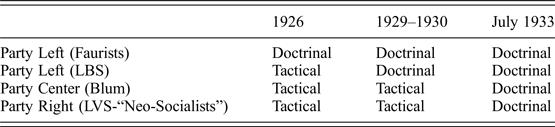
The campaign of anathematization in turn constrained Déat and his allies to double down on their heresy in preparation for their inevitable exit from the party. Déat no longer qualified his statements by insisting on the tactical nature of his disagreements as he had before the July congress (see Table 1). Indeed, his articles came to take on a more frankly heretical tenor. The conflict was now one that “[surpassed] by a thousand miles the parliamentary incidents” and the issue was “to decide between a socialism of immediate action and an outdated socialism.”Footnote 49 Two clans now opposed each other, one “archéo” and the other “néo.” The first, led by Blum, “refuse[d] to modify anything of dogmas and routines.” The latter, “shrewdly accused of fascism by the former, want[ed] to take the offensive, to keep the initiative of construction, even if doctrine [was] not entirely saved.”Footnote 50 Déat began, for the first time, to openly chastise the SFIO for holding on to the “Charter,” arguing that it did so only “in full symbolism, in full ritualism, in full craziness,” and that meanwhile “events that could not care less about Amsterdam, the Charter, or the statutes proceed[ed] at their breakneck pace.”Footnote 51
Characterization of the factional conflict within the SFIO. In 1929–1930, the party's right mounted a serious challenge to the leadership, but by July 1933 their fortunes had waned and a schism appeared inevitable.

The affirmations of doctrinal innovation became more common as the schism approached. But the emergence of neo-socialism as a political identity distinct from traditional socialism was confirmed by the self-conscious embrace of the term by many participationists themselves. In October 1933, Montagnon's, Marquet's, and Déat's interventions at the July congress were published under the title Néo-socialisme? Ordre, Autorité, Nation (Montagnon, Marquet, and Déat Reference Montagnon, Marquet and Déat.1933). The book presented what had been uncoordinated and improvised interventions as expressions of a single and unified stream of thought under the sign of “neo-socialism.” In doing so, the book retroactively validated and enshrined a classification that had originally been applied polemically by the participationists’ factional adversaries and represented an effort to transvalue the terms of an opposition that had become undeniably doctrinal.
Dispossessed of a party following their exclusion from the SFIO, Montagnon, Marquet, Déat, and their participationist comrades were now armed with a new doctrine. After the constitution of the PSdF in December 1933, they dropped any remaining qualms they might have had and fully embraced “neo-socialism” as a distinct political identity and as the doctrinal foundation of their new party. What began as a pejorative became openly proclaimed by those it was meant to discredit as the invention of a new position within the political space.
CONCLUSION
I have argued that the 1933 schism was not the ineluctable outcome of preexisting doctrinal differences within the SFIO. Neo-socialism was not a pre-constituted heresy spawned ready-made from the heads of its proponents. Its origins lie not in a willful effort at doctrinal revision, but instead in the ebb and flow of the factional conflict over the SFIO's parliamentary strategy. Only when the participationists started presenting a tangible threat to the party's anti-participationist majority were the would-be neo-socialists accused of doctrinal deviation. Though Déat and his allies initially disavowed any heretical intention, they grew bolder in their dissidence as their chances of conquering the party diminished.
The critical moments came after the 1932 elections, when the participationists misread their strength and persisted in defying the party majority. With a censure vote a foregone conclusion, and their hopes decisively dashed, Montagnon, Marquet, and Déat sought to change the terms of the debate at the 1933 July congress. The inflammatory nature of their speeches provoked a furious reaction from the party majority, this time including Blum and the party centrists. It was only then, with the schism having become inevitable, that “neo-socialism” became widely accepted as a term of classification. Furthermore, what had been a pejorative label meant to discredit and isolate the renegades of the July congress became the self-understanding of some of the schismatics themselves. In adopting the label, the neo-socialists accepted a definition of themselves that had originally been imposed by their adversaries. Neo-socialism was thus not always-already a definite and coherent revisionist tendency, but only came to be constituted as such in and through the factional dynamics of the SFIO. Neo-socialism, as a distinct doctrinal identity, emerged out of the very schismatic process it is often presumed to have determined.
Prevailing accounts of the 1933 schism have largely confused cause and effect, suggesting that a broader rethinking of the relationship between political identity and schism is in order. The neo-socialist case suggests that schisms do not simply confirm pre-existing divisions, and that new lines of division can be created in and through the schismatic dynamic itself. Indeed, schisms are classification struggles par excellence. More broadly, the case lends support to the view that political identities, motivations, and interests are contingently, processually, and interactionally formed in response to specific contexts. As these contexts shift, sometimes rapidly, novelties can arise as political actors reposition and redefine themselves in uncertain situations. In short, political identities are practical inventions. When we treat them as fixed and given, we miss an essential feature of what is going on, not just in schisms, but in many other political phenomena.