Have you ever lived in heresy or schism? When, by what persuasions, and by whose work did you embrace the Catholic faith, if you have ever been a heretic? … Have you ever suffered anything for the Catholic faith? What can you say about your calling to the Catholic faith?
Between 1598 and 1685, 750 young men who defied the law by leaving Protestant England to study for the Catholic priesthood answered these questions on entering the English College at Rome. The 595 extant answers to the questionnaire, from which the above extract is taken, form the Responsa Scholarum (Responsa). At Valladolid, Spain, entrants to another English seminary in exile answered similar questions: 309 responses from 1592 to 1623 survive in the Liber Primi Examinis (LPE), as they were recorded by the College staff.Footnote 1 Their value lies not only in the vivid detail of individual accounts, but in the possibility of quantitative and comparative analysis. Especially rare is the insight offered into children's and young people's experiences of religion, through probably the largest collection of self-writings by predominantly young subjects existing for the early modern period.
These records are selective: they represent four-fifths of the English men who studied at two Catholic seminaries.Footnote 2 This advises caution in generalizing from their evidence, but although in some respects the ‘selection’ may be deemed narrow, it may be regarded as wide in others. It supplies examples from across the social scale and the map of England, spanning a century, and the high total means quantitative analysis yields evidence which is more than anecdotal. As with any interrogative records, responses are linguistically and ideologically conditioned by the questions' agenda, in ways considered in this article. But, as will be seen, respondents also interpreted the questions: if the voices speak a prescribed language, their individuality is still heard.
A. C. F. Beales examined the LPE and Responsa up to 1622 for information on educational background,Footnote 3 and John Bossy used the data to study developments in the social profile of English Catholic clergy.Footnote 4 Michael Questier analysed the numbers and backgrounds of converts before 1640, and what they suggest about clerical recruitment.Footnote 5 Molly Murray examined the Elizabethan responsa in her work on William Alabaster's conversion narratives, showing how the Responsa challenge assumptions that autobiography was exclusively, or even originally, a Protestant genre.Footnote 6 Comprehensive analysis of these sources is, however, lacking.
This article aims to illustrate, and begin to realize, the potential of such analysis. As the above studies suggest, the Responsa and LPE would repay detailed study in a number of areas, to examine all of which is beyond the scope of a single article. My focus is on the formation of religious identity, particularly in relation to childhood and youth. Sources which bring us close to early modern young people's experiences and opinions are rare, and even rarer in such quantity; this is one of the most exciting qualities of these two collections, offering powerful insights into a subject which is still under-researched but whose importance is increasingly recognized.Footnote 7 Although a number of respondents were of mature age, most were aged eighteen to twenty-four; hence these are very much young men's sources.
Religion is a dominant theme, inevitably to some degree, in admissions papers for Catholic seminarians. The extent to which respondents focus on concerns of religious identity and the pertinence of childhood and adolescence to such narratives is, however, remarkable. Identity has become prominent in studies of English Catholicism: how contemporaries perceived it, how historians should perceive it, its relation to culture, propaganda wars, and politics.Footnote 8 How the commentaries of young people illuminate and challenge our understanding of such issues strikes the reader of these records forcefully, and demands attention in relation to the wider study of early modern religion.
I
The questionnaire systems at the English Colleges in Valladolid and Rome were probably the work of Robert Persons. A member of the first Jesuit mission to England in 1580–1, and afterwards its superior in exile, he remained a controversial figure until his death in 1610. Persons enraged the English government by his political scheming, was at the centre of paper battles between English Catholics, and wrote best-selling spiritual works.Footnote 9 He was instrumental in founding the Valladolid seminary, and the Rome responsa commence in 1598, which was a year after Persons became rector there. The questionnaire at Rome survives as students answered it, and that at Valladolid was probably similar. In 1658, the questionnaire at Rome was changed; the revised version covers the same subjects, but requests more detail in specific areas. Some implications of this alteration will be discussed.Footnote 10
The English Colleges were training students for the capital crime of re-entering England as priests: they were always targeted by spies, and the questionnaire could be a way of checking entrants' credentials. The Valladolid instructions emphasize that a candidate is to be secluded from current students until he has ‘passed’, and asked about his Catholic contacts in England, his referees, and who knows him within the College.Footnote 11 Intra-Catholic conflict might also have influenced Persons's project to collect information about incoming students; dissension amongst English Catholics affected the seminaries acutely, and Persons took over at Rome following a period of internal strife.Footnote 12 He was likely to prioritize re-establishing the authority of the College's Jesuit administrators, and knowledge of candidates' connections and previous careers would help to identify potential opponents.
Perhaps linked to this agenda was the final question, which demanded a promise to obey the College statutes, and enquired whether the candidate intended to become a priest. The second of these also had a basic bureacratic function, since only those willing to be ordained could be enrolled as scholars; a number of others who intended to study without taking orders were convictors, paying for their board.Footnote 13 After 1658 at Rome, an oath was required to take Holy Orders and return to the ‘English Mission’, thereby eliminating those laymen who entered only to study. The question on the candidate's educational history was obviously useful for academic administration: entrants ranged from university graduates to grammar school leavers, and the staff had to arrange suitable studies for each.
Other questions enquired after the candidates' social origins, their parents' and siblings' religion. This was important background for the key question of the respondent's own faith. Candidates were not only asked if they were converts, but required to give accounts of their conversion; and this is where both the questionnaire's and the respondents' agenda become more complex, and much of the most fascinating evidence appears. Candidates were also asked whether they had experienced persecution, perhaps part of assessing their credentials and monitoring the situation in England. Gathering and disseminating news was part of the enterprise of English Catholicism, representing it and writing its history (indeed its competing histories).Footnote 14 The stories of the students at Rome and Valladolid were part of this: the ‘Annual Letters’ of the Society of Jesus contain several accounts taken from responsa, showing that when the College superiors compiled their reports, they were aware of the news-value of students' histories.Footnote 15 This may even have been one reason for instituting the Responsa.
Looking at the respondents as a group shows several patterns. Bossy's analysis of social origins suggests similar developments at Rome, Valladolid, and the other major English seminary at Douai.Footnote 16 Between 1598 and 1610, there were slightly more sons of non-gentry than gentry. Between the 1610s and the mid-seventeenth century, there was a strong gentry majority; after the Restoration this proportion declined again (to 17 per cent at Rome in the 1680s, although records are scanty by this date). There may be various reasons for this trend: Bossy suggests that for much of the seventeenth century the seminaries' financial difficulties precluded those who could not pay. Historians of Engish Catholicism have posited a predominance of the gentry during the seventeenth century, in numbers and influence, which would explain the heavy representation of this class in the seminaries as elsewhere. Gentry domination of the clergy was also not exclusive to Catholicism in this period.Footnote 17
Respondents were asked their place of birth, and their answers (predictably enough) show heavy recruitment from England's more Catholic areas, especially Yorkshire and Lancashire, and also London.Footnote 18 The remainder were spread fairly evenly across the rest of the country, although central Wales was barely represented. They were also asked their ages, and the trend here illustrates the dominance of youth.Footnote 19 The average age in both Rome and Valladolid was twenty, with two-thirds to three-quarters aged between eighteen and twenty-four.Footnote 20 A small number (twenty-five overall at Rome, and twelve at Valladolid) were over thirty, while 12 per cent at Rome and 20 per cent at Valladolid were under eighteen. It should be noted, though, that in the period before 1620 there were slightly higher proportions of older respondents (7 per cent) and younger ones (14 per cent under eighteen) at Rome. Valladolid recorded eleven respondents under sixteen, Rome four. The oldest respondent (at Rome) was forty-six (LR354); the youngest ones were fourteen (LR359, LPE14, LPE15, LPE50).Footnote 21 Early modern society had marked concepts of childhood and youth, which differentiated between these two stages, and separated both from adulthood. There was not (as there is not now) a universal consensus about when one stage succeeded the next, but, broadly speaking, ‘childhood’ can be posited as up to the age of fourteen, and ‘youth’ or adolescence up to the age of twenty-four.Footnote 22
Although these documents represent the self-descriptions of their subjects, the two sources differ in nature. At Rome, we have the original answers to the questionnaire: the manuscripts, in the hands of their 595 authors, are filed as they were written in loose leaves, which were later arranged chronologically. Although most fit onto a single large sheet, the responsa vary greatly in length, from a few lines of basic information to vivid miniature autobiographies.Footnote 23 They were mostly composed in Latin (as the questionnaire was in Latin), but three respondents wrote all or partly in English. At Valladolid, autograph responses do not survive: the LPE consists of abstracts of answers to a similar questionnaire. The scribes were presumably members of the College staff. Originally, answers may have been written down: inserted in the LPE is one external sheet containing fuller answers to the questionnaire for one entrant, Peter Warnford (1610), which is quite possibly a chance survival of his autograph ‘responsa’. There is no formal LPE entry for Warnford, precluding comparison of the original to the abstract. Some degree of selection and interpretation may be assumed, though, and where trends differ between Valladolid and Rome, differing agendas of respondents and clerical staff may be partly responsible. Six entrants at Valladolid also went to Rome and left responsa, making comparison possible in those cases.
At Valladolid, the ‘first examination’ was to be made during the candidate's probation before admission, when he was secluded from existing students (though whether from other candidates is unclear). He was later to be re-examined to make sure his responses still tallied, and his answers recorded in the LPE. The examination was to be in private, ‘lest he should be prevented by modesty from revealing something in the presence of others’.Footnote 24 We have less information on the composition of responsa; there are no records of oral examinations, so perhaps the questionnaire was entirely a written exercise there. Kenny deduced that it was set soon after arrival, but before formal enrolment.Footnote 25 The conditions are unspecified: did they write in ‘exam conditions’? Or was the questionnaire handed out and handed back in later, leaving room for respondents to discuss and influence one another's accounts? It has not been possible to pinpoint strong trends in content to particular years, but the manuscripts often show similarities of form; some years it was the fashion to write the questions out in full, or not, or to use Italic hand for the headings, or to head one's responsa with ‘Jesus Maria’ or similar.Footnote 26 This suggests communication between respondents, which also opens the possibility of influence from the staff. One or two responsa may have been returned for a second attempt: thus Nicholas Hart (LR353) dropped into English for his detailed conversion narrative, but then wrote a shorter Latin answer to the same question. Richard Fisher (LR349) wrote a similarly prolix answer, though in the required Latin, but also produced an abbreviated version. There is a decrease in detail towards the end of the period: by the 1650s, answers were rarely long or so comprehensive. After 1658, the new questionnaire with its larger number of precise enquiries seems to expect yes/no answers, and these were largely what was supplied. Parents' religion could be given in one word, and conversion histories in five: a question asking by whom a convert was converted often elicited simply the name of a priest, presumably who reconciled him.Footnote 27 This facilitates quantification in some areas – if one wished to calculate the proportion of seminarians who arrived knowing Greek, for example – but means later entries do not repay textual analysis in the same way. There is also a reduction in quantity: from 1668, two whole years are without responsa, and from 1671 the number surviving is only about half of entrants recorded in the Liber Ruber (the College's entry register). Perhaps this institution became less important as circumstances within the College and in England demanded it less; and so responsa were frequently omitted or lost. For reasons that remain unclear, they were discontinued after 1685.
II
Catholic, Heretic, Schismatic. These are the words made available for respondents to define their own and their relatives' religion: more subjective and evaluative than other requested information, paradoxically these terms demand objective categorization – and Robert Persons intended that they should. Although the Rome responsa are directly autobiographical, unmediated by a scribe or by translation, they remain interrogative records: the interplay between questioners' agenda and respondents' agendas is one of their most interesting features. Nowhere are questions of interpretation and classification more crucial than in the area of religious identity.
The term ‘schismatic’ was ambiguous. Theoretically, its meaning was simple: a person who held Catholic beliefs but attended Protestant services as legally required, so that, while not a heretic, he was not in complete communion with the Catholic church. This theory was based on papal rulings that attendance at heretical worship was unlawful, and clerical leaders of English Catholicism presented recusancyFootnote 28 as the only (spiritually) safe path.Footnote 29 As Alexandra Walsham has demonstrated, however, practice was infinitely complex and theory disputable. Catholics also made arguments justifying conformity, and even thoroughgoing recusancy theorists knew pastoral reality necessitated concessions. Given that recusancy was the basis for most prosecution of lay Catholics, while outward conformity usually secured indemnity, complete separatism set the bar high. Walsham's study of church-papists (as outward conformists were labelled) shows that recusancy and Catholicism were not co-terminous; church-papistry could be part of a dissenting religious identity. The fluidity of confessional definitions meant that many people cannot be labelled ‘Catholic’ or ‘Protestant’.Footnote 30
The recusancy debate flourished to the end of Elizabeth's reign, and responsa of that period were written in its wake.Footnote 31 But a respondent who claimed to have converted from heresy at the age of eight and from schism aged sixteenFootnote 32 was not saying that at thirteen he would have described himself as schismatic; former schism should not be read simply as ‘shallow temporization for convenience sake’.Footnote 33 Respondents' employment of ‘schism’ and ‘conversion’ ranges across the possible definitions of both terms. Robert Persons was a major contributor to these controversies, and when the Responsa were begun at Rome, he was engaged in all-out pamphlet war with a group of English priests who disagreed with the Jesuit approach to almost everything. This war (known to historians as the Appellant or Archpriest Controversy) involved many issues, but arguably the original dispute was over whether conformity was in fact the appropriate way to demonstrate that one was a loyal Englishman and a loyal Catholic.Footnote 34 The English government was happy to toy with the Appellants' idea of religious toleration on this basis, combined with correspondingly more repression of Jesuits, recusants and traitors (categories they tended to conflate). Persons would not allow any collapsing of the definitions ‘Catholic’ and ‘schismatic’, and the questionnaire's language sought to ensure that England's future priests did not either. Persons was an internationally famous (or notorious) figure; until his death in 1610, respondents must have been aware that he was their likely reader, and so we must be aware that they may have been writing to his expectations. Yet the varied ways in which those who chose to use the contested term ‘schism’ did so argues powerfully for the authenticity of the experiences and interpretations they recorded. Importantly, the term appears in the questionnaire only with reference to the respondent's religion (see above): the question on relatives' religion asks instead ‘if they are heretics or Catholics’. Yet ‘schism’ proved a useful word for dozens of respondents assessing the state of their parents' souls.
The Responsa and LPE are records created for a particular purpose, decided initially by the examiners and not the respondents. In dealing with questions of religious identity and definitions, the historian must constantly reckon with this. But while this complexity can be an obstacle to straightforward data collection, it is also highly revealing.
III
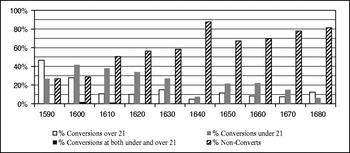
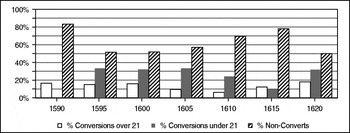
Between 1598 and 1619, 135 of 218 Rome respondents (61·9 per cent) described themselves as converts. Eighty-eight of these recorded a conversion before the age of twenty-one. At Valladolid between 1592 and 1623, 123 of 309 respondents were converts, of whom 65·9 per cent converted at under twenty-one (Figure 1b).Footnote 35 As Questier argues, the number of converts in the early decades counters any supposition that Catholic clergy were recruited from a small, closed circle and raises questions about the extra-familial influences that brought young men to enter Catholic seminaries.Footnote 36 The term ‘convert’ is complex; this analysis follows respondents' self-definitions, so that in this study ‘converts’ denotes respondents who do not describe themselves as ‘always Catholic’, and who state that they were reconciled to the Catholic church or became Catholic.
Proportions of converts – Rome (%).

Proportions of converts – Valladolid (%).

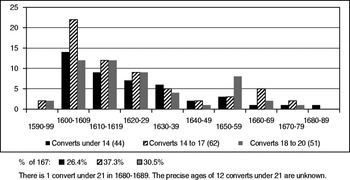
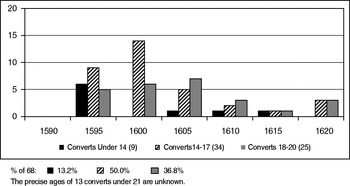
Figure 1a (converts at Rome) shows that, while conversions decreased overall, throughout the seventeenth century most converts dated their conversion from before the age of twenty-one. Further breakdown of ages shows that conversion was most likely during adolescence, although 26·4 per cent converted before reaching fourteen, when ‘youth’ was held to succeed ‘childhood’. The Valladolid figures reveal a similar bias toward adolescent conversions, but fewer converts under fourteen and more aged between eighteen and twenty (Figures 2a–b). Contemporaries recognized adolescence as crucial to religious commitment, as do modern psychologists.Footnote 37 Since these are young people's sources, there is an inherent bias towards anything that happened to them happening in youth, but a total of 113 converts aged fourteen to twenty at Rome and 59 at Valladolid constitutes nearly a fifth (19·2 per cent) of the whole group. A large proportion of these converted between the ages of fourteen and seventeen: at Rome, 62 out of 167 young converts, at Valladolid 34 out of 68. Out of all respondents, convert and non-convert, this is 10·4 per cent at Rome and 11 per cent at Valladolid. Adolescence, and especially early adolescence, is the most strongly represented age category for conversion.
Age ranges of converts under 21 – Rome (%).

Age ranges of converts under 21 – Valladolid.

Murray found that while respondents ‘accept the categories proposed for the analysis of their individual experiences, they … use these given forms to produce various and idiosyncratic life-writings’.Footnote 38 The following exploration of ‘schism’ and conversion considers how the respondents' interpretative power complicates such ‘acceptance’.
At Rome, six adult and nineteen younger converts described themselves as converts from ‘schism’. A further six adult converts and six under twenty-one converted from heresy to schism and then to Catholicism (nine individuals, since three became ‘schismatics’ under twenty-one and Catholics at over twenty-one).Footnote 39 This was a minority of the converts recorded for any period, with the majority calling themselves converts from heresy (i.e. Protestantism). The concept of schism has, however, become central to the historiography of English Catholicism. Its dynamic use within a framework apparently so clear as the Responsa makes an excellent case-study of the potential and the limitations of the ‘naming game’ in early modern religion, and how individuals understood such definitions. There is evidence of the fluidity of confessional boundaries in actual experience, which subverts imposed categories; but also of an acute need for a definable identity amid confusion and conflict. Schism features noticeably in juvenile conversion narratives, where its applications offer particular insight into young people's self-definitions.
Aged about sixteen, Thomas Hodgson (LR368, 1600) was ‘convinced of the truth’ of Catholicism by some ‘schismatic’ friends. His conversion (conversione) took place twenty years later, however, when he was received into the church by John Gerard. This ‘almost miraculous’ conversion is characterized as a crisis resulting from divine revelation. Having resisted persuasion to be reconciled, Hodgson awoke in the night on Christmas Eve with his mind made up, found Gerard, and declared ‘I have come to adore him who did not disdain to be born in a vile stable for me, and I said that I wanted to become a Catholic.’ The emphasis is on reconciliation as the defining moment, rather than on the human process of doctrinal argument.Footnote 40 Thomas Newman (LR357, 1600) described himself as ‘schismatic’ although ‘in opinion Catholic’; he had first been drawn to Catholicism by reading Edmund Campion's Decem Rationes while at school, but it was only when he sought out a priest that ‘[the priest] made me a member of the Catholic church’. Questier has discussed how, irrespective of confessional position, submission to divine grace was the essence of early modern conversion, more than altered theological opinions.Footnote 41 Murray argues that these accounts translate such a theology of conversion into narratives of ‘denominational progress’ with conversion as a ‘moment of revised outward affiliation’.Footnote 42 Hodgson's conversion interweaves all three aspects. Doctrinal argument brought Hodgson only into schism; Gerard's exhortations were ineffective until the intervention of grace; submission to grace was manifested by Hodgson going back to Gerard to be ritually reconciled.
Hodgson and Newman relate ‘schism’ to the gradual nature of their conversions. There is no description of their practice changing after reconciliation, but they use the category ‘schismatic’ to formulate remembered turning-points. Humphrey Leech (LR470, 1609), the Oxford theologian who failed to win endorsement for his proto-Arminian views within the Church of England and subsequently converted to Rome, portrayed this process in terms of schism. Having been a Calvinist, he was ‘made a schismatic’ (factus schismaticus) by reading Vincent of Lerins. Only after this did he allude to his contentious sermons and consequent struggles, culminating in his epiphanic moment: an interior voice urging ‘Go forth, go forth from this babylonish heretical Anglican congregation.’ Leech left England to be ‘received into the Church’.Footnote 43 Henry Clyffe (LR396, 1603) and John Goode (LR461, 1608) used schism in reference to an interval between conversion from heresy and reconciliation, without implying a change in intention.
Promoting recusancy is often seen as narrowing the definition of ‘Catholic’, against the reality that the difficulty of identifying church attendance with Protestant belief made dividing ‘Catholics’ from ‘church-papists’ problematic.Footnote 44 But the existence of the term ‘schismatic’ also broadened the definition of Catholic, enabling converts to distinguish themselves from ‘heretics’ while there may have been no visible difference. William Forster (LR429, 1605), was brought up among Protestants, but described himself as ‘a heretic or rather schismatic, awaiting only the opportunity to be able to be Catholic’. Leech's use of ‘schism’ could be dismissed as a gesture towards the questionnaire's requirements, while presenting experiences essentially unrelated to its categories. But equally therefore, Leech need not have introduced the term (plenty of people did not): he employed it to provide a distinctive definition for his changing theology prior to altering his institutional allegiance. Hodgson's family ‘are (as I judge) schismatics’ – ‘or at least very little distant from the Catholic faith’; yet he had not learnt Catholic beliefs from them. Such usage shows the difficulties in including church-papists in an account of English Catholicism as much as in excluding them.
Some respondents apparently subscribed clearly to the questionnaires' definitions: Henry Lanman (LR366, 1600), for instance, described his conversion from schism explicitly as persuasion that recusancy was necessary, followed by reconciliation.Footnote 45 Charles Yelverton (LR372, 1601) specified the realization that his continued attendance at church was hypocritical ‘because I was simulating heresy’ (quod haeresim simulabam) as part of his conversion. John Chapperlin (LR410, 1604), a convert from heresy, was ‘by reading (in terms of faith) made a Catholic’, but regretted that ‘I did not immediately adapt my life and exterior profession to the internal gift of faith, but I was polluted with the most dangerous and foul crime of schism for the next year from my conversion’. He became a Catholic (Catholicum fieri) through a ‘Mr Strange’. The language is vehemently orthodox; yet Chapperlin's account shows a doctrinal conversion that did not entail a commitment to ‘recusancy’. It was instigated by a ‘schismatic’ who gave him Catholic books, demonstrating the public nature of some church-papists' Catholicism. In the account rendered to the College authorities, this man was a ‘schismatic’, and Chapperlin in a state of hypocrisy and mortal sin until truly converted; but this does not mean either thought so at the time.
Chapperlin had conformed to recusant orthodoxy by the time of writing his responsa, but other respondents may have dissented. George Morgan (LR409, 1604) insisted ‘I was always at heart a Catholic’ although for several years he did not hear Mass, and he went ‘unwillingly’ to church while an apprentice. Several ‘converts’ state that they frequented Protestant churches and later became Catholic, but without using the term ‘schism’;Footnote 46 two describing themselves as ‘always Catholic’ add that this is ‘except for’ (praeterquam) periods or occasions when they attended church, but record no subsequent ‘conversion’.Footnote 47 This was usually in childhood, and so perhaps related to their age. As Chapperlin demonstrates, the evidence of even the clearest of these texts is ambiguous. Hodgson's cry ‘I have come to adore him’ (Veni eum adoraturus) is directly quoted, but the second part is indirect speech: dixique me desiderare catholicum fieri (‘I said that I wanted to become a Catholic’). So we are not certainly told that, at the time, Hodgson believed he was not a Catholic and was asking to become one.
The Responsa demonstrate complex responses to a determinedly simple question. Even those who hesitated to describe it as ‘schism’ knew that church attendance was significant to Catholic identity, although application of theory to experience was complicated and respondents created meanings to fit their perceptions. Walsham notes that pro-conformists argued that recusancy was not a binding duty but a ‘counsel of perfection’;Footnote 48 yet as such it would remain the standard against which all conduct was measured.
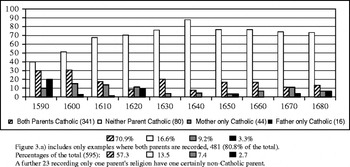
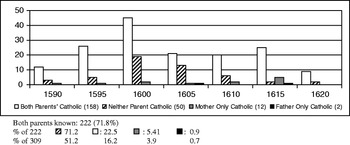
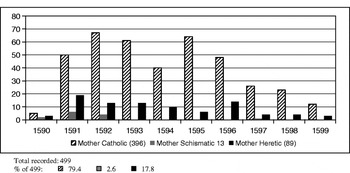
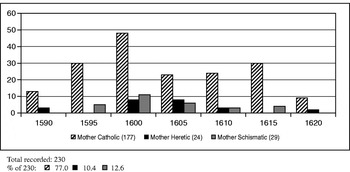
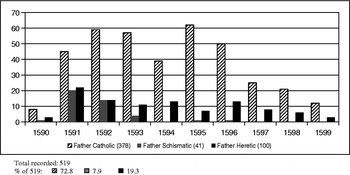
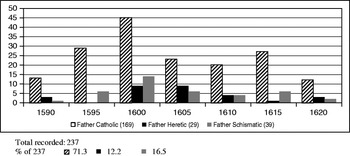
Schism is a feature of the early responsa. One 1661 entrant converted ‘from heresy or schism’ while two entrants in the 1650s refer to attending church before conversion, but this is atypical.Footnote 49 Information on parents' religion shows a similar development. At Rome, 7·9 per cent of recorded fathers and 2·6 per cent of mothers overall were ‘schismatic’, though the figures between 1598 and 1629 were 6·6 per cent of mothers and 23·1 per cent of fathers. Between 1592 and 1623, the Valladolid figures likewise indicate more schismatics, outnumbering ‘heretic’ parents (Figures 3a–f).
Parents' religion – Rome.

Parents' religion – Valladolid.

Mother's religion – Rome.

Mother's religion – Valladolid.

Father's religion – Rome.

Father's religion –Valladolid.

These are constructions rather than self-constructions. Respondents chose categories which might differ not only from those which their parents would have chosen, but from how the readers of the responsa might have described the same behaviour. Yet they are derived from practice. For example, Figures 3a–b show that respondents at both Colleges were more likely to report Catholic mothers than Catholic fathers. Fathers were more likely to be schismatic (Figures 3c–f) and at Rome nearly three-quarters of those with only one Catholic parent had a Catholic mother (73·3 per cent), of whom more than half (twenty-five of forty-four) described the father as ‘schismatic’: this may reflect a practice often referred to whereby husbands conformed while their wives (less liable to legal penalties) remained recusant.Footnote 50
The LPE records include seventeen mothers and eighteen fathers not categorized but described as ‘well affected’ to Catholicism, or a similar term. This may refer to outwardly conforming Catholic believers – those for whom the label ‘schismatic’ was intended – but either the student or the recorder chose not to use the term. However, it could mean parents with conservative religious tastes, or a tolerant attitude to Catholicism, or the most positive spin possible on non-Catholic parents. The elasticity of such terms is indicated by a footnote (in the CRS editon) to John Maxey's entry (LPE132, 1602), whose parents were bene de fide Catholica sentientibus: a manuscript in the Valladolid archives relates that when Maxey returned to England as a priest, his father turned him in and insisted on his committal to Bridewell prison, where Maxey died.Footnote 51 The higher incidence of ‘schism’ at Valladolid is partly because these figures come from the earlier period, when the term was also used more often at Rome. But it may also reflect the fact that these constructions are twice-mediated: the staff categorized as ‘schismatic’ parents whom students might have recorded as ‘Catholic’, simplifying a complex description in one direction rather than another.Footnote 52 Yet the most significant constant is that young people were being asked to define, and therefore to judge, their parents' beliefs and conduct. The subversion inherent in an eighteen-year-old writing that his father ‘deserted the perfect union of the Church, and even until now leads his life in the error of schism’ (Richard Wigmore, LR528 1613) should not be underrated.Footnote 53
Walsham argues that church-papists were a discernible presence for longer than has sometimes been thought, and the revised post-1658 questionnaire at Rome still refers to ‘heresy or schism’. But the answers supplied suggest that it was no longer a meaningful referrent, and that the ‘labels’ Catholic and Protestant were increasingly sufficient for these respondents.Footnote 54 The disappearance of schism is related both to the steady increase in respondents recording Catholic parents (Figure 3a) and the long-term decline in numbers of converts entering at Rome (Figure 1a). This trend may partly reflect the decline of Catholicism in England, its ultimate failure to convert the Protestant nation; remembering, however, that our definition of converts is dependent on writers' self-definitions, the smaller number of converts also reflects changing perceptions of identity, and developments within the Catholic community.Footnote 55 Explaining what your religion was and had been took less agonizing by the later seventeenth century. Lifelong Catholics did not have to think about the difference between that and conversion from Protestantism, while converts could dispose of the event in a few words. Families were less likely to be in conflict over religion, partly because the easing of persecution reduced the need for outward conformity, partly because Catholic communities solidified and marriage within them was more likely.
IV
Youth and conversion are strongly linked in these sources. In particular, conversion from ‘schism’ appears most frequently in accounts by younger converts, who related it to issues of growing up and the formation of religious identity. Age was an important determinant in early modern concepts of social structure: ideal constructions and actual institutions placed youth under the authority of age, something reflected and reinforced by the frequent use of parent–child metaphors for other authority relationships.Footnote 56 The perceived aim of adolescence was the attainment of an adult place in society, through whatever detours the journey went.Footnote 57 We would expect the writers of the Responsa to illustrate such concerns in recounting their religious history, with the complicating factor that an adolescent's development into an adult Catholic (and especially a Catholic priest) put him in a sense outside English society. As Paul Griffiths has emphasized, young people did not simply accept adult expectations; indeed, in the area of religion they could not, because they faced conflicting expectations and competing claims to authority. Youthful defiance is often discussed largely in terms of youthful irreligion,Footnote 58 but religious commitment – to a proscribed faith – also produced conflict. Whilst this has been explored in relation to the Protestant Reformation, the Responsa and LPE powerfully illustrate its equal relevance to post-Reformation English Catholicism.Footnote 59 We should therefore be wary of attributing such phenomena to inherent confessional qualities, and interpret them rather as illustrating how competing claims allowed young people to set limits to authority while negotiating conformity, defiance, and autonomy.
In the Responsa, young people's narratives create self-definitions using a particular interpretive framework. Whether people recorded their youthful experiences as conversions depended as much on how they chose to define such experiences as on what may have happened. The significance of respondents' own perceptions is suggested by the fact that four individuals who appear in both collections are briefly noted as Catholics in the LPE, but described a conversion in their autograph responsa. Edward Morgan (LR433, 1606, and LPE250, 1615) described himself as a heretic until converted, with his father, aged about fourteen, and William Hargreave (LR575, 1617, and LPE261, 1616) remembered going to heretical churches as a boy before being reconciled.
Some youthful conversions from schism, such as Thomas Leedes's (LR544, 1615), were clearly tied to church-going,Footnote 60 but others were not. Thomas Beveridge's (LR362, 1600) parents were ‘schismatics’; inspired by his brother's journeying to Rome ‘for devotion's sake’, the eight-year-old Thomas ‘was eager for Catholic books and indifferent to those of the heretics from that time’ and from then on ‘lived a schismatic life’. At fifteen, when asked by his father to choose a career, Beveridge decided to go to Rome, and was ‘reconciled’; he left England with his elder brother's help, not daring to tell his parents. John Smith (LR363, 1600) had a ‘schismatic’ father and grandfather, a Catholic mother and siblings, and himself ‘as far as I can guess was always a schismatic’. He could not remember what made him ‘want to become a Catholic’ ‘from his early years’; he does record that he was ‘vehemently’ afraid of death ‘because I was not a Catholic’. Smith was about fifteen when his mother sent him to a priest, who told him that his little sister knew more about religion than he did, and to correct this before being reconciled.
Smith's concern to define his identity denominationally is too clearly recalled to be merely a re-casting to Persons's categories. His confusion is painfully recounted: believing that he would be damned if he was not a member of the church, he was not sure if he was one. He was familiar with Catholic activities, and recalled meeting priests known to his mother – but also that the prospect of meeting them used to reduce him to tears. Smith remembered the specific prayer he used to console himself – Conditor Caeli et terrae, a traditional Catholic pentitential prayer, which is long, passionate and deeply self-castigating. For some people at least, growing up with fluid confessional boundaries was a traumatic experience. Smith sought and found in reconciliation the certainty of self-definition that he required.
Yet Smith's account of ‘becoming Catholic’ is still one of clarification more than change. As with Beveridge, it coincided with other marks of growing up. Some entrants locate a similar development earlier: Richard Huddleston (LR381, 1601) mentions Catholic siblings and had a recusant mother.Footnote 61 He, however, attended ‘heretics’ temples schismatically’, until aged ten when, spending Easter at a relative's house, he was encouraged to go to confession and was reconciled (reconsilior). For these respondents, ‘schism’ defined an immature spiritual state. Nicholas Hart's account of his ‘conversion’ (LR353, 1599) exists in an English and a Latin version whose differences are suggestive. Hart described his father as a formerly schismatic Catholic and his mother as a formerly heretic schismatic. His English response states that he was ‘allwayes from myne Infancye a scysmatick; and contynuallye very much geven unto devotion’, and describes how, studying in London aged sixteen, he degenerated ‘& did beginn a most lewd course of lyfe’. Hart became involved in a duel and ‘considering with my selfe … that I might chaunce to be slayne; I called to mynd this sentence which I had often before read Nulla salus extra ecclesiam, theirfore thought I, I will goe and be reconcyled & then I care not whether I be slayne or noe’. However, he ‘continued my badd course of lyfe’ for over a year after his reconciliation, when sickness prompted his resolution he would reform, starting from the next Michaelmas (Michaelmas is the feast of St Michael at the end of September; Hart notes that it was the anniversary of his first hearing Mass). Following a second confession, Hart began to consider becoming a priest.
This is primarily a ‘conversion of life’ narrative in which the subject falls into sin and returns to virtue, rather than one based on change of religion. Hart considered his membership of the church dubious prior to being ‘reconcyled’, but the significant turning-point came after he ‘had bynn at confession’ again. At no point is there any suggestion that his belief changed. The vice-to-virtue frame may reflect recusant tracts linking church-papistry to moral slackness;Footnote 62 but Hart differentiates moral from denominational conversion. The Latin version clarifies the significance of ‘reconciliation’: ‘I was made a Catholic … and however (I being now a Catholic) I did not leave that most wicked life’ (the second confession is omitted). This heavier emphasis on the chosen moment of ‘becoming Catholic’ may suggest a conscious re-writing to the questionnaire's agenda,Footnote 63 although schism and reconciliation are both present in the English version. But their meaning is complicated by Hart's comment that ‘by Custome of sinninge I grewe to have noe sence or feeling of sinne, insoemuch as their was noe sinn soe haynous that I would not have attempted, onlye this being odious unto me to goe unto the Church of the heretickes’. His ‘schism’ was not defined by attendance at Protestant churches. Was Hart's perception that, regardless of church-going, one was not a Catholic until one had been ‘reconciled’?
A connection of identity with maturity is made by nineteen juvenile converts who seem unsure whether they were heretics or schismatics (twelve), or state that they were ignorant or confused (seven). One was ‘always a heretic (or I should rather say an atheist since I did not know what I professed)’ until nineteen (LR407, 1604), while Thomas Foster (LR589, 1618) wrote ‘I do not know whether I was a heretic or a Catholic, neither did I know what religion was then; when I was away I frequented the heretics’ temples, when at home I neither went to the temples with the heretics, nor said any prayers such as Catholics use’. This is characteristic of converts under twenty-one, as well as of earlier responsa: only five older converts are similarly vague, and Foster was the latest example of this kind of answer.
This confusion, accompanied by (at least retrospective) anxiety to define oneself, might have various sources. It is obviously significant that Catholicism was proscribed: since Catholic teachers and books were illegal, and so was Catholic worship, educating children in Catholic beliefs was difficult, and involving them in Catholic practice was criminal. A divided family, like John Smith's, might contribute to a child's uncertainty; so might a church-papist background. Thomas Foster's family was partially conformist, and his elder brother (LR476, 1609) recorded their parents as former schismatics.Footnote 64
If children and adolescents did define their religious identity, one must ask how, at least on the showing of the LPE and Responsa, they did so. The primary mark of a Christian is baptism, which is the sacrament that confers membership of the church, and the sine qua non of all other sacraments. The Catholic church also recognizes the Eucharist and Confirmation as sacraments of initiation into further stages of Christian life.Footnote 65 In post-reformation England, all three identifiers were problematized: baptism was not exclusively Catholic, Confirmation was impossible due to the lack of bishops to confer it, and access to the Eucharist was difficult, not to say dangerous.
Although baptism was common to Protestants and Catholics, the rituals surrounding it differed, and the Catholic church considered christenings by Protestant ministers valid (the child was genuinely baptized, and could not be baptized again), but illicit (accepting a Protestant baptismal ceremony endorsed heresy).Footnote 66 Baptism remained, therefore, the first point at which parents could give a child a distinctively Catholic identity, by evading the requirement for Protestant christening and seeking it from a Catholic priest. Little research has so far been done as to how frequently this happened, or how much conflict it caused. There are, however, indications that a recusant attitude to christenings was regarded by both sides as characteristic of Catholicism.Footnote 67 The present question is whether children later perceived this as important to their identity.
Baptism is not prominent in the Responsa and LPE. At Rome, out of 346 non-converts, 6 referred to baptism as their point of entry into the Church. In the LPE, there is one reference to Catholic baptism. At Rome after 1658, when the new questionnaire requested details of christening, 41·6 per cent of non-converts specified Catholic baptism, to 5·2 per cent Protestant; 48·1 per cent did not answer. Two respondents, one from a ‘mixed’ family, were baptized twice, by Catholic and by Protestant rites (LR966, LR988). While these figures indicate that Catholic baptism was relatively normal by the later seventeenth century, they cannot be projected back to the earlier period, and a rate of nearly 50 per cent ignorance does not suggest that people retrospectively assigned baptism a defining importance.
It is not surprising that in a society whose collective religious identity had recently been thrown into chaos, and particularly among a proscribed minority, people would be less likely to locate identity in passive reception of a sacrament in infancy. Foster (LR589, 1618), who did not know his religious identity during his childhood in England, recorded that at the Jesuit school at St Omer ‘I learnt those things which pertain to the Catholic faith’: for him, a discernible identity began with knowledge of Catholic beliefs. Fifteen other young converts dated their Catholicism from their arrival at St Omer, of whom seven were sent there by Catholic or schismatic parents, and four described that transition in terms of catechesis.
At least five of them, however, referred – like other converts – to ‘reconciliation’, or first confession, including some with Catholic parents. This is repeated by respondents who cannot be described as converts: for example, Robert Watkinson (LR348, 1599) recorded that ‘having been taught from my earliest age the rudiments of the faith by my parents, after I reached (I think) my eighth year … I was freed from my sins through confession, and then … numbered among the Catholics’. At the age of twenty, Watkinson looked back to his seven-year-old self, and perceived the occasion when a priest first performed on him the rite of absolution as the moment he became a member of the illegal faith he had already learnt. This is the reference-point for his identity.
Comparing Watkinson to John Smith illustrates the fluidity of the distinction between convert and non-convert. Watkinson refers to ‘confession’, and Smith to ‘reconciliation’. Both meant receiving absolution from a priest, but for converts their first reception of absolution made them members of the church, different in significance if not from the regular confession of sins by existing Catholics. Five other respondents from Catholic families use Confession or ‘the Sacraments’ (presumably Confession and Communion) as a reference-point for their Catholicism.Footnote 68 This can be described almost as a conversion: Thomas Colles (LR516, 1613) had Catholic parents but ‘remained outside the Catholic Church until my twelfth year, then I was admitted by my cousin a priest into the Church’. Alteratively, it could appear merely as some kind of turning-point, as for William Threlfall (LR678, 1627) who ‘always lived as a Catholic, and about my eleventh year was admitted to the Sacraments’. Like Nicholas Hart's, these responses suggest that the criterion for Catholicism was reconciliation. These highly confessionalized young people are not a large proportion even of the Responsa; the majority of non-converts at Rome were just ‘always Catholic’ (semper Catholicus). But where they did define a point of entry into the church, absolution was used repeatedly; and this overlaps with ‘conversion’ narratives to create a feature which demands exploration.
As the method by which Protestant converts entered the church, confession was already characterized as a rite of passage. It was exclusive to Catholics, and implied acceptance of the authority of the priest and the Catholic church. It required personal involvement and a degree of maturity and knowledge: John Smith (LR363) had to learn Catholic doctrine as a condition. The connection with maturity is pertinent. Thomas Foster's non-attendance at either Catholic or Protestant worship has been read as neglect of religion generally within a less clearly committed family.Footnote 69 It could indicate, however, that his conformist parents preferred to keep their children recusant, as some other conformists did, but would not risk their revealing crimes like Mass and confession.Footnote 70 Meanwhile, Edmund Neville (LR620, 1621) was ‘always indeed educated Catholicly, but because of my age never attended the holy sacrifice of the Mass in England, nor confessed to a priest’.
Theologically, penance is not a sacrament of initiation, but in England it was the best distinguishing mark of a Catholic. Confession as part of an increasingly individual spirituality was promoted during the Catholic Reformation;Footnote 71 the denominational significance it acquired for English Catholics perhaps had its precedent in Marian England, when bishops' instructions insisted that the formal absolution of England from schism in November 1554 be followed by the reconciliation, through absolution, of every person. Despite the different context, this could be the origin of an assumption that living in a heretic nation involved one in heresy; and that the way one became a full member of the Catholic church again was confession.Footnote 72
There is evidence that some English priests shared that interpretation. At Valladolid, ten entrants reporting two Catholic parents recorded a conversion. LPE entries give less detail than responsa, but three of these ten described themselves as previously schismatic, implying something like the experience of Smith or Hart. Another twelve entrants recorded Catholic parents, and described themselves as ‘always in spirit a Catholic, and has lived in the unity of the Church x years’ or ‘since x years old’ (e.g. in animo semper amplexatus est fidem catholicam, et a septem annis vixit in unitate ecclesiae, LPE17); the age from which this was dated ranged from seven (LPE17, 1594) to twenty (LPE64, 1597). The term ‘lived in the unity’ almost certainly refers to absolution. Most of these examples appear between 1594 and 1597, suggesting an individual scribe's method of codifying information; but a further seventeen entries imply something similar without using the same formula. Lewis Edner (LPE96, 1600) had Catholic parents, but was ‘sent to the Seminary at St Omer where for a year he has lived in the unity of the Church, reconciled by Father George [blank] of the Society of Jesus’. William Kirkham (LPE232, 1613), whose father had been imprisoned for Catholicism, and who ‘from his early years was inclined to the same faith … at last at a mature age was received into the bosom of the Church by Father Pett’. These descriptions overlap with those of ‘converts’ such as Thomas Bullaker (LPE305, 1621), who had Catholic parents, but ‘was converted to the faith at fourteen years old’. We do not know what exact statements these records are based on, although in our one (probable) autograph response Peter Warnford wrote that he had Catholic parents and ‘from the thirteenth year of my age (reconciled by Mr Barrow) I have lived Catholicly’. Another entrant's Rome responsa describe a temporary lapse into heresy.Footnote 73 But for most, it seems, the Jesuit staff were either concurring with or promoting the idea of being absolved, rather than baptized, into the Catholic church.
Even if it was not made in isolation from adult influences, young respondents who called their first confession ‘reconciliation’ exercised a choice: this interpretation was not necessary, and is interesting in view of the legal situation. Writing of the martyr James Bird in 1594, Henry Garnet observed that
the heretics can, by English law, condemn all Catholics to death. For whoever confesses to a priest is absolved from his sins. Therefore he is absolved by power received from the Roman Church. And this is a capital crime [a statute of 1581 had made it treason for both parties]. Usually, however … this law is more mildly interpreted, of that first reconciliation by which one returning from heresy is restored to the Church. So if one asserts that he has been often reconciled to God through the sacrament of Confession, but never reconciled to the Church of Rome, in whose communion he lives now and has always lived, he avoids this danger of reconciliation.
The judge interpreted the fact that Bird had previously attended the Protestant church as proof that he must have been reconciled, otherwise he could not now be a Catholic. Garnet, however, suggests that Bird was ‘perhaps never outside the Catholic Church’.Footnote 74 What is noteworthy is that numerous young people agreed with the judge rather than Garnet, although they might not have said so to the judge.
The significance of reconciliation to English Catholics in this period needs further research, which is beyond the scope of this article.Footnote 75 The Responsa and LPE indicate how young people's willingness to adopt confession as a rite of passage related to their sense of identity. Perhaps they were influenced by the fact that reconciliation was a crime, and laying claim to such an act enabled them to delineate clearly their rejection of the English establishment.
Narratives of ‘reconciliation’ also contributed to circumscribing familial authority. For those with Catholic parents, it signalled a personal commitment beyond mere acquiescence; but for respondents with a more mixed upbringing, aligning themselves with converts put clear water between themselves and their parents. In the Responsa, 71·2 per cent of juvenile converts described themselves as converts from ‘heresy’, and 34·1 per cent reported one or two ‘heretic’ parents. Their experiences of conversion are a topic for another study, but the rejection of legal and parental authority in favour of the spiritual authority of a church officially regarded as the national enemy is an inescapable theme.Footnote 76 From them we hear such descriptions as John Young's (LR686, 1627), who having converted at sixteen wished to ‘assist my impious heretical parents with spiritual help’, or Edmund Smith's, whose parents were in ‘imminent danger while they spend their lives outside the bosom of the Church in the darkness of heresy’ (LR352, 1599). When someone such as Thomas Beveridge defined his journey as analogous to these, rather than to that of those who happily wrote semper Catholicus, he judged his parents' position and found it wanting.
V
The Responsa and LPE not only record information about 900 individuals, but preserve their voices to a surprising degree. The variation in content and interpretation in the manuscripts of the Responsa is testament to this; the LPE is mediated through scribal agendas, but the information the scribes worked from was that selected by the students.
Examining these texts, individually and collectively, contributes invaluably to our understanding of the definitions and self-definitions central to English Catholicism, and therefore to our perceptions of religion in early modern society. While many responsa tend to break down categories like Catholic, heretic, schismatic, the concern – and ability – of respondents to define themselves by them, albeit retrospectively, suggests that the importance of signifiers like recusancy should not be underestimated. The possibility that English Catholics developed ‘reconciliation’ as a mark of identity which adapted existing tradition to peculiar circumstances is another indication of their concern with self-definitions, which young people creatively appropriated. Conflict and persecution could preclude children from forming a religious identity, but also encourage them to develop one specific to themselves rather than inherited by default, a process often located in adolescence, but sometimes in childhood. As I have indicated, the Responsa and LPE will reward study in areas barely touched on here. But, most compellingly, they show the centrality of the young to the development of religion in the post-Reformation world.