In 1761, Count Carlo Gozzi created a “reflective analysis” of an Italian fairy tale about three oranges, framing his commedia dell'arte–infused scenario with a series of polemical attacks on his theatrical rivals. In 1914, Vsevelod Meyerhold and two collaborators, Konstantin Vogak and Vladimir Soloviev,Footnote 1 published a reflective analysis of Gozzi's reflective analysis. This new Love of Three Oranges (Liubov k trem apel'sinam, translated as Love for Three Oranges),Footnote 2 served as the source material for Sergei Prokofiev's opera (1919; Chicago world premiere, 1921). It is also one of the most illuminating, yet strangely understudied sources of information on how Meyerhold redefined the theatrical event, the creative process of the director, and the role of the actor in the years preceding the October Revolution.Footnote 3 In particular, this Russian Three Oranges explores how a conscious relationship between actor and character in concert with framing devices that delineate levels of fiction can emphasize an experience peculiar to the theatre: regardless of style, audiences inevitably maintain both belief and disbelief in what they see and perceive theatrical performance as simultaneously real and not real.
The theatre's persistent duality is as old as the theatre itself. Actors are always both themselves and their characters, productions make meaning through content and form, and spectators are aware of the fiction they are watching even as they are imaginatively immersed in it. This understanding of theatre as consisting of multiple, colliding perceptual planes lies at the heart of Meyerhold's creative poetics. He constructed productions that emphasized such collisions in order to combat what he called, in a 1915 review of the Moscow Art Theatre First Studio's The Cricket on the Hearth, the passive “soft armchair” voyeurism of naturalism, the “keyhole” theatre, in which plural visionFootnote 4 is reduced to a single, unified view of life and the actor is blind to the spectator on the other side of the fourth wall.Footnote 5
Meyerhold described these discordant juxtapositions as “the grotesque.” He stated in 1922, the year he first publicly demonstrated biomechanics in Magnanimous Cuckold:
The theater, an unnatural combination of natural, temporal, spatial, and numerical phenomena that necessarily contradicts our daily experience, is, in its very essence, an example of the grotesque. Arising from the grotesque of the ritual masquerade, it is inevitably destroyed by any kind of attempt to remove the grotesque from it by basing it on everyday reality.Footnote 6
To understand Meyerhold's grotesque—what we now, in the wake of Lionel Abel's pioneering work, often place under the umbrella term “metatheatre”Footnote 7—we must consider Meyerhold's framing of character, space, and other elements of the make-believe world and how he engaged audiences by confronting them with dissonance.
This essay analyzes Meyerhold, Soloviev, and Vogak's “refraction” of Gozzi's Love of Three Oranges in order to illuminate with greater precision the development of Meyerhold's theatrical poetics and his view of the creative process of the director. The first portion of this essay defines what I call “refraction” before turning to an introduction of Meyerhold, Soloviev, and Vogak's scenario in the context of Gozzi's fiaba, its German Romantic refractions, and the journal in which the Russian Three Oranges was first published. I next analyze Three Oranges itself, examining how it uses plural vision to redefine character, mise-en-scène, and the theatrical event. Finally, I show how the structural innovations of Three Oranges informed practical actor training at the Borodinskaia (Borodin) Street Studio (1913–17), a seminal period in Meyerhold's lifelong quest to provoke the audience's fantasy by prompting the make-believe world to spill over the proscenium divide and into the real lives of its spectators.
Refraction
Meyerhold did not believe that the aim of theatre is to hold a mirror to life. In fact, he called mimesis “the lowest rung on the ladder—imitation with no creative input.”Footnote 8 Theatre was instead to be what Gozzi had termed a “reflective analysis”: the artist's overtly subjective interpretation of life and the work of others in an eternal dance between response and renewal. In 1907, Meyerhold called the actor “a prism through whom the audience receives the director and the playwright.”Footnote 9 In Meyerhold's view of theatre, what he called “theatre of the straight line,” each artist—the playwright, the director, the actor—interprets the work of others in a creative process that also necessarily includes the audience.Footnote 10
The prism was one of many optical metaphors that abounded during Russia's early twentieth century: theatrical cabarets, productions, and reviews are filled with distorting mirrors, kaleidoscopes, and phantasmagorias. Among these images, the prism stands out, however, as an especially precise metaphor for the creative process of the director. On a basic level, both “direct”: a prism directs light, a director directs a production. Art and prelomlenie (interpretation or refraction) were also often viewed as synonyms in Russian modernist theatre. While any source is inevitably redirected or made multihued when passed through an artist's fantasy, theatricalist theatre—theatre that celebrates itself as theatre—was about this process.
Prelomlenie is typically translated as interpretation in the context of art and refraction in the context of light. Exploring directorial interpretation as refraction allows us to investigate both meanings at once. In the science of light, light can be refracted in two primary ways: the direction of a ray of light can be changed, or white light can be dispersed into the colors of the spectrum. The degree to which a ray of light changes direction depends on the refractive index of the medium through which it passes. Because water, for instance, has a higher refractive index than glass, it bends light more. With regard to the director's refractive index, those who prioritize fidelity, authenticity, or likeness to life assume that they should “bend” a source—a dramatic text, a historical period, observable reality—as little as possible, whereas those who favor subjective interpretation are more likely to alter a source's trajectory. Material dispersion, on the other hand, is the process whereby a dispersive prism refracts white light into a rainbow. If we think of the director as a dispersive prism, s/he provides a creative perspective on source material by revealing aspects of it that otherwise are invisible or by taking one line of meaning—written words, for instance—and refracting it into numerous sign systems: light, sound, intonation, movement, design, audience interaction, aesthetic vocabulary, and so on.
Directors inevitably engage in both kinds of refraction, both bending and revealing the colors of the sources with which they engage. To refract is not the same as to create sui generis, however. We might think of a director's layering of unrelated ideas atop extant material as aberration, the misdirection of light due to a fault in the optical system. Such aberrations have many potential sources: incomplete analysis, self-censorship, habit, tradition, and so on. Refraction in a Meyerholdian context assumes that deep intellectual engagement with a source is a creative process. As he wrote in 1907,
By “stylization” I do not mean reproducing precisely the style of a given era or phenomenon, as a photographer does in photographs. … To “stylize” an era or phenomenon means … to renew, using every possible means of expression, the latent characteristic traits that are in the deeply latent style of any work of art.Footnote 11
Though he came to call himself a “production author,” Meyerhold believed that it is specifically through this kind of rigorous engagement that the director truly becomes an author.Footnote 12
Refraction, the artist's deep engagement with a source via the prism of untrammeled fantasy, is aimed at inspiring similarly free expression in others. For the actor, to refract is to play, to improvise, rather than to live on the stage. For the audience, to refract is to generate rather than to receive meaning. Refraction allows for multiple perspectives and truths to be presented simultaneously, allowing audiences to negotiate the inevitable simultaneities of conflicting elements in art and in life. Meyerhold's very definition of theatre, in his words, “assumes the existence … of a fourth creator, after the author, actor, and director: the spectator. Conventionalized theatre creates a type of staging in which the spectator, with the imagination, creatively, has to finish drawing what a given scene hints at.”Footnote 13 Meyerhold believed that this finishing of the drawing cultivates cognitive flexibility and trains the audience as cocreators.
This view of making theatre—and art more broadly—is important for several reasons. Unlike adaptation or transposition,Footnote 14 which focus on a source and its subsequent versions, refraction focuses on the process of the artist. Refraction allows us to think of the creative process as engagement with a source rather than imitation of it, thus providing room for each individual who encounters a work to become a refractor of it. Thinking of borrowings, homages, and rebellions as refractions unhinges assumptions that fidelity or authenticity are necessarily measures of quality or, alternatively, that artists should eschew engaging with outside sources for fear their work will be labeled derivative.
Meyerhold, who came from an ethnically German family, developed his view of the creative process in conjunction with his encounters with German Romanticism, including the plays of Ludwig Tieck, author of Puss in Boots (Der gestiefelte Kater, 1797), “the first manifesto of German theatrical Romanticism,”Footnote 15 and the tales of Ernst Theodor Amadeus (E. T. A.) Hoffmann, “the true father of magic realism.”Footnote 16 Meyerhold was at the epicenter of what several have called a Russian theatrical “cult” of HoffmannFootnote 17 that began in the new century's early years and extended into the early revolutionary period. Because the rise of the director and the rise of this Russian “Hoffmaniana” occurred simultaneously, many characteristics that we associate with theatricalist directors—emphasis on subjective perspective, unexpected uses of familiar conventions, experiments with irony and the grotesque, playful manipulations of aesthetic distance—were developed in conjunction with this engagement. Together they constitute an aesthetic that is sometimes conflated with yet significantly predates Bertolt Brecht's Verfremdungseffekt.
Meyerhold viewed several formative inspirations—Gozzi, Tieck, and French visual artist Jacques CallotFootnote 18—through Hoffmann's prism.Footnote 19 Like Meyerhold, each deeply admired the commedia dell'arte. The artistic worldview of each is also based on the capriccio, a work of art that values individual fantasy, opposes externally mandated rules, and “does not correspond to the rule of imitation, that is to Aristotelian mimesis.”Footnote 20 The capriccio's freedom to self-define, comment, and create instead of mirroring or photographically duplicating was infused into the Russian theatre of the 1910s and 1920s, in which many redefined the rules of theatrical practice.
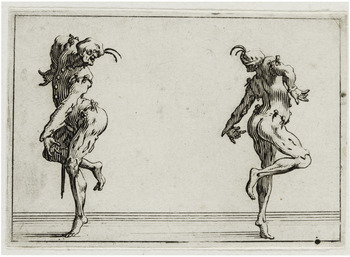
The term “capriccio” was initially used in the seventeenth century for whimsical musical compositions.Footnote 21 Jacques Callot's Capricci di varie figure di lacopo Callot (1617), a series of fifty etchings the artist created in Florence, marks the word's “‘anchoring’ as a term” to visual art.Footnote 22 In these etchings, Callot paired dualities in several ways: some, such as his etchings of Pantalone, present two views of the same figure from opposite perspectives (Fig. 1). In others, the composition is based on contrasting at least two but as many as four planes of action: often a large, silhouetted foreground figure frames and shapes the viewer's gaze into a distant field image.
Jacques Callot, Two Pantaloni Turning Their Backs (1617). Etching; 5.7 × 8.3 cm. (2 1/4 × 3 1/4 in.). Harvard Art Museums/Fogg Museum, gift of William Gray from the collection of Francis Calley Gray, by exchange, S4.3.3. Photo: Imaging Department © President and Fellows of Harvard College.

Hoffmann moored the capriccio to literature with his Princess Brambilla: A Capriccio after Jacques Callot (1820). In his preface to this commedia-infused novella, his second major work “in the manner of” Callot, he wrote:
The kind reader … who may be ready and willing to put gravity aside for a few hours and abandon himself to the whimsical and audacious play of a hobgoblin … is humbly requested by the editor not to forget the basis on which the whole affair rests, Callot's fantastic caricatures, and also to consider what a musician may demand of a capriccio.Footnote 23
One of Hoffmann's major innovations in Brambilla was to link the capriccio's self-defined form within whimsy with Gozzi's polemical approach to theatrical reform. For Hoffmann, this duality was expressed through the self-referentiality of Romantic irony.
Although Friedrich Schlegel was the first German Romantic to write about “irony” (Hoffmann preferred the term “humor”), Russian modernist writers and directors often associated irony with Hoffmann.Footnote 24 Its precise meaning has long been debated, but the definition of Romantic irony most relevant to Russian theatre is a literary (or theatrical) “self-consciousness in which an author signals his or her freedom from the limits of a given work by puncturing its fictional illusion and exposing its process of composition as a matter of authorial whim.”Footnote 25 Examples of theatrical irony include direct audience address, authorial interruptions, plays within plays, and other devices that draw attention to plural perspective. Jestrovic explains: “When romantic irony is used, a conflicting semiotic activity takes place contributing to the effect of theatricality—the signifier and the signified are simultaneously shown as identical (through the protagonist's voice) and different (through the authorial voice).”Footnote 26 In Russian theatre, irony and the grotesque became formal devices through which to reveal the artist's fantasy. Irony's self-referentiality allowed for dual emphases on the work and its creator, whereas the grotesque altered and commented through exaggeration and juxtaposition. Irony dispersed the theatrical experience into multiple modes of perception; the grotesque bent it through subjective distortion.
Before Newton, Europeans assumed that prisms were devices whereby white light was physically transformed into the colors of the rainbow. Newton discovered that the colors in white light are always there; we simply don't have the ability to see them until they are refracted. Meyerhold believed that theatre is inherently a plural experience but that its colors are invisible in productions that mirror life. One of his lifelong quests was to discover how to reveal the theatre's full spectrum. He and his collaborators viewed Gozzi's Love of Three Oranges as deeply consonant with this aim, both in terms of how Gozzi's form might be instructive and how the fiaba could help to define the new Russian theatre.
Love of Three Oranges: The Fiaba
Meyerhold–Soloviev–Vogak's Three Oranges is one in a series of oranges—Giambattista Basile's “The Three Citrons” (and other tales) in the Pentamerone (1634–6); the Italian oral tradition; Gozzi's fiaba; refractions of Gozzi by Hoffmann and Tieck; Meyerhold, Soloviev, and Vogak's “divertissement”; Prokofiev's opera; and subsequent stage productions. It lies outside the scope of this essay to analyze each. Instead, I will briefly place the Russian scenario in the context of three immediate frames that illuminate its formal logic: Gozzi's fiaba, Hoffmann's retelling of Love of Three Oranges in Strange Sorrows of a Theatre Manager, and Meyerhold's Love for Three Oranges: The Journal of Doctor Dapertutto.
Gozzi's Analisi riflessiva della fiaba “L'amore delle tre melarance” (Reflective Analysis of the Fairy Tale “Love of Three Oranges”) documented (after the fact) the 1761 production that became the first of Gozzi's ten fiabe teatrali (theatrical fairy tales). Although English versions often render Love of Three Oranges in dialogue, Gozzi's scenario contains only a few scripted lines that ridicule the singsong rhythm of the Martellian verse his theatrical competitors often used.Footnote 27 Gozzi directly interpolates abundant commentary, giving equal weight to the story and its barbed polemical frame: Gozzi's theatre wars against Carlo Goldoni's domestic comedies and Abbate Pietro Chiari's bombastic tragedies. As a result, dialogue, action, and topical jabs flow from one to the other, sometimes seamlessly, sometimes jarringly, but always without segue. Beginning with Love of Three Oranges, Gozzi revitalized commedia by infusing it with fantastical and self-referential elements, in opposition to Goldoni's gradual move away from conventionalized masks, lazzi, and scenarii and toward sanitized comedy grounded in daily life.
The plot of Love of Three Oranges focuses on Prince Tartaglia, who is languishing from a fatal case of hypochondria. Truffaldino, the court comic, saves the prince by making him laugh. Two warring magicians, Fata Morgana (a caricature of Chiari) and Celio (a caricature of Goldoni), battle over Tartaglia's fate. After the prince is cursed by Fata Morgana, the remainder of the fiaba details his love, pursuit, rescue of, and marriage to one of the titular oranges, a magically charmed princess.
Gozzi's polemical framing trivializes Chiari's and Goldoni's plays by using framed seriousness to make their work “doubly ridiculous”Footnote 28 and by staging comic literalizations of metaphors. Chiari's Martellian verse becomes an actual poison—likened to opium—that the tale's villains sneak into the prince's food. Gozzi also delights in overt convention: a devil wielding a bellows blows at Tartaglia and Truffaldino to create a “wind” that transports them vast distances in an instant.Footnote 29
Gozzi's commedia characters frame the action of an ostensibly serious plot with commedia masks, lazzi, and asides, thus becoming negotiators between the fairy-tale world and the world of the audience. His fiabe destabilize boundaries between humans, animals, and objects with waters that dance (in The Green Bird), statues that speak (in The King Stag), and oranges that become humans (in Love of Three Oranges). As Clayton describes it, “the highly theatrical introduction of animal characters, and the transformation of characters into animals and back, heralds the grotesque as a new, and subsequently important, element in the commedia tradition.”Footnote 30
Love of Three Oranges: German Refractions
Gozzi's theatre wars inspired several other uses of Love of Three Oranges as a tool for theatrical reform. The plays within plays of Tieck's Puss in Boots may incorporate Charles Perrault's fairy-tale content, but they refract Gozzi's form. Hoffmann similarly refracts Gozzi in several of his tales, most notably in Strange Sorrows of a Theatre Manager (Seltsame Leiden eines Theaterdirektors, 1818), a seminal theoretical treatise that has yet to appear in English translation. In all likelihood, it was through Strange Sorrows that Meyerhold first encountered Three Oranges. Footnote 31
Strange Sorrows is a manifesto for theatrical reform loosely disguised as a dialogue. Two theatre managers, one in brown, the other in gray, meet by chance at an inn and exchange tales of theatrical woes. After listening to Gray, Brown presents a methodical assessment of the problems in contemporary theatre along with proposed solutions. With Brown as his spokesperson, Hoffmann calls for actors to analyze each new character, to play supporting as well as lead roles, to express roles physically, and to move beyond a single emploi (character type). He also calls for the unification of theatrical elements (a generation before Wagner's Gesamtkunstwerk), design that provokes the fantasy, production-specific costumes, and plays by Shakespeare, Calderón, and Gozzi.
The remainder of the tale sets up a surprise ending. Brown, who is staging Gozzi's Love of Three Oranges, tells his own version of the scenario. In it, Fata Morgana brings about Prince Tartaglia's “melancholy” by dicing up “tragedies of fate” and putting them in his chocolate, one plot line is absent altogether, and Truffaldino becomes the German Kasper, a change that effectively absorbs Gozzi into the German tradition. The two theatre managers also actively reframe Love of Three Oranges by breaking into conversation about it as it is told.
Just as Brown reaches the end of the story, Gray begs him to stop: he thinks it impossible to stage Gozzi's fiaba without Sacchi's troupe,Footnote 32 the commedia company that originally performed it. Brown proposes that Gozzi can be staged only under special circumstances: as opera or by his company. He describes the virtues of his actors: they never upstage one another, know their roles perfectly, and don't superimpose their “selves” onto the roles. When he leads Gray up to his room, he reveals a company of marionettes. Written nearly a century before Craig's “The Actor and the Über-marionette” (1907), Hoffmann's declaration of puppets as ideal actors presented a provocative new paradigm for actor–director and actor–character relationships in Russia.
Meyerhold's view of Gozzi's Love of Three Oranges was shaped by its retelling in Strange Sorrows, which many Russian theatre artists had viewed as a theoretical work of seminal importance since its 1894 Russian translation.Footnote 33 Shortly after their Three Oranges was completed, Meyerhold and Soloviev wrote to one another about seeking a composer who could adapt it into an opera.Footnote 34 Although Meyerhold did not attempt literally to reconstruct Sacchi's troupe, he did train young actors to generate audience-centered productions based in commedia techniques. And like Hoffmann's theatre managers, Meyerhold and his collaborators openly discussed their reforms even as they undertook them.
Love for Three Oranges: Dapertutto's Journal
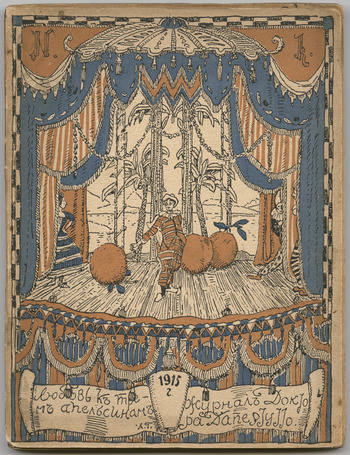
In 1913, Meyerhold and several collaboratorsFootnote 35 opened a studio aimed at training a new generation of actors to negotiate character and space together with an audience. This studio, Meyerhold's first to achieve longevity after the failed Moscow Art Theatre Studio on Povarskaia Street (1905) and other smaller-scale experiments, finally allowed Meyerhold to train actors with “the enthusiasm of Sacchi.”Footnote 36 In conjunction with what became known as the Borodinskaia Street Studio,Footnote 37 which operated until 1917, Meyerhold published Love for Three Oranges: The Journal of Doctor Dapertutto (1914–16, hereafter LTA) (Fig. 2). This title can and should be read as a manifesto. In its first half, Meyerhold advocates for the fantastical, conventionalized, polemical theatre of Gozzi. Unsurprisingly, several of the journal's articles accused the Moscow Art Theatre and the First Studio, where Konstantin Stanislavsky's system was then taking shape, of mistakenly pursuing the aesthetic aims of Goldoni.Footnote 38
Alexander Golovin's design for the front cover of Love for Three Oranges: The Journal of Doctor Dapertutto no. 1–3 (1915). Savine Collection, Rare Book Collection, Wilson Special Collections Library (PN2007.L5 1915 no. 1/3), UNC–Chapel Hill.

The journal's subtitle references Meyerhold's pseudonym: for nearly a decade he worked as a St. Petersburg imperial theatre director by day but experimented, performed, and wrote after hours as Doctor Dapertutto. A character from E. T. A. Hoffmann's “The Story of the Lost Reflection,” a tale within A New Year's Eve Adventure, the malevolent magician Doctor Dapertutto (after Italian dappertutto, ‘everywhere’) steals the hero's reflection. For Meyerhold, who aimed to create a theatre that did not simply reflect life, this choice of pseudonym could not have been more apt. Meyerhold penned polemical articles as Dapertutto that were published in his journal. He also sometimes appeared publicly as Dapertutto, visibly donning his second self before an audience to debate about theatrical reform.Footnote 39 In these cases, Meyerhold's doppelgänger became a physical manifestation of the director's fascination with theatrical moments when reality and fiction collide as an actor dons a mask to become a character or drops it to show the self that lies behind.
The aims of Meyerhold's journal were both scientific and unabashedly subjective: the studio functioned as a theatrical laboratory and the journal as a record and instigator of its ideas and experiments. Its authors disseminated information on the commedia mask as an ideal distillation of character, on the grotesque, and on an artistic worldview infused with the irony, framing devices, and collisions of Gozzi, Callot, Hoffmann, and Tieck. Meyerhold required his students to read the journal, both in this prerevolutionary period and in the 1920s, when he was developing and teaching biomechanics.Footnote 40
Love for Three Oranges: The Divertissement
Three Oranges appeared in the inaugural issue of Meyerhold's journal, an orange within an orange, a manifesto within a manifesto. Several changes from Gozzi are apparent immediately. The Russian version reframes Gozzi's prologue and three acts by dividing them into “A Divertissement in Twelve Scenes, a Prologue, an Epilogue, and Three Interludes,” deliberately creating a fragmented form that gives actors flexibility to shift instantaneously between plot and interruption. This structure anticipates and makes legible the logic behind the grotesque fragmentation that became a defining characteristic of all Meyerhold's productions.
Conspicuously absent from the divertissement are most of the topical references to Gozzi's theatre wars. In response to a negative review of the scenario, Meyerhold, Soloviev, and Vogak published a wittily caustic “open letter” that explained why they were drawn to Gozzi:
You think … that Count Carlo Gozzi's reflective analysis of the fairy tale “Love for Three Oranges” is noteworthy only for its element of polemical parody. You absolutely ignore its specifically theatrical aesthetic aims, which, in our view, are the most valuable aspect of this scenario and for fiabe dramatiche [sic] in general. … The essence of this element, from our point of view, consists in contrasting improvised comedy with scripted comedy, the theatre of masks with the theatre of character.
In the divertissement we composed (after Gozzi), we … entirely consciously removed Gozzi's polemical satire … simply because Gozzi's technical methods of scenario composition are much more important than their transient combative meaning. …
The theatrical techniques of commedia dell'arte are clearer and more distinctly valuable to us as they resonate in the scenarios of Count Carlo Gozzi.Footnote 41
Meyerhold and his collaborators were particularly attracted to Gozzi's juxtaposition techniques. Their changes to Gozzi's text explore how commedia masks frame action and negotiate audience experience and how physically framing specific portions of the stage can achieve similar ends.
In a 1911 interview, Meyerhold described the grotesque as “a constant drawing of the spectator from one mode of perception he has only just guessed to another he did not expect at all.”Footnote 42 At its simplest, this “oscillation”Footnote 43 between modes of perception takes place between two planes: Meyerhold often juxtaposed contrasting styles, emotions, and tempos or collided the fictional world of the theatre with the real world of the audience. He also, however, generated multiple theatrical planes that create the impression of many levels of experience. In Puss in Boots and in the lesser-known Topsy-Turvy World, Tieck had nested multiple theatres within theatres—as many as five—in which real audiences watched fictional audiences watch plays within plays within plays.Footnote 44 Hoffmann's Princess Blandina was a play within a play within a tale within a book (four planes—five, if you include the reader). For Meyerhold, constructing and rupturing theatrical frames prompted similar perceptual multiplicities.
Meyerhold's earliest and most famous use of such devices was his production of Alexander Blok's Balaganchik (Little Fairground Booth, 1906).Footnote 45 This play, which experimented with what Blok called “the ‘transcendental irony’ of which the Romantics spoke,”Footnote 46 overflows with authorial interruptions and overtly applied conventions. Nikolai Sapunov's designs also featured a theatre within a theatre, a “little show-booth with the prompter and all the scenery exposed.”Footnote 47 Meyerhold explored the forestage as a place to physicalize Romantic irony by using the area in front of the booth as a location where actors drop in and out of character or acknowledge the audience. Braun has argued that Balaganchik “furnish[ed] the basis for [Meyerhold's] entire style, a style that in a word can be called ‘grotesque.’”Footnote 48 I would modify this slightly: Balaganchik sparked Meyerhold's interest in deeply studying, understanding, and applying formal elements that grew into a poetics. Balaganchik whetted his appetite, but other experiments, one of the most significant of which was Three Oranges, helped him develop the necessary techniques.
The Three Oranges divertissement is particularly noteworthy for how it shapes simultaneity and oscillation through character and space. Meyerhold understood Gozzi's commedia masks as framing characters that shape audience experience. As early formalist Viktor ZhirmunskyFootnote 49 wrote in an LTA article called “Comedy of Pure Joy,” these characters
are spectators, ideal comedic mirrors with various distorting curves in them, reflecting in their own particular distortions the development of the poetic action. With their commentary on the action … with their references to actual—not theatrical—reality, they destroy the scenic illusion of the primary … action. More precisely, they reveal the illusoriness of everything happening onstage.Footnote 50
Tieck took Gozzi's framing characters further by turning them into a fictional audience. In Puss in Boots,
Tieck replaces these masks with real spectators … [that] sit in the parterre and watch this fairy tale. During the intermissions they make remarks; they interrupt the play's action with their own critical commentary. … Conversations in the parterre serve as an introduction to the play and a theatrical departure from it. Thus the parterre's participation in the action gives Tieck the ability to develop an element of comic reflection, the bearer of which in Gozzi had been the masks.Footnote 51
As in Gozzi's fiabe, Tieck “compels the actor to break character, thereby revealing the actor standing behind the guise of the play's character.”Footnote 52
Three Oranges frames a variety of theatrical elements in addition to character: dramatic structure, stage space, entrances and exits, props, theatrical genres, and conventions. This framing is paired with equally varied directorial intrusions: masks, “parades” in which characters physically introduce themselves, prologues, interludes, action on the edge of the forestage, framing characters who function as a living proscenium, and individually framed stage spaces.
The Russian Three Oranges frames major characters at first entrance with what Meyerhold called the “parade,” a term borrowed from the fairground and the circus. In his 1913 essay “Balagan” (“The Fairground Booth”), Meyerhold explained the purpose of the parade:
The prologue and the ensuing parade, together with the direct address to the audience at the final curtain, so loved both by the Italians and Spaniards in the seventeenth century and by the French vaudevillistes, all force the spectator to recognize the actors' performance as pure playacting. And every time the actor leads the spectators too far into the land of make-believe he immediately resorts to some unexpected sally or lengthy address a parte to remind them that what is being performed is only a play.Footnote 53
Even before the opening prologue, Three Oranges stages a parade in which Gozzi's theatre wars are reconceived as choruses of warring theatrical genres:
The loud sounds of trumpets and drums resound from backstage. Onto the stage from both sides, with cries and noise, actors enter, battling each other with quills. Kitchen-sink comedians advance upon über-tragic tragedians, who, desperately defending themselves, gradually fall back to center stage, where a collective scuffle ensues. Unexpectedly, three eccentrics run out headlong from the center curtain onto the stage and pull apart those fighting. …
Meanwhile, behind the curtain there is some kind of commotion: backs and heads intermittently appear outlined in the curtain; the whole thing sways; and arms and legs flash out here and there from behind it. … The same musical sounds from the opening play backstage but mixed with squeals and loud laughter. Suddenly, one of the corners of the curtain is lifted slightly, and several hands push out onto the stage a boy, who timidly and embarrassedly walks down to the forestage.Footnote 54
This pantomimic prologue, which introduces the boy's spoken prologue, points to Meyerhold's later concept of preacting, a kinetic introduction to a character's subsequently spoken words. It also introduces three “eccentrics,” “the masks of the authors of the divertissement”—Meyerhold, Soloviev, and Vogak—as characters in their own play.Footnote 55
Three Oranges features a variety of additional parades: characters traverse the forestage as a visual introduction before joining the action. Celio and Fata Morgana are introduced with “Bengal fires and fireworks typical of a lavish spectacle” and “musical accompaniment” before commencing a wizard's war.Footnote 56 Truffaldino's parade at first entrance consists of crossing the forestage bearing “clownish props,” followed by an entire procession of accoutrements to a royal fête.Footnote 57 This kind of establishing shot became important to many of Meyerhold's productions. Well-known examples include Magnanimous Cuckold, in which actors costumed in identical prozodezhda (utilitarian overalls) present themselves in front of Liubov Popova's constructivist set, and The Forest, in which two actors playing actors take several scenes to descend a bridge that brings them incrementally closer to the audience, an example that also recalls kabuki's hanamichi.
Three Oranges contains several categories of characters that multiply or fragment audience perception. Two sets of doubling characters, “fools in the towers” and “supernumeraries in the towers,” peer down onto the main action from towers that flank a false proscenium.Footnote 58 Both comment on the action as it unfolds, the fools verbally and the supernumeraries physically. Their interjections punctuate plot moments by drawing attention to them. For example, the fools repeat key points of exposition:
The first fool in the towers: The hypochondriac prince …
The second: … Tartaglia, who is ill …
The first: … will recover …
The second: … once he laughs.Footnote 59
Although their interjections are rarely longer than an aside, these asides are spatialized by virtue of the fact that they emanate from within the proscenium arch, thus directing the audience's gaze from stage to frame and back again. Meyerhold's productions were filled with such framing characters, from the forestage servants of Dom Juan (1910)Footnote 60 to the ball masqueraders of Masquerade (1917).Footnote 61
Meyerhold and his collaborators also physicalize Gozzi's verbal debates. The competing choruses of Three Oranges prompt a constant process of unmaking and remaking of the performance and of the rules and genres according to which theatre is constructed.Footnote 62 The kitchen-sink comedians and über-tragic tragedians who battled in the opening parade reappear in the second of the scenario's three interludes to physicalize an “argument”Footnote 63 about theatrical repertoire. Clarice, Leandro, and Brighella take turns defending their favorite genres: über-tragedy, kitchen-sink comedy, and commedia, respectively. The following description of Clarice's favorite, über-tragedy, demonstrates how the choruses physicalize her words:
Clarice: I love tragic performances with characters that hurl themselves out of windows and from the tops of towers out of love.
Brighella: And somehow manage to stay alive without breaking their necks.
As Clarice speaks, a chorus of über-tragic tragedians performs. … A king does not want to give his daughter in marriage to a young knight. The latter throws himself from the tower in grief. After him, in despair, comes his bride. Finally the saddened king follows their example. The king remains alive and meets the young lovers, also alive, at the base of the tower. Collective joy. Footnote 64
After Leandro's chorus of kitchen-sink comedians performs similar parodic antics, Brighella, the divertissement's staunch commedia advocate, dons a Harlequin mask and performs a lazzo in which Harlequin laments that his beloved Smeraldina is to marry a farmer. In a scene that does not appear in Gozzi,Footnote 65 Brighella splits into two Harlequins who debate over whether to live or die:
Brighella: Why should you hang yourself?––Because, I want to.––You will not hang yourself.––I will hang myself.––I assure you that you won't.––I swear to you I will.––I tell you, you will not hang yourself.—Just you wait, you scoundrel, I know how to get rid of your meddling!
(Harlequin takes out a stick, deals several full-weight blows onto his own back and takes off running.)
Ah, finally our scamp has skedaddled! Now we can hang ourselves without interference.Footnote 66
This lazzo of oscillation presents an acrobatic quadrupling of character: an actor plays Brighella, who plays not one but two Harlequins, thereby framing the process whereby an actor becomes a character to celebrate virtuosic creation without need for psychological identification. This scene also physicalizes what Marvin Carlson calls “ghosting.”Footnote 67 Just one year earlier Meyerhold had written, “The mask enables the spectator to see not only the actual Arlecchino before him, but all the Arlecchinos who live in his memory.”Footnote 68
Instead of trying to pretend that the actor does not exist when the character is present, Brighella's lazzo of oscillation acknowledges that embodiment is a dance between at least two selves, both for the actor and for the audience. The splitting of actor and character, what Julia Vaingurt has called “bifurcation,”Footnote 69 allows the creator to observe the creation, to maintain an omniscience that the material alone—the body or the mask—cannot have. In later writings on biomechanics, Meyerhold developed a formula to articulate this: N = A 1 + A 2, where N is the actor, A 1 the creator, and A 2 the material.Footnote 70 The actor's creation of a role was, for Meyerhold, an act of authorship, not a passive manipulation by a director or playwright. In this sense, it is more accurate to think of Meyerhold's actors as puppeteers of their bodies and characters than Meyerhold as a puppeteer depriving actors of agency, a common misunderstanding of Meyerhold's work with actors.Footnote 71
In the work of Meyerhold's Borodinskaia Street Studio, the framing of character and the framing of space were inextricably linked. And it is this link that, for me, is this scenario's—and the studio's—most interesting and significant innovation. Three Oranges expands the bifurcation of the actor into a kaleidoscopic splintering of playing spaces with multiple, nested frames. Meyerhold used space as a material object with which the actor interacts creatively.
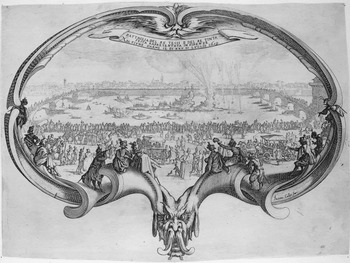
Meyerhold drew extensively from visual art, especially from the etchings of Callot, to inspire mise-en-scène. Several scholars have shown that Callot's Balli di Sfessania (Dances of Sfessania), a series of twenty-four etchings that depict grotesque duos dancing or sword fighting, probably don't depict actual commedia players,Footnote 72 but Meyerhold and his collaborators believed they did and examined them closely for information on commedia physicality.Footnote 73 As with Callot's capricci, several of the balli are staged on multiple planes: focal figures in the foreground contrast with other characters in the background, itself often divided into different planes.Footnote 74 Callot's characteristic foreground–background divides become even more apparent in his etching The Fan, an image identified in Meyerhold's journal as an inspiration for action on multiple planes (Fig. 3).Footnote 75 The silhouetted figures that crouch on its internal frame are reminiscent of the fictional audience that watches a play within a play. They, too, provoke a double perspective: the viewer views the picture directly and through the perspective of its framing figures.
Jacques Callot, The Fan (1619). Etching and engraving; 22.2 × 30 cm. (8 3/4 × 11 13/16 in.). Harvard Art Museums/Fogg Museum, gift of William Gray from the collection of Francis Calley Gray, by exchange, S3.69.1. Photo: Imaging Department © President and Fellows of Harvard College.

For Meyerhold, the forestage served the same function in the theatre. He understood the forestage not as a boundary but as a threshold between the fictional world and the world of the audience, and he trained actors to do the same. Three Oranges calls over a dozen times for action on the forestage, especially during interludes and parades, and Meyerhold's studio notes contain multiple references to training actors how to play on the forestage. Meyerhold eliminated the footlights not simply in order to reimagine lighting design or to remove the fourth wall but also to replace the fourth wall with a permeable liminal space in which the actor becomes the negotiator for the audience of the production's various planes.
Three Oranges also prompts plural perspective by dividing the stage into individually framed spaces. With this in mind, here is the description for the opening setting:
The theatre is set up as the interior of a theatre building being prepared for a grand spectacle. Along the sides of a generous forestage, tall towers are set up for the fools. … At the bases of the towers are built-in alcoves from which actors, as they are performing, take props: at one point the king's crown, etc. Along the wings from the towers to the upstage area stretches a semicircular, opulent, two-tier facade with a great quantity of doors covered by curtains. In the middle of the facade is a large gate … covered with a … curtain, behind which lies a second stage.Footnote 76
Thus there are several framed spaces: the forestage, the main stage, and the upstage stage within a stage but also the towers flanking the proscenium, framed areas for props, curtained doors, and the balcony. Centuries before, wings began to be arranged successively to force a feeling of infinity extending from the vantage point of a single perspective. Meyerhold replaced these wings with frames that provoke a different kind of infinity: one of infinite perspectives.
In Postdramatic Theatre, Hans-Thies Lehmann argues that theatrical productions of European scripted drama have tended historically to treat ruptures of their frames as temporary interruptions:
Even if theatre has a number of conventionalized disruptions of its closure (asides, direct audience address), the play on stage is understood as diegesis of a separated and “framed” reality … which is marked off against its environment as a separate “made up” reality. While arguably “real,” the occasional disruption of the theatrical frame has traditionally been treated as an artistically and conceptually negligible aspect of theatre. … [T]he artistic task consisted in integrating all this into the fictive cosmos as inconspicuously as possible, so that addressing the real audience and speaking outside the play would not be noticeable as a disturbing element. In this respect, one can draw a parallel between the drama in theatre and the “frame” of a picture that closes the picture off to the outside and at the same time creates an internal cohesion.Footnote 77
While this may be true of many representational dramas, Meyerhold's understanding of theatrical frames and their “disruptions” is a major exception to Lehmann's claim. In Meyerhold's view, frames are neither negligible nor inconspicuous. They are the artist's thinking made visible. Their presence allows the audience to participate in the infinite possibilities of “making-believe” and the joy of creation. In Zhirmunsky's words, “For the Romantics, Gozzi represented ‘comedy of pure joy.’ … Let art be like play—light, cheerful, fantastical, not like everyday, all-too-ordinary life!”Footnote 78 This pairing of make-believe and joy was to become a defining aspect of Russian and early Soviet theatre, most notably in the work of Alexander Tairov and Evgeny Vakhtangov, who each stressed jubilant improvisation as a means of elating the spectator regardless of a play's thematic content.
In her analysis of Hoffmann's narrator in The Sandman, Maria Tatar notes that Hoffmann's “narrative intrusions … do not disrupt the fictional illusion, as is generally assumed, but rather remind us that we are contemplating a world created by a mind. … The self-conscious narrator, through his reflections on himself and on the creative process, never lets us forget that we are in the realm of art.”Footnote 79 The intended effect of this on the reader is that “The narrator's reflections … stimulate the reader to engage in the same kind of activity on a higher level: to reflect on a mind reflecting on itself.”Footnote 80 It is easy to see how Meyerhold adapted this to the theatre. Reminding audiences that they are in a theatre does not disrupt illusion; it allows them to reflect on a production reflecting on itself. Meyerhold's constructed and deconstructed frames gave audiences the opportunity to create through thought. I suggest describing this theatrical technique as dissonancing—intentionally generating a conflict between a viewer's “field of expectations”Footnote 81 and what is presented in order to allow for reflection—rather than as distancing—moving the viewer farther away from the familiar.
For several of the Russian formalists, Viktor Shklovsky most famously, the purpose of baring the device (obnazhenie priem) and estrangement (ostranenie) was a revivification of life and art, a renewed ability to perceive and experience. For Meyerhold and his circle, who used different terms for similar ideas, the purpose of irony and conventionalization was joy, an unfettering of the fantasy, a revivification of theatre through shared actor-audience creation. The ideas of Shklovsky and Meyerhold converge, interestingly, in Shklovsky's musings on the theatre specifically. In “The Making of Don Quixote,” he wrote:
As far as the theater is concerned, the illusion presented on the stage ought to have a “flickering” quality to it (i.e., it should alternate with the other, more realistic element in the play). As for the spectator, he must experience within himself a shift in his perception of the action onstage from the “contrived” to the “realistic” and back.Footnote 82
Whether we term this experience flickering, oscillation, or, after Brecht, “complex seeing,”Footnote 83 this contextualizes the cognitive experience that Meyerhold was trying to provoke. In Three Oranges, Meyerhold and his collaborators bared the frame that divides the theatrical world into here and there, reality and fiction, person and character, thus transforming the frame itself into a liminal, shared space in which meaning is generated by actors and audiences alike.
Three Oranges and the Borodinskaia Street Studio
Although Meyerhold, Soloviev, and Vogak's Three Oranges was never publicly staged,Footnote 84 it publicly bared the inner workings of the Borodinskaia Street Studio. Each Three Oranges author was closely involved in the studio's activities. Soloviev taught commedia history and technique. Meyerhold trained students in stage movement and the grotesque. Vogak translated several of Gozzi's critical writings for LTA, taught voice classes, and participated in the studio's only public performance (1915).Footnote 85 As Meyerhold and his collaborators experimented with implementing the theatrical reforms laid out in Three Oranges, they trained students to develop expertise in three basic categories.
The first was the creative responsiveness of the actor's mental and physical instruments: the fantasy and the body. This included honing the ability to play (to “make believe”) through improvisation; cultivating deep knowledge of the history of theatre, art, music, and “the literary balagan” (Hoffmann, Tieck, and others)Footnote 86; and generating exercises that refracted this knowledge through a contemporary prism, trained the actor's instantaneous responsiveness, and developed playfulness and virtuosity in commedia, acrobatics, dance, and athletics. Voice classes in musical recitation taught actors to “overcome the formless, relaxed tempo of naturalism.”Footnote 87
The second was responsiveness to the material elements of performance. In his studio notes, Meyerhold writes that honing awareness of “dramatis elements” sharpens the actor's ability to interact with the material world and punctuate a production visually.Footnote 88 This begins with understanding the actor as part of a larger artistic cosmos. Meyerhold wrote from the imagined point of view of the actor:
“Since my acting will reach the spectator simultaneously with the scenery and music, in order for the combination of all performance elements to have a precise meaning, acting must be one of the components of this sum of dramatis elements.” Knowing … how the whole theatrical work came to be, the actor who goes out onto the stage transforms himself, becoming a work of art.Footnote 89
Meyerhold goes on to use the word “polyphony” to characterize the interplay between music and movement specifically,Footnote 90 but each of the dramatis elements in a production might be thought of as a distinct musical line in a polyphonic view of theatrical production.
The third category, what Leach has called “the cornerstone of Meyerhold's theatre,”Footnote 91 was making the spectator a cocreator in the theatrical event. It is here that the studio's engagement with Hoffmann, Tieck, Romantic irony, and Gozzi was most central and that the connection between Three Oranges and studio work is most apparent. In Three Oranges and in studio exercises, actors learned to perform on multiple planes, to self-introduce for the benefit of the audience, and to oscillate between fiction and reality, content and commentary.
Soloviev and Meyerhold documented their class activities in a regular LTA “Studio” column that provides valuable detail on specific experiments. Soloviev lectured on topics “related to the theatrical method of studying the techniques of commedia dell'arte,”Footnote 92 including “E. T. A. Hoffmann and his Princess Brambilla as a new understanding by the German Romantics of the fate of Italian improvised comedy”; the Gozzi–Goldoni–Chiari theatre wars; Gozzi's fiabe; Atellan farce; Roman mimes; commedia in France; and Molière, all of which he viewed as part of a shared genealogy with which the studio had chosen to engage.Footnote 93 He accompanied these lectures with practical work, using “Bergamo dance” as a foundational performance techniqueFootnote 94 and Harlequin the Matchmaker Footnote 95 to introduce “the characteristic gestures and movements of the most common masks.”Footnote 96 He also taught the “parade,” “the role of forestage servants in a performance,” and “the significance of the grotesque.”Footnote 97 Students experimented with lazzi, including “night scene,” “the city,” and “the duel.”Footnote 98 They rehearsed the second interlude from Three Oranges and refracted the divertissement into a new scene, “Three Oranges, An Astrological Telescope; or, The Lengths to Which Love for the Metteur en Scène Can Go.”Footnote 99
Meyerhold's classes acquainted actors with the physical and rhythmical skills needed to perform in the new theatre. He cultivated play and creative joy, “the death of psychologism,” “the merging of the past with the contemporary,” the grotesque,Footnote 100 and a theatricalist basis for stage movement:
In theatre that reproduces life photographically (naturalistic theatre), movement is considered from the perspective of its use in the business of helping the spectator understand this or that task of the playwright. … Theatre is an art, and … everything must be subordinate to the laws of this art. The laws of life and the laws of art differ.Footnote 101
He also developed exercises that trained the actor's interaction with the material world, using props to train the hands and costumes as initiators of gesture. Techniques included
The significance of the “refusal” [otkaz]. … The precision and intrinsic value of gesture. The actor's self-admiration while acting. The technique of using two planes (stage and forestage). … The actor's costume as decorative adornment and not as utilitarian necessity. Hats as a pretext for a theatrical bow. Sticks, lances, rugs, lanterns, shawls, cloaks, weapons, flowers, masks, noses, and like instruments as material for training exercises for the hands. … Tulle in the hands of forestage servants as distinct punctuating accents for the gestures and conversations … of the main dramatis personae. The parade as an essential and autonomous part of theatrical performance.Footnote 102
Each exercise was supported by a clearly reasoned view of its larger purpose in developing the new actor.
After a century of using Stanislavsky-based actor training (in its many versions), we sometimes forget that Meyerhold developed his pioneering approach to actor training just when Stanislavsky, in collaboration with Vakhtangov and Leopold Sulerzhitsky, was shaping the early System at the MAT First Studio. The Borodinskaia Street Studio centered on teaching actors to activate audiences creatively. As Leach has shown, “The fundamental cause for the split between Stanislavsky and Meyerhold at the very beginning of the century lay in their divergent views of the place of the audience in the theatrical event.”Footnote 103 Instead of Stanislavsky's “public solitude,” Dapertutto's actors presented themselves via the parade. Instead of tracking “given circumstances,” students learned to respond to their immediate artistic environment. Instead of “experiencing” a role, studio participants grew adept at oscillating between mask and self.
The Borodinskaia Street Studio gave one public performance that placed its process of actor training onstage. The 12 February 1915 presentation consisted of ten études, interludes, and pantomimes (in celebration of theatrical work that is provisional, between acts, or without words) performed in the manner of sources with which the studio engaged. Nearly every scene was performed in a different style—“after” Callot,Footnote 104 as a clown act,Footnote 105 as a parody of marionette theatre,Footnote 106 in the style of nineteenth-century French harlequinades,Footnote 107—to give actors corporeal experience of the devices they refracted. The performance space was arranged on two levels to allow for differing play on the forestage and main stage. One reviewer noted that instead of a “traditional” stage, there was a “fairly high platform” in front of which was “a forestage carpeted in a semicircle with dark blue cloth.” As actors performed, “they constantly had to jump from platform to ‘forestage’ and back again.”Footnote 108 One scene was presented with “street performers” on the main platform and an internal audience on the forestage to “stir up the contemporary audience.”Footnote 109
For Meyerhold, it was far more important that audiences be stirred up than that they be universally laudatory. The 1915 no. 1–3 issue of LTA featured an unusual studio section, “Reviews from the Daily Press and Remarks by the Editors of the Journal of Doctor Dapertutto on the 12 February 1915 Evening of the ‘Studio.’” The eighteen pages that follow are organized in two columns: on the left are reprints of reviews, beginning with the most provocative, rebutted on the right with wit—and larger font size—by Meyerhold and his collaborators. Meyerhold reveled in controversy and, as is clear from this “Studio” report, taught his students to do so as well. Future filmmaker Sergei Yutkevich recalled Meyerhold saying, “If everyone praises your production, it can be said with certainty that it is worthless. If the show is met entirely with bayonets, there might be something good in it. If it splits the audience in half, then quite possibly your work is good.”Footnote 110
Once Meyerhold began to teach regularly, he did so for the remainder of his life with remarkably consistent aims in terms of developing physical agility, responsiveness to the material elements of performance, and direct audience engagement. The Borodinskaia Street Studio closed in 1917, but it was followed by Meyerhold's Courses on the Technique of Theatrical Productions in 1918–19 and the State Higher Theatre Workshops in 1921,Footnote 111 where Meyerhold developed biomechanics.
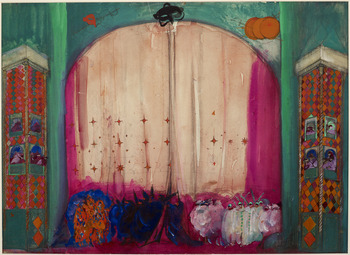
The theatrical worldview of Meyerhold, Soloviev, and Vogak's Three Oranges prompted innovations that extend far beyond the studio or Meyerhold's future experiments, however. Plural perspective functioned—and continues to function—similarly in myriad refractions of Meyerhold's ideas by other artists. Just a few contemporaneous examples include Sergei Sudeikin's designs for Tales of Hoffmann (1915), Prokofiev's opera Love for Three Oranges (1919) and its designs by Boris Anisfeld for the Chicago world premiere (1921) (Fig. 4), Vakhtangov's fantasy-infused Turandot (1922), Nikolai Evreinov's metatheatrical plays of the 1910s and 1920s, Tairov's Princess Brambilla: A Kamerny Theatre Capriccio (1920), Sergei Eisenstein's “montage of attractions” in theatre and film, the “verbal montage” of Sergei Tretiakov's plays, and, later, the defamiliarization devices of Bertolt Brecht—though there is an important difference between estrangement in Meyerhold and estrangement in Brecht.
Design for Prokofiev's opera Love for Three Oranges (Chicago world premiere, 1921). Note Prokofiev's four competing choruses on the forestage and the observing figures in the towers. Boris Israelevich Anisfeld, Russian, 1879–1973, Pink Curtain #2, from Love for Three Oranges, n.d. Gouache and watercolor, with pen and black ink, gold metallic paint, and charcoal, over graphite, selectively varnished, on off-white laid paper, 565 × 780 mm. Friends of American Art Collection, 1922.84, The Art Institute of Chicago.

For Brecht, the activation of the spectator was something to be harnessed. Though Meyerhold's staging techniques seem similar, for him the activation of the spectator was instead something to be unleashed. This is precisely why Meyerhold viewed violent disagreement in the audience as a sign of a production's success and why, beginning in the 1920s, he methodically tracked as many as twenty different audience responses, ranging from laughter to rushing the stage.Footnote 112 Brecht created dialectics of dissonant possibilities that the viewer is prompted to try to resolve in the world outside the theatre. Meyerhold created a symphony of dissonances that embrace the impossibility of resolution as the fundamental, if uncomfortable, stuff of which life is made. Meyerhold viewed theatre as a conversation rather than as a mirror, as a refraction rather than a reflection of life and art. For him, to bare the frame was to bare the creative process. He believed that content and form coexist, just as a painting and its frame, fiction and reality, and character and actor coexist, and that it is by embracing dissonant simultaneities such as these that we free ourselves to create.