INTRODUCTION
Although the majority of the over 3200 (De Grave et al., Reference De Grave, Pentcheff, Ahyong, Chan, Crandall, Dworschak, Felder, Feldmann, Fransen, Goulding, Lemaitre, Low, Martin, Ng, Schweitzer, Tan, Tsudy and Wetzer2009) species of caridean shrimps have a sexual system with separate sexes (gonochory), a substantial and growing number of species have been found to be hermaphroditic (Bauer, Reference Bauer2000; Correa & Thiel Reference Correa and Thiel2003a; Baeza, Reference Baeza2010; Baeza & Piatoni, Reference Baeza and Piatoni2010; Bauer & Thiel, Reference Bauer and Thiel2011). Hermaphroditism in carideans is primarily sequential and protandric, in which some or all individuals first develop as functional males (‘male phase’) and then later change sex to functional females (‘female phase’) (Bauer, Reference Bauer2000, Reference Bauer2004). Protandry in carideans takes several forms (Bauer, Reference Bauer2000). All individuals change from male to female in some protandric species, e.g. Pandalopsis dispar Rathbun, Reference Rathbun1902 in Butler (Reference Butler1964), Paratya curvirostris (Heller, Reference Heller1862) in Carpenter (Reference Carpenter1978) and Thor amboinensis (De Man, Reference De Man1888) in Baeza & Piatoni (Reference Baeza and Piatoni2010). In others, e.g. Pandalus spp. (Bergström, Reference Bergström2000), most individuals change sex but there are varying proportions of the population that develop directly into females (‘primary females’). In the genera Lysmata and Exhippolysmata, a more advanced form of protandry has evolved (‘protandric simultaneous hermaphroditism’ (PSH)) in which individuals first develop and function as males but, when changing sex to the female phase, retain male gonadal structures and sexual ability, i.e. are functionally simultaneous hermaphrodites (Kagwade, Reference Kagwade1982; Bauer & Holt, Reference Bauer and Holt1998; Bauer, Reference Bauer2006; Baeza, Reference Baeza2006, Reference Baeza2009; Laubenheimer & Rhyne, Reference Laubenheimer and Rhyne2008; Baeza et al., Reference Baeza, Schubart, Zillner, Fuentes and Bauer2009, Braga et al., Reference Braga, López-Greco, Santos and Fransozo2009). Evidence indicating or confirming protandry includes: (1) population size–frequency distributions consisting of small males and larger females, with little to no overlap in size; (2) transitional individuals with a mixture of deteriorating male features and/or development of female primary and secondary sexual characteristics; (3) females with vestiges of male external or internal structures; and (4) direct observation of sex change in individuals maintained in the laboratory (Bauer, Reference Bauer2004; Espinoza-Fuenzalida et al., Reference Espinoza-Fuenzalida, Thiel, Dupré and Baeza2008; Anker et al., Reference Anker, Baeza and De Grave2009).
There is considerable intrageneric variation in sexual systems (gonochory, protandry and PSH) of caridean shrimps (e.g. Crangon: Boddeke et al., 1991; Gavio et al., Reference Gavio, Orensanz and Armstrong2006; Schatte & Saborowski, Reference Schatte and Saborowski2006; Hippolyte: Zupo, Reference Zupo1994; Cobos et al., Reference Cobos, Díaz, García-Raso and Manjón-Cabeza2005; Espinoza-Fuenzalida et al., Reference Espinoza-Fuenzalida, Thiel, Dupré and Baeza2008; Terossi et al., Reference Terossi, López Greco and Mantelatto2008; Zupo et al., Reference Zupo, Messina, Carcaterra, Aflalo and Sagi2008; pandalids: reviewed in Bergström, Reference Bergström2000; Lysmata: Bauer Reference Bauer2000, Reference Bauer2006; Baeza, Reference Baeza2009; Thor: Bauer, Reference Bauer1986; Bauer & VanHoy, Reference Bauer and VanHoy1996; Baeza & Piatoni, Reference Baeza and Piatoni2010; Rhynchocinetes; Correa & Thiel, Reference Correa and Thiel2003b; Thiel et al., Reference Thiel, Chak and Dumont2010; Bauer & Thiel, Reference Bauer and Thiel2011). Shrimps of the genus Processa, with at least 52 species (De Grave & Fransen, in press), are small, nocturnally active predators that inhabit temperate to tropical shallow-water soft-bottom habitats, and are often important members of the shrimp fauna in seagrass meadows (Manning & Chace, Reference Manning and Chace1971; Bauer, Reference Bauer2004). Previous studies (Noël, Reference Noël1973, Reference Noël1976) have suggested protandry in two subspecies of Processa edulis (Risso, Reference Risso1816) from the Atlantic and Mediterrean coasts of France. However, the evidence for protandry in that species is controversial (Labat & Noël, Reference Labat and Noël1987). These reports stimulated our interest in the sexual system of two species, Processa bermudensis (Rankin, Reference Rankin1900) and Processa riveroi Manning & Chace Reference Manning and Chace1971, whose populations were sampled on a monthly basis in Thalassia–Syringodium seagrass meadows on the north coast of Puerto Rico (Bauer, Reference Bauer1985, Reference Bauer1989). In this paper, we test the hypothesis of protandry in these two species with observations on size–frequency distributions, sex-ratio, and morphological data.
MATERIALS AND METHODS
Collection
Seagrass shrimps were taken with a pushnet (1-mm mesh) in day and night sampling of Thalassia–Syringodium grass beds just off the public beach (balneario) at Dorado, north coast of Puerto Rico (18°28 ′32″N 66°16′42″W) from March 1982 through to February 1983 (Bauer, Reference Bauer1985). Samples were initially preserved in 10% seawater–formalin, washed, and stored permanently in 70% ethanol. Samples were sorted to species, including Processa riveroi and P. bermudensis, the subjects of this study.
Population structure and sexual morphology
Individuals (N = 806 in P. riveroi; N = 1330 in P. bermudensis) were sexed by examination of the second abdominal appendages (pleopods) for the presence (male) or absence (female) of an appendix masculina (AM), a characteristic of males in most caridean shrimp species (Bauer, Reference Bauer2004). The presence or absence of a vitellogenic ovary, easily observed through the thin translucent carapace of this small shrimp, as well as embryos incubated below the abdomen, was recorded (Bauer, Reference Bauer, Wenner and Kuris1991). Body size was measured as carapace length (CL), the chordal distance from the posterior edge of the eye orbit to the mid-dorsal posterior edge of the carapace, which was measured with a stereomicroscope equipped with an ocular micrometer. The minimum male size in both species was 1.4 mm CL. The relatively few individuals < 1.4 mm CL lacked an AM and were classified as juveniles; individuals ≥ 1.4 mm CL without an AM and not incubating embryos were termed females without embryos. Individuals incubating embryos were termed females with embryos. Monthly size–frequency distributions were constructed and overall sex-ratios (number of males/number of males +number of females) were calculated using 0.50 mm CL size intervals.
The change from male to female in protandric species can often be recognized by a gradual degeneration of external male characters on the first and second pleopods (Butler, Reference Butler1964; Bauer, Reference Bauer1986; Bauer & Holt, Reference Bauer and Holt1998; Bauer & Newman, Reference Bauer and Newman2004). Males of both Processa spp. were observed for such changes by measuring the length of the pleopod 2 AM (from base to tip excluding terminal setae) and the number of AM setae as well as the number of cincinnuli (coupling hooks) on the endopod of pleopod 1, another typical male character of carideans (Bauer, Reference Bauer2004). A sample of males were chosen haphazardly from each species, and one of the first and second pleopods from each male were removed and mounted on slides using the slide-mounting medium CMC (trade name of Polysciences Inc. for a mixture of polyvinyl alcohol, lactic acid and phenol in water) for later observation. Additionally, a sample of females incubating embryos was also taken haphazardly and similarly observed for vestiges of these male characters, which remain in some sex-changing species, e.g. Lysmata wurdemanni (Gibbes, Reference Gibbes1850) in Bauer & Holt (Reference Bauer and Holt1998) and L. californica (Stimpson, Reference Stimpson1866) in Bauer & Newman (Reference Bauer and Newman2004).
Statistics
Allometry of growth in male sexual processes (AM length, number of AM setae, and number of pleopod 1 cincinnuli) was examined with regression analysis, using the log transformation of the allometric growth equation Y = αX β [log (Y) = β log (X) + log α] where β is the slope and α is the Y-intercept of the regression equation. In this study, Y = AM length (μm) or counts of AM setae or pleopod 1 cincinnuli, and X = CL (mm). Positive allometry, negative allometry, and isometry are indicated by β > 1, β < 1, and β = 1, respectively (Gould, Reference Gould1966; Kuris et al., Reference Kuris, Ra'anan, Sagi and Cohen1987). Robust rank regression (SYSTAT, 2007) was used because the assumptions for parametric regressions were not met after log-transformation. For rank regressions, the Spearman correlation coefficient was used to test the hypothesis of a non-significant regression (β = 0). The slopes (β) of regression lines are reported with lower and upper 95% confidence intervals. For sex-ratios, the hypothesis of no difference from a sex-ratio of 0.50 was tested using Chi-square (α = 0.05).
RESULTS
Population structure
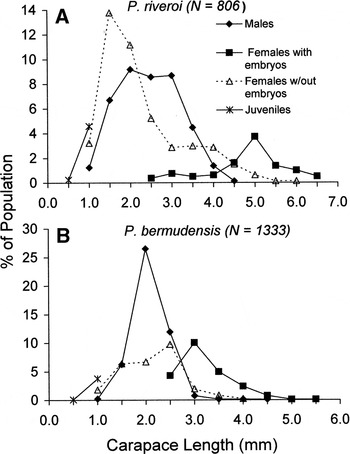
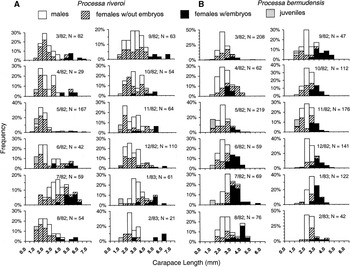
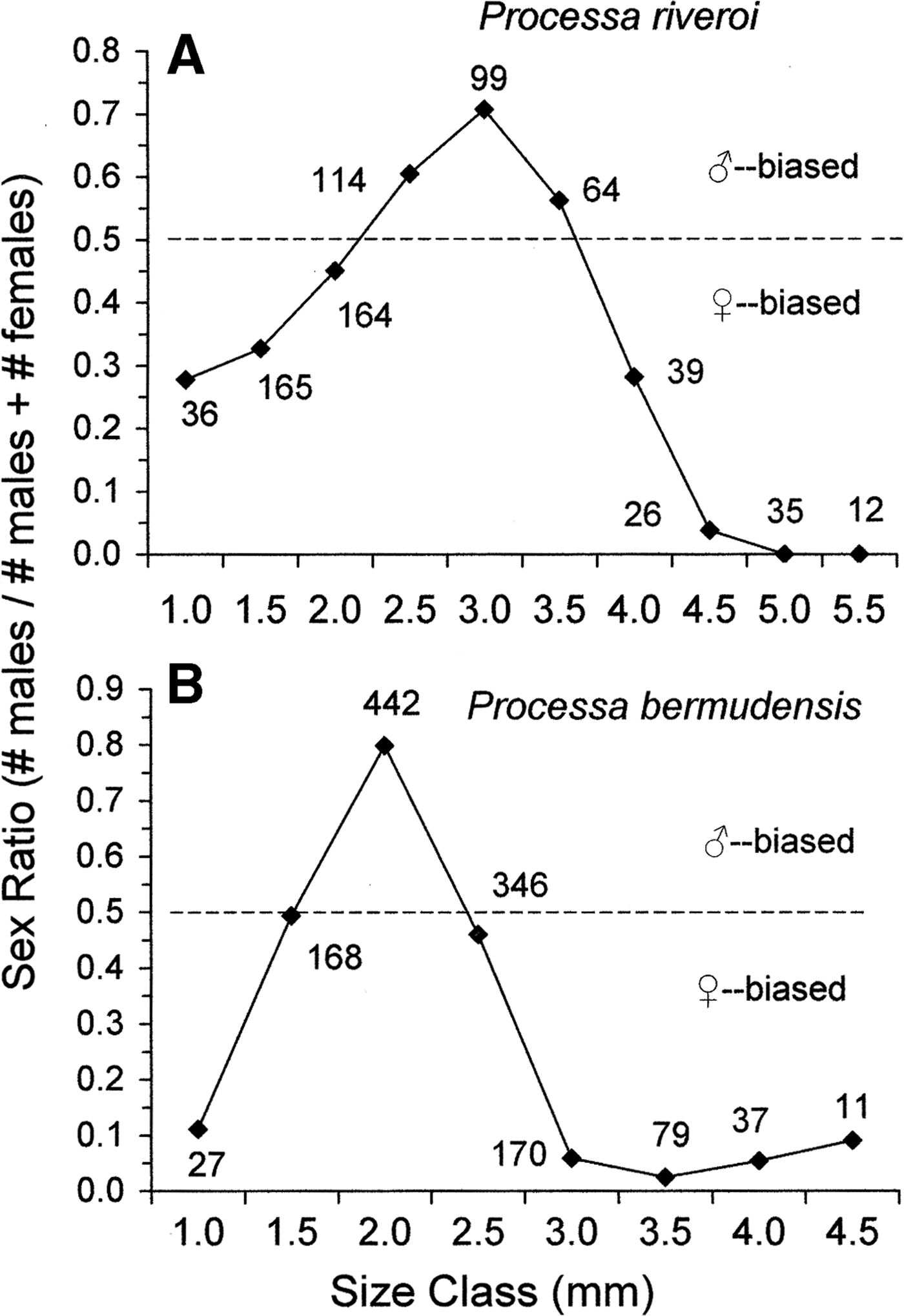
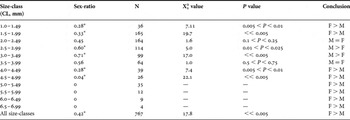
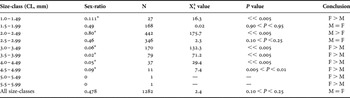
Processa riveroi and P. bermudensis showed similar patterns of frequency distribution by sex in which the smaller size-classes (SC) were a mix of males and immature (without embryos) females and the larger SC were dominated by females incubating embryos (Figures 1–2). Intermediate SC were dominated by males. In both species, males showed external chacterisitics of sexually mature males at a very small size (1.4 mm CL) whereas females began incubating embryos at a much larger size (≥ 2.7 mm CL in P. riveroi; ≥2.5 mm CL in P. bermudensis). Summed over the entire year, the sex-ratio (number of males/number of males + number of females) was female biased (0.42) in P. riveroi but was not significantly different (0.48) from 0.50 in P. bermudensis (Tables 1–2). Sex-ratios by SC, summed through the year of sampling, clearly show this pattern of smaller SC with immature female-biased or equal SC, male-dominated intermediate SC, and female-dominated large SC (Figure 3; Tables 1–2). Examination of detailed size–frequency distributions (Figure 2) shows the monthly variation from this overall pattern. Females incubating embryos were present throughout the year in this tropical species (Figure 2). Recruitment of individuals into the smallest SC occurred sporadically throughout the year and not on a seasonal basis (Figure 2; Bauer, Reference Bauer1989). Thus, the pattern of recruitment and growth observed in these species appears to be entry of both male and female recruits, with a more rapid growth of females into large size with their accumulation in and dominance of large SC. Males, on the other hand, grew to a smaller size and accumulated in the intermediate SC.
Frequency distribution of sexual types of Processa riveroi and P. bermudensis. Percentage frequency of males, females with embryos, females without embryos and juveniles in the total sample of (A)P. riveroi and (B) P. bermudensis from the seagrass meadows at Dorado, Puerto Rico (sum of monthly samples from March 1982 through to February 1983).

Monthly size–frequency distributions of Processa riveroi and P. bermudensis from March 1982 to February 1983. The frequency of males, females with embryos, females without embryos and juveniles from monthly population samples is given for (A) P. riveroi and (B) P. bermudensis.

Sex-ratios by size-class from the total sample of (A) Processa riveroi and (B) P. bermudensis.
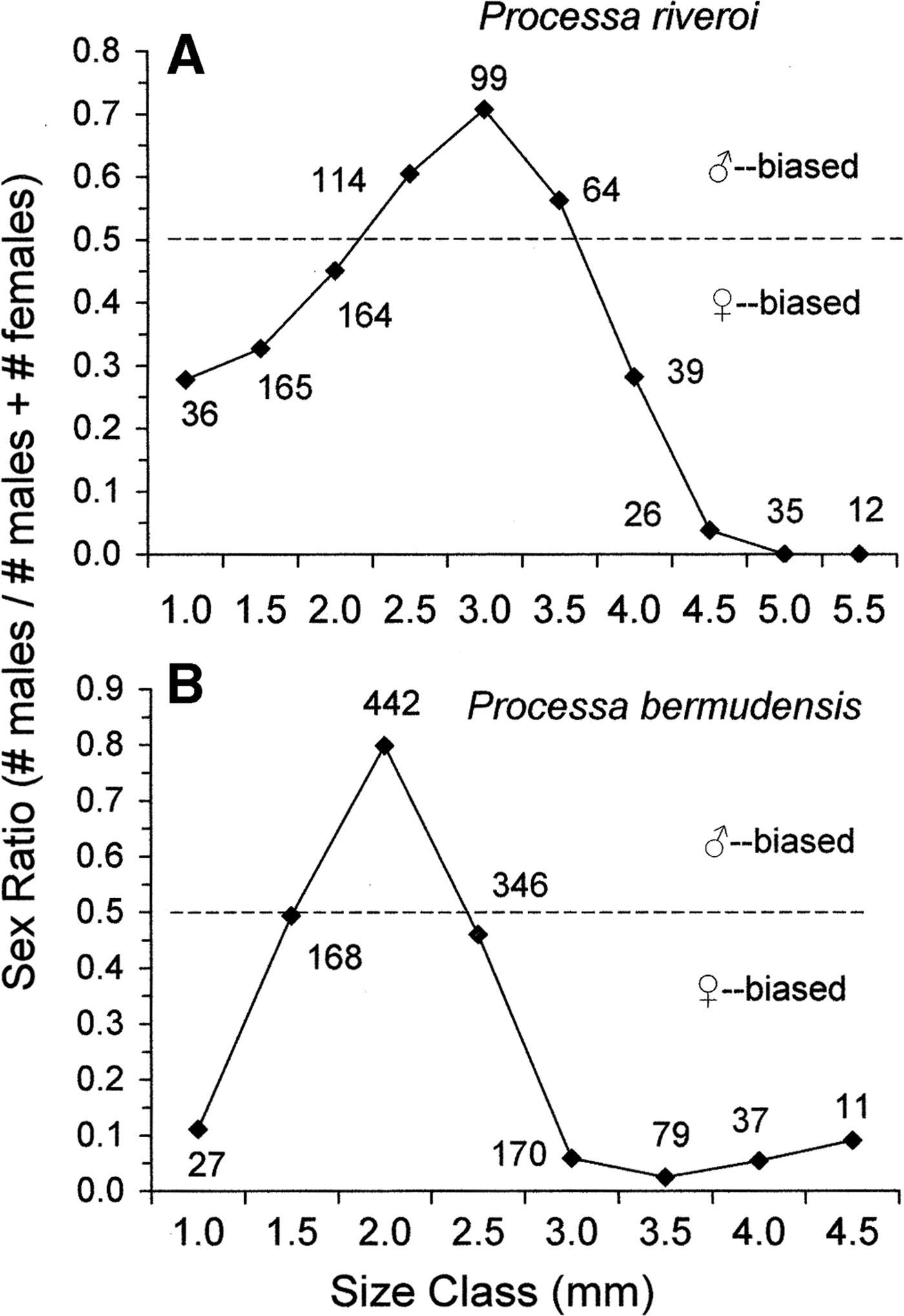
Sex-ratios (number of males/number of males + number of females) in 0.5 mm carapace length (CL) size-classes in Processa riveroi in seagrass meadows at Dorado, Puerto Rico, March 1982 to February 1983. N = total number of males + females in a size-class. The hypothesis of a 0.5 sex-ratio was tested using Chi-square (1 df) for all size-classes with both males and females. An asterisk next to the sex-ratio indicates that the null hypothesis of a 0.5 sex-ratio was rejected (P ≤ 0.05). The conclusion column indicates whether the number of males in the size-class was equal, less than or greater than the number of females.

Sex-ratios (number of males/number of males + number of females) in 0.5 mm carapace length (CL) size-classes in Processa bermudensis from seagrass meadows at Dorado, Puerto Rico, March 1982 to February 1983. See Table 1 for symbol legend used below.

Variation in sexual characters
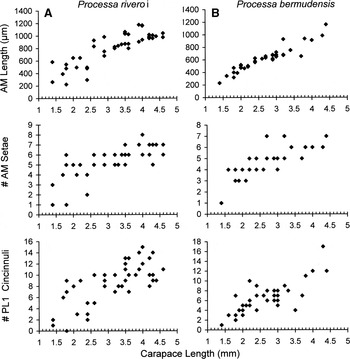
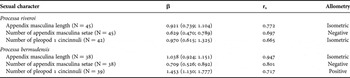
To identify negative growth, reduction, or loss of male characters with increasing size, observed in some protandric species, allometric analysis was done on two measures of the AM (length and number of setae) on pleopod 2 and on the number of cincinnuli (coupling hooks) on the endopod of pleopod 1 (Figures 4–5). In both species, the AM length increased isometrically with male size (β not significantly different from 1; Table 3). The number of AM setae was linearly related to body size but the slope (β) was significantly less than 1, indicating negative allometry for both species. Growth in the number of pleopod 1 cincinnuli was isometric in P. riveroi and positively allometric in P. bermudensis (Table 3).
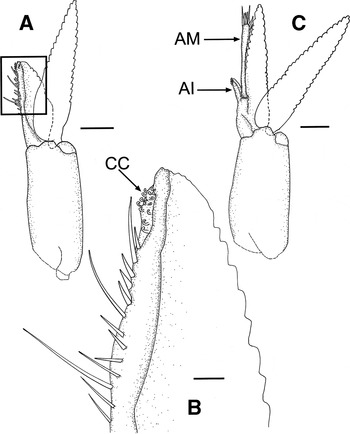
Male external sexual characters from a Processa riveroi male, 3.3. mm carapace length (A) pleopod 1 showing portion (box) of endopod magnified in (B); (B) distal half of endopod, pleopod 1, showing setae and cincinnuli (coupling hooks, CC) characteristic of males and lacking in females; (C) pleopod 2 of same male, showing the appendix masculina (AM) and appendix interna (AI) with cincinnuli. Scale bars = 250 µm in A and C, 50 µm in B.

Morphometric measures of male external sexual characters of Processa riveroi and P. bermudensis. Appendix masculina (AM) length, number of AM setae, and number of pleopod 1 cincinnuli are plotted against size (carapace length) in (A) Processa riveroi and (B) P. bermudensis. See Table 3 for regression coefficients and statistics.

Allometry of male secondary sexual characters in Processa riveroi (above) and P. bermudensis (below). The slope (β) (with lower and upper 95% confidence limits) is given for rank regressions of appendix masculina length, the number of appendix masculina setae, and the number of pleopod 1 cincinnuli regressed on carapace length of the form (Y) = β (log X) + y-intercept. The Spearman correlation coefficient (rs) tests the null hypothesis of no significant regression (β = 0) which was rejected for all regressions (P <<< 0.001).

The anterior pleopods of females from both species (N = 24 in P. riveroi; N = 25 in P. bermudensis) were examined under high magnification (400 ×) to look for vestiges of a male AM on pleopod 2 and cincinnuli on pleopod 1, an indicator of sex change in some protandric carideans. No such vestiges were observed. During body size measurement and sexing, all individuals were examined for the presence or absence of a developing ovary. None was ever observed in any male, including larger males that might indicate an individual preparing to change sex.
DISCUSSION
Analysis of population size–frequency distribution and sex-ratio by SC does not support a hypothesis of protandry in either of the two Processa species investigated. A population structure composed of small males and larger females with little or no overlap in size is often used to initally suggest protandric sex change in caridean shrimps (e.g. Butler, Reference Butler1964; Carpenter, Reference Carpenter1978; Bauer, Reference Bauer1986, Reference Bauer2004; Baeza, Reference Baeza2010; Baeza & Piatoni, Reference Baeza and Piatoni2010; Bauer & Thiel, Reference Bauer and Thiel2011). This was the most important evidence used by Noël (Reference Noël1973, Reference Noël1976) to conclude that Atlantic and Mediterranean subspecies of P. edulis were protandric. Monthly size–frequency distributions in the Caribbean P. riveroi and P. bermudensis examined in this study did show that females reached larger size than males. However, smaller SC contained both males and immature females throughout the year, although there were some months when there were more males than females in some of these SC. A sex-ratio (SR) analysis by SC of the overall year-long population sample showed an equal or female-biased SR in the smallest SC, a male-biased SR in 1–3 intermediate SC, with larger SC dominated by females incubating embryos. Such a population structure may result from differential growth and mortality in males and females (Wenner, Reference Wenner1972; Labat & Noël, Reference Labat and Noël1987). Indeed, a size–frequency distribution with only small males and only larger females, with little overlap in male and size, may occur in completely gonochoric species at certain seasons of the year (Heptacarpus sitchensis (Brandt, Reference Brandt and von Middendorff1851) in Bauer (Reference Bauer1976); Thor dobkini Chace, Reference Chace1972 in Bauer & VanHoy (Reference Bauer and VanHoy1996); reviewed in Bauer (Reference Bauer2004)). In P. riveroi and P. bermudensis, slower growth to smaller male body size together with a higher mortality on large males may have caused the observed accumulation of males in intermediate SC, resulting in an ‘anomalous pattern’ (Wenner, Reference Wenner1972) in size–frequency distributions.
Observation of transitional individuals with sexual characters intermediate between male and female has been important in identification of protandry or protandric simultaneous hermaphroditism in caridean shrimps (e.g. pandalids: Berkeley, Reference Berkeley1930; Butler, Reference Butler1964; Bergström, Reference Bergström2000; hippolytids: Kagwade, Reference Kagwade1982; Bauer, Reference Bauer1986; Bauer & Holt, Reference Bauer and Holt1998; Braga et al., Reference Braga, López-Greco, Santos and Fransozo2009; Baeza, Reference Baeza2010; Baeza & Piatoni, Reference Baeza and Piatoni2010) even when population sample sizes are small (Baeza, Reference Baeza2010; Baeza & Piatoni, Reference Baeza and Piatoni2010; Bauer & Thiel, Reference Bauer and Thiel2011). In some species, such as the hippolytid Thor manningi Chace, Reference Chace1972, the size of male characters such as the relative size of the AM and ejaculatory ducts diminish in size (Bauer, Reference Bauer1986). In the same transitional individuals, female ‘breeding dress’ characters associated with spawning and embryo incubation, such as the width of pleopod flanges and abdominal pleura, increase and become more female-like. Prior to sex change, individuals with male external characters can be observed with macroscopically visible vitellogenic ovaries in various stages of development (e.g. Bauer, Reference Bauer1986; Bauer & Holt, Reference Bauer and Holt1998; Baeza, Reference Baeza2010; Baeza & Piatoni, Reference Baeza and Piatoni2010). In this study, careful measures of two male characters, the AM (length; number of setae) and pleopod 1 cincinnuli, showed no or little reduction with increasing body size. No vestiges of external male structures were observed in females whose anterior pleopods were examined microscopically. Likewise, no male individuals of the many examined in this study during sexing showed any development of gonads with vitellogenic oocytes.
Thus, evidence presented here does not suggest protandry in P. riveroi and P. bermudensis. In a very thorough study on the population biology of P. nouveli holthuisi Al-Adhub & Williamson, Reference Al-Adhub and Williamson1975 by Gros (Reference Gros1979), no evidence of protandry in size–frequency distributions and no intersexes was found. In the larger SC during the reproductive season, males were significantly smaller than females with low overlap, but in smaller SC, both males and juvenile females occurred in similar numbers. In P. edulis, the size–frequency distribution was strongly suggestive of protandry, particularly partial protandry, a sexual system in which most indviduals go through sex change (‘secondary females’) but with some individuals that develop directly into females without a male phase (‘primary females’) (Noël Reference Noël1973, Reference Noël1976). Partial protandry is quite common in North Pacific pandalids (review in Bergström, Reference Bergström2000), with sometimes numerous primary females. However, morphological evidence for protandry in these pandalids is quite convincing, with sexually transitional individuals intermediate in size between smaller males and larger reproductive females.
There is little direct morphological evidence for protandry in P. edulis. Only 4 of approximately 3500 individuals examined (0.11%) showing striking intersex characters (Noël, Reference Noël1976), although Noël (Reference Noël1976: 86) does state that some unspecified number (‘plusieurs’; i.e. some or several) showed an apparently less striking mix of male and female characters. Other clearly gonochoristic species may have a much higher rate of intersex individuals, e.g. 1–2% reported by Blackless et al. (Reference Blackless, Charuvastra, Derryck, Fausto-Sterling, Lauzanne and Lee2000) for Homo sapiens Linnaeus, Reference Linnaeus1758. However, Noël (Reference Noël1976) suggested that sex change occurs in a single moult in P. edulis, accounting for the relative lack of individuals with either external or internal (gonadal) transitional characters.
Other similar controversial cases of protandry occur in the caridean genera Hippolyte and Crangon. Hippolyte inermis Leach, Reference Leach1815 was intially described as protandric by Reverberi (Reference Reverberi1950) in a short descriptive paper, a conclusion supported by Zupo (Reference Zupo1994) with extensive size–frequency analysis. However, Cobos et al. (Reference Cobos, Díaz, García-Raso and Manjón-Cabeza2005) performed careful histological work which showed no evidence of a transitional gonad. Zupo et al. (Reference Zupo, Messina, Carcaterra, Aflalo and Sagi2008) observed growth and external sexual morphology in males in the laboratory; in several instances, males lost the male appendices masculinae in a single moult. Furthermore, one such individual did show, upon histological examination, development of an active ovary. Likewise, protandry in Crangon crangon (Linnaeus, Reference Linnaeus1758) has been disputed for some time. For example, Bodekke et al. (Reference Bodekke, Bosschieter, Goudswaard, Bauer and Martin1991), based on size–frequency and morphological observations including purported transitional individuals, concluded that a significant proportion of the population studied underwent sex change. On the other hand, Schatte & Saborowski (Reference Schatte and Saborowski2006) observed sex change in one individual directly but suggested that sex change in this species may be facultative. Gavio et al. (Reference Gavio, Orensanz and Armstrong2006), using a variety of evidence including transitional individuals and direct observation of sex change in 2 captive individuals, showed more convincingly that the sexual system of C. franciscorum Stimpson, Reference Stimpson1856 is partial protandry. In species where protandry is strongly suggested on the basis of population structure, but where transitional individuals are not routinely observed, direct observation of sex change in individuals followed through time may provide key evidence of protandry.
In carideans, there is considerable intrageneric variation in sexual systems (gonochory; protandry; protandric simultaneous hermaphroditism or PSH). In some genera, such as Pandalus, nearly all species are protandric (Bergström, Reference Bergström2000); likewise, all of the several Lysmata and the two Exhippolysmata spp. examined to date have a PSH sexual system (Kagwade, Reference Kagwade1982; Bauer & Holt, Reference Bauer and Holt1998; Bauer, Reference Bauer2006; Baeza, Reference Baeza2006, Reference Baeza2009; Laubenheimer & Rhyne, Reference Laubenheimer and Rhyne2008; Baeza et al., Reference Baeza, Schubart, Zillner, Fuentes and Bauer2009; Braga et al., Reference Braga, López-Greco, Santos and Fransozo2009). On the other hand, of the four Thor species examined, one species has a mix of protandric and primary male individuals (Bauer, Reference Bauer1986), another is purely protandric (Baeza & Piatoni, Reference Baeza and Piatoni2010), and two others are definitely gonochoristic (Bauer & VanHoy, Reference Bauer and VanHoy1996). These four Thor spp. are tropical or subtropical seagrass species, and three are very similar in size and habitat requirements (Bauer & VanHoy, Reference Bauer and VanHoy1996). In this study, we found no strong or convincing evidence for protandry in P. riveroi and P. bermudensis, small tropical seagrass-meadow species with continuous reproduction, episodic recruitment, and a probable short life span of less than one year (Figure 2; and see Bauer, Reference Bauer1989). On the other hand, P. edulis, a temperate-zone species with highly seasonal reproduction and a 2–2.5 year life span, is considered protandric (Noël, Reference Noël1973, Reference Noël1976), although such a conclusion is controversial and needs to be resolved. The mating system of these species has not been studied in detail, but most likely is a promiscuous ‘pure searching’ typical of caridean species with small males and larger females (Wickler & Seibt, Reference Wickler and Seibt1981; Bauer, Reference Bauer2004) (e.g. mating observations on P. edulis by Noël, Reference Noël1976). The interesting and important question that must be asked and resolved about sexual systems in carideans is: what are the selective pressures which favour one sexual system (gonochory, protandry or PSH) over another among closely related species? To answer this question, the true variation in sexual systems among caridean species must be known, which will require careful examination and testing of sexuality in caridean species suspected of protandric hermaphroditism or PSH.
ACKNOWLEDGEMENTS
R.T.B. would like to thank various undergraduate students in the Department of Biology, University of Puerto Rico, Río Piedras, both volunteers from marine biology classes and those funded as research assistants by the university, for valuable help during sampling of seagrass meadows as well as for sorting and initial measurements on sampled shrimps. Funding from National Science Foundation grant OCE (Division of Ocean Sciences) 9982466 to R.T.B. and the National Oceanic and Atmospheric Administration Office of Sea Grant, Department of Commerce grant no. NA06OAR4170022 and Project No. R/SA-04 to R.T.B. and Louisiana State University (statements, findings, conclusions, and recommendations are those of the authors and do not necessarily reflect the views of Louisiana Sea Grant or the United States Department of Commerce) is gratefully acknowledged. This is Contribution No. 144 of the University of Louisiana Laboratory for Crustacean Research.