Introduction
Arsenic in mine waste is a major source of pollution for both surface water and groundwater (Gruyter, Reference Gruyter2014; Hudson-Edwards, Reference Hudson-Edwards2016). Arsenic-containing water causes various health problems, including cancer, skin lesions, cardiovascular diseases and adverse pregnancy outcomes (Henke, Reference Henke2009; Bowell et al., Reference Bowell, Alpers, Jamieson, Nordstrom and Majzlan2014). Arsenic contamination from historic mine areas has been reported throughout the world, including China (Hui et al., Reference Hui, Ma and Hu2002; Rodríguez-Lado et al., Reference Rodríguez-Lado, Sun, Berg, Zhang, Xue, Zheng and Johnson2013; Tang et al., Reference Tang, Liao, Yang, Chai and Yang2016), USA (Goossens et al., Reference Goossens, Buck, Teng and Mclaurin2015), Canada (Van Den Berghe et al., Reference Van Den Berghe, Jamieson and Palmer2018), UK (Smedley et al., Reference Smedley and Kinniburgh and2002; Šlejkovec et al., Reference Šlejkovec, Elteren, Glass, Jeran and Jaćimović2010) among others (Chowdhury et al., Reference Chowdhury, Mandal, Samanta, Basu, Chowdhury, Chanda, Karan, Lodh, Dhar, Das, Abernathy, Calderon and Chappell1997; Shrestha et al., Reference Shrestha, Shrestha, Upadhyay, Pradhan, Khadka, Maskey, Maharjan, Tuladhar, Dahal and Shrestha2003; Drahota et al., Reference Drahota, Mihaljevič, Grygar, Rohovec and Pertold2011). In some areas, the concentration of arsenic in groundwater or surface water was found to reach up to 4.8×10⁴ μg/L (Smedley et al., Reference Smedley and Kinniburgh and2002).
Arsenopyrite (FeAsS) and realgar (As4S4) are primary arsenic minerals commonly found in metallic mines. Arsenopyrite mainly occurs in the tailings of gold mines (Bao, Reference Bao1991; Xiang et al., Reference Xiang, Jiang and Min2000), Pb–Zn mines (Lingmei et al., Reference Lingmei, Chaoyang and Linsheng2009) and tin mines (Pu, Reference Pu1950). It results in both acid mine drainage and arsenic release (Corkhill and Vaughan, Reference Corkhill and Vaughan2009), and affects the soil and water of the mine area. Chang-Li et al. (Reference Chang-Li, Feng-Chang, Zhi-You, Zhu and Ran2013) found that the arsenic content of soil in the Sn–Sb mining area of the Hunan Province was 14.95–363.19 mg/kg. As-rich tailings are common in the Hunan Province of China due to their abundance in polymetallic deposits. Arsenopyrite can generate acid within mine waste, just like pyrite (FeS2), via the following reaction:
 $$4{\rm FeAsS} + 11{\rm O}_2 + 6{\rm H}_2{\rm O\ }\to 4{\rm H}_3{\rm As}{\rm O}_3 + 4{\rm F}{\rm e}^{2 + } + 4{\rm S}{\rm O}_4^{2\ndash } $$
In contrast, realgar commonly occurs in low-temperature hydrothermal deposits (Lengke and Tempel, Reference Lengke and Tempel2003; Zhu et al., Reference Zhu, Wang, Lu, Liu, Li, Ouyang, Lu and Xiancai2015; Fan et al., Reference Fan, Zhao, Liu and Hudson-Edwards2018b) often with quartz (SiO2) and calcite/dolomite (CaCO3 and MgCa(CO3)2) as associated minerals, while orpiment (As2S3) can also often be found in the surrounding rocks (Gruyter, Reference Gruyter2014). Under aerobic surface conditions, realgar is oxidised gradually to produce arsenic and sulfuric acid via the pathway:
 $${\rm A}{\rm s}_4{\rm S}_4 + 9{\rm O}_2 + 10{\rm H}_2{\rm O\ }\to 4{\rm H}_3{\rm As}{\rm O}_3 + 4{\rm H}_2{\rm S}{\rm O}_4$$
Lengke and Tempel (Reference Lengke and Tempel2003) evaluated kinetically the acid production in a natural realgar-based mixed-flow experiment, at 25°C and pH 7−9 to give:
 $$\lsqb {{\rm H}^ + } \rsqb _{{\rm prod}} = 7.89\lsqb {{\rm H}^ + } \rsqb _{{\rm initial}} + 2.37 \times 10^{{-}7}$$
where [H+]prod is acidity released from oxidation, and [H+]initial is the initial acidity (Lengke and Tempel, Reference Lengke and Tempel2003). Because of the small amount of realgar (<1%) and large amount of calcium (>40%), however, the realgar-containing tailings become alkaline (Gruyter, Reference Gruyter2014). For example, the Huangshui Creek in Hunan Province, which flows through the realgar tailings area, has a stable pH at 9.01. For this reason, realgar-containing tailings are usually referred to as alkaline tailings whereas arsenopyrite-containing tailings are usually referred to as acidic tailings.
Various technologies have been designed to minimise arsenic release and limit acid production in mine areas, such as blending (Lottermoser, Reference Lottermoser2007), stabilisation/solidification (Dermatas et al., Reference Dermatas, Moon, Menounou and Xiaoguang Meng2004) and nano-remediation (Gil-Díaz et al., Reference Gil-Díaz, Rodríguez-Valdés, Alonso, Baragaño, Gallego and Lobo2019). Blending, i.e. the addition of some materials to tailings, is one effective method for reducing pollution (Lottermoser, Reference Lottermoser2007). Blending commonly employs inexpensive materials to help neutralise or adsorb pollutants. Some alkaline materials, such as limestone, coal washery wastes, fine-grained tailings, bauxite and organic waste, have been used for acid buffering or as natural adsorbents (Wang and Reardon, Reference Wang and Reardon2001; Bertocchi et al., Reference Bertocchi, Ghiani, Peretti and Zucca2006; Lottermoser, Reference Lottermoser2007; Liu et al., Reference Liu, Cheng, Zhao, Dong and Frost2013; Lockwood et al., Reference Lockwood, Mortimer, Stewart, Mayes, Peacock, Polya, Lythgoe, Lehoux, Gruiz and Burke2014), and are thus referred to as benign waste relative to sulfidic waste.
Recently, nano-sized, zero-valence iron (nZVI) particles and ZVI-biochar have been used for the remediation of As and Cr (Qiao et al., Reference Qiao, Liu, Wang, Li, Lv, Cui, Zeng, Yuan and Liu2017; Vítková et al., Reference Vítková, Puschenreiter and Komárek2018; Liu et al., Reference Liu, Zhang, Tao, Hao and Zhang2019). Baragaño et al. (Reference Baragaño, Alonso, Gallego, Lobo and Gil-Díaz2020) showed that notable results were obtained for nZVI at a dose of 2% (89.5% decrease in As, TCLP test – toxicity characteristic leaching procedure), and no negative effects on soil parameters were detected. Kim et al. (Reference Kim, Lee and Kim2012) revealed that arsenic concentration extracted by TCLP decreased by 52.25% after stabilisation with sodium-dodecyl-sulfate-coated synthesised nZVI at an iron/tailings ratio of 0.34%. Su et al. (Reference Su, Fang, Tsang, Fang and Zhao2016) reported that the immobilisation efficiency of Cr(VI) and Crtotal was 100% and 92.9%, respectively, when the soil was treated with 8 g/kg of biochar–nZVI for 15 days. No single technology could be applied in all of the various arsenic pollution conditions. Some arsenic-containing tailings have large volumes and generate large quantities of acid, which make progressive blending with other tailings or the introduction of ZVI more realistic. So, progressive blending with variant tailings and introducing other materials exogenously becomes more realistic.
A realistic proxy of nZVI is slag ZVI grains from the steel industry, often treated as industry waste, because they are strongly corrosive, but produced in large quantity. Compared with synthetic nZVI, slag ZVI is an inexpensive and economical use of industry waste. Liu et al. (Reference Liu, Gan, Wang, Ma and Li2010) used iron slag to remove arsenic from water under acidic conditions (pH < 5), and showed that As adsorbed onto the iron slag. Iron dust was used by Liu et al. (Reference Liu, Cheng, Zhao, Dong and Frost2013) to treat arsenic-containing acid mine drainage. At present, there are ~29,000 m3 of arsenic-containing tailings in the Shimen realgar mine area in Hunan Province, which need to be remediated. The introduction of exogenous slag ZVI combined with blending technology might be an efficient remediation strategy for in situ arsenic-containing tailings.
The present study aimed to remediate the two common kinds of arsenic-containing tailings (realgar and arsenopyrite) in the Hunan Province of China by using slag ZVI as a blending mixture to reduce arsenic release and acid generation.
Materials and methods
Sample preparation and characterisation
Realgar and orpiment commonly originate from hypabyssal epithermal deposits in carbonaceous dolomitic carbonate strata (Zhu et al., Reference Zhu, Wang, Lu, Liu, Li, Ouyang, Lu and Xiancai2015). Realgar-containing tailings were collected from the historic realgar mine area in Shimen County, Hunan Province, China. The sampling site was located at 29°38′5″N, 111°01′55″E. The realgar-containing tailings were ground and sieved to 40–100 mesh (150–850 μm) to represent local processing. X-ray fluorescence (XRF) analysis showed that the realgar-containing tailings were composed mainly of CaO (59.02 wt.%), MgO (17.09 wt.%), SO3 (10.25 wt.%), As2O3 (7.82 wt.%), SiO2 (3.53 wt.%) and Al2O3 (1.11 wt.%). Arsenopyrite particles were handpicked from samples collected in the Chenzhou Pb–Zn mine, Hunan Province, ground by a ball crusher mill (NETZSCH), and sieved to 20–40 mesh (425–850 μm). Analysis by XRF showed that the arsenopyrite was composed mainly of As2O3 (21.00 wt.%), SO3 (26.83 wt.%), Fe2O3 (16.20 wt.%), ZnO (14.59 wt.%), MgO (14.29 wt.%), SiO2 (4.42 wt.%), with minor amounts of Al2O3 (1.55 wt.%), PbO (0.60 wt.%), CaO (0.25 wt.%) and others (0.22 wt.%). The slag ZVI used in the experiments was collected from the Chenzhou Huasheng steel Co., Ltd (Hunan Province, China). It was black in colour and in granular form. The slag ZVI was also ground and sieved to 40–100 mesh (150–850 μm) to represent local processing. Analysis by XRF showed that the slag ZVI was composed mainly of Fe2O3 (92.10 wt.%), SiO2 (5.44 wt.%), Al2O3 (1.11 wt.%), As2O3 (0.06 wt.%) and others (1.29 wt.%). To remove the surface fine particles and impurities, the ZVI grains were washed with ethanol repeatedly in an ultrasonic bath until the supernatant became clear, then dried at 60°C for 24 h. No attempt was made to remove the oxidised surface because the oxidation was local only and further acid washing might have altered the ZVI grains.
Bacterial strain
Acidithiobacillus ferrooxidans, a common Fe-oxidising bacterium in mine areas, can accelerate the oxidation of pyrite (FeS2)-like sulfide minerals, to produce acid mine drainage (Singer and Stumm, Reference Singer and Stumm1970; Fan et al., Reference Fan, Zhao, Liu and Hudson-Edwards2018b). In the present study, the authors used A. ferrooxidans to model a biological oxidation environment with rapid acceleration of weathering so that the changes in the two mine wastes with or without ZVI could be observed immediately. The bacterial strain Acidithiobacillus ferrooxidans SW 02 used here was provided by the Key Laboratory of Solid Waste Treatment and Resource Recycle, Southwest University of Science and Technology, Mianyang, China. Pure cultures of the A. ferrooxidans cells were incubated at 30°C in 9K liquid medium as follows (per 1 L): 0.5 g K2HPO4⋅3H2O, 0.01 g Ca(NO3)2, 0.1 g KCl, 0.5 g MgSO4⋅7H2O, 3 g (NH4)2SO4, 44.3 g FeSO4⋅7H2O, and pH = 2.2 (adjusted with 5 M H2SO4) (Silverman and Lundgren, Reference Silverman and Lundgren1959). Cells were harvested during the late exponential growth phase (~3 days after inoculation).
Batch bioleaching experiment
Procedure
Five recipes were examined for blending tests based on future treatment possibilities. These are (‘Re’ = realgar tailings and ‘Ar’ = arsenopyrite tailings): the mixture group (1 g Re + 1 g Ar, no ZVI), the 0.2 g ZVI group (1 g Re + 1 g Ar + 0.2 g ZVI), the 4.0 g ZVI group (1 g Re + 1 g Ar + 4.0 g ZVI), the Ar-rich group (0.5 g Re + 1 g Ar + 2.0 g ZVI), and the Re-rich group (1 g Re + 0.5 g Ar + 2.0 g ZVI). These formulations represent the simple mixture of two tailings, the introduction of low- and high-ZVI, as well as more acidic and more alkaline tailings in the presence of ZVI, respectively. The two control groups included only arsenopyrite tailings (Ar control) and only realgar tailings (Re control), respectively. Abiotic control was not devised as this study adopted A. ferrooxidans only to model accelerated weathering. During bioleaching, the solution (100 mL) containing A. ferrooxidans was placed in a 250 mL Erlenmeyer flask, the neck of which was sealed by sterile dressing instead of a glass plug to allow exposure of the solution to ambient air and thus help the growth of A. ferrooxidans. Each stage of batch experiments was completed by placing the flask in a rotary shaker at 150 rpm and 30°C for 7 days as A. ferrooxidans has a lifetime of ~7 days. After each stage, solids were separated from the suspension by vacuum filtration and dried for 24 h at 80°C. The dried solids were ground gently in a mortar with an agate pestle without compaction of particles, then weighed and used in the next stage at a normalised amount. Three stages were run sequentially to investigate the long-term variations of arsenic release and acid generation. All experiments were done in triplicate. Measured values were described as mean ± standard deviation and plotted with error bars (n = 3).
Aqueous-phase analysis
During bioleaching, an aliquot (2 mL) was sampled daily from the supernatant in each Erlenmeyer flask, then filtered (0.45 μm), diluted appropriately with ultrapure water (18.25 MΩ) and acidified with 10 vol.% HCl (Guaranteed Reagent). The pH and Eh were measured using a freshly calibrated pH meter (Sartorius PB-21) and a HACH440d meter with a platinum electrode (MTC10103), respectively. The volume of the suspension was unified by adding stock solution to give a constant solid/solution ratio for all analyses. The As (detection limit was 0.080 mg/L) and Fe (detection limit was 0.002 mg/L) concentrations of the solution were then measured by inductively coupled plasma – atomic emission spectrometry (ICP–AES, iCAP6500 Thermo Fisher, USA). These analyses were undertaken in the Analysis and Test Center, Southwest University of Science and Technology, Mianyang, China. The Ca (detection limit was 0.002 mg/L) concentration was also determined by ICP–AES because the realgar tailings had abundant calcium. The concentration of arsenic released from each group was normalised based on the different initial mass and expressed in the form of milligrams of arsenic per gram of mine waste to characterise clearly, variations during all stages. The ferrous iron in the solution was determined by UV at λ = 510 nm after the application of a phenanthroline spectrophotometric reagent (Liu et al., Reference Liu, Zhou, Dong and Hudson-Edwards2017b). The ferric iron in the solution was obtained by subtracting ferrous iron from total iron.
Solid-phase characterisation
All solid samples were collected from individual batch experiments. As the solid colour may be a potential index for describing the variation of minerals in field tailings, the colour of fresh and wet filtered sample cakes was identified by a standard colorimetric card (standard Munsell colour) as a function of time. The bulk elemental compositions of a powder sample were determined by XRF analysis using a PANalytical Axios instrument equipped with a rhodium anode. The X-ray diffraction (XRD) patterns of the solid samples after bioleaching were recorded using an X'Pert Pro (PANalytical, Netherlands) instrument with a CuKα source. Diffraction data were obtained over a 2θ range of 10–90° with a scan time of 10.16 s per step and a step size of 0.03°. The solid phases were identified using the Jade 6 software (from Materials Data Inc).
Dried solid samples were subjected to in situ infrared spectroscopy using an attenuated total reflection Fourier-transform infrared spectrometer (ATR-FTIR, Frontier) with a diamond ATR accessory. The corresponding spectra ranging from 400 to 4000 cm−1 were obtained by co-addition of 64 scans with a resolution of 1 cm−1 and a mirror velocity of 0.6329 cm/s. To demonstrate clearly the main variations from arsenic and other molecular vibrations, only the partial spectra in 400–1600 cm−1 are shown. The surface morphology and the secondary minerals of raw and leached samples were imaged by scanning electron microscopy (SEM, EVO@18, ZEISS, Germany) equipped with energy-dispersive-X-ray spectroscopy (EDX) operating at 15 kV. The changes in the oxidation state of solid-phase As, Fe and S were determined by X-ray photoelectron spectroscopy (XPS, R3000, VG-Scienta) using an AlKα source at 30 eV with a step size of 0.05 eV. The specimen surface was analysed under an argon plasma beam in the vacuum chamber. Photoelectron binding energies were referenced to the C1s level at 284.8 eV. The XPS spectra were obtained at the University of Science and Technology of China, Hefei, China. Deconvolution of the raw data was fitted using CasaXPS, and the Shirley-type background was subtracted before deconvolution and fitting (Fan et al., Reference Fan, Zhao, Liu and Hudson-Edwards2018b). The compound peaks of As were determined based on the summary report on arsenopyrite by Corkhill and Vaughan (Reference Corkhill and Vaughan2009). The binding energies for the component peaks of As, Fe and S were identified by previously reported reference values (Nesbitt and Muir, Reference Nesbitt and Muir1998; Ouyang et al., Reference Ouyang, Lu, Liu, Li, Zhu, Zhu, Lu and Wang2014).
Arsenic in amorphous iron precipitates
Shelobolina et al. (Reference Shelobolina, Avakyan and Karavaiko1999) investigated the biological dissolution of kaolin by mixed iron-reducing bacteria, and found that the amorphous fraction in solids after leaching was proportional to oxalate-soluble iron. The current study employed the same extraction method to measure the amorphous iron fraction by oxalate dissolution (Shelobolina et al., Reference Shelobolina, Avakyan and Karavaiko1999). Briefly, a dried solid sample (0.5 g) was transferred into a 250 mL flask before the addition of aqueous oxalate (0.02 mol/L, 100 mL and pH = 2.0). The suspension was shaken at 25°C and 150 rpm for 24 h, then passed through 0.45 μm filter and diluted by ultrapure water. The total As and Fe in the solution was analysed by ICP–AES (iCAP6500 Thermo Fisher, USA). All experiments were carried out in triplicate. Figure S1 (Supplementary material – see below) lists the release dynamics of As and Fe (at 0, 0.5, 1, 2, 4, 6, 10, 18 and 24 h) and preliminary investigations showed that for all samples, the arsenic concentration (including iron) in the solution arrived at a plateau within 24 h. The total arsenic in each group was calculated follows: total As in amorphous iron precipitates (mg) = concentration of aqueous As (mg/L) × solution volume (L) × dried weight of initial solids (g)/0.5 g.
Results and discussion
Dynamics of pH and Eh
The variations of pH and Eh can indicate the dissolution of tailings in the environment (Fan et al., Reference Fan, Zhao, Liu and Hudson-Edwards2018b). Figure 1 shows the changes in pH as a function of time for the five test groups and the two control groups. In Stage 1, the pH value remained relatively stable at ~2.1–2.4 for the Re control and ~1.9–1.8 for the Ar control, respectively, whereas the pH values of all test groups were higher. For example, the pH of the mixture group increased dramatically to ~4.5 on the third day but then decreased gradually to ~2.4 on the seventh day. In the presence of 0.2 g ZVI, the pH first increased to 4.0 over the first 2 days, and decreased gradually to 2.1 on the seventh day. In contrast, the presence of 4.0 g ZVI kept the pH stable at 4.6–5.0 throughout Stage 1, far exceeding the pH value of all other groups.
Variation of solution pH over time.

The Eh value was the highest in the Re control group, always at ~520–560 mV (Fig. S2). The Eh value of the mixture group remained at ~320 mV over the first 3 days and then increased gradually to ~500 mV on the seventh day. The Fe2+ concentration of the mixture group decreased quickly over the first three days (Fig. S3), which resulted in the increase in Eh.
In Stage 2, the pH values of the two control groups were similar and both stayed at 1.6–2.2, whereas the pH of both the mixture group and the 0.2 g ZVI group decreased, to slightly less than the controls. In contrast, the 4.0 g ZVI group still exhibited higher pH, although it declined steadily from 5.5 on the first day to 2.6 on the seventh day. The Eh value of the 4.0 g ZVI group increased from –180 to 210 mV in Stage 2 (Fig. S2), and a quick decrease in Fe2+ concentration was also observed (Fig. S3). All groups had pH < 2 in Stage 3. The pH values of the mixture group and the 0.2 g ZVI group still decreased steadily and were both less than the values for the controls. In Stages 1, 2 and 3, only the pH values of the 4.0 g ZVI group and Re-rich group were greater than the control groups. Thus, large amounts of ZVI and more realgar-containing tailings could help maintain higher pH values in the mine waste.
Dynamics of As and Fe release
Levels of arsenic release from all groups over the three stages are shown in Fig. 2. In Stage 1, the arsenic concentration of the Ar control rose dramatically, from 43.89 mg/g on the first day to 105.49 mg/g on the seventh day, whereas the Re control during this Stage released relatively little arsenic to the solution (~0.13 mg/g). By mixing the two tailings, the mixture group showed an arsenic release that was 72.9–74.7% lower than the Ar control, i.e. down to 12.19 mg/g on the first day and 28.01 mg/g on the seventh day.
Arsenic release as a function of time.

The arsenic release was clearly curtailed by the addition of ZVI. When 0.2 g ZVI was present, the arsenic release was initially 0.10 mg/g on the first day and gradually increased to just 29.89 mg/g on the seventh day (Fig. 2). Further addition of ZVI to a total of 4.0 g reduced the arsenic release even further, in fact even lower than that of the Re control. The arsenic release fell in the order of Ar-rich group > Re-rich group > 4.0 g ZVI group > Re control group. Note that both the Ar-rich and the Re-rich groups contained 2.0 g ZVI in their formulations.
In Stage 2, the increase in arsenic release of the Ar control became accentuated compared with Stage 1, increasing from a smaller starting value of 24.47 mg/g on the first day to a larger value of 127.44 mg/g on the seventh day. The arsenic release of the mixture group was 52.0–52.7% less than that of the Ar control group and increased to 60.22 mg/g on the seventh day. The arsenic release of the 0.2 g ZVI group was very similar to that of the mixture group. Because variation in the Ar control experiment was accentuated in Stage 2 compared to Stage 1, the difference between the Re-rich and Ar-rich groups, both containing 2.0 g ZVI, should, theoretically, become distinctive from Stage 1. In fact, a larger difference was observed between the Ar-rich group and the Re-rich group, indicating that the strategy of controlling arsenic by regulating the proportions of various tailings is also effective with identical intermediate ZVI addition. Still, the 4.0 g ZVI group exhibited the smallest amount of arsenic release of only 0.0035–1.89 mg/g throughout the entire stage, which was even less than that from the Re control (~0.79 mg/g).
In Stage 3, the absolute value of arsenic release of the Ar control group decreased further, from 17.5 mg/g on the first day to 53.11 mg/g on the seventh day. The arsenic release of the Ar control group was relatively low compared to those in Stages 1 and 2. This suggested that arsenopyrite oxidation occurred to a lesser degree in Stage 3. The precipitation of jarosite was observed (Fig. 4b, Fig. S5), which retarded the adsorption of bacteria on the arsenopyrite surface (Henao and Godoy, Reference Henao and Godoy2010; Deng et al., 2018). The Re control group exhibited the lowest arsenic release of 0.10–0.18 mg/g throughout Stage 3. That might be related to a reduced level of oxidation of realgar. The mixture group showed a similar pattern but the actual arsenic release was 5.9–37.0% lower than the Ar control. The 0.2 g ZVI group actually showed greater arsenic release than the mixture group, indicating that the utility of the starting 0.2 g ZVI in controlling arsenic release had been exhausted. After proceeding from Stage 2 to Stage 3, the arsenic release of the Ar-rich group declined by ~50%, but that of the Re-rich group remained more or less at the same level. Hence, adjusting the mixing ratio of tailings had an obvious impact on arsenic control in Stage 3. That is, alkali tailings slowed the dissolution of arsenopyrite.
Stage 3 arsenic concentrations were relatively small compared to those in Stage 2, except for the 4.0 g ZVI group. The decrease in arsenic was due to the adsorption and uptake of arsenic by secondary iron-containing minerals and Fe–As oxysalts. The 4.0 g ZVI group actually released more arsenic in Stage 3 than it did during the two previous stages, probably because the arsenic that was adsorbed on the Fe precipitates became liberated, as will soon be demonstrated in the subsequent sections.
Formation of secondary phases and arsenic components
Variations in the colours of solid samples
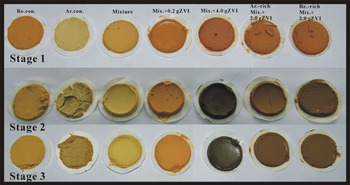
The colour change of the solids is related to secondary iron minerals (Schwertmann and Cornell, Reference Schwertmann and Cornell1993). The different concentrations of AsO43− and AsO33− in the SO4–Fe(III) system also changes the colour of precipitates (Liu et al., Reference Liu, Deng, Zhao, Cheng and Frost2014). Pictures of the filter cakes of all groups in all stages are shown in Fig. 3. The Re control group had a darker colour than the Ar control group, varying from strong dark brown (7.5YR/5/8) in Stage 1 to yellowish brown (10YR/5/8) in Stage 2 and then light olive brown (2.5Y/5/8) in Stage 3. The colour of the Ar control group changed from pale yellow (5Y/7/4) in Stage 1 to olive yellow (5Y/6/6) in Stage 2 and then olive (5Y/5/6) in Stage 3. The mixture group showed a similar colour variation to that of the Ar control group. The 0.2 g ZVI group varied from yellowish red (5YR/5/8) in Stages 1 and Stage 2 to reddish yellow (7.5YR/6/10) in Stage 3.
Visible changes in colour during dissolution of tailings by A. ferrooxidans.

The 4.0 g ZVI group was clearly the darkest among all, having a colour changing from yellowish red (5YR/4/8) during Stage 1 to black (10 YR/2/1) in Stages 2 and 3. The drastic colour change from Stage 1 to Stage 2 matched the sudden surge of the Eh value (−100 mV in Stage 1 to 200 mV in Stage 2). The colour change was similar for the Ar-rich and Re-rich groups and could be associated in both cases with the observed gentle h variation in Eh (Fig. S2). Hence, colour could be used to help to indicate the degree of bioleaching for the mine waste undergoing remediation.
Comparison of secondary minerals
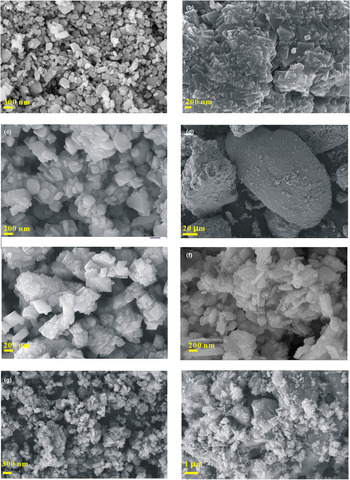
The mineralogical phases of all sample groups are shown in Fig. S5, and Fig. 4 presents SEM images that illustrate the changes of solids morphology under biological dissolution and fresh ZVI. The Re control group exhibited three kinds of jarosite minerals in the solid phase, jarosite KFe3(OH)6(SO4)2, hydroniumjarosite (H3O)Fe3(SO4)2(OH)6, and ammoniojarosite (NH4)Fe3(OH)6(SO4)2. In addition, Ca3(AsO4)2 was also identified in the tailings. Analysis by XRD indicated that solids from the Ar control only contained jarosite, and no other crystalline components were detected, which was in agreement with the previous observation by Corkhill and Vaughan (Reference Corkhill and Vaughan2009). The SEM results further showed that three main crystal planes of jarosite developed, i.e. faces (012), (021) and (113) (Fig. 4b). The fresh tailings of the Re control had grains with an irregular appearance (Fig. 4a). After bioleaching, the crystal planes of grains developed and some grains were cemented (Fig. 4c). Fresh ZVI had a granular shape (Fig. 4d) but this could not be discerned after bioleaching. In the mixture group, a phase of iron sulfate (Fe2(SO4)3) was found along with jarosite and dimorphite. In the 0.2 g ZVI group, iron arsenate (FeAsO4) was also observed. It has been reported that scorodite (FeAsO4⋅2H2O) is a good mineral trap to control arsenic release because of its very low solubility (0.33–5.89 mg/L at pH = 5.01–6.99, K sp = 10−21.66 at 22°C) (Langmuir et al., Reference Langmuir, Mahoney and Rowson2006; Bluteau and Demopoulos, Reference Bluteau and Demopoulos2007). A small amount of schwertmannite (Fe8O8(OH)6SO4) was also observed in the Re-rich group. In addition, some secondary crystalline Fe minerals such as goethite (α-FeOOH), iron oxide hydroxide (FeOOH), lepidocrocite (γ-FeO(OH)) and magnetite (Fe3O4) were also found. In agreement with the colour changes, in the 4.0 g ZVI group, needle-like precipitates of goethite were observed (Fig. 4f). The adsorption capacity of arsenic on goethite (α-FeOOH) is 11.4 mg/g for As(V) at pH = 2 (Mohapatra et al., Reference Mohapatra, Sahoo, Anand and Das2006) and 7.5 mg/g for As(III) at pH = 5.5 (Ladeira and Ciminelli, Reference Ladeira and Ciminelli2004). The re-adsorption of arsenic on these secondary minerals and mineralisation of Fe–As(V) species is arguably a key mechanism for arsenic removal.
Scanning electron microscope images of various samples under biological dissolution and with ZVI. (a) Re control; (b) Ar control; (c) mixture group; (d) fresh ZVI; (e) mixture + 0.2 g ZVI group; (f) mixture + 4.0 g ZVI group; (g) Ar-rich group; and (h) Re-rich group.

FTIR characterisation of the solid phase
The ATR–FTIR spectra of solids from all groups at all stages is shown in Fig. 5. Solids from the Ar control group clearly had more peaks than those of the Re control group in Stage 1. These peaks occurred at 1203, 1076, 996, 627 and 466 cm−1, which originated from the ν3 (1203 and 1076 cm−1), ν1 (996 cm−1), ν4 (627 cm−1) and ν2 (466 cm−1) vibrations of SO42−, respectively (Liu et al., Reference Liu, He, Chen, Dong and Frost2016). The intensities of the peaks increased due to dissolution of tailings and secondary mineralisation. All peaks from the solids of the mixture group had weaker intensity than those of the control groups, indicating that the dissolution of tailings slowed in the mixture group. Solids of the 4.0 g ZVI group showed a weak peak at 743 cm−1, which could be attributed to the vibration of As–OH and confirmed the presence of a certain amount of arsenate in the precipitates (Goldberg and Johnston, Reference Goldberg and Johnston2001). Free AsO33− in solution has a planar molecular structure (Loehr and Plane, Reference Loehr and Plane1968; Tossell, Reference Tossell1997). As there were no obvious SO42− peaks in the solids of the 4.0 g ZVI group, which implied crystalline minerals were not abundant, arsenite existed mainly in the form of adsorbed species. The solids of the Re-rich group had more FTIR peaks than those of Ar-rich group, and peaks related to arsenite and arsenate were observed at 745, 792 and 892 cm−1. Free AsO43− has a tetrahedral structure and gives four vibration modes ν1, ν2, ν3 and ν4 at 837, 349, 878 and 463 cm−1 (Liu et al., Reference Liu, He, Dong and Frost2017a). The weathering of arsenopyrite and realgar generates arsenite as the dominant species (Fan et al., Reference Fan, Zhao, Liu and Hudson-Edwards2018b), and further oxidation converts dissolved arsenite (AsO33−) to arsenate (AsO43−). For the Re-rich group, adsorbed arsenate species showed only a weak peak at 1022 cm−1 in the FTIR. Therefore, the Re-rich group appeared to be superior to the Ar-rich group in controlling arsenic release. This was in agreement with the preceding solution analyses, where the Ar-rich group was found to release more arsenic than the Re-rich group.
ATR-FTIR spectra of solid products of tailing dissolution experiments.

All FTIR peaks from the solids of all groups intensified in Stage 2 compared with Stage 1, suggesting continuous decomposition of tailings. The greater intensity of the weak peak at 744 cm−1 in the solids of 4.0 g ZVI group suggested that more arsenite occurred in the solid phase than in Stage 1. In comparison, a broad peak occurred at 892 cm−1 for the solids of the Re-rich and Ar-rich groups, which could also be associated with the presence of arsenite in Stage 2. No characteristic peak of arsenite or arsenate was observed in the solids of the 0.2 g ZVI group. Hence, increasing the amount of ZVI added could assist the formation of amorphous Fe precipitates if the dissolution rate of tailings remained constant. As these precipitates provided more sites to adsorb arsenite and arsenate, the arsenic content in solids also became higher in the 4.0 g ZVI, Re-rich and Ar-rich groups.
All peaks became sharpest in Stage 3. No obvious difference was noted between the solids of the Re-rich and Ar-rich groups. The arsenate peak at 892 cm−1 became visible for the solids in the 4.0 g ZVI group, which suggested a greater abundance of arsenate species. The Eh of the 4.0 g ZVI group also jumped from –180 mV in Stage 2 to 480 mV in Stage 3 (Fig. S2). For the mixture group and the ZVI groups, Stage 3 showed no new peaks and the peak intensity increased gradually compared with Stage 2. Peak intensities appeared relatively low for all the ZVI groups. It could be inferred that the addition of ZVI delayed the dissolution of sulfide tailings, but this delay came at the expense of ZVI corrosion. Not also that the solids from the 4.0 g ZVI group always exhibited the lowest Fe3+ content compared with others (Fig. S5).
Comparison of As valence
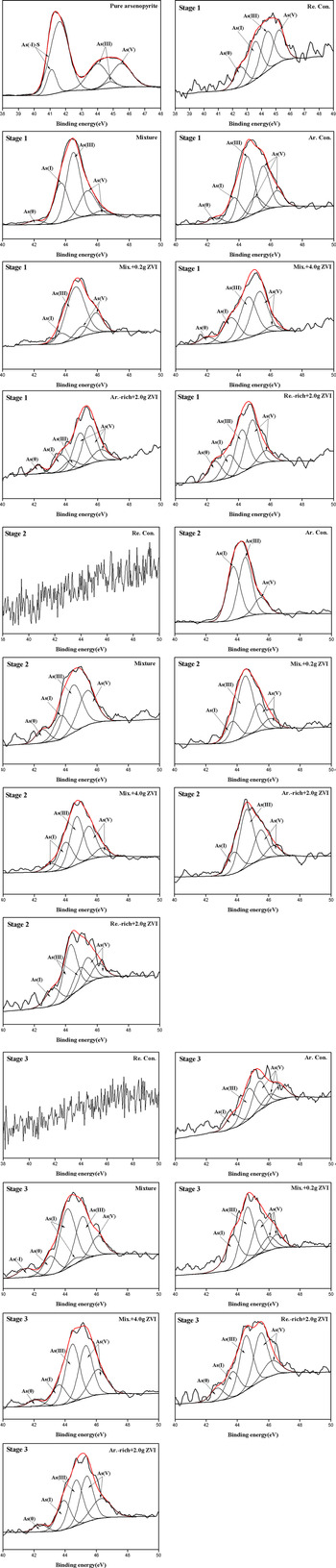
As(III) and As(V) were shown in Fig. 6 to be the dominant valences of As in the collected solids, and Fig. 7 gives the corresponding XPS spectra of the solids collected for all groups in all stages. The Re control group always had less As(III) and As(V) than the Ar control group. It was found previously from the oxidative dissolution of arsenopyrite in the presence of Leptospirillum ferrooxidans, a common acid mine drainage bacterium, that arsenic is oxidised more rapidly than S and Fe (Corkhill and Vaughan, Reference Corkhill and Vaughan2009). The addition of ZVI clearly reduced the amount of As(III) and As(V) in the precipitates (Fig. 6). The preceding analyses also showed that ZVI reduced the arsenic release into the solution, and it can thus be inferred that ZVI slowed down the oxidation of the tailings, which is an additional line of evidence to support the effect of ZVI in controlling the arsenic pollution of mine waste. With the progression of the oxidation stages, the peak area of various arsenic valence states from each group decreased gradually, especially for the groups with ZVI addition. It could be seen after normalising the surface area that for the precipitates of the Ar control, the total arsenic after three stages was 54.5% As(V), 31.4% As(III) and 14.1% As(I). The addition of ZVI increased the quantity of As(III) in the precipitates from 33.5% to 35.1% and As(I) from 14.1% (for the 0.2 g ZVI group) to 20.3% (for the 4.0 g ZVI group). Thus, the oxidation state is related directly to the bioaccessibility of arsenic (Van Den Berghe et al., Reference Van Den Berghe, Jamieson and Palmer2018).
Valences of arsenic in the solid phase.

XPS spectra in As 3d regions of solid products after biological dissolution for all groups in all stages.

Compared with the Ar control group, the solids of the mixture group obviously had less As(V) (only 12.3%), similar As(III) and higher As(I) (46.8%). In fact, the percentage of As(I) was far greater than the solids of all other groups (14.1–24.9%), even including the Re control group. The greater abundance of intermediate valance states, i.e. As(I) and As(III), and the decrease in As(V) could be attributed to slower oxidation. It could thus be inferred that the mixture group reduced arsenic release not only by re-adsorption and mineralisation but also by passivation.
Main mechanisms
In the Re control group, the Fe2+ was oxidised to Fe3+ by dissolved O2 or A. ferrooxidans (equation 4). The Fe3+ can accelerate realgar-containing tailings decomposition. Dissolution of calcium-containing minerals in the Re control group increases the pH of the solution (equation 5).
 $$4{\rm F}{\rm e}^{2 + } + {\rm O}_2 + 4{\rm H}^ + \mathop{-\!\!\!-\!\!\!-\!\!\!-\!\!\!-\!\!\!-\!\!\!-\!\!\!\to}\limits^{\!\! A. \;ferrooxidans} 4{\rm F}{\rm e}^{3 + } + 2{\rm H}_2{\rm O}$$
 $${\rm CaMg}\lpar {{\rm C}{\rm O}_3} \rpar _2 + 4{\rm H}^ + \to {\rm C}{\rm a}^{2 + } + {\rm M}{\rm g}^{2 + } + {\rm C}{\rm O}_2\uparrow + 2{\rm H}_2{\rm O}$$
Both O2 and Fe3+ are the main oxidants of arsenopyrite, and acid is produced after the oxidation (equations 6 and 7). Because Fe3+ has a greater impact than O2 on the oxidation rate of arsenopyrite (He et al., Reference He, Cao and Duan2019), lower Fe3+ concentration in the solution may help to slow the dissolution of As. In Stage 1, the Fe3+ concentration measured in the solution was as low as 1.34–14.87 mg/g for the mixture group, but 165.99–237.41 mg/g for the Ar control and 166.07–48.43 mg/g for the Re control groups (Fig. S4).
 $$4{\rm FeAsS\ } + 13{\rm O}_2 + 6{\rm H}_2{\rm O\ }\to 4{\rm FeS}{\rm O}_4 + 4{\rm H}_3{\rm As}{\rm O}_4$$
 $${\rm FeAsS\ } + 11{\rm F}{\rm e}^{3 + } + 7{\rm H}_2{\rm O\ }\to {\rm H}_3{\rm As}{\rm O}_3 + 12{\rm F}{\rm e}^{2 + } + {\rm S}{\rm O}_4^{2-} + 11{\rm H}^ + $$
The dissolution of slag ZVI also consumes the H+ in the solution produced by the oxidation of the tailings, and then generates hydrogen gas, produces Fe2+ and leads to an increase in the solution pH (equation 8). Dissolved A. ferrooxidans can oxidise Fe2+ to Fe3+ (equation 4), which could then result in Fe3+ precipitates (equation 9). The precipitation of Fe3+ commonly begins at pH = 3.2 (Liu et al., Reference Liu, Cheng, Zhao, Dong and Frost2013). The transformation of the iron species in the precipitates can be confirmed by the colour changes of the precipitates and by aqueous analysis (Fig. S3).
 $${\rm F}{\rm e}^0 + 2{\rm H}^ + \to {\rm F}{\rm e}^{2 + } + {\rm H}_2\uparrow $$
 $${\rm F}{\rm e}^{3 + } + 3{\rm O}{\rm H}^-\to {\rm Fe}\lpar {{\rm OH}} \rpar _3\downarrow $$
In Stage 2, the concentration of Fe3+ in the solution remained stable in the 4.0 g ZVI group at ~4.59–12.39 mg/g, which was the lowest in all other groups. Meanwhile, Fe2+ became the dominant species, with a concentration 10 times that of Fe3+ (Fig. S3). The addition of ZVI introduced a variety of secondary iron-containing minerals, such as goethite, schwertmannite and lepidocrocite, all of which could adsorb or co-precipitate with As(V) and As(III) (equations 10–12). The Fe2+ generated in equation 11 would have been an additional source of Fe2+ for A. ferrooxidans to generate Fe3+, which could in turn form additional Fe3+ precipitates.
 $${\rm F}{\rm e}^{3 + } + {\rm H}_3{\rm As}{\rm O}_4\to {\rm FeAs}{\rm O}_4\downarrow + \;3{\rm H}^ + $$
 $$3{\rm F}{\rm e}^{3 + } + {\rm K}^ + { + } 2{nS}{\rm O}_4^{2-} + \lpar {1-2{n}} \rpar {\rm As}{\rm O}_4^{3-} + 6{\rm H}_2{\rm O\ }\to {\rm KF}{\rm e}_3\lpar {{\rm S}{\rm O}_4} \rpar _{2{n}}\lpar {{\rm As}{\rm O}_4} \rpar _{\lpar 1-2{n}\rpar }\lpar {{\rm OH}} \rpar _6 + 6{\rm H}^ + $$
 $$3{\rm C}{\rm a}^{2 + } + 2{\rm As}{\rm O}_4^{3-} \to {\rm C}{\rm a}_3\lpar {{\rm As}{\rm O}_4} \rpar _2\downarrow $$
Rich Fe2+ could maintain a relatively reducing environment and assist the oxidation of As(III) (Liu et al., Reference Liu, Zhang, Tao, Hao and Zhang2019).
The increased As(III) peak area in Stage 2 of the ZVI experiments indicated that some of the As(V) produced by oxidation of As(III) was reduced to As(III). This probably occurred through reduction of the As(V) by the ZVI, which in turn oxidised, producing additional Fe2+. This process, shown in equation 13, would have led to further generation of Fe2+, which would, in turn, have oxidised to Fe3+ to generate more secondary As–Fe phases.
 $$2{\rm Fe\ } + {\rm H}_3{\rm As}{\rm O}_4 + 2{\rm H}^ + \to 2{\rm F}{\rm e}^{2 + } + {\rm H}_3{\rm As}{\rm O}_3 + {\rm H}_2{\rm O}$$
Carlson et al. (Reference Carlson, Bigham, Schwertmann, Kyek and Wagner2002) found that the schwertmannite they synthesized in the laboratory had an adsorption capacity of as much as 175 mg/g at pH = 3 for As(V). The maximum adsorption capacity of ferrihydrite, also an amorphous Fe-containing mineral, is 19.9 mg/g at pH = 5 for As(III) (Carlson et al., Reference Carlson, Bigham, Schwertmann, Kyek and Wagner2002) and 210 mg/g at pH = 3 for As(V) (Teixeira and Ciminelli, Reference Teixeira and Ciminelli2005). These minerals could thus provide additional As removal by sorption or co-precipitation, as can be seen from ATR–FTIR, XPS and XRD observations.
Crystalline iron arsenate (FeAsO4), which can improve the stability of arsenic in the solid phase, was also found in this study. The chemical extraction of arsenic in amorphous Fe precipitates is shown in Fig. 8. Overall, the amount of arsenic in the precipitates increased gradually in Stage 2 with the progression of oxidation stages for all groups. The amount of arsenic in amorphous Fe precipitates increased in Stage 2, and decreased in Stage 3 for the 0.2 g ZVI group but increased gradually for the 4.0 g ZVI group. In Stage 3, the amount of arsenic in the precipitates of the 4.0 g ZVI group exceeded that of the Ar-rich and Re-rich groups, thus accounting for the slight increase in arsenic release of the 4.0 g ZVI group in Stage 3.
Total arsenic quantity in amorphous iron precipitates.

Environmental implications
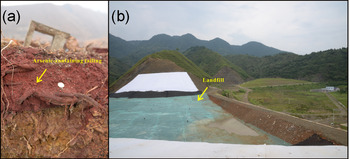
Arsenic pollution in the Shimen realgar mine of Hunan originated from the mining of realgar and orpiment. Unfortunately, among the three thousand villagers of the region, more than one thousand have shown an average hair arsenic content of 0.972–2.459 μg/g indicative of poisoning (Wang et al., Reference Wang, He, Yan and Wu1999). Tailings containing realgar occur widely in mine areas and calcining zones (Fig. 9a), and remediation of arsenic-containing realgar tailings is needed urgently. Arsenic-containing tailings amounting to ~2.7×10⁵ t (including soil and settlement tailings) will be disposed to landfill areas according to current estimation. The previous study by the present authors showed that realgar and related settlement tailings will produce acid, and ZVI addition can potentially remediate arsenic release from Fe-deficient arsenic-containing tailings (Fan et al., Reference Fan, Zhao, Liu and Frost2018a,Reference Fan, Zhao, Liu and Hudson-Edwardsb). The present study has shown that mixing two different kinds of arsenic-containing tailings does not aggravate but actually reduces both arsenic release and acid mine drainage. This finding will help in the centralised treatment of arsenic pollution in polymetallic mine areas due to the variety of tailings and limited land. At the time of writing, the comprehensive treatment of arsenic-containing tailings is underway in the Shimen mine (Fig. 9b). The current finding may inspire the processing of tailings in similar mine areas.
Arsenic-containing tailings from the Shimen realgar mine (a) and construction of the proposed landfill (b). The coin in (a) is 2 cm in diameter.

Conclusions
The possibility of mixing two typical arsenic-containing tailings to reduce arsenic release and control acid generation was discussed here, and the subject of whether exogenous ZVI can restrain arsenic release also, was investigated. The major findings are summarised as follows:
(1) The dissolution of arsenopyrite by Acidithiobacillus ferrooxidans results in decreased solution pH. Mixing the two tested tailings initially increased pH and reduced arsenic release due to pH control and decreasing Fe3+. These trends were obvious for the tailings mixture in Stages 1 and 2.
(2) A small amount of ZVI (0.2 g) limited arsenic release from the tailings mixture effectively, and a much larger amount of ZVI (4.0 g) further reduced arsenic release to 0.003 mg/g, a level lower than that of the control groups. An intermediate amount of ZVI (2.0 g) can be applied along with additional realgar tailings in the tailings mixture to jointly restrict arsenic release.
(3) ATR–FTIR spectra confirmed that mixed tailings reduced arsenic dissolution by A. ferrooxidans and accounted for the decrease in arsenic release. When ZVI was added, the attenuation of arsenic release could additionally benefit from the adsorption and uptake of As(V) and As(III) by secondary Fe–As(III) and Fe–As(V) precipitates and by Fe–As(V) crystalline phases. Smaller amounts of arsenic were found in the amorphous Fe precipitate in the 4.0 g ZVI group (0.006 mg/g in Stage 1, 21.90 mg/g in Stage 2 and 30.75 mg/g in Stage 3) compared with those of the 0.2 g ZVI group (23.28 mg/g in Stage 1, 71.39 mg/g in Stage 2 and 32.38 mg/g in Stage 3). Release of arsenic by the 4.0 g ZVI group increased obviously in Stage 3 only.
(4) A low-cost and integrated strategy for treating arsenic-containing tailings would be to mix two typical tailings and add exogenous slag ZVI.
Acknowledgements
The present study was supported by the National Natural Science Foundation of China (No. 41772367).
Supplementary material
To view supplementary material for this article, please visit https://doi.org/10.1180/mgm.2020.26